


 Скачать презентацию The 4 th International Seville Conference on Future-Oriented
97bba9468ece0731f4868e4791610380.ppt
- Количество слайдов: 21
 The 4 th International Seville Conference on Future-Oriented Technology Analysis (FTA) 12 & 13 May 2011 A Technology Opportunities Analysis Model: Applied to Dye-Sensitized Solar Cells for China Tingting Ma 1, 2, Alan Porter 1, Jud Ready 1, Chen Xu 1, Lidan Gao 3, Wenping Wang 1, 2, Ying Guo 1, 2 1 Georgia Institute of Technology 2 Beijing Institute of Technology 3 Chinese Academy of Sciences
 A Technology Opportunities Analysis Model: Applied to Dye-Sensitized Solar Cells for China Index • Summary • Introduction • Data and methodology • Case study: Dye-sensitized solar cells (DSSCs) • Conclusion • Acknowledge • References
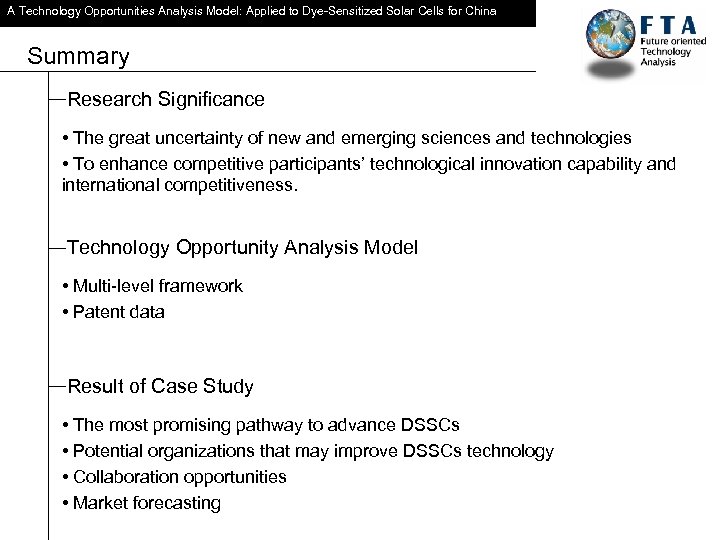 A Technology Opportunities Analysis Model: Applied to Dye-Sensitized Solar Cells for China Summary Research Significance • The great uncertainty of new and emerging sciences and technologies • To enhance competitive participants’ technological innovation capability and international competitiveness. Technology Opportunity Analysis Model • Multi-level framework • Patent data Result of Case Study • The most promising pathway to advance DSSCs • Potential organizations that may improve DSSCs technology • Collaboration opportunities • Market forecasting
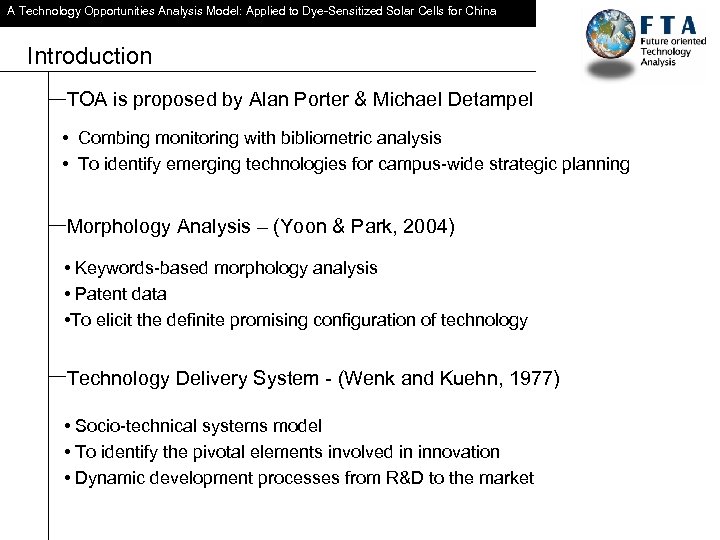 A Technology Opportunities Analysis Model: Applied to Dye-Sensitized Solar Cells for China Introduction TOA is proposed by Alan Porter & Michael Detampel • Combing monitoring with bibliometric analysis • To identify emerging technologies for campus-wide strategic planning Morphology Analysis – (Yoon & Park, 2004) • Keywords-based morphology analysis • Patent data • To elicit the definite promising configuration of technology Technology Delivery System - (Wenk and Kuehn, 1977) • Socio-technical systems model • To identify the pivotal elements involved in innovation • Dynamic development processes from R&D to the market
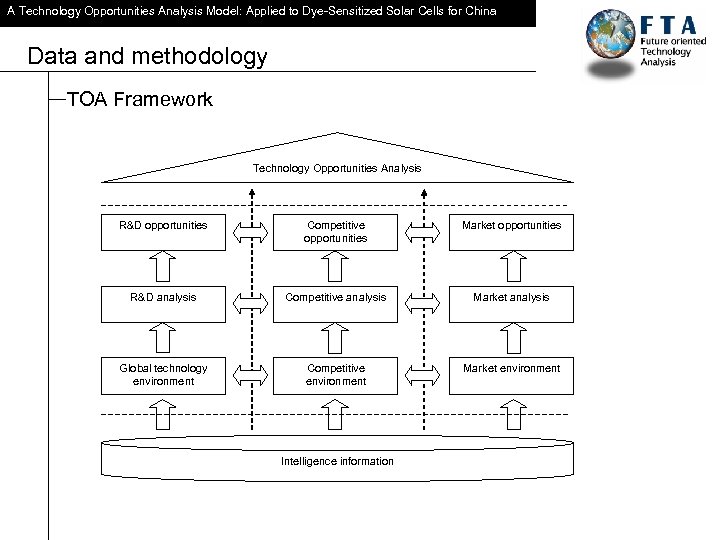 A Technology Opportunities Analysis Model: Applied to Dye-Sensitized Solar Cells for China Data and methodology TOA Framework Technology Opportunities Analysis R&D opportunities Competitive opportunities Market opportunities R&D analysis Competitive analysis Market analysis Global technology environment Competitive environment Market environment Intelligence information
 A Technology Opportunities Analysis Model: Applied to Dye-Sensitized Solar Cells for China Data Derwent World Patents Index (DWPI) A multi-stage Boolean search strategy • Create main search terms - a variety of DSSC technical terminology • Enrich those search terms - different expressions of DSSCs -closely related technical structures. • Check search terms -excluding their retrieval overlap with the main search. • Combine the terms and evaluate them -randomly testing and assessing retrieval results • Further revise our search terms Data cleaning – Vantagepoint software 3079 records from 1991 -2010 on DSSCs
 A Technology Opportunities Analysis Model: Applied to Dye-Sensitized Solar Cells for China Methodology R&D analysis • Define technical structure of morphology • Extract keywords and classify them • Technology component analysis Competitive analysis • Assignee-technology analysis • Co-assignee analysis Market analysis • Home countries/family countries matrix • International assignee profiling
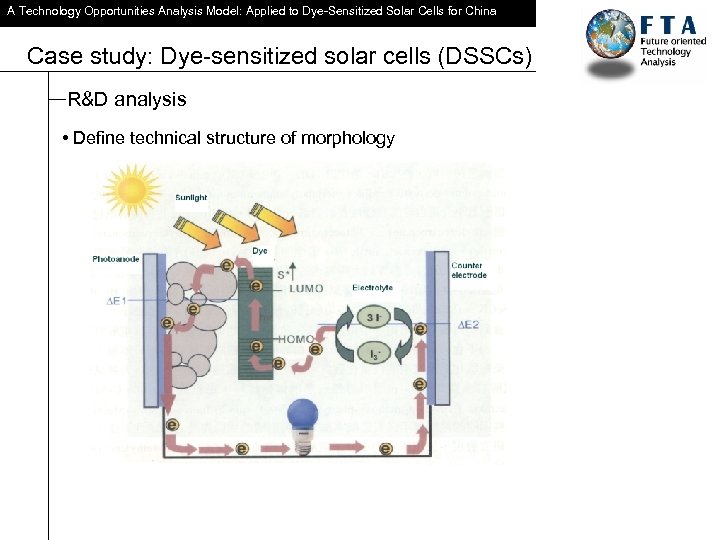 A Technology Opportunities Analysis Model: Applied to Dye-Sensitized Solar Cells for China Case study: Dye-sensitized solar cells (DSSCs) R&D analysis • Define technical structure of morphology
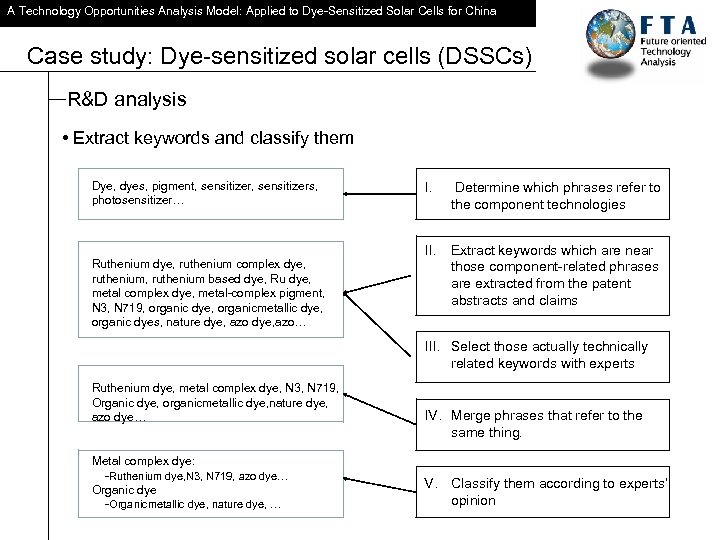 A Technology Opportunities Analysis Model: Applied to Dye-Sensitized Solar Cells for China Case study: Dye-sensitized solar cells (DSSCs) R&D analysis • Extract keywords and classify them Dye, dyes, pigment, sensitizers, photosensitizer… Ruthenium dye, ruthenium complex dye, ruthenium, ruthenium based dye, Ru dye, metal complex dye, metal-complex pigment, N 3, N 719, organic dye, organicmetallic dye, organic dyes, nature dye, azo… I. Determine which phrases refer to the component technologies II. Extract keywords which are near those component-related phrases are extracted from the patent abstracts and claims III. Select those actually technically related keywords with experts Ruthenium dye, metal complex dye, N 3, N 719, Organic dye, organicmetallic dye, nature dye, azo dye… Metal complex dye: -Ruthenium dye, N 3, N 719, azo dye… Organic dye -Organicmetallic dye, nature dye, … IV. Merge phrases that refer to the same thing. V. Classify them according to experts’ opinion
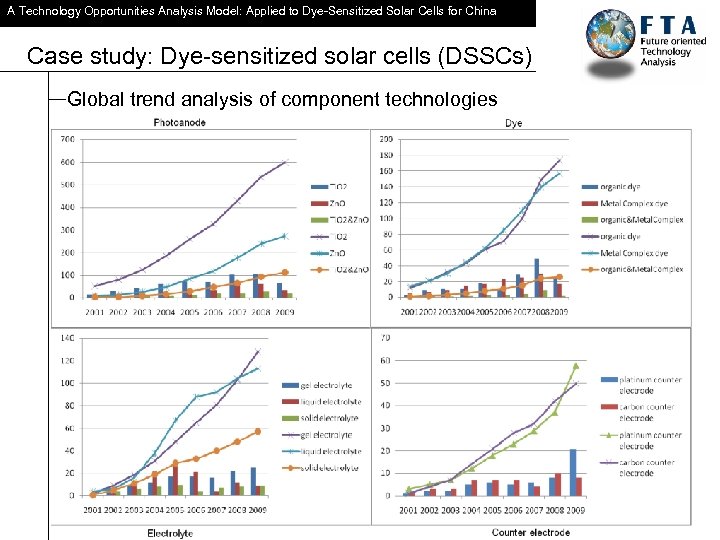 A Technology Opportunities Analysis Model: Applied to Dye-Sensitized Solar Cells for China Case study: Dye-sensitized solar cells (DSSCs) Global trend analysis of component technologies
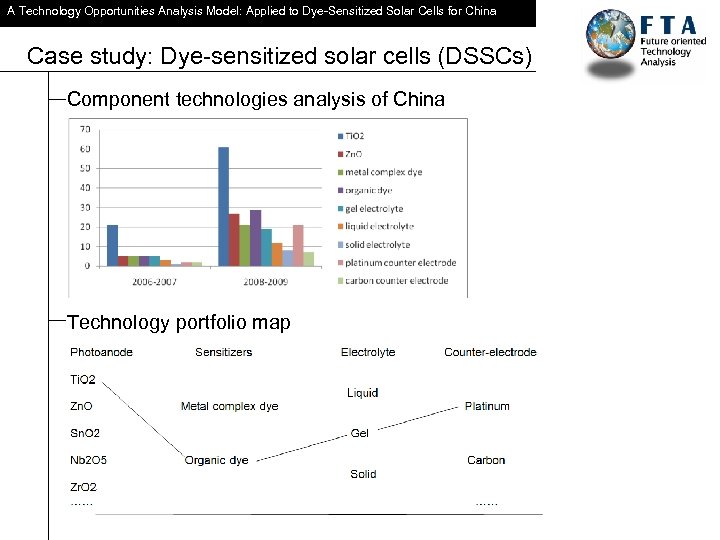 A Technology Opportunities Analysis Model: Applied to Dye-Sensitized Solar Cells for China Case study: Dye-sensitized solar cells (DSSCs) Component technologies analysis of China Technology portfolio map
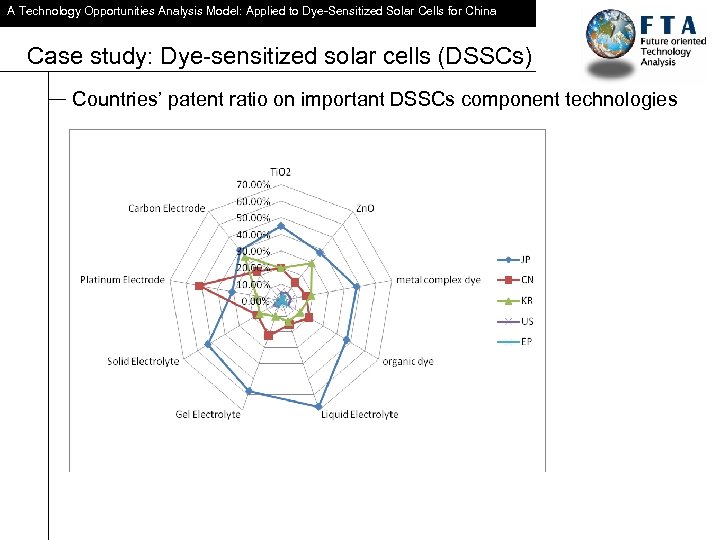 A Technology Opportunities Analysis Model: Applied to Dye-Sensitized Solar Cells for China Case study: Dye-sensitized solar cells (DSSCs) Countries’ patent ratio on important DSSCs component technologies
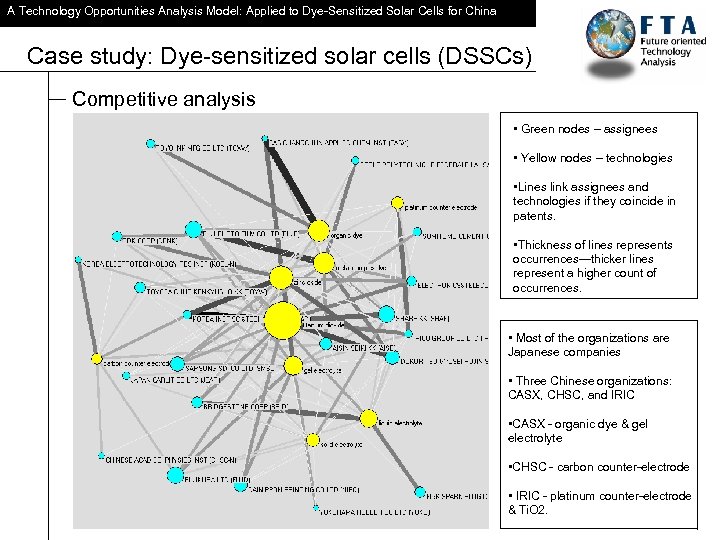 A Technology Opportunities Analysis Model: Applied to Dye-Sensitized Solar Cells for China Case study: Dye-sensitized solar cells (DSSCs) Competitive analysis • Green nodes – assignees • Yellow nodes – technologies • Lines link assignees and technologies if they coincide in patents. • Thickness of lines represents occurrences—thicker lines represent a higher count of occurrences. • Most of the organizations are Japanese companies • Three Chinese organizations: CASX, CHSC, and IRIC • CASX - organic dye & gel electrolyte • CHSC - carbon counter-electrode • IRIC - platinum counter-electrode & Ti. O 2.
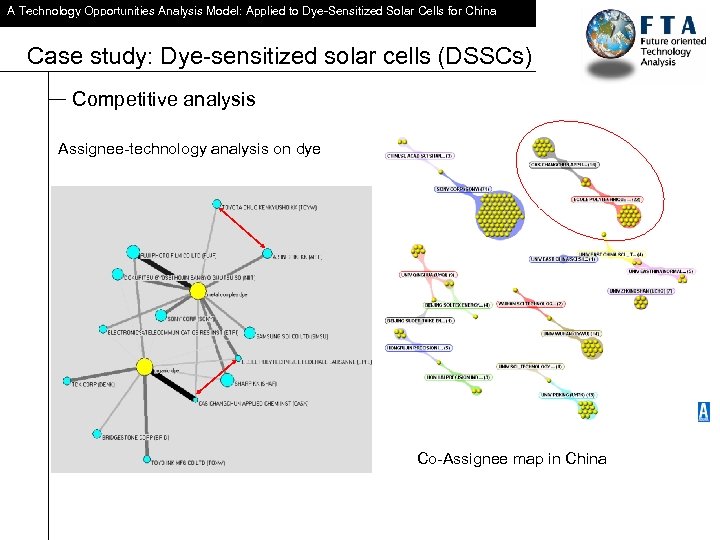 A Technology Opportunities Analysis Model: Applied to Dye-Sensitized Solar Cells for China Co-Assignee map in China Case study: Dye-sensitized solar cells (DSSCs) Competitive analysis Assignee-technology analysis on dye Co-Assignee map in China
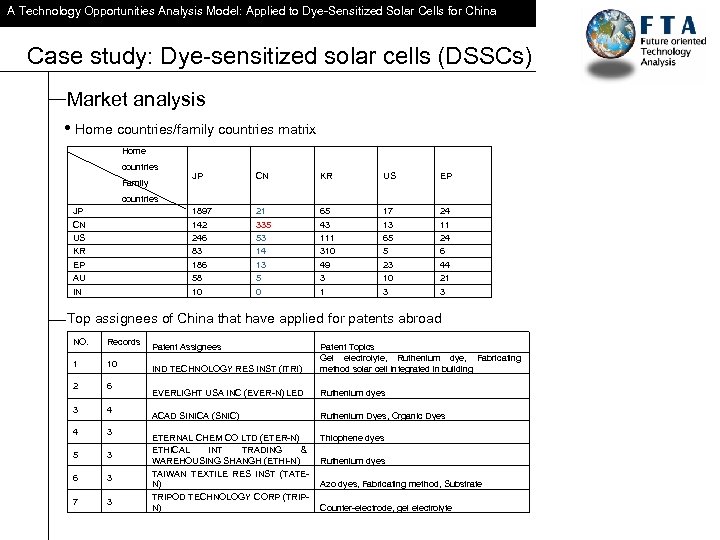 A Technology Opportunities Analysis Model: Applied to Dye-Sensitized Solar Cells for China Case study: Dye-sensitized solar cells (DSSCs) Market analysis • Home countries/family countries matrix Home countries JP CN KR US EP 1897 142 246 83 186 58 10 Family 21 335 53 14 13 5 0 65 43 111 310 49 3 1 17 13 65 5 23 10 3 24 11 24 6 44 21 3 countries JP CN US KR EP AU IN Top assignees of China that have applied for patents abroad NO. Records 1 10 2 6 3 4 4 3 5 3 6 3 7 3 Patent Assignees IND TECHNOLOGY RES INST (ITRI) Patent Topics Gel electrolyte, Ruthenium dye, Fabricating method solar cell integrated in building EVERLIGHT USA INC (EVER-N) LED Ruthenium dyes ACAD SINICA (SNIC) Ruthenium Dyes, Organic Dyes ETERNAL CHEM CO LTD (ETER-N) ETHICAL INT TRADING & WAREHOUSING SHANGH (ETHI-N) TAIWAN TEXTILE RES INST (TATEN) TRIPOD TECHNOLOGY CORP (TRIPN) Thiophene dyes Ruthenium dyes Azo dyes, Fabricating method, Substrate Counter-electrode, gel electrolyte
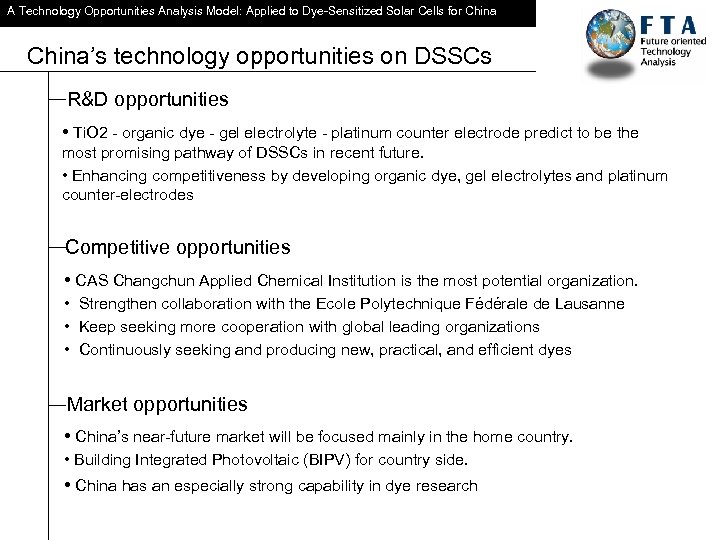 A Technology Opportunities Analysis Model: Applied to Dye-Sensitized Solar Cells for China’s technology opportunities on DSSCs R&D opportunities • Ti. O 2 - organic dye - gel electrolyte - platinum counter electrode predict to be the most promising pathway of DSSCs in recent future. • Enhancing competitiveness by developing organic dye, gel electrolytes and platinum counter-electrodes Competitive opportunities • CAS Changchun Applied Chemical Institution is the most potential organization. • Strengthen collaboration with the Ecole Polytechnique Fédérale de Lausanne • Keep seeking more cooperation with global leading organizations • Continuously seeking and producing new, practical, and efficient dyes Market opportunities • China’s near-future market will be focused mainly in the home country. • Building Integrated Photovoltaic (BIPV) for country side. • China has an especially strong capability in dye research
 A Technology Opportunities Analysis Model: Applied to Dye-Sensitized Solar Cells for China’s challenges on DSSCs • Japan and South Korea is the most potential competitive in future market and is on the way of commercialization • China still has a long way to go for significant commercialization of DSSCs globally • It is important to encourage more companies to become involved in DSSCs. • China might also consider ways to promote collaboration between companies and academic institutions.
 A Technology Opportunities Analysis Model: Applied to Dye-Sensitized Solar Cells for China Tips • This research implements a special in-depth analysis on DSSCs’ component technologies rather than more “macro” analyses. • The keywords selection and classification is challenging but benefits from inputs by knowledgeable colleagues. • It is important to carefully identify technology morphology with experts according to the purpose of that analysis.
 A Technology Opportunities Analysis Model: Applied to Dye-Sensitized Solar Cells for China Acknowledgements • This research was undertaken at Georgia Tech drawing on support from the National Science Foundation (NSF) through the Center for Nanotechnology in Society (Arizona State University; Award Numbers 0531194 and 0937591) and the Science of Science Policy Program—“Measuring and Tracking Research Knowledge Integration” (Georgia Tech; Award No. 0830207). • The findings and observations contained in this paper are those of the authors and do not necessarily reflect the views of the National Science Foundation.
 A Technology Opportunities Analysis Model: Applied to Dye-Sensitized Solar Cells for China References • Porter, A. L. , and Detampela, M. J. (July 1995). Technology opportunities analysis, Technological Forecasting and Social Change. 49(3): 237 -255 • Porter, A. L. , and Cunningham, S. W. (2005). Tech Mining: Exploiting new technologies for competitive advantage. New York: Wiley. • www. sciencedirect. com. www. library. gatech. edu/science? _ob=Redirect. URL&_method=outward. Link&_partner Name=27983&_origin=article&_zone=art_page&_link. Type=scopus. Author. Documents&_target. URL=http%3 A%2 F%2 Fwww. scopus. com%2 Fscopus%2 Finward%2 Fauthor. url%3 Fpartner. ID%3 D 10%26 rel%3 D 3. 0. 0%26 sort. Fiel d%3 Dcited%26 sort. Order%3 Dasc%26 author%3 DTrappey, %2520 Charles%2520 V. %26 author. ID%3 D 353230335 00%26 md 5%3 D 0 e 0 f 06 a 304 f 021829 e 3 b 5 f 7 e 313 a 2 a 92&_acct=C 000034078&_version=1&_userid=655052&md 5=7 ca 6 dc 86007019126 e 8 bced 8 aa 22 e 63 c, C. V. , Wua, H. -Y. , Taghaboni-Duttab, F. , and Trappey, A. J. C. (January 2011). Using patent data for technology forecasting: China RFID patent analysis. dvanced A Engineering Informatics, 25(1): 53– 64. • Roper, A. T. , Cunningham, S. W. , Porter, A. L. , Mason, T. W. , Rossini, F. A. , and Banks, J. Forecasting and management of technology. New York: John Wiley. • Porter, A. L. , Youtie, J. , Shapira, P. , Schoeneck, D. J. (2008). Refining search terms for nanotechnology. Journal of nanoparticle research, 10(5): 715– 728 • Wenk, E. Jr. and Kuehn, T. J. (1977). Interinstitutional networks in Technological Delivery Systems, in: J. Haberer (Ed. ), Science and Technology Policy (pp. 153– 175), Lexington, MA: Lexington Books. • Oregan, B. and Gratzel, M. (October 1991). A low-cost, high-efficiency solar-cell based on dye-sensitized colloidal Ti. O 2 films. Nature, 353(6346): 737– 740. • www. sciencedirect. com. www. library. gatech. edu/science? _ob=Redirect. URL&_method=outward. Link&_partner Name=27983&_origin=article&_zone=art_page&_link. Type=scopus. Author. Documents&_target. URL=http%3 A%2 F%2 Fwww. scopus. com%2 Fscopus%2 Finward%2 Fauthor. url%3 Fpartner. ID%3 D 10%26 rel%3 D 3. 0. 0%26 sort. Fiel d%3 Dcited%26 sort. Order%3 Dasc%26 author%3 DYoon, %2520 Byungun%26 author. ID%3 D 6603748026%26 md 5 %3 D 1 cc 5 b 08 b 8 b 9813344 b 3 a 1 c 2 e 91 fd 6 f 53&_acct=C 000034078&_version=1&_userid=655052&md 5=f 3769 e 6 d 05535 f 5 a 01 bc 1 d 1665638 a 7 c, B. and Park, Y. (February 2005). A systematic approach for identifying technology opportunities: keyword-based morphology analysis. Technological Forecasting and Social Change, 72(2): 145– 160 • Martínez, C. (6 June 2010). Patent families: When do different definitions really matter? Scientometrics, 86(1): 39– 63. • Yuhang, K. and Jingqin, S. (August 2008). Visualization identify of technology innovation opportunities: empirical analysis based on patent bibliometric. Studies in Science of Science, 26(4): 695 -699 • Solar & Energy (March 2011). DSSC Technology Trend and Market Forecast (2008~2015). Available at http: //www. solarnenergy. com/research_file/656983. pdf (Accessed on 4 April, 2011).
 A Technology Opportunities Analysis Model: Applied to Dye-Sensitized Solar Cells for China THANK YOU Welcome any guidance