


 Скачать презентацию The 3 Economic Questions The Circular Flow
4b0d83fcbb8e5abdfbc4e9a924f51200.ppt
- Количество слайдов: 27
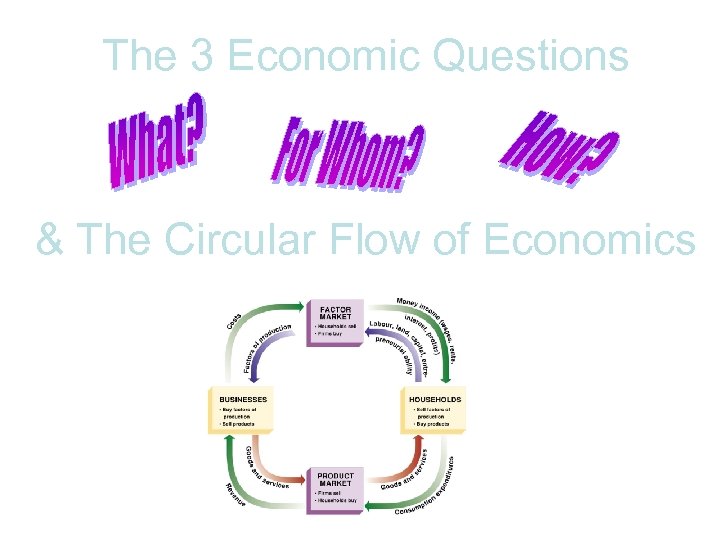 The 3 Economic Questions & The Circular Flow of Economics
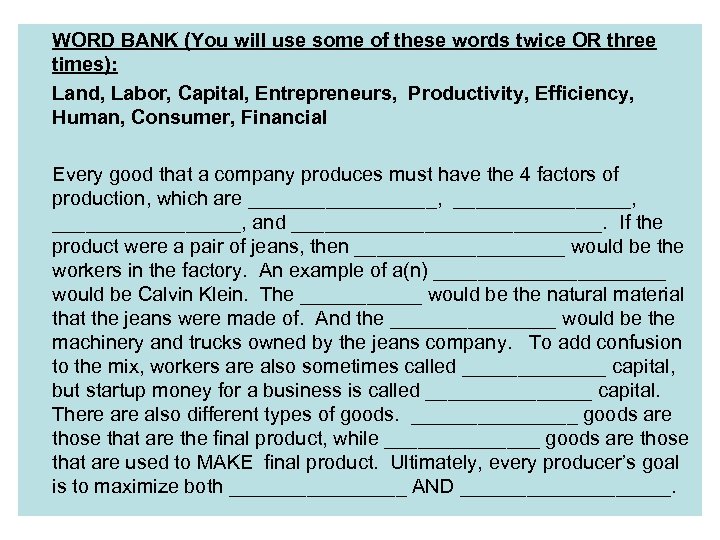 WORD BANK (You will use some of these words twice OR three times): Land, Labor, Capital, Entrepreneurs, Productivity, Efficiency, Human, Consumer, Financial Every good that a company produces must have the 4 factors of production, which are _________, _________________, and ______________. If the product were a pair of jeans, then __________ would be the workers in the factory. An example of a(n) ___________ would be Calvin Klein. The ______ would be the natural material that the jeans were made of. And the ________ would be the machinery and trucks owned by the jeans company. To add confusion to the mix, workers are also sometimes called _______ capital, but startup money for a business is called ________ capital. There also different types of goods. ________ goods are those that are the final product, while _______ goods are those that are used to MAKE final product. Ultimately, every producer’s goal is to maximize both ________ AND __________.
 1. Name the two plans that proposed the set up of the legislative branch. 2. What was the plan that combined the two? 3. A state decides to use the 10 Commandments as its nation’s laws, and appoints a Rabbi to lead its new government. What form of government is this? 4. Which role of the president means he meets with the important people of other countries? a. commander-in-chief b. party leader c. chief diplomat d. legislative leader
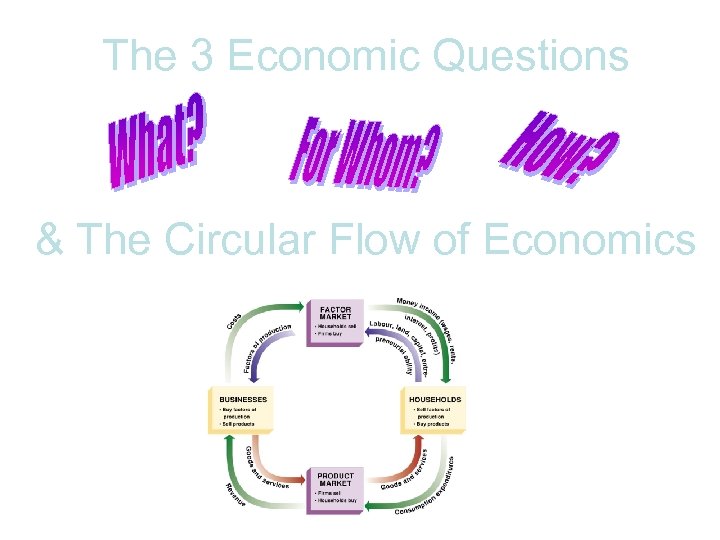 The 3 Economic Questions & The Circular Flow of Economics
 EXIT TICKET- FOR A GRADE! 1. What are the 3 economic questions? 2. Draw the circular flow of economic activity with all parts labeled.
![Circle one and finish the sentence… [Businesses who produce goods/ People who buy goods]](https://present5.com/presentation/4b0d83fcbb8e5abdfbc4e9a924f51200/image-6.jpg "Circle one and finish the sentence… [Businesses who produce goods/ People who buy goods]") Circle one and finish the sentence… [Businesses who produce goods/ People who buy goods] are more important to the economy because…
Circle one and finish the sentence… [Businesses who produce goods/ People who buy goods] are more important to the economy because…
 • Before anything is created producers must answer the 3 economic questions. – What to produce? – How to produce? – For whom to produce?
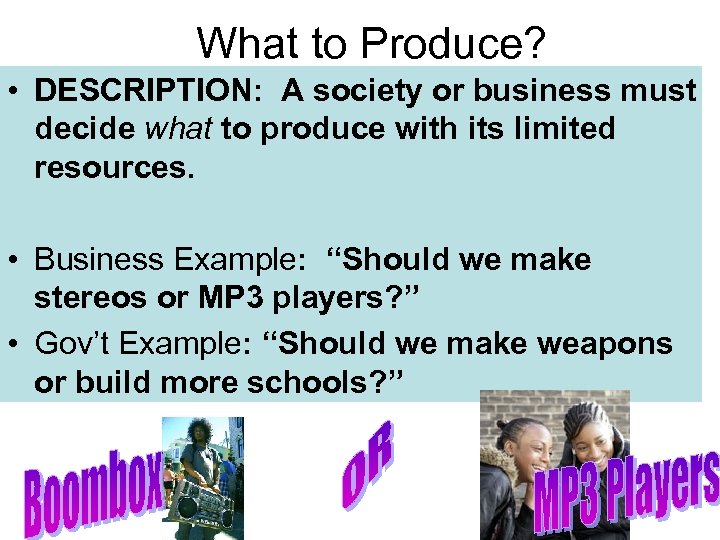 What to Produce? • DESCRIPTION: A society or business must decide what to produce with its limited resources. • Business Example: “Should we make stereos or MP 3 players? ” • Gov’t Example: “Should we make weapons or build more schools? ”
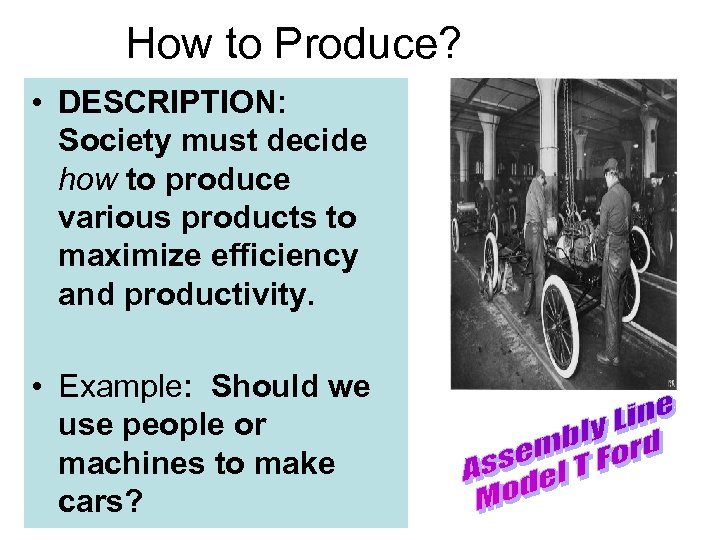 How to Produce? • DESCRIPTION: Society must decide how to produce various products to maximize efficiency and productivity. • Example: Should we use people or machines to make cars?
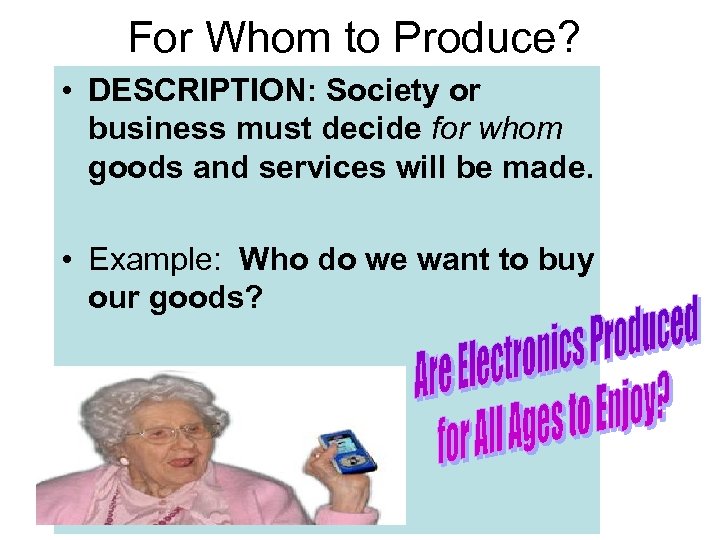 For Whom to Produce? • DESCRIPTION: Society or business must decide for whom goods and services will be made. • Example: Who do we want to buy our goods?
 Circular flow model • It shows how our economy works • It shows how goods and services, money, and the factors of production are exchanged between households and firms in the economy.
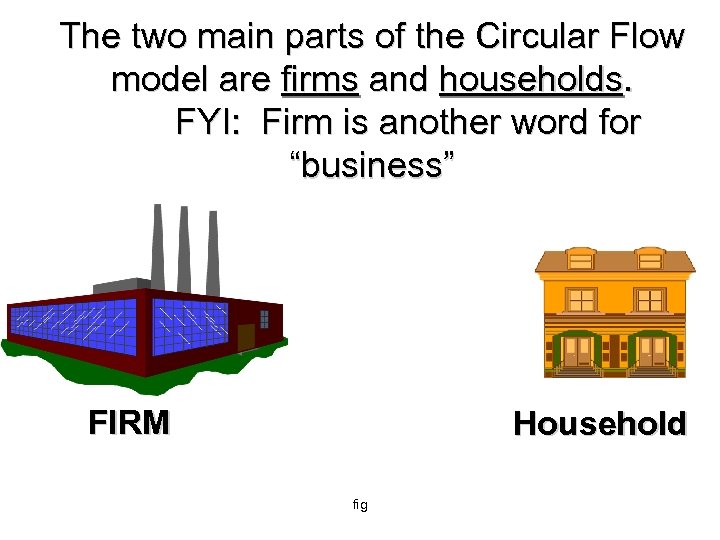 The two main parts of the Circular Flow model are firms and households. FYI: Firm is another word for “business” FIRM Household fig
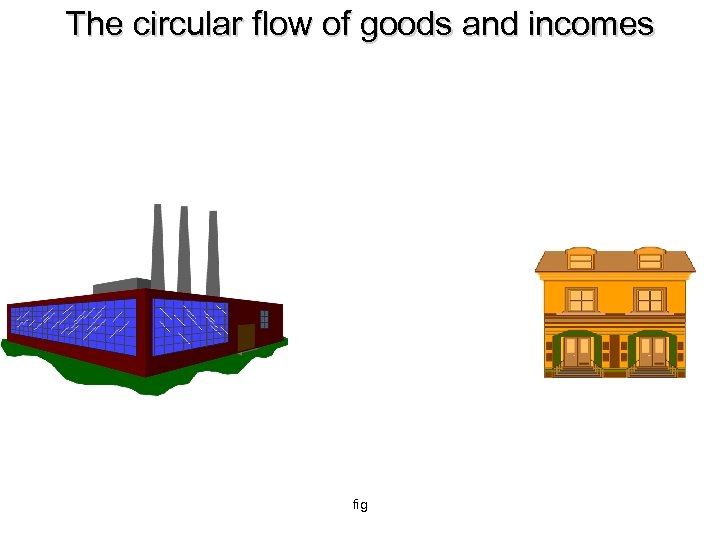 The circular flow of goods and incomes fig
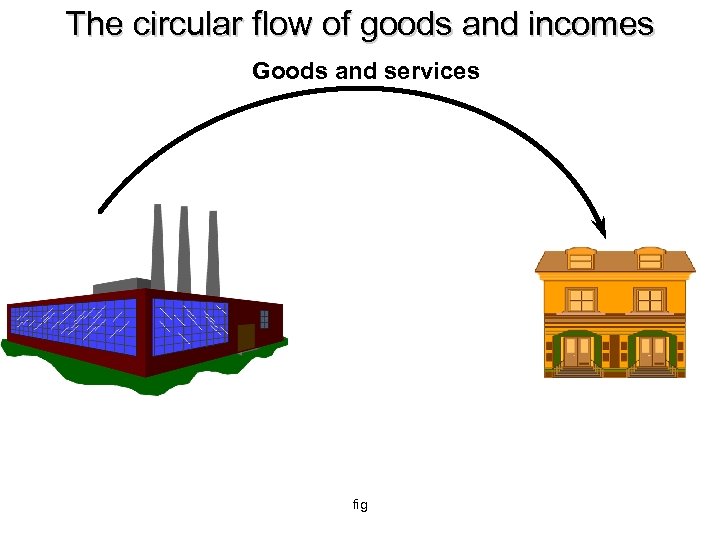 The circular flow of goods and incomes Goods and services fig
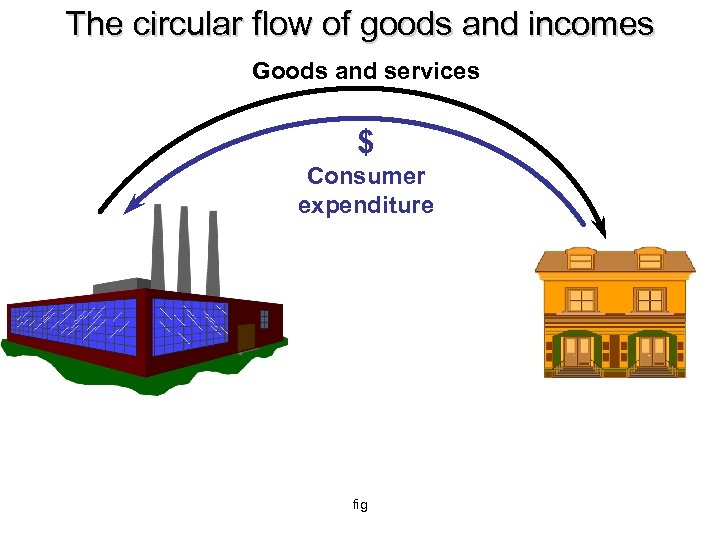 The circular flow of goods and incomes Goods and services $ Consumer expenditure fig
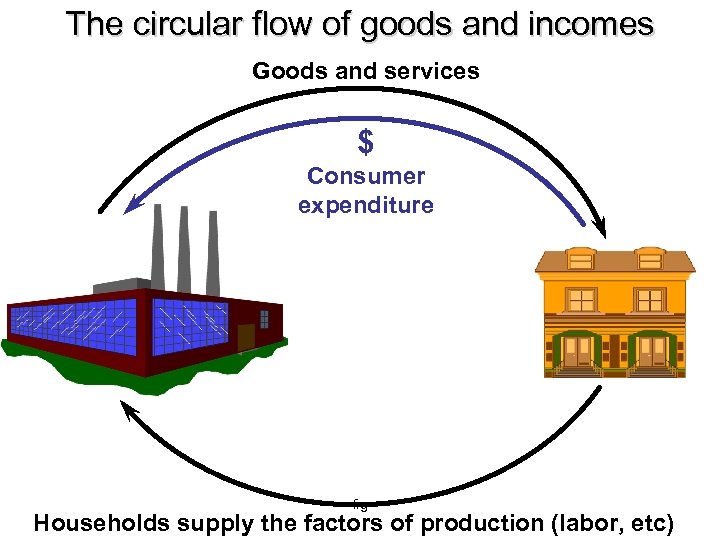 The circular flow of goods and incomes Goods and services $ Consumer expenditure fig Households supply the factors of production (labor, etc)
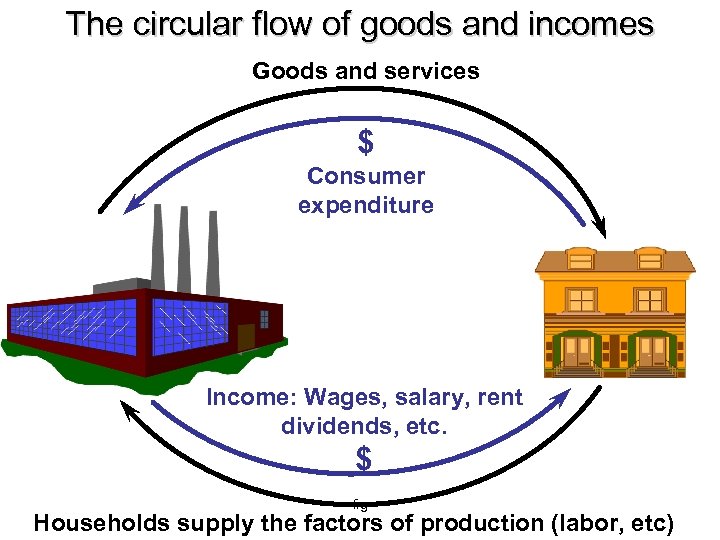 The circular flow of goods and incomes Goods and services $ Consumer expenditure Income: Wages, salary, rent dividends, etc. $ fig Households supply the factors of production (labor, etc)
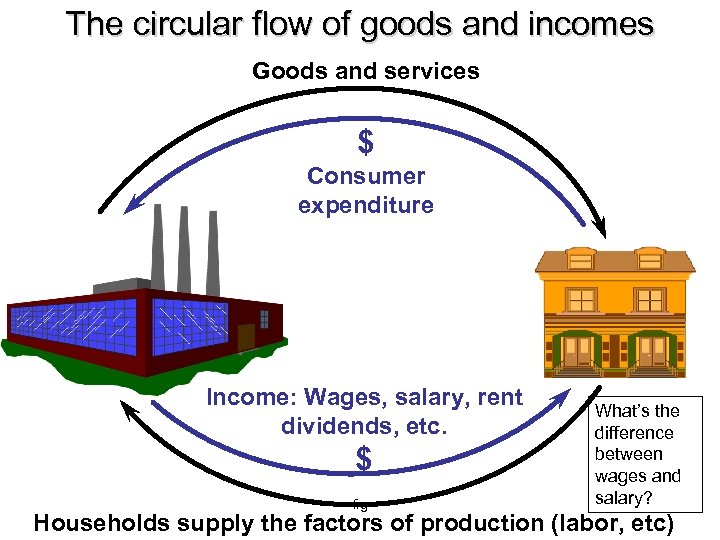 The circular flow of goods and incomes Goods and services $ Consumer expenditure Income: Wages, salary, rent dividends, etc. $ fig What’s the difference between wages and salary? Households supply the factors of production (labor, etc)
 FIRMS: • Firms purchase the factors of production (______, _________, &_______) on the factor market. – Then firms use the factors of production to create goods & services – Then firms sell goods & services to households to earn profits.
 HOUSEHOLDS • Households purchase goods & services on the product market. – They are able to do this because they earned money by selling their labor (a factor of production) to firms.
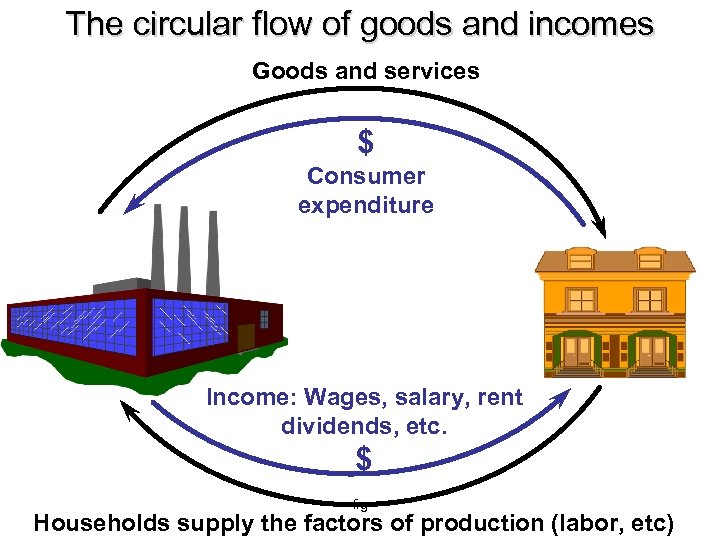 The circular flow of goods and incomes Goods and services $ Consumer expenditure Income: Wages, salary, rent dividends, etc. $ fig Households supply the factors of production (labor, etc)
 The Tale of the Circular Flow of Economics • Once upon a time Mr. Egan realized that many of his students were not motivated during class. So he decided to start a business called ___________. This firm produced ________. Before the firm could start producing he had answer the 3 economic questions: _____, ______, and ____ to produce. He also had to purchase all _________________.
 • Mr. Egan bought (capital) story Circular flow __________________. He hired (labor) __________________. His workers lived in __________. His workers were productive, allowing him to make a lot of ____. He paid them _____ an hour.
 • Then his workers would take their weekly paychecks and ___________________. When his workers spent their money and consumed more goods/services it created more _____ for other businesses. Those other businesses were able to expand create more ______. • And this is the story of how money, goods & services are exchanged in the economy!
 Do you get it? 1. Who provides firms with the factors of production? 2. Who purchases good & services? 3. Who creates goods & services? 4. What do households get in return for providing labor to firms? 5. What must a firm have in order to produce any good or service? BONUS: 1. Where do firms get the money to purchase the factors of production? 2. Where do households get the money to buy goods & services?
 The Big Question • Take a look at the Circular Flow Model: Pick one (or more!) part(s) of the model, and explain what would happen to the circular flow if that part were eliminated. JUST SAYING IT WOULD FAIL IS NOT ENOUGH. EXPLAIN WHY.
 EXIT TICKET- FOR A GRADE! 1. What are the 3 economic questions? 2. Draw the circular flow of economic activity with ALL parts labeled.