


 Скачать презентацию The 1950 s Essential Questions What
8376539fef8864009e572c3c1b73e9bb.ppt
- Количество слайдов: 76
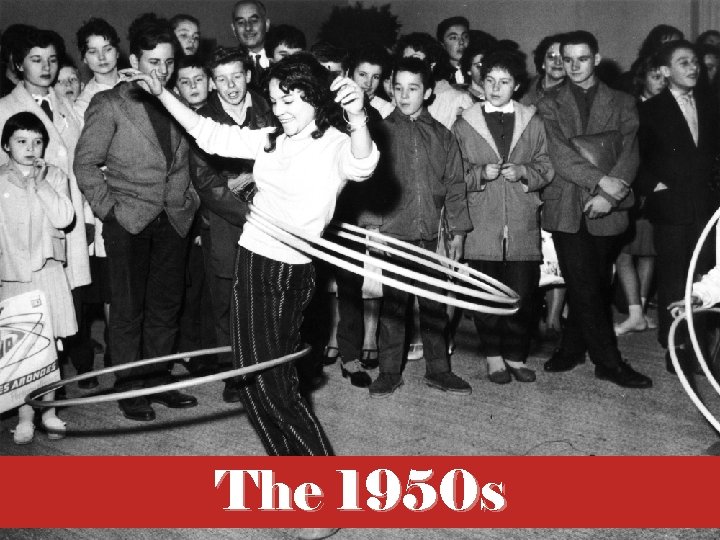 The 1950 s
 Essential Questions • What aspects of post–World War II America shaped the issues that arose in the 1950 s? • How did the Cold War affect American foreign policy during the decade? • How did changing aspects of culture affect the upbringing of children and adolescents? • Why did rock ‘n’ roll engender wildly different reactions from various segments of society? • How did the modern civil rights movement evolve in the mid- and late 1950 s? • What impact did television have on society, economics, and politics during the 1950 s? • How did events and issues in the 1950 s help lead to the cultural and social revolutions of the 1960 s?
 Returning Veterans “Readjust” • GI Bill of Rights (Servicemen’s Readjustment Act of 1944) • Provided vets with education, training, and low-cost loans for businesses and homes • Millions took advantage of benefits • College enrollment skyrocketed • GI Bill helped create “baby boom” of 1950 s and 1960 s
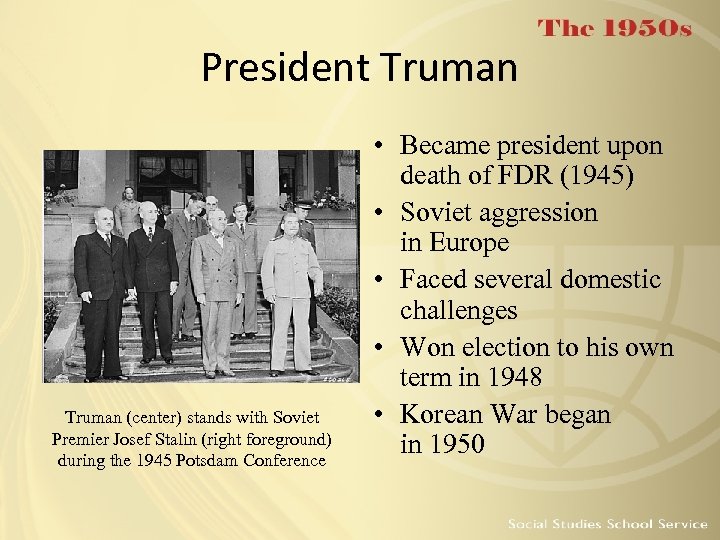 President Truman (center) stands with Soviet Premier Josef Stalin (right foreground) during the 1945 Potsdam Conference • Became president upon death of FDR (1945) • Soviet aggression in Europe • Faced several domestic challenges • Won election to his own term in 1948 • Korean War began in 1950
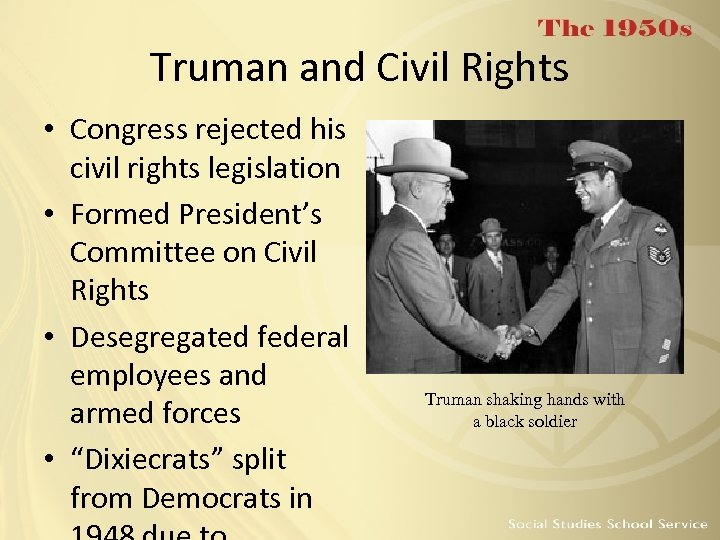 Truman and Civil Rights • Congress rejected his civil rights legislation • Formed President’s Committee on Civil Rights • Desegregated federal employees and armed forces • “Dixiecrats” split from Democrats in Truman shaking hands with a black soldier
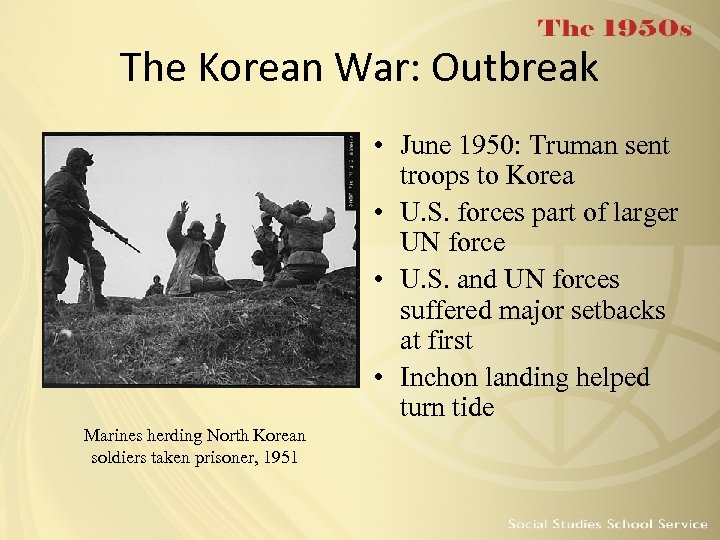 The Korean War: Outbreak • June 1950: Truman sent troops to Korea • U. S. forces part of larger UN force • U. S. and UN forces suffered major setbacks at first • Inchon landing helped turn tide Marines herding North Korean soldiers taken prisoner, 1951
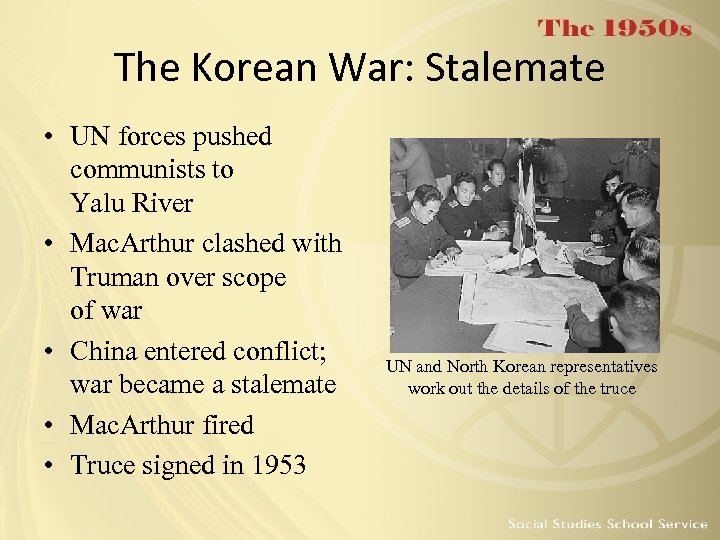 The Korean War: Stalemate • UN forces pushed communists to Yalu River • Mac. Arthur clashed with Truman over scope of war • China entered conflict; war became a stalemate • Mac. Arthur fired • Truce signed in 1953 UN and North Korean representatives work out the details of the truce
 Discussion Questions 1. How did the U. S. government assist veterans returning from WWII? What benefits did they receive? 2. What actions did Truman take on issues of civil rights? How did his positions affect the Democratic Party? 3. How did Truman and Mac. Arthur differ on conducting the war in Korea? Whose point of view do you agree with? Why?
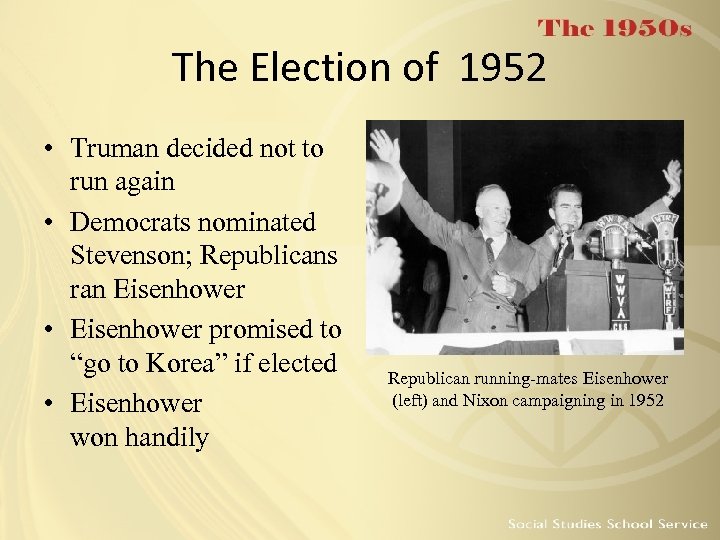 The Election of 1952 • Truman decided not to run again • Democrats nominated Stevenson; Republicans ran Eisenhower • Eisenhower promised to “go to Korea” if elected • Eisenhower won handily Republican running-mates Eisenhower (left) and Nixon campaigning in 1952
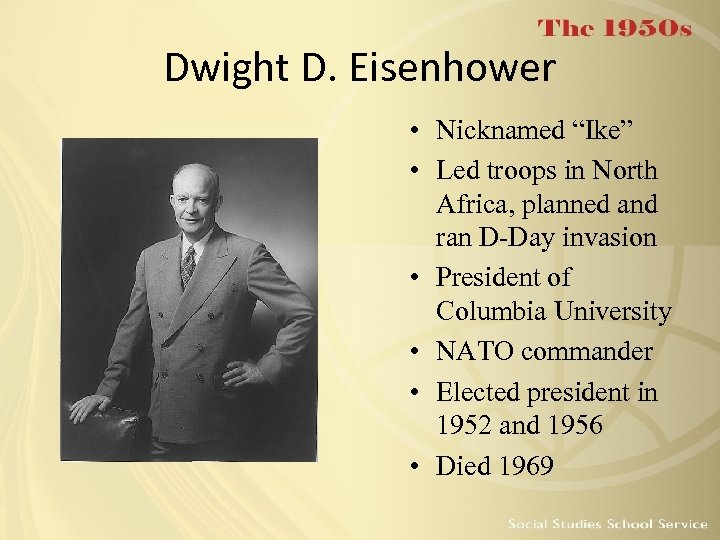 Dwight D. Eisenhower • Nicknamed “Ike” • Led troops in North Africa, planned and ran D-Day invasion • President of Columbia University • NATO commander • Elected president in 1952 and 1956 • Died 1969
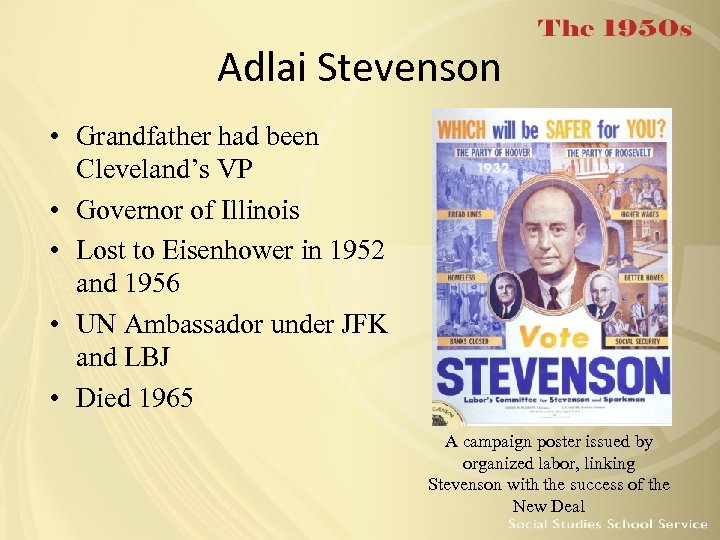 Adlai Stevenson • Grandfather had been Cleveland’s VP • Governor of Illinois • Lost to Eisenhower in 1952 and 1956 • UN Ambassador under JFK and LBJ • Died 1965 A campaign poster issued by organized labor, linking Stevenson with the success of the New Deal
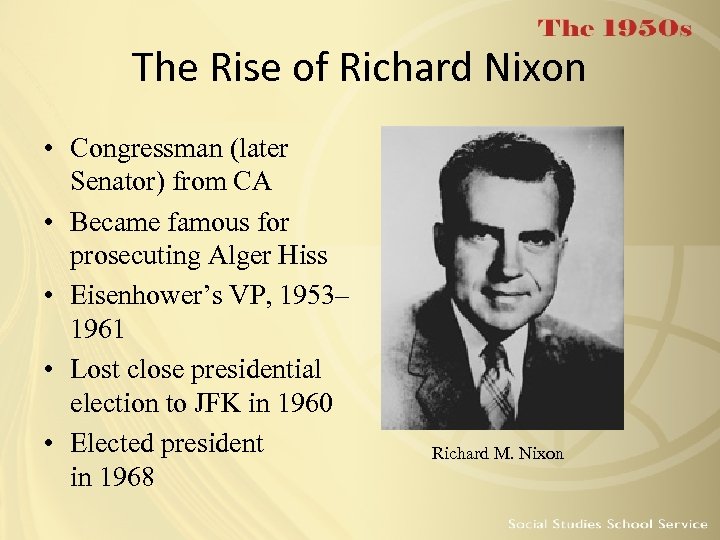 The Rise of Richard Nixon • Congressman (later Senator) from CA • Became famous for prosecuting Alger Hiss • Eisenhower’s VP, 1953– 1961 • Lost close presidential election to JFK in 1960 • Elected president in 1968 Richard M. Nixon
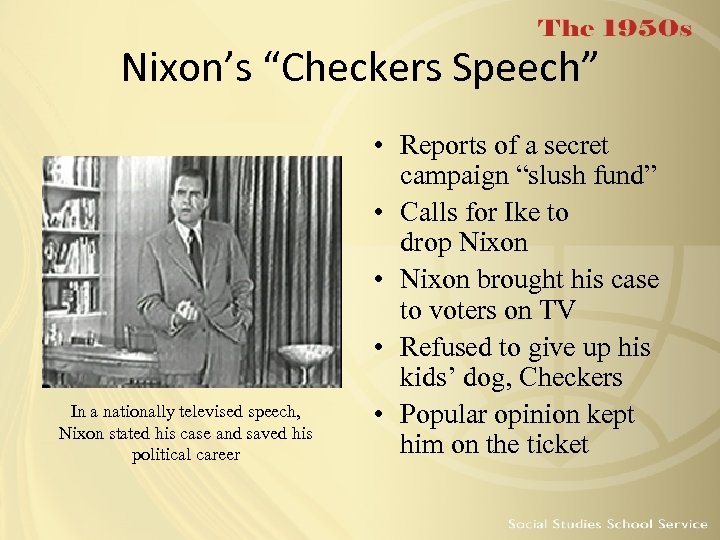 Nixon’s “Checkers Speech” In a nationally televised speech, Nixon stated his case and saved his political career • Reports of a secret campaign “slush fund” • Calls for Ike to drop Nixon • Nixon brought his case to voters on TV • Refused to give up his kids’ dog, Checkers • Popular opinion kept him on the ticket
![From the “Checkers Speech” I should say this, that Pat [Nixon’s wife] doesn't have](https://present5.com/presentation/8376539fef8864009e572c3c1b73e9bb/image-14.jpg "From the “Checkers Speech” I should say this, that Pat [Nixon’s wife] doesn't have") From the “Checkers Speech” I should say this, that Pat [Nixon’s wife] doesn't have a mink coat. But she does have a respectable Republican cloth coat, and I always tell her she would look good in anything. One other thing I probably should tell you, because if I don’t they will probably be saying this about me, too. We did get something, a gift, after the election. A man down in Texas heard Pat on the radio mention the fact that our two youngsters would like to have a dog, and, believe it or not, the day before we left on this campaign trip we got a message from Union Station in Baltimore, saying they had a package for us. We went down to get it. You know what it was? It was a little cocker spaniel dog, in a crate that he had sent all the way from Texas, black and white, spotted, and our little girl Tricia, the six year old, named it “Checkers. ” And you know, the kids, like all kids, loved the dog, and I just want to say this, right now, that regardless of what they say about it, we are going to keep it.
From the “Checkers Speech” I should say this, that Pat [Nixon’s wife] doesn't have a mink coat. But she does have a respectable Republican cloth coat, and I always tell her she would look good in anything. One other thing I probably should tell you, because if I don’t they will probably be saying this about me, too. We did get something, a gift, after the election. A man down in Texas heard Pat on the radio mention the fact that our two youngsters would like to have a dog, and, believe it or not, the day before we left on this campaign trip we got a message from Union Station in Baltimore, saying they had a package for us. We went down to get it. You know what it was? It was a little cocker spaniel dog, in a crate that he had sent all the way from Texas, black and white, spotted, and our little girl Tricia, the six year old, named it “Checkers. ” And you know, the kids, like all kids, loved the dog, and I just want to say this, right now, that regardless of what they say about it, we are going to keep it.
 Discussion Questions 1. Who were the candidates in the election of 1952? What attributes of the Democratic candidate did the Republicans capitalize on? Why do you think this was so? 2. How did Richard Nixon become a major political figure in the 1950 s? How did the “Checkers speech” affect his career?
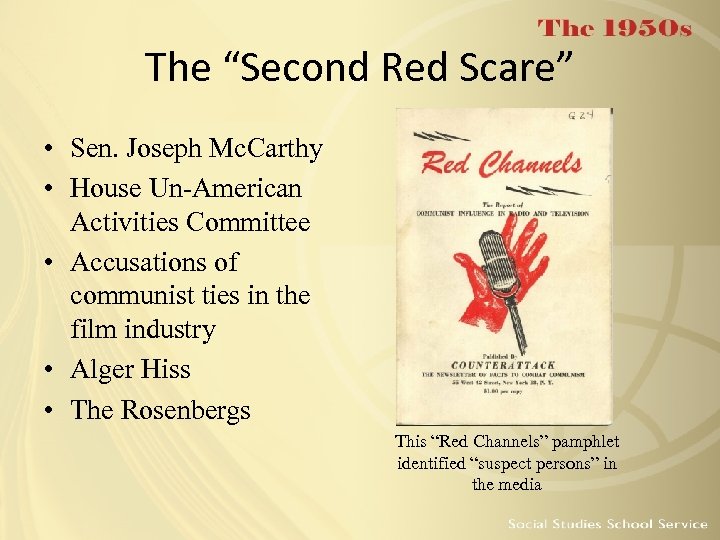 The “Second Red Scare” • Sen. Joseph Mc. Carthy • House Un-American Activities Committee • Accusations of communist ties in the film industry • Alger Hiss • The Rosenbergs This “Red Channels” pamphlet identified “suspect persons” in the media
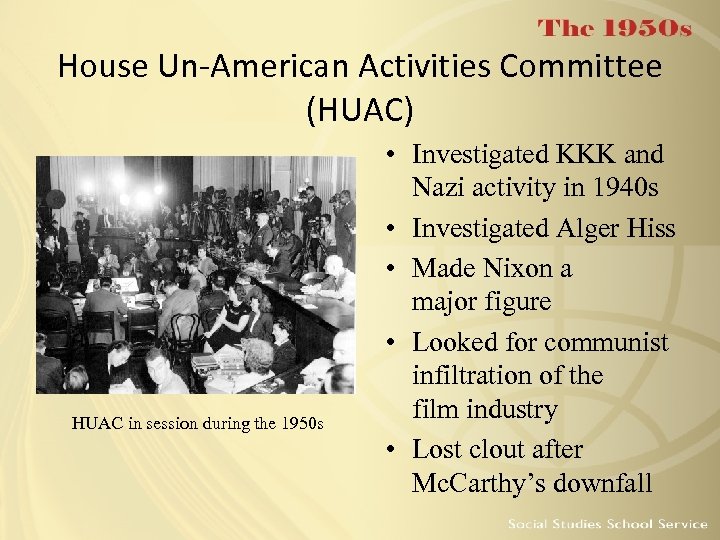 House Un-American Activities Committee (HUAC) HUAC in session during the 1950 s • Investigated KKK and Nazi activity in 1940 s • Investigated Alger Hiss • Made Nixon a major figure • Looked for communist infiltration of the film industry • Lost clout after Mc. Carthy’s downfall
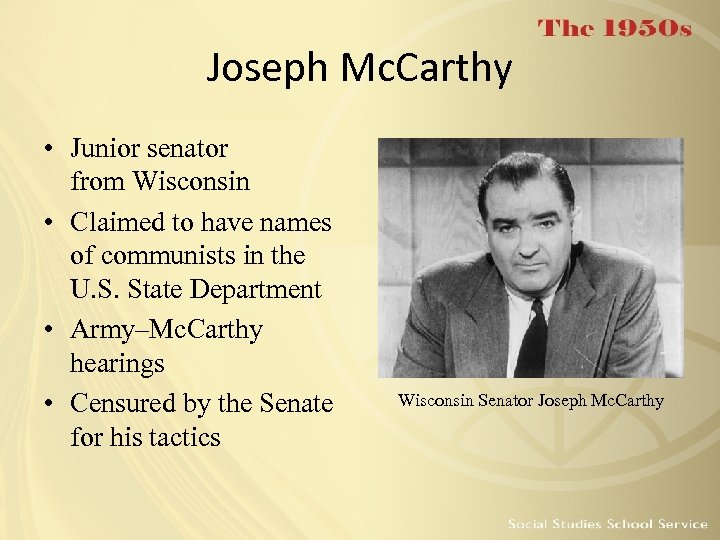 Joseph Mc. Carthy • Junior senator from Wisconsin • Claimed to have names of communists in the U. S. State Department • Army–Mc. Carthy hearings • Censured by the Senate for his tactics Wisconsin Senator Joseph Mc. Carthy
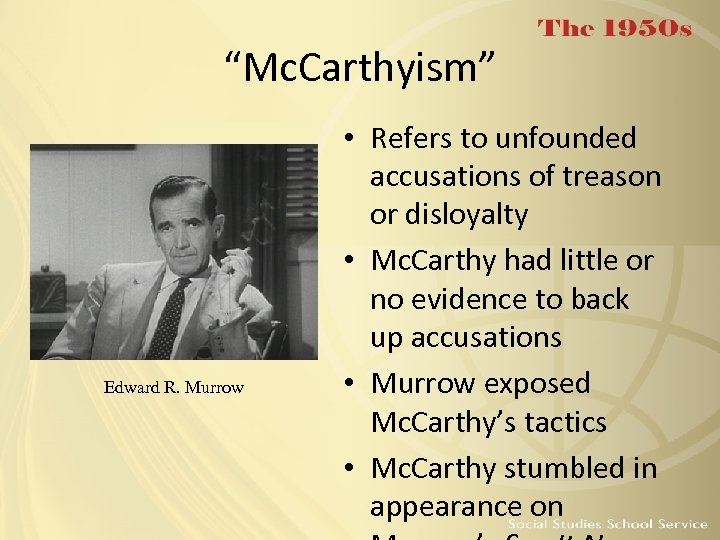 “Mc. Carthyism” Edward R. Murrow • Refers to unfounded accusations of treason or disloyalty • Mc. Carthy had little or no evidence to back up accusations • Murrow exposed Mc. Carthy’s tactics • Mc. Carthy stumbled in appearance on
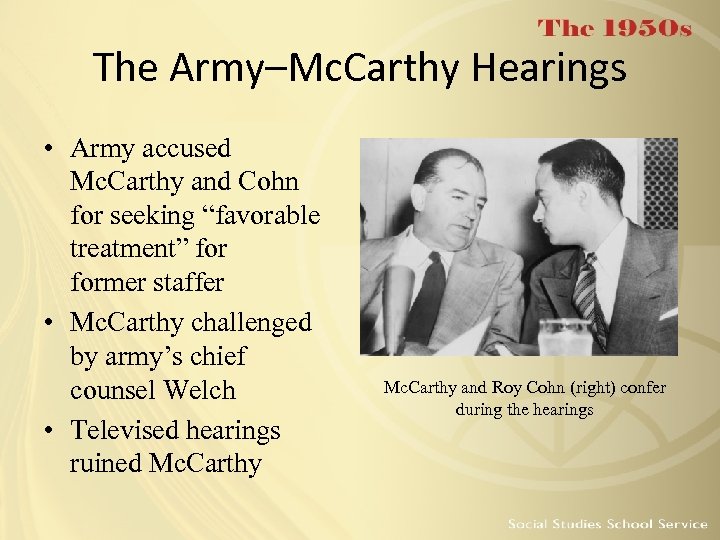 The Army–Mc. Carthy Hearings • Army accused Mc. Carthy and Cohn for seeking “favorable treatment” former staffer • Mc. Carthy challenged by army’s chief counsel Welch • Televised hearings ruined Mc. Carthy and Roy Cohn (right) confer during the hearings
 Discussion Questions 1. What factors made the nation so concerned about communist infiltration during the 1950 s? 2. What was the original purpose of the House Un-American Activities Committee? What did HUAC change its focus to? Was it successful? 3. What made Joseph Mc. Carthy an influential figure during the early 1950 s? What tactics did he use? What eventually led to his
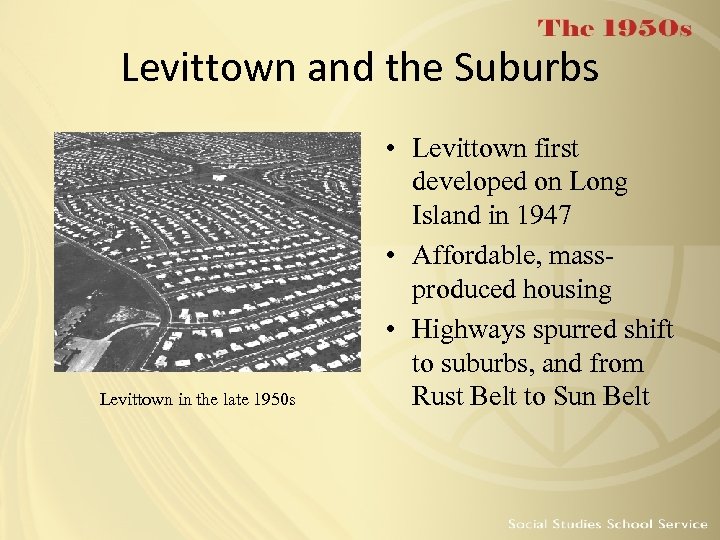 Levittown and the Suburbs Levittown in the late 1950 s • Levittown first developed on Long Island in 1947 • Affordable, massproduced housing • Highways spurred shift to suburbs, and from Rust Belt to Sun Belt
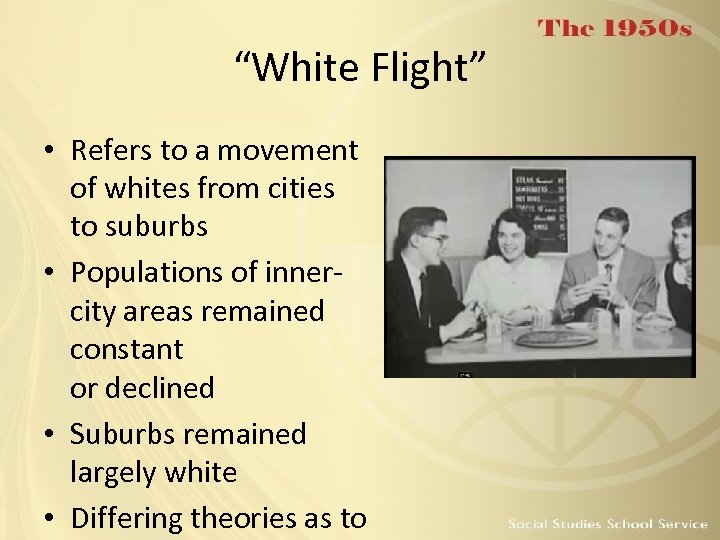 “White Flight” • Refers to a movement of whites from cities to suburbs • Populations of innercity areas remained constant or declined • Suburbs remained largely white • Differing theories as to
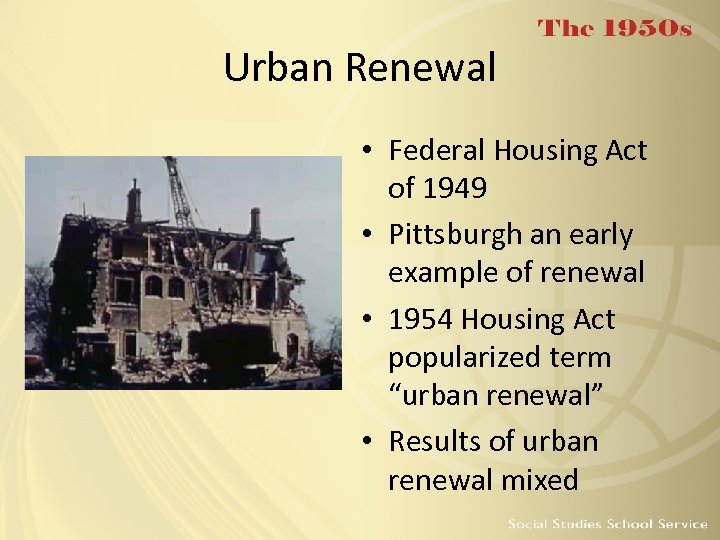 Urban Renewal • Federal Housing Act of 1949 • Pittsburgh an early example of renewal • 1954 Housing Act popularized term “urban renewal” • Results of urban renewal mixed
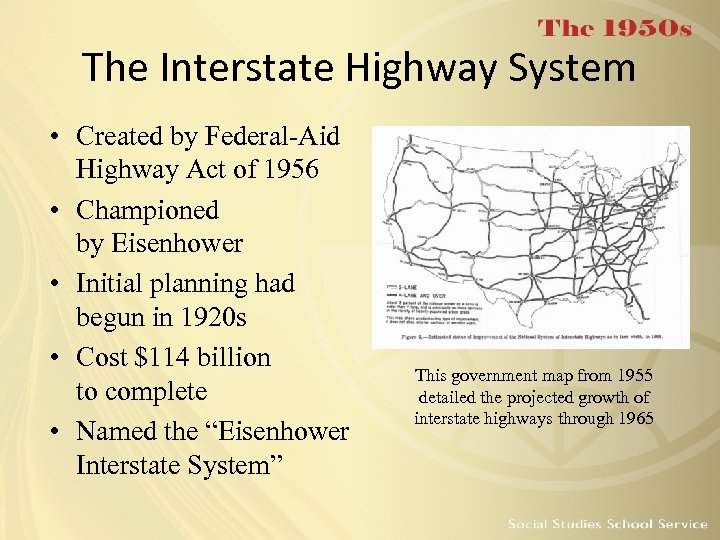 The Interstate Highway System • Created by Federal-Aid Highway Act of 1956 • Championed by Eisenhower • Initial planning had begun in 1920 s • Cost $114 billion to complete • Named the “Eisenhower Interstate System” This government map from 1955 detailed the projected growth of interstate highways through 1965
 The “Baby Boom” • Term “baby boom” first coined by columnist Sylvia Porter • Postwar boom ran from 1946– 1964 • Estimated 78 million Americans born during boom • Veterans used GI Bill benefits for mortgages and businesses • A return to typical gender roles • Boom leveled off by 1958
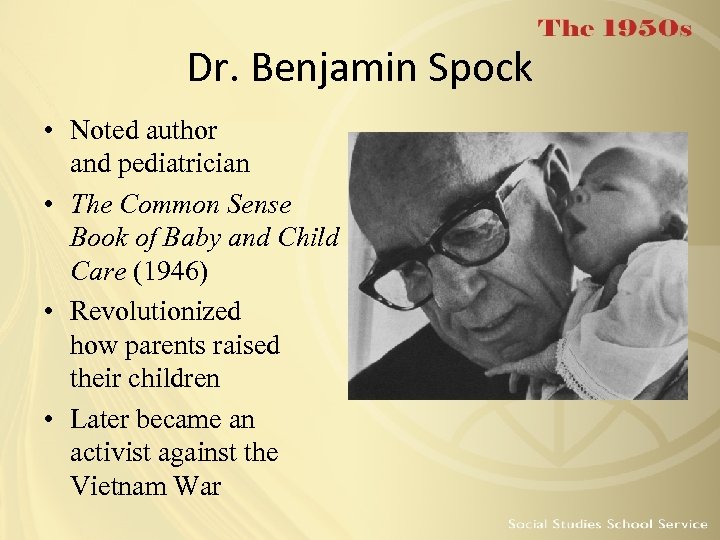 Dr. Benjamin Spock • Noted author and pediatrician • The Common Sense Book of Baby and Child Care (1946) • Revolutionized how parents raised their children • Later became an activist against the Vietnam War
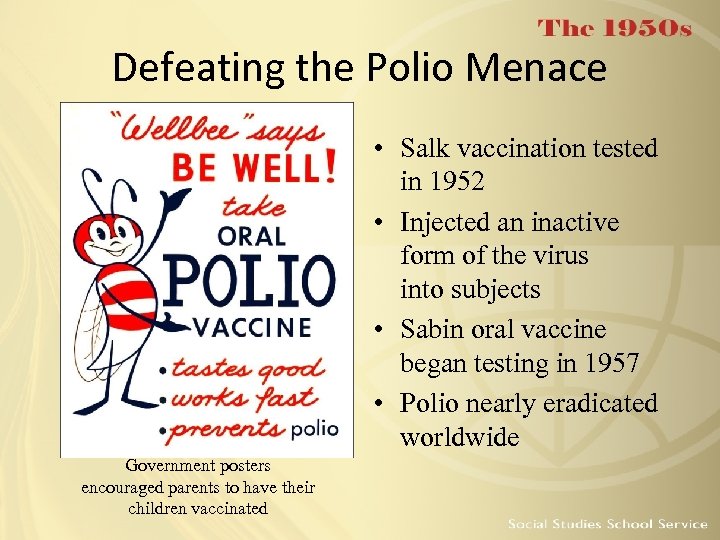 Defeating the Polio Menace • Salk vaccination tested in 1952 • Injected an inactive form of the virus into subjects • Sabin oral vaccine began testing in 1957 • Polio nearly eradicated worldwide Government posters encouraged parents to have their children vaccinated
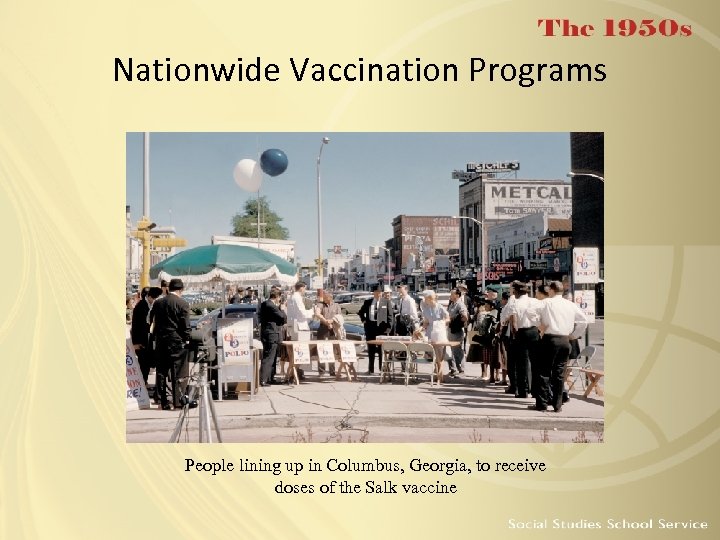 Nationwide Vaccination Programs People lining up in Columbus, Georgia, to receive doses of the Salk vaccine
 Discussion Questions 1. What factors led to the rise of suburbs such as Levittown? How did this trend relate to the Baby Boom? 2. Why was Dr. Spock’s book so popular in the 1950 s? How did it revolutionize the concept of child rearing? How did later editions reflect changes in the concept of family?
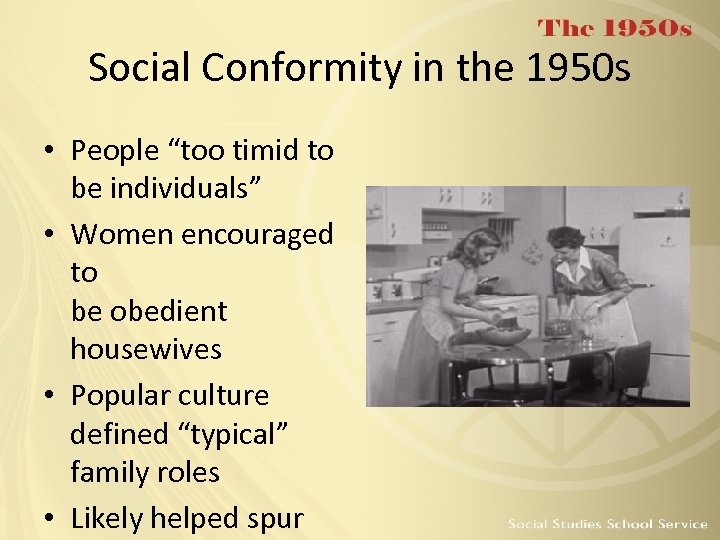 Social Conformity in the 1950 s • People “too timid to be individuals” • Women encouraged to be obedient housewives • Popular culture defined “typical” family roles • Likely helped spur
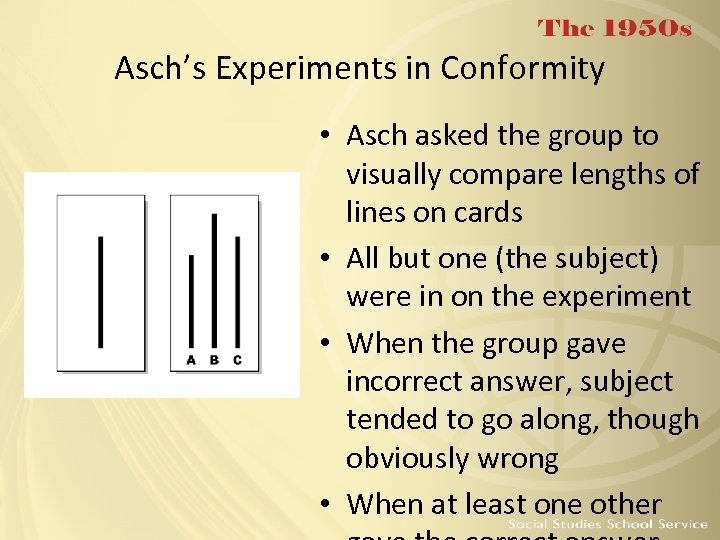 Asch’s Experiments in Conformity • Asch asked the group to visually compare lengths of lines on cards • All but one (the subject) were in on the experiment • When the group gave incorrect answer, subject tended to go along, though obviously wrong • When at least one other
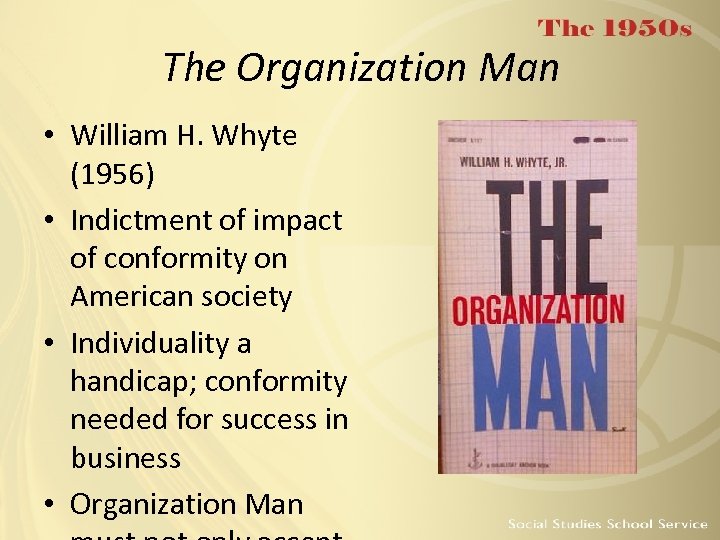 The Organization Man • William H. Whyte (1956) • Indictment of impact of conformity on American society • Individuality a handicap; conformity needed for success in business • Organization Man
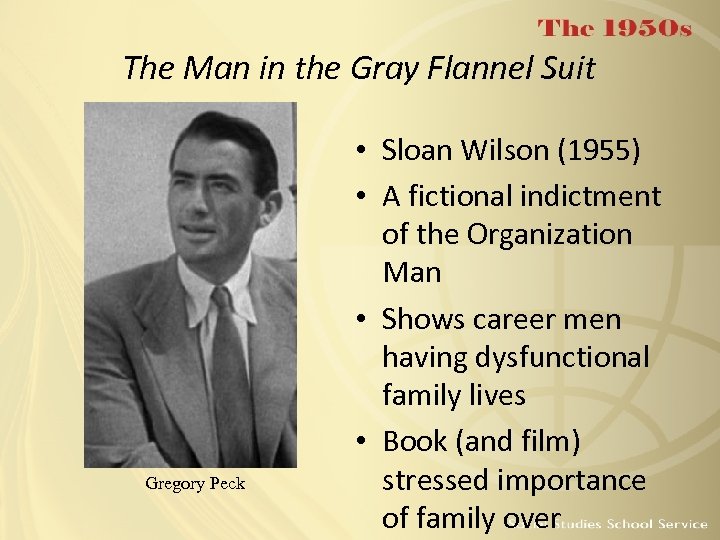 The Man in the Gray Flannel Suit Gregory Peck • Sloan Wilson (1955) • A fictional indictment of the Organization Man • Shows career men having dysfunctional family lives • Book (and film) stressed importance of family over
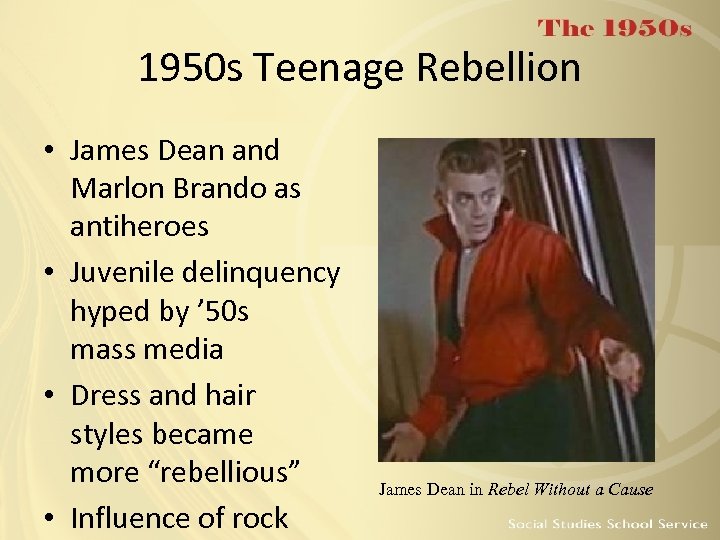 1950 s Teenage Rebellion • James Dean and Marlon Brando as antiheroes • Juvenile delinquency hyped by ’ 50 s mass media • Dress and hair styles became more “rebellious” • Influence of rock James Dean in Rebel Without a Cause
 Discussion Questions 1. How did Asch’s experiments in conformity work, and what did they reveal? Do you agree with Asch’s findings? Why? 2. In Whyte’s book, who was the Organization Man? How did Wilson’s The Man in the Gray Flannel Suit resist becoming an Organization Man? 3. In your view, were the 1950 s more a decade of social conformity or teenage rebellion? Why?
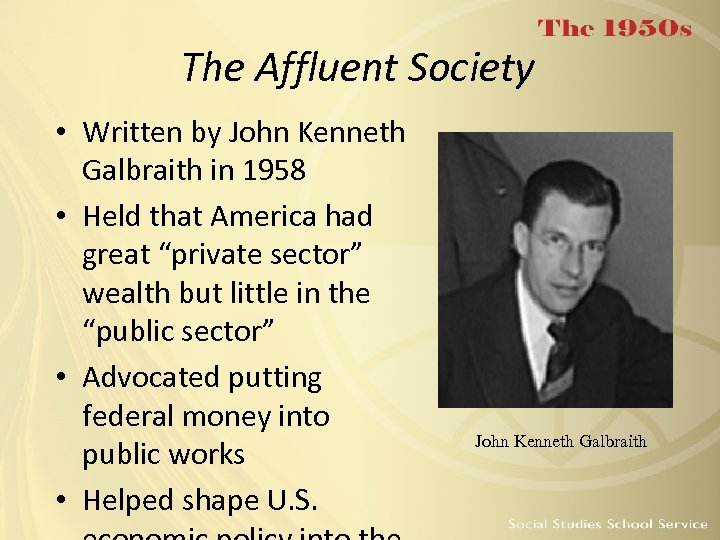 The Affluent Society • Written by John Kenneth Galbraith in 1958 • Held that America had great “private sector” wealth but little in the “public sector” • Advocated putting federal money into public works • Helped shape U. S. John Kenneth Galbraith
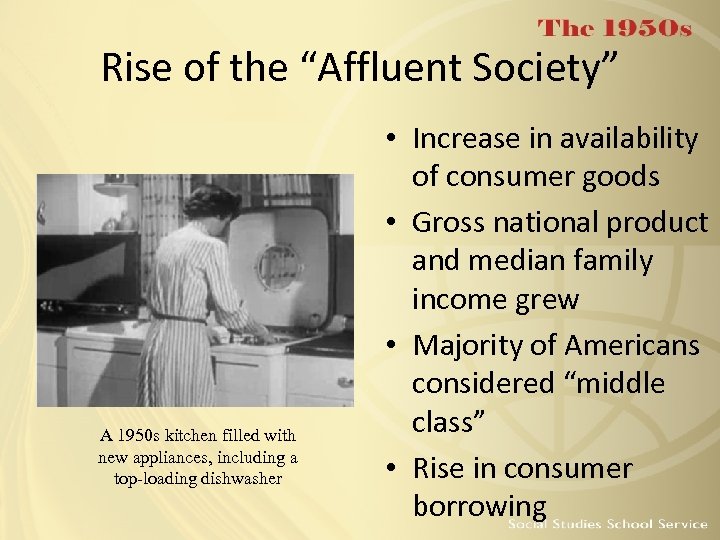 Rise of the “Affluent Society” A 1950 s kitchen filled with new appliances, including a top-loading dishwasher • Increase in availability of consumer goods • Gross national product and median family income grew • Majority of Americans considered “middle class” • Rise in consumer borrowing
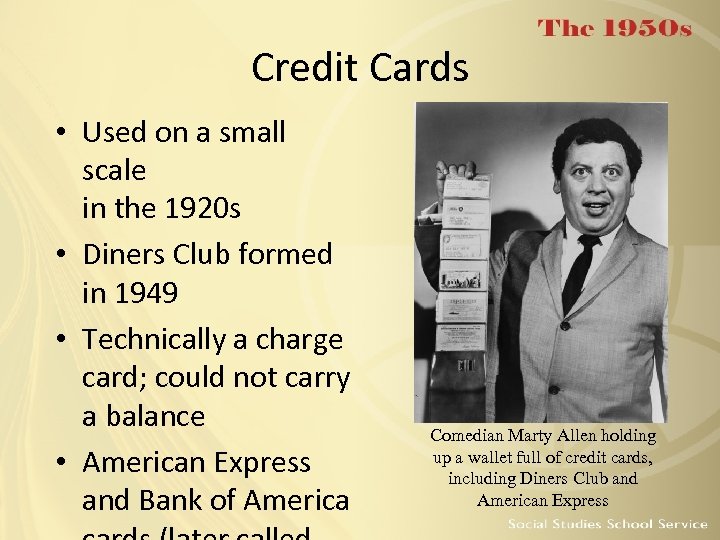 Credit Cards • Used on a small scale in the 1920 s • Diners Club formed in 1949 • Technically a charge card; could not carry a balance • American Express and Bank of America Comedian Marty Allen holding up a wallet full of credit cards, including Diners Club and American Express
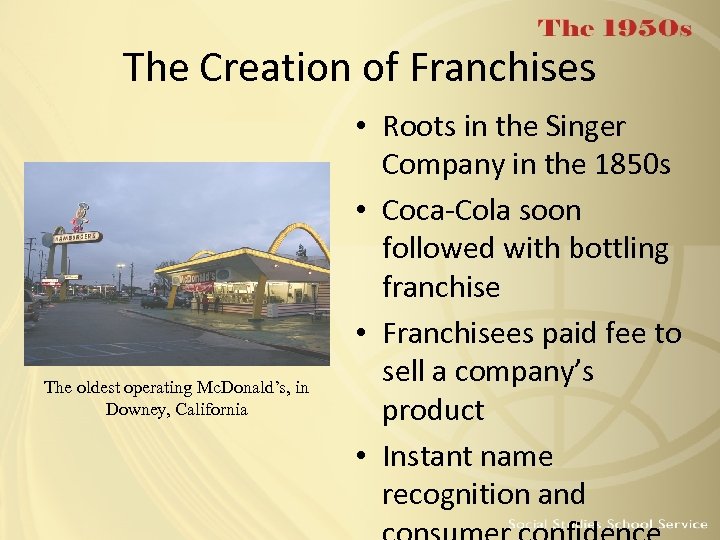 The Creation of Franchises The oldest operating Mc. Donald’s, in Downey, California • Roots in the Singer Company in the 1850 s • Coca-Cola soon followed with bottling franchise • Franchisees paid fee to sell a company’s product • Instant name recognition and
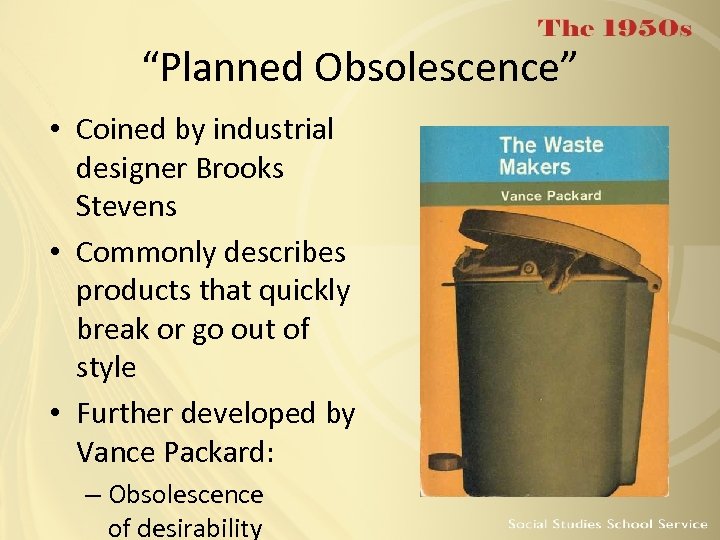 “Planned Obsolescence” • Coined by industrial designer Brooks Stevens • Commonly describes products that quickly break or go out of style • Further developed by Vance Packard: – Obsolescence of desirability
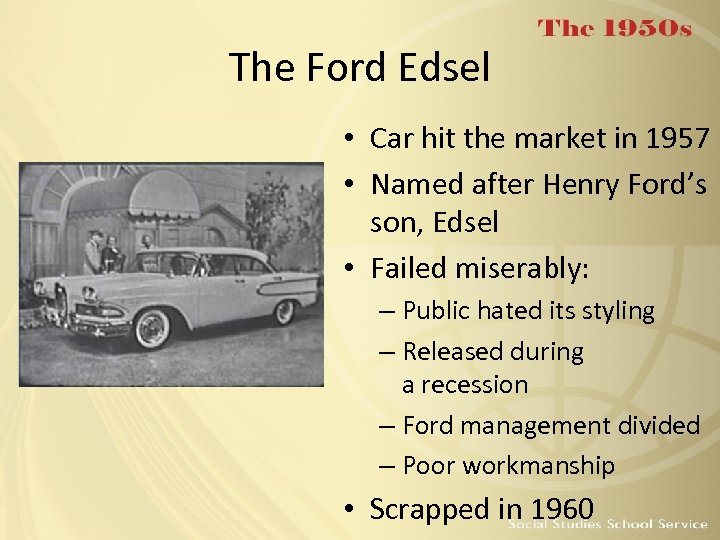 The Ford Edsel • Car hit the market in 1957 • Named after Henry Ford’s son, Edsel • Failed miserably: – Public hated its styling – Released during a recession – Ford management divided – Poor workmanship • Scrapped in 1960
 Discussion Questions 1. How did Galbraith describe his concept of the “affluent society”? What did he suggest be done to improve such a society? 2. How did the development of credit cards and franchising change Americans’ spending habits during the 1950 s?
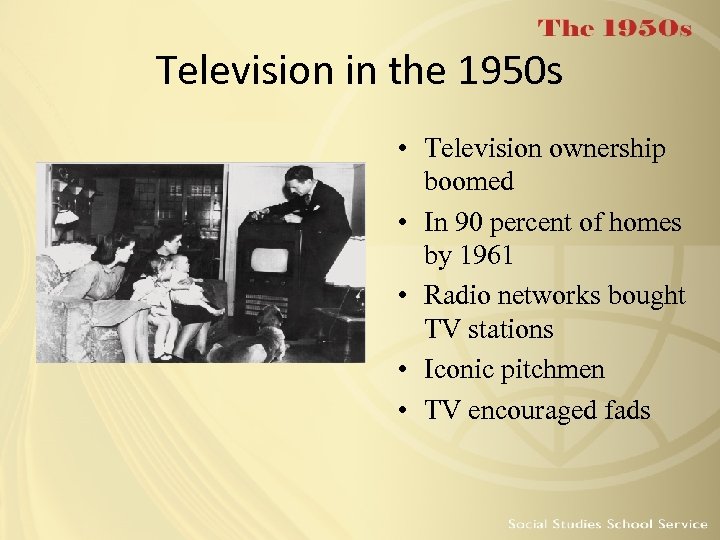 Television in the 1950 s • Television ownership boomed • In 90 percent of homes by 1961 • Radio networks bought TV stations • Iconic pitchmen • TV encouraged fads
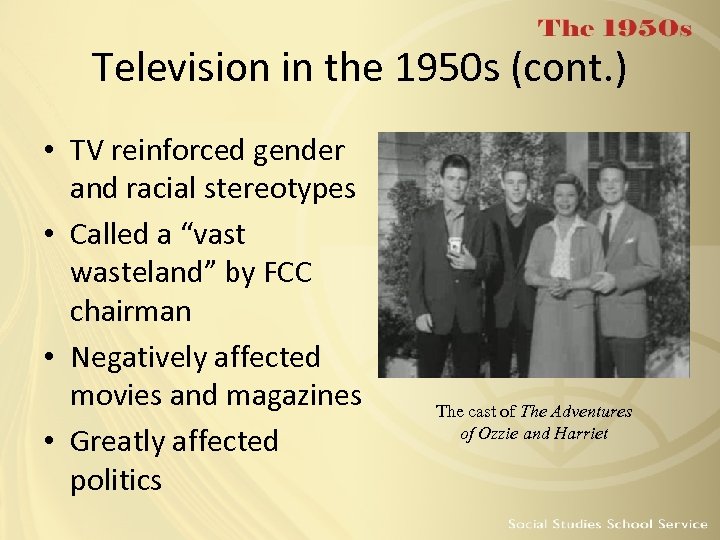 Television in the 1950 s (cont. ) • TV reinforced gender and racial stereotypes • Called a “vast wasteland” by FCC chairman • Negatively affected movies and magazines • Greatly affected politics The cast of The Adventures of Ozzie and Harriet
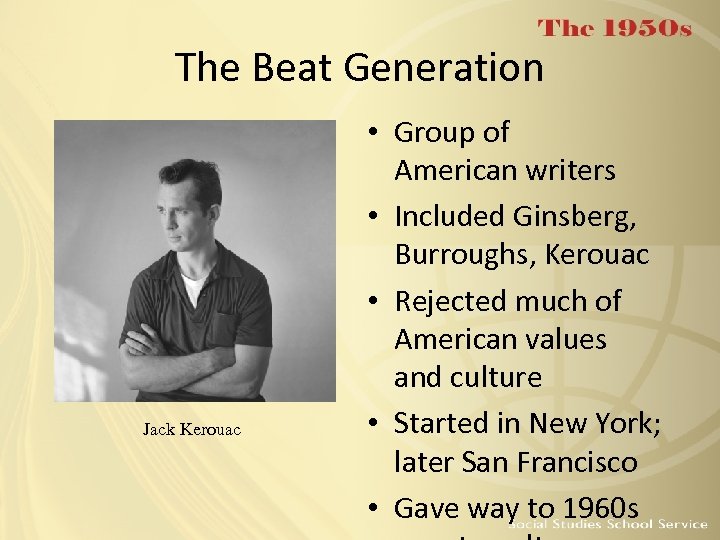 The Beat Generation Jack Kerouac • Group of American writers • Included Ginsberg, Burroughs, Kerouac • Rejected much of American values and culture • Started in New York; later San Francisco • Gave way to 1960 s
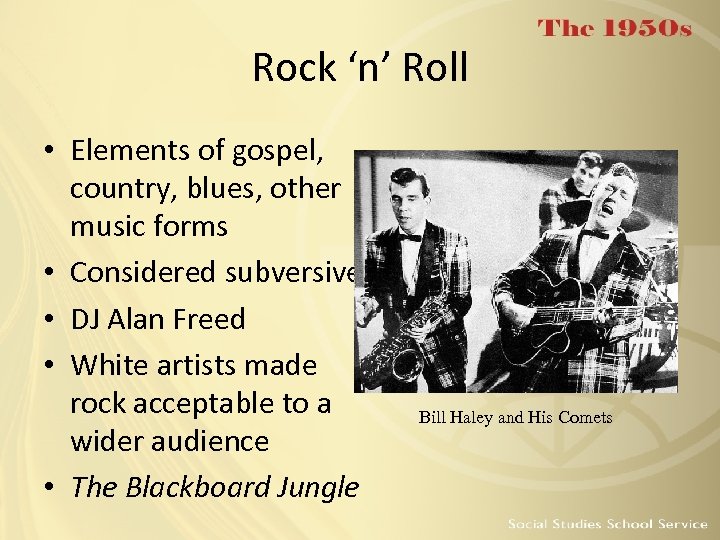 Rock ‘n’ Roll • Elements of gospel, country, blues, other music forms • Considered subversive • DJ Alan Freed • White artists made rock acceptable to a wider audience • The Blackboard Jungle Bill Haley and His Comets
 Rock ‘n’ Roll: Cultural Backlash • Strong African American influences • Said to encourage race mixing and immoral behavior • Variously called: – the devil’s music – a communist plot – a communicable disease
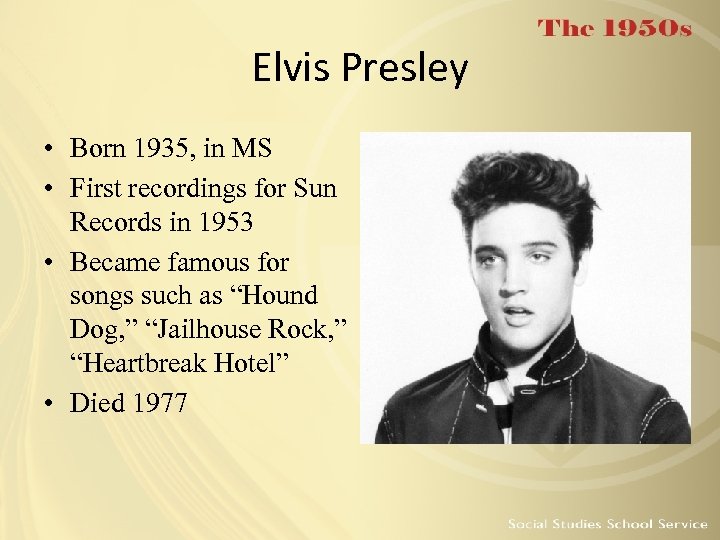 Elvis Presley • Born 1935, in MS • First recordings for Sun Records in 1953 • Became famous for songs such as “Hound Dog, ” “Jailhouse Rock, ” “Heartbreak Hotel” • Died 1977
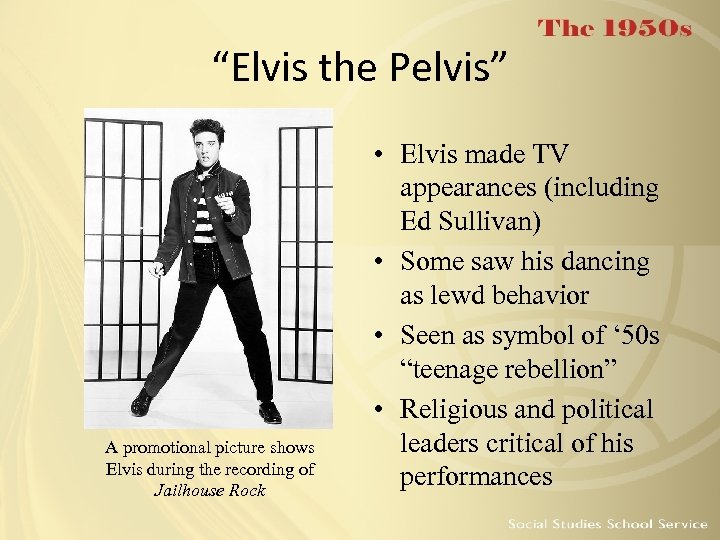 “Elvis the Pelvis” A promotional picture shows Elvis during the recording of Jailhouse Rock • Elvis made TV appearances (including Ed Sullivan) • Some saw his dancing as lewd behavior • Seen as symbol of ‘ 50 s “teenage rebellion” • Religious and political leaders critical of his performances
 Discussion Questions 1. What impact did television have on American society in the 1950 s? Give examples of specific areas it affected. 2. Why did Elvis Presley have so great an influence on early rock ‘n’ roll? Why were many people fearful of him?
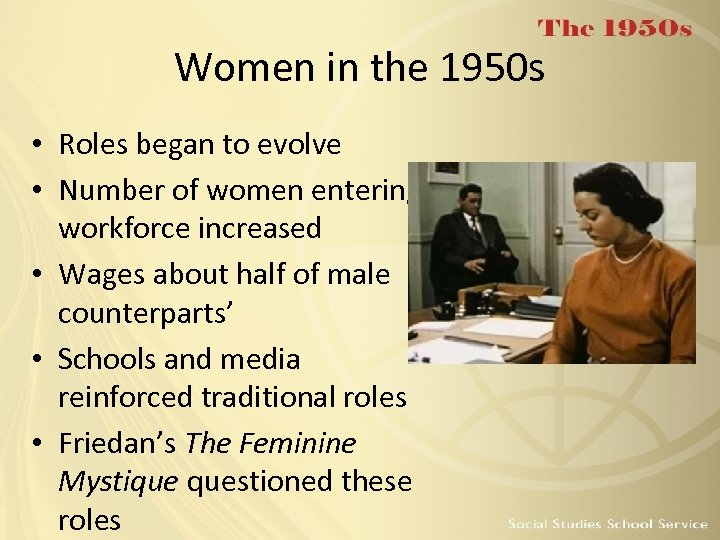 Women in the 1950 s • Roles began to evolve • Number of women entering workforce increased • Wages about half of male counterparts’ • Schools and media reinforced traditional roles • Friedan’s The Feminine Mystique questioned these roles
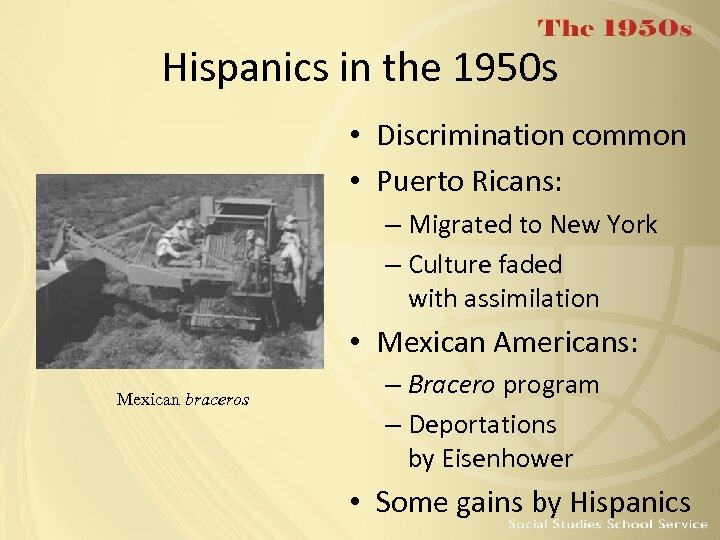 Hispanics in the 1950 s • Discrimination common • Puerto Ricans: – Migrated to New York – Culture faded with assimilation • Mexican Americans: Mexican braceros – Bracero program – Deportations by Eisenhower • Some gains by Hispanics
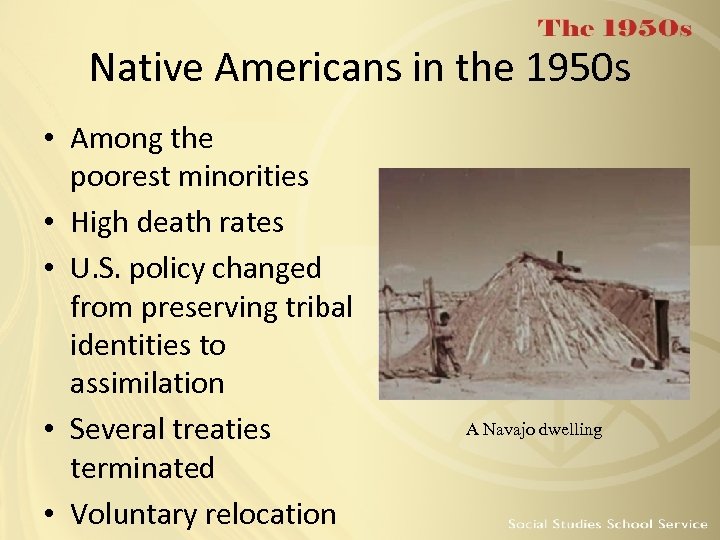 Native Americans in the 1950 s • Among the poorest minorities • High death rates • U. S. policy changed from preserving tribal identities to assimilation • Several treaties terminated • Voluntary relocation A Navajo dwelling
 The Civil Rights Movement: Origins • Became more organized and vocal in the 1950 s • Strategy of nonviolent civil disobedience • Brown decision (1954) integrated public schools • Montgomery Bus Boycott (1955) • Leaders included Dr. Martin Luther King Jr. • Southern Christian Leadership Council
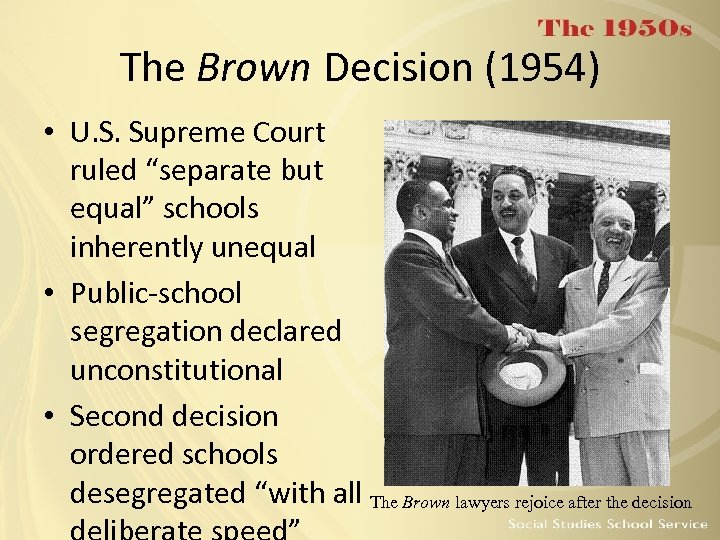 The Brown Decision (1954) • U. S. Supreme Court ruled “separate but equal” schools inherently unequal • Public-school segregation declared unconstitutional • Second decision ordered schools desegregated “with all The Brown lawyers rejoice after the decision
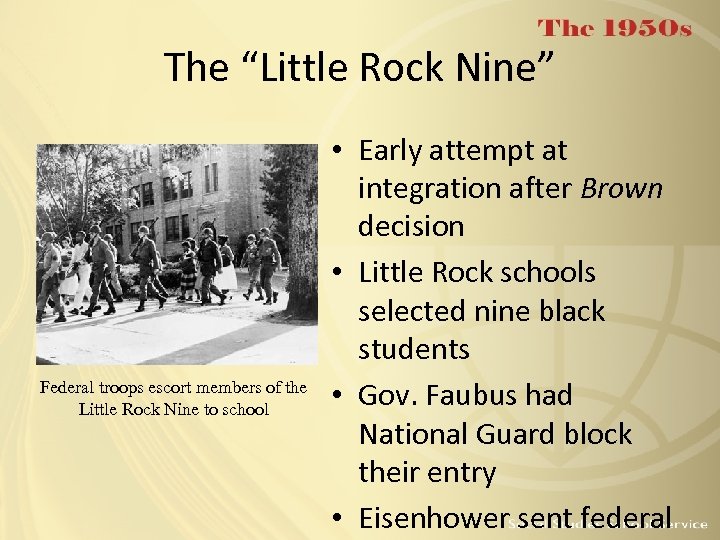 The “Little Rock Nine” Federal troops escort members of the Little Rock Nine to school • Early attempt at integration after Brown decision • Little Rock schools selected nine black students • Gov. Faubus had National Guard block their entry • Eisenhower sent federal
 The Montgomery Bus Boycott • Rosa Parks arrested, Dec. 1, 1955 • Refused to give up her seat on a city bus to a white woman • Blacks planned boycott of city buses until ordinance was changed • King led Montgomery Improvement Association • Courts ruled segregated busing unconstitutional
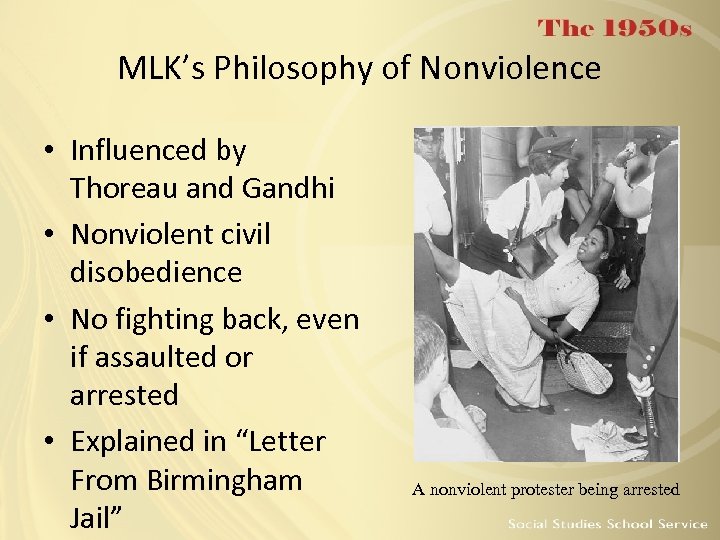 MLK’s Philosophy of Nonviolence • Influenced by Thoreau and Gandhi • Nonviolent civil disobedience • No fighting back, even if assaulted or arrested • Explained in “Letter From Birmingham Jail” A nonviolent protester being arrested
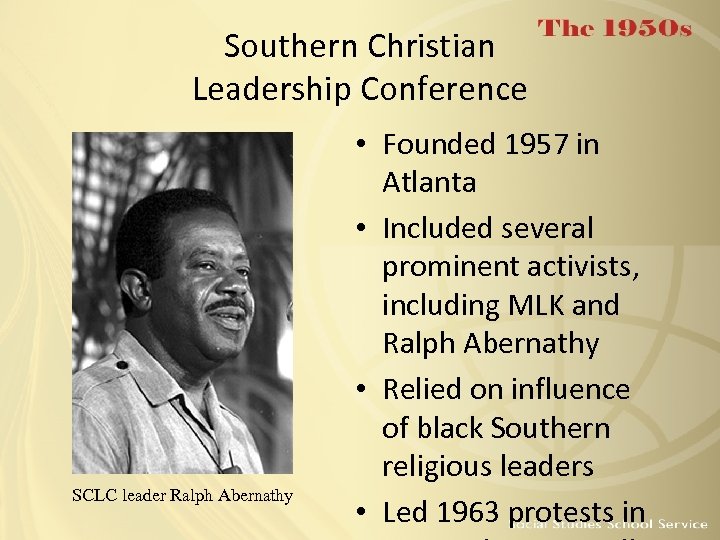 Southern Christian Leadership Conference SCLC leader Ralph Abernathy • Founded 1957 in Atlanta • Included several prominent activists, including MLK and Ralph Abernathy • Relied on influence of black Southern religious leaders • Led 1963 protests in
 Discussion Questions 1. Why did the Supreme Court rule public school segregation unconstitutional in Brown? How quickly did it later say that integration should occur? 2. What was MLK’s philosophy regarding demonstrating for civil rights? What historical figures influenced him? What dangers did protesters face with this strategy?
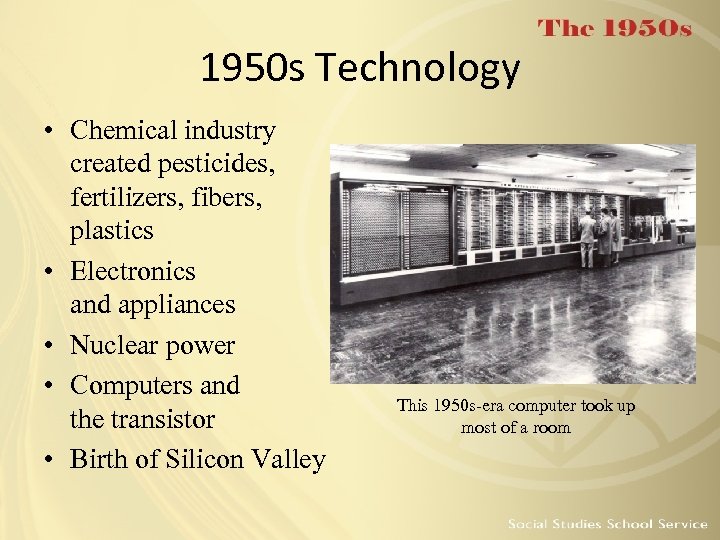 1950 s Technology • Chemical industry created pesticides, fertilizers, fibers, plastics • Electronics and appliances • Nuclear power • Computers and the transistor • Birth of Silicon Valley This 1950 s-era computer took up most of a room
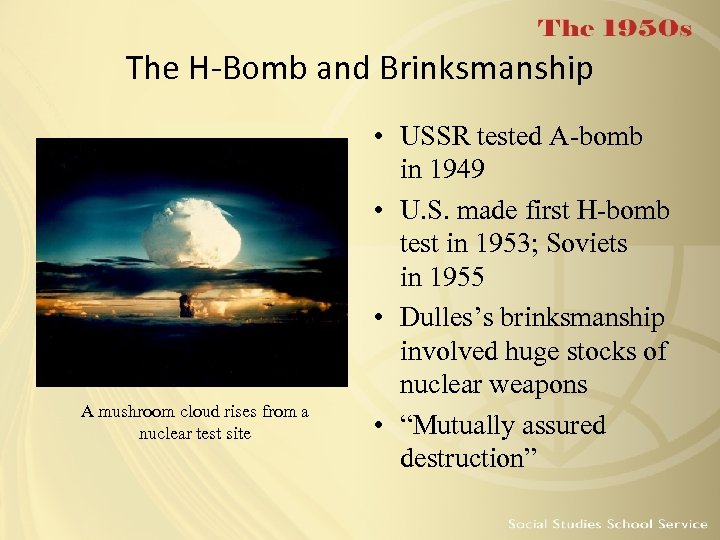 The H-Bomb and Brinksmanship A mushroom cloud rises from a nuclear test site • USSR tested A-bomb in 1949 • U. S. made first H-bomb test in 1953; Soviets in 1955 • Dulles’s brinksmanship involved huge stocks of nuclear weapons • “Mutually assured destruction”
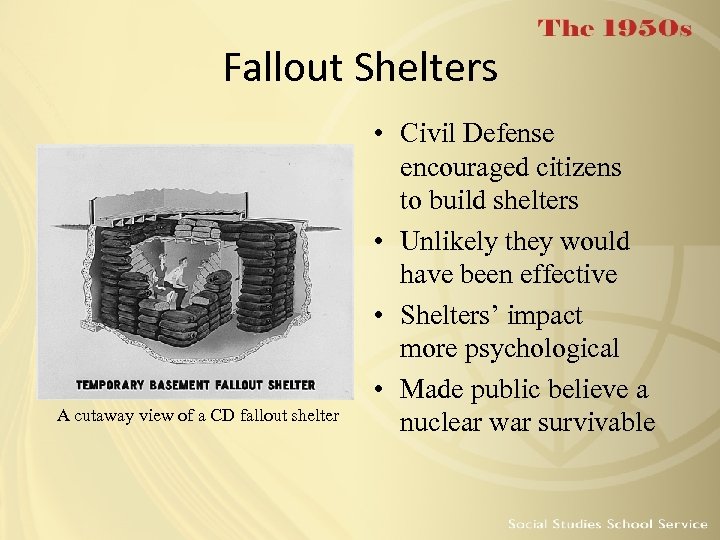 Fallout Shelters A cutaway view of a CD fallout shelter • Civil Defense encouraged citizens to build shelters • Unlikely they would have been effective • Shelters’ impact more psychological • Made public believe a nuclear war survivable
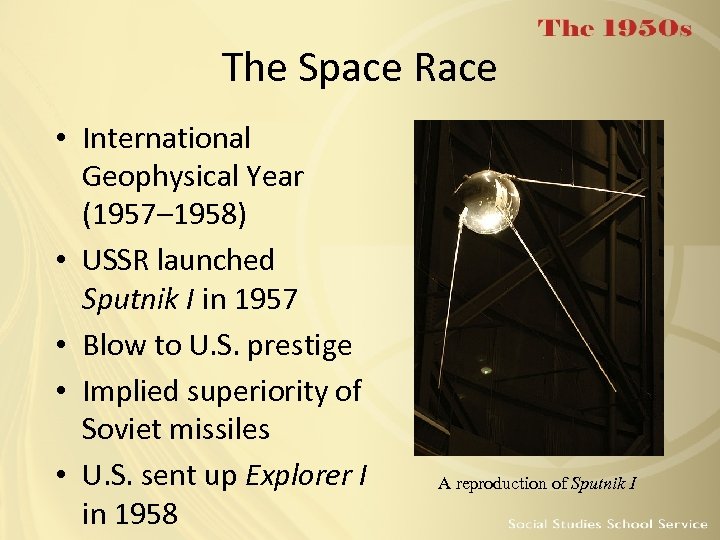 The Space Race • International Geophysical Year (1957– 1958) • USSR launched Sputnik I in 1957 • Blow to U. S. prestige • Implied superiority of Soviet missiles • U. S. sent up Explorer I in 1958 A reproduction of Sputnik I
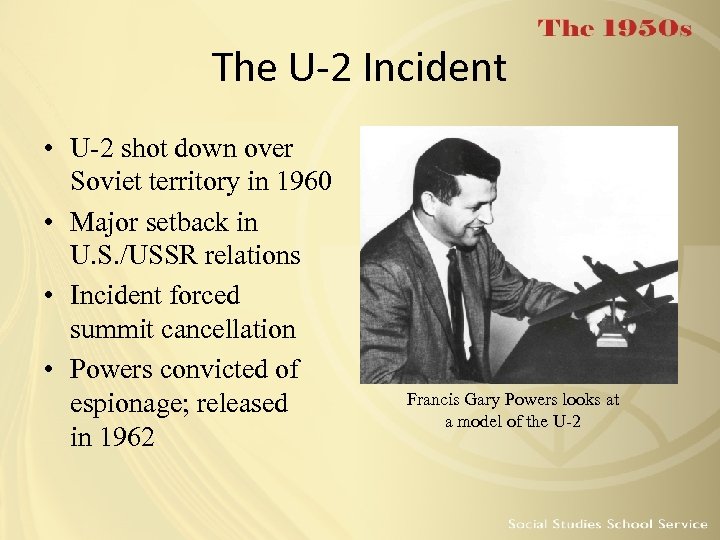 The U-2 Incident • U-2 shot down over Soviet territory in 1960 • Major setback in U. S. /USSR relations • Incident forced summit cancellation • Powers convicted of espionage; released in 1962 Francis Gary Powers looks at a model of the U-2
 Discussion Questions 1. What sorts of new technologies were developed during the 1950 s? What kinds of problems did these new technologies bring? 2. How did the launch of Sputnik affect the Cold War between the U. S. and USSR? 3. How did the U-2 incident affect Cold War tensions? What might Eisenhower have done to minimize the controversy?
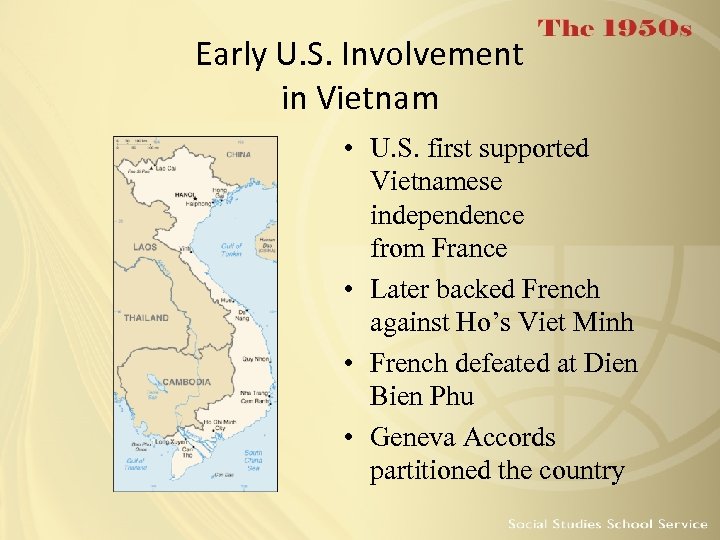 Early U. S. Involvement in Vietnam • U. S. first supported Vietnamese independence from France • Later backed French against Ho’s Viet Minh • French defeated at Dien Bien Phu • Geneva Accords partitioned the country
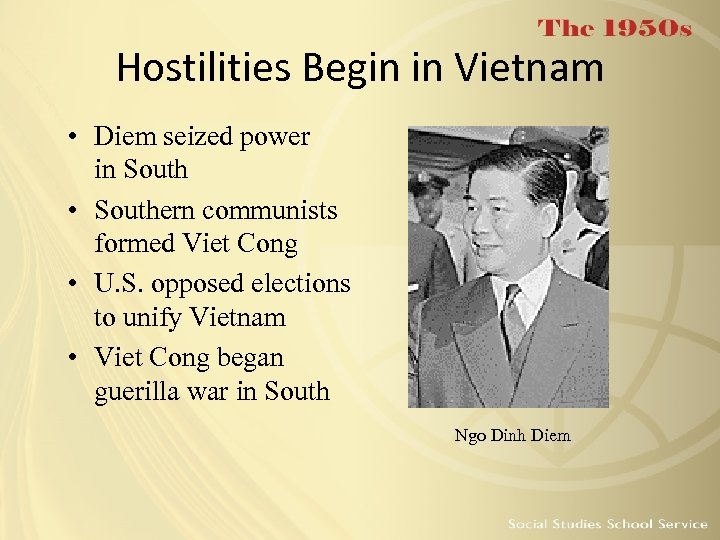 Hostilities Begin in Vietnam • Diem seized power in South • Southern communists formed Viet Cong • U. S. opposed elections to unify Vietnam • Viet Cong began guerilla war in South Ngo Dinh Diem
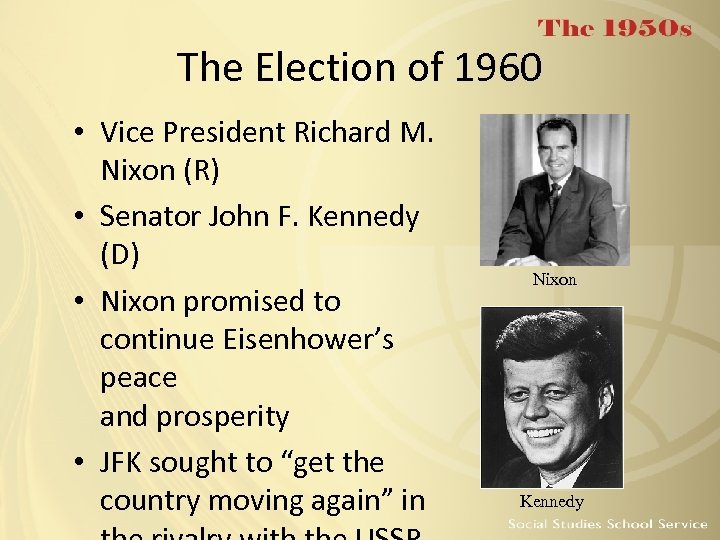 The Election of 1960 • Vice President Richard M. Nixon (R) • Senator John F. Kennedy (D) • Nixon promised to continue Eisenhower’s peace and prosperity • JFK sought to “get the country moving again” in Nixon Kennedy
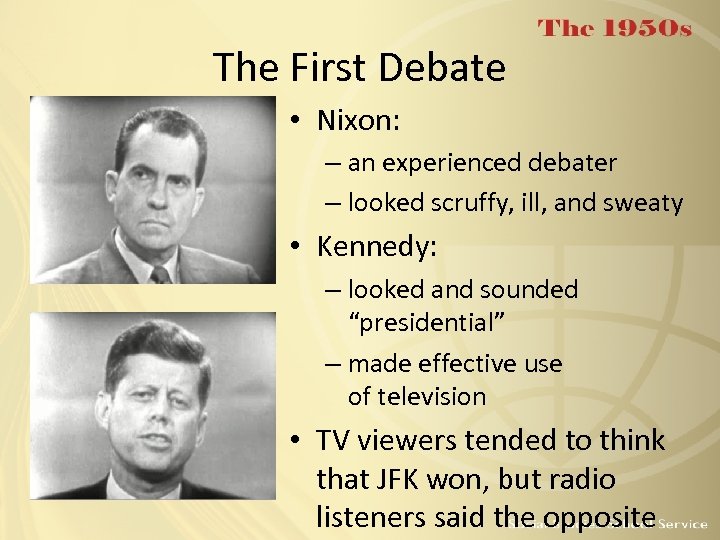 The First Debate • Nixon: – an experienced debater – looked scruffy, ill, and sweaty • Kennedy: – looked and sounded “presidential” – made effective use of television • TV viewers tended to think that JFK won, but radio listeners said the opposite
 A Close Election • • • About 68 million votes cast JFK won popular vote by about 118, 000 Key states Texas and Illinois Rumors of voter fraud in IL Nixon lost by 84 electoral votes Byrd got 15 electoral votes
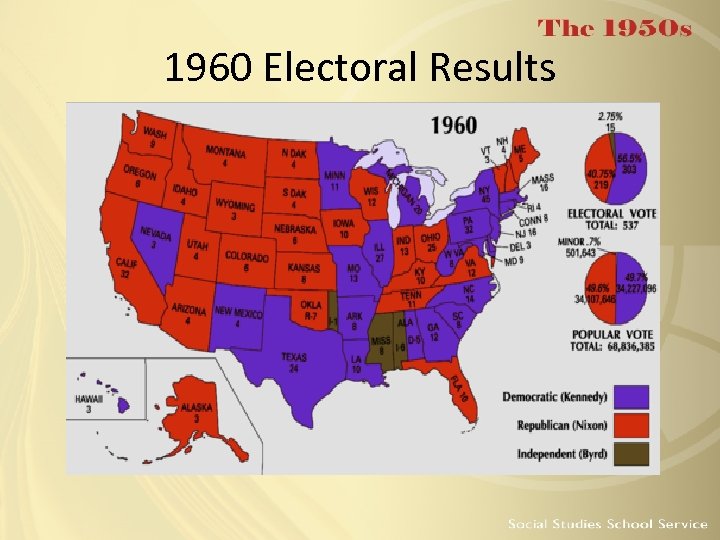 1960 Electoral Results
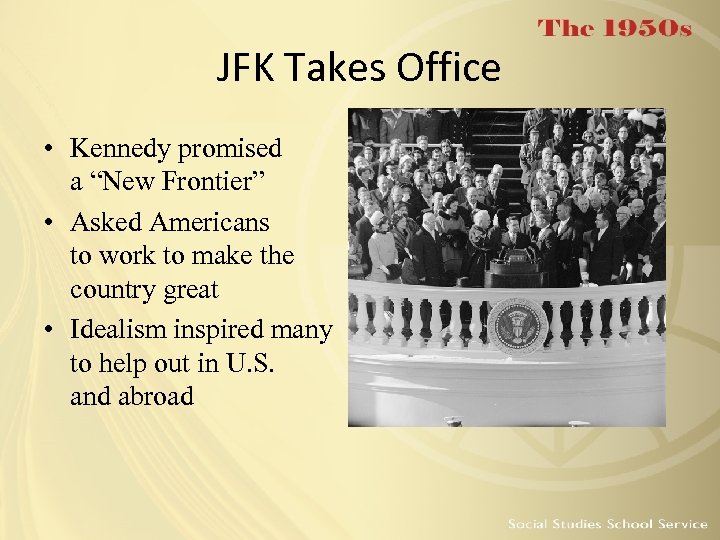 JFK Takes Office • Kennedy promised a “New Frontier” • Asked Americans to work to make the country great • Idealism inspired many to help out in U. S. and abroad
 The Legacy of the 1950 s • Cold War got “colder” • Civil rights movement led to Civil Rights Act (1964) and Voting Rights Act (1965) • Women’s rights movement and NOW • Beats and other symbols of rebellion contributed to social activism • 1960 s “British invasion” built on early rock ‘n’ roll
 Discussion Questions 1. Why did the U. S. stop supporting the Viet Minh in its struggle against the French? What were the results of the Geneva Accords? 2. Why did the U. S. not support elections to reunify Vietnam? 3. Why you think that television had helped Nixon stay on Eisenhower’s ticket in 1952, but hurt his presidential campaign in 1960?