 Скачать презентацию The 1920 s Chapters 12 13 Republican Administrations
2b11e77e6d410db017159bd47184ea1a.ppt
- Количество слайдов: 26



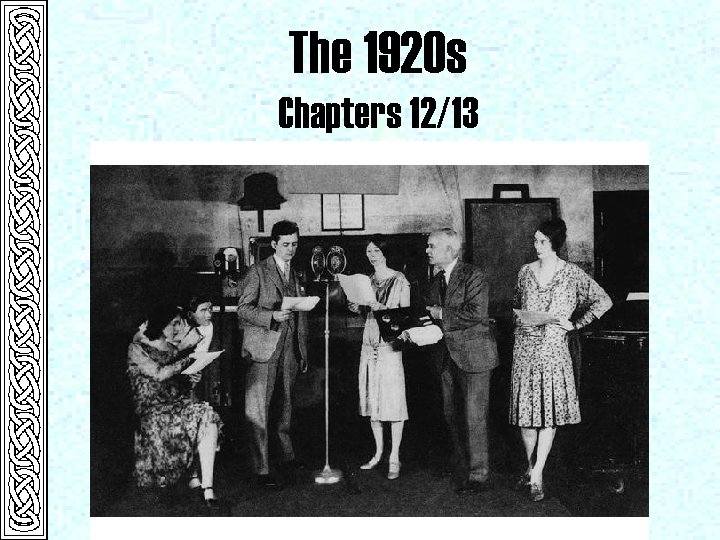
The 1920 s Chapters 12/13
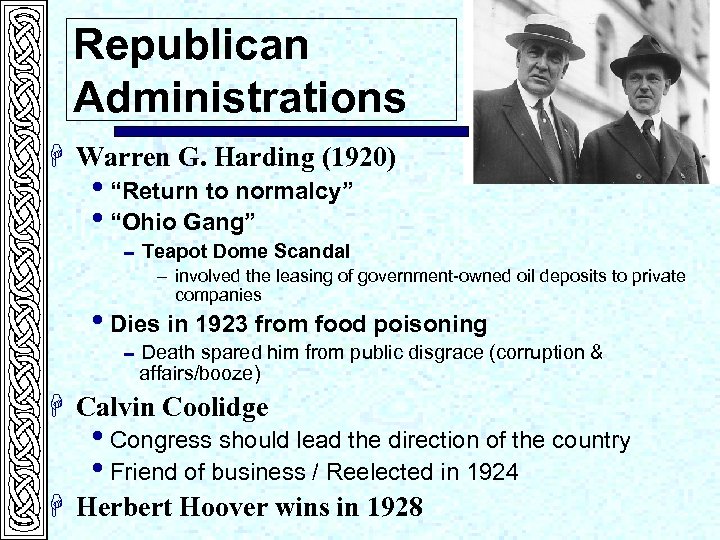
Republican Administrations H Warren G. Harding (1920) i“Return to normalcy” i“Ohio Gang” 0 Teapot Dome Scandal – involved the leasing of government-owned oil deposits to private companies i. Dies in 1923 from food poisoning 0 Death spared him from public disgrace (corruption & affairs/booze) H Calvin Coolidge i. Congress should lead the direction of the country i. Friend of business / Reelected in 1924 H Herbert Hoover wins in 1928
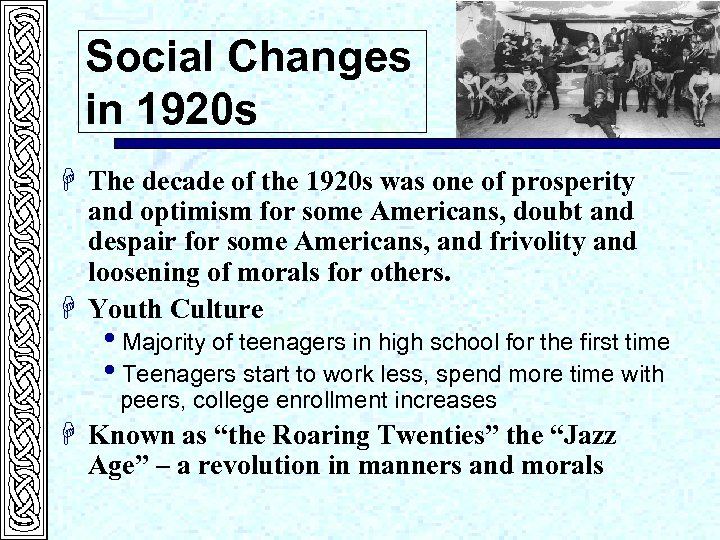
Social Changes in 1920 s H The decade of the 1920 s was one of prosperity and optimism for some Americans, doubt and despair for some Americans, and frivolity and loosening of morals for others. H Youth Culture i. Majority of teenagers in high school for the first time i. Teenagers start to work less, spend more time with peers, college enrollment increases H Known as “the Roaring Twenties” the “Jazz Age” – a revolution in manners and morals
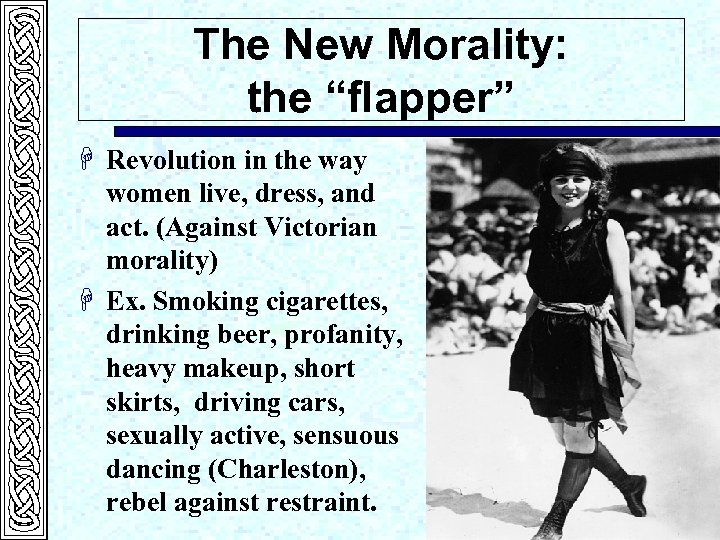
The New Morality: the “flapper” H Revolution in the way women live, dress, and act. (Against Victorian morality) H Ex. Smoking cigarettes, drinking beer, profanity, heavy makeup, short skirts, driving cars, sexually active, sensuous dancing (Charleston), rebel against restraint.
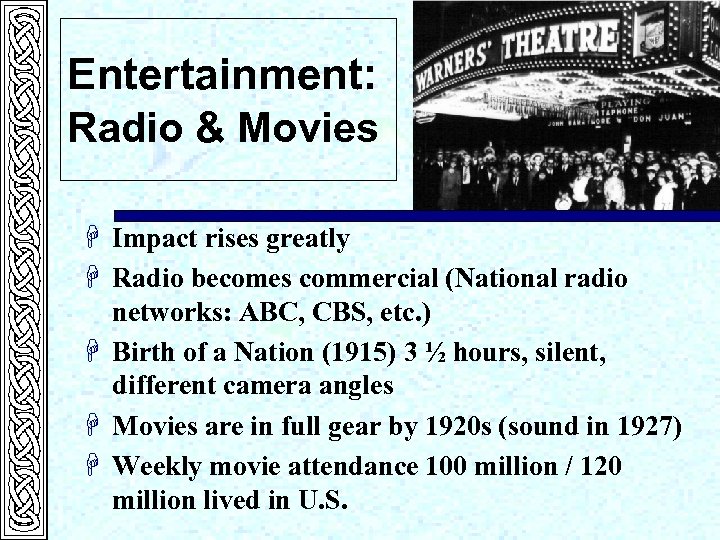
Entertainment: Radio & Movies H Impact rises greatly H Radio becomes commercial (National radio networks: ABC, CBS, etc. ) H Birth of a Nation (1915) 3 ½ hours, silent, different camera angles H Movies are in full gear by 1920 s (sound in 1927) H Weekly movie attendance 100 million / 120 million lived in U. S.
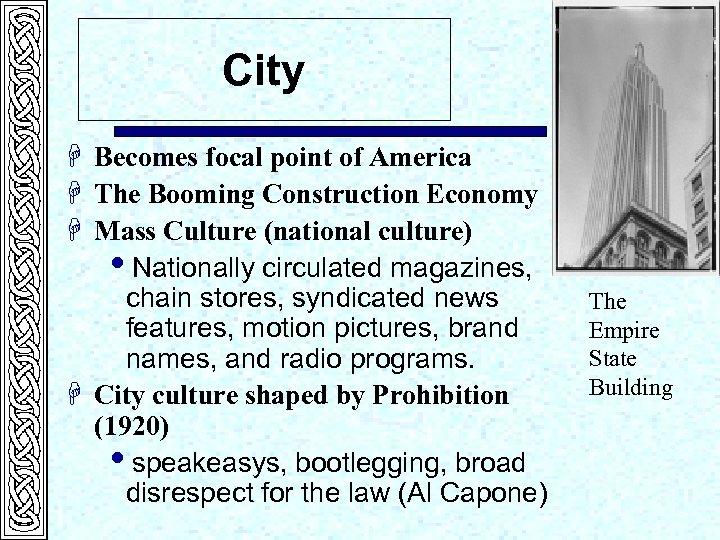
City H Becomes focal point of America H The Booming Construction Economy H Mass Culture (national culture) i. Nationally circulated magazines, chain stores, syndicated news features, motion pictures, brand names, and radio programs. H City culture shaped by Prohibition (1920) ispeakeasys, bootlegging, broad disrespect for the law (Al Capone) The Empire State Building
The Roaring Economy H Revolution in Production i. Manufacturing rose 64 percent i. The sale of electricity doubled i. Consumption of fuel oil doubled H Between 1922 and 1927 the economy grew by 7 percent a year– the largest peacetime rate ever. H Welfare capitalism i. Improved working conditions, increased pay, softball leagues, cafeterias, etc.
The Roaring Economy H Technology and Consumer Spending i. Steam turbines and shovels, electric motors, belt and bucket conveyors, and countless other new machines became commonplace at work sites. i. Machines replaced 200, 000 workers each year; however, demand for consumer goods kept the labor force growing.
The Roaring Economy: Spend! H More consumer products appeared on store shelves: i. Cigarette lighters, wristwatches, radios, film. i. Improvements in productivity helped keep prices down. H Goods once available only to the wealthy were now made accessible to the general public iwashing machines, refrigerators, electric ranges, vacuum cleaners, cameras. H The purchasing power of wage earners jumped by 20 percent.
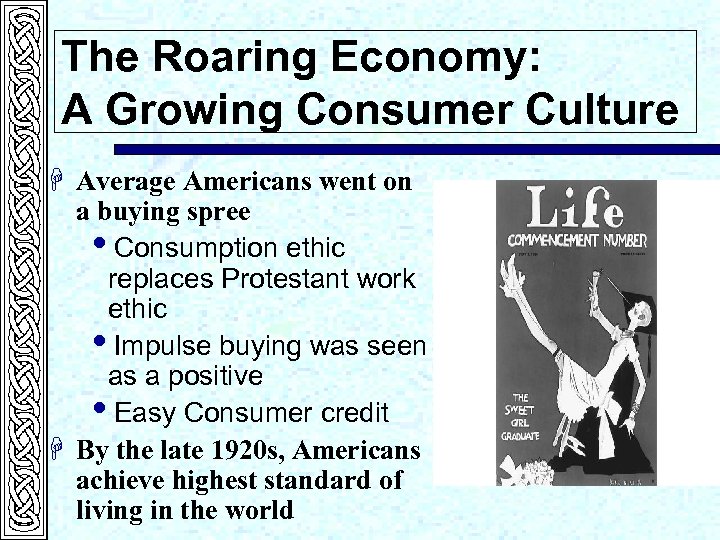
The Roaring Economy: A Growing Consumer Culture H Average Americans went on a buying spree i. Consumption ethic replaces Protestant work ethic i. Impulse buying was seen as a positive i. Easy Consumer credit H By the late 1920 s, Americans achieve highest standard of living in the world
The Roaring Economy: Warning Signs H For all the prosperity, a dangerous imbalance in the economy developed. i. Most Americans were putting very little of their savings into the bank. i. Personal debt was rising two and a half times faster than personal income. i. Business profits double/ workers’ wages rise 30%
The Roaring Economy H The Booming Construction Industry i. Residential construction doubled as people moved from cities to suburbs. i. Road construction made suburban life possible and pumped millions of dollars in the economy. 0 States began implementing taxes on gasoline. i. Construction stimulated other businesses 0 Steel, concrete, lumber, home mortgages, and insurance.
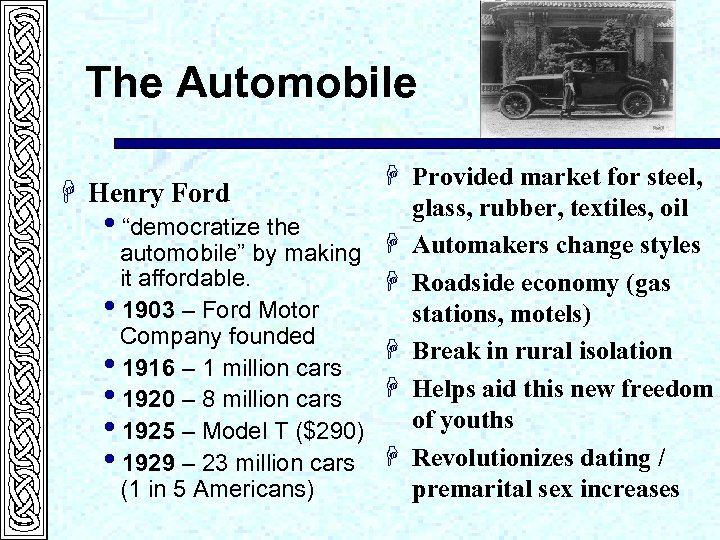
The Automobile H Provided market for steel, H Henry Ford glass, rubber, textiles, oil i“democratize the automobile” by making H Automakers change styles it affordable. H Roadside economy (gas i 1903 – Ford Motor stations, motels) Company founded H Break in rural isolation i 1916 – 1 million cars H Helps aid this new freedom i 1920 – 8 million cars of youths i 1925 – Model T ($290) i 1929 – 23 million cars H Revolutionizes dating / (1 in 5 Americans) premarital sex increases
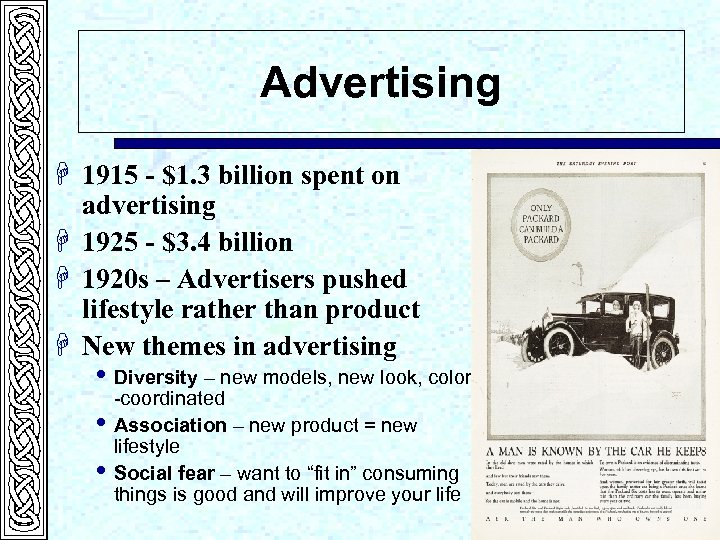
Advertising H 1915 - $1. 3 billion spent on advertising H 1925 - $3. 4 billion H 1920 s – Advertisers pushed lifestyle rather than product H New themes in advertising i Diversity – new models, new look, color -coordinated i Association – new product = new lifestyle i Social fear – want to “fit in” consuming things is good and will improve your life
Tension and Response H Tension: old rural culture (work ethic) vs. new city culture (consumer culture H Responses i. Acceptance – (young people and city dwellers) i. Opposition i. Division (most Americans) 0 Torn between new lifestyle and traditional values 0 This issue will be put on shelf during 1930 s (trying to eat), 1940 s (trying to fight WWII), but Americans come back to this issue in late 1940 s
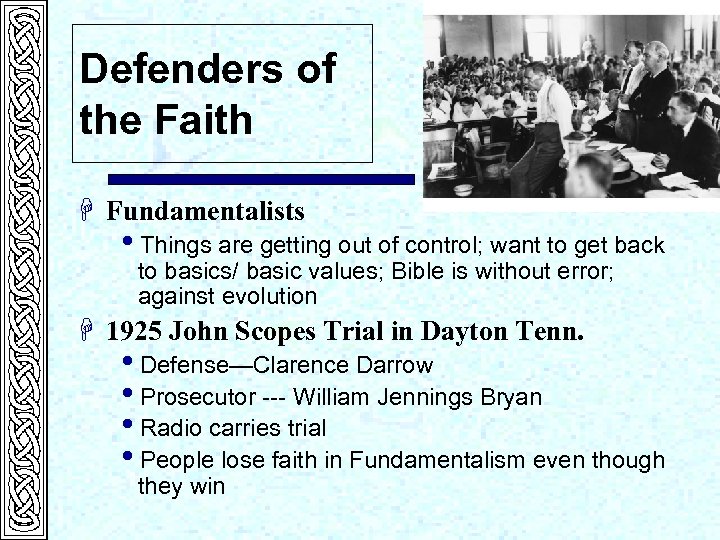
Defenders of the Faith H Fundamentalists i. Things are getting out of control; want to get back to basics/ basic values; Bible is without error; against evolution H 1925 John Scopes Trial in Dayton Tenn. i. Defense—Clarence Darrow i. Prosecutor --- William Jennings Bryan i. Radio carries trial i. People lose faith in Fundamentalism even though they win
Nativism and Immigration Restriction H Nicola Sacco and Bartolomeo Vanzetti i. Two Italian aliens and admitted anarchists i 1921, sentenced to death for a shoe company robbery and murder in Mass. Executed in 1927 i. World reaction: A symbol of American bigotry and prejudice. H National Origins Act (1921 & 1924) i. East Asian immigration stopped i. Limit on immigrants: 350, 000 per year / 150, 000 i. Quota of 3 percent of each nationality already in the U. S. as of 1910. Later pushed back to 1890. Bias toward “old” immigrants i. Coolidge--- “America must be kept American”
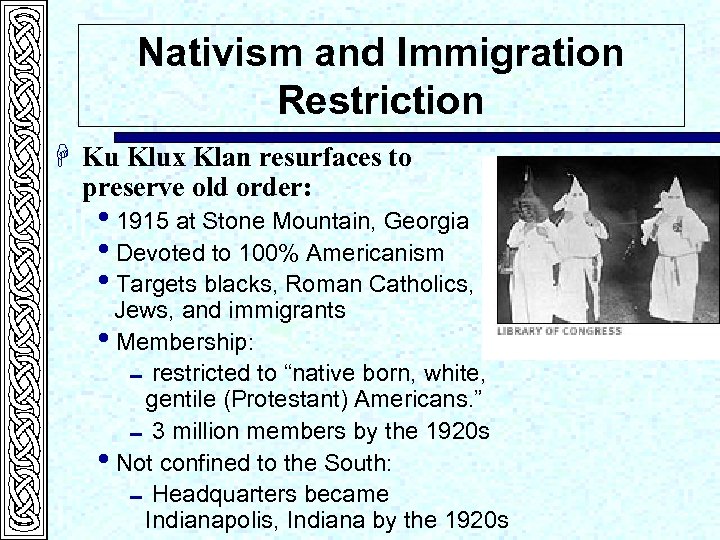
Nativism and Immigration Restriction H Ku Klux Klan resurfaces to preserve old order: i 1915 at Stone Mountain, Georgia i. Devoted to 100% Americanism i. Targets blacks, Roman Catholics, Jews, and immigrants i. Membership: 0 restricted to “native born, white, gentile (Protestant) Americans. ” 03 million members by the 1920 s i. Not confined to the South: 0 Headquarters became Indianapolis, Indiana by the 1920 s
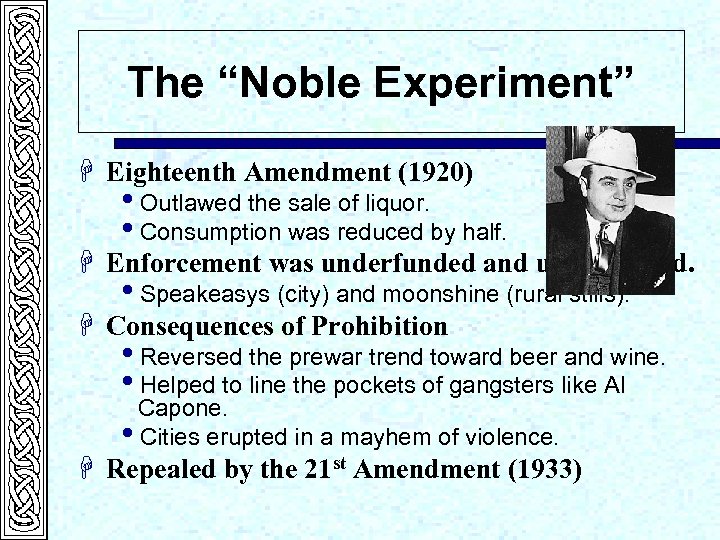
The “Noble Experiment” H Eighteenth Amendment (1920) i. Outlawed the sale of liquor. i. Consumption was reduced by half. H Enforcement was underfunded and understaffed. i. Speakeasys (city) and moonshine (rural stills). H Consequences of Prohibition i. Reversed the prewar trend toward beer and wine. i. Helped to line the pockets of gangsters like Al Capone. i. Cities erupted in a mayhem of violence. H Repealed by the 21 st Amendment (1933)
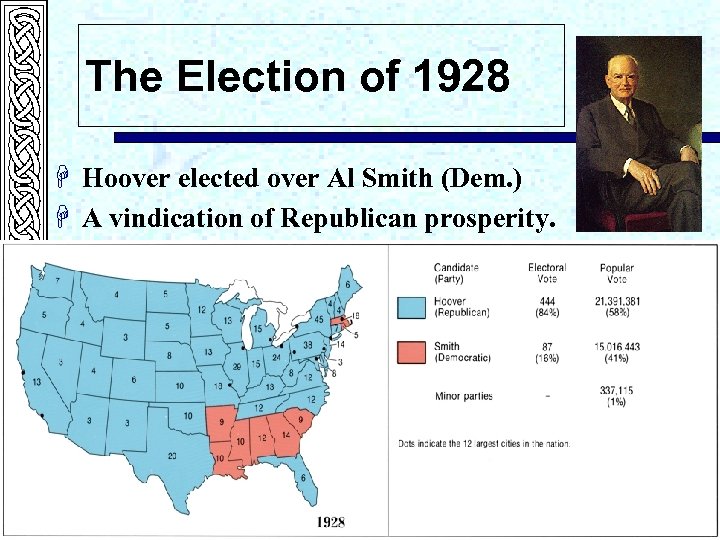
The Election of 1928 H Hoover elected over Al Smith (Dem. ) H A vindication of Republican prosperity.
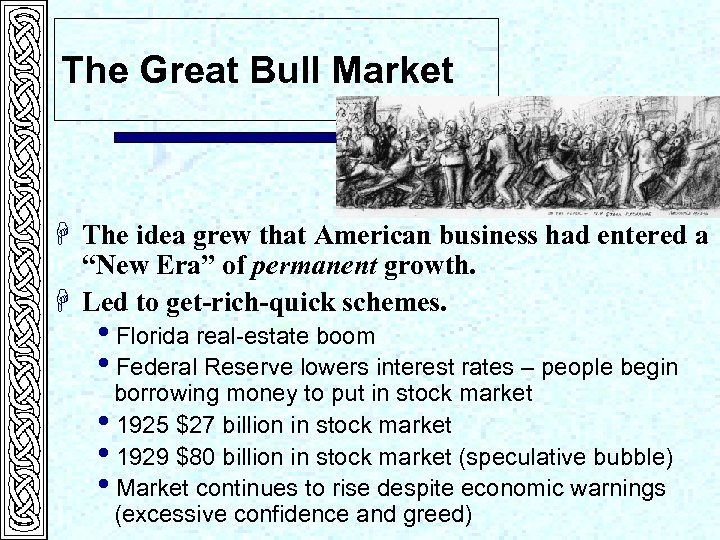
The Great Bull Market H The idea grew that American business had entered a “New Era” of permanent growth. H Led to get-rich-quick schemes. i. Florida real-estate boom i. Federal Reserve lowers interest rates – people begin borrowing money to put in stock market i 1925 $27 billion in stock market i 1929 $80 billion in stock market (speculative bubble) i. Market continues to rise despite economic warnings (excessive confidence and greed)
The Great Crash H Tuesday, October 29, 1929, the stock market index dropped almost 13 percent. i. From 1929 to 1932, Americans’ personal incomes declined by more than half. i. The crash had revealed the economy’s structural problems. (symptom of larger problem)
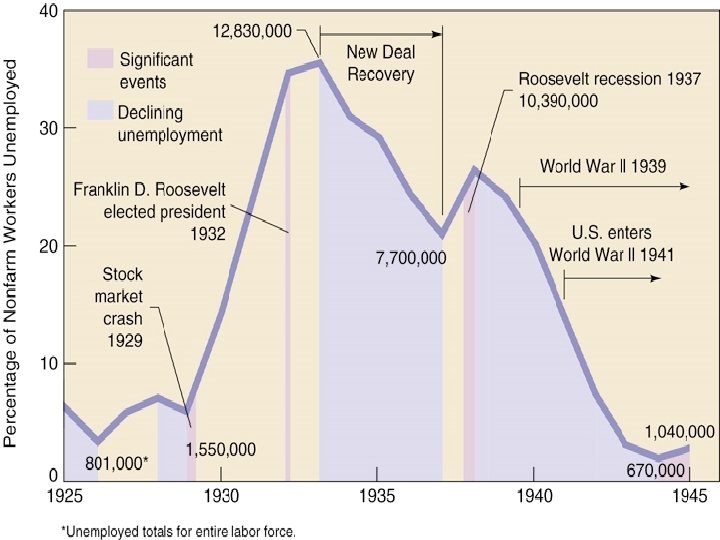
The Causes of the Great Depression H Overexpansion and decline in mass purchasing power i. Business had done too well H Consumer debt and the uneven distribution of wealth i. Wages did not rise fast enough to consume products H Banking system (banks crash—U. S. loses savings) i. Funds used for speculative investments i. Low money supply because of gold standard
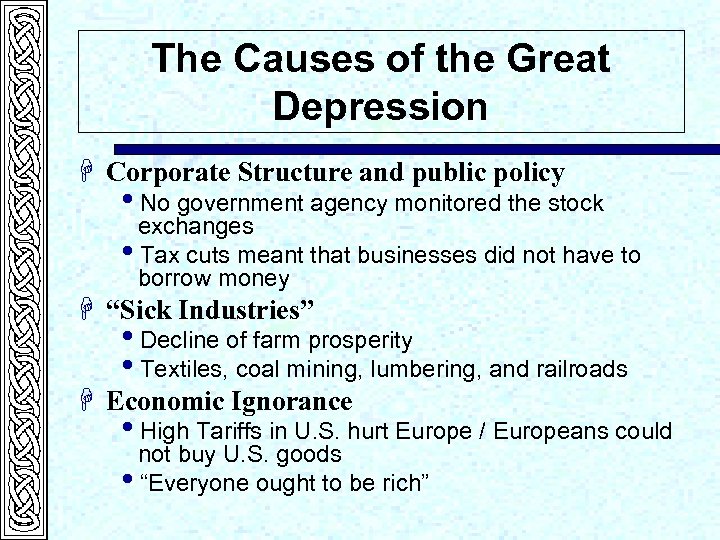
The Causes of the Great Depression H Corporate Structure and public policy i. No government agency monitored the stock exchanges i. Tax cuts meant that businesses did not have to borrow money H “Sick Industries” i. Decline of farm prosperity i. Textiles, coal mining, lumbering, and railroads H Economic Ignorance i. High Tariffs in U. S. hurt Europe / Europeans could not buy U. S. goods i“Everyone ought to be rich”
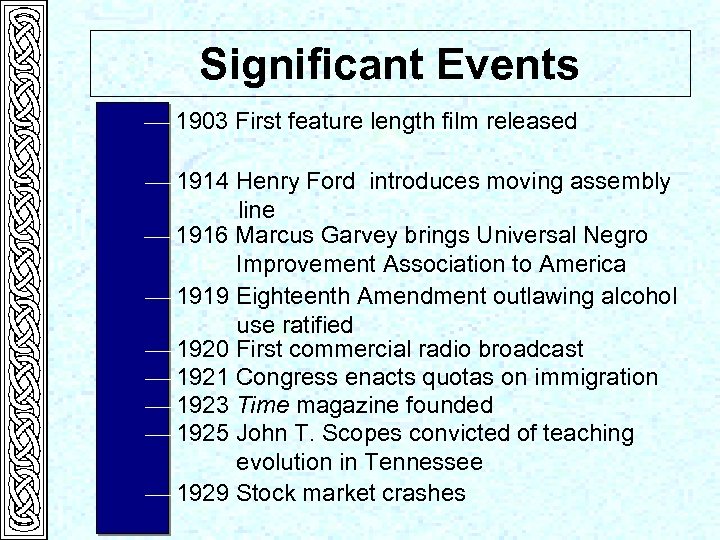
Significant Events 1903 First feature length film released 1914 Henry Ford introduces moving assembly line 1916 Marcus Garvey brings Universal Negro Improvement Association to America 1919 Eighteenth Amendment outlawing alcohol use ratified 1920 First commercial radio broadcast 1921 Congress enacts quotas on immigration 1923 Time magazine founded 1925 John T. Scopes convicted of teaching evolution in Tennessee 1929 Stock market crashes
Скачать презентацию The 1920 s Chapters 12 13 Republican Administrations
2b11e77e6d410db017159bd47184ea1a.ppt