


 Скачать презентацию The 1920 s America at the Start
8553604de01a56e90016f21d87875dee.ppt
- Количество слайдов: 42
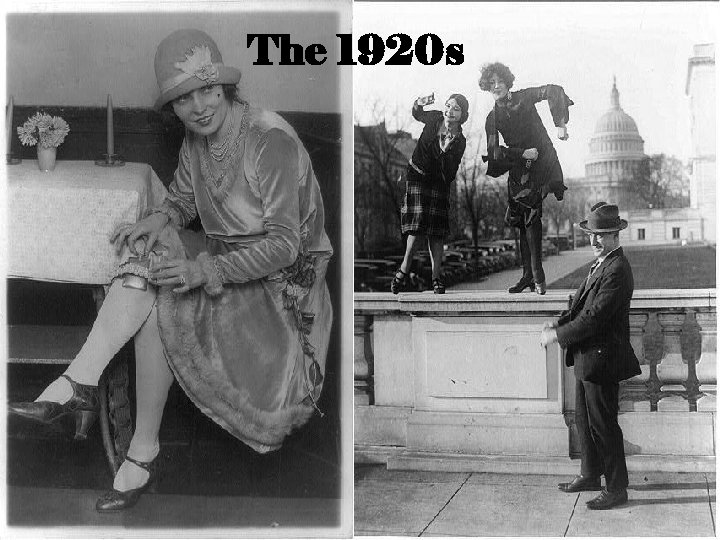 The 1920 s
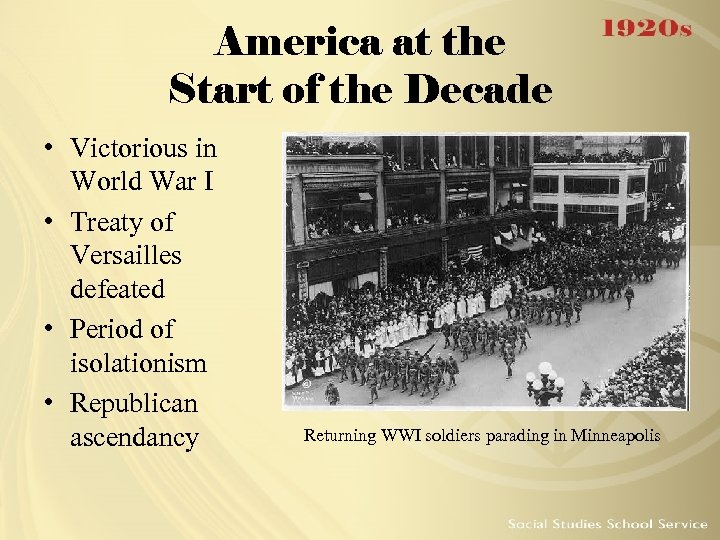 America at the Start of the Decade • Victorious in World War I • Treaty of Versailles defeated • Period of isolationism • Republican ascendancy Returning WWI soldiers parading in Minneapolis
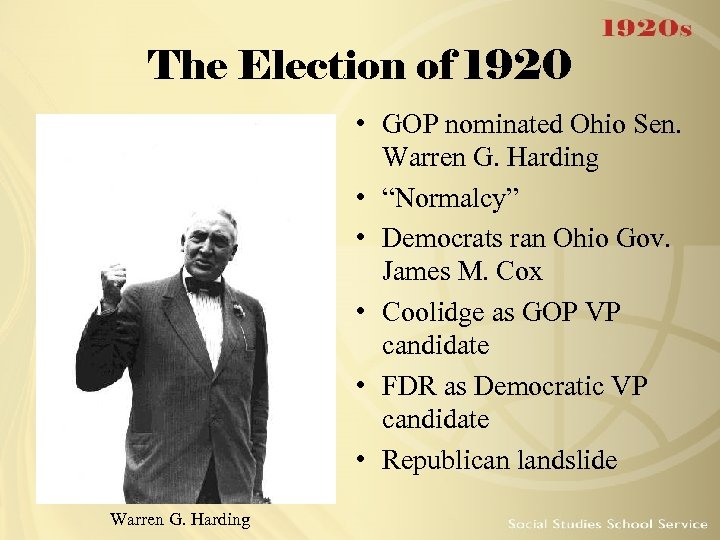 The Election of 1920 • GOP nominated Ohio Sen. Warren G. Harding • “Normalcy” • Democrats ran Ohio Gov. James M. Cox • Coolidge as GOP VP candidate • FDR as Democratic VP candidate • Republican landslide Warren G. Harding
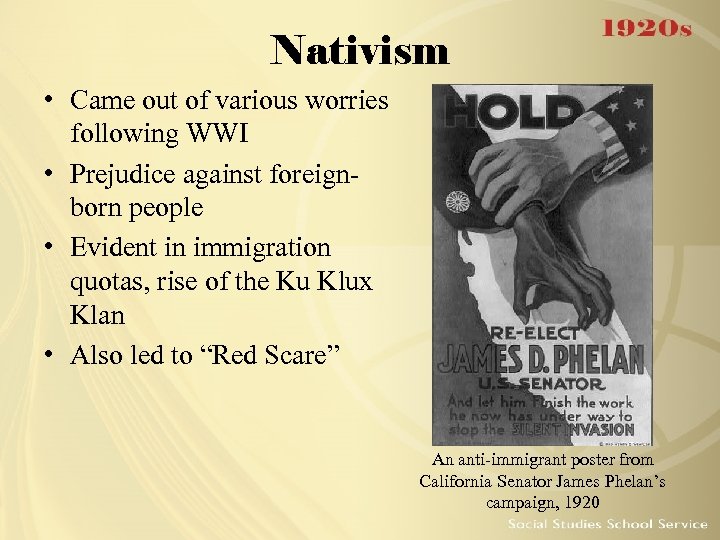 Nativism • Came out of various worries following WWI • Prejudice against foreignborn people • Evident in immigration quotas, rise of the Ku Klux Klan • Also led to “Red Scare” An anti-immigrant poster from California Senator James Phelan’s campaign, 1920
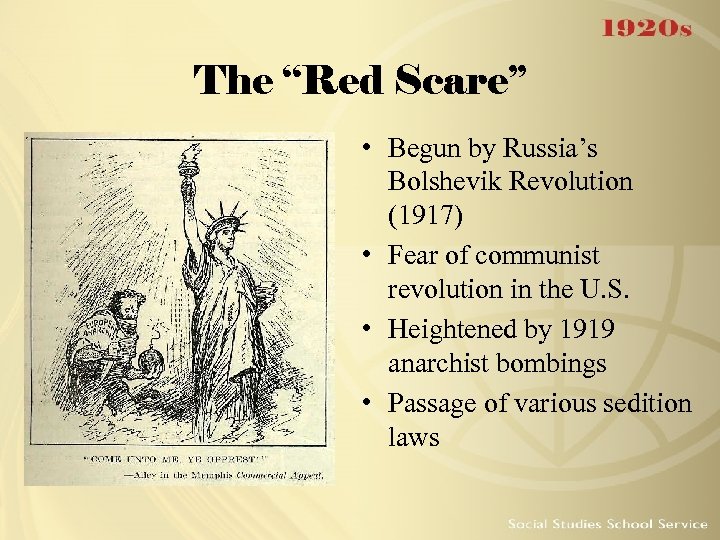 The “Red Scare” • Begun by Russia’s Bolshevik Revolution (1917) • Fear of communist revolution in the U. S. • Heightened by 1919 anarchist bombings • Passage of various sedition laws
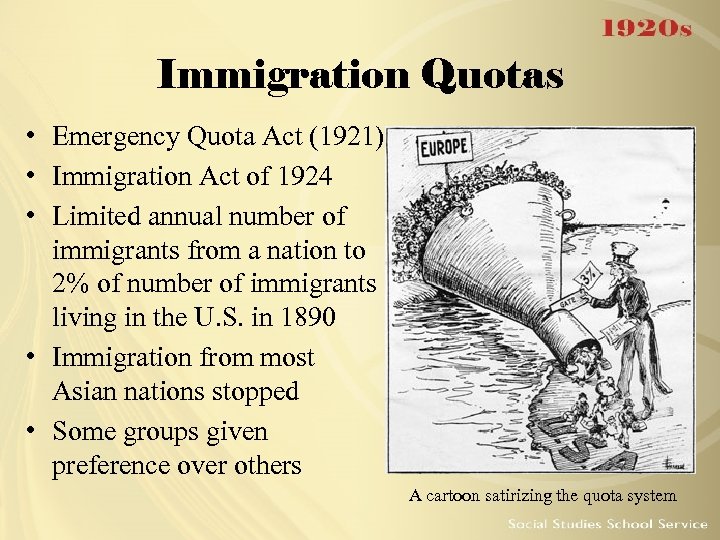 Immigration Quotas • Emergency Quota Act (1921) • Immigration Act of 1924 • Limited annual number of immigrants from a nation to 2% of number of immigrants living in the U. S. in 1890 • Immigration from most Asian nations stopped • Some groups given preference over others A cartoon satirizing the quota system
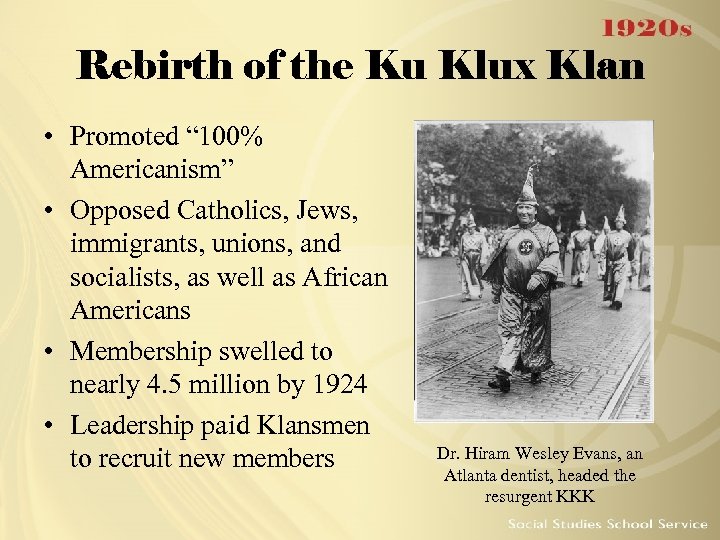 Rebirth of the Ku Klux Klan • Promoted “ 100% Americanism” • Opposed Catholics, Jews, immigrants, unions, and socialists, as well as African Americans • Membership swelled to nearly 4. 5 million by 1924 • Leadership paid Klansmen to recruit new members Dr. Hiram Wesley Evans, an Atlanta dentist, headed the resurgent KKK
 From “The Ku Klux Klan Defends Americanism” “First in the Klansman’s mind is patriotism—America for Americans. He believes religiously that a betrayal of Americanism or the American race is treason to the most sacred of trusts, a trust from his fathers and a trust from God. He believes, too, that Americanism can only be achieved if the pioneer stock is kept pure…” The second word in the Klansman’s trilogy is ‘white. ’ The white race must be supreme, not only in America but in the world. This is equally undebatable, except on the ground that the races might live together, each with full regard for the rights and interests of others, and that those rights and interests would never conflict. The third of the Klan principles is that Protestantism must be supreme; that Rome shall not rule America. The Klansman believes this is not merely because he is a Protestant, nor even because the Colonies that are now our nation were settled for the purpose of wresting America from the control of Rome and establishing a land of free conscience. He believes it also because Protestantism is an essential part of Americanism; without it America could never have been created and without it she cannot go forward. Roman rule would kill it. ” Dr. Hiram Wesley Evans, in North American Review, March–May 1926
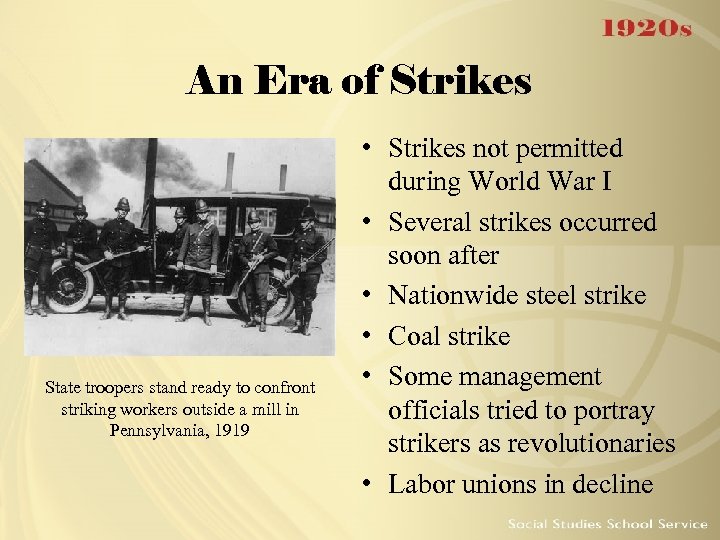 An Era of Strikes State troopers stand ready to confront striking workers outside a mill in Pennsylvania, 1919 • Strikes not permitted during World War I • Several strikes occurred soon after • Nationwide steel strike • Coal strike • Some management officials tried to portray strikers as revolutionaries • Labor unions in decline
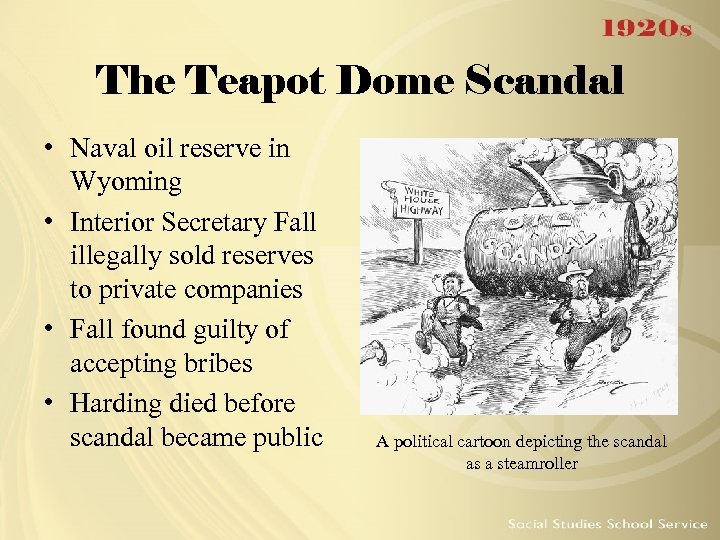 The Teapot Dome Scandal • Naval oil reserve in Wyoming • Interior Secretary Fall illegally sold reserves to private companies • Fall found guilty of accepting bribes • Harding died before scandal became public A political cartoon depicting the scandal as a steamroller
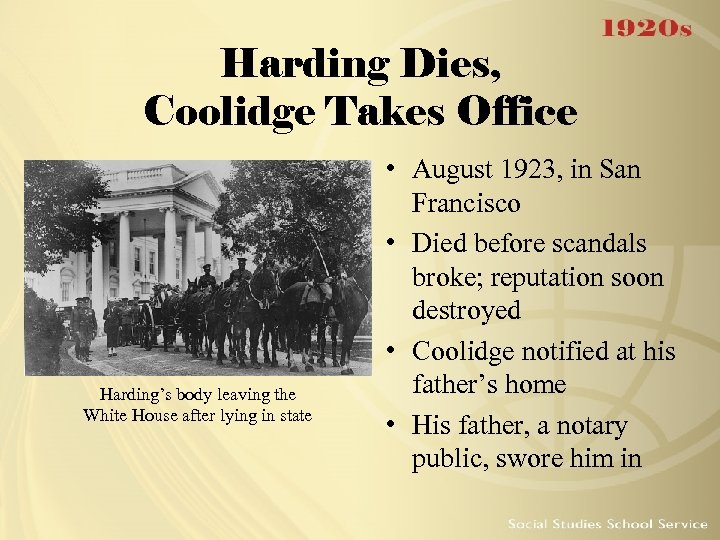 Harding Dies, Coolidge Takes Office Harding’s body leaving the White House after lying in state • August 1923, in San Francisco • Died before scandals broke; reputation soon destroyed • Coolidge notified at his father’s home • His father, a notary public, swore him in
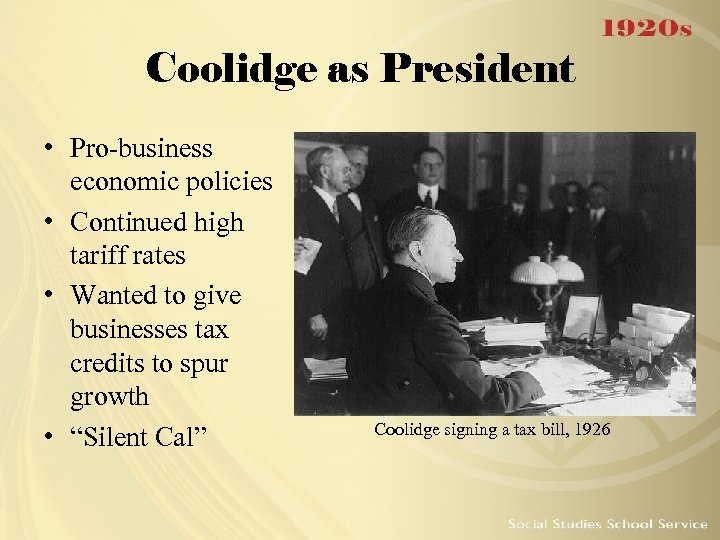 Coolidge as President • Pro-business economic policies • Continued high tariff rates • Wanted to give businesses tax credits to spur growth • “Silent Cal” Coolidge signing a tax bill, 1926
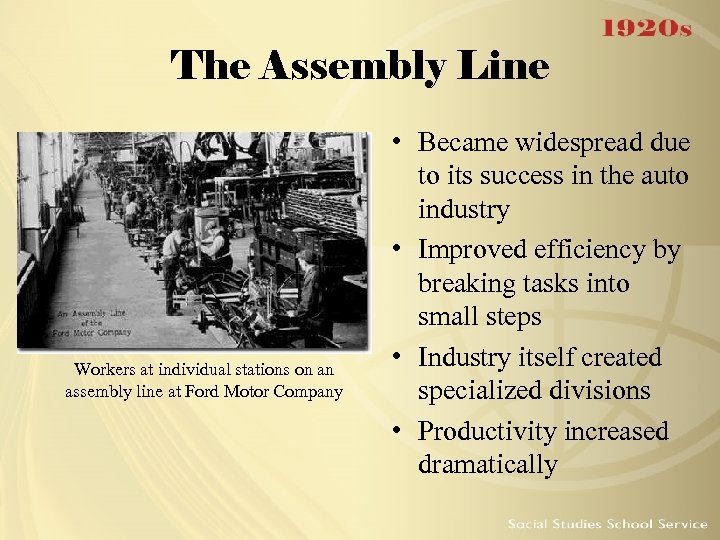 The Assembly Line Workers at individual stations on an assembly line at Ford Motor Company • Became widespread due to its success in the auto industry • Improved efficiency by breaking tasks into small steps • Industry itself created specialized divisions • Productivity increased dramatically
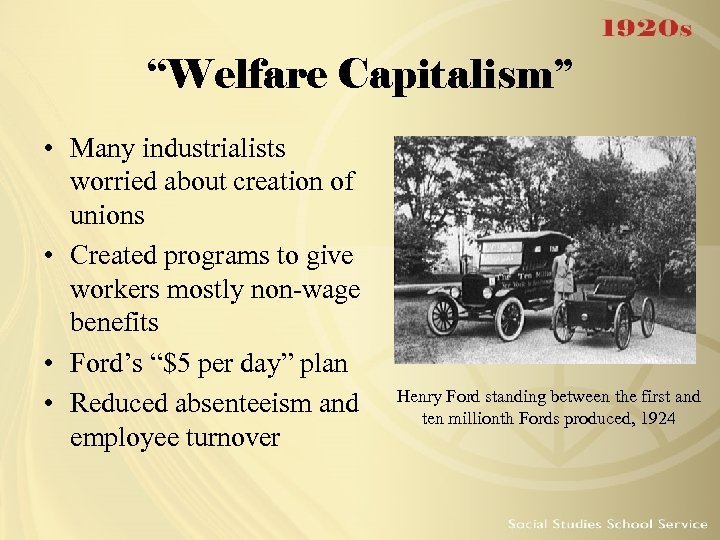 “Welfare Capitalism” • Many industrialists worried about creation of unions • Created programs to give workers mostly non-wage benefits • Ford’s “$5 per day” plan • Reduced absenteeism and employee turnover Henry Ford standing between the first and ten millionth Fords produced, 1924
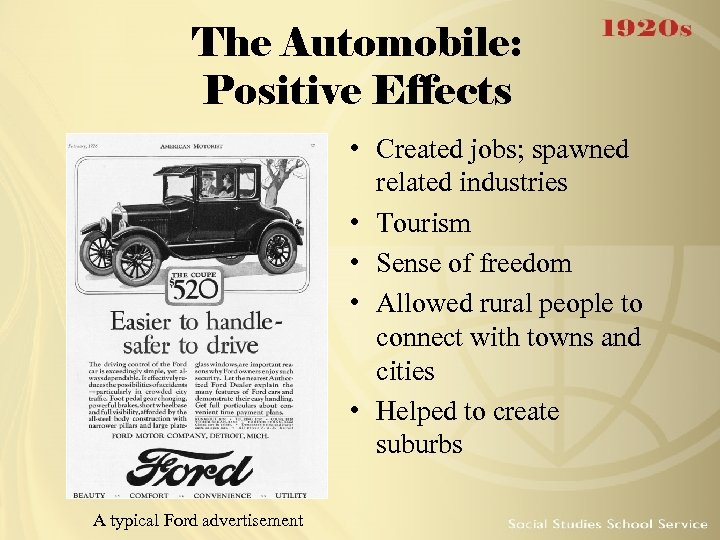 The Automobile: Positive Effects • Created jobs; spawned related industries • Tourism • Sense of freedom • Allowed rural people to connect with towns and cities • Helped to create suburbs A typical Ford advertisement
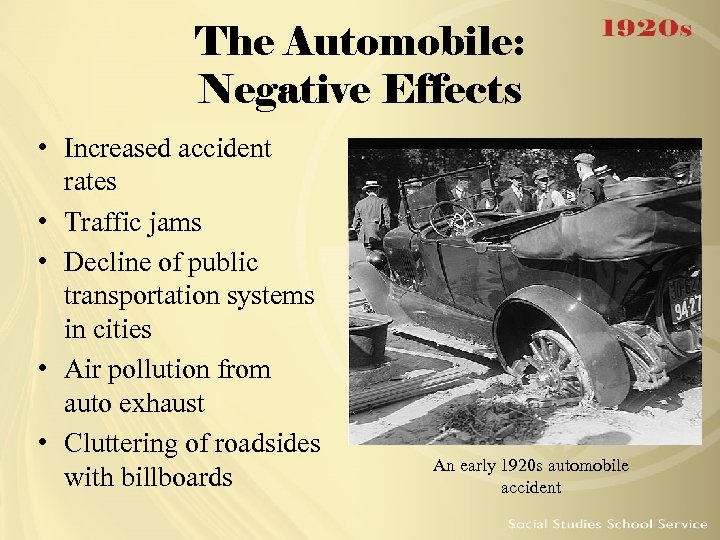 The Automobile: Negative Effects • Increased accident rates • Traffic jams • Decline of public transportation systems in cities • Air pollution from auto exhaust • Cluttering of roadsides with billboards An early 1920 s automobile accident
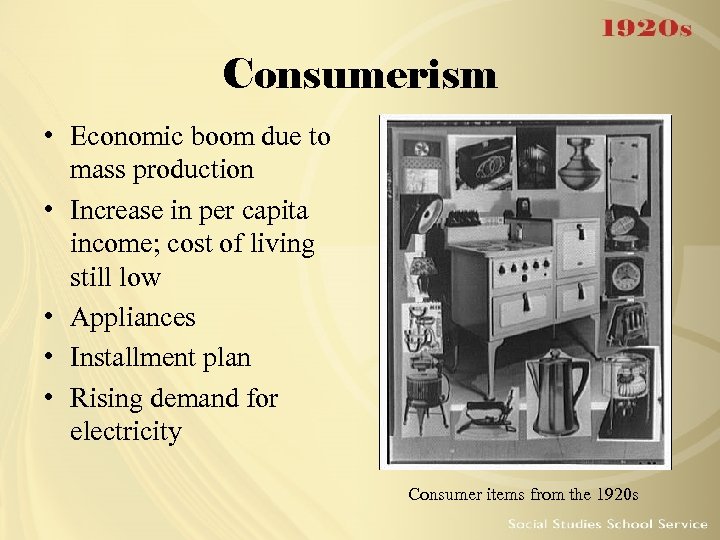 Consumerism • Economic boom due to mass production • Increase in per capita income; cost of living still low • Appliances • Installment plan • Rising demand for electricity Consumer items from the 1920 s
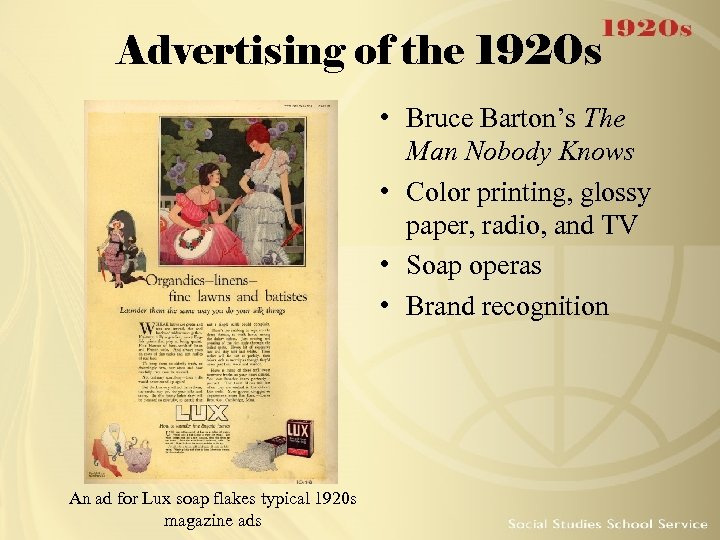 Advertising of the 1920 s • Bruce Barton’s The Man Nobody Knows • Color printing, glossy paper, radio, and TV • Soap operas • Brand recognition An ad for Lux soap flakes typical 1920 s magazine ads
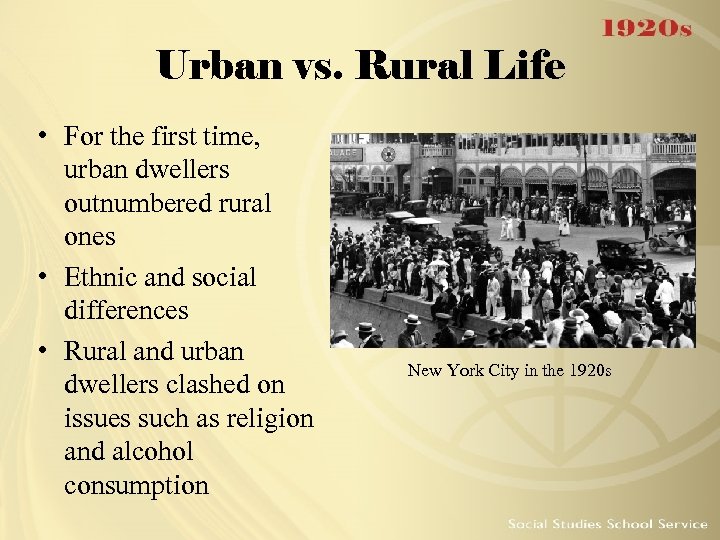 Urban vs. Rural Life • For the first time, urban dwellers outnumbered rural ones • Ethnic and social differences • Rural and urban dwellers clashed on issues such as religion and alcohol consumption New York City in the 1920 s
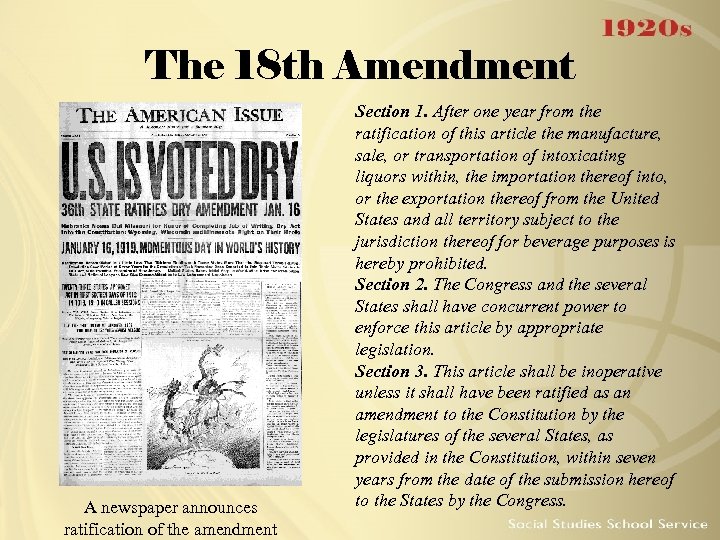 The 18 th Amendment A newspaper announces ratification of the amendment Section 1. After one year from the ratification of this article the manufacture, sale, or transportation of intoxicating liquors within, the importation thereof into, or the exportation thereof from the United States and all territory subject to the jurisdiction thereof for beverage purposes is hereby prohibited. Section 2. The Congress and the several States shall have concurrent power to enforce this article by appropriate legislation. Section 3. This article shall be inoperative unless it shall have been ratified as an amendment to the Constitution by the legislatures of the several States, as provided in the Constitution, within seven years from the date of the submission hereof to the States by the Congress.
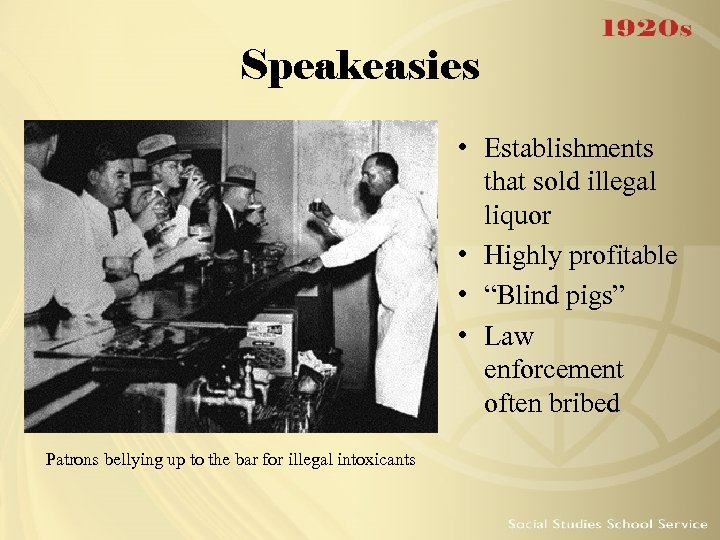 Speakeasies • Establishments that sold illegal liquor • Highly profitable • “Blind pigs” • Law enforcement often bribed Patrons bellying up to the bar for illegal intoxicants
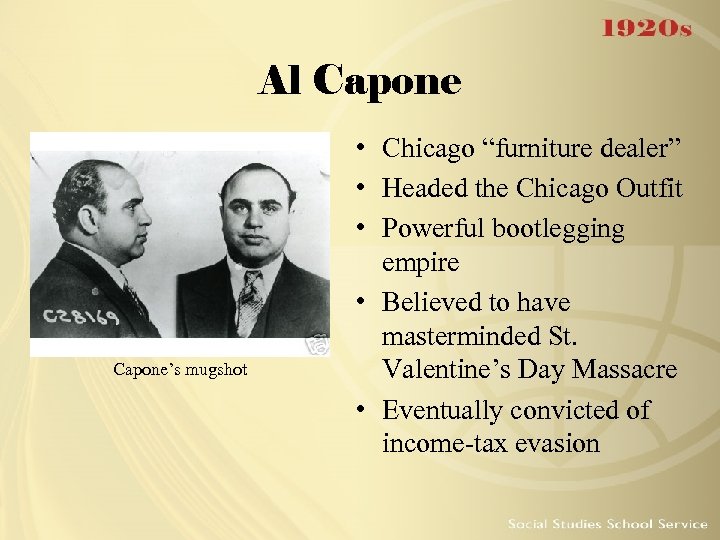 Al Capone’s mugshot • Chicago “furniture dealer” • Headed the Chicago Outfit • Powerful bootlegging empire • Believed to have masterminded St. Valentine’s Day Massacre • Eventually convicted of income-tax evasion
 Prohibition: Successes and Failures Successes: • Per capita consumption of alcohol decreased • Public drunkenness arrests declined • Deaths from alcoholism dropped • Fewer workers squandered paychecks on drinking Failures: • “Drys” insisted on abstinence, forcing many moderates to become lawbreakers • Strict enforcement nearly impossible • Skyrocketing enforcement costs • Rise of organized crime • Some poisoned by homemade liquor
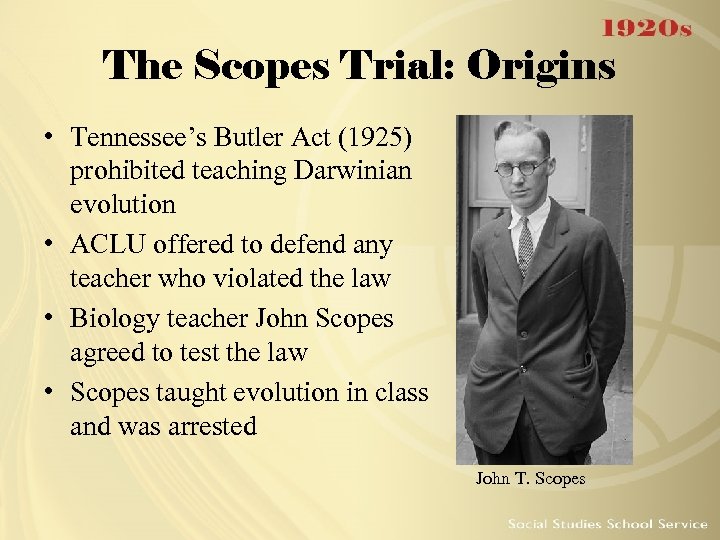 The Scopes Trial: Origins • Tennessee’s Butler Act (1925) prohibited teaching Darwinian evolution • ACLU offered to defend any teacher who violated the law • Biology teacher John Scopes agreed to test the law • Scopes taught evolution in class and was arrested John T. Scopes
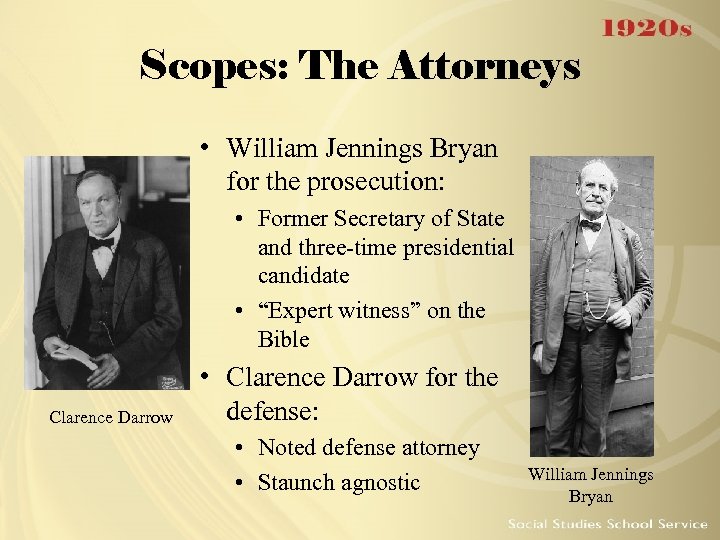 Scopes: The Attorneys • William Jennings Bryan for the prosecution: • Former Secretary of State and three-time presidential candidate • “Expert witness” on the Bible Clarence Darrow • Clarence Darrow for the defense: • Noted defense attorney • Staunch agnostic William Jennings Bryan
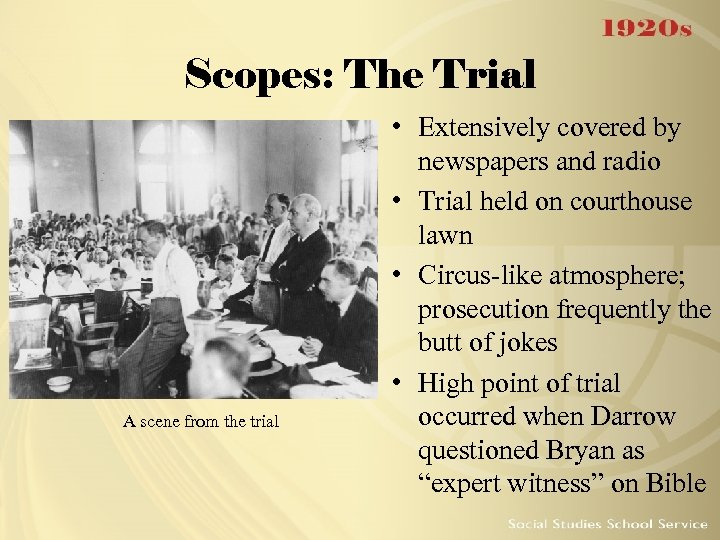 Scopes: The Trial A scene from the trial • Extensively covered by newspapers and radio • Trial held on courthouse lawn • Circus-like atmosphere; prosecution frequently the butt of jokes • High point of trial occurred when Darrow questioned Bryan as “expert witness” on Bible
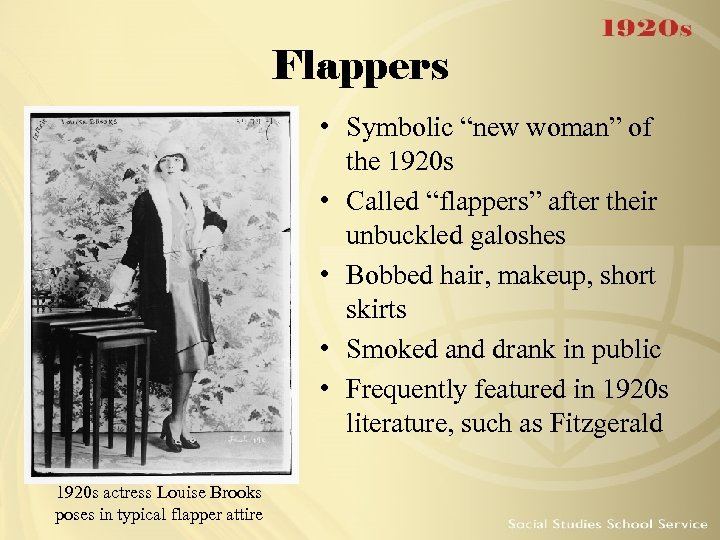 Flappers • Symbolic “new woman” of the 1920 s • Called “flappers” after their unbuckled galoshes • Bobbed hair, makeup, short skirts • Smoked and drank in public • Frequently featured in 1920 s literature, such as Fitzgerald 1920 s actress Louise Brooks poses in typical flapper attire
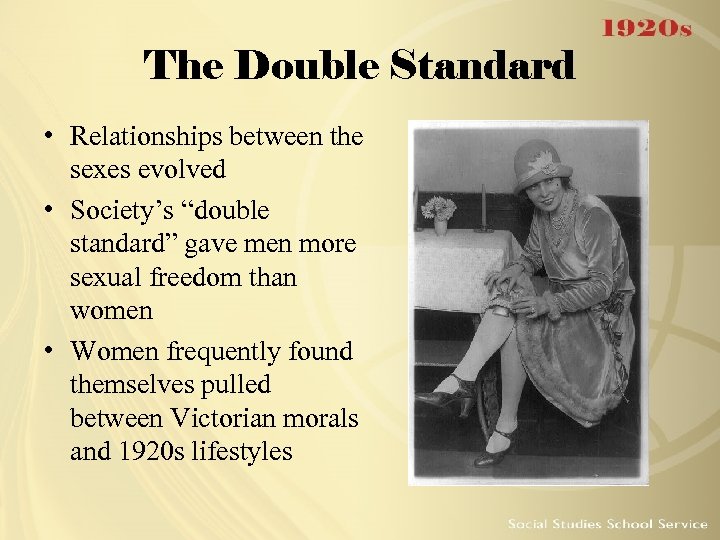 The Double Standard • Relationships between the sexes evolved • Society’s “double standard” gave men more sexual freedom than women • Women frequently found themselves pulled between Victorian morals and 1920 s lifestyles
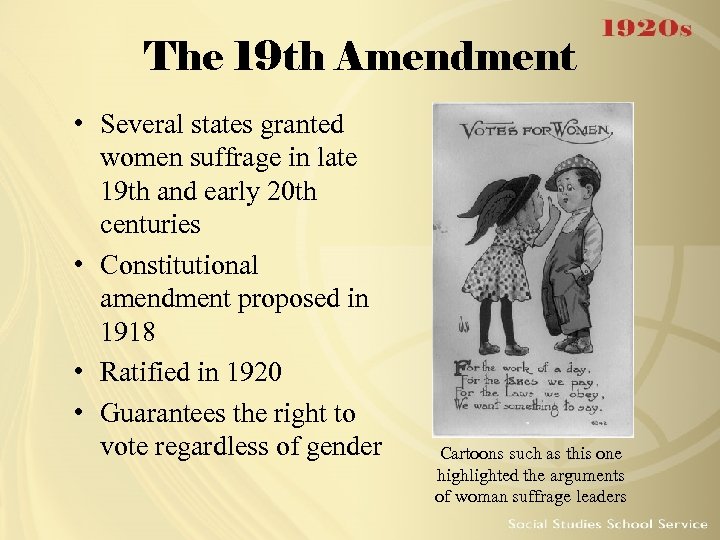 The 19 th Amendment • Several states granted women suffrage in late 19 th and early 20 th centuries • Constitutional amendment proposed in 1918 • Ratified in 1920 • Guarantees the right to vote regardless of gender Cartoons such as this one highlighted the arguments of woman suffrage leaders
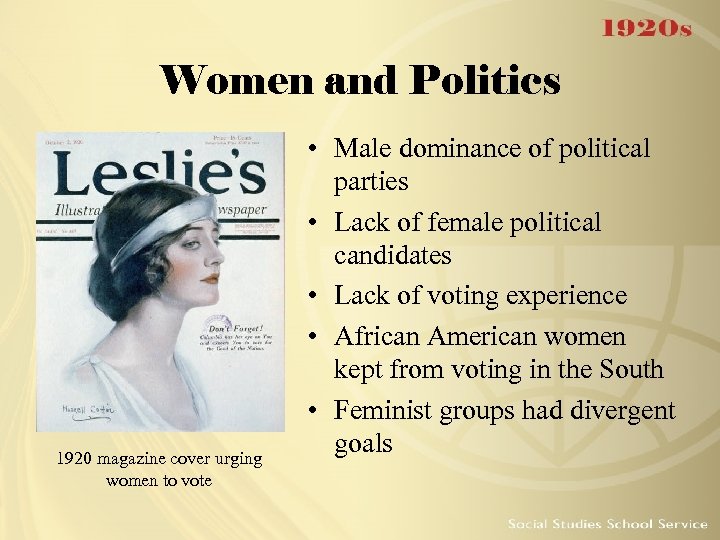 Women and Politics 1920 magazine cover urging women to vote • Male dominance of political parties • Lack of female political candidates • Lack of voting experience • African American women kept from voting in the South • Feminist groups had divergent goals
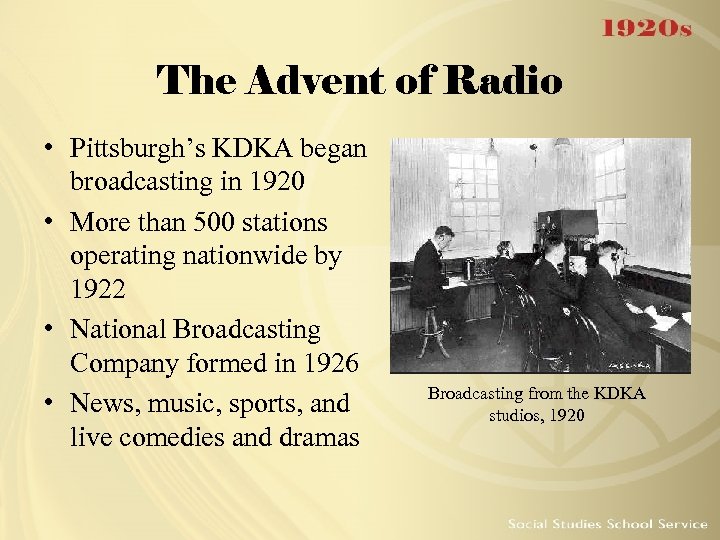 The Advent of Radio • Pittsburgh’s KDKA began broadcasting in 1920 • More than 500 stations operating nationwide by 1922 • National Broadcasting Company formed in 1926 • News, music, sports, and live comedies and dramas Broadcasting from the KDKA studios, 1920
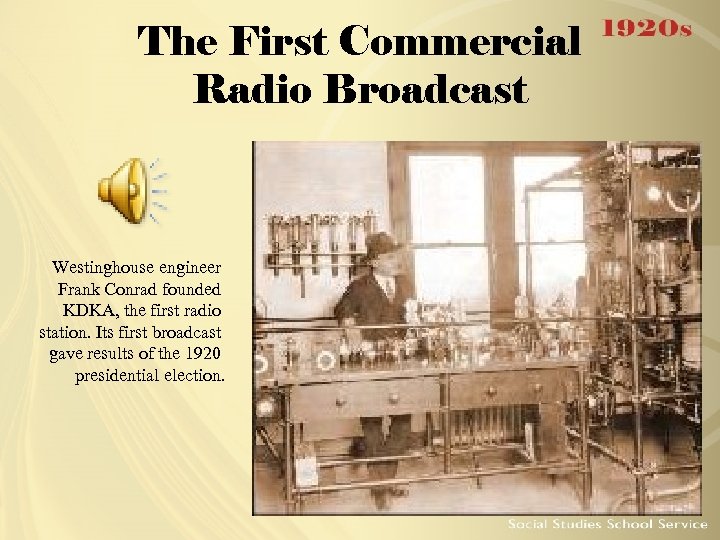 The First Commercial Radio Broadcast Westinghouse engineer Frank Conrad founded KDKA, the first radio station. Its first broadcast gave results of the 1920 presidential election.
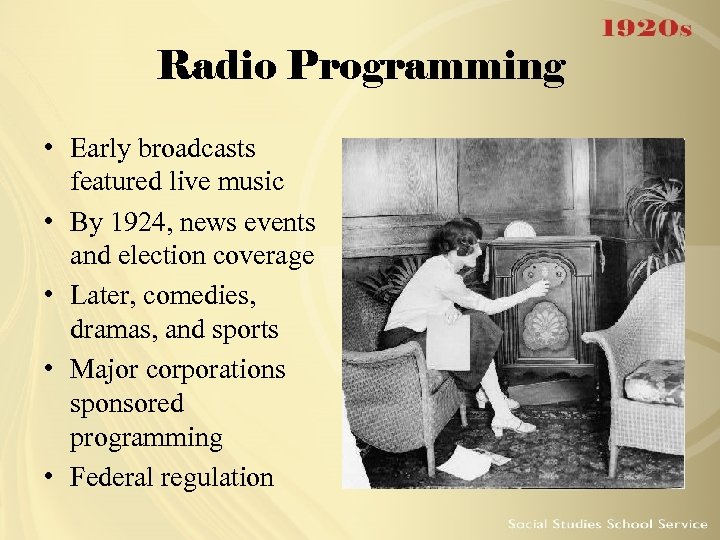 Radio Programming • Early broadcasts featured live music • By 1924, news events and election coverage • Later, comedies, dramas, and sports • Major corporations sponsored programming • Federal regulation
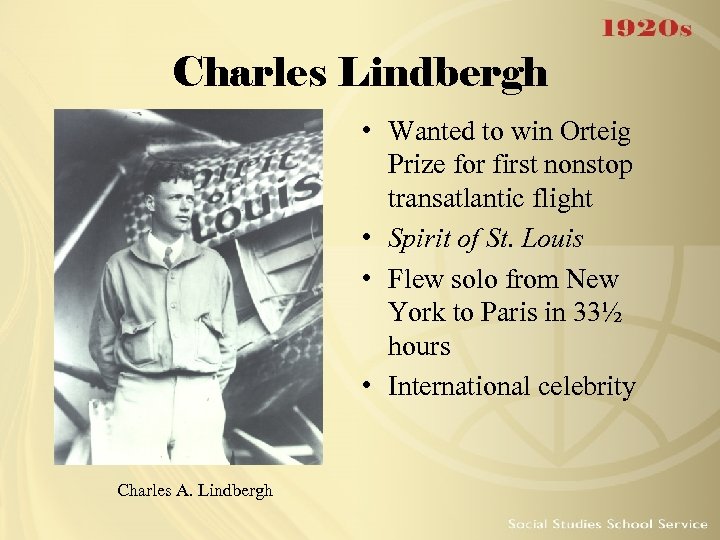 Charles Lindbergh • Wanted to win Orteig Prize for first nonstop transatlantic flight • Spirit of St. Louis • Flew solo from New York to Paris in 33½ hours • International celebrity Charles A. Lindbergh
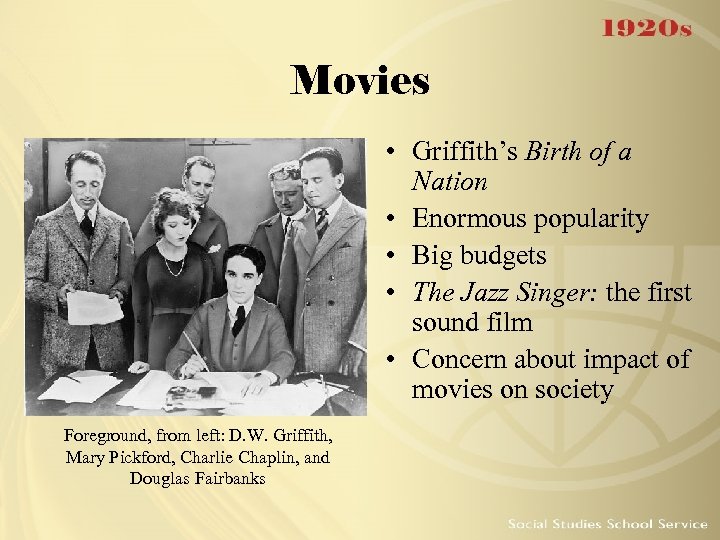 Movies • Griffith’s Birth of a Nation • Enormous popularity • Big budgets • The Jazz Singer: the first sound film • Concern about impact of movies on society Foreground, from left: D. W. Griffith, Mary Pickford, Charlie Chaplin, and Douglas Fairbanks
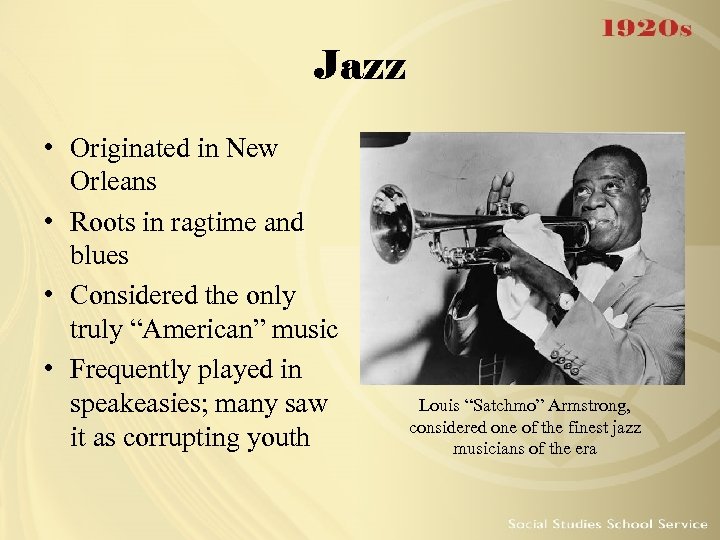 Jazz • Originated in New Orleans • Roots in ragtime and blues • Considered the only truly “American” music • Frequently played in speakeasies; many saw it as corrupting youth Louis “Satchmo” Armstrong, considered one of the finest jazz musicians of the era
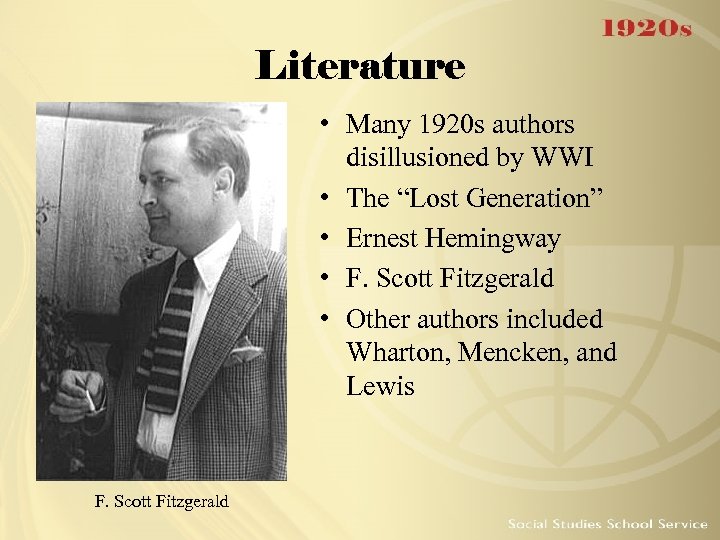 Literature • Many 1920 s authors disillusioned by WWI • The “Lost Generation” • Ernest Hemingway • F. Scott Fitzgerald • Other authors included Wharton, Mencken, and Lewis F. Scott Fitzgerald
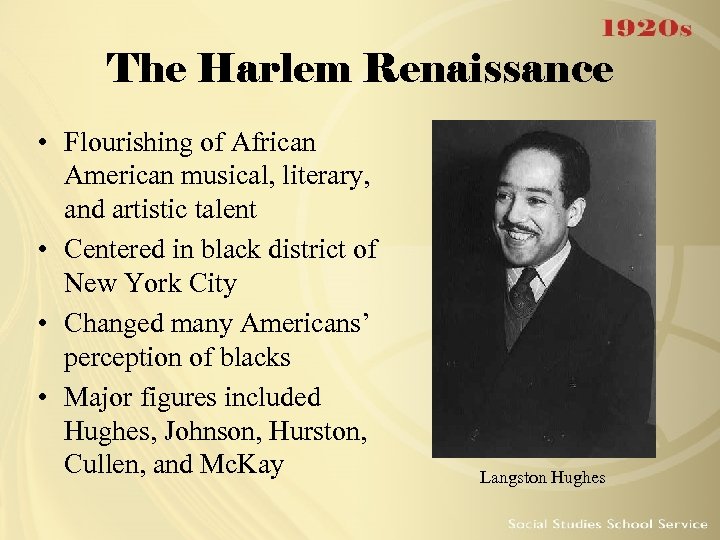 The Harlem Renaissance • Flourishing of African American musical, literary, and artistic talent • Centered in black district of New York City • Changed many Americans’ perception of blacks • Major figures included Hughes, Johnson, Hurston, Cullen, and Mc. Kay Langston Hughes
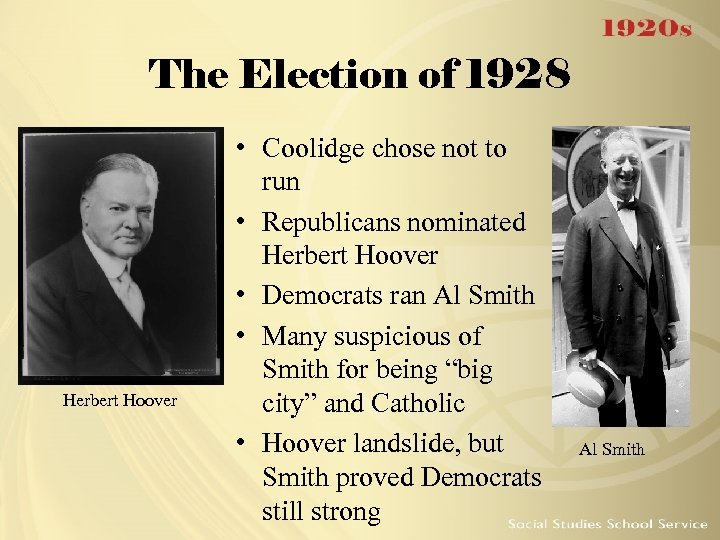 The Election of 1928 Herbert Hoover • Coolidge chose not to run • Republicans nominated Herbert Hoover • Democrats ran Al Smith • Many suspicious of Smith for being “big city” and Catholic • Hoover landslide, but Smith proved Democrats still strong Al Smith
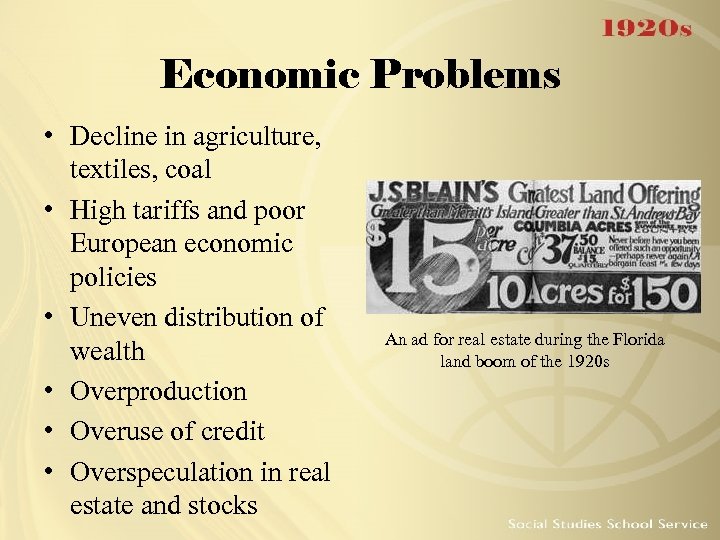 Economic Problems • Decline in agriculture, textiles, coal • High tariffs and poor European economic policies • Uneven distribution of wealth • Overproduction • Overuse of credit • Overspeculation in real estate and stocks An ad for real estate during the Florida land boom of the 1920 s
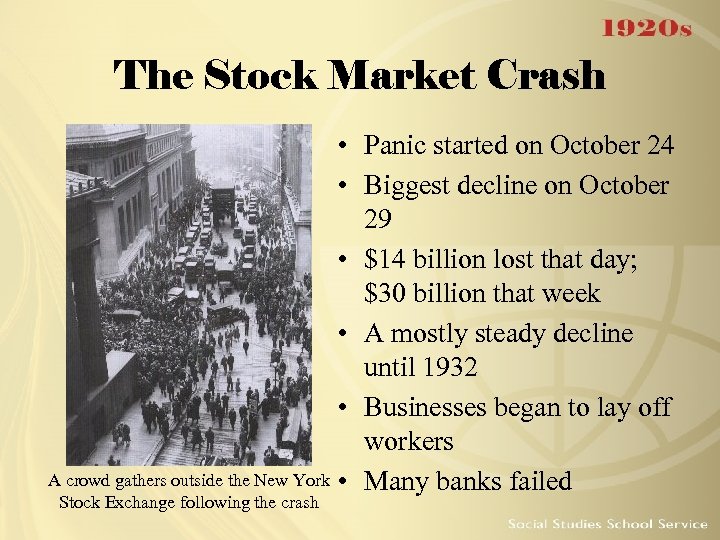 The Stock Market Crash • Panic started on October 24 • Biggest decline on October 29 • $14 billion lost that day; $30 billion that week • A mostly steady decline until 1932 • Businesses began to lay off workers A crowd gathers outside the New York • Many banks failed Stock Exchange following the crash
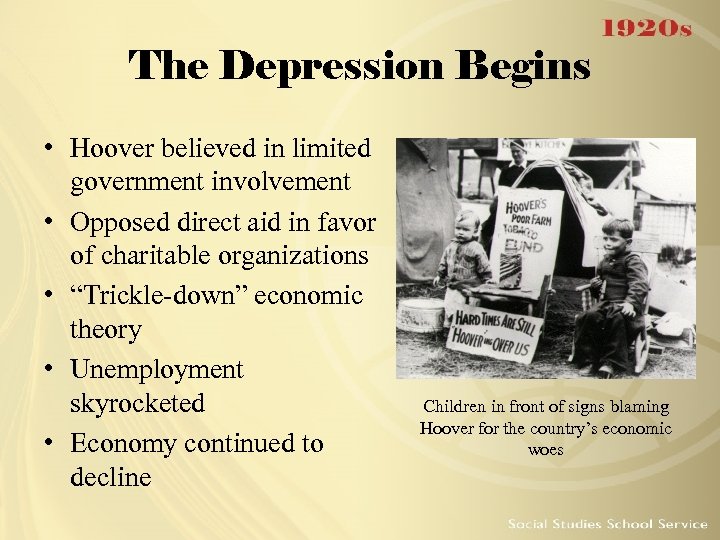 The Depression Begins • Hoover believed in limited government involvement • Opposed direct aid in favor of charitable organizations • “Trickle-down” economic theory • Unemployment skyrocketed • Economy continued to decline Children in front of signs blaming Hoover for the country’s economic woes