


 Скачать презентацию The 17 th Conference on Advanced Information Systems
35bee8b6cbdd976b5516cf7385afcf2c.ppt
- Количество слайдов: 89
 The 17 th Conference on Advanced Information Systems Engineering (CAi. SE'05), 13 -17 June 2005, Porto, Portugal LIFECYCLE OF SEMANTIC WEB PROCESSES Jorge Cardoso Department of Mathematics and Engeneering University of Madeira 9000 -390 Funchal – Portugal Amit Sheth Departemnt of Computer Science University of Georgia Athens, GA – USA
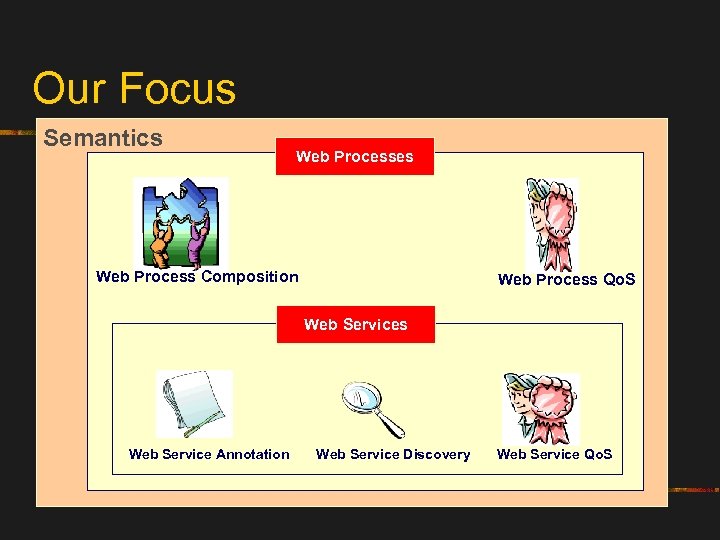 Our Focus Semantics Web Processes Web Process Composition Execution Web Process Qo. S Web Services Web Service Annotation Web Service Discovery Web Service Qo. S
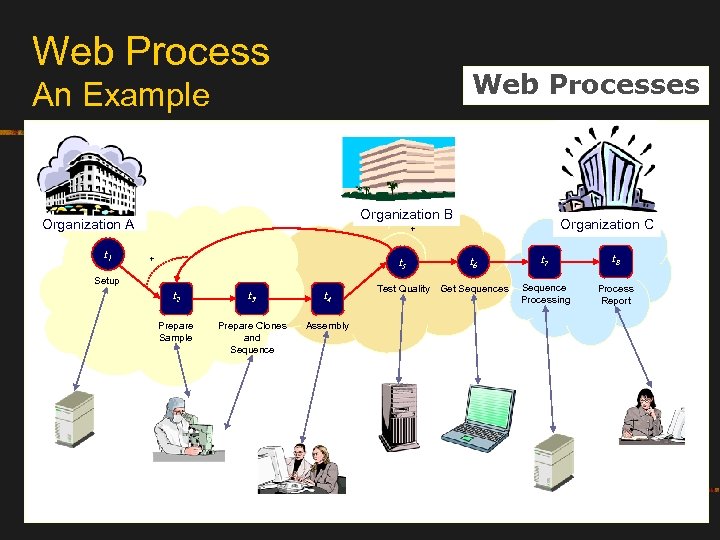 Web Processes An Example Organization B Organization A t 1 Organization C + + t 5 Setup t 2 t 3 t 4 Prepare Sample Prepare Clones and Sequence Assembly t 6 Test Quality Get Sequences t 7 t 8 Sequence Processing Process Report
 Web Processes What are Web Processes? n n n The next generation workflow technology Facilitate the interaction of organizations with markets, competitors, suppliers, customers etc. Support enterprise-level and core business activities n n n Encompass the ideas of both intra and inter organizational workflow. Created from the composition of Web services Can use BPEL 4 WS to represent composition
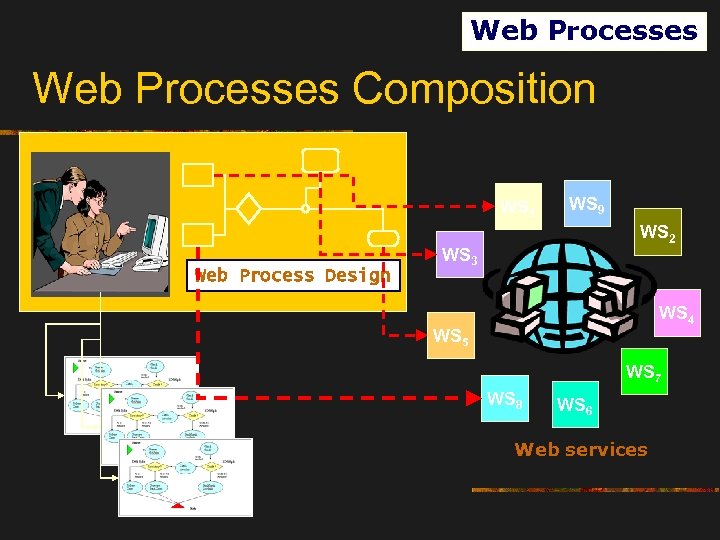 Web Processes Composition WS 1 Web Process Design WS 9 WS 2 WS 3 WS 4 WS 5 WS 7 WS 8 WS 6 Web services
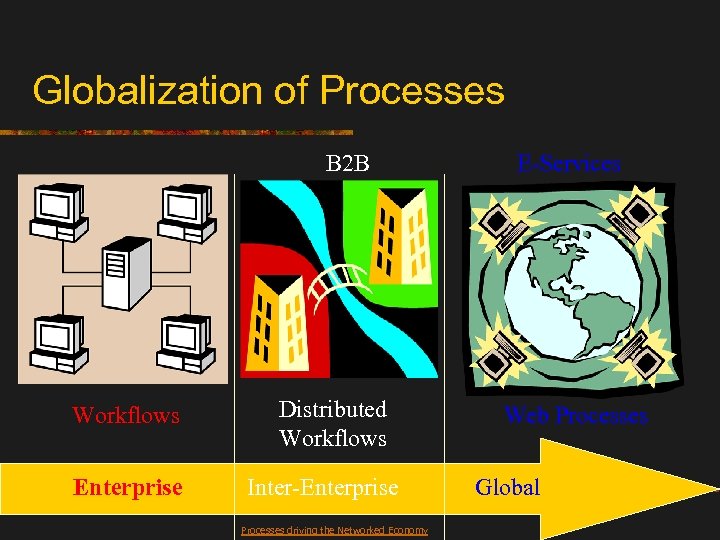 Globalization of Processes B 2 B Workflows Enterprise Distributed Workflows Inter-Enterprise Processes driving the Networked Economy E-Services Web Processes Global
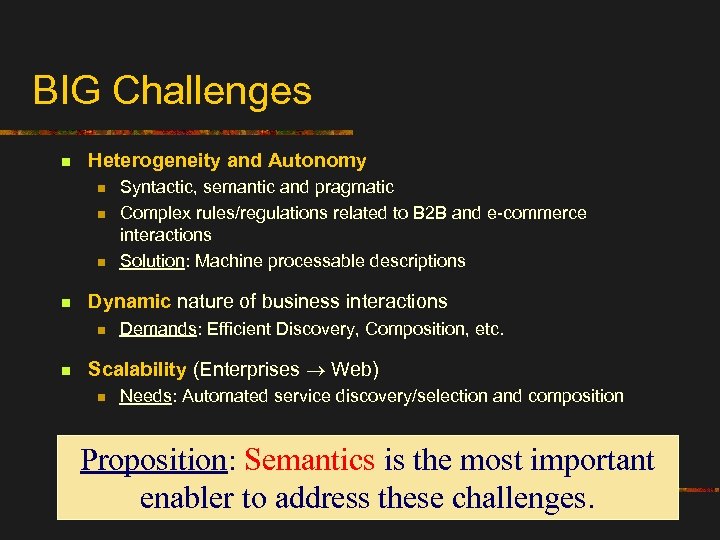 BIG Challenges n Heterogeneity and Autonomy n n Dynamic nature of business interactions n n Syntactic, semantic and pragmatic Complex rules/regulations related to B 2 B and e-commerce interactions Solution: Machine processable descriptions Demands: Efficient Discovery, Composition, etc. Scalability (Enterprises Web) n Needs: Automated service discovery/selection and composition Proposition: Semantics is the most important enabler to address these challenges.
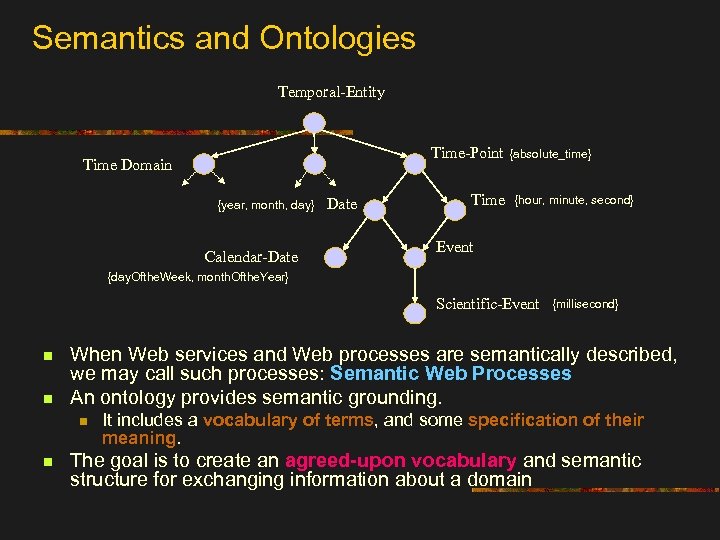 Semantics and Ontologies Temporal-Entity Time-Point Time Domain {year, month, day} Calendar-Date Time {absolute_time} {hour, minute, second} Event {day. Ofthe. Week, month. Ofthe. Year} Scientific-Event n n When Web services and Web processes are semantically described, we may call such processes: Semantic Web Processes An ontology provides semantic grounding. n n {millisecond} It includes a vocabulary of terms, and some specification of their meaning. The goal is to create an agreed-upon vocabulary and semantic structure for exchanging information about a domain
 Semantic Web Services (OWL-S) n OWL-S n n Formerly DAML-S Set of markup language constructs Describe the properties and capabilities of Web services Unambiguous and computer-intepretable
 OWL-S Introduction OWL-S provides support for the following elements: n n n Process description. Advertisement and discovery of services. Selection, composition & interoperation. Invocation. Execution and monitoring. OWL-S project home page
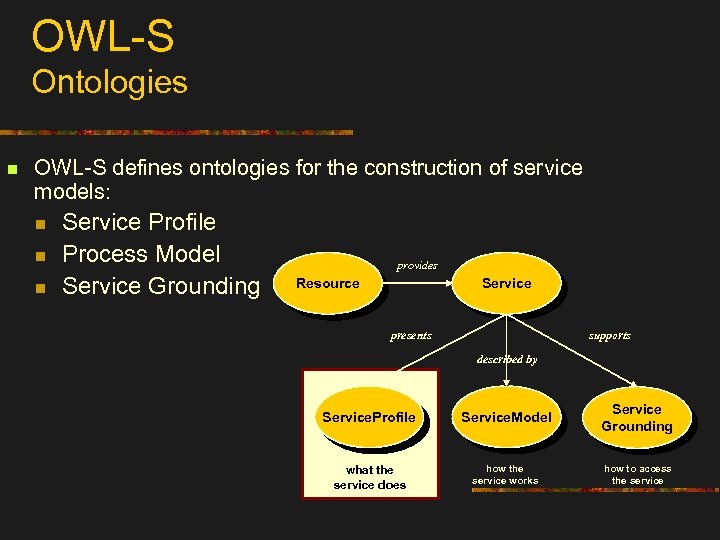 OWL-S Ontologies n OWL-S defines ontologies for the construction of service models: n n n Service Profile Process Model Service Grounding provides Resource Service presents supports described by Service. Profile Service. Model Service Grounding what the service does how the service works how to access the service
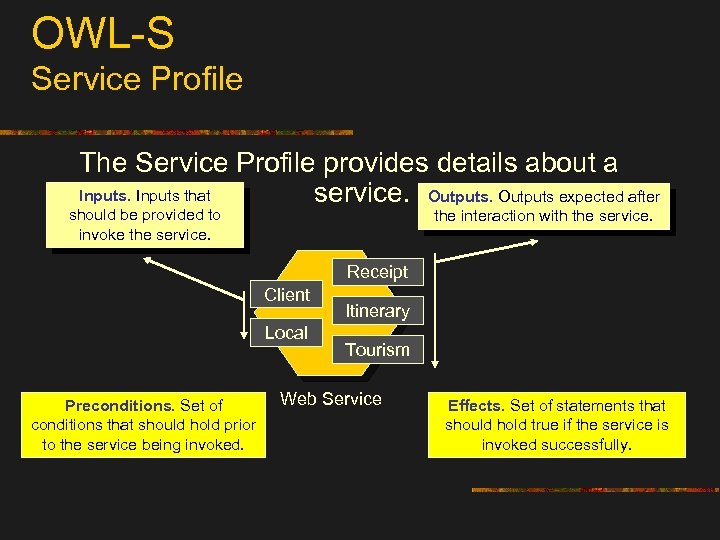 OWL-S Service Profile The Service Profile provides details about a Inputs that service. Outputs expected after should be provided to invoke the service. the interaction with the service. Receipt Client Local Preconditions. Set of conditions that should hold prior to the service being invoked. Itinerary Tourism Web Service Effects. Set of statements that should hold true if the service is invoked successfully.
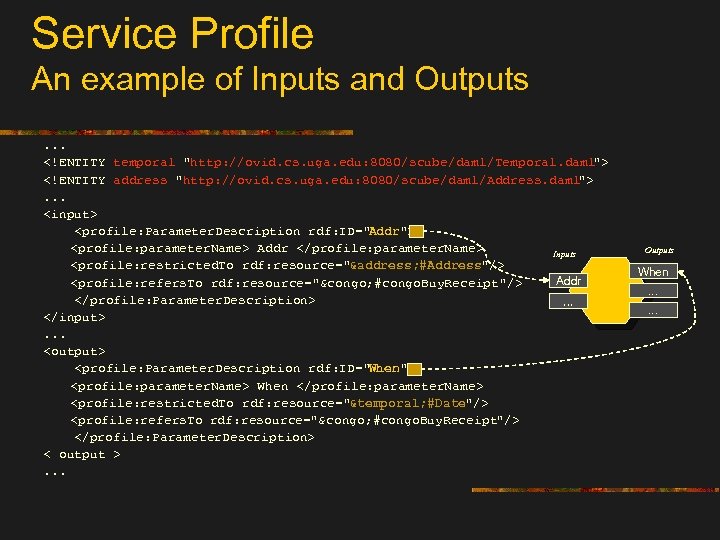 Service Profile An example of Inputs and Outputs. . . . . .
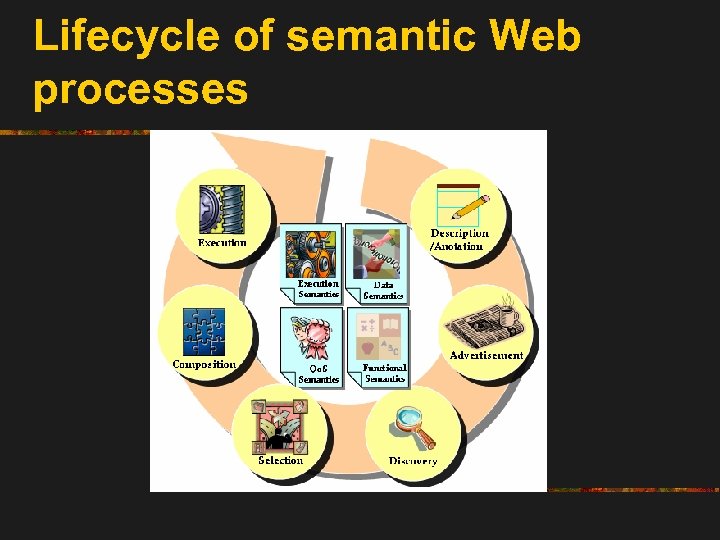 Lifecycle of semantic Web processes
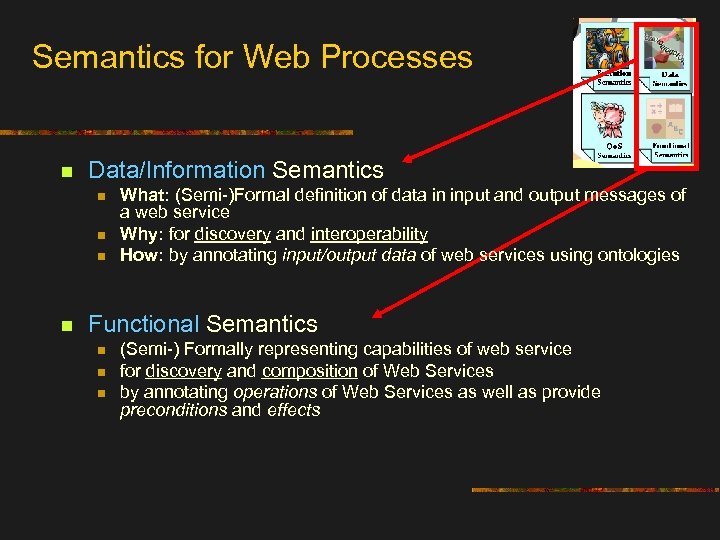 Semantics for Web Processes n Data/Information Semantics n n What: (Semi-)Formal definition of data in input and output messages of a web service Why: for discovery and interoperability How: by annotating input/output data of web services using ontologies Functional Semantics n n n (Semi-) Formally representing capabilities of web service for discovery and composition of Web Services by annotating operations of Web Services as well as provide preconditions and effects
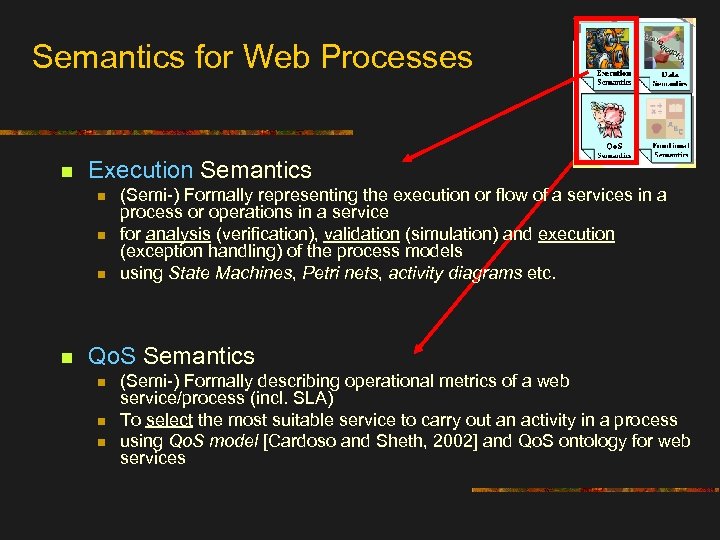 Semantics for Web Processes n Execution Semantics n n (Semi-) Formally representing the execution or flow of a services in a process or operations in a service for analysis (verification), validation (simulation) and execution (exception handling) of the process models using State Machines, Petri nets, activity diagrams etc. Qo. S Semantics n n n (Semi-) Formally describing operational metrics of a web service/process (incl. SLA) To select the most suitable service to carry out an activity in a process using Qo. S model [Cardoso and Sheth, 2002] and Qo. S ontology for web services
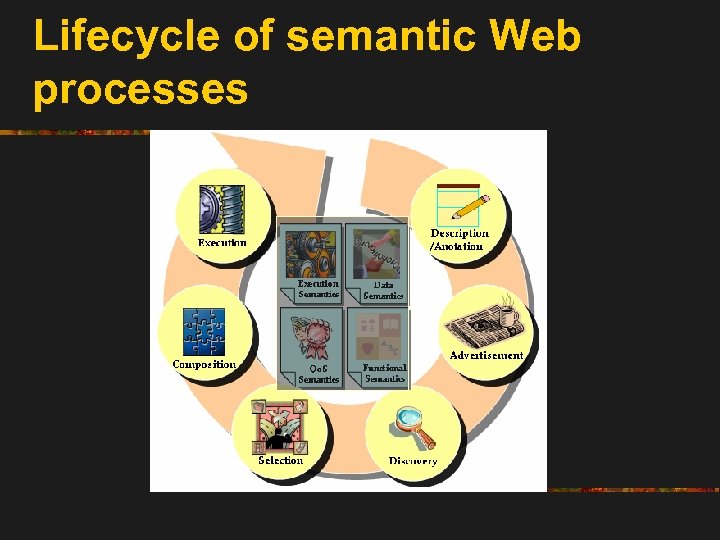 Lifecycle of semantic Web processes
 1 Description/Annotation n Web service specifications (e. g. WSDL) only define syntactic characteristics n n Insufficient Interoperation of Web services cannot be successfully achieved Solution: add meaning to methods and data Annotation n n Use an ontology to annotate the data involved in Web service operations Use an ontology to annotate the Web service’s operations
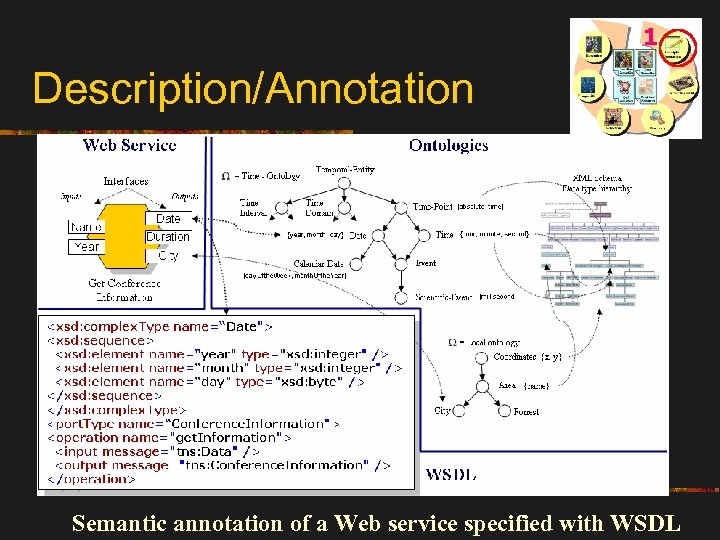 1 Description/Annotation Semantic annotation of a Web service specified with WSDL
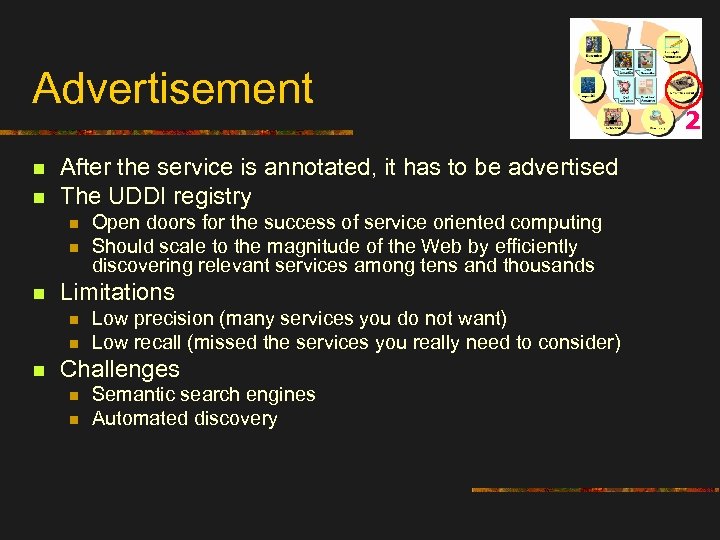 Advertisement n n After the service is annotated, it has to be advertised The UDDI registry n n n Limitations n n n Open doors for the success of service oriented computing Should scale to the magnitude of the Web by efficiently discovering relevant services among tens and thousands Low precision (many services you do not want) Low recall (missed the services you really need to consider) Challenges n n Semantic search engines Automated discovery 2
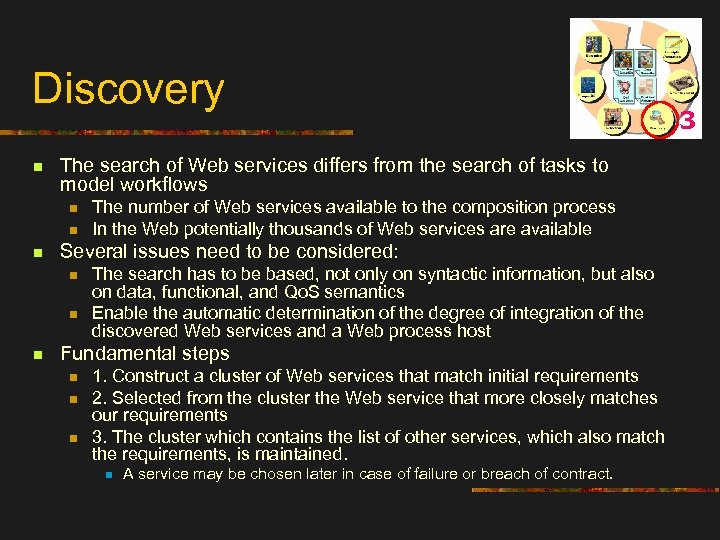 Discovery n The search of Web services differs from the search of tasks to model workflows n n n Several issues need to be considered: n n n The number of Web services available to the composition process In the Web potentially thousands of Web services are available The search has to be based, not only on syntactic information, but also on data, functional, and Qo. S semantics Enable the automatic determination of the degree of integration of the discovered Web services and a Web process host Fundamental steps n n n 1. Construct a cluster of Web services that match initial requirements 2. Selected from the cluster the Web service that more closely matches our requirements 3. The cluster which contains the list of other services, which also match the requirements, is maintained. n A service may be chosen later in case of failure or breach of contract. 3
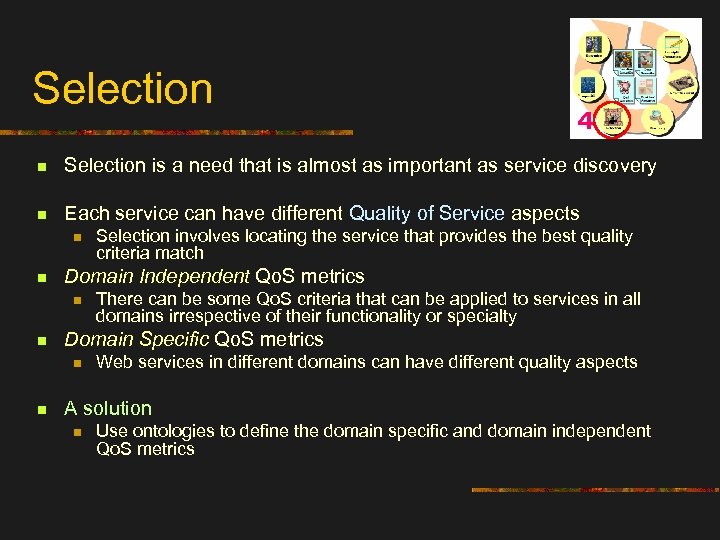 Selection 4 n Selection is a need that is almost as important as service discovery n Each service can have different Quality of Service aspects n n Domain Independent Qo. S metrics n n There can be some Qo. S criteria that can be applied to services in all domains irrespective of their functionality or specialty Domain Specific Qo. S metrics n n Selection involves locating the service that provides the best quality criteria match Web services in different domains can have different quality aspects A solution n Use ontologies to define the domain specific and domain independent Qo. S metrics
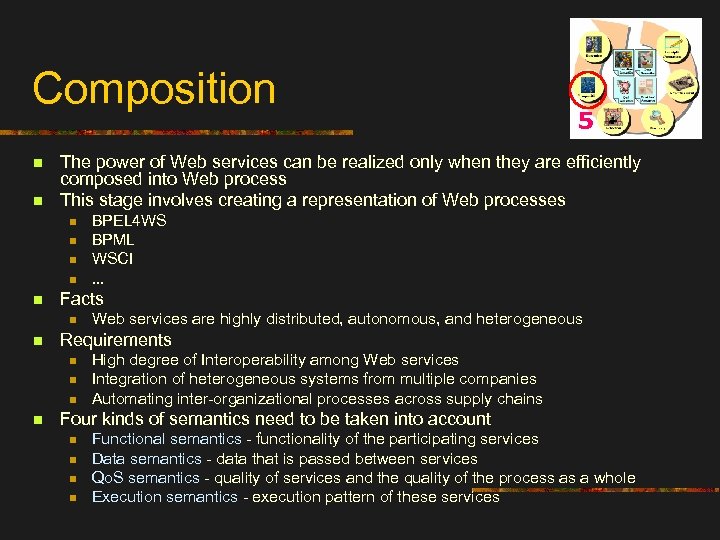 Composition n n The power of Web services can be realized only when they are efficiently composed into Web process This stage involves creating a representation of Web processes n n n Web services are highly distributed, autonomous, and heterogeneous Requirements n n BPEL 4 WS BPML WSCI. . . Facts n n 5 High degree of Interoperability among Web services Integration of heterogeneous systems from multiple companies Automating inter-organizational processes across supply chains Four kinds of semantics need to be taken into account n n Functional semantics - functionality of the participating services Data semantics - data that is passed between services Qo. S semantics - quality of services and the quality of the process as a whole Execution semantics - execution pattern of these services
 6 Execution n Execution semantics of a Web service encompasses n The ideas of message sequence n n Conversation pattern of Web service execution n n n peer-to-peer pattern global controller pattern Flow of actions n n request-response Sequence Parallel Loops Preconditions and effects of Web service invocation, etc. Formal mathematical models to represent execution semantics n n Process Algebra Concurrency formalisms (Petri Nets, state machines) Simulation techniques Etc. . .
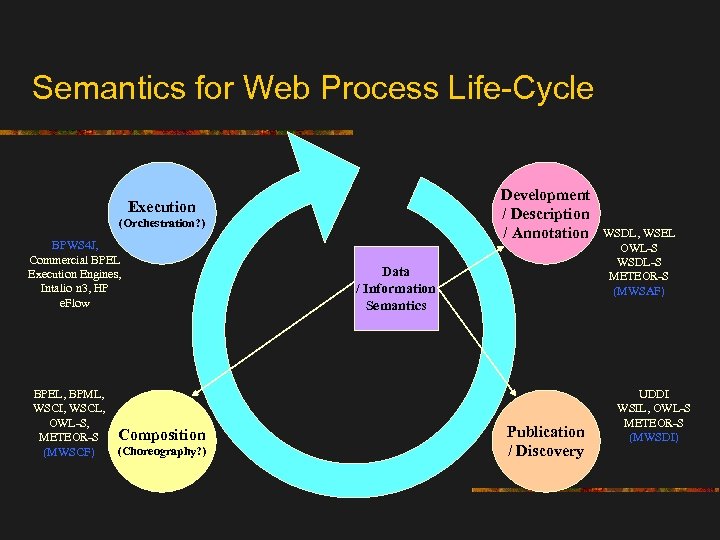 Semantics for Web Process Life-Cycle Development / Description / Annotation Execution (Orchestration? ) BPWS 4 J, Commercial BPEL Execution Engines, Intalio n 3, HP e. Flow BPEL, BPML, WSCI, WSCL, OWL-S, METEOR-S (MWSCF) Composition (Choreography? ) Data / Information Semantics Publication / Discovery WSDL, WSEL OWL-S WSDL-S METEOR-S (MWSAF) UDDI WSIL, OWL-S METEOR-S (MWSDI)
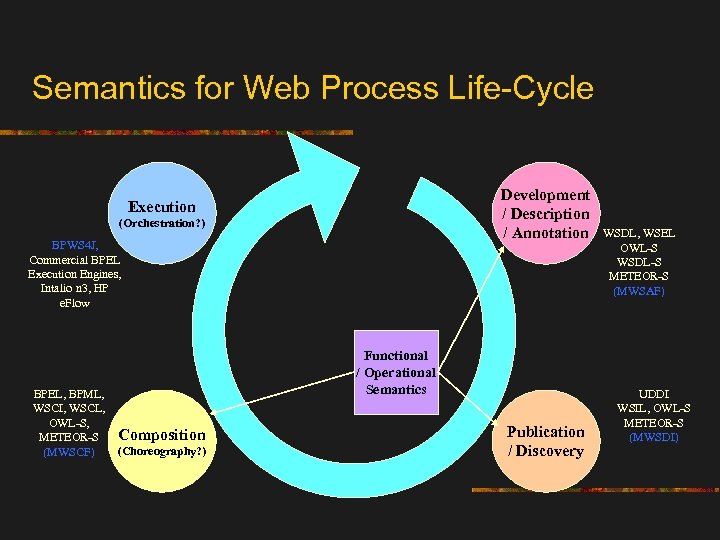 Semantics for Web Process Life-Cycle Development / Description / Annotation Execution (Orchestration? ) BPWS 4 J, Commercial BPEL Execution Engines, Intalio n 3, HP e. Flow BPEL, BPML, WSCI, WSCL, OWL-S, METEOR-S (MWSCF) Functional / Operational Semantics Composition (Choreography? ) Publication / Discovery WSDL, WSEL OWL-S WSDL-S METEOR-S (MWSAF) UDDI WSIL, OWL-S METEOR-S (MWSDI)
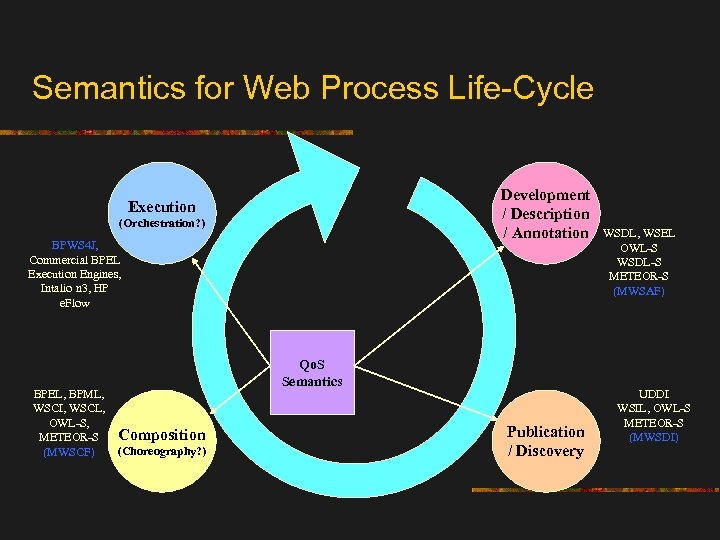 Semantics for Web Process Life-Cycle Development / Description / Annotation Execution (Orchestration? ) BPWS 4 J, Commercial BPEL Execution Engines, Intalio n 3, HP e. Flow BPEL, BPML, WSCI, WSCL, OWL-S, METEOR-S (MWSCF) Qo. S Semantics Composition (Choreography? ) Publication / Discovery WSDL, WSEL OWL-S WSDL-S METEOR-S (MWSAF) UDDI WSIL, OWL-S METEOR-S (MWSDI)
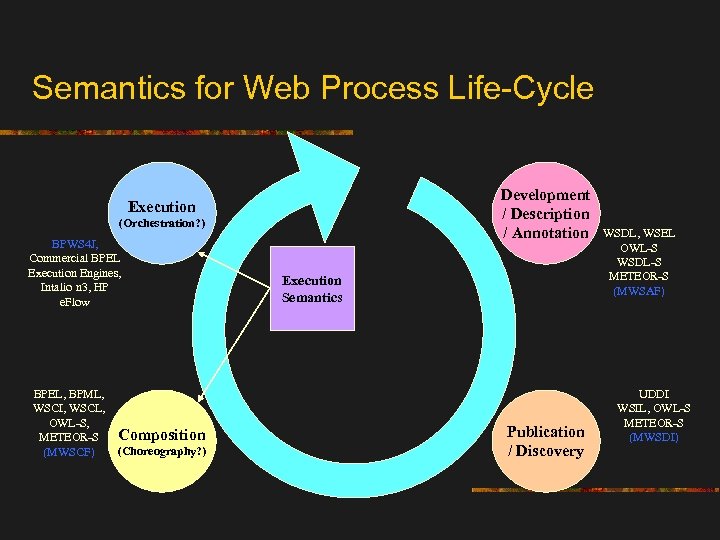 Semantics for Web Process Life-Cycle Development / Description / Annotation Execution (Orchestration? ) BPWS 4 J, Commercial BPEL Execution Engines, Intalio n 3, HP e. Flow BPEL, BPML, WSCI, WSCL, OWL-S, METEOR-S (MWSCF) Composition (Choreography? ) Execution Semantics Publication / Discovery WSDL, WSEL OWL-S WSDL-S METEOR-S (MWSAF) UDDI WSIL, OWL-S METEOR-S (MWSDI)
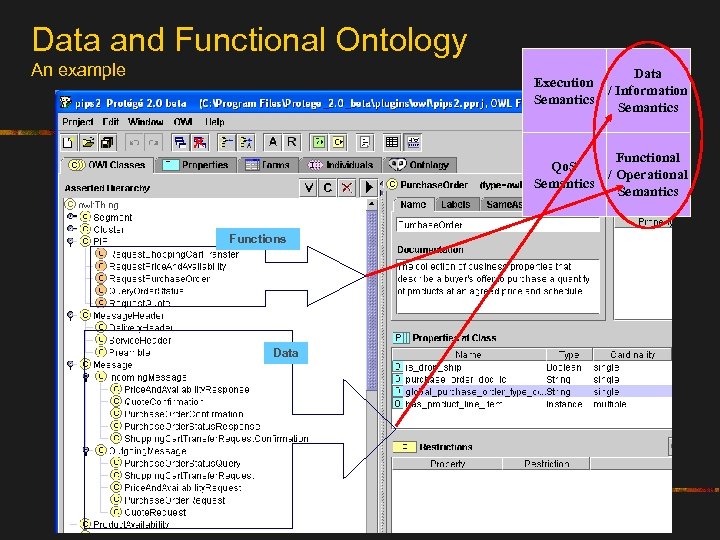 Data and Functional Ontology An example Data Execution / Information Semantics Functional Qo. S / Operational Semantics Functions Data
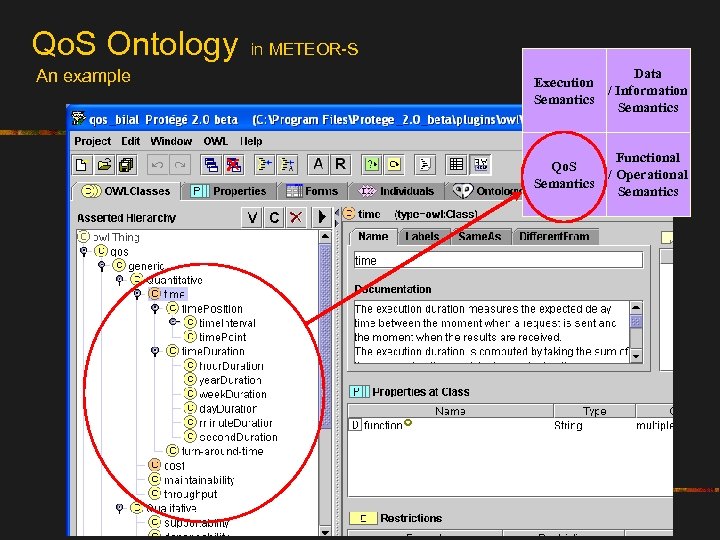 Qo. S Ontology An example in METEOR-S Data Execution / Information Semantics Functional Qo. S / Operational Semantics
 Using semantic Web services for E-Tourism: A case study
 Introduction - Tourism Industry n n Highly competitive business Competitive advantage is driven by n n Science Information technology Innovation Statistics n n n By 2020, tourist travel will increase over 200% 95% of customers use the Internet to gather travel information The number of people using the Internet for travel planning has increased more than 300% over the past 5 years
 Dynamic Packaging n Old technology n n n Travelers must visit manually multiple independent Web sites to plan their trip Register their personal information multiple times Spend hours or days waiting for response or confirmation Make multiple payments by credit card Dynamic packaging technology n n n Consumers or travel agents can bundle trip components Build customized trips Combine preferences with flights, car rentals, hotel, and leisure activities in a single price
 Current Applications - Expedia n n n Expedia pioneered dynamic packaging in 2002 and now gets almost 30% of revenue from package buyers One-stop shopping Consumers can book airline tickets and hotel rooms, and also book a shuttle to pick them up at the airport and set up prepaid restaurant meals using. Strategy focus on the total journey of consumers Dynamic packaging solution is one of the best among the competition
 Current Applications - Orbitz Started in June 2001 The third largest online travel site in the world Founded by five major airlines, American, Continental, Delta, Northwest and United. The main objective was to compete with Expedia and online ticketing sales, hoping to take advantage of increase in ticket sales online. Orbitz’s Web site has already completed the full implementation of its dynamic packaging engine Customer relationship doesn’t end when a customer buys a travel product n n n n Monitors nationwide travel conditions for travelers Provides the latest information on flight delays, weather conditions, gate changes, airport congestion or any other event that might impact travel via mobile phone, pager, PDA or e-mail.
 Current Applications - Travelocity n n n Owned by Sabre, the world’s largest GDS Provides information for more than 700 airlines, more than 55, 000 hotels and more than 50 car rental companies Strategic acquisition of Site 59. com n n Dynamic packaging technology allows Travelocity to respond to the growing popularity of Expedia’s dynamic packages. Its dynamic vacation technology will be the first to allow users to book specific airline seats and hotel rooms themselves
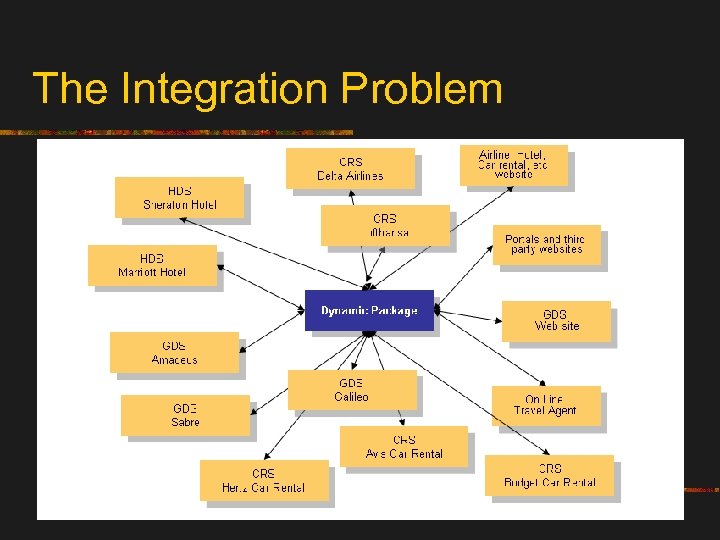 The Integration Problem
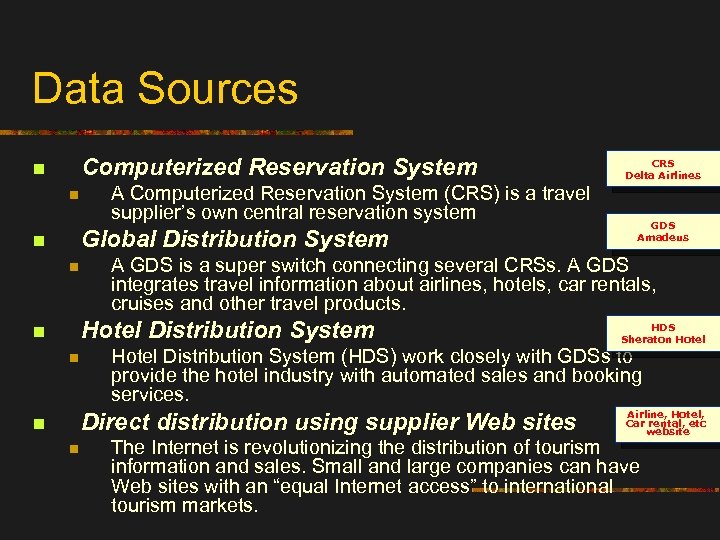 Data Sources Computerized Reservation System n n A Computerized Reservation System (CRS) is a travel supplier’s own central reservation system Global Distribution System n n HDS Sheraton Hotel Distribution System (HDS) work closely with GDSs to provide the hotel industry with automated sales and booking services. Direct distribution using supplier Web sites n GDS Amadeus A GDS is a super switch connecting several CRSs. A GDS integrates travel information about airlines, hotels, car rentals, cruises and other travel products. Hotel Distribution System n CRS Delta Airlines Airline, Hotel, Car rental, etc website The Internet is revolutionizing the distribution of tourism information and sales. Small and large companies can have Web sites with an “equal Internet access” to international tourism markets.
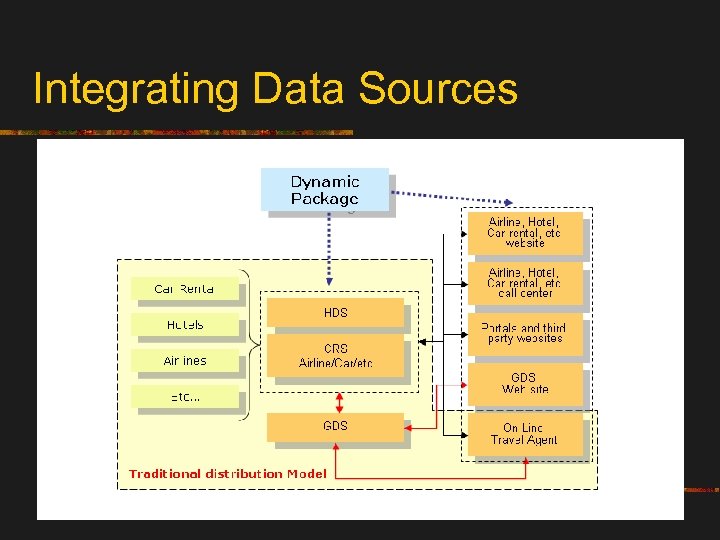 Integrating Data Sources
 Lack of standards n The price of tourism products is expressed in many different currencies n n Euros, dollars, British pounds, etc. Time units do not follow a standard n n Some Web sites state time in hours, others in minutes, others in hours and minutes…etc. For example, 1 hour and 30 minutes, 1 h and 30 min, 1: 30 h, 90 min, one hour and thirty minutes, ninety minutes, 1: 30 pm, etc.
 Lack of standards n Keywords used to express a date are not normalized n n The temperature unit scale is not standard n n Some express a day of the week using the words Monday, Tuesday, …, Sunday, while other use the keywords M, T, …, Su It can be expressed in degrees centigrade as well as in degrees Celsius. Numerical values are not express in a normalized way n n 1, 2, and 3 or one, two, and three.
 Enabling technologies for Dynamic Packaging n n Semantic Web Ontologies Web services Web processes
 Objective n n Integrate e-tourism data sources Find a solution to surpass the lack of standards in e-tourism Automatically understand the different ways of expressing tourism products Create dynamic packages
 Dynamic Packaging System Architecture n Our architecture to develop a dynamic packaging infrastructure has four major phases: n n Integration of e-Tourism information sources Semantic mediator generation Dynamic packaging process generation Dynamic packaging final products
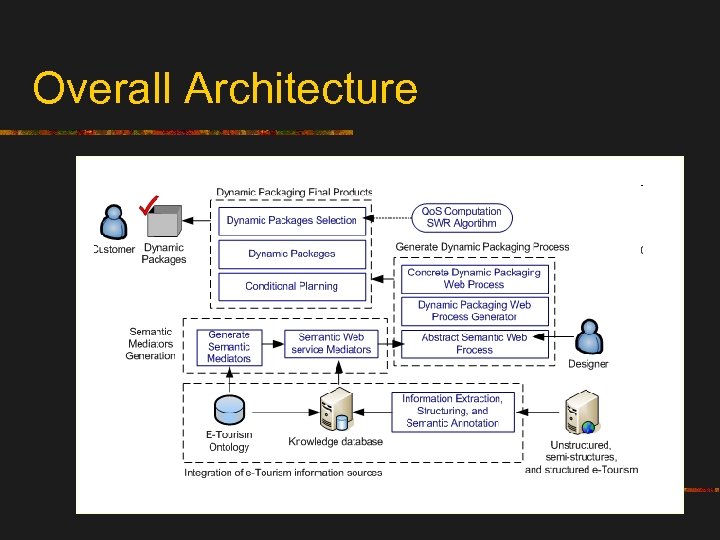 Overall Architecture
 Integration of e-Tourism information sources n Challenges n n n Develop dynamic packaging applications to integrate the non-standard way of defining e-tourism products No standards to express transportation vehicles, leisure activities, weather conditions, etc. One possible solution n The semantic Web can considerably improve e. Tourism Use of ontologies Use semantic annotation
 Data Integration n A dynamic packaging platform must include provisions for supporting and integrating: n n Structured data Semi-structured data Unstructured data Use a common data representation!! n XML
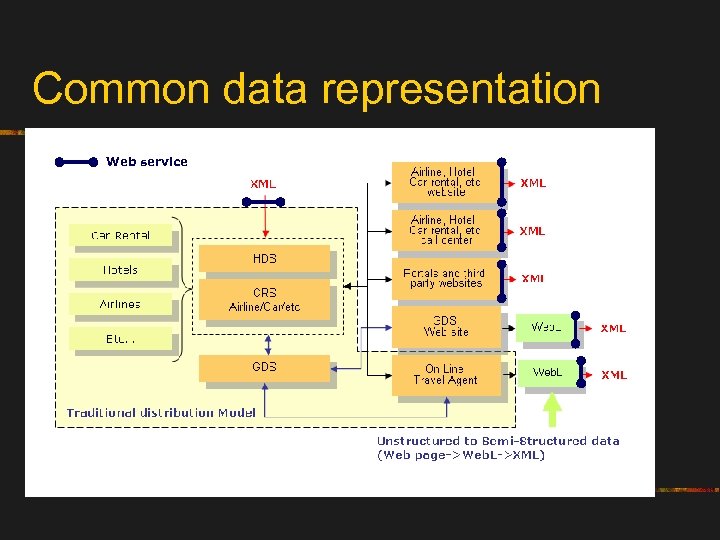 Common data representation Web service
 XML does not solve the Integration Problem!!! n XML is a published standard n n n Defines the standard to define tags and relationships But it does not specify a predefined set of tags Leaves the design of a specific set of tags to individual businesses and industries Different tourism businesses and industries use different XML schema!!!
 E-Tourism Ontology n The e-Tourism ontology provides a way of viewing the world of tourism n n Achieving interoperability through the use of a shared vocabulary and meanings for terms The e-Tourism ontology was created using Protégé and the OWL language
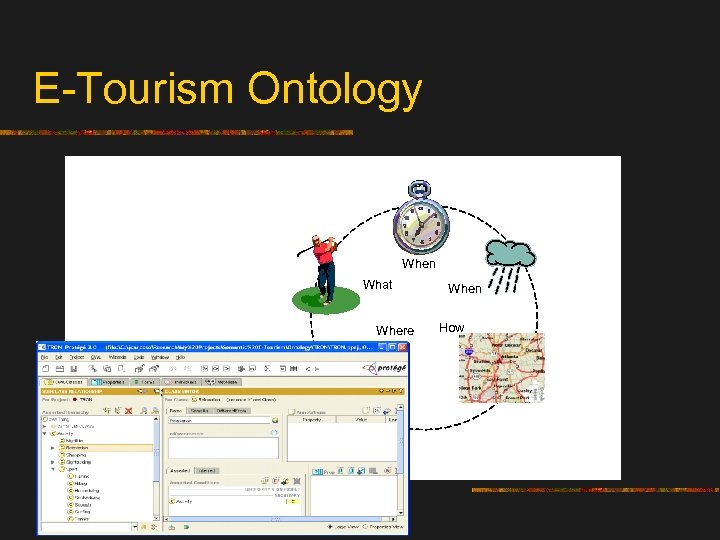 E-Tourism Ontology When What Where When How
 E-Tourism Ontology n n A working group at DERI is also constructing an ontology for the tourism industry Our approach differs – it is objective-oriented n n The ontology is able to answers four types of questions that can be asked when developing a dynamic package. These questions involve the predicates What, Where, When, and How. n n n What can a tourist see and visit Where are located the interesting places to see and visit. When can the tourist visit a particular place? n n n Day of the week and the hours of the day Atmospheric conditions of the weather How can the tourist get to its destination to see or do an activity? n Which transportation can he use and which routes to follow.
 Semantic registration A dynamic packaging infrastructure requires integrating data from XML sources n n It requires querying in a uniform way and across multiple heterogeneous XML sources containing tourism related information Semantics can be use to resolve the differences among the data present in distinct e-Tourism XML sources Semantic Registration n n Maintain a mapping table that maps tags in XML documents with ontological concepts The purpose is to assign semantics to the text between the opening and closing tags
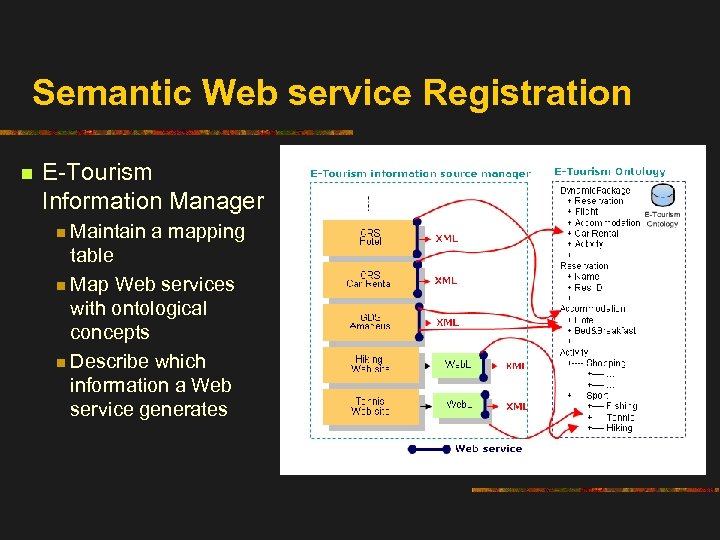 Semantic Web service Registration n E-Tourism Information Manager n Maintain a mapping table n Map Web services with ontological concepts n Describe which information a Web service generates
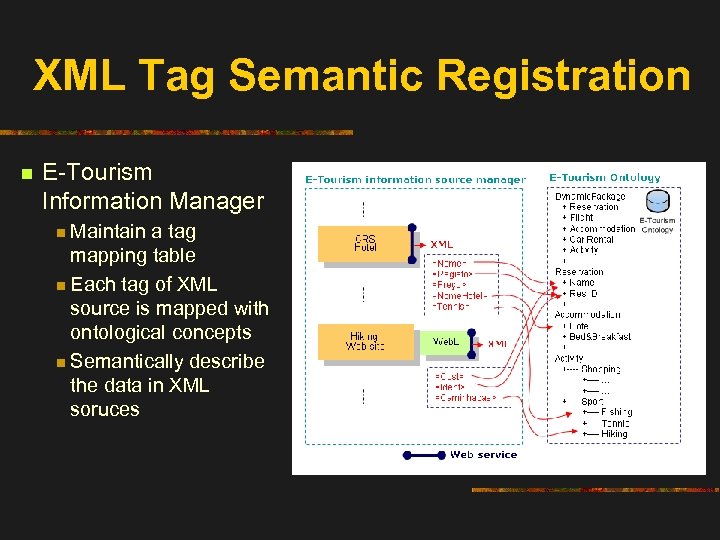 XML Tag Semantic Registration n E-Tourism Information Manager n Maintain a tag mapping table n Each tag of XML source is mapped with ontological concepts n Semantically describe the data in XML soruces
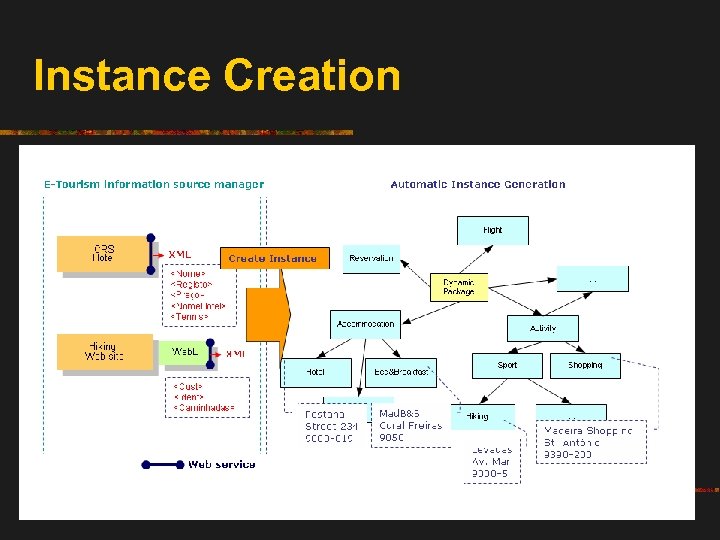 Instance Creation
 Abstract semantic Web process n An abstract Web process specifies the controlflow and data-flow of an application n n Does not define which Web services will be executed at runtime Abstracting away the resource descriptions allows: n n Web processes modeling dynamic packages to be portable Reuse processes to generate different process instance at runtime
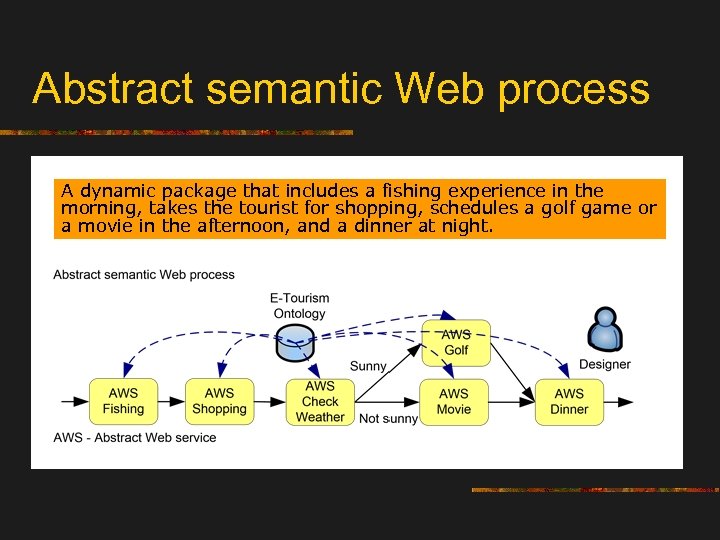 Abstract semantic Web process A dynamic package that includes a fishing experience in the morning, takes the tourist for shopping, schedules a golf game or a movie in the afternoon, and a dinner at night.
 Dynamic Packaging Web Process Generator n n Concrete dynamic package Web processes are automatically created using a suitable generator. The generator may optimize the concrete process based on the availability of Web services. n Each service is turned into an executable service by specifying the locations of the Web service implementation
 Concrete Dynamic Packaging Web Process n An abstract Web process typically originates several concrete processes. n n Each Web process invokes different Web services The processes are valid from a functional pointof-view, but they may not generate valid dynamic package n Need to follow time or cost constraints
 Conditional Planning Select a schedule that is consistent with the overall dynamic package n n n Conditional planning The main objective of the planning is to schedule an appropriate timeframe during which the tourist will realize a particular activity referenced by a dynamic package
 Dynamic Packages and Qo. S n At this stage n n Compute the Qo. S n n All the dynamic packages are valid Some packages may take more time to execute than others or be more expensive for the tourist They have a distinct Qo. S (Quality of Service) Use the SWR algorithm Ranking and selecting n Rank and select the packages which have a set of characteristics that is more similar with the tourist Qo. S requirements
 Examples of Ontologies
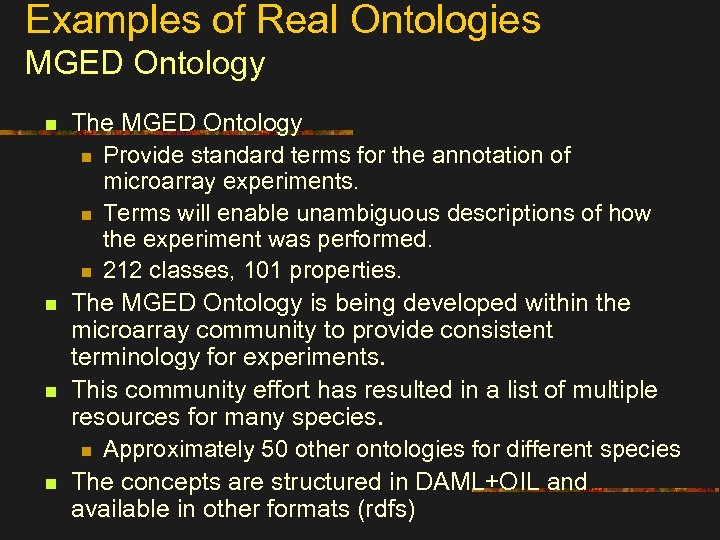 Examples of Real Ontologies MGED Ontology n n The MGED Ontology n Provide standard terms for the annotation of microarray experiments. n Terms will enable unambiguous descriptions of how the experiment was performed. n 212 classes, 101 properties. The MGED Ontology is being developed within the microarray community to provide consistent terminology for experiments. This community effort has resulted in a list of multiple resources for many species. n Approximately 50 other ontologies for different species The concepts are structured in DAML+OIL and available in other formats (rdfs)
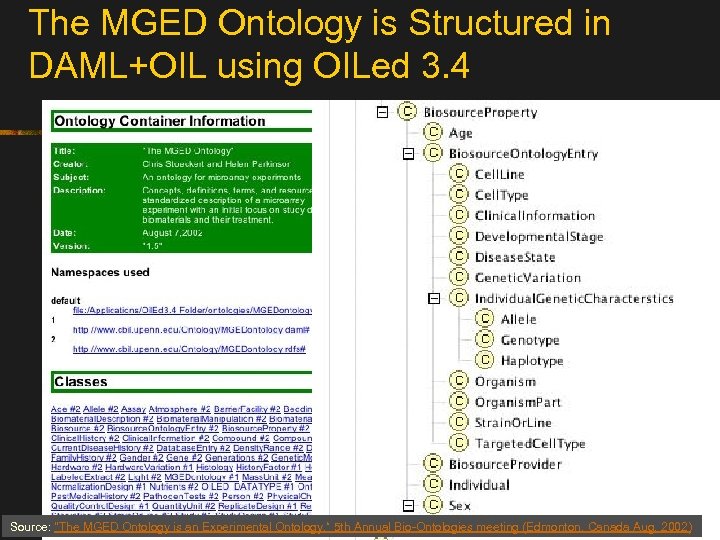 The MGED Ontology is Structured in DAML+OIL using OILed 3. 4 Source: "The MGED Ontology is an Experimental Ontology, “ 5 th Annual Bio-Ontologies meeting (Edmonton, Canada Aug. 2002)
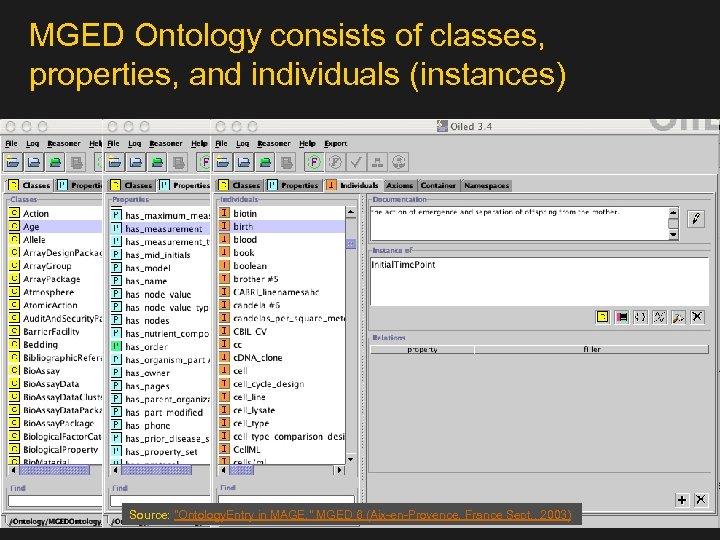 MGED Ontology consists of classes, properties, and individuals (instances) Source: "Ontology. Entry in MAGE, " MGED 6 (Aix-en-Provence, France Sept. , 2003)
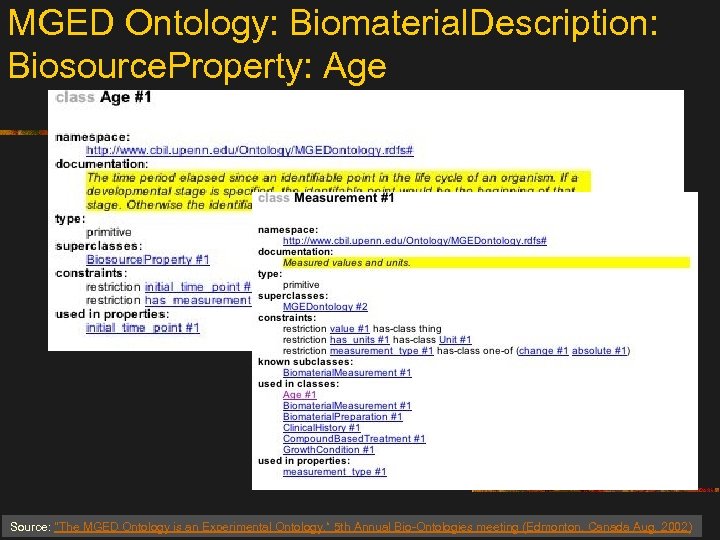 MGED Ontology: Biomaterial. Description: Biosource. Property: Age Source: "The MGED Ontology is an Experimental Ontology, “ 5 th Annual Bio-Ontologies meeting (Edmonton, Canada Aug. 2002)
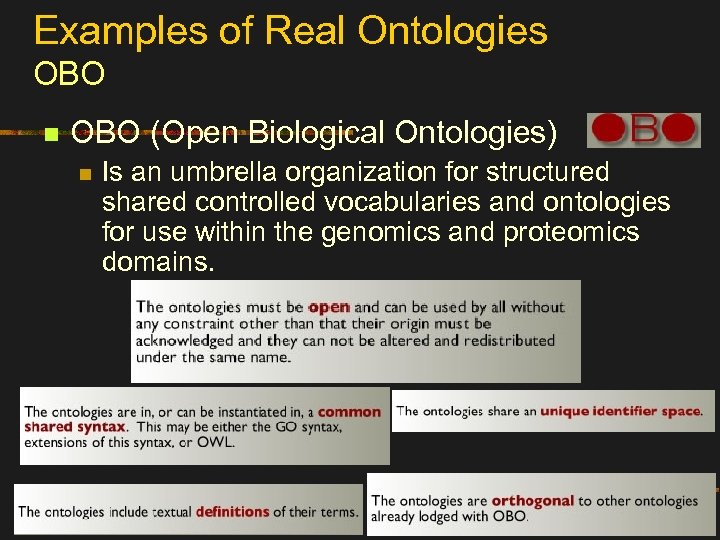 Examples of Real Ontologies OBO n OBO (Open Biological Ontologies) n Is an umbrella organization for structured shared controlled vocabularies and ontologies for use within the genomics and proteomics domains.
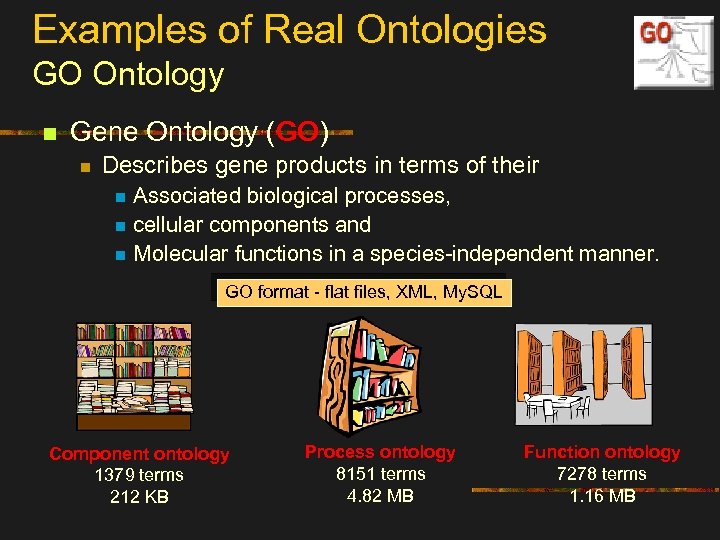 Examples of Real Ontologies GO Ontology n Gene Ontology (GO) n Describes gene products in terms of their n n n Associated biological processes, cellular components and Molecular functions in a species-independent manner. GO format - flat files, XML, My. SQL Component ontology 1379 terms 212 KB Process ontology 8151 terms 4. 82 MB Function ontology 7278 terms 1. 16 MB
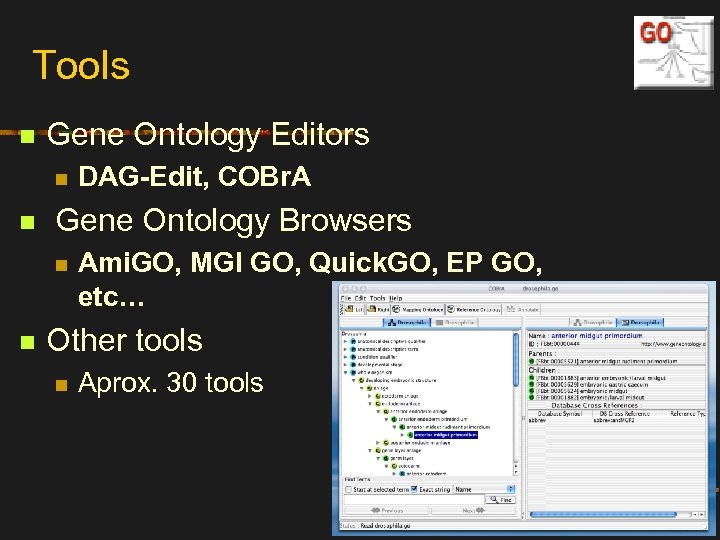 Tools n Gene Ontology Editors n n Gene Ontology Browsers n n DAG-Edit, COBr. A Ami. GO, MGI GO, Quick. GO, EP GO, etc… Other tools n Aprox. 30 tools
 Examples of Toy Ontologies DAML library n DAML Ontology Library n n 282 ontologies A few examples n http: //cicho 0. tripod. com/cs_Courses_ont http: //daml. umbc. edu/ontologies/calendar-ont. daml http: //mnemosyne. umd. edu/~aelkiss/weather-ont. daml http: //ontolingua. stanford. edu/doc/chimaera/ontologies/wines. daml http: //www. ai. sri. com/daml/ontologies/sri-basic/1 -0/Person. daml http: //www. kestrel. edu/DAML/2000/12/TIME. daml http: //www. daml. org/2002/08/nasdaq-ont http: //www. daml. org/2001/10/html/airport-ont http: //www. daml. org/2001/10/html/nyse-ont http: //www. daml. ecs. soton. ac. uk/ont/currency. daml http: //horus. isx. com/markup/2002/01/countries 2. rdf n … n n n n n
 Examples of Toy Ontologies wine. daml n Classes n n ALSATIAN-WINE, AMERICAN-WINE, ANJOU, AUSTRALIAN-REGION, BEAUJOLAIS, BLAND-FISH, BORDEAUX-REGION, BOURGOGNEREGION, BURGUNDY, CABERNET-FRANC, CALIFORNIA-WINE, … Properties n BODY, COLOR, COURSE, DRINK, FLAVOR, FOOD, GRAPE-SLOT, MAKER, REGION, SUGAR
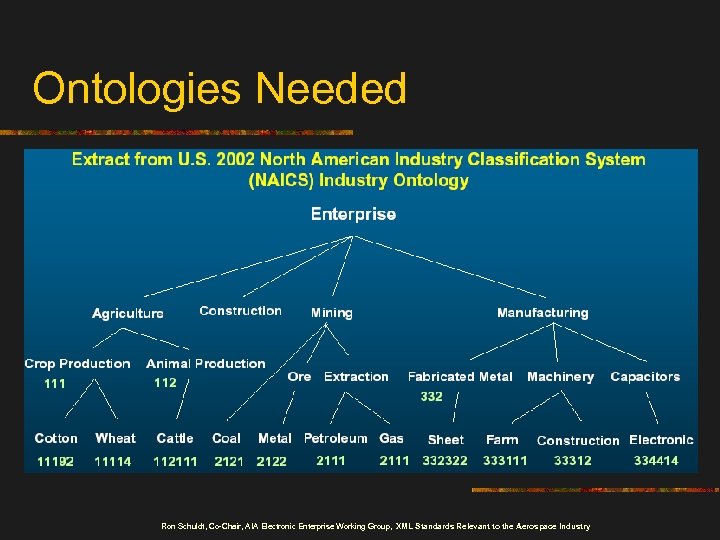 Ontologies Needed Ron Schuldt, Co-Chair, AIA Electronic Enterprise Working Group, XML Standards Relevant to the Aerospace Industry
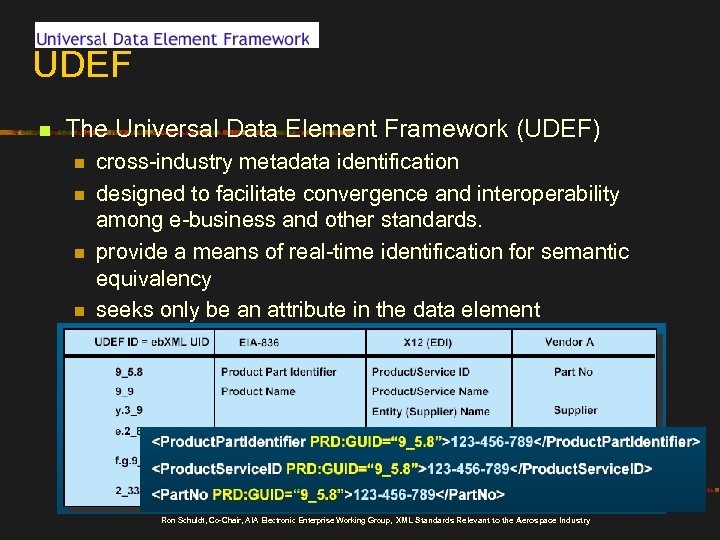 UDEF n The Universal Data Element Framework (UDEF) n n cross-industry metadata identification designed to facilitate convergence and interoperability among e-business and other standards. provide a means of real-time identification for semantic equivalency seeks only be an attribute in the data element Ron Schuldt, Co-Chair, AIA Electronic Enterprise Working Group, XML Standards Relevant to the Aerospace Industry
 Ontology Domains n n n n n Aerospace and defense, Automotive, Consumer products, Travel, Telecommunications Engineering and construction, Banking Health care … +
 Ontology Editors
 Tools: Ontology Editors n More than 50 applications. A few examples, n n n Protégé 2000 OILed Web. Onto GKB-Editor Chimaera …
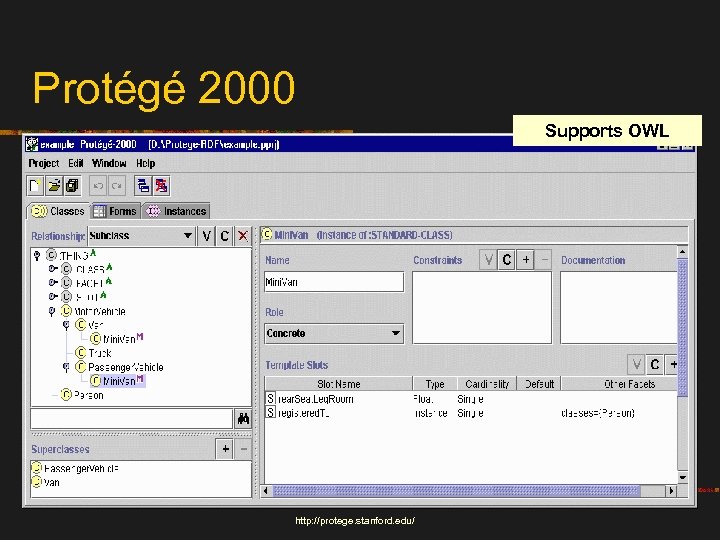 Protégé 2000 Supports OWL http: //protege. stanford. edu/
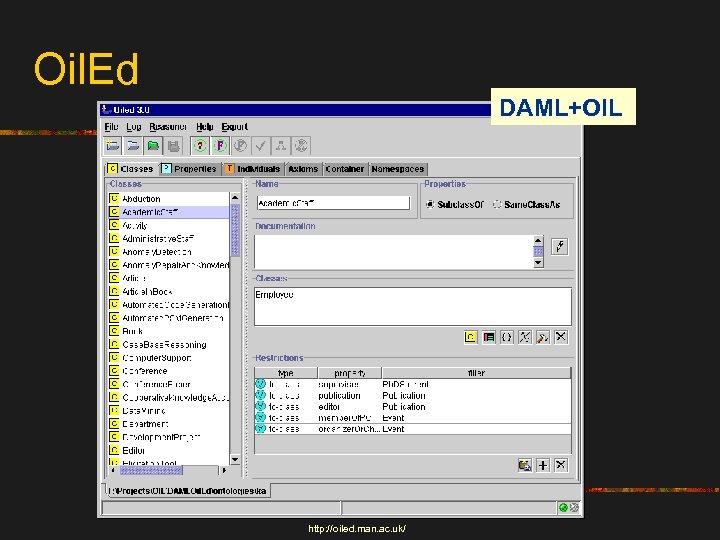 Oil. Ed DAML+OIL http: //oiled. man. ac. uk/
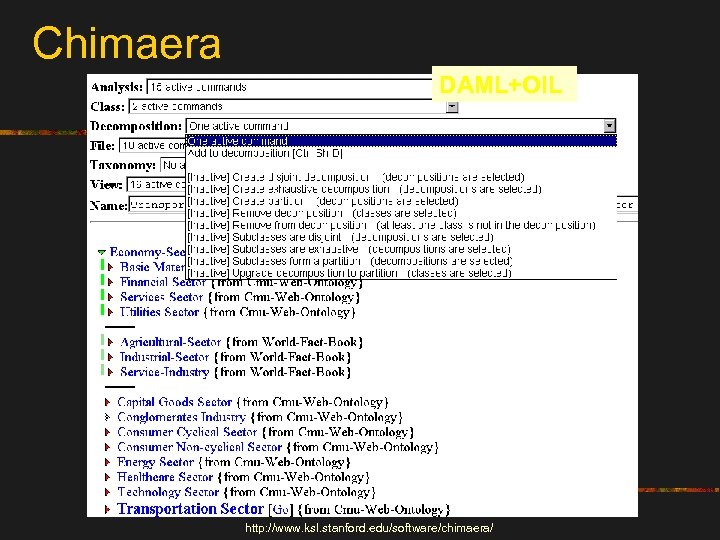 Chimaera DAML+OIL http: //www. ksl. stanford. edu/software/chimaera/
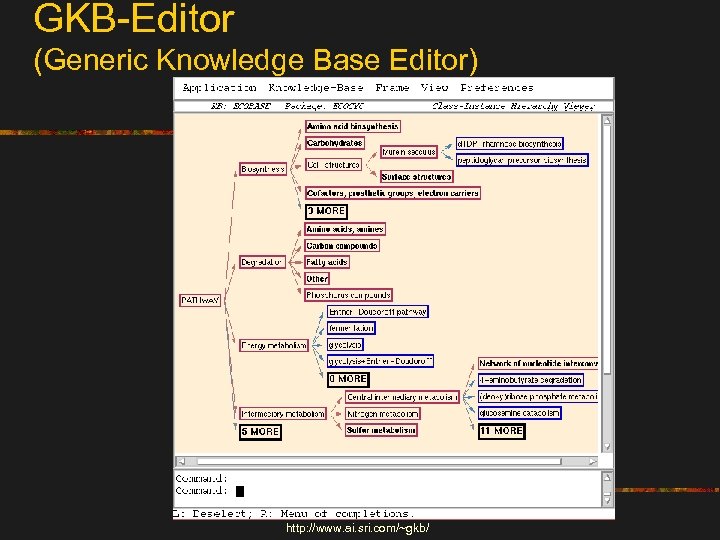 GKB-Editor (Generic Knowledge Base Editor) http: //www. ai. sri. com/~gkb/
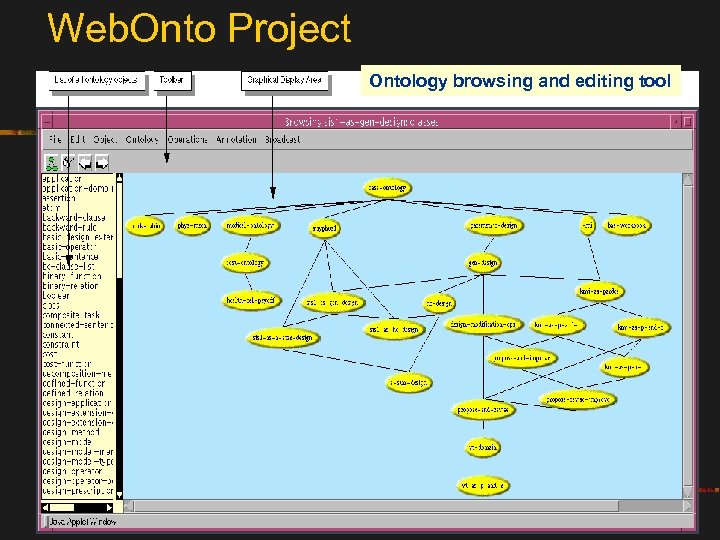 Web. Onto Project Ontology browsing and editing tool
 Thank you. . . Questions.