 Скачать презентацию The 16 th ADAS Workshop Auburn 19 October
960befb66b7157b75b2eee73a8ded84c.ppt
- Количество слайдов: 22



The 16 th ADAS Workshop Auburn, 19 October 2011 Rosa Antidormi European Commission 1 of 20
Energy demand the case for fusion · IEA “World Energy Outlook 2010”: global energy demand is predicted to rise by 36% between 2008 and 2035 · EU objective set to reduce greenhouse gas emissions by 80 to 95% by 2050 (European Council meeting, March 2010). · Energy production in the future MUST become environmentally sustainable, and security of delivery is a key factor · Fusion fits the bill (if its commercial viability can be demonstrated) · There is abundant fuel distributed world wide · No “meltdown” accidents or transport of nuclear radioactive fuel during normal operation · Waste not a burden for future generations (less than 100 years radio-toxicity) · No CO 2 emissions · Scale to allow providing base-load electricity 2 of 20
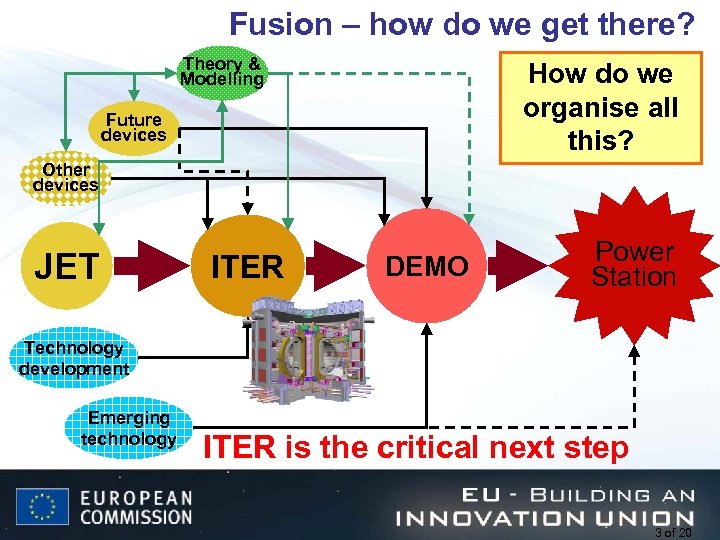
Fusion – how do we get there? Theory & Modelling How do we organise all this? Future devices Other devices JET ITER DEMO Power Station Technology development Emerging technology ITER is the critical next step 3 of 20
Why fund fusion research at European level? · Pooling and leveraging resources § creation of a critical mass of funding/researchers § spreading costs (and the later benefits) § undertaking projects too large for one EU Member State · Fostering human capacity (training, mobility and career development of researchers) · Better integration of European R&D § problems and solutions which affect all the EU member states § coordination of national policies â European added value 4 of 20
Energy Technology Development in the Framework Programmes · EC Framework Programme (2007 -13), FP 7 · Energy efficiency € 2350 M · Renewable energy · Knowledge for policy making · Hydrogen and fuel cells · Carbon capture and sequestration · Euratom Framework Programme (2007 -11 FP 7) + (201213 FP 7+2) Commission · · funding 2007 -11 € 287 M management, Fission related activities (waste radiation protection) Fusion (Commission spending ~ 54% of total) € 1, 947 M 5 of 20
The objective of the EURATOM Fusion Programme Building on the achievements of previous FPs, and maintaining the same overall direction: “Developing the knowledge base for, and realising ITER as the major step towards, the creation of prototype reactors for power stations which are safe, sustainable, environmentally responsible, and economically viable” (Council Decision on Euratom-FP 7) 6 of 20
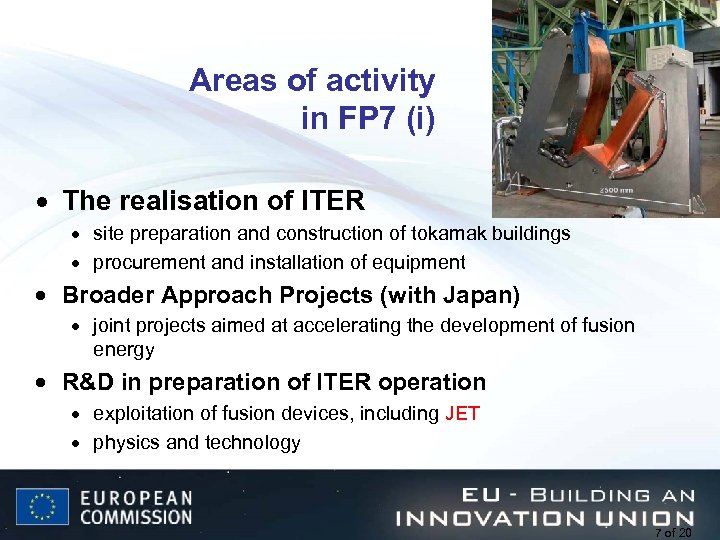
Areas of activity in FP 7 (i) · The realisation of ITER · site preparation and construction of tokamak buildings · procurement and installation of equipment · Broader Approach Projects (with Japan) · joint projects aimed at accelerating the development of fusion energy · R&D in preparation of ITER operation · exploitation of fusion devices, including JET · physics and technology 7 of 20
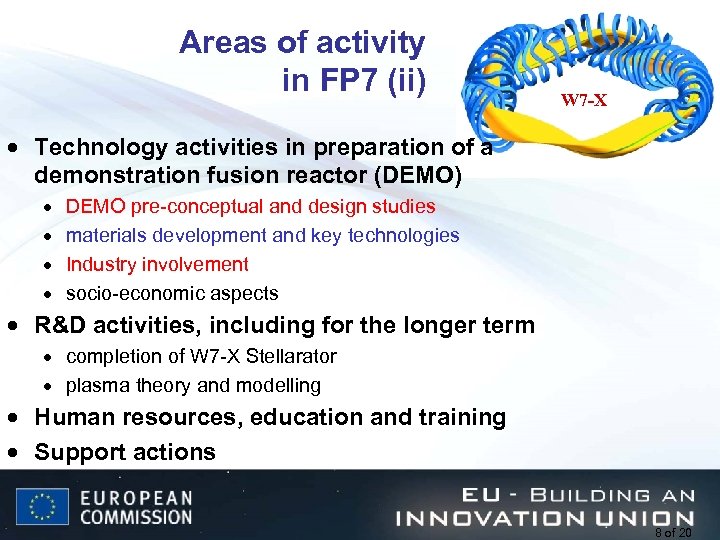
Areas of activity in FP 7 (ii) W 7 -X · Technology activities in preparation of a demonstration fusion reactor (DEMO) · · DEMO pre-conceptual and design studies materials development and key technologies Industry involvement socio-economic aspects · R&D activities, including for the longer term · completion of W 7 -X Stellarator · plasma theory and modelling · Human resources, education and training · Support actions 8 of 20
The nature of the Fusion Programme · The programme has a well defined long term objective: the joint realisation of prototype fusion power plants · This orientation is an essential motivation for supporting a programme of this size · Programme is fully integrated at the European level, with a strong international dimension · overall co-ordination · extensive collaborations · large joint projects 9 of 20
The main players in the European fusion programme l The European Commission (Euratom) l l Euratom Fusion Associations l l 26 “Contracts of Association” between Euratom and EU member states (plus Switzerland) fusion R&D in these laboratories EFDA (The European Fusion Development Agreement) l l Overall programme management (including funding), representation of the programme internationally (fusion co-operation Agreements) An agreement between all the Associations and Euratom to support co -ordinated and collective activities 3 dpts Fusion Energy (F 4 E) in Barcelona (the EU Joint Undertaking for ITER) l The EU Domestic Agency for ITER, Broader Approach projects and preparation for DEMO 10 of 20
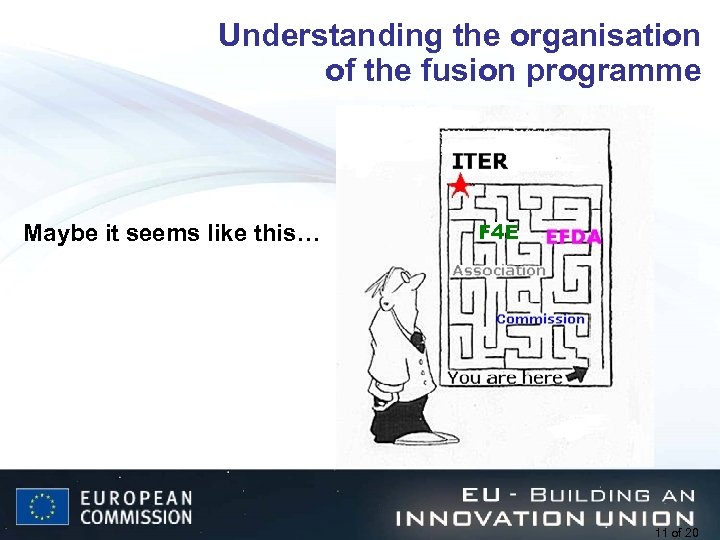
Understanding the organisation of the fusion programme Maybe it seems like this… F 4 E 11 of 20
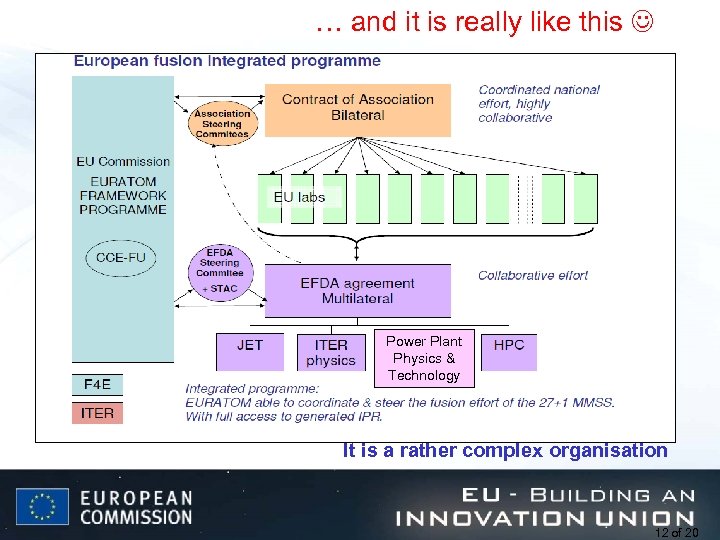
… and it is really like this Power Plant Physics & Technology It is a rather complex organisation 12 of 20
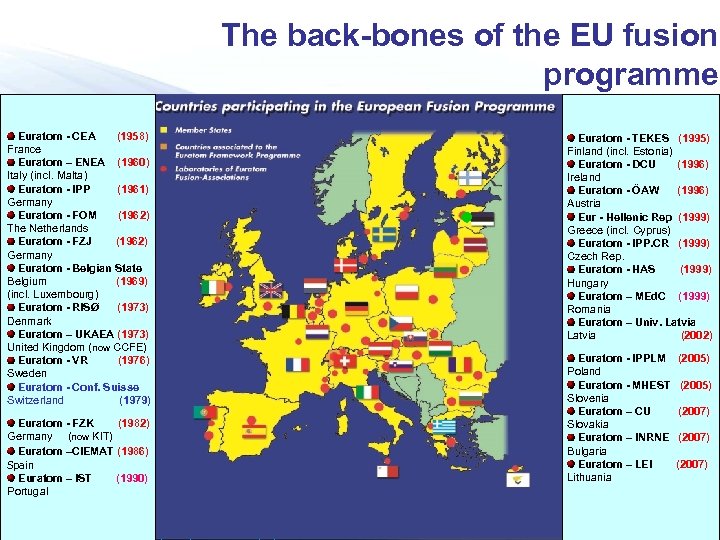
The back-bones of the EU fusion programme Euratom - CEA (1958) France Euratom – ENEA (1960) Italy (incl. Malta) Euratom - IPP (1961) Germany Euratom - FOM (1962) The Netherlands Euratom - FZJ (1962) Germany Euratom - Belgian State Belgium (1969) (incl. Luxembourg) Euratom - RISØ (1973) Denmark Euratom – UKAEA (1973) United Kingdom (now CCFE) Euratom - VR (1976) Sweden Euratom - Conf. Suisse Switzerland (1979) Euratom - FZK (1982) Germany (now KIT) Euratom –CIEMAT (1986) Spain Euratom – IST (1990) Portugal 10 th Carolus Magnus Summer School, Weert, the Netherlands, September 2011 Euratom - TEKES (1995) Finland (incl. Estonia) Euratom - DCU (1996) Ireland Euratom - ÖAW (1996) Austria Eur - Hellenic Rep (1999) Greece (incl. Cyprus) Euratom - IPP. CR (1999) Czech Rep. Euratom - HAS (1999) Hungary Euratom – MEd. C (1999) Romania Euratom – Univ. Latvia (2002) Euratom - IPPLM Poland Euratom - MHEST Slovenia Euratom – CU Slovakia Euratom – INRNE Bulgaria Euratom – LEI Lithuania (2005) (2007) 13 of 20
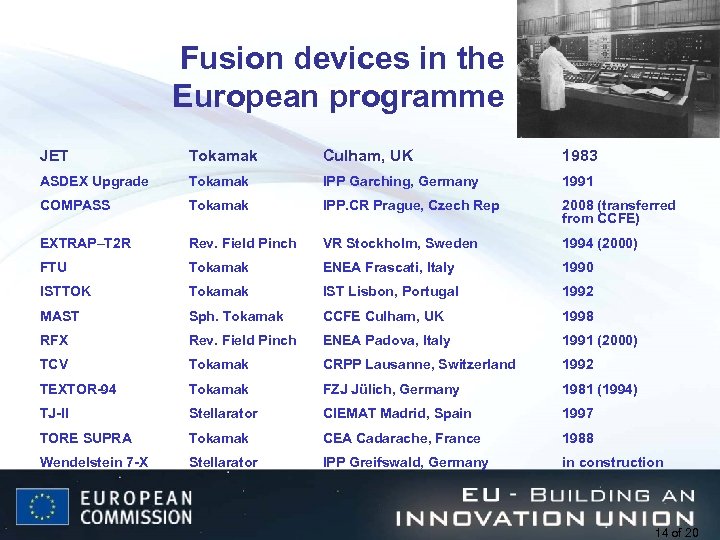
Fusion devices in the European programme JET Tokamak Culham, UK 1983 ASDEX Upgrade Tokamak IPP Garching, Germany 1991 COMPASS Tokamak IPP. CR Prague, Czech Rep 2008 (transferred from CCFE) EXTRAP–T 2 R Rev. Field Pinch VR Stockholm, Sweden 1994 (2000) FTU Tokamak ENEA Frascati, Italy 1990 ISTTOK Tokamak IST Lisbon, Portugal 1992 MAST Sph. Tokamak CCFE Culham, UK 1998 RFX Rev. Field Pinch ENEA Padova, Italy 1991 (2000) TCV Tokamak CRPP Lausanne, Switzerland 1992 TEXTOR-94 Tokamak FZJ Jülich, Germany 1981 (1994) TJ-II Stellarator CIEMAT Madrid, Spain 1997 TORE SUPRA Tokamak CEA Cadarache, France 1988 Wendelstein 7 -X Stellarator IPP Greifswald, Germany in construction 14 of 20
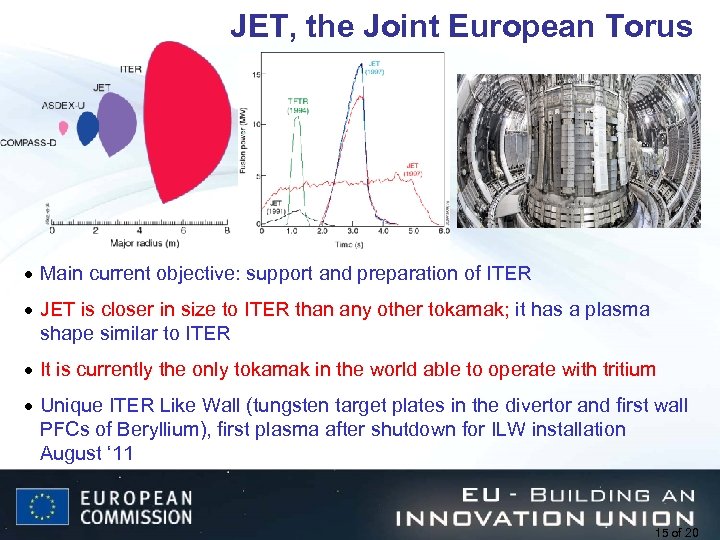
JET, the Joint European Torus · Main current objective: support and preparation of ITER · JET is closer in size to ITER than any other tokamak; it has a plasma shape similar to ITER · It is currently the only tokamak in the world able to operate with tritium · Unique ITER Like Wall (tungsten target plates in the divertor and first wall PFCs of Beryllium), first plasma after shutdown for ILW installation August ‘ 11 15 of 20
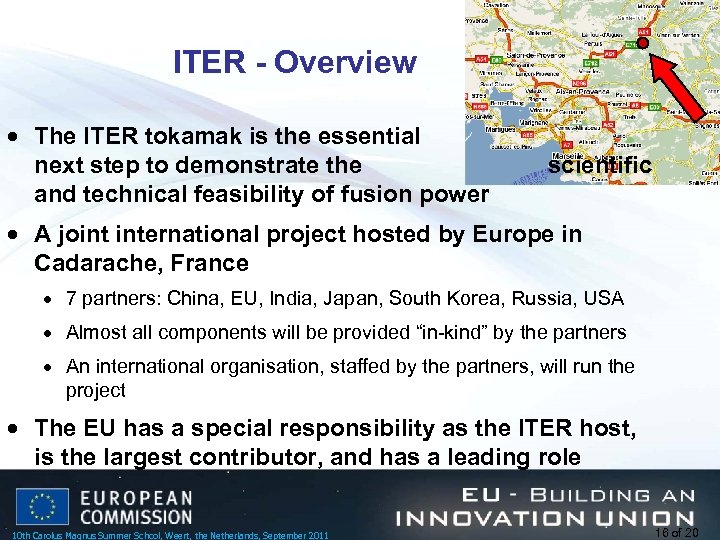
ITER - Overview · The ITER tokamak is the essential next step to demonstrate the and technical feasibility of fusion power scientific · A joint international project hosted by Europe in Cadarache, France · 7 partners: China, EU, India, Japan, South Korea, Russia, USA · Almost all components will be provided “in-kind” by the partners · An international organisation, staffed by the partners, will run the project · The EU has a special responsibility as the ITER host, is the largest contributor, and has a leading role 10 th Carolus Magnus Summer School, Weert, the Netherlands, September 2011 16 of 20
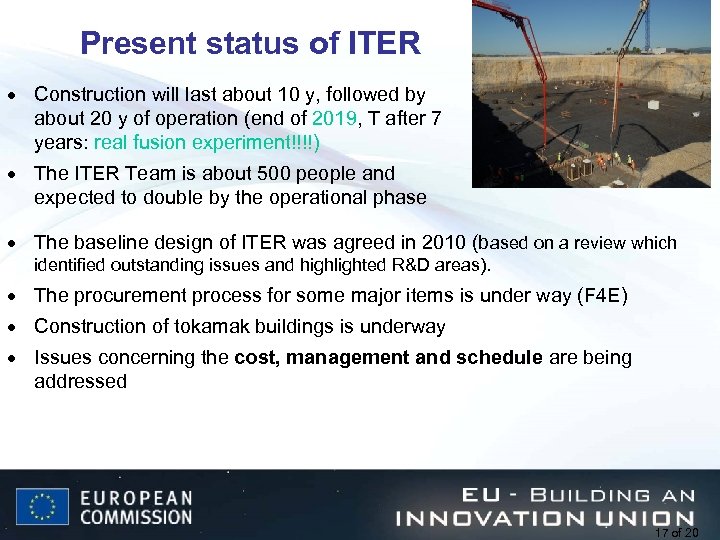
Present status of ITER · Construction will last about 10 y, followed by about 20 y of operation (end of 2019, T after 7 years: real fusion experiment!!!!) · The ITER Team is about 500 people and expected to double by the operational phase · The baseline design of ITER was agreed in 2010 (based on a review which identified outstanding issues and highlighted R&D areas). · The procurement process for some major items is under way (F 4 E) · Construction of tokamak buildings is underway · Issues concerning the cost, management and schedule are being addressed 17 of 20
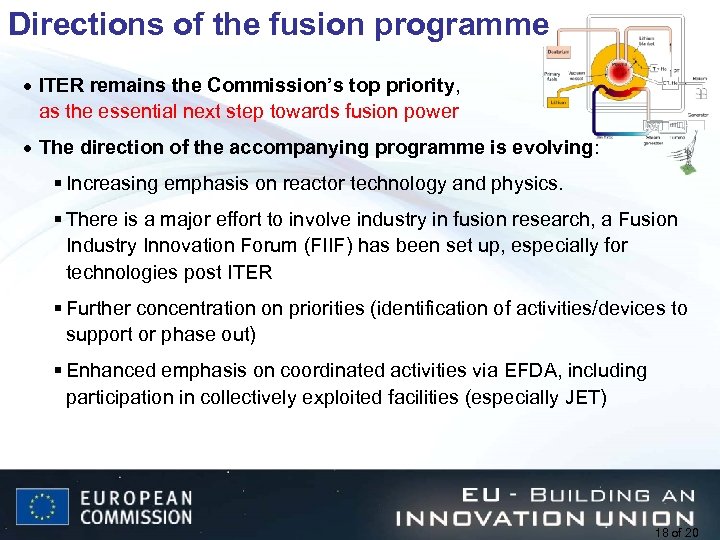
Directions of the fusion programme · ITER remains the Commission’s top priority, as the essential next step towards fusion power · The direction of the accompanying programme is evolving: § Increasing emphasis on reactor technology and physics. § There is a major effort to involve industry in fusion research, a Fusion Industry Innovation Forum (FIIF) has been set up, especially for technologies post ITER § Further concentration on priorities (identification of activities/devices to support or phase out) § Enhanced emphasis on coordinated activities via EFDA, including participation in collectively exploited facilities (especially JET) 18 of 20
ADAS-EU Atomic data and modelling in support of fusion plasma experiments FP 7 -Fusion Support Action (2007 -2012), 900 k€ http: //www. adas-fusion. eu ADAS-EU addresses the most critical deficiencies of current Atomic data bases for use in a fusion reactor research • Diagnostics: the scientific themes of ADAS-EU have many applications in line with the high priority areas and research needs of fusion (ITER, EFDA JET and other EU facilities). • Modelling: the ADAS-EU team is contributing to the EFDA task force on Integrated Tokamak Modelling by coordinating its atomic data needs. EFDA aims at developing a comprehensive fusion plasma modelling capacity and infrastructure under EFDA ADAS-EU is highly integrated into existing and recognised European fusion projects and structures for fusion energy research coordination 19 of 20
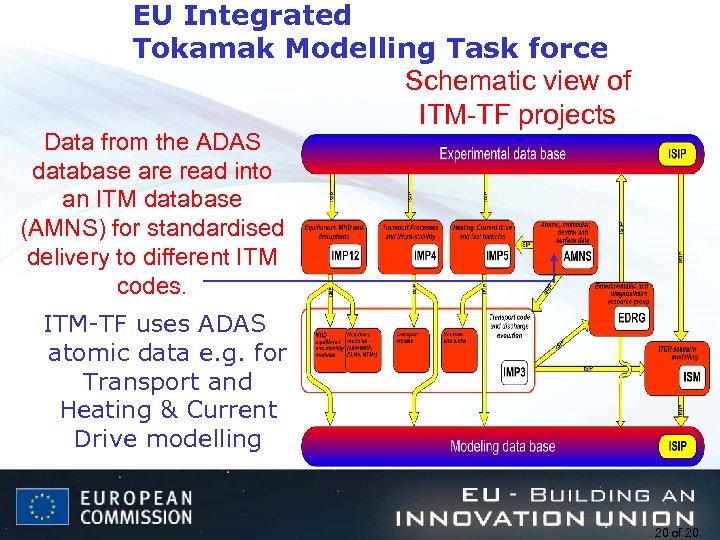
EU Integrated Tokamak Modelling Task force Schematic view of ITM-TF projects Data from the ADAS database are read into an ITM database (AMNS) for standardised delivery to different ITM codes. ITM-TF uses ADAS atomic data e. g. for Transport and Heating & Current Drive modelling 20 of 20
Key Links of ADAS-EU with the fusion community • ITER • EU Associations experiments • EFDA ITM framework • Into the wider ADAS context • New scientists into the field together with top level experts Significant contributions by Lars-Göran Eriksson are gratefully acknowledged 21 of 20
Areas of activity in FP 12 -13 will also contribute to the implementation of the Innovation Union, one of the Europe 2020 flagship initiatives, and will be a bridge to Horizon 2020, the programme starting from 2014. • R&D in preparation of ITER operation · Limited technology activities to prepare for DEMO • Human resources, education and trainingbuilding the ITER generation • Technology transfer, industry involvement and innovation 22 of 20
Скачать презентацию The 16 th ADAS Workshop Auburn 19 October
960befb66b7157b75b2eee73a8ded84c.ppt