 Скачать презентацию The 13 th Annual The Nuts and Bolts
09b866960486a0d4267ddbfe948532b3.ppt
- Количество слайдов: 37



The 13 th Annual The Nuts and Bolts of Business Plans MIT Course 15. 975 January 2002 Joe Hadzima Senior Lecturer, MIT Sloan School Managing Director, Main Street Partners LLC jgh@alum. mit. edu Joost Bonsen Yonald Chery Former Lead Organizer, MIT $50 K Competition Founder Virtual Ink jpbonsen@alum. mit. edu yonald@newburynetworks. com TA: Timo Somervuo (somervuo@mit. edu) $50 K Finalist,
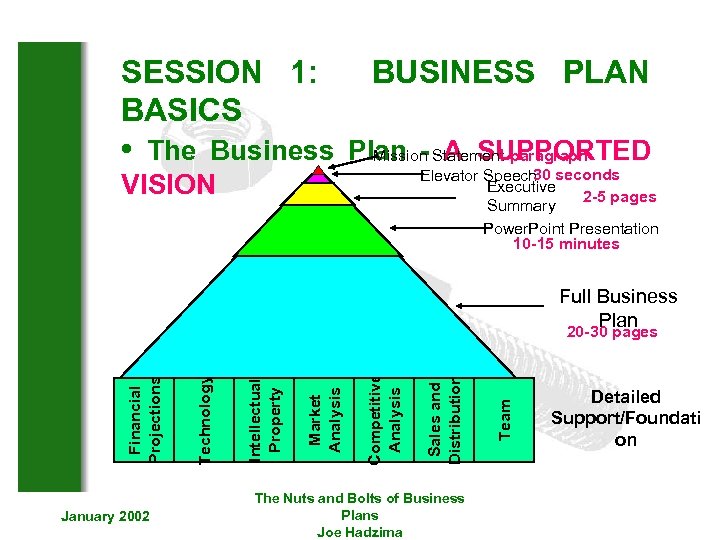
SESSION 1: BUSINESS PLAN BASICS • The Business Plan - Statement paragraph Mission A SUPPORTED 1 30 Elevator Speech seconds Executive 2 -5 pages Summary Power. Point Presentation 10 -15 minutes VISION Full Business Plan January 2002 The Nuts and Bolts of Business Plans Joe Hadzima Team Sales and Distribution Competitive Analysis Market Analysis Intellectual Property Technology Financial Projections 20 -30 pages Detailed Support/Foundati on
SESSION 1: BUSINESS PLAN BASICS What We Will Discuss Today: – Why Write A Business Plan? – What Should Be In A Business Plan? – The Business Plan As A Financing Document January 2002 The Nuts and Bolts of Business Plans Joe Hadzima
SESSION 1: BUSINESS PLAN BASICS Why Write a Business Plan? – Because I have to. . . – Needed for financing – Strategic partnering – To explain business customers/suppliers – To attract key people January 2002 The Nuts and Bolts of Business Plans Joe Hadzima to
SESSION 1: BUSINESS PLAN BASICS Why Write a Business Plan? – Because I Need to Understand My Business • The Business Plan is a result of a PLANNING PROCESS – – Who are your customers? Why will the buy your service or product? What will they pay? How will you make and deliver the service/product – What resources (people, money, technology) will you need? – Can Nuts and Boltsmoney/create value? you make of Business The January 2002 Plans Joe Hadzima
SESSION 1: BUSINESS PLAN BASICS • Types of Plans • Operational plans • External plans – Summary Plan – Full Business Plan • Who should write the Plan? • CEO alone? • The team? • A hired writer/consultant? January 2002 The Nuts and Bolts of Business Plans Joe Hadzima
SESSION 1: BUSINESS PLAN BASICS Should Be In A Business • What Plan? • Size/Packaging Of The Plan • Avoid the 3" thick binder • Separate binding of Summary? • How to bind? – – January 2002 Executive staple spiral Velabind Accubinder • Appearance should be professional The Nuts and Bolts of Business Plans but not overly slick Joe Hadzima
SESSION 1: BUSINESS PLAN BASICS • What Should Be In A Business Plan? – The Plan DOCUMENT is a SELLING – Don't lose sight of the vision – The excitement must come through – The Plan should project your image – BUT: The Plan Must Be Defensible January 2002 The Nuts and Bolts of Business Plans Joe Hadzima
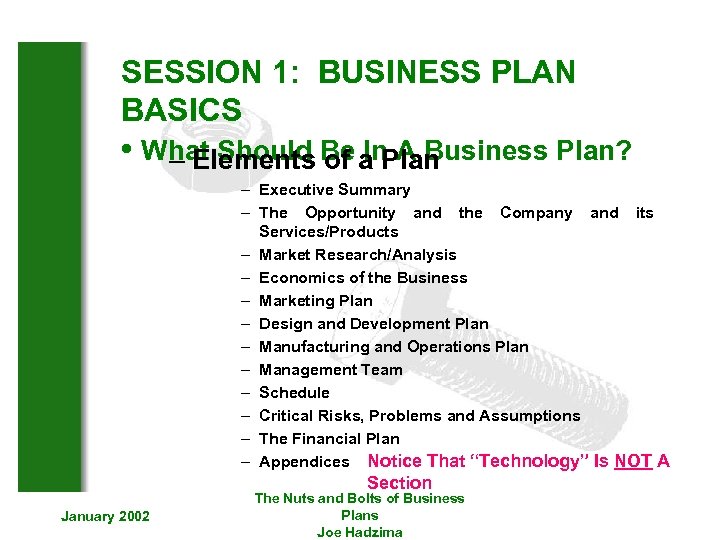
SESSION 1: BUSINESS PLAN BASICS • What Should Be a Plan – Elements of In A Business Plan? – Executive Summary – The Opportunity and the Company and its Services/Products – Market Research/Analysis – Economics of the Business – Marketing Plan – Design and Development Plan – Manufacturing and Operations Plan – Management Team – Schedule – Critical Risks, Problems and Assumptions – The Financial Plan – Appendices Notice That “Technology” Is NOT A Section January 2002 The Nuts and Bolts of Business Plans Joe Hadzima
SESSION 1: BUSINESS PLAN BASICS • What Should Be In A Business Plan? – Cover Page • • • Name of Company Address Telephone/fax/email Confidentiality legend Securities law legend Control numbering of copies – Table of Contents • Put one in • Include page numbers January 2002 The Nuts and Bolts of Business Plans Joe Hadzima
SESSION 1: BUSINESS PLAN BASICS • What Should Be In A Business Plan? – Executive Summary • An Executive Summary is – – NOT an abstract of the plan NOT an introduction NOT a preface NOT a random collection of highlights • An Executive Summary IS the Business Plan in miniature January 2002 The Nuts and Bolts of Business Plans Joe Hadzima
SESSION 1: BUSINESS PLAN BASICS • What Should Be In A Business Plan? -Executive Summary (continued) • Size – Two pages (preferable) to five pages (max) • The Executive Summary must be – Logical – Clear – Interesting/Exciting • The Executive Summary is like a RESUME January 2002 – If it gets the reader’s attention, the rest gets read – The Elevator Speech is to the Exec Summary The Nuts and Bolts of Business as the Exec Summary is to the Full Plans Joe Hadzima
SESSION 1: BUSINESS PLAN BASICS • What Should Be In A Business Plan? -Executive Summary (continued) • The Executive Summary tells – – – Who you are What your strategy/vision is What you are doing and/or propose to do What is the market How many $$$$ do you need and what will you do with them – What your SUSTAINABLE COMPETITIVE ADVANTAGE is • When the reader is finished he or she should be able to tell someone what you are up to. January 2002 The Nuts and Bolts of Business Plans Joe Hadzima
SESSION 1: BUSINESS PLAN BASICS • What Should Be In A Business Plan? -Executive Summary (continued) • The Executive Summary Should Contain: – Description of the Business Concept and the Business – The Opportunity and Strategy – The Target Market and Projections – The Competitive Advantages – The Economics, Profitability and Harvest Potential – The Team January 2002 The Nuts and Bolts of Business Plans Joe Hadzima
SESSION 1: BUSINESS PLAN BASICS – The Body Be In A Business Plan? • What Shouldof the Plan • The Opportunity – What is the Market / Opportunity? » How big is it now? » What are the trends- how fast is it or will it grow? – Why Is This Time The Right Time For Your Product/Service? » Convergence of Opportunity and Solution January 2002 The Nuts and Bolts of Business Plans Joe Hadzima
SESSION 1: BUSINESS PLAN BASICS • What Should Be In A Business Plan? -The. Market Analysis • Body of the Plan – Existing and planned products marketplace – Market segments – Market players/competition » Competitive Advantages – Estimated Market Shares » Current Players » You January 2002 The Nuts and Bolts of Business Plans Joe Hadzima in
SESSION 1: BUSINESS PLAN BASICS • What Should Be In A Business Plan? – Economics of Business -The Body of the Plan – What Are Your: » Expected Gross and Operating Margins » Profit potential and erosion » Fixed, variable and semivariable costs » Months to breakeven » Months to Cash Flow Positive January 2002 The Nuts and Bolts of Business Plans Joe Hadzima
SESSION 1: BUSINESS PLAN BASICS • What Should Be In A Business Plan? • Body of the -The. Marketing Plan – What is your Marketing Strategy? – Pricing and Distribution » Pricing and margin erosion » Distribution must match strategy/pricing – Sales Tactics » Who will be the first customer, second customer etc. ? » How will you reach the customer? – Advertising and Promotion January 2002 The Nuts and Bolts of Business Plans Joe Hadzima
SESSION 1: BUSINESS PLAN BASICS • What Should Be In A Business Plan? • Body of the Plan -The. Development Plan – Where is development today- product status – What development is needed? » Time and resources needed for development » Do you have to produce a complete product to get going? Avoid “Nuclear Fusion” – Difficulty and Risks – Product Pipeline Plans January 2002 The Nuts and Bolts of Business Plans Joe Hadzima
SESSION 1: BUSINESS PLAN BASICS • What Should Be In A Business Plan? -The Body of the Plan • Intellectual Property • The Development Plan (cont) » Do you have patents? » How broad is your intellectual property protection? » How do you compare to your competitors? » Other technologies? – Proprietary Rights » Do prior employers have rights? January 2002 The Nuts and Bolts of Business Plans Joe Hadzima
SESSION 1: BUSINESS PLAN BASICS • What Should Be In A Business Plan? • Body of the and Operations Plan -The. Manufacturing Plan – – Operating Cycle Geographical Location Facilities needed Strategy and Plans » outsourcing vs. in-house – Regulatory and Legal issues » FDA » Environmental January 2002 The Nuts and Bolts of Business Plans Joe Hadzima
SESSION 1: BUSINESS PLAN BASICS • What Should Be In A Business Plan? -The Body of the Plan • The Team – The Internal Team » Background of principals » How long has the company been in operation? – The External Team » Board of Directors » Advisory Board » Professional Advisors » Don’t “name drop” if the external person has not agreed to be mentioned January 2002 The Nuts and Bolts of Business Plans Joe Hadzima
SESSION 1: BUSINESS PLAN BASICS • What Should Be In A Business Plan? • Action of -The Body. Planthe Plan – What Will You Do and When? » Identification of “Credibility Testers” » Sequencing to build VALUE » Eliminate or Reduce Dependencies » Coordination of Schedule, Value Recognition Events and Financing Requirements January 2002 The Nuts and Bolts of Business Plans Joe Hadzima
SESSION 1: BUSINESS PLAN BASICS • What Should Be In A Business Plan? • Risk Factors and Critical Assumptions -The Body of the Plan – Be sure to address Negatives as well as Positives » There always negatives/problems – Set the stage for the reader – Show that you have a plan for getting around or minimizing the negatives – Reduce Dependencies If Possible January 2002 The Nuts and Bolts of Business Plans Joe Hadzima
SESSION 1: BUSINESS PLAN BASICS • What Should Be In A Business Plan? • Body of the Plan -The. The Financial Plan – Actual Income Statements and Balance Sheets – Pro Forma » Income Statements » Balance Sheets » Cash Flow Statements » Breakeven Chart – Assumptions should be stated » Get these right or defensible January 2002 The Nuts and Bolts of Business Plans Joe Hadzima
SESSION 1: BUSINESS PLAN BASICS • What Should Be In A Business Plan? -The Body of the Plan The Financial Plan (cont. ) – Spreadsheetitis – – Do numbers balance? Do the numbers tie to the PLAN CASH IS KING – C I M I T Y M Use traditional financial statement presentation – Now is NOT the time to invent new methods of presentation » Get help if you aren't expert – Tie to rounds of financing/expansion January 2002 The Nuts and Bolts of Business Plans Joe Hadzima
SESSION 1: BUSINESS PLAN BASICS • What Should Be In A Business Plan? – Appendices – – – – – January 2002 Separately Bound Volume Resumes of Principals Product Literature Trade Press/Business Press Patents (front page) Testimonials Letters Technical Information Confidentiality Technical person to technical person discussion The Nuts and Bolts of Business Plans Joe Hadzima
SESSION 1: BUSINESS PLAN BASICS • Fine Tuning/Targeting the Plan • Have an Independent Reader Review the Plan – One or more independent readers for feedback: » Retired industry pro? » Customer(? ) » Consultant? » Professor? » Accountant- yes definitely » Lawyer- yes definitely January 2002 The Nuts and Bolts of Business Plans Joe Hadzima
SESSION 1: BUSINESS PLAN BASICS The Business Plan As A Financing Document (Excerpts From Materials Prepared By Lita Nelsen, Director of MIT Technology Licensing Office) • A. First Reading: Like a Resume – Make The Cut, So That You Get An Opportunity To Tell Your Story • B. Second Reading: Justify The Investment • C. Third Reading: Commit To A Plan – That You And The Investors Can Live With. • REMEMBER: If you don’t make the FIRST CUT, B and C never happen. January 2002 The Nuts and Bolts of Business Plans Joe Hadzima
SESSION 1: BASICS BUSINESS PLAN The MAKING THE FIRST CUT A Financing – Business Plan As – An Document Idea Too Good To Ignore – A Financial Promise Too Good To Turn Down – A Team Good Enough To Believe In – An Action Plan That’s » Credible » Focused – Details That Give Assurance of Insight, Commitment and Follow Through – Format and Style That Show » Passion » Sanity January 2002 The Nuts and Bolts of Business Plans Joe Hadzima
SESSION 1: BASICS BUSINESS PLAN The Business Plan As A Financing • . WHY PLANS FAIL THE FIRST CUT Document – Insufficient Market – Non-Credible Technology » Too Wild » Too Blue-Sky (Unproven) » Not Protectible » Too Mundane – Investment Too Large For The Promise – Failure to Understand The Market January 2002 The Nuts and Bolts of Business Plans Joe Hadzima
SESSION 1: BASICS BUSINESS PLAN The Business Plan As A Financing • . WHY PLANS FAIL THE FIRST CUT Document (cont. ) – Action Plan Not Credible » Too Optimistic » Naïve About The Hurdles » Runs Off In All Directions » Not Ambitious Enough » Regulatory Barriers Insufficiently Addressed » Gaps Filled By Handwaving » No Promises At All – Team Not Credible January 2002 The Nuts and Bolts of Business Plans Joe Hadzima
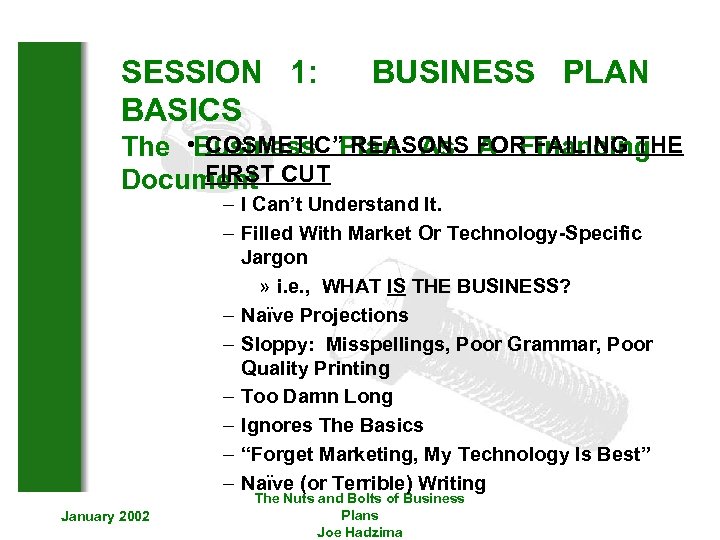
SESSION 1: BASICS BUSINESS PLAN COSMETIC” REASONS A Financing The • Business Plan As FOR FAILING THE FIRST Document CUT – I Can’t Understand It. – Filled With Market Or Technology-Specific Jargon » i. e. , WHAT IS THE BUSINESS? – Naïve Projections – Sloppy: Misspellings, Poor Grammar, Poor Quality Printing – Too Damn Long – Ignores The Basics – “Forget Marketing, My Technology Is Best” – Naïve (or Terrible) Writing January 2002 The Nuts and Bolts of Business Plans Joe Hadzima
SESSION 1: BASICS BUSINESS PLAN • SUMMARY – We Have Covered • Why Write A Business Plan? • What Should Be In A Business Plan? • The Business Plan As A Financing Document January 2002 The Nuts and Bolts of Business Plans Joe Hadzima
The Nuts and Bolts of Business Plans Course Information MIT Course 15. 975 nutsandbolts@mit. edu http: //entrepreneurship. mit. edu/15975. html Teaching Assistant: Timo Somervuo (somervuo@mit. edu) 3 Credits Pass/Fail: Class Attendance Required Writing Requirement: -Executive Summary The Nuts and Bolts of Business Plans or-Analysis of Business Plan
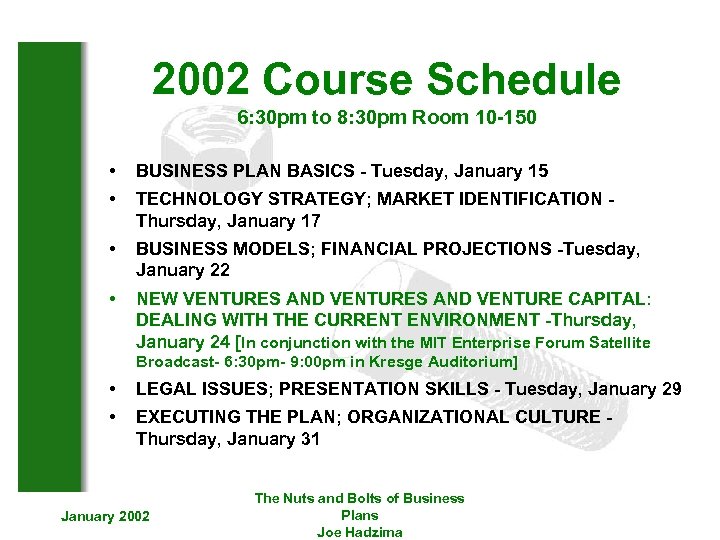
2002 Course Schedule 6: 30 pm to 8: 30 pm Room 10 -150 • BUSINESS PLAN BASICS - Tuesday, January 15 • TECHNOLOGY STRATEGY; MARKET IDENTIFICATION Thursday, January 17 • BUSINESS MODELS; FINANCIAL PROJECTIONS -Tuesday, January 22 • NEW VENTURES AND VENTURE CAPITAL: DEALING WITH THE CURRENT ENVIRONMENT -Thursday, January 24 [In conjunction with the MIT Enterprise Forum Satellite Broadcast- 6: 30 pm- 9: 00 pm in Kresge Auditorium] • LEGAL ISSUES; PRESENTATION SKILLS - Tuesday, January 29 • EXECUTING THE PLAN; ORGANIZATIONAL CULTURE Thursday, January 31 January 2002 The Nuts and Bolts of Business Plans Joe Hadzima
SESSION 1: • NEXT TIME: BASICS BUSINESS PLAN – Jan 17 - TECHNOLOGY STRATEGY; MARKET IDENTIFICATION • Professor Fiona Murray, Sloan School • Bob Jones, Functional Foods – Reading: Moore, Geoffrey A. , Crossing the Chasm, Marketing and Selling High-Tech Products to Mainstream Customers, Chapters 1 and 2. Focus on the descriptions of markets in Chapter 2. January 2002 – TA: Timo Somervuo (somervuo@mit. edu) – Website: The Nuts and Bolts of Business enterpreneurship. mit. edu/15. 975. html Plans Joe Hadzima
Скачать презентацию The 13 th Annual The Nuts and Bolts
09b866960486a0d4267ddbfe948532b3.ppt