Скачать презентацию Thailand Its Knowledge Economy Arkhom Termpittayapaisith Deputy Secretary-General
5d81ac0c4c7db331ceb78915b84dc199.ppt
- Количество слайдов: 29
 Thailand Its Knowledge Economy Arkhom Termpittayapaisith Deputy Secretary-General, Office of the National Economic and Social Development Board, Thailand.
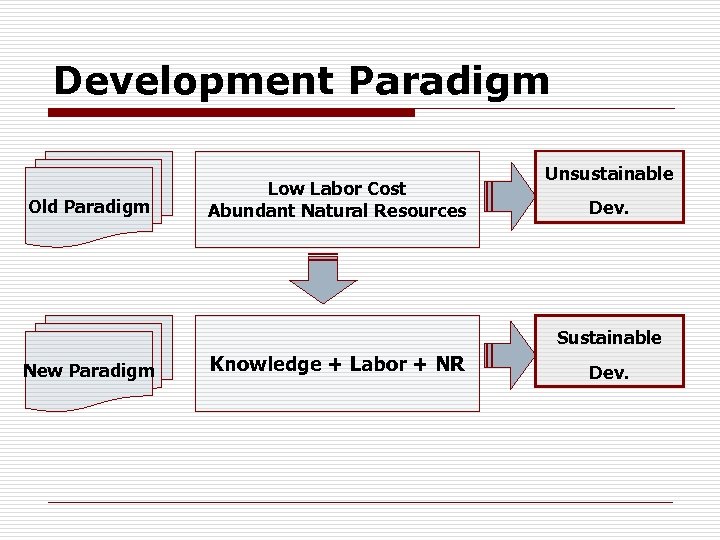 Development Paradigm Old Paradigm Low Labor Cost Abundant Natural Resources Unsustainable Dev. Sustainable New Paradigm Knowledge + Labor + NR Dev.
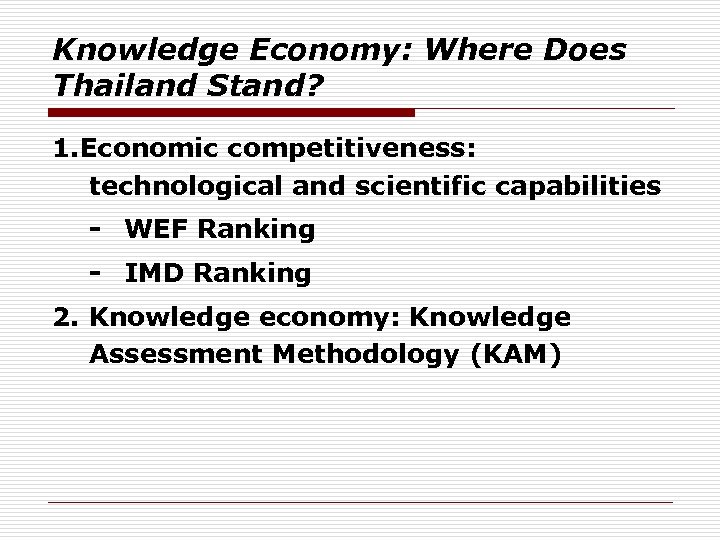 Knowledge Economy: Where Does Thailand Stand? 1. Economic competitiveness: technological and scientific capabilities - WEF Ranking - IMD Ranking 2. Knowledge economy: Knowledge Assessment Methodology (KAM)
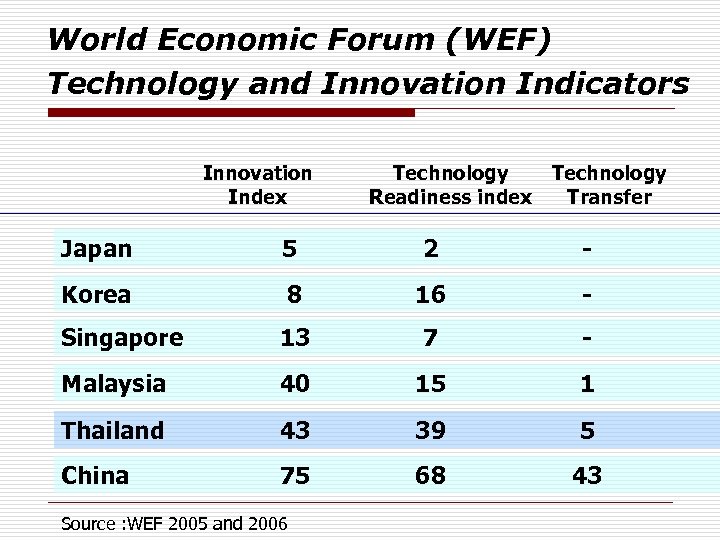 World Economic Forum (WEF) Technology and Innovation Indicators Innovation Index Technology Readiness index Transfer Japan 5 2 - Korea 8 16 - Singapore 13 7 - Malaysia 40 15 1 Thailand 43 39 5 China 75 68 43 Source : WEF 2005 and 2006
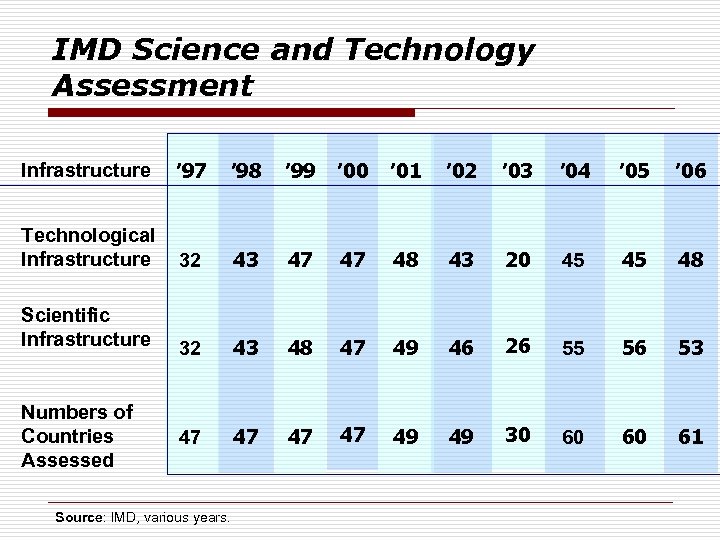 IMD Science and Technology Assessment Infrastructure ’ 97 ’ 98 ’ 99 ’ 00 ’ 01 ’ 02 ’ 03 ’ 04 ’ 05 ’ 06 Technological Infrastructure 32 43 47 47 48 43 20 45 45 48 Scientific Infrastructure 32 43 48 47 49 46 26 55 56 53 47 47 49 49 30 60 60 61 Numbers of Countries Assessed Source: IMD, various years.
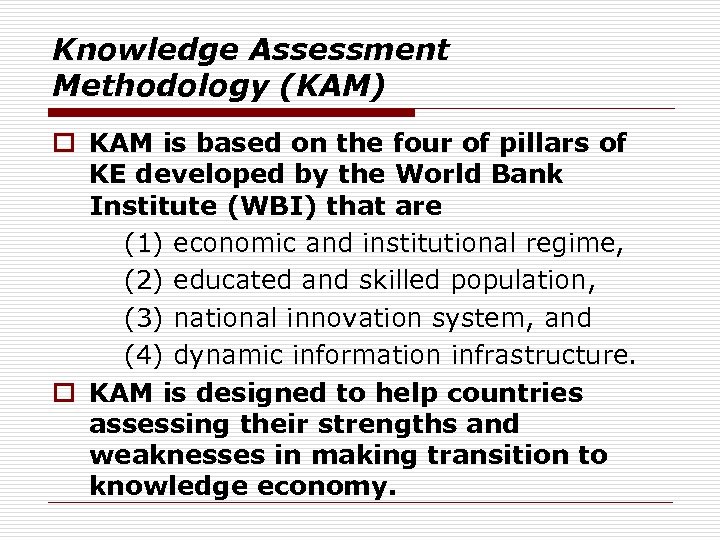 Knowledge Assessment Methodology (KAM) o KAM is based on the four of pillars of KE developed by the World Bank Institute (WBI) that are (1) economic and institutional regime, (2) educated and skilled population, (3) national innovation system, and (4) dynamic information infrastructure. o KAM is designed to help countries assessing their strengths and weaknesses in making transition to knowledge economy.
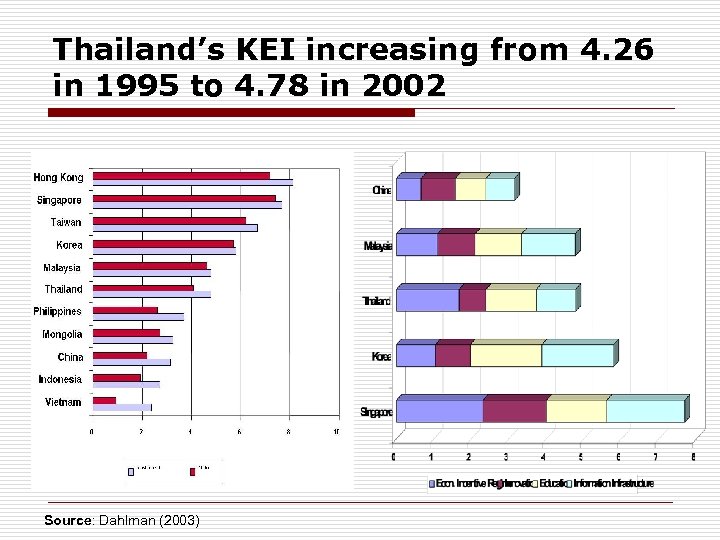 Thailand’s KEI increasing from 4. 26 in 1995 to 4. 78 in 2002 Source: Dahlman (2003)
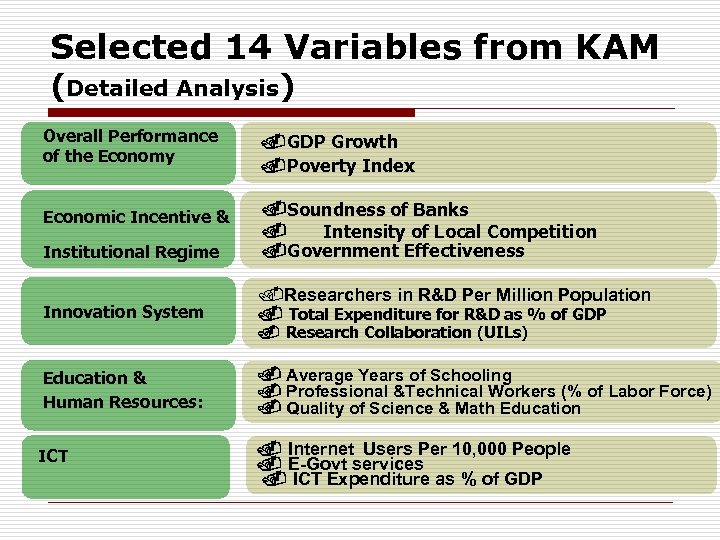 Selected 14 Variables from KAM (Detailed Analysis) Overall Performance of the Economy GDP Growth Poverty Index Economic Incentive & Institutional Regime Soundness of Banks Intensity of Local Competition Government Effectiveness Innovation System Researchers in R&D Per Million Population Total Expenditure for R&D as % of GDP Research Collaboration (UILs) Education & Human Resources: Average Years of Schooling Professional &Technical Workers (% of Labor Force) Quality of Science & Math Education ICT Internet Users Per 10, 000 People E-Govt services ICT Expenditure as % of GDP
 KAM Spidergram for Thailand, Japan, Korea and China Source: The World Bank Institute (2006)
 Thailand, KAM Spidergram for Selected Variables of Innovation Pillar Source: The World Bank Institute (2006)
 Selected Indicators: Measures of Innovation o Educational Attainment of Thai Population and Workforce o Quality of the Educational Outputs o R&D Expenditure and Patents
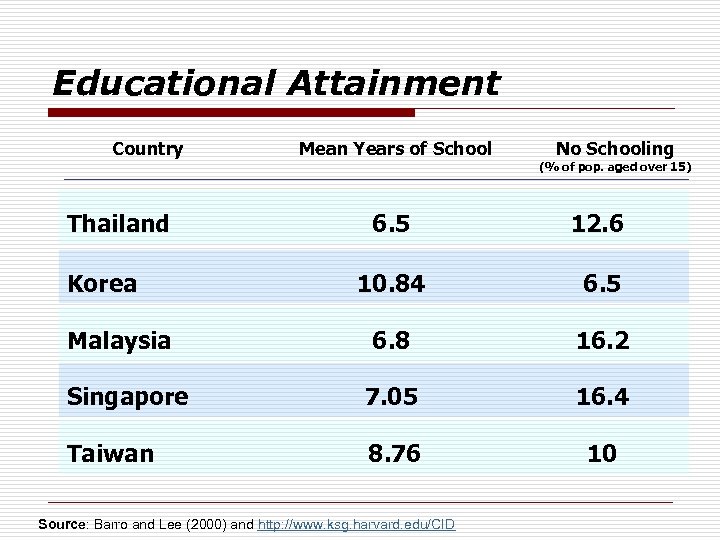 Educational Attainment Country Thailand Mean Years of School No Schooling (% of pop. aged over 15) 6. 5 12. 6 10. 84 6. 5 6. 8 16. 2 Singapore 7. 05 16. 4 Taiwan 8. 76 10 Korea Malaysia Source: Barro and Lee (2000) and http: //www. ksg. harvard. edu/CID
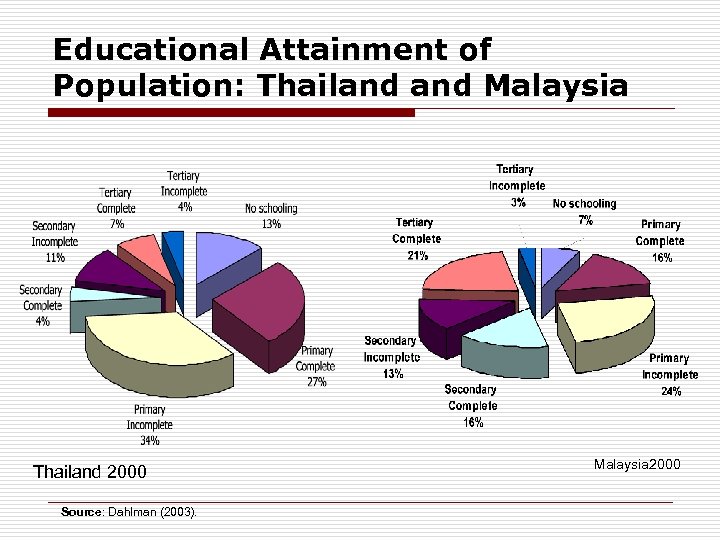 Educational Attainment of Population: Thailand Malaysia Thailand 2000 Source: Dahlman (2003). Malaysia 2000
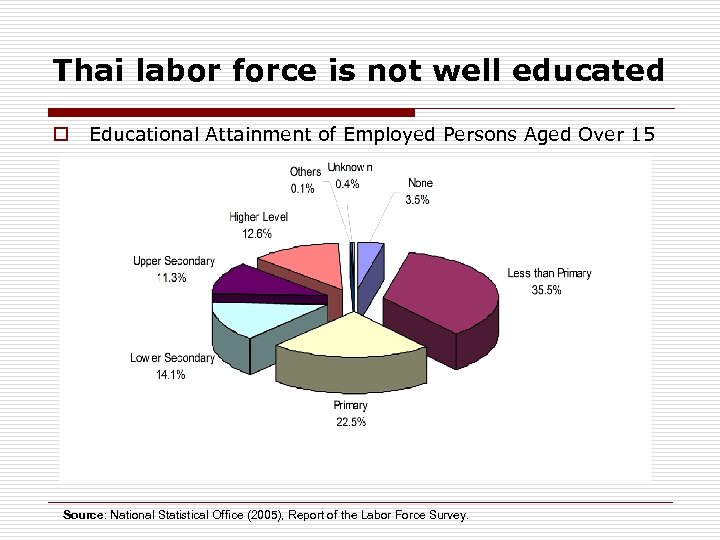 Thai labor force is not well educated o Educational Attainment of Employed Persons Aged Over 15 Source: National Statistical Office (2005), Report of the Labor Force Survey.
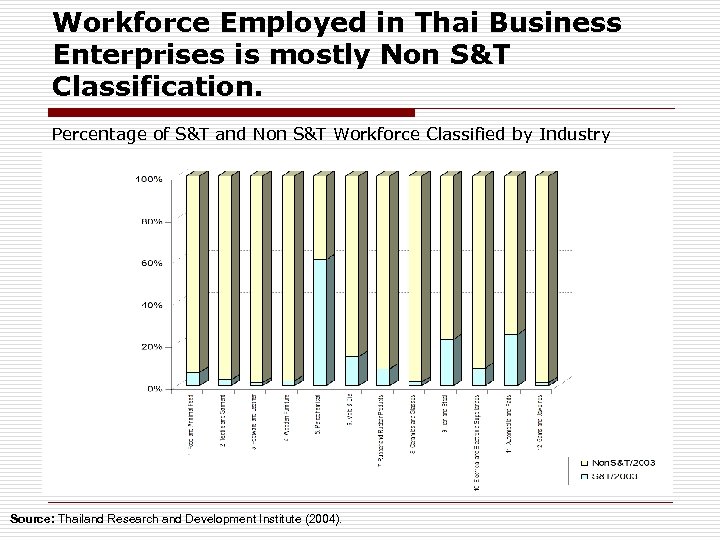 Workforce Employed in Thai Business Enterprises is mostly Non S&T Classification. Percentage of S&T and Non S&T Workforce Classified by Industry Source: Thailand Research and Development Institute (2004).
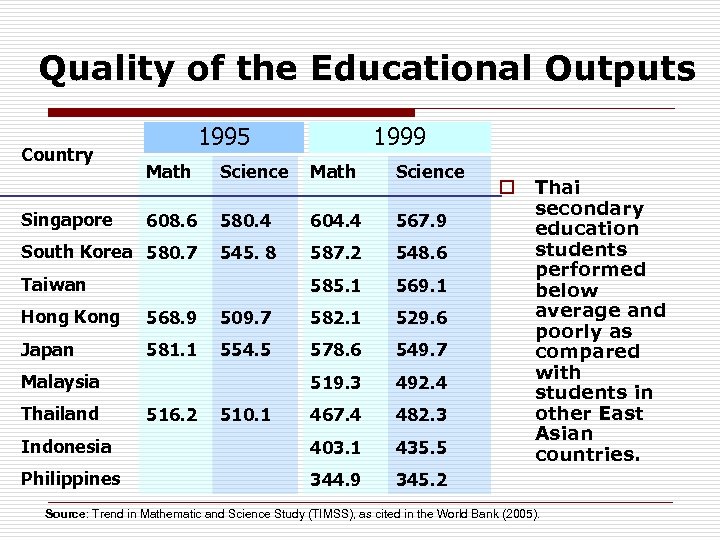 Quality of the Educational Outputs Country 1995 1999 Math Science 608. 6 580. 4 604. 4 567. 9 South Korea 580. 7 545. 8 587. 2 548. 6 585. 1 569. 1 Singapore Taiwan Hong Kong 568. 9 509. 7 582. 1 529. 6 Japan 581. 1 554. 5 578. 6 549. 7 519. 3 492. 4 467. 4 482. 3 Indonesia 403. 1 435. 5 Philippines 344. 9 o Thai secondary education students performed below average and poorly as compared with students in other East Asian countries. 345. 2 Malaysia Thailand 516. 2 510. 1 Source: Trend in Mathematic and Science Study (TIMSS), as cited in the World Bank (2005).
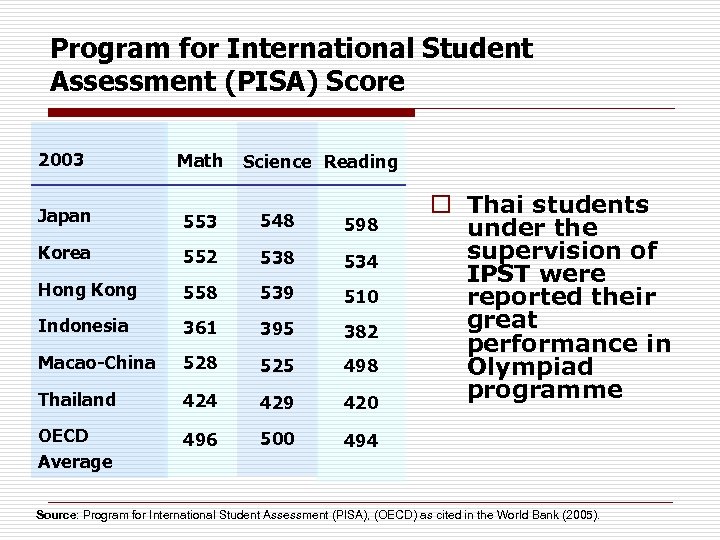 Program for International Student Assessment (PISA) Score 2003 Math Japan 553 548 598 Korea 552 538 534 Hong Kong 558 539 510 Indonesia 361 395 382 Macao-China 528 525 498 Thailand 424 429 420 OECD Average 496 500 494 Science Reading o Thai students under the supervision of IPST were reported their great performance in Olympiad programme Source: Program for International Student Assessment (PISA), (OECD) as cited in the World Bank (2005).
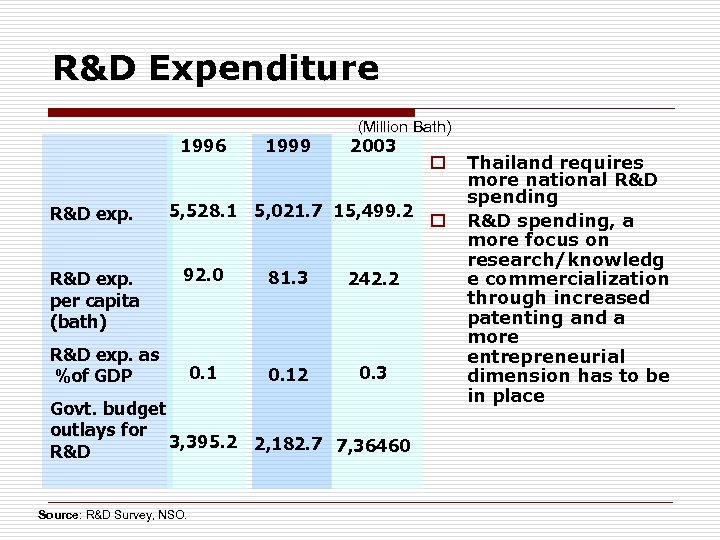 R&D Expenditure 1996 R&D exp. per capita (bath) 1999 (Million Bath) 2003 5, 528. 1 5, 021. 7 15, 499. 2 92. 0 81. 3 242. 2 0. 12 0. 3 R&D exp. as %of GDP Govt. budget outlays for 3, 395. 2 2, 182. 7 7, 36460 R&D Source: R&D Survey, NSO. o o Thailand requires more national R&D spending, a more focus on research/knowledg e commercialization through increased patenting and a more entrepreneurial dimension has to be in place
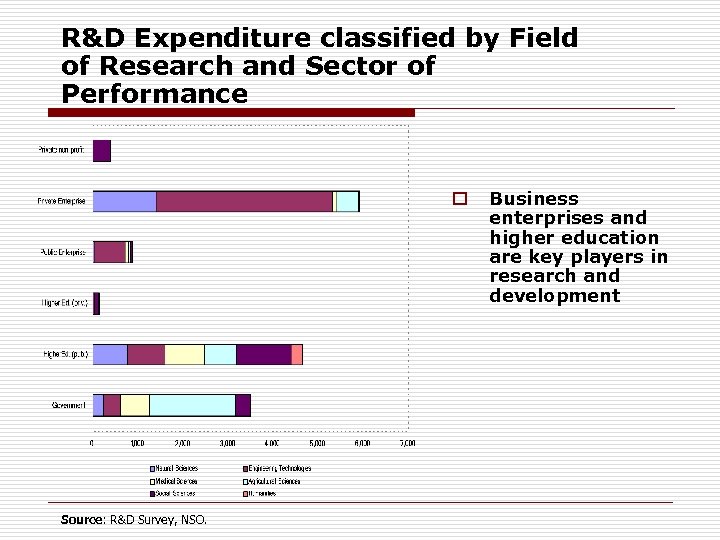 R&D Expenditure classified by Field of Research and Sector of Performance o Source: R&D Survey, NSO. Business enterprises and higher education are key players in research and development
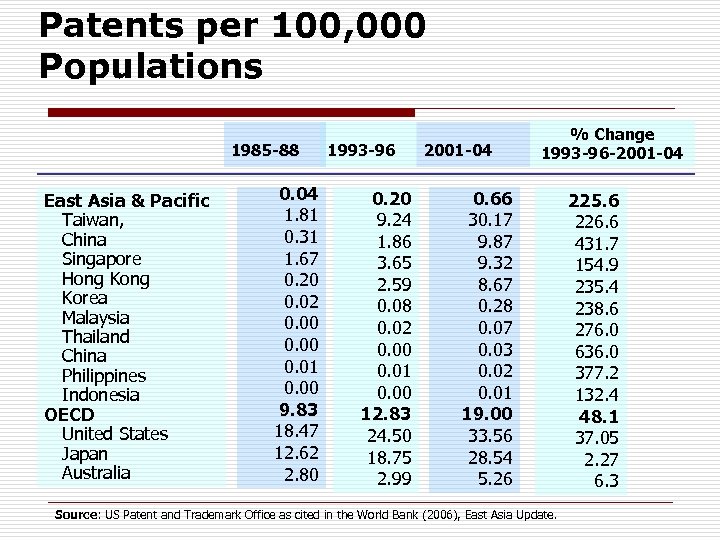 Patents per 100, 000 Populations 1985 -88 East Asia & Pacific Taiwan, China Singapore Hong Korea Malaysia Thailand China Philippines Indonesia OECD United States Japan Australia 0. 04 1. 81 0. 31 1. 67 0. 20 0. 02 0. 00 0. 01 0. 00 9. 83 18. 47 12. 62 2. 80 1993 -96 0. 20 9. 24 1. 86 3. 65 2. 59 0. 08 0. 02 0. 00 0. 01 0. 00 12. 83 24. 50 18. 75 2. 99 2001 -04 % Change 1993 -96 -2001 -04 0. 66 30. 17 9. 87 9. 32 8. 67 0. 28 0. 07 0. 03 0. 02 0. 01 19. 00 33. 56 28. 54 5. 26 Source: US Patent and Trademark Office as cited in the World Bank (2006), East Asia Update. 225. 6 226. 6 431. 7 154. 9 235. 4 238. 6 276. 0 636. 0 377. 2 132. 4 48. 1 37. 05 2. 27 6. 3
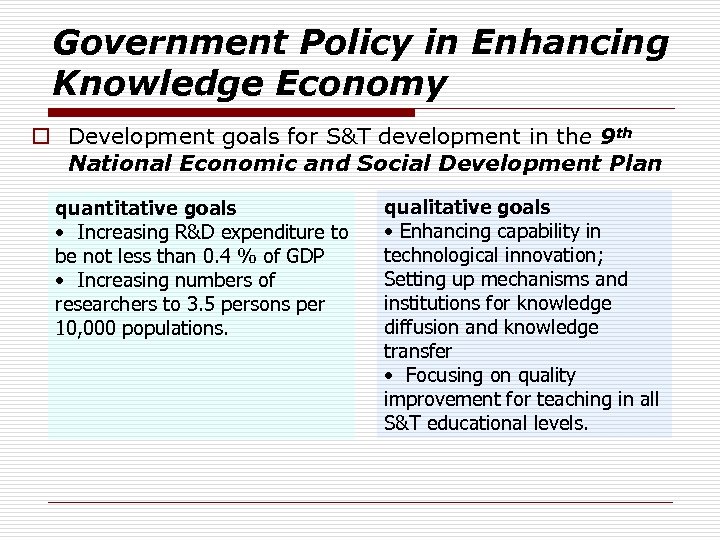 Government Policy in Enhancing Knowledge Economy o Development goals for S&T development in the 9 th National Economic and Social Development Plan quantitative goals • Increasing R&D expenditure to be not less than 0. 4 % of GDP • Increasing numbers of researchers to 3. 5 persons per 10, 000 populations. qualitative goals • Enhancing capability in technological innovation; Setting up mechanisms and institutions for knowledge diffusion and knowledge transfer • Focusing on quality improvement for teaching in all S&T educational levels.
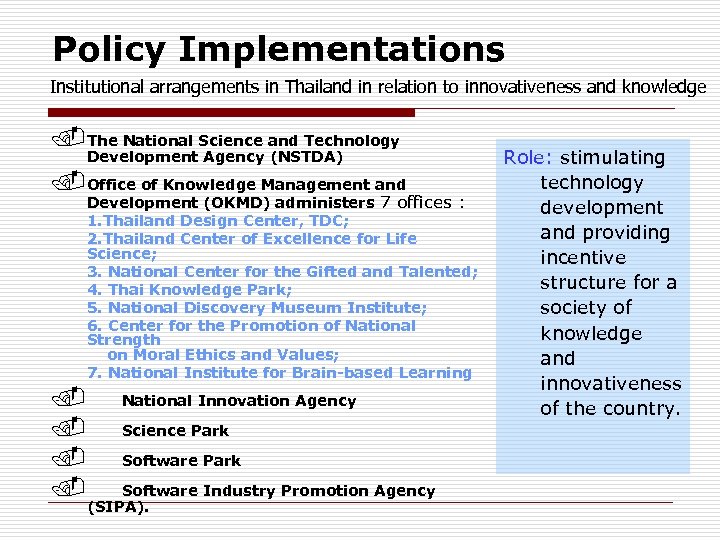 Policy Implementations Institutional arrangements in Thailand in relation to innovativeness and knowledge The National Science and Technology Development Agency (NSTDA) Office of Knowledge Management and Development (OKMD) administers 7 offices : 1. Thailand Design Center, TDC; 2. Thailand Center of Excellence for Life Science; 3. National Center for the Gifted and Talented; 4. Thai Knowledge Park; 5. National Discovery Museum Institute; 6. Center for the Promotion of National Strength on Moral Ethics and Values; 7. National Institute for Brain-based Learning National Innovation Agency Science Park Software Industry Promotion Agency (SIPA). Role: stimulating technology development and providing incentive structure for a society of knowledge and innovativeness of the country.
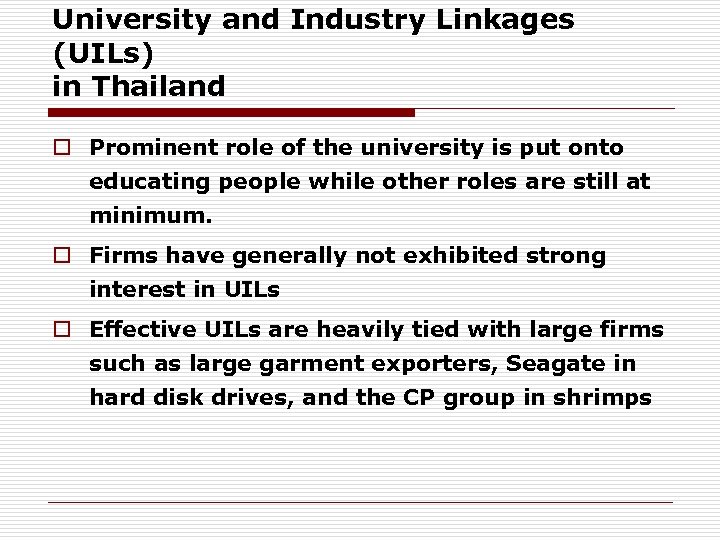 University and Industry Linkages (UILs) in Thailand o Prominent role of the university is put onto educating people while other roles are still at minimum. o Firms have generally not exhibited strong interest in UILs o Effective UILs are heavily tied with large firms such as large garment exporters, Seagate in hard disk drives, and the CP group in shrimps
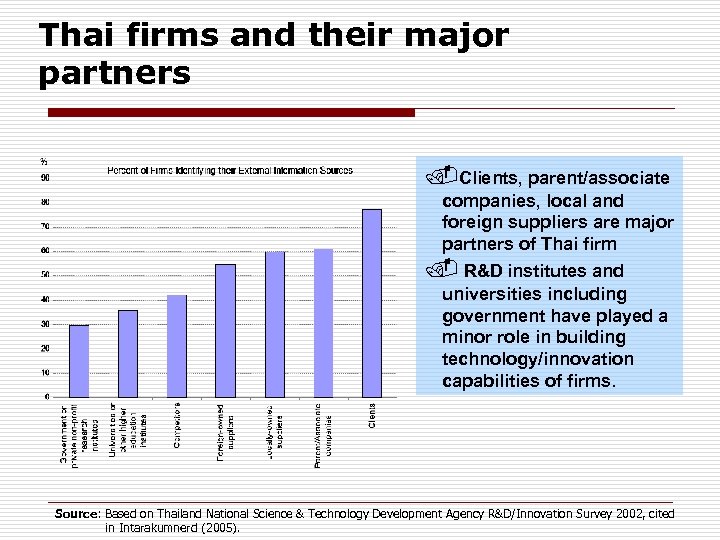 Thai firms and their major partners Clients, parent/associate companies, local and foreign suppliers are major partners of Thai firm R&D institutes and universities including government have played a minor role in building technology/innovation capabilities of firms. Source: Based on Thailand National Science & Technology Development Agency R&D/Innovation Survey 2002, cited in Intarakumnerd (2005).
 Brief review of UILs in Thailand o Mitr Phol sugarcane research center has linkages with public technology institutions like National Science and Technology Development Agency, and MTEC more than those with university. o Toyota Technical Center—Asia Pacific (TTCAP) has had significant linkages and collaboration extending beyond the national boundary where the center is located. However, TTCAP is reported to have a simple network to recruit employees with Thai universities. o Seagate: Qualified engineers are produced in collaboration with Thai universities and the first joint Seagate/AIT academic course has been offered in the Master's program since 1999. Sources: Brimble (2006), Asian Institute of Technology(2006).
 NSTDA : Major actor in national innovation system o o o The National Center for Genetic Engineering and Biotechnology (BIOTEC) has led the research in modern biotechnology that helped prevent disastrous losses in shrimp production, The Cassava and Starch Technology Unit induces research and development for improvement in Thai cassava and starch, e. g. industrial application of cassava and starch in both food and non -food industries—process for the production of ethanol and renewable fuel (BIOTEC, 2006). , Set up the Software Park Thailand (SPT) one successful example that received strong support from well-known transnational corporations (such as IBM, HP, SUN, and ORACLE) and established collaboration with Canegie-Mellon university for offering training and certification on the Capability Maturity Model to raise the standard of software production of STP’s tenant companies (Virasa, 2005, p. 104)
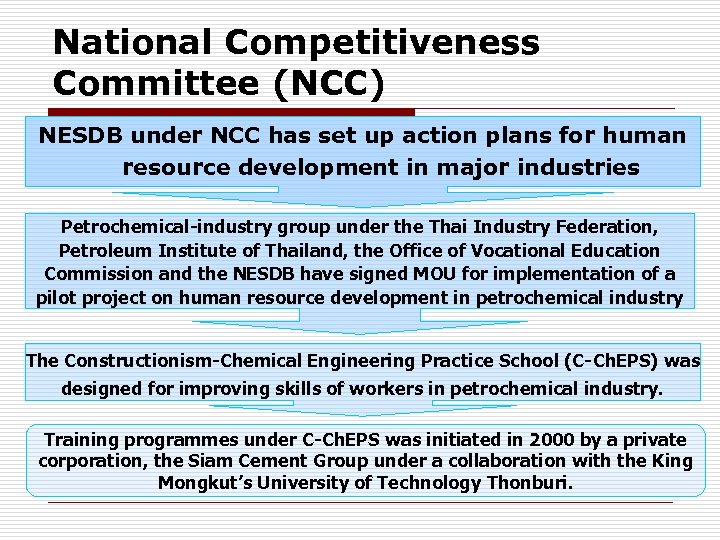 National Competitiveness Committee (NCC) NESDB under NCC has set up action plans for human resource development in major industries Petrochemical-industry group under the Thai Industry Federation, Petroleum Institute of Thailand, the Office of Vocational Education Commission and the NESDB have signed MOU for implementation of a pilot project on human resource development in petrochemical industry The Constructionism-Chemical Engineering Practice School (C-Ch. EPS) was designed for improving skills of workers in petrochemical industry. Training programmes under C-Ch. EPS was initiated in 2000 by a private corporation, the Siam Cement Group under a collaboration with the King Mongkut’s University of Technology Thonburi.
 Some Policy Recommendations: Given the framework of knowledge economy, Thailand’s innovation and education systems have confirmed the weakest arena among others. o o Strengthening education system (i. e. education reform) and outputs to increase qualified workforce particularly in S&T skills, including putting in place incentives for firms in the-job training system; Building new knowledge through basic research, R&D spending, technology transfer including developing strong linkages in universities, research institutes and firms (i. e. university-industry linkages) as foundation for knowledge generation and technology catching-up; Ensuring sufficient incentives for firms to innovate in new products and processes for industry and services sectors, given new trend in technology and market demand; Establishing S&T infrastructure (e. g. science parks, research funding, IT infrastructure etc. ) and increasing private involvement in developing the knowledge economy.