 Скачать презентацию Thailand I Campbell University Government History 354 Thailand
ThailandIC.ppt
- Количество слайдов: 31



Thailand I Campbell University Government/History 354
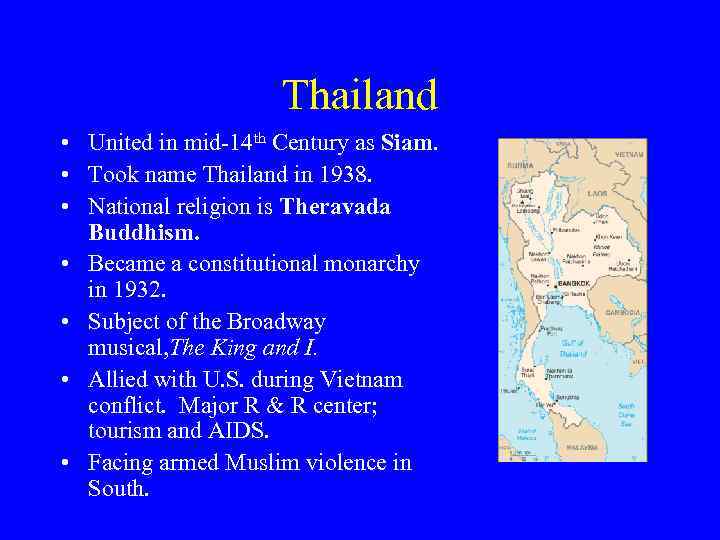
Thailand • United in mid-14 th Century as Siam. • Took name Thailand in 1938. • National religion is Theravada Buddhism. • Became a constitutional monarchy in 1932. • Subject of the Broadway musical, The King and I. • Allied with U. S. during Vietnam conflict. Major R & R center; tourism and AIDS. • Facing armed Muslim violence in South.
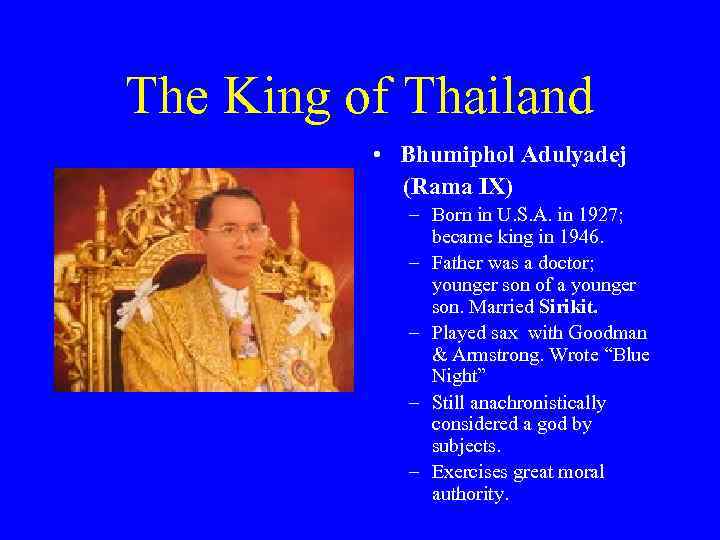
The King of Thailand • Bhumiphol Adulyadej (Rama IX) – Born in U. S. A. in 1927; became king in 1946. – Father was a doctor; younger son of a younger son. Married Sirikit. – Played sax with Goodman & Armstrong. Wrote “Blue Night” – Still anachronistically considered a god by subjects. – Exercises great moral authority.
The King’s Role • Politically – to moderate. • Economically – to pioneer. – – – The Greening of Isarn. Artificial rainmaking. New strains of fish(tilapia), rice & tapioca (casava). Irrigation projects and dams Alternate crops for Hmong – cabbages, turnips, brussels sprouts, etc. , instead of poppies. – Demonstration projects – dairy farming, bio-gas & forests. • Traditional Mediator – hill tribesman’s complaint. .
Questions • What is the national religion of Thailand? • With what major power was Thailand allied during the Vietnam conflict? • Name the current king of Thailand. For how many years has he been king? • Name the fish that the king pioneered raising commercially?
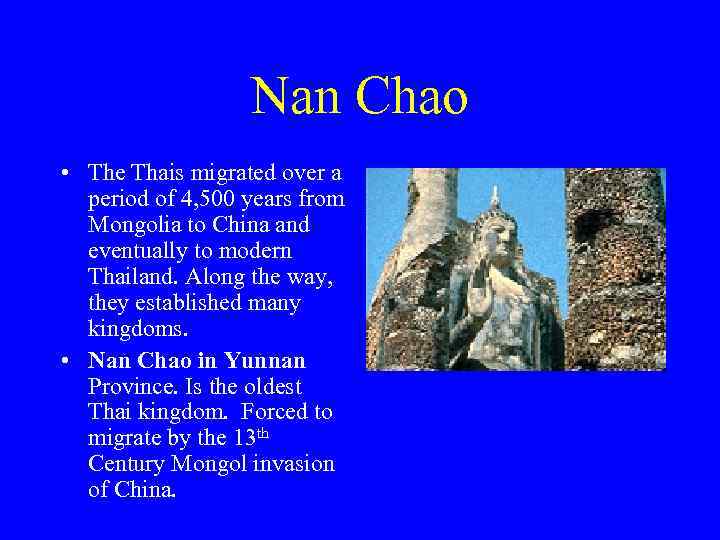
Nan Chao • The Thais migrated over a period of 4, 500 years from Mongolia to China and eventually to modern Thailand. Along the way, they established many kingdoms. • Nan Chao in Yunnan Province. Is the oldest Thai kingdom. Forced to migrate by the 13 th Century Mongol invasion of China.
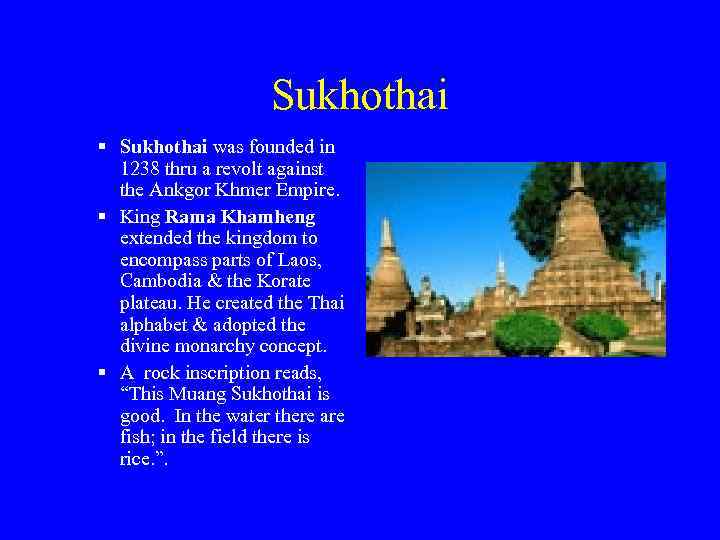
Sukhothai § Sukhothai was founded in 1238 thru a revolt against the Ankgor Khmer Empire. § King Rama Khamheng extended the kingdom to encompass parts of Laos, Cambodia & the Korate plateau. He created the Thai alphabet & adopted the divine monarchy concept. § A rock inscription reads, “This Muang Sukhothai is good. In the water there are fish; in the field there is rice. ”.
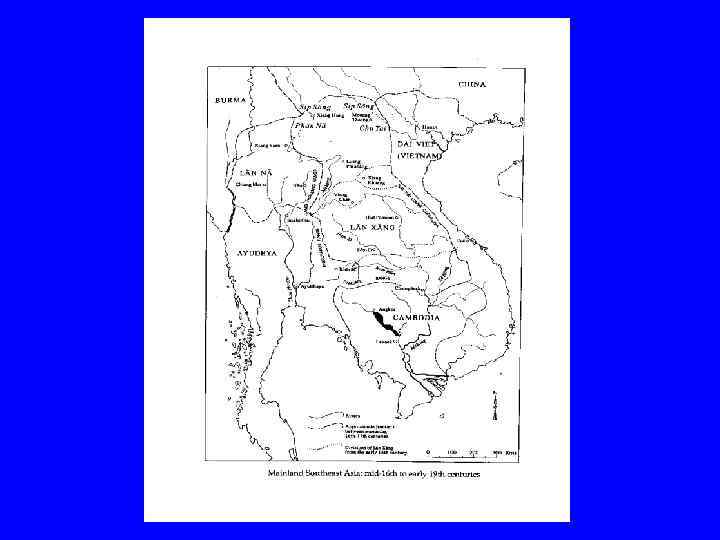
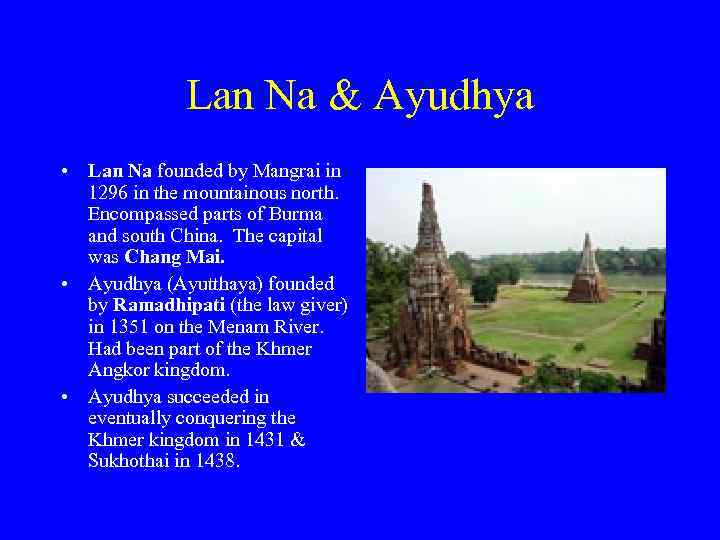
Lan Na & Ayudhya • Lan Na founded by Mangrai in 1296 in the mountainous north. Encompassed parts of Burma and south China. The capital was Chang Mai. • Ayudhya (Ayutthaya) founded by Ramadhipati (the law giver) in 1351 on the Menam River. Had been part of the Khmer Angkor kingdom. • Ayudhya succeeded in eventually conquering the Khmer kingdom in 1431 & Sukhothai in 1438.
Ayudhya • King Trailok had a lasting impact on the country’s administrative and social structure. – Converted (feudal style) principalities into provinces, each headed by a chao phraya (governor). Local armies were placed under central control. – Established a departmental system for the central administration: Interior, Local Gov. (capital), Finance (& foreign trade), Agriculture, Palace & Justice. – Organized society based on sakdi na (field power)grades. Amount of land held determined social position and status in legal system. – The Palatine Law of 1458 dealing with royalty.
Ayudhya • Ayudhya was sacked in 1569 by a Burmese coalition including Lan Na and Lan Xang (Laos). • Thai independence restored by King Naresuan the Great, who personally killed the Crown Prince of Burma in a dual. conducted on the elephant back. • Ayudhya became a very prosperous entrepot for European, Indian and Asian trade. Employed several hundred foreigners as experts (weapons) and advisors. • Was receptive to Catholic missionaries. • The “Revolution” of 1688 was a succession dispute over the replacement of King Narai, who had no heir. Led to a new dynasty under King Phetracha.
Ayudhya’s Last Dynasty (1688 -1767) • The “revolution” contained a strong anti foreign, particularly anti-French, anti-Catholic element, and led to the execution of Constantine Phaulkon, the king’s pro. French Greek advisor. Troops had already been garrisoned in Thailand near Bangkok as part of a plot to make it a French protectorate. • Fear of foreign influence, especially European, marked the remainder of the Ayudhya period. Moors and Chinese tended to replace Europeans as experts and advisors • King’s role as “principal” trader continued: India for textiles, Japan and China, Java for horses, Europe for weapons – muskets & cannon.
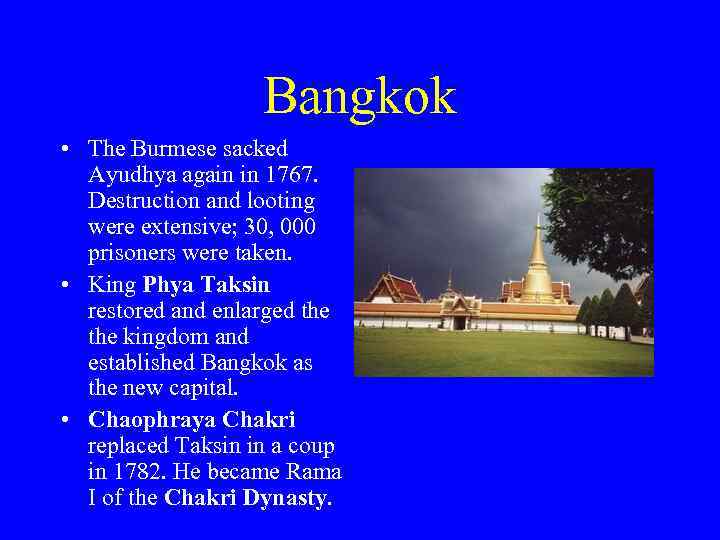
Bangkok • The Burmese sacked Ayudhya again in 1767. Destruction and looting were extensive; 30, 000 prisoners were taken. • King Phya Taksin restored and enlarged the kingdom and established Bangkok as the new capital. • Chaophraya Chakri replaced Taksin in a coup in 1782. He became Rama I of the Chakri Dynasty.
Questions • What was the name of the Thai kingdom that existed in China? • Name three great founding kings of Thailand. Which one invented the Thai alphabet? Which instituted Sakdi Na? • What was the Sakdi Na system? • Name the capital of Lan Na? • The Revolution of 1688 led to the death of what European adventurer? • What was the name of the king who founded Bangkok? • Who founded the current Thai dynasty?
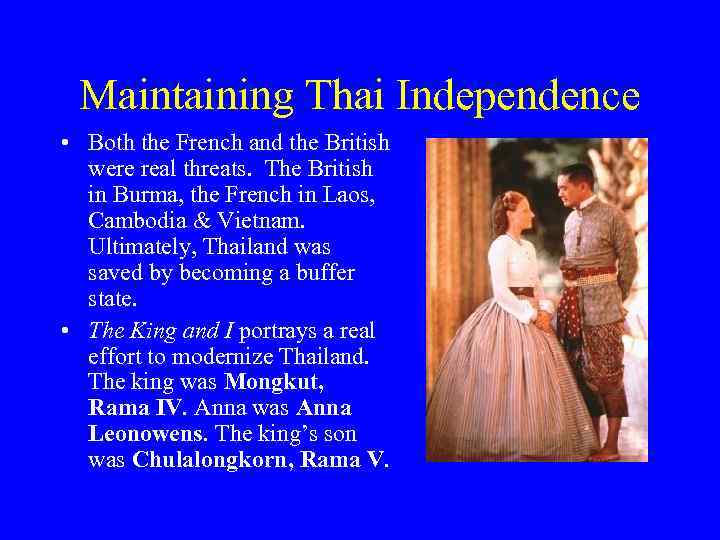
Maintaining Thai Independence • Both the French and the British were real threats. The British in Burma, the French in Laos, Cambodia & Vietnam. Ultimately, Thailand was saved by becoming a buffer state. • The King and I portrays a real effort to modernize Thailand. The king was Mongkut, Rama IV. Anna was Anna Leonowens. The king’s son was Chulalongkorn, Rama V.
Foreign Pressure • The Thais were under very real pressure from the French and British. – In 1867, the Thais were forced to relinquish their clams to Cambodia in exchange for recognition of their suzerainty over Battambang and Siem Reap. – Fighting between French and Thai forces in Laos led to French gunboats blockaded Bangkok. The Thais were forced to cede Laos to the French in 1893. – In 1907, Chulalongkorn was forced to cede Battambang and Siem Reap to the French. – In 1909, the Thais had to surrender five states in the northern Malay peninsula to Britain
Maintaining Thai Independence • Anglo-Thai Treaty of 1855 – Tariff control on imports & exports. – Extraterritoriality. – Most-favored-nation. • Modernizaton - Mongkut 1851 -1868). – – Study of foreign languages. Foreign advisors from many countries. Minted coinage. Eliminated prostration foreigners.
Maintaining Thai Independence • Modernization – Chulalongkorn (1868 -1910) – – – – – Foreign education of princess. Eliminated prostration for all subjects. Regulate debt slavery. Controlled sale of opium. Construction of first RR. Governmental administration overhauled. Codified and published penal code Established a judicial system. Streamlined court procedures. Opened public schools.
Maintaining Thai Independence • The London Declaration by the British and French in 1893 guaranteeing the independence and integrity of the Menam basin. • 1897 Thai promise to Britain not to cede rights to Isthmus of Kra that could result in a canal, thereby threatening the commercial value of Singapore. • 1909 agreement by British to replace jurisdiction of counselor courts with bi-national courts.
Maintaining Thai Independence • Entered WWI on side of allies. • In 1919, became only Southeast Asian member of League of Nations. • In 1922, U. S abandoned rights of extraterritoriality; other powers followed.
Continued Modernization • Maja Vajiravudh, Rama VI (1910 -1925) – Was a British educated Anglophile. Highly nationalistic and anti-Chinese, in particular. – Sponsored Wild Tigers program to instill nationalism. – Modernization thru monogamy and western attire. – Compulsory primary education & Chulalongkorn U. • Prajadhipok, Rama VII (1925 -1935) – Revived Privy Council and Supreme Council of State. – Built Don Muang airport, improved public health facilities, promoted Thai banking & established a new national library and museum.
Questions • The King & I portrays a time in history when Thailand feared_______ by _____ & ______. • What was the name of the king in the King & I? Who was the son who succeeded him? • Name the agreement between European powers that guaranteed Thai independence. • Why was Britain concerned about the disposition of the Isthmus of Kra? • Who was the king who promoted wearing western attire and compulsory primary education?
Thai Democracy • 1932 Revolution led by the “Promoters. ” Established a constitutional monarchy. Included a bicameral parliamentary system with separation of powers. • Since 1932, 13 revolutions, 8 constitutions & 30 plus changes of administration. • Reign of military dictators as prime ministers. – Pridi Phanamyong (1933)&Phraya Phahon (1934 -8). • Pridi’s attempt to nationalize industry & commerce rejected. • Anti Chinese sentiment. – Quota of 10, 000/year & deportation of illegal aliens. – Reaction to large scale immigration & KMT assertiveness. • Anti-foreign & anti Christian elements.
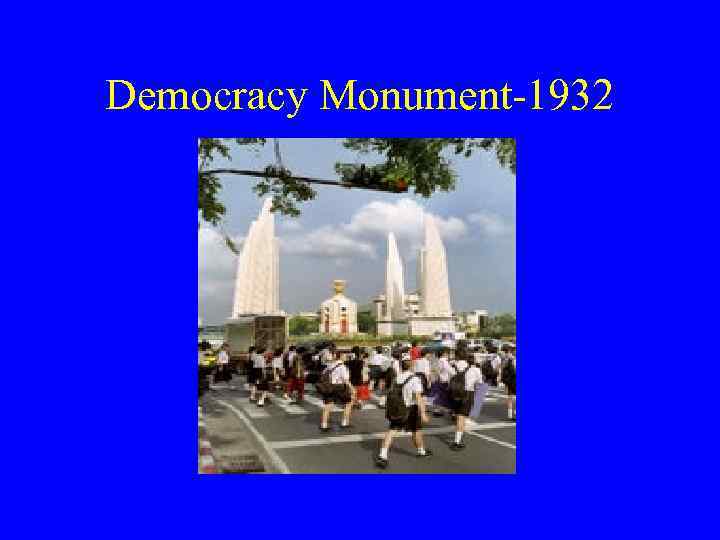
Democracy Monument-1932
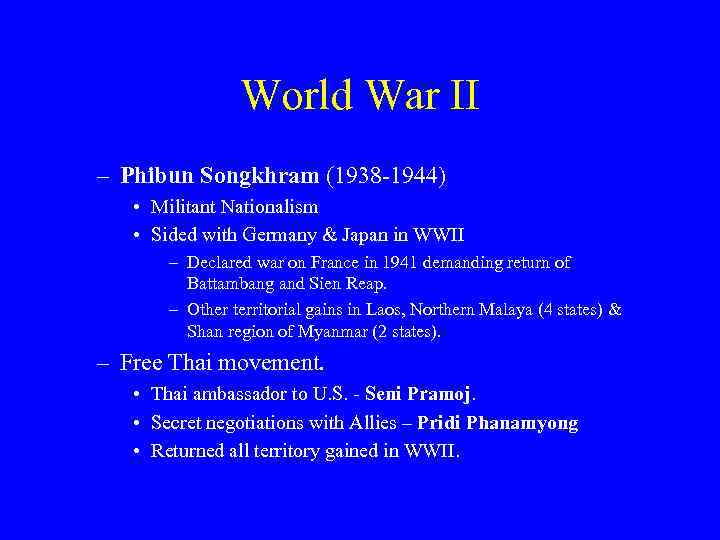
World War II – Phibun Songkhram (1938 -1944) • Militant Nationalism • Sided with Germany & Japan in WWII – Declared war on France in 1941 demanding return of Battambang and Sien Reap. – Other territorial gains in Laos, Northern Malaya (4 states) & Shan region of Myanmar (2 states). – Free Thai movement. • Thai ambassador to U. S. - Seni Pramoj. • Secret negotiations with Allies – Pridi Phanamyong • Returned all territory gained in WWII.
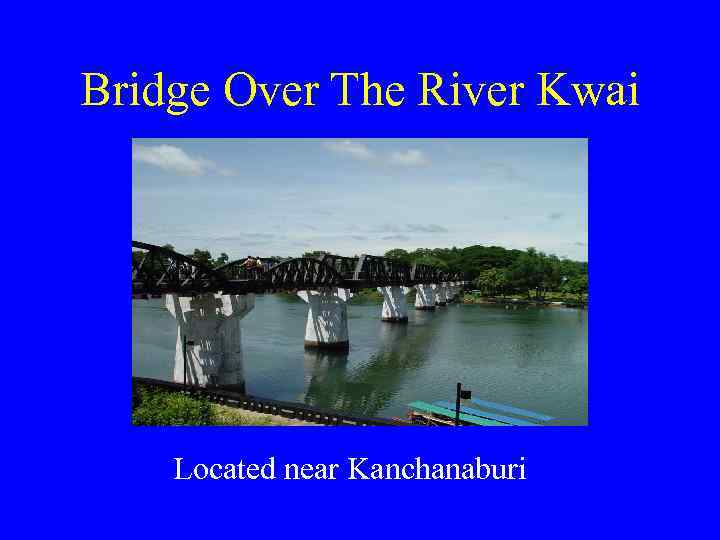
Bridge Over The River Kwai Located near Kanchanaburi
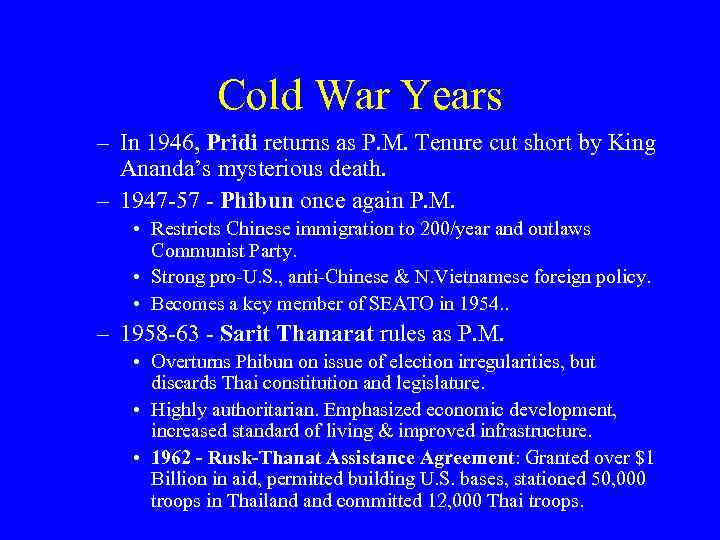
Cold War Years – In 1946, Pridi returns as P. M. Tenure cut short by King Ananda’s mysterious death. – 1947 -57 - Phibun once again P. M. • Restricts Chinese immigration to 200/year and outlaws Communist Party. • Strong pro-U. S. , anti-Chinese & N. Vietnamese foreign policy. • Becomes a key member of SEATO in 1954. . – 1958 -63 - Sarit Thanarat rules as P. M. • Overturns Phibun on issue of election irregularities, but discards Thai constitution and legislature. • Highly authoritarian. Emphasized economic development, increased standard of living & improved infrastructure. • 1962 - Rusk-Thanat Assistance Agreement: Granted over $1 Billion in aid, permitted building U. S. bases, stationed 50, 000 troops in Thailand committed 12, 000 Thai troops.
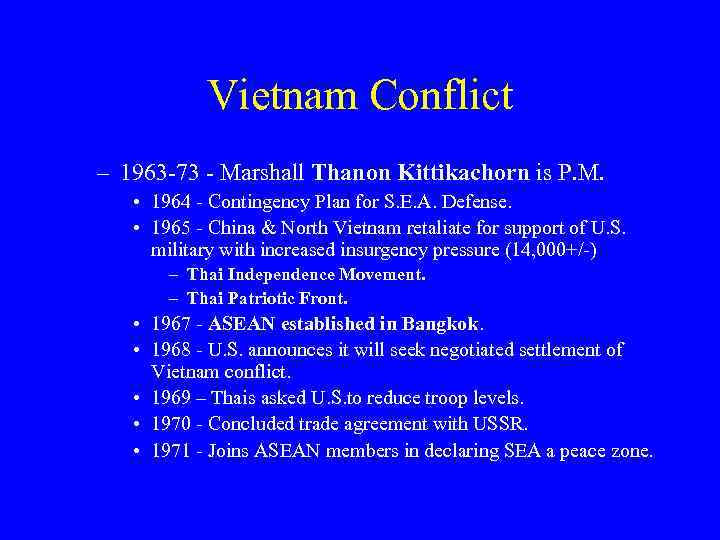
Vietnam Conflict – 1963 -73 - Marshall Thanon Kittikachorn is P. M. • 1964 - Contingency Plan for S. E. A. Defense. • 1965 - China & North Vietnam retaliate for support of U. S. military with increased insurgency pressure (14, 000+/-) – Thai Independence Movement. – Thai Patriotic Front. • 1967 - ASEAN established in Bangkok. • 1968 - U. S. announces it will seek negotiated settlement of Vietnam conflict. • 1969 – Thais asked U. S. to reduce troop levels. • 1970 - Concluded trade agreement with USSR. • 1971 - Joins ASEAN members in declaring SEA a peace zone.
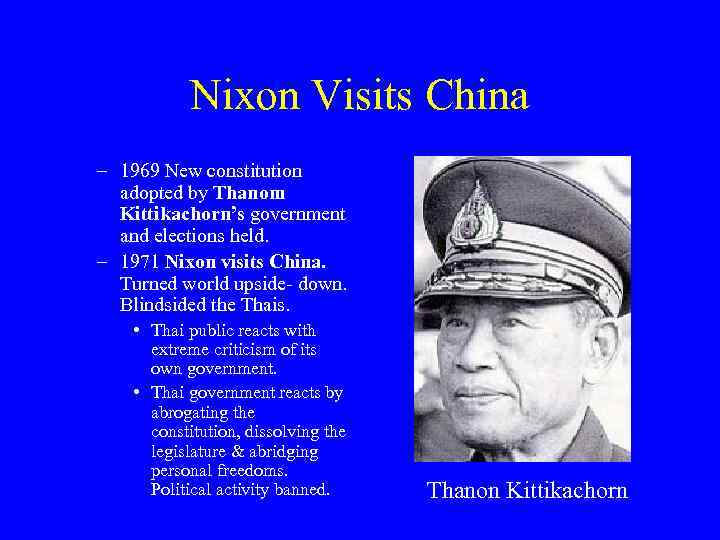
Nixon Visits China – 1969 New constitution adopted by Thanom Kittikachorn’s government and elections held. – 1971 Nixon visits China. Turned world upside- down. Blindsided the Thais. • Thai public reacts with extreme criticism of its own government. • Thai government reacts by abrogating the constitution, dissolving the legislature & abridging personal freedoms. Political activity banned. Thanon Kittikachorn
Questions • Who were the Promoters; what did they want? • Between 1932 and 1958, Thailand was ruled by which three men who alternated as P. M. s and cabinet members? • Which side did Thailand take during WW II? Why? • What were the key provisions of the Rusk-Thanat Assistance Agreement? • How did China respond to Thailand’s support of the U. S. during the Vietnam conflict? • What was the impact on Thailand of Nixon’s visit to China in 1971? • Which P. M. after he died in 1963 was found to have been keeping 100+ mistresses at government expense?

The End Proceed to Part II
Скачать презентацию Thailand I Campbell University Government History 354 Thailand
ThailandIC.ppt