


 Скачать презентацию th 20 Century since 1945 Review Session 7
13578bed38123baae09bec3373b0285d.ppt
- Количество слайдов: 21
 th 20 Century since 1945 Review Session 7
 Cold War Balance of Power • Germany after WWII – split among Allies (US, Fr, Br and USSR) => West Germany (democratic) and East Germany (communist) • Japan after WWII – Emperor steps down (NOT a god); demilitarized Japan; new constitution and parliamentary gov’t • Emergence of superpowers = US v. USSR
 • Marshall Plan: economic aid to countries that apply for it => become US allies & promotes democracy (West Europe) • Truman Doctrine: military & economic aid to Greece & Turkey to fight communism *early containment policies • Berlin Blockade & Airlift: Soviets blockade the former German capital to rid West Berlin of democracy; Allies airlift goods to combat the blockade
 • NATO: North Atlantic Treaty Organization – military alliance of the US and West Europe • Warsaw Pact: military alliance of the USSR and East Europe *Collective Security • Hungarian Revolt: Hungarian gov’t is threatened by democratic protests – Soviet military invades to stop the protests and restore communists to power
 • Soviet Invasion of Czech: Czech gov’t starts to grant democratic reforms – Soviets intervene to restore communism • Role of the UN during the Cold War: they attempted to keep peace however they also became a battlefield for the Cold War
 Economic Issues in the Cold War and Post Cold War Era • Market v. Command economy: Market – consumers and producers decide “what, how and for whom to produce”; Command – central planners/gov’t decide “what, how and for whom to produce” • Economic Recovery: E. vs. W. Germany: – East Germany’s economy struggles under communism while West Germany flourishes under capitalism
 – European Economic Community: created in order to increase trade and improve economic conditions among European nations – Japan becomes an economic superpower: manufacturing and exports make Japan a successful nation • OPEC (Organization of Petroleum Exporting Countries) • Goals: to control the exportation and price of oil world-wide • Oil Crisis 1970 s: cut the supply of oil world-wide creating a shortage and causing $s to rise
 Chinese Communist Revolution • Rise to power: called for the support of the peasants by promising them a better life under communism • Communism under Mao: – Great Leap Forward: tried to increase production of agriculture (communes) and industry => wanted to reach world power status – Cultural Revolution and Red Guard: to reestablish faith in communism and eliminate opposition to Mao (Red Guard: school-aged)
 – US Recognition of China: during the 1970 s, US-Chinese relations were established (Nixon’s visit, table tennis team, etc) • Communism Under Deng Xiaoping: • Four Modernizations: agriculture, industry, defense & science and technology • limited privatization: farming and industry • foreign investment: opened relations with the west
 • Tiananmen Square (1989): student protests violently suppressed by the gov’t (world recognizes human rights violations) • Role of women: women were seen as equals, but traditionally were not as valued as men
 Collapse of European Imperialism India-Independence and partition: independence brought a split – India (Hindus) and Pakistan (Muslim) • Muslim/Hindu Conflicts – caused disunity and tension • Status of the Caste System: Illegal, but still socially accepted (esp. in rural areas) • Non-alignment: played both sides of the Cold War conflict to their benefit (ex. Nuclear weapons)
 African Independence Movements and Pan Africanism • Apartheid: policy of racial separation: white minority controlled black majority • Historical circumstances: – ANC (African National Congress): promoted nationalism, fought for independence and then equal rights – Nelson Mandela: jailed for 27 years -> symbol of Apartheid injustice (called for its end); 1 st black South African president
 –Desmond Tutu: Catholic priest who called for the peaceful end to Apartheid; headed the Truth and Reconciliation Committee –FW de. Klerk: Pres. who began the end of Apartheid; legalized the ANC and freed Mandela
 • Southeast Asia – Vietnam/Ho Chi Minh & Ngo Dinh Diem: Ho Chi Minh led a nationalist movement to end foreign (French) control – backed by the communists (USSR & China); Ngo Dinh Diem was a non-communist dictator in the south supported by the US – Cambodia/Pol Pot/Khmer Rouge: Pol Pot wanted a return to traditional society based on agriculture (act of genocide? ) against intellectuals
 • Conflicts and Change in the Middle East – Israel: zionists called for a Jewish homeland & were granted Palestinian lands which brought immediate conflict between Jews and Muslims – Conflicts in Lebanon and Iraq: the Lebanese gov’t and terrorist group Hezbollah fought one another for control; Iraqis tried to suppress majority Sunni and Kurds through violent means
 • Iranian revolution: – Causes: traditional Muslim fundamentalism v. westernization (modernization) – Impact: Ayatollah Khomeini leads the muslim fundamentalists to victory over Shah Ravi Pahlavi = Iran is now ruled by Muslim laws and customs • Persian Gulf War: • Saddam Hussein: invaded Kuwait => UN forces led by the US, force Iraqis out of Kuwait, protecting their oil interests in the Middle East
 Collapse of Communism • Afghanistan: Soviets invade Afghanistan • Gorbachev: – Perestroika: eco. changes (free market strategy) – Glastnost (openness): allowed some democratic freedoms • Fall of the Berlin Wall – Reunification: symbolized the end of communism in E. Europe and Germany (Germany struggled economically)
 • Ethnic conflicts: – Balkans – variety of ethnic/religious groups want their own autonomy (independence) -> split of Yugoslavia, Czechoslovakia • Boris Yeltsin • Command to Market economy: “shock therapy” – the switch “shocked” the economy and created slow progress and restlessness among Russians • Latin America • Argentina – Juan Peron: attempted to increase nationalism through economic reforms that appealed to the people; was very repressive though
 • Cuba - Fidel Castro: led a socialist revolution against US-backed dictator Fulgencio Bastista; allied with the USSR • Nicaragua and the Sandinistas: when the Sandinistas (communists) took over, Contras (US-backed) rebelled against them • Guatemala: US sent the CIA to overthrow the communist gov’t
 Ethnic and Religious Tensions • Northern Ireland: Protestants v. Catholics – Protestants (British) and Catholics (Irish) debate over who should control the gov’t • Balkans (Serbs, Croats, Muslims): all want their own independent nations free from each other’s control • Middle East (Jews & Palestinians): fight for control over Palestine -> each claim its their historic homeland
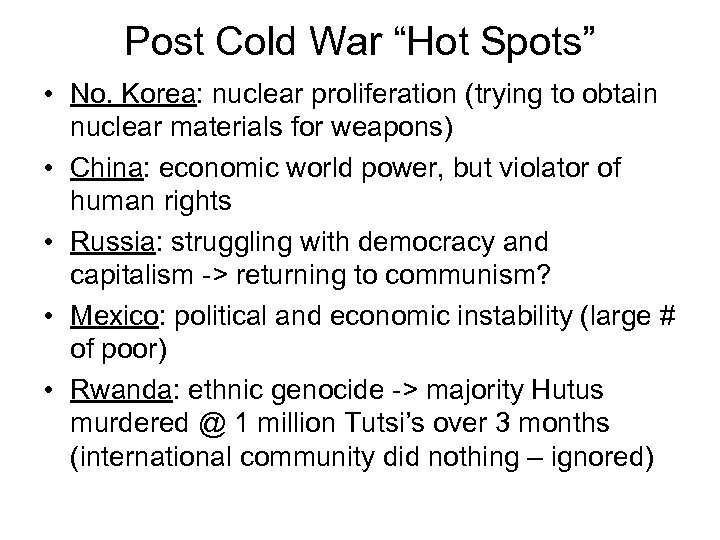 Post Cold War “Hot Spots” • No. Korea: nuclear proliferation (trying to obtain nuclear materials for weapons) • China: economic world power, but violator of human rights • Russia: struggling with democracy and capitalism -> returning to communism? • Mexico: political and economic instability (large # of poor) • Rwanda: ethnic genocide -> majority Hutus murdered @ 1 million Tutsi’s over 3 months (international community did nothing – ignored)