


 Скачать презентацию th 15 th 10 National Sahodaya Conference
a6f539b233adde14eaed6395f4123f5d.ppt
- Количество слайдов: 90
 th 15 th 10 National Sahodaya Conference – th 12 December 2008 www. schoolofeducators. com
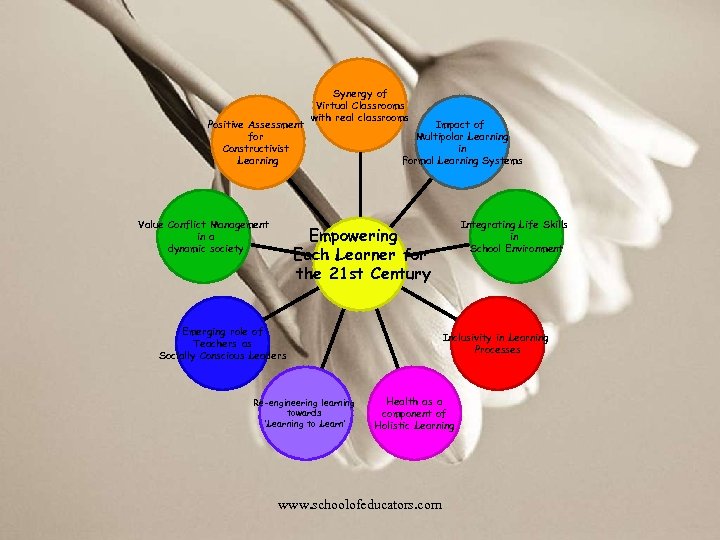 Positive Assessment for Constructivist Learning Value Conflict Management in a dynamic society Synergy of Virtual Classrooms with real classrooms Impact of Multipolar Learning in Formal Learning Systems Integrating Life Skills in School Environment Empowering Each Learner for the 21 st Century Emerging role of Teachers as Socially Conscious Leaders Re-engineering learning towards ‘Learning to Learn’ Inclusivity in Learning Processes Health as a component of Holistic Learning www. schoolofeducators. com
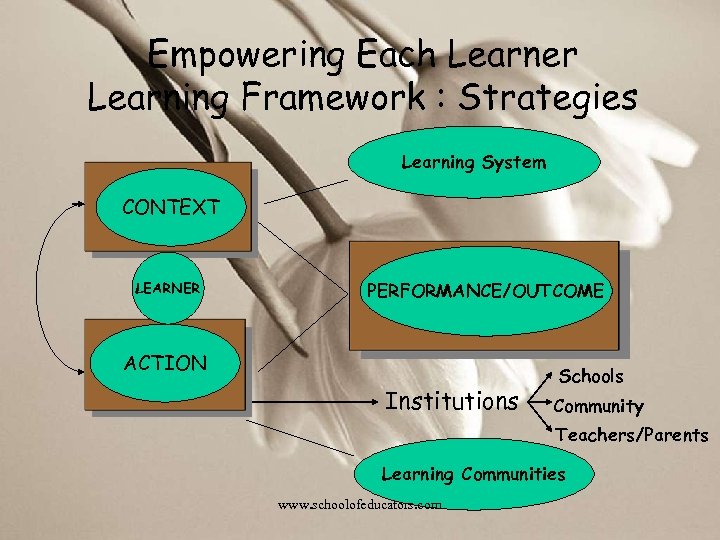 Empowering Each Learner Learning Framework : Strategies Learning System CONTEXT LEARNER PERFORMANCE/OUTCOME ACTION Institutions Schools Community Teachers/Parents Learning Communities www. schoolofeducators. com
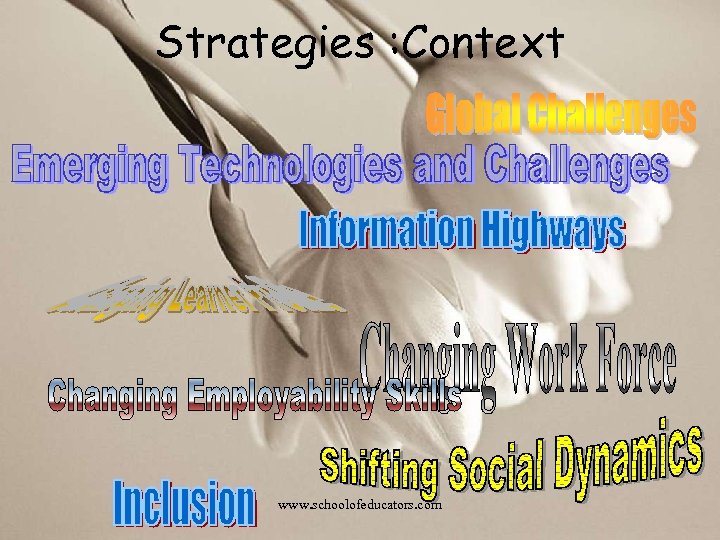 Strategies : Context www. schoolofeducators. com
 Strategies : Context Global Challenges • From delivering content to building capacity. • From stand alone institutions to value-added networks. • From setting and delivering curriculum to cocreating curriculum. • From standard operating creative adaptations. www. schoolofeducators. com procedures to
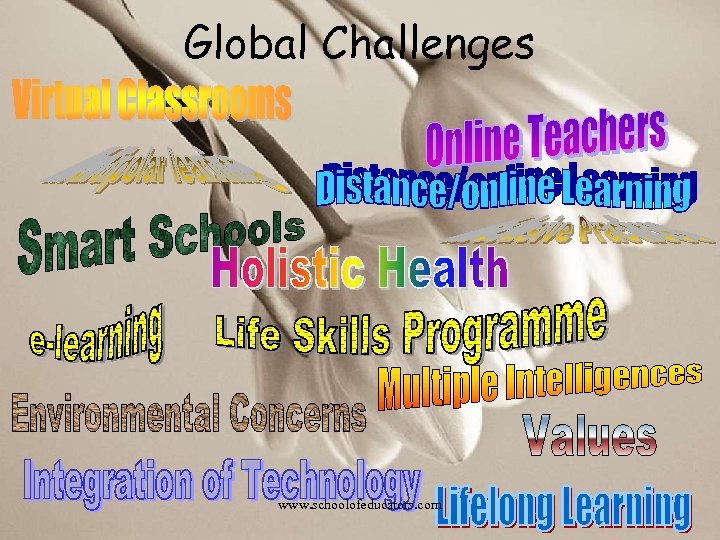 Global Challenges www. schoolofeducators. com
 MEDIA – PRINT – ELECTRONIC CHALLENGES Values and Violence § Phone. Channel http: //www. digitalopportunity. org/article/archive/1072/ § Interactive textbooks http: //www. phschool. com/social_studies/ § Tablet PCs http: //www. communities. hp. com/online/blogs/highered/archive/2007/09/28/HPPost 4561. aspx § Computerised tutor § http: //in. youtube. com/watch? v=lx. Uz. Ko. It 5 a. M § § http: //www. boloji. com/mahabharata/index. htm § http: //www. harappa. com/gandhi. html www. schoolofeducators. com www. culturalindia. net/indian-folktales/panchatantra-tales/index. html
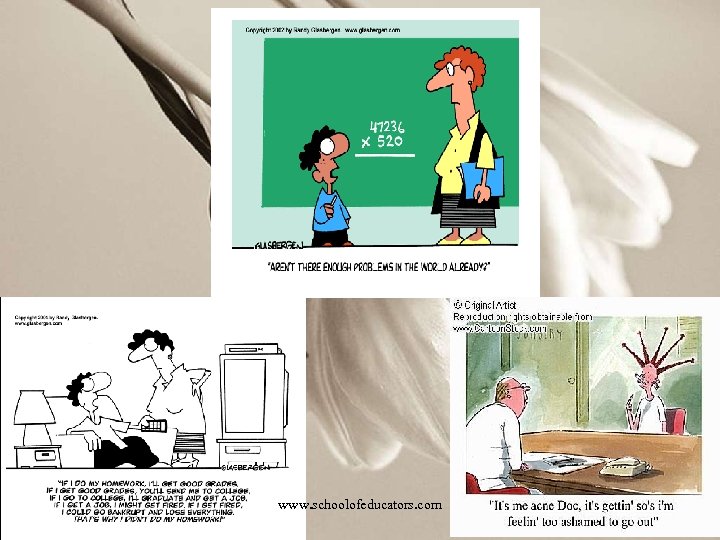
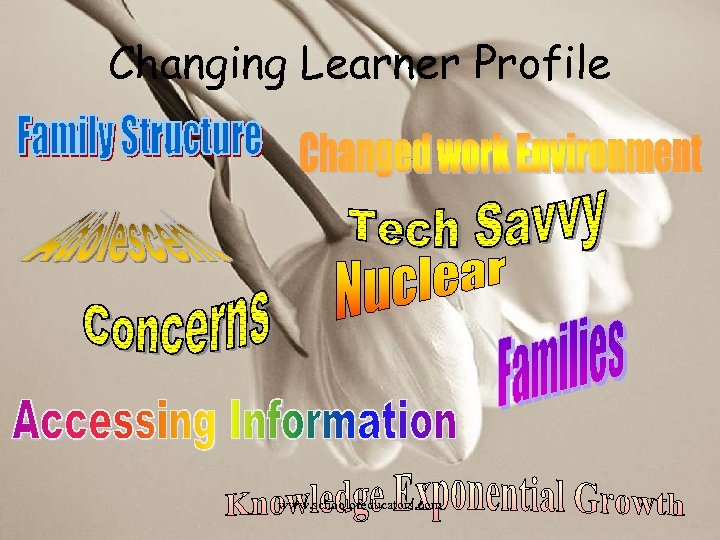 Changing Learner Profile www. schoolofeducators. com
 www. schoolofeducators. com
 www. schoolofeducators. com
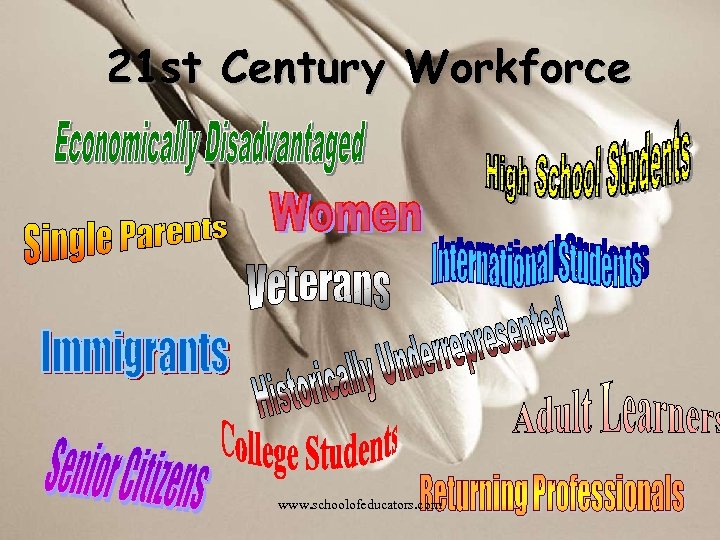 21 st Century Workforce www. schoolofeducators. com
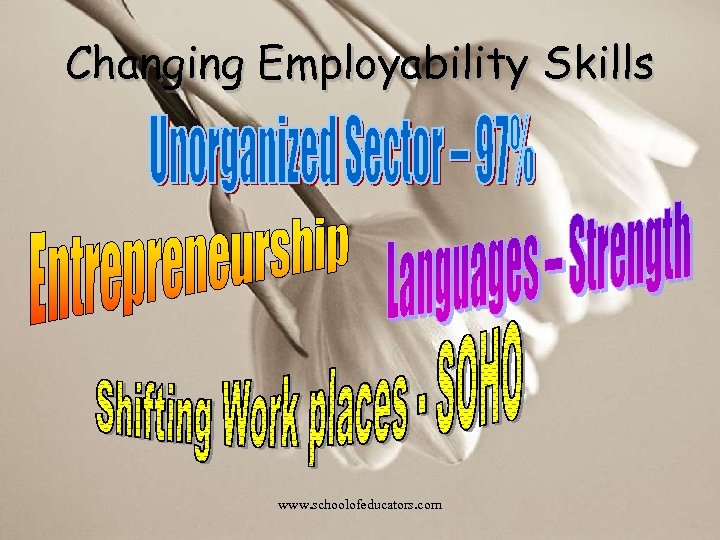 Changing Employability Skills www. schoolofeducators. com
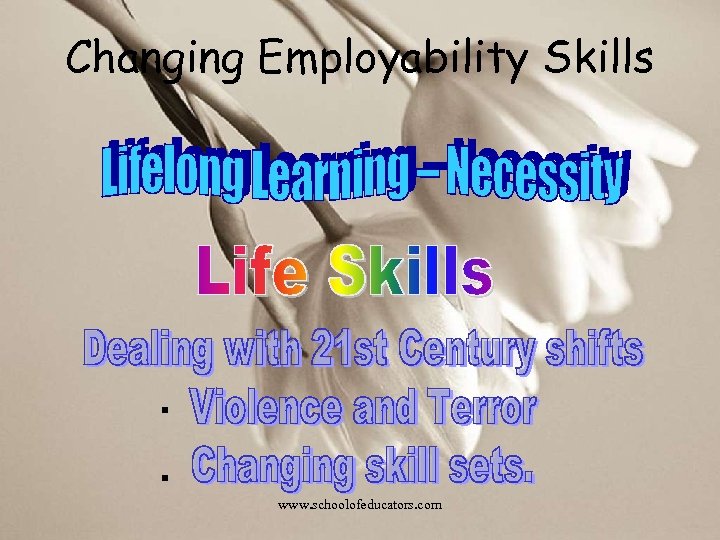 Changing Employability Skills ▪ ▪ www. schoolofeducators. com
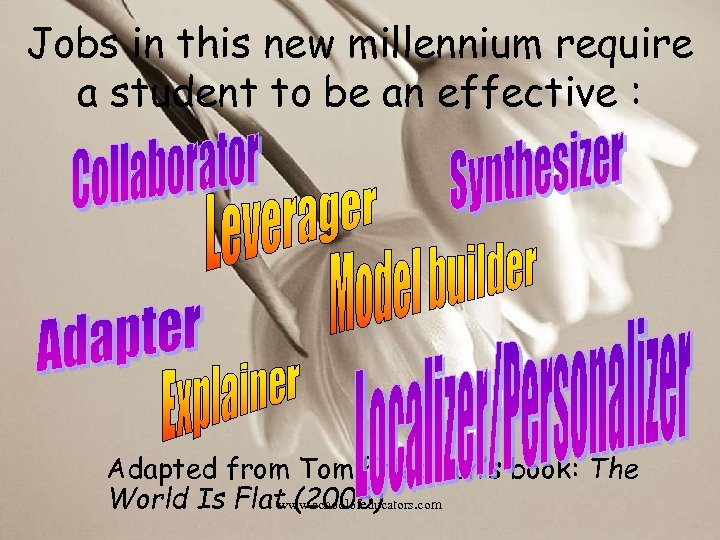 Jobs in this new millennium require a student to be an effective : Adapted from Tom Friedman’s book: The World Is Flat (2006) www. schoolofeducators. com
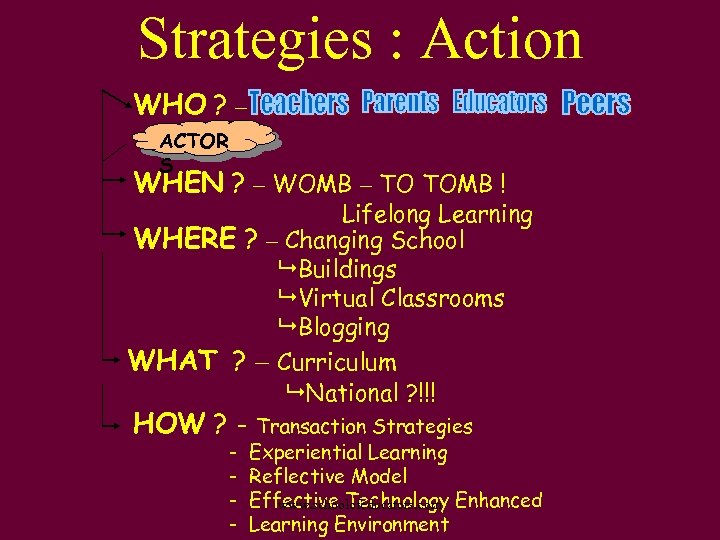 Strategies : Action WHO ? – ACTOR S WHEN ? – WOMB – TO TOMB ! Lifelong Learning WHERE ? – Changing School Buildings Virtual Classrooms Blogging WHAT ? – Curriculum National ? !!! HOW ? - Transaction Strategies Experiential Learning Reflective Model Effective Technology Enhanced www. schoolofeducators. com Learning Environment
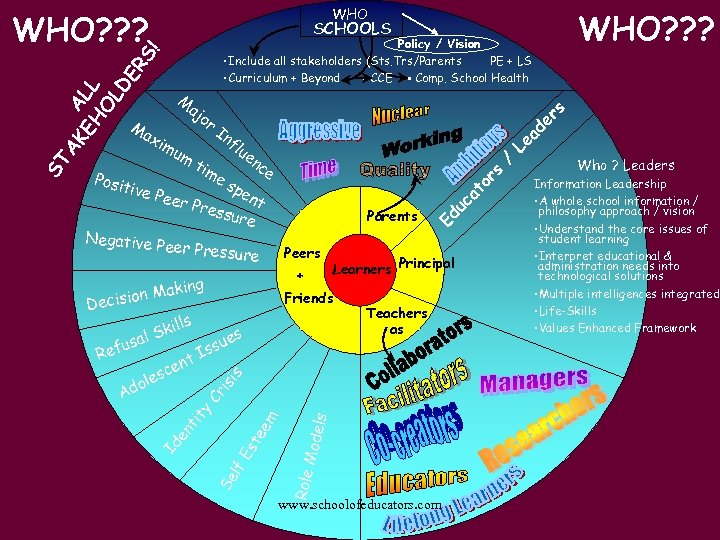 WHO WHO? ? ? rs ad e en ce / tim es pe ive P Le fl u s um In or or xim Negative P eer Pressu re king ion Ma Learners Principal is is Teachers as te Es ls Mode Role em tit y Cr o + es en Ad nt sce le Peers u Iss lf al s efu R lls Ski Parents Friends Se Decis at nt eer P ress ure Id ST Ma uc aj Ed AK A EH LL O LD E RS ! Policy / Vision • Include all stakeholders (Sts. Trs/Parents PE + LS • Curriculum + Beyond • CCE • Comp. School Health M Posit WHO? ? ? SCHOOLS www. schoolofeducators. com Who ? Leaders Information Leadership • A whole school information / philosophy approach / vision • Understand the core issues of student learning • Interpret educational & administration needs into technological solutions • Multiple intelligences integrated • Life-Skills • Values Enhanced Framework
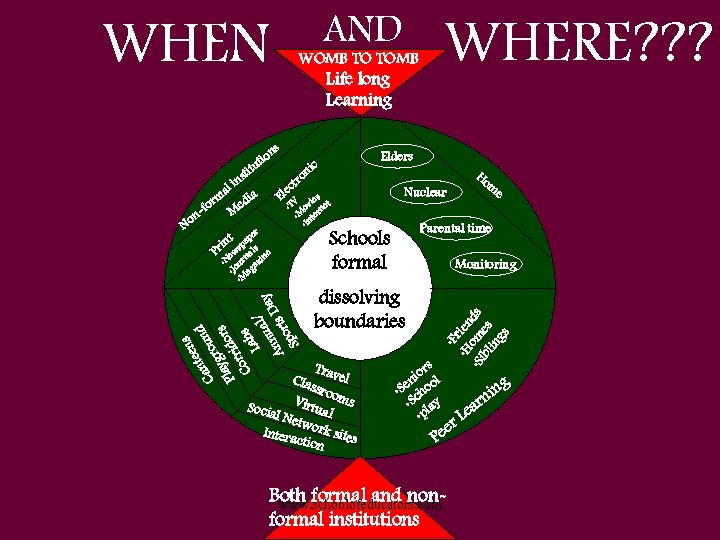 AND WHEN Life long Learning t sti n rm fo on N e M er ap sp w als e Ne urn azin • o • J ag • M t rin tro ec El V ies • T ov rnet • M nte • I m e Parental time Monitoring dissolving boundaries Trav el ssro om Socia Virtual s l Net w Intera ork sites ction Cla Ho Nuclear Schools formal ns tee nd n Ca rou s yg Pla ridor r Co abs L l/ ua Day n An rts o Sp P dia Elders c ni • F • H rien • Si om ds bl es in gs ns io ut i al WHERE? ? ? WOMB TO TOMB s ior l n • Se choo • S lay • p ng a Pe e Both formal and nonwww. schoolofeducators. com formal institutions e r. L i rn
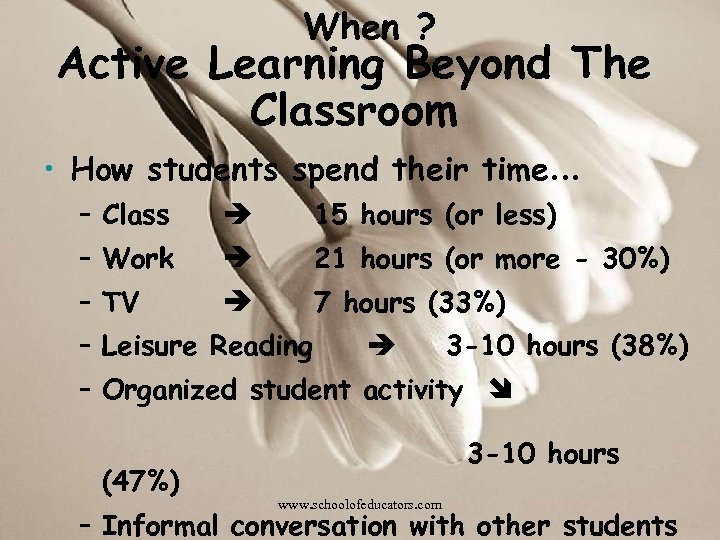 When ? Active Learning Beyond The Classroom • How students spend their time… – Class 15 hours (or less) – Work 21 hours (or more - 30%) – TV 7 hours (33%) – Leisure Reading 3 -10 hours (38%) – Organized student activity (47%) 3 -10 hours www. schoolofeducators. com – Informal conversation with other students
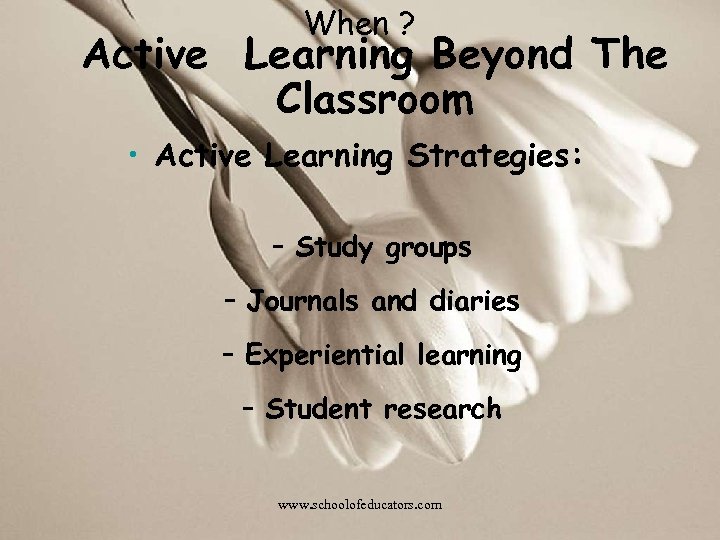 When ? Active Learning Beyond The Classroom • Active Learning Strategies: – Study groups – Journals and diaries – Experiential learning – Student research www. schoolofeducators. com
 • Curriculum • Beyond The Curriculum www. schoolofeducators. com
 ØLanguages – Communicative Language Teaching ○ English ○ Japanese – VIII – 2008 -09 ○ Sanskrit ○ German – VI – 2008 -09 ○ French ○ Bahasa Maleyu – X – 2008 -09 ØMathematics ØScience ØSocial Science ØI. T. ØEnrichment activities www. schoolofeducators. com ØExamination Reforms
 Disaster Management Class - VIII Class - IX www. schoolofeducators. com Class - X
 Information Technology based Subjects • Upper Primary Level (VI-VIII) - Computer basics as part of work experience. • Secondary Level ( IX & X) - I I T - Additional Subject • Senior Secondary Level (XI & XII) - 3 Electives 1. Computer Science 2. Informatics Practices 3. Multimedia & Web Technology www. schoolofeducators. com
 New Electives at Senior Secondary Level Academics • Creative Writing and Translation Studies: 2007– 08. Reader – Class XII FIRST BOARD EXAM www. schoolofeducators. com - 2009 Contd…
 New Electives at Senior Secondary Level • Heritage Crafts – XI - 2008 -09 Readers NCERT – XII - 2009 -10 • Graphic Design – XI - 2008 -09 Readers NCERT – XII - 2009 -10 www. schoolofeducators. com
 New Electives at Senior Secondary Level (Contd…) VOCATIONAL • FINANCIAL MARKET MANAGEMENT (FMM) – 2007 -08 www. schoolofeducators. com Contd…
 New Electives at Senior Secondary Level (Contd…) • 03 Vocational + 01 Language + 01 Elective (+ 01 Additional Elective). • Joint Certification by CBSE and NSE www. schoolofeducators. com
 Health Care Sciences • Class XI 2009 – 2010 • First Board Examination 2011 Joint certification with FICCI www. schoolofeducators. com
 What ? ? Promoting Innovation and Creativity in School System • Strengthening school cluster system through ‘Sahodayas’. • Student support activities through participation in Olympiads, Science exhibition, quizzes, etc. • Nurturing creativity in indigenous and modern knowledge in collaboration with National Innovation Foundation. www. schoolofeducators. com
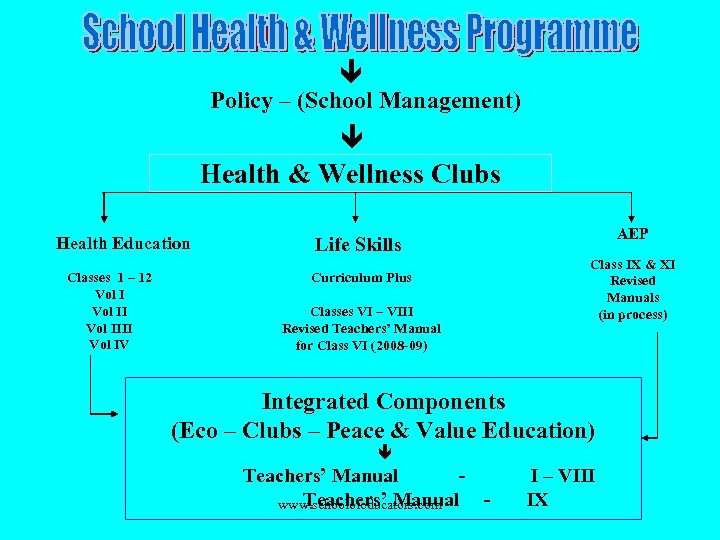 Policy – (School Management) Health & Wellness Clubs Health Education Classes 1 – 12 Vol IIII Vol IV AEP Life Skills Curriculum Plus Classes VI – VIII Revised Teachers’ Manual for Class VI (2008 -09) Class IX & XI Revised Manuals (in process) Integrated Components (Eco – Clubs – Peace & Value Education) Teachers’ Manual www. schoolofeducators. com I – VIII IX
 COMPREHENSIVE SCHOOL HEALTH PROGRAMME IN CBSE SCHOOLS www. schoolofeducators. com
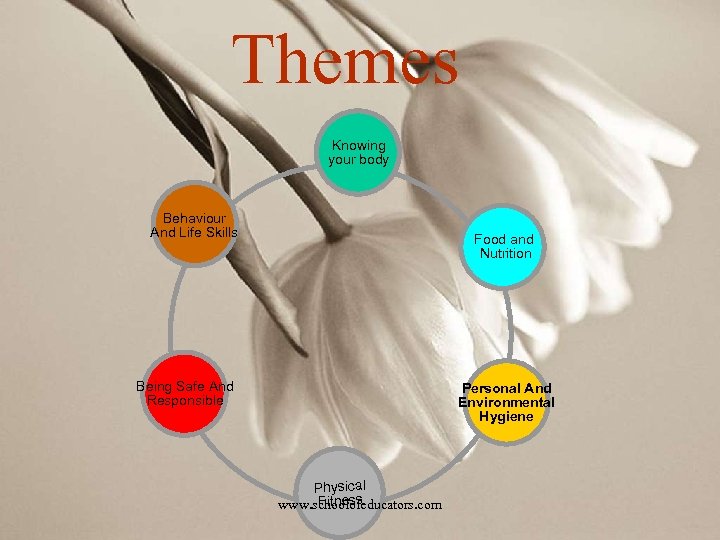 Themes Knowing your body Behaviour And Life Skills Food and Nutrition Being Safe And Responsible Personal And Environmental Hygiene Physical Fitness www. schoolofeducators. com
 Health Manuals- An Overview Comprehensive School Health Manuals (C. S. H. M): ØHolistic health ( physical, mental, emotional and psychological health). ØFormal and informal approaches in curriculum pedagogy for health promotion. ØEmphasis on providing a safe www. schoolofeducators. com school environment.
 Detailing Manuals…. Four Manuals: ØVolume 1 – all stakeholders ØVolume 2 Primary Level (Classes I-V) www. schoolofeducators. com
 Detailing Manuals…. ØVolume 3 - Upper Primary Level (Classes VI-VIII) ØVolume 4 Secondary and Senior Secondary Level (Classes IXXII). www. schoolofeducators. com
 Themes Covered… • Six different themes : ØKnowing your Body ØFood and Nutrition ØPersonal and Environmenta l Hygiene www. schoolofeducators. com
 Themes Covered… ØPhysical Fitness ØBeing Responsible Safe ØBehaviour and Life Skills. www. schoolofeducators. com
 What ? Beyond WHY Life Skills? • Work with others • Learn from others • Ask questions • Be open to other points of view • Learn to defend your point of view • Don’t automatically accept fact unless you know it to be true • Challenge assumptions www. schoolofeducators. com
 What ? CBSE - AEP Students Feedback AEP 2007 • Information on Adolescent Education is very useful to understand the adolescent issues. Mr. Nupur Jha ( DAV Public School, Sikkam) • Adolescent Education is very useful and we don’t have previous knowledge on these issues, and we would like to attend this type of programme in future. Mr. Pankaj Kr Giri ( DAV Public School, Sikkam) www. schoolofeducators. com
 What ? Teachers Feedback On AEP • Adolescence Education Programme is important as it helps students in understanding in a better way Mrs. Alpana Sharma Ms. Ruchi Bhargava (Nodel Teachers) Jaipuria Vidyalaya, Jawahar Lal Marg, Jaipur-302018 • • During psychological and physical changes, the child’s energy should be properly channelised. Mrs. Meenakshi Sharma • Effective communication and working towards one’s goal help to cope up with stress and emotions. • Mr. Suresh Chand www. schoolofeducators. com
 What ? Principals Feedback On AEP • • We are satisfied with this seminar and it is better to give knowledge on AEP Issues. Ms. Suchita (Principal) • Such type of programme are really useful. These may help in overall development and help to cope up problemsof life. Such type of programme should be conductedregularly. www. schoolofeducators. com
 What ? Parents Feedback On AEP This programme should not be implemented through schools rather teacher should trained the parent and parents will trained their adolescence. Mrs. Jaya Srivastava (Varanasi) • In my opinion information parents should be given full information from schools, so, that parents can guide at home properly. Mr. Ram Chand Narayan Pandey(Varanasi) • Sex education is not necessary in our culture and tradition, parent should teach adolescence. Dr. O. P. Chaudhary (Varanasi ) • This programme is beneficial for parents if parents gets proper knowledge, they can guide their children at home. Dr. D. N. Ojha (Varanasi) www. schoolofeducators. com
 Status of AEP - 2008 Programmes held under AEP in Sep-Nov 2008 NTT 15 Programme Advocacy Programme 15 www. schoolofeducators. com
 ØScience Exhibition – Innovativeness – Creativity – Last 5 years – Regional Level – National Springdales School, Delhi – Best 20 exhibits -Jawahar Lal Nehru Children Science Exhibition www. schoolofeducators. com
 Enrichment Activities Ø Heritage India Quiz Ø National Informatics Olympiad Ø Group Mathematics Olympiad Ø National Innovation Programme (with IIM, Ahmedabad) www. schoolofeducators. com
 Sahodaya - Concept • School Clusters • Spirit of ‘Caring and Sharing’ – Information and resources • Encourages Community of Practices • 250 Sahodayas networking 4500 schools www. schoolofeducators. com
 Losing an edge, Japanese envy Indian Schools • JAPAN – Growing Craze for Indian Education think of India as world’s ascendant education superpower • Bookstores are filled with titles like “Extreme Indian Arithmetic Drills” and “The Unknown Secrets of the Indians. ” Newspapers carry reports of Indian children memorizing multiplication tables far beyond nine times nine, the standard for young elementary students in Japan. www. schoolofeducators. com
 The New York Times…. • Japanese praise Indian Education. Envy Indian Learners: – learning more at an earlier age. – an emphasis on memorization. – focus on the basics, particularly in math and science. www. schoolofeducators. com
 How ? Training And Empowerment • In-service Teacher through Sahodayas. Training programme • Empowerment of Heads of Institutions in collaboration with top business schools and also with NUEPA. • Theme based regional and national level Sahodaya conferences. www. schoolofeducators. com
 How ? Dimensions of effective technology enhanced learning environments: l Task-Oriented l Challenging l Collaborative l Constructionist l Conversational l Responsive l Reflective Formative www. schoolofeducators. com l
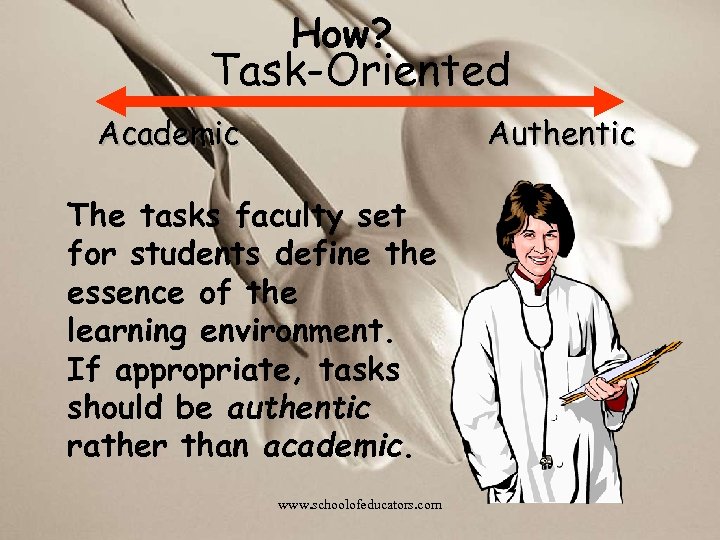 How? Task-Oriented Academic Authentic The tasks faculty set for students define the essence of the learning environment. If appropriate, tasks should be authentic rather than academic. www. schoolofeducators. com
 How? Collaborative Unsupported Integral Web-based tools for group work and collaboration can prepare students for team work in 21 st Century work environments . Art, dance, and music students are collaborating to produce online shows with digital versions of their works and performances for critique by international experts. www. schoolofeducators. com
 How? Constructivist Replication Origination Faculty should engage students in creating original knowledge representations that can be shared, critiqued, and revised. Students in fields ranging from Creative Writing to Heritage Craft are producing portfolios. www. schoolofeducators. com
 How? Conversational One-way Multi-faceted Students must have ample time and secure spaces for in-depth discussions, debates, arguments, and other forms of conversation. New knowledge and insight are being constructed in conversation spaces such as GDs and elearning forums. www. schoolofeducators. com
 How? Reflective Shallow Deep Both faculty and learners must engage in deep reflection and metacognition. These are not instinctive activities, but they can be learned. Teacher preparation : Teachers are keeping electronic journals to reflect upon the children they teach, and their roles as advocates for children. www. schoolofeducators. com
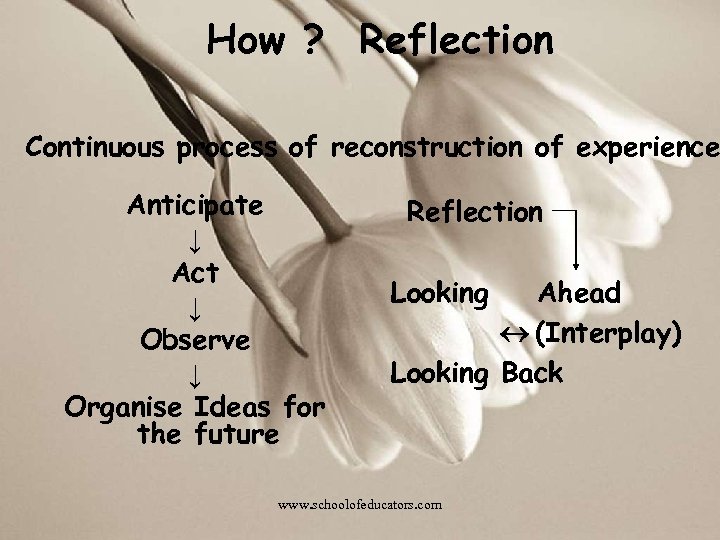 How ? Reflection Continuous process of reconstruction of experience Anticipate ↓ Act ↓ Observe ↓ Organise Ideas for the future Reflection Looking Ahead (Interplay) Looking Back www. schoolofeducators. com
 How ? Learning To Learn ? How can you calculate the return on your education investment in schooling ? What will you be doing five years after you leave school þ RECOMMENDATIONS: – Learn to learn and learn to like it. – Study whatever subject you like, but recognize that you can broaden your skill base considerable by choosing elective courses wisely. – Develop life skills that will enable you to provide value to a variety of organizations. www. schoolofeducators. com
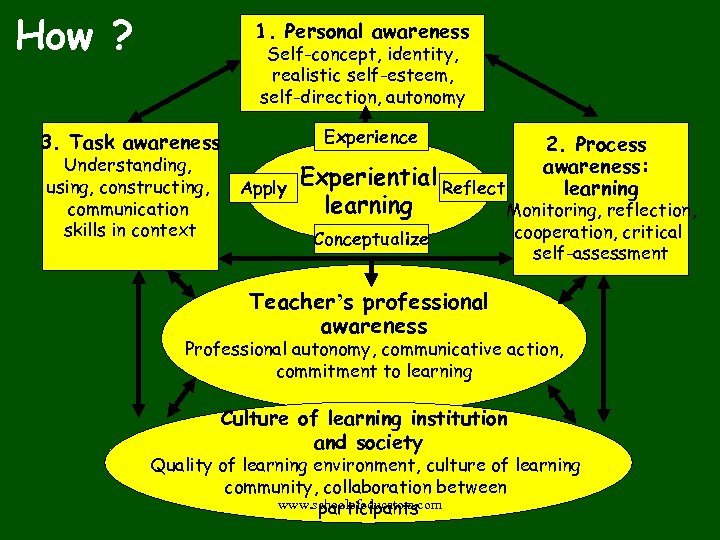 How ? 1. Personal awareness Self-concept, identity, realistic self-esteem, self-direction, autonomy Experience 3. Task awareness Understanding, using, constructing, communication skills in context Apply 2. Process awareness: learning Experiential Reflect learning Monitoring, reflection, Conceptualize cooperation, critical self-assessment Teacher’s professional awareness Professional autonomy, communicative action, commitment to learning Culture of learning institution and society Quality of learning environment, culture of learning community, collaboration between www. schoolofeducators. com participants
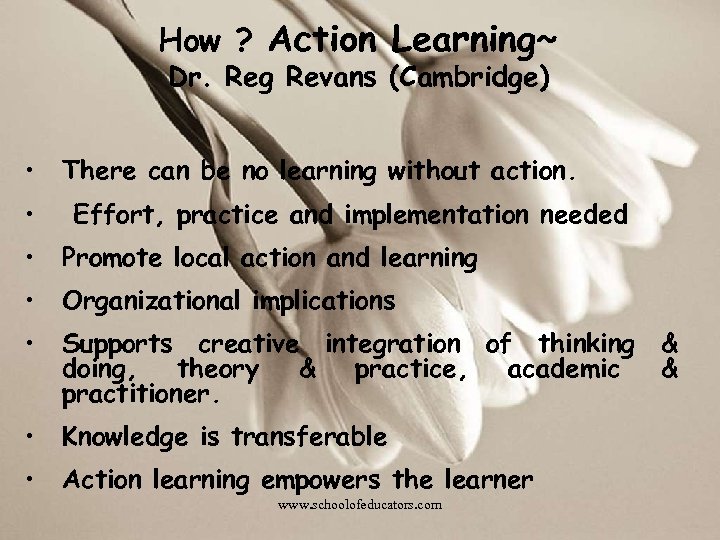 How ? Action Learning~ Dr. Reg Revans (Cambridge) • • There can be no learning without action. Effort, practice and implementation needed • Promote local action and learning • Organizational implications • Supports creative integration of thinking & doing, theory & practice, academic & practitioner. • Knowledge is transferable • Action learning empowers the learner www. schoolofeducators. com
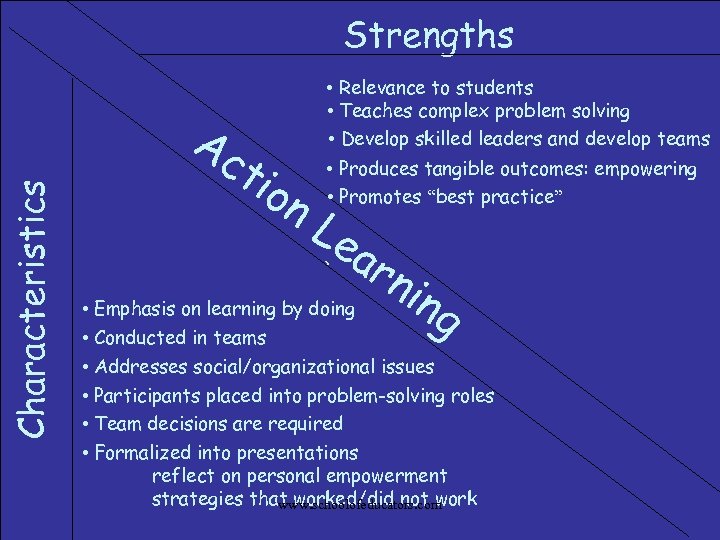 Characteristics Strengths Ac tio • Relevance to students • Teaches complex problem solving • Develop skilled leaders and develop teams • Produces tangible outcomes: empowering • Promotes “best practice” n. L ea rn ing • Emphasis on learning by doing ` • Conducted in teams • Addresses social/organizational issues • Participants placed into problem-solving roles • Team decisions are required • Formalized into presentations reflect on personal empowerment strategies that worked/did not work www. schoolofeducators. com
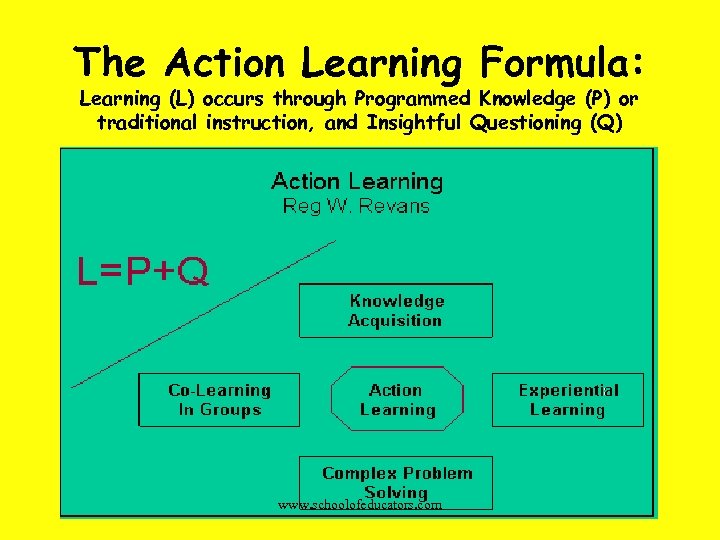 The Action Learning Formula: Learning (L) occurs through Programmed Knowledge (P) or traditional instruction, and Insightful Questioning (Q) www. schoolofeducators. com
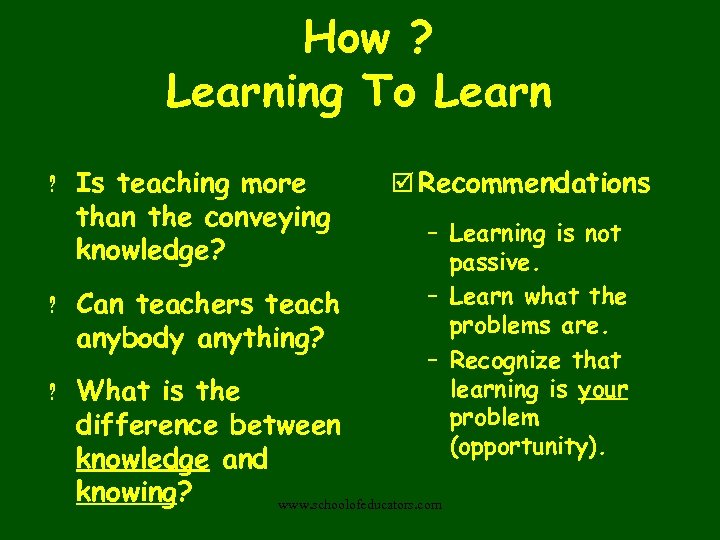 How ? Learning To Learn ? Is teaching more than the conveying knowledge? ? Can teachers teach anybody anything? ? What is the þ Recommendations – Learning is not passive. – Learn what the problems are. – Recognize that learning is your problem (opportunity). difference between knowledge and knowing? www. schoolofeducators. com
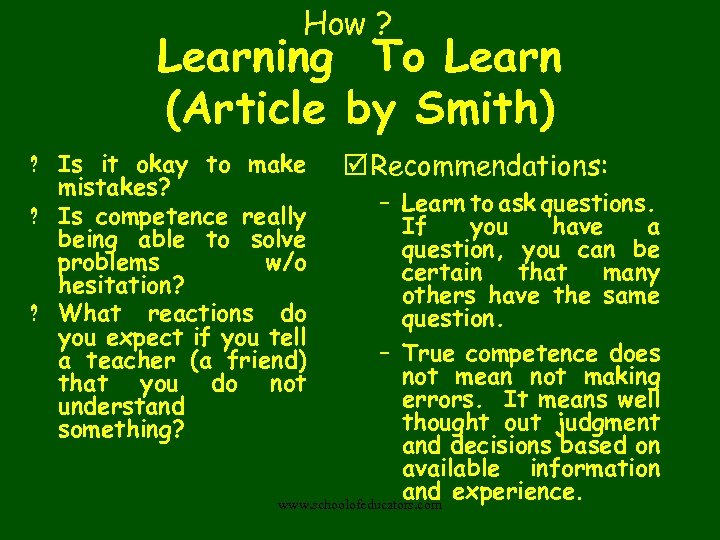 How ? Learning To Learn (Article by Smith) ? Is it okay to make mistakes? ? Is competence really being able to solve problems w/o hesitation? ? What reactions do you expect if you tell a teacher (a friend) that you do not understand something? þ Recommendations: – Learn to ask questions. If you have a question, you can be certain that many others have the same question. – True competence does not mean not making errors. It means well thought out judgment and decisions based on available information and experience. www. schoolofeducators. com
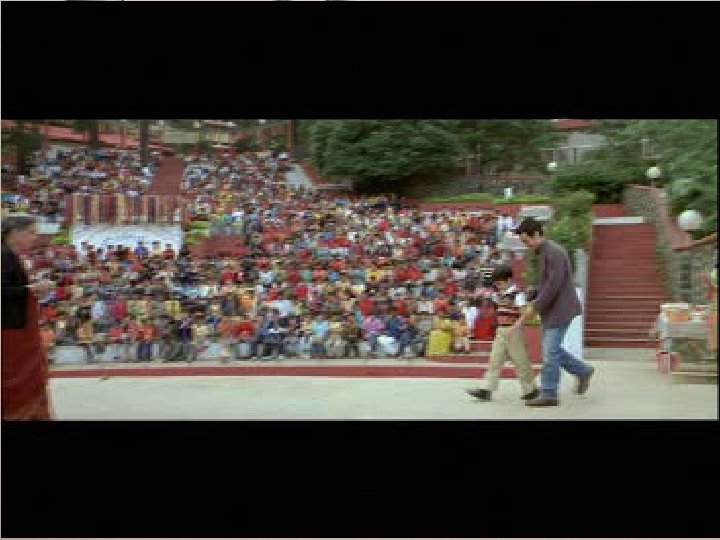
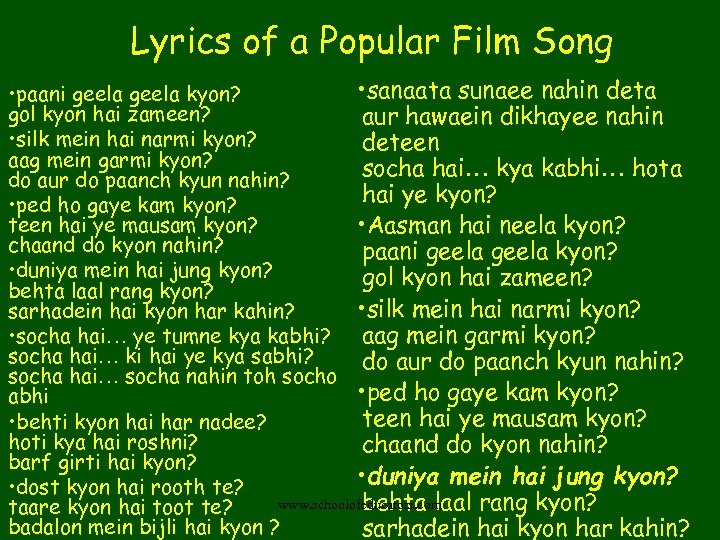 Lyrics of a Popular Film Song • sanaata sunaee nahin deta • paani geela kyon? gol kyon hai zameen? aur hawaein dikhayee nahin • silk mein hai narmi kyon? deteen aag mein garmi kyon? socha hai… kya kabhi… hota do aur do paanch kyun nahin? hai ye kyon? • ped ho gaye kam kyon? teen hai ye mausam kyon? • Aasman hai neela kyon? chaand do kyon nahin? paani geela kyon? • duniya mein hai jung kyon? gol kyon hai zameen? behta laal rang kyon? • silk mein hai narmi kyon? sarhadein hai kyon har kahin? • socha hai… ye tumne kya kabhi? aag mein garmi kyon? socha hai… ki hai ye kya sabhi? do aur do paanch kyun nahin? socha hai… socha nahin toh socho • ped ho gaye kam kyon? abhi teen hai ye mausam kyon? • behti kyon hai har nadee? hoti kya hai roshni? chaand do kyon nahin? barf girti hai kyon? • duniya mein hai jung kyon? • dost kyon hai rooth te? www. schoolofeducators. com behta laal rang kyon? taare kyon hai toot te? badalon mein bijli hai kyon ? sarhadein hai kyon har kahin?
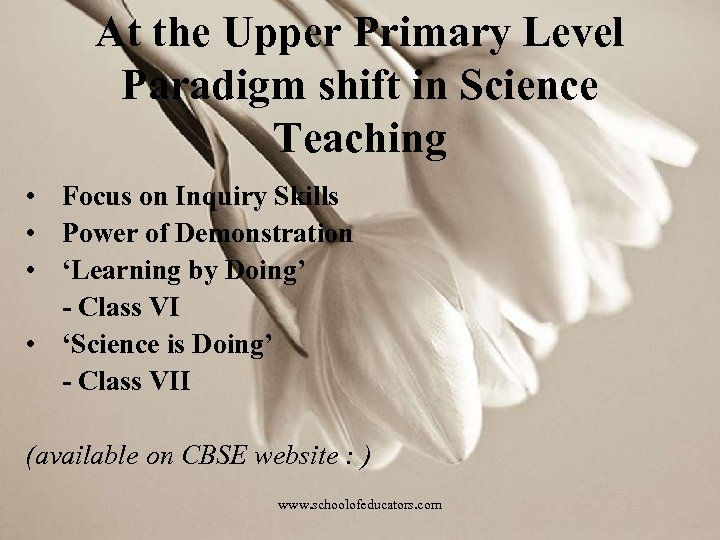 At the Upper Primary Level Paradigm shift in Science Teaching • Focus on Inquiry Skills • Power of Demonstration • ‘Learning by Doing’ - Class VI • ‘Science is Doing’ - Class VII (available on CBSE website : ) www. schoolofeducators. com
 Performance / Outcome – Ref. Formative Fixed Assessment Developmental Learning environments can be designed to allow students to develop prototype solutions over time rather than to find one right answer that someone else has defined. www. schoolofeducators. com
 Performance / Outcome Formative Example Faculty should engage their students in ongoing efforts to evaluate and refine their work related to authentic tasks to encourage lifelong learning www. schoolofeducators. com
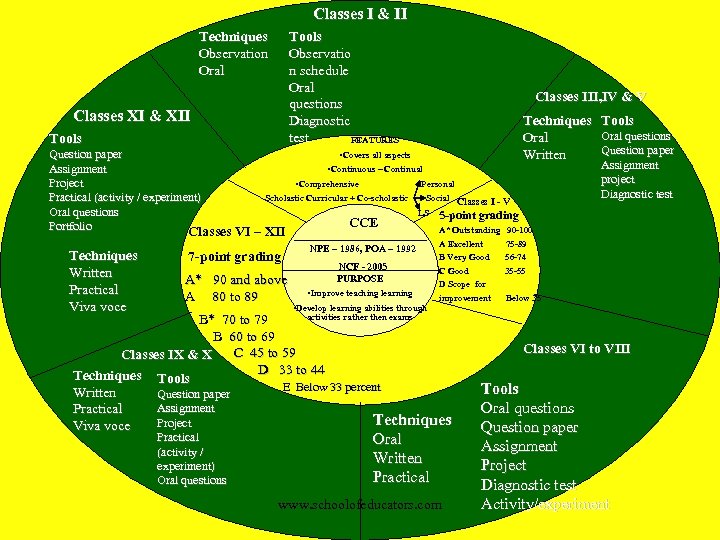 Classes I & II Techniques Observation Oral Tools Observatio n schedule Oral questions Diagnostic test FEATURES Classes XI & XII Tools Classes III, IV & V Techniques Oral Written • Covers all aspects Question paper • Continuous – Continual Assignment • Comprehensive Personal Project Scholastic Curricular + Co-scholastic Social Classes I - V Practical (activity / experiment) Oral questions LS 5 -point grading CCE Portfolio A* Outstanding 90 -100 Classes VI – XII Techniques Written Practical Viva voce 7 -point grading A* 90 and above A 80 to 89 NPE – 1986, POA – 1992 NCF - 2005 Violences PURPOSE • Improve teaching learning • Develop learning abilities through A Excellent B Very Good C Good Oral questions Question paper Assignment project Diagnostic test 75 -89 56 -74 35 -55 D Scope for improvement activities rather then exams B* 70 to 79 B 60 to 69 C 45 to 59 Classes IX & X D 33 to 44 Techniques Tools E Below 33 percent Written Question paper Assignment Practical Techniques Project Viva voce Practical (activity / experiment) Oral questions Tools Oral Written Practical www. schoolofeducators. com Below 35 Classes VI to VIII Tools Oral questions Question paper Assignment Project Diagnostic test Activity/experiment
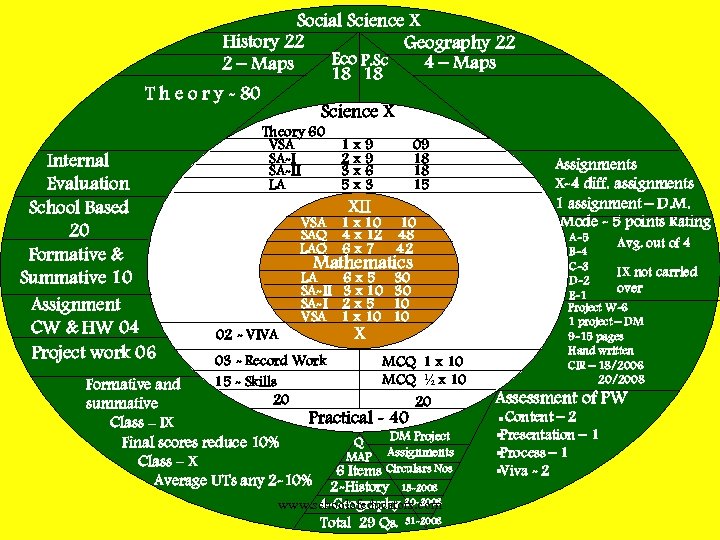 Social Science X History 22 Geography 22 Eco P. Sc 4 – Maps 2 – Maps 18 18 T h e o r y - 80 Internal Evaluation School Based 20 Formative & Summative 10 Assignment CW & HW 04 Project work 06 Science X Theory 60 VSA SA-II LA 1 x 9 2 x 9 3 x 6 5 x 3 09 18 18 15 XII VSA 1 x 10 10 SAQ 4 x 12 48 LAQ 6 x 7 42 Mathematics LA SA-II SA-I VSA 02 - VIVA 03 - Record Work 15 - Skills 20 6 x 5 3 x 10 2 x 5 1 x 10 X 30 30 10 10 MCQ 1 x 10 MCQ ½ x 10 20 Formative and summative Practical - 40 Class – IX DM Project Q Final scores reduce 10% MAP Assignments Class – X 6 Items Circulars Nos Average UTs any 2 -10% 2 -History 15 -2008 4 -Geography 20 -2008 www. schoolofeducators. com Total 29 Qs. 31 -2008 Assignments X-4 diff. assignments 1 assignment – D. M. Mode - 5 points Rating A-5 Avg. out of 4 B-4 C-3 IX not carried D-2 over E-1 Project W-6 1 project – DM 9 -15 pages Hand written CIR – 18/2006 20/2008 Assessment of PW ▪Content – 2 ▪Presentation – 1 ▪Process – 1 ▪Viva - 2
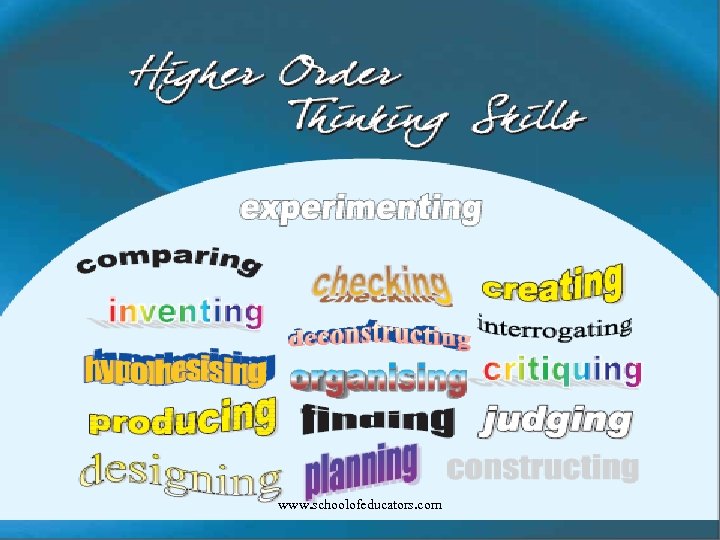 CHANGED HOTS SLIDES www. schoolofeducators. com
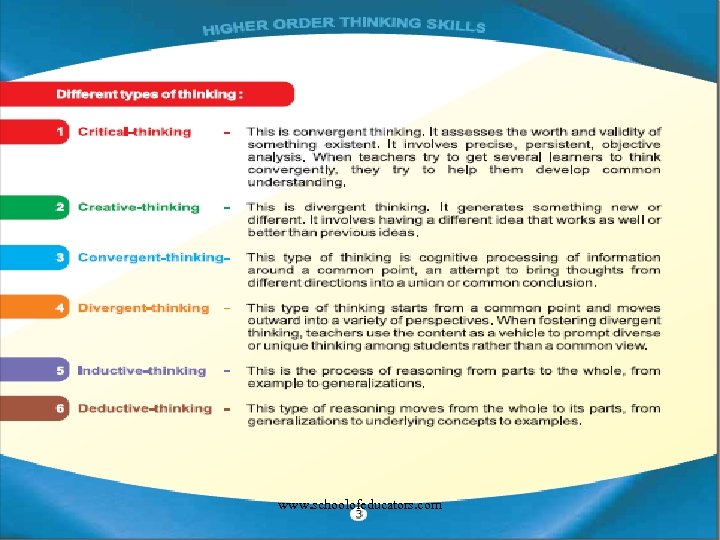 www. schoolofeducators. com
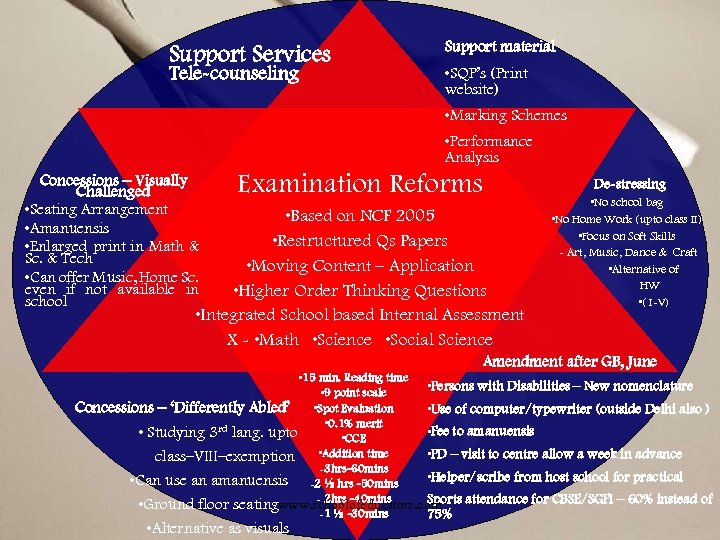 Support Services Tele-counseling Support material • SQP’s (Print website) • Marking Schemes • Performance Analysis Concessions – Visually Challenged • Seating Arrangement • Amanuensis • Enlarged print in Math & Sc. & Tech • Can offer Music, Home Sc. even if not available in school Examination Reforms De-stressing • Based on NCF 2005 • Restructured Qs Papers • Moving Content – Application • Higher Order Thinking Questions • Integrated School based Internal Assessment X - • Math • Science • Social Science • No school bag • No Home Work (upto class II) • Focus on Soft Skills - Art, Music, Dance & Craft • Alternative of HW • ( I-V) Amendment after GB, June • 15 min. Reading time • Persons with Disabilities – New nomenclature • 9 point scale Concessions – ‘Differently Abled’ • Spot Evaluation • Use of computer/typewriter (outside Delhi also ) • 0. 1% merit • Fee to amanuensis • Studying 3 rd lang. upto • CCE • PD – visit to centre allow a week in advance class–VIII–exemption • Addition time -3 hrs-60 mins • Helper/scribe from host school for practical • Can use an amanuensis -2 ½ hrs -50 mins - 2 hrs -40 mins Sports • Ground floor seatingwww. schoolofeducators. com attendance for CBSE/SGFI – 60% instead of -1 ½ -30 mins 75% • Alternative as visuals
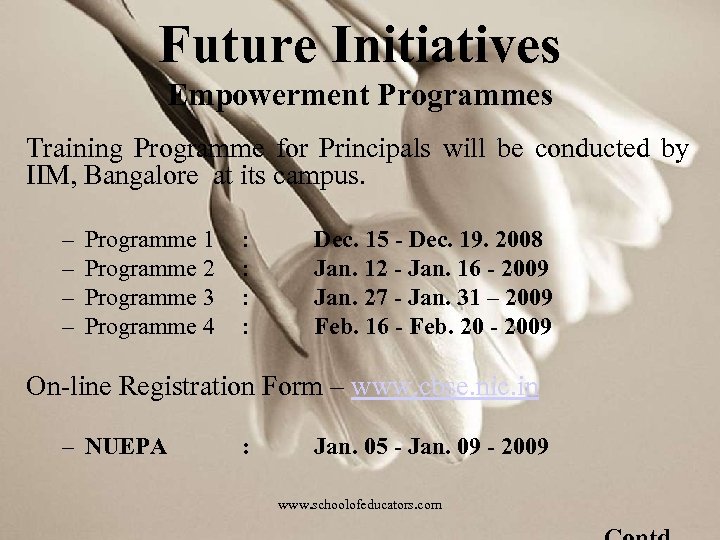 Future Initiatives Empowerment Programmes Training Programme for Principals will be conducted by IIM, Bangalore at its campus. – – Programme 1 Programme 2 Programme 3 Programme 4 : : Dec. 15 - Dec. 19. 2008 Jan. 12 - Jan. 16 - 2009 Jan. 27 - Jan. 31 – 2009 Feb. 16 - Feb. 20 - 2009 On-line Registration Form – www. cbse. nic. in – NUEPA : Jan. 05 - Jan. 09 - 2009 www. schoolofeducators. com
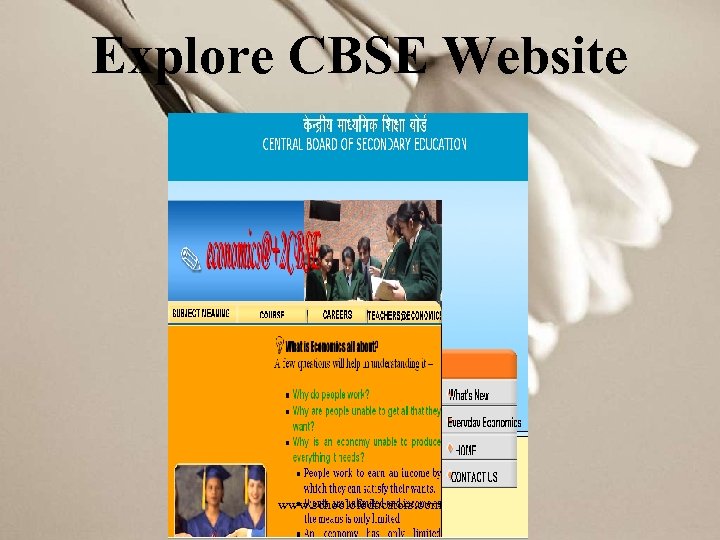 Explore CBSE Website www. schoolofeducators. com
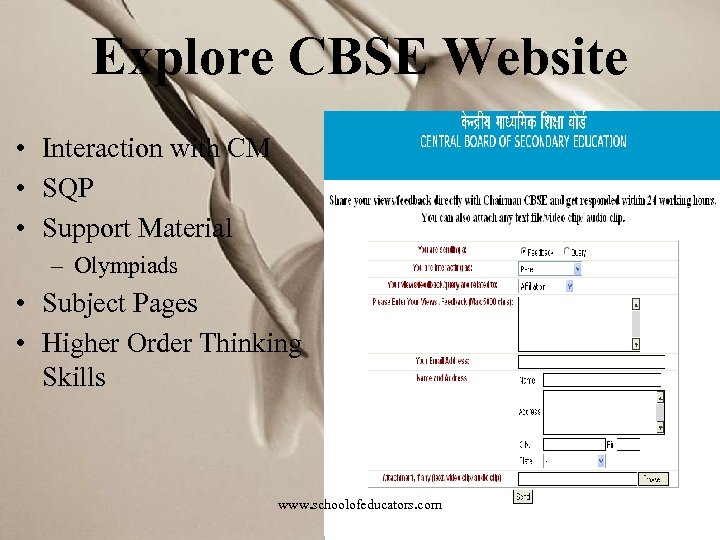 Explore CBSE Website • Interaction with CM • SQP • Support Material – Olympiads • Subject Pages • Higher Order Thinking Skills www. schoolofeducators. com
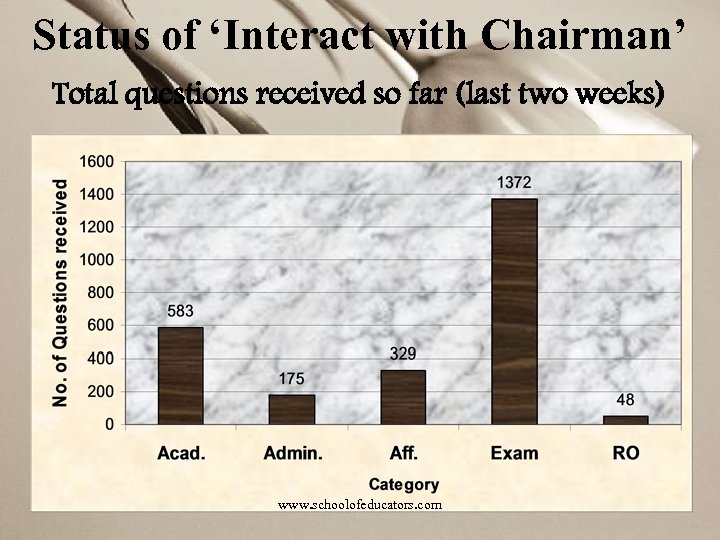 Status of ‘Interact with Chairman’ Total questions received so far (last two weeks) www. schoolofeducators. com
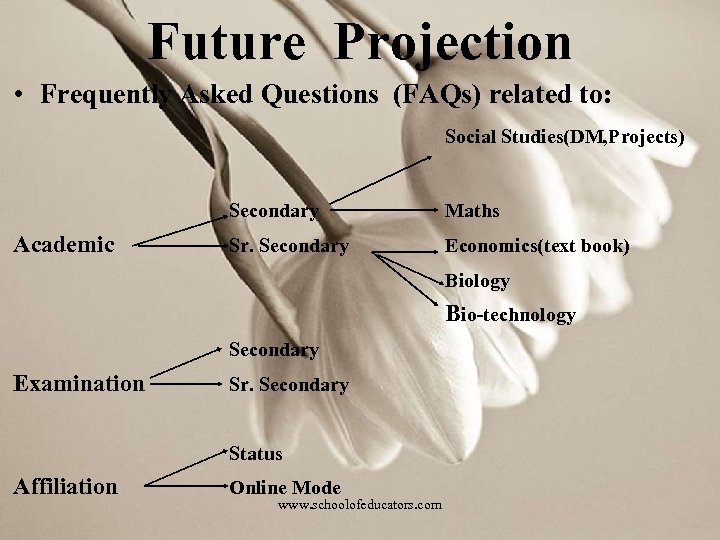 Future Projection • Frequently Asked Questions (FAQs) related to: Social Studies(DM, Projects) Secondary Academic Maths Sr. Secondary Economics(text book) Biology Bio-technology Secondary Examination Sr. Secondary Status Affiliation Online Mode www. schoolofeducators. com
 -Vision- • Strengthening Position of CBSE in Overseas. • Developing Curricula Internationally Competitive. • Bring Global Dynamics in School Education. • Provide leadership in School Education for other Countries. • Offer affordable Cost effective International Curriculum worldwide. www. schoolofeducators. com
 New Initiatives • Formulation of Policy for optimum Enrollment of Students in Affiliated Schools. • Policy for restricting enrollment in Schools Violating rules. • Outsourcing work of Affiliation Branch. • Creation of a Committee for further International Presence of CBSE www. schoolofeducators. com
 Academics– • Pilot Project with Australian Counsel for Educational Research (ACER) for Data analysis alongwith Training Workshops for Evaluators. – Class XII , English & Economics • Pilot Project on School Mapping – locating CBSE Affiliated School on Public Mapping System – development of an in-house GSM Gateway Solution to provide alert based on-line facility to all stakeholders. • In-house Training Centre at Academic Unit for Capacity Building and dissemination of knowledge. www. schoolofeducators. com
 Launch of National Urban Eco. Sanitation and Green School Initiatives – 30 th Jan, 2009 • 100% sanitation during 11 th Five Year Plan • Awareness – Behavioural change • Green School – Reduce, Reuse, Recycle – Rain water harvesting • Pilot Project – 100 Schools (25 KVs + 25 Govt. sch + 50 PVT Sch) www. schoolofeducators. com
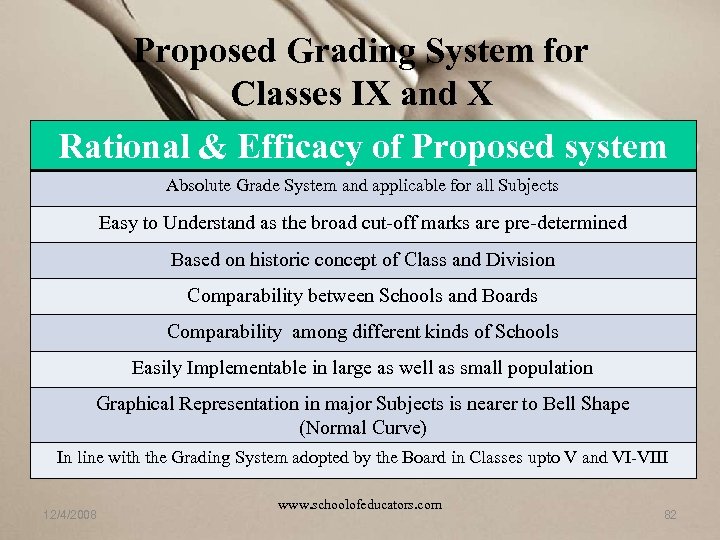 Proposed Grading System for Classes IX and X Rational & Efficacy of Proposed system Absolute Grade System and applicable for all Subjects Easy to Understand as the broad cut-off marks are pre-determined Based on historic concept of Class and Division Comparability between Schools and Boards Comparability among different kinds of Schools Easily Implementable in large as well as small population Graphical Representation in major Subjects is nearer to Bell Shape (Normal Curve) In line with the Grading System adopted by the Board in Classes upto V and VI-VIII 12/4/2008 www. schoolofeducators. com 82
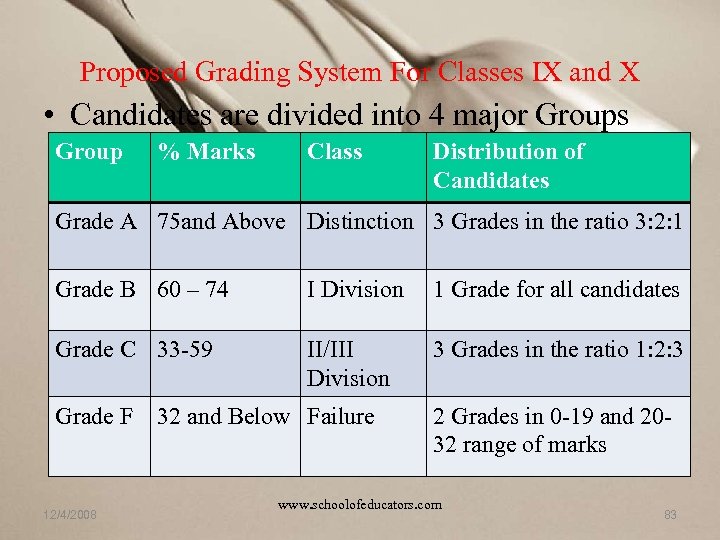 Proposed Grading System For Classes IX and X • Candidates are divided into 4 major Groups Group % Marks Class Distribution of Candidates Grade A 75 and Above Distinction 3 Grades in the ratio 3: 2: 1 Grade B 60 – 74 I Division 1 Grade for all candidates Grade C 33 -59 II/III Division 3 Grades in the ratio 1: 2: 3 Grade F 12/4/2008 32 and Below Failure 2 Grades in 0 -19 and 2032 range of marks www. schoolofeducators. com 83
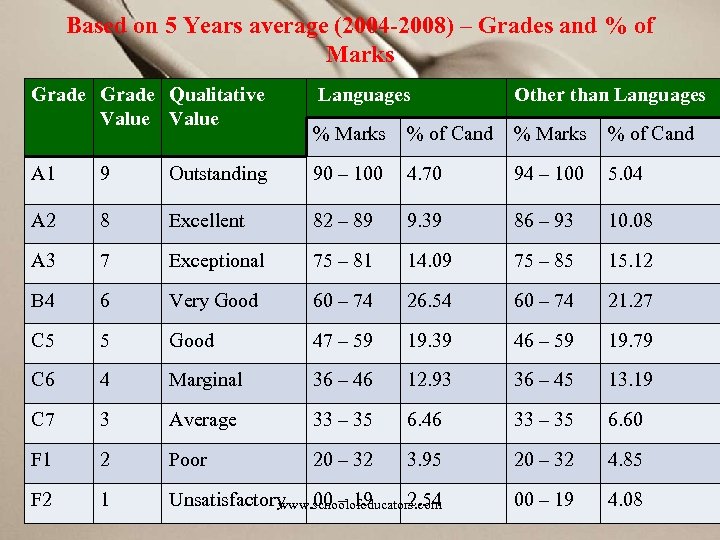 Based on 5 Years average (2004 -2008) – Grades and % of Marks Grade Qualitative Value Languages Other than Languages % Marks % of Cand A 1 9 Outstanding 90 – 100 4. 70 94 – 100 5. 04 A 2 8 Excellent 82 – 89 9. 39 86 – 93 10. 08 A 3 7 Exceptional 75 – 81 14. 09 75 – 85 15. 12 B 4 6 Very Good 60 – 74 26. 54 60 – 74 21. 27 C 5 5 Good 47 – 59 19. 39 46 – 59 19. 79 C 6 4 Marginal 36 – 46 12. 93 36 – 45 13. 19 C 7 3 Average 33 – 35 6. 46 33 – 35 6. 60 F 1 2 Poor 20 – 32 3. 95 20 – 32 4. 85 F 2 1 Unsatisfactory 00 – 19 2. 54 www. schoolofeducators. com 00 – 19 4. 08 84
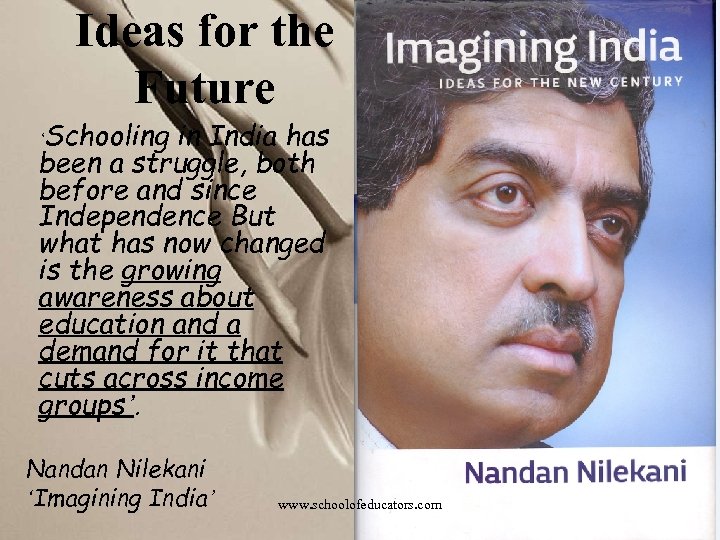 Ideas for the Future ‘Schooling in India has been a struggle, both before and since Independence But what has now changed is the growing awareness about education and a demand for it that cuts across income groups’. Nandan Nilekani ‘Imagining India’ www. schoolofeducators. com
 Ideas for the Future India’s involvement with good education practices will move ‘conclusively than any other reform, determine India’s economic future’ … Our response will made all the difference between the world’s largest … Illiterates. . or … a country with a large pool of talented human capital that can fire up the country to new levels of growth. Our opportunity to choose between the two is her, now and, transient. Nandan Nilekani www. schoolofeducators. com ‘Imagining India’
 Ideas for the Future Solar electric system powered – Computer lab – Internet connected satellite disk in South Africa Thomas L. Friedman HOT, FLAT and CROWDED www. schoolofeducators. com
 Ideas for the Future Localization and Globalization balance Humanization One natural resource we still have human ingenuity www. schoolofeducators. com
 www. schoolofeducators. com
 We have exactly enough time – starting now. Dana Meadows (Environmentalist) www. schoolofeducators. com