 Скачать презентацию Text Classification Web Search and Mining Lecture 15
eff45cffae54ca85df473808f3f6c3b0.ppt
- Количество слайдов: 94




Text Classification Web Search and Mining Lecture 15: Classification 1
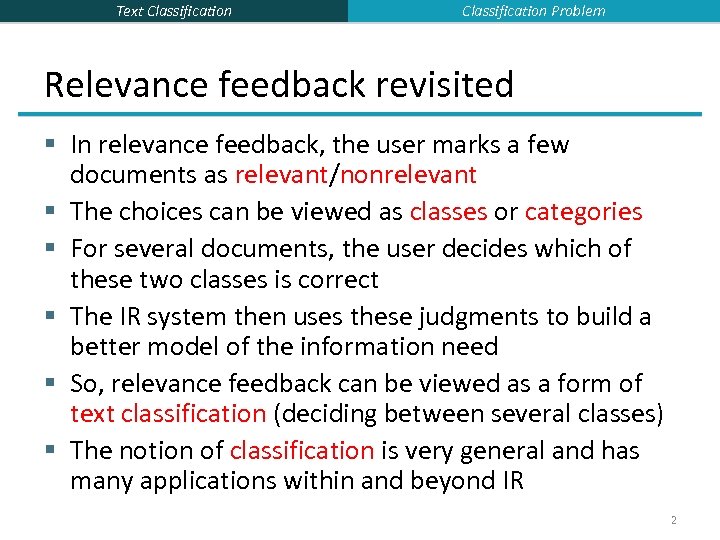
Text Classification Problem Relevance feedback revisited § In relevance feedback, the user marks a few documents as relevant/nonrelevant § The choices can be viewed as classes or categories § For several documents, the user decides which of these two classes is correct § The IR system then uses these judgments to build a better model of the information need § So, relevance feedback can be viewed as a form of text classification (deciding between several classes) § The notion of classification is very general and has many applications within and beyond IR 2

Text Classification Problem Spam filtering: Another text classification task From: "" <takworlld@hotmail. com> Subject: real estate is the only way. . . gem oalvgkay Anyone can buy real estate with no money down Stop paying rent TODAY ! There is no need to spend hundreds or even thousands for similar courses I am 22 years old and I have already purchased 6 properties using the methods outlined in this truly INCREDIBLE ebook. Change your life NOW ! ========================= Click Below to order: http: //www. wholesaledaily. com/sales/nmd. htm ========================= 3
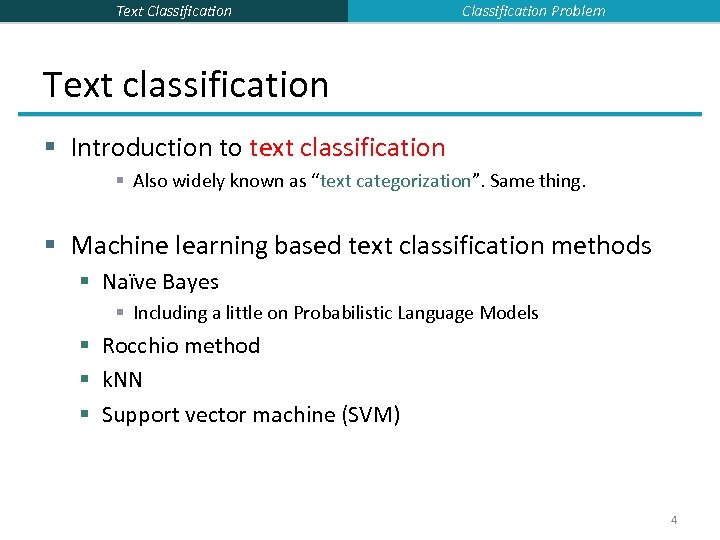
Text Classification Problem Text classification § Introduction to text classification § Also widely known as “text categorization”. Same thing. § Machine learning based text classification methods § Naïve Bayes § Including a little on Probabilistic Language Models § Rocchio method § k. NN § Support vector machine (SVM) 4
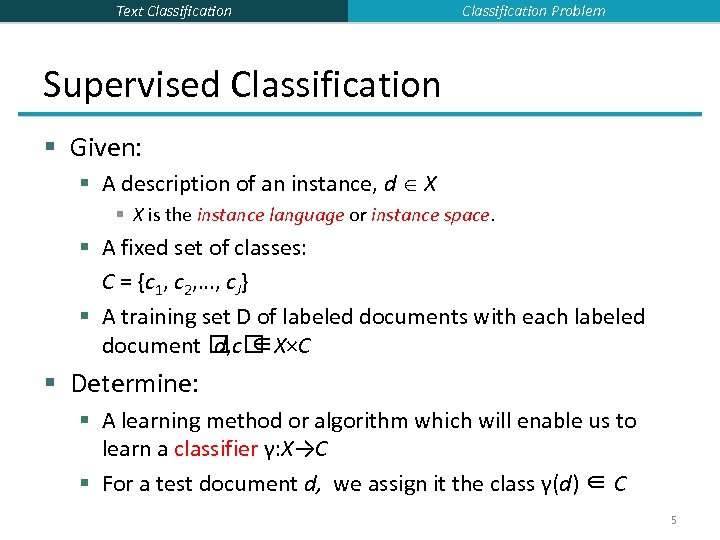
Text Classification Problem Supervised Classification § Given: § A description of an instance, d X § X is the instance language or instance space. § A fixed set of classes: C = {c 1, c 2, …, c. J} § A training set D of labeled documents with each labeled document ∈X×C d, c § Determine: § A learning method or algorithm which will enable us to learn a classifier γ: X→C § For a test document d, we assign it the class γ(d) ∈ C 5
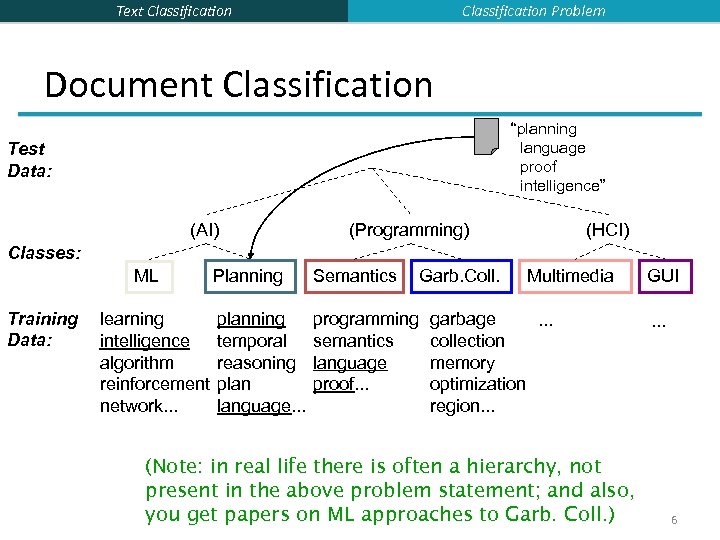
Classification Problem Text Classification Document Classification “planning language proof intelligence” Test Data: (AI) (Programming) (HCI) Classes: ML Training Data: learning intelligence algorithm reinforcement network. . . Planning Semantics Garb. Coll. planning temporal reasoning plan language. . . programming semantics language proof. . . Multimedia garbage. . . collection memory optimization region. . . (Note: in real life there is often a hierarchy, not present in the above problem statement; and also, you get papers on ML approaches to Garb. Coll. ) GUI. . . 6
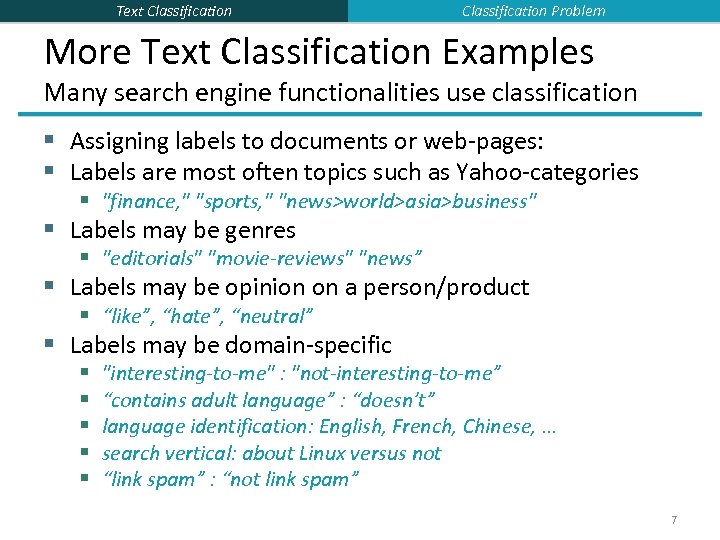
Text Classification Problem More Text Classification Examples Many search engine functionalities use classification § Assigning labels to documents or web-pages: § Labels are most often topics such as Yahoo-categories § "finance, " "sports, " "news>world>asia>business" § Labels may be genres § "editorials" "movie-reviews" "news” § Labels may be opinion on a person/product § “like”, “hate”, “neutral” § Labels may be domain-specific § § § "interesting-to-me" : "not-interesting-to-me” “contains adult language” : “doesn’t” language identification: English, French, Chinese, … search vertical: about Linux versus not “link spam” : “not link spam” 7
Text Classification Naïve Bayes methods 8
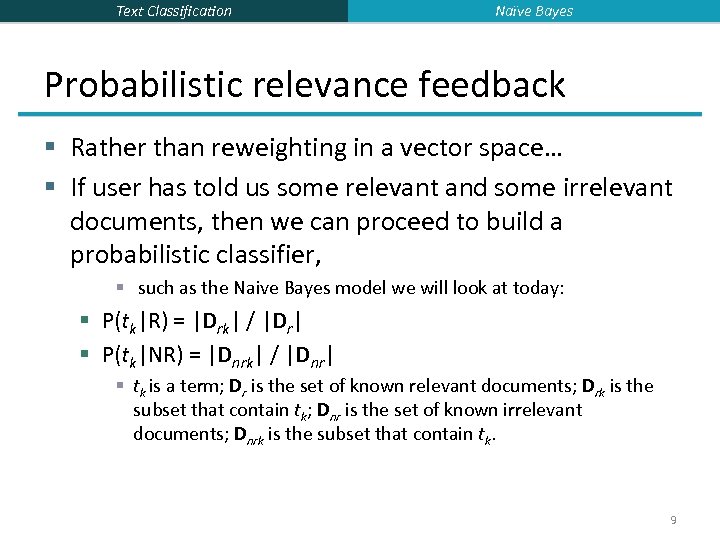
Text Classification Naïve Bayes Probabilistic relevance feedback § Rather than reweighting in a vector space… § If user has told us some relevant and some irrelevant documents, then we can proceed to build a probabilistic classifier, § such as the Naive Bayes model we will look at today: § P(tk|R) = |Drk| / |Dr| § P(tk|NR) = |Dnrk| / |Dnr| § tk is a term; Dr is the set of known relevant documents; Drk is the subset that contain tk; Dnr is the set of known irrelevant documents; Dnrk is the subset that contain tk. 9
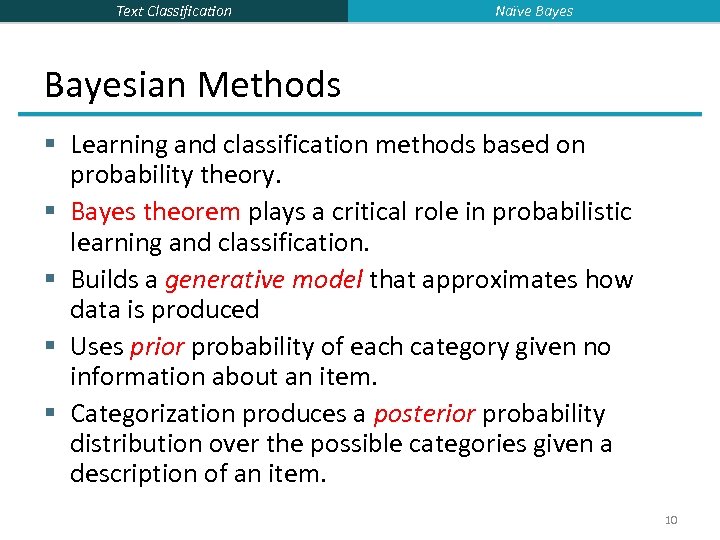
Text Classification Naïve Bayesian Methods § Learning and classification methods based on probability theory. § Bayes theorem plays a critical role in probabilistic learning and classification. § Builds a generative model that approximates how data is produced § Uses prior probability of each category given no information about an item. § Categorization produces a posterior probability distribution over the possible categories given a description of an item. 10
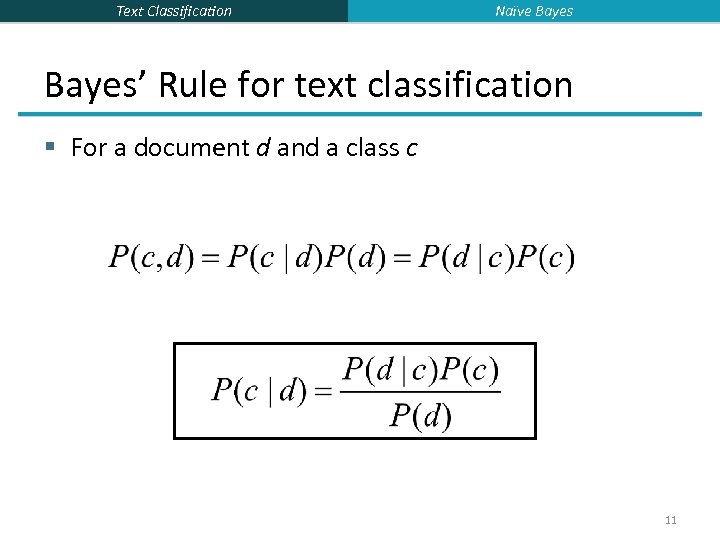
Text Classification Naïve Bayes’ Rule for text classification § For a document d and a class c 11
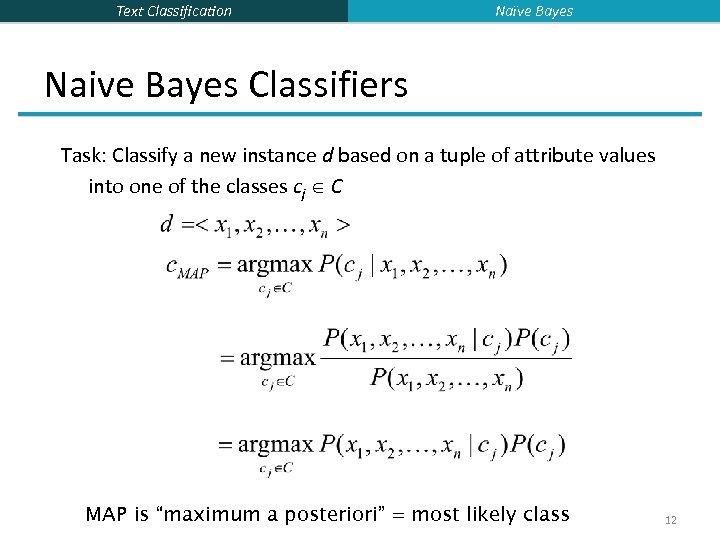
Text Classification Naïve Bayes Naive Bayes Classifiers Task: Classify a new instance d based on a tuple of attribute values into one of the classes cj C MAP is “maximum a posteriori” = most likely class 12
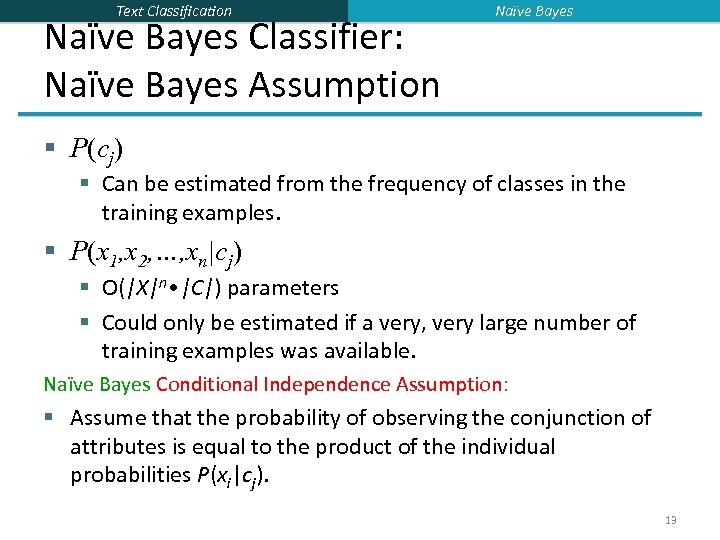
Text Classification Naïve Bayes Classifier: Naïve Bayes Assumption Naïve Bayes § P(cj) § Can be estimated from the frequency of classes in the training examples. § P(x 1, x 2, …, xn|cj) § O(|X|n • |C|) parameters § Could only be estimated if a very, very large number of training examples was available. Naïve Bayes Conditional Independence Assumption: § Assume that the probability of observing the conjunction of attributes is equal to the product of the individual probabilities P(xi|cj). 13
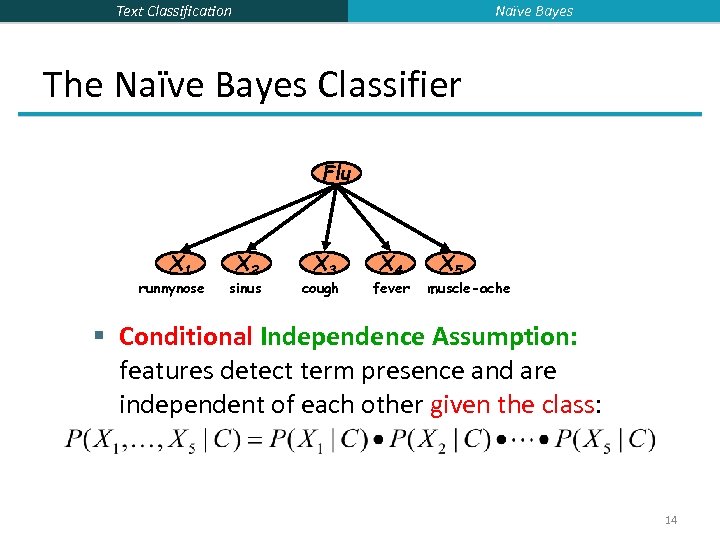
Naïve Bayes Text Classification The Naïve Bayes Classifier Flu X 1 runnynose X 2 sinus X 3 cough X 4 fever X 5 muscle-ache § Conditional Independence Assumption: features detect term presence and are independent of each other given the class: 14
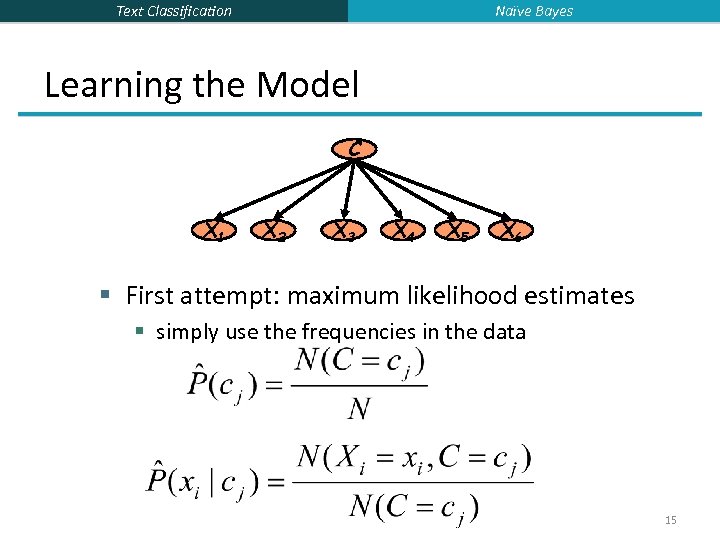
Naïve Bayes Text Classification Learning the Model C X 1 X 2 X 3 X 4 X 5 X 6 § First attempt: maximum likelihood estimates § simply use the frequencies in the data 15
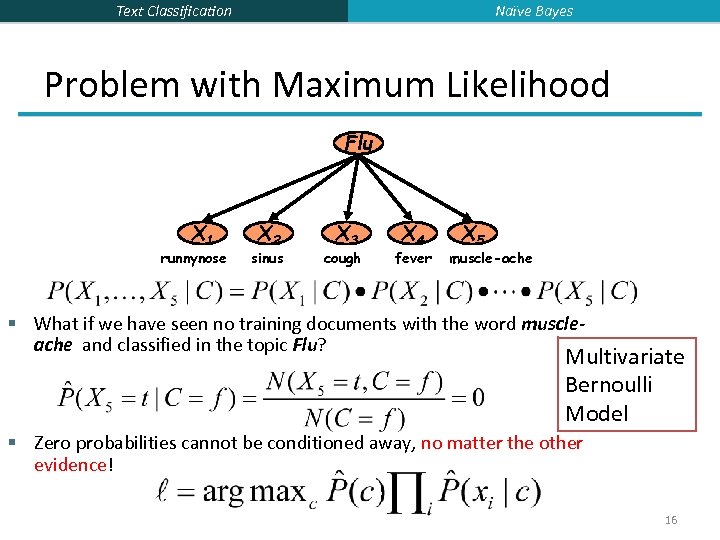
Naïve Bayes Text Classification Problem with Maximum Likelihood Flu X 1 runnynose X 2 sinus X 3 cough X 4 fever X 5 muscle-ache § What if we have seen no training documents with the word muscleache and classified in the topic Flu? Multivariate Bernoulli Model § Zero probabilities cannot be conditioned away, no matter the other evidence! 16
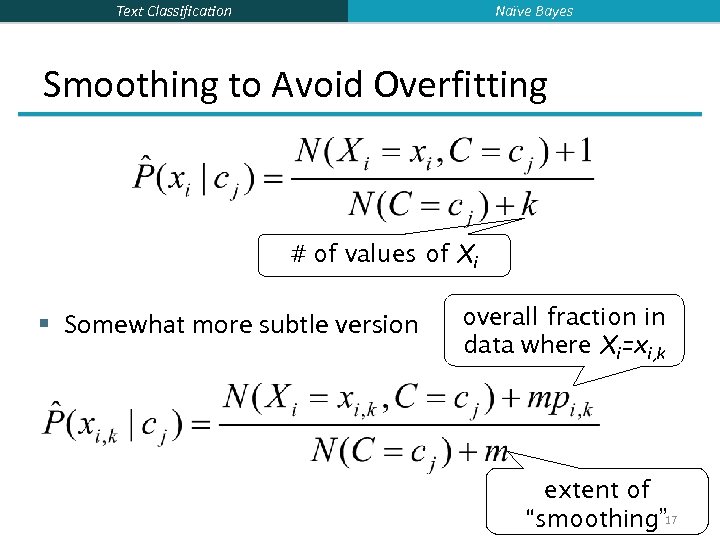
Naïve Bayes Text Classification Smoothing to Avoid Overfitting # of values of Xi § Somewhat more subtle version overall fraction in data where Xi=xi, k extent of “smoothing” 17
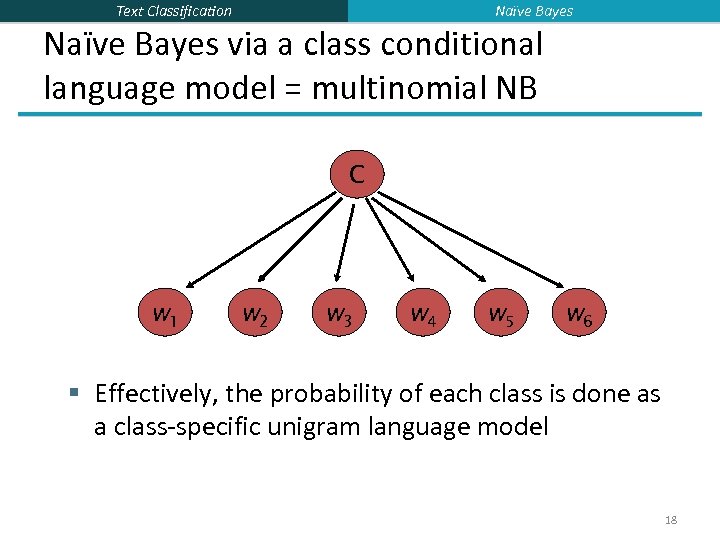
Naïve Bayes Text Classification Naïve Bayes via a class conditional language model = multinomial NB C w 1 w 2 w 3 w 4 w 5 w 6 § Effectively, the probability of each class is done as a class-specific unigram language model 18
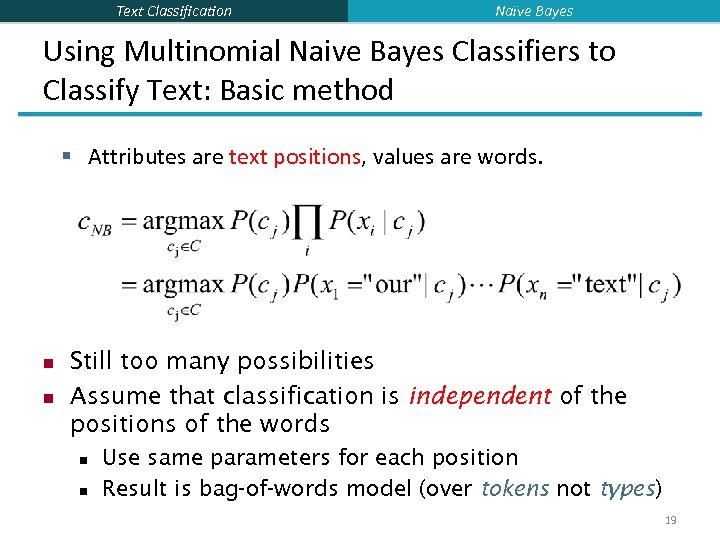
Text Classification Naïve Bayes Using Multinomial Naive Bayes Classifiers to Classify Text: Basic method § Attributes are text positions, values are words. n n Still too many possibilities Assume that classification is independent of the positions of the words n n Use same parameters for each position Result is bag-of-words model (over tokens not types) 19
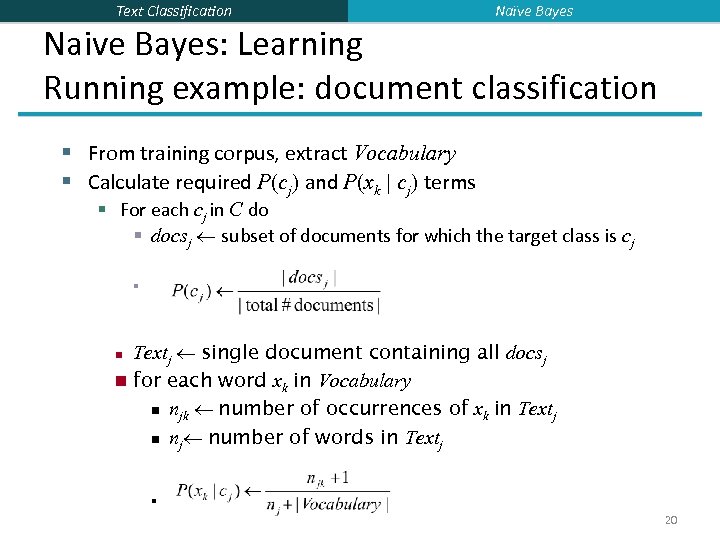
Text Classification Naïve Bayes Naive Bayes: Learning Running example: document classification § From training corpus, extract Vocabulary § Calculate required P(cj) and P(xk | cj) terms § For each cj in C do § docsj subset of documents for which the target class is cj § Textj single document containing all docsj n for each word xk in Vocabulary n njk number of occurrences of xk in Textj n nj number of words in Textj n n 20
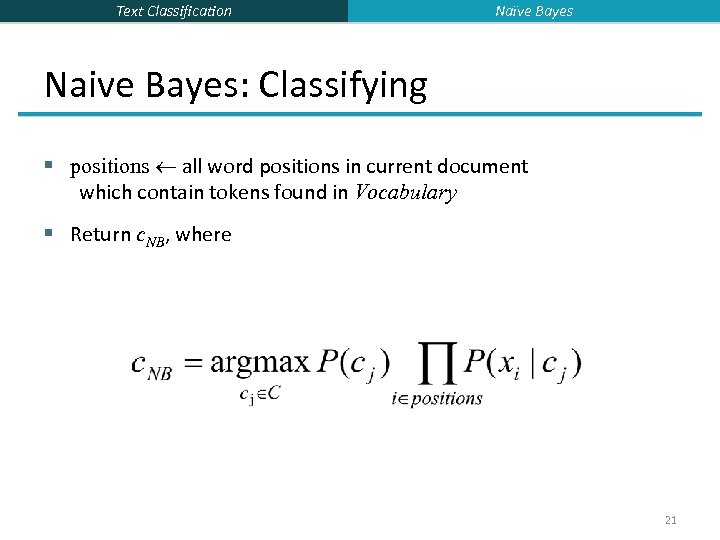
Text Classification Naïve Bayes Naive Bayes: Classifying § positions all word positions in current document which contain tokens found in Vocabulary § Return c. NB, where 21
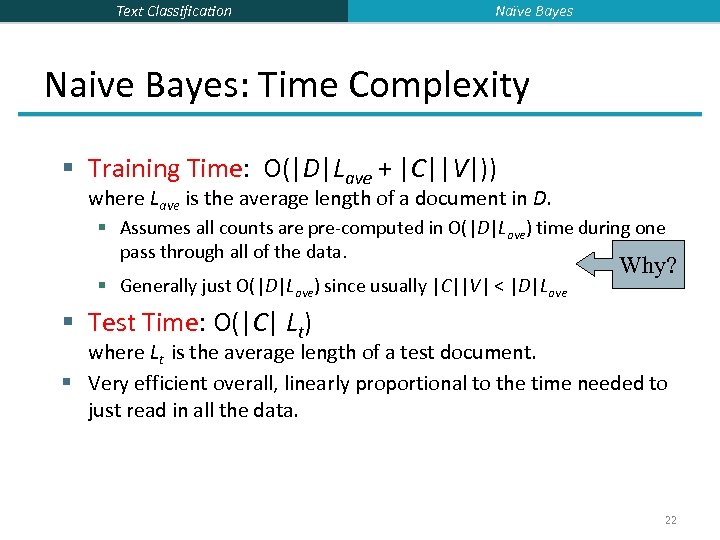
Text Classification Naïve Bayes Naive Bayes: Time Complexity § Training Time: O(|D|Lave + |C||V|)) where Lave is the average length of a document in D. § Assumes all counts are pre-computed in O(|D|Lave) time during one pass through all of the data. § Generally just O(|D|Lave) since usually |C||V| < |D|Lave Why? § Test Time: O(|C| Lt) where Lt is the average length of a test document. § Very efficient overall, linearly proportional to the time needed to just read in all the data. 22
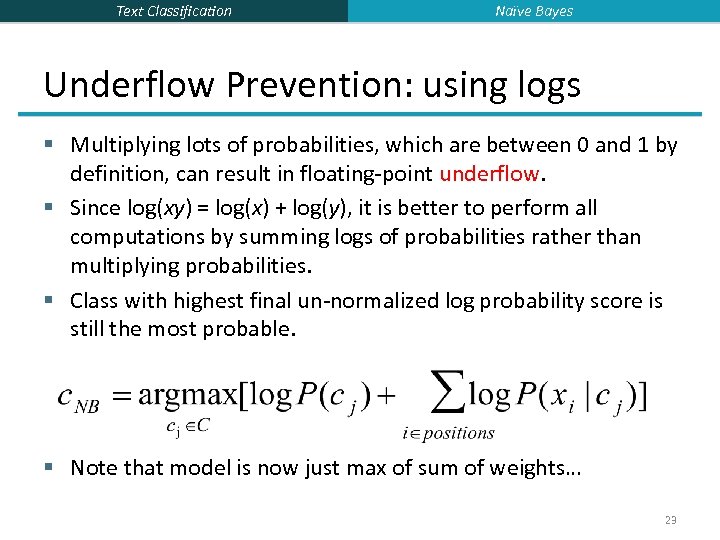
Text Classification Naïve Bayes Underflow Prevention: using logs § Multiplying lots of probabilities, which are between 0 and 1 by definition, can result in floating-point underflow. § Since log(xy) = log(x) + log(y), it is better to perform all computations by summing logs of probabilities rather than multiplying probabilities. § Class with highest final un-normalized log probability score is still the most probable. § Note that model is now just max of sum of weights… 23
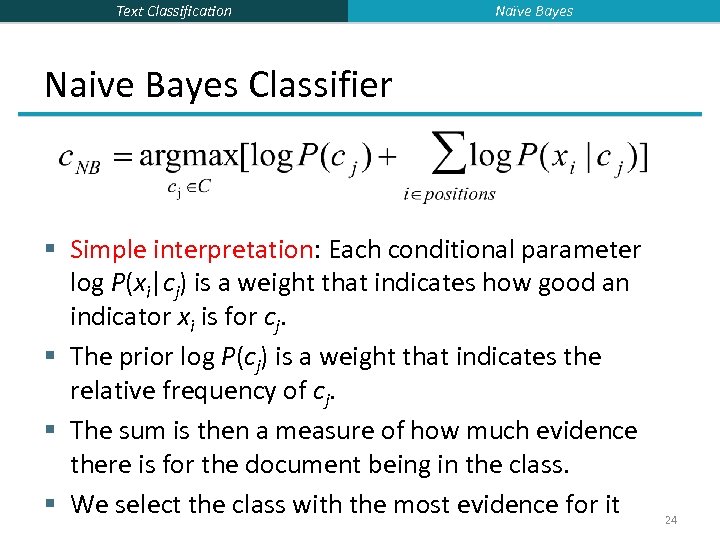
Text Classification Naïve Bayes Naive Bayes Classifier § Simple interpretation: Each conditional parameter log P(xi|cj) is a weight that indicates how good an indicator xi is for cj. § The prior log P(cj) is a weight that indicates the relative frequency of cj. § The sum is then a measure of how much evidence there is for the document being in the class. § We select the class with the most evidence for it 24
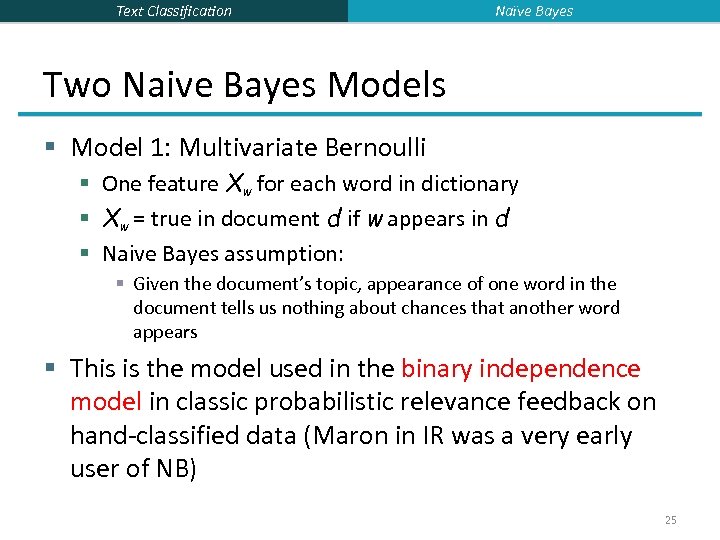
Text Classification Naïve Bayes Two Naive Bayes Models § Model 1: Multivariate Bernoulli § One feature Xw for each word in dictionary § Xw = true in document d if w appears in d § Naive Bayes assumption: § Given the document’s topic, appearance of one word in the document tells us nothing about chances that another word appears § This is the model used in the binary independence model in classic probabilistic relevance feedback on hand-classified data (Maron in IR was a very early user of NB) 25
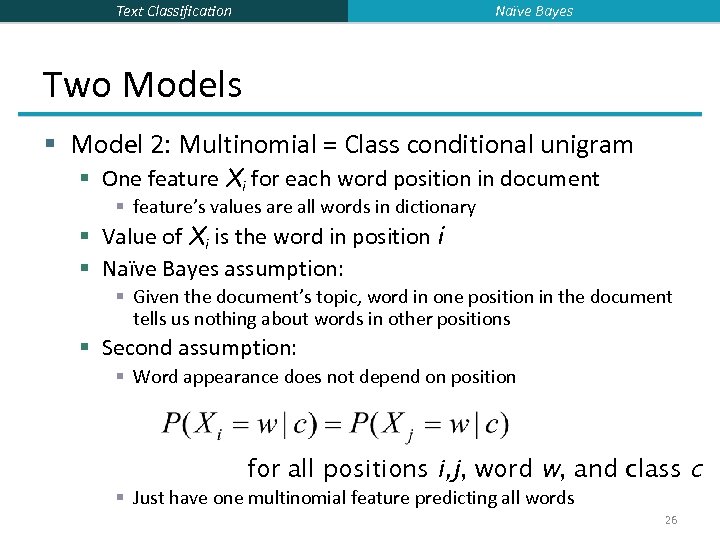
Naïve Bayes Text Classification Two Models § Model 2: Multinomial = Class conditional unigram § One feature Xi for each word position in document § feature’s values are all words in dictionary § Value of Xi is the word in position i § Naïve Bayes assumption: § Given the document’s topic, word in one position in the document tells us nothing about words in other positions § Second assumption: § Word appearance does not depend on position for all positions i, j, word w, and class c § Just have one multinomial feature predicting all words 26
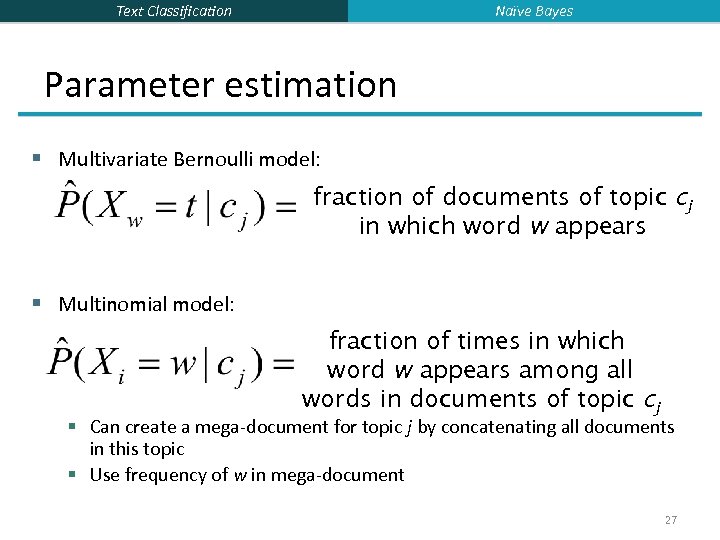
Naïve Bayes Text Classification Parameter estimation § Multivariate Bernoulli model: fraction of documents of topic cj in which word w appears § Multinomial model: fraction of times in which word w appears among all words in documents of topic cj § Can create a mega-document for topic j by concatenating all documents in this topic § Use frequency of w in mega-document 27
Text Classification Naïve Bayes Classification § Multinomial vs Multivariate Bernoulli? § Multinomial model is almost always more effective in text applications! § See results figures later § See IIR sections 13. 2 and 13. 3 for worked examples with each model 28
Text Classification The rest of text classification methods § Vector space methods for Text Classification § Vector space classification using centroids (Rocchio) § K Nearest Neighbors § Support Vector Machines 29
Text Classification Vector Space Representation Recall: Vector Space Representation § Each document is a vector, one component for each term (= word). § Normally normalize vectors to unit length. § High-dimensional vector space: § Terms are axes § 10, 000+ dimensions, or even 100, 000+ § Docs are vectors in this space § How can we do classification in this space? 30
Text Classification Vector Space Representation Classification Using Vector Spaces § As before, the training set is a set of documents, each labeled with its class (e. g. , topic) § In vector space classification, this set corresponds to a labeled set of points (or, equivalently, vectors) in the vector space § Premise 1: Documents in the same class form a contiguous region of space § Premise 2: Documents from different classes don’t overlap (much) § We define surfaces to delineate classes in the space 31
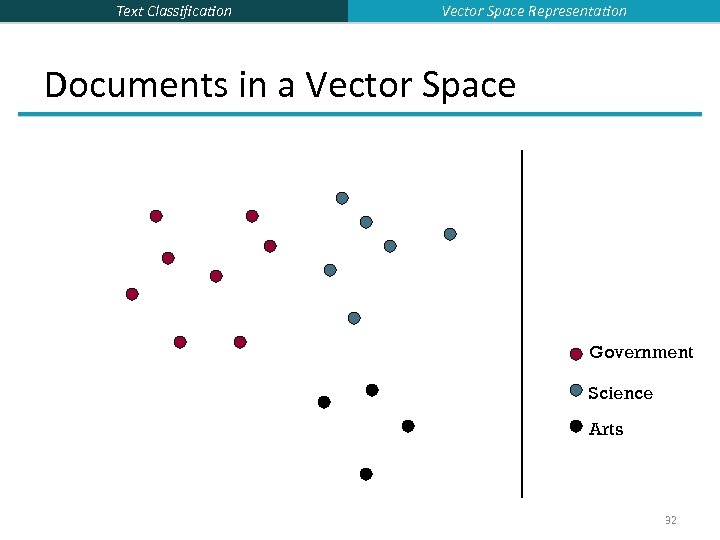
Text Classification Vector Space Representation Documents in a Vector Space Government Science Arts 32
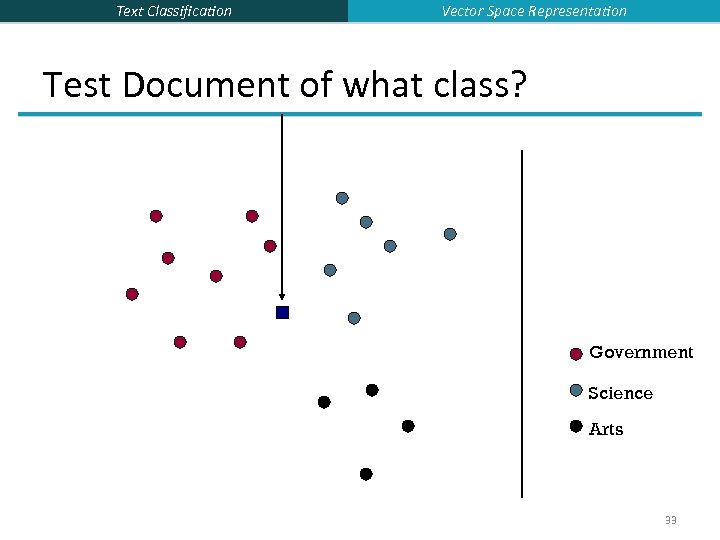
Text Classification Vector Space Representation Test Document of what class? Government Science Arts 33
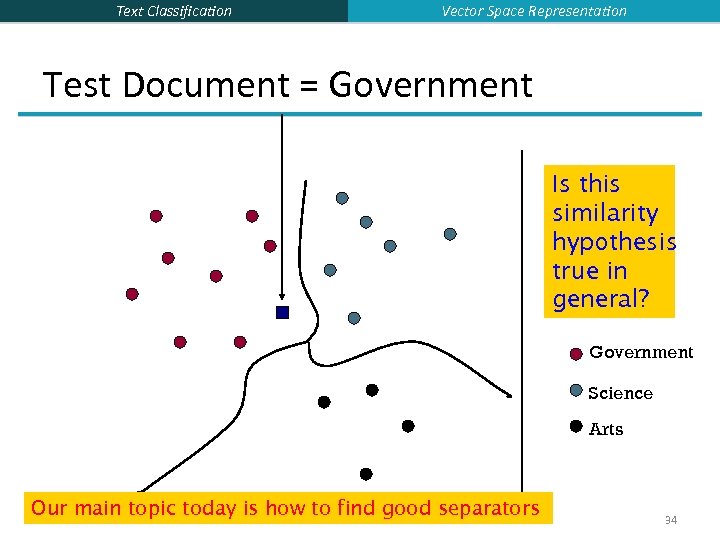
Text Classification Vector Space Representation Test Document = Government Is this similarity hypothesis true in general? Government Science Arts Our main topic today is how to find good separators 34
Text Classification Rocchio Classification 35
Text Classification Rocchio Classification Using Rocchio for text classification § Relevance feedback methods can be adapted for text categorization § As noted before, relevance feedback can be viewed as 2 classification § Relevant vs. nonrelevant documents § Use standard tf-idf weighted vectors to represent text documents § For training documents in each category, compute a prototype vector by summing the vectors of the training documents in the category. § Prototype = centroid of members of class § Assign test documents to the category with the closest prototype vector based on cosine similarity. 36
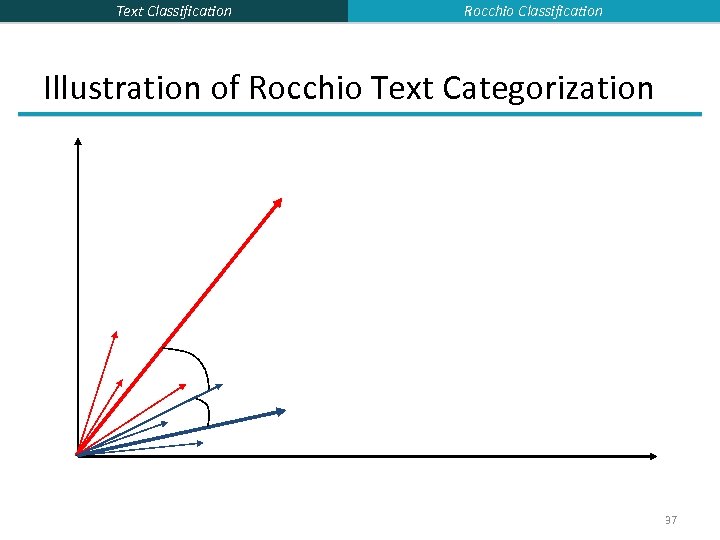
Text Classification Rocchio Classification Illustration of Rocchio Text Categorization 37
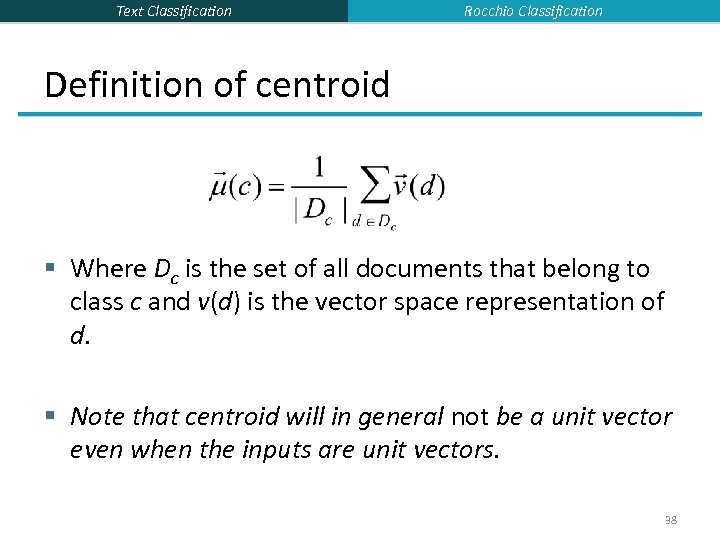
Text Classification Rocchio Classification Definition of centroid § Where Dc is the set of all documents that belong to class c and v(d) is the vector space representation of d. § Note that centroid will in general not be a unit vector even when the inputs are unit vectors. 38
Text Classification Rocchio Properties § Forms a simple generalization of the examples in each class (a prototype). § Prototype vector does not need to be averaged or otherwise normalized for length since cosine similarity is insensitive to vector length. § Classification is based on similarity to class prototypes. § Does not guarantee classifications are consistent with the given training data. Why not? 39
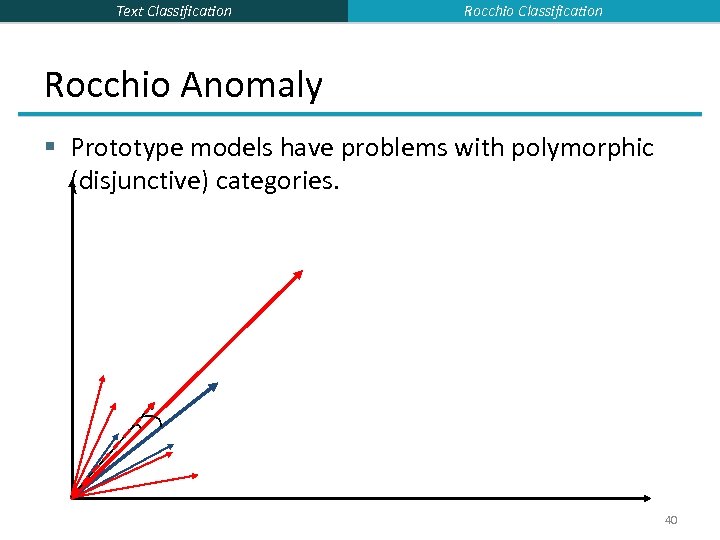
Text Classification Rocchio Anomaly § Prototype models have problems with polymorphic (disjunctive) categories. 40

Text Classification Rocchio classification § Rocchio forms a simple representation for each class: the centroid/prototype § Classification is based on similarity to / distance from the prototype/centroid § It does not guarantee that classifications are consistent with the given training data § It is little used outside text classification § It has been used quite effectively for text classification § But in general worse than Naïve Bayes § Again, cheap to train and test documents 41
Text Classification k. NN Classification 42
Text Classification K Nearest Neighbor k Nearest Neighbor Classification § k. NN = k Nearest Neighbor § § § To classify a document d into class c: Define k-neighborhood N as k nearest neighbors of d Count number of documents ic in N that belong to c Estimate P(c|d) as ic/k Choose as class argmaxc P(c|d) [ = majority class] 43
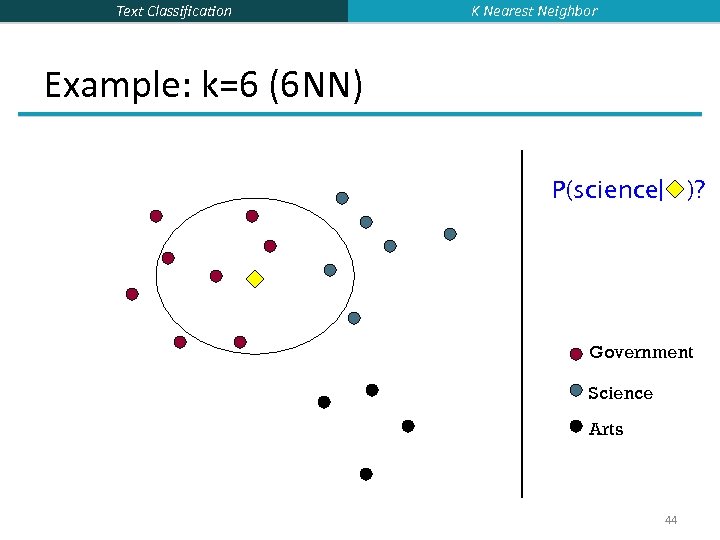
Text Classification K Nearest Neighbor Example: k=6 (6 NN) P(science| )? Government Science Arts 44
Text Classification K Nearest Neighbor Nearest-Neighbor Learning Algorithm § Learning is just storing the representations of the training examples in D. § Testing instance x (under 1 NN): § Compute similarity between x and all examples in D. § Assign x the category of the most similar example in D. § Does not explicitly compute a generalization or category prototypes. § Also called: § Case-based learning § Memory-based learning § Lazy learning § Rationale of k. NN: contiguity hypothesis 45
Text Classification K Nearest Neighbor k. NN Is Close to Optimal § Cover and Hart (1967) § Asymptotically, the error rate of 1 -nearest-neighbor classification is less than twice the Bayes rate [error rate of classifier knowing model that generated data] § In particular, asymptotic error rate is 0 if Bayes rate is 0. § Assume: query point coincides with a training point. § Both query point and training point contribute error → 2 times Bayes rate 46
Text Classification K Nearest Neighbor k Nearest Neighbor § Using only the closest example (1 NN) to determine the class is subject to errors due to: § A single atypical example. § Noise (i. e. , an error) in the category label of a single training example. § More robust alternative is to find the k most-similar examples and return the majority category of these k examples. § Value of k is typically odd to avoid ties; 3 and 5 are most common. 47
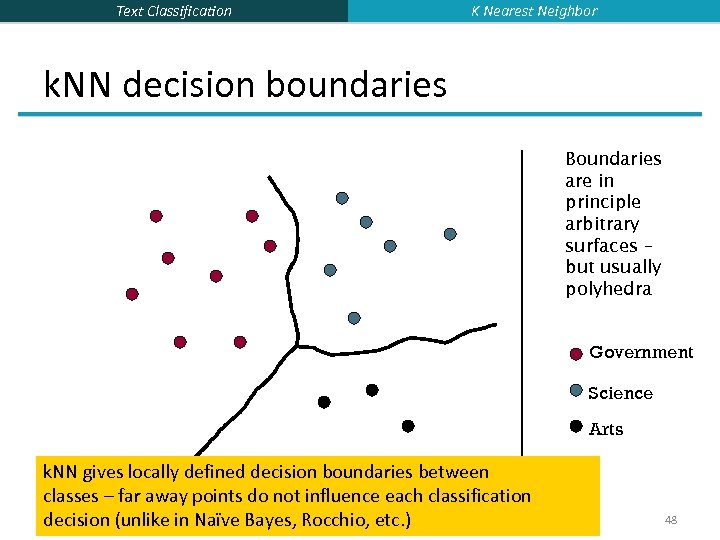
Text Classification K Nearest Neighbor k. NN decision boundaries Boundaries are in principle arbitrary surfaces – but usually polyhedra Government Science Arts k. NN gives locally defined decision boundaries between classes – far away points do not influence each classification decision (unlike in Naïve Bayes, Rocchio, etc. ) 48
Text Classification K Nearest Neighbor Similarity Metrics § Nearest neighbor method depends on a similarity (or distance) metric. § Simplest for continuous m-dimensional instance space is Euclidean distance. § Simplest for m-dimensional binary instance space is Hamming distance (number of feature values that differ). § For text, cosine similarity of tf. idf weighted vectors is typically most effective. 49
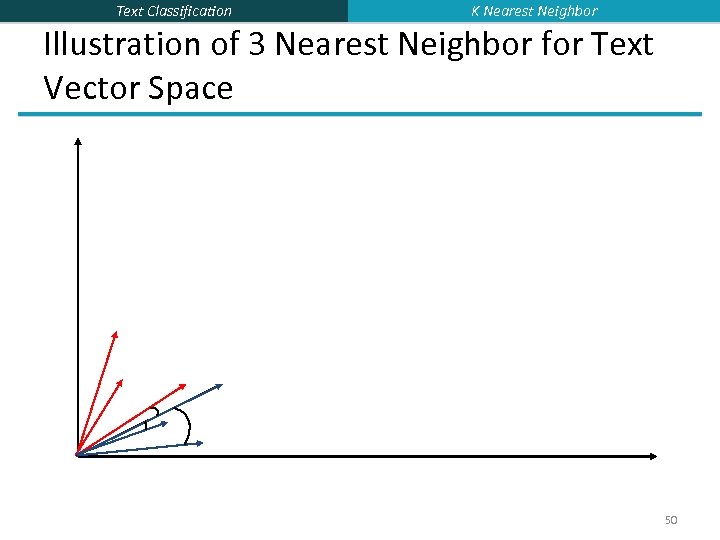
Text Classification K Nearest Neighbor Illustration of 3 Nearest Neighbor for Text Vector Space 50
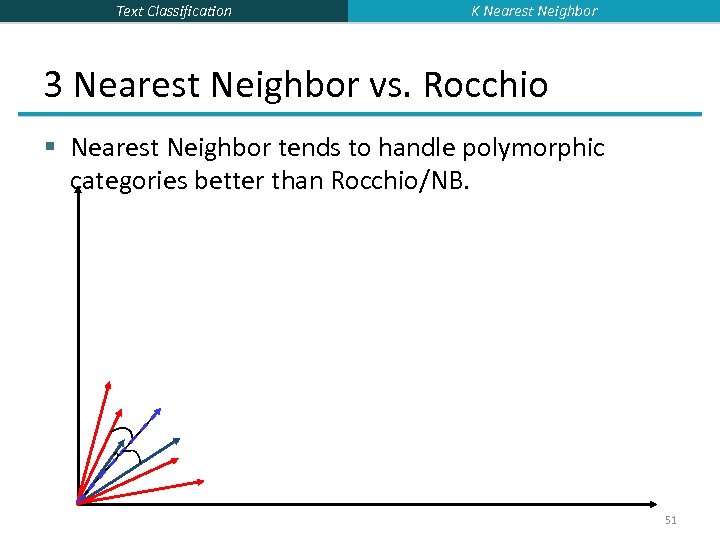
Text Classification K Nearest Neighbor 3 Nearest Neighbor vs. Rocchio § Nearest Neighbor tends to handle polymorphic categories better than Rocchio/NB. 51
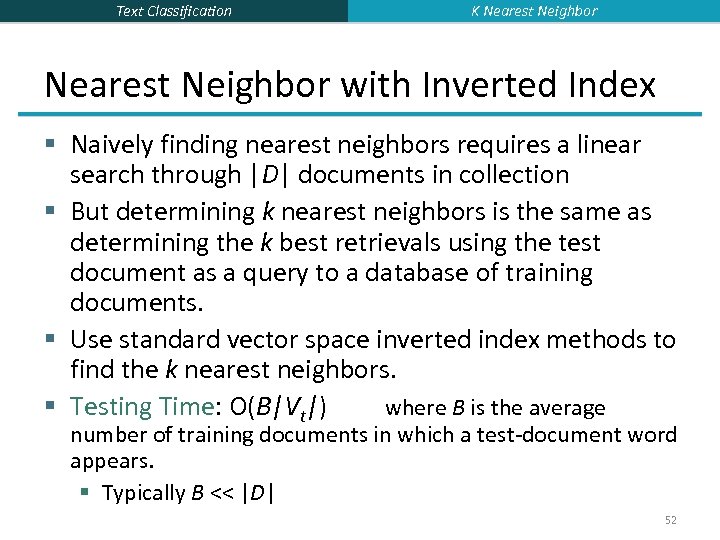
Text Classification K Nearest Neighbor with Inverted Index § Naively finding nearest neighbors requires a linear search through |D| documents in collection § But determining k nearest neighbors is the same as determining the k best retrievals using the test document as a query to a database of training documents. § Use standard vector space inverted index methods to find the k nearest neighbors. § Testing Time: O(B|Vt|) where B is the average number of training documents in which a test-document word appears. § Typically B << |D| 52
Text Classification K Nearest Neighbor k. NN: Discussion § Scales well with large number of classes § Don’t need to train n classifiers for n classes § Classes can influence each other § Small changes to one class can have ripple effect § Scores can be hard to convert to probabilities § No training necessary § Actually: perhaps not true. (Data editing, etc. ) § May be expensive at test time § In most cases it’s more accurate than NB or Rocchio 53
Text Classification Support Vector Machine 54
Text Classification Linear classifiers and binary and multiclassification § Consider 2 class problems § Deciding between two classes, perhaps, government and non-government § One-versus-rest classification § How do we define (and find) the separating surface? § How do we decide which region a test doc is in? 55
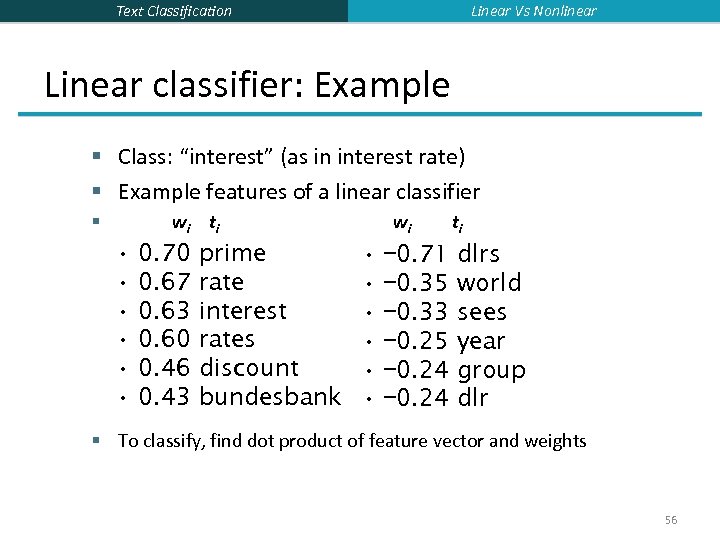
Linear Vs Nonlinear Text Classification Linear classifier: Example § Class: “interest” (as in interest rate) § Example features of a linear classifier wi t i § • • • 0. 70 0. 67 0. 63 0. 60 0. 46 0. 43 prime rate interest rates discount bundesbank wi • • • − 0. 71 − 0. 35 − 0. 33 − 0. 25 − 0. 24 ti dlrs world sees year group dlr § To classify, find dot product of feature vector and weights 56
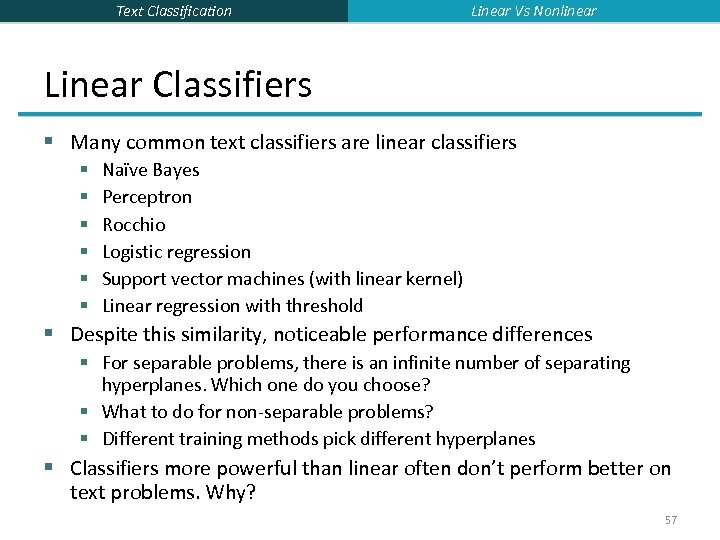
Text Classification Linear Vs Nonlinear Linear Classifiers § Many common text classifiers are linear classifiers § § § Naïve Bayes Perceptron Rocchio Logistic regression Support vector machines (with linear kernel) Linear regression with threshold § Despite this similarity, noticeable performance differences § For separable problems, there is an infinite number of separating hyperplanes. Which one do you choose? § What to do for non-separable problems? § Different training methods pick different hyperplanes § Classifiers more powerful than linear often don’t perform better on text problems. Why? 57
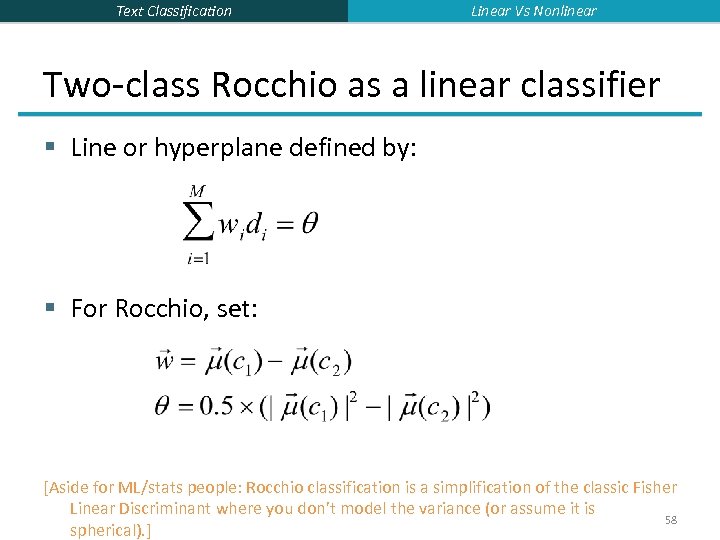
Text Classification Linear Vs Nonlinear Two-class Rocchio as a linear classifier § Line or hyperplane defined by: § For Rocchio, set: [Aside for ML/stats people: Rocchio classification is a simplification of the classic Fisher Linear Discriminant where you don’t model the variance (or assume it is 58 spherical). ]
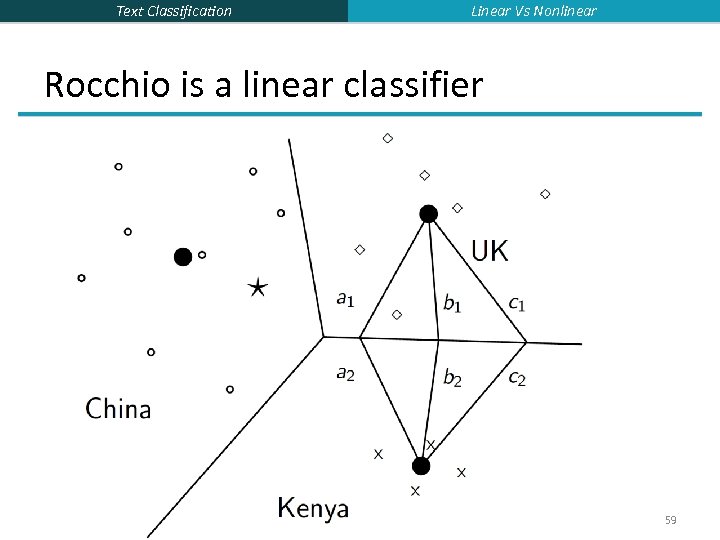
Text Classification Linear Vs Nonlinear Rocchio is a linear classifier 59
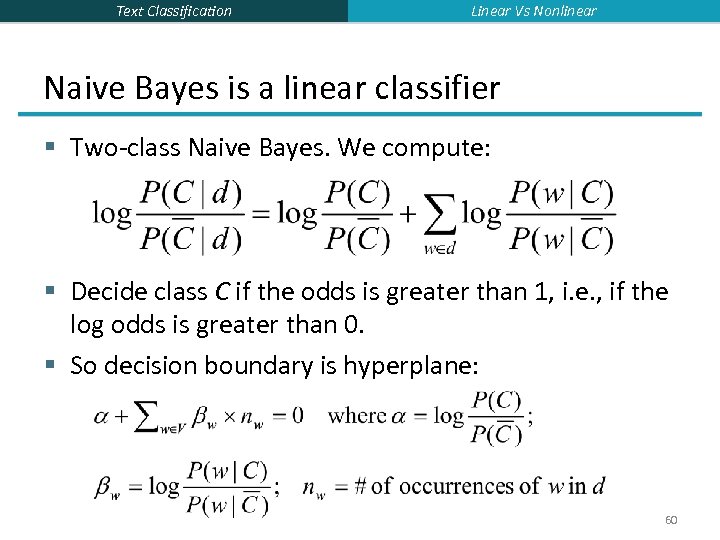
Text Classification Linear Vs Nonlinear Naive Bayes is a linear classifier § Two-class Naive Bayes. We compute: § Decide class C if the odds is greater than 1, i. e. , if the log odds is greater than 0. § So decision boundary is hyperplane: 60
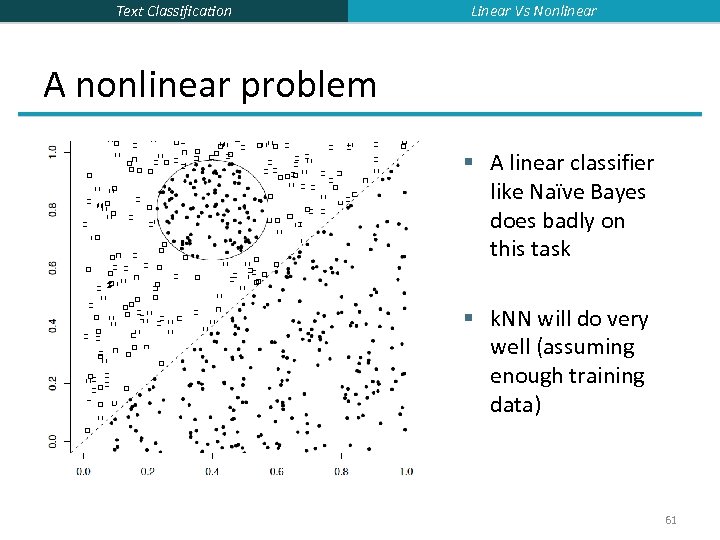
Text Classification Linear Vs Nonlinear A nonlinear problem § A linear classifier like Naïve Bayes does badly on this task § k. NN will do very well (assuming enough training data) 61
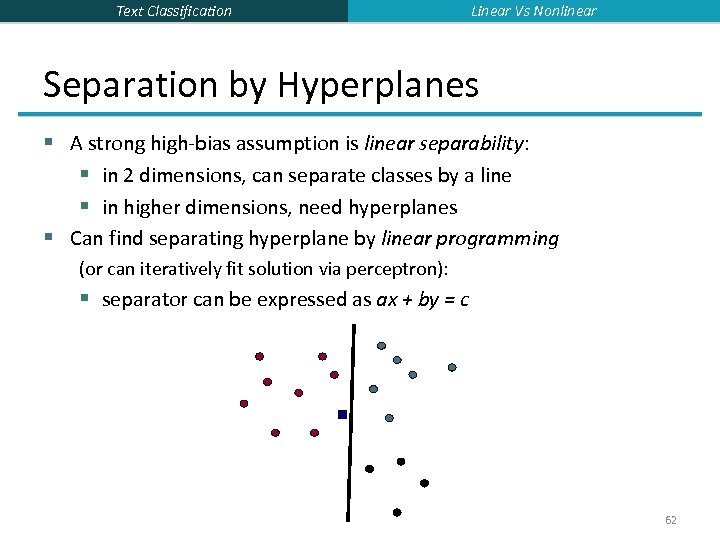
Text Classification Linear Vs Nonlinear Separation by Hyperplanes § A strong high-bias assumption is linear separability: § in 2 dimensions, can separate classes by a line § in higher dimensions, need hyperplanes § Can find separating hyperplane by linear programming (or can iteratively fit solution via perceptron): § separator can be expressed as ax + by = c 62
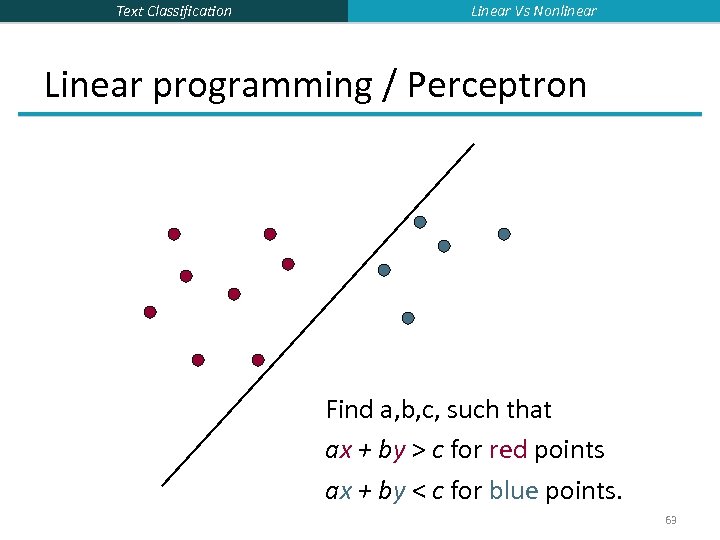
Text Classification Linear Vs Nonlinear Linear programming / Perceptron Find a, b, c, such that ax + by > c for red points ax + by < c for blue points. 63
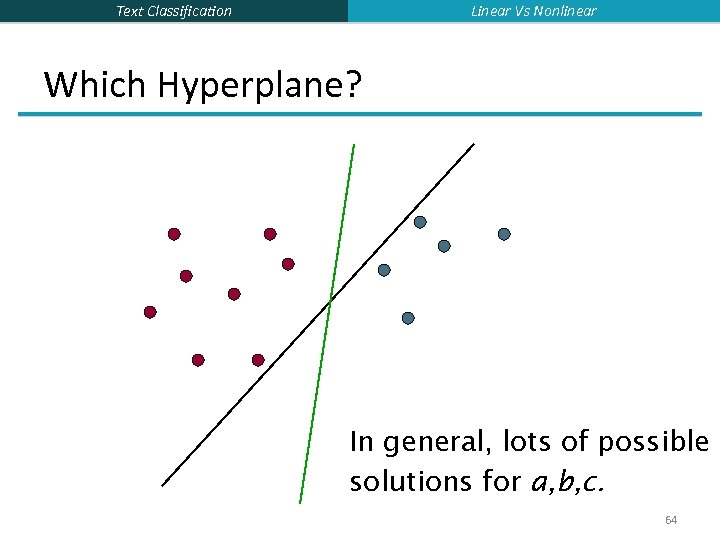
Linear Vs Nonlinear Text Classification Which Hyperplane? In general, lots of possible solutions for a, b, c. 64
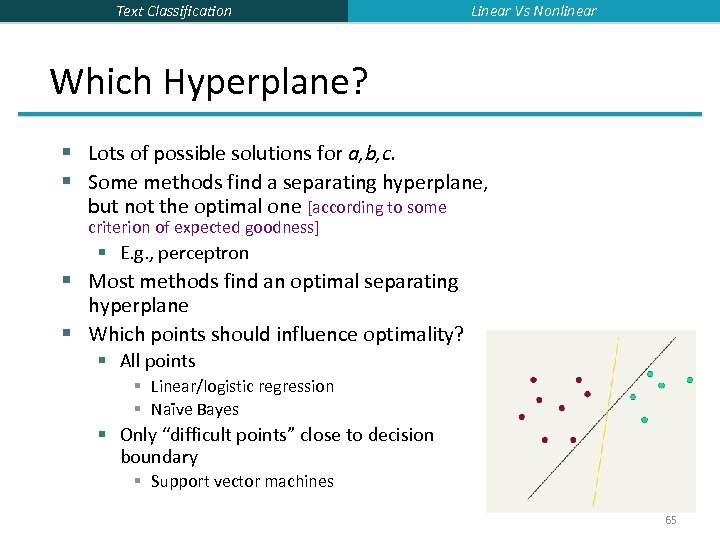
Text Classification Linear Vs Nonlinear Which Hyperplane? § Lots of possible solutions for a, b, c. § Some methods find a separating hyperplane, but not the optimal one [according to some criterion of expected goodness] § E. g. , perceptron § Most methods find an optimal separating hyperplane § Which points should influence optimality? § All points § Linear/logistic regression § Naïve Bayes § Only “difficult points” close to decision boundary § Support vector machines 65
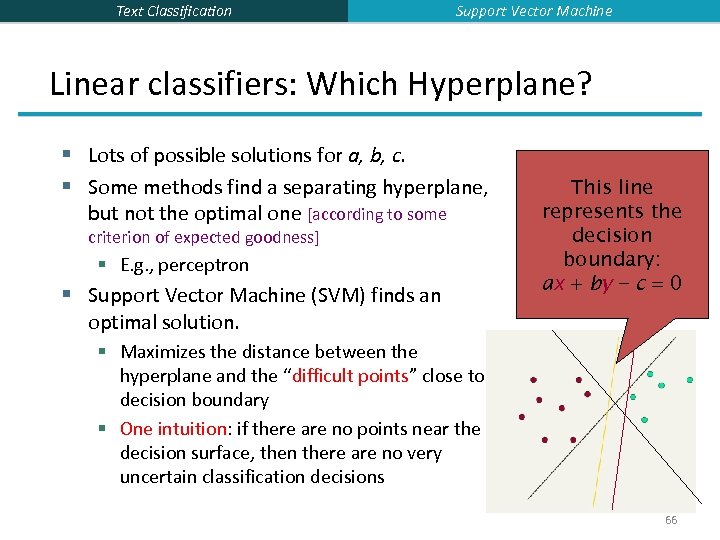
Text Classification Support Vector Machine Linear classifiers: Which Hyperplane? § Lots of possible solutions for a, b, c. § Some methods find a separating hyperplane, but not the optimal one [according to some criterion of expected goodness] § E. g. , perceptron § Support Vector Machine (SVM) finds an optimal solution. This line represents the decision boundary: ax + by − c = 0 § Maximizes the distance between the hyperplane and the “difficult points” close to decision boundary § One intuition: if there are no points near the decision surface, then there are no very uncertain classification decisions 66
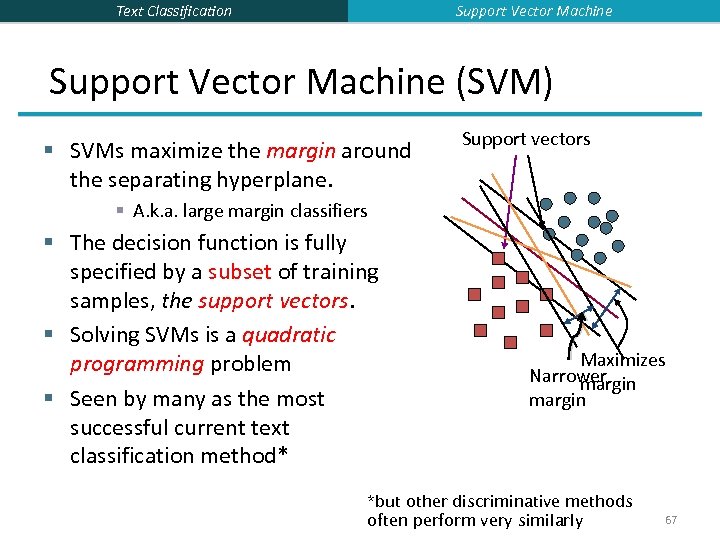
Support Vector Machine Text Classification Support Vector Machine (SVM) § SVMs maximize the margin around the separating hyperplane. Support vectors § A. k. a. large margin classifiers § The decision function is fully specified by a subset of training samples, the support vectors. § Solving SVMs is a quadratic programming problem § Seen by many as the most successful current text classification method* Maximizes Narrower margin *but other discriminative methods often perform very similarly 67
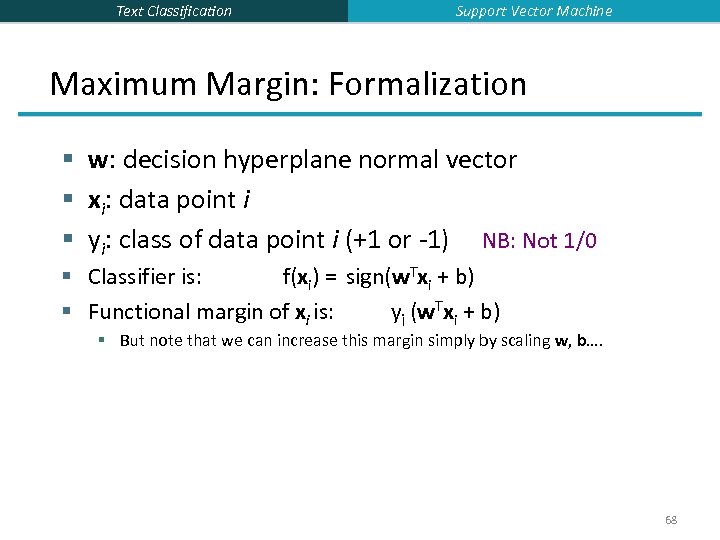
Text Classification Support Vector Machine Maximum Margin: Formalization § w: decision hyperplane normal vector § xi: data point i § yi: class of data point i (+1 or -1) NB: Not 1/0 § Classifier is: f(xi) = sign(w. Txi + b) § Functional margin of xi is: yi (w. Txi + b) § But note that we can increase this margin simply by scaling w, b…. 68
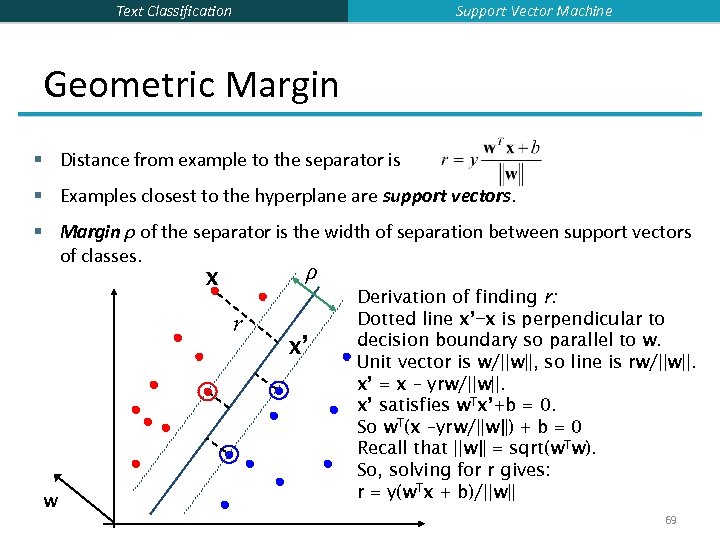
Support Vector Machine Text Classification Geometric Margin § Distance from example to the separator is § Examples closest to the hyperplane are support vectors. § Margin ρ of the separator is the width of separation between support vectors of classes. ρ x r w x’ Derivation of finding r: Dotted line x’−x is perpendicular to decision boundary so parallel to w. Unit vector is w/||w||, so line is rw/||w||. x’ = x – yrw/||w||. x’ satisfies w. Tx’+b = 0. So w. T(x –yrw/||w||) + b = 0 Recall that ||w|| = sqrt(w. Tw). So, solving for r gives: r = y(w. Tx + b)/||w|| 69
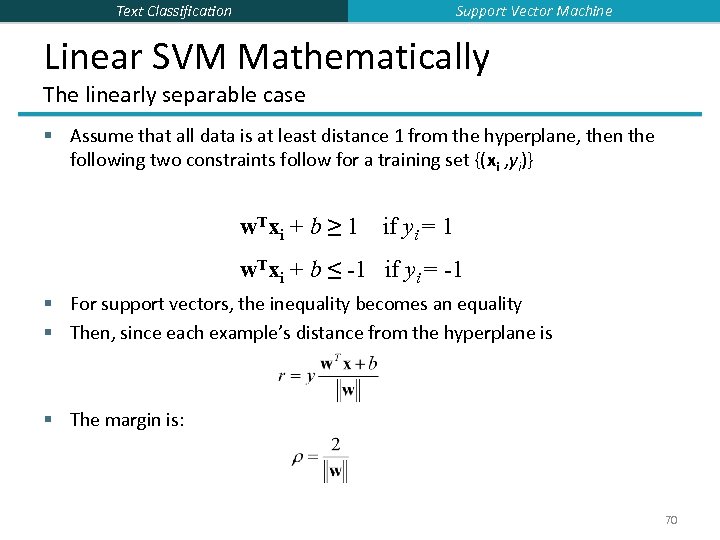
Support Vector Machine Text Classification Linear SVM Mathematically The linearly separable case § Assume that all data is at least distance 1 from the hyperplane, then the following two constraints follow for a training set {(xi , yi)} w. Txi + b ≥ 1 if yi = 1 w. Txi + b ≤ -1 if yi = -1 § For support vectors, the inequality becomes an equality § Then, since each example’s distance from the hyperplane is § The margin is: 70
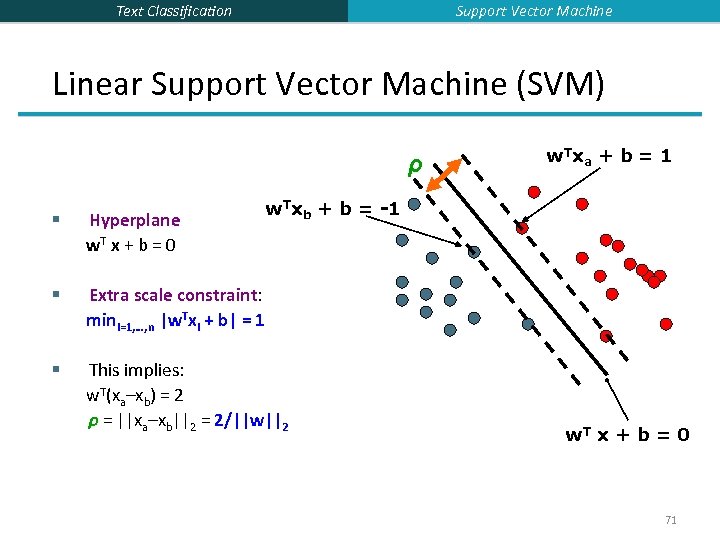
Support Vector Machine Text Classification Linear Support Vector Machine (SVM) ρ w. T x a + b = 1 w. Txb + b = -1 § Hyperplane w. T x + b = 0 § Extra scale constraint: mini=1, …, n |w. Txi + b| = 1 § This implies: w. T(xa–xb) = 2 ρ = ||xa–xb||2 = 2/||w||2 w. T x + b = 0 71
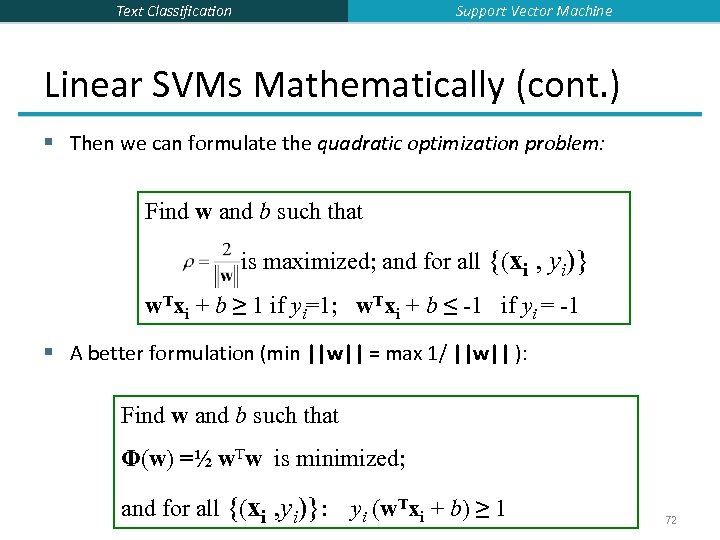
Support Vector Machine Text Classification Linear SVMs Mathematically (cont. ) § Then we can formulate the quadratic optimization problem: Find w and b such that is maximized; and for all {(xi , yi)} w. Txi + b ≥ 1 if yi=1; w. Txi + b ≤ -1 if yi = -1 § A better formulation (min ||w|| = max 1/ ||w|| ): Find w and b such that Φ(w) =½ w. Tw is minimized; and for all {(xi , yi)}: yi (w. Txi + b) ≥ 1 72
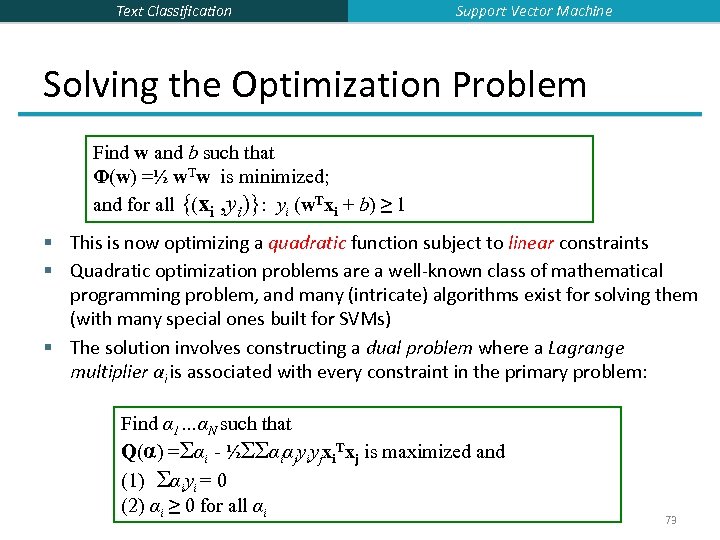
Text Classification Support Vector Machine Solving the Optimization Problem Find w and b such that Φ(w) =½ w. Tw is minimized; and for all {(xi , yi)}: yi (w. Txi + b) ≥ 1 § This is now optimizing a quadratic function subject to linear constraints § Quadratic optimization problems are a well-known class of mathematical programming problem, and many (intricate) algorithms exist for solving them (with many special ones built for SVMs) § The solution involves constructing a dual problem where a Lagrange multiplier αi is associated with every constraint in the primary problem: Find α 1…αN such that Q(α) =Σαi - ½ΣΣαiαjyiyjxi. Txj is maximized and (1) Σαiyi = 0 (2) αi ≥ 0 for all αi 73
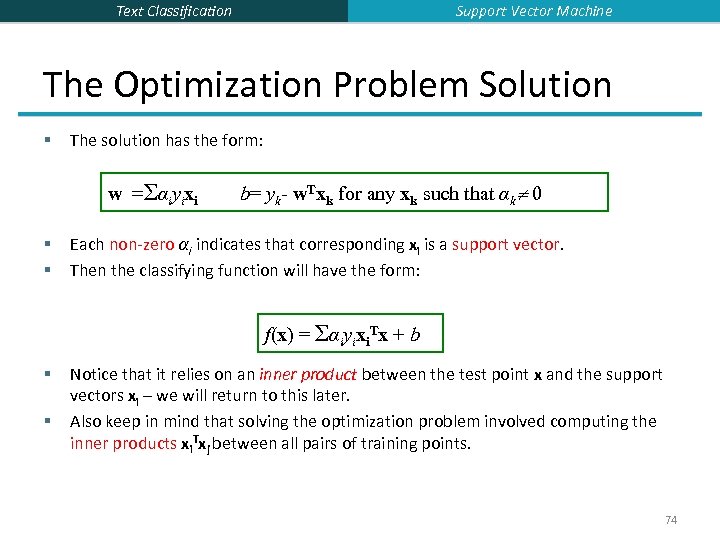
Support Vector Machine Text Classification The Optimization Problem Solution § The solution has the form: w =Σαiyixi § § b= yk- w. Txk for any xk such that αk 0 Each non-zero αi indicates that corresponding xi is a support vector. Then the classifying function will have the form: f(x) = Σαiyixi. Tx + b § § Notice that it relies on an inner product between the test point x and the support vectors xi – we will return to this later. Also keep in mind that solving the optimization problem involved computing the inner products xi. Txj between all pairs of training points. 74
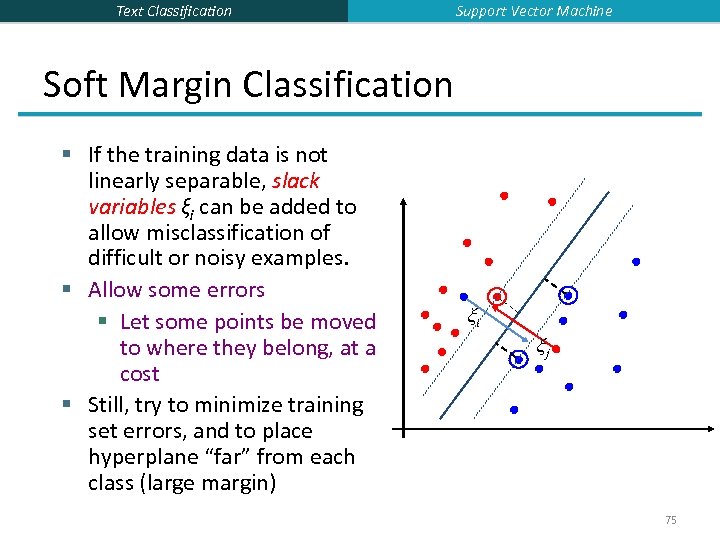
Text Classification Support Vector Machine Soft Margin Classification § If the training data is not linearly separable, slack variables ξi can be added to allow misclassification of difficult or noisy examples. § Allow some errors § Let some points be moved to where they belong, at a cost § Still, try to minimize training set errors, and to place hyperplane “far” from each class (large margin) ξi ξj 75
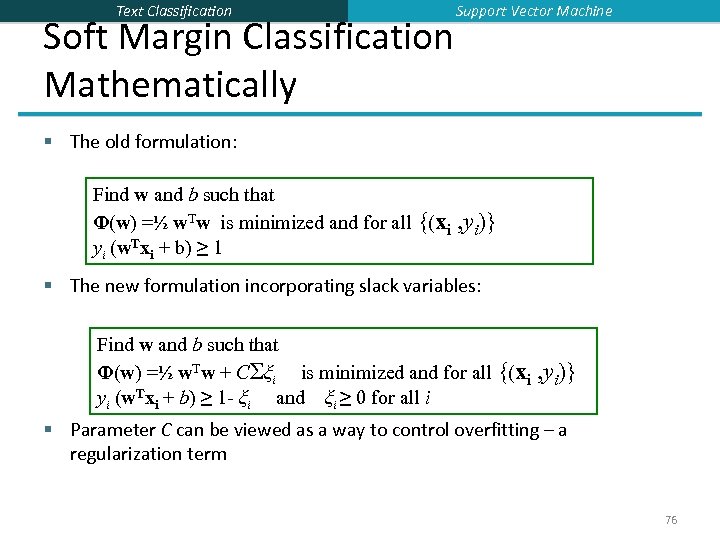
Text Classification Soft Margin Classification Mathematically Support Vector Machine § The old formulation: Find w and b such that Φ(w) =½ w. Tw is minimized and for all {(xi yi (w. Txi + b) ≥ 1 , yi)} § The new formulation incorporating slack variables: Find w and b such that Φ(w) =½ w. Tw + CΣξi is minimized and for all {(xi yi (w. Txi + b) ≥ 1 - ξi and ξi ≥ 0 for all i , yi)} § Parameter C can be viewed as a way to control overfitting – a regularization term 76
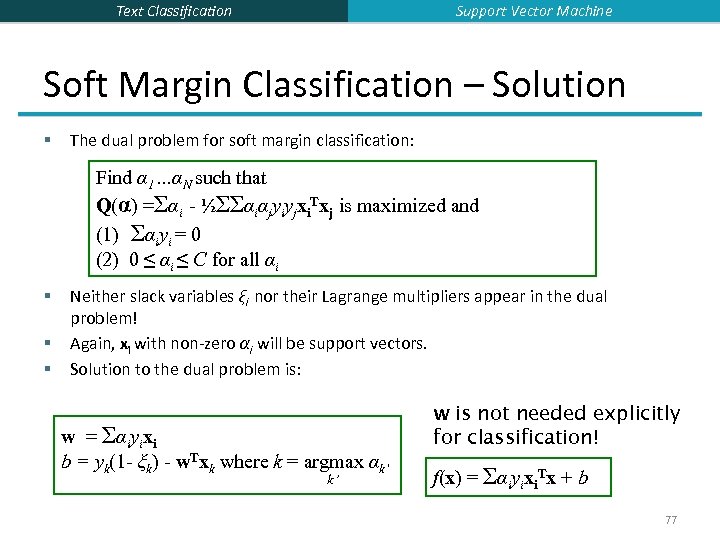
Support Vector Machine Text Classification Soft Margin Classification – Solution § The dual problem for soft margin classification: Find α 1…αN such that Q(α) =Σαi - ½ΣΣαiαjyiyjxi. Txj is maximized and (1) Σαiyi = 0 (2) 0 ≤ αi ≤ C for all αi § § § Neither slack variables ξi nor their Lagrange multipliers appear in the dual problem! Again, xi with non-zero αi will be support vectors. Solution to the dual problem is: w = Σαiyixi b = yk(1 - ξk) - w. Txk where k = argmax αk’ k’ w is not needed explicitly for classification! f(x) = Σαiyixi. Tx + b 77
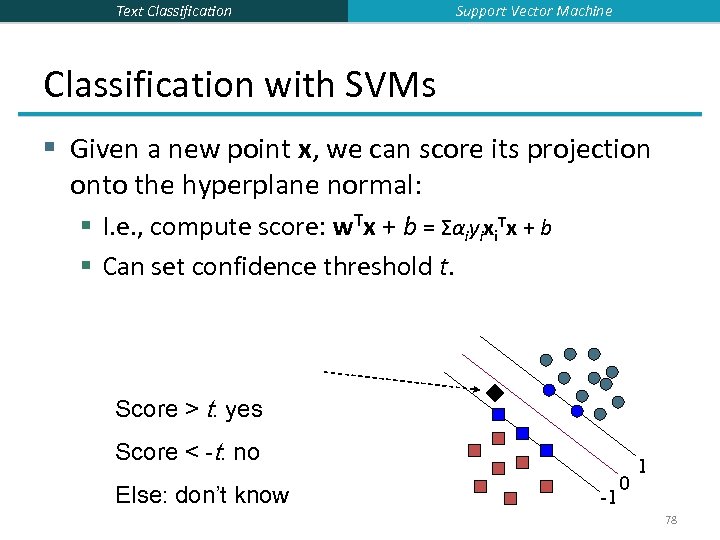
Text Classification Support Vector Machine Classification with SVMs § Given a new point x, we can score its projection onto the hyperplane normal: § I. e. , compute score: w. Tx + b = Σαiyixi. Tx + b § Can set confidence threshold t. Score > t: yes Score < -t: no Else: don’t know -1 0 1 78
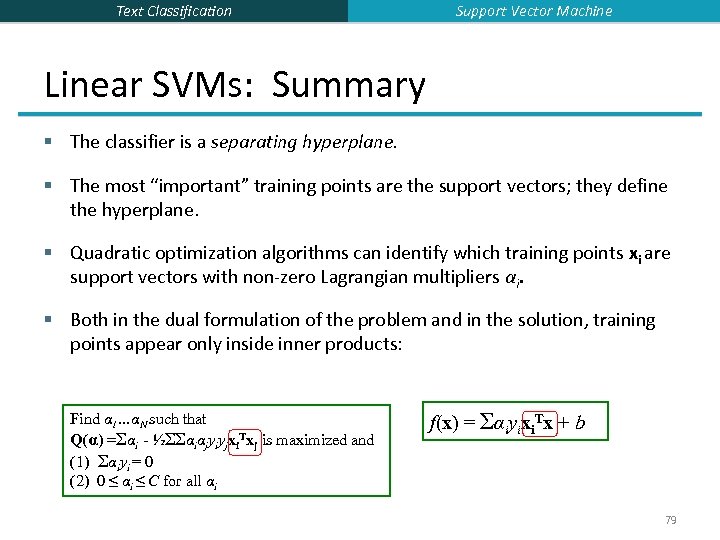
Text Classification Support Vector Machine Linear SVMs: Summary § The classifier is a separating hyperplane. § The most “important” training points are the support vectors; they define the hyperplane. § Quadratic optimization algorithms can identify which training points xi are support vectors with non-zero Lagrangian multipliers αi. § Both in the dual formulation of the problem and in the solution, training points appear only inside inner products: Find α 1…αN such that Q(α) =Σαi - ½ΣΣαiαjyiyjxi. Txj is maximized and (1) Σαiyi = 0 (2) 0 ≤ αi ≤ C for all αi f(x) = Σαiyixi. Tx + b 79
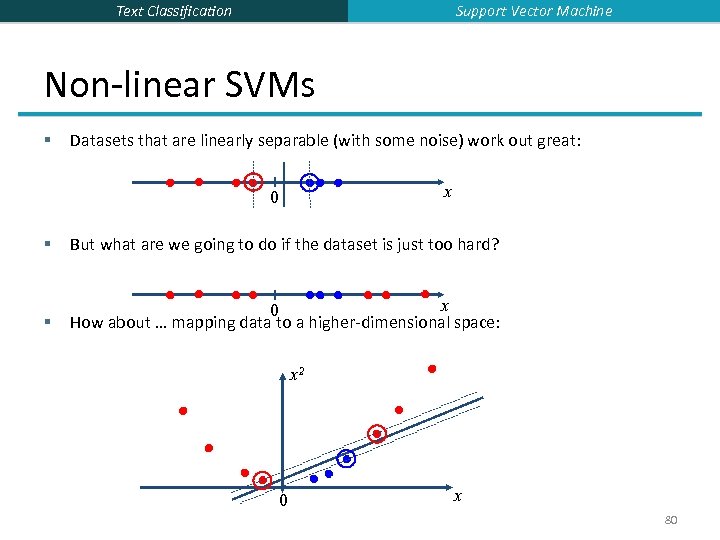
Support Vector Machine Text Classification Non-linear SVMs § Datasets that are linearly separable (with some noise) work out great: x 0 § But what are we going to do if the dataset is just too hard? § x 0 How about … mapping data to a higher-dimensional space: x 2 0 x 80
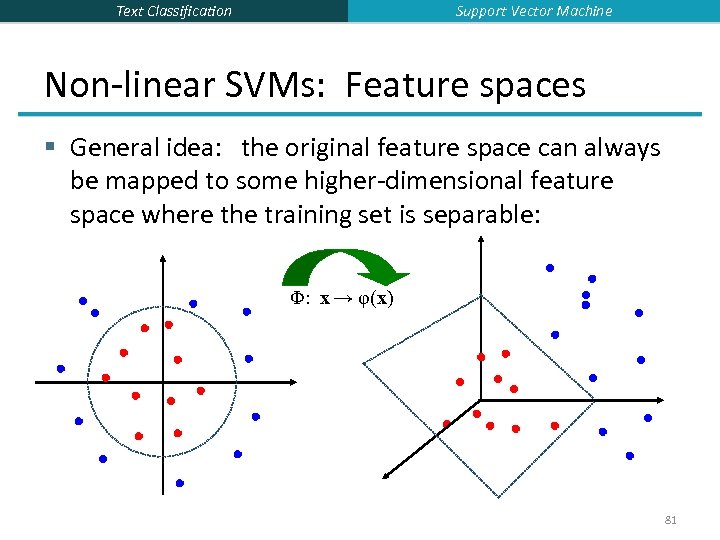
Support Vector Machine Text Classification Non-linear SVMs: Feature spaces § General idea: the original feature space can always be mapped to some higher-dimensional feature space where the training set is separable: Φ: x → φ(x) 81
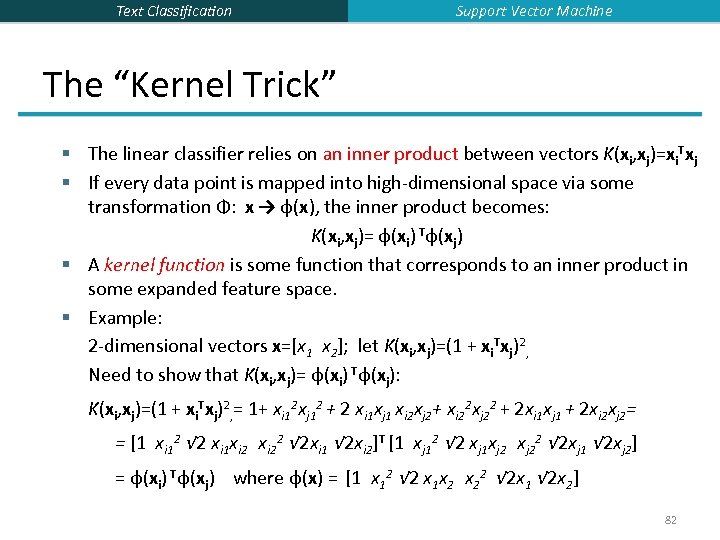
Text Classification Support Vector Machine The “Kernel Trick” § The linear classifier relies on an inner product between vectors K(xi, xj)=xi. Txj § If every data point is mapped into high-dimensional space via some transformation Φ: x → φ(x), the inner product becomes: K(xi, xj)= φ(xi) Tφ(xj) § A kernel function is some function that corresponds to an inner product in some expanded feature space. § Example: 2 -dimensional vectors x=[x 1 x 2]; let K(xi, xj)=(1 + xi. Txj)2, Need to show that K(xi, xj)= φ(xi) Tφ(xj): K(xi, xj)=(1 + xi. Txj)2, = 1+ xi 12 xj 12 + 2 xi 1 xj 1 xi 2 xj 2+ xi 22 xj 22 + 2 xi 1 xj 1 + 2 xi 2 xj 2= = [1 xi 12 √ 2 xi 1 xi 22 √ 2 xi 1 √ 2 xi 2]T [1 xj 12 √ 2 xj 1 xj 22 √ 2 xj 1 √ 2 xj 2] = φ(xi) Tφ(xj) where φ(x) = [1 x 12 √ 2 x 1 x 2 x 22 √ 2 x 1 √ 2 x 2] 82
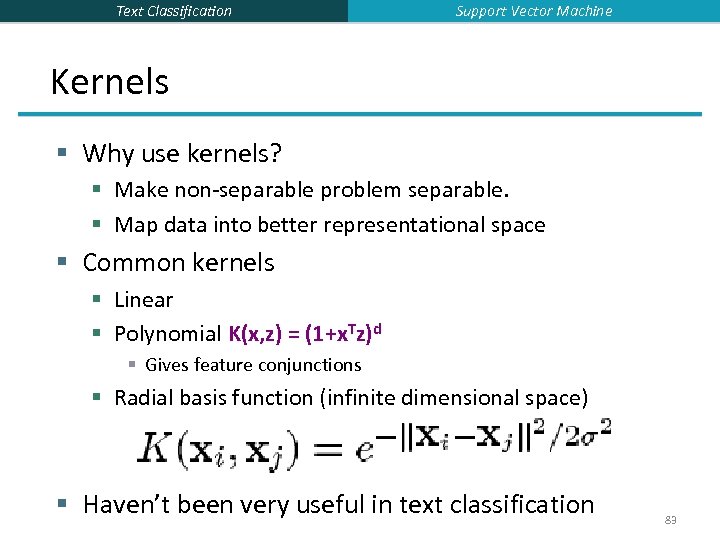
Text Classification Support Vector Machine Kernels § Why use kernels? § Make non-separable problem separable. § Map data into better representational space § Common kernels § Linear § Polynomial K(x, z) = (1+x. Tz)d § Gives feature conjunctions § Radial basis function (infinite dimensional space) § Haven’t been very useful in text classification 83
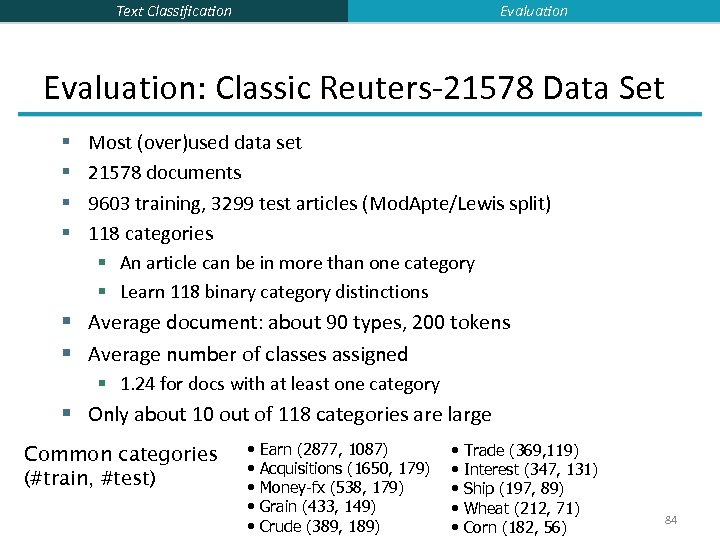
Evaluation Text Classification Evaluation: Classic Reuters-21578 Data Set Most (over)used data set 21578 documents 9603 training, 3299 test articles (Mod. Apte/Lewis split) 118 categories § An article can be in more than one category § Learn 118 binary category distinctions § Average document: about 90 types, 200 tokens § § § Average number of classes assigned § 1. 24 for docs with at least one category § Only about 10 out of 118 categories are large Common categories (#train, #test) • • • Earn (2877, 1087) Acquisitions (1650, 179) Money-fx (538, 179) Grain (433, 149) Crude (389, 189) • • • Trade (369, 119) Interest (347, 131) Ship (197, 89) Wheat (212, 71) Corn (182, 56) 84

Text Classification Evaluation Reuters Text Categorization data set (Reuters-21578) document <REUTERS TOPICS="YES" LEWISSPLIT="TRAIN" CGISPLIT="TRAINING-SET" OLDID="12981" NEWID="798"> <DATE> 2 -MAR-1987 16: 51: 43. 42</DATE> <TOPICS><D>livestock</D><D>hog</D></TOPICS> <TITLE>AMERICAN PORK CONGRESS KICKS OFF TOMORROW</TITLE> <DATELINE> CHICAGO, March 2 - </DATELINE><BODY>The American Pork Congress kicks off tomorrow, March 3, in Indianapolis with 160 of the nations pork producers from 44 member states determining industry positions on a number of issues, according to the National Pork Producers Council, NPPC. Delegates to the three day Congress will be considering 26 resolutions concerning various issues, including the future direction of farm policy and the tax law as it applies to the agriculture sector. The delegates will also debate whether to endorse concepts of a national PRV (pseudorabies virus) control and eradication program, the NPPC said. A large trade show, in conjunction with the congress, will feature the latest in technology in all areas of the industry, the NPPC added. Reuter  </BODY></TEXT></REUTERS> 85
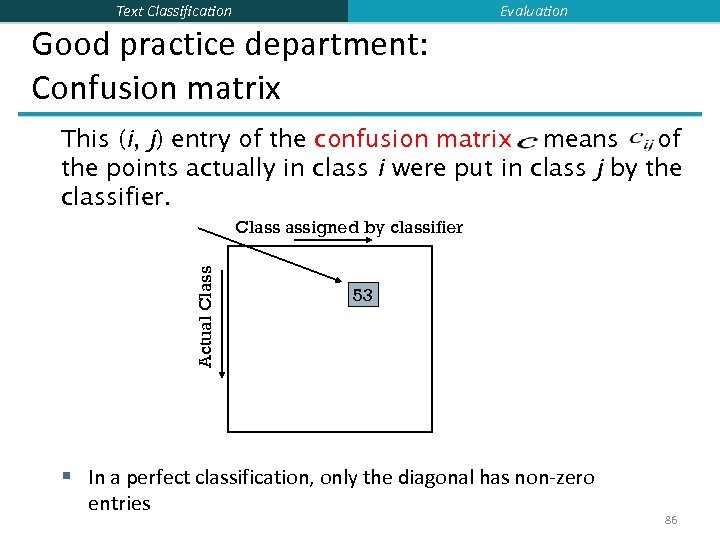
Evaluation Text Classification Good practice department: Confusion matrix This (i, j) entry of the confusion matrix means of the points actually in class i were put in class j by the classifier. Actual Class assigned by classifier 53 § In a perfect classification, only the diagonal has non-zero entries 86
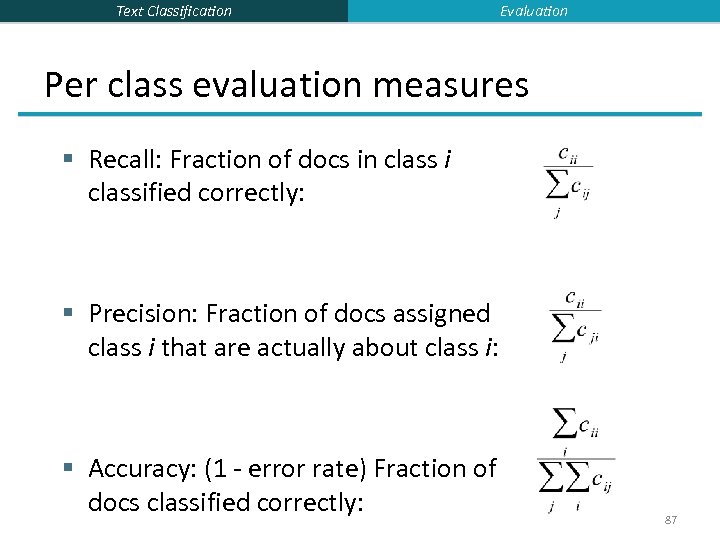
Text Classification Evaluation Per class evaluation measures § Recall: Fraction of docs in class i classified correctly: § Precision: Fraction of docs assigned class i that are actually about class i: § Accuracy: (1 - error rate) Fraction of docs classified correctly: 87
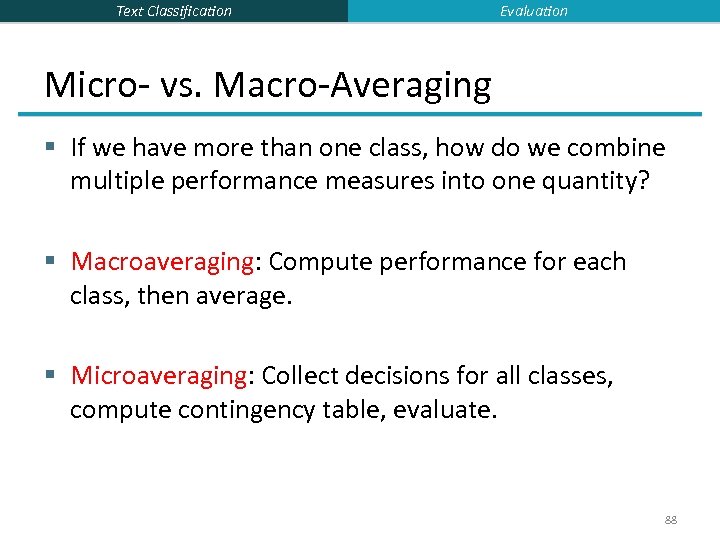
Text Classification Evaluation Micro- vs. Macro-Averaging § If we have more than one class, how do we combine multiple performance measures into one quantity? § Macroaveraging: Compute performance for each class, then average. § Microaveraging: Collect decisions for all classes, compute contingency table, evaluate. 88
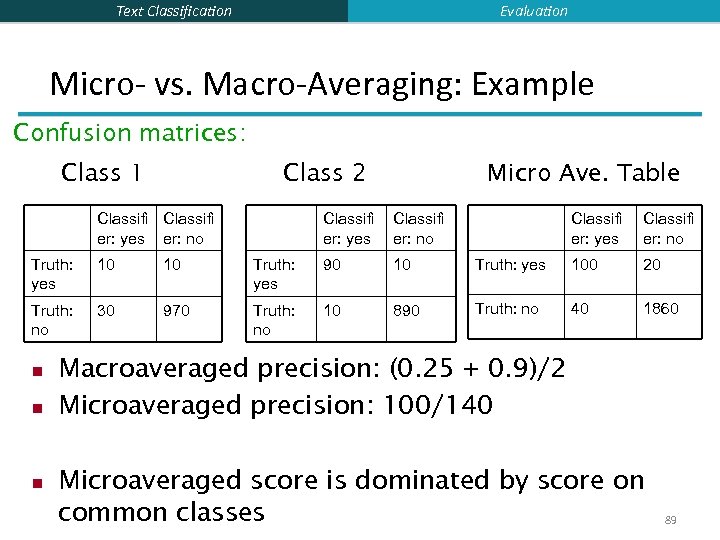
Evaluation Text Classification Micro- vs. Macro-Averaging: Example Confusion matrices: Class 1 Class 2 Classifi er: yes er: no Micro Ave. Table Classifi er: yes Classifi er: no Truth: yes 10 10 Truth: yes 90 10 Truth: yes 100 20 Truth: no 30 970 Truth: no 10 890 Truth: no 40 1860 n n n Macroaveraged precision: (0. 25 + 0. 9)/2 Microaveraged precision: 100/140 Microaveraged score is dominated by score on common classes 89
Text Classification Evaluation 90
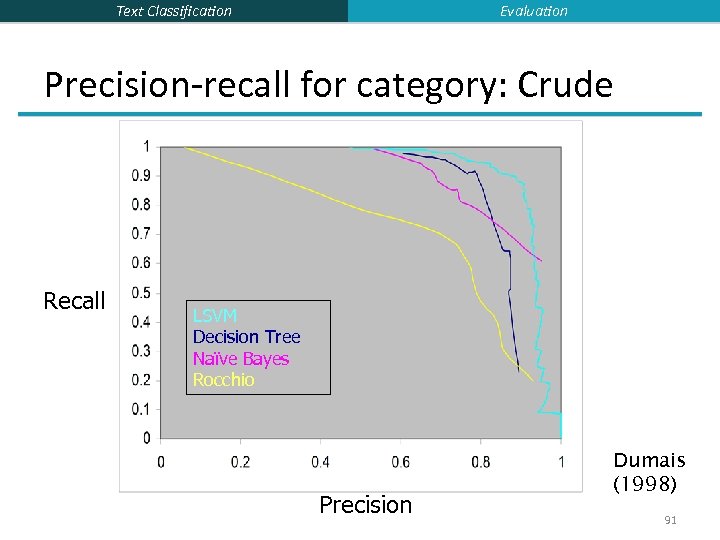
Evaluation Text Classification Precision-recall for category: Crude Recall LSVM Decision Tree Naïve Bayes Rocchio Precision Dumais (1998) 91
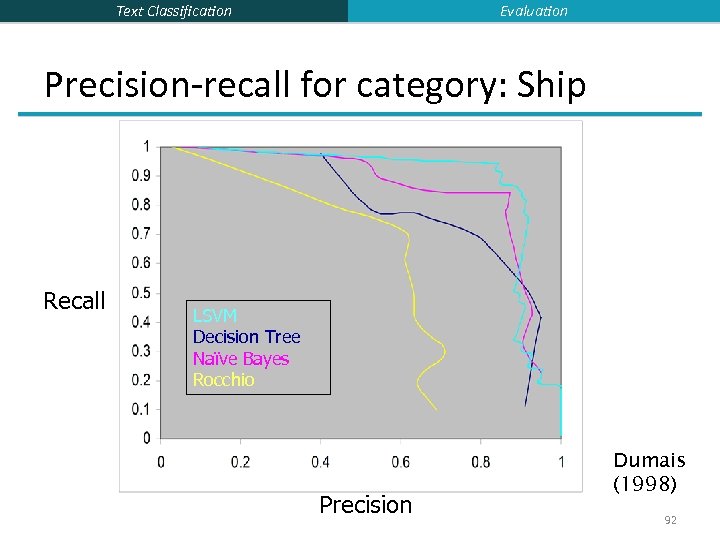
Evaluation Text Classification Precision-recall for category: Ship Recall LSVM Decision Tree Naïve Bayes Rocchio Precision Dumais (1998) 92
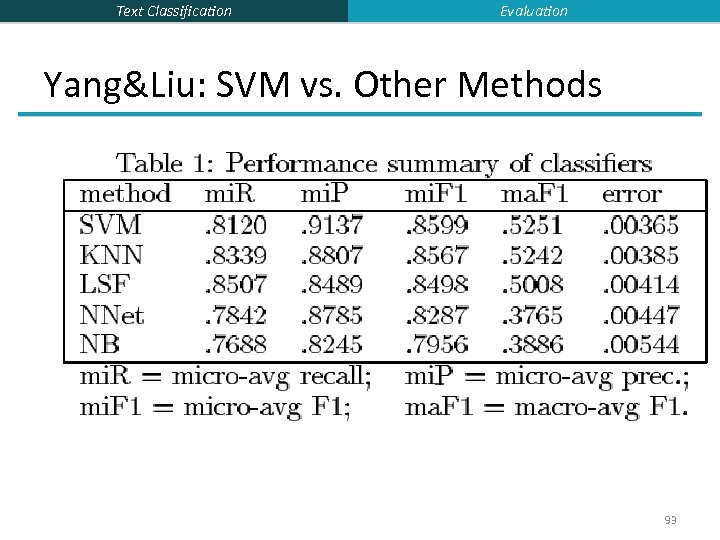
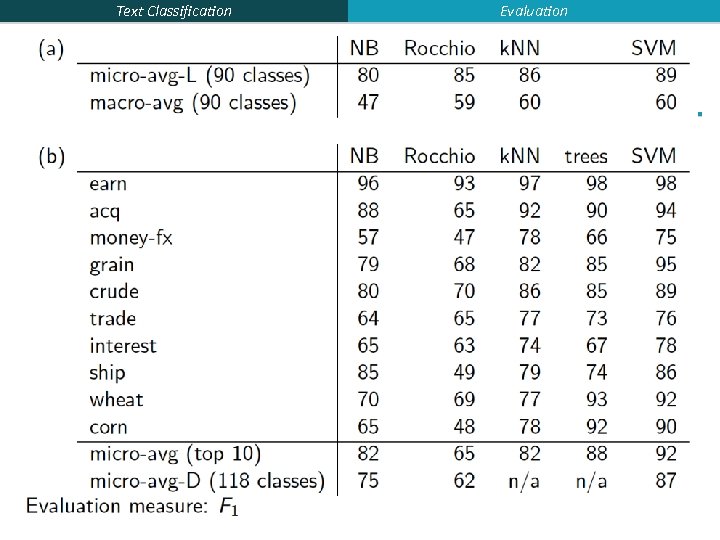
Text Classification Evaluation Yang&Liu: SVM vs. Other Methods 93
Text Classification Resources § IIR 13 -15 § Fabrizio Sebastiani. Machine Learning in Automated Text Categorization. ACM Computing Surveys, 34(1): 1 -47, 2002. § Yiming Yang & Xin Liu, A re-examination of text categorization methods. Proceedings of SIGIR, 1999. § Trevor Hastie, Robert Tibshirani and Jerome Friedman, Elements of Statistical Learning: Data Mining, Inference and Prediction. Springer-Verlag, New York. § Open Calais: Automatic Semantic Tagging § Free (but they can keep your data), provided by Thompson/Reuters § Weka: A data mining software package that includes an implementation of many ML algorithms 94
Скачать презентацию Text Classification Web Search and Mining Lecture 15
eff45cffae54ca85df473808f3f6c3b0.ppt