


 Скачать презентацию Texas Legislature Class Review Theoretical Issues
3b443c2c22215eee3a92011d7f92b4e6.ppt
- Количество слайдов: 24
 Texas Legislature Class Review
 Theoretical Issues • Functions of Legislative Bodies – Articulation of ideas of public – Representation of society: General & Special – Lawmaking – Budgeting and taxation • Representational Issues – Multi vs single member districts – Homogeneous vs heterogeneous districts
 Typologies of Legislatures • Citizen’s Legislatures • “Professional” Legislatures • Hybrid- combines features of both – (Texas is considered a hybrid due to professional level of staffing)
 Roles of Representativeknow and understand each • Delegate- represents ideas of district • Advocate- represents views of special publics • Trustee- votes own ideas • Politico- combination of all above
 Types of Districts • Texas Senate- 31 single member districts, plurality elections, 4 year overlapping terms • Texas House- 150 single member districts, plurality elections, 2 year terms • No term limits for any state office • Prior to 1970 s– Urban counties- multi-member, at-large districts in House – Single member districts for Senate
 Redistricting Requirement in the Texas Constitution • Districts must be contiguous • County boundaries must be respected as much as possible. • Districts must be compact. • Single member districts only
 Districting Issues • Mal-apportionment – Prior to 1964 - urban counties limited to 1 district per 100, 000 people, only one state senator – Federal Court required equal representation Gerrymandering 2011 - districts heavily gerrymandered to maximize Republican control of House/Senate
 Organization Issues • Bicameral vs unicameral- 49 are bi, one uni • Session length and timing – Limited vs unlimited (Regular 140 days, special- 30) – Annual vs biennial- 43 annual, 7 biennial (Texas is only urban state to use biennial sessions • Level of professionalism – Citizen vs professional (pay, sessions, staffing) • Partisan vs non-partisan – Formal party control of leadership, committes, and staffing
 Types of Committees • Standing- number and jurisdictions established by chamber rules • Special- established by either SR/HR or SCR/HCR • Statutory- established by law – Legislative Budget Board – Legislative Audit Committee – Legislative Council
 Compensation • Salary- $7200/yr • Per diem expenses- set by Texas Ethics Commission • Travel- rates set by statute • Retirement- 2. 3 % x years of service x salary of state district judge ($125, 000 per year) -designed to encourage members to invest minimum of 8 years
 Types of Legislative Instruments • HB/SB- establish or amend law/ appropriate money • HJR/SJR- amendment to Texas constitution • HCR/SCR- concurrent resolution • HR/SR- passed by one chamber only. Rules or expression of will of that chamber.
 Constitutional Duties • • • Legislative Propose amendments to constitution Electoral- select Governor in rare cases Directory and supervisory- by resolution and LBB Investigative Impeachment and removal of executive and judicial officials
 Non-Constitutional Duties • Constituent services • Oversight • Research
 Presiding Officers • House – Speaker- elected by members of House • Powers established by Rules of the House – Speaker pro-tem & Officers- appointed by Speaker • Senate – Lt. Governor- elected by voters • Powers established by Rules of Senate – President pro-tem & Officers- elected by members of the Senate
 Powers of Presiding Officers • Appoints all committees (standing, special, interim) and designate chairs • Refers bills to committee • Approves appointment of employees • Organizes calendars for legislative action • Recognizes speakers (persons who may speak on issues) • Rules on points of order 15
 Types of Committees • Standing- established by the rules of each chamber (substantive and procedural) • Special- established by resolution • Interim- established by resolution for interim (generally for studies) • Statutory- established by law – LBB – Legislative Council – Legislative Audit Committee
 Staffing • Types of staffing for Legislature – Professional staff for chamber and the three statutory committees – Committee staff – Staff for individual members
 Legislative Role of Governor • • Declaration of legislative emergencies Address legislature Call special sessions Vetos- item veto on appropriations bills only
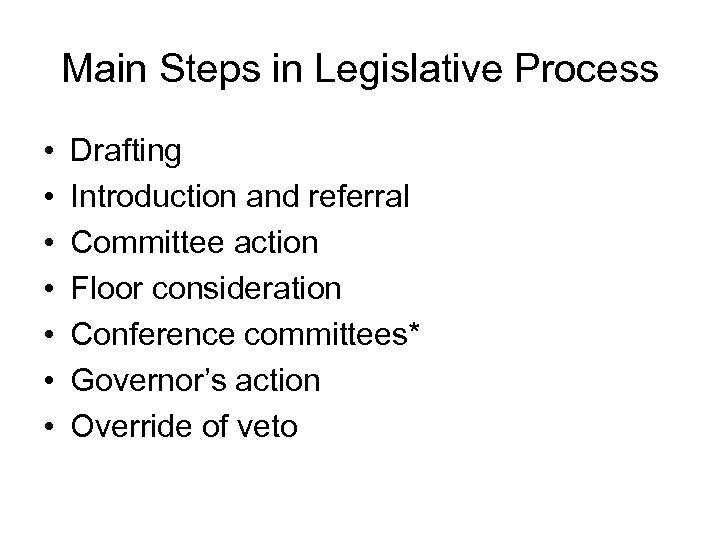 Main Steps in Legislative Process • • Drafting Introduction and referral Committee action Floor consideration Conference committees* Governor’s action Override of veto
 Types of Legislative Instruments • • Bills- HB/SB Joint Resolutions- HJR/SJR Concurrent Resolutions- HCR/SCR Simple Resolutions- HR/SR
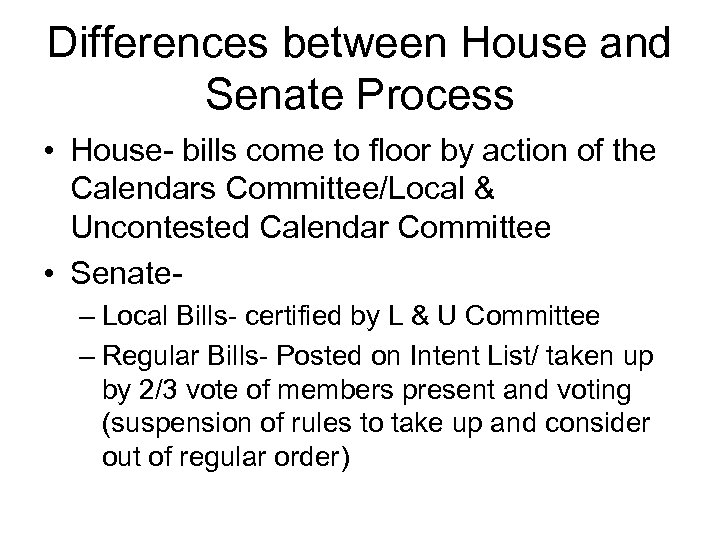 Differences between House and Senate Process • House- bills come to floor by action of the Calendars Committee/Local & Uncontested Calendar Committee • Senate– Local Bills- certified by L & U Committee – Regular Bills- Posted on Intent List/ taken up by 2/3 vote of members present and voting (suspension of rules to take up and consider out of regular order)
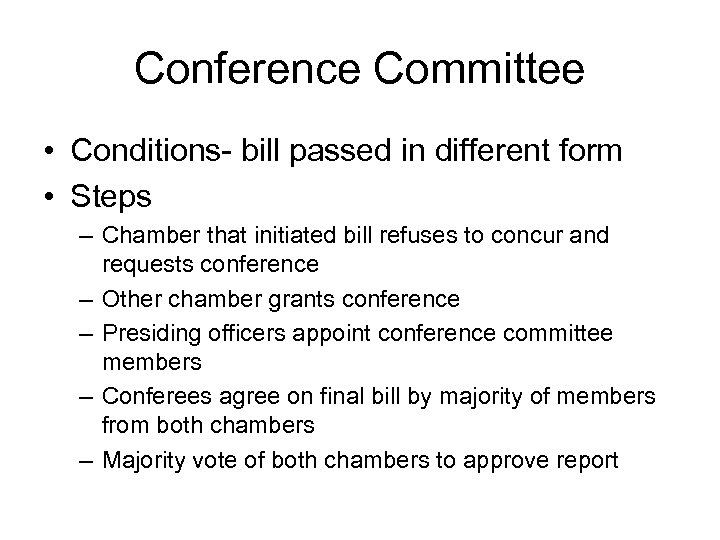 Conference Committee • Conditions- bill passed in different form • Steps – Chamber that initiated bill refuses to concur and requests conference – Other chamber grants conference – Presiding officers appoint conference committee members – Conferees agree on final bill by majority of members from both chambers – Majority vote of both chambers to approve report
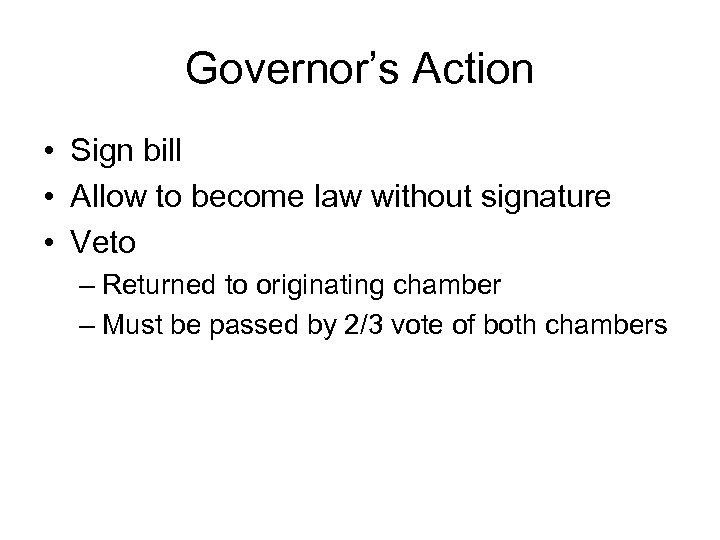 Governor’s Action • Sign bill • Allow to become law without signature • Veto – Returned to originating chamber – Must be passed by 2/3 vote of both chambers
 Governor’s Item Veto • Appropriations Bills ONLY • Allows Governor to remove any items within an appropriations bill.