 Скачать презентацию Tevatron Beam Diagnostics Boosting Collider Performance Vladimir Shiltsev
8c1858f5a2a5334ab1ac0694ed2ce23b.ppt
- Количество слайдов: 57



Tevatron Beam Diagnostics: Boosting Collider Performance Vladimir Shiltsev, Ron Moore, Andreas Jansson FNAL/Accelerator Division 05/01/2006 Tevatron Instrumentation
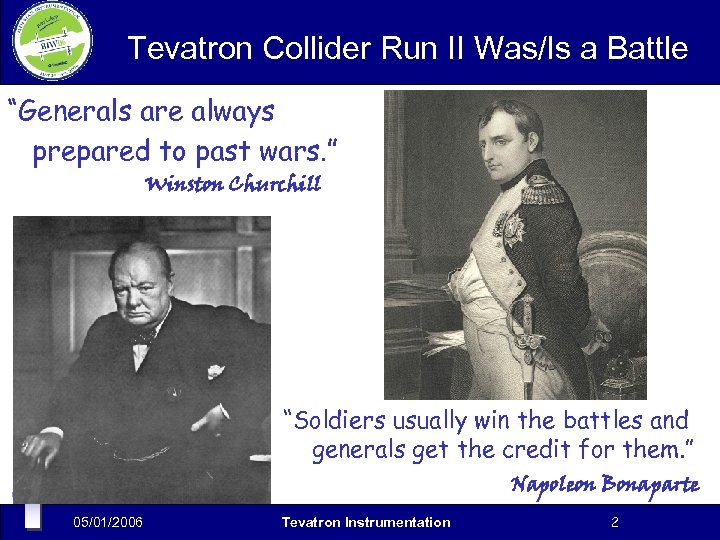
Tevatron Collider Run II Was/Is a Battle “Generals are always prepared to past wars. ” Winston Churchill “Soldiers usually win the battles and generals get the credit for them. ” Napoleon Bonaparte 05/01/2006 Tevatron Instrumentation 2
So, Purposes of This Talk Are: • Give credit to soldiers • Show some remarkable luminosity-related examples of diagnostics progress: – Lattice /helix issues BPM Upgrade – Reliability/uptime orbit stabilization + HLS + vibrations – CDF/D 0 discrepancy IP vertex diagnostics – Beam-Beam 1. 7 GHz Schottky + Tune Stabilization – Losses on ramp IBEAM + FBI + Tune Tracker – Losses at 150 Head-Tail Monitor – DC beam Abort. Gap. Monitor + LPM +SBD – Injection mismatch FWs + IPM + OTR • Outline lessons learned during the Run II 05/01/2006 Tevatron Instrumentation 3
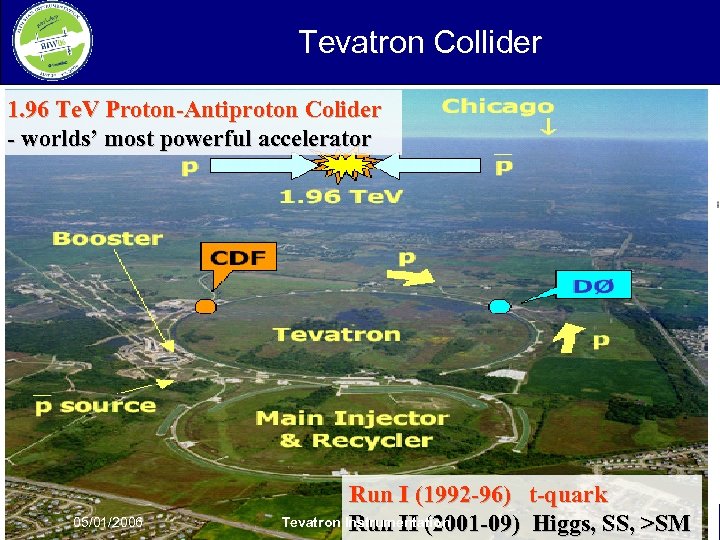
Tevatron Collider 1. 96 Te. V Proton-Antiproton Colider - worlds’ most powerful accelerator 05/01/2006 Run I (1992 -96) t-quark 4 Tevatron Instrumentation Run II (2001 -09) Higgs, SS, >SM
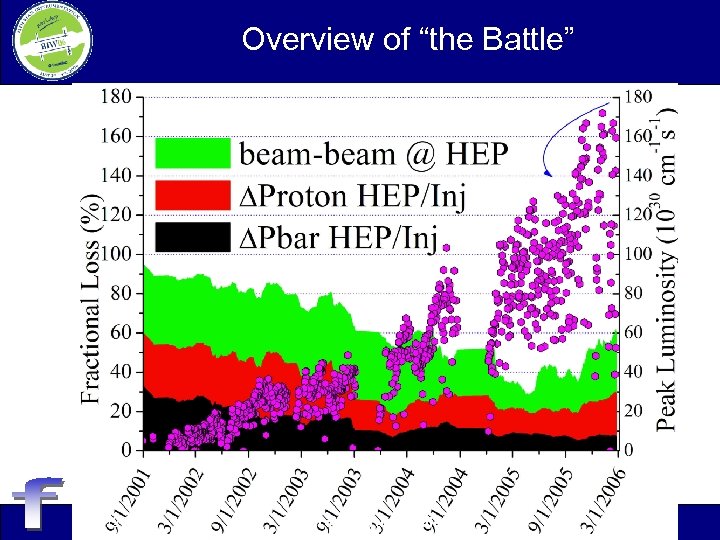
Overview of “the Battle” 05/01/2006 Tevatron Instrumentation 5
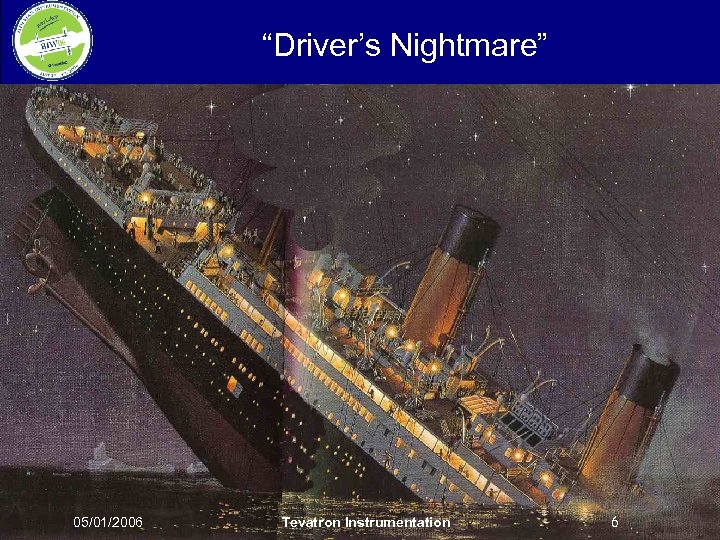
“Driver’s Nightmare” Store #535 Jun 15, 2001 0. 5 -1% of loss Poor lifetime 0. 5 -1 mm orbit error Collimator malfunct Sequencer error 05/01/2006 QUENCH ! 2 -4 hrs to recover 4 -8 hrs for new pbars or Blow Up Tevatron Instrumentation tune few 0. 001 coupling ‘s wrong instability kicker malfunct 1000’s of PSs 6
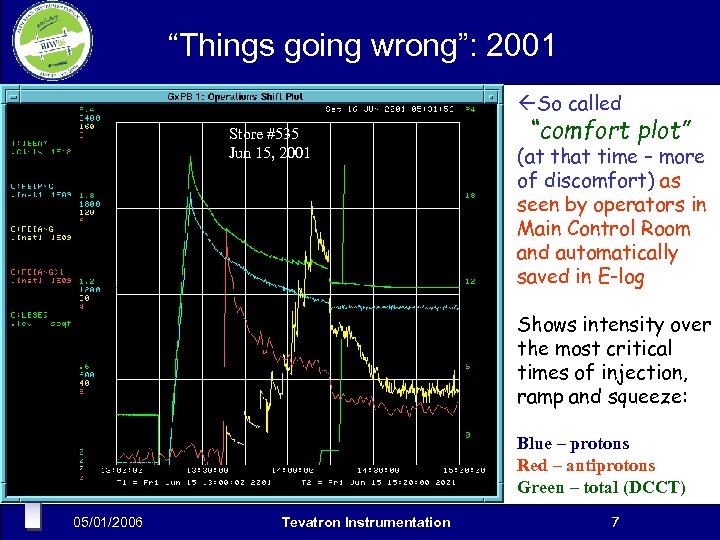
“Things going wrong”: 2001 ßSo called Store #535 Jun 15, 2001 “comfort plot” (at that time – more of discomfort) as seen by operators in Main Control Room and automatically saved in E-log Shows intensity over the most critical times of injection, ramp and squeeze: Blue – protons Red – antiprotons Green – total (DCCT) 05/01/2006 Tevatron Instrumentation 7
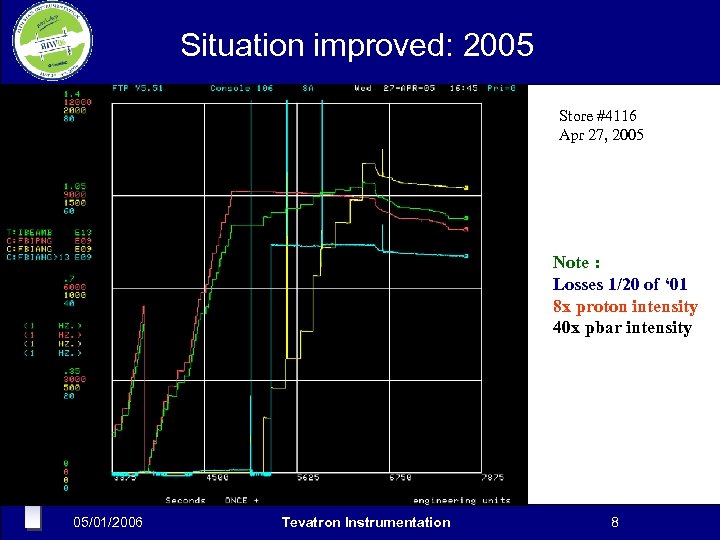
Situation improved: 2005 Store #4116 Apr 27, 2005 Note : Losses 1/20 of ‘ 01 8 x proton intensity 40 x pbar intensity 05/01/2006 Tevatron Instrumentation 8
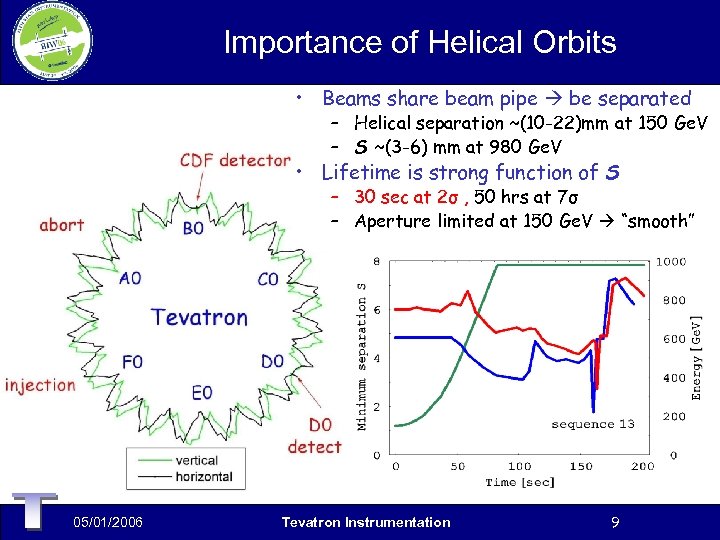
Importance of Helical Orbits • Beams share beam pipe be separated – Helical separation ~(10 -22)mm at 150 Ge. V – S ~(3 -6) mm at 980 Ge. V • Lifetime is strong function of S – 30 sec at 2σ , 50 hrs at 7σ – Aperture limited at 150 Ge. V “smooth” 05/01/2006 Tevatron Instrumentation 9
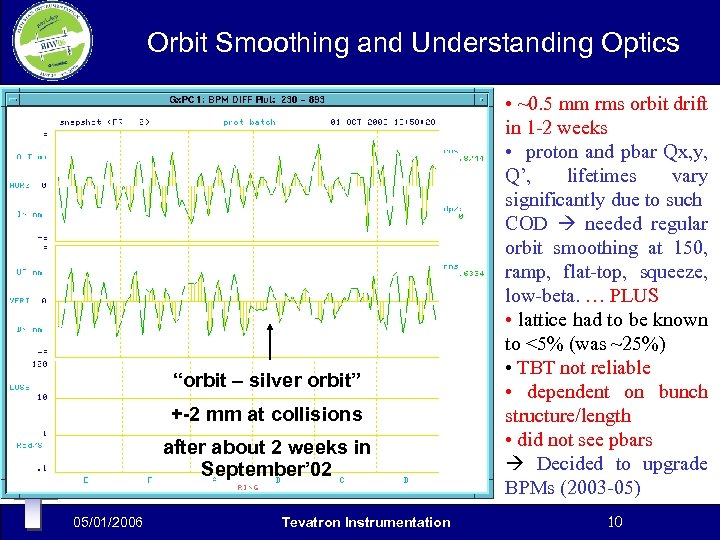
Orbit Smoothing and Understanding Optics “orbit – silver orbit” +-2 mm at collisions after about 2 weeks in September’ 02 05/01/2006 Tevatron Instrumentation • ~0. 5 mm rms orbit drift in 1 -2 weeks • proton and pbar Qx, y, Q’, lifetimes vary significantly due to such COD needed regular orbit smoothing at 150, ramp, flat-top, squeeze, low-beta. … PLUS • lattice had to be known to <5% (was ~25%) • TBT not reliable • dependent on bunch structure/length • did not see pbars Decided to upgrade BPMs (2003 -05) 10
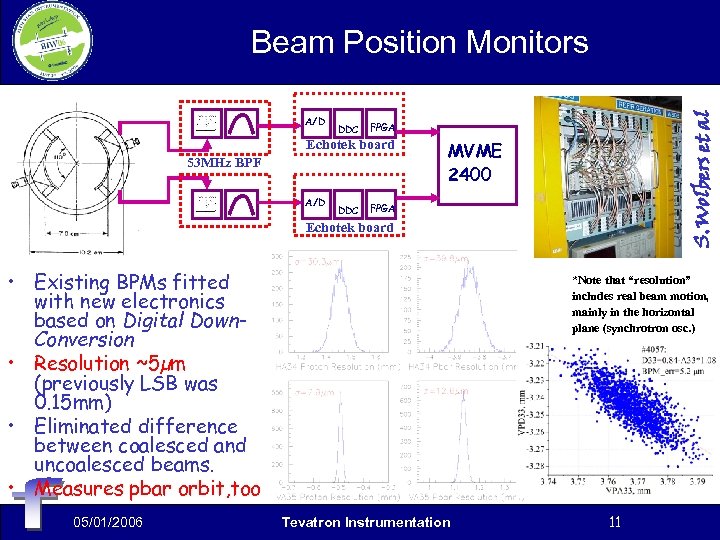
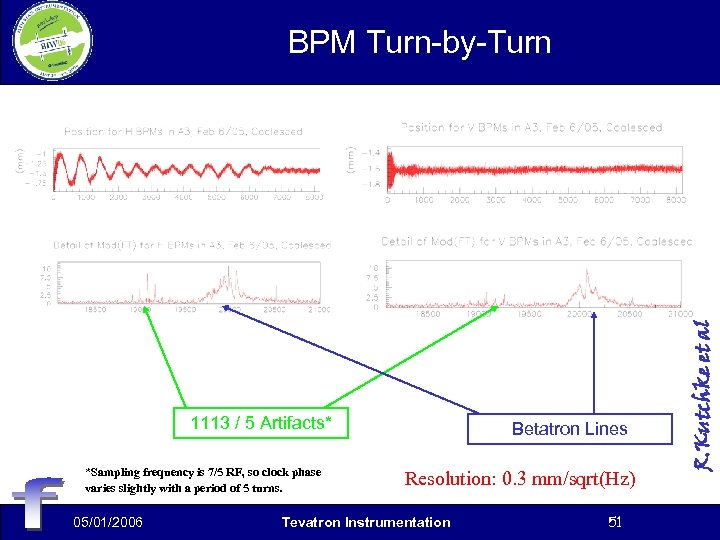
A/D DDC FPGA Echotek board 53 MHz BPF A/D DDC S. Wolbers et al Beam Position Monitors MVME 2400 FPGA Echotek board • Existing BPMs fitted with new electronics based on Digital Down. Conversion • Resolution ~5µm (previously LSB was 0. 15 mm) • Eliminated difference between coalesced and uncoalesced beams. • Measures pbar orbit, too 05/01/2006 *Note that “resolution” includes real beam motion, mainly in the horizontal plane (synchrotron osc. ) Tevatron Instrumentation 11
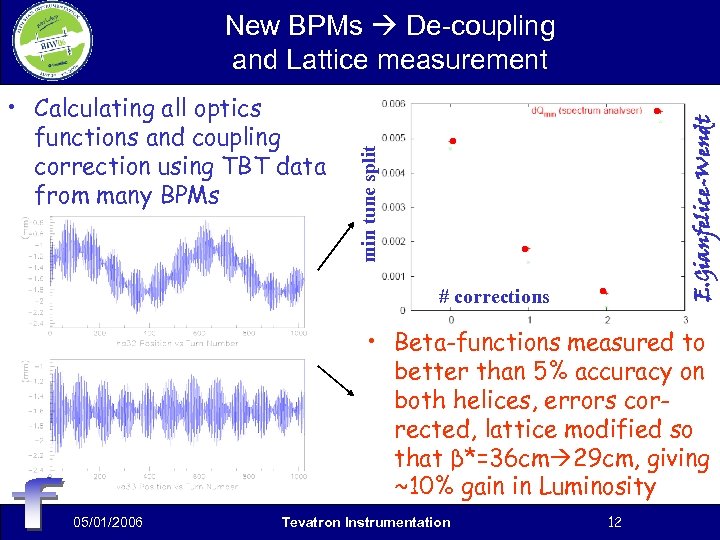
min tune split • Calculating all optics functions and coupling correction using TBT data from many BPMs E. Gianfelice-Wendt New BPMs De-coupling and Lattice measurement # corrections • Beta-functions measured to better than 5% accuracy on both helices, errors corrected, lattice modified so that β*=36 cm 29 cm, giving ~10% gain in Luminosity 05/01/2006 Tevatron Instrumentation 12
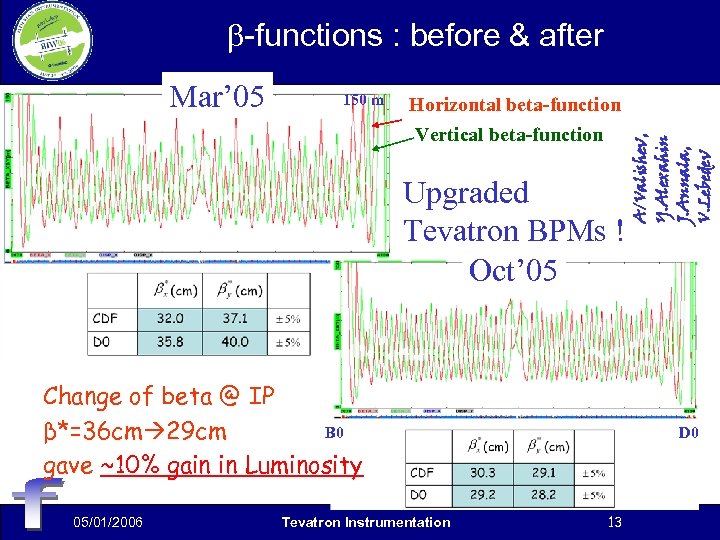
-functions : before & after 150 m Horizontal beta-function Vertical beta-function Upgraded Tevatron BPMs ! Oct’ 05 Change of beta @ IP B 0 β*=36 cm 29 cm gave ~10% gain in Luminosity 05/01/2006 Tevatron Instrumentation A/Valishev, Y. Alexahin J. Annala, V. Lebedev Mar’ 05 D 0 13
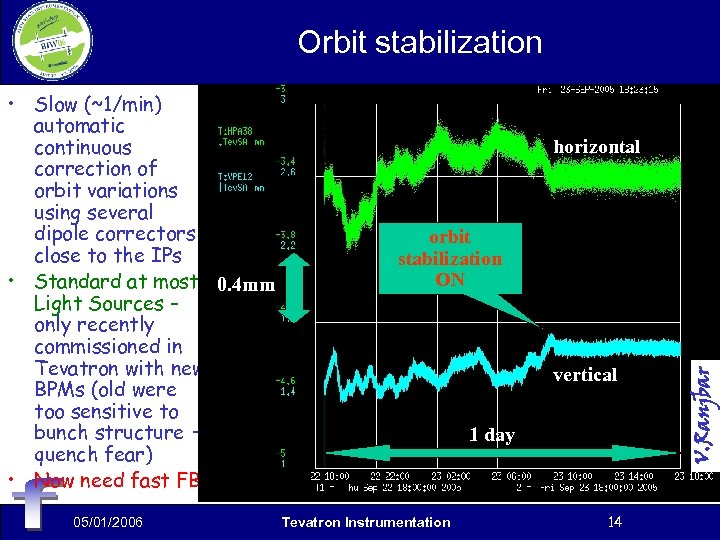
Orbit stabilization 05/01/2006 horizontal orbit stabilization ON vertical 1 day Tevatron Instrumentation 14 V. Ranjbar • Slow (~1/min) automatic continuous correction of orbit variations using several dipole correctors close to the IPs • Standard at most 0. 4 mm Light Sources – only recently commissioned in Tevatron with new BPMs (old were too sensitive to bunch structure quench fear) • Now need fast FB
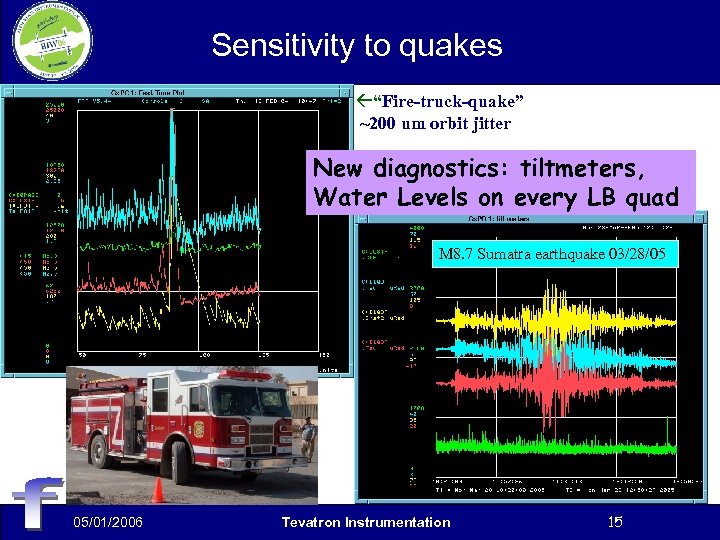
Sensitivity to quakes ß“Fire-truck-quake” ~200 um orbit jitter New diagnostics: tiltmeters, Water Levels on every LB quad M 8. 7 Sumatra earthquake 03/28/05 05/01/2006 Tevatron Instrumentation 15
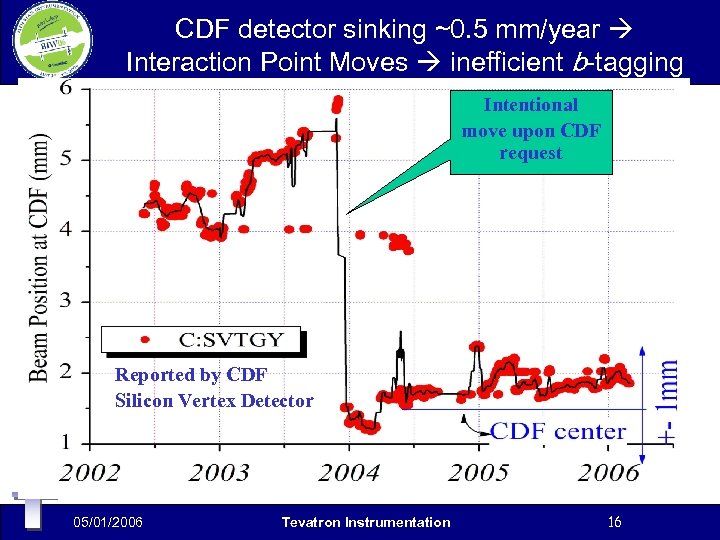
CDF detector sinking ~0. 5 mm/year Interaction Point Moves inefficient b-tagging Intentional move upon CDF request Reported by CDF Silicon Vertex Detector 05/01/2006 Tevatron Instrumentation 16
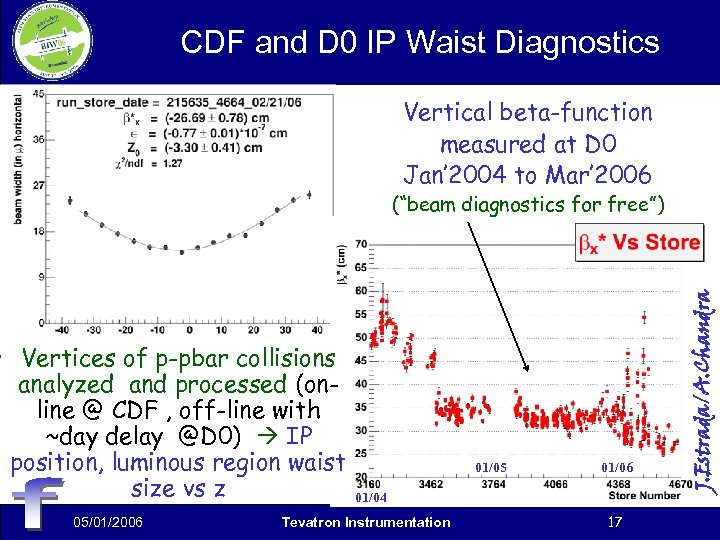
CDF and D 0 IP Waist Diagnostics Vertical beta-function measured at D 0 Jan’ 2004 to Mar’ 2006 • Vertices of p-pbar collisions analyzed and processed (online @ CDF , off-line with ~day delay @D 0) IP position, luminous region waist size vs z 05/01/2006 01/05 01/06 01/04 Tevatron Instrumentation 17 J. Estrada/A. Chandra (“beam diagnostics for free”)
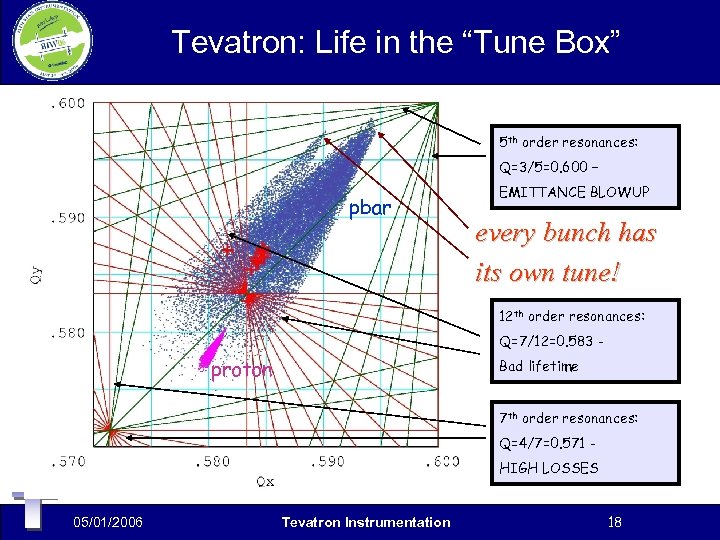
Tevatron: Life in the “Tune Box” 5 th order resonances: Q=3/5=0. 600 – pbar EMITTANCE BLOWUP every bunch has its own tune! 12 th order resonances: Q=7/12=0. 583 - proton Bad lifetime 7 th order resonances: Q=4/7=0. 571 HIGH LOSSES 05/01/2006 Tevatron Instrumentation 18
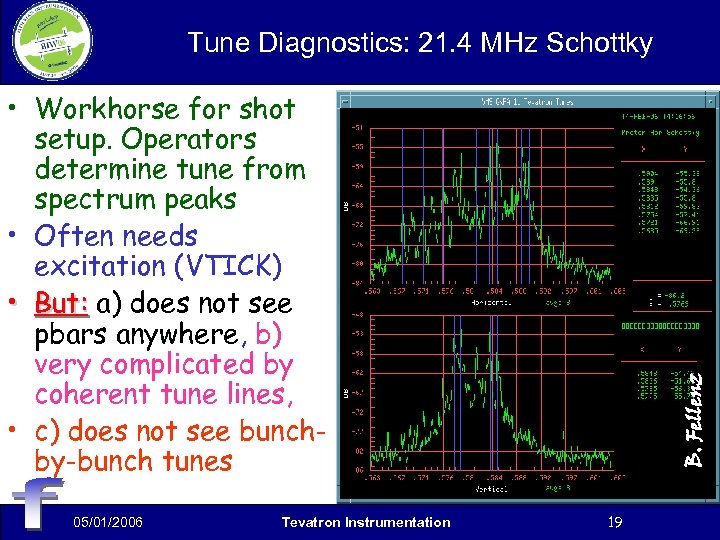
Tune Diagnostics: 21. 4 MHz Schottky 05/01/2006 Tevatron Instrumentation B. Fellenz • Workhorse for shot setup. Operators determine tune from spectrum peaks • Often needs excitation (VTICK) • But: a) does not see pbars anywhere, b) very complicated by coherent tune lines, • c) does not see bunchby-bunch tunes 19
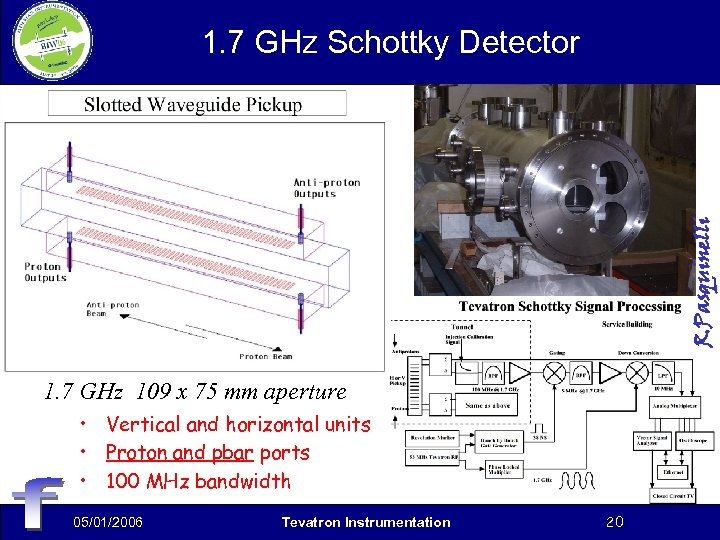
R. Pasquinelli 1. 7 GHz Schottky Detector 1. 7 GHz 109 x 75 mm aperture • Vertical and horizontal units • Proton and pbar ports • 100 MHz bandwidth 05/01/2006 Tevatron Instrumentation 20
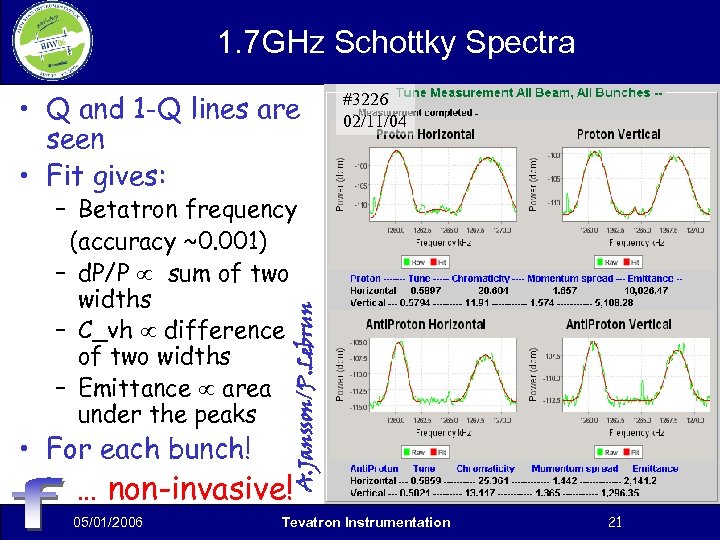
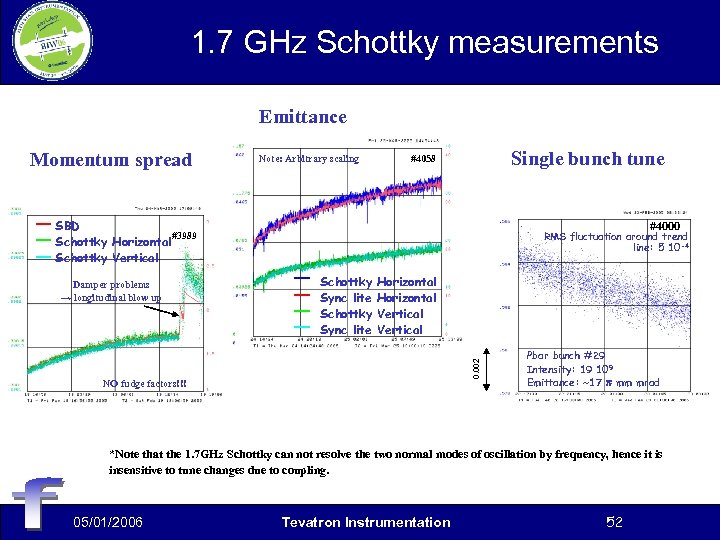
1. 7 GHz Schottky Spectra • Q and 1 -Q lines are seen • Fit gives: #3226 02/11/04 • For each bunch! A. Jansson/P. Lebrun – Betatron frequency (accuracy ~0. 001) – d. P/P sum of two widths – C_vh difference of two widths – Emittance area under the peaks … non-invasive! 05/01/2006 Tevatron Instrumentation 21
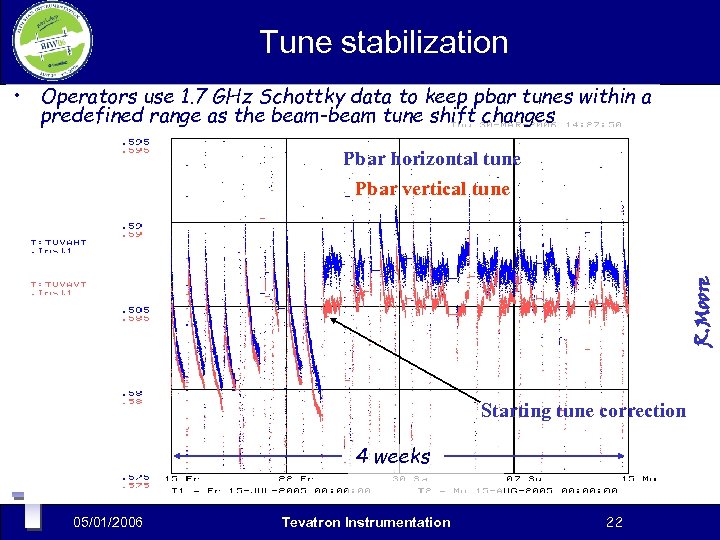
Tune stabilization • Operators use 1. 7 GHz Schottky data to keep pbar tunes within a predefined range as the beam-beam tune shift changes R. Moore Pbar horizontal tune Pbar vertical tune Starting tune correction 4 weeks 05/01/2006 Tevatron Instrumentation 22
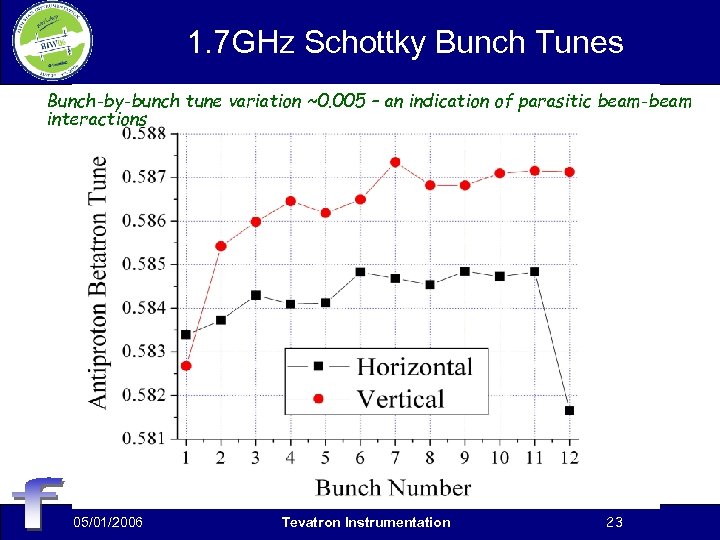
1. 7 GHz Schottky Bunch Tunes Bunch-by-bunch tune variation ~0. 005 – an indication of parasitic beam-beam interactions 05/01/2006 Tevatron Instrumentation 23
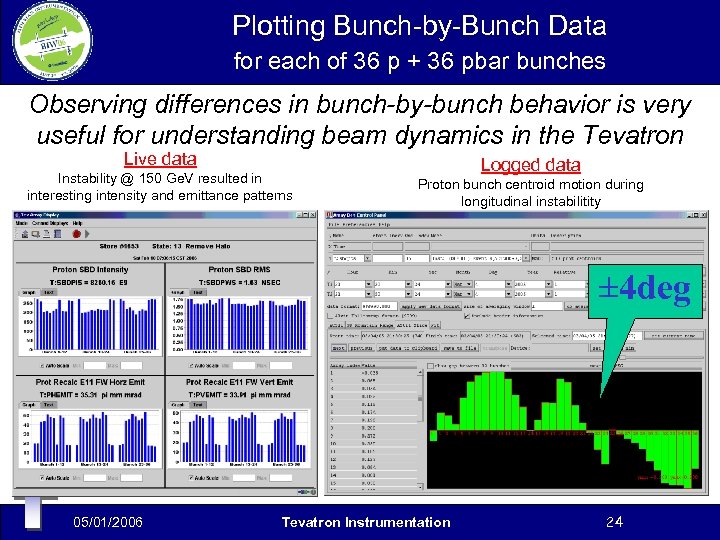
Plotting Bunch-by-Bunch Data for each of 36 p + 36 pbar bunches Observing differences in bunch-by-bunch behavior is very useful for understanding beam dynamics in the Tevatron Live data Instability @ 150 Ge. V resulted in interesting intensity and emittance patterns Logged data Proton bunch centroid motion during longitudinal instabilitity ± 4 deg 05/01/2006 Tevatron Instrumentation 24
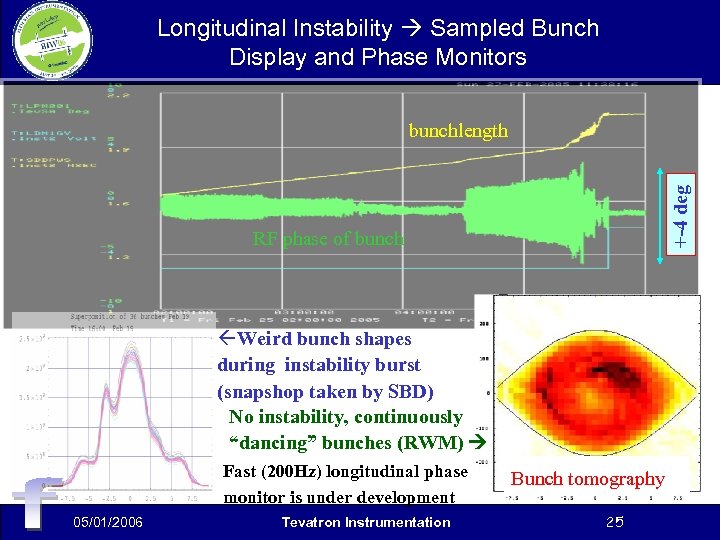
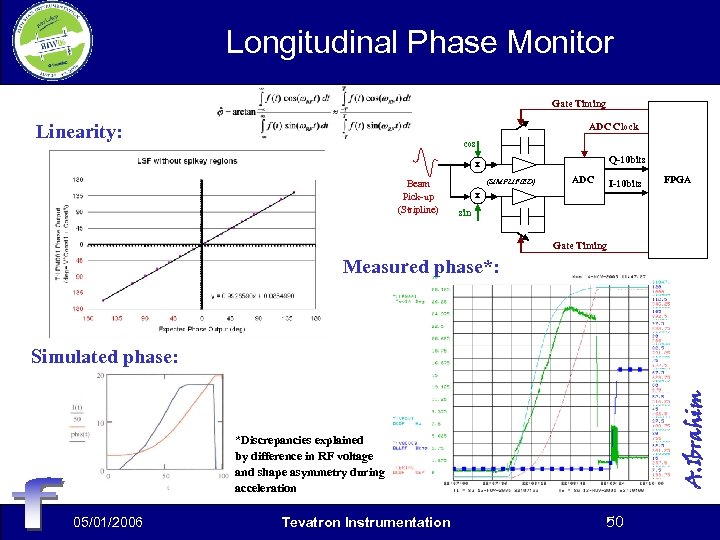
Longitudinal Instability Sampled Bunch Display and Phase Monitors +-4 deg bunchlength RF phase of bunch ßWeird bunch shapes during instability burst (snapshop taken by SBD) No instability, continuously “dancing” bunches (RWM) Fast (200 Hz) longitudinal phase monitor is under development 05/01/2006 Tevatron Instrumentation bunch # Bunch tomography 25
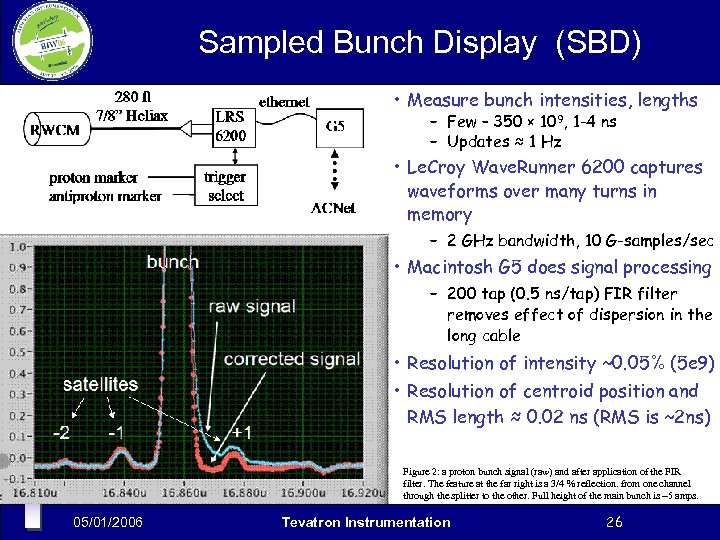
Sampled Bunch Display (SBD) • Measure bunch intensities, lengths – Few – 350 × 109, 1 -4 ns – Updates ≈ 1 Hz • Le. Croy Wave. Runner 6200 captures waveforms over many turns in memory – 2 GHz bandwidth, 10 G-samples/sec • Macintosh G 5 does signal processing – 200 tap (0. 5 ns/tap) FIR filter removes effect of dispersion in the long cable • Resolution of intensity ~0. 05% (5 e 9) • Resolution of centroid position and RMS length ≈ 0. 02 ns (RMS is ~2 ns) Figure 2: a proton bunch signal (raw) and after application of the FIR filter. The feature at the far right is a 3/4 % reflection. from one channel through the splitter to the other. Full height of the main bunch is ~5 amps. 05/01/2006 Tevatron Instrumentation 26
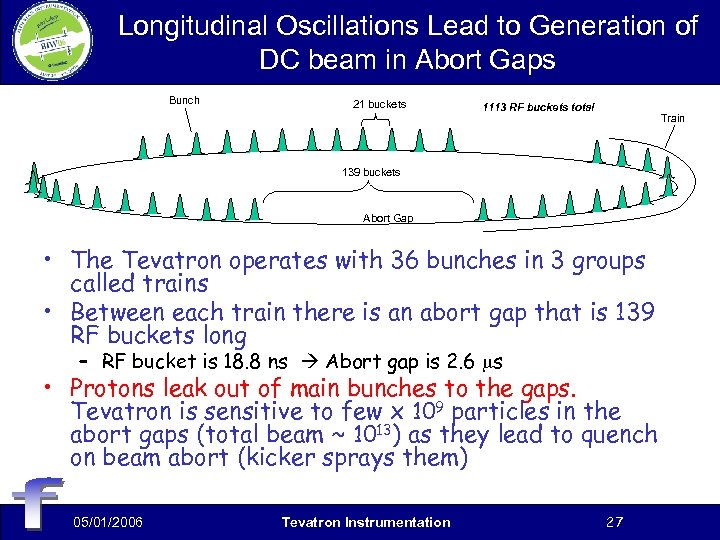
Longitudinal Oscillations Lead to Generation of DC beam in Abort Gaps Bunch 21 buckets 1113 RF buckets total Train 139 buckets Abort Gap • The Tevatron operates with 36 bunches in 3 groups called trains • Between each train there is an abort gap that is 139 RF buckets long – RF bucket is 18. 8 ns Abort gap is 2. 6 ms • Protons leak out of main bunches to the gaps. Tevatron is sensitive to few x 109 particles in the abort gaps (total beam ~ 1013) as they lead to quench on beam abort (kicker sprays them) 05/01/2006 Tevatron Instrumentation 27
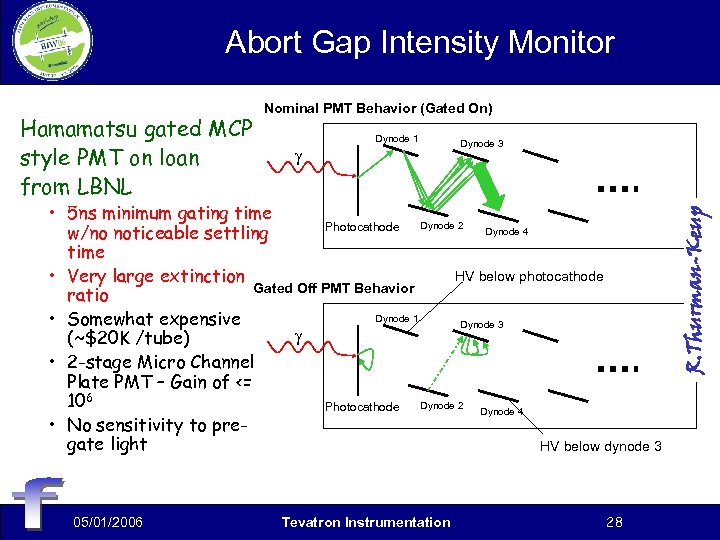
Abort Gap Intensity Monitor g Dynode 1 Dynode 3 • 5 ns minimum gating time Dynode 2 Photocathode Dynode 4 w/no noticeable settling time HV below photocathode • Very large extinction Gated Off PMT Behavior ratio Dynode 1 • Somewhat expensive Dynode 3 g (~$20 K /tube) • 2 -stage Micro Channel Plate PMT – Gain of <= 106 Dynode 2 Photocathode Dynode 4 • No sensitivity to pregate light HV below dynode 3 05/01/2006 Tevatron Instrumentation 28 R. Thurman-Keup Hamamatsu gated MCP style PMT on loan from LBNL Nominal PMT Behavior (Gated On)
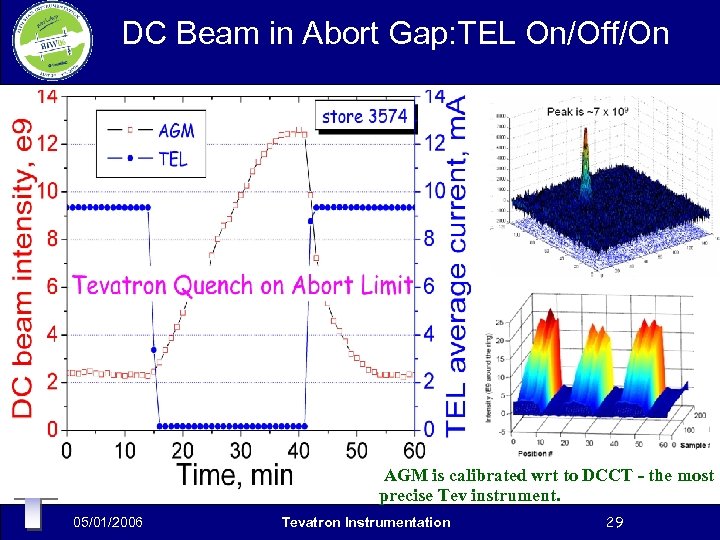
DC Beam in Abort Gap: TEL On/Off/On AGM is calibrated wrt to DCCT - the most precise Tev instrument. 05/01/2006 Tevatron Instrumentation 29
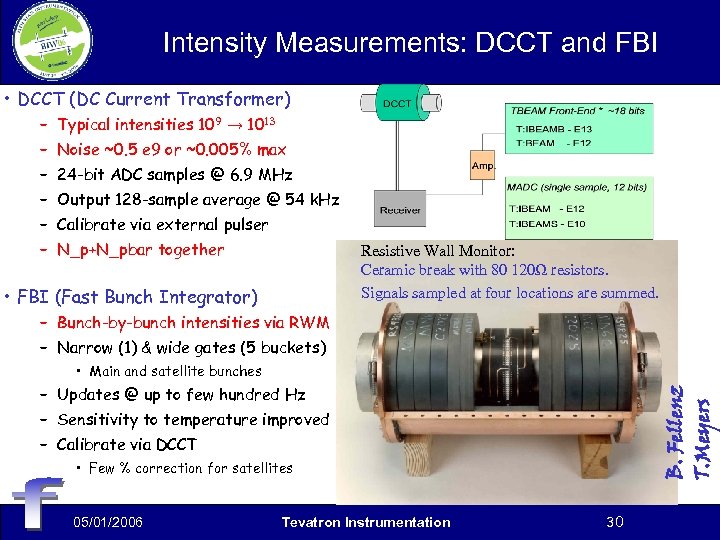
Intensity Measurements: DCCT and FBI • DCCT (DC Current Transformer) – Typical intensities 109 → 1013 – Noise ~0. 5 e 9 or ~0. 005% max – 24 -bit ADC samples @ 6. 9 MHz – Output 128 -sample average @ 54 k. Hz – Calibrate via external pulser – N_p+N_pbar together Resistive Wall Monitor: Ceramic break with 80 120Ω resistors. Signals sampled at four locations are summed. • FBI (Fast Bunch Integrator) – Bunch-by-bunch intensities via RWM – Narrow (1) & wide gates (5 buckets) • Main and satellite bunches B. Fellenz T. Meyers – Updates @ up to few hundred Hz – Sensitivity to temperature improved – Calibrate via DCCT • Few % correction for satellites 05/01/2006 Tevatron Instrumentation 30
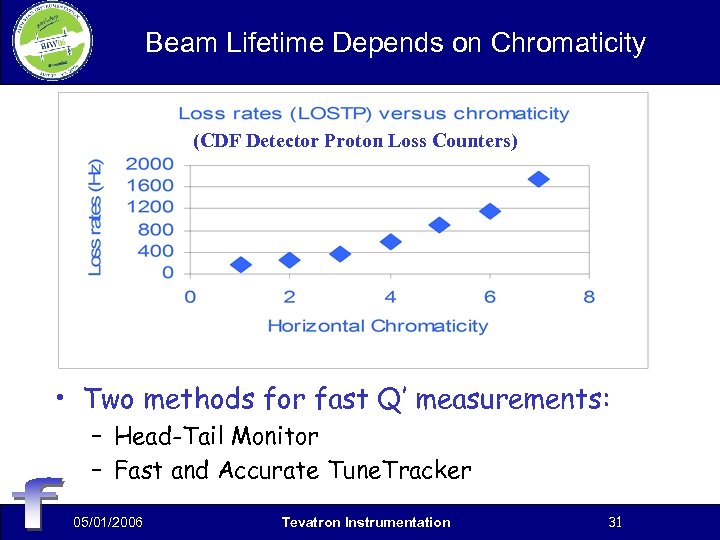
Beam Lifetime Depends on Chromaticity (CDF Detector Proton Loss Counters) • Two methods for fast Q’ measurements: – Head-Tail Monitor – Fast and Accurate Tune. Tracker 05/01/2006 Tevatron Instrumentation 31
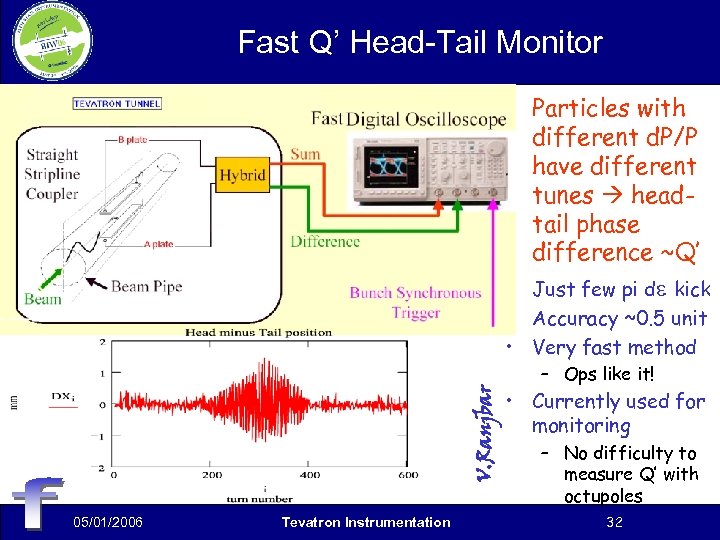
Fast Q’ Head-Tail Monitor • Particles with different d. P/P have different tunes headtail phase difference ~Q’ • Just few pi d kick • Accuracy ~0. 5 unit • Very fast method V. Ranjbar – Ops like it! 05/01/2006 Tevatron Instrumentation • Currently used for monitoring – No difficulty to measure Q’ with octupoles 32
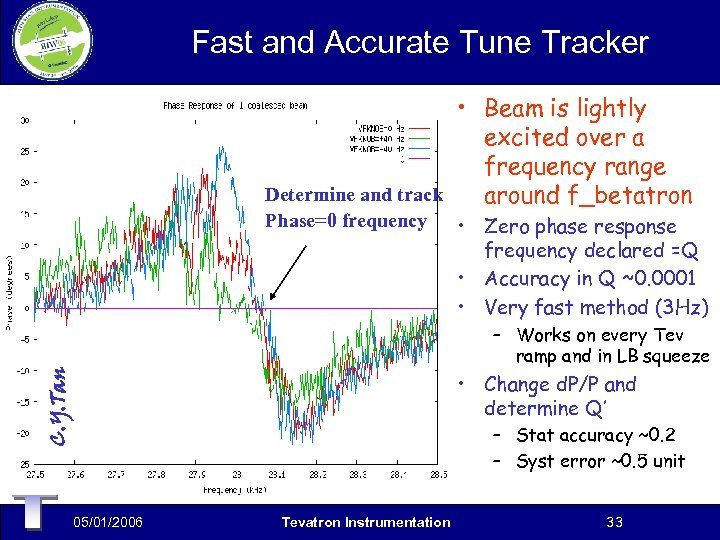
Fast and Accurate Tune Tracker • Beam is lightly excited over a frequency range Determine and track around f_betatron Phase=0 frequency • Zero phase response frequency declared =Q • Accuracy in Q ~0. 0001 • Very fast method (3 Hz) C. Y. Tan – Works on every Tev ramp and in LB squeeze 05/01/2006 • Change d. P/P and determine Q’ – Stat accuracy ~0. 2 – Syst error ~0. 5 unit Tevatron Instrumentation 33
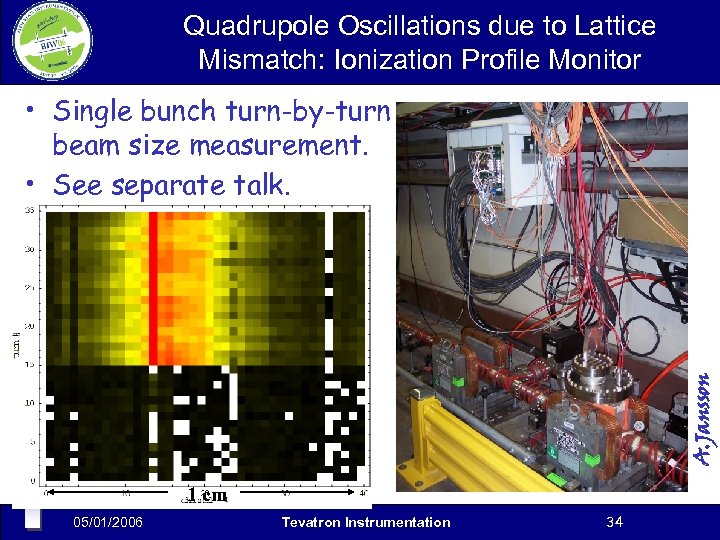
Quadrupole Oscillations due to Lattice Mismatch: Ionization Profile Monitor A. Jansson • Single bunch turn-by-turn beam size measurement. • See separate talk. 1 cm 05/01/2006 Tevatron Instrumentation 34
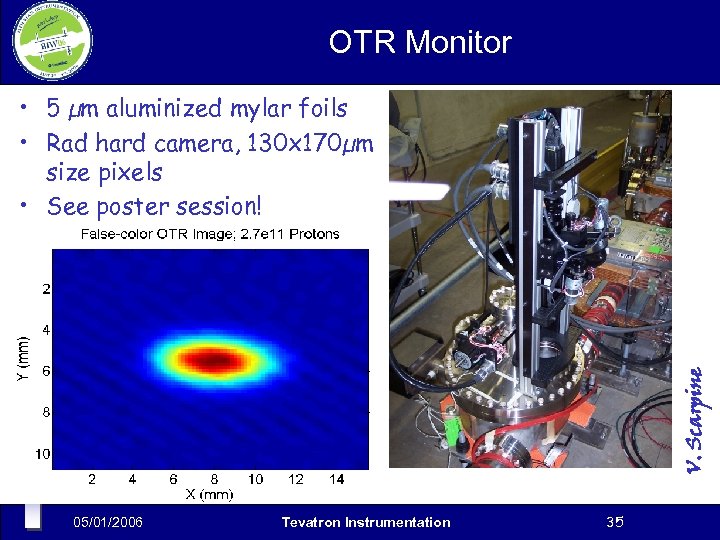
OTR Monitor V. Scarpine • 5 µm aluminized mylar foils • Rad hard camera, 130 x 170µm size pixels • See poster session! 05/01/2006 Tevatron Instrumentation 35
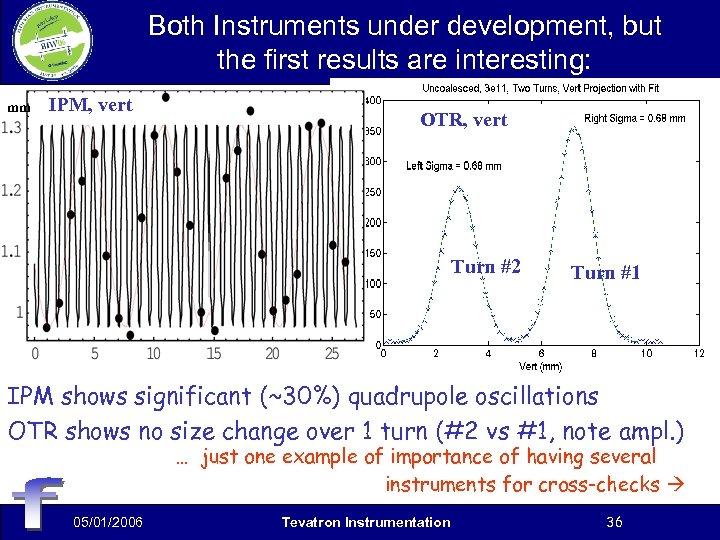
Both Instruments under development, but the first results are interesting: mm IPM, vert OTR, vert Turn #2 Turn #1 IPM shows significant (~30%) quadrupole oscillations OTR shows no size change over 1 turn (#2 vs #1, note ampl. ) … just one example of importance of having several instruments for cross-checks 05/01/2006 Tevatron Instrumentation 36
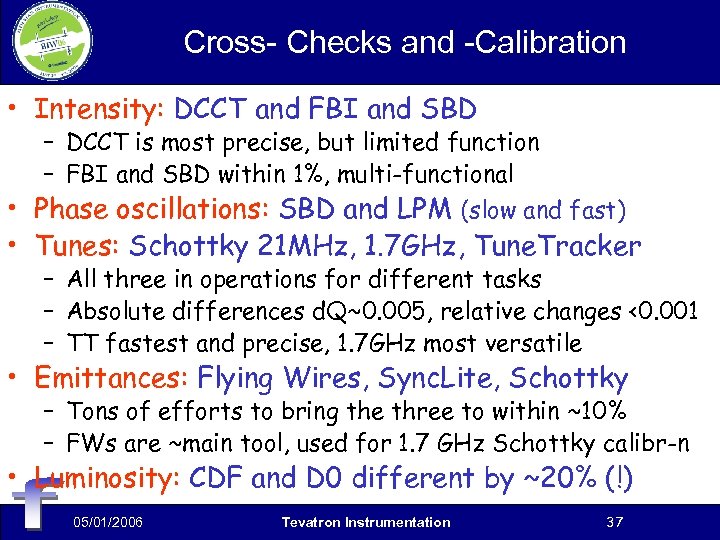
Cross- Checks and -Calibration • Intensity: DCCT and FBI and SBD – DCCT is most precise, but limited function – FBI and SBD within 1%, multi-functional • Phase oscillations: SBD and LPM (slow and fast) • Tunes: Schottky 21 MHz, 1. 7 GHz, Tune. Tracker – All three in operations for different tasks – Absolute differences d. Q~0. 005, relative changes <0. 001 – TT fastest and precise, 1. 7 GHz most versatile • Emittances: Flying Wires, Sync. Lite, Schottky – Tons of efforts to bring the three to within ~10% – FWs are ~main tool, used for 1. 7 GHz Schottky calibr-n • Luminosity: CDF and D 0 different by ~20% (!) 05/01/2006 Tevatron Instrumentation 37
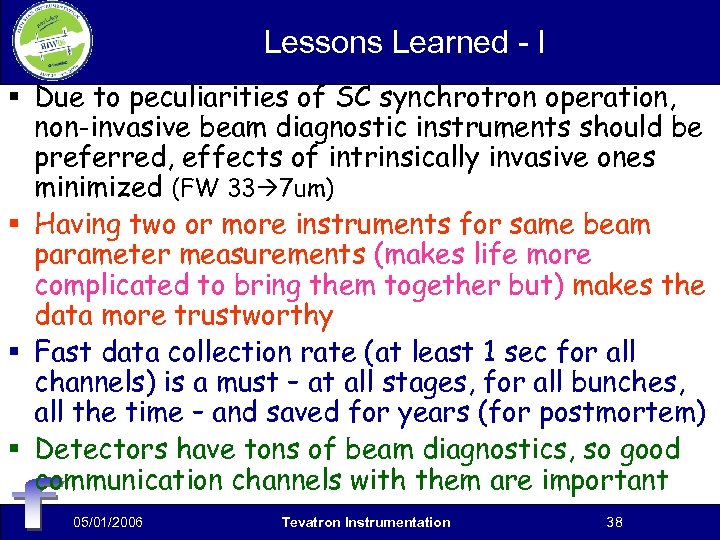
Lessons Learned - I § Due to peculiarities of SC synchrotron operation, non-invasive beam diagnostic instruments should be preferred, effects of intrinsically invasive ones minimized (FW 33 7 um) § Having two or more instruments for same beam parameter measurements (makes life more complicated to bring them together but) makes the data more trustworthy § Fast data collection rate (at least 1 sec for all channels) is a must – at all stages, for all bunches, all the time – and saved for years (for postmortem) § Detectors have tons of beam diagnostics, so good communication channels with them are important 05/01/2006 Tevatron Instrumentation 38
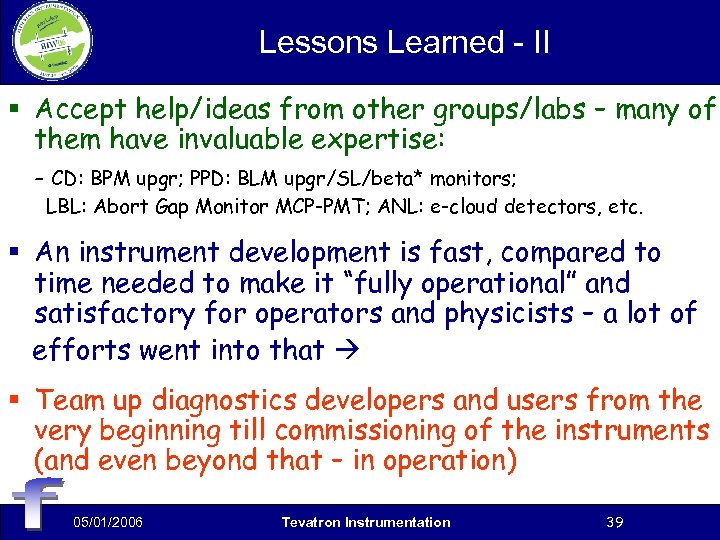
Lessons Learned - II § Accept help/ideas from other groups/labs – many of them have invaluable expertise: - CD: BPM upgr; PPD: BLM upgr/SL/beta* monitors; LBL: Abort Gap Monitor MCP-PMT; ANL: e-cloud detectors, etc. § An instrument development is fast, compared to time needed to make it “fully operational” and satisfactory for operators and physicists – a lot of efforts went into that § Team up diagnostics developers and users from the very beginning till commissioning of the instruments (and even beyond that – in operation) 05/01/2006 Tevatron Instrumentation 39
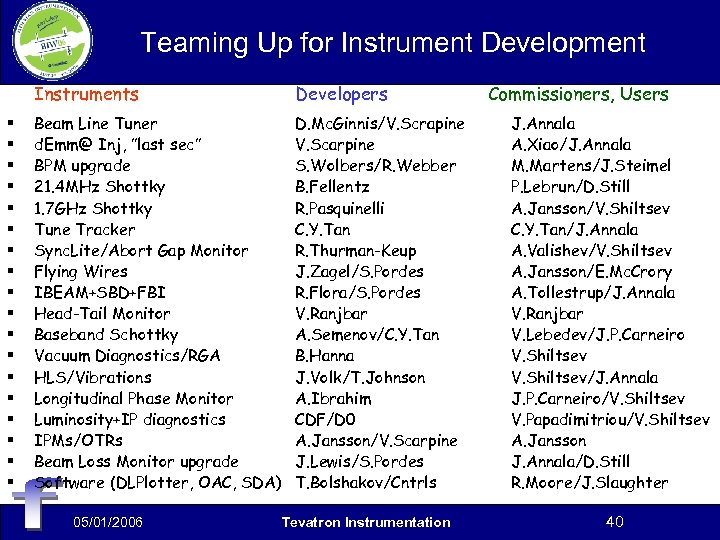
Teaming Up for Instrument Development Instruments § § § § § Developers Beam Line Tuner d. Emm@ Inj, ”last sec” BPM upgrade 21. 4 MHz Shottky 1. 7 GHz Shottky Tune Tracker Sync. Lite/Abort Gap Monitor Flying Wires IBEAM+SBD+FBI Head-Tail Monitor Baseband Schottky Vacuum Diagnostics/RGA HLS/Vibrations Longitudinal Phase Monitor Luminosity+IP diagnostics IPMs/OTRs Beam Loss Monitor upgrade Software (DLPlotter, OAC, SDA) D. Mc. Ginnis/V. Scrapine V. Scarpine S. Wolbers/R. Webber B. Fellentz R. Pasquinelli C. Y. Tan R. Thurman-Keup J. Zagel/S. Pordes R. Flora/S. Pordes V. Ranjbar A. Semenov/C. Y. Tan B. Hanna J. Volk/T. Johnson A. Ibrahim CDF/D 0 A. Jansson/V. Scarpine J. Lewis/S. Pordes T. Bolshakov/Cntrls 05/01/2006 Tevatron Instrumentation Commissioners, Users J. Annala A. Xiao/J. Annala M. Martens/J. Steimel P. Lebrun/D. Still A. Jansson/V. Shiltsev C. Y. Tan/J. Annala A. Valishev/V. Shiltsev A. Jansson/E. Mc. Crory A. Tollestrup/J. Annala V. Ranjbar V. Lebedev/J. P. Carneiro V. Shiltsev/J. Annala J. P. Carneiro/V. Shiltsev V. Papadimitriou/V. Shiltsev A. Jansson J. Annala/D. Still R. Moore/J. Slaughter 40

So, Have We Won The Battle? Yes, but only one of many… …the campaign is not over 05/01/2006 Tevatron Instrumentation 41
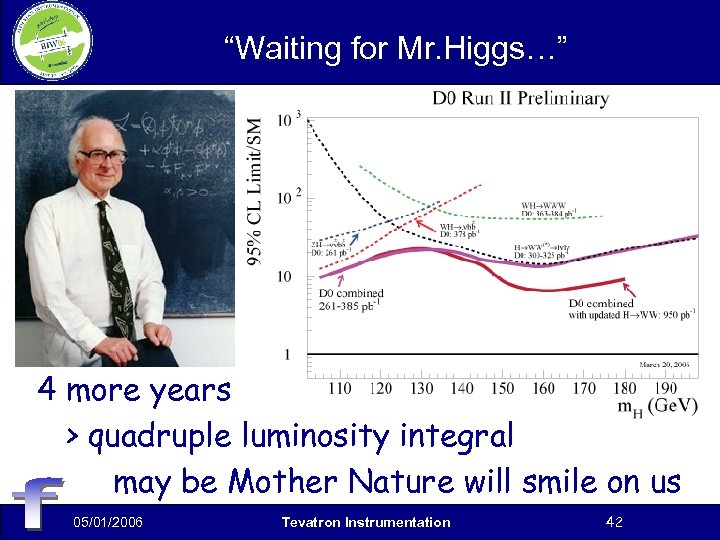
“Waiting for Mr. Higgs…” 4 more years > quadruple luminosity integral may be Mother Nature will smile on us 05/01/2006 Tevatron Instrumentation 42
And at the end… On behalf of the Run II team, we’d like to thank all who took part in beam diagnostics development and Thank you for your attention! 05/01/2006 Tevatron Instrumentation 43
back. Up Slides § 05/01/2006 Tevatron Instrumentation 44
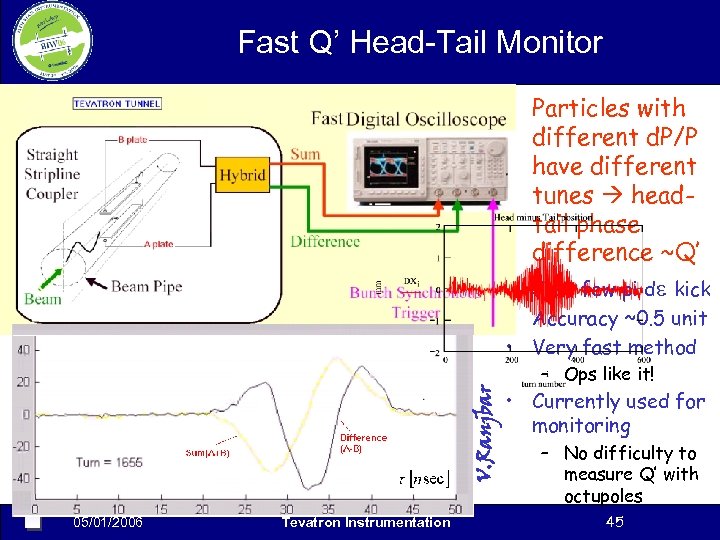
Fast Q’ Head-Tail Monitor • Particles with different d. P/P have different tunes headtail phase difference ~Q’ • Just few pi d kick • Accuracy ~0. 5 unit • Very fast method V. Ranjbar – Ops like it! 05/01/2006 Tevatron Instrumentation • Currently used for monitoring – No difficulty to measure Q’ with octupoles 45
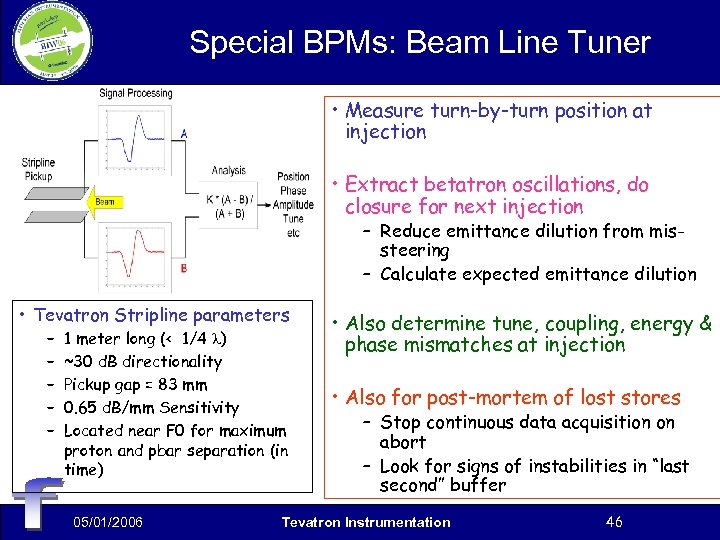
Special BPMs: Beam Line Tuner • Measure turn-by-turn position at injection • Extract betatron oscillations, do closure for next injection – Reduce emittance dilution from missteering – Calculate expected emittance dilution • Tevatron Stripline parameters – – – 1 meter long (< 1/4 l) ~30 d. B directionality Pickup gap = 83 mm 0. 65 d. B/mm Sensitivity Located near F 0 for maximum proton and pbar separation (in time) 05/01/2006 • Also determine tune, coupling, energy & phase mismatches at injection • Also for post-mortem of lost stores – Stop continuous data acquisition on abort – Look for signs of instabilities in “last second” buffer Tevatron Instrumentation 46
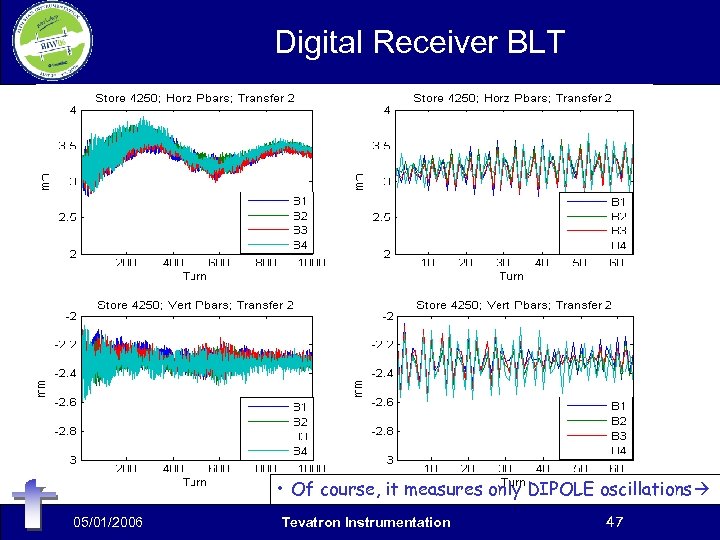
Digital Receiver BLT • Of course, it measures only DIPOLE oscillations 05/01/2006 Tevatron Instrumentation 47
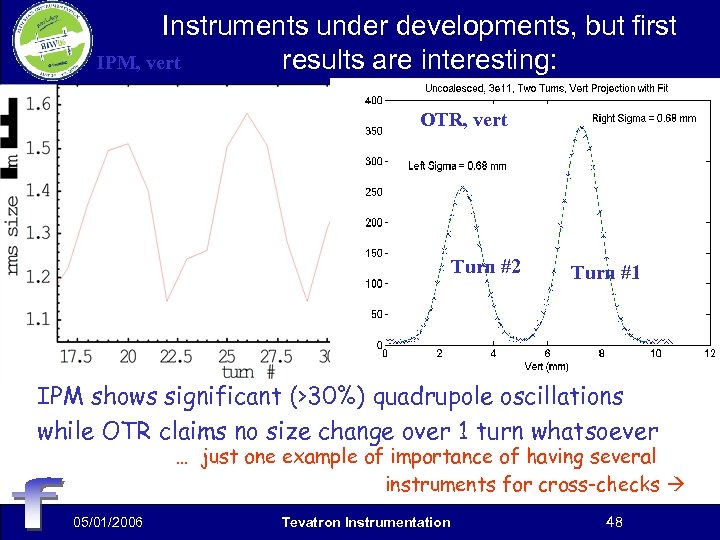
Instruments under developments, but first results are interesting: IPM, vert OTR, vert Turn #2 Turn #1 IPM shows significant (>30%) quadrupole oscillations while OTR claims no size change over 1 turn whatsoever … just one example of importance of having several instruments for cross-checks 05/01/2006 Tevatron Instrumentation 48
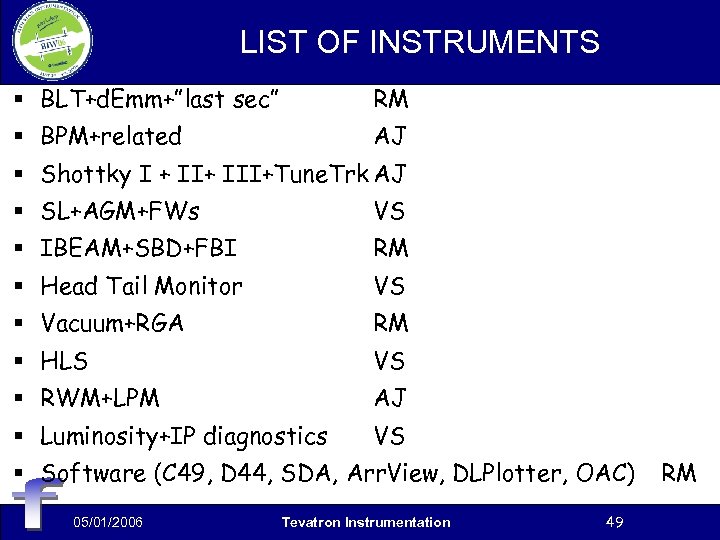
LIST OF INSTRUMENTS § BLT+d. Emm+”last sec” RM § BPM+related AJ § Shottky I + III+Tune. Trk AJ § SL+AGM+FWs VS § IBEAM+SBD+FBI RM § Head Tail Monitor VS § Vacuum+RGA RM § HLS VS § RWM+LPM AJ § Luminosity+IP diagnostics VS § Software (C 49, D 44, SDA, Arr. View, DLPlotter, OAC) 05/01/2006 Tevatron Instrumentation 49 RM
Longitudinal Phase Monitor Gate Timing Linearity: ADC Clock cos Q-10 bits x Beam Pick-up (Stripline) (SIMPLIFIED) ADC I-10 bits FPGA x sin Gate Timing Measured phase*: A. Ibrahim Simulated phase: *Discrepancies explained by difference in RF voltage and shape asymmetry during acceleration 05/01/2006 Tevatron Instrumentation 50
1113 / 5 Artifacts* *Sampling frequency is 7/5 RF, so clock phase varies slightly with a period of 5 turns. 05/01/2006 Betatron Lines Resolution: 0. 3 mm/sqrt(Hz) Tevatron Instrumentation 51 R. Kutchke et al BPM Turn-by-Turn
1. 7 GHz Schottky measurements Emittance Momentum spread Note: Arbitrary scaling Single bunch tune #4058 SBD #3989 Schottky Horizontal Schottky Vertical Schottky Sync lite Horizontal Vertical 0. 002 Damper problems → longitudinal blow up #4000 RMS fluctuation around trend line: 5 10 -4 NO fudge factors!!! Pbar bunch #29 Intensity: 19 10 9 Emittance: ~17 mm mrad *Note that the 1. 7 GHz Schottky can not resolve the two normal modes of oscillation by frequency, hence it is insensitive to tune changes due to coupling. 05/01/2006 Tevatron Instrumentation 52
Schottky development II A–B TRACK/ HOLD (A-B)- LPF(A-B) + - Gain 100÷ 150 LPF(A-B) 100 MHz 16 bit ADC 100 MHz 14 bit DAC A+B TRACK/ HOLD ~40 ns 100 MHz 16 bit ADC FPGA 64 MS RAM DSP SHARC Hold Input from Plate 10 Mbit ETHERNET A, B Reset Ethernet, OAC 05/01/2006 Tevatron Instrumentation 53 A. Semenov INPUTs: • In-house development BPM Plates • Similar to 3 D Cable -BBQ from • Looks at Tunnel both positive and negative peaks RF • Feed-back to CLOCK, eliminate LF Rev. Marker, and increase TCLK, dynamic range Digital Beam Tune Monitor based on 16 bit 100 MHz Digitizer
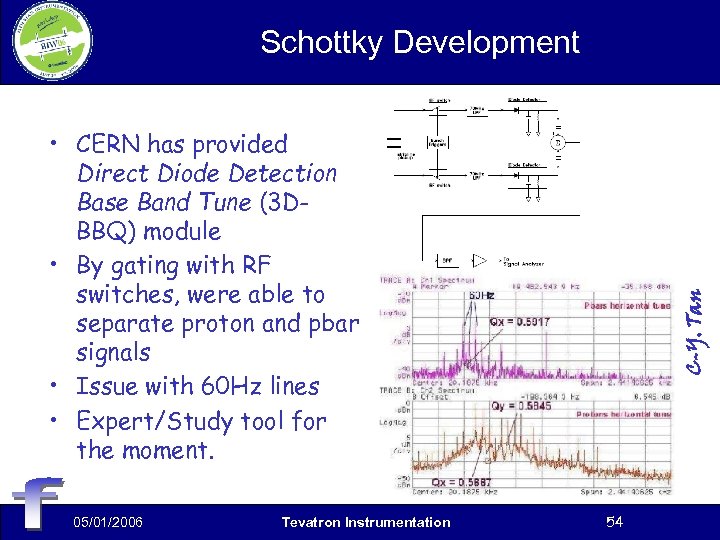
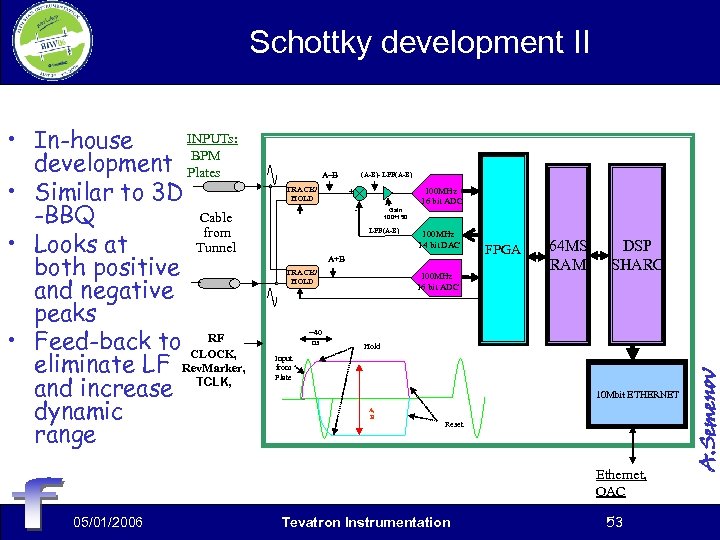
Schottky Development 05/01/2006 Tevatron Instrumentation C-Y. Tan • CERN has provided Direct Diode Detection Base Band Tune (3 DBBQ) module • By gating with RF switches, were able to separate proton and pbar signals • Issue with 60 Hz lines • Expert/Study tool for the moment. 54
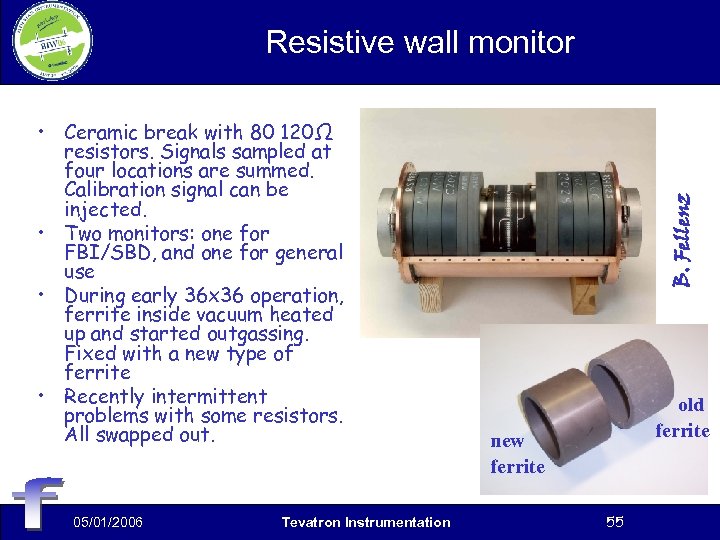
• Ceramic break with 80 120Ω resistors. Signals sampled at four locations are summed. Calibration signal can be injected. • Two monitors: one for FBI/SBD, and one for general use • During early 36 x 36 operation, ferrite inside vacuum heated up and started outgassing. Fixed with a new type of ferrite • Recently intermittent problems with some resistors. All swapped out. 05/01/2006 Tevatron Instrumentation B. Fellenz Resistive wall monitor old ferrite new ferrite 55
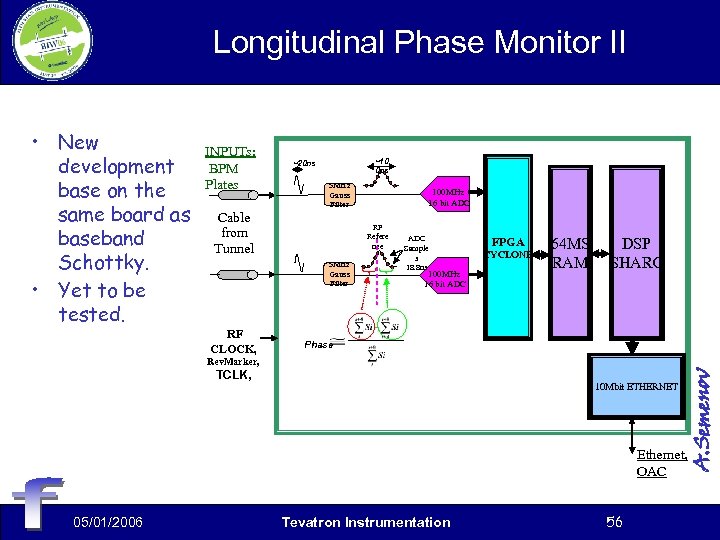
Longitudinal Phase Monitor II 2 Channels Longitudinal Phase Meter Based on 16 bit 100 MHz Digitizer • New development base on the same board as baseband Schottky. • Yet to be tested. INPUTs: BPM Plates ~10 0 ns ~20 ns 5 MHz Gauss Filter Cable from Tunnel RF Refere nce 5 MHz Gauss Filter RF CLOCK, 100 MHz 16 bit ADC Sample s 18. 8 ns 100 MHz 16 bit ADC FPGA CYCLONE 64 MS RAM DSP SHARC Phase TCLK, 10 Mbit ETHERNET A. Semenov Rev. Marker, Ethernet, OAC 05/01/2006 Tevatron Instrumentation 56
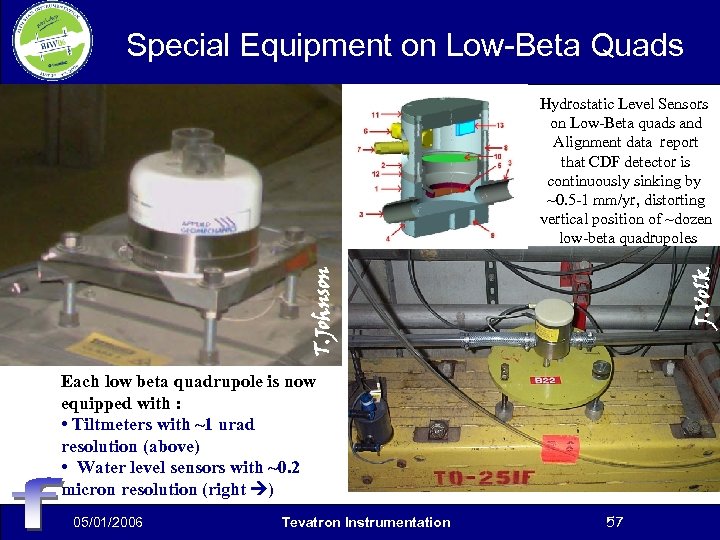
Special Equipment on Low-Beta Quads J. Volk T. Johnson Hydrostatic Level Sensors on Low-Beta quads and Alignment data report that CDF detector is continuously sinking by ~0. 5 -1 mm/yr, distorting vertical position of ~dozen low-beta quadrupoles Each low beta quadrupole is now equipped with : • Tiltmeters with ~1 urad resolution (above) • Water level sensors with ~0. 2 micron resolution (right ) 05/01/2006 Tevatron Instrumentation 57
Скачать презентацию Tevatron Beam Diagnostics Boosting Collider Performance Vladimir Shiltsev
8c1858f5a2a5334ab1ac0694ed2ce23b.ppt