 Скачать презентацию Testing Summit Sacramento CA November 28 2005 Barbara
cd8da676cd7195e29d86b35b97bdc0de.ppt
- Количество слайдов: 35



Testing Summit Sacramento, CA November 28, 2005 Barbara Guttman National Institute of Standards and Technology www. vote. nist. gov
NIST “Help America Vote Act” Responsibilities • Chair Technical Guidelines Development Committee (TGDC) • Provide technical support to TGDC in the development of voluntary voting system guidelines including: –Security –Methods to detect and prevent fraud –Human factors, including technologies for individuals with disabilities • Accredit testing labs
Who’s Who in Federal Voting Guidelines? • EAC – responsible for the guidelines • TGDC – provide recommended guidelines to EAC • Standards Board – give States’ input to EAC • Advisory Board – give advice to EAC • NIST – provide technical assistance to TGDC
Who’s Who at NIST? • NIST – measurements & standards – www. nist. gov • Information Technology Lab – www. itl. nist. gov • National Voluntary Laboratory Accreditation Program – http: //ts. nist. gov/ts/htdocs/210/214. htm
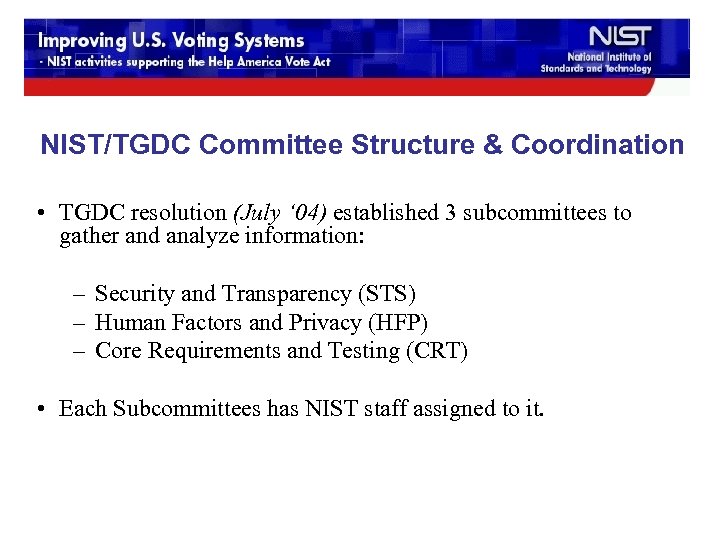
NIST/TGDC Committee Structure & Coordination • TGDC resolution (July ‘ 04) established 3 subcommittees to gather and analyze information: – Security and Transparency (STS) – Human Factors and Privacy (HFP) – Core Requirements and Testing (CRT) • Each Subcommittees has NIST staff assigned to it.
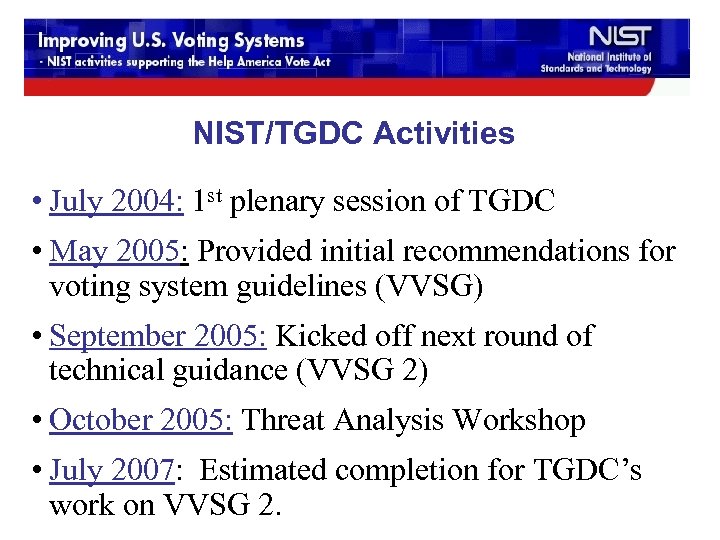
NIST/TGDC Activities • July 2004: 1 st plenary session of TGDC • May 2005: Provided initial recommendations for voting system guidelines (VVSG) • September 2005: Kicked off next round of technical guidance (VVSG 2) • October 2005: Threat Analysis Workshop • July 2007: Estimated completion for TGDC’s work on VVSG 2.
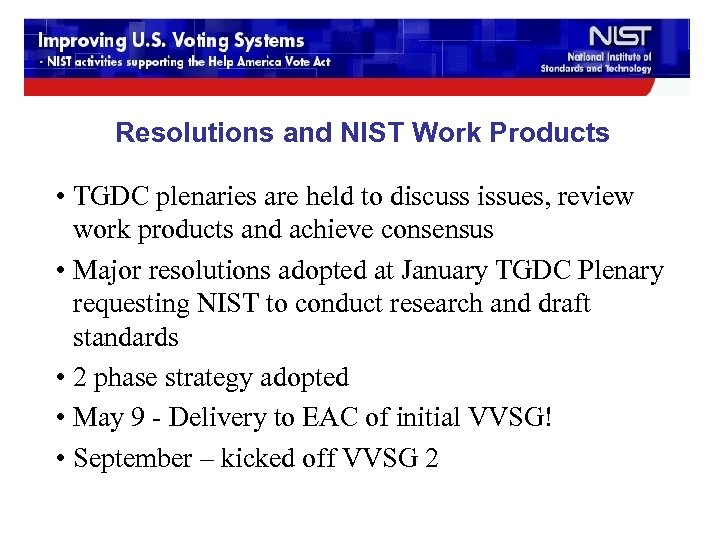
Resolutions and NIST Work Products • TGDC plenaries are held to discuss issues, review work products and achieve consensus • Major resolutions adopted at January TGDC Plenary requesting NIST to conduct research and draft standards • 2 phase strategy adopted • May 9 - Delivery to EAC of initial VVSG! • September – kicked off VVSG 2
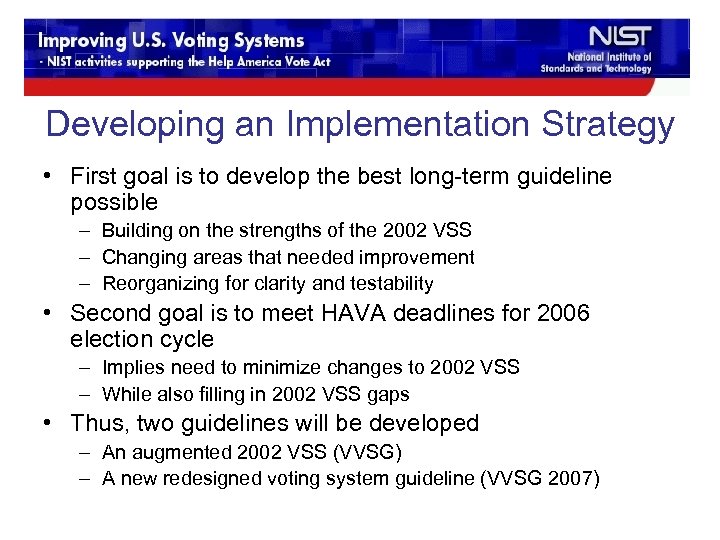
Developing an Implementation Strategy • First goal is to develop the best long-term guideline possible – Building on the strengths of the 2002 VSS – Changing areas that needed improvement – Reorganizing for clarity and testability • Second goal is to meet HAVA deadlines for 2006 election cycle – Implies need to minimize changes to 2002 VSS – While also filling in 2002 VSS gaps • Thus, two guidelines will be developed – An augmented 2002 VSS (VVSG) – A new redesigned voting system guideline (VVSG 2007)
Voluntary Voting System Guideline • Improves the 2002 VSS by addressing: – – – Human Factors VVPAT, Wireless, Software Distribution and Setup Validation Conformance, Glossary, Error Rates • Sets stage for Redesigned Version – Human Factors – Independent Dual Verification
VVSG 2007 Outline: Overview & Timeline
Topics • • VVSG 2007 major changes New requirements format VVSG 2007 major organization Timeline
Major Changes • Restructured, precise requirements • Improved organization, usable design • Expanded requirements for human factors, security, core areas • Requirements will reference their corresponding test methods or test cases
New requirements format • Numbered requirement text – TR: test reference to corresponding general test method/test case – P: any election official procedures necessary to accomplish requirement – D: discussion to clarify requirement
VVSG 2007 Major Organization 1. 2. 3. 4. 5. Overview Terminology Standard Product Standards on Data to be Provided Requirements Testing Standard • Requirements in 3 and 4 reference general test methods/test cases found in 5
Terminology Standard • The basis for discussion in other major sections • Provides common vocabulary for all terms and definitions • Based on current voting systems glossary • NIST will research current usage election-related terminology and combine with common language guidelines
Product Standard • Requirements for voting systems – Security – Human factors – Various core requirements • Contains large sections with general requirements • Contains requirements organized by voting system activity, e. g. , pre-election, casting, counting
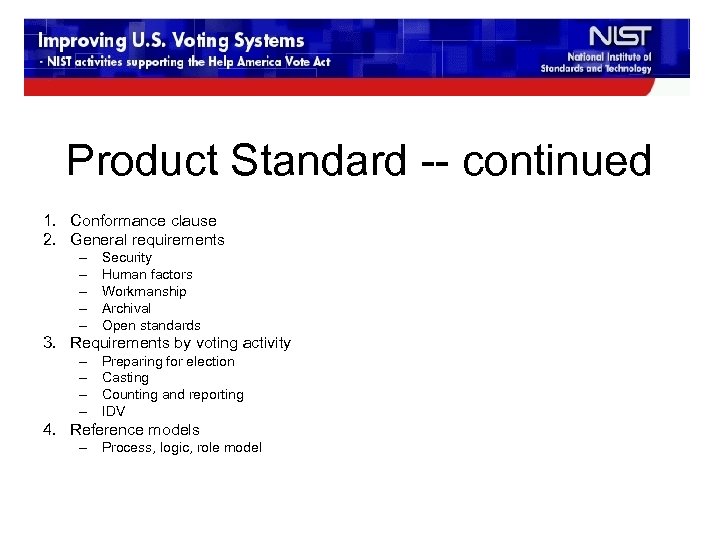
Product Standard -- continued 1. Conformance clause 2. General requirements – – – Security Human factors Workmanship Archival Open standards 3. Requirements by voting activity – – Preparing for election Casting Counting and reporting IDV 4. Reference models – Process, logic, role model
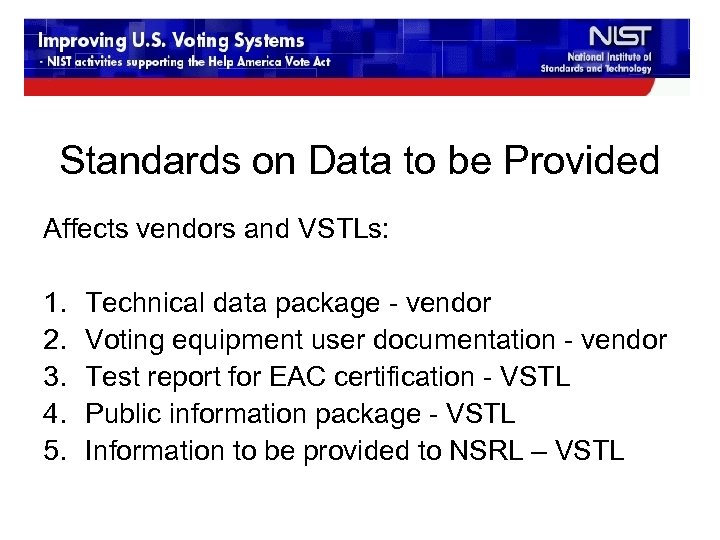
Standards on Data to be Provided Affects vendors and VSTLs: 1. 2. 3. 4. 5. Technical data package - vendor Voting equipment user documentation - vendor Test report for EAC certification - VSTL Public information package - VSTL Information to be provided to NSRL – VSTL
Testing Standard • To assist VSTLs in using consistent testing techniques • Contains high level general test methods and test cases, referenced by requirements as appropriate • Full test suite not currently in timeline
VVSG 2007 • The “final” deliverable of voting systems guidelines estimated for July, 2007 • A completely rewritten and reformatted guideline • Will incorporate modules delivered to EAC prior to 7/07
General Workplan • TGDC working groups develop chapters • Send to TGDC as a whole for comment • TGDC provides formal guidance at meetings, but will have already had a chance to comment • This will allow for faster development
General Workplan • Original research, e. g. , – Usability Performance Benchmarks – IDV • Analysis – Apply security knowledge to voting – Apply accessibility and usability knowledge to IDV • Review and outreach
How Do You Contribute? • Comment on posted drafts. All TGDC material is public. See www. vote. nist. gov. • We read the comments. • Send email to voting@nist. gov • States are represented on the TGDC via the Standards Board, but feel free to comment to us directly too.
Test Labs • ITAs will become VSTLs (Voting System Testing Labs) • NVLAP will accredit them according to international laboratory accreditation procedures (ISO 17025) • EAC will accredit them for testing voting systems
Test Labs and States • Can NVLAP accredit State labs? – Yes. • What does NVLAP accreditation mean? – NVLAP provides an unbiased third-party evaluation and recognition of performance. • Is NVLAP tied to a business model where the vendor pays? – No.
Testing Business Models • Vendor tests and pays (self-testing) • Vendor pays (current ITA model) • Purchaser pays (GA pays Kennesaw State) • Government or Consortium pays (What if the EAC paid for ITA testing? )
Threat Workshop October 7, 2005
Threat Modeling • Everyone agreed we need a REAL threat analysis • And it will be public – Comp: National Vulnerability Database • It should help drive the standards process
Threat Questions • Is the threat plausible? • How difficult/easy? – What would it take to make an attack successful? • What countermeasures could apply? • What damage could occur? – How big a risk is it?
Talked thru some threats • • Trojan Horse in DRE Application, DRE Misprogramming Optical Scan Configuration File Optical Scan Ballot Design Touch Screen Calibration Optical Scan Calibration Trojan Horse Poor usability Poor procedures
Threat Workshop • “Exotic” threats should be taken seriously and studied further • “Mundane” threats are a bigger threat today and must be better addressed
Threats and Testing • Some threats are mitigated through better standards (equipment and procedural) • Some through better testing • And some through better monitoring Prevent – Detect - Recover
What Next on Threat? • NIST will issue workshop report • Brennan Center is working on a threat analysis • NIST heard a mandate to continue this work
NSRL • Hashes for all major voting system products www. nsrl. nist. gov/voting • What are hashes? • What can they do for improving voting system integrity? • What can’t they do with current voting equipment?
Questions? • Email: voting@nist. gov • Website: www. vote. nist. gov • My email: bguttman@nist. gov
Скачать презентацию Testing Summit Sacramento CA November 28 2005 Barbara
cd8da676cd7195e29d86b35b97bdc0de.ppt