 Скачать презентацию Testing Object Oriented Software Chapter 15 Learning
a566caa83d5f2afcd0f86800b4351dcd.ppt
- Количество слайдов: 62



Testing Object Oriented Software Chapter 15
Learning objectives • Understand how object orientation impacts software testing – What characteristics matter? Why? – What adaptations are needed? • Understand basic techniques to cope with each key characteristic • Understand staging of unit and integration testing for OO software (intra-class and interclass testing) (c) 2008 Mauro Pezzè & Michal Young Ch 15, slide 2
15. 2 Characteristics of OO Software Typical OO software characteristics that impact testing • State dependent behavior • Encapsulation • Inheritance • Polymorphism and dynamic binding • Abstract and generic classes • Exception handling (c) 2008 Mauro Pezzè & Michal Young Ch 15, slide 3
Quality activities and OO SW (c) 2008 Mauro Pezzè & Michal Young Ch 15, slide 4
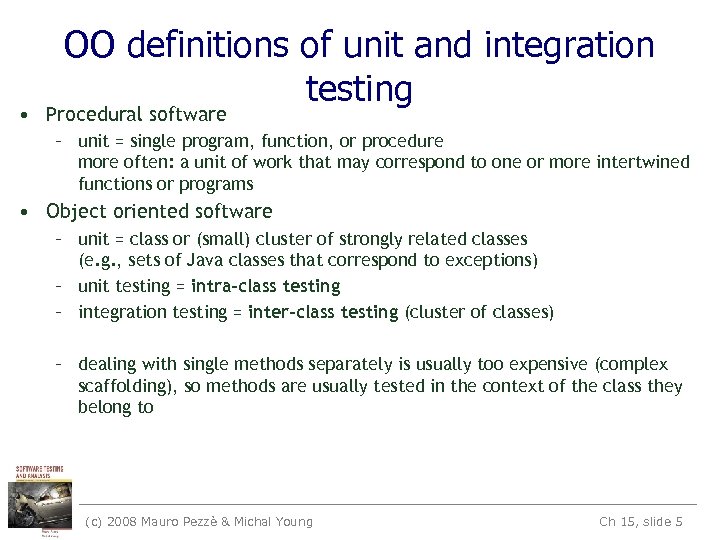
OO definitions of unit and integration testing • Procedural software – unit = single program, function, or procedure more often: a unit of work that may correspond to one or more intertwined functions or programs • Object oriented software – unit = class or (small) cluster of strongly related classes (e. g. , sets of Java classes that correspond to exceptions) – unit testing = intra-class testing – integration testing = inter-class testing (cluster of classes) – dealing with single methods separately is usually too expensive (complex scaffolding), so methods are usually tested in the context of the class they belong to (c) 2008 Mauro Pezzè & Michal Young Ch 15, slide 5
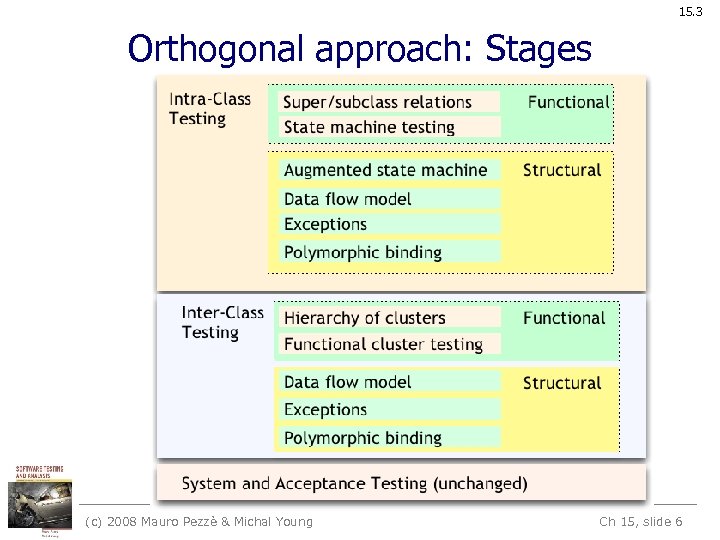
15. 3 Orthogonal approach: Stages (c) 2008 Mauro Pezzè & Michal Young Ch 15, slide 6
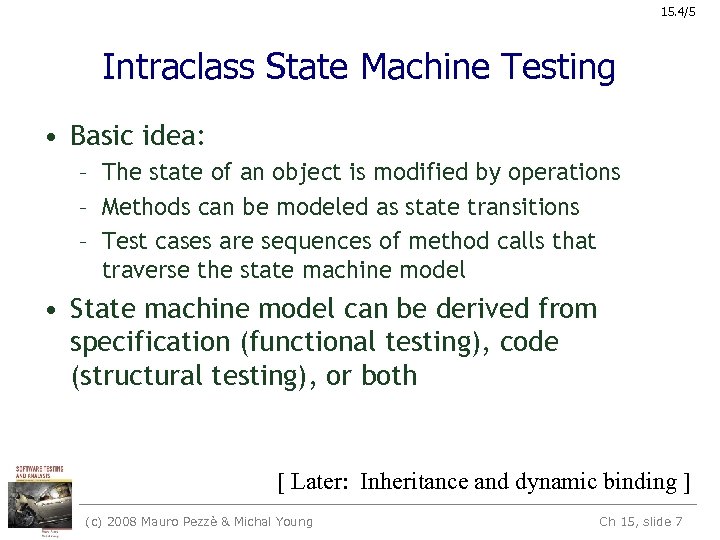
15. 4/5 Intraclass State Machine Testing • Basic idea: – The state of an object is modified by operations – Methods can be modeled as state transitions – Test cases are sequences of method calls that traverse the state machine model • State machine model can be derived from specification (functional testing), code (structural testing), or both [ Later: Inheritance and dynamic binding ] (c) 2008 Mauro Pezzè & Michal Young Ch 15, slide 7
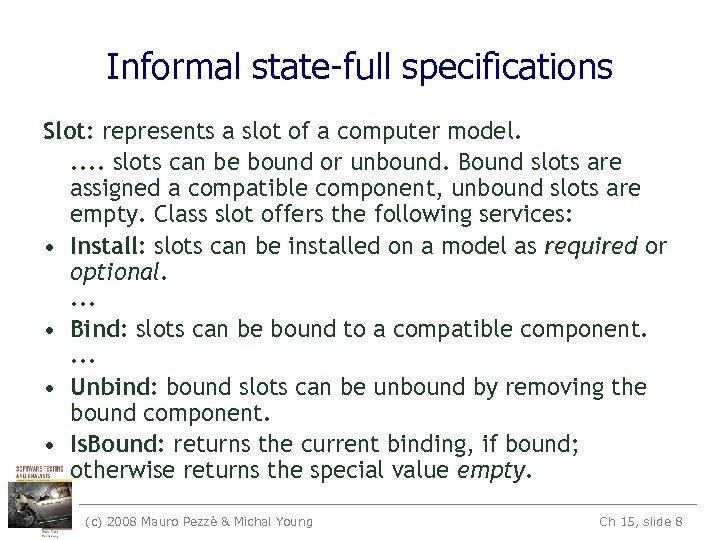
Informal state-full specifications Slot: represents a slot of a computer model. . . slots can be bound or unbound. Bound slots are assigned a compatible component, unbound slots are empty. Class slot offers the following services: • Install: slots can be installed on a model as required or optional. . • Bind: slots can be bound to a compatible component. . • Unbind: bound slots can be unbound by removing the bound component. • Is. Bound: returns the current binding, if bound; otherwise returns the special value empty. (c) 2008 Mauro Pezzè & Michal Young Ch 15, slide 8
Identifying states and transitions • From the informal specification we can identify three states: – Not_installed – Unbound – Bound • and four transitions – – install: from Not_installed to Unbound bind: from Unbound to Bound unbind: . . . to Unbound is. Bound: does not change state (c) 2008 Mauro Pezzè & Michal Young Ch 15, slide 9
Deriving an FSM and test cases • TC-1: incorporate, is. Bound, bind, is. Bound • TC-2: incorporate, un. Bind, bind, un. Bind, is. Bound (c) 2008 Mauro Pezzè & Michal Young Ch 15, slide 10
Testing with State Diagrams • A statechart (called a “state diagram” in UML) may be produced as part of a specification or design • May also be implied by a set of message sequence charts (interaction diagrams), or other modeling formalisms • Two options: – Convert (“flatten”) into standard finite-state machine, then derive test cases – Use state diagram model directly (c) 2008 Mauro Pezzè & Michal Young Ch 15, slide 11
class model Statecharts specification super-state or “OR-state” method of class Model called by class Model (c) 2008 Mauro Pezzè & Michal Young Ch 15, slide 12
From Statecharts to FSMs (c) 2008 Mauro Pezzè & Michal Young Ch 15, slide 13
Statechart based criteria • In some cases, “flattening” a Statechart to a finite-state machine may cause “state explosion” • Particularly for super-states with “history” • Alternative: Use the statechart directly • Simple transition coverage: execute all transitions of the original Statechart • incomplete transition coverage of corresponding FSM • useful for complex statecharts and strong time constraints (combinatorial number of transitions) (c) 2008 Mauro Pezzè & Michal Young Ch 15, slide 14
15. 6 Interclass Testing • The first level of integration testing for objectoriented software – Focus on interactions between classes • Bottom-up integration according to “depends” relation – A depends on B: Build and test B, then A • Start from use/include hierarchy – Implementation-level parallel to logical “depends” relation • Class A makes method calls on class B • Class A objects include references to class B methods – but only if reference means “is part of” (c) 2008 Mauro Pezzè & Michal Young Ch 15, slide 15

from a class diagram. . . (c) 2008 Mauro Pezzè & Michal Young Ch 15, slide 16
. . to a hierarchy Note: we may have to break loops and generate stubs (c) 2008 Mauro Pezzè & Michal Young Ch 15, slide 17
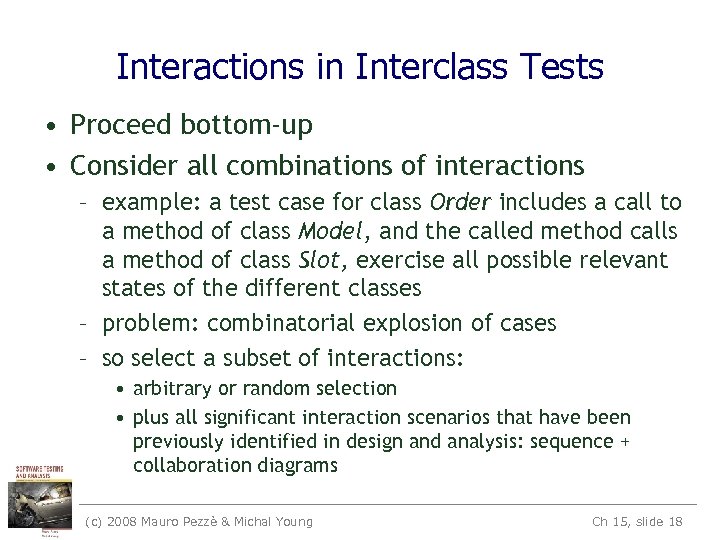
Interactions in Interclass Tests • Proceed bottom-up • Consider all combinations of interactions – example: a test case for class Order includes a call to a method of class Model, and the called method calls a method of class Slot, exercise all possible relevant states of the different classes – problem: combinatorial explosion of cases – so select a subset of interactions: • arbitrary or random selection • plus all significant interaction scenarios that have been previously identified in design and analysis: sequence + collaboration diagrams (c) 2008 Mauro Pezzè & Michal Young Ch 15, slide 18

sequence diagram (c) 2008 Mauro Pezzè & Michal Young Ch 15, slide 19
15. 7 Using Structural Information • Start with functional testing – As for procedural software, the specification (formal or informal) is the first source of information for testing object-oriented software • “Specification” widely construed: Anything from a requirements document to a design model or detailed interface description • Then add information from the code (structural testing) – Design and implementation details not available from other sources (c) 2008 Mauro Pezzè & Michal Young Ch 15, slide 20
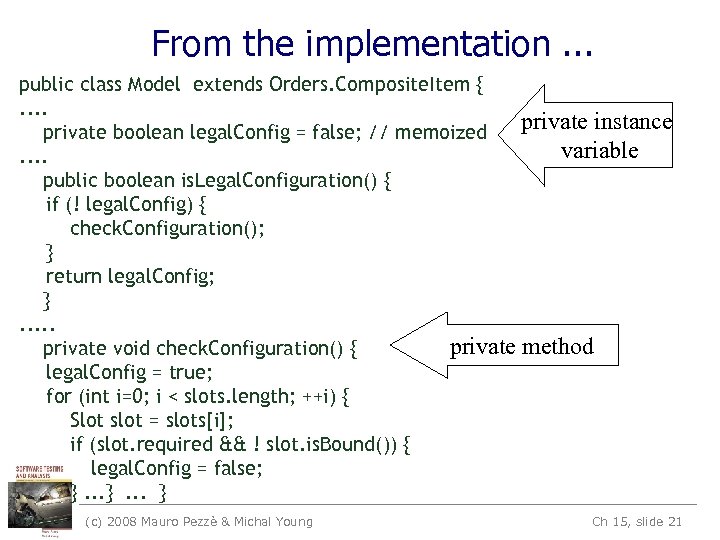
From the implementation. . . public class Model extends Orders. Composite. Item {. . private instance private boolean legal. Config = false; // memoized variable. . public boolean is. Legal. Configuration() { if (! legal. Config) { check. Configuration(); } return legal. Config; }. . . private method private void check. Configuration() { legal. Config = true; for (int i=0; i < slots. length; ++i) { Slot slot = slots[i]; if (slot. required && ! slot. is. Bound()) { legal. Config = false; }. . . (c) 2008 Mauro Pezzè & Michal Young Ch 15, slide 21
Intraclass data flow testing • Exercise sequences of methods – From setting or modifying a field value – To using that field value • We need a control flow graph that encompasses more than a single method. . . (c) 2008 Mauro Pezzè & Michal Young Ch 15, slide 22
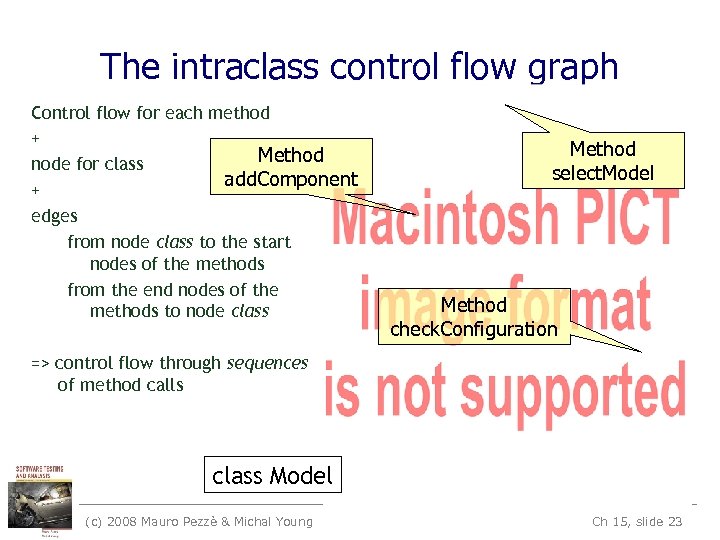
The intraclass control flow graph Control flow for each method + Method node for class add. Component + edges from node class to the start nodes of the methods from the end nodes of the methods to node class Method select. Model Method check. Configuration => control flow through sequences of method calls class Model (c) 2008 Mauro Pezzè & Michal Young Ch 15, slide 23
Interclass structural testing • Working “bottom up” in dependence hierarchy • Dependence is not the same as class hierarchy; not always the same as call or inclusion relation. • May match bottom-up build order – Starting from leaf classes, then classes that use leaf classes, . . . • Summarize effect of each method: Changing or using object state, or both – Treating a whole object as a variable (not just primitive types) (c) 2008 Mauro Pezzè & Michal Young Ch 15, slide 24
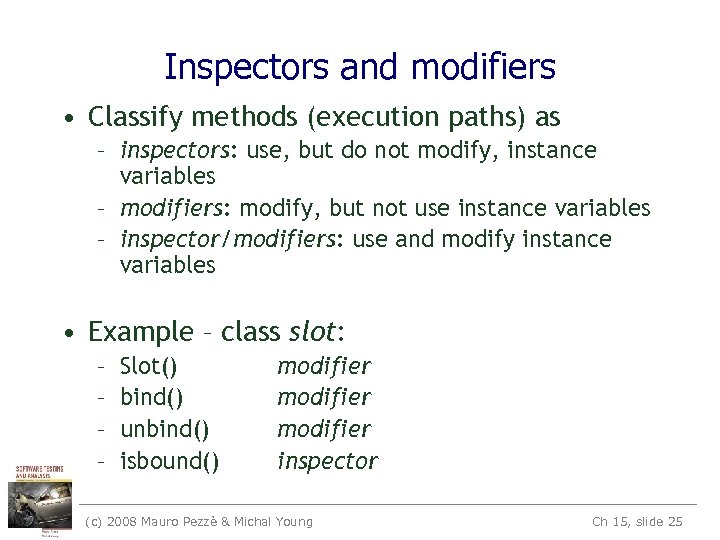
Inspectors and modifiers • Classify methods (execution paths) as – inspectors: use, but do not modify, instance variables – modifiers: modify, but not use instance variables – inspector/modifiers: use and modify instance variables • Example – class slot: – – Slot() bind() unbind() isbound() modifier inspector (c) 2008 Mauro Pezzè & Michal Young Ch 15, slide 25
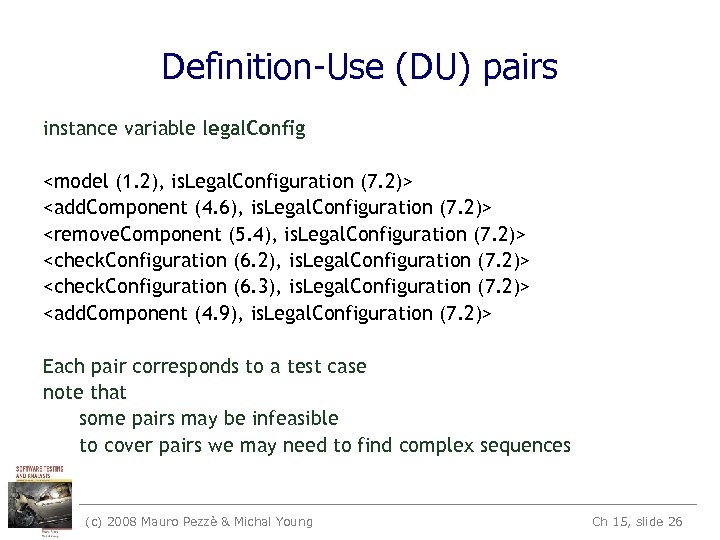
Definition-Use (DU) pairs instance variable legal. Config <model (1. 2), is. Legal. Configuration (7. 2)> <add. Component (4. 6), is. Legal. Configuration (7. 2)> <remove. Component (5. 4), is. Legal. Configuration (7. 2)> <check. Configuration (6. 2), is. Legal. Configuration (7. 2)> <check. Configuration (6. 3), is. Legal. Configuration (7. 2)> <add. Component (4. 9), is. Legal. Configuration (7. 2)> Each pair corresponds to a test case note that some pairs may be infeasible to cover pairs we may need to find complex sequences (c) 2008 Mauro Pezzè & Michal Young Ch 15, slide 26
Definitions from modifiers Definitions of instance variable slot in class model add. Component (4. 5) add. Component (4. 7) add. Component (4. 8) select. Model (2. 3) remove. Component (5. 3) Slot() bind() unbind() isbound() modifier inspector (c) 2008 Mauro Pezzè & Michal Young Ch 15, slide 27
Uses from inspectors Uses of instance variables slot in class model remove. Component (5. 2) check. Configuration (6. 4) check. Configuration (6. 5) check. Configuration (6. 7) Slot() bind() unbind() isbound() Slot slot =slots[slot. Index]; modifier inspector (c) 2008 Mauro Pezzè & Michal Young Ch 15, slide 28
15. 8 Stubs, Drivers, and Oracles for Classes • Problem: State is encapsulated – How can we tell whether a method had the correct effect? • Problem: Most classes are not complete programs – Additional code must be added to execute them • We typically solve both problems together, with scaffolding (c) 2008 Mauro Pezzè & Michal Young Ch 15, slide 29
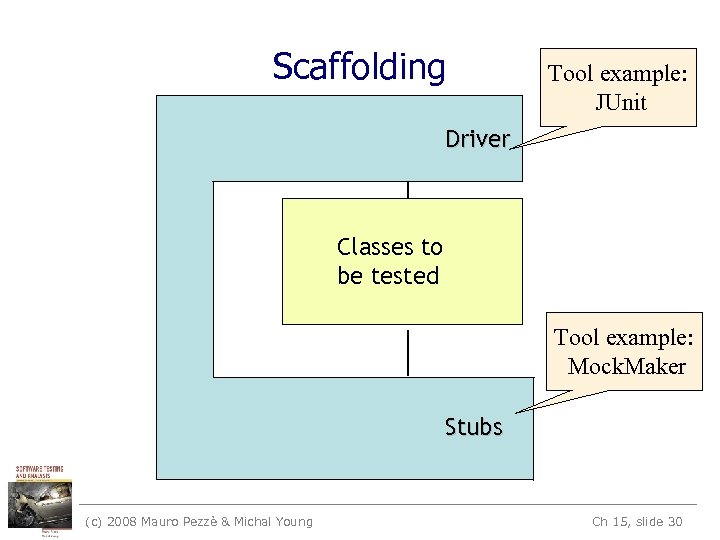
Scaffolding Tool example: JUnit Driver Classes to be tested Tool example: Mock. Maker Stubs (c) 2008 Mauro Pezzè & Michal Young Ch 15, slide 30
Approaches • Requirements on scaffolding approach: Controllability and Observability • General/reusable scaffolding – Across projects; build or buy tools • Project-specific scaffolding – Design for test – Ad hoc, per-class or even per-test-case • Usually a combination (c) 2008 Mauro Pezzè & Michal Young Ch 15, slide 31
Oracles • Test oracles must be able to check the correctness of the behavior of the object when executed with a given input • Behavior produces outputs and brings an object into a new state – We can use traditional approaches to check for the correctness of the output – To check the correctness of the final state we need to access the state (c) 2008 Mauro Pezzè & Michal Young Ch 15, slide 32
Accessing the state • Intrusive approaches – use language constructs (C++ friend classes) – add inspector methods – in both cases we break encapsulation and we may produce undesired results • Equivalent scenarios approach: – generate equivalent and non-equivalent sequences of method invocations – compare the final state of the object after equivalent and non-equivalent sequences (c) 2008 Mauro Pezzè & Michal Young Ch 15, slide 33
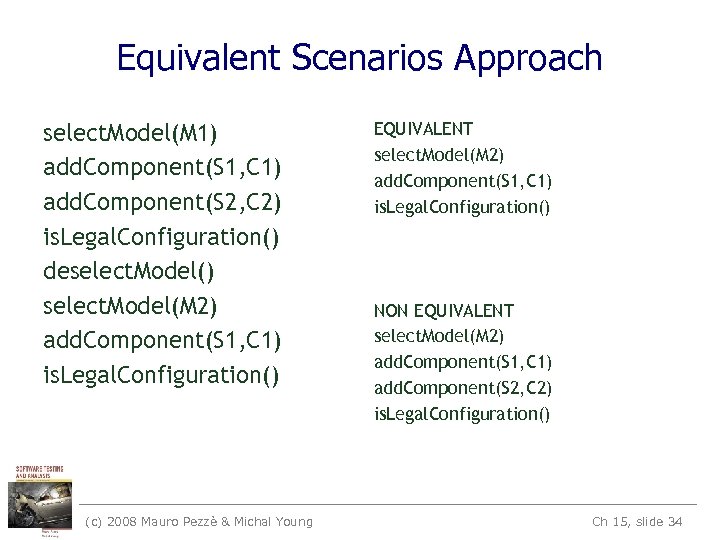
Equivalent Scenarios Approach select. Model(M 1) add. Component(S 1, C 1) add. Component(S 2, C 2) is. Legal. Configuration() deselect. Model() select. Model(M 2) add. Component(S 1, C 1) is. Legal. Configuration() (c) 2008 Mauro Pezzè & Michal Young EQUIVALENT select. Model(M 2) add. Component(S 1, C 1) is. Legal. Configuration() NON EQUIVALENT select. Model(M 2) add. Component(S 1, C 1) add. Component(S 2, C 2) is. Legal. Configuration() Ch 15, slide 34
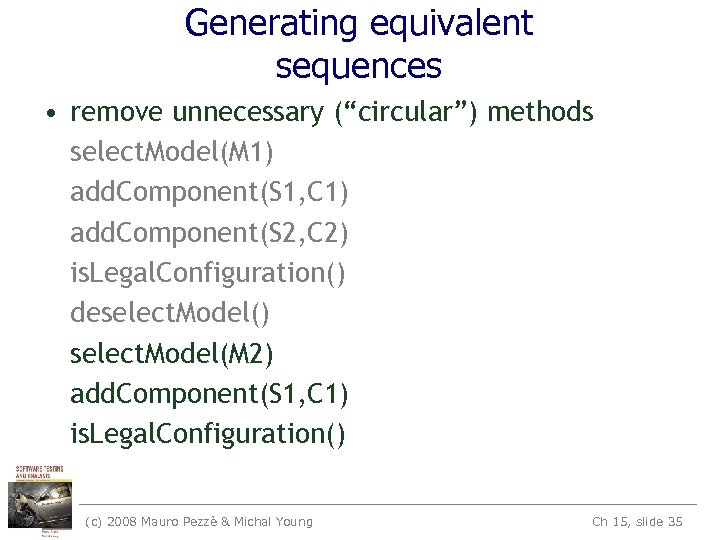
Generating equivalent sequences • remove unnecessary (“circular”) methods select. Model(M 1) add. Component(S 1, C 1) add. Component(S 2, C 2) is. Legal. Configuration() deselect. Model() select. Model(M 2) add. Component(S 1, C 1) is. Legal. Configuration() (c) 2008 Mauro Pezzè & Michal Young Ch 15, slide 35
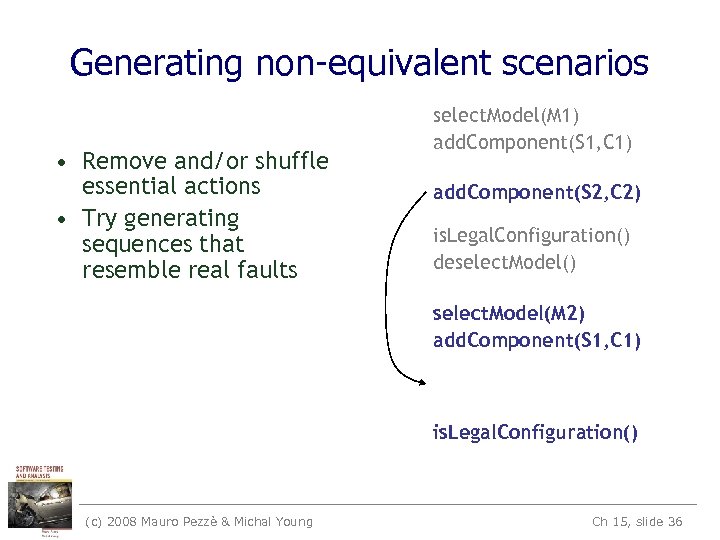
Generating non-equivalent scenarios • Remove and/or shuffle essential actions • Try generating sequences that resemble real faults select. Model(M 1) add. Component(S 1, C 1) add. Component(S 2, C 2) is. Legal. Configuration() deselect. Model() select. Model(M 2) add. Component(S 1, C 1) is. Legal. Configuration() (c) 2008 Mauro Pezzè & Michal Young Ch 15, slide 36
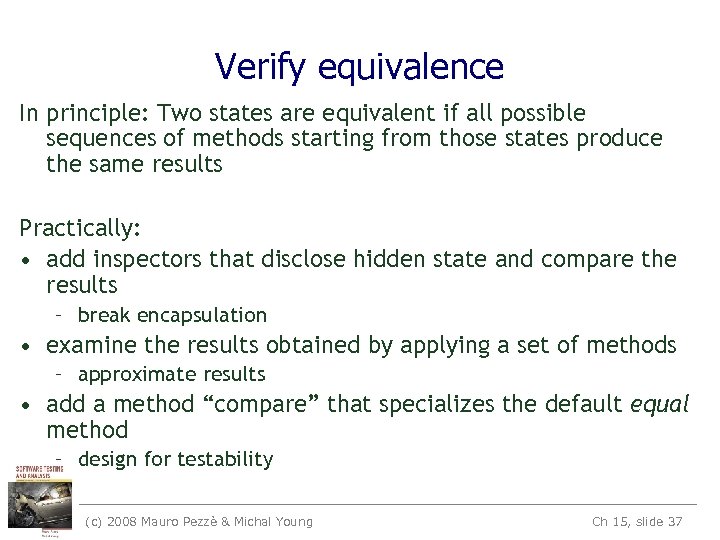
Verify equivalence In principle: Two states are equivalent if all possible sequences of methods starting from those states produce the same results Practically: • add inspectors that disclose hidden state and compare the results – break encapsulation • examine the results obtained by applying a set of methods – approximate results • add a method “compare” that specializes the default equal method – design for testability (c) 2008 Mauro Pezzè & Michal Young Ch 15, slide 37
15. 9 Polymorphism and dynamic binding One variable potentially bound to methods of different (sub-)classes
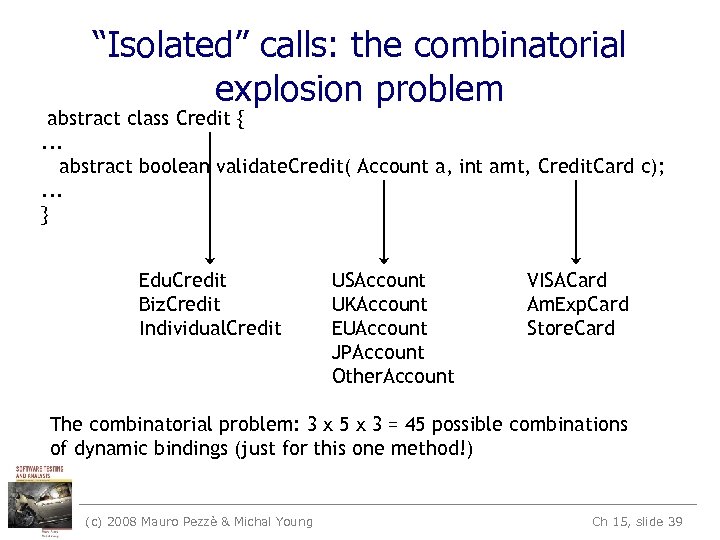
“Isolated” calls: the combinatorial explosion problem abstract class Credit {. . . abstract boolean validate. Credit( Account a, int amt, Credit. Card c); . . . } Edu. Credit Biz. Credit Individual. Credit USAccount UKAccount EUAccount JPAccount Other. Account VISACard Am. Exp. Card Store. Card The combinatorial problem: 3 x 5 x 3 = 45 possible combinations of dynamic bindings (just for this one method!) (c) 2008 Mauro Pezzè & Michal Young Ch 15, slide 39
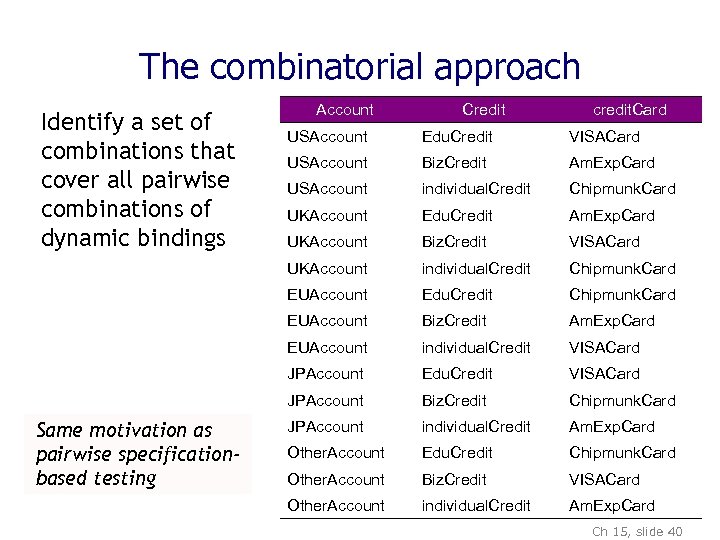
The combinatorial approach Identify a set of combinations that cover all pairwise combinations of dynamic bindings Account Credit credit. Card Edu. Credit VISACard USAccount Biz. Credit Am. Exp. Card USAccount individual. Credit Chipmunk. Card UKAccount Edu. Credit Am. Exp. Card UKAccount Biz. Credit VISACard UKAccount individual. Credit Chipmunk. Card EUAccount Edu. Credit Chipmunk. Card EUAccount Biz. Credit Am. Exp. Card EUAccount individual. Credit VISACard JPAccount Edu. Credit VISACard JPAccount Same motivation as pairwise specificationbased testing USAccount Biz. Credit Chipmunk. Card JPAccount individual. Credit Am. Exp. Card Other. Account Edu. Credit Chipmunk. Card Other. Account Biz. Credit VISACard Other. Account individual. Credit Am. Exp. Card (c) 2008 Mauro Pezzè & Michal Young Ch 15, slide 40
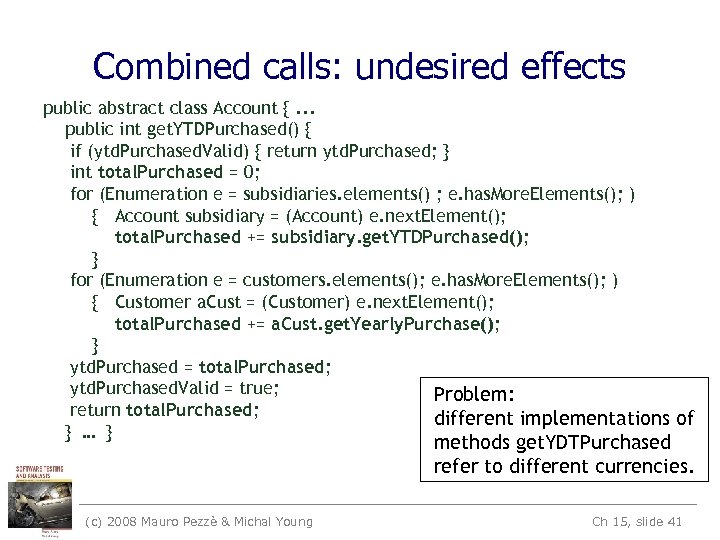
Combined calls: undesired effects public abstract class Account {. . . public int get. YTDPurchased() { if (ytd. Purchased. Valid) { return ytd. Purchased; } int total. Purchased = 0; for (Enumeration e = subsidiaries. elements() ; e. has. More. Elements(); ) { Account subsidiary = (Account) e. next. Element(); total. Purchased += subsidiary. get. YTDPurchased(); } for (Enumeration e = customers. elements(); e. has. More. Elements(); ) { Customer a. Cust = (Customer) e. next. Element(); total. Purchased += a. Cust. get. Yearly. Purchase(); } ytd. Purchased = total. Purchased; ytd. Purchased. Valid = true; Problem: return total. Purchased; different implementations of } … } methods get. YDTPurchased refer to different currencies. (c) 2008 Mauro Pezzè & Michal Young Ch 15, slide 41

A data flow approach ased rch ined def public abstract class Account { step 1: identify. . . public int get. YTDPurchased() { polymorphic calls, binding if (ytd. Purchased. Valid) { return ytd. Purchased; } int total. Purchased = 0; sets, defs and uses for (Enumeration e = subsidiaries. elements() ; e. has. More. Elements(); ) { Account subsidiary = (Account) e. next. Element(); total. Purchased += subsidiary. get. YTDPurchased(); } for (Enumeration e = customers. elements(); e. has. More. Elements(); ) { Customer a. Cust = (Customer) e. next. Element(); total. Purchased += a. Cust. get. Yearly. Purchase(); } ytd. Purchased = total. Purchased; ytd. Purchased. Valid = true; return total. Purchased; } … } u tal. P to total. Purchased used and defined total. Purc hased use d hased use (c) 2008 Mauro Pezzè & Michal Young d Ch 15, slide 42
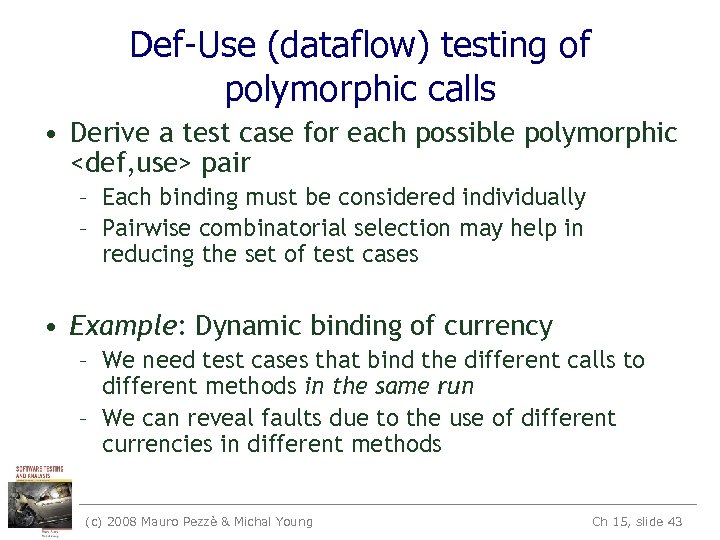
Def-Use (dataflow) testing of polymorphic calls • Derive a test case for each possible polymorphic <def, use> pair – Each binding must be considered individually – Pairwise combinatorial selection may help in reducing the set of test cases • Example: Dynamic binding of currency – We need test cases that bind the different calls to different methods in the same run – We can reveal faults due to the use of different currencies in different methods (c) 2008 Mauro Pezzè & Michal Young Ch 15, slide 43
15. 10 Inheritance • When testing a subclass. . . – We would like to re-test only what has not been thoroughly tested in the parent class • for example, no need to test hash. Code and get. Class methods inherited from class Object in Java – But we should test any method whose behavior may have changed • even accidentally! (c) 2008 Mauro Pezzè & Michal Young Ch 15, slide 44
Reusing Tests with the Testing History Approach • Track test suites and test executions – determine which new tests are needed – determine which old tests must be re-executed • New and changed behavior. . . – new methods must be tested – redefined methods must be tested, but we can partially reuse test suites defined for the ancestor – other inherited methods do not have to be retested (c) 2008 Mauro Pezzè & Michal Young Ch 15, slide 45
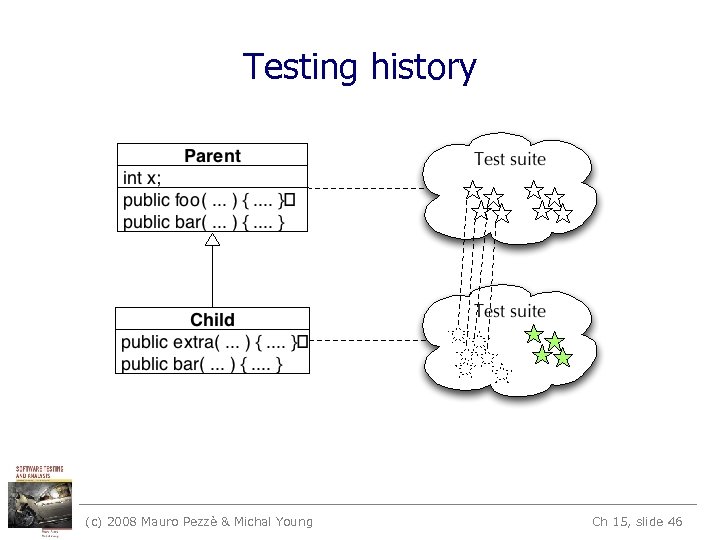
Testing history (c) 2008 Mauro Pezzè & Michal Young Ch 15, slide 46
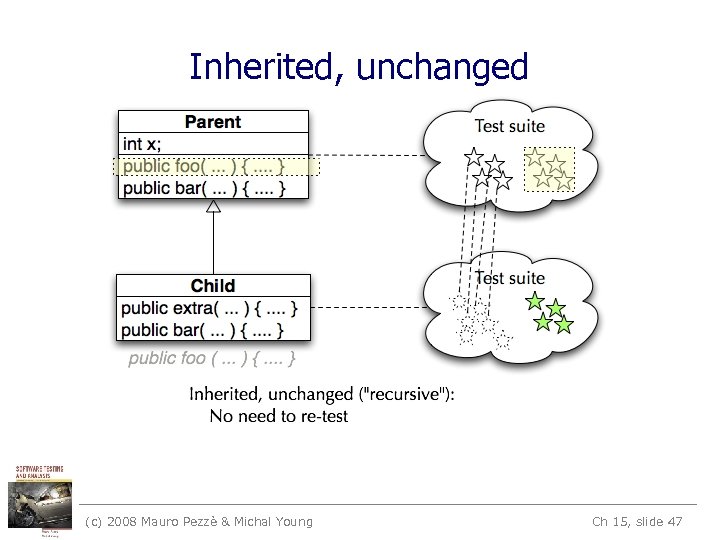
Inherited, unchanged (c) 2008 Mauro Pezzè & Michal Young Ch 15, slide 47
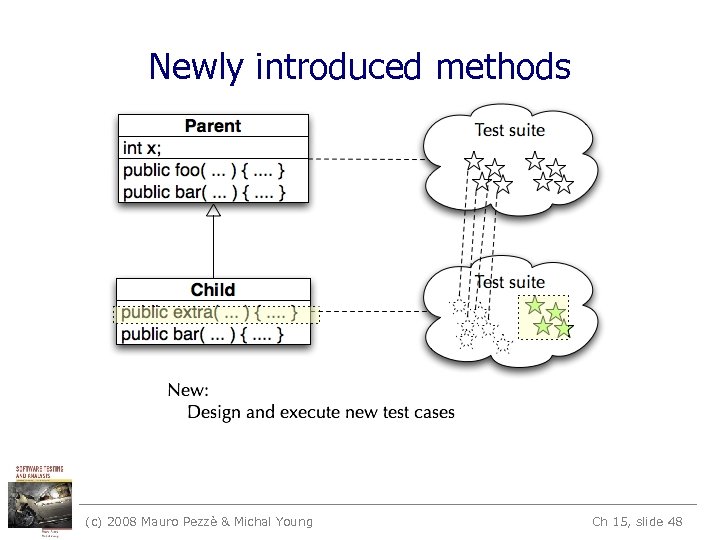
Newly introduced methods (c) 2008 Mauro Pezzè & Michal Young Ch 15, slide 48
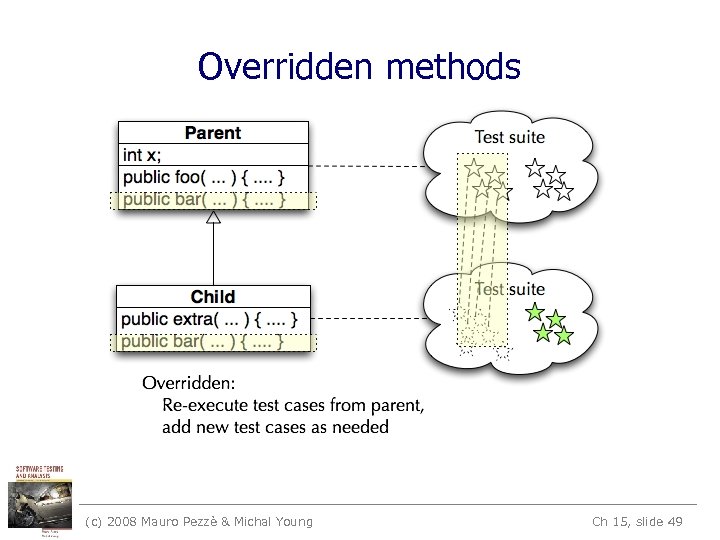
Overridden methods (c) 2008 Mauro Pezzè & Michal Young Ch 15, slide 49
Testing History – some details • Abstract methods (and classes) – Design test cases when abstract method is introduced (even if it can’t be executed yet) • Behavior changes – Should we consider a method “redefined” if another new or redefined method changes its behavior? • The standard “testing history” approach does not do this • It might be reasonable combination of data flow (structural) OO testing with the (functional) testing history approach (c) 2008 Mauro Pezzè & Michal Young Ch 15, slide 50
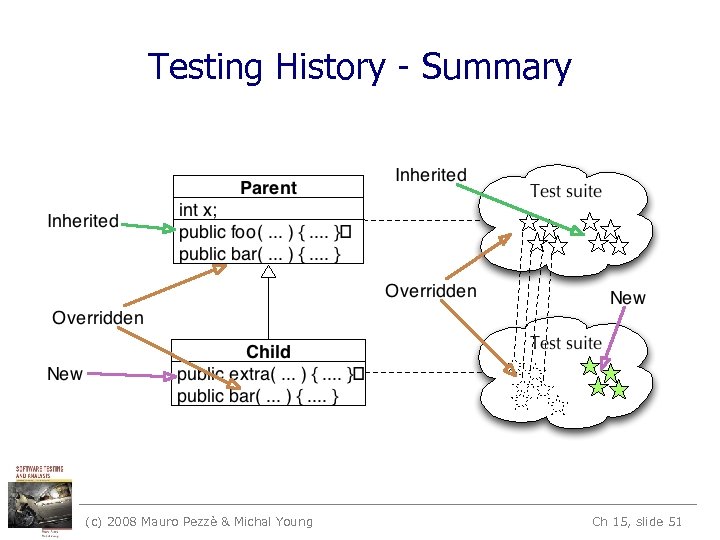
Testing History - Summary (c) 2008 Mauro Pezzè & Michal Young Ch 15, slide 51
Does testing history help? • Executing test cases should (usually) be cheap – It may be simpler to re-execute the full test suite of the parent class –. . . but still add to it for the same reasons • But sometimes execution is not cheap. . . – Example: Control of physical devices – Or very large test suites • Ex: Some Microsoft product test suites require more than one night (so daily build cannot be fully tested) – Then some use of testing history is profitable (c) 2008 Mauro Pezzè & Michal Young Ch 15, slide 52
15. 11 Testing generic classes a generic class Priority. Queue<Elem Implements Comparable> {. . . } is designed to be instantiated with many different parameter types Priority. Queue<Customers> Priority. Queue<Tasks> A generic class is typically designed to behave consistently some set of permitted parameter types. Testing can be broken into two parts – Showing that some instantiation is correct – showing that all permitted instantiations behave consistently (c) 2008 Mauro Pezzè & Michal Young Ch 15, slide 53
Show that some instantiation is correct • Design tests as if the parameter were copied textually into the body of the generic class. – We need source code for both the generic class and the parameter class (c) 2008 Mauro Pezzè & Michal Young Ch 15, slide 54
Identify (possible) interactions • Identify potential interactions between generic and its parameters – Identify potential interactions by inspection or analysis, not testing – Look for: method calls on parameter object, access to parameter fields, possible indirect dependence – Easy case is no interactions at all (e. g. , a simple container class) • Where interactions are possible, they will need to be tested (c) 2008 Mauro Pezzè & Michal Young Ch 15, slide 55
Example interaction class Priority. Queue <Elem implements Comparable> {. . . } • Priority queue uses the “Comparable” interface of Elem to make method calls on the generic parameter • We need to establish that it does so consistently – So that if priority queue works for one kind of Comparable element, we can have some confidence it does so for others (c) 2008 Mauro Pezzè & Michal Young Ch 15, slide 56
Testing variation in instantiation • We can’t test every possible instantiation – Just as we can’t test every possible program input • . . . but there is a contract (a specification) between the generic class and its parameters – Example: “implements Comparable” is a specification of possible instantiations – Other contracts may be written only as comments • Functional (specification-based) testing techniques are appropriate – Identify and then systematically test properties implied by the specification (c) 2008 Mauro Pezzè & Michal Young Ch 15, slide 57
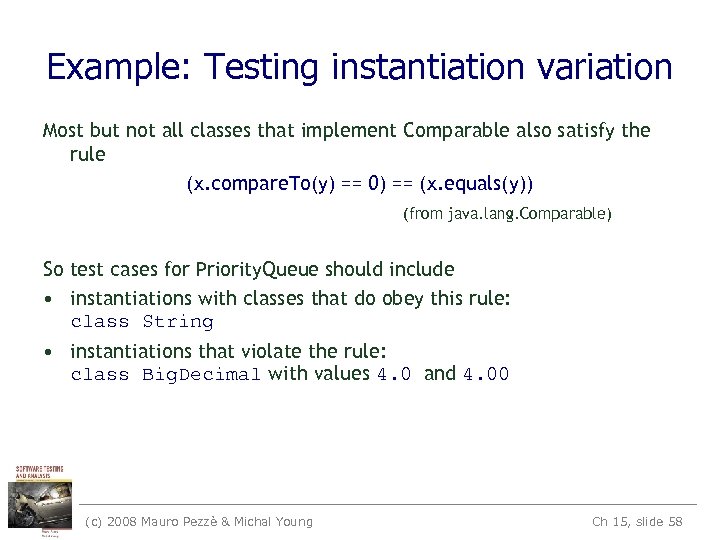
Example: Testing instantiation variation Most but not all classes that implement Comparable also satisfy the rule (x. compare. To(y) == 0) == (x. equals(y)) (from java. lang. Comparable) So test cases for Priority. Queue should include • instantiations with classes that do obey this rule: class String • instantiations that violate the rule: class Big. Decimal with values 4. 0 and 4. 00 (c) 2008 Mauro Pezzè & Michal Young Ch 15, slide 58
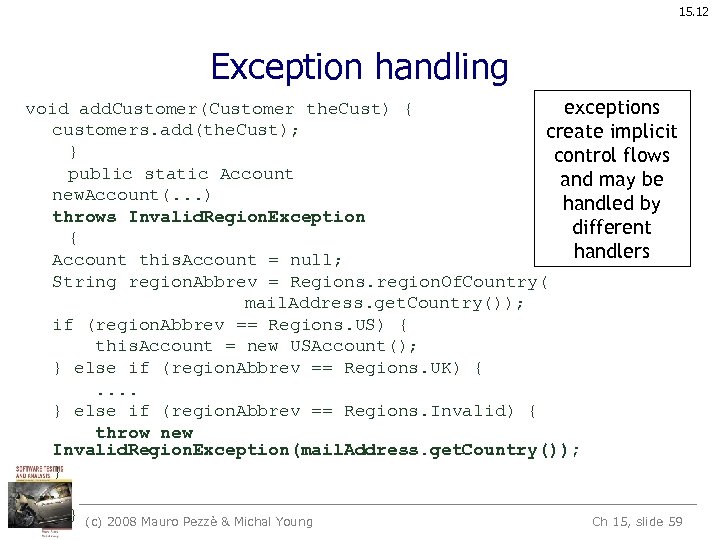
15. 12 Exception handling void add. Customer(Customer the. Cust) { exceptions customers. add(the. Cust); create implicit } control flows public static Account and may be new. Account(. . . ) handled by throws Invalid. Region. Exception different { handlers Account this. Account = null; String region. Abbrev = Regions. region. Of. Country( mail. Address. get. Country()); if (region. Abbrev == Regions. US) { this. Account = new USAccount(); } else if (region. Abbrev == Regions. UK) {. . } else if (region. Abbrev == Regions. Invalid) { throw new Invalid. Region. Exception(mail. Address. get. Country()); }. . . } (c) 2008 Mauro Pezzè & Michal Young Ch 15, slide 59
Testing exception handling • Impractical to treat exceptions like normal flow • too many flows: every array subscript reference, every memory allocation, every cast, . . . • multiplied by matching them to every handler that could appear immediately above them on the call stack. • many actually impossible • So we separate testing exceptions • and ignore program error exceptions (test to prevent them, not to handle them) • What we do test: Each exception handler, and each explicit throw or re-throw of an exception (c) 2008 Mauro Pezzè & Michal Young Ch 15, slide 60
Testing program exception handlers • Local exception handlers – test the exception handler (consider a subset of points bound to the handler) • Non-local exception handlers – Difficult to determine all pairings of <points, handlers> – So enforce (and test for) a design rule: if a method propagates an exception, the method call should have no other effect (c) 2008 Mauro Pezzè & Michal Young Ch 15, slide 61
Summary • Several features of object-oriented languages and programs impact testing – from encapsulation and state-dependent structure to generics and exceptions – but only at unit and subsystem levels – and fundamental principles are still applicable • Basic approach is orthogonal – Techniques for each major issue (e. g. , exception handling, generics, inheritance, . . . ) can be applied incrementally and independently (c) 2008 Mauro Pezzè & Michal Young Ch 15, slide 62
Скачать презентацию Testing Object Oriented Software Chapter 15 Learning
a566caa83d5f2afcd0f86800b4351dcd.ppt