


 Скачать презентацию Testing KLEE Unassisted and Automatic Generation of High-Coverage
963d333ececcfee4b0f52be1e90ab761.ppt
- Количество слайдов: 52
 Testing KLEE: Unassisted and Automatic Generation of High-Coverage Tests for Complex Systems Programs (2008) Cristian Cadar, Daniel Dunbar, Dawson Engler EXE: Automatically Generating Inputs of Death (2006) Cristian Cadar, Vijay Ganesh, Peter M. Pawlowski, David L. Dill, Dawson R. Engler Presented by Oren Kishon 9/3/2014
 Agenda • Testing: Introduction • KLEE + STP: Technical details • Evaluation • Related work • Summary • Discussion
 Agenda • Testing: Introduction • KLEE + STP: Technical details • Evaluation • Related work • Summary • Discussion
 Testing • Purpose : • Verifying functional correctness (vs. spec) • Verifying software completeness - no crashes, memory leaks, assert violations…
 Testing • Purpose : • Verifying functional correctness (vs. spec) • Verifying software completeness - no crashes, memory leaks, assert violations…
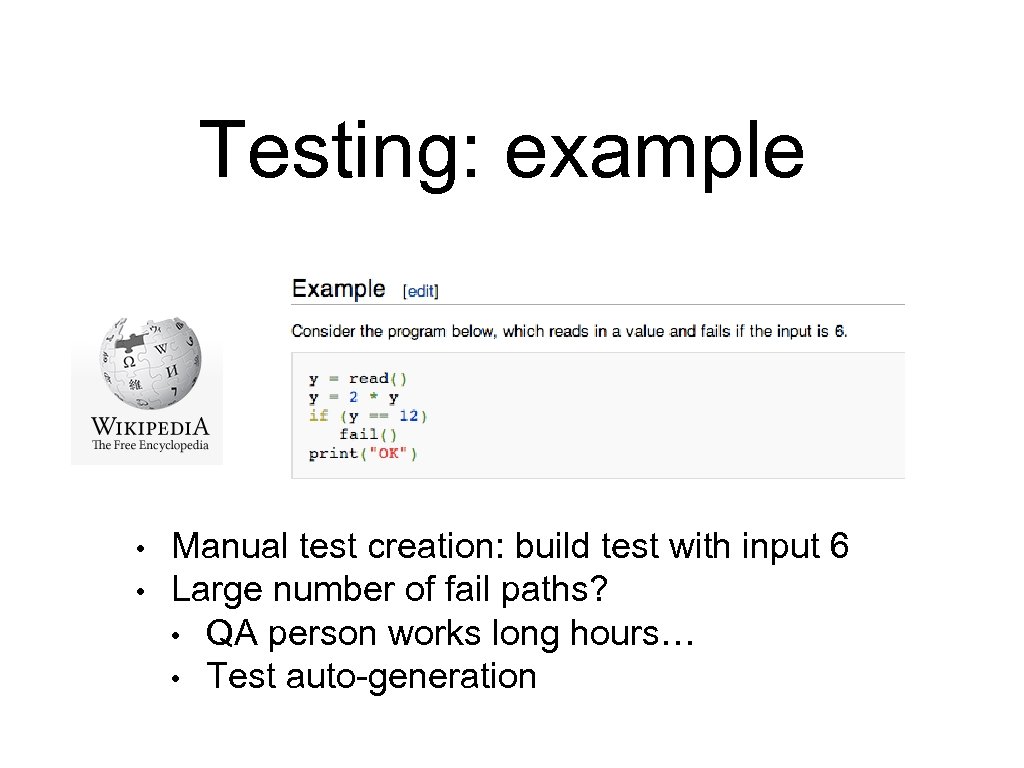 Testing: example • • Manual test creation: build test with input 6 Large number of fail paths? • QA person works long hours… • Test auto-generation
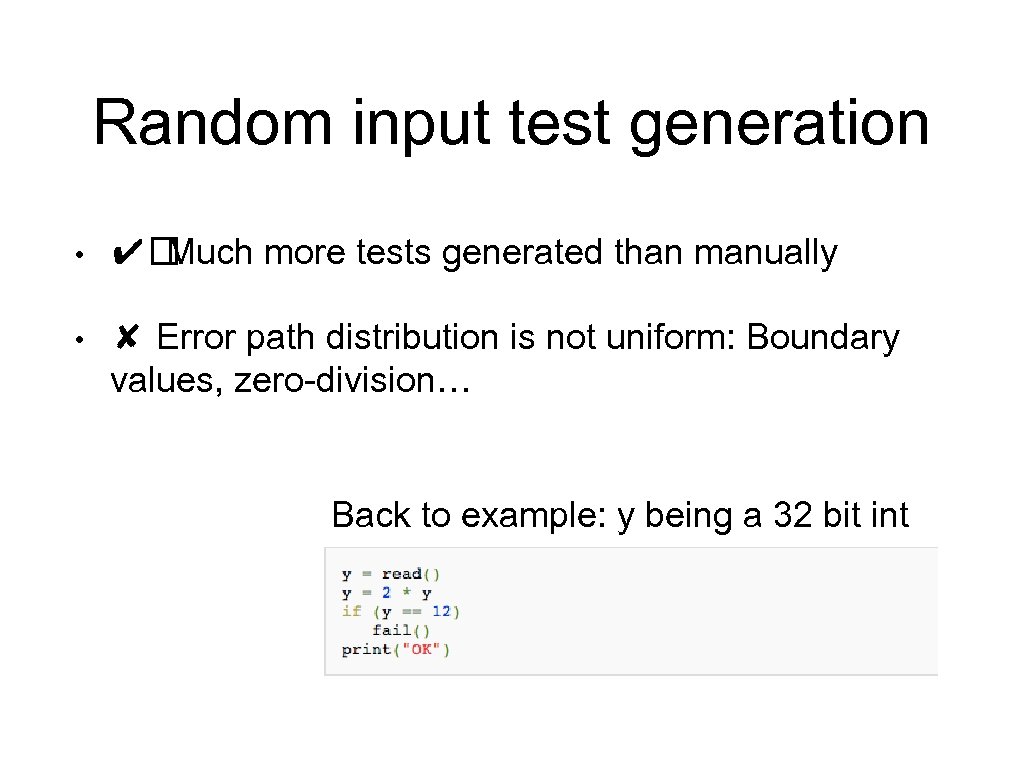 Random input test generation • ✔ Much more tests generated than manually • ✘ Error path distribution is not uniform: Boundary values, zero-division… Back to example: y being a 32 bit int
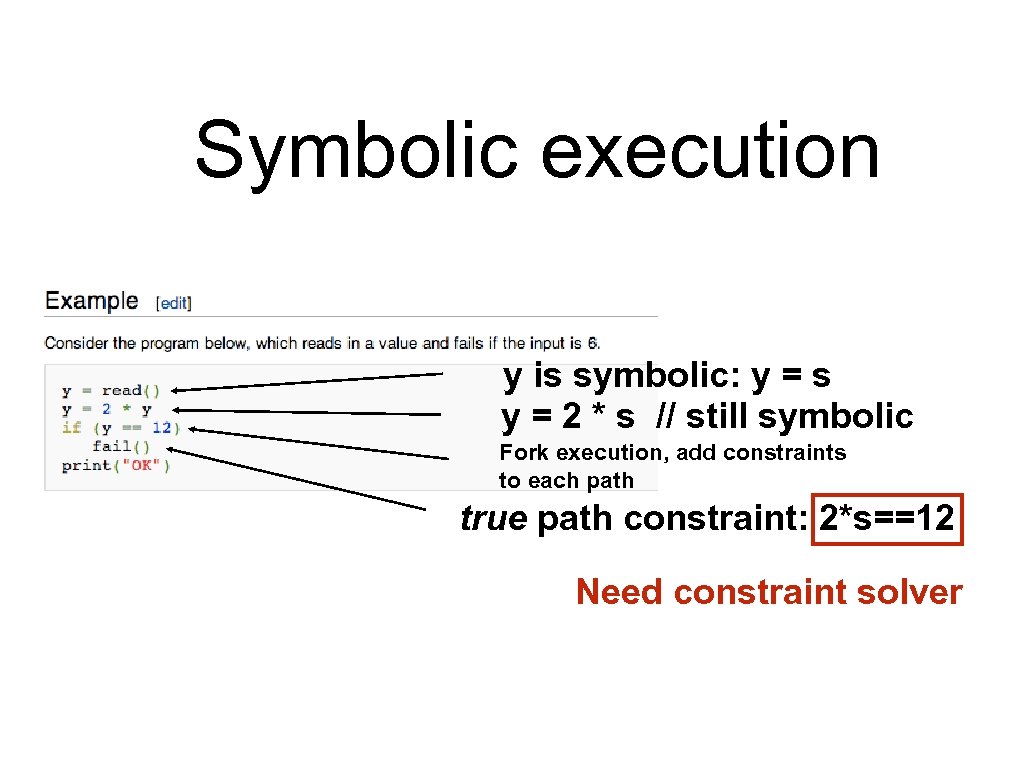 Symbolic execution y is symbolic: y = s y = 2 * s // still symbolic Fork execution, add constraints to each path true path constraint: 2*s==12 Need constraint solver
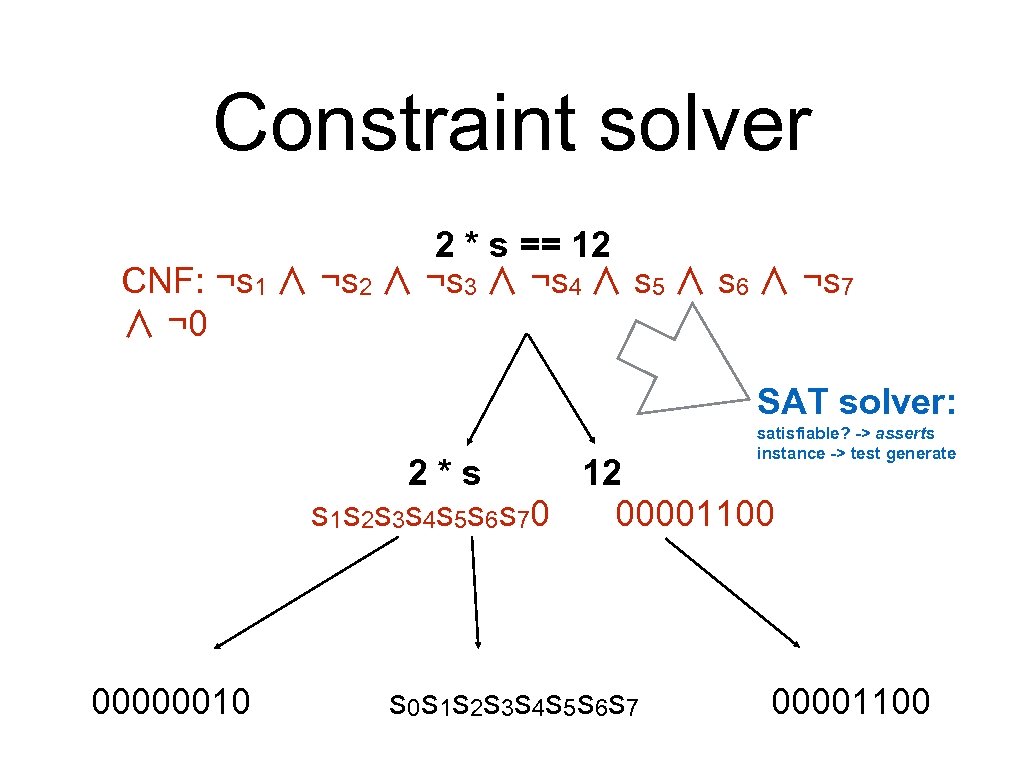 Constraint solver 2 * s == 12 CNF: ¬s 1 ∧ ¬s 2 ∧ ¬s 3 ∧ ¬s 4 ∧ s 5 ∧ s 6 ∧ ¬s 7 ∧ ¬ 0 SAT solver: satisfiable? -> asserts instance -> test generate 2*s 12 s 1 s 2 s 3 s 4 s 5 s 6 s 70 00001100 00000010 s 0 s 1 s 2 s 3 s 4 s 5 s 6 s 7 00001100
 KLEE: symbolic executer • Architecture: compiles C code to LLVM byte code. Executes a symbolic interpreter. • Map LLVM instructions to constraints. Constraint solver: STP. • generates executable tests, independent of KLEE. • Used to check all GNU Coreutils and covered 90% lines: more than 15 year on-going manual test suite - in 89 hours.
 Introduction • Before technical details - any questions?
 Agenda • Testing: Introduction • KLEE + STP: Technical details • Evaluation • Related work • Summary • Discussion
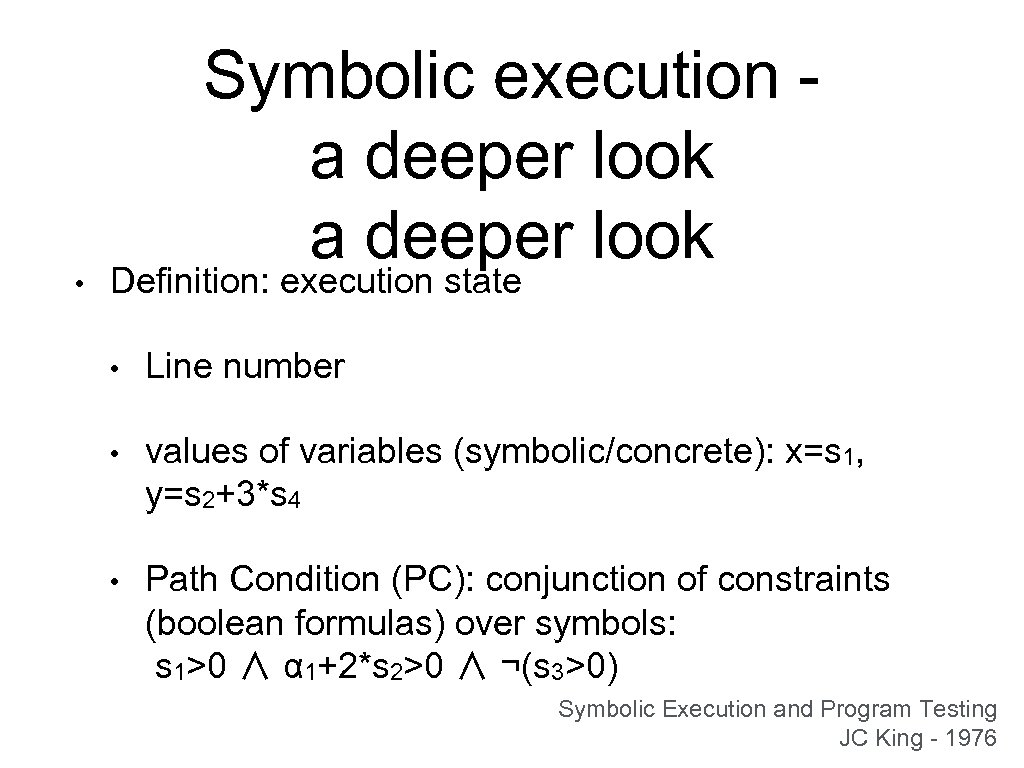 • Symbolic execution a deeper look Definition: execution state • Line number • values of variables (symbolic/concrete): x=s 1, y=s 2+3*s 4 • Path Condition (PC): conjunction of constraints (boolean formulas) over symbols: s 1>0 ∧ α 1+2*s 2>0 ∧ ¬(s 3>0) Symbolic Execution and Program Testing JC King - 1976
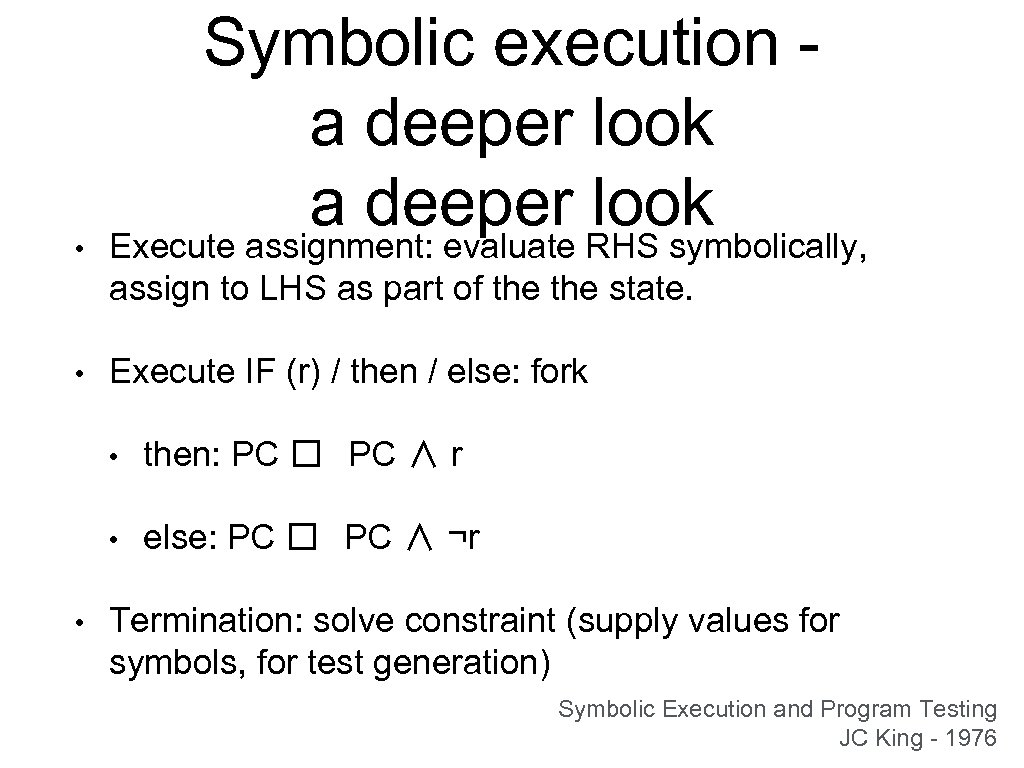 • Symbolic execution a deeper look a deeper RHS symbolically, look Execute assignment: evaluate assign to LHS as part of the state. • Execute IF (r) / then / else: fork • • • then: PC ∧ r else: PC ∧ ¬r Termination: solve constraint (supply values for symbols, for test generation) Symbolic Execution and Program Testing JC King - 1976
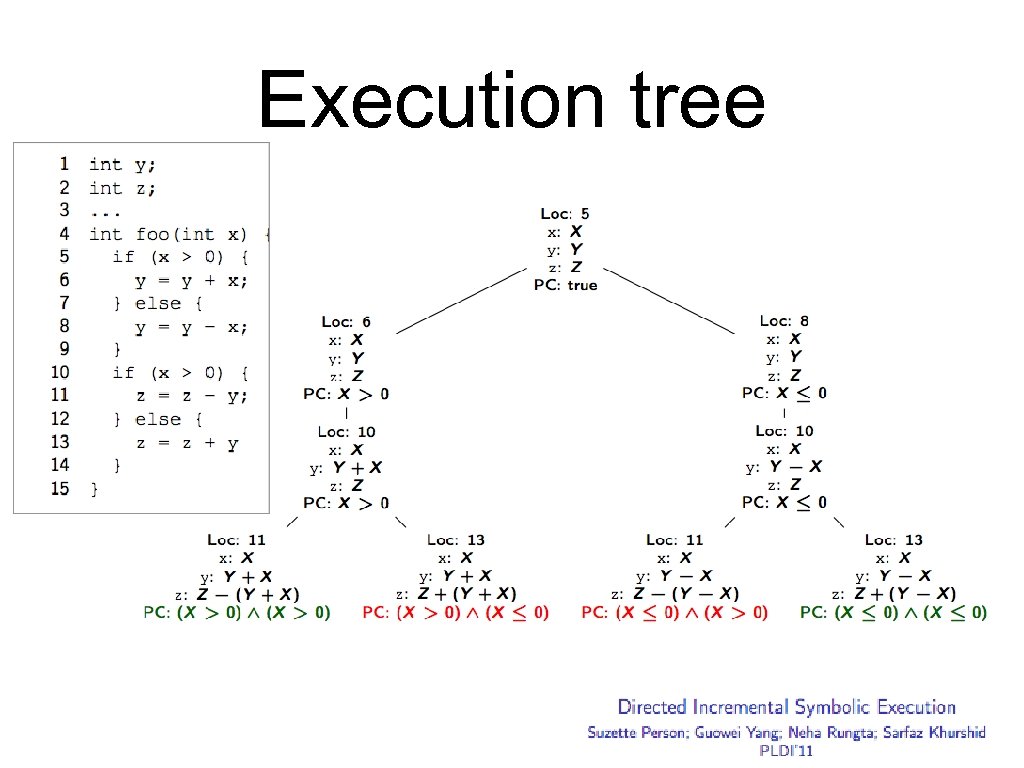 Execution tree
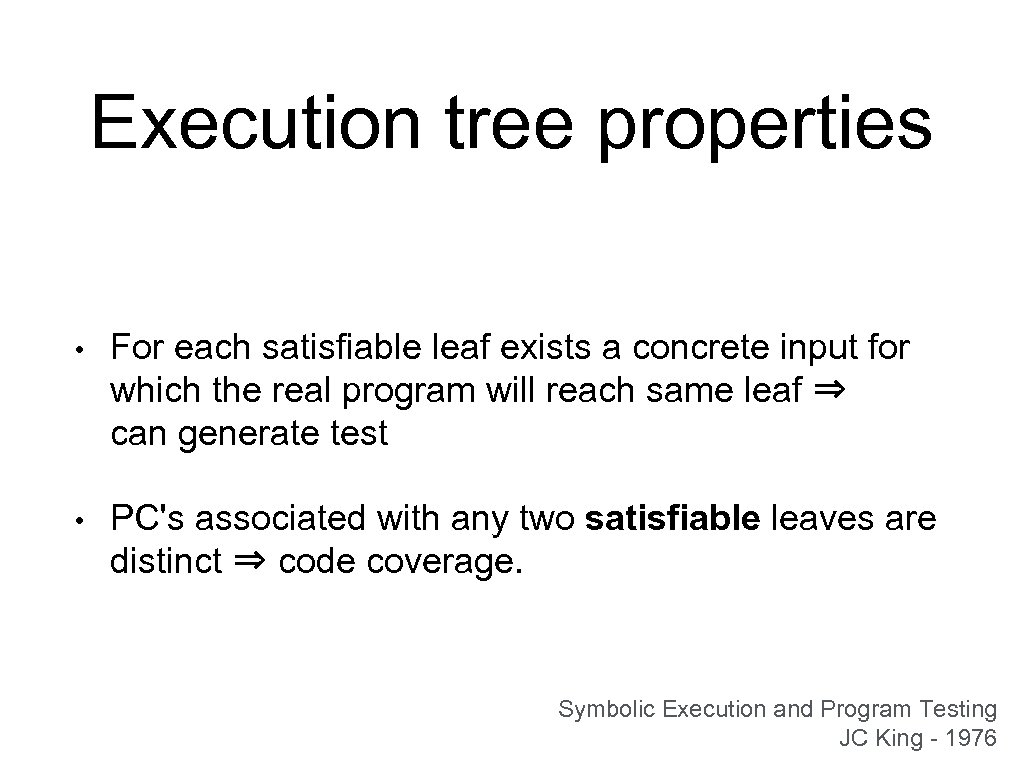 Execution tree properties • For each satisfiable leaf exists a concrete input for which the real program will reach same leaf ⇒ can generate test • PC's associated with any two satisfiable leaves are distinct ⇒ code coverage. Symbolic Execution and Program Testing JC King - 1976
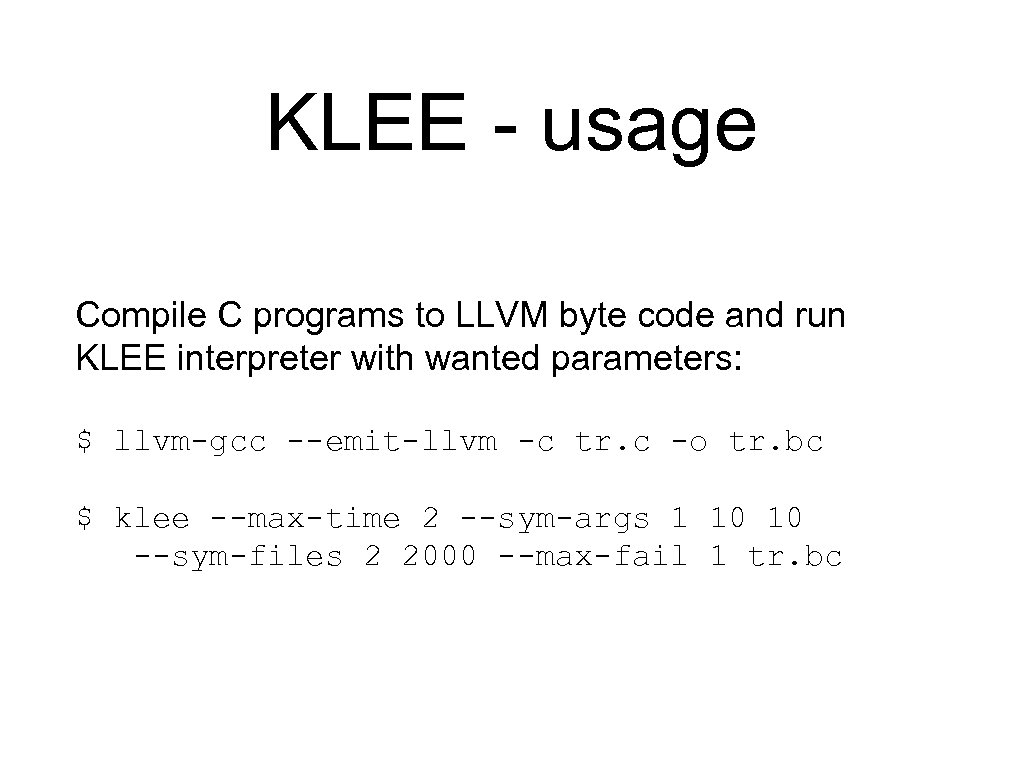 KLEE - usage Compile C programs to LLVM byte code and run KLEE interpreter with wanted parameters: $ llvm-gcc --emit-llvm -c tr. c -o tr. bc $ klee --max-time 2 --sym-args 1 10 10 --sym-files 2 2000 --max-fail 1 tr. bc
![KLEE - symbolic execution: tr (Minix) arguments 3 symbolic Fork execution Fork, constraint arg[0]==‘[‘](https://present5.com/presentation/963d333ececcfee4b0f52be1e90ab761/image-18.jpg "KLEE - symbolic execution: tr (Minix) arguments 3 symbolic Fork execution Fork, constraint arg[0]==‘[‘") KLEE - symbolic execution: tr (Minix) arguments 3 symbolic Fork execution Fork, constraint arg[0]==‘[‘ Detect bug (implicit array bounds checking) and generate test: input={“[“, “”} all 37 paths in 2 minutes
KLEE - symbolic execution: tr (Minix) arguments 3 symbolic Fork execution Fork, constraint arg[0]==‘[‘ Detect bug (implicit array bounds checking) and generate test: input={“[“, “”} all 37 paths in 2 minutes
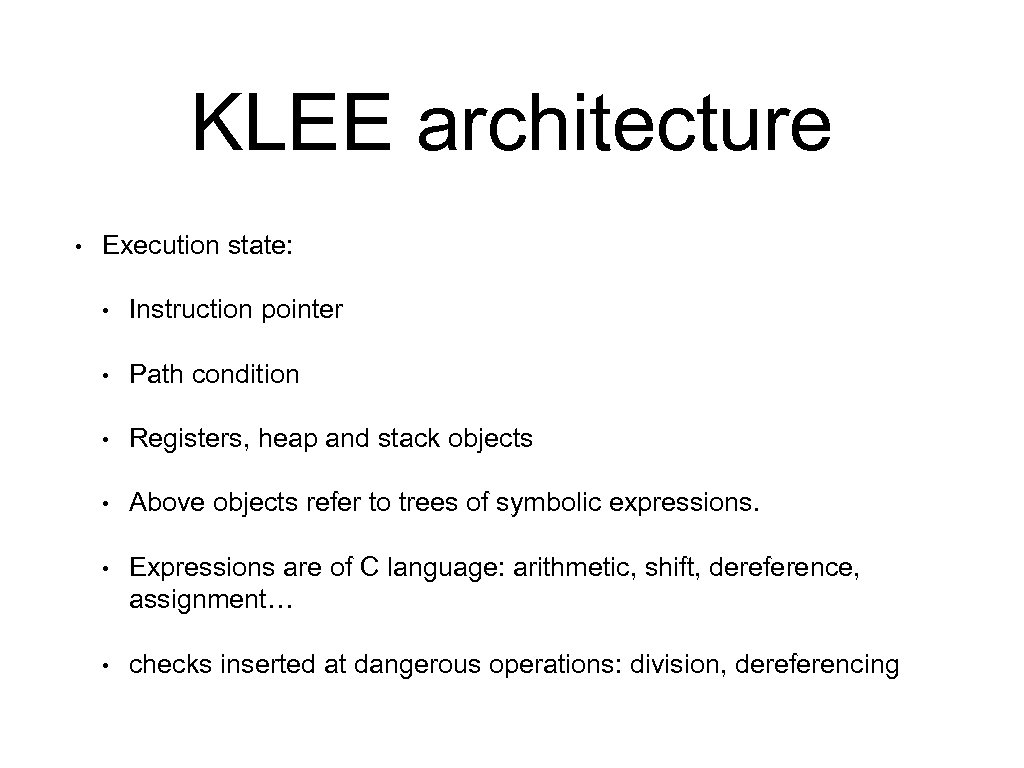 KLEE architecture • Execution state: • Instruction pointer • Path condition • Registers, heap and stack objects • Above objects refer to trees of symbolic expressions. • Expressions are of C language: arithmetic, shift, dereference, assignment… • checks inserted at dangerous operations: division, dereferencing
 STP - constraint solver • A Decision Procedure for Bit-Vectors and Arrays • “Decision procedures are programs which determine the satisfiability of logical formulas that can express constraints relevant to software and hardware” • STP uses new efficient SAT solvers.
 STP - constraint solver • Treat everything as bit vectors - no types. • Expressions on bit vectors: arithmetic (incl. non linear), bitwise operations, relational operations. • All formulas are converted to DAGs of single bit operations (node for every bit!)
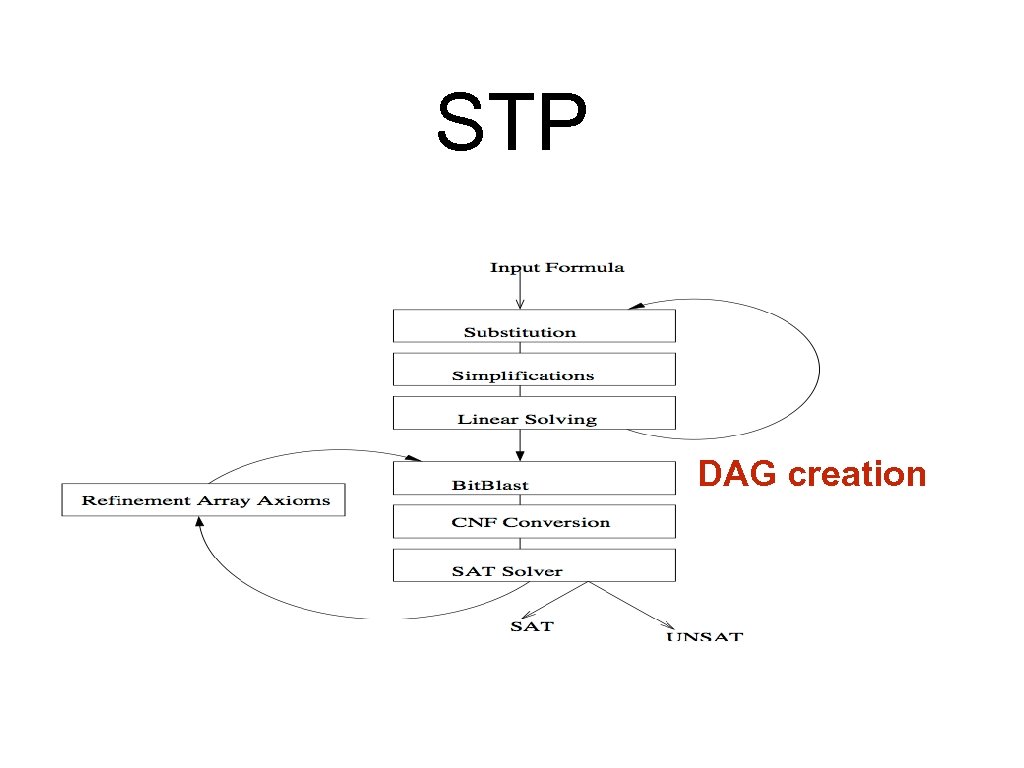 STP DAG creation
 Query optimizations • Constraint solver dominates run time (NP-complete problem in general…) • Can pre-process calls to solver to make query easier • Two complicated optimizations (presented next) and other basic ones (later on)
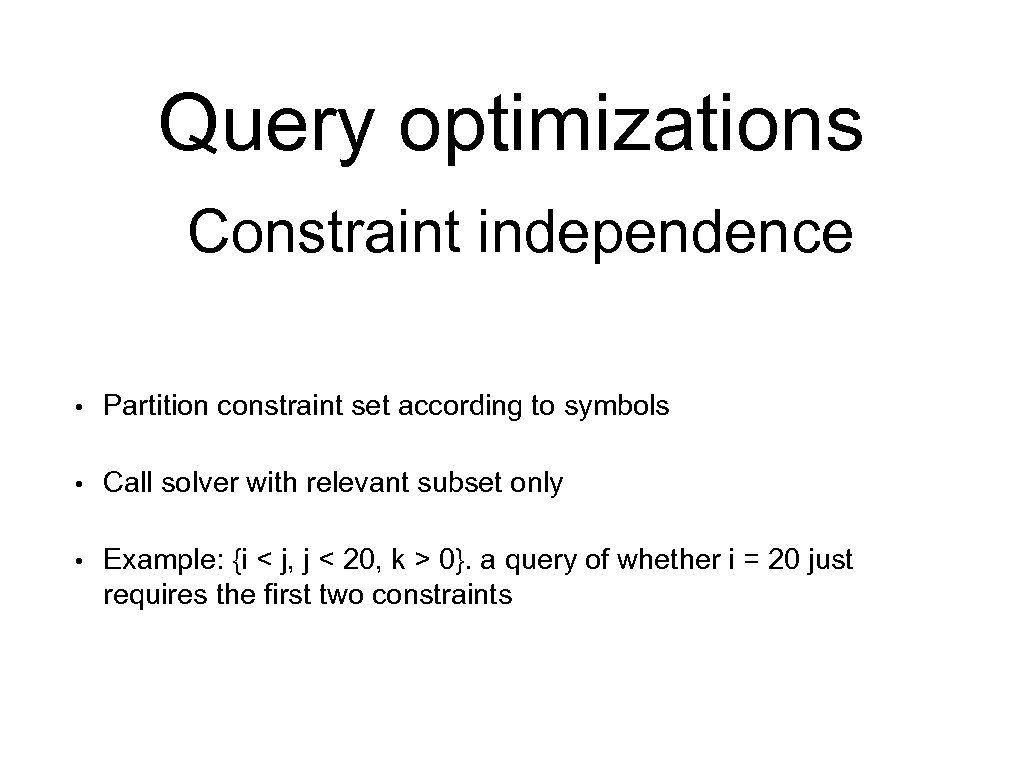 Query optimizations Constraint independence • Partition constraint set according to symbols • Call solver with relevant subset only • Example: {i < j, j < 20, k > 0}. a query of whether i = 20 just requires the first two constraints
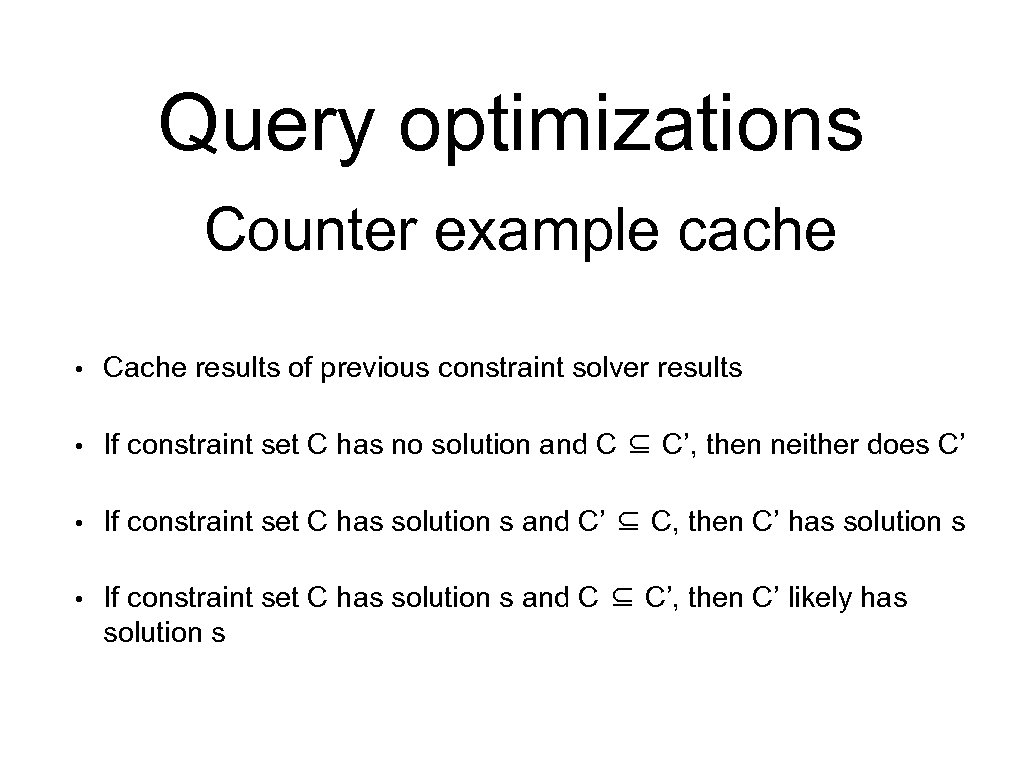 Query optimizations Counter example cache • Cache results of previous constraint solver results • If constraint set C has no solution and C ⊆ C’, then neither does C’ • If constraint set C has solution s and C’ ⊆ C, then C’ has solution s • If constraint set C has solution s and C ⊆ C’, then C’ likely has solution s
 State choosing heuristics: • A big challenge of symbolic executing: path explosion • Can’t cover all paths: need to choose wisely • Use different choosing heuristic at each selection (using round robin)
 State choosing heuristics: Random Path Selection • Maintain binary tree of paths • When branch reached, traverse randomly from root to select state to execute • Done to prevent starvation caused by large subtrees (i. e loops with symbolic condition)
 State choosing heuristics: Coverage-optimize search • Compute state weight using: • Minimum distance to an uncovered instruction • Call stack of the state • Whether the state recently covered new code
 Environment modeling • Another big challenge of symbolic executing: symbolizing file systems, env. variables, network packets, etc. • KLEE’s solution: model as much as you can. modeling means to costumize code of system calls (e. g. open, read, write, stat, lseek, ftruncate, ioctl): 2500 lines of modeling code.
 Environment modeling • File system examples • Read concrete file with symbolic offset: read() is wrapped with pread() • Open symbolic file-name: • Program was initiated with a symbolic file system with up to N files (user defined). • Open all N files + one open() failure
 Environment modeling • How to generate tests after using symbolic env: • Except of supplying input args, supply an description of symbolic env for each test path. • A special driver creates real OS objects from the description
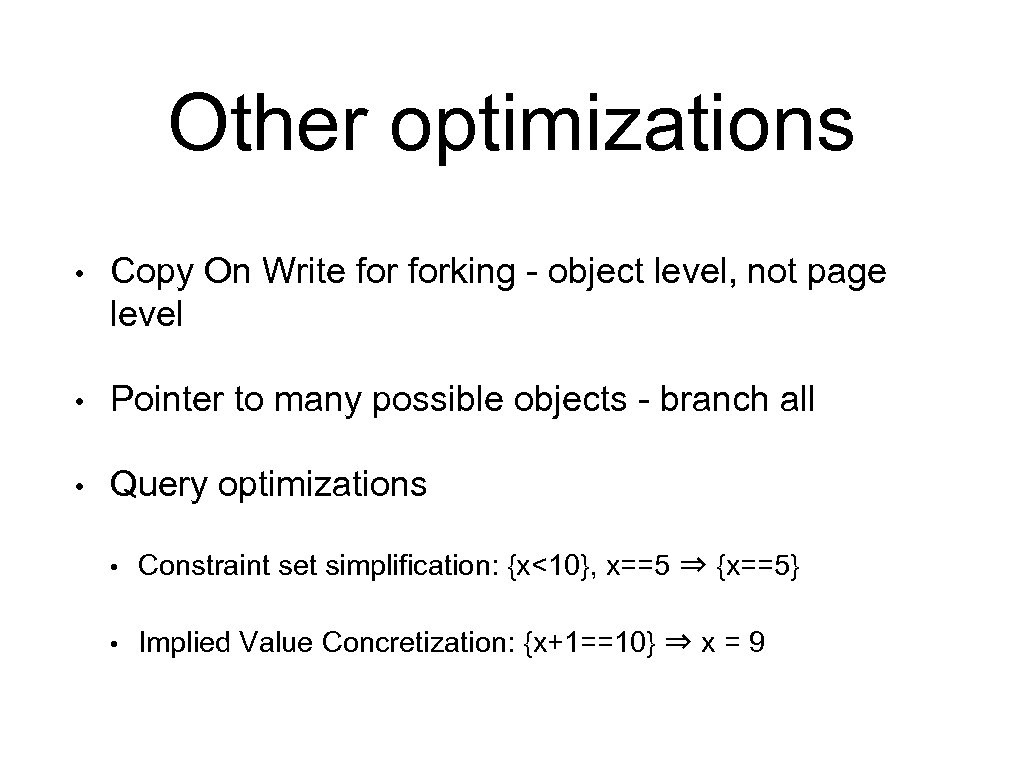 Other optimizations • Copy On Write forking - object level, not page level • Pointer to many possible objects - branch all • Query optimizations • Constraint set simplification: {x<10}, x==5 ⇒ {x==5} • Implied Value Concretization: {x+1==10} ⇒ x = 9
 KLEE • Questions?
 Agenda • Testing: Introduction • KLEE + STP: Technical details • Evaluation • Related work • Summary • Discussion
 Evaluation - Metrics • Line coverage, only executable: ELOC percentage • Doesn’t measure actual conditional paths used • Used also because the gcov profiler outputs it and its a common tool among testing tools.
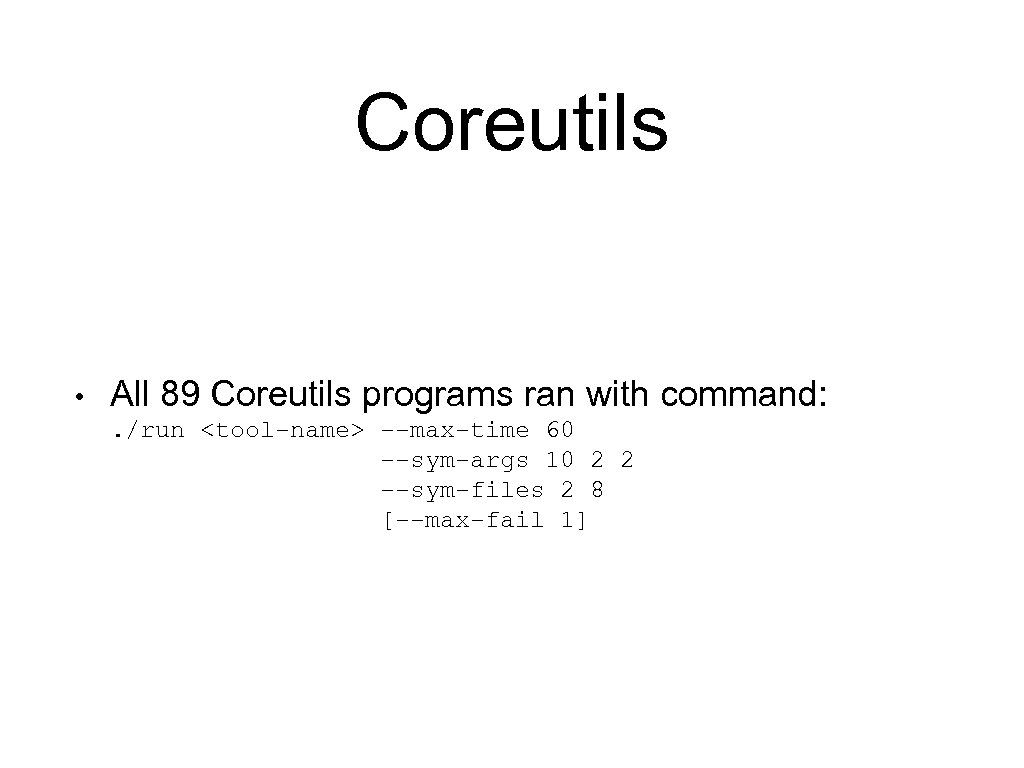 Coreutils • All 89 Coreutils programs ran with command: . /run
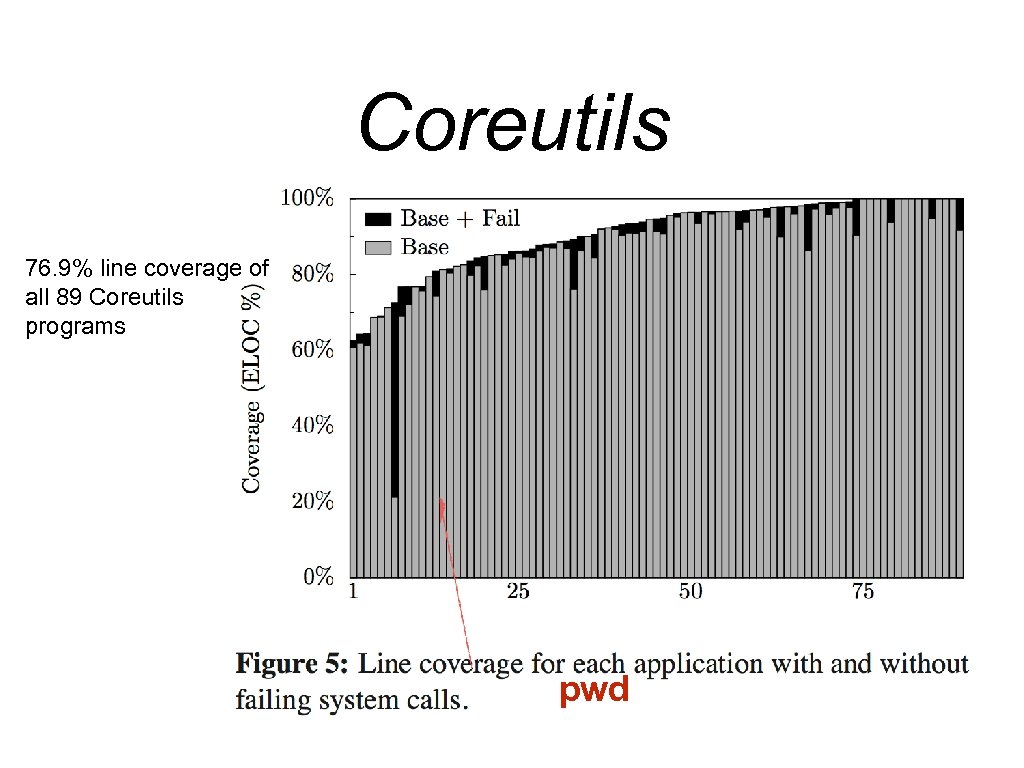 Coreutils 76. 9% line coverage of all 89 Coreutils programs pwd
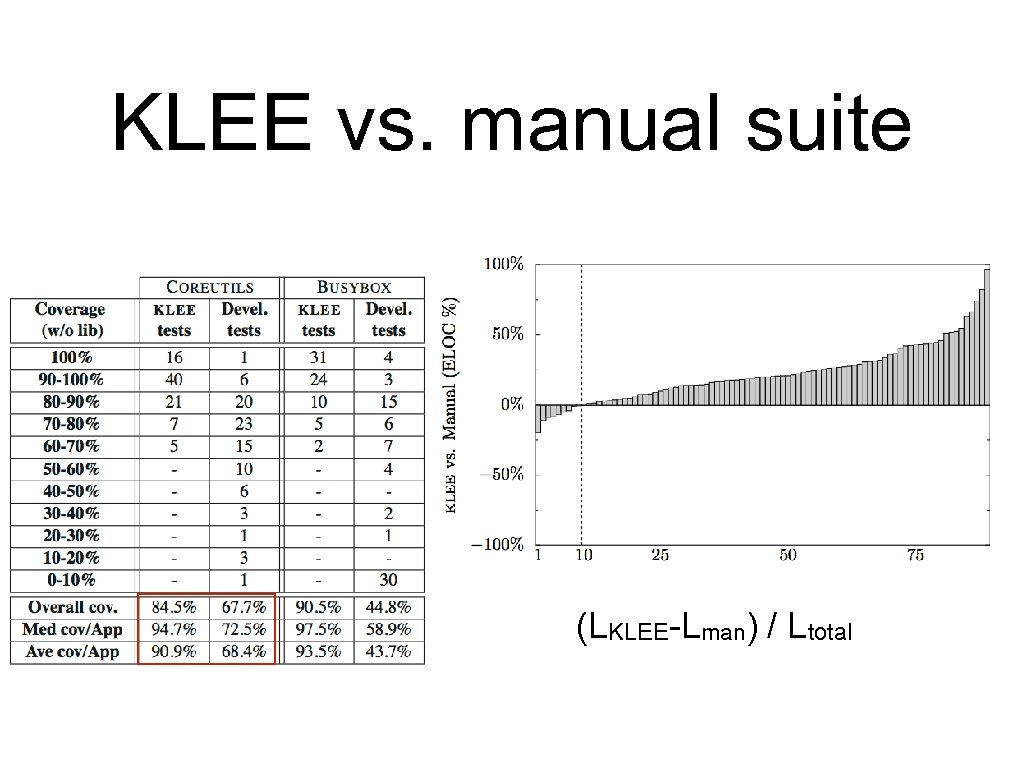 KLEE vs. manual suite (LKLEE-Lman) / Ltotal
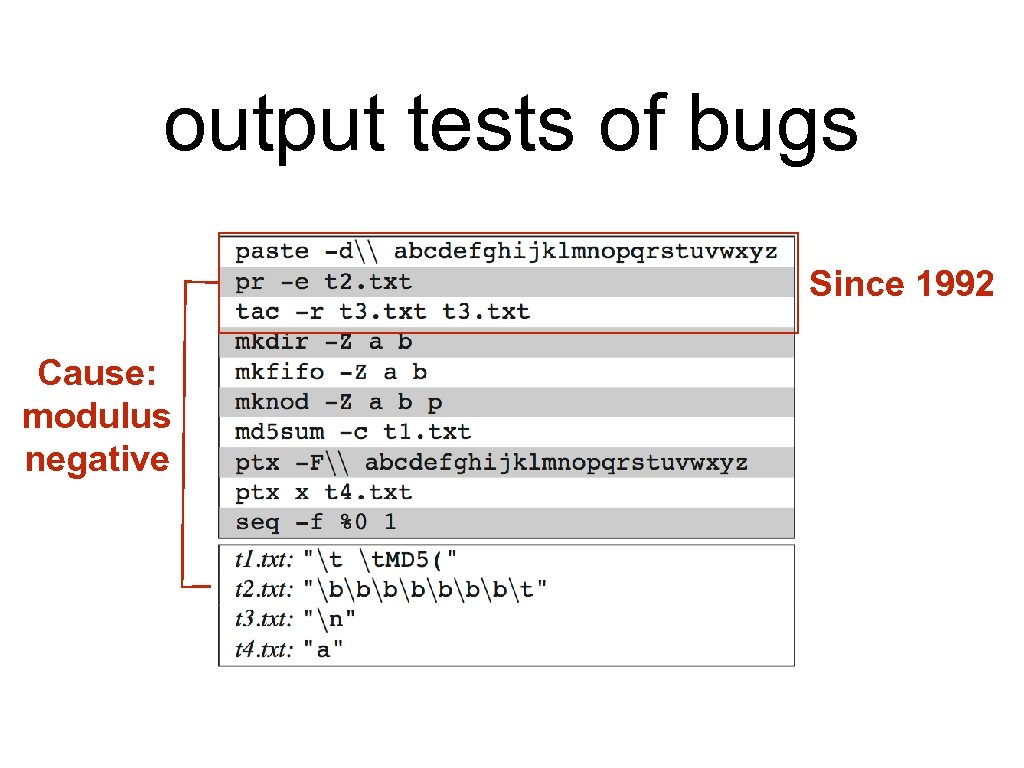 output tests of bugs Since 1992 Cause: modulus negative
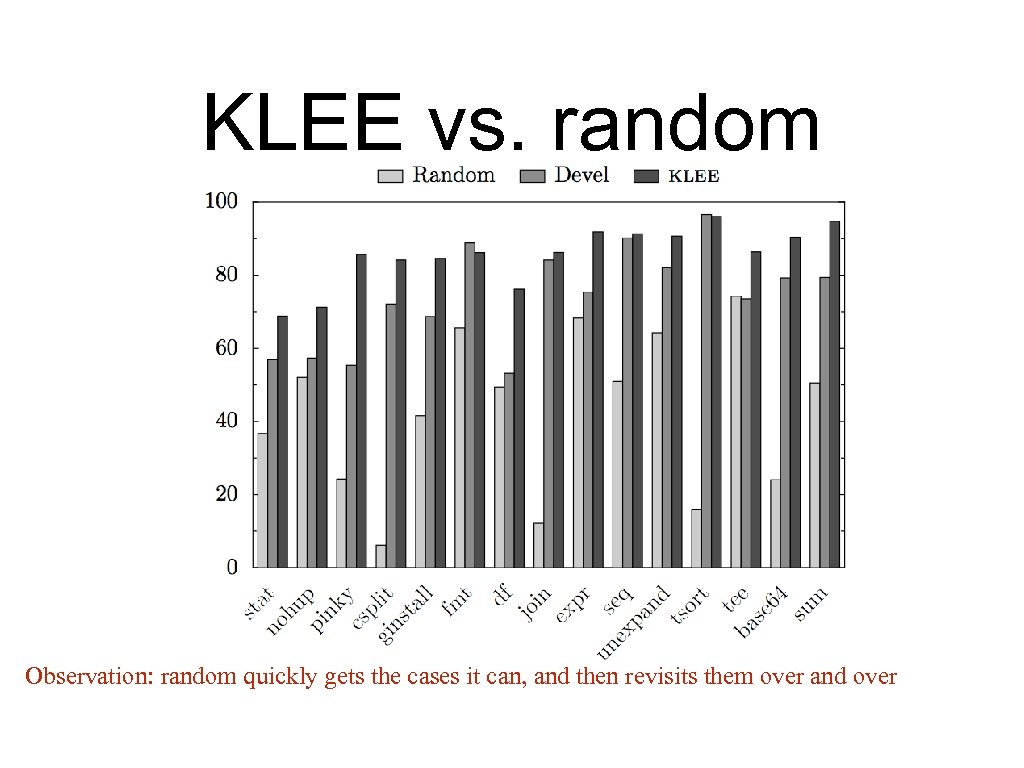 KLEE vs. random Observation: random quickly gets the cases it can, and then revisits them over and over
 Program equivalence • Needed in: • standard implementation • New version testing
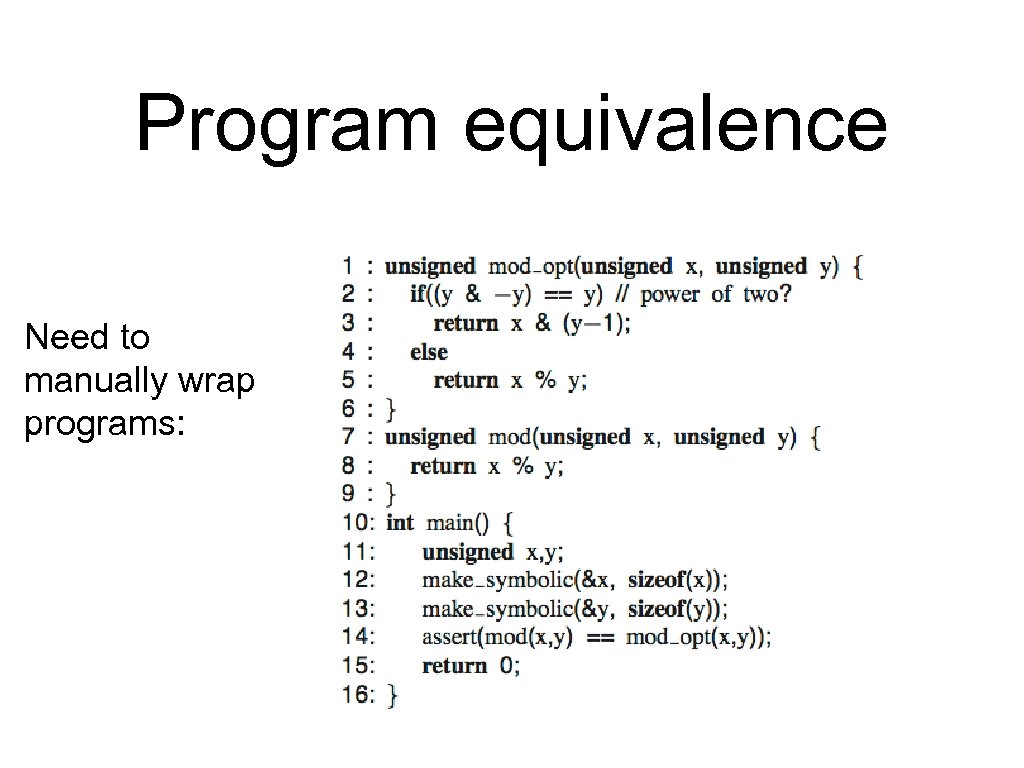 Program equivalence Need to manually wrap programs:
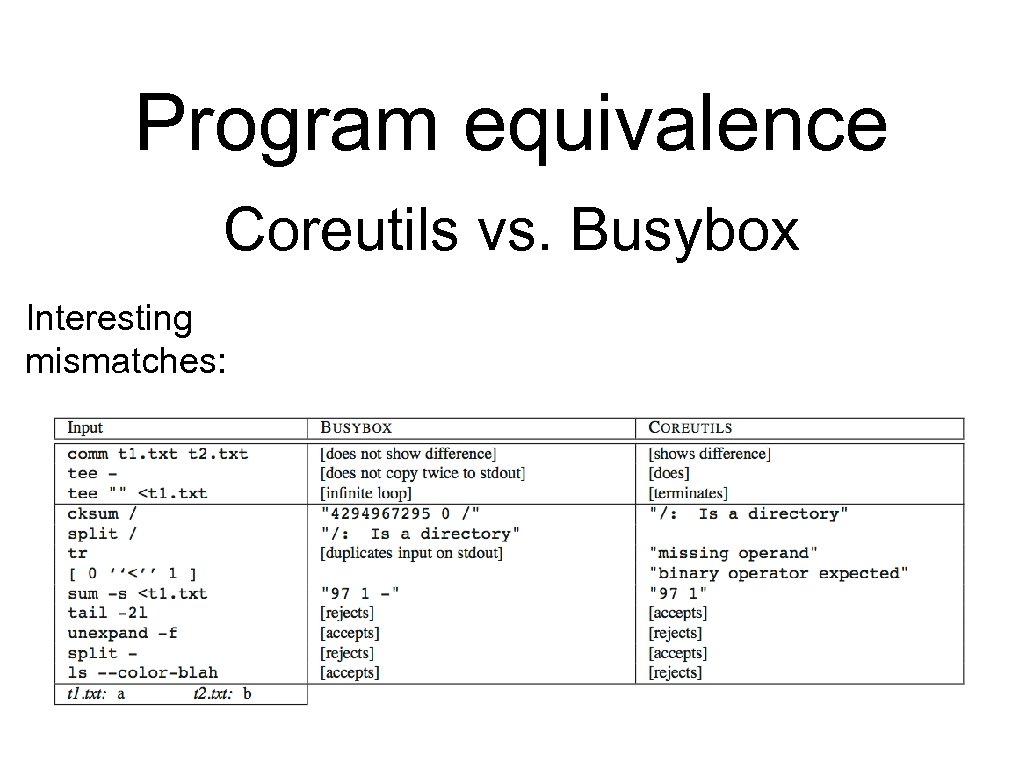 Program equivalence Coreutils vs. Busybox Interesting mismatches:
 Agenda • Symbolic testing: Introduction • KLEE + STP • Metrics, experimental methods, results • Related work • Discussion
 Related work • Similar to KLEE path choose heuristic: generational search (Godefroid, P. , Levin, M. Y. , And Molnar, D. Automated whitebox fuzz testing) • Give score to states according to line coverage they done. • But uses random values when symbolic execution is hard (environment interfacing)
 Related work • Concolic (concrete/symbolic) testing: Run on concrete random inputs. In parallel, execute symbolically and solve constraints. Generate inputs to other paths than the concrete one along the way. • Godefroid, Patrice; Nils Klarlund, Koushik Sen (2005). "DART: Directed Automated Random Testing” • Sen, Koushik; Darko Marinov, Gul Agha (2005). "CUTE: a concolic unit testing engine for C"
 Agenda • Symbolic testing: Introduction • KLEE + STP • Metrics, experimental methods, results • Related work • Discussion
 Discussion • Code coverage is not good enough as a metric. Path coverage is preferred (admitted in the paper) • Symbolic environment interaction - how reliable can the costume modeling really be? think about concurrent programs, inter-process programs, etc. • What is more commonly needed - functional testing or security/completeness/crash testing?
 Added subject Klee. Net: Discovering Insidious Interaction Bugs in Wireless Sensor Networks Before Deployment Raimondas Sasnauskas∗, Olaf Landsiedel∗, Muhammad Hamad Alizai∗, Carsten Weise‡, Stefan Kowalewski‡, Klaus Wehrle∗ Distributed Systems Group, ‡Embedded Software Laboratory RWTH Aachen University, Germany ∗ • Sensor networks: network of nodes with unreliable, resourceconstrained devices • On comm loss: hard to find/fix • Packet loss/corruption, often reboots
 Klee. Net • Node model - same as Klee’s environment model. Focuses on TCP failures (invalid packets, etc) • Network model: Holds status of network and packet passing. Injects network wide failures. • Essentially its a testing tool for distributed systems
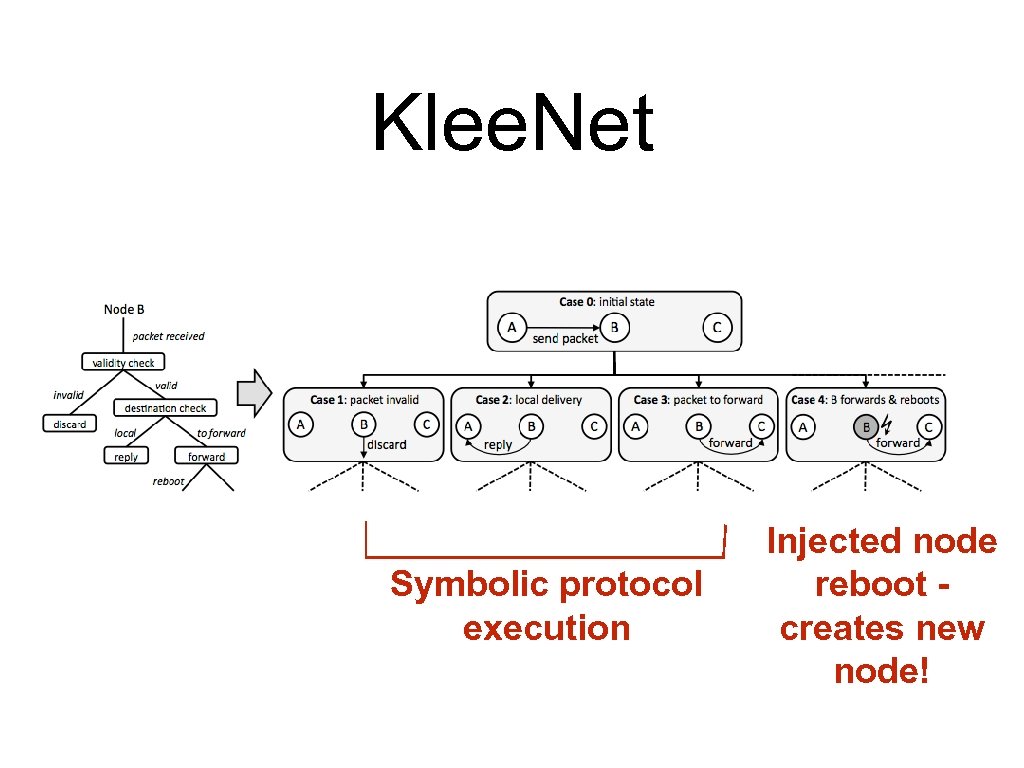 Klee. Net Symbolic protocol execution Injected node reboot creates new node!
 Klee. Net • Insight - after all, complicated systems need customizing tests…