


 Скачать презентацию TESTING CRYPTOGRAPHIC PROTOCOL IMPLEMENTATIONS Verifying crypto protocols
4a2934fdfed31c0746ef003316a3b119.ppt
- Количество слайдов: 21
 TESTING CRYPTOGRAPHIC PROTOCOL IMPLEMENTATIONS
 Verifying crypto protocols Lots of formal methods Good representative: Blanchet’s Pro. Verif Mainly for its good spec language Almost always gives an answer Not much on verifying implementations fs 2 pv, Csur Running example today: TLS (the thing that runs when you browse https: //. . .
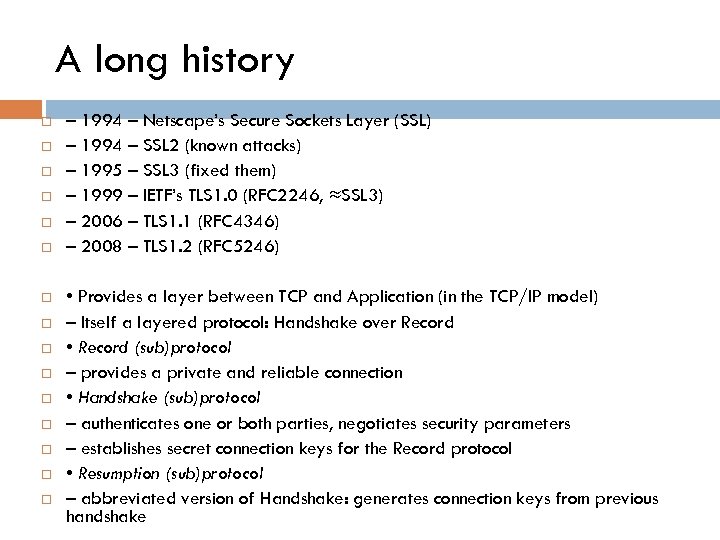 A long history – 1994 – Netscape’s Secure Sockets Layer (SSL) – 1994 – SSL 2 (known attacks) – 1995 – SSL 3 (fixed them) – 1999 – IETF’s TLS 1. 0 (RFC 2246, ≈SSL 3) – 2006 – TLS 1. 1 (RFC 4346) – 2008 – TLS 1. 2 (RFC 5246) • Provides a layer between TCP and Application (in the TCP/IP model) – Itself a layered protocol: Handshake over Record • Record (sub)protocol – provides a private and reliable connection • Handshake (sub)protocol – authenticates one or both parties, negotiates security parameters – establishes secret connection keys for the Record protocol • Resumption (sub)protocol – abbreviated version of Handshake: generates connection keys from previous handshake
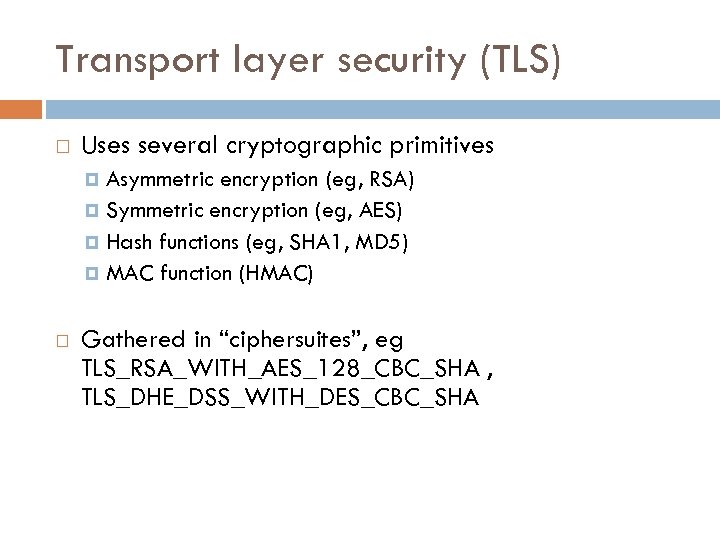 Transport layer security (TLS) Uses several cryptographic primitives Asymmetric encryption (eg, RSA) Symmetric encryption (eg, AES) Hash functions (eg, SHA 1, MD 5) MAC function (HMAC) Gathered in “ciphersuites”, eg TLS_RSA_WITH_AES_128_CBC_SHA , TLS_DHE_DSS_WITH_DES_CBC_SHA
![TLS (generic) Client. Hello Server ----> <-------[Certificate] Client. Key. Exchange [Certificate. Verify] [Change. Cipher.](https://present5.com/presentation/4a2934fdfed31c0746ef003316a3b119/image-5.jpg "TLS (generic) Client. Hello Server ----> <-------[Certificate] Client. Key. Exchange [Certificate. Verify] [Change. Cipher.") TLS (generic) Client. Hello Server ----> <-------[Certificate] Client. Key. Exchange [Certificate. Verify] [Change. Cipher. Spec] Finished Server. Hello [Certificate] [Server. Key. Exchange] [Certificate. Request] Server. Hello. Done ----> <---- Application Data [Change. Cipher. Spec] Finished <-------> Application Data
TLS (generic) Client. Hello Server ----> <-------[Certificate] Client. Key. Exchange [Certificate. Verify] [Change. Cipher. Spec] Finished Server. Hello [Certificate] [Server. Key. Exchange] [Certificate. Request] Server. Hello. Done ----> <---- Application Data [Change. Cipher. Spec] Finished <-------> Application Data
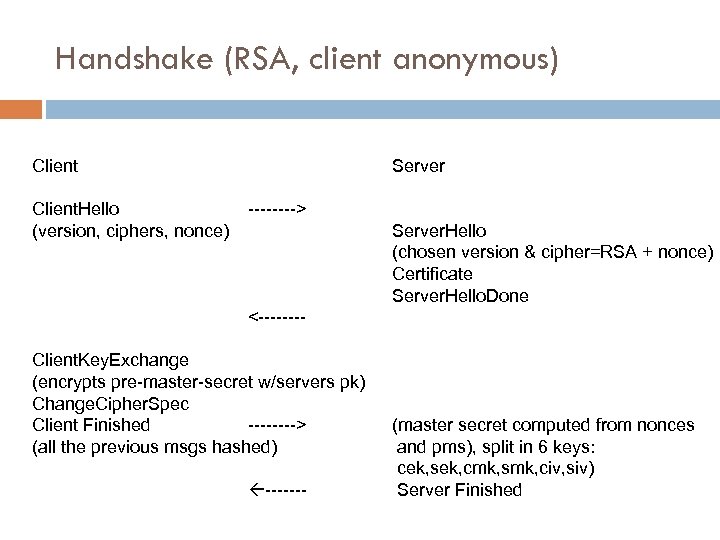 Handshake (RSA, client anonymous) Client. Hello (version, ciphers, nonce) Server ----> Server. Hello (chosen version & cipher=RSA + nonce) Certificate Server. Hello. Done <---- Client. Key. Exchange (encrypts pre-master-secret w/servers pk) Change. Cipher. Spec Client Finished ----> (all the previous msgs hashed) ------- (master secret computed from nonces and pms), split in 6 keys: cek, sek, cmk, smk, civ, siv) Server Finished
 TLS bugs / attacks Bugs and attacks keep being found! This year a couple Errors: “Bugs” -> crash the client or server, execute code, … “Attacks” -> everything looks fine but the goals are violated 3 kinds: Message-flow Implementation Cryptographic
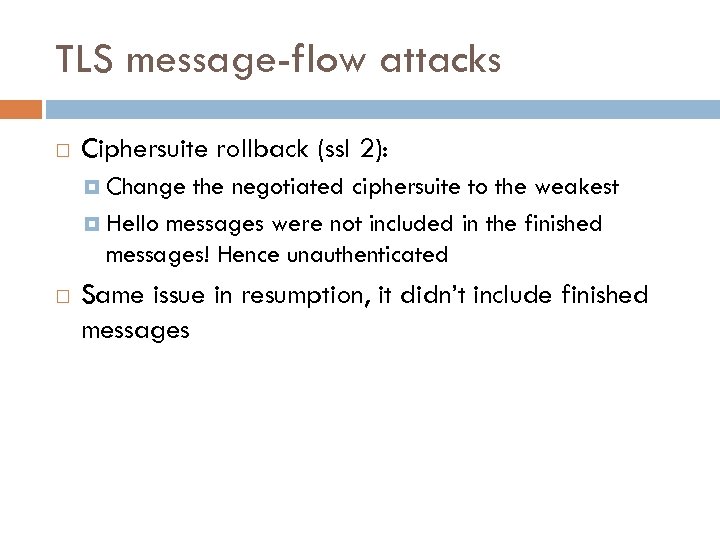 TLS message-flow attacks Ciphersuite rollback (ssl 2): Change the negotiated ciphersuite to the weakest Hello messages were not included in the finished messages! Hence unauthenticated Same issue in resumption, it didn’t include finished messages
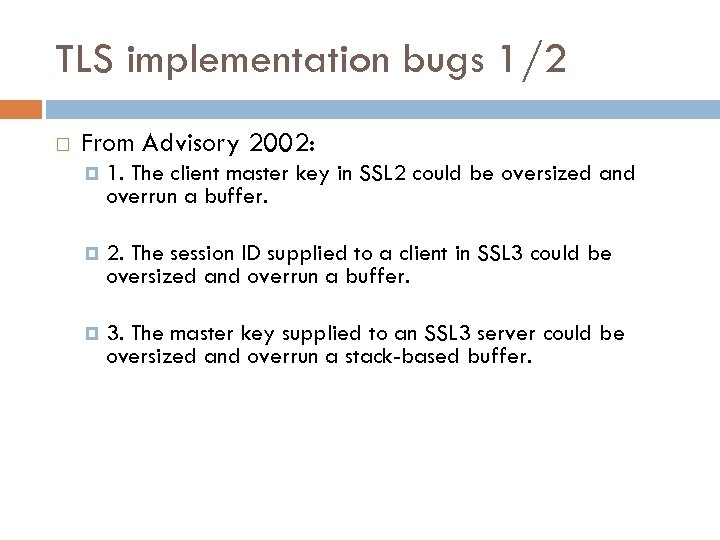 TLS implementation bugs 1/2 From Advisory 2002: 1. The client master key in SSL 2 could be oversized and overrun a buffer. 2. The session ID supplied to a client in SSL 3 could be oversized and overrun a buffer. 3. The master key supplied to an SSL 3 server could be oversized and overrun a stack-based buffer.
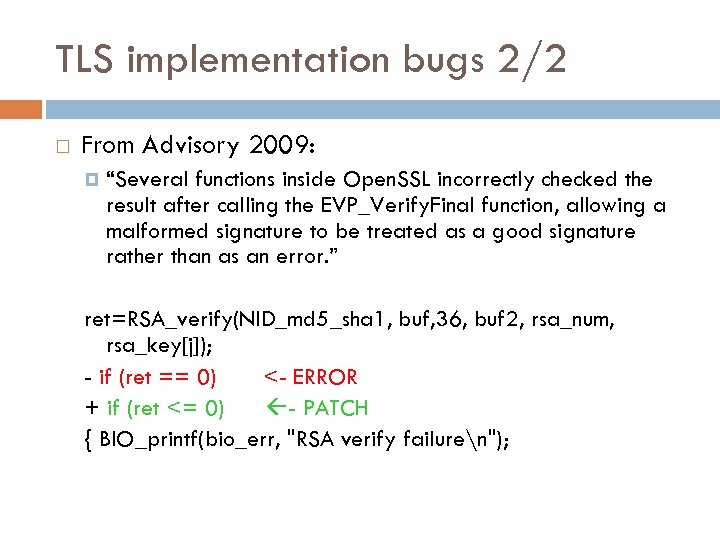 TLS implementation bugs 2/2 From Advisory 2009: “Several functions inside Open. SSL incorrectly checked the result after calling the EVP_Verify. Final function, allowing a malformed signature to be treated as a good signature rather than as an error. ” ret=RSA_verify(NID_md 5_sha 1, buf, 36, buf 2, rsa_num, rsa_key[j]); - if (ret == 0) <- ERROR + if (ret <= 0) - PATCH { BIO_printf(bio_err, "RSA verify failuren");
 TLS cryptographic attacks Attacks more on the primitives Predicting randomness Timing attacks Using alert messages as oracles in RSA mode ….
 How to verify TLS? Translates to 3 separate problems “How to verify an implementation of TLS {symbolically, cryptographically, implementationwise} Mostly manual attempts Some work in verification for “symbolically” Rest of this talk: Will show earlier work for “symbolically” This work’s idea: put symbolic and impl. together
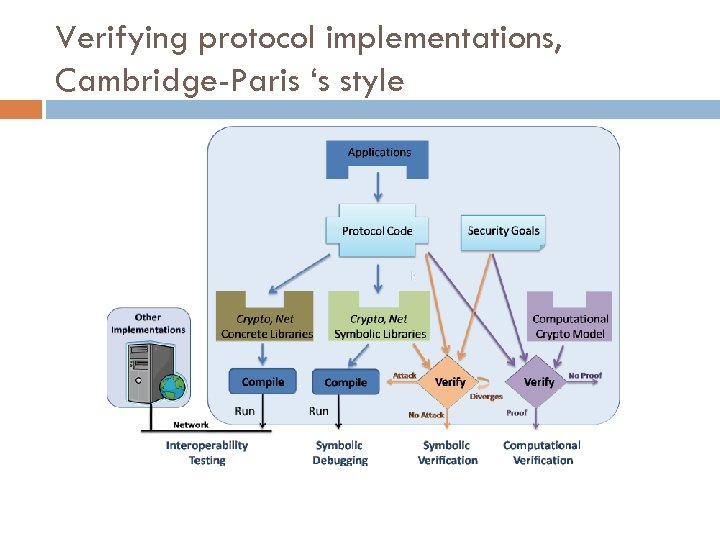 Verifying protocol implementations, Cambridge-Paris ‘s style
 Demo
Demo
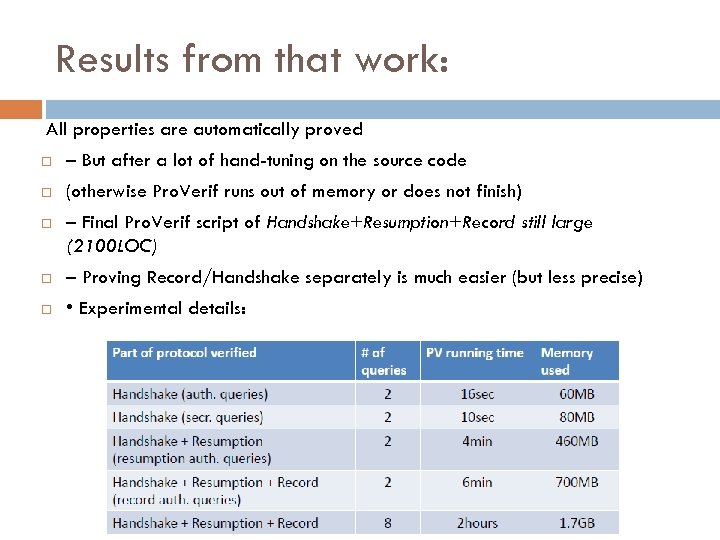 Results from that work: All properties are automatically proved – But after a lot of hand-tuning on the source code (otherwise Pro. Verif runs out of memory or does not finish) – Final Pro. Verif script of Handshake+Resumption+Record still large (2100 LOC) – Proving Record/Handshake separately is much easier (but less precise) • Experimental details:
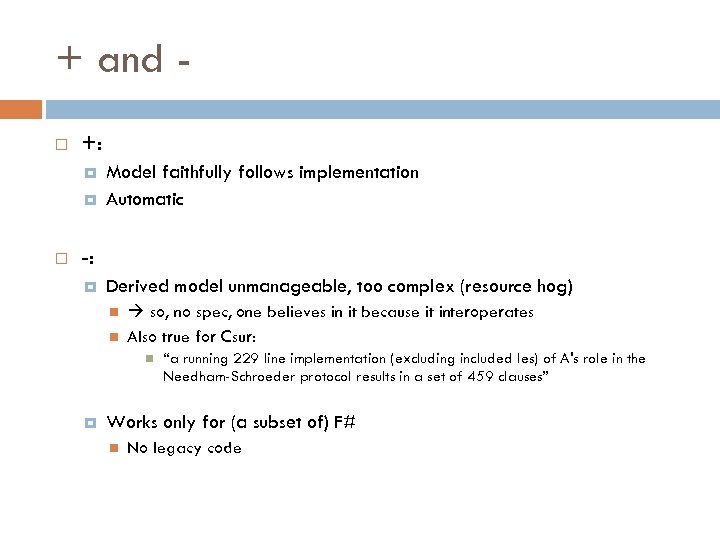 + and +: Model faithfully follows implementation Automatic -: Derived model unmanageable, too complex (resource hog) so, no spec, one believes in it because it interoperates Also true for Csur: “a running 229 line implementation (excluding included les) of A's role in the Needham-Schroeder protocol results in a set of 459 clauses” Works only for (a subset of) F# No legacy code
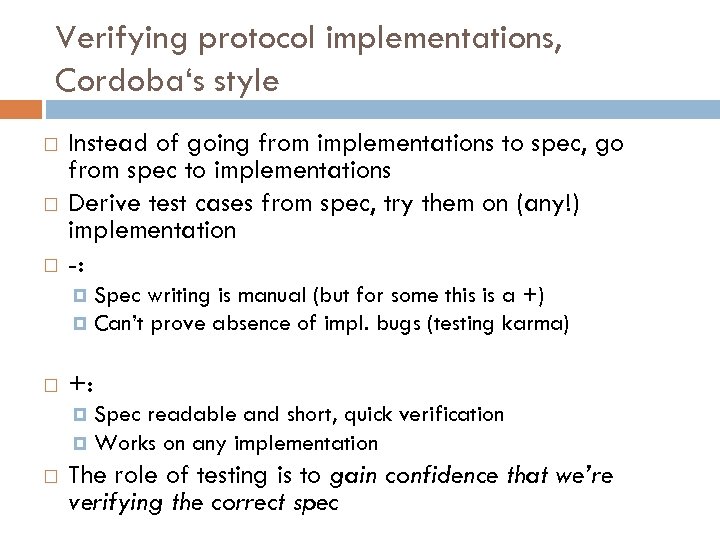 Verifying protocol implementations, Cordoba‘s style Instead of going from implementations to spec, go from spec to implementations Derive test cases from spec, try them on (any!) implementation -: Spec writing is manual (but for some this is a +) Can’t prove absence of impl. bugs (testing karma) +: Spec readable and short, quick verification Works on any implementation The role of testing is to gain confidence that we’re verifying the correct spec
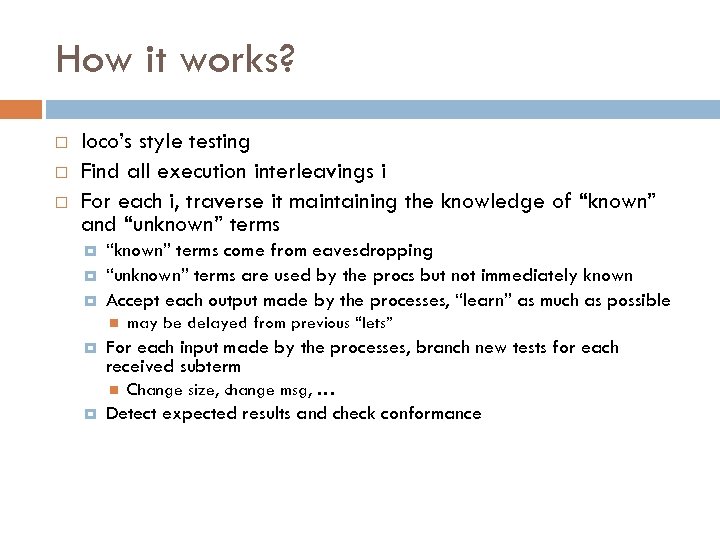 How it works? Ioco’s style testing Find all execution interleavings i For each i, traverse it maintaining the knowledge of “known” and “unknown” terms “known” terms come from eavesdropping “unknown” terms are used by the procs but not immediately known Accept each output made by the processes, “learn” as much as possible For each input made by the processes, branch new tests for each received subterm may be delayed from previous “lets” Change size, change msg, … Detect expected results and check conformance
 Demo
Demo
 The future If bugs_found -> JACM Elsif old_bugs_found -> JAIIO Else FAMAF_TR
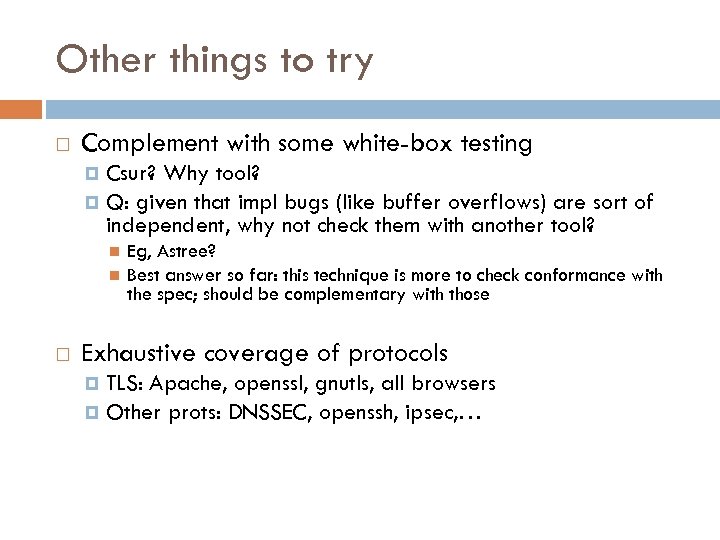 Other things to try Complement with some white-box testing Csur? Why tool? Q: given that impl bugs (like buffer overflows) are sort of independent, why not check them with another tool? Eg, Astree? Best answer so far: this technique is more to check conformance with the spec; should be complementary with those Exhaustive coverage of protocols TLS: Apache, openssl, gnutls, all browsers Other prots: DNSSEC, openssh, ipsec, …