


 Скачать презентацию Test Planning for AOC FOC Interface for Data Comm
aef1be68f4d1bce45b82b592b9a743a6.ppt
- Количество слайдов: 20
 Test Planning for AOC/FOC Interface for Data Comm Production System To: DCIT 26 From: Data Comm Production Sub-Team Date: 21 -22 August 2013 Federal Aviation Administration
 Introduction • In preparation for integration testing activities planned in 2014, FAA would like to discuss establishing a test interface between TDLS and AOC/FOC systems • This testing will ensure all necessary changes made for DCL operations within the production system are working appropriately prior to operational and field tests • FAA will provide information to the aircraft operators for their feedback for planning of this activity 21 -22 August 2013 Federal Aviation Administration 2
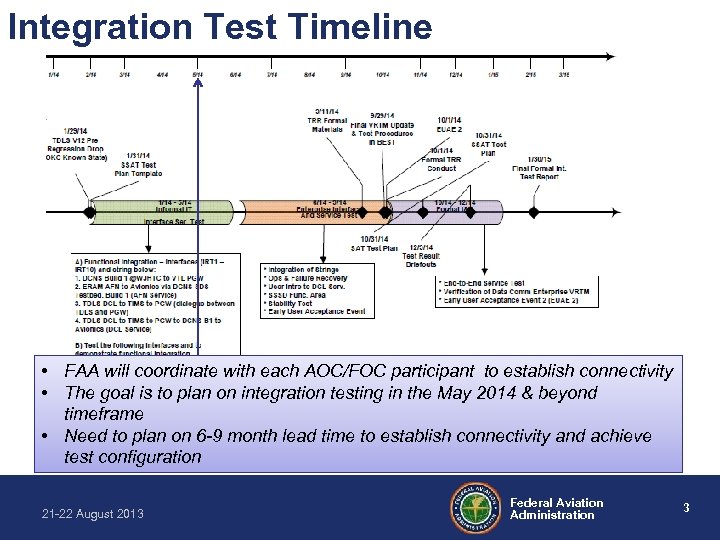 Integration Test Timeline • FAA will coordinate with each AOC/FOC participant to establish connectivity • The goal is to plan on integration testing in the May 2014 & beyond timeframe • Need to plan on 6 -9 month lead time to establish connectivity and achieve test configuration 21 -22 August 2013 Federal Aviation Administration 3
 Connectivity Establishment • FAA will provide IRDs and ICDs, which includes messages exchanged with AOCs, to be used for AOC system updates for the interface – The TDLS-CSP interface is the legacy PDC interface that is being enhanced with new messages – The TIMS SDB-CSP interface is the new web-based interface to support the Subscriber Data Base and user preferences • • Airline(s) who choose to participate and FAA’s IFCET (Interfacility Communications Engineering Team) will coordinate to configure a VPN connection to FAA’s Front End Processors within the FTI National Test Bed (FNTB) located at WHJTC FAA’s FTI User's Guide for Non-NAS Users will provide details Once the operator’s VPN is configured, IFCET will provide a certificate with the appropriate private/public keys FAA will configure the FNTB to ensure a proper flow from the airline system to TDLS 21 -22 August 2013 Federal Aviation Administration 4
 Documentation • TDLS - CSP IRD dated April 26, 2013 – This IRD was provided to DCIT AOC WG in May – Includes legacy PDC, new Dispatch message (Courtesy Copy) and new Gate Request (GREQ) message – Currently updates being made to address comments • TIMS SDB - CSP IRD dated April 26, 2013 – This IRD was provided to DCIT AOC WG in May – Describes the web-based interface to the Master Subscriber Database – Currently updates being made to address comments • Corresponding ICDs – TDLS - CSP ICD dated June 21, 2013 – TIMS SDB - CSP ICD dated May 29, 2013 – Currently updates being made to address comments • FTI User's Guide for Non-NAS Users 21 -22 August 2013 Federal Aviation Administration 5
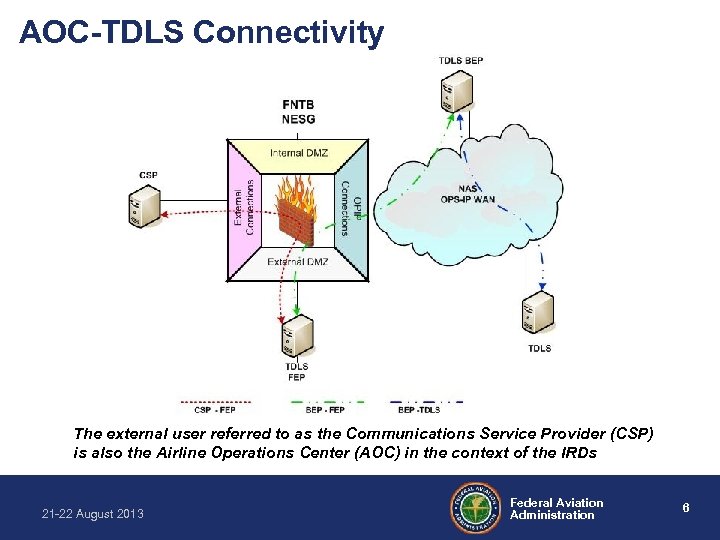 AOC-TDLS Connectivity The external user referred to as the Communications Service Provider (CSP) is also the Airline Operations Center (AOC) in the context of the IRDs 21 -22 August 2013 Federal Aviation Administration 6
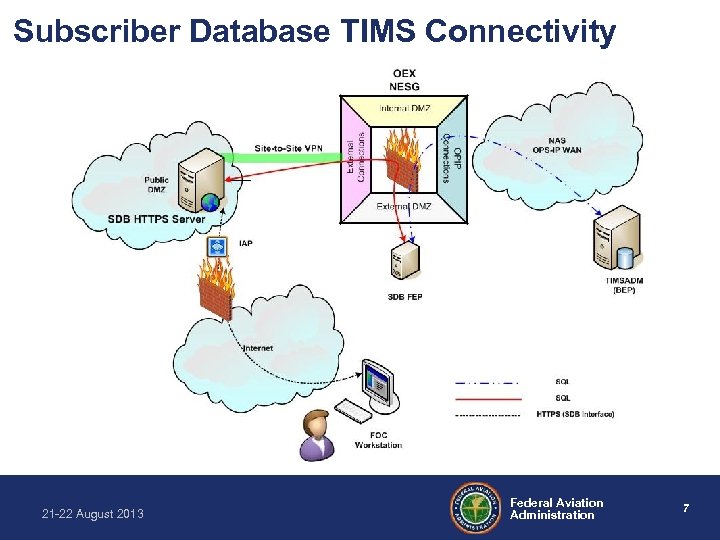 Subscriber Database TIMS Connectivity 21 -22 August 2013 Federal Aviation Administration 7
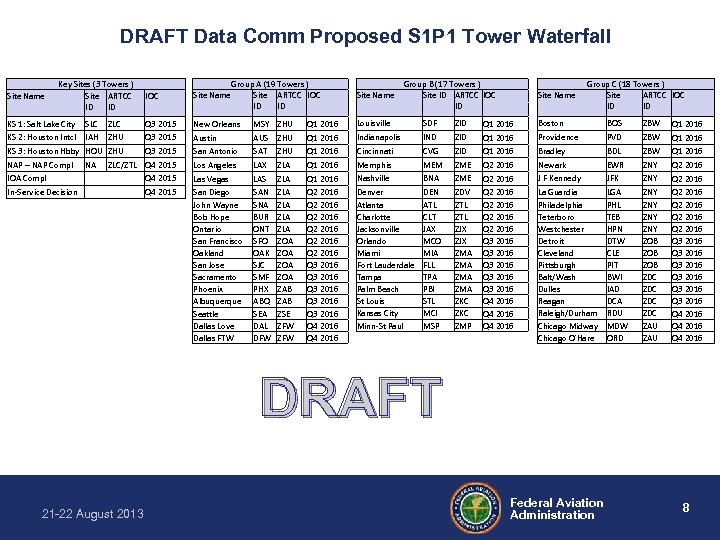 DRAFT Data Comm Proposed S 1 P 1 Tower Waterfall Site Name Key Sites (3 Towers ) Site ARTCC ID ID IOC Site Name Group A (19 Towers ) Site ARTCC IOC ID ID Site Name Group B (17 Towers ) Site ID ARTCC IOC ID Site Name Group C (18 Towers ) Site ARTCC IOC ID ID KS 1: Salt Lake City SLC ZLC Q 3 2015 New Orleans MSY ZHU Q 1 2016 Louisville SDF ZID Q 1 2016 Boston BOS ZBW Q 1 2016 KS 2: Houston Intcl IAH ZHU Q 3 2015 Austin AUS ZHU Q 1 2016 Indianapolis IND ZID Q 1 2016 Providence PVD ZBW Q 1 2016 KS 3: Houston Hbby HOU ZHU Q 3 2015 San Antonio SAT ZHU Q 1 2016 Cincinnati CVG ZID Q 1 2016 Bradley BDL ZBW Q 1 2016 ZLC/ZTL Q 4 2015 Los Angeles LAX ZLA Q 1 2016 Memphis MEM ZME Q 2 2016 Newark EWR ZNY Q 2 2016 Q 4 2015 Las Vegas LAS ZLA Q 1 2016 Nashville BNA ZME Q 2 2016 J F Kennedy JFK ZNY Q 2 2016 Q 4 2015 San Diego John Wayne Bob Hope Ontario San Francisco Oakland San Jose Sacramento Phoenix Albuquerque Seattle Dallas Love Dallas FTW SAN SNA BUR ONT SFO OAK SJC SMF PHX ABQ SEA DAL DFW ZLA ZLA ZOA ZOA ZAB ZSE ZFW Q 2 2016 Q 2 2016 Q 3 2016 Q 3 2016 Q 4 2016 Denver Atlanta Charlotte Jacksonville Orlando Miami Fort Lauderdale Tampa Palm Beach St Louis Kansas City Minn-St Paul DEN ATL CLT JAX MCO MIA FLL TPA PBI STL MCI MSP ZDV ZTL ZJX ZMA ZMA ZKC ZMP Q 2 2016 Q 3 2016 Q 3 2016 Q 4 2016 La Guardia Philadelphia Teterboro Westchester Detroit Cleveland Pittsburgh Balt/Wash Dulles Reagan Raleigh/Durham Chicago Midway Chicago O’Hare LGA PHL TEB HPN DTW CLE PIT BWI IAD DCA RDU MDW ORD ZNY ZNY ZOB ZOB ZDC ZDC ZAU Q 2 2016 Q 3 2016 Q 3 2016 Q 4 2016 NAP – NAP Compl NA IOA Compl In-Service Decision DRAFT 21 -22 August 2013 Federal Aviation Administration 8
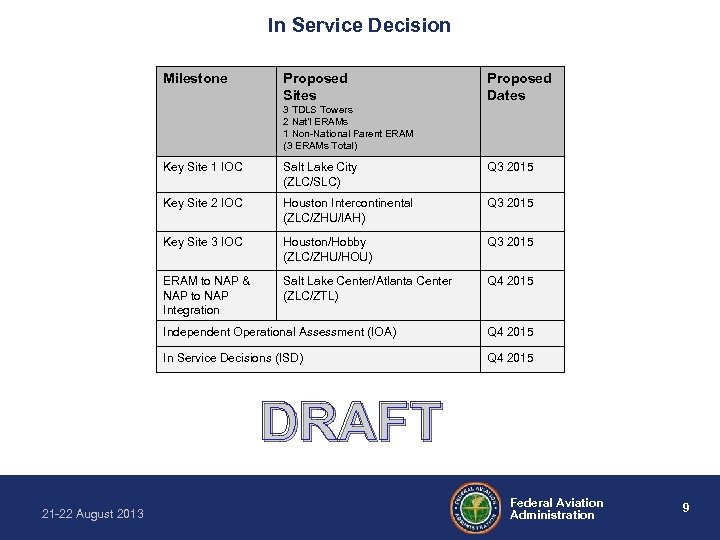 In Service Decision Milestone Proposed Sites Proposed Dates 3 TDLS Towers 2 Nat’l ERAMs 1 Non-National Parent ERAM (3 ERAMs Total) Key Site 1 IOC Salt Lake City (ZLC/SLC) Q 3 2015 Key Site 2 IOC Houston Intercontinental (ZLC/ZHU/IAH) Q 3 2015 Key Site 3 IOC Houston/Hobby (ZLC/ZHU/HOU) Q 3 2015 ERAM to NAP & NAP to NAP Integration Salt Lake Center/Atlanta Center (ZLC/ZTL) Q 4 2015 Independent Operational Assessment (IOA) Q 4 2015 In Service Decisions (ISD) Q 4 2015 DRAFT 21 -22 August 2013 Federal Aviation Administration 9
 QUESTIONS? 21 -22 August 2013 Federal Aviation Administration 10
 BACKUP CHARTS 21 -22 August 2013 Federal Aviation Administration 11
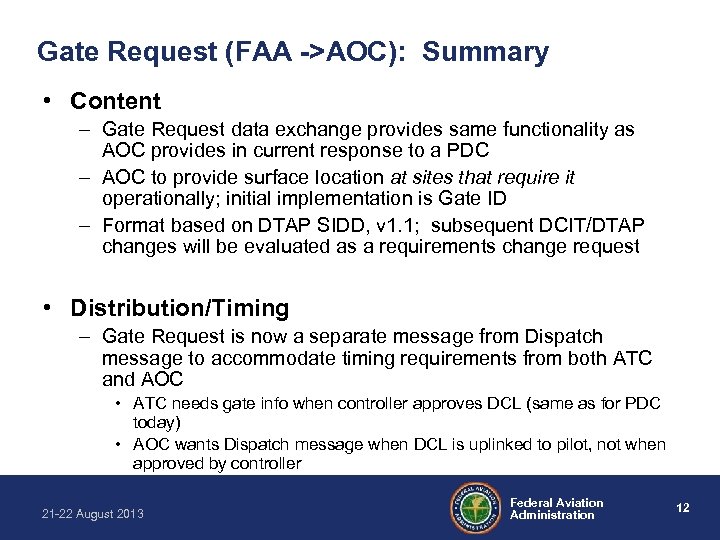 Gate Request (FAA ->AOC): Summary • Content – Gate Request data exchange provides same functionality as AOC provides in current response to a PDC – AOC to provide surface location at sites that require it operationally; initial implementation is Gate ID – Format based on DTAP SIDD, v 1. 1; subsequent DCIT/DTAP changes will be evaluated as a requirements change request • Distribution/Timing – Gate Request is now a separate message from Dispatch message to accommodate timing requirements from both ATC and AOC • ATC needs gate info when controller approves DCL (same as for PDC today) • AOC wants Dispatch message when DCL is uplinked to pilot, not when approved by controller 21 -22 August 2013 Federal Aviation Administration 12
 Gate Request (FAA ->AOC): Summary (cont’d) – Gate Request sent to AOC when controller/system first approves DCL, e. g. , approx. 20 -25 min prior to PTime • No explicit controller involvement in actual message to AOC • One-time request message; any subsequent gate changes will be handled procedurally – Ground system will send to all users; • When not operationally required, users can opt out of Gate Request via Subscriber Data Base (Discussion topic) 21 -22 August 2013 Federal Aviation Administration 13
 Gate Request Response (AOC->FAA): Summary • Content – {Flight ID *A} { Sequence Number} {Tail Number} { Airport Departure} {Gate Assignment} – 5 -8 char Gate ID, if known; “G” if gate is unknown – Format based on DTAP SIDD, v 1. 1; subsequent DCIT/DTAP tweaks will be evaluated as a requirements change request • Distribution/Timing – Sent by AOC to FAA in response to Gate Request Message – Expect response from AOC within 2 min, similar to PDC response 21 -22 August 2013 Federal Aviation Administration 14
 Gate Request/Response: Questions (cont’d) • Implementation: – Previous DCIT proposed that Gate Request message will be sent only to those users who currently supply gate in PDC response – Specific mechanism for determining which airports and which users require the Gate Request message was not defined • Current planned implementation – Ground system will send Gate Request Message for all DCL aircraft to all AOCs (No change to existing PDC) – Users opt out via Web-based access to Subscriber Data Base (SDB), which is same mechanism as for providing ADNS addresses – SDB Web Access allows other user default preferences – If any issues with ATC for specific airport or users, adjust accordingly 21 -22 August 2013 Federal Aviation Administration 15
 DCL Dispatch Message: Summary • Content – Contains content of DCL that is sent to pilot for initial and any revised DCL • Caveat this is not an ATC clearance, and does NOT include a beacon code – For initial and revised DCLs, includes a separate full route string even if this was not sent to pilot – Format based on DTAP Systems Integration Description Document (SIDD v 1. 1, Nov. 2012); – Users have option to tailor Dispatch message preferences via Subscriber Data Base (not required) • Distribution/Timing – Sent to AOC only when a DCL clearance uplink is sent to flight deck • Initial DCL as response to request by flight deck via DM 25 • Revised DCL upon uplink (immediately after controller approval) 21 -22 August 2013 Federal Aviation Administration 16
 DCL Dispatch Message Response: Summary • Content – Format based on DTAP Systems Integration Description Document (SIDD v 1. 1, Nov. 2012) except no gate assignment (handled by separate Gate Request message) – Note that if gate is left in, will not be used – {Flight ID *A} { Sequence Number} {Tail Number} {Departure time} – Contains Departure time field from legacy PDC response to minimize software impact, per SIDD • Distribution/Timing – Sent by AOC to FAA in response to DCL Dispatch Message – Expect within 2 min, similar to PDC and DTAP 21 -22 August 2013 Federal Aviation Administration 17
 Web Access to the SDB • Web Access provides a new, secure method for accessing the SDB – AOC/CSP can directly manipulate their subscriber data – Portal access is limited to their data – AOC/CSP may not need to access the SDB after initial set up • Concept of Operation – – CSP/AOC creates/modifies a record to specify clearance type(s), Dispatch message options, Gate Request preference, and CSP/AOC address – • CSP/AOC logs in to Web Access SDB CSP/AOC only accesses SDB when changes are required The enhanced SDB will include various flight specific and AOC/user data elements – Flight id (tail number, call sign, Airline ID, etc. ) – ADNS address for PDCs and DCL Dispatch messages – Primary and secondary clearance preference types (PDC, DCL) – Other User Preferences, e. g. , type of DCL Dispatch/Courtesy Copy(CC) airline will receive (initial, revision, all), Gate Request message – Other PDC and CPDLC management information, as applicable 21 -22 August 2013 Federal Aviation Administration 18
 DCL Service Fallback Concept: Summary • If CPDLC service for DCL is not available, FAA automation will “fall back” to PDC – Flights tagged as getting DCL will be retagged as PDC if prior to 30 min before P-Time – AOC/User must tell FAA they want this fallback scheme applied • Can be done in ICAO FP preferences in Field 18/DAT, e. g. , code for DCL as primary and PDC as secondary • An additional option is for AOC/user to provide this fallback preference via Web Access portal (Subscriber Data Base) for all flights (systemwide) • Notification – Open question on notification of DCL service unavailability to AOC and/or flight deck – Current planned procedural implementation • If short-term outage, add to D-ATIS • If longer outage, issue NOTAM 21 -22 August 2013 Federal Aviation Administration 19
 DCL Service Fallback Concept: Summary (cont’d) • Fallback Implementation Approach – Fallback only occurs if AOC/User has designated PDC as the secondary clearance type preference via ICAO flight plan codes or Web Access SDB • ICAO FP takes precedence – If flight has been “processed” as DCL, even if DCL not yet picked up by the pilot, no PDC will be sent • If DCL is already approved, flight will still get the pending clearance as a response to DM 25 but nothing after • If DCL is not yet approved, controller will go to voice – If not yet processed, i. e. , new flights or those earlier than “strip” time, will get PDCs if user has so indicated 21 -22 August 2013 Federal Aviation Administration 20