


 Скачать презентацию Tertiary Structure Prediction Methods Any given protein sequence
49244b59e9154c046e448d9cb0674242.ppt
- Количество слайдов: 29
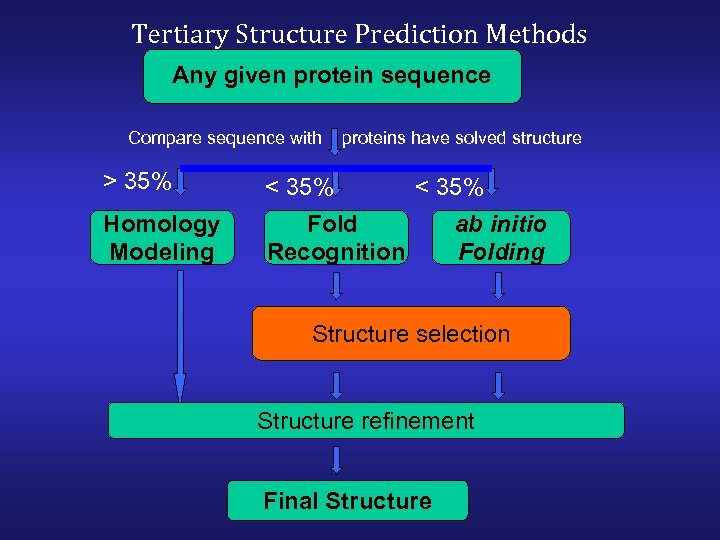 Tertiary Structure Prediction Methods Any given protein sequence Compare sequence with proteins have solved structure > 35% < 35% Homology Modeling Fold Recognition < 35% ab initio Folding Structure selection Structure refinement Final Structure
 Why Homology modelling ? X-ray Diffraction – Only a small number of proteins can be made to form crystals. – A crystal is not the protein’s native environment. – Very time consuming. NMR Distance Measurement – – Not all proteins are found in solution. – This method generally looks at isolated proteins rather than protein complexes. – Very time consuming
 Homology Modeling: Principles, tools and techniques • Development of molecular biology: rapid identification, isolation and sequencing of genes. • Problem : time-consuming task to obtain the 3 Dstructure of proteins. • Alternative strategy in structural biology is to develop models of protein when the constraints from X-ray diffraction or NMR are not yet available. • Homology modeling is the method that can be applied to generate reasonable models of protein structure.
 Database approach to homology modelling As of June 2000, 12, 500 protein structures have been deposited into the Protein Data Bank (PDB) and 86, 500 protein sequence entries were contained in Swiss. Prot protein sequence database. • This is a 1: 7 ratio – relatively few structures are known. • The number of sequence will increase much faster than the number of structures due to advances in sequencing.
 Sequence similarity methods • These methods can be very accurate if there is > 50% sequence similarity. • They are rarely accurate if the sequence similarity < 30%. • They use similar methods as used for sequence alignment such as the dynamic programming algorithm, hidden markov models, and clustering algorithms.
 What is Homology Modeling? • Predicts the three-dimensional structure of a given protein sequence (TARGET) based on an alignment to one or more known protein structures (TEMPLATES) • If similarity between the TARGET sequence and the TEMPLATE sequence is detected, structural similarity can be assumed. • In general, 30% sequence identity is required for generating useful models.
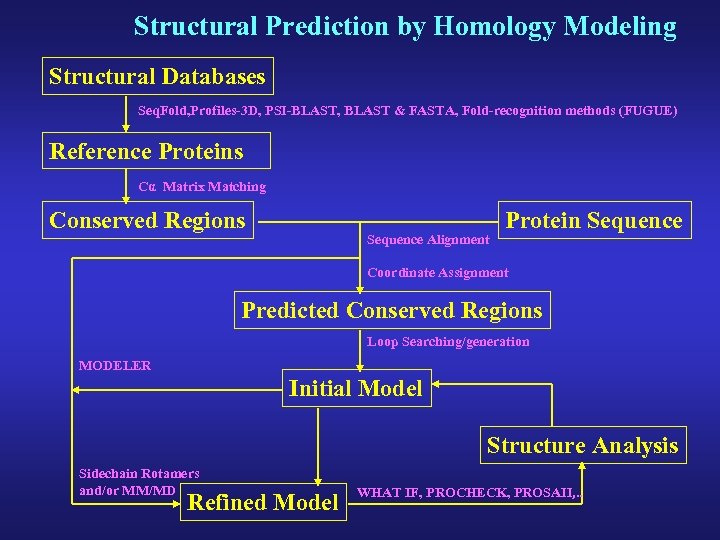 Structural Prediction by Homology Modeling Structural Databases Seq. Fold, Profiles-3 D, PSI-BLAST, BLAST & FASTA, Fold-recognition methods (FUGUE) Reference Proteins Cα Matrix Matching Conserved Regions Sequence Alignment Protein Sequence Coordinate Assignment Predicted Conserved Regions Loop Searching/generation MODELER Initial Model Structure Analysis Sidechain Rotamers and/or MM/MD Refined Model WHAT IF, PROCHECK, PROSAII, . .
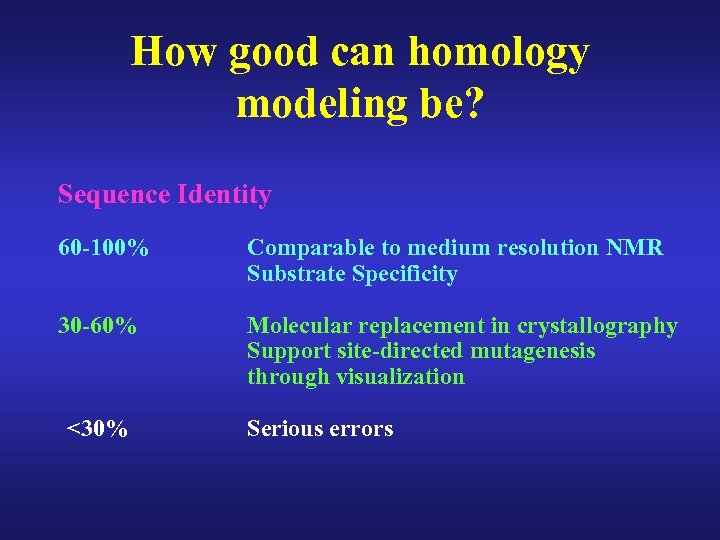 How good can homology modeling be? Sequence Identity 60 -100% Comparable to medium resolution NMR Substrate Specificity 30 -60% Molecular replacement in crystallography Support site-directed mutagenesis through visualization <30% Serious errors
 Significance of Protein Structure What does a structure offer in the way of biological knowledge? Ø Location of mutants and conserved residues Ø Ligand functional sites Ø Clefts/Cavities Ø Evolutionary Relationships Ø Mechanisms
 The importance of the sequence alignment • the quality of the sequence alignment is of crucial importance • Misplaced gaps, representing insertions or deletions, will cause residues to be misplaced in space • Careful inspection and adjustment on Automatic alignment may improve the quality of the modeling.
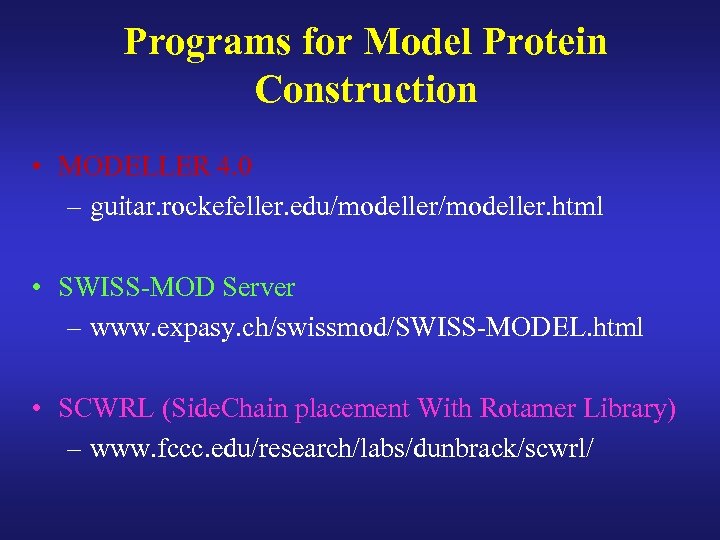 Programs for Model Protein Construction • MODELLER 4. 0 – guitar. rockefeller. edu/modeller. html • SWISS-MOD Server – www. expasy. ch/swissmod/SWISS-MODEL. html • SCWRL (Side. Chain placement With Rotamer Library) – www. fccc. edu/research/labs/dunbrack/scwrl/
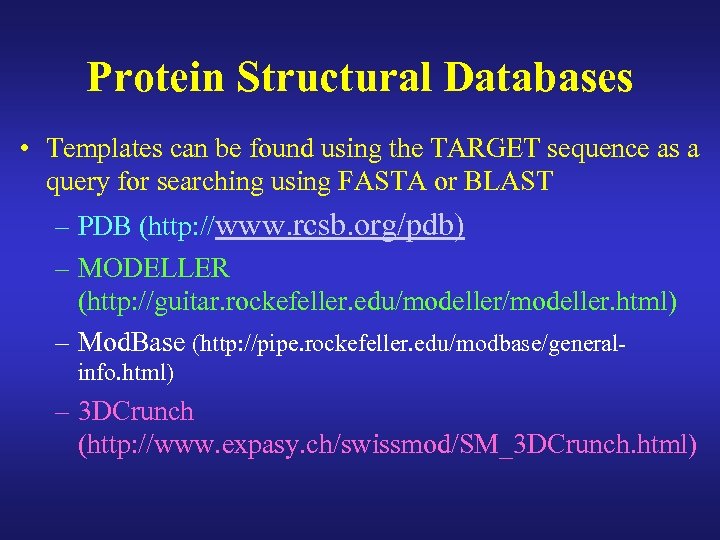 Protein Structural Databases • Templates can be found using the TARGET sequence as a query for searching using FASTA or BLAST – PDB (http: //www. rcsb. org/pdb) – MODELLER (http: //guitar. rockefeller. edu/modeller. html) – Mod. Base (http: //pipe. rockefeller. edu/modbase/generalinfo. html) – 3 DCrunch (http: //www. expasy. ch/swissmod/SM_3 DCrunch. html)
 Gaining confidence in template searching • Once a suitable template is found, it is a good idea to do a literature search (Pub. Med) on the relevant fold to determine what biological role(s) it plays. • Does this match the biological/biochemical function that you expect?
 Other factors to consider in selecting templates • Template environment – p. H – Ligands present? • Resolution of the templates • Family of proteins – Phylogenetic tree construction can help find the subfamily closest to the target sequence • Multiple templates?
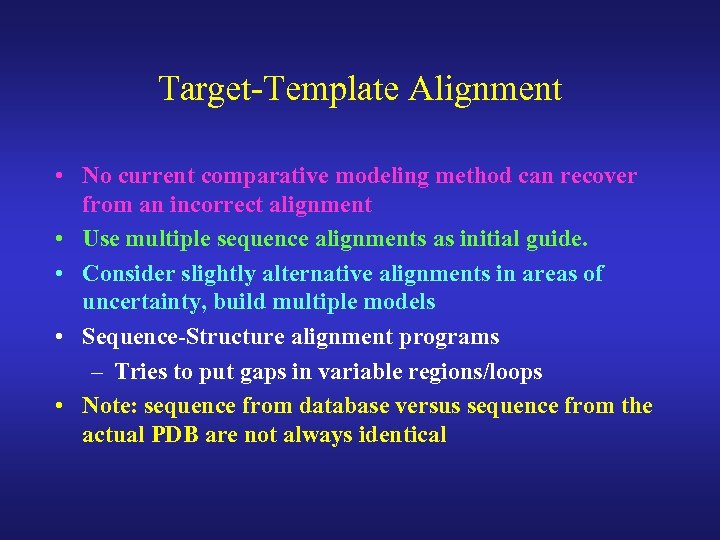 Target-Template Alignment • No current comparative modeling method can recover from an incorrect alignment • Use multiple sequence alignments as initial guide. • Consider slightly alternative alignments in areas of uncertainty, build multiple models • Sequence-Structure alignment programs – Tries to put gaps in variable regions/loops • Note: sequence from database versus sequence from the actual PDB are not always identical
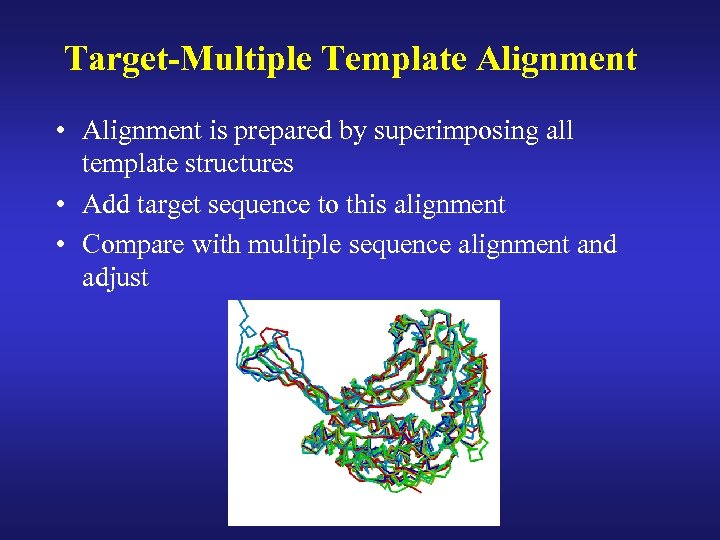 Target-Multiple Template Alignment • Alignment is prepared by superimposing all template structures • Add target sequence to this alignment • Compare with multiple sequence alignment and adjust
 Adjusting the alignment • Using tools such as Joy (wwwcryst. bioc. cam. ac. uk/~joy/) to view secondary structure along the alignment and use this information as criteria for adjustments • Avoid gaps in secondary structure elements
 Secondary Structure Prediction Ø The Predict Protein server Ø http: //www. embl-heidelberg. de/predictprotein/ Ø Adding secondary structure prediction algorithms can help make decisions on whether helices should be shortened/extended in areas of poor sequence identity. Ø PHD program
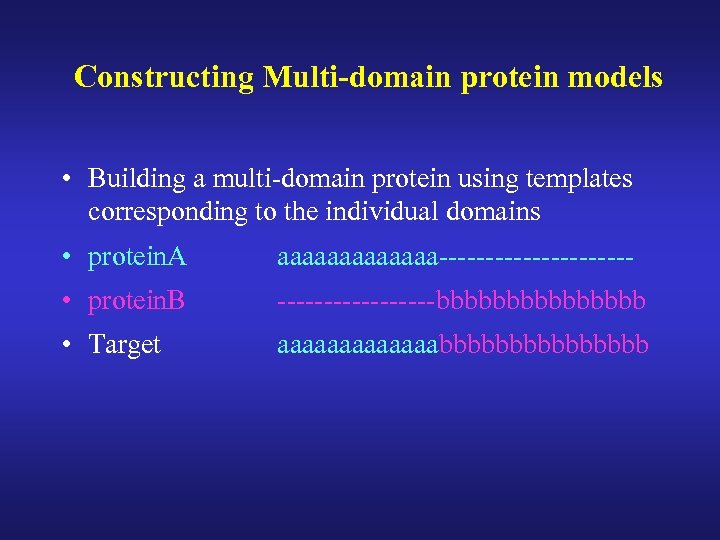 Constructing Multi-domain protein models • Building a multi-domain protein using templates corresponding to the individual domains • protein. A aaaaaaa----------- • protein. B ---------bbbbbbbb • Target aaaaaaabbbbbbbb
 Multiple model approach Ø Reminder: Consider the effects of different substitution matrices, different gap penalties, and different algorithms. (Vogt et al. J. Mol. Biol. 1995, 249: 816831. ) Ø Construct multiple models Ø Use structural analysis programs to determine best model Jaroszewski, Pawlowski and Godsik, J. Molecular Modeling, 1998, 4: 294 -309 Venclovas, Ginalski and Fidelis. PROTEINS, 1999, 3: 73 -80 (Suppl)
 Model Building • Rigid-Body Assembly – Assembles a model from a small number of rigid bodies obtained from aligned protein structure – Implemented in COMPOSER • Segment Matching • Satisfaction of Spatial Restraints – MODELLER – guitar. rockefeller. edu/modeller. html
 Modeller • Main input are restraints on the spatial structure of AA and ligands to be modeled. • Output is a 3 D structure that satisfies these restraints • Restraints are obtained from related protein structures (homology modeling) - obtained automatically, NMR structures, secondary struture packing and other experimental data
 What are the Restraints ? distances, angles, dihedral angles, pairs of dihedral angles and some other spatial features defined by atoms or pseudo atoms.
 Sidechain Conformation • Protein sidechains play a key role in molecular recognition and packing of hydrophobic cores of globular proteins • Protein sidechain conformations tend to exist in a limited number of canonical shapes, usually called rotamers • Rotamer libraries can be constructed where only 350 conformations are taken into account for each side chain
 Sidechains on surface of protein • Exposed sidechains on surface can be highly flexible without a single dominant conformation • So ultimately if these solvent exposed sidechains do not form binding interactions with other molecules or involved in say, a catalytic reaction, then accuracy may not be crucial—also look at the B-factors • Can refine the sidechains with molecular mechanics minimization – Sampling? – Scoring?
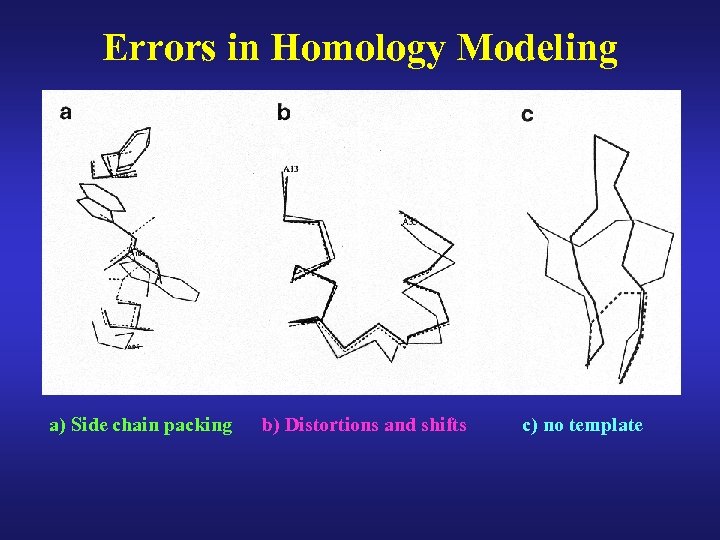 Errors in Homology Modeling a) Side chain packing b) Distortions and shifts c) no template
 Errors in Homology Modeling d) Misalignments e) incorrect template Marti-Renom et al. , Ann. Rev. Biophys. Biomol. Struct. , 2000, 29: 291 -325.
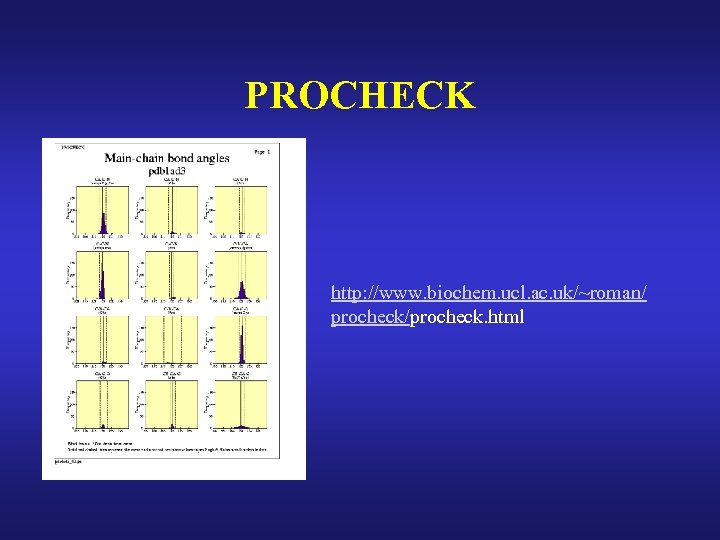
 Detection of Errors • First check should include a stereochemical check on the modeled structure—PROCHECK, WHATCHECK, DISTAN– which will show deviations from normal bond lengths, dihedrals, etc. • Visualization– follow the backbone trace and then subsequently move out to Cα-Cβ orientation.
 PROCHECK http: //www. biochem. ucl. ac. uk/~roman/ procheck/procheck. html