


 Скачать презентацию Territory-wide System Assessment 2005 Primary 3 6
6d6bb2dc6a9051699c5aaa1935e2dd45.ppt
- Количество слайдов: 39
 Territory-wide System Assessment 2005 Primary 3 & 6 English Language 1
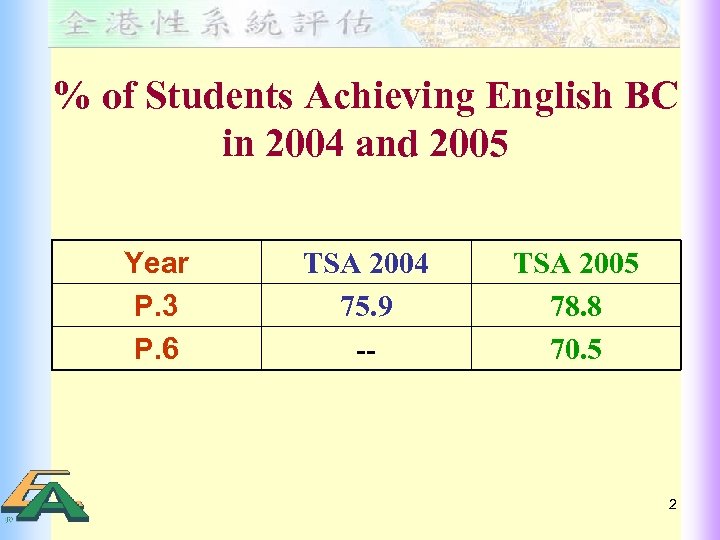 % of Students Achieving English BC in 2004 and 2005 Year P. 3 P. 6 TSA 2004 75. 9 -- TSA 2005 78. 8 70. 5 2
 Territory-wide System Assessment 2005 Primary 3 English Language 3
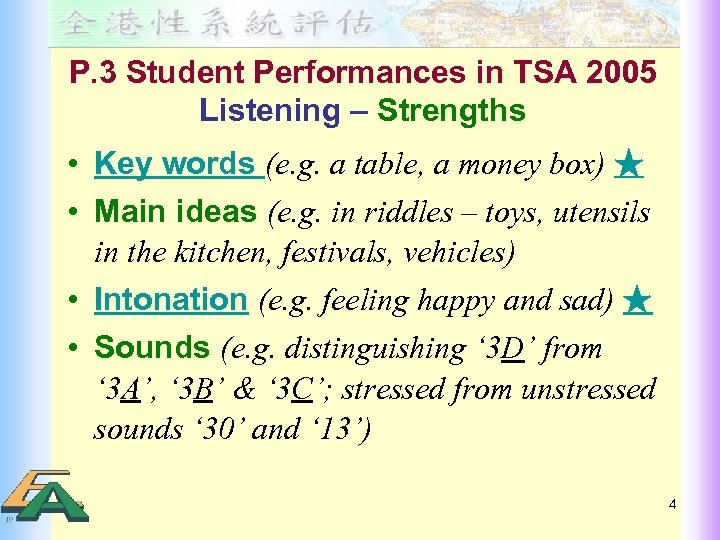 P. 3 Student Performances in TSA 2005 Listening – Strengths • Key words (e. g. a table, a money box) ★ • Main ideas (e. g. in riddles – toys, utensils in the kitchen, festivals, vehicles) • Intonation (e. g. feeling happy and sad) ★ • Sounds (e. g. distinguishing ‘ 3 D’ from ‘ 3 A’, ‘ 3 B’ & ‘ 3 C’; stressed from unstressed sounds ‘ 30’ and ‘ 13’) 4
 P. 3 Student Performances in TSA 2005 Listening – Weaknesses • Key words (e. g. distinguishing ‘Dora’ from ‘Dorothy, ‘Doreen’ & ‘Doris’) • Main ideas (e. g. ‘grapes’ in a riddle) ★ • Sounds (e. g. ‘day’ and ‘play’ in a poem) • Connection between ideas (e. g. the use of connectives ‘first’ and ‘then’ for correct order) ★ • Inference skills (e. g. inferring‘Mandy is clever. ’ from‘Excellent! You’re the winner of this game. ’ ★) 5
 P. 3 Student Performances in TSA 2005 Reading – Strengths • Key words (e. g. hamburgers, sunny weather) • Main ideas (e. g. identifying the main idea – ‘Little Duck was happy’ in ‘Thanks. These sandwiches taste good. ’ ) • Book concept (e. g. telling the number of stories in the book) ★ • Unfamiliar words (e. g. ‘hurray’ and ‘yummy’ ) • Inference skills (e. g. able to tell the boy was ‘pleased’ from his smiling face ) ★ 6
 P. 3 Student Performances in TSA 2005 Reading – Weaknesses • Key words (e. g. ‘weekend’, ‘sale’) • Main ideas (e. g. the reason for an activity ★) • Unfamiliar words (e. g. ‘smashed’ from contextual clues) ★ • Inference skills (e. g. unable to infer what they thought about a character in the story) • Pronoun references (e. g. ‘it’, ‘him’, ‘that’) ★ • Connection between ideas (e. g. ‘and’, ‘or’ ) 7
 P. 3 Student Performances in TSA 2005 Writing – Strengths • able to understand the task requirements (e. g. signs, letter, e-mail & story) ★ • able to write a short story based on a series of given pictures (e. g. a story about Piggy and the Apple Tree) ★ • able to provide the correct recipient and sender in writing a letter and an e-mail ★ 8
 P. 3 Student Performances in TSA 2005 Writing – Weaknesses • only gave brief answers to guiding questions without supporting details (e. g. a letter) ★ • many grammatical and spelling mistakes (e. g. ‘Don’t step on the glass. ’ instead of ‘Don’t step on the grass. ’ ) 9
 P. 3 Student Performances in TSA 2005 Speaking – Strengths • able to give appropriate spontaneous responses to simple daily situations • able to read texts aloud quite clearly • able to provide brief answers to questions about their personal experiences (e. g. seasons, fast food shop, library & activities on Sundays) • able to respond to questions on topics related to their daily life in the pictures 10
 P. 3 Student Performances in TSA 2005 Speaking – Weaknesses • showed some hesitations when encountering unfamiliar words • could only give short and brief answers to questions raised by oral assessors without elaboration • lacked the necessary vocabulary to express themselves adequately 11
 Comparison of Student Performances P. 3 Listening TSA 2004 TSA 2005 • able to identify key words about numbers words about objects (e. g and letters a table, a money box) • able to distinguish a • able to identify some wide range of midinitial consonants (e. g. vowels (e. g. pot) and Lung, Tung, Fung, Hung) some initial consonants • only able students could (e. g. Molly) identify rhyming words (e. g. ‘day’ and ‘play’) 12
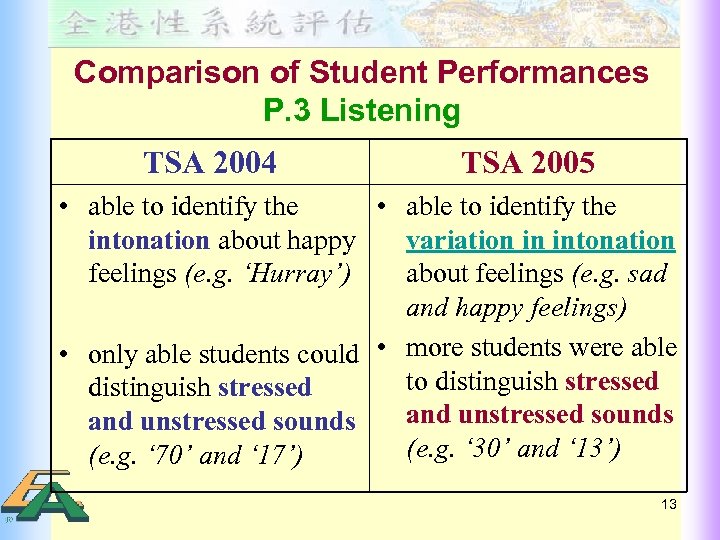 Comparison of Student Performances P. 3 Listening TSA 2004 TSA 2005 • able to identify the intonation about happy variation in intonation feelings (e. g. ‘Hurray’) about feelings (e. g. sad and happy feelings) • only able students could • more students were able to distinguish stressed and unstressed sounds (e. g. ‘ 30’ and ‘ 13’) (e. g. ‘ 70’ and ‘ 17’) 13
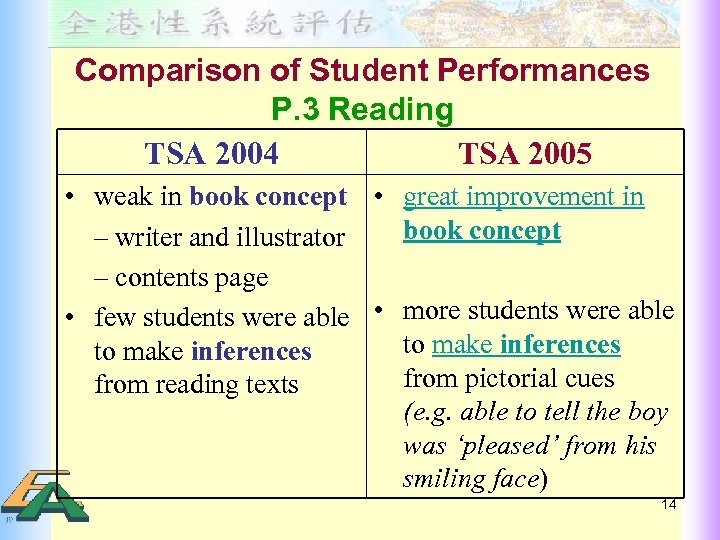 Comparison of Student Performances P. 3 Reading TSA 2004 TSA 2005 • weak in book concept • great improvement in book concept – writer and illustrator – contents page • few students were able • more students were able to make inferences from pictorial cues from reading texts (e. g. able to tell the boy was ‘pleased’ from his smiling face) 14
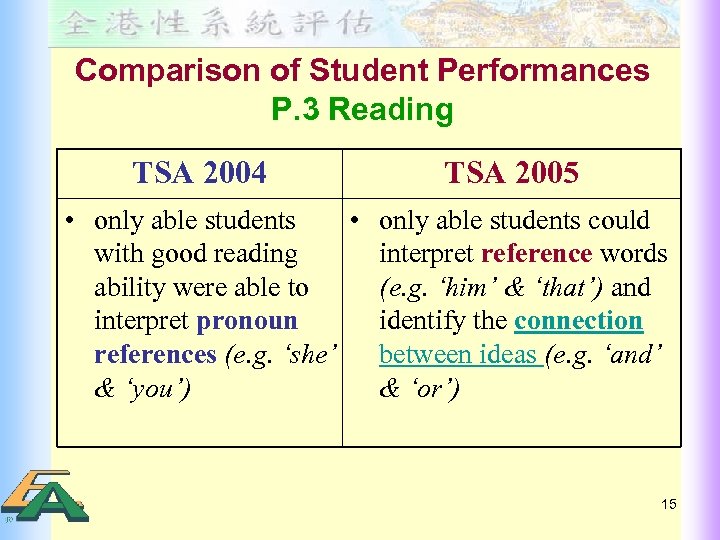 Comparison of Student Performances P. 3 Reading TSA 2004 TSA 2005 • only able students could with good reading interpret reference words ability were able to (e. g. ‘him’ & ‘that’) and interpret pronoun identify the connection references (e. g. ‘she’ between ideas (e. g. ‘and’ & ‘you’) & ‘or’) 15
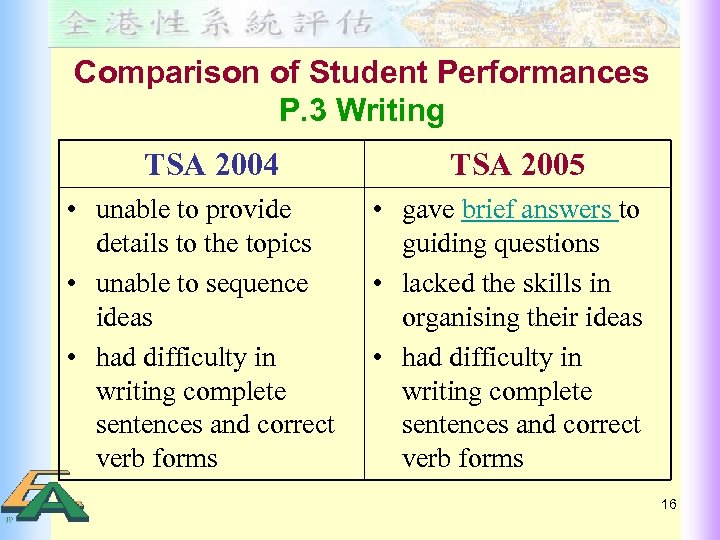 Comparison of Student Performances P. 3 Writing TSA 2004 • unable to provide details to the topics • unable to sequence ideas • had difficulty in writing complete sentences and correct verb forms TSA 2005 • gave brief answers to guiding questions • lacked the skills in organising their ideas • had difficulty in writing complete sentences and correct verb forms 16
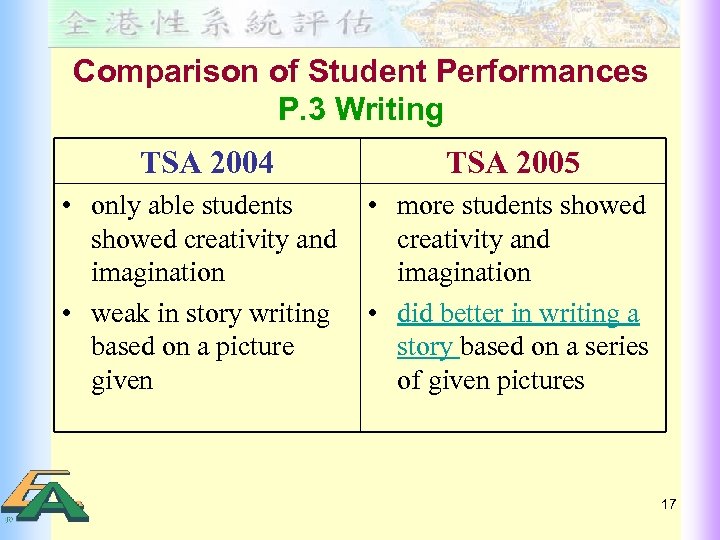 Comparison of Student Performances P. 3 Writing TSA 2004 TSA 2005 • only able students showed creativity and imagination • weak in story writing based on a picture given • more students showed creativity and imagination • did better in writing a story based on a series of given pictures 17
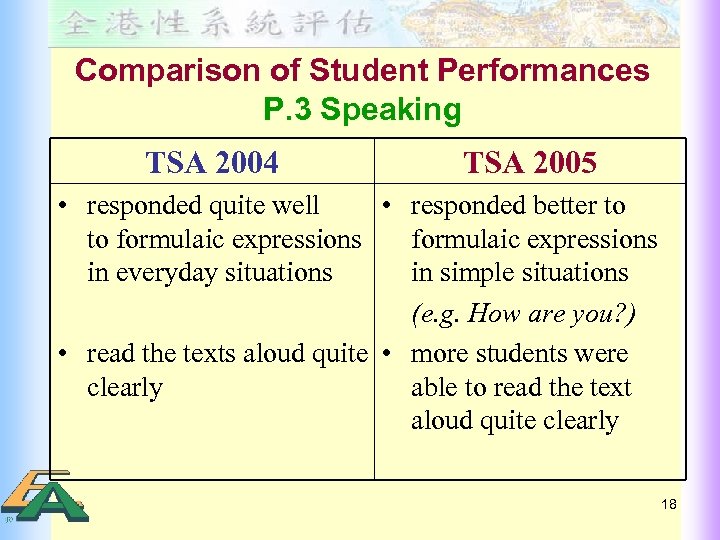 Comparison of Student Performances P. 3 Speaking TSA 2004 TSA 2005 • responded quite well • responded better to to formulaic expressions in everyday situations in simple situations (e. g. How are you? ) • read the texts aloud quite • more students were clearly able to read the text aloud quite clearly 18
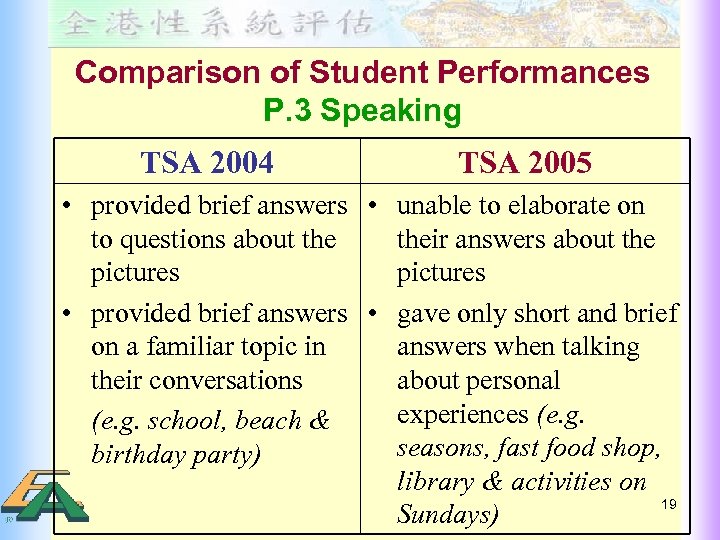 Comparison of Student Performances P. 3 Speaking TSA 2004 TSA 2005 • provided brief answers • unable to elaborate on to questions about their answers about the pictures • provided brief answers • gave only short and brief on a familiar topic in answers when talking their conversations about personal experiences (e. g. school, beach & seasons, fast food shop, birthday party) library & activities on 19 Sundays)
 Territory-wide System Assessment 2005 Primary 6 English Language 20
 P. 6 Student Performances in TSA 2005 Listening – Strengths • Key words (e. g. scores ‘ 9: 5’, day of a week ‘Sunday’, quantity of ingredients ‘ 1’ pack, ‘ 2’ cups) • Sequence (e. g. procedure for baking a cake) ★ • Specific information (e. g. age group ‘all ages’, price ‘$13’ per packet, place ‘supermarkets’ to buy biscuits in an advertisement) • Predicting development (e. g. why Lucy brought Miss Lam to her home – ‘to give back her cat’ in a story about Lucy and the cat) 21
 P. 6 Student Performances in TSA 2005 Listening – Weaknesses • Rhyme (e. g. “Sit back and have a snack. ”) • Intonation (e. g. speaker’s worried tone – “Grandfather, look at this poor cat! Can I keep it? ” said Lucy. ) • Inference skills (e. g in a riddle, “Drip drop, drip drop. Why won’t it stop? ” being inferred as ‘the tap is on’ – the reason ‘I’ can’t sleep) 22
 P. 6 Student Performances in TSA 2005 Listening – Weaknesses • Simile (e. g. ‘His short, stiff hair is like a brush’ & ‘Her fur is as white as snow’ in a poem about Auntie Mary’s pets) • Key words (e. g. ingredients of a recipe: ‘a quarter’ = ‘ 1/4’ cup of water & ‘half a dozen’ = ‘ 6’ eggs) 23
 P. 6 Student Performances in TSA 2005 Reading – Strengths • Specific information (e. g. name, age, status and appearance of characters ★; sequencing the popularity of books from a chart ★) • Main ideas (e. g. why classmates read books ★ ) • Connection between ideas (e. g. able to understand the use of connectives ‘to’ & ‘and’ to get the total number of opening hours in a notice) 24
 P. 6 Student Performances in TSA 2005 Reading – Weaknesses • Unfamiliar words (e. g. interpreting ‘flock’ by using contextual clues ‘thousands of tourists’ ★) • Inference skills (e. g. implicit ideas about what the writer wants to say and feels about HK in a poem ★) • Main ideas (e. g. the blurbs of two books about a treasure hunt and Dolphin Dolly ★) 25
 P. 6 Student Performances in TSA 2005 Reading – Weaknesses • Rhyme (e. g. ‘hand’ and ‘dreamland’, ‘there’ and ‘everywhere’ in a poem ‘Hong Kong – Live it! Love it!’ ★) • Simile (e. g. ‘tourists’ like ‘birds’ in a poem ‘Hong Kong – Live it! Love it!’ ★) • Personification (e. g. ‘moon’, ‘sun’ in riddles ★) 26
 P. 6 Student Performances in TSA 2005 Writing – Strengths • able to understand the task requirements (e. g. library rules on a poster, a response to a play, a reply to a letter & Susan and the Robot Cat ★) • able to respond to simple texts with relevant content and expressions of ideas (e. g. a response to a play & a reply to a letter ★) • able to provide a correct letter format – sender and recipient – appropriate beginning and/or closing 27
 P. 6 Student Performances in TSA 2005 Writing – Weaknesses • no elaboration with supporting details • lack of coherence (e. g. no cohesive devices to link ideas) • many grammatical and spelling mistakes • substitution of words and ideas from the given letter (e. g. a reply to a letter) 28
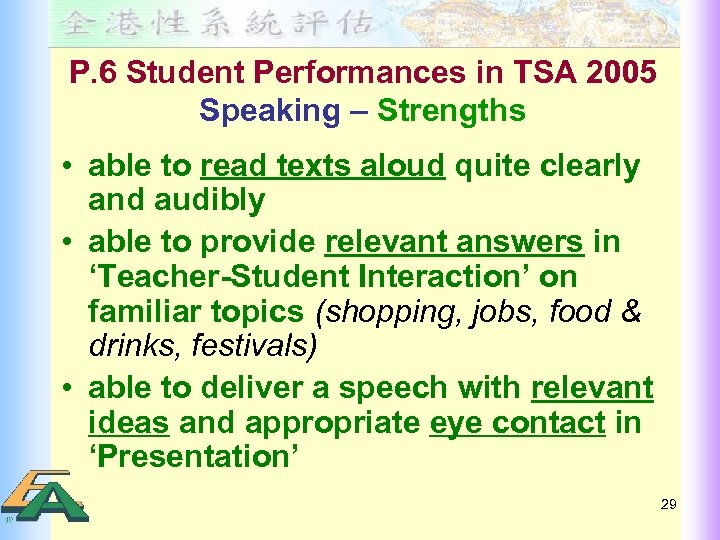 P. 6 Student Performances in TSA 2005 Speaking – Strengths • able to read texts aloud quite clearly and audibly • able to provide relevant answers in ‘Teacher-Student Interaction’ on familiar topics (shopping, jobs, food & drinks, festivals) • able to deliver a speech with relevant ideas and appropriate eye contact in ‘Presentation’ 29
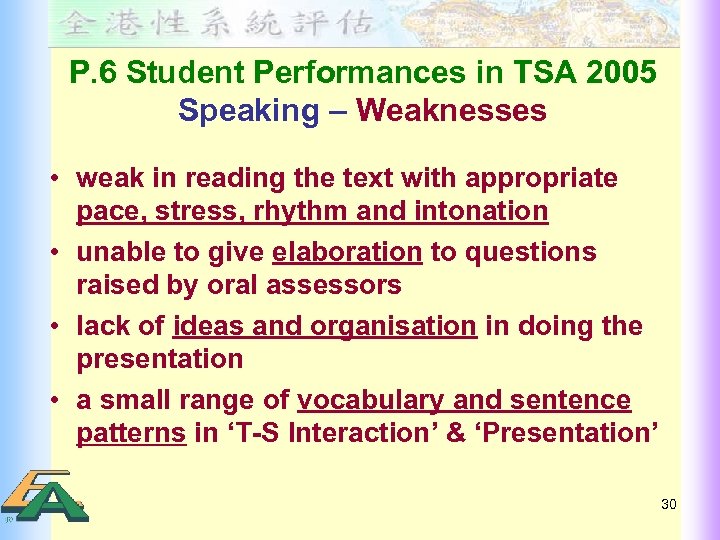 P. 6 Student Performances in TSA 2005 Speaking – Weaknesses • weak in reading the text with appropriate pace, stress, rhythm and intonation • unable to give elaboration to questions raised by oral assessors • lack of ideas and organisation in doing the presentation • a small range of vocabulary and sentence patterns in ‘T-S Interaction’ & ‘Presentation’ 30
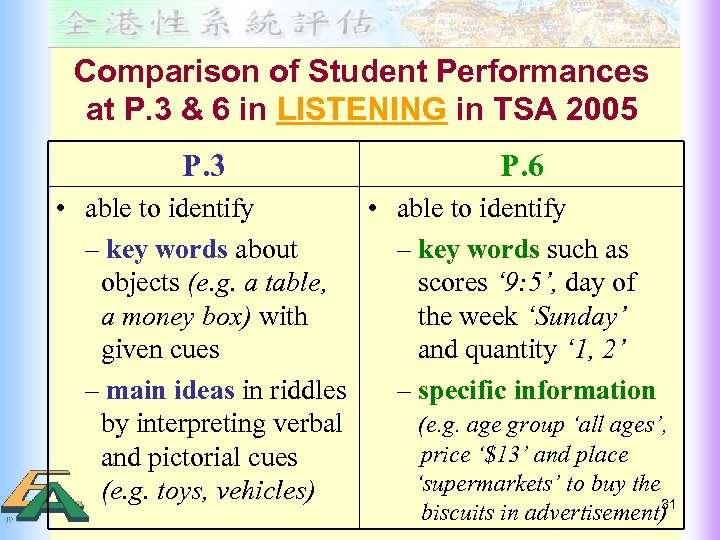 Comparison of Student Performances at P. 3 & 6 in LISTENING in TSA 2005 P. 3 P. 6 • able to identify – key words about – key words such as objects (e. g. a table, scores ‘ 9: 5’, day of a money box) with the week ‘Sunday’ given cues and quantity ‘ 1, 2’ – main ideas in riddles – specific information by interpreting verbal (e. g. age group ‘all ages’, price ‘$13’ and place and pictorial cues ‘supermarkets’ to buy the (e. g. toys, vehicles) 31 biscuits in advertisement)
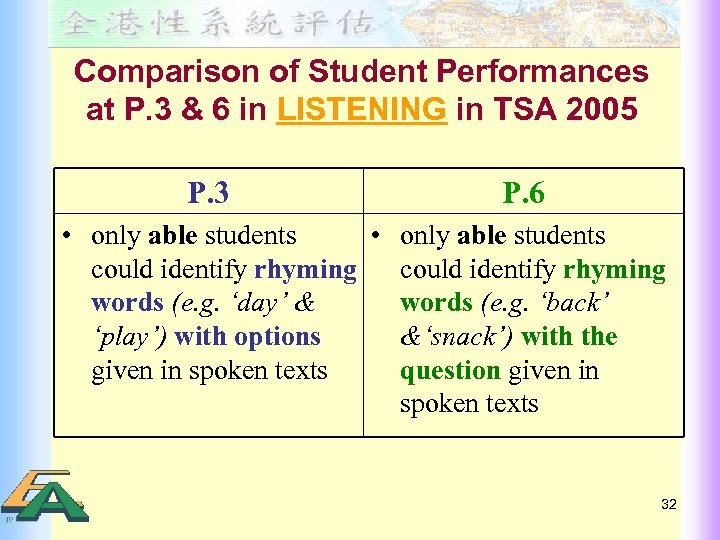 Comparison of Student Performances at P. 3 & 6 in LISTENING in TSA 2005 P. 3 P. 6 • only able students could identify rhyming words (e. g. ‘day’ & words (e. g. ‘back’ ‘play’) with options &‘snack’) with the given in spoken texts question given in spoken texts 32
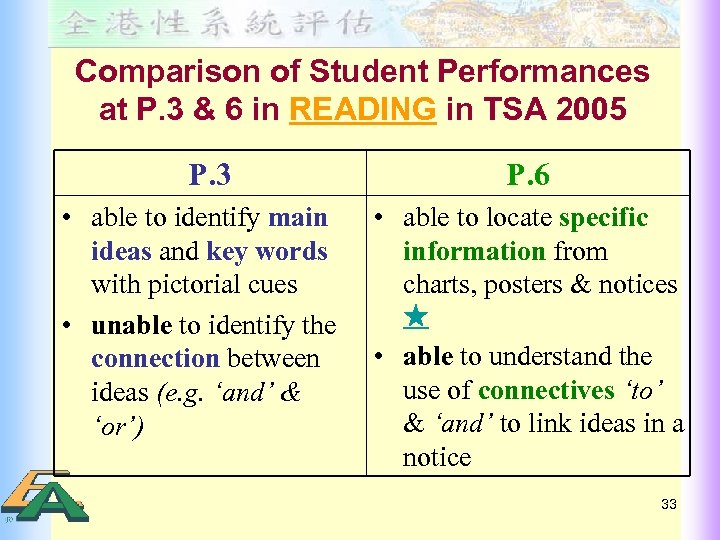 Comparison of Student Performances at P. 3 & 6 in READING in TSA 2005 P. 3 • able to identify main ideas and key words with pictorial cues • unable to identify the connection between ideas (e. g. ‘and’ & ‘or’) P. 6 • able to locate specific information from charts, posters & notices ★ • able to understand the use of connectives ‘to’ & ‘and’ to link ideas in a notice 33
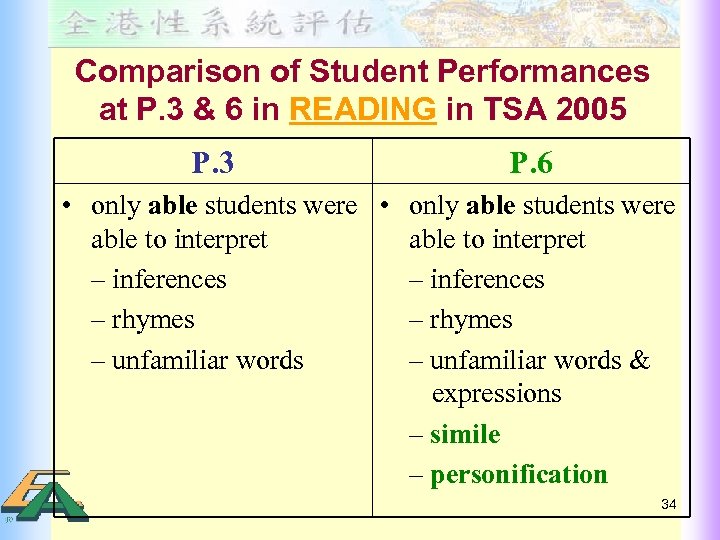 Comparison of Student Performances at P. 3 & 6 in READING in TSA 2005 P. 3 P. 6 • only able students were able to interpret – inferences – rhymes – unfamiliar words & expressions – simile – personification 34
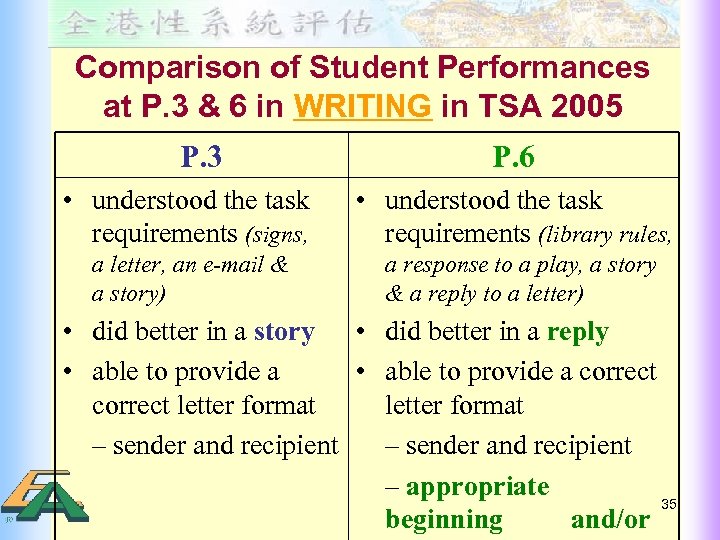 Comparison of Student Performances at P. 3 & 6 in WRITING in TSA 2005 P. 3 P. 6 • understood the task requirements (signs, • understood the task requirements (library rules, a letter, an e-mail & a story) a response to a play, a story & a reply to a letter) • did better in a story • did better in a reply • able to provide a correct letter format – sender and recipient – appropriate 35 beginning and/or
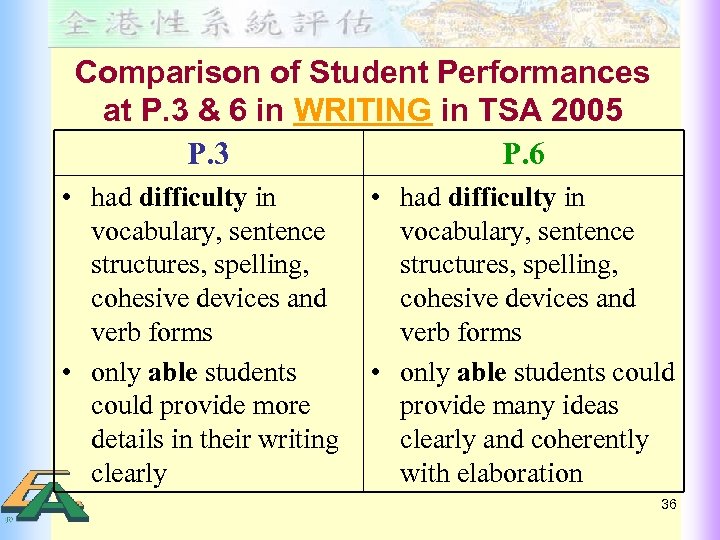 Comparison of Student Performances at P. 3 & 6 in WRITING in TSA 2005 P. 3 P. 6 • had difficulty in vocabulary, sentence structures, spelling, cohesive devices and verb forms • only able students could provide more details in their writing clearly • had difficulty in vocabulary, sentence structures, spelling, cohesive devices and verb forms • only able students could provide many ideas clearly and coherently with elaboration 36
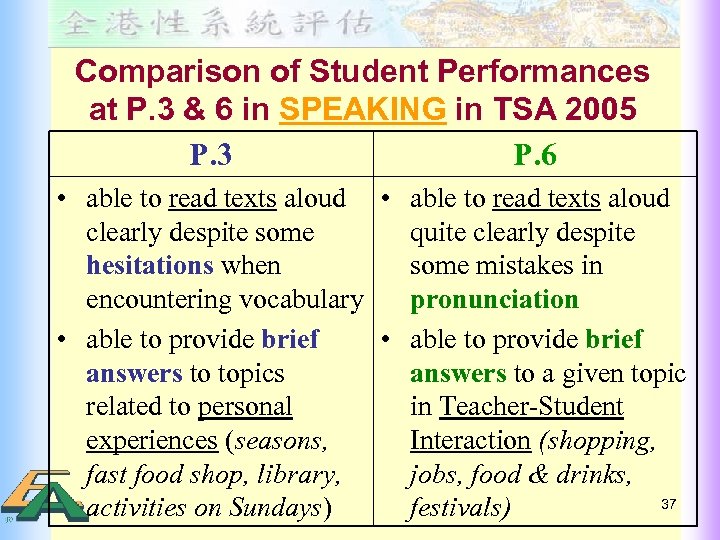 Comparison of Student Performances at P. 3 & 6 in SPEAKING in TSA 2005 P. 3 P. 6 • able to read texts aloud clearly despite some quite clearly despite hesitations when some mistakes in encountering vocabulary pronunciation • able to provide brief answers to topics answers to a given topic related to personal in Teacher-Student experiences (seasons, Interaction (shopping, fast food shop, library, jobs, food & drinks, 37 activities on Sundays) festivals)
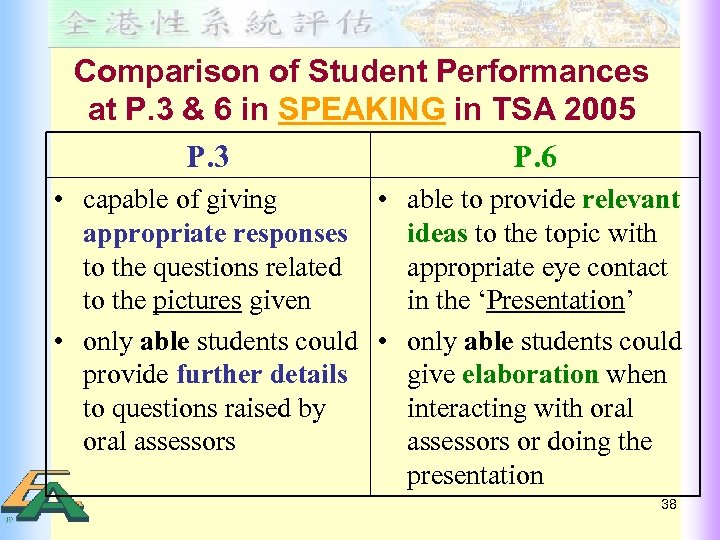 Comparison of Student Performances at P. 3 & 6 in SPEAKING in TSA 2005 P. 3 P. 6 • capable of giving • able to provide relevant appropriate responses ideas to the topic with to the questions related appropriate eye contact to the pictures given in the ‘Presentation’ • only able students could provide further details give elaboration when to questions raised by interacting with oral assessors or doing the presentation 38
 Thank you! 39