 Скачать презентацию Termination of Copyright Grants Presented by the YLD
2fe15796108f453760484279361bc3da.ppt
- Количество слайдов: 35



Termination of Copyright Grants Presented by the YLD Entertainment & Sports Industry Committee Teleconference: March 6, 2013, 1: 00 PM-2: 00 PM ET Moderator: Casey Kannenberg, Bingham Greenebaum Doll LLP Speakers: Ramona De. Salvo, De. Salvo Law Firm PLLC (Nashville, TN) Chrissie Scelsi, Scelsi Law (Port Charlotte, FL) Professor Jon M. Garon, Northern Kentucky University (Highland Heights, KY) 1
COPYRIGHT TERMINATION 17 U. S. C. §§ 203, 304 Ramona P. De. Salvo Law Firm PLLC 1720 West End Avenue, Suite 403 Nashville, TN rdesalvo@ramonadesalvo. com March 6, 2013 2
1976 COPYRIGHT ACT 17 U. S. C. § 203 January 1, 1978 to present 17 U. S. C. § 304 Pre-1978 renewal extensions 3
TERMINATIONS PUBLIC POLICY Second chance to author and family to benefit from author’s mental labors. 4
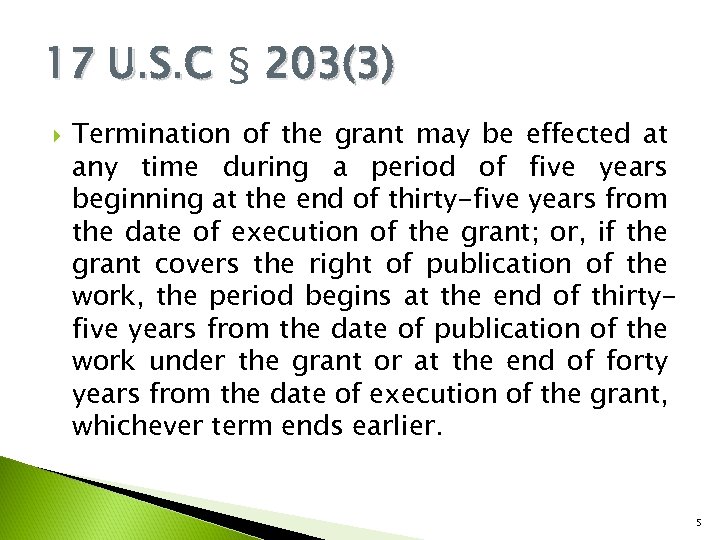
17 U. S. C § 203(3) Termination of the grant may be effected at any time during a period of five years beginning at the end of thirty-five years from the date of execution of the grant; or, if the grant covers the right of publication of the work, the period begins at the end of thirtyfive years from the date of publication of the work under the grant or at the end of forty years from the date of execution of the grant, whichever term ends earlier. 5

FIRST STEP: IS WORK ELIGIBLE FOR TERMINATION? 6
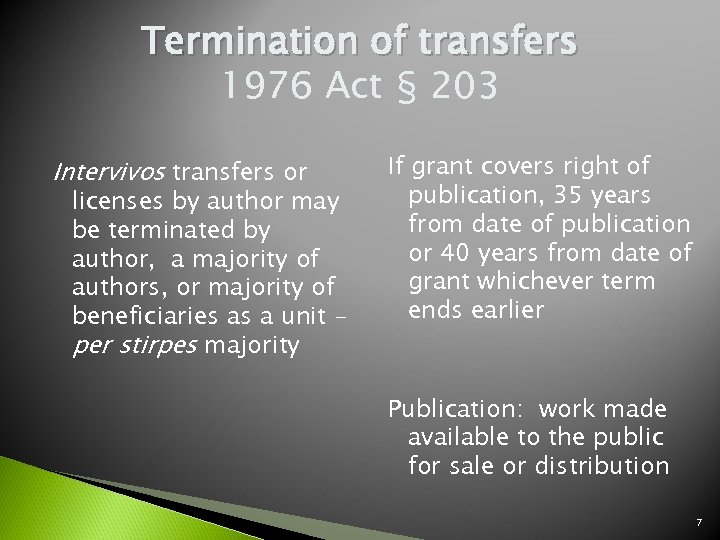
Termination of transfers 1976 Act § 203 Intervivos transfers or licenses by author may be terminated by author, a majority of authors, or majority of beneficiaries as a unit per stirpes majority If grant covers right of publication, 35 years from date of publication or 40 years from date of grant whichever term ends earlier Publication: work made available to the public for sale or distribution 7
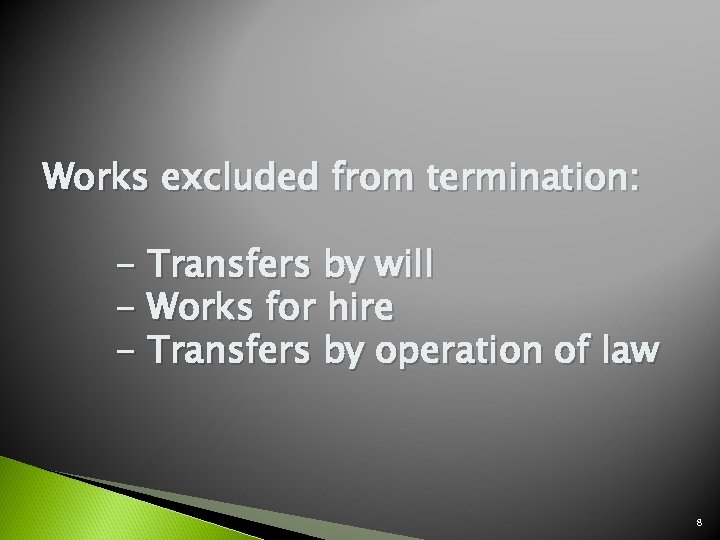
Works excluded from termination: - Transfers by will - Works for hire - Transfers by operation of law 8
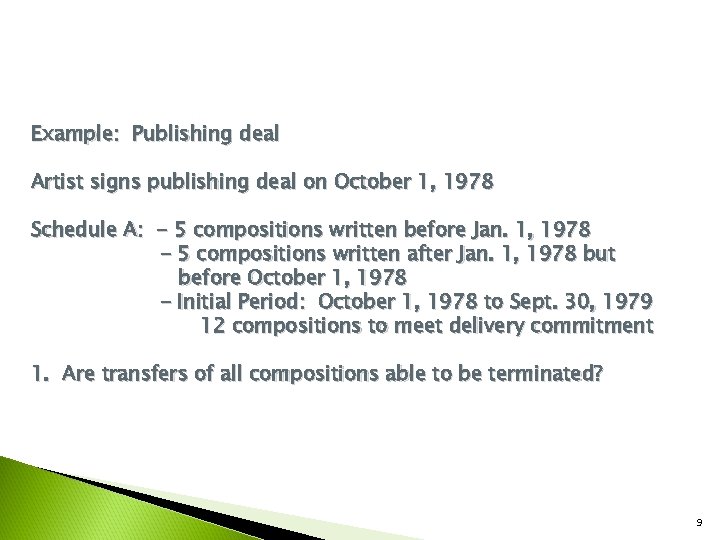
Example: Publishing deal Artist signs publishing deal on October 1, 1978 Schedule A: - 5 compositions written before Jan. 1, 1978 - 5 compositions written after Jan. 1, 1978 but before October 1, 1978 - Initial Period: October 1, 1978 to Sept. 30, 1979 12 compositions to meet delivery commitment 1. Are transfers of all compositions able to be terminated? 9
Yes, all are transfers subject to termination. 2. What if the Artist copyrighted the five pre 1978 compositions prior to January 1, 1978? 10
It does not matter if works copyrighted before 1978. The intervivos transfer by the author took place after January 1, 1978. Date of transfer (grant) matters – must be January 1, 1978 or after to be governed by Section 203. 11
SECOND STEP: DETERMINE EFFECTIVE DATE OF TERMINATION Will termination be effective? 12
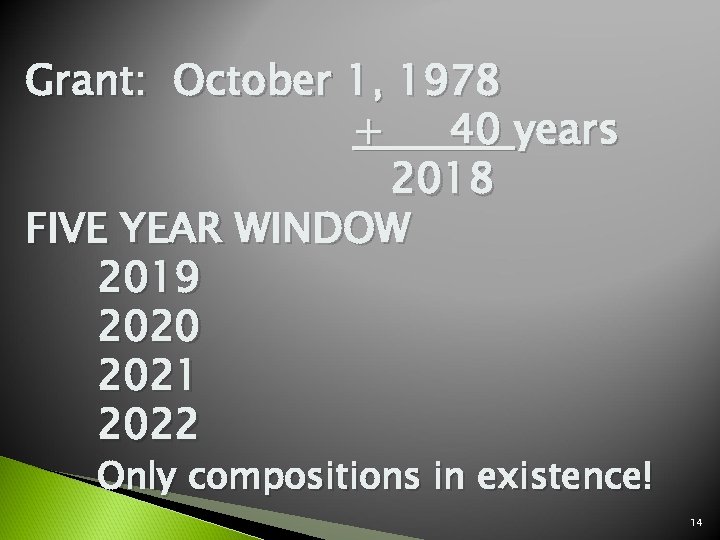
If eligible for termination, calculate: -35 years from publication OR -40 years from grant, -whichever is earlier. 13
Grant: October 1, 1978 + 40 years 2018 FIVE YEAR WINDOW 2019 2020 2021 2022 Only compositions in existence! 14
THIRD STEP: Determine when notice may be given (earliest date) & when notice must be given (latest date) 15
Notice: No earlier than 10 years nor later than two years prior to the effective date 1978 + 40 = October 1, 2018 No earlier than October 1, 2008 No later than October 1, 2016 IF effective date of termination is 2018. 16
IF effective date is 2022 (end of five-year window) Notice MAY be given Oct. 1, 2012 Notice MUST be given Oct. 1, 2020 17
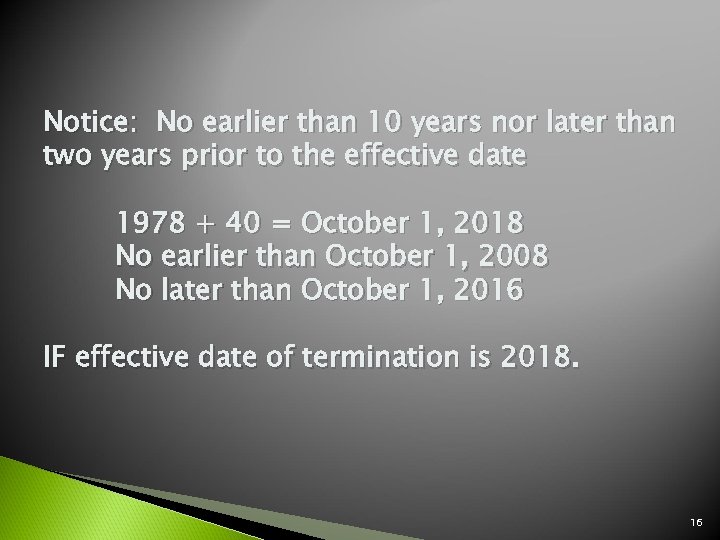
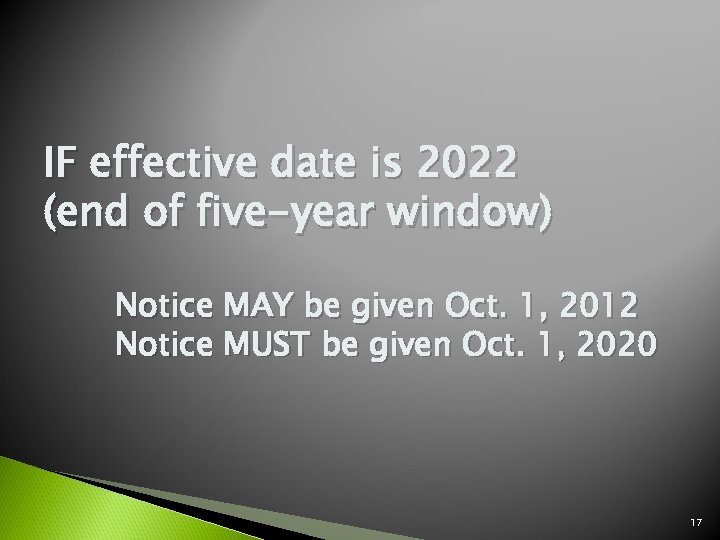
Remember: Effective date and notice dates are exact dates, not end of calendar year like duration If published on November 1, 1978, then earliest termination date is November 1, 2013 (1978 + 35=2013) with notice by November 1, 2003 (10 years) with latest November 1, 2011(2 years) 18
FOURTH STEP: Prepare and send notice of termination 19
NOTICE 1. Who are the proper parties who must give notice? • • Author Joint authors: majority of authors who executed the grant Deceased author: majority of beneficiaries voting as a unit for each author – per stirpes Surviving spouse Surviving children of deceased child Author’s executor, administrator, personal rep, trustee 20
Must joint authors who executed two separate grants join in the termination of each grant? 1. 2. 3. 4. A & B wrote the hit song “Forever” 50/50 A transferred his share of the copyright to C Two years later, B transferred his share to D. Does B have to join A to terminate A’s transfer to C? Does A have to join B to terminate B’s transfer to D? 21
Scorpio Music v. Willis 3: 11 -cv-01557 -BTM-RBB (S. D. CA) Titles include YMCA/In the Navy/Go West 22
2. Who are the proper parties to whom notice must be given? The original transferee or its successor-ininterest. Consider mergers/buy-outs/ bankruptcies/catalog sales/going out of business sales/sole proprietor 23
CONTENT OF NOTICE 37 CFR § 201. 10 • Name of the copyrighted work • Name of at least one of the authors • Date of original copyright for each work • Copyright registration number, if available • Identify the agreement (grant) to which the termination applies • Name(s) & address(es) of transferees whose grant is being ended • The effective date of the termination • If the writer is deceased, list the names of the successors to the deceased writer and the relationship 24
SERVE & RECORD NOTICE Personal service or first class mail to last known address of original transferee or successor-in-interest Record notice of termination with copyright office BEFORE effective date of termination Current fee: $105. 00 for single title $30. 00 for each additional group of ten titles 25
Effect of termination - All rights revert to everyone who holds a termination interest whether or not holder signed termination notice. - Terminates U. S. rights only - Does not terminate licenses in derivative works if such license granted before effective date of termination. - Until effective date, a new deal may be negotiated with transferee only 26
The Ray Charles Foundation v. Robinson CV-12 -2725 (FFMx), (C. D. CA 2013) Motion to Strike state law claims and Motion to Dismiss federal declaratory relief claim • • Does the California Anti-SLAPP statute apply to Plaintiff’s action? Are the termination notices valid? 27
Anti-SLAPP Statute Civil Code 425. 16 State law claims barred if it arises from any act of a person in furtherance of the person’s right of petition or free speech in connection with a public interest Bars claims based on communications made in an official proceeding which includes establishing a property right. Copyright termination involves the establishment of a property right. It is not a ministerial act. 28
Anti-SLAPP Statute B/P shifted to Plaintiff to demonstrate that they had a reasonable probability of success on the merits of their breach of contract and breach of covenant of good faith and fair dealing. Plaintiff argued it was not preventing exercise of termination rights, but if such rights were exercised, it breached the agreement defendants made with Ray Charles. 29
Court held the contract to waive termination rights was “an agreement to the contrary” contemplated by sections 304 and 203. Court found that forcing defendants to choose between exercising termination rights and breach of contract in reality prevented defendants from exercising their statutory rights. 30
Court held that defendants were not in breach of contract since they made no claim against Charles’s estate which had been probated. Good faith & fair dealing claim also would fail since it was based on contract claim and is co -extensive. If termination notices were claims against the estate, Copyright Act prevents court from limiting defendants’ statutory rights to terminate. 31
Foundation initially claimed compositions were works for hire. Can Foundation alternatively argue (without a rule 11 violation) that the compositions are not works for hire and it is a beneficial owner of the copyrights because it receives royalties that will be affected by the termination? 32
Case or controversy – prudential limitations Do rights fall within “zone of interests” protected by statute or constitutions? Protecting a third party interest? Authorized to sue under the Copyright Act? 33
Zone of interests Congress can limit zone of interests. Look at Copyright Act and application of “zone” as beneficial owner turns on interests protected by §§ 304 and 203, not resulting damages. © act addresses authors/statutory heirs and the grantees & their successors 34
Zone of interests Court looked at interplay between § 501(b) beneficial owner and §§ 203 and 304. Termination protects widow(er) and children and requires notice to grantee(s) & successor(s) Beneficial owner has no “seat at the table. ” Foundation also has no third party standing to bring the claim on behalf of Warner/Chappell. 35
Скачать презентацию Termination of Copyright Grants Presented by the YLD
2fe15796108f453760484279361bc3da.ppt