



ТЕОРИЯ ОБРАЗОВ
THEORY OF IMAGES In a broad sense the term “image” means reflection of the external environment in human conscience. The main functions of image: • cognitive, • communicative, • аesthetic, • educational.
EXAMPLE 1 It was six o’clock on a winter’s evening. Thin, dingy rain spat and drizzled past the lighted street lamps. The pavements shone long and yellow. In squeaking galoshes, with makintosh collars up and bowlers and trilbies weeping, youngish men from the offices bundled home against the thistly wind. (D. Thomas/ The Followers) • The example characterizes usual and occasional linguistic figurativeness. • The words BUNDLE & THISTLY having initial meanings узел и чертополох are used here in their figurative metaphoric meanings ОТПРАВЛЯТЬСЯ и КОЛЮЧИЙ. • They are supported by occasional metaphors SPIT (about a rain) and WEEP (about hats), and participate in figurative description of the surroundings.
EXAMPLE 2 Something seemed to break in Winterbourne’s head. He felt he was going mad, and sprang to his feet. The line of bullets smashed across his chest like a savage steel whip. (R. Aldington Death of a Hero) • The image for the line of bullets is not only in the word WHIP but also in the whole italicized passage. • The word whip in its sound pattern is very expressive as it is filled with associations of pain and violence. Its sound is associated with very abrupt fast movement. • Figurative and reinforcing expressiveness of the word WHIP is supported by convergence of additional stylistic means. • Epithet SAVAGE supplements the image by an emotional and estimating component. • The image is reinforced by rhythmic and phonetic sound pattern with the emphasized alliteration of sibilant and hushing sounds.
EXAMPLES 3&4 Evans possessed that British rhinoceros equipment of mingled ignorance, self-confidence and complacency which is triple-armed against all the shafts of mind. (E. Hemingway The Snows of Kilimanjaro) Soft is the music that would charm for ever The flower of sweetest smell is shy and lowly. (W. Wordsworth)
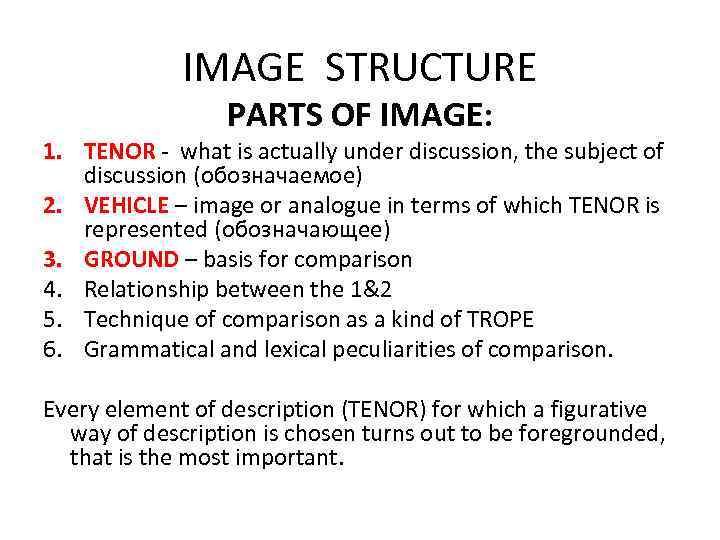
IMAGE STRUCTURE PARTS OF IMAGE: 1. TENOR - what is actually under discussion, the subject of discussion (обозначаемое) 2. VEHICLE – image or analogue in terms of which TENOR is represented (обозначающее) 3. GROUND – basis for comparison 4. Relationship between the 1&2 5. Technique of comparison as a kind of TROPE 6. Grammatical and lexical peculiarities of comparison. Every element of description (TENOR) for which a figurative way of description is chosen turns out to be foregrounded, that is the most important.
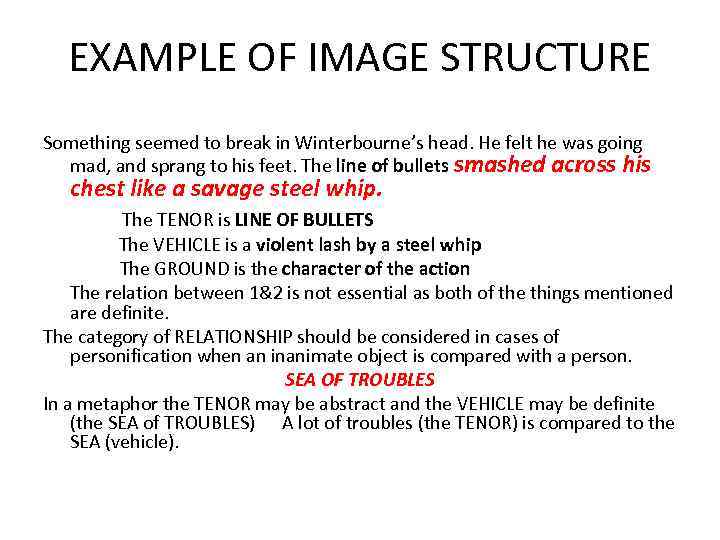
EXAMPLE OF IMAGE STRUCTURE Something seemed to break in Winterbourne’s head. He felt he was going mad, and sprang to his feet. The line of bullets smashed across his chest like a savage steel whip. The TENOR is LINE OF BULLETS The VEHICLE is a violent lash by a steel whip The GROUND is the character of the action The relation between 1&2 is not essential as both of the things mentioned are definite. The category of RELATIONSHIP should be considered in cases of personification when an inanimate object is compared with a person. SEA OF TROUBLES In a metaphor the TENOR may be abstract and the VEHICLE may be definite (the SEA of TROUBLES) A lot of troubles (the TENOR) is compared to the SEA (vehicle).
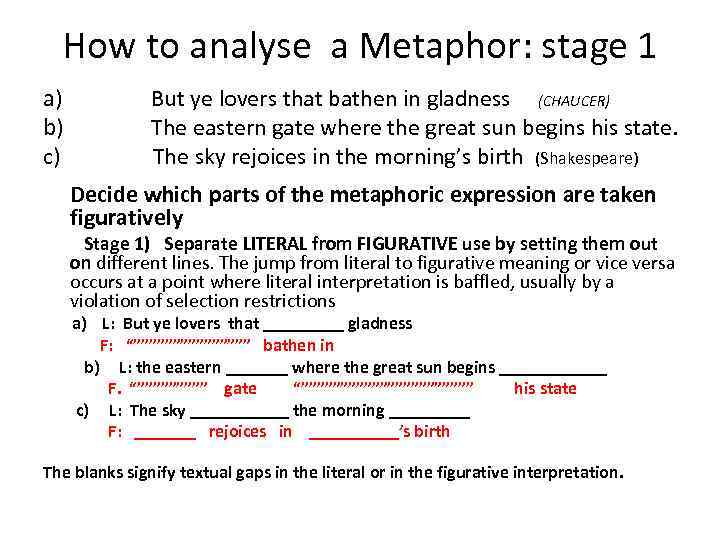
How to analyse a Metaphor: stage 1 a) But ye lovers that bathen in gladness (CHAUCER) b) The eastern gate where the great sun begins his state. c) The sky rejoices in the morning’s birth (Shakespeare) Decide which parts of the metaphoric expression are taken figuratively Stage 1) Separate LITERAL from FIGURATIVE use by setting them out on different lines. The jump from literal to figurative meaning or vice versa occurs at a point where literal interpretation is baffled, usually by a violation of selection restrictions a) L: But уe lovers that _____ gladness F: “”””””””” bathen in b) L: the eastern _______ where the great sun begins ______ F. “””””” gate “””””””””””” his state c) L: The sky ______ the morning _____ F: _______ rejoices in _____’s birth The blanks signify textual gaps in the literal or in the figurative interpretation.
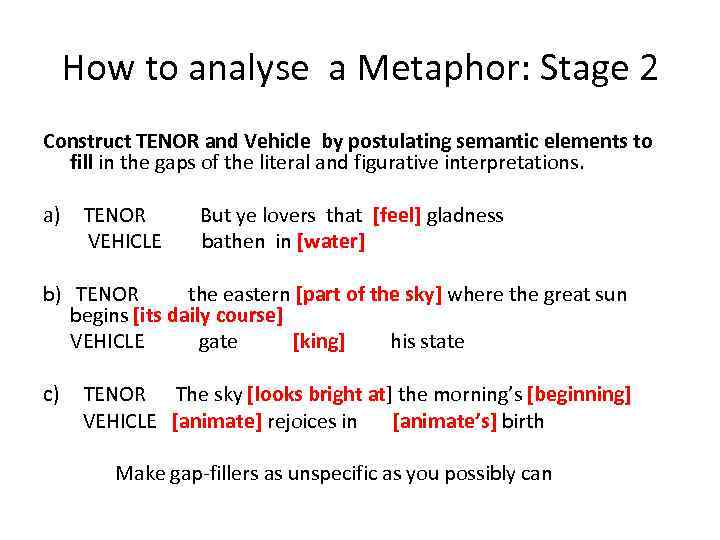
How to analyse a Metaphor: Stage 2 Construct TENOR and Vehicle by postulating semantic elements to fill in the gaps of the literal and figurative interpretations. a) TENOR But ye lovers that [feel] gladness VEHICLE bathen in [water] b) TENOR the eastern [part of the sky] where the great sun begins [its daily course] VEHICLE gate [king] his state c) TENOR The sky [looks bright at] the morning’s [beginning] VEHICLE [animate] rejoices in [animate’s] birth Make gap-fillers as unspecific as you possibly can
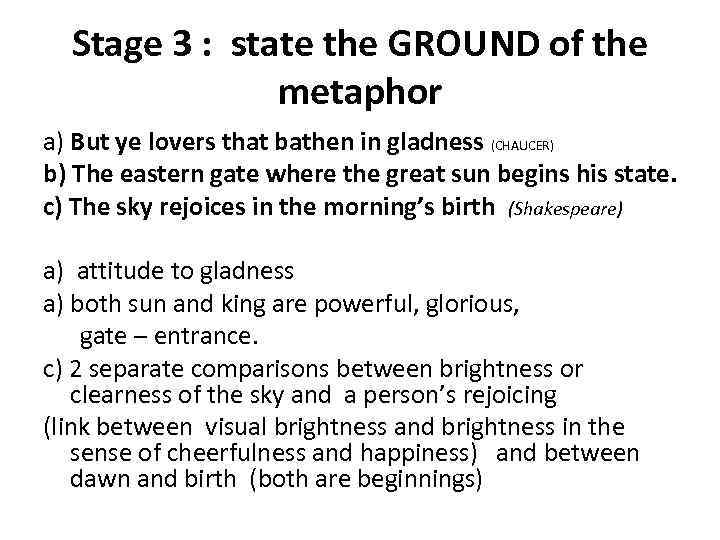
Stage 3 : state the GROUND of the metaphor a) But ye lovers that bathen in gladness (CHAUCER) b) The eastern gate where the great sun begins his state. c) The sky rejoices in the morning’s birth (Shakespeare) a) attitude to gladness a) both sun and king are powerful, glorious, gate – entrance. c) 2 separate comparisons between brightness or clearness of the sky and a person’s rejoicing (link between visual brightness and brightness in the sense of cheerfulness and happiness) and between dawn and birth (both are beginnings)
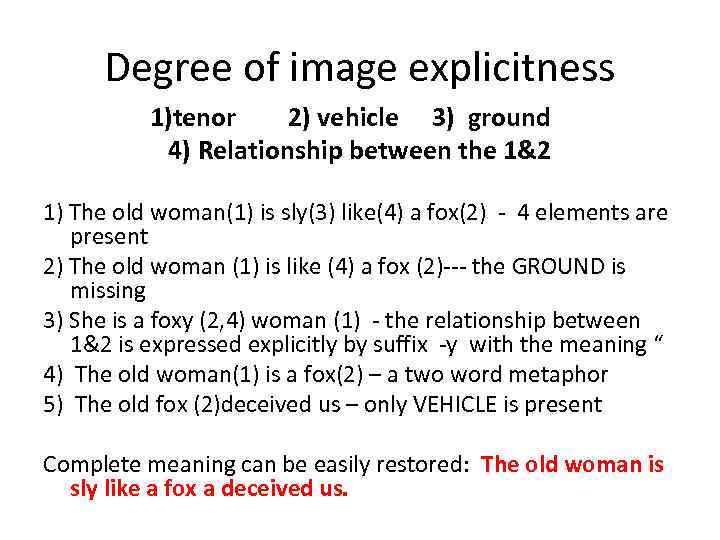
Degree of image explicitness 1)tenor 2) vehicle 3) ground 4) Relationship between the 1&2 1) The old woman(1) is sly(3) like(4) a fox(2) - 4 elements are present 2) The old woman (1) is like (4) a fox (2)--- the GROUND is missing 3) She is a foxy (2, 4) woman (1) - the relationship between 1&2 is expressed explicitly by suffix -y with the meaning “ 4) The old woman(1) is a fox(2) – a two word metaphor 5) The old fox (2)deceived us – only VEHICLE is present Complete meaning can be easily restored: The old woman is sly like a fox a deceived us.
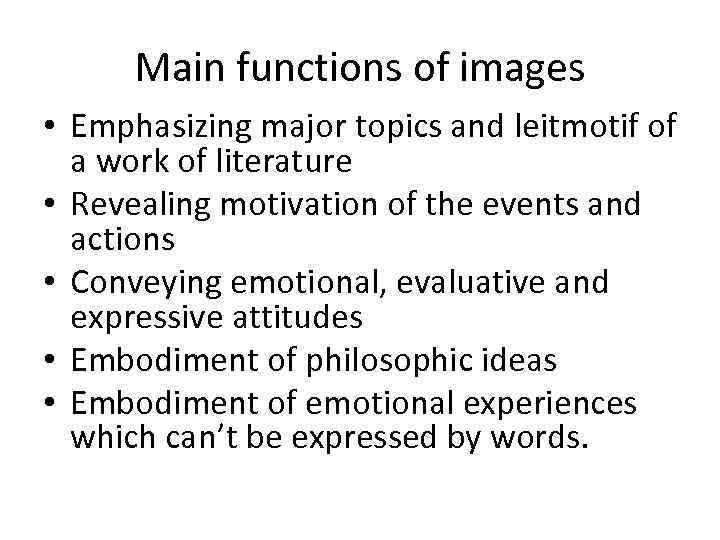
Main functions of images • Emphasizing major topics and leitmotif of a work of literature • Revealing motivation of the events and actions • Conveying emotional, evaluative and expressive attitudes • Embodiment of philosophic ideas • Embodiment of emotional experiences which can’t be expressed by words.
