


 Скачать презентацию Tensilica Xtensa Tuan Huynh Kevin Peek Paul
fd1a978f7151bcd5faa05e7c9f0f9544.ppt
- Количество слайдов: 77
 Tensilica Xtensa Tuan Huynh, Kevin Peek & Paul Shumate CS 451 - Advanced Processor Architecture November 15, 2005
 Overview Background n Changes in progress from Xtensa to Xtensa LX n Automated Development Process n ISA n TIE Language n Benchmarks n
 Tensilica Founded in 1997 in Santa Clara, California by a group of engineers from Intel, SGI, MIPS, and Synopsys to compete with ARC n Goal: To address application specific microprocessor cores and software development tools by designing the first configurable and extensible processor core n
 Why? Embedded application problems with high cost custom designs or low performance (inefficient) processors n System on a Chip (So. C) challenge n ¨ Traditionally blocks solved using hardwired RTL
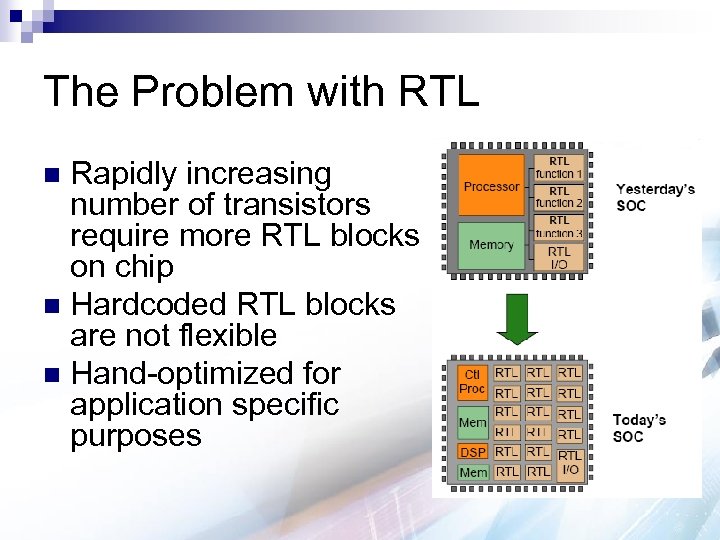 The Problem with RTL Rapidly increasing number of transistors require more RTL blocks on chip n Hardcoded RTL blocks are not flexible n Hand-optimized for application specific purposes n
 Tensilica’s Solution n Xtensa ¨ Focusing on design through the processor, and not through hardwired RTL
 Xtensa n n n First appearing in 1999 32 -bit microprocessor core with a graphical configuration interface and integrated tool chain Designed from the start to be user customizable Emphasizes instruction-set configurability as its primary feature distinguishing it from other core offerings Has revolutionized the System on a Chip (So. C) challenge through out its development Configurable and Extensible
 Xtensa – In a Nutshell n n n Enables embedded system designers to build better, more highly integrated products in significantly less time Can add specialized functions or instructions to processor and have them recognized as “native” by the entire software development took chain Move to a higher level of abstraction by designing with processors rather than RTL
 Xtensa - Deliverables Provided as synthesizable RTL cores ¨Gate count range: 25, 000 – 150, 000+ ¨Increase in gates as customer adds instructions or optional features n Software development tools n
 Xtensa – Verification Challenges To extensively verify the configurable processor to ensure each possible configuration will be bug free n To enable the customer to rapidly integrate the core while limiting support costs n
 Xtensa – Basic Architecture 78 instructions n five-stage pipeline that supports singlecycle execution n 1 - load/store model n 32 -entry orthogonal register file n 32 optional extra registers n
 Xtensa – Basic Architecture n Processor Configuration ¨ ¨ ¨ Power Usage: 200 m. W, 0. 25 m, 1. 5 V Clock Speed: 170 MHz Cache: n n n ¨ ¨ 16 KB I-cache 16 KB D-cache Direct mapped 32 Registers (32 -bits) Extensible via use of TIE instructions No Floating Point Processor Zero over head loops
 Xtensa - ISA n Priorities used in ISA Development ¨ Code Size, Configurability, Processor Cost, Energy Efficiency, Scalability, Features n ISA Influences ¨ MIPS ¨ IBM Power ¨ Sun SPARC ¨ ARM Thumb ¨ HP Playdoh ¨ DSPs
 Xtensa III n n With Virtual IP Group developed an MP 3 audio decoder for Tensilica's Xtensa configurable microprocessor architecture. The decoder offers hardware extensions and optimized code for accelerating MP 3 decoding 32 -bit floating point processing 32 x 32 -bit hardware multiplier First Coprocessor interface ¨ Vectra DSP enhancements
 Xtensa IV Used white box verification methodology for the original development n Includes 0 -In Check and the Checker. Ware Library made by Mentor Graphics n Could repartition instructions up until point of manufacturing n Support multiple processors in ASIC n 128 -bit wide local memory interface n
 Xtensa V n n 350 MHz (synthesized), as small as 18 K gates (0. 25 mm 2) More flexible interfaces for multiple processors ¨ ¨ ¨ n More Automation ¨ ¨ n Write-back and write-through caches Enhanced Xtensa Local Memory Interface Shared data memories Xtensa C/C++ Compiler & TIE Language improvements XT 2000 Emulation kit World’s fastest embedded core
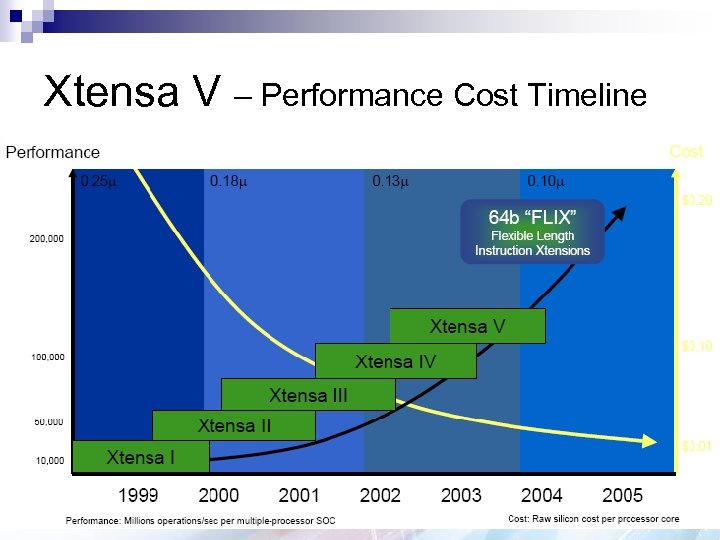 Xtensa V – Performance Cost Timeline
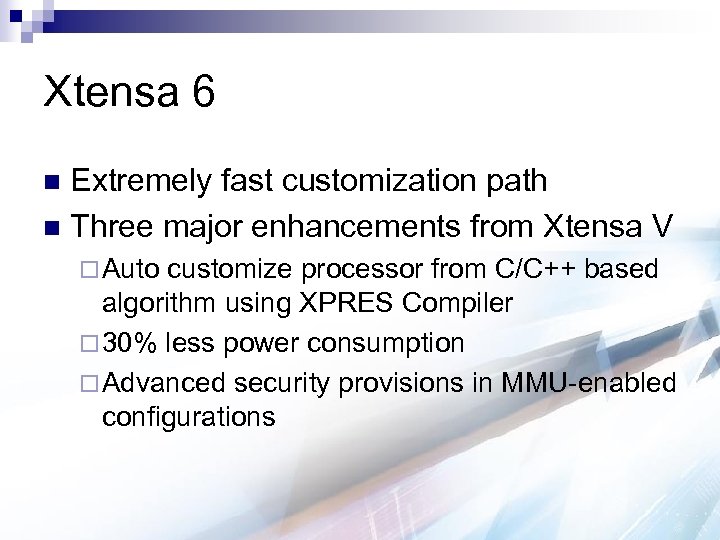 Xtensa 6 Extremely fast customization path n Three major enhancements from Xtensa V n ¨ Auto customize processor from C/C++ based algorithm using XPRES Compiler ¨ 30% less power consumption ¨ Advanced security provisions in MMU-enabled configurations
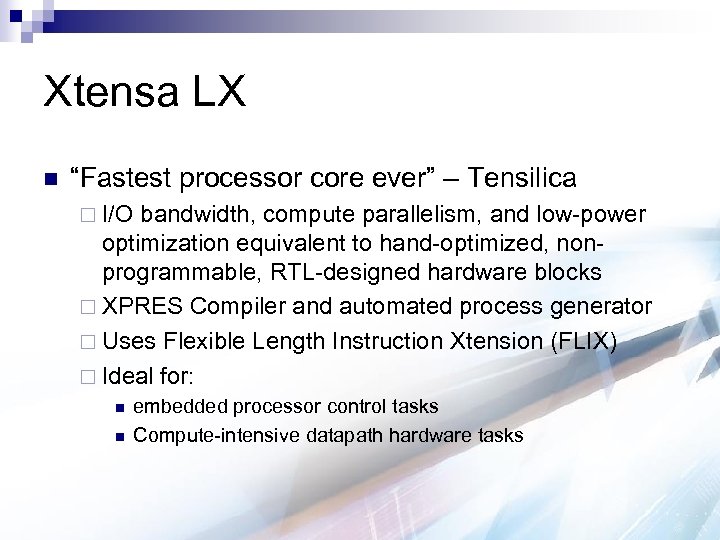 Xtensa LX n “Fastest processor core ever” – Tensilica ¨ I/O bandwidth, compute parallelism, and low-power optimization equivalent to hand-optimized, nonprogrammable, RTL-designed hardware blocks ¨ XPRES Compiler and automated process generator ¨ Uses Flexible Length Instruction Xtension (FLIX) ¨ Ideal for: n n embedded processor control tasks Compute-intensive datapath hardware tasks
 Xtensa 6 Vs Xtensa LX
 Xtensa LX n Strongest selling point is performance n DSP operations can be encapsulated into custom instructions n High performance leads to power savings n Custom instructions target a special application
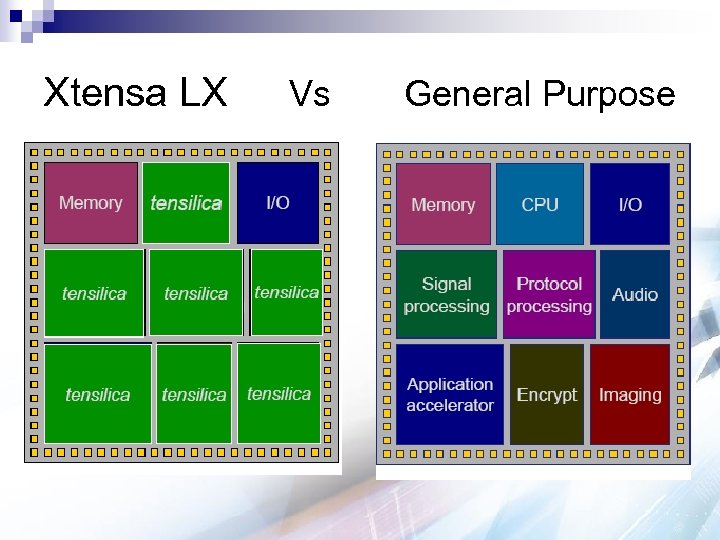 Xtensa LX Vs General Purpose
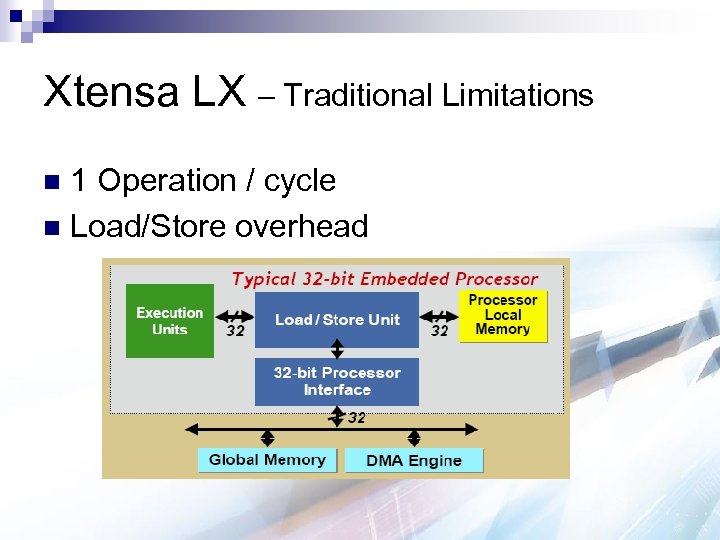 Xtensa LX – Traditional Limitations 1 Operation / cycle n Load/Store overhead n
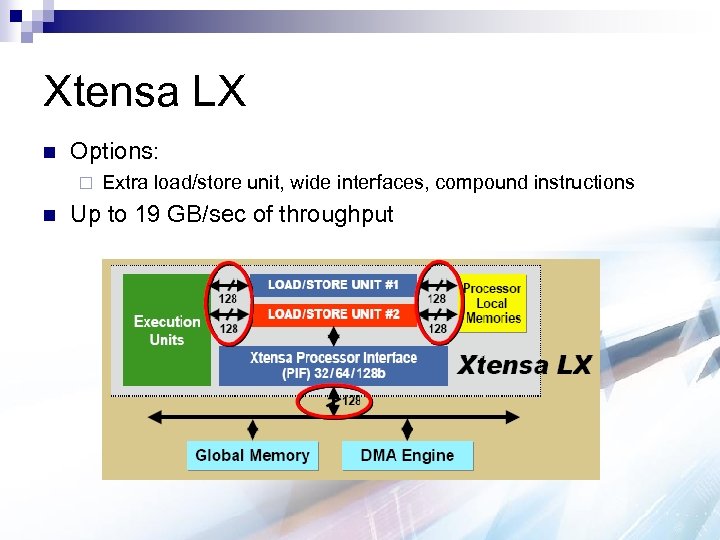 Xtensa LX n Options: ¨ n Extra load/store unit, wide interfaces, compound instructions Up to 19 GB/sec of throughput
 Xtensa LX – Highlights Lower power usage n I/O throughput at RTL speeds n Outstanding computer performance n XPRES Compiler n
 Xtensa LX – Lower Power Useage n Automated the insertion of fine-grain clock gating for every functional element of the Xtensa LX processor This includes functions created by the designer ¨ Direct I/O capability – like RTL ¨
 Outstanding Computing Performance n Extensible using FLIX (Flexible Length Instruction Xtensions) ¨ Similar to VLIW – but customizable to fit application code’s needs n Significant improvement over competitors and previous Xtensa Design ¨ DSP instructions formed using FLIX to be recognized as native to entire development system
 XPRES Compiler n Powerful synthesis tool ¨ Creates tailored processor descriptions ¨ Run on native C/C++ code
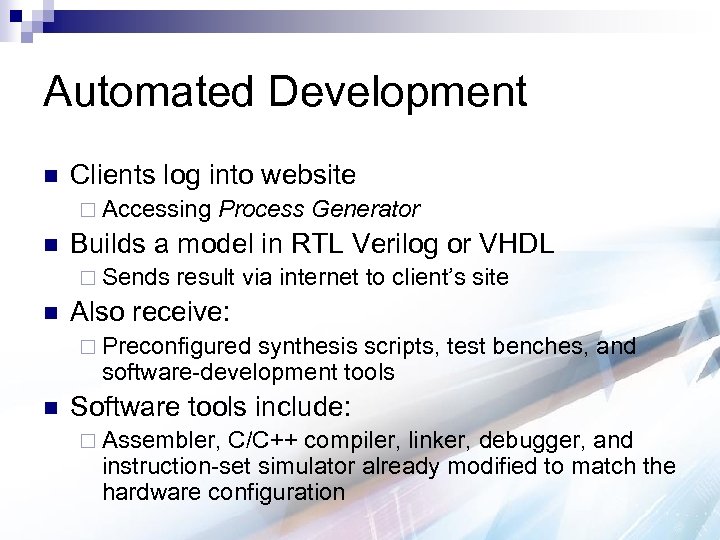 Automated Development n Clients log into website ¨ Accessing n Builds a model in RTL Verilog or VHDL ¨ Sends n Process Generator result via internet to client’s site Also receive: ¨ Preconfigured synthesis scripts, test benches, and software-development tools n Software tools include: ¨ Assembler, C/C++ compiler, linker, debugger, and instruction-set simulator already modified to match the hardware configuration
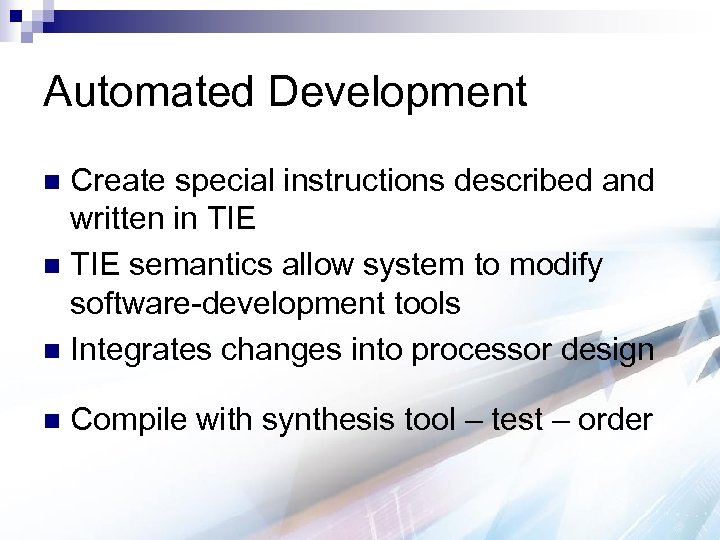 Automated Development Create special instructions described and written in TIE semantics allow system to modify software-development tools n Integrates changes into processor design n n Compile with synthesis tool – test – order
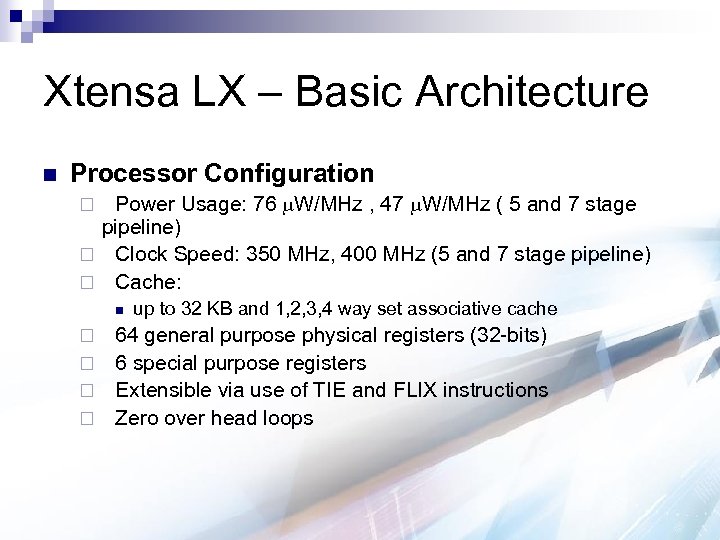 Xtensa LX – Basic Architecture n Processor Configuration Power Usage: 76 W/MHz , 47 W/MHz ( 5 and 7 stage pipeline) ¨ Clock Speed: 350 MHz, 400 MHz (5 and 7 stage pipeline) ¨ Cache: ¨ n up to 32 KB and 1, 2, 3, 4 way set associative cache 64 general purpose physical registers (32 -bits) ¨ 6 special purpose registers ¨ Extensible via use of TIE and FLIX instructions ¨ Zero over head loops ¨
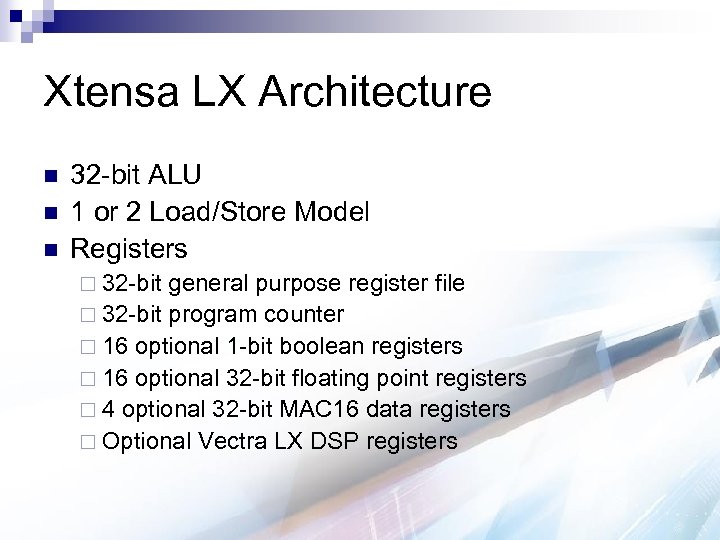 Xtensa LX Architecture n n n 32 -bit ALU 1 or 2 Load/Store Model Registers ¨ 32 -bit general purpose register file ¨ 32 -bit program counter ¨ 16 optional 1 -bit boolean registers ¨ 16 optional 32 -bit floating point registers ¨ 4 optional 32 -bit MAC 16 data registers ¨ Optional Vectra LX DSP registers
 Xtensa LX Architecture n General Purpose AR Register File ¨ 32 or 64 registers ¨ Instructions have access through “sliding window” of 16 registers. Window can rotate by 4, 8, or 12 registers ¨ Register window reduces code size by limiting number of bits for the address and eliminated the need to save and restore register files
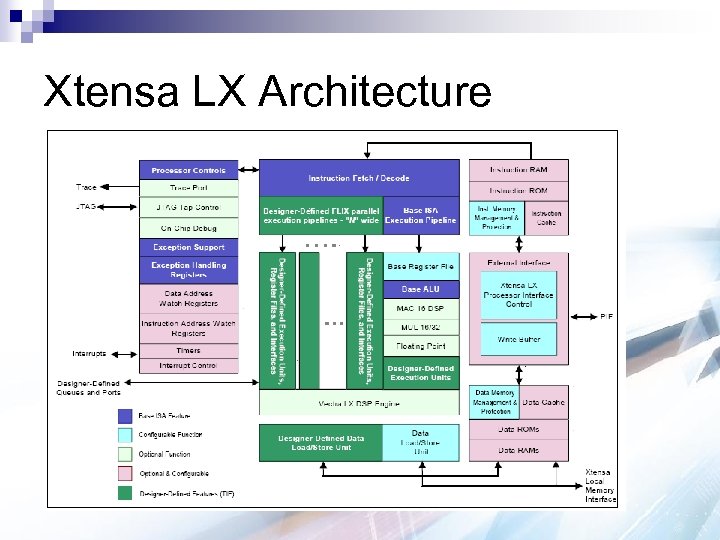 Xtensa LX Architecture
 Xtensa LX Pipelining n n n 5 or 7 Stage Pipeline Design 5 stage pipeline has stages: IF, Register Access, Execute, Data-Memory Access, and register writeback 5 stage pipeline accesses memory in two stages. 7 stage pipeline is extended version of the 5 stage pipeline with extra IF and Memory Access stage. Extra stages provide more time for memory access. Designer can run at a higher clock speed while using slower memory to improve performance
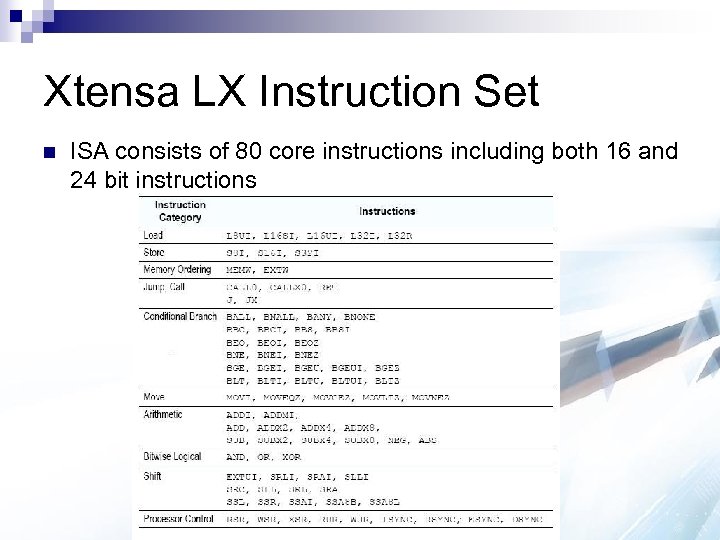 Xtensa LX Instruction Set n ISA consists of 80 core instructions including both 16 and 24 bit instructions
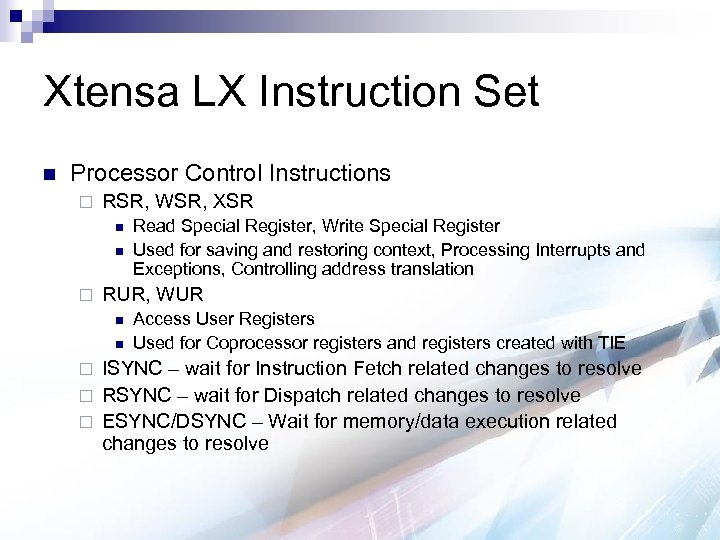 Xtensa LX Instruction Set n Processor Control Instructions ¨ RSR, WSR, XSR n n ¨ Read Special Register, Write Special Register Used for saving and restoring context, Processing Interrupts and Exceptions, Controlling address translation RUR, WUR n n Access User Registers Used for Coprocessor registers and registers created with TIE ISYNC – wait for Instruction Fetch related changes to resolve ¨ RSYNC – wait for Dispatch related changes to resolve ¨ ESYNC/DSYNC – Wait for memory/data execution related changes to resolve ¨
 Xtensa LX ISA – Building Blocks n MUL 32 ¨ MUL 32 n adds 32 bit multiplier MUL 16 and MAC 16 ¨ MUL 16 adds 16 x 16 bit multiplier ¨ MAC 16 adds 16 x 16 bit multiplier and 40 -bit accumulator
 Xtensa LX ISA – Building Blocks n Floating Point Unit ¨ 32 -bit, single precision, floating-point coprocessor n Vectra LX DSP Engine ¨ Optimized to handle Digital Signal Processing Applications
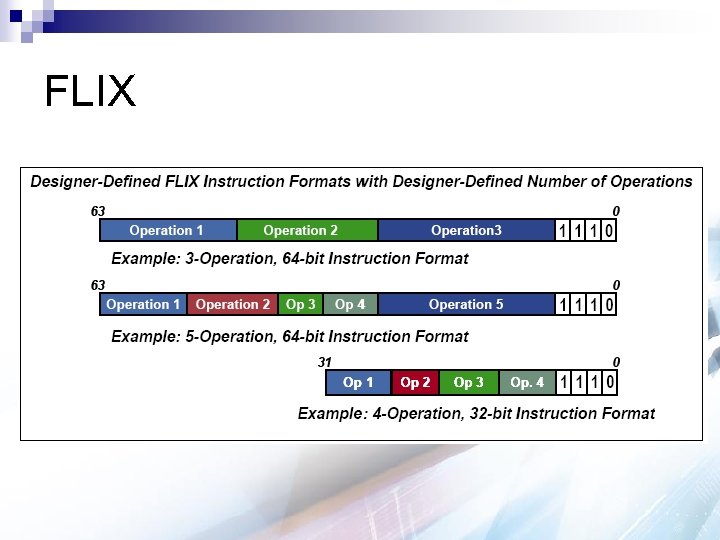
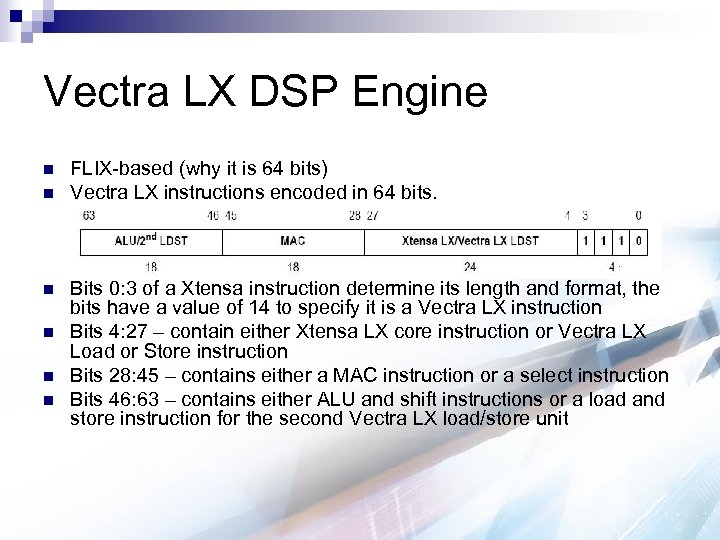 Vectra LX DSP Engine n n n FLIX-based (why it is 64 bits) Vectra LX instructions encoded in 64 bits. Bits 0: 3 of a Xtensa instruction determine its length and format, the bits have a value of 14 to specify it is a Vectra LX instruction Bits 4: 27 – contain either Xtensa LX core instruction or Vectra LX Load or Store instruction Bits 28: 45 – contains either a MAC instruction or a select instruction Bits 46: 63 – contains either ALU and shift instructions or a load and store instruction for the second Vectra LX load/store unit
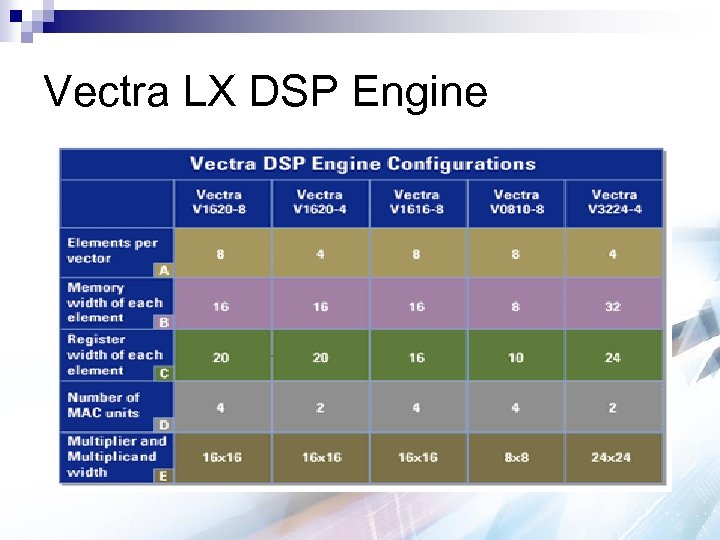 Vectra LX DSP Engine
 Tensilica Instruction Extension Method used to extend the processor’s architecture and instruction set n Can be used in two ways: n ¨ For the TIE Compiler ¨ For the Processor Generator
 Tensilica Instruction Extension n TIE Compiler ¨ Generates file used to configure software development tools so that they recognize TIE Extensions ¨ Estimates hardware size of new instruction ¨ You can modify application code to take advantage of the new instruction and simulate to decide if the speed advantage is worth the hardware cost
 TIE Resembles Verilog n More concise than RTL (it omits all sequential logic, pipeline registers, and initialization sequences. n The custom instructions and registers described in TIE are part of the processor’s programming model. n
 TIE Queues and Ports n n New way to communicate with external devices Queues: data can be sent or read through queues. A queue is defined in the TIE and the compiler generates the interface signals required for the additional port needed to connect to the queue. Logic is also automatically generated Import-wire: processor can sample the value of an external signal Export-state: drive an output based on TIE
 TIE n TIE Combines multiple operations into one using: ¨ Fusion ¨ SIMD/Vector ¨ FLIX Transformation
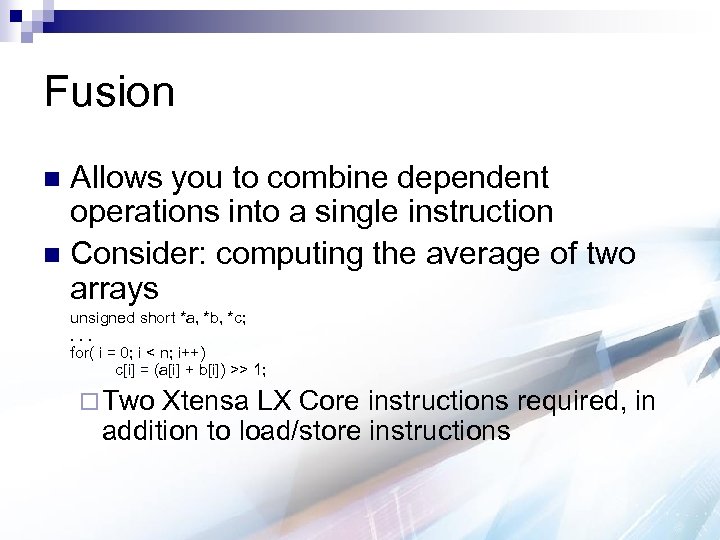 Fusion Allows you to combine dependent operations into a single instruction n Consider: computing the average of two arrays n unsigned short *a, *b, *c; . . . for( i = 0; i < n; i++) c[i] = (a[i] + b[i]) >> 1; ¨ Two Xtensa LX Core instructions required, in addition to load/store instructions
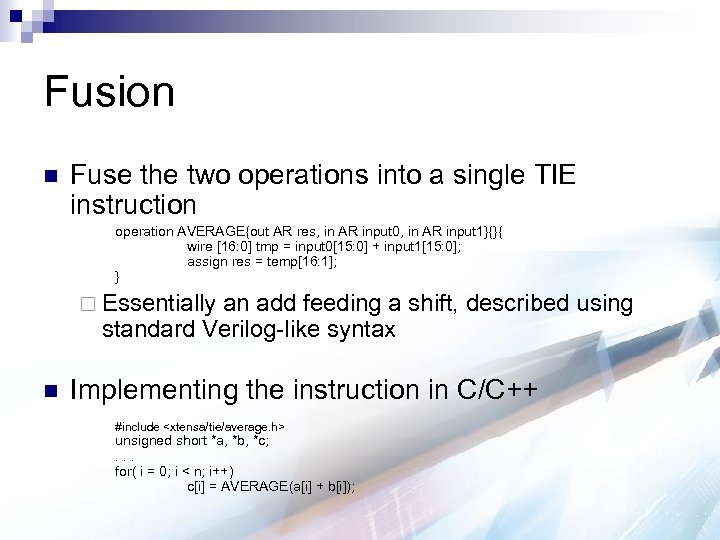 Fusion n Fuse the two operations into a single TIE instruction operation AVERAGE{out AR res, in AR input 0, in AR input 1}{}{ wire [16: 0] tmp = input 0[15: 0] + input 1[15: 0]; assign res = temp[16: 1]; } ¨ Essentially an add feeding a shift, described using standard Verilog-like syntax n Implementing the instruction in C/C++ #include
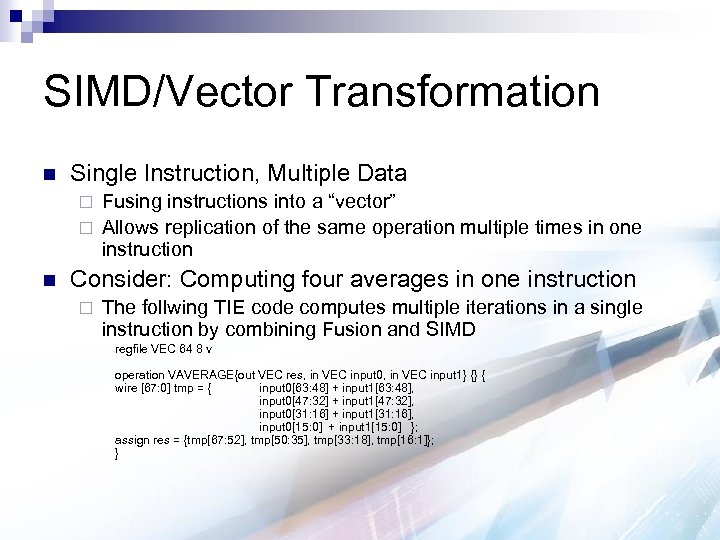 SIMD/Vector Transformation n Single Instruction, Multiple Data Fusing instructions into a “vector” ¨ Allows replication of the same operation multiple times in one instruction ¨ n Consider: Computing four averages in one instruction ¨ The follwing TIE code computes multiple iterations in a single instruction by combining Fusion and SIMD regfile VEC 64 8 v operation VAVERAGE{out VEC res, in VEC input 0, in VEC input 1} {} { wire [67: 0] tmp = { input 0[63: 48] + input 1[63: 48], input 0[47: 32] + input 1[47: 32], input 0[31: 16] + input 1[31: 16], input 0[15: 0] + input 1[15: 0] }; assign res = {tmp[67: 52], tmp[50: 35], tmp[33: 18], tmp[16: 1]}; }
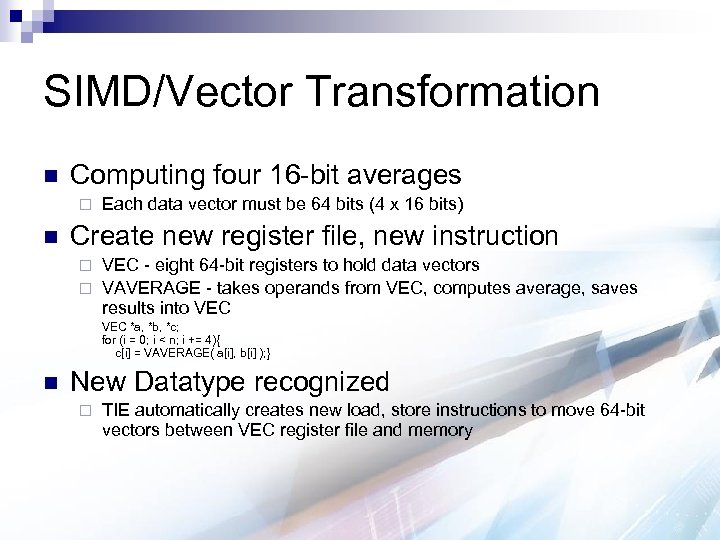 SIMD/Vector Transformation n Computing four 16 -bit averages ¨ n Each data vector must be 64 bits (4 x 16 bits) Create new register file, new instruction VEC - eight 64 -bit registers to hold data vectors ¨ VAVERAGE - takes operands from VEC, computes average, saves results into VEC ¨ VEC *a, *b, *c; for (i = 0; i < n; i += 4){ c[i] = VAVERAGE( a[i], b[i] ); } n New Datatype recognized ¨ TIE automatically creates new load, store instructions to move 64 -bit vectors between VEC register file and memory
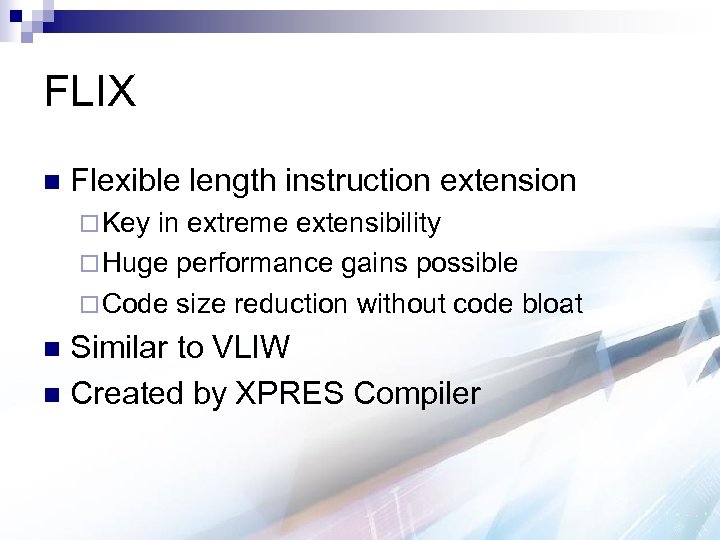 FLIX n Flexible length instruction extension ¨ Key in extreme extensibility ¨ Huge performance gains possible ¨ Code size reduction without code bloat Similar to VLIW n Created by XPRES Compiler n
 FLIX
FLIX
 FLIX - Usage Used selectively when parallelism is needed n Avoids code bloat n Used seemlessly and modelessly used with standard 16 - and 24 -bit instructions n
 XPRES Compiler n Powerful synthesis tool ¨ Creates tailored processor descriptions ¨ Run on native C/C++ code Three optimizations methods n Returns optimal configurations along with pros and cons (tradeoffs) n
 XPRES Compiler Analyzes C/C++ code n Generates possible configurations n Compares performance criteria to silicon size (cost) n Returns possible configurations n
 XPRES Compiler - Results n Application dependent ¨ Compute intensive programs ¨ Data intensive programs n More is sometimes less ¨ operation slots in FLIX
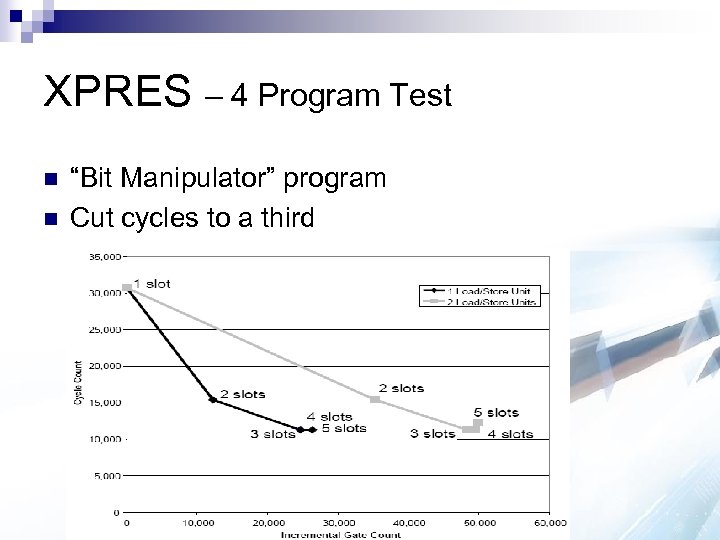 XPRES – 4 Program Test n n “Bit Manipulator” program Cut cycles to a third
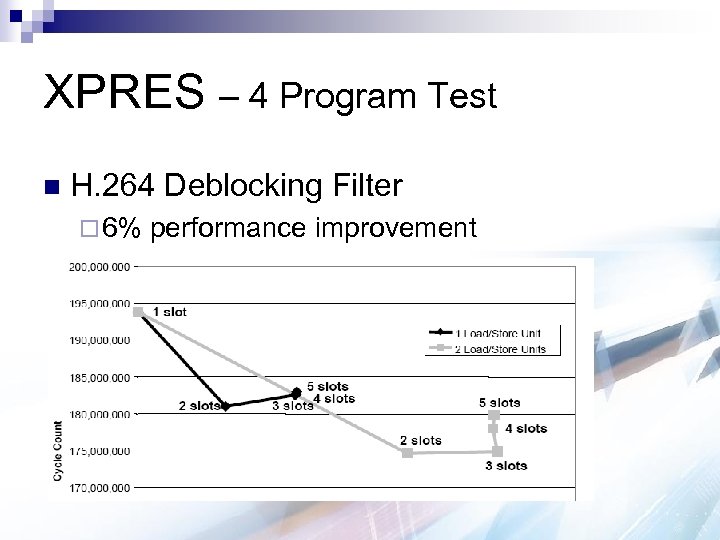 XPRES – 4 Program Test n H. 264 Deblocking Filter ¨ 6% performance improvement
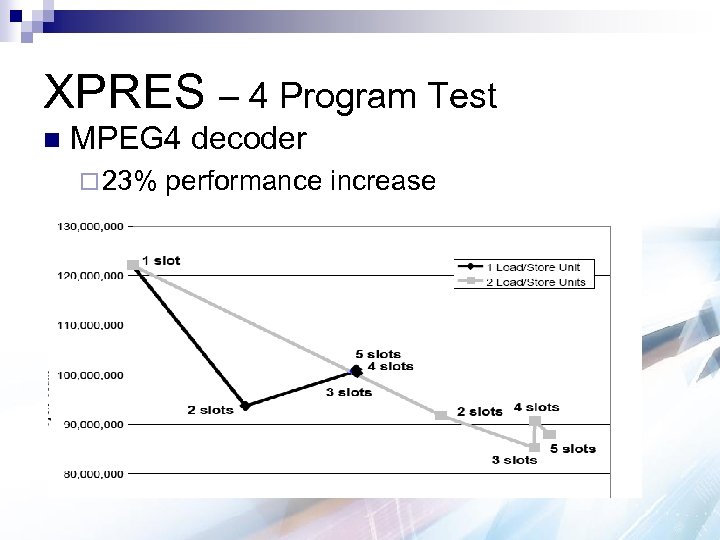 XPRES – 4 Program Test n MPEG 4 decoder ¨ 23% performance increase
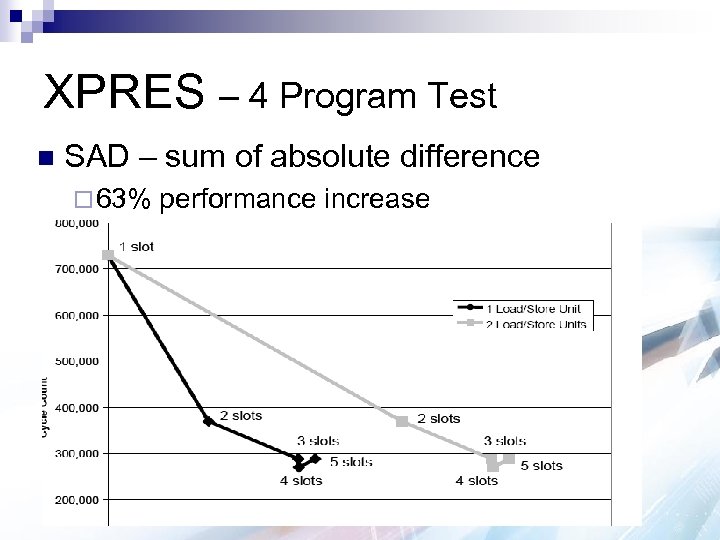 XPRES – 4 Program Test n SAD – sum of absolute difference ¨ 63% performance increase
 Xtensa Hi-Fi 2 Audio Engine n n Add-on package for Xtensa LX Advantages over common audio processors: ¨ better sound quality of compressed files because of increased precision available for intermediate calculations. (24 bits rather than 16) ¨ 24 -bit audio fully compatible with modern audio standards
 Xtensa Hi-Fi 2 Audio Engine n n Audio packages integrated into an SOC design, so no additional codec development required Integrated Audio Packages: ¨ Dolby Digital AC-3 Decoder, Dolby Digital AC-3 Consumer Encoder, QSound Micro. Q, MP 3 Encoder/Decoder, MPEG-4 aacplus v 1 and v 2 Encoder/Decoder, MPEG-2/4 AAC LC Encoder/Decoder, WMA Encoder/Decoder, AMR narrowband speech codec, AMR wideband speech codec.
 Xtensa Hi-Fi 2 Audio Engine Uses over 300 audio specific DLP instructions. n Features dual-multiply accumulate for 24 x 24 and 32 x 16 bit arithmetic on both units n “delivers noticeably superior sound quality even when decoding prerecorded 16 -bit encoded music files. “ n
 Speed-up Example n n n GSM Audio Codec – written in C Profiling code using unaltered RISC architecture showed that 80% of the processor cycles were devoted to multiplication Simply by adding a hardware multiplier, the designer can reduce the number of cycles required from 204 million to 28 million
 Speed-up Example n Viterbi butterfly instruction ¨ Acts like compression for the data ¨ Consists of 8 logical operation ¨ 8 of these operations are used to decode each symbol in the received digital information stream ¨ The designer can add a Viterbi instruction to the Xtensa ISA. The extension can use the 128 -bit memory bus to load data for 8 symbols at once. This results in a average execution time of 0. 16 cycles per butterfly. An unaugmented Xtensa LX executes Viterbi in 42 cycles.
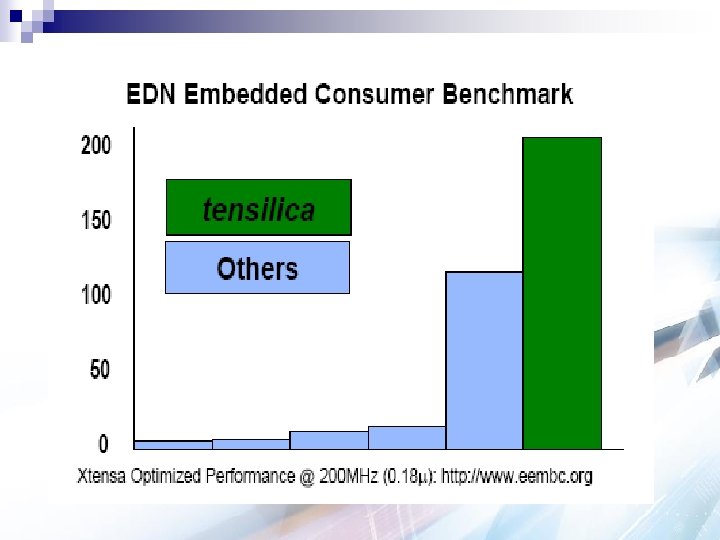
 EEMBC Networking Benchmark Xtensa LX received highest benchmark ever achieved on the Networking version 2 test. n Xtensa LX has a 4 x code density advantage and a 100 x advantage in both die area and power dissipation n
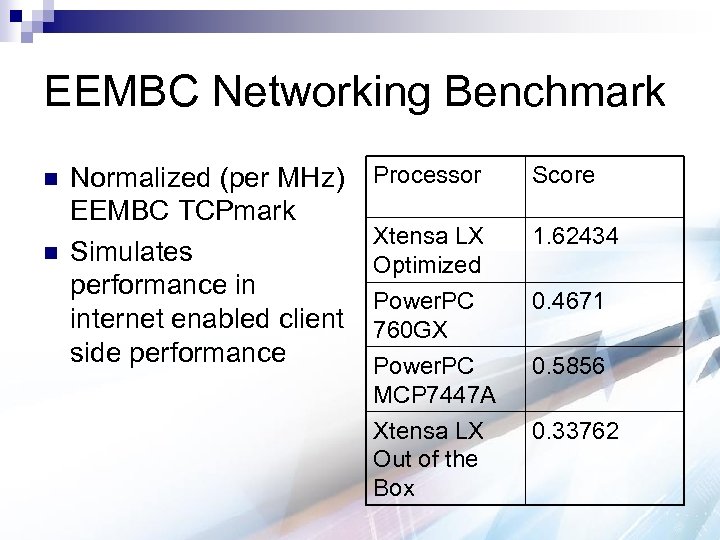 EEMBC Networking Benchmark n n Normalized (per MHz) EEMBC TCPmark Simulates performance in internet enabled client side performance Processor Score Xtensa LX Optimized 1. 62434 Power. PC 760 GX Power. PC MCP 7447 A 0. 4671 Xtensa LX Out of the Box 0. 33762 0. 5856
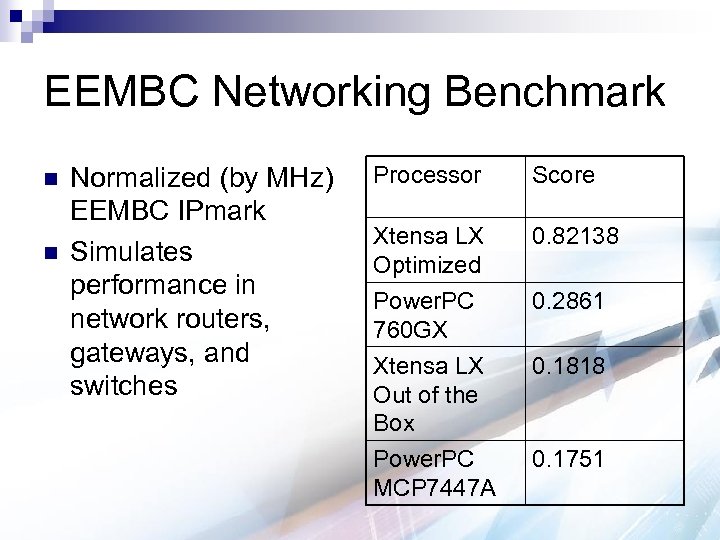 EEMBC Networking Benchmark n n Normalized (by MHz) EEMBC IPmark Simulates performance in network routers, gateways, and switches Processor Score Xtensa LX Optimized 0. 82138 Power. PC 760 GX Xtensa LX Out of the Box 0. 2861 Power. PC MCP 7447 A 0. 1751 0. 1818
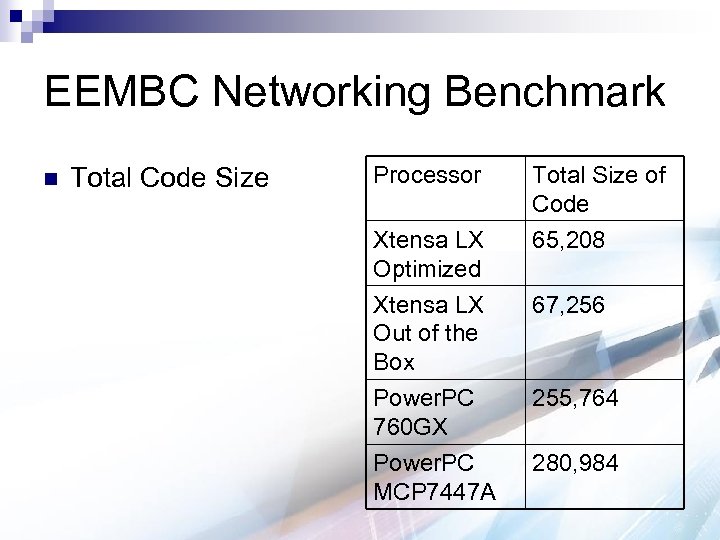 EEMBC Networking Benchmark n Total Code Size Processor Total Size of Code Xtensa LX Optimized Xtensa LX Out of the Box 65, 208 Power. PC 760 GX 255, 764 Power. PC MCP 7447 A 280, 984 67, 256
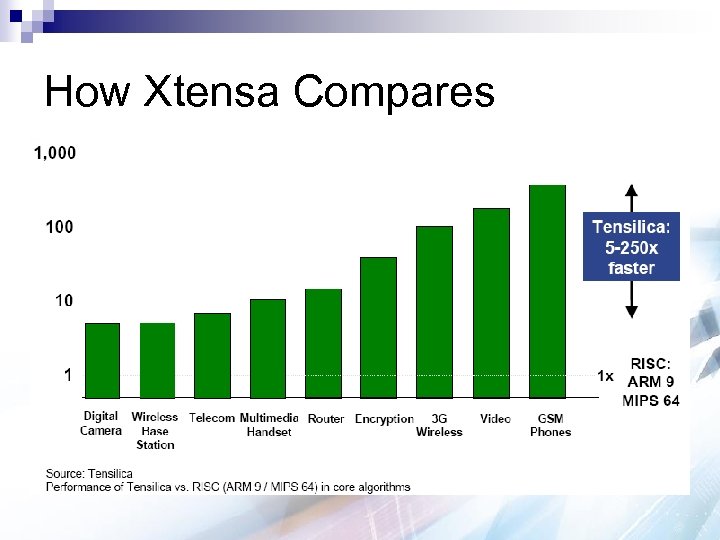 How Xtensa Compares
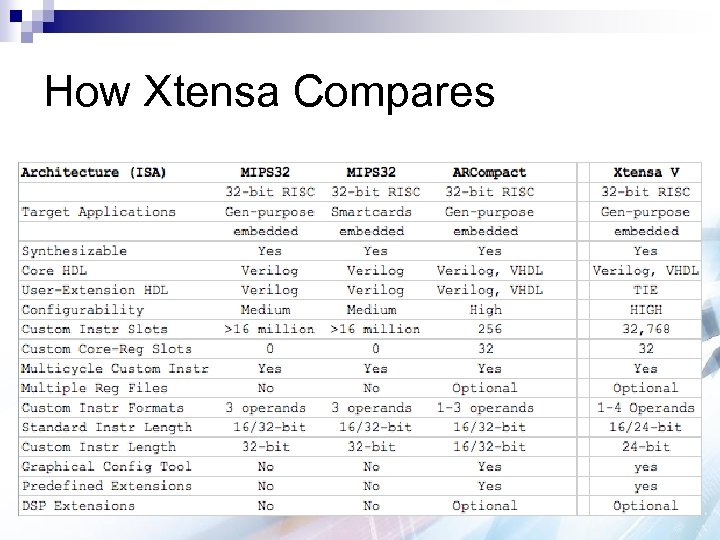 How Xtensa Compares
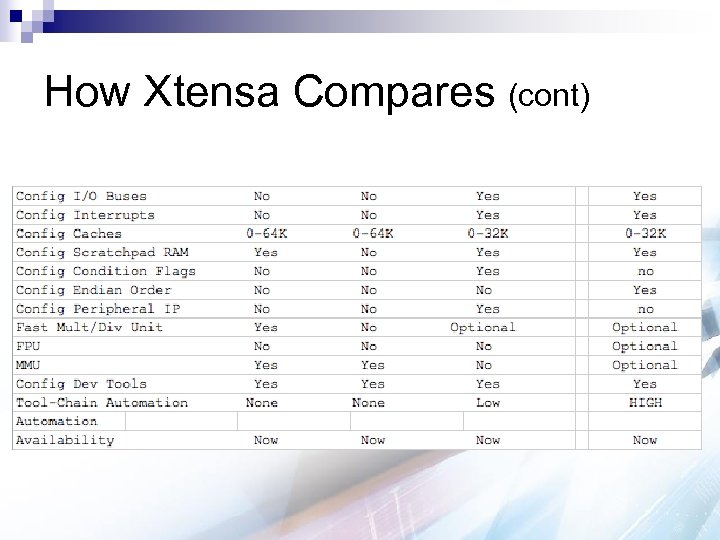 How Xtensa Compares (cont)
 Uses of Xtensa Products n NVIDIA – Licensed Xtensa LX ¨ “We were very impressed with Tensilica's automated approach for both the processor extensions and the generation of the associated software tools”
 Uses of Xtensa Products n LG Cell Phone ¨ Phone is digital broadcast enabled ¨ Xtensa processor was used because it enabled LG to “cut design time significantly and be first to market with this exciting new technology. ” ¨ Terrestrial digital-multimedia-broadcast system in Korea
 In case you are wondering. . n --Tensilica's announced licensees include Agilent, ALPS, AMCC (JNI Corporation), Astute Networks, ATI, Avision, Bay Microsystems, Berkeley Wireless Research Center, Broadcom, Cisco Systems, Conexant Systems, Cypress, Crimson Microsystems, ETRI, FUJIFILM Microdevices, Fujitsu Ltd. , Hudson Soft, Hughes Network Systems, Ikanos Communications, LG Electronics, Marvell, NEC Laboratories America, NEC Corporation, Net. Effect, Neterion, Nippon Telephone and Telegraph (NTT), NVIDIA, Olympus Optical Co. Ltd. , sci-worx, Seiko Epson, Solid State Systems, Sony, STMicroelectronics, Stretch, Tran. Switch Corporation, and Victor Company of Japan (JVC).
 Questions?