 Скачать презентацию Tennessee Diploma Project Shelby County Schools Department of
b03c7244b6c82e94db2d2e04a1bc214c.ppt
- Количество слайдов: 44




Tennessee Diploma Project Shelby County Schools Department of Curriculum and Accountability
Committee Recognition • Angela Allen, Exemplary Teacher • Dedric Mc. Ghee, Science Specialist • David Barrett, Millington High School (SS teacher) • Matt Nelson, Language Arts Specialist • Cathy Bishop, Bartlett High School (CTE teacher) • Dr. Judy Ostner, Assistant Superintendent of Curriculum & Accountability • Dr. Allison Clark, Math Specialist • • Amanda Galbraith, Art Lead Teacher Missy Owen, Bolton High School (English/Spanish teacher) • Todd Goforth, ESL Specialist • Relzie Payton, Social Studies Specialist • Margaret Gilmore, Programs Specialist • Rebecca Pendleton, Houston High School (Wellness/PE teacher) • Carol Ann Hudgens, SPED Specialist • Susan Pittman, Director of Elementary Education • Tim Jones, Exemplary Teacher • Shannon Pryor, Instructional Coach • Lee Ann Kelly, ESL teacher • Beth Schermerhorn, SPED Specialist • Clark Knight, CTE Specialist • Faye Werner, Millington High School Vice Principal • Dee Lunsford, Director of Counseling, Intervention, and Alternative Services • Karen Woodard, Director of Middle and Secondary Education 2
What is the Tennessee Diploma Project? • It is an initiative to ensure all high school graduates are prepared to face the challenges of work and college. • Tennessee has joined 32 other states that participate in The American Diploma Project (ADP). • The ADP was created by governors, state superintendents of education, business executives, and college leaders. 3
American Diploma Project Goals • Align standards and assessments with the knowledge and skills required beyond high school • Require all HS students to take challenging courses that prepare them for life after HS • Build college and work-ready measures into statewide accountability systems • Hold schools accountable for graduating students who are college and/or workforce ready, and hold postsecondary institutions accountable for students’ success once enrolled 4
Why does Tennessee need to make these changes? • To keep pace with rising knowledge and skill demands • To prepare high school graduates to succeed in work or college 5
Why does Tennessee need to make these changes? • Tennessee has lost more than 33, 000 manufacturing jobs in the last two years. Economist David Penn • Tennessee is tied for 50 th (with Arizona) in growth rate of per capita income. The reason – “We just don’t have the workforce to compete. ” UT Economist Bill Fox 6
Why does Tennessee need to make these changes? • Sixty-seven percent of new jobs will require training beyond a high school diploma by 2010. • Thirty-six states produce high school graduates better prepared for college than Tennessee. 7
When? Who is Affected? • The Tennessee Diploma Project will go into effect beginning in the 2009 -2010 school year. • Incoming 9 th grade students will be affected by this change. 8
Three major changes • New K-12 curriculum standards in math, language arts, and science • New graduation requirements • More rigorous statewide assessments 9
New K-12 Curriculum Standards • The current math, language arts, and science curriculum standards will be replaced with new and more rigorous standards for the 2009 -2010 school year and beyond. 10
New K-12 Curriculum Standards • New curriculum guides and pacing charts are currently being created for language arts, mathematics, and science courses. • These will be introduced to teachers in training sessions beginning in January 2009. 11
New K-12 Curriculum Standards • The general format of the new curriculum standards include: • Standards = major content area topics • Course level expectations = fundamental goals for student learning • Checks for understanding = suggestions for assessing student learning • State performance indicators = basis for students accountability New standards are found at the bottom of this website. 12
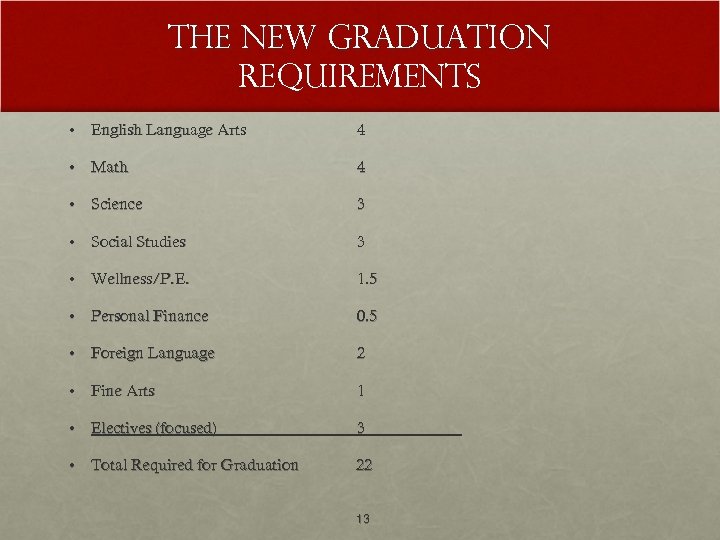
The New Graduation Requirements • English Language Arts 4 • Math 4 • Science 3 • Social Studies 3 • Wellness/P. E. 1. 5 • Personal Finance 0. 5 • Foreign Language 2 • Fine Arts 1 • Electives (focused) 3______ • Total Required for Graduation 22 13
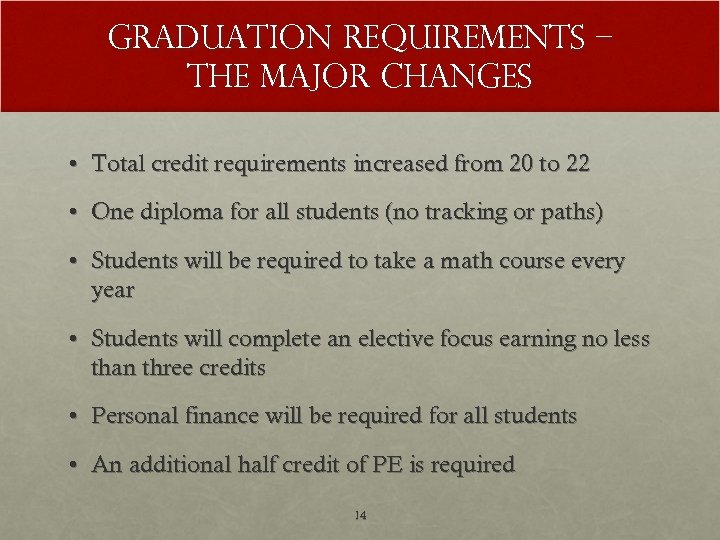
Graduation requirements – the major changes • Total credit requirements increased from 20 to 22 • One diploma for all students (no tracking or paths) • Students will be required to take a math course every year • Students will complete an elective focus earning no less than three credits • Personal finance will be required for all students • An additional half credit of PE is required 14
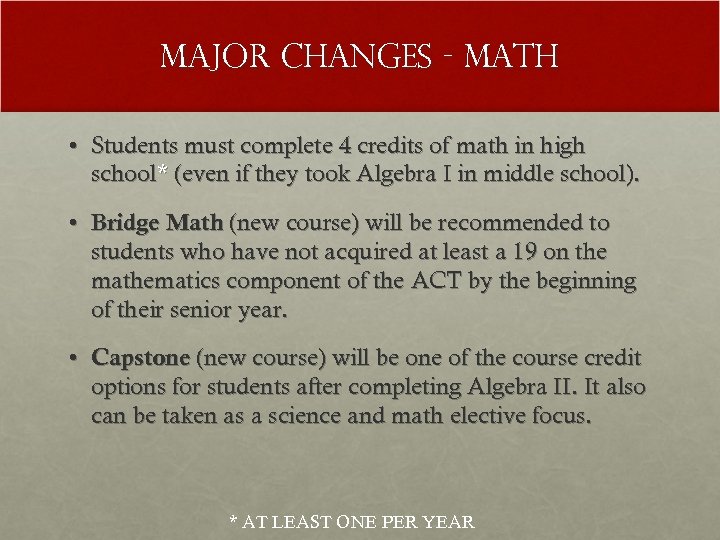
Major changes - math • Students must complete 4 credits of math in high school* (even if they took Algebra I in middle school). • Bridge Math (new course) will be recommended to students who have not acquired at least a 19 on the mathematics component of the ACT by the beginning of their senior year. • Capstone (new course) will be one of the course credit options for students after completing Algebra II. It also can be taken as a science and math elective focus. * AT LEAST ONE PER YEAR
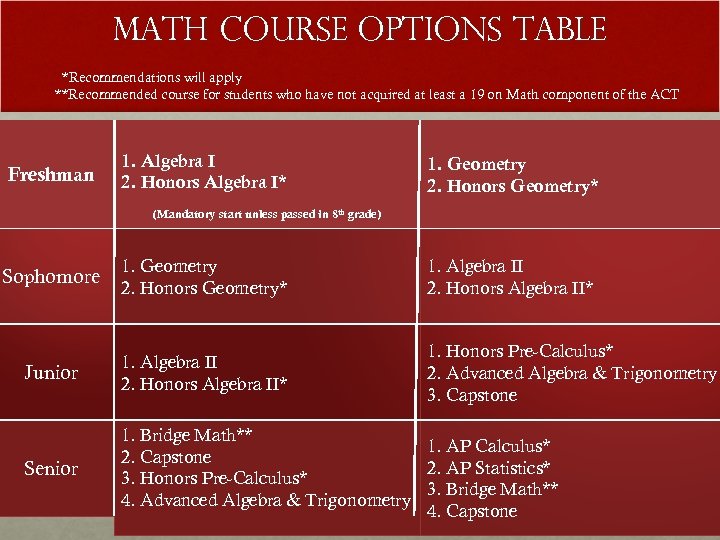
Math course options Table *Recommendations will apply **Recommended course for students who have not acquired at least a 19 on Math component of the ACT Freshman 1. Algebra I 2. Honors Algebra I* 1. Geometry 2. Honors Geometry* (Mandatory start unless passed in 8 th grade) Sophomore 1. Geometry 2. Honors Geometry* 1. Algebra II 2. Honors Algebra II* Junior 1. Algebra II 2. Honors Algebra II* 1. Honors Pre-Calculus* 2. Advanced Algebra & Trigonometry 3. Capstone Senior 1. Bridge Math** 1. AP Calculus* 2. Capstone 2. AP Statistics* 3. Honors Pre-Calculus* 3. Bridge Math** 4. Advanced Algebra & Trigonometry 4. Capstone
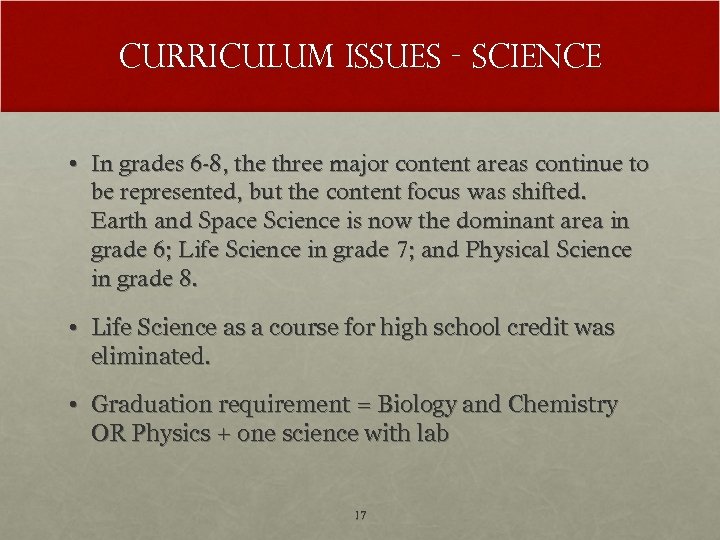
Curriculum Issues - Science • In grades 6 -8, the three major content areas continue to be represented, but the content focus was shifted. Earth and Space Science is now the dominant area in grade 6; Life Science in grade 7; and Physical Science in grade 8. • Life Science as a course for high school credit was eliminated. • Graduation requirement = Biology and Chemistry OR Physics + one science with lab 17
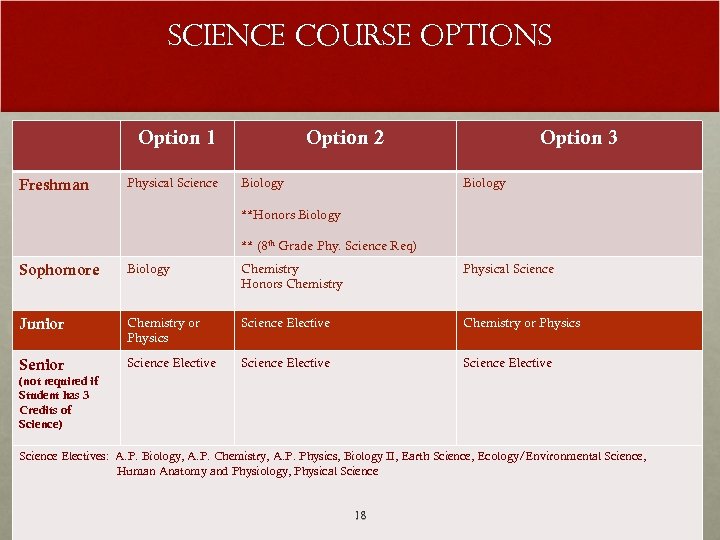
Science Course Options Option 1 Freshman Physical Science Option 2 Biology Option 3 Biology **Honors Biology ** (8 th Grade Phy. Science Req) Sophomore Biology Chemistry Honors Chemistry Physical Science Junior Chemistry or Physics Science Elective Chemistry or Physics Senior Science Elective (not required if Student has 3 Credits of Science) Science Electives: A. P. Biology, A. P. Chemistry, A. P. Physics, Biology II, Earth Science, Ecology/Environmental Science, Human Anatomy and Physiology, Physical Science 18
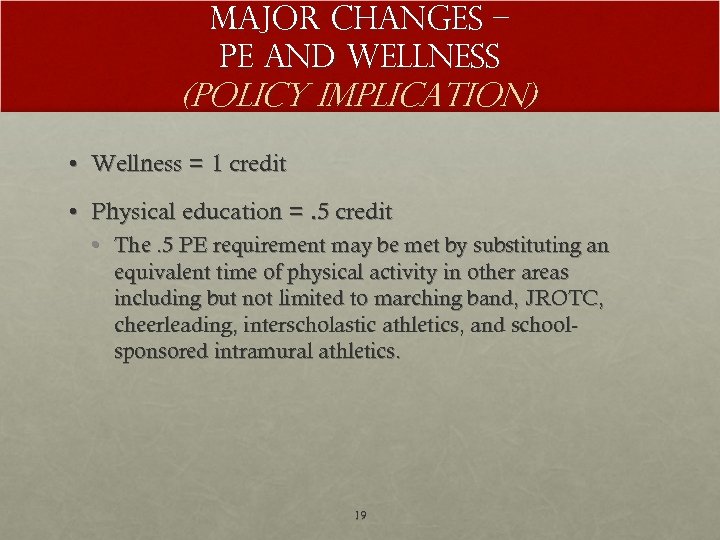
Major Changes – PE and Wellness (Policy Implication) • Wellness = 1 credit • Physical education =. 5 credit • The. 5 PE requirement may be met by substituting an equivalent time of physical activity in other areas including but not limited to marching band, JROTC, cheerleading, interscholastic athletics, and schoolsponsored intramural athletics. 19
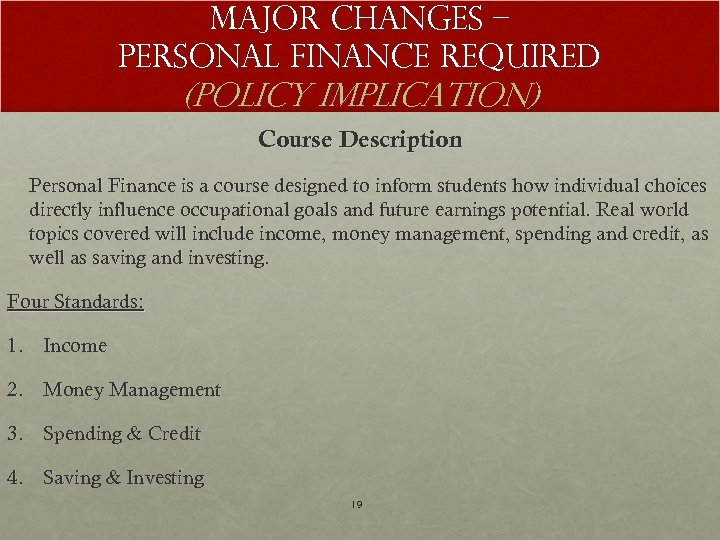
Major Changes – Personal Finance Required (Policy Implication) Course Description Personal Finance is a course designed to inform students how individual choices directly influence occupational goals and future earnings potential. Real world topics covered will include income, money management, spending and credit, as well as saving and investing. Four Standards: 1. Income 2. Money Management 3. Spending & Credit 4. Saving & Investing 19
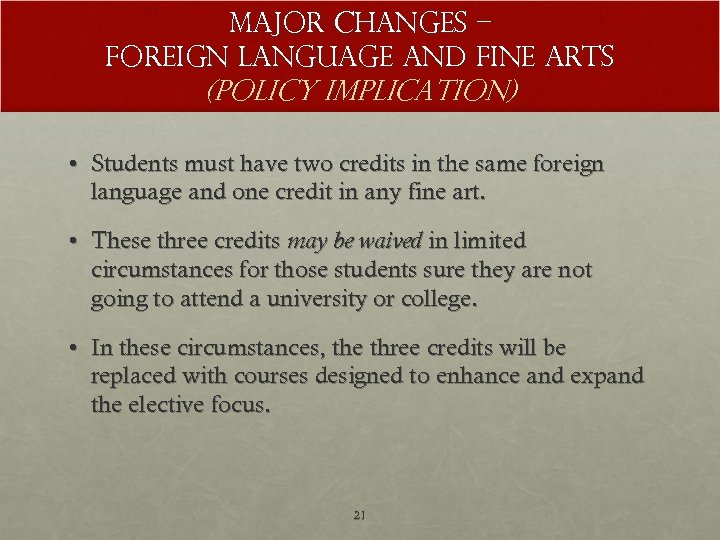
Major Changes – Foreign Language and Fine Arts (Policy implication) • Students must have two credits in the same foreign language and one credit in any fine art. • These three credits may be waived in limited circumstances for those students sure they are not going to attend a university or college. • In these circumstances, the three credits will be replaced with courses designed to enhance and expand the elective focus. 21
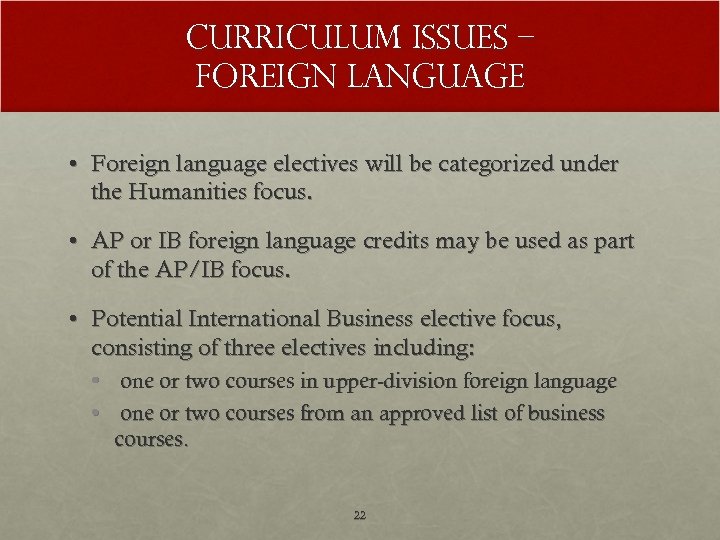
Curriculum Issues – Foreign Language • Foreign language electives will be categorized under the Humanities focus. • AP or IB foreign language credits may be used as part of the AP/IB focus. • Potential International Business elective focus, consisting of three electives including: • • one or two courses in upper-division foreign language one or two courses from an approved list of business courses. 22
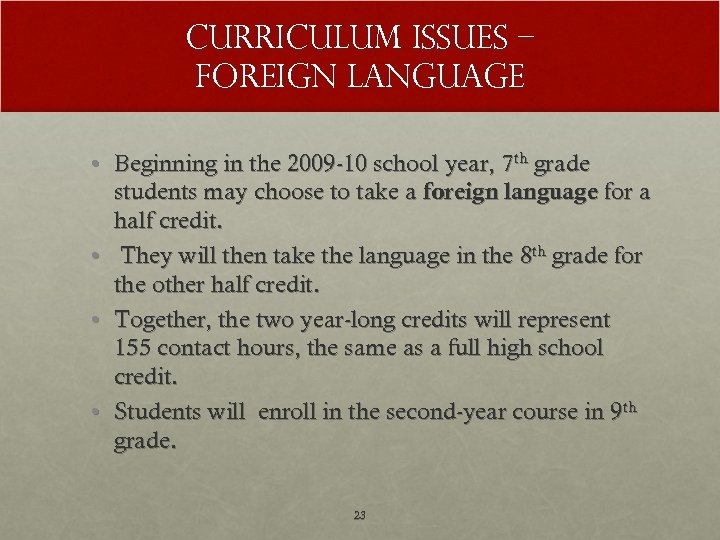
Curriculum Issues – Foreign Language • Beginning in the 2009 -10 school year, 7 th grade students may choose to take a foreign language for a half credit. • They will then take the language in the 8 th grade for the other half credit. • Together, the two year-long credits will represent 155 contact hours, the same as a full high school credit. • Students will enroll in the second-year course in 9 th grade. 23
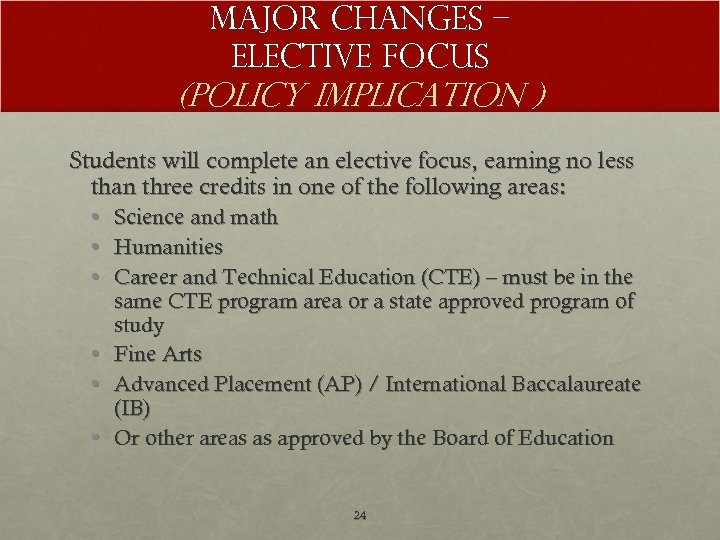
Major Changes – elective focus (Policy implication ) Students will complete an elective focus, earning no less than three credits in one of the following areas: • • • Science and math Humanities Career and Technical Education (CTE) – must be in the same CTE program area or a state approved program of study • Fine Arts • Advanced Placement (AP) / International Baccalaureate (IB) • Or other areas as approved by the Board of Education 24
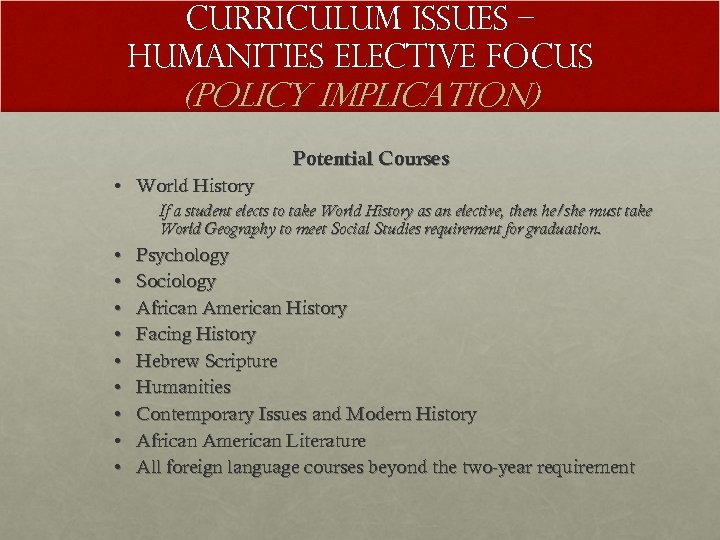
Curriculum Issues – Humanities elective focus (Policy IMPLICATION) Potential Courses • World History If a student elects to take World History as an elective, then he/she must take World Geography to meet Social Studies requirement for graduation. • • • Psychology Sociology African American History Facing History Hebrew Scripture Humanities Contemporary Issues and Modern History African American Literature All foreign language courses beyond the two-year requirement
Curriculum Issues – CTE Elective Focus • The Tennessee Department of Education has approved cluster areas that align with the Department of Labor Workplace Development • Career and Technical Education has created program of studies within each cluster • A program of study is 4 CTE classes that a student can complete as their focus area • Students are required to complete a focus of at least 3 credit hours within a program of study 26
Curriculum Issues – CTE Elective Focus Students who complete a CTE focus, earning no less than three credits in one of the following clusters offered in Shelby County Schools • Agriculture, Food and Natural Resources • Architecture • Arts, A/V Technology & Communication • Business, Management, Finance, and Administration • Education and Training • Government & Public Admin/Law Public Safety 27
Curriculum Issues – CTE Elective Focus Continued • Health Science • Hospitality and Tourism/Marketing, Sales, and Services • Human Services • Information Technology • Manufacturing/Engineering • Transportation, Distribution, and Logistics 28
Curriculum Issues – CTE Elective Focus • Shelby County Schools programs of study have been approved by the state or are in the process of being approved • Each high school may have a different program of study depending on the course offering at that school • All programs of study have articulation agreements with postsecondary schools • Students will have the option of pursuing career goals through post-secondary studies or workforce training 29
Curriculum Issues – Fine Arts Elective Focus • The three credit elective focus in Fine Art should be in addition to the one required Fine Arts Credit. • A three credit elective focus in Fine Art will allow students to choose from any of the Fine Arts (including Band, Choir, Theater and Visual Arts) and from other arts -related areas in their Junior/ Senior year (including Interior Design, Welding, Web Design, Digital Imagery, Textiles, TV/Film Production, and Graphic Media) to fulfill the requirements of the three credit elective focus in Fine Art. 30 30
Capstone experience (policy implication) • Local boards of education have been encouraged to consider requirements for students to complete a capstone experience such as, but not limited to: • • Senior Project Virtual Enterprise Internship Externship Work-based learning Service learning (minimum of 40 hours) Community service (minimum of 40 hours) 31
Graduating with honors (Policy implication) • If students score at or above all of the subject area readiness benchmarks on the ACT or the equivalent score on the SAT, they will graduate with honors. 32
Graduating with distinction (POLICY IMPLICATION) • Students will graduate with distinction if they earn a B average and complete at least one of the following: • • Earn a nationally recognized industry certification Participate in at least one of the Governor’s Schools Participate in one of the state’s All State musical organizations Be selected as a National Merit finalist or semi-finalist Attain a 31 or higher composite score on the ACT Attain a score of 3 or higher on at least two AP exams Successfully complete the International Baccalaureate Diploma Program • Earn 12 or more semester hours of postsecondary credit 33
Graduating with distinction (POLICY IMPLICATION) • Each local school board shall develop a policy prescribing how students graduating with “distinction” will be noted and recognized. 34
Assessments K-8 • TCAP T (spring 2009) - this assessment will field test new items • Summer 2009 – new cut scores established • TCAP U (spring 2010) – New operational assessment (new content standards) 35
Assessments 9 -12 • Spring 2009 Gateway Sunset – field test new items • Summer 2009 – new cut scores established • Fall 2009 – End of Course new operational assessments in place for the following courses: • • English I, English III Algebra I, Geometry, Algebra II Biology I, Chemistry, Physics U. S. History 36
Assessments 9 -12 • The weight of the End of Course exam on the students’ course average is as follows for entering ninth graders: • Fall of 2009 and 2010 – 20% • Fall of 2011 and thereafter – 25% Students will not be required to pass any one exam; instead, students will need to achieve a passing score for the course average in accordance with the State Board of Education’s uniform grading policy. 37
Assessments • TN State Legislation requires testing at 8 th, 10 th, and 11 th grades (effective June 2007). • Starting with the 2008 -2009 school year, all SCS students will be required to take EXPLORE (grade 8), PLAN (grade 10), and ACT (grade 11) 38
Students with disabilities (Policy Implications) • Regular High School Diploma • Will be awarded to students with disabilities who: • earn the required 22 units of credits. • maintain satisfactory attendance and conduct. • Transition Certificate • Will be awarded to students with disabilities who: • have failed to earn a regular HS Diploma at the end of four years • have satisfactorily completed their IEP • maintain satisfactory attendance and conduct • NOTE: These students are eligible to return to HS through the end of the school year in which they turn twenty-two years old in order to complete deficient credits. 39
Students with disabilities (Policy Implications) • IEP Certificate • Will be awarded to students with disabilities who have: • • satisfactorily completed their IEP. successfully completed a portfolio. satisfactory records of attendance and conduct. NOTE: This is the same as the old “Special Education Diploma”. 40
Grade classification (POLICY IMPLICATION) • Policy 6305 – Grade Classification for High School Students will be adjusted to read: • Students in Shelby County high schools are to be classified as follows: • Less than five (5) credits 9 th grade • Earned five (5) credits and passed English 9 10 th grade • Earned eleven (11) credits and passed English 10 11 th grade • Earned sixteen (16) credits and passed English 11 12 th grade *In accordance to the Tennessee Department of Education requirements, a student classified as a 12 th grader must be enrolled in a full schedule of credit bearing courses his/her senior year. 41
Middle School involvement • Middle schools must prepare students for rigorous high school studies. • Middle schools will begin offering high school credit for appropriate courses. 42
Middle School involvement (POLICY IMPLICATION) • When students are in the eighth grade, a four-year plan of focused, purposeful high school study will be completed for each student. • High school and middle school faculty will collaborate in planning curriculum and the transition between middle school and high school. • The plan of study will be reviewed annually by the student and faculty advisor or school counselor and revised based on changes in the student's interests and career goals. Results of various types of assessments will also be used in adjusting the plan of study. 43
For More Information • Go to achieve. org • Go to the Tennessee State Board of Education 44
Скачать презентацию Tennessee Diploma Project Shelby County Schools Department of
b03c7244b6c82e94db2d2e04a1bc214c.ppt