


 Скачать презентацию Ten Years of Failed Transition to Democracy the
1a8e3e22500fcb360c72582bedefa110.ppt
- Количество слайдов: 65
 Ten Years of Failed Transition to Democracy: the struggle between modernity and feudalism in Mexican society Research seminar A personal point of view of Antonio Puron March 31, 2011
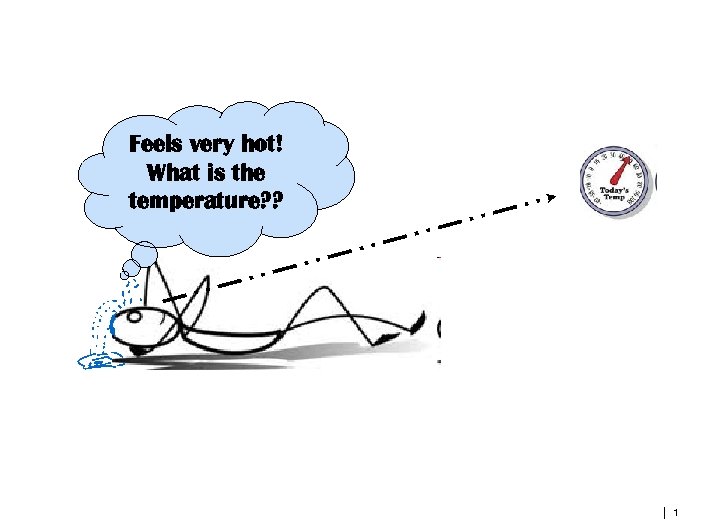 Feels very hot! What is the temperature? ? | 1
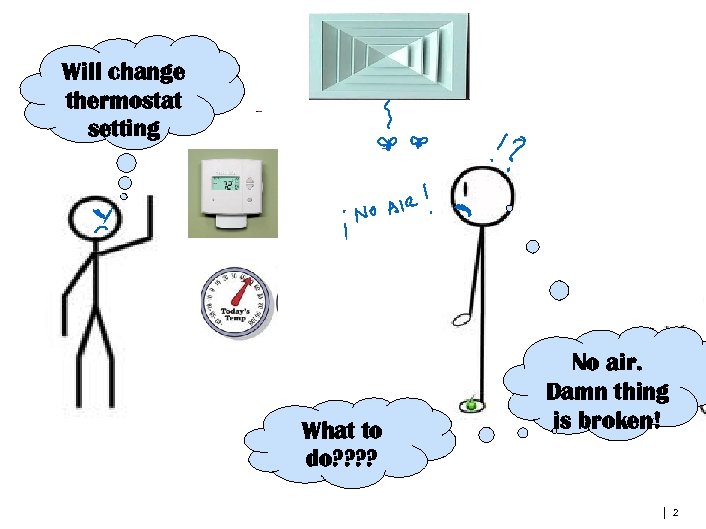 Will change thermostat setting What to do? ? No air. Damn thing is broken! | 2
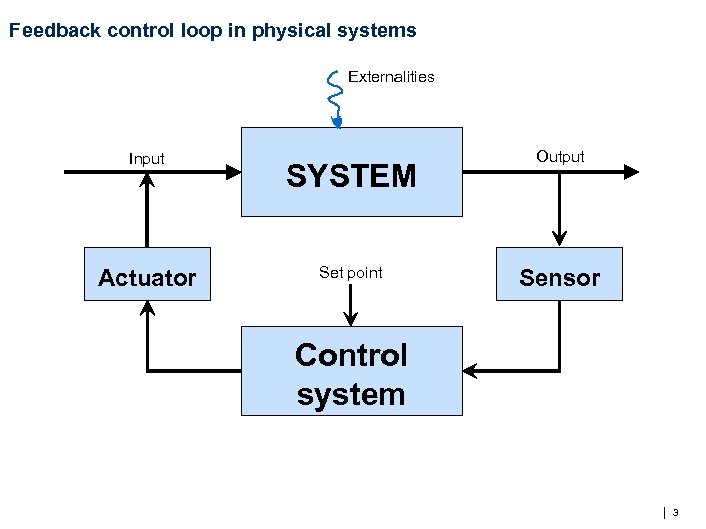 Feedback control loop in physical systems Externalities Input SYSTEM Actuator Set point Output Sensor Control system | 3
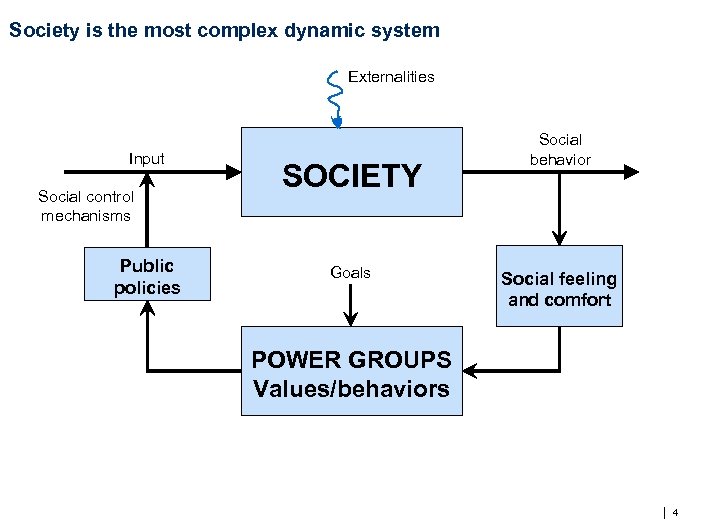 Society is the most complex dynamic system Externalities Input Social control mechanisms Public policies SOCIETY Goals Social behavior Social feeling and comfort POWER GROUPS Values/behaviors | 4
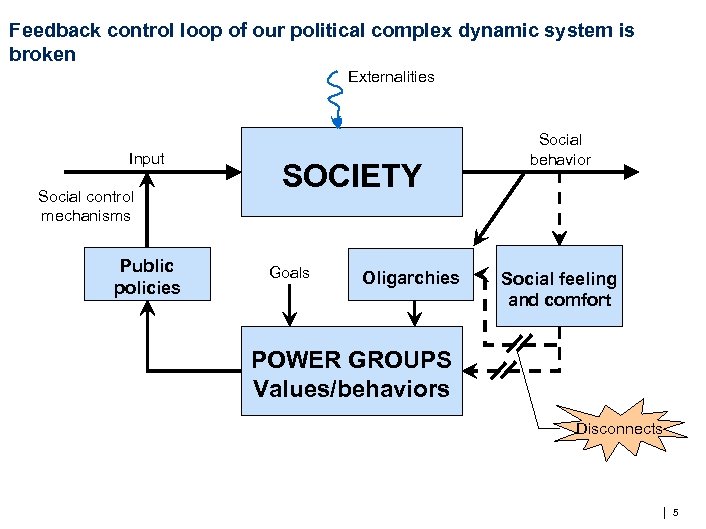 Feedback control loop of our political complex dynamic system is broken Externalities Input Social control mechanisms Public policies SOCIETY Goals Oligarchies Social behavior Social feeling and comfort POWER GROUPS Values/behaviors Disconnect | 5
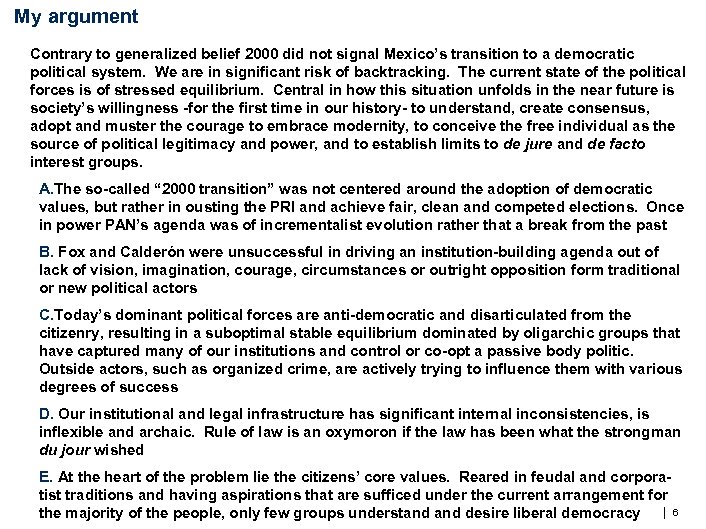 My argument Contrary to generalized belief 2000 did not signal Mexico’s transition to a democratic political system. We are in significant risk of backtracking. The current state of the political forces is of stressed equilibrium. Central in how this situation unfolds in the near future is society’s willingness -for the first time in our history- to understand, create consensus, adopt and muster the courage to embrace modernity, to conceive the free individual as the source of political legitimacy and power, and to establish limits to de jure and de facto interest groups. A. The so-called “ 2000 transition” was not centered around the adoption of democratic values, but rather in ousting the PRI and achieve fair, clean and competed elections. Once in power PAN’s agenda was of incrementalist evolution rather that a break from the past B. Fox and Calderón were unsuccessful in driving an institution-building agenda out of lack of vision, imagination, courage, circumstances or outright opposition form traditional or new political actors C. Today’s dominant political forces are anti-democratic and disarticulated from the citizenry, resulting in a suboptimal stable equilibrium dominated by oligarchic groups that have captured many of our institutions and control or co-opt a passive body politic. Outside actors, such as organized crime, are actively trying to influence them with various degrees of success D. Our institutional and legal infrastructure has significant internal inconsistencies, is inflexible and archaic. Rule of law is an oxymoron if the law has been what the strongman du jour wished E. At the heart of the problem lie the citizens’ core values. Reared in feudal and corporatist traditions and having aspirations that are sufficed under the current arrangement for the majority of the people, only few groups understand desire liberal democracy | 6
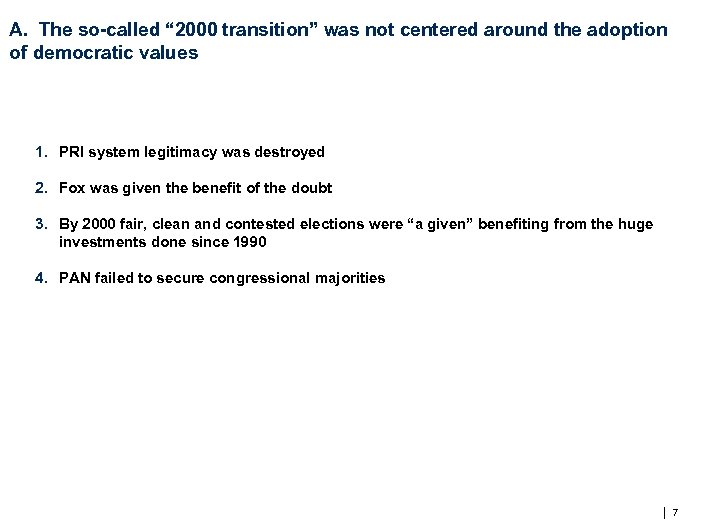 A. The so-called “ 2000 transition” was not centered around the adoption of democratic values 1. PRI system legitimacy was destroyed 2. Fox was given the benefit of the doubt 3. By 2000 fair, clean and contested elections were “a given” benefiting from the huge investments done since 1990 4. PAN failed to secure congressional majorities | 7
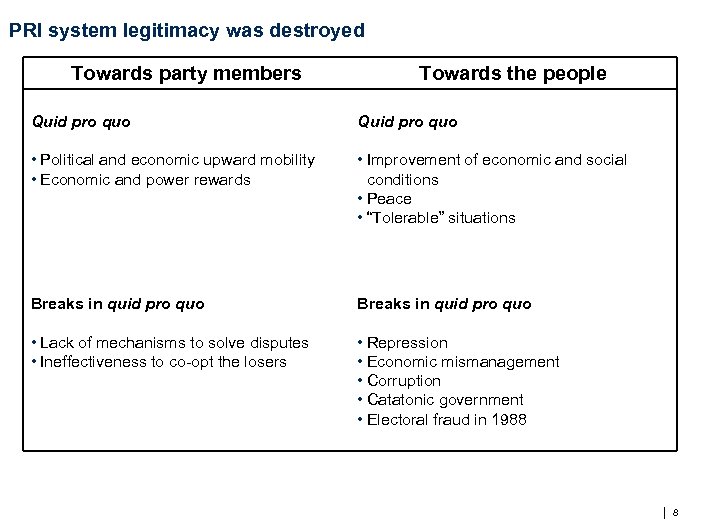 PRI system legitimacy was destroyed Towards party members Towards the people Quid pro quo • Political and economic upward mobility • Economic and power rewards • Improvement of economic and social conditions • Peace • “Tolerable” situations Breaks in quid pro quo • Lack of mechanisms to solve disputes • Ineffectiveness to co-opt the losers • Repression • Economic mismanagement • Corruption • Catatonic government • Electoral fraud in 1988 | 8
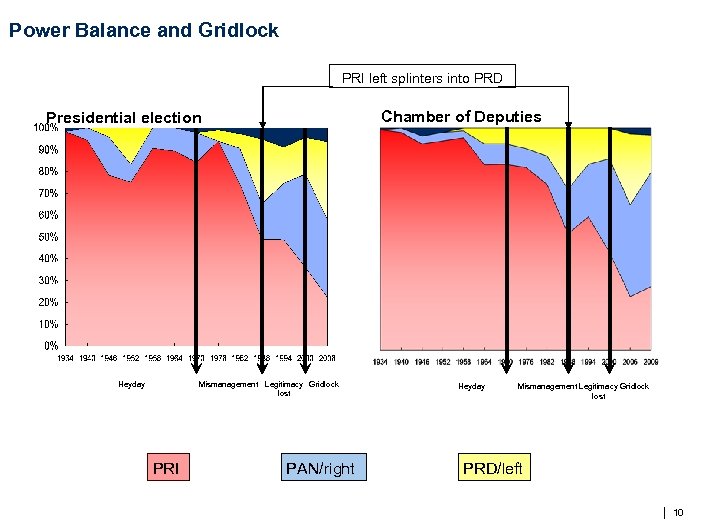 Power Balance and Gridlock PRI left splinters into PRD Chamber of Deputies Presidential election Heyday Mismanagement Legitimacy Gridlock lost PRI PAN/right Heyday Mismanagement Legitimacy Gridlock lost PRD/left | 10
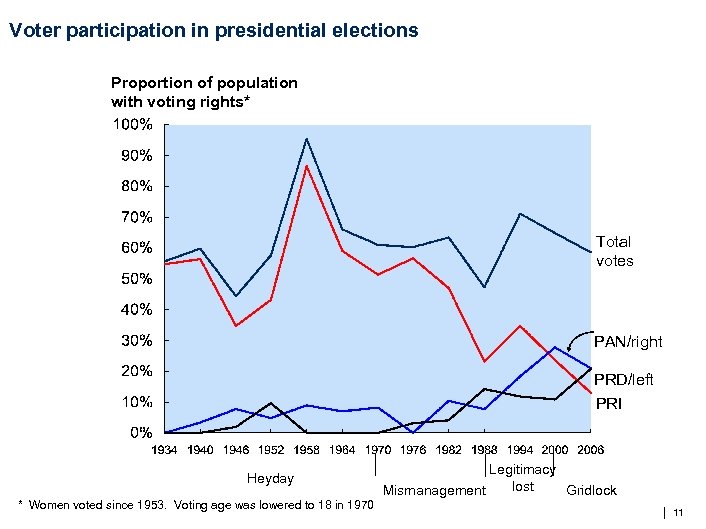 Voter participation in presidential elections Proportion of population with voting rights* Total votes PAN/right PRD/left PRI Heyday * Women voted since 1953. Voting age was lowered to 18 in 1970 Legitimacy lost Mismanagement Gridlock | 11
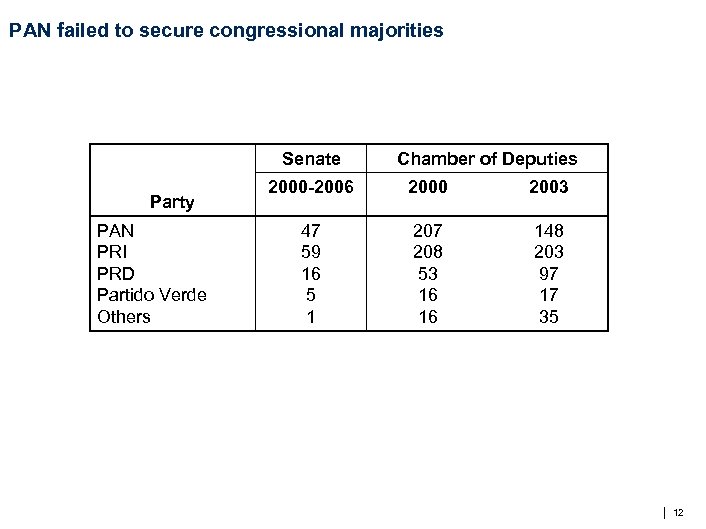 PAN failed to secure congressional majorities Senate Party PAN PRI PRD Partido Verde Others Chamber of Deputies 2000 -2006 2000 2003 47 59 16 5 1 207 208 53 16 16 148 203 97 17 35 | 12
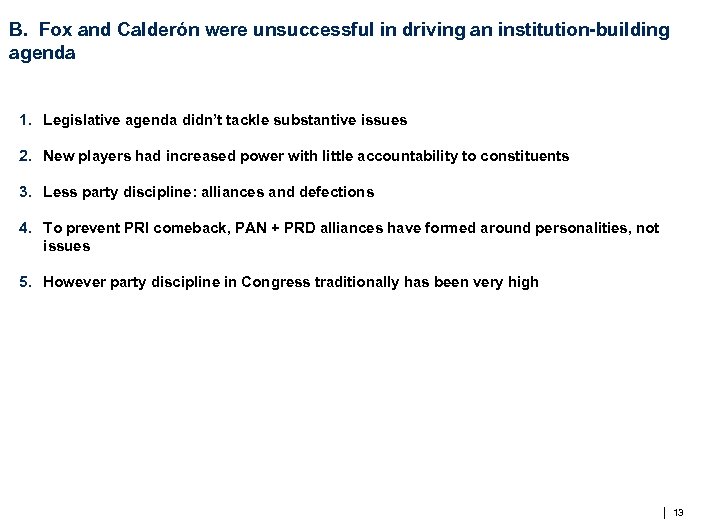 B. Fox and Calderón were unsuccessful in driving an institution-building agenda 1. Legislative agenda didn’t tackle substantive issues 2. New players had increased power with little accountability to constituents 3. Less party discipline: alliances and defections 4. To prevent PRI comeback, PAN + PRD alliances have formed around personalities, not issues 5. However party discipline in Congress traditionally has been very high | 13
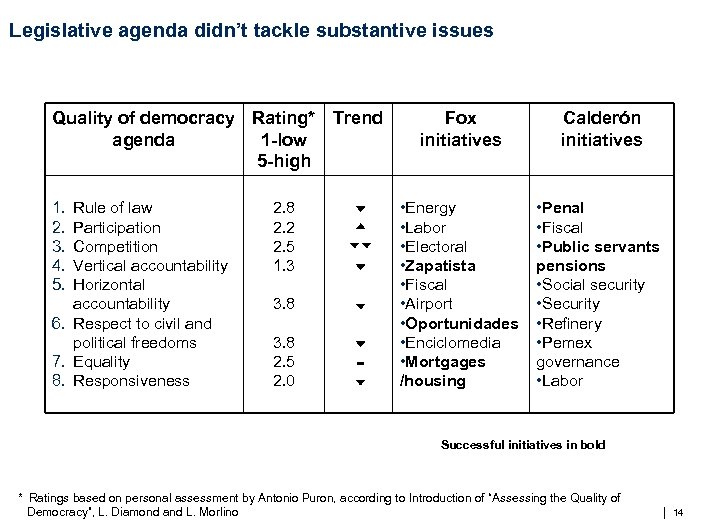 Legislative agenda didn’t tackle substantive issues Quality of democracy Rating* agenda 1 -low 5 -high 1. 2. 3. 4. 5. Rule of law Participation Competition Vertical accountability Horizontal accountability 6. Respect to civil and political freedoms 7. Equality 8. Responsiveness 2. 8 2. 2 2. 5 1. 3 3. 8 2. 5 2. 0 Trend Fox initiatives Calderón initiatives • Energy • Labor • Electoral • Zapatista • Fiscal • Airport • Oportunidades • Enciclomedia • Mortgages /housing • Penal • Fiscal • Public servants pensions • Social security • Security • Refinery • Pemex governance • Labor Successful initiatives in bold * Ratings based on personal assessment by Antonio Puron, according to Introduction of “Assessing the Quality of Democracy”, L. Diamond and L. Morlino | 14
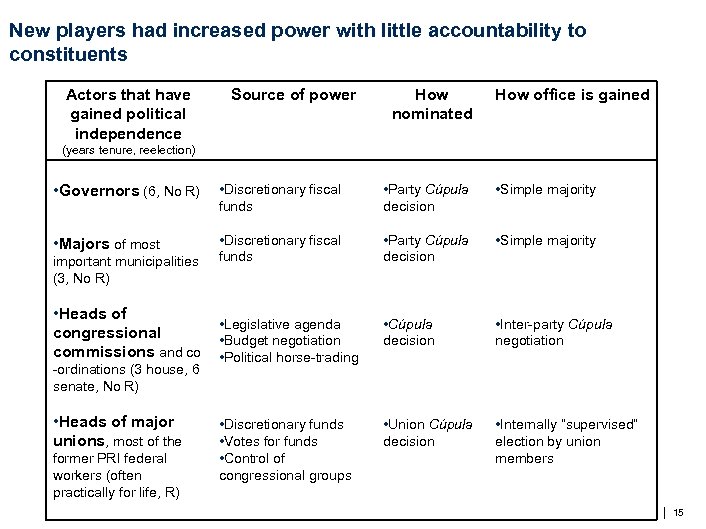 New players had increased power with little accountability to constituents Actors that have gained political independence Source of power How nominated How office is gained (years tenure, reelection) • Governors (6, No R) • Discretionary fiscal funds • Party Cúpula decision • Simple majority • Majors of most • Discretionary fiscal funds • Party Cúpula decision • Simple majority • Legislative agenda • Budget negotiation • Political horse-trading • Cúpula decision • Inter-party Cúpula negotiation • Discretionary funds • Votes for funds • Control of congressional groups • Union Cúpula decision • Internally “supervised” election by union members important municipalities (3, No R) • Heads of congressional commissions and co -ordinations (3 house, 6 senate, No R) • Heads of major unions, most of the former PRI federal workers (often practically for life, R) | 15
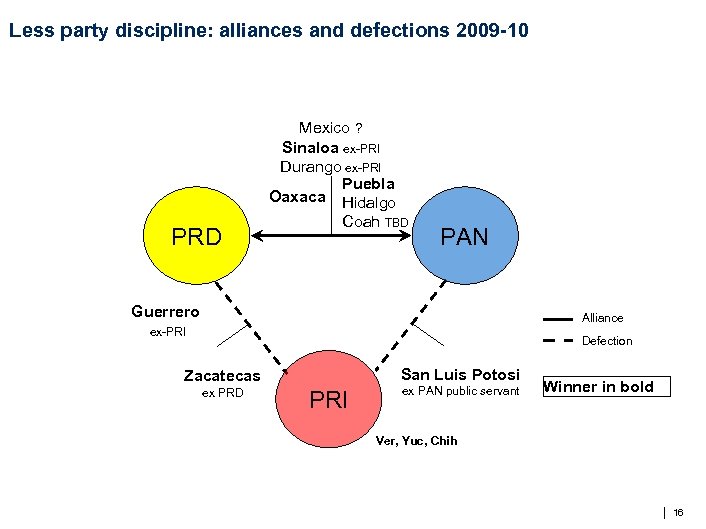 Less party discipline: alliances and defections 2009 -10 PRD Mexico ? Sinaloa ex-PRI Durango ex-PRI Puebla Oaxaca Hidalgo Coah TBD PAN Guerrero Alliance ex-PRI Defection San Luis Potosi Zacatecas ex PRD PRI ex PAN public servant Winner in bold Ver, Yuc, Chih | 16
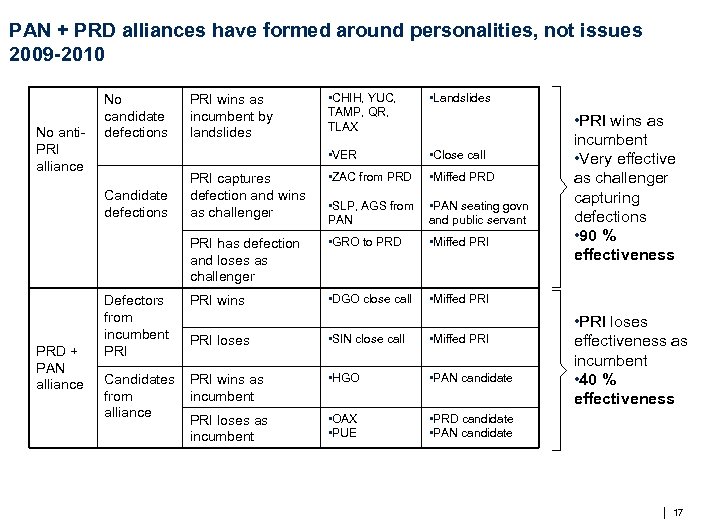 PAN + PRD alliances have formed around personalities, not issues 2009 -2010 • Landslides • VER • Close call PRI captures defection and wins as challenger • ZAC from PRD • Miffed PRD • SLP, AGS from PAN • PAN seating govn and public servant PRI has defection and loses as challenger No anti. PRI alliance • CHIH, YUC, TAMP, QR, TLAX • GRO to PRD • Miffed PRI Defectors from incumbent PRI wins • DGO close call • Miffed PRI loses • SIN close call • Miffed PRI Candidates from alliance PRI wins as incumbent • HGO • PAN candidate PRI loses as incumbent • OAX • PUE • PRD candidate • PAN candidate No candidate defections Candidate defections PRD + PAN alliance PRI wins as incumbent by landslides • PRI wins as incumbent • Very effective as challenger capturing defections • 90 % effectiveness • PRI loses effectiveness as incumbent • 40 % effectiveness | 17
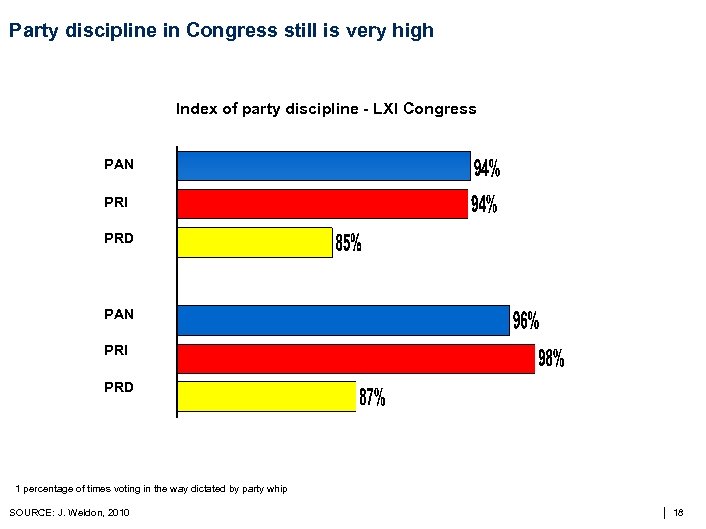 Party discipline in Congress still is very high Index of party discipline - LXI Congress PAN PRI PRD 1 percentage of times voting in the way dictated by party whip SOURCE: J. Weldon, 2010 | 18
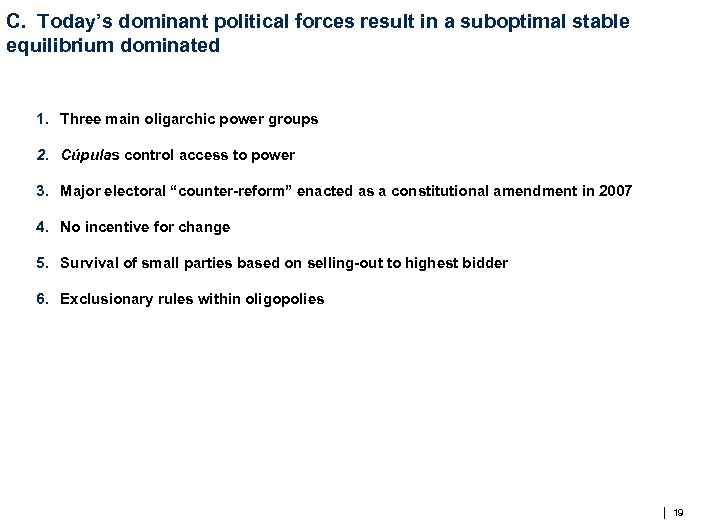 C. Today’s dominant political forces result in a suboptimal stable equilibrium dominated 1. Three main oligarchic power groups 2. Cúpulas control access to power 3. Major electoral “counter-reform” enacted as a constitutional amendment in 2007 4. No incentive for change 5. Survival of small parties based on selling-out to highest bidder 6. Exclusionary rules within oligopolies | 19
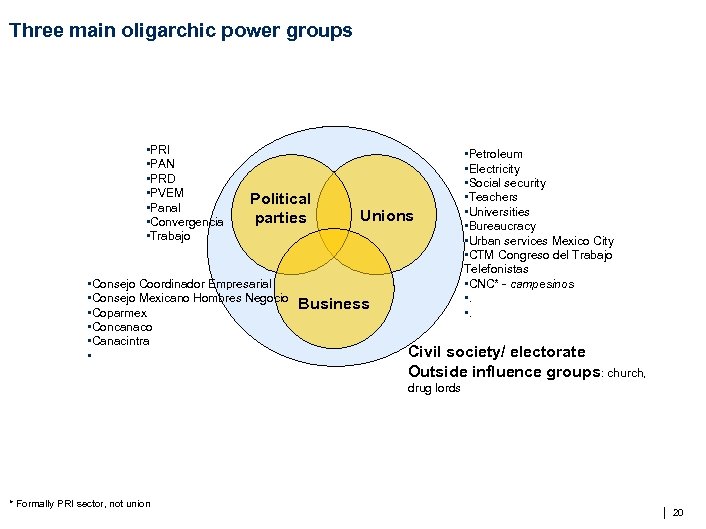 Three main oligarchic power groups • PRI • PAN • PRD • PVEM • Panal • Convergencia • Trabajo Political parties • Consejo Coordinador Empresarial • Consejo Mexicano Hombres Negocio • Coparmex • Concanaco • Canacintra • Unions Business • Petroleum • Electricity • Social security • Teachers • Universities • Bureaucracy • Urban services Mexico City • CTM Congreso del Trabajo Telefonistas • CNC* - campesinos • . Civil society/ electorate Outside influence groups: church, drug lords * Formally PRI sector, not union | 20
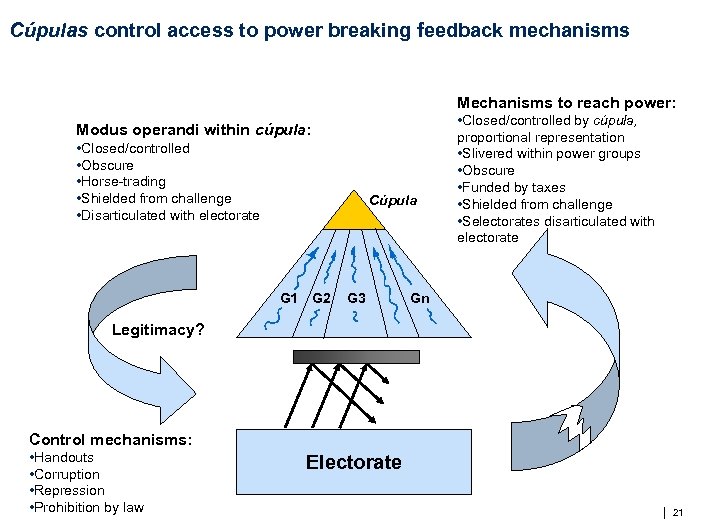 Cúpulas control access to power breaking feedback mechanisms Mechanisms to reach power: Modus operandi within cúpula: • Closed/controlled • Obscure • Horse-trading • Shielded from challenge • Disarticulated with electorate Cúpula G 1 G 2 G 3 • Closed/controlled by cúpula, proportional representation • Slivered within power groups • Obscure • Funded by taxes • Shielded from challenge • Selectorates disarticulated with electorate Gn Legitimacy? Control mechanisms: • Handouts • Corruption • Repression • Prohibition by law Electorate | 21
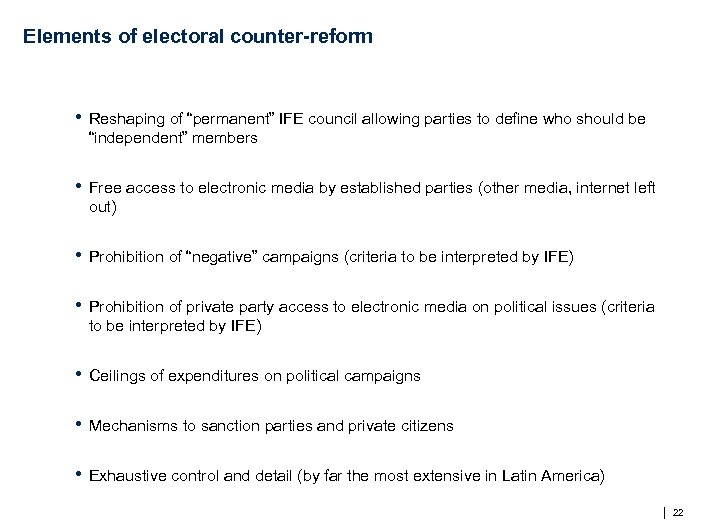 Elements of electoral counter-reform • Reshaping of “permanent” IFE council allowing parties to define who should be “independent” members • Free access to electronic media by established parties (other media, internet left out) • Prohibition of “negative” campaigns (criteria to be interpreted by IFE) • Prohibition of private party access to electronic media on political issues (criteria to be interpreted by IFE) • Ceilings of expenditures on political campaigns • Mechanisms to sanction parties and private citizens • Exhaustive control and detail (by far the most extensive in Latin America) | 22
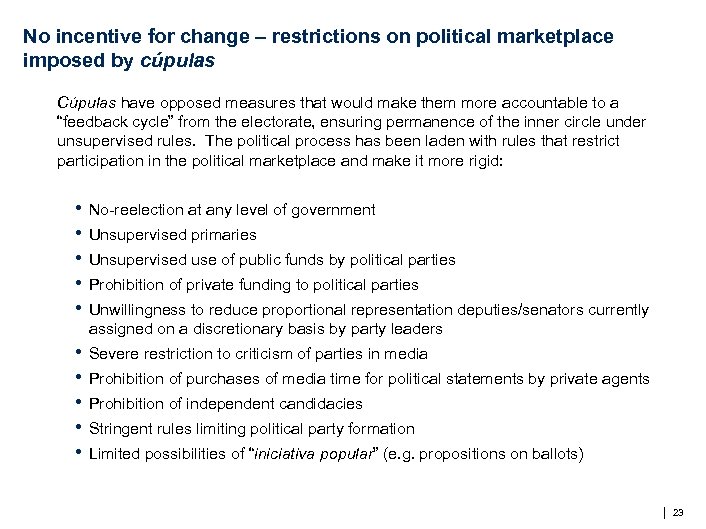 No incentive for change – restrictions on political marketplace imposed by cúpulas Cúpulas have opposed measures that would make them more accountable to a “feedback cycle” from the electorate, ensuring permanence of the inner circle under unsupervised rules. The political process has been laden with rules that restrict participation in the political marketplace and make it more rigid: • • • No-reelection at any level of government • • • Severe restriction to criticism of parties in media Unsupervised primaries Unsupervised use of public funds by political parties Prohibition of private funding to political parties Unwillingness to reduce proportional representation deputies/senators currently assigned on a discretionary basis by party leaders Prohibition of purchases of media time for political statements by private agents Prohibition of independent candidacies Stringent rules limiting political party formation Limited possibilities of “iniciativa popular” (e. g. propositions on ballots) | 23
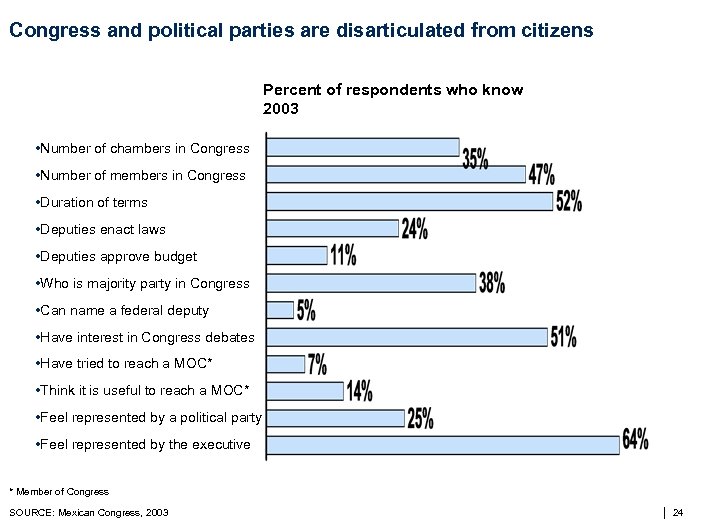 Congress and political parties are disarticulated from citizens Percent of respondents who know 2003 • Number of chambers in Congress • Number of members in Congress • Duration of terms • Deputies enact laws • Deputies approve budget • Who is majority party in Congress • Can name a federal deputy • Have interest in Congress debates • Have tried to reach a MOC* • Think it is useful to reach a MOC* • Feel represented by a political party • Feel represented by the executive * Member of Congress SOURCE: Mexican Congress, 2003 | 24
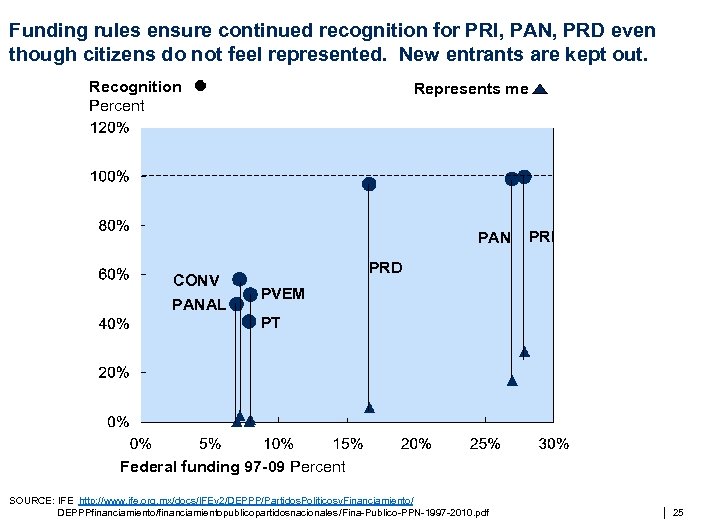 Funding rules ensure continued recognition for PRI, PAN, PRD even though citizens do not feel represented. New entrants are kept out. Recognition Percent Represents me PAN CONV PANAL PRI PRD PVEM PT Federal funding 97 -09 Percent SOURCE: IFE http: //www. ife. org. mx/docs/IFEv 2/DEPPP/Partidos. Politicosy. Financiamiento/ DEPPPfinanciamiento/financiamientopublicopartidosnacionales /Fina-Publico-PPN-1997 -2010. pdf | 25
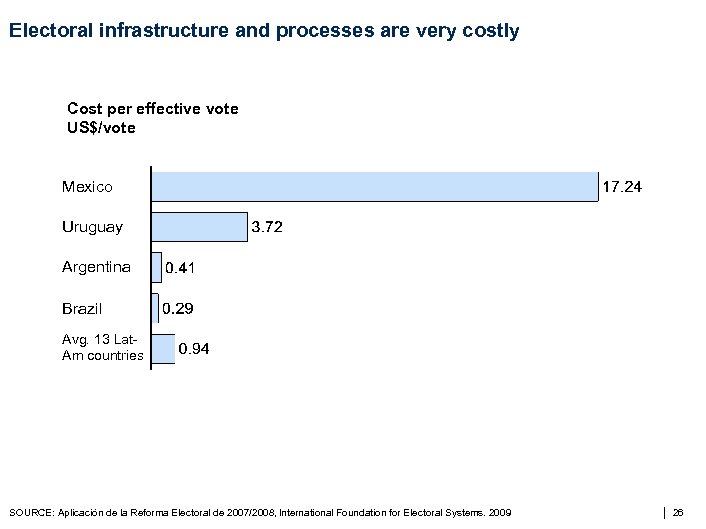 Electoral infrastructure and processes are very costly Cost per effective vote US$/vote Mexico Uruguay Argentina Brazil Avg. 13 Lat. Am countries SOURCE: Aplicación de la Reforma Electoral de 2007/2008, International Foundation for Electoral Systems. 2009 | 26
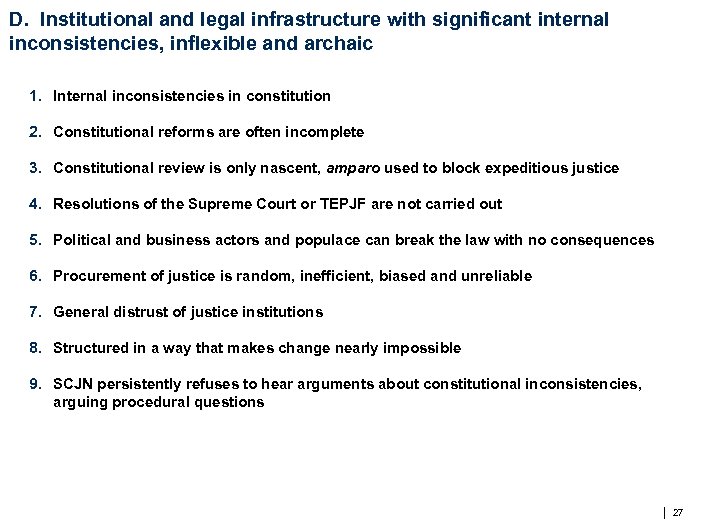 D. Institutional and legal infrastructure with significant internal inconsistencies, inflexible and archaic 1. Internal inconsistencies in constitution 2. Constitutional reforms are often incomplete 3. Constitutional review is only nascent, amparo used to block expeditious justice 4. Resolutions of the Supreme Court or TEPJF are not carried out 5. Political and business actors and populace can break the law with no consequences 6. Procurement of justice is random, inefficient, biased and unreliable 7. General distrust of justice institutions 8. Structured in a way that makes change nearly impossible 9. SCJN persistently refuses to hear arguments about constitutional inconsistencies, arguing procedural questions | 27
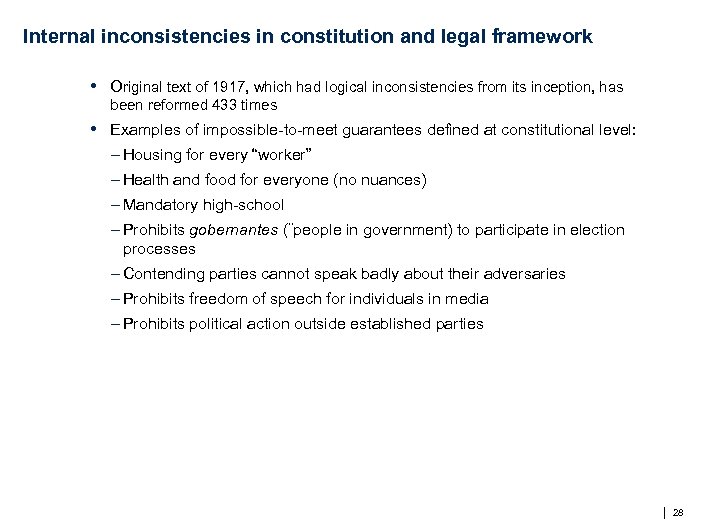 Internal inconsistencies in constitution and legal framework • Original text of 1917, which had logical inconsistencies from its inception, has been reformed 433 times • Examples of impossible-to-meet guarantees defined at constitutional level: – Housing for every “worker” – Health and food for everyone (no nuances) – Mandatory high-school – Prohibits gobernantes (¨people in government) to participate in election processes – Contending parties cannot speak badly about their adversaries – Prohibits freedom of speech for individuals in media – Prohibits political action outside established parties | 28
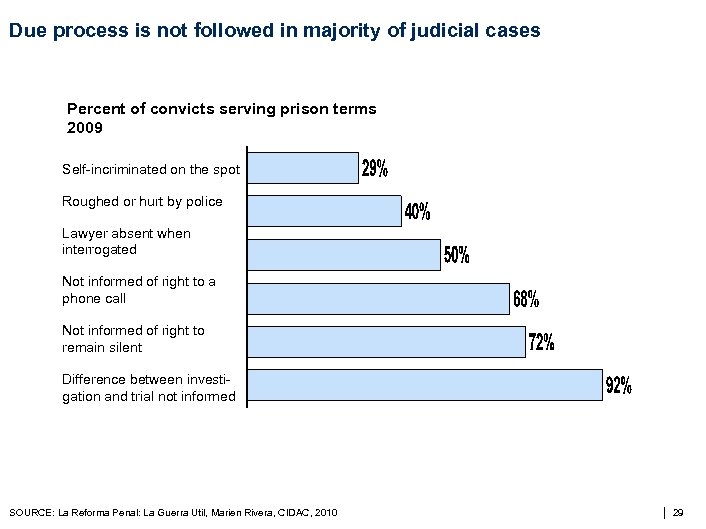 Due process is not followed in majority of judicial cases Percent of convicts serving prison terms 2009 Self-incriminated on the spot Roughed or hurt by police Lawyer absent when interrogated Not informed of right to a phone call Not informed of right to remain silent Difference between investigation and trial not informed SOURCE: La Reforma Penal: La Guerra Util, Marien Rivera, CIDAC, 2010 | 29
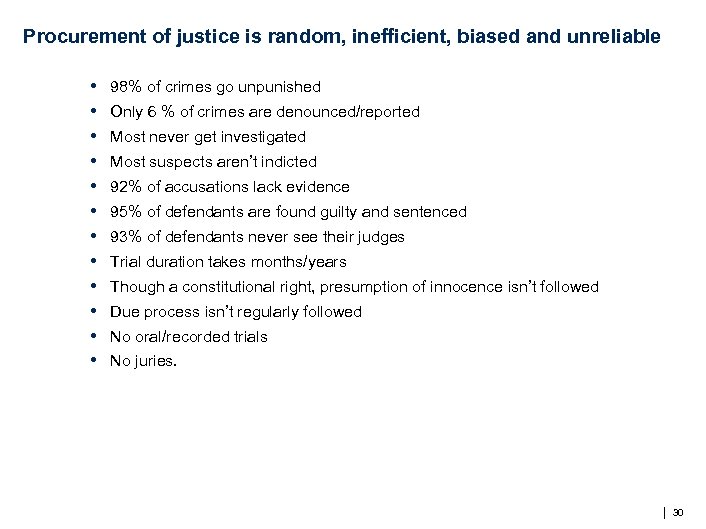 Procurement of justice is random, inefficient, biased and unreliable • • • 98% of crimes go unpunished Only 6 % of crimes are denounced/reported Most never get investigated Most suspects aren’t indicted 92% of accusations lack evidence 95% of defendants are found guilty and sentenced 93% of defendants never see their judges Trial duration takes months/years Though a constitutional right, presumption of innocence isn’t followed Due process isn’t regularly followed No oral/recorded trials No juries. | 30
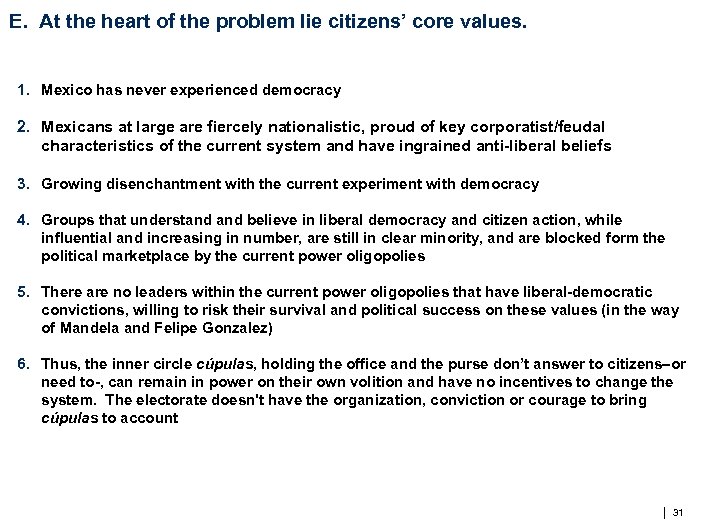 E. At the heart of the problem lie citizens’ core values. 1. Mexico has never experienced democracy 2. Mexicans at large are fiercely nationalistic, proud of key corporatist/feudal characteristics of the current system and have ingrained anti-liberal beliefs 3. Growing disenchantment with the current experiment with democracy 4. Groups that understand believe in liberal democracy and citizen action, while influential and increasing in number, are still in clear minority, and are blocked form the political marketplace by the current power oligopolies 5. There are no leaders within the current power oligopolies that have liberal-democratic convictions, willing to risk their survival and political success on these values (in the way of Mandela and Felipe Gonzalez) 6. Thus, the inner circle cúpulas, holding the office and the purse don’t answer to citizens–or need to-, can remain in power on their own volition and have no incentives to change the system. The electorate doesn't have the organization, conviction or courage to bring cúpulas to account | 31
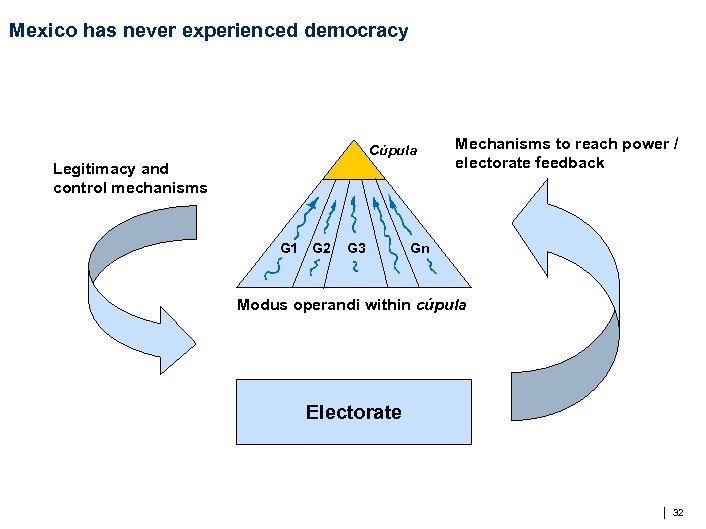 Mexico has never experienced democracy Cúpula Legitimacy and control mechanisms G 1 G 2 G 3 Mechanisms to reach power / electorate feedback Gn Modus operandi within cúpula Electorate | 32
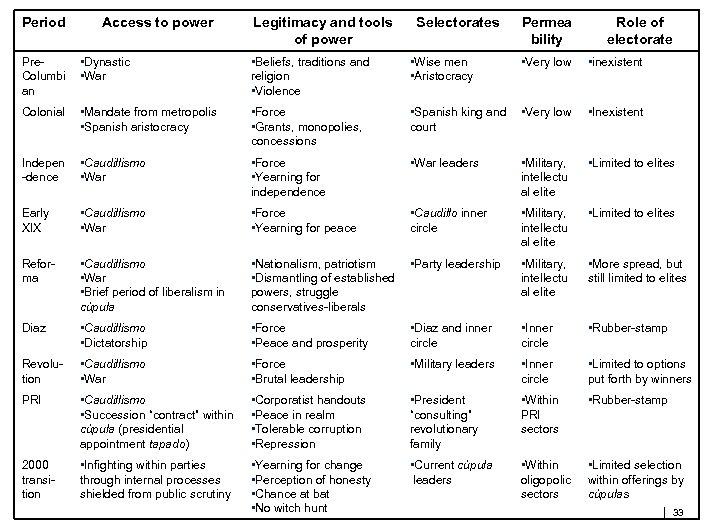 Period Access to power Legitimacy and tools of power Selectorates Permea bility Role of electorate Pre. Columbi an • Dynastic • War • Beliefs, traditions and religion • Violence • Wise men • Aristocracy • Very low • inexistent Colonial • Mandate from metropolis • Spanish aristocracy • Force • Grants, monopolies, concessions • Spanish king and court • Very low • Inexistent Indepen -dence • Caudillismo • War • Force • Yearning for independence • War leaders • Military, intellectu al elite • Limited to elites Early XIX • Caudillismo • War • Force • Yearning for peace • Caudillo inner circle • Military, intellectu al elite • Limited to elites Reforma • Caudillismo • War • Brief period of liberalism in cúpula • Nationalism, patriotism • Dismantling of established powers, struggle conservatives-liberals • Party leadership • Military, intellectu al elite • More spread, but still limited to elites Diaz • Caudillismo • Dictatorship • Force • Peace and prosperity • Diaz and inner circle • Inner circle • Rubber-stamp Revolution • Caudillismo • War • Force • Brutal leadership • Military leaders • Inner circle • Limited to options put forth by winners PRI • Caudillismo • Succession “contract” within cúpula (presidential appointment tapado) • Corporatist handouts • Peace in realm • Tolerable corruption • Repression • President “consulting” revolutionary family • Within PRI sectors • Rubber-stamp 2000 transition • Infighting within parties through internal processes shielded from public scrutiny • Yearning for change • Perception of honesty • Chance at bat • No witch hunt • Current cúpula leaders • Within oligopolic sectors • Limited selection within offerings by cúpulas | 33
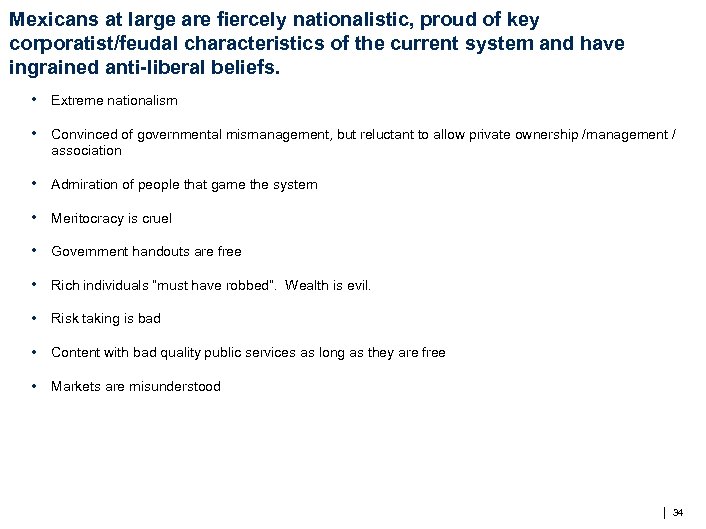 Mexicans at large are fiercely nationalistic, proud of key corporatist/feudal characteristics of the current system and have ingrained anti-liberal beliefs. • Extreme nationalism • Convinced of governmental mismanagement, but reluctant to allow private ownership /management / association • Admiration of people that game the system • Meritocracy is cruel • Government handouts are free • Rich individuals “must have robbed”. Wealth is evil. • Risk taking is bad • Content with bad quality public services as long as they are free • Markets are misunderstood | 34
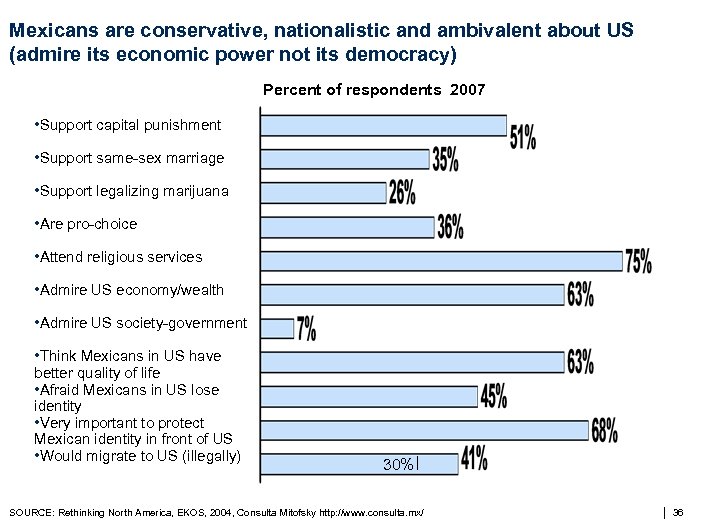 Mexicans are conservative, nationalistic and ambivalent about US (admire its economic power not its democracy) Percent of respondents 2007 • Support capital punishment • Support same-sex marriage • Support legalizing marijuana • Are pro-choice • Attend religious services • Admire US economy/wealth • Admire US society-government • Think Mexicans in US have better quality of life • Afraid Mexicans in US lose identity • Very important to protect Mexican identity in front of US • Would migrate to US (illegally) 30% SOURCE: Rethinking North America, EKOS, 2004, Consulta Mitofsky http: //www. consulta. mx/ | 36
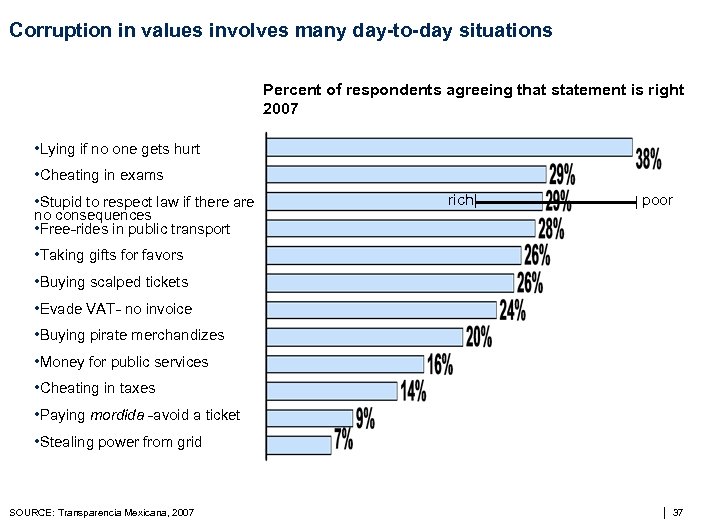 Corruption in values involves many day-to-day situations Percent of respondents agreeing that statement is right 2007 • Lying if no one gets hurt • Cheating in exams • Stupid to respect law if there are no consequences • Free-rides in public transport rich poor • Taking gifts for favors • Buying scalped tickets • Evade VAT- no invoice • Buying pirate merchandizes • Money for public services • Cheating in taxes • Paying mordida -avoid a ticket • Stealing power from grid SOURCE: Transparencia Mexicana, 2007 | 37
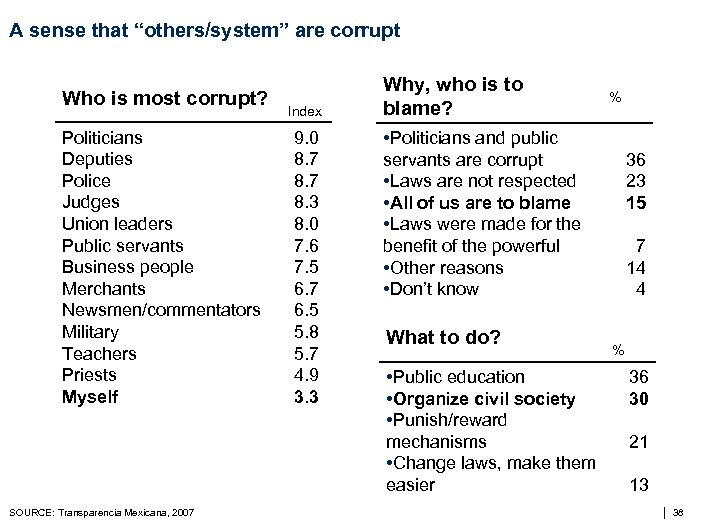 A sense that “others/system” are corrupt Who is most corrupt? Politicians Deputies Police Judges Union leaders Public servants Business people Merchants Newsmen/commentators Military Teachers Priests Myself SOURCE: Transparencia Mexicana, 2007 Index 9. 0 8. 7 8. 3 8. 0 7. 6 7. 5 6. 7 6. 5 5. 8 5. 7 4. 9 3. 3 Why, who is to blame? % • Politicians and public servants are corrupt • Laws are not respected • All of us are to blame • Laws were made for the benefit of the powerful • Other reasons • Don’t know What to do? • Public education • Organize civil society • Punish/reward mechanisms • Change laws, make them easier 36 23 15 7 14 4 % 36 30 21 13 | 38
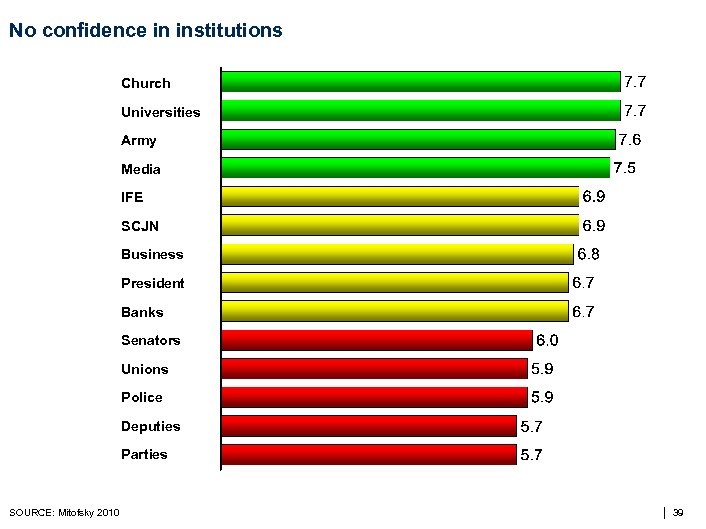 No confidence in institutions Church Universities Army Media IFE SCJN Business President Banks Senators Unions Police Deputies Parties SOURCE: Mitofsky 2010 | 39
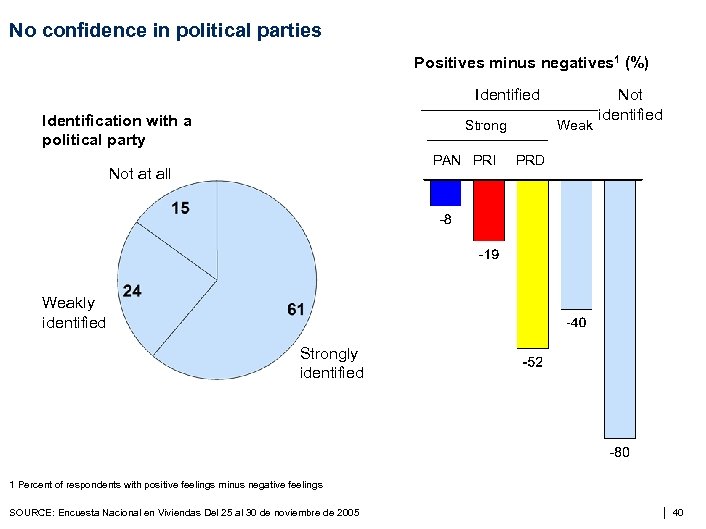 No confidence in political parties Positives minus negatives 1 (%) Identified Identification with a political party Strong PAN PRI Not at all Weak Not identified PRD Weakly identified Strongly identified 1 Percent of respondents with positive feelings minus negative feelings SOURCE: Encuesta Nacional en Viviendas Del 25 al 30 de noviembre de 2005 | 40
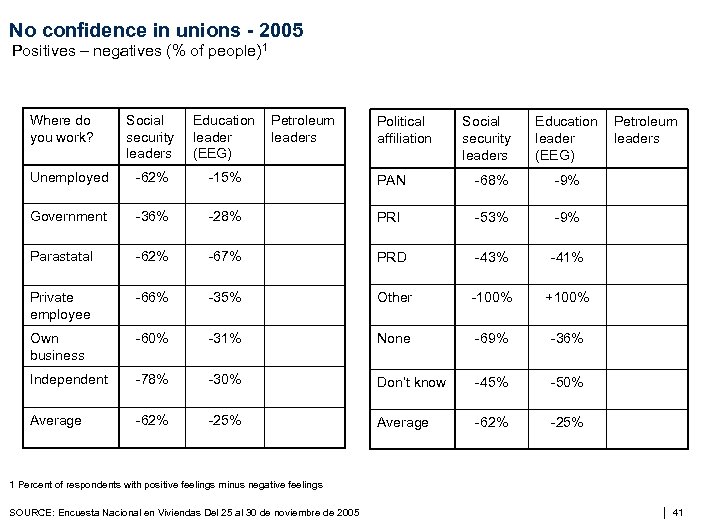 No confidence in unions - 2005 Positives – negatives (% of people)1 Where do you work? Social security leaders Education leader (EEG) Petroleum leaders Unemployed -62% -15% PAN -68% -9% Government -36% -28% PRI -53% -9% Parastatal -62% -67% PRD -43% -41% Private employee -66% -35% Other -100% +100% Own business -60% -31% None -69% -36% Independent -78% -30% Don’t know -45% -50% Average -62% -25% Political affiliation Social security leaders Education leader (EEG) Petroleum leaders 1 Percent of respondents with positive feelings minus negative feelings SOURCE: Encuesta Nacional en Viviendas Del 25 al 30 de noviembre de 2005 | 41
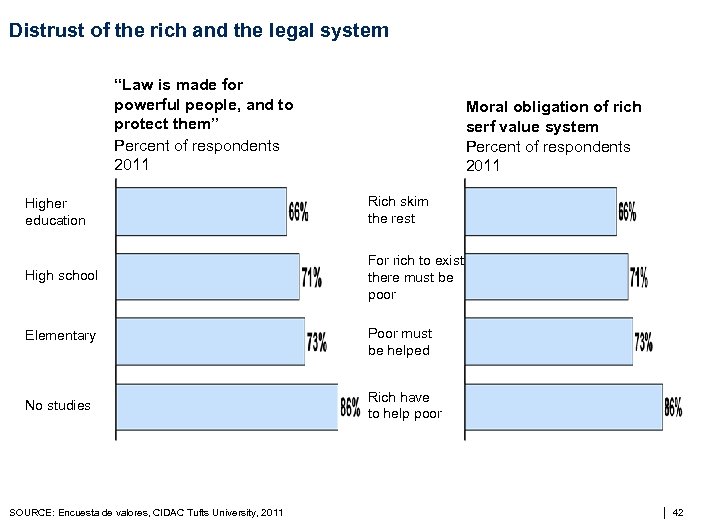 Distrust of the rich and the legal system “Law is made for powerful people, and to protect them” Percent of respondents 2011 Moral obligation of rich serf value system Percent of respondents 2011 Higher education Rich skim the rest High school For rich to exist there must be poor Elementary Poor must be helped No studies Rich have to help poor SOURCE: Encuesta de valores, CIDAC Tufts University, 2011 | 42
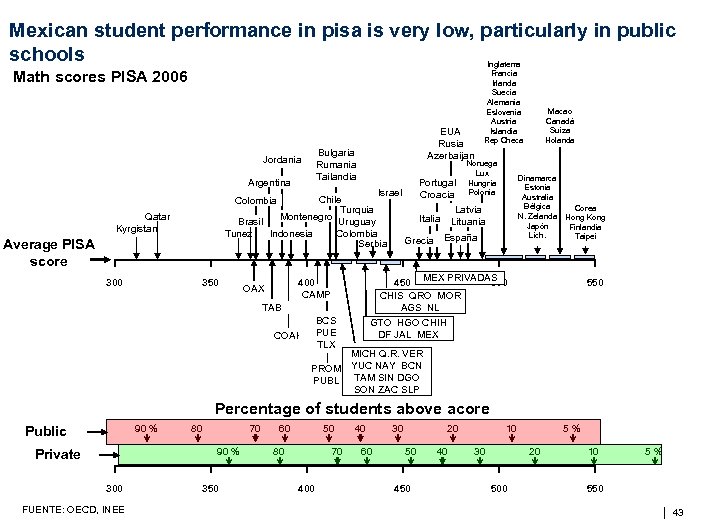 Mexican student performance in pisa is very low, particularly in public schools Inglaterra Francia Irlanda Suecia Alemania Eslovenia Austria Islandia Rep Checa Math scores PISA 2006 EUA Rusia Azerbaijan Bulgaria Rumania Tailandia Jordania Argentina Noruega Lux Hungría Polonia Israel Chile Turquia Montenegro Uruguay Brasil Tunez Colombia Indonesia Grecia España Serbia Qatar Kyrgistan Average PISA score 300 Dinamarca Estonia Australia Bélgica N. Zelanda Japón Lich. Portugal Croacia Latvia Italia Lituania Colombia 350 TAB BCS PUE TLX COAH Corea Hong Kong Finlandia Taipei 450 MEX PRIVADAS 500 CHIS QRO MOR AGS NL 400 CAMP OAX Macao Canadá Suiza Holanda PROM PUBL 550 GTO HGO CHIH DF JAL MEX MICH Q. R. VER YUC NAY BCN TAM SIN DGO SON ZAC SLP Percentage of students above acore 90 % Public 80 70 90 % Private 300 FUENTE: OECD, INEE 350 60 50 80 70 40 60 30 20 50 40 10 30 5% 20 500 10 5% 550 | 43
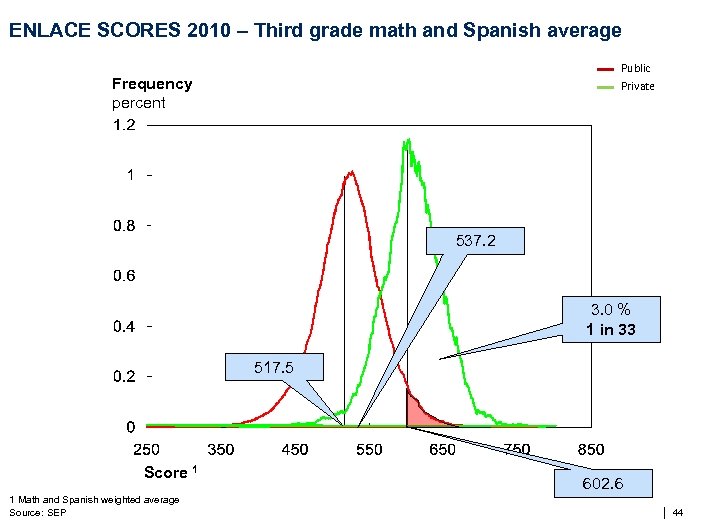 ENLACE SCORES 2010 – Third grade math and Spanish average Public Frequency percent Private 537. 2 3. 0 % 1 in 33 517. 5 Score 1 1 Math and Spanish weighted average Source: SEP 602. 6 | 44
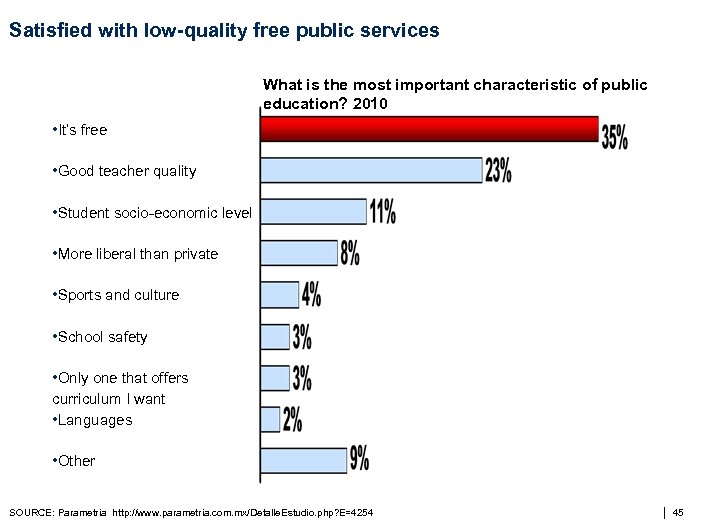 Satisfied with low-quality free public services What is the most important characteristic of public education? 2010 • It’s free • Good teacher quality • Student socio-economic level • More liberal than private • Sports and culture • School safety • Only one that offers curriculum I want • Languages • Other SOURCE: Parametría http: //www. parametria. com. mx/Detalle. Estudio. php? E=4254 | 45
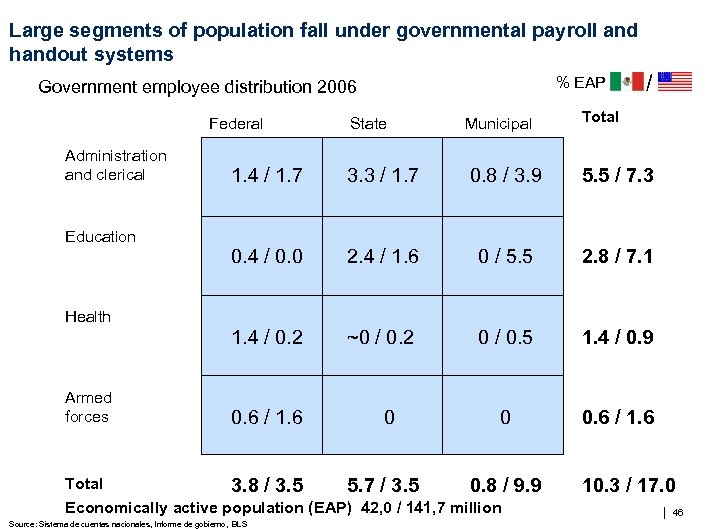 Large segments of population fall under governmental payroll and handout systems % EAP Government employee distribution 2006 State Municipal Total 1. 4 / 1. 7 3. 3 / 1. 7 0. 8 / 3. 9 5. 5 / 7. 3 0. 4 / 0. 0 2. 4 / 1. 6 0 / 5. 5 2. 8 / 7. 1 1. 4 / 0. 2 ~0 / 0. 2 0 / 0. 5 1. 4 / 0. 9 0 0. 6 / 1. 6 Federal Administration and clerical Education Health / Armed forces 0. 6 / 1. 6 Total 3. 8 / 3. 5 0 5. 7 / 3. 5 0. 8 / 9. 9 Economically active population (EAP) 42, 0 / 141, 7 million Source: Sistema de cuentas nacionales, Informe de gobierno, BLS 10. 3 / 17. 0 | 46
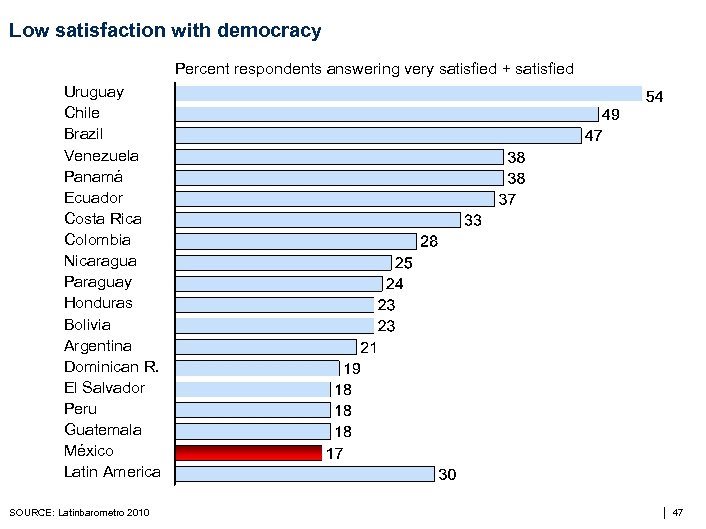 Low satisfaction with democracy Percent respondents answering very satisfied + satisfied Uruguay Chile Brazil Venezuela Panamá Ecuador Costa Rica Colombia Nicaragua Paraguay Honduras Bolivia Argentina Dominican R. El Salvador Peru Guatemala México Latin America SOURCE: Latinbarometro 2010 | 47
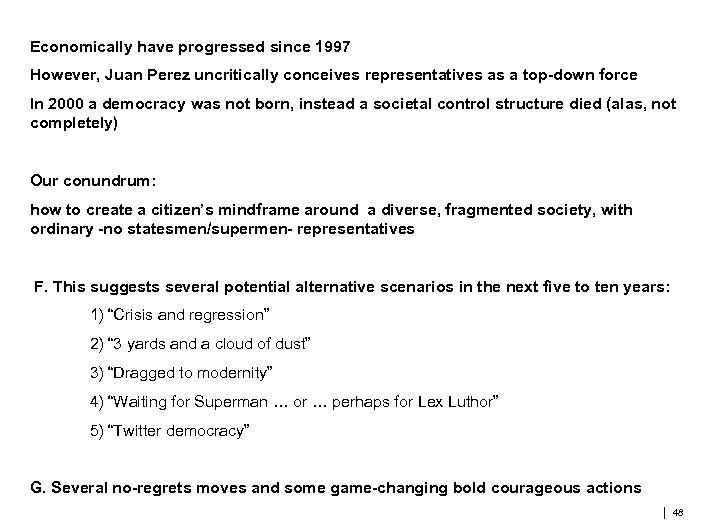 Economically have progressed since 1997 However, Juan Perez uncritically conceives representatives as a top-down force In 2000 a democracy was not born, instead a societal control structure died (alas, not completely) Our conundrum: how to create a citizen’s mindframe around a diverse, fragmented society, with ordinary -no statesmen/supermen- representatives F. This suggests several potential alternative scenarios in the next five to ten years: 1) “Crisis and regression” 2) “ 3 yards and a cloud of dust” 3) “Dragged to modernity” 4) “Waiting for Superman … or … perhaps for Lex Luthor” 5) “Twitter democracy” G. Several no-regrets moves and some game-changing bold courageous actions | 48
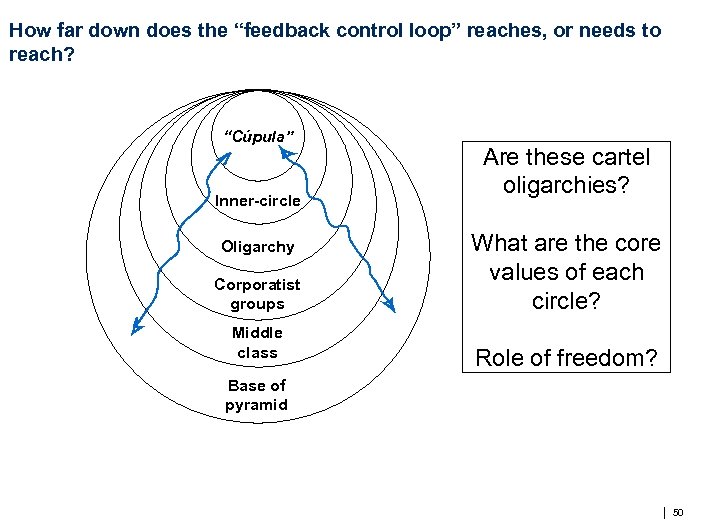 How far down does the “feedback control loop” reaches, or needs to reach? “Cúpula” Inner-circle Oligarchy Corporatist groups Middle class Are these cartel oligarchies? What are the core values of each circle? Role of freedom? Base of pyramid | 50
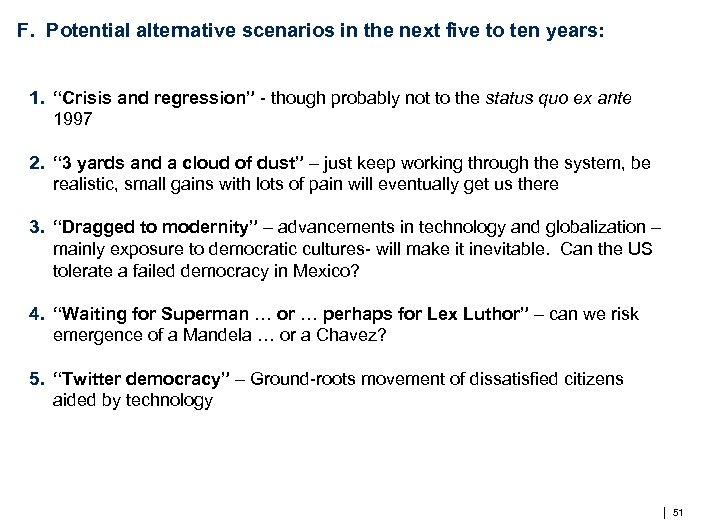 F. Potential alternative scenarios in the next five to ten years: 1. “Crisis and regression” - though probably not to the status quo ex ante 1997 2. “ 3 yards and a cloud of dust” – just keep working through the system, be realistic, small gains with lots of pain will eventually get us there 3. “Dragged to modernity” – advancements in technology and globalization – mainly exposure to democratic cultures- will make it inevitable. Can the US tolerate a failed democracy in Mexico? 4. “Waiting for Superman … or … perhaps for Lex Luthor” – can we risk emergence of a Mandela … or a Chavez? 5. “Twitter democracy” – Ground-roots movement of dissatisfied citizens aided by technology | 51
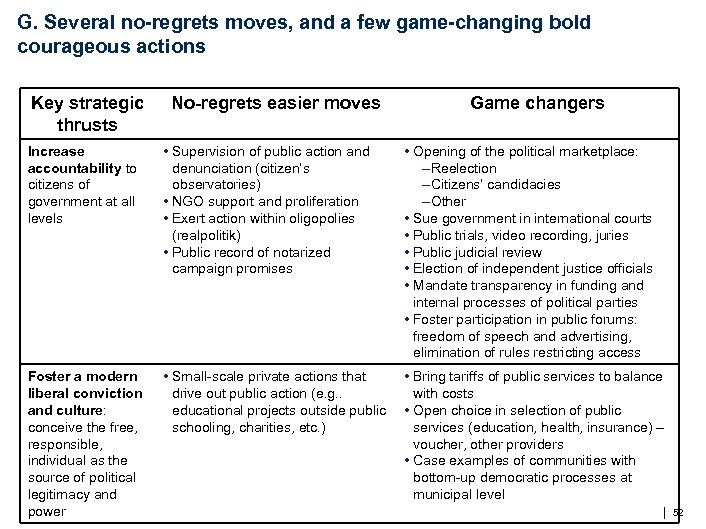 G. Several no-regrets moves, and a few game-changing bold courageous actions Key strategic thrusts No-regrets easier moves Game changers Increase accountability to citizens of government at all levels • Supervision of public action and denunciation (citizen’s observatories) • NGO support and proliferation • Exert action within oligopolies (realpolitik) • Public record of notarized campaign promises • Opening of the political marketplace: – Reelection – Citizens’ candidacies – Other • Sue government in international courts • Public trials, video recording, juries • Public judicial review • Election of independent justice officials • Mandate transparency in funding and internal processes of political parties • Foster participation in public forums: freedom of speech and advertising, elimination of rules restricting access Foster a modern liberal conviction and culture: conceive the free, responsible, individual as the source of political legitimacy and power • Small-scale private actions that drive out public action (e. g. . educational projects outside public schooling, charities, etc. ) • Bring tariffs of public services to balance with costs • Open choice in selection of public services (education, health, insurance) – voucher, other providers • Case examples of communities with bottom-up democratic processes at municipal level | 52
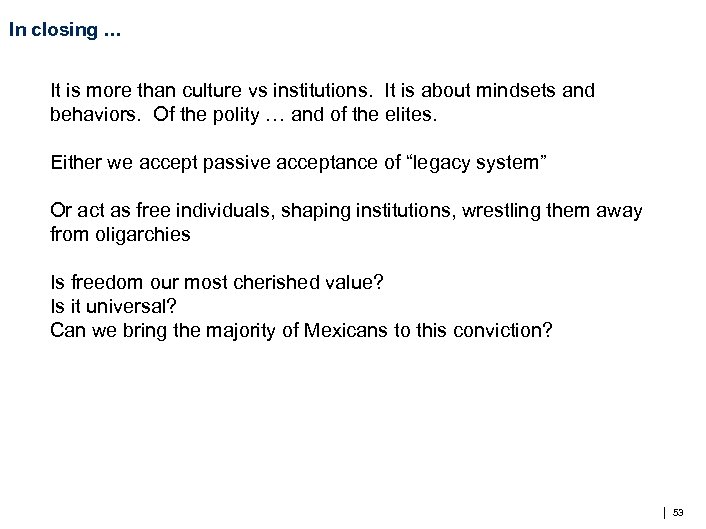 In closing … It is more than culture vs institutions. It is about mindsets and behaviors. Of the polity … and of the elites. Either we accept passive acceptance of “legacy system” Or act as free individuals, shaping institutions, wrestling them away from oligarchies Is freedom our most cherished value? Is it universal? Can we bring the majority of Mexicans to this conviction? | 53
 Ten Years of Failed Transition to Democracy: the struggle between modernity and feudalism in Mexican society Research seminar A personal point of view of Antonio Puron March 31, 2011
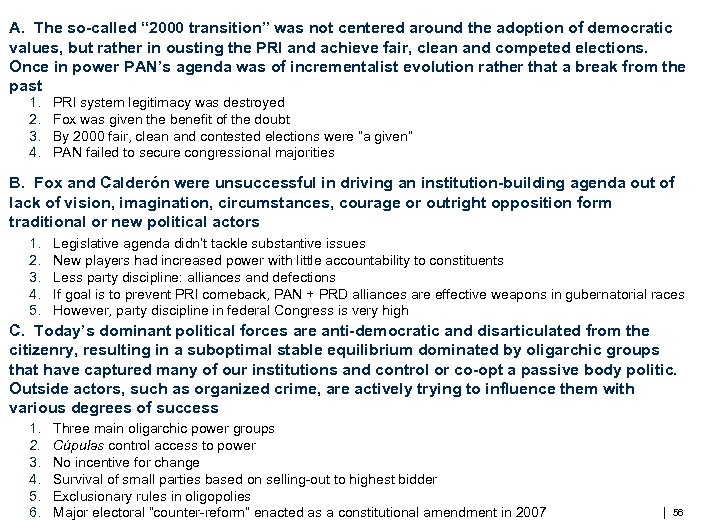 A. The so-called “ 2000 transition” was not centered around the adoption of democratic values, but rather in ousting the PRI and achieve fair, clean and competed elections. Once in power PAN’s agenda was of incrementalist evolution rather that a break from the past 1. 2. 3. 4. PRI system legitimacy was destroyed Fox was given the benefit of the doubt By 2000 fair, clean and contested elections were “a given” PAN failed to secure congressional majorities B. Fox and Calderón were unsuccessful in driving an institution-building agenda out of lack of vision, imagination, circumstances, courage or outright opposition form traditional or new political actors 1. 2. 3. 4. 5. Legislative agenda didn’t tackle substantive issues New players had increased power with little accountability to constituents Less party discipline: alliances and defections If goal is to prevent PRI comeback, PAN + PRD alliances are effective weapons in gubernatorial races However, party discipline in federal Congress is very high C. Today’s dominant political forces are anti-democratic and disarticulated from the citizenry, resulting in a suboptimal stable equilibrium dominated by oligarchic groups that have captured many of our institutions and control or co-opt a passive body politic. Outside actors, such as organized crime, are actively trying to influence them with various degrees of success 1. 2. 3. 4. 5. 6. Three main oligarchic power groups Cúpulas control access to power No incentive for change Survival of small parties based on selling-out to highest bidder Exclusionary rules in oligopolies Major electoral “counter-reform” enacted as a constitutional amendment in 2007 | 56
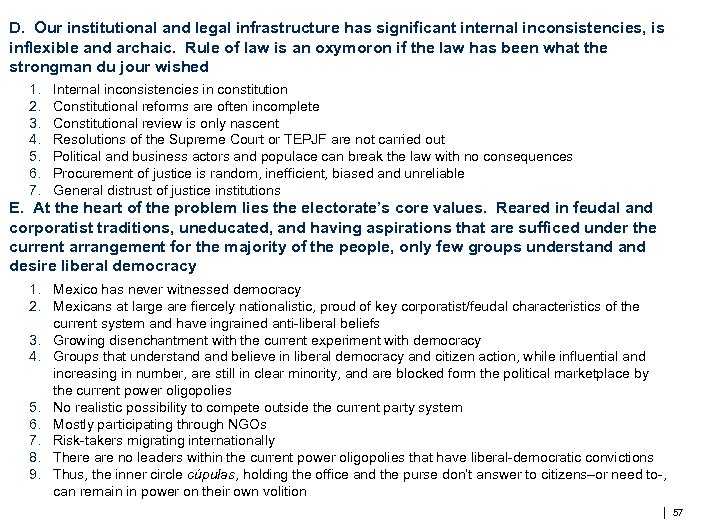 D. Our institutional and legal infrastructure has significant internal inconsistencies, is inflexible and archaic. Rule of law is an oxymoron if the law has been what the strongman du jour wished 1. 2. 3. 4. 5. 6. 7. Internal inconsistencies in constitution Constitutional reforms are often incomplete Constitutional review is only nascent Resolutions of the Supreme Court or TEPJF are not carried out Political and business actors and populace can break the law with no consequences Procurement of justice is random, inefficient, biased and unreliable General distrust of justice institutions E. At the heart of the problem lies the electorate’s core values. Reared in feudal and corporatist traditions, uneducated, and having aspirations that are sufficed under the current arrangement for the majority of the people, only few groups understand desire liberal democracy 1. Mexico has never witnessed democracy 2. Mexicans at large are fiercely nationalistic, proud of key corporatist/feudal characteristics of the current system and have ingrained anti-liberal beliefs 3. Growing disenchantment with the current experiment with democracy 4. Groups that understand believe in liberal democracy and citizen action, while influential and increasing in number, are still in clear minority, and are blocked form the political marketplace by the current power oligopolies 5. No realistic possibility to compete outside the current party system 6. Mostly participating through NGOs 7. Risk-takers migrating internationally 8. There are no leaders within the current power oligopolies that have liberal-democratic convictions 9. Thus, the inner circle cúpulas, holding the office and the purse don’t answer to citizens–or need to-, can remain in power on their own volition | 57
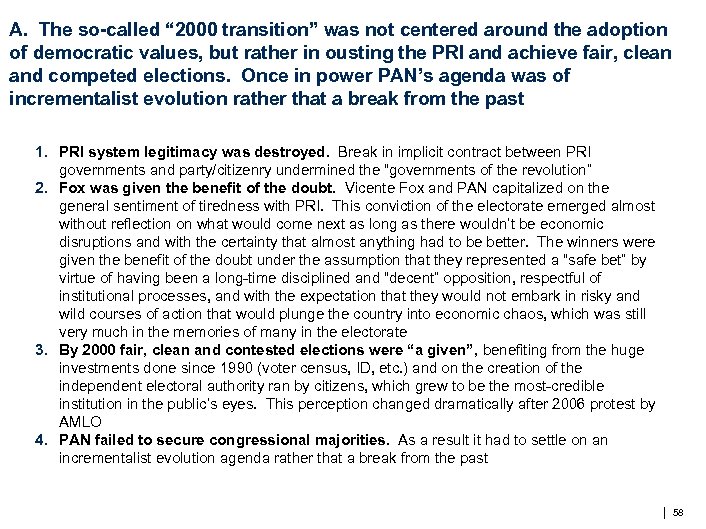 A. The so-called “ 2000 transition” was not centered around the adoption of democratic values, but rather in ousting the PRI and achieve fair, clean and competed elections. Once in power PAN’s agenda was of incrementalist evolution rather that a break from the past 1. PRI system legitimacy was destroyed. Break in implicit contract between PRI governments and party/citizenry undermined the “governments of the revolution” 2. Fox was given the benefit of the doubt. Vicente Fox and PAN capitalized on the general sentiment of tiredness with PRI. This conviction of the electorate emerged almost without reflection on what would come next as long as there wouldn’t be economic disruptions and with the certainty that almost anything had to be better. The winners were given the benefit of the doubt under the assumption that they represented a “safe bet” by virtue of having been a long-time disciplined and “decent” opposition, respectful of institutional processes, and with the expectation that they would not embark in risky and wild courses of action that would plunge the country into economic chaos, which was still very much in the memories of many in the electorate 3. By 2000 fair, clean and contested elections were “a given”, benefiting from the huge investments done since 1990 (voter census, ID, etc. ) and on the creation of the independent electoral authority ran by citizens, which grew to be the most-credible institution in the public’s eyes. This perception changed dramatically after 2006 protest by AMLO 4. PAN failed to secure congressional majorities. As a result it had to settle on an incrementalist evolution agenda rather that a break from the past | 58
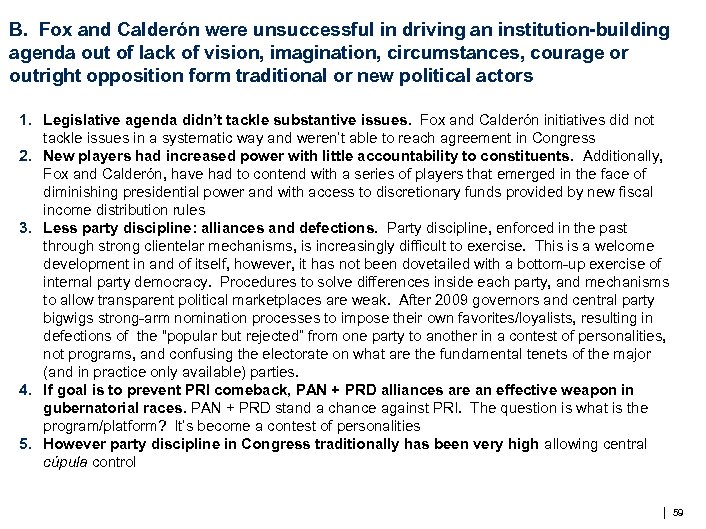 B. Fox and Calderón were unsuccessful in driving an institution-building agenda out of lack of vision, imagination, circumstances, courage or outright opposition form traditional or new political actors 1. Legislative agenda didn’t tackle substantive issues. Fox and Calderón initiatives did not tackle issues in a systematic way and weren’t able to reach agreement in Congress 2. New players had increased power with little accountability to constituents. Additionally, Fox and Calderón, have had to contend with a series of players that emerged in the face of diminishing presidential power and with access to discretionary funds provided by new fiscal income distribution rules 3. Less party discipline: alliances and defections. Party discipline, enforced in the past through strong clientelar mechanisms, is increasingly difficult to exercise. This is a welcome development in and of itself, however, it has not been dovetailed with a bottom-up exercise of internal party democracy. Procedures to solve differences inside each party, and mechanisms to allow transparent political marketplaces are weak. After 2009 governors and central party bigwigs strong-arm nomination processes to impose their own favorites/loyalists, resulting in defections of the “popular but rejected” from one party to another in a contest of personalities, not programs, and confusing the electorate on what are the fundamental tenets of the major (and in practice only available) parties. 4. If goal is to prevent PRI comeback, PAN + PRD alliances are an effective weapon in gubernatorial races. PAN + PRD stand a chance against PRI. The question is what is the program/platform? It’s become a contest of personalities 5. However party discipline in Congress traditionally has been very high allowing central cúpula control | 59
 C. Today’s dominant political forces are anti-democratic and disarticulated from the citizenry, resulting in a suboptimal stable equilibrium dominated by oligarchic groups that have captured many of our institutions and control or co-opt a passive body politic. Outside actors, such as organized crime, are actively trying to influence them with various degrees of success 1. Three main power groups. The consolidation of 3 groups around cúpulas whose power is gained through selectorates that have no accountability to the electorate: a) Leadership of political parties, b) Union leaders c) Business representatives. Their leaderships are small and overlap, oftentimes pushing the agenda of their principal allegiance 2. Cúpulas control access to power. Main players in cúpulas have all mechanisms available to control access to power, and to extract resources to fund it and to make this arrangement permanent. We’ve locked the door to our prison, and thrown the keys far away … only an enlightened guard will get us out 3. No incentive for change. Political cúpulas have opposed measures that would make them more accountable to a “feedback cycle” from the electorate, ensuring permanence of the inner circle under unsupervised rules. The political process has been laden with rules that restrict participation in the political marketplace and make it more rigid: no-reelection at any level of government, unsupervised primaries, unsupervised use of public funds by political parties, prohibition of private funding to political parties, unwillingness to reduce proportional representation deputies/senators currently assigned on a discretionary basis by party leaders, severe restriction to criticism of parties in media, prohibition of purchases of media time for political statements by private agents, prohibition of independent candidacies, stringent rules limiting political party formation, limited possibilities of “iniciativa popular” (e. g. propositions on ballots), among others. Granted, some of them may be warranted, but the main thrust is to restrict participation. | 60
 4. Survival of small parties based on selling-out to highest bidder. Alliances not issuebased, but on retaining certification. Alliances done with all big 3 parties depending on jurisdiction. Some unions (e. g. teachers) formed a party big enough for federal certification thus obtaining funds and selling out to the highest bidder of the big 3 5. Exclusionary rules in oligopolies. Within any single institution/enterprise membership in a single union is compulsory. No access to political marketplace outside existing political parties. No representation outside mainstream business organizations 6. Major electoral “counter-reform” enacted as a constitutional amendment in 2007. As a reaction to post-electoral conflict in 2006, Main political parties, through Congress, stripped the electoral authority (IFE) of substantial elements of its independence and supervisory roles, devolving them to Congress and to the established political parties. Removal of “noncompliant” councilors and appointment of councilors compliant to big 3 party wishes. Evolution of IFE to minutiae supervision in baroque regulation | 61
 D. Our institutional and legal infrastructure has significant internal inconsistencies, is inflexible and archaic. Rule of law is an oxymoron if the law has been what the strongman du jour wished 1. Internal inconsistencies in constitution. The original text of 1917, which had logical inconsistencies from its inception, has been reformed 433 times 2. Constitutional reforms are often incomplete. Frequently no accompanying laws and regulations are enacted 3. Constitutional review is only nascent. Particularly, no due process with respect to electoral law. The Supreme Court handed over most of its power to the Tribunal Electoral del Poder Judicial de la Federación (TEPJF). At times both bodies declare themselves “incompetent” and refuse to review cases due to procedural problems 4. Resolutions of the Supreme Court or TEPJF are not carried out. Several instances of political actors refusing to abide by final resolutions of the Judicial branch. Several highprofile political actors proclaim that “unfair laws aren’t binding”, even when the courts have judged on the matter 5. Political and business actors and populace can break the law with no consequences. High-profile actors, party leaders, union leaders and businessmen can, and do, break the law without their adversaries -or authorities- initiating judicial processes, or get off-the-hook due to lack of a substantiated cases. Informality and tax evasion are the rule 6. Procurement of justice is random, inefficient, biased and unreliable. 98% of crimes go unpunished. Only 6 % of crimes are denounced/reported. Most never get investigated. Most suspects aren’t indicted. 92% of accusations lack evidence. 95% of defendants are found guilty and sentenced. 93% of defendants never see their judges. Trial duration takes months/years. Though a constitutional right, presumed innocence isn’t followed. Due process isn’t regularly followed. No oral/recorded trials. No juries. 7. General distrust of justice institutions. Police, MP (district attorneys), judges, prison system and law dispensation in general is avoided and regarded as corrupt | 62
 E. At the heart of the problem lies the citizens’ core values. Reared in feudal and corporatist traditions, uneducated, and having aspirations that are sufficed under the current arrangement for the majority of the people, only few groups understand desire liberal democracy 1. Mexico has never witnessed democracy. At no time in pre-Columbian, Colonial, XIX century, Revolutionary, PRI-Post-Revolutionary, or Transition history has the electorate had a chance to experience, even demand, democracy based on a concept of free individuals as the source of political legitimacy and power 2. Mexicans at large are fiercely nationalistic, proud of key corporatist/feudal characteristics of the current system and have ingrained anti-liberal beliefs. • Extreme nationalism, while longing for US-style prosperity • Convinced that icons of governmental control are mismanaged, but reluctant to allow private ownership/management/association (petroleum-Pemex, electricity-CFE, education-SENTE, public transportation-Metro, health-IMSS, higher education-UNAM, many others): – – – • Convinced of corruption in unions and “public managers/servants” Unwilling to allow private, let alone foreign, control of large swathes of economic activity. “Loss” of Mexican banking industry still thought of as mandated by Washington Prone to believe in a grand conspiracy by Washington-IMF-imperialistic clique Public ownership of some of these entities creates sense of pride –perhaps only sense of pride- in the international context, particularly Pemex Assumption that entitlements requires operation through governmental bureaucracies, because private operation may be more efficient but skims the public enterprise and is corrupt Admiration of people that game the system: selling or inheriting plazas (government union slots), working in government payroll (“el que no vive en el presupuesto vive en el error”) even by purchasing positions from the union, pensions before 50, holding two simultaneous government jobs, paying mordida -for slots in street vending, avoiding fines or to settle in public or private property-, influence trafficking, crony capitalism concessions | 63
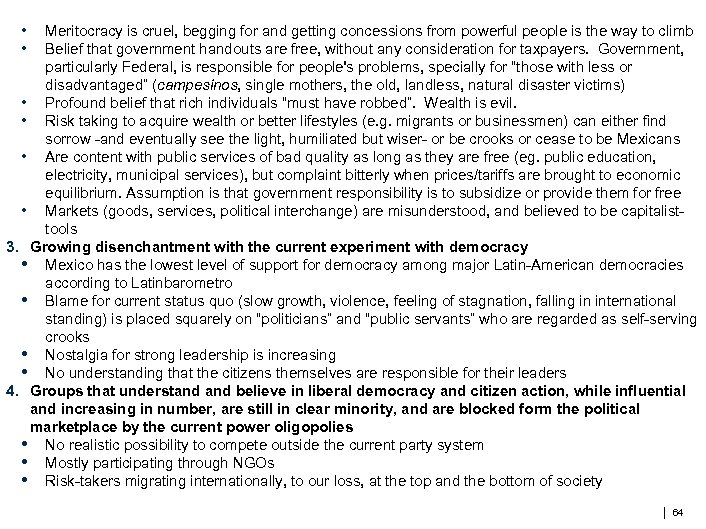 • • Meritocracy is cruel, begging for and getting concessions from powerful people is the way to climb Belief that government handouts are free, without any consideration for taxpayers. Government, particularly Federal, is responsible for people's problems, specially for “those with less or disadvantaged” (campesinos, single mothers, the old, landless, natural disaster victims) • Profound belief that rich individuals “must have robbed”. Wealth is evil. • Risk taking to acquire wealth or better lifestyles (e. g. migrants or businessmen) can either find sorrow -and eventually see the light, humiliated but wiser- or be crooks or cease to be Mexicans • Are content with public services of bad quality as long as they are free (eg. public education, electricity, municipal services), but complaint bitterly when prices/tariffs are brought to economic equilibrium. Assumption is that government responsibility is to subsidize or provide them for free • Markets (goods, services, political interchange) are misunderstood, and believed to be capitalisttools 3. Growing disenchantment with the current experiment with democracy • Mexico has the lowest level of support for democracy among major Latin-American democracies according to Latinbarometro • Blame for current status quo (slow growth, violence, feeling of stagnation, falling in international standing) is placed squarely on “politicians” and “public servants” who are regarded as self-serving crooks • Nostalgia for strong leadership is increasing • No understanding that the citizens themselves are responsible for their leaders 4. Groups that understand believe in liberal democracy and citizen action, while influential and increasing in number, are still in clear minority, and are blocked form the political marketplace by the current power oligopolies • No realistic possibility to compete outside the current party system • Mostly participating through NGOs • Risk-takers migrating internationally, to our loss, at the top and the bottom of society | 64
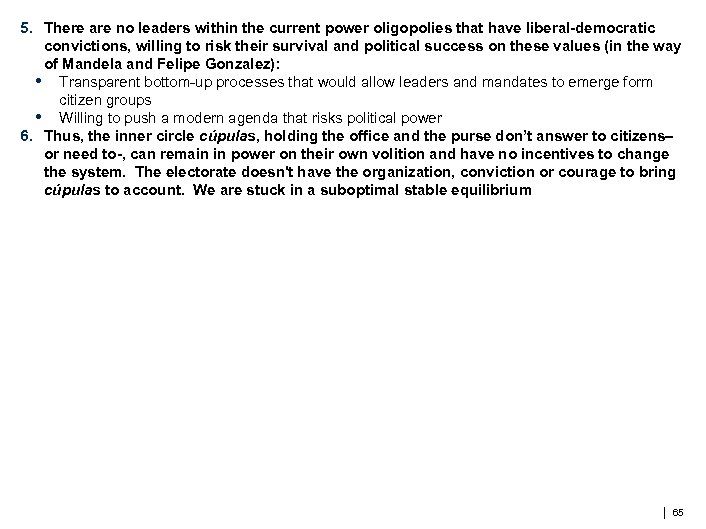 5. There are no leaders within the current power oligopolies that have liberal-democratic convictions, willing to risk their survival and political success on these values (in the way of Mandela and Felipe Gonzalez): • Transparent bottom-up processes that would allow leaders and mandates to emerge form citizen groups • Willing to push a modern agenda that risks political power 6. Thus, the inner circle cúpulas, holding the office and the purse don’t answer to citizens– or need to-, can remain in power on their own volition and have no incentives to change the system. The electorate doesn't have the organization, conviction or courage to bring cúpulas to account. We are stuck in a suboptimal stable equilibrium | 65
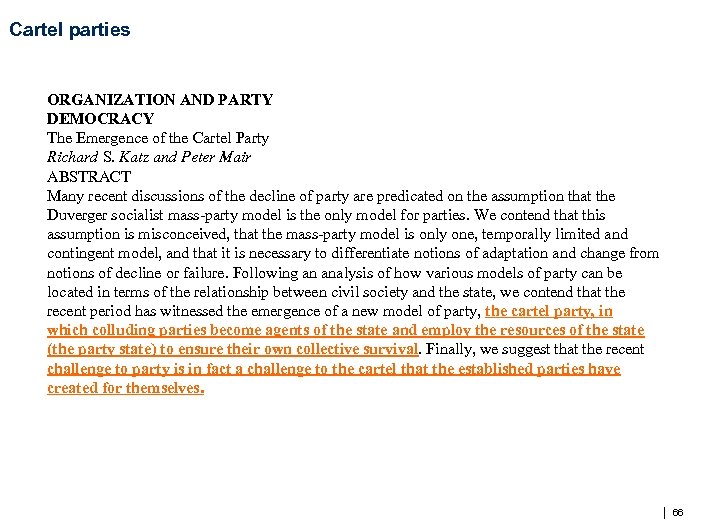 Cartel parties ORGANIZATION AND PARTY DEMOCRACY The Emergence of the Cartel Party Richard S. Katz and Peter Mair ABSTRACT Many recent discussions of the decline of party are predicated on the assumption that the Duverger socialist mass-party model is the only model for parties. We contend that this assumption is misconceived, that the mass-party model is only one, temporally limited and contingent model, and that it is necessary to differentiate notions of adaptation and change from notions of decline or failure. Following an analysis of how various models of party can be located in terms of the relationship between civil society and the state, we contend that the recent period has witnessed the emergence of a new model of party, the cartel party, in which colluding parties become agents of the state and employ the resources of the state (the party state) to ensure their own collective survival. Finally, we suggest that the recent challenge to party is in fact a challenge to the cartel that the established parties have created for themselves. | 66
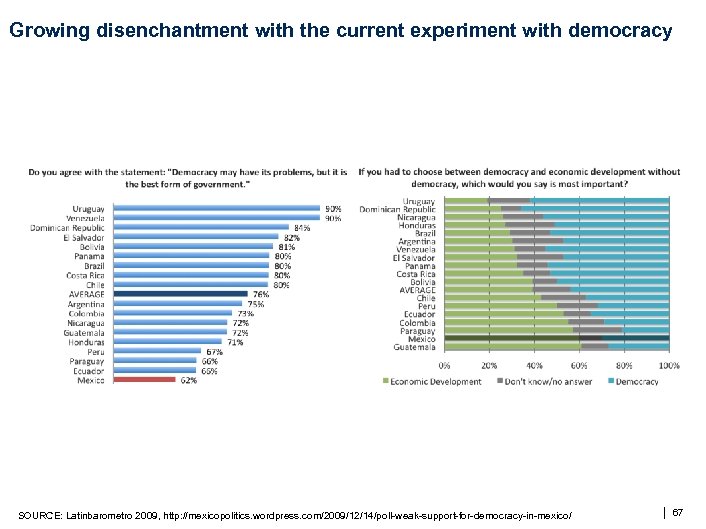 Growing disenchantment with the current experiment with democracy SOURCE: Latinbarometro 2009, http: //mexicopolitics. wordpress. com/2009/12/14/poll-weak-support-for-democracy-in-mexico/ | 67
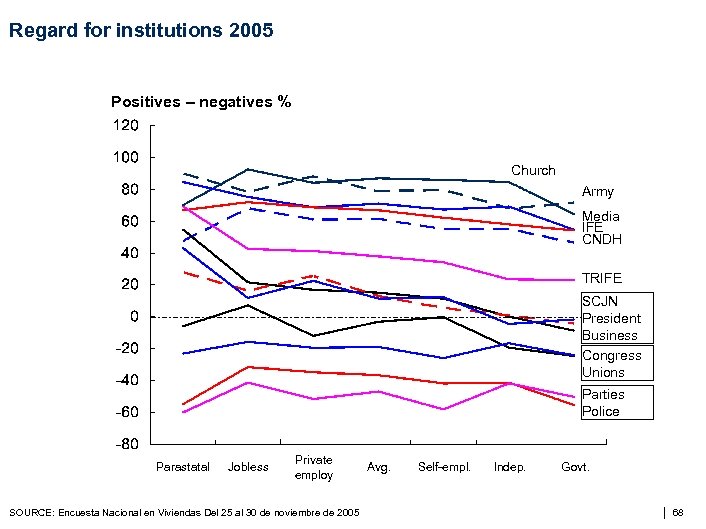 Regard for institutions 2005 Positives – negatives % Church Army Media IFE CNDH TRIFE SCJN President Business Congress Unions Parties Police Parastatal Jobless Private employ SOURCE: Encuesta Nacional en Viviendas Del 25 al 30 de noviembre de 2005 Avg. Self-empl. Indep. Govt. | 68