


 Скачать презентацию TEMPUS JPCR-517313 -IT- 2011 Environment Protection through
34ba35566095343e904a6db19826847a.ppt
- Количество слайдов: 32
 TEMPUS JPCR-517313 -IT- 2011 “ Environment Protection through development and Application of Sustainable Agriculture Technologies” EPASAT Eligibility period: 15 th October 2011 - 14 th October 2014 Short presentation of the project
 General and specific objectives The general aim of the project is to enhance competence and awareness for environment protection in CA, by providing an advanced integrated three level system of BA-MA-Ph. D according to the best European practice in 4 areas of specialization (Agro-ecology, Agro-economy, Agricultural Technology and Agricultural Engineering). EPASAT will allow CA universities to professionalize their programmes with the help of local and international organisations and stakeholders, according to Lisbon strategy and Europe 2020 perspectives.
 Specific objectives: - Improvement of teaching skills of 60 teachers and preparation of up-dated teaching materials by Dec. 2012, - Development of appropriate quality assurance policies and procedures according to European Quality Standards by Dec. 2012 - reform or creation of Bachelors curricula in 4 areas and creation of a Master curriculum in Agro-ecology with the use of ECTS by June 2012 - creation of new Ph. D studies in the 4 areas by Sept. 2013 - 500 student trained in the third year. The project proposal covers the regional priority (Environment) and the national priorities of the Kyrgyzstan (Agriculture sciences), Tajikistan and Uzbekistan (Engineering and Technologies), Kazakhstan (Engineering, Sciences and Technologies).
 Rationale Unsustainable farming technologies is major contributor to degradation of ecosystems in CA. The way to reverse the trend is to revolutionize agricultural methodologies through capacity building of youth. In CA no courses integrating technology, sciences and environment in agriculture exist. The project aims to reform curricula by providing 4 areas of specialisation at BA level (Agro-Ecology, Agricultural Technology and Engineering, Agro-economy), a Master in Agro-Ecology and start Ph. D programmes in these areas. Project focuses on development of curricula for integrated two level courses on applied advanced technologies on the sustainable agriculture and creating pool for Ph. D on the field. Countries involved: Uzbekistan, Kazakhstan, Kyrgyzstan, Tajikistan
 Motivation The reason of the selected topic lays on the CA territorial characteristics, the fast change of the society according to a wide democratization of institutions, the lack of entrepreneurial farmers’ skills, the need to look at a globalised market, improve the quality of life of rural villages and at the same time preserve the soil, the traditional cultivations and the local identities. In order to meet the specified constraints and needs, the project foresees several connected actions aiming to affect knowledge, behavior and mentality of teachers, students and staff as well as rules and laws related to HE organization.
 The project aims will be achieved through: 1. Existing curricula analysis and reform in accordance with ECTS 2. Elaboration of 5 new courses and updating of 5 courses 3. Preparation of teaching materials in English/Russian (also for LD) 4. Improvement of 60 teachers' skills by means training at EU universities 5. Improvement of language skills of 120 teachers 6. Language training for 500 students and short mobility of 40 students to EU 7. Enrollment of 400 BA students and 100 MA students in the new courses in the second project year 8. Creation of 4 doctoral schools in the selected areas 9. Development of measures for the validation of a joint MA and Ph. D degrees between EU and CA 10. Development of appropriate quality assurance policies and procedures according to EQS 11. Well targeted dissemination activities in order to involve decision-makers and societal actors
 ACTIVITIES AND WORK PACKAGES WP n. Title WP 1 New profiles and curricula definition for the updated BA degrees in 3 specialisations and new MA degree in “Agroecology” Organisation of the new MA in “Agroecology” and Development of doctoral schools Updated academic staff skills and teaching methods Accreditation of the new master degree at national level and validation of joint degrees Dissemination Sustainability Quality Plan Management of the project WP 2 WP 3 WP 4 WP 5 WP 6 WP 7 WP 8 Month n. n. Start End 1 12 3 36 3 12 16 30 3 36 1 36
 WORK PACKAGES DELIVERABLES WP 1 - New profiles and curricula definition for the updated BA degrees in 4 specialisations and new MA degree in “Agroecology” Deliverable n. Title Delivery date D 1. 1 Review of existing courses 2011 -12 -31 D 1. 2 Needed cultural background at BA level 2011 -12 -30 D 1. 3 First draft of BA/MA Curricula 2012 -03 -31 D 1. 4 Master curriculum defined and agreed 2012 -03 -31 D 1. 5 Identification new courses and those to be updated 2012 -03 -31
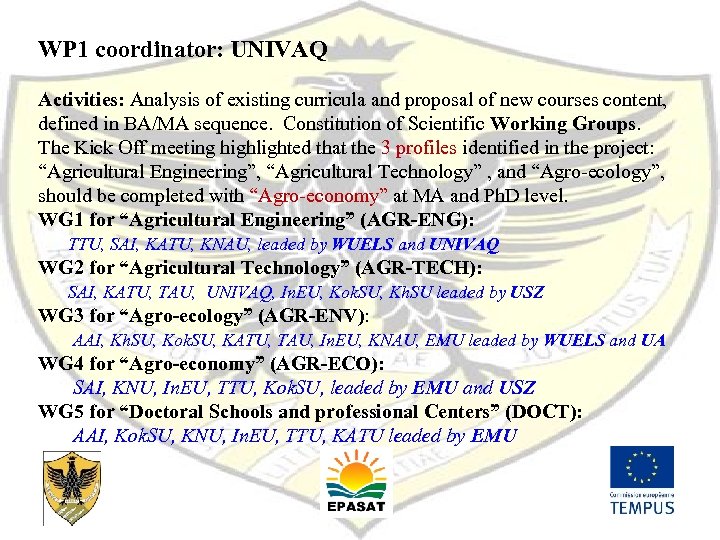 WP 1 coordinator: UNIVAQ Activities: Analysis of existing curricula and proposal of new courses content, defined in BA/MA sequence. Constitution of Scientific Working Groups. The Kick Off meeting highlighted that the 3 profiles identified in the project: “Agricultural Engineering”, “Agricultural Technology” , and “Agro-ecology”, should be completed with “Agro-economy” at MA and Ph. D level. WG 1 for “Agricultural Engineering” (AGR-ENG): TTU, SAI, KATU, KNAU, leaded by WUELS and UNIVAQ WG 2 for “Agricultural Technology” (AGR-TECH): SAI, KATU, TAU, UNIVAQ, In. EU, Kok. SU, Kh. SU leaded by USZ WG 3 for “Agro-ecology” (AGR-ENV): AAI, Kh. SU, Kok. SU, KATU, TAU, In. EU, KNAU, EMU leaded by WUELS and UA WG 4 for “Agro-economy” (AGR-ECO): SAI, KNU, In. EU, TTU, Kok. SU, leaded by EMU and USZ WG 5 for “Doctoral Schools and professional Centers” (DOCT): AAI, Kok. SU, KNU, In. EU, TTU, KATU leaded by EMU
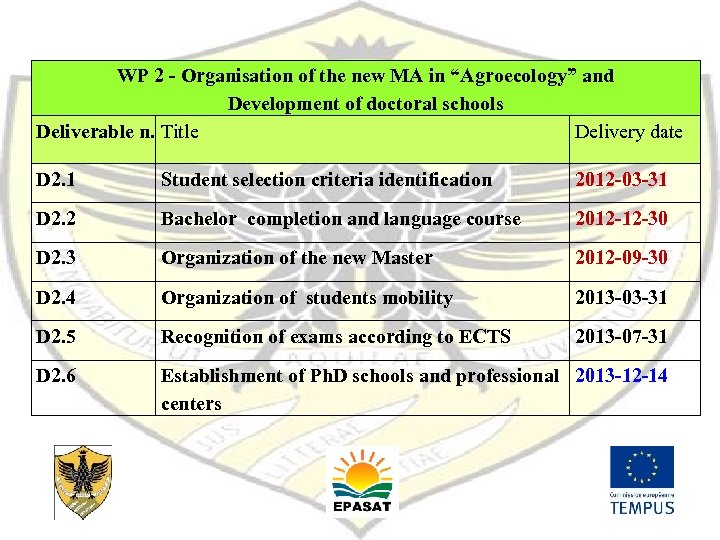 WP 2 - Organisation of the new MA in “Agroecology” and Development of doctoral schools Deliverable n. Title Delivery date D 2. 1 Student selection criteria identification 2012 -03 -31 D 2. 2 Bachelor completion and language course 2012 -12 -30 D 2. 3 Organization of the new Master 2012 -09 -30 D 2. 4 Organization of students mobility 2013 -03 -31 D 2. 5 Recognition of exams according to ECTS 2013 -07 -31 D 2. 6 Establishment of Ph. D schools and professional 2013 -12 -14 centers
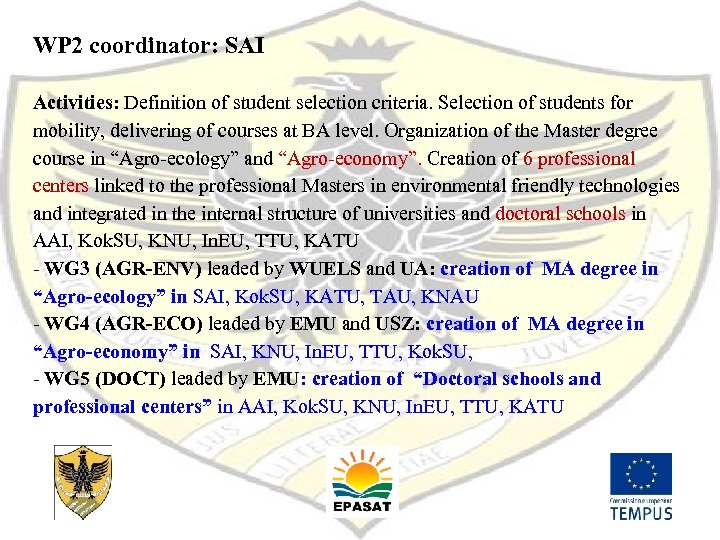 WP 2 coordinator: SAI Activities: Definition of student selection criteria. Selection of students for mobility, delivering of courses at BA level. Organization of the Master degree course in “Agro-ecology” and “Agro-economy”. Creation of 6 professional centers linked to the professional Masters in environmental friendly technologies and integrated in the internal structure of universities and doctoral schools in AAI, Kok. SU, KNU, In. EU, TTU, KATU - WG 3 (AGR-ENV) leaded by WUELS and UA: creation of MA degree in “Agro-ecology” in SAI, Kok. SU, KATU, TAU, KNAU - WG 4 (AGR-ECO) leaded by EMU and USZ: creation of MA degree in “Agro-economy” in SAI, KNU, In. EU, TTU, Kok. SU, - WG 5 (DOCT) leaded by EMU: creation of “Doctoral schools and professional centers” in AAI, Kok. SU, KNU, In. EU, TTU, KATU
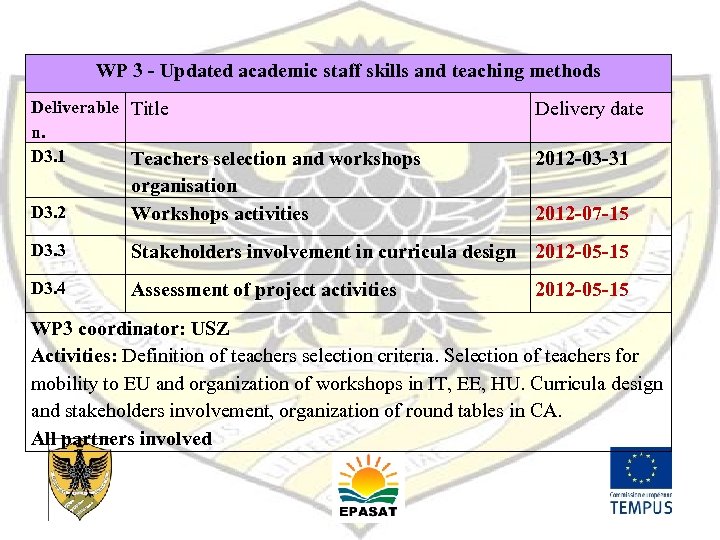 WP 3 - Updated academic staff skills and teaching methods Deliverable Title n. D 3. 1 Teachers selection and workshops Delivery date 2012 -03 -31 D 3. 2 organisation Workshops activities D 3. 3 Stakeholders involvement in curricula design 2012 -05 -15 D 3. 4 Assessment of project activities 2012 -07 -15 2012 -05 -15 WP 3 coordinator: USZ Activities: Definition of teachers selection criteria. Selection of teachers for mobility to EU and organization of workshops in IT, EE, HU. Curricula design and stakeholders involvement, organization of round tables in CA. All partners involved
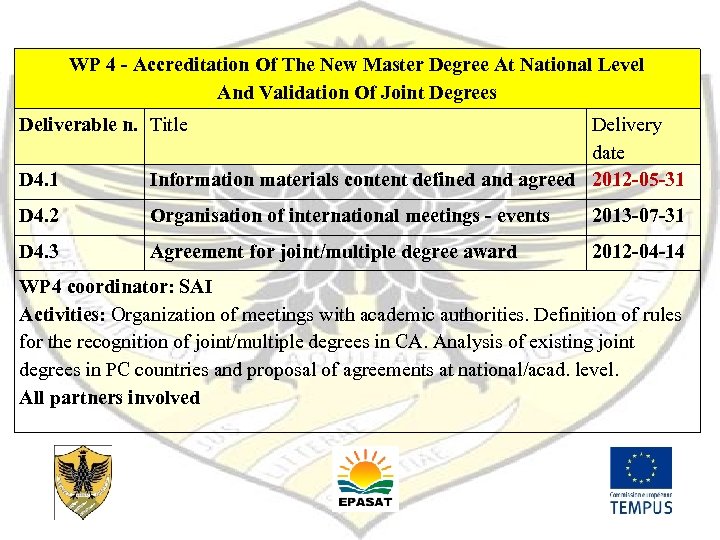 WP 4 - Accreditation Of The New Master Degree At National Level And Validation Of Joint Degrees Deliverable n. Title D 4. 1 Delivery date Information materials content defined and agreed 2012 -05 -31 D 4. 2 Organisation of international meetings - events 2013 -07 -31 D 4. 3 Agreement for joint/multiple degree award 2012 -04 -14 WP 4 coordinator: SAI Activities: Organization of meetings with academic authorities. Definition of rules for the recognition of joint/multiple degrees in CA. Analysis of existing joint degrees in PC countries and proposal of agreements at national/acad. level. All partners involved
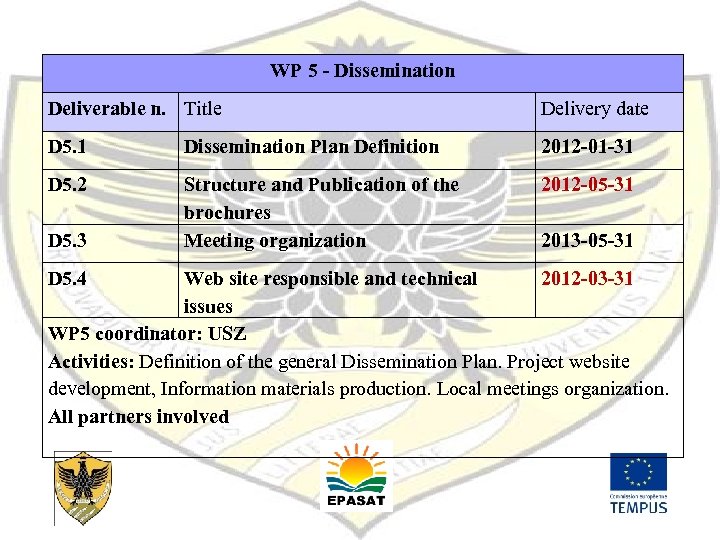 WP 5 - Dissemination Deliverable n. Title Delivery date D 5. 1 Dissemination Plan Definition 2012 -01 -31 D 5. 2 Structure and Publication of the brochures Meeting organization 2012 -05 -31 D 5. 3 D 5. 4 2013 -05 -31 Web site responsible and technical 2012 -03 -31 issues WP 5 coordinator: USZ Activities: Definition of the general Dissemination Plan. Project website development, Information materials production. Local meetings organization. All partners involved
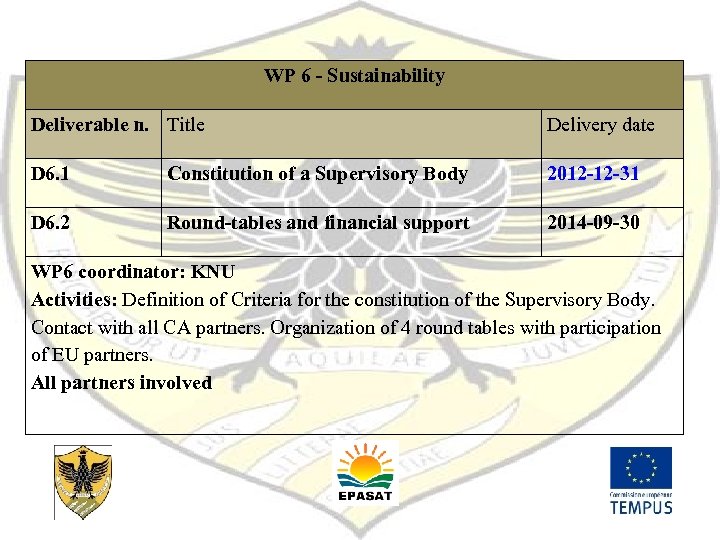 WP 6 - Sustainability Deliverable n. Title Delivery date D 6. 1 Constitution of a Supervisory Body 2012 -12 -31 D 6. 2 Round-tables and financial support 2014 -09 -30 WP 6 coordinator: KNU Activities: Definition of Criteria for the constitution of the Supervisory Body. Contact with all CA partners. Organization of 4 round tables with participation of EU partners. All partners involved
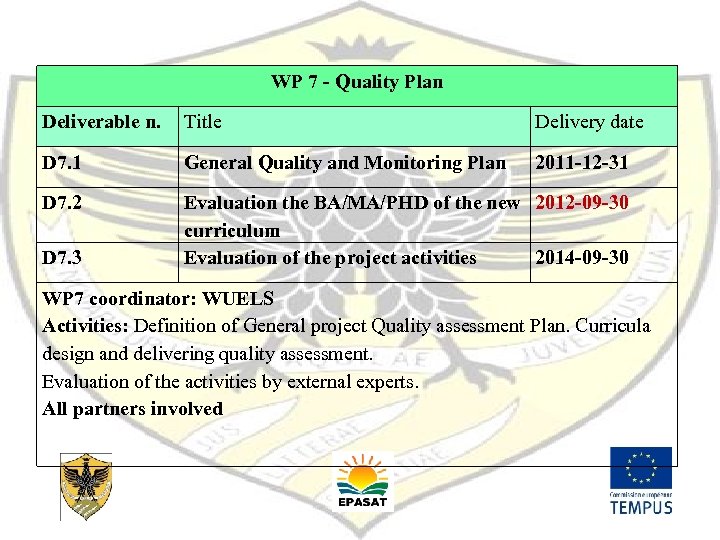 WP 7 - Quality Plan Deliverable n. Title Delivery date D 7. 1 General Quality and Monitoring Plan 2011 -12 -31 D 7. 2 Evaluation the BA/MA/PHD of the new 2012 -09 -30 curriculum Evaluation of the project activities 2014 -09 -30 D 7. 3 WP 7 coordinator: WUELS Activities: Definition of General project Quality assessment Plan. Curricula design and delivering quality assessment. Evaluation of the activities by external experts. All partners involved
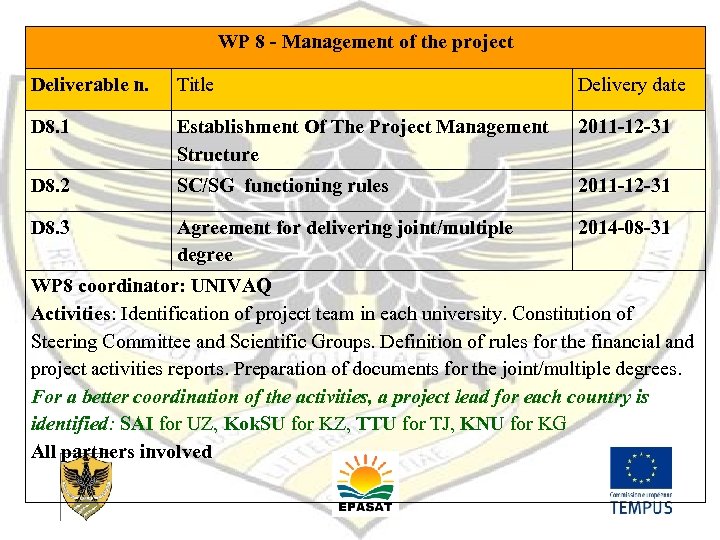 WP 8 - Management of the project Deliverable n. Title Delivery date D 8. 1 Establishment Of The Project Management Structure 2011 -12 -31 D 8. 2 SC/SG functioning rules 2011 -12 -31 D 8. 3 Agreement for delivering joint/multiple degree 2014 -08 -31 WP 8 coordinator: UNIVAQ Activities: Identification of project team in each university. Constitution of Steering Committee and Scientific Groups. Definition of rules for the financial and project activities reports. Preparation of documents for the joint/multiple degrees. For a better coordination of the activities, a project lead for each country is identified: SAI for UZ, Kok. SU for KZ, TTU for TJ, KNU for KG All partners involved
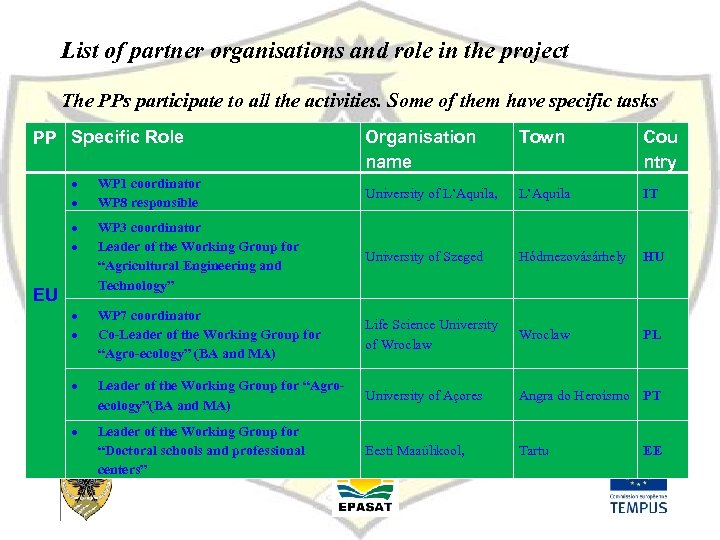 List of partner organisations and role in the project The PPs participate to all the activities. Some of them have specific tasks PP Specific Role Organisation name Town Cou ntry University of L’Aquila, L’Aquila IT EU WP 1 coordinator WP 8 responsible WP 3 coordinator Leader of the Working Group for “Agricultural Engineering and Technology” University of Szeged Hódmezovásárhely HU WP 7 coordinator Co-Leader of the Working Group for “Agro-ecology” (BA and MA) Life Science University of Wroclaw PL Leader of the Working Group for “Agroecology”(BA and MA) University of Açores Angra do Heroísmo PT Leader of the Working Group for “Doctoral schools and professional centers” Eesti Maaülikool, Tartu EE
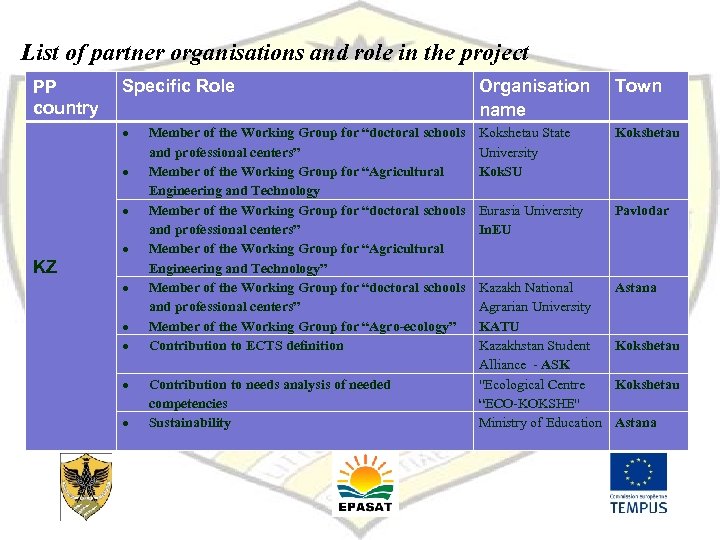 List of partner organisations and role in the project Specific Role Organisation name Town PP country Kokshetau State University Kok. SU Kokshetau Eurasia University In. EU Pavlodar Kazakh National Agrarian University KATU Kazakhstan Student Alliance - ASK "Ecological Centre “ECO-KOKSHE" Ministry of Education Astana KZ Member of the Working Group for “doctoral schools and professional centers” Member of the Working Group for “Agricultural Engineering and Technology” Member of the Working Group for “doctoral schools and professional centers” Member of the Working Group for “Agro-ecology” Contribution to ECTS definition Contribution to needs analysis of needed competencies Sustainability Kokshetau Astana
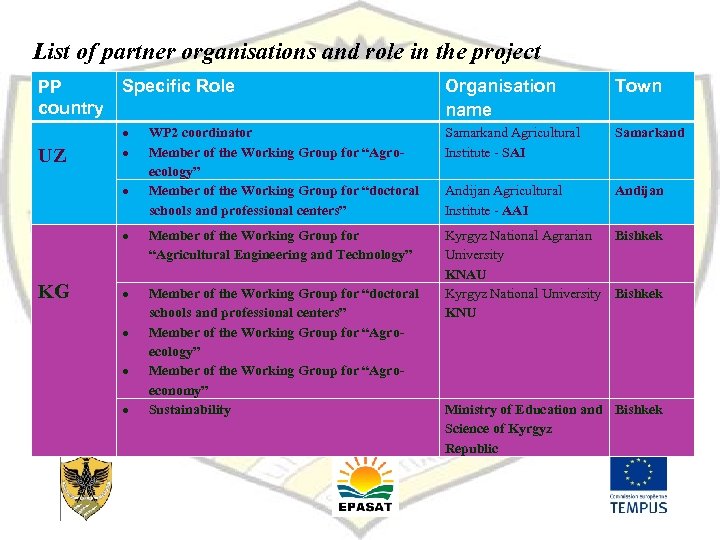 List of partner organisations and role in the project Specific Role PP country Town WP 2 coordinator Member of the Working Group for “Agroecology” Member of the Working Group for “doctoral schools and professional centers” Samarkand Agricultural Institute - SAI Samarkand Andijan Agricultural Institute - AAI Andijan UZ Organisation name Member of the Working Group for “Agricultural Engineering and Technology” Member of the Working Group for “doctoral schools and professional centers” Member of the Working Group for “Agroecology” Member of the Working Group for “Agroeconomy” Sustainability Kyrgyz National Agrarian Bishkek University KNAU Kyrgyz National University Bishkek KNU KG Ministry of Education and Bishkek Science of Kyrgyz Republic
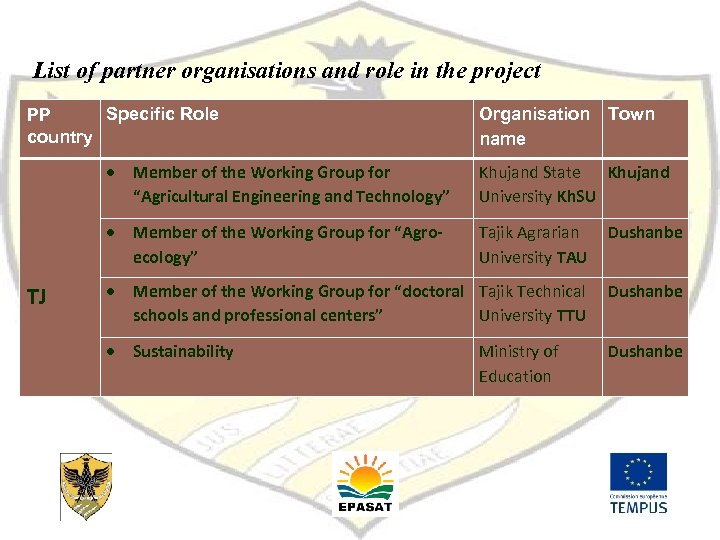 List of partner organisations and role in the project Specific Role PP country Organisation Town name Khujand State Khujand University Kh. SU TJ Member of the Working Group for “Agricultural Engineering and Technology” Member of the Working Group for “Agroecology” Tajik Agrarian University TAU Dushanbe Member of the Working Group for “doctoral Tajik Technical schools and professional centers” University TTU Dushanbe Sustainability Dushanbe Ministry of Education
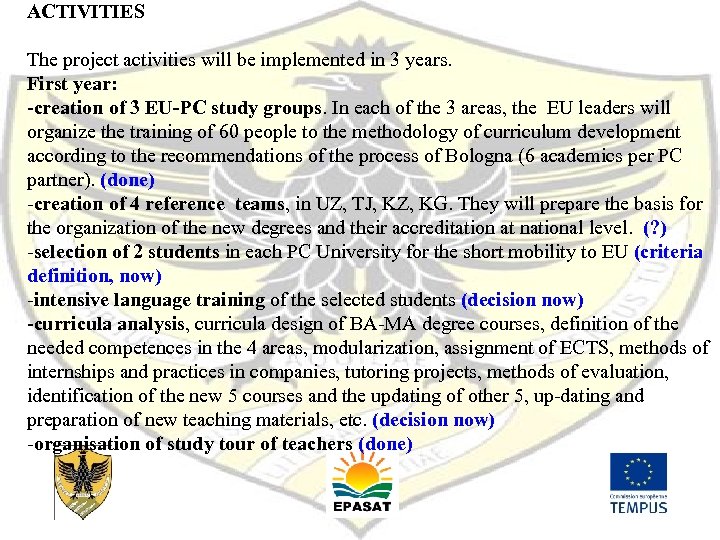 ACTIVITIES The project activities will be implemented in 3 years. First year: -creation of 3 EU-PC study groups. In each of the 3 areas, the EU leaders will organize the training of 60 people to the methodology of curriculum development according to the recommendations of the process of Bologna (6 academics per PC partner). (done) -creation of 4 reference teams, in UZ, TJ, KZ, KG. They will prepare the basis for the organization of the new degrees and their accreditation at national level. (? ) -selection of 2 students in each PC University for the short mobility to EU (criteria definition, now) -intensive language training of the selected students (decision now) -curricula analysis, curricula design of BA-MA degree courses, definition of the needed competences in the 4 areas, modularization, assignment of ECTS, methods of internships and practices in companies, tutoring projects, methods of evaluation, identification of the new 5 courses and the updating of other 5, up-dating and preparation of new teaching materials, etc. (decision now) -organisation of study tour of teachers (done)
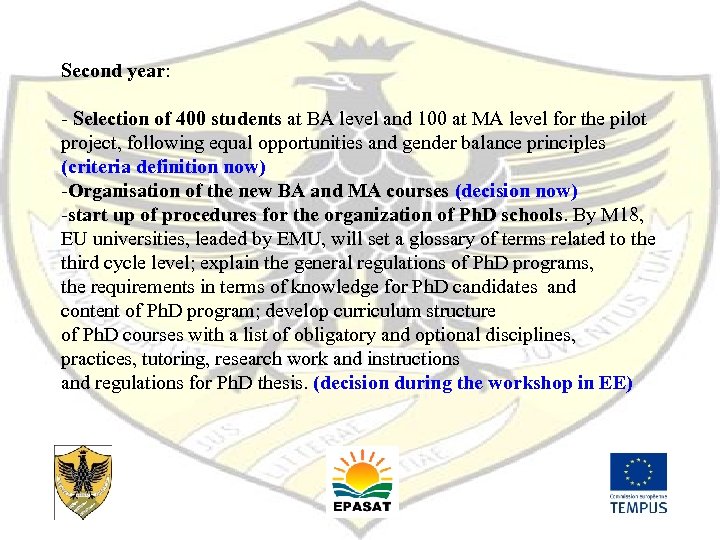 Second year: - Selection of 400 students at BA level and 100 at MA level for the pilot project, following equal opportunities and gender balance principles (criteria definition now) -Organisation of the new BA and MA courses (decision now) -start up of procedures for the organization of Ph. D schools. By M 18, EU universities, leaded by EMU, will set a glossary of terms related to the third cycle level; explain the general regulations of Ph. D programs, the requirements in terms of knowledge for Ph. D candidates and content of Ph. D program; develop curriculum structure of Ph. D courses with a list of obligatory and optional disciplines, practices, tutoring, research work and instructions and regulations for Ph. D thesis. (decision during the workshop in EE)
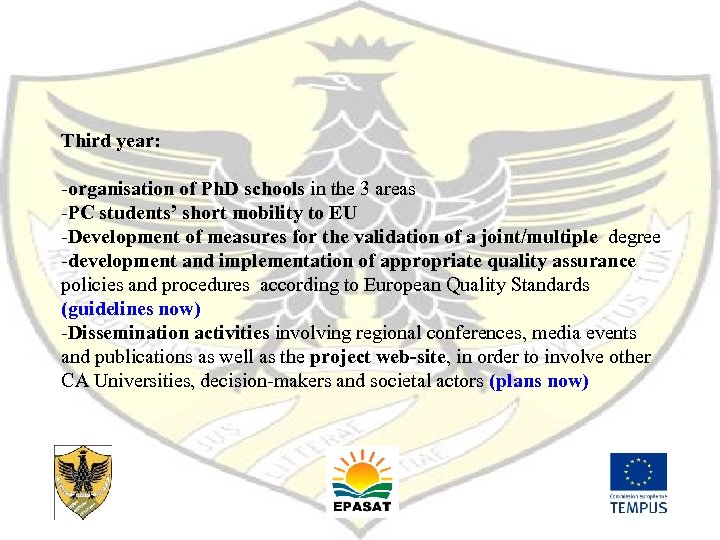 Third year: -organisation of Ph. D schools in the 3 areas -PC students’ short mobility to EU -Development of measures for the validation of a joint/multiple degree -development and implementation of appropriate quality assurance policies and procedures according to European Quality Standards (guidelines now) -Dissemination activities involving regional conferences, media events and publications as well as the project web-site, in order to involve other CA Universities, decision-makers and societal actors (plans now)
 SUSTAINBILITY: The general plan is proposed by KNU. All PPs participate specially the Ministries. The activity is implemented along the project life. QUALITY: The overall quality of the project will be assessed by WUELS. Peer review and internal questionnaires will be implemented. Yearly reports are foreseen. The activity is implemented along the project life. MANAGEMENT: The general management of the project will be done by UNIVAQ. Reports with contribution of all the partners. The activity is implemented along the project life.
 II. PROJECT FINANCE € PROJECT BUDGET Direct costs 1 Staff costs 2 Travel costs and Costs of Stay 3 Equipment 4 Printing and Publishing 5 Other costs Total Eligible Direct Costs Indirect Costs 216. 915, 00 303. 080, 00 140. 000, 00 37. 440, 00 69. 630, 00 767. 065, 00 53. 694, 55 TOTAL ELIGIBLE COSTS 820. 759, 55 A Tempus Grant Requested B Co-financing 738. 671, 69 82. 087, 86
 ACADEMIC CONTENT Within the project, names of specializations will be harmonized and for each PP the specialization that will be delivered has been identified, according to its nature and competence. “Agro-ecology” will be delivered in AAI, Kok. SU, Kh. SU, KNU , “Agricultural Engineering” in SAI, In. EU, TTU, KNAU “Agricultural Technology” in SAI, In. EU, KATU, TAU, KNAU “Agro-economy” in KATU. The EU partners will provide information, orientation, development and support. The target groups of this action will be UZ/KZ/TJ/KG university teachers, staff and students, direct beneficiaries the farmers, agro industry and indirect beneficiaries, the Ministries of Education, the Ministries of Agriculture and Water Resources, the job market and the society in general.
 Agro-ecology - is the development and application of ecological theory to the management of agricultural systems, according to the specific land other resources available. Beyond the biological and climatic dimensions of agriculture and ecology, there is growing appreciation of the influence of social, economic, and political factors on the structure and success of farming systems. This broader field is becoming known as “agro-ecology and sustainable development. ” Expansion of the conventional curriculum to include integrative themes is essential because of the need for students to appreciate a whole farm focus for analysis, to understand the impact of socio-economic factors, and to further develop their abilities to link people and environment. The curriculum includes study of system structure and function, cycles and interactions among components, system development and performance, and the importance of resource conservation and use. Future agricultural professionals need to understand how improvement of agro-ecosystems is closely linked to economic, cultural, and political systems, and how they are both enhanced and constrained by factors beyond biology and climate.
 Agricultural Engineering - also called Biological and Agricultural Engineering, is the branch of Engineering concerned with maximizing the efficient use of natural resources. This manifests itself primarily in relation to food, since Agricultural Engineering seeks to improve the way food is grown, stored and transported. Utilizing principles from mathematics and science, Agricultural Engineering creates practical solutions to agriculture issues. It consists primarily of design (creation and development of tools that can improve farming techniques) research (collection of information on the ways that products, equipment and machinery are used) and analysis (of existing systems, technology and practices for finding ways to improve them)
 Agricultural Technology - defines tools and machinery that are used primarily or entirely in order to support agricultural enterprise and consists of different topics that combines the study of economic principles and the basic agricultural sciences with the technology. Graduates will have a thorough grounding in the protection and production of agrarian products, the biochemistry of agrarian products and their economic management, as well as a general understanding of rural notions (agrarian mechanization, agrarian water management, rural constructions, and livestock management). Agricultural Economics - combines the technical aspects of agriculture with the business aspects of management, marketing and finance. Students are prepared for a wide variety of exciting careers in the marketing of commodities sold and inputs purchased by agricultural producers; agricultural finance; and management of agribusinesses, farms and ranches. In addition, many graduates pursue successful careers in government service, economic development, commodity promotion and agricultural policy analysis.
 The Consortium agreed that the cultural diversity should be used to increase the competitiveness and the new curricula should provide a balance between “Depth of knowledge” and “Breadth of knowledge”. Broad Knowledge is feasible at the foundation level, deep understanding is only possible in one specific area. The proposed curricula will be based on the following issues: 1) broad basics: Scientific and technology base, i. e. a broad spectrum of mathematical/physical/biological scientific and technical knowledge, (about 30% of the courses), 2) strong linkage between science and technology bases (to avoid theories with no practical use, technology with no analytical base), 3) application base, system solution methodology and specific knowledge for the particular job profile (about 25%), 4) personal and business skills (at least 15%), 5) practical work experience, 6) project work on a project/thesis, 7) language skills development
 Thus the curriculum for each profile identified should consist of: - sets of core modules (scientific and technological base), - sets of area-specific core modules (characterising the selected profile), - sets of optional modules (additional skills). TUNING METHODOLOGY WILL FOLLOW