


 Скачать презентацию Тема 4 Смысл и контекст 1 Э Т
Тема 4. Смысл и контекст. през slides only ppt.ppt
- Количество слайдов: 31
 Тема 4. Смысл и контекст 1. Э. Т. Холл о роли контекста в коммуникативных процессах 2. Типы культур с точки зрения коммуникативных процессов 3. Культуры с высокой / низкой степенью ориентации на контекст
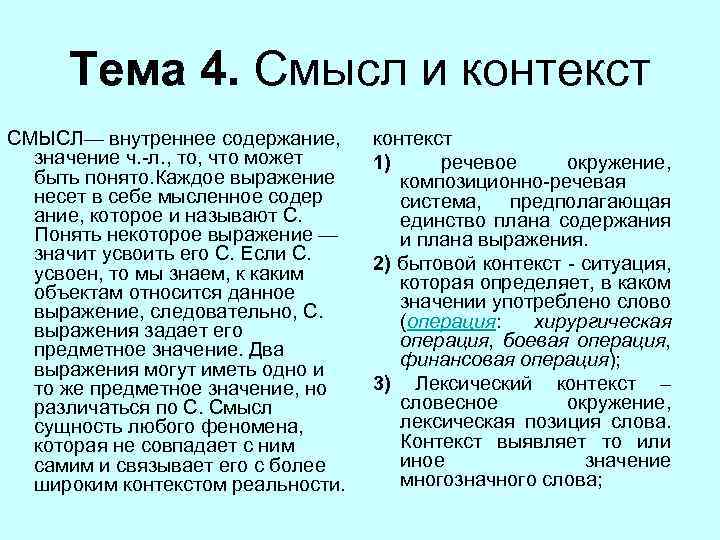 Тема 4. Смысл и контекст СМЫСЛ— внутреннее содержание, значение ч. -л. , то, что может быть понято. Каждое выражение несет в себе мысленное содер ание, которое и называют С. Понять некоторое выражение — значит усвоить его С. Если С. усвоен, то мы знаем, к каким объектам относится данное выражение, следовательно, С. выражения задает его предметное значение. Два выражения могут иметь одно и то же предметное значение, но различаться по С. Смысл сущность любого феномена, которая не совпадает с ним самим и связывает его с более широким контекстом реальности. контекст 1) речевое окружение, композиционно-речевая система, предполагающая единство плана содержания и плана выражения. 2) бытовой контекст - ситуация, которая определяет, в каком значении употреблено слово (операция: хирургическая операция, боевая операция, финансовая операция); 3) Лексический контекст – словесное окружение, лексическая позиция слова. Контекст выявляет то или иное значение многозначного слова;
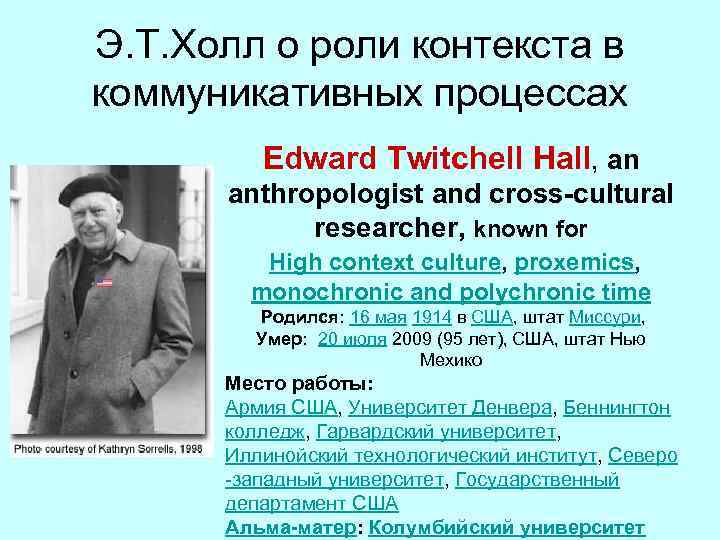 Э. Т. Холл о роли контекста в коммуникативных процессах Edward Twitchell Hall, an anthropologist and cross-cultural researcher, known for High context culture, proxemics, monochronic and polychronic time Родился: 16 мая 1914 в США, штат Миссури, Умер: 20 июля 2009 (95 лет), США, штат Нью Мехико Место работы: Армия США, Университет Денвера, Беннингтон колледж, Гарвардский университет, Иллинойский технологический институт, Северо -западный университет, Государственный департамент США Альма-матер: Колумбийский университет
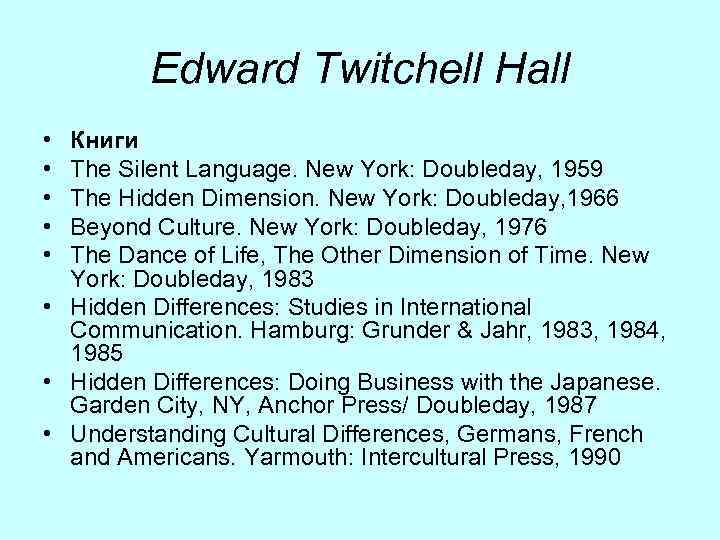 Edward Twitchell Hall • • • Книги The Silent Language. New York: Doubleday, 1959 The Hidden Dimension. New York: Doubleday, 1966 Beyond Culture. New York: Doubleday, 1976 The Dance of Life, The Other Dimension of Time. New York: Doubleday, 1983 • Hidden Differences: Studies in International Communication. Hamburg: Grunder & Jahr, 1983, 1984, 1985 • Hidden Differences: Doing Business with the Japanese. Garden City, NY, Anchor Press/ Doubleday, 1987 • Understanding Cultural Differences, Germans, French and Americans. Yarmouth: Intercultural Press, 1990
 Э. Т. Холл о роли контекста в коммуникативных процессах Throughout his career, Hall introduced a number of new concepts, including proxemics, polychronic and monochronic time, and high and low context culture. In his second book, The Hidden Dimension, he describes the culturally specific temporal and spatial dimensions that surround each of us, such as the physical distances people maintain in different contexts.
 Э. Т. Холл о роли контекста в коммуникативных процессах Proxemics is a psychological, social-psychological, and anthropological area of study that addresses the use of space in interpersonal communication, usually in regards to the distance between people in conversation. The term was first coined by cultural anthropologist Edward T. Hall in 1963[1]. Hall notes that the value in studying Proxemics comes from its applicability in evaluating not only the way man interacts with others in his daily life, but also "the organization of space in his houses and buildings, and ultimately the layout of his towns[2]. [1] Hall, Edward T. (1966). The Hidden Dimension. [2] Hall, Edward T. (October 1963). "A System for the Notation of Proxemic Behavior". American Anthropologist 65 (5): 1003 -1026
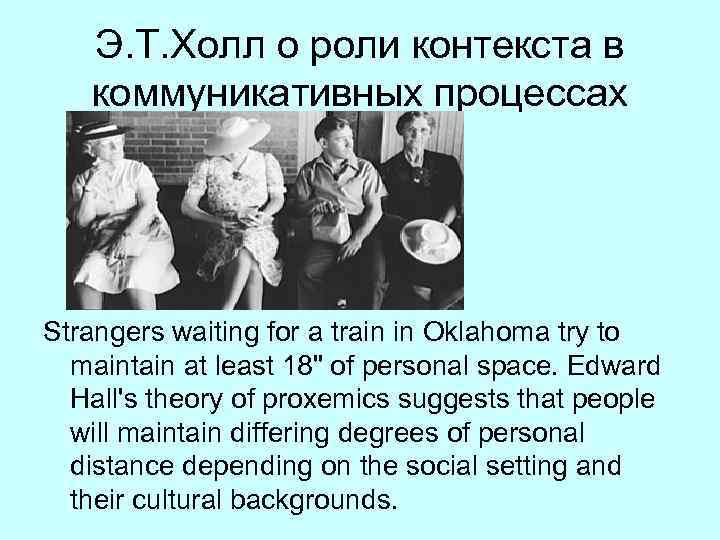 Э. Т. Холл о роли контекста в коммуникативных процессах Strangers waiting for a train in Oklahoma try to maintain at least 18" of personal space. Edward Hall's theory of proxemics suggests that people will maintain differing degrees of personal distance depending on the social setting and their cultural backgrounds.
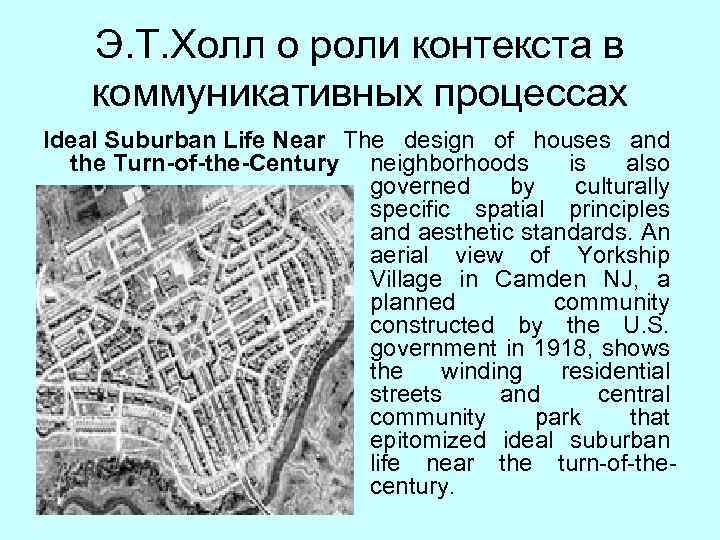 Э. Т. Холл о роли контекста в коммуникативных процессах Ideal Suburban Life Near The design of houses and the Turn-of-the-Century neighborhoods is also governed by culturally specific spatial principles and aesthetic standards. An aerial view of Yorkship Village in Camden NJ, a planned community constructed by the U. S. government in 1918, shows the winding residential streets and central community park that epitomized ideal suburban life near the turn-of-thecentury.
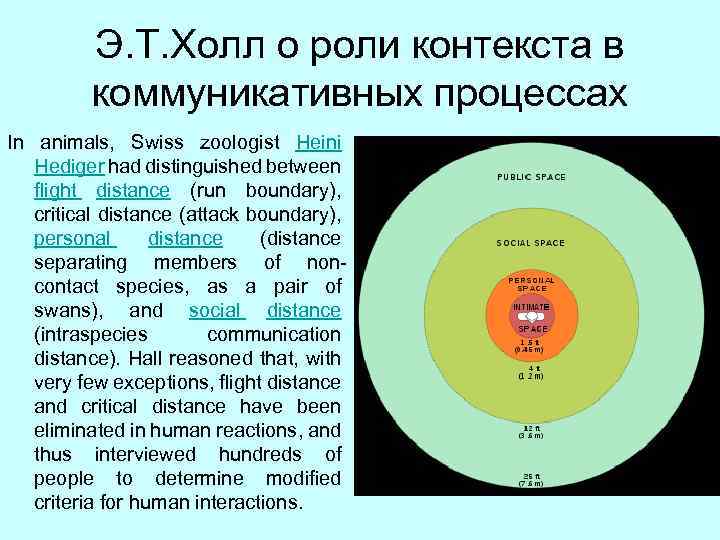 Э. Т. Холл о роли контекста в коммуникативных процессах In animals, Swiss zoologist Heini Hediger had distinguished between flight distance (run boundary), critical distance (attack boundary), personal distance (distance separating members of noncontact species, as a pair of swans), and social distance (intraspecies communication distance). Hall reasoned that, with very few exceptions, flight distance and critical distance have been eliminated in human reactions, and thus interviewed hundreds of people to determine modified criteria for human interactions.
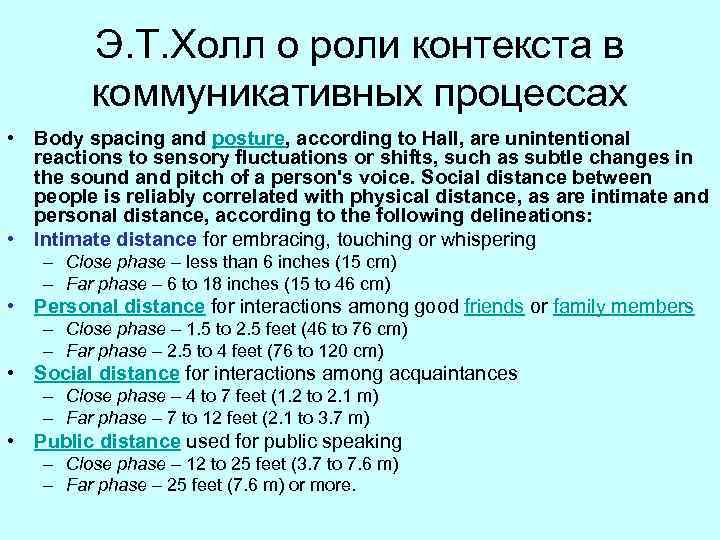 Э. Т. Холл о роли контекста в коммуникативных процессах • Body spacing and posture, according to Hall, are unintentional reactions to sensory fluctuations or shifts, such as subtle changes in the sound and pitch of a person's voice. Social distance between people is reliably correlated with physical distance, as are intimate and personal distance, according to the following delineations: • Intimate distance for embracing, touching or whispering – Close phase – less than 6 inches (15 cm) – Far phase – 6 to 18 inches (15 to 46 cm) • Personal distance for interactions among good friends or family members – Close phase – 1. 5 to 2. 5 feet (46 to 76 cm) – Far phase – 2. 5 to 4 feet (76 to 120 cm) • Social distance for interactions among acquaintances – Close phase – 4 to 7 feet (1. 2 to 2. 1 m) – Far phase – 7 to 12 feet (2. 1 to 3. 7 m) • Public distance used for public speaking – Close phase – 12 to 25 feet (3. 7 to 7. 6 m) – Far phase – 25 feet (7. 6 m) or more.
 Э. Т. Холл о роли контекста в коммуникативных процессах Hall notes that different cultures maintain different standards of personal space. In Latin cultures, for instance, those relative distances are smaller, and people tend to be more comfortable standing close to each other; in Nordic cultures the opposite is true. Realizing and recognizing these cultural differences improves cross-cultural understanding, and helps eliminate discomfort people may feel if the interpersonal distance is too large ("stand-offish") or too small (intrusive). Comfortable personal distances also depend on the culture, social situation, gender, and individual preference.
 Hall's cultural factors High context In a high-context culture, there are many contextual elements that help people to understand the rules. As a result, much is taken for granted. This can be very confusing for person who does not understand the 'unwritten rules' of the culture.
 Hall's cultural factors Low context In a low-context culture, very little is taken for granted. Whilst this means that more explanation is needed, it also means there is less chance of misunderstanding particularly when visitors are present.
 Hall's cultural factors Contrasting the two French contracts tend to be short (in physical length, not time duration) as much of the information is available within the high-context French culture. American content, on the other hand, is low-context and so contracts tend to be longer in order to explain the detail. • Highly mobile environments where people come and go need lower-context culture. With a stable population, however, a higher context culture may develop.
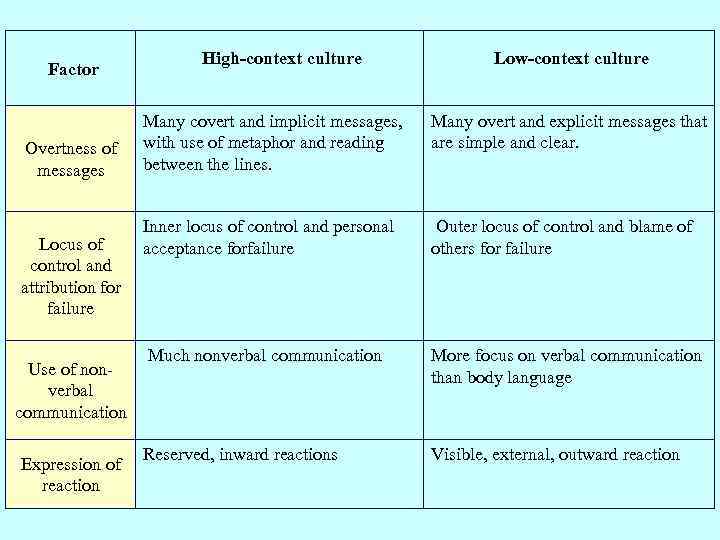 Factor Overtness of messages Locus of control and attribution for failure Use of nonverbal communication Expression of reaction High-context culture Low-context culture Many covert and implicit messages, with use of metaphor and reading between the lines. Many overt and explicit messages that are simple and clear. Inner locus of control and personal acceptance forfailure Outer locus of control and blame of others for failure Much nonverbal communication More focus on verbal communication than body language Reserved, inward reactions Visible, external, outward reaction
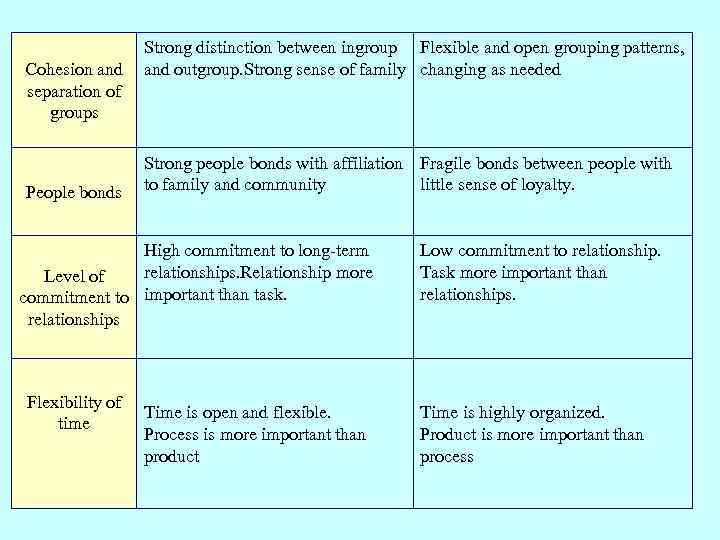 Strong distinction between ingroup Flexible and open grouping patterns, Cohesion and outgroup. Strong sense of family changing as needed separation of groups Strong people bonds with affiliation Fragile bonds between people with little sense of loyalty. People bonds to family and community High commitment to long-term relationships. Relationship more Level of commitment to important than task. relationships Flexibility of Time is open and flexible. time Process is more important than product Low commitment to relationship. Task more important than relationships. Time is highly organized. Product is more important than process
 Э. Т. Холл о роли контекста в коммуникативных процессах
 Э. Т. Холл о роли контекста в коммуникативных процессах
 Типы культур с точки зрения коммуникативных процессов • Time • Monochronic time • M-Time, as he called it, means doing one thing at a time. It assumes careful planning and scheduling and is a familiar Western approach that appears in disciplines such as 'time management'. • Monochronic people tend also to be low context.
 Типы культур с точки зрения коммуникативных процессов • Polychronic time • In Polychronic cultures, human interaction is valued over time and material things, leading to a lesser concern for 'getting things done' -- they do get done, but more in their own time. • Aboriginal and Native Americans have typical polychronic cultures, where 'talking stick' meetings can go on for as long as somebody has something to say. • Polychronic people tend also to be high context.
 Типы культур с точки зрения коммуникативных процессов Western cultures vary in their focus on monochronic or polychronic time. Americans are strongly monochronic whilst the French have a much greater polychronic tendency -- thus a French person may turn up to a meeting late and think nothing of it (much to the annoyance of a German or American co-worker).
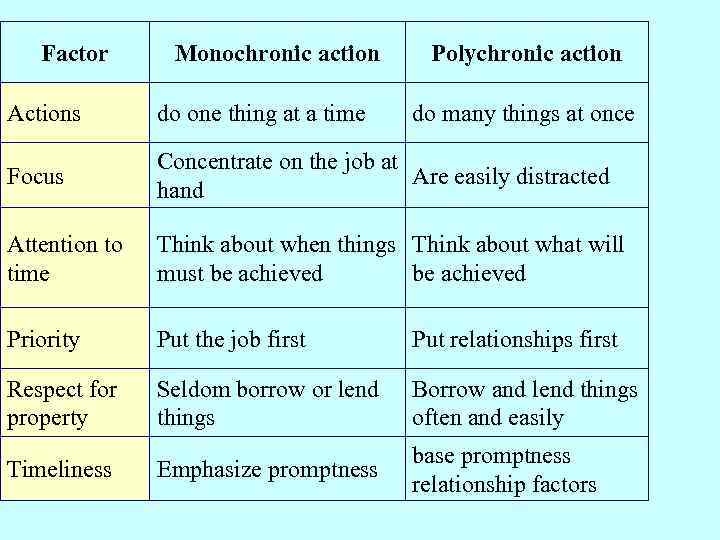 Factor Monochronic action Polychronic action Actions do one thing at a time Focus Concentrate on the job at Are easily distracted hand Attention to time Think about when things Think about what will must be achieved Priority Put the job first Put relationships first Respect for property Seldom borrow or lend things Borrow and lend things often and easily Emphasize promptness base promptness relationship factors Timeliness do many things at once
 Типы культур с точки зрения коммуникативных процессов. So what? When working across cultures, pay attention to high and low cultures through the actions of others. For example if people are late for meetings it may be because they are polychronic, not because they are disrespectful or lazy. When you understand the personal, national or organizational culture, then you can seek to align with them and hence gain greater influence.
 4. 3. Культуры с высокой / низкой степенью ориентации на контекст • Higher Context Cultures: USA - southern states, China, Arab countries, Italy, Greece, Japan, Spain, Korea, India, Brazil, Russia • Lower Context Cultures: [USA - northern states, Canada, German-speaking countries, Scandinavia, Poland • Spectrum: Low context culture < Scandinavian < German-Swiss < German < North American < French < English < Italian < Spanish < Mexican < Greek < Arab < Korean < Japanese < Chinese < High context culture
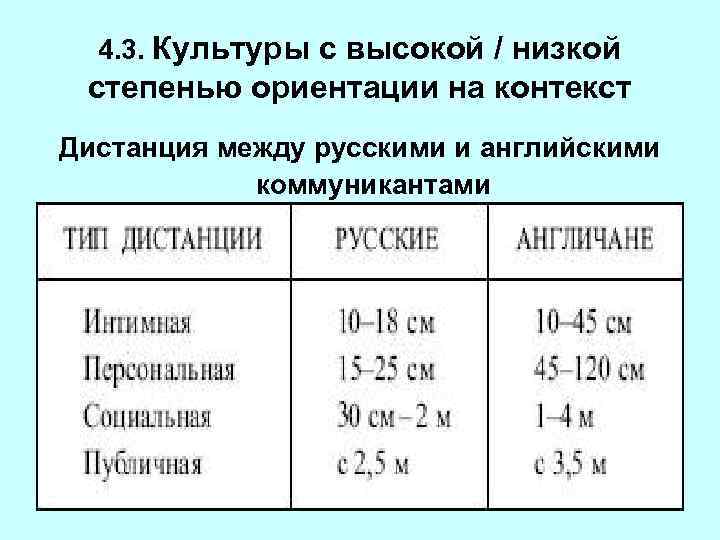 4. 3. Культуры с высокой / низкой степенью ориентации на контекст Дистанция между русскими и английскими коммуникантами
![4. 3. Культуры с высокой / низкой степенью ориентации на контекст privacy [‘praıvəsı, ‘prıvəsı]](https://present5.com/presentation/163357467_159645002/image-26.jpg "4. 3. Культуры с высокой / низкой степенью ориентации на контекст privacy [‘praıvəsı, ‘prıvəsı]") 4. 3. Культуры с высокой / низкой степенью ориентации на контекст privacy [‘praıvəsı, ‘prıvəsı] 1) a state in which one is not observed or disturbed by other people 2) the state of being free from public attention. If you have privacy, you are in a place or situation which allows you to do things without other people seeing you or disturbing you. If someone or something invades your privacy, they interfere in your life without your permission.
4. 3. Культуры с высокой / низкой степенью ориентации на контекст privacy [‘praıvəsı, ‘prıvəsı] 1) a state in which one is not observed or disturbed by other people 2) the state of being free from public attention. If you have privacy, you are in a place or situation which allows you to do things without other people seeing you or disturbing you. If someone or something invades your privacy, they interfere in your life without your permission.
 4. 3. Культуры с высокой / низкой степенью ориентации на контекст

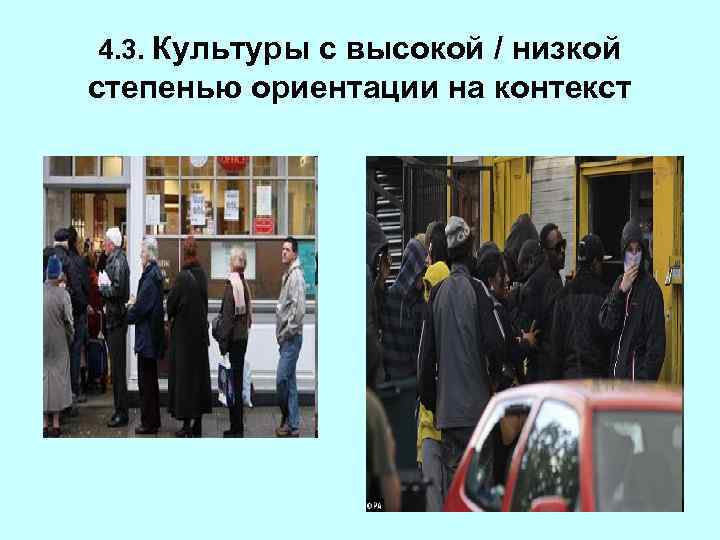
 Английский стиль невербальной коммуникации • значительная пространственная дистанция; • бережное отношение к незыблемости личного пространства каждого из участников коммуникативного акта, его автономии, недопустимость его нарушения; • практически полное отсутствие тактильной коммуникации; • ограниченное и сдержанное использование мимики и жестов; • сдержанность в проявлении эмоций; • социальная улыбчивость.
 Русский стиль коммуникации • достаточно близкая дистанция общения; • незначительное личное пространство и допустимость его нарушения; • использование тактильной коммуникации; • более активная жестикуляция; • более интенсивная и выразительная мимика; • открытое проявление эмоций; • бытовая неулыбчивость. В результате можно говорить о таких доминантных чертах невербальной коммуникации, как дистантность и сдержанность у англичан и контактность и бóльшая свобода действий у русских.
 Коммуникативные правила • Соблюдайте дистанцию: не приближайтесь близко к собеседнику. • Будьте внимательны не только к тем, кто находится в непосредственной близости, но и дальше, т. е. , расширяйте радиус, при котором следует обращать внимание на окружающих. • Будьте сдержанны в поведении. • Ограничивайте жестикуляцию. • Избегайте тактильных контактов. • Не протягивайте руку для пожатия при каждой встрече. • Контролируйте эмоции. • Не перебивайте собеседника. • Соблюдайте поочередность реплик. • Демонстрируйте хорошее настроение – улыбайтесь!