


 Скачать презентацию Telling the Safety Performance Story Using a Needs-Results
023fb62b4c53c62856ae9600ca91978d.ppt
- Количество слайдов: 34
 Telling the Safety Performance Story: Using a Needs-Results Hierarchy for Planning and Measuring Progress in System Safety Steve Montague steve. montague@pmn. net Performance Management Network Inc. February 11, 2010
 Agenda n Defining expected results and results chains in system safety situations n Sorting risks via spheres of influence n Using a Needs-Results Hierarchy for planning and management steve. montague@pmn. net 2
 n Without changing our patterns of thought, we will not be able to solve the problems we created with our current patterns of thought. n Things should be made as simple as possible – not simpler. -Albert Einstein steve. montague@pmn. net 3
 The Current Regulatory Situation: n n Accountability Complexity Dynamism Tools for performance measurement and assessment are inadequate n n n Scorecards – Dashboards [Simple Matrices] Compliance rates Process measures Audit Evaluation steve. montague@pmn. net 4
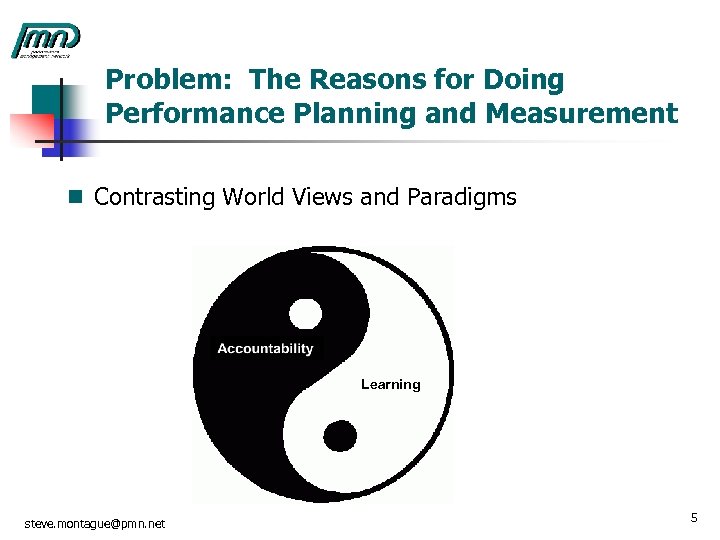 Problem: The Reasons for Doing Performance Planning and Measurement n Contrasting World Views and Paradigms Learning steve. montague@pmn. net 5
![The Problem with Traditional Measurement and Accountability Applied to Modern Public [Regulatory] Performance: n](https://present5.com/presentation/023fb62b4c53c62856ae9600ca91978d/image-6.jpg "The Problem with Traditional Measurement and Accountability Applied to Modern Public [Regulatory] Performance: n") The Problem with Traditional Measurement and Accountability Applied to Modern Public [Regulatory] Performance: n Most Performance Measurement is n n n “disaggregationist”, while strategic management requires synthesis Balanced vs. integrated thinking (Sparrow) Tendency to emphasize linear thinking Standardized metrics (e. g. speed, compliance level – Sparrow) Implied command control Efficiency over effectiveness (Sparrow) steve. montague@pmn. net 6
The Problem with Traditional Measurement and Accountability Applied to Modern Public [Regulatory] Performance: n Most Performance Measurement is n n n “disaggregationist”, while strategic management requires synthesis Balanced vs. integrated thinking (Sparrow) Tendency to emphasize linear thinking Standardized metrics (e. g. speed, compliance level – Sparrow) Implied command control Efficiency over effectiveness (Sparrow) steve. montague@pmn. net 6
 Case Example: Walkerton n n n steve. montague@pmn. net Thousands rendered ill, 7 die from ecoli contaminated municipal water Regulations ‘stiffened’ almost immediately – lots of risk shifting and paper burden to small community well operators 2 year O’Connor enquiry Blame essentially laid on local officials Assessment of water regulations? / risk management? Was this a deeper systems problem? 7
 The Need: n Recognize a different definition of accountability – based on learning and managing for results (i. e. You are accountable for learning and adapting, not for a given outcome per se) n Tell a Performance Story n How, Who, What, Why n Change our mental models to recognize n synthesis n interaction n ‘communities’ (people with some common task, function or identity in the system) n performance measures as progress markers steve. montague@pmn. net 8
 A Deeper Aspect of the Current Problem n Many results models for programs prove inadequate in describing programs, initiatives and cases n n n Too linear Either too complex or too simple Miss key community behaviours Analysis vs. synthesis Miss an important question: What problem(s) are we solving? steve. montague@pmn. net 9
 Analysis vs. Synthesis In analysis, something that we want to understand is first taken apart. In synthesis, that which we want to understand is first identified as a part of one or more larger systems. In analysis, the understanding of the parts of the system to be understood is … aggregated in an effort to explain the behavior or properties of the whole. In synthesis, the understanding of the larger containing system is then disaggregated to identify the role or function of the system to be understood. - Ackoff steve. montague@pmn. net 10
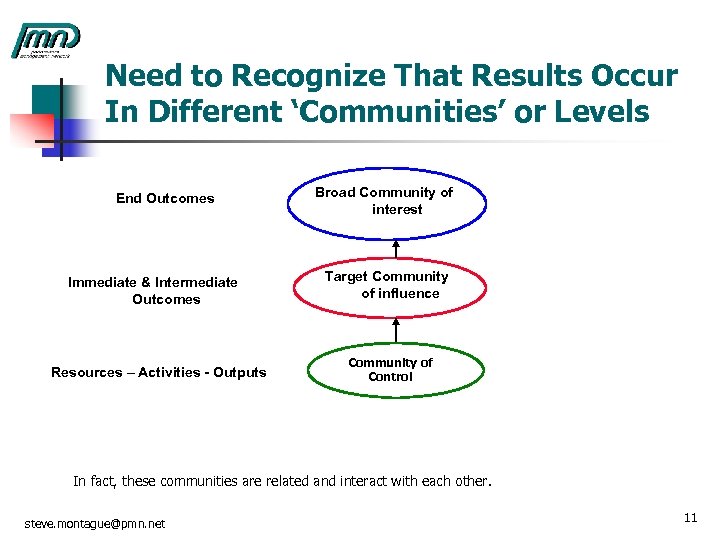 Need to Recognize That Results Occur In Different ‘Communities’ or Levels End Outcomes Immediate & Intermediate Outcomes Resources – Activities - Outputs Broad Community of interest Target Community of influence Community of Control In fact, these communities are related and interact with each other. steve. montague@pmn. net 11
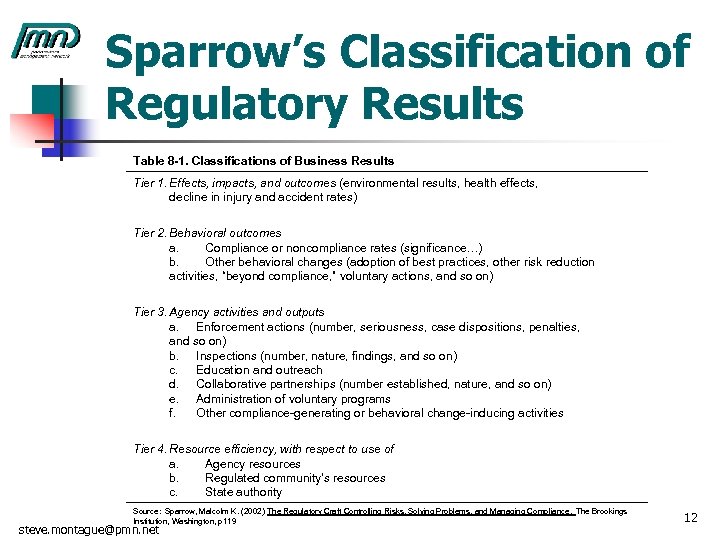 Sparrow’s Classification of Regulatory Results Table 8 -1. Classifications of Business Results Tier 1. Effects, impacts, and outcomes (environmental results, health effects, decline in injury and accident rates) Tier 2. Behavioral outcomes a. Compliance or noncompliance rates (significance…) b. Other behavioral changes (adoption of best practices, other risk reduction activities, “beyond compliance, ” voluntary actions, and so on) Tier 3. Agency activities and outputs a. Enforcement actions (number, seriousness, case dispositions, penalties, and so on) b. Inspections (number, nature, findings, and so on) c. Education and outreach d. Collaborative partnerships (number established, nature, and so on) e. Administration of voluntary programs f. Other compliance-generating or behavioral change-inducing activities Tier 4. Resource efficiency, with respect to use of a. Agency resources b. Regulated community’s resources c. State authority Source: Sparrow, Malcolm K. (2002) The Regulatory Craft Controlling Risks, Solving Problems, and Managing Compliance, The Brookings Institution, Washington, p 119 steve. montague@pmn. net 12
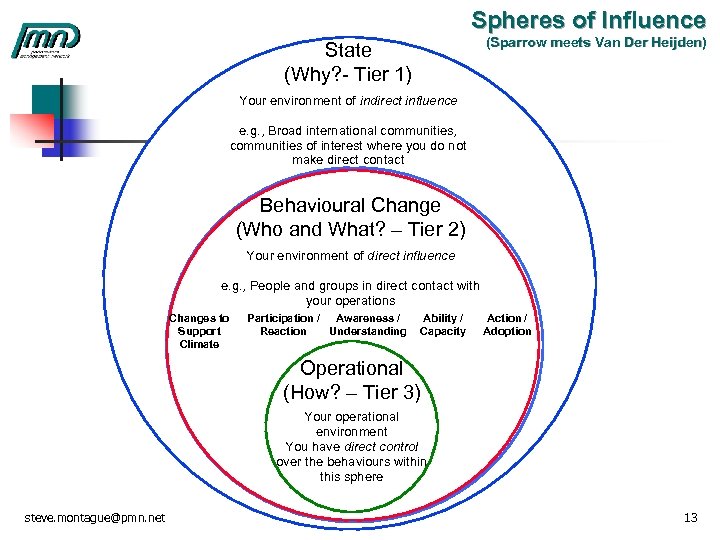 Spheres of Influence (Sparrow meets Van Der Heijden) State (Why? - Tier 1) Your environment of indirect influence e. g. , Broad international communities, communities of interest where you do not make direct contact Behavioural Change (Who and What? – Tier 2) Your environment of direct influence e. g. , People and groups in direct contact with your operations Changes to Support Climate Participation / Awareness / Reaction Understanding Ability / Capacity Action / Adoption Operational (How? – Tier 3) Your operational environment You have direct control over the behaviours within this sphere steve. montague@pmn. net 13
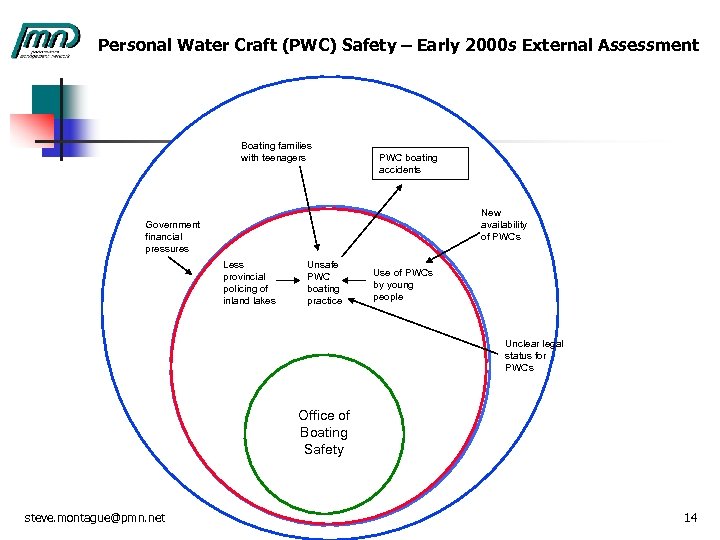 Personal Water Craft (PWC) Safety – Early 2000 s External Assessment Boating families with teenagers PWC boating accidents New availability of PWCs Government financial pressures Less provincial policing of inland lakes Unsafe PWC boating practice Use of PWCs by young people Unclear legal status for PWCs Office of Boating Safety steve. montague@pmn. net 14
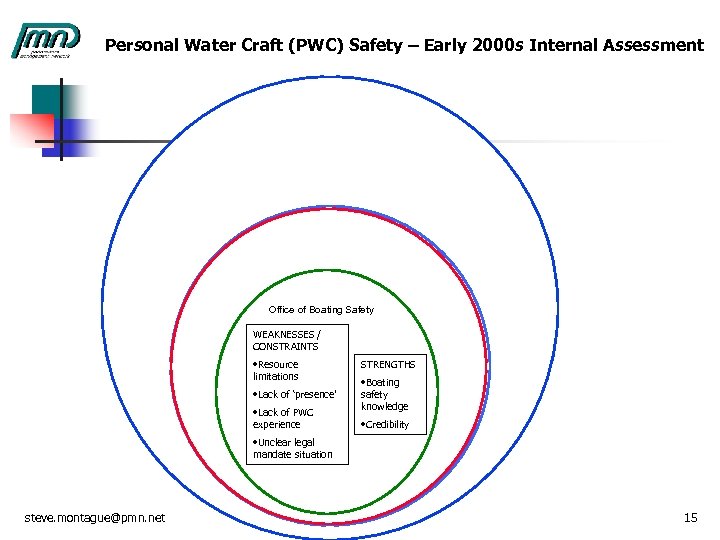 Personal Water Craft (PWC) Safety – Early 2000 s Internal Assessment Office of Boating Safety WEAKNESSES / CONSTRAINTS • Resource limitations • Lack of ‘presence’ • Lack of PWC experience STRENGTHS • Boating safety knowledge • Credibility • Unclear legal mandate situation steve. montague@pmn. net 15
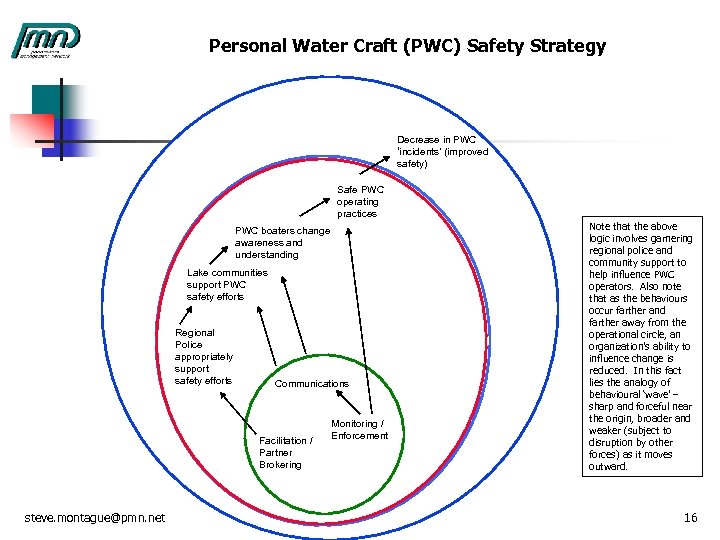 Personal Water Craft (PWC) Safety Strategy Decrease in PWC ‘incidents’ (improved safety) Safe PWC operating practices PWC boaters change awareness and understanding Lake communities support PWC safety efforts Regional Police appropriately support safety efforts Communications Facilitation / Partner Brokering steve. montague@pmn. net Monitoring / Enforcement Note that the above logic involves garnering regional police and community support to help influence PWC operators. Also note that as the behaviours occur farther and farther away from the operational circle, an organization's ability to influence change is reduced. In this fact lies the analogy of behavioural ‘wave’ – sharp and forceful near the origin, broader and weaker (subject to disruption by other forces) as it moves outward. 16
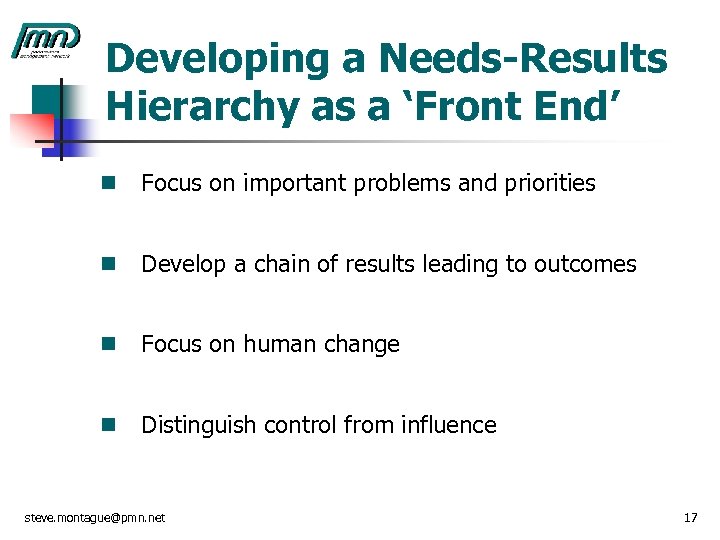 Developing a Needs-Results Hierarchy as a ‘Front End’ n Focus on important problems and priorities n Develop a chain of results leading to outcomes n Focus on human change n Distinguish control from influence steve. montague@pmn. net 17
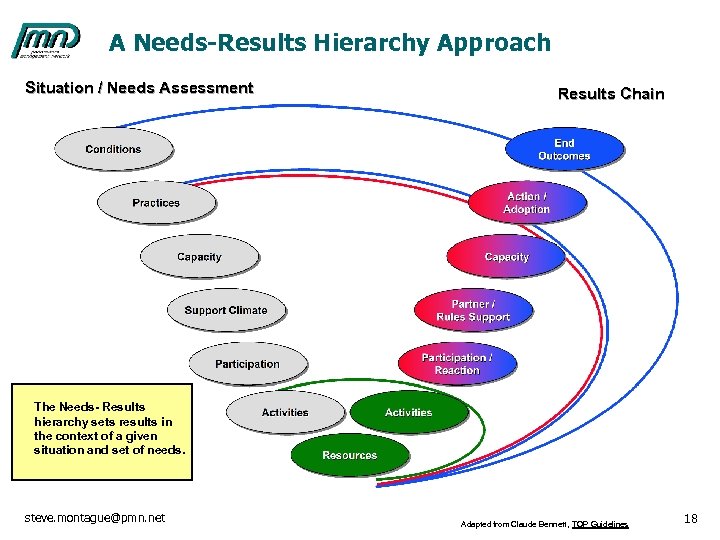 A Needs-Results Hierarchy Approach Situation / Needs Assessment Results Chain The Needs- Results hierarchy sets results in the context of a given situation and set of needs. steve. montague@pmn. net Adapted from Claude Bennett, TOP Guidelines 18
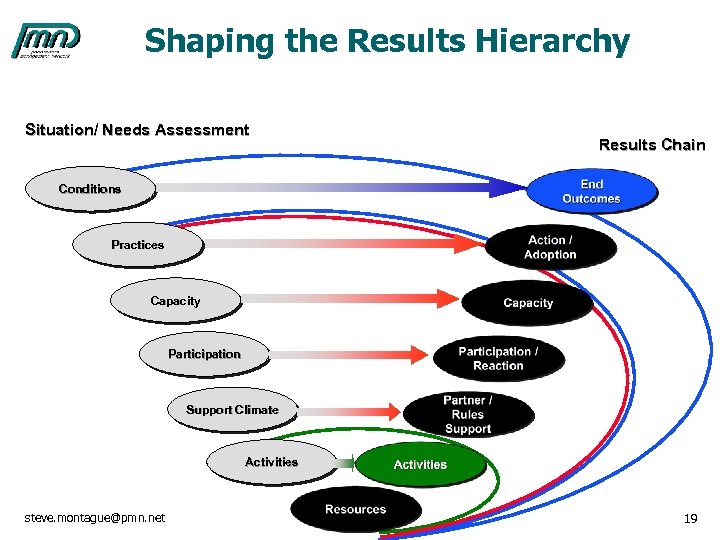 Shaping the Results Hierarchy Situation/ Needs Assessment Results Chain Conditions Practices Capacity Participation Support Climate Activities steve. montague@pmn. net 19
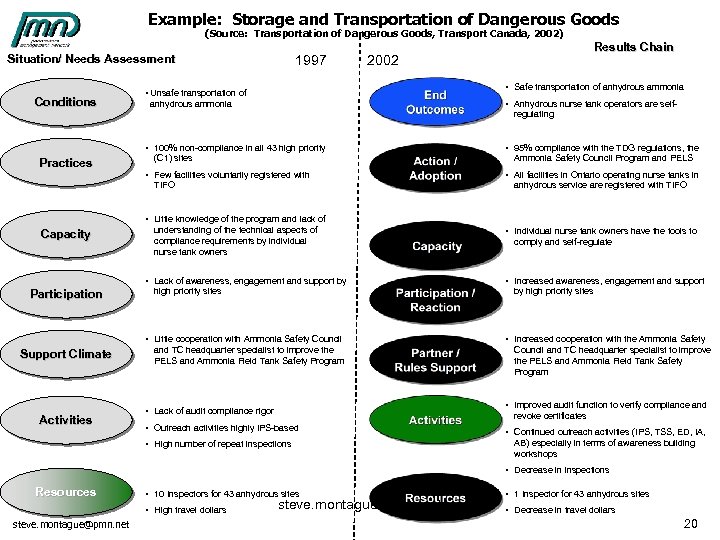 Example: Storage and Transportation of Dangerous Goods (Source: Transportation of Dangerous Goods, Transport Canada, 2002) Situation/ Needs Assessment Conditions 1997 2002 • Safe transportation of anhydrous ammonia • Unsafe transportation of • Anhydrous nurse tank operators are self- anhydrous ammonia regulating • 100% non-compliance in all 43 high priority Practices Results Chain (C 1) sites • 95% compliance with the TDG regulations, the Ammonia Safety Council Program and PELS • Few facilities voluntarily registered with TIFO • All facilities in Ontario operating nurse tanks in anhydrous service are registered with TIFO • Little knowledge of the program and lack of Capacity understanding of the technical aspects of compliance requirements by individual nurse tank owners • Lack of awareness, engagement and support by Participation high priority sites Activities comply and self-regulate • Increased awareness, engagement and support by high priority sites • Little cooperation with Ammonia Safety Council Support Climate • Individual nurse tank owners have the tools to and TC headquarter specialist to improve the PELS and Ammonia Field Tank Safety Program • Increased cooperation with the Ammonia Safety Council and TC headquarter specialist to improve the PELS and Ammonia Field Tank Safety Program • Improved audit function to verify compliance and • Lack of audit compliance rigor revoke certificates • Outreach activities highly IPS-based • High number of repeat inspections • Continued outreach activities (IPS, TSS, ED, IA, AB) especially in terms of awareness building workshops • Decrease in inspections Resources • 1 Inspector for 43 anhydrous sites • High travel dollars steve. montague@pmn. net • 10 Inspectors for 43 anhydrous sites • Decrease in travel dollars steve. montague@pmn. net 20
![A Case Study in [lack of] Regulatory Harm Reduction Accountability – The Walkerton Water](https://present5.com/presentation/023fb62b4c53c62856ae9600ca91978d/image-21.jpg "A Case Study in [lack of] Regulatory Harm Reduction Accountability – The Walkerton Water") A Case Study in [lack of] Regulatory Harm Reduction Accountability – The Walkerton Water Situation Weather climate change – flooding Economic pressure on agriculture E-coli: contaminated water leading to health crisis S&T developments in farming Financial pressure on public infrastructure “Factory” farming – antibiotics – fecal waste Public (lack of) awareness, knowledge, and preventative action Aging water infrastructure Local Medical Officer Brockton – Walkerton “We thought this was a disaster waiting to happen for the last four years. ” Dr. Murray Mc. Quigge, Yahoo news, May 30 / 00 “Our role is only to test the water, not to fix the problems. ” Palmateer and Patterson, Globe and Mail, May 29 / 00 Other Institutions: e. g. , Health Canada, CFIA, AAFC Private Testing Labs Public Utilities Commission Politicians Ontario Government (MOE) “I didn’t say we’re responsible, I didn’t say we’re not responsible. ” Premier Mike Harris, Globe and Mail, May 30 / 00 Environment Minister announces regulatory changes: 1 - Mandatory lab accreditation 2 - Mandatory to inform MOE of lab testing changes 3 - Review of testing certificates 4 - Reinforce current notification procedures May 29 / 00 A two year inquiry held two town officials almost completely to blame. Deeper systems surrounding the situation were not extensively reviewed. steve. montague@pmn. net Source: Montague, Steve, A Regulatory Challenge Conference, 2000 21
A Case Study in [lack of] Regulatory Harm Reduction Accountability – The Walkerton Water Situation Weather climate change – flooding Economic pressure on agriculture E-coli: contaminated water leading to health crisis S&T developments in farming Financial pressure on public infrastructure “Factory” farming – antibiotics – fecal waste Public (lack of) awareness, knowledge, and preventative action Aging water infrastructure Local Medical Officer Brockton – Walkerton “We thought this was a disaster waiting to happen for the last four years. ” Dr. Murray Mc. Quigge, Yahoo news, May 30 / 00 “Our role is only to test the water, not to fix the problems. ” Palmateer and Patterson, Globe and Mail, May 29 / 00 Other Institutions: e. g. , Health Canada, CFIA, AAFC Private Testing Labs Public Utilities Commission Politicians Ontario Government (MOE) “I didn’t say we’re responsible, I didn’t say we’re not responsible. ” Premier Mike Harris, Globe and Mail, May 30 / 00 Environment Minister announces regulatory changes: 1 - Mandatory lab accreditation 2 - Mandatory to inform MOE of lab testing changes 3 - Review of testing certificates 4 - Reinforce current notification procedures May 29 / 00 A two year inquiry held two town officials almost completely to blame. Deeper systems surrounding the situation were not extensively reviewed. steve. montague@pmn. net Source: Montague, Steve, A Regulatory Challenge Conference, 2000 21
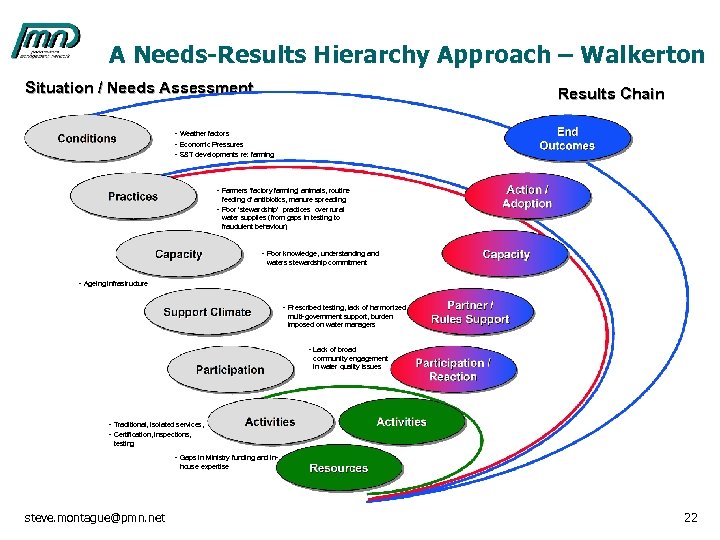 A Needs-Results Hierarchy Approach – Walkerton Situation / Needs Assessment Results Chain - Weather factors - Economic Pressures - S&T developments re: farming - Farmers ‘factory farming’ animals, routine feeding of antibiotics, manure spreading - Poor ‘stewardship’ practices over rural water supplies (from gaps in testing to fraudulent behaviour) - Poor knowledge, understanding and waters stewardship commitment - Ageing infrastructure - Prescribed testing, lack of harmonized, multi-government support, burden imposed on water managers - Lack of broad community engagement in water quality issues - Traditional, isolated services, - Certification, inspections, testing - Gaps in Ministry funding and inhouse expertise steve. montague@pmn. net 22
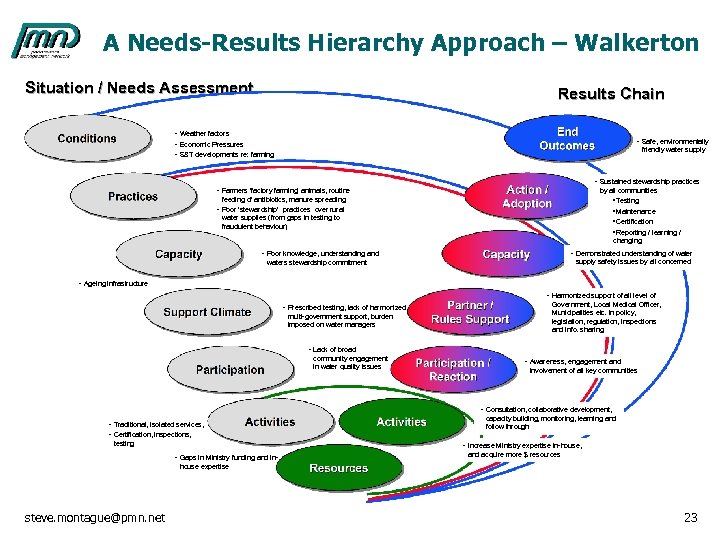 A Needs-Results Hierarchy Approach – Walkerton Situation / Needs Assessment Results Chain - Weather factors - Economic Pressures - S&T developments re: farming - Safe, environmentally friendly water supply - Sustained stewardship practices - Farmers ‘factory farming’ animals, routine by all communities feeding of antibiotics, manure spreading • Testing • Maintenance • Certification • Reporting / learning / - Poor ‘stewardship’ practices over rural water supplies (from gaps in testing to fraudulent behaviour) changing - Demonstrated understanding of water - Poor knowledge, understanding and supply safety issues by all concerned waters stewardship commitment - Ageing infrastructure - Harmonized support of all level of - Prescribed testing, lack of harmonized, multi-government support, burden imposed on water managers Government, Local Medical Officer, Municipalities etc. in policy, legislation, regulation, inspections and info. sharing - Lack of broad community engagement in water quality issues - Awareness, engagement and involvement of all key communities - Consultation, collaborative development, - Traditional, isolated services, - Certification, inspections, testing capacity building, monitoring, learning and follow through - Increase Ministry expertise in-house, - Gaps in Ministry funding and in- and acquire more $ resources house expertise steve. montague@pmn. net 23
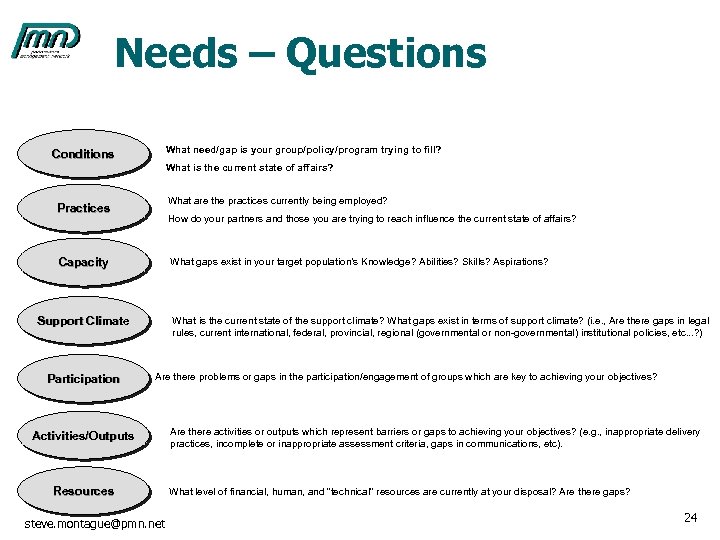 Needs – Questions What need/gap is your group/policy/program trying to fill? Conditions What is the current state of affairs? What are the practices currently being employed? Practices How do your partners and those you are trying to reach influence the current state of affairs? Capacity What gaps exist in your target population’s Knowledge? Abilities? Skills? Aspirations? Support Climate Participation What is the current state of the support climate? What gaps exist in terms of support climate? (i. e. , Are there gaps in legal rules, current international, federal, provincial, regional (governmental or non-governmental) institutional policies, etc. . . ? ) Are there problems or gaps in the participation/engagement of groups which are key to achieving your objectives? Activities/Outputs Resources steve. montague@pmn. net Are there activities or outputs which represent barriers or gaps to achieving your objectives? (e. g. , inappropriate delivery practices, incomplete or inappropriate assessment criteria, gaps in communications, etc). What level of financial, human, and “technical” resources are currently at your disposal? Are there gaps? 24
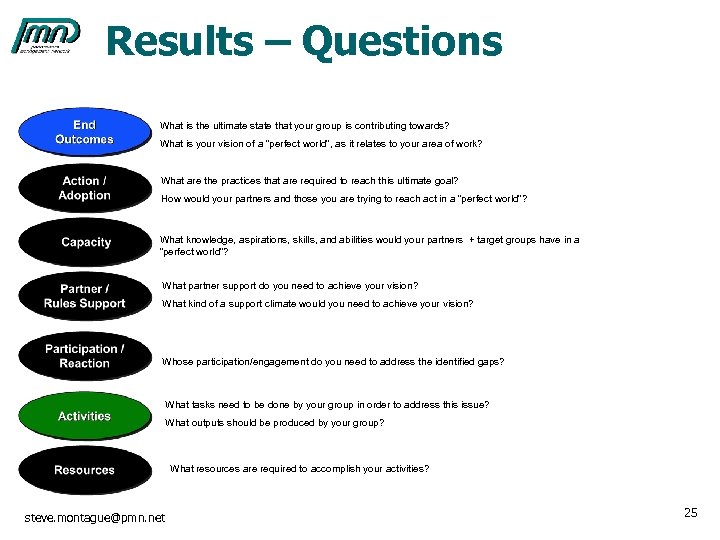 Results – Questions What is the ultimate state that your group is contributing towards? What is your vision of a “perfect world”, as it relates to your area of work? What are the practices that are required to reach this ultimate goal? How would your partners and those you are trying to reach act in a “perfect world”? What knowledge, aspirations, skills, and abilities would your partners + target groups have in a “perfect world”? What partner support do you need to achieve your vision? What kind of a support climate would you need to achieve your vision? Whose participation/engagement do you need to address the identified gaps? What tasks need to be done by your group in order to address this issue? What outputs should be produced by your group? What resources are required to accomplish your activities? steve. montague@pmn. net 25
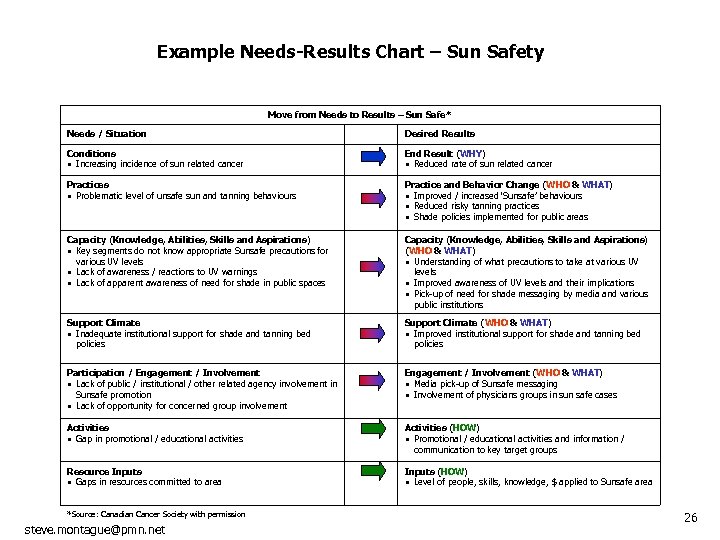 Example Needs-Results Chart – Sun Safety Move from Needs to Results – Sun Safe* Needs / Situation Desired Results Conditions • Increasing incidence of sun related cancer End Result (WHY) • Reduced rate of sun related cancer Practices • Problematic level of unsafe sun and tanning behaviours Practice and Behavior Change (WHO & WHAT) • Improved / increased ‘Sunsafe’ behaviours • Reduced risky tanning practices • Shade policies implemented for public areas Capacity (Knowledge, Abilities, Skills and Aspirations) • Key segments do not know appropriate Sunsafe precautions for various UV levels • Lack of awareness / reactions to UV warnings • Lack of apparent awareness of need for shade in public spaces Capacity (Knowledge, Abilities, Skills and Aspirations) (WHO & WHAT) • Understanding of what precautions to take at various UV levels • Improved awareness of UV levels and their implications • Pick-up of need for shade messaging by media and various public institutions Support Climate • Inadequate institutional support for shade and tanning bed policies Support Climate (WHO & WHAT) • Improved institutional support for shade and tanning bed policies Participation / Engagement / Involvement • Lack of public / institutional / other related agency involvement in Sunsafe promotion • Lack of opportunity for concerned group involvement Engagement / Involvement (WHO & WHAT) • Media pick-up of Sunsafe messaging • Involvement of physicians groups in sun safe cases Activities • Gap in promotional / educational activities Activities (HOW) • Promotional / educational activities and information / communication to key target groups Resource Inputs • Gaps in resources committed to area Inputs (HOW) • Level of people, skills, knowledge, $ applied to Sunsafe area *Source: Canadian Cancer Society with permission steve. montague@pmn. net 26
 Small Group Exercise n Look at a case n Suggest some situational needs / risks n Then consider some results steve. montague@pmn. net 27
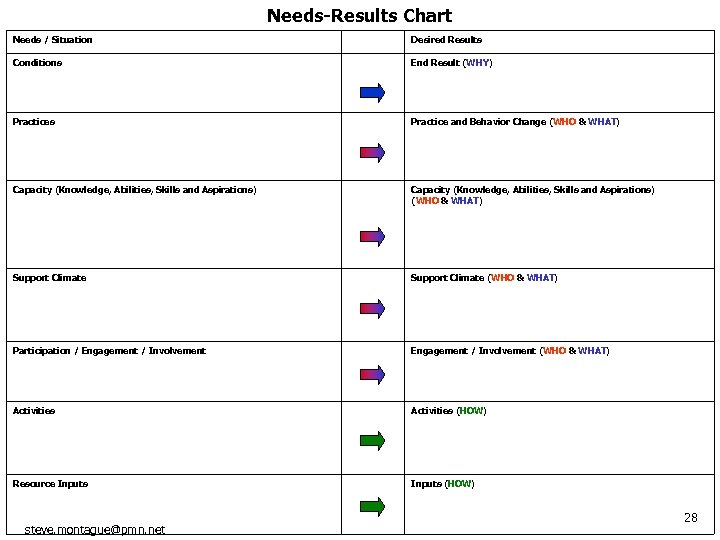 Needs-Results Chart Needs / Situation Desired Results Conditions End Result (WHY) Practices Practice and Behavior Change (WHO & WHAT) Capacity (Knowledge, Abilities, Skills and Aspirations) (WHO & WHAT) Support Climate (WHO & WHAT) Participation / Engagement / Involvement (WHO & WHAT) Activities (HOW) Resource Inputs (HOW) steve. montague@pmn. net 28
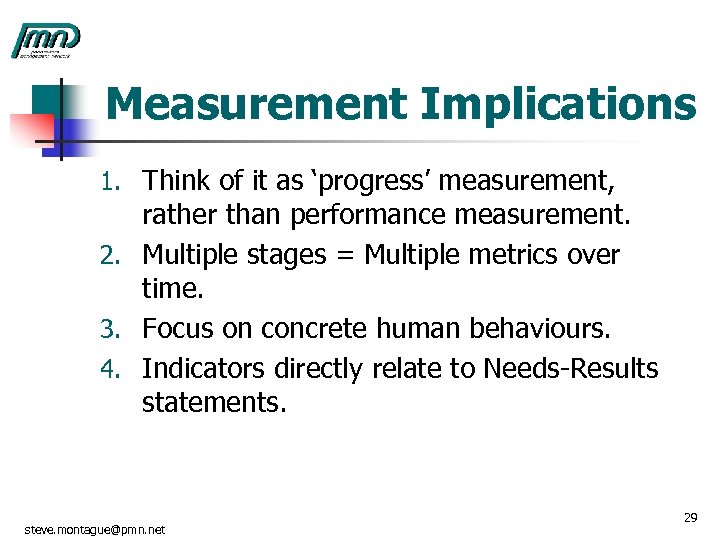 Measurement Implications 1. Think of it as ‘progress’ measurement, rather than performance measurement. 2. Multiple stages = Multiple metrics over time. 3. Focus on concrete human behaviours. 4. Indicators directly relate to Needs-Results statements. steve. montague@pmn. net 29
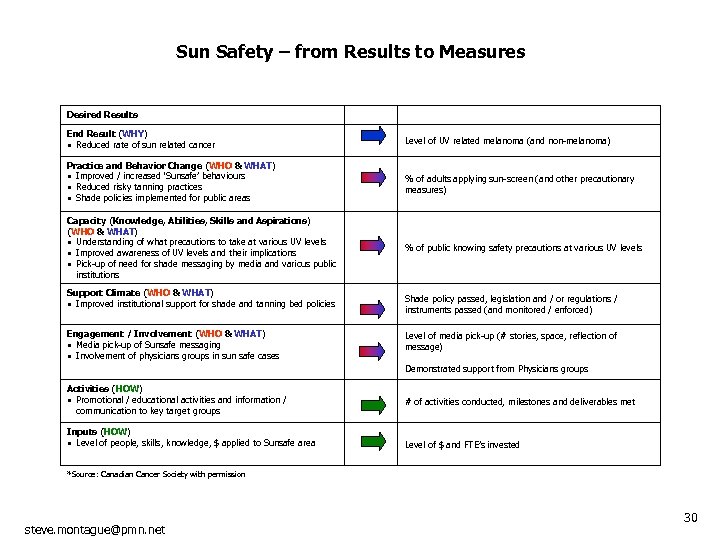 Sun Safety – from Results to Measures Desired Results End Result (WHY) • Reduced rate of sun related cancer Level of UV related melanoma (and non-melanoma) Practice and Behavior Change (WHO & WHAT) • Improved / increased ‘Sunsafe’ behaviours • Reduced risky tanning practices • Shade policies implemented for public areas % of adults applying sun-screen (and other precautionary measures) Capacity (Knowledge, Abilities, Skills and Aspirations) (WHO & WHAT) • Understanding of what precautions to take at various UV levels • Improved awareness of UV levels and their implications • Pick-up of need for shade messaging by media and various public institutions % of public knowing safety precautions at various UV levels Support Climate (WHO & WHAT) • Improved institutional support for shade and tanning bed policies Engagement / Involvement (WHO & WHAT) • Media pick-up of Sunsafe messaging • Involvement of physicians groups in sun safe cases Shade policy passed, legislation and / or regulations / instruments passed (and monitored / enforced) Level of media pick-up (# stories, space, reflection of message) Demonstrated support from Physicians groups Activities (HOW) • Promotional / educational activities and information / communication to key target groups Inputs (HOW) • Level of people, skills, knowledge, $ applied to Sunsafe area # of activities conducted, milestones and deliverables met Level of $ and FTE’s invested *Source: Canadian Cancer Society with permission steve. montague@pmn. net 30
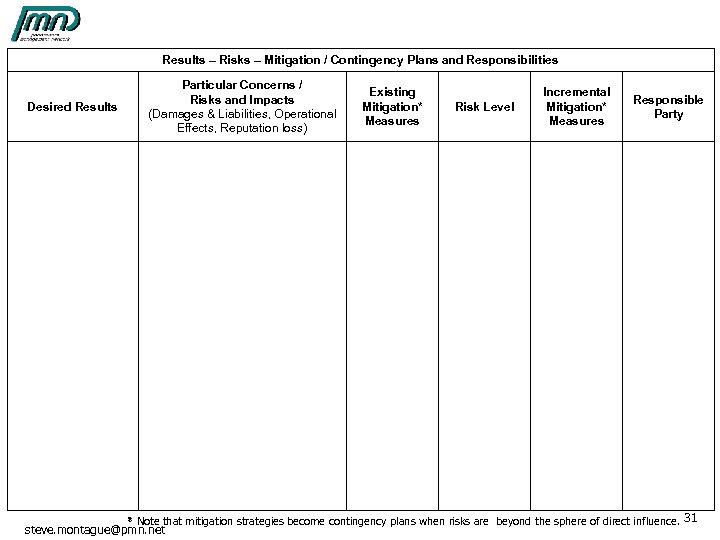 Results – Risks – Mitigation / Contingency Plans and Responsibilities Desired Results Particular Concerns / Risks and Impacts (Damages & Liabilities, Operational Effects, Reputation loss) Existing Mitigation* Measures Risk Level Incremental Mitigation* Measures Responsible Party * Note that mitigation strategies become contingency plans when risks are beyond the sphere of direct influence. 31 steve. montague@pmn. net
 Conclusions – For Harm Reduction and Regulatory Initiatives: n Use a structured needs assessment and a reach- results chain to: n n n Plan Refine results Set targets Define measures Set up risk plans n Integrate: n n n Approaches Stakeholders Processes n Cultivate (rather than engineer) the process steve. montague@pmn. net 32
 Questions n Do current planning, reporting and ‘accountability’ approaches – as typically applied to harm reduction and regulatory oversight in complex public systems – cause problems in and of themselves? n Can structured need (problem) assessments, systems thinking and reach-results chains be effectively incorporated into performance planning, measurement and reporting? Can this complement analytical system safety approaches? (e. g. hazard analysis) n What are the implications for performance measurement and evaluation? n n n Strategically Structurally ‘Politically’ steve. montague@pmn. net 33
 Select Sources / References 1. Bennett, C. et. al. (2001). Management and Assessment Indicators for Intergovernmental Programs: Toward A Workable Approach. January 2001 revision of Paper Presented at the Australasian Evaluation Society Meeting 1999. Perth, Western Australia, Australia. 2. Environment Australia (2003). Evaluation of the NAT Phase 1 Facilitator, Coordinator and Community Support Networks. 3. Gerard and Ellinor, Flexing a Different Conversational “Muscle”: The Practice of Dialogue, The Systems Thinker Vol II No 9. 4. Mayne, J. (2001). Addressing Attribution through Contribution Analysis: Using Performance Measures Sensibly , The Canadian Journal of Program Evaluation Vol. 16 No. 1. 5. Montague and Allerdings (2005), Building Accountability Structures into Agri-Environmental Policy Development in Evaluating Agri. Environmental Policies: Design, Practice and Results, OECD, 2005, pp 55 -70 6. Montague, S. (2002). Circles of Influence: An Approach to Structured, Succinct Strategy http: //pmn. net/library/Circles_of_Influence_An_Approach. htm 7. Montague, S. , Young, G. and Montague, C. (2003). Using Circles to Tell the Performance Story, Canadian Government Executive http: //pmn. net/library/usingcirclestotelltheperformancestory. htm. 8. Pahl and Norland, (November 2002). A Systemic Framework for Designing Utilization-Focused, Evaluation of Federal, Environmental 9. Perrin, B. (January 2006) Moving from Outputs to Outcomes: Practical Advice from Governments Around the World http: //www. businessofgovernment. org/pdfs/Perrin. Report. pdf. 10. Sparrow, Malcolm K. (2002) The Regulatory Craft Controlling Risks, Solving Problems, and Managing Compliance, The Brookings Institution, Washington. 11. Valovirta and Uusikylä (September 2004) Three Spheres of Performance Governance Spanning the Boundaries from Singleorganisation Focus Towards a Partnership Network http: //soc. kuleuven. be/io/egpa/qual/ljubljana/Valovirta%20 Uusikila_paper. pdf. 12. Van Der Heijden, K. , (1996) Scenarios: The Art of Strategic Conversation Wiley. Research, Extending the Focus from Outputs to Outcomes. steve. montague@pmn. net 34