


 Скачать презентацию Telecounselling for neurosurgery in Veneto Region Elena Vio
f6a6ff4520f95afe42fc02f45614680c.ppt
- Количество слайдов: 12
 Telecounselling for neurosurgery in Veneto Region Elena Vio – Arsenàl. IT Veneto's Research Centre for e. Health Innovation 20 june 2012
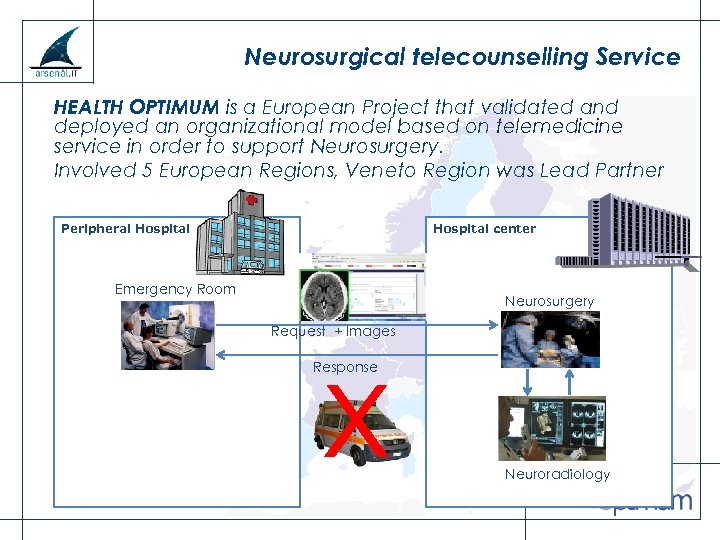 Neurosurgical telecounselling Service HEALTH OPTIMUM is a European Project that validated and deployed an organizational model based on telemedicine service in order to support Neurosurgery. Involved 5 European Regions, Veneto Region was Lead Partner Peripheral Hospital center Emergency Room Neurosurgery Request + Images Response X Neuroradiology
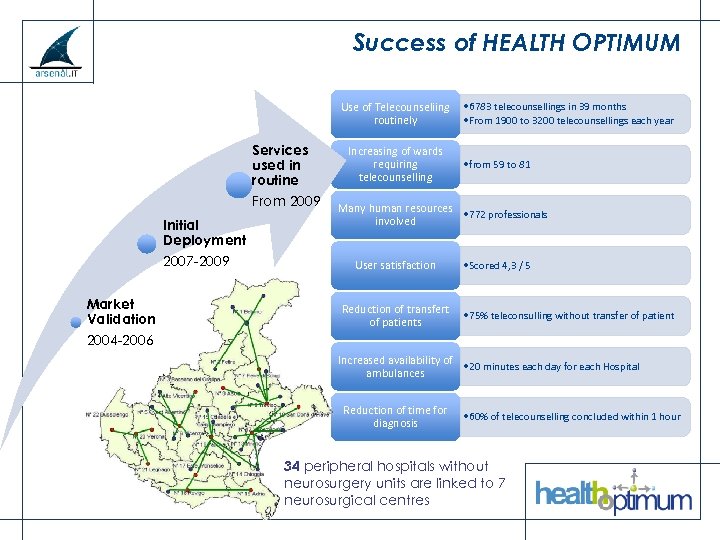 Success of HEALTH OPTIMUM Use of Telecounseliing routinely Services used in routine From 2009 Initial Deployment 2007 -2009 Market Validation 2004 -2006 Increasing of wards requiring telecounselling • 6783 telecounsellings in 39 months • From 1900 to 3200 telecounsellings each year • from 59 to 81 Many human resources • 772 professionals involved User satisfaction Reduction of transfert of patients • Scored 4, 3 / 5 • 75% teleconsulling without transfer of patient Increased availability of • 20 minutes each day for each Hospital ambulances Reduction of time for diagnosis • 60% of telecounselling concluded within 1 hour 34 peripheral hospitals without neurosurgery units are linked to 7 neurosurgical centres
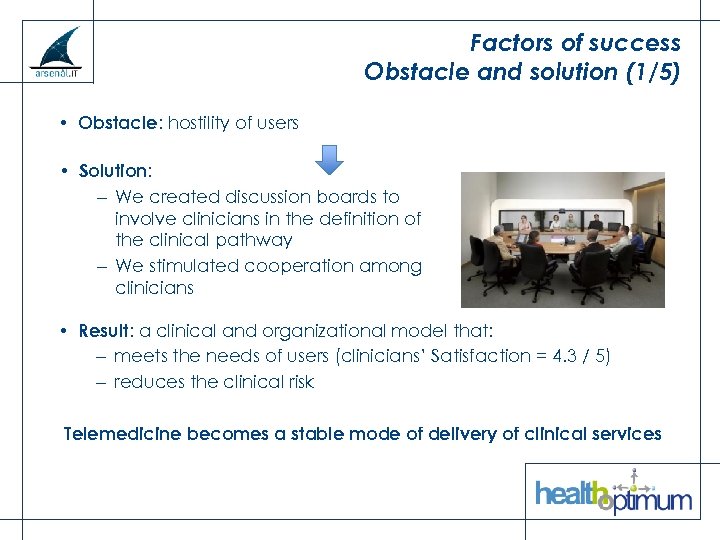 Factors of success Obstacle and solution (1/5) • Obstacle: hostility of users • Solution: – We created discussion boards to involve clinicians in the definition of the clinical pathway – We stimulated cooperation among clinicians • Result: a clinical and organizational model that: – meets the needs of users (clinicians’ Satisfaction = 4. 3 / 5) – reduces the clinical risk Telemedicine becomes a stable mode of delivery of clinical services
 Factors of success Obstacle and solution (2/5) • Obstacle: Telemedicine can find obstacles due to the lack of a clear regulatory framework. In this case, users and decision makers are not protected in terms of responsibility and reject the use of the instrument • Solution: – We introduced the digital signature on the digital documents that are exchanged in order to make the responsibilities clear. • Results: Before the introduction of telemedicine, the roles of actors in the neurosurgical consultation were unclear. The use of telemedicine service empowers and reassures operators
 Factors of success Obstacle and solution (3/5) • Obstacle: the transition from the normal consultation to teleconsultation requires funding. The EU funding was limited to 30%, the LHAs could not bear the expense for the implementation and the new activities. • Solution: – Providing decision makers (Veneto Region) with a multidisciplinary analysis conducted in market validation phase in order to obtain the co-financing – Generating agreements between requiring hospitals and hospitals which offer the service • Result: the service is economically sustainable and generates the balance between LHAs.
 Factors of success Obstacle and solution (4/5) • Obstacle: difficulty in creating a network that can support the deployment • Solution: • Building services on a model of integration and communication between LHAs, developed on a common semantic, technological, techno-organizational, and infrastructural basis (standard)
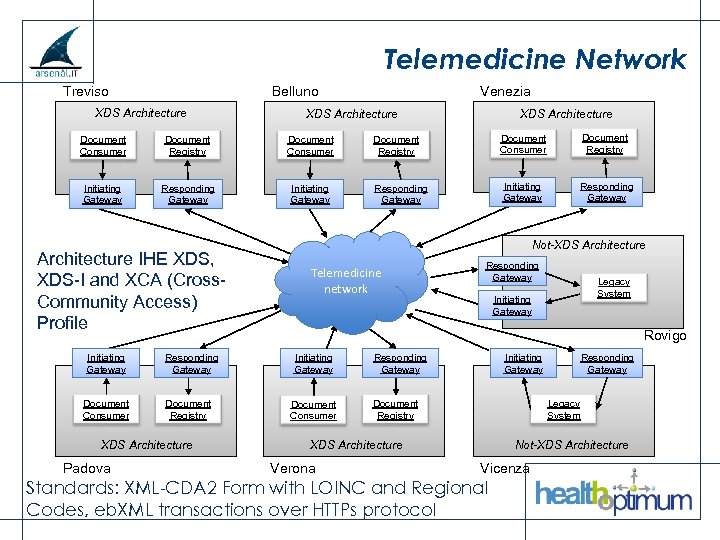 Telemedicine Network Treviso Belluno XDS Architecture Venezia XDS Architecture Document Consumer Document Registry Initiating Gateway Responding Gateway Architecture IHE XDS, XDS-I and XCA (Cross. Community Access) Profile Initiating Gateway Document Consumer Responding Gateway Document Registry XDS Architecture Padova Not-XDS Architecture Telemedicine network Responding Gateway Legacy System Initiating Gateway Rovigo Initiating Gateway Document Consumer Responding Gateway Initiating Gateway Document Registry Legacy System XDS Architecture Verona Responding Gateway Not-XDS Architecture Vicenza Standards: XML-CDA 2 Form with LOINC and Regional Codes, eb. XML transactions over HTTPs protocol
 Factors of success Obstacle and solution (4/5) • Obstacle: difficulty in creating a network that can support the deployment • Solution: • Building services on a model of integration and communication between LHAs, developed on a common semantic, technological, techno-organizational, and infrastructural basis (standard) • Creating a body for innovation with a unified vision of integration: Arsenàl. IT. In HO project, it released interoperability guidelines and managed start up phase • Result: • The network is flexible, allowing easy interoperability between systems implemented by different vendors that can follow guidelines provided by Arsenàl. IT and based on international standards • Freedom in acquisitions
 Factors of success Obstacle and solution (5/5) • Obstacle: Some vendors were not familiar with interoperability and application of international standards. • Solution: • Arsenàl. IT daily updates interoperability skills and knowledge and provides suppliers with the possibility to test systems and to participate in international trials organized by IHE. • Result: • The industry is prepared to deploy telemedicine also for other services
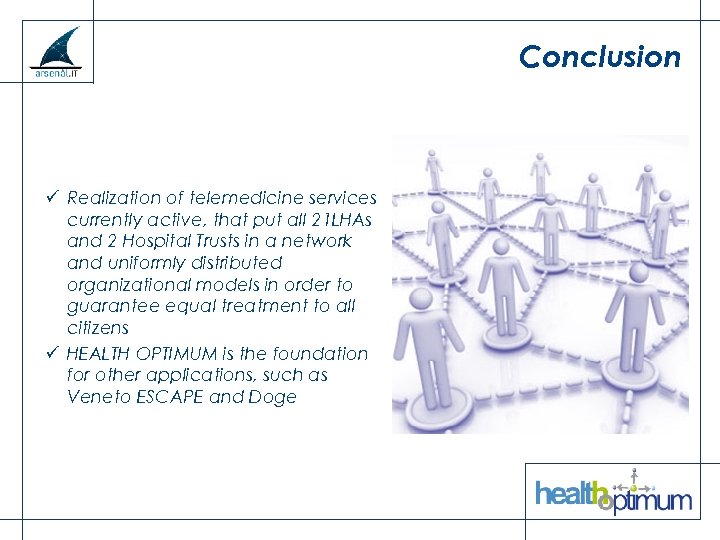 Conclusion ü Realization of telemedicine services currently active, that put all 21 LHAs and 2 Hospital Trusts in a network and uniformly distributed organizational models in order to guarantee equal treatment to all citizens ü HEALTH OPTIMUM is the foundation for other applications, such as Veneto ESCAPE and Doge
 Thank you for your attention! Elena Vio evio@consorzioarsenal. it