 Скачать презентацию TELECOSM 2003 August 24 2003 Industry Analyst Briefing
da00df5000efda58d6c36eb5288e44da.ppt
- Количество слайдов: 9



TELECOSM 2003 August 24, 2003 Industry Analyst Briefing Deck May, 2003 Wi. Fi & 3 G CDMA 802. 11 a Hot Spot Cordless Internet 802. 11 b PWLAN 802. 11 g
TELECOSM 2003 August 24, 2003 Covering QUALCOMM’s Campus with Wi. Fi • QUALCOMM believes in 802. 11 for the enterprise & home environments • QUALCOMM has spent over $300, 000 "full up costs" for the access points covering our common areas and meeting rooms – 200 Access Point's represent in one mid size company in a restricted area campus an equivalent of 20% of Boingo's sites nationwide – Access point installation currently costs about $1, 500, at around $500 per an access point and approximately $1, 000 in installation expenses. - Cometa, May, 2003 Source: QUALCOMM IT
TELECOSM 2003 August 24, 2003 Public Wi. Fi Service Limitations • Data speeds • “Hotspot” coverage – Limited by backhaul and multiple access scalability – 11 Mbps becomes irrelevant when connecting through a T 1/E 1 (~1. 5 Mbps), DSL or cable modem (300 – 500 kbps) – Very limited – Predicated on “travel to compute” model • • Backhaul costs Landlord fees/revenue sharing • Billing issues • Barriers to entry are few – Perceptions of ultra-low service fees are incorrect – Hotel room phone example – CTIA IT show / T-Mobile example – Wi. Fi roaming is in its infancy, need for multiple subscriptions – “Java Joes” can provide free access next door to a Starbucks/T-Mobile
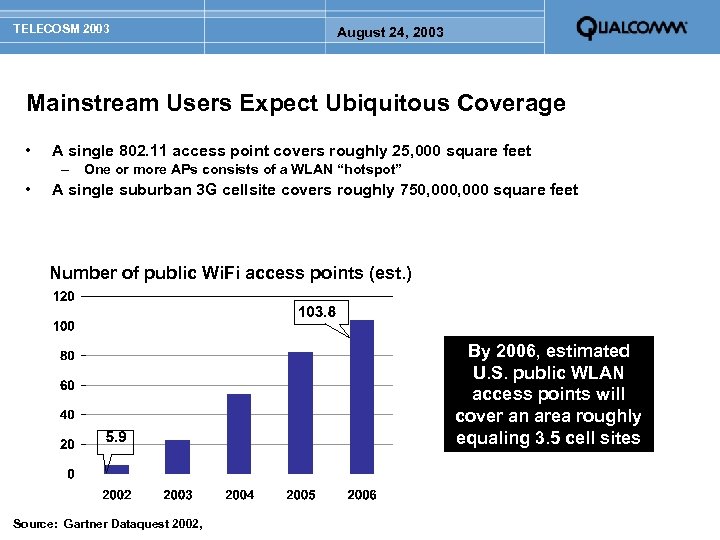
TELECOSM 2003 August 24, 2003 Mainstream Users Expect Ubiquitous Coverage • A single 802. 11 access point covers roughly 25, 000 square feet – One or more APs consists of a WLAN “hotspot” • A single suburban 3 G cellsite covers roughly 750, 000 square feet Number of public Wi. Fi access points (est. ) By 2006, estimated U. S. public WLAN access points will cover an area roughly equaling 3. 5 cell sites Source: Gartner Dataquest 2002,
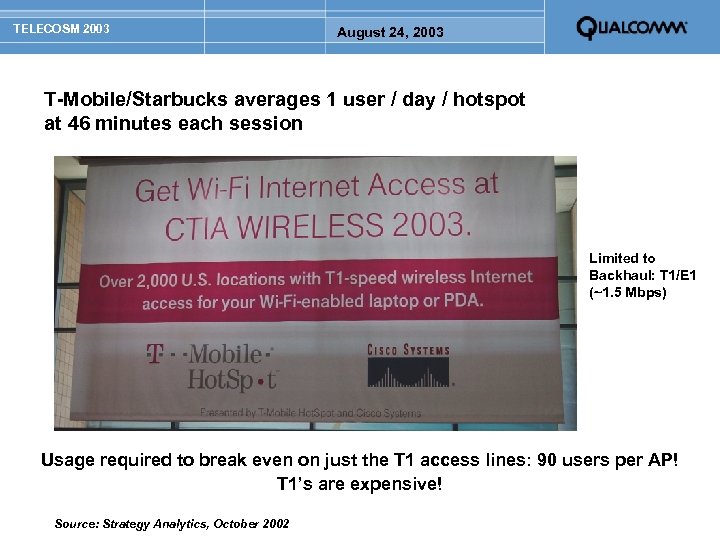
TELECOSM 2003 August 24, 2003 T-Mobile/Starbucks averages 1 user / day / hotspot at 46 minutes each session Limited to Backhaul: T 1/E 1 (~1. 5 Mbps) Usage required to break even on just the T 1 access lines: 90 users per AP! T 1’s are expensive! Source: Strategy Analytics, October 2002
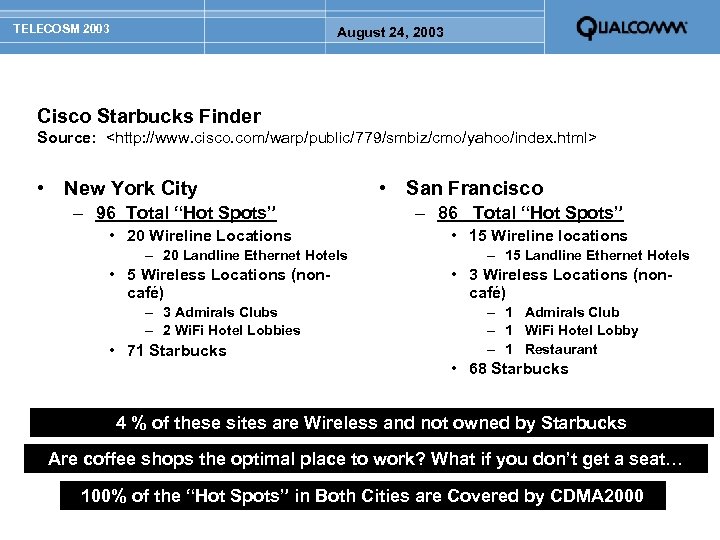
TELECOSM 2003 August 24, 2003 Cisco Starbucks Finder Source: <http: //www. cisco. com/warp/public/779/smbiz/cmo/yahoo/index. html> • New York City – 96 Total “Hot Spots” • 20 Wireline Locations – 20 Landline Ethernet Hotels • San Francisco – 86 Total “Hot Spots” • 15 Wireline locations – 15 Landline Ethernet Hotels • 5 Wireless Locations (noncafé) • 3 Wireless Locations (noncafé) – 3 Admirals Clubs – 2 Wi. Fi Hotel Lobbies – 1 Admirals Club – 1 Wi. Fi Hotel Lobby – 1 Restaurant • 71 Starbucks • 68 Starbucks 4 % of these sites are Wireless and not owned by Starbucks Are coffee shops the optimal place to work? What if you don’t get a seat… 100% of the “Hot Spots” in Both Cities are Covered by CDMA 2000
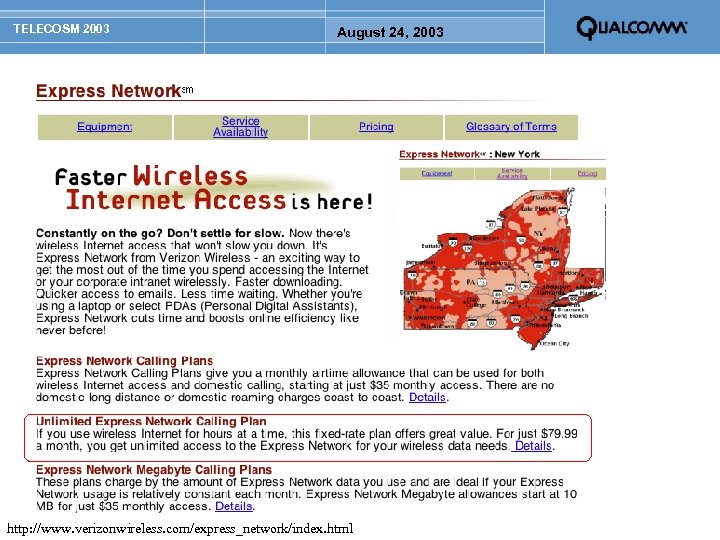
TELECOSM 2003 August 24, 2003 http: //www. verizonwireless. com/express_network/index. html
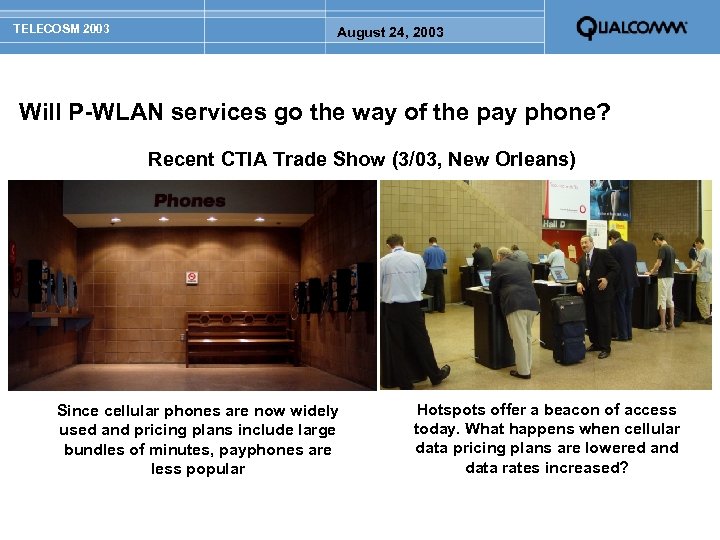
TELECOSM 2003 August 24, 2003 Will P-WLAN services go the way of the pay phone? Recent CTIA Trade Show (3/03, New Orleans) Since cellular phones are now widely used and pricing plans include large bundles of minutes, payphones are less popular Hotspots offer a beacon of access today. What happens when cellular data pricing plans are lowered and data rates increased?
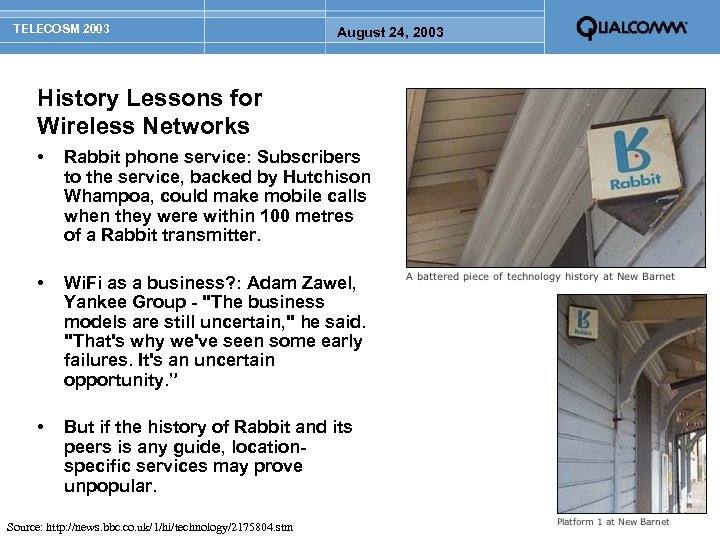
TELECOSM 2003 August 24, 2003 History Lessons for Wireless Networks • Rabbit phone service: Subscribers to the service, backed by Hutchison Whampoa, could make mobile calls when they were within 100 metres of a Rabbit transmitter. • Wi. Fi as a business? : Adam Zawel, Yankee Group - "The business models are still uncertain, " he said. "That's why we've seen some early failures. It's an uncertain opportunity. ” • But if the history of Rabbit and its peers is any guide, locationspecific services may prove unpopular. Source: http: //news. bbc. co. uk/1/hi/technology/2175804. stm
Скачать презентацию TELECOSM 2003 August 24 2003 Industry Analyst Briefing
da00df5000efda58d6c36eb5288e44da.ppt