


 Скачать презентацию Telecommunication Engineering Arjan Meijerink TE Presentation May
fb8e2c052785c885e17ba20a8b523bdf.ppt
- Количество слайдов: 39
 Telecommunication Engineering Arjan Meijerink TE Presentation – May 29, 2012
 Education at the UT – new curriculum ; tasks of Ph. Ds; tasks of supervisors Mark Bentum
 Assessment of EE curriculum § 2010 § Good quality (BSc/MSc) § But § All EE curricula failed in effectiveness § Possibly talent is lost… § The reaction on effectiveness and duration is rather phlegmatic § In coming years serious efforts are expected to improve the success !! 3
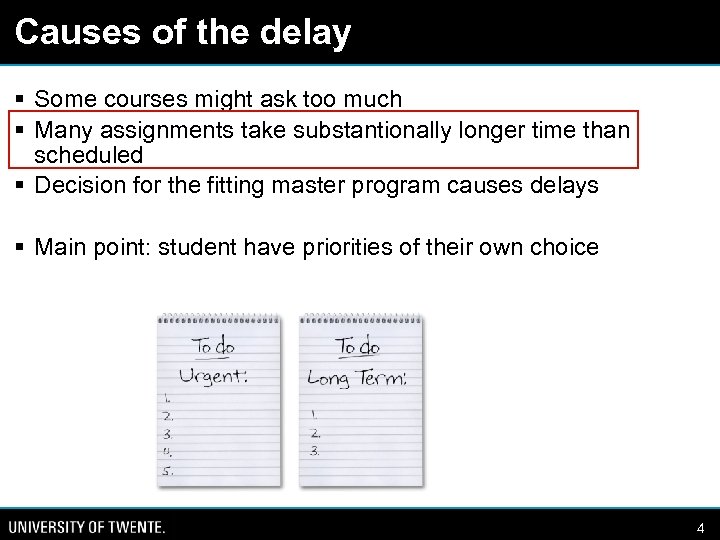 Causes of the delay § Some courses might ask too much § Many assignments take substantionally longer time than scheduled § Decision for the fitting master program causes delays § Main point: student have priorities of their own choice 4
 Problems in the assignments We observe the following: § Huge delays in the projects - often ~1 year. § Responsibilities are not always clear § Poor background in writing …and in structuring research §… 5
 Conclusions § Tell you about the new Electrical Engineering curriculum and the rational behind it. § Show you that the duration of the assignment is one of the main problems. This is also the case for Ph. D projects. § Show you the structure of assignments. § Tell you about a career in science. § Give you some tips and expectations Open issues: § How to write a paper/report/thesis § How to structure research 6
 in Telecommunication Engineering Some practical hints for preparing reports, papers and presentations Arjan Meijerink TE Presentation – May 29, 2012
 Outline 1. Motivation 2. Proficient communication 3. Some myths & facts about writing 4. Preparation 5. The actual writing 6. Revision 7. Other forms of communication 8. Conclusion (8)
 Outline 1. Motivation 2. Proficient communication 3. Some myths & facts about writing 4. Preparation 5. The actual writing 6. Revision 7. Other forms of communication 8. Conclusion (9)
 2. Proficient communication (10) Communication should be § effective § efficient § acceptable and this is determined by factors such as § goale. g. knowledge transfer, seeking feedback building reputation, convincing (!), entertai § audience relation? knowledge? attitude/opinion? culture? goals? (!) § boundary conditions form (written/oral), length i. e. house style, tools, time for preparation
 Outline (11) 1. Motivation 2. Proficient communication 3. Some myths & facts about writing 4. Preparation 5. The actual writing 6. Revision 7. Other forms of communication 8. Conclusion
 3. Some myths & facts about writing (1) Myth (12) Writing is a matter of § talent § personal taste § inspiration § choosing the proper words and sentences § following a procedure with a predefined order § ‘first time right’
 3. Some myths & facts about writing (2) Facts (13) § Writing is like solving a problem § There are good and bad approaches § Being a proficient writer is mostly a matter of attitude § The writing process consists of subprocesses: o planning o data collection and ordering o text formulation and formatting o revising § Good writers spend relatively much time on
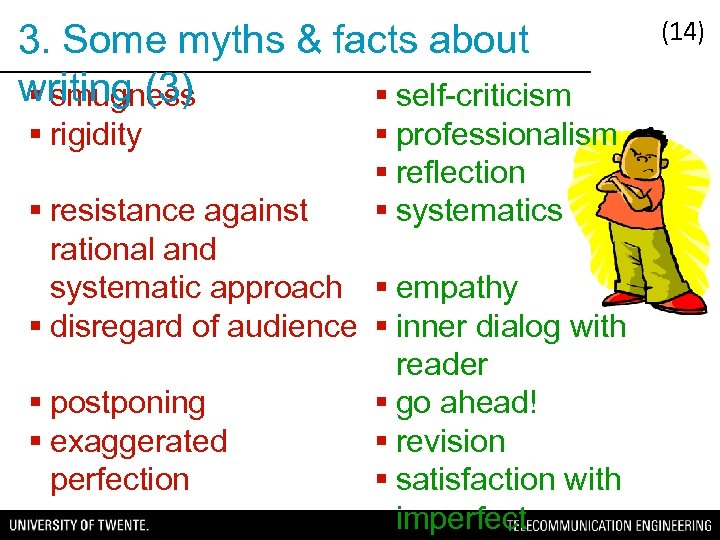 3. Some myths & facts about writing (3) § smugness § self-criticism § rigidity § professionalism § reflection § systematics § resistance against rational and systematic approach § empathy § disregard of audience § inner dialog with reader § postponing § go ahead! § exaggerated § revision perfection § satisfaction with imperfect (14)
 Outline 1. Motivation 2. Proficient communication 3. Some myths & facts about writing 4. Preparation 5. The actual writing 6. Revision 7. Other forms of communication 8. Conclusion (15)
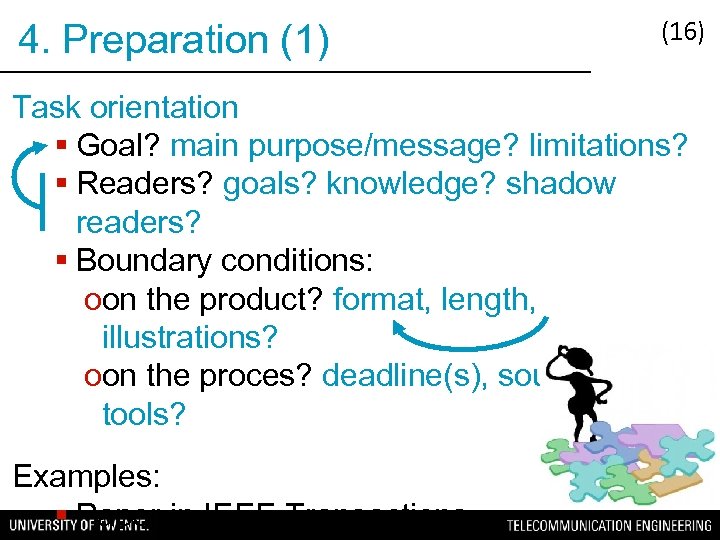 4. Preparation (1) (16) Task orientation § Goal? main purpose/message? limitations? § Readers? goals? knowledge? shadow readers? § Boundary conditions: oon the product? format, length, illustrations? oon the proces? deadline(s), sources, help, tools? Examples: § Paper in IEEE Transactions
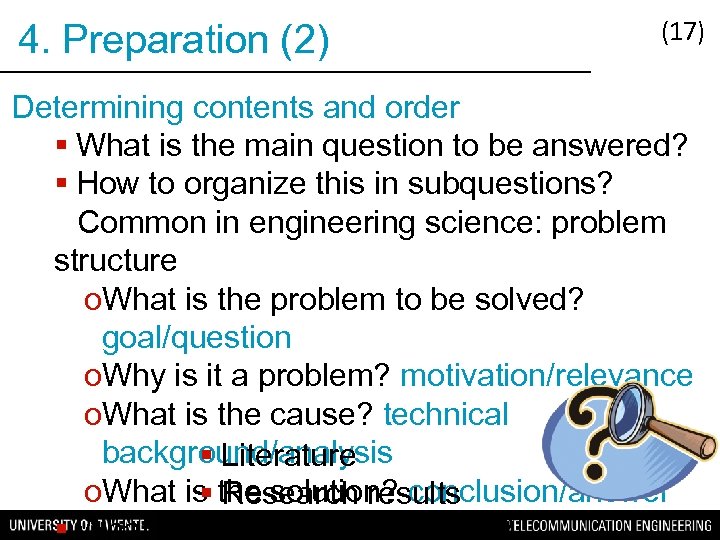 4. Preparation (2) (17) Determining contents and order § What is the main question to be answered? § How to organize this in subquestions? Common in engineering science: problem structure o. What is the problem to be solved? goal/question o. Why is it a problem? motivation/relevance o. What is the cause? technical background/analysis § Literature o. What is the solution? conclusion/answer § Research results § What is the proper detail level?
 Outline 1. Motivation 2. Proficient communication 3. Some myths & facts about writing 4. Preparation 5. The actual writing 6. Revision 7. Other forms of communication 8. Conclusion (18)
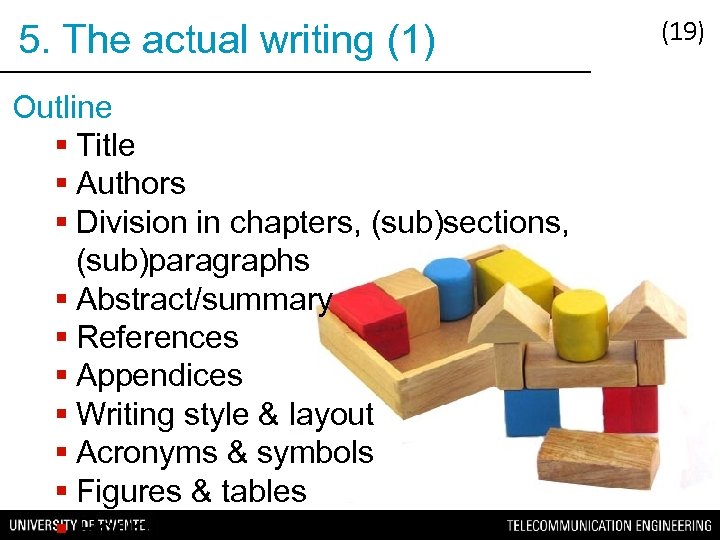 5. The actual writing (1) Outline § Title § Authors § Division in chapters, (sub)sections, (sub)paragraphs § Abstract/summary § References § Appendices § Writing style & layout § Acronyms & symbols § Figures & tables § Equations (19)
 5. The actual writing (2) Title purposes: § structuring o theme o keywords o type of text e. g. review, comparison, § motivating be creative… analysis, … possible approach: title – subtitle (20)
 in Telecommunication Engineering Some practical hints for preparing reports, papers and presentations Arjan Meijerink TE Presentation – May 29, 2012
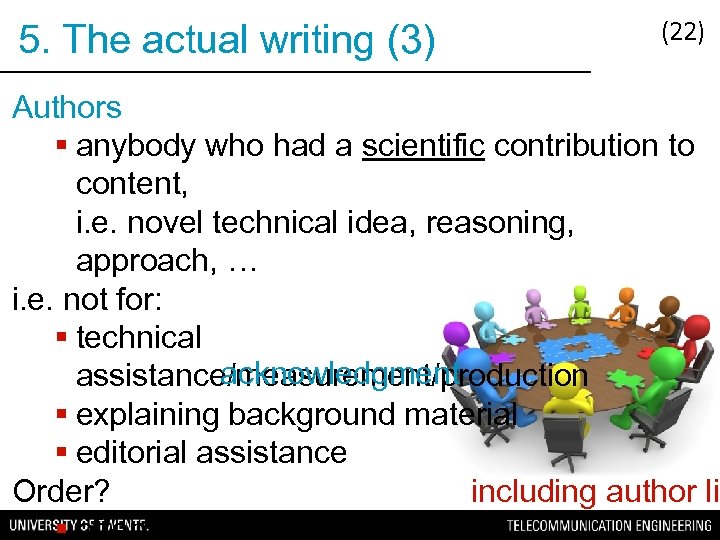 5. The actual writing (3) (22) Authors § anybody who had a scientific contribution to content, i. e. novel technical idea, reasoning, approach, … i. e. not for: § technical acknowledgment assistance/measurement/production § explaining background material § editorial assistance Order? including author lis § often: student(s), advisor(s),
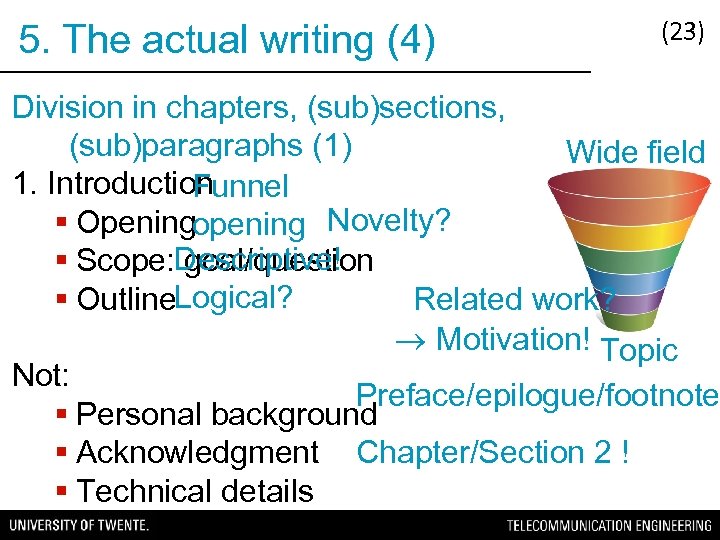 5. The actual writing (4) (23) Division in chapters, (sub)sections, (sub)paragraphs (1) Wide field 1. Introduction Funnel § Openingopening Novelty? § Scope: Descriptive! goal/question § Outline. Logical? Related work? Motivation! Topic Not: Preface/epilogue/footnote § Personal background § Acknowledgment Chapter/Section 2 ! § Technical details
 5. The actual writing (5) Division in chapters, (sub)sections, (sub)paragraphs (2) Connect x. Conclusion(s) (and recommendations) to § Goal achieved? introductio or: answer to research question n! § Future perspective, e. g. oapplications orelation to future work ocall to action Abstract ! Not: summary Remaining chapters/sections: support of (24)
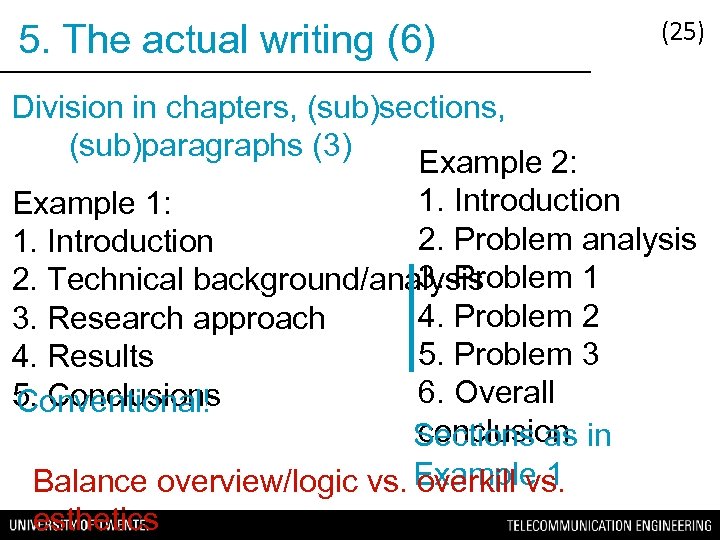 5. The actual writing (6) (25) Division in chapters, (sub)sections, (sub)paragraphs (3) Example 2: 1. Introduction Example 1: 2. Problem analysis 1. Introduction 3. Problem 1 2. Technical background/analysis 4. Problem 2 3. Research approach 5. Problem 3 4. Results 6. Overall 5. Conclusions Conventional! conclusion Sections as in Balance overview/logic vs. Example 1 overkill vs. esthetics
 5. The actual writing (7) (26) Abstract/summary § Summary of context, scope, support, conclusion § Typically o 1– 2 pages, ~1 paragraph/chapter (report) o 1 paragraph, 1– 3 lines/section (paper) So distinguish between: § Preface: personal notes etc. outside scope § Introduction: context, scope, outline § Conclusion: evaluation/answer
 5. The actual writing (8) (27) References § Not: list of consulted or recommended refe material r! § Purpose: honor / support / context § Form: quote / summary / citation § Descriptive & traceable (complete!) § In order of citation [4] http: //www. utwente. nl/ewi/te/ Better: [4] Web site of the Telecommunication Engineering the University of Twente, http: //www. utwente. nl/ewi/te/. Group at
 5. The actual writing (9) refe Appendices r! Anything that is relevant but not essential for understanding e. g. raw data, mathematical proof, source code or at least not for every reader e. g. summary background knowledge (28)
 5. The actual writing (10) (29) Writing style & layout § be specific and precise § be punctual (spelling & layout) § be consistent § follow conventions Acronyms & symbols § Introduced once, upon first occurrence Exception: abstract § Abbreviated words not capitalized. Exception: names The probability density function (PDF) is given by […]. From this PDF it follows that
 5. The actual writing (11) (30) refe Figures & tables r! § Purpose: illustration, support, attraction, esthetics § Should explain (not be explained) § Should not contain more information than needed e. g. graphs § Independent var. on x axis; dependent var. on y axis § Clearly define variables and units § Scales: illustrative and consistent
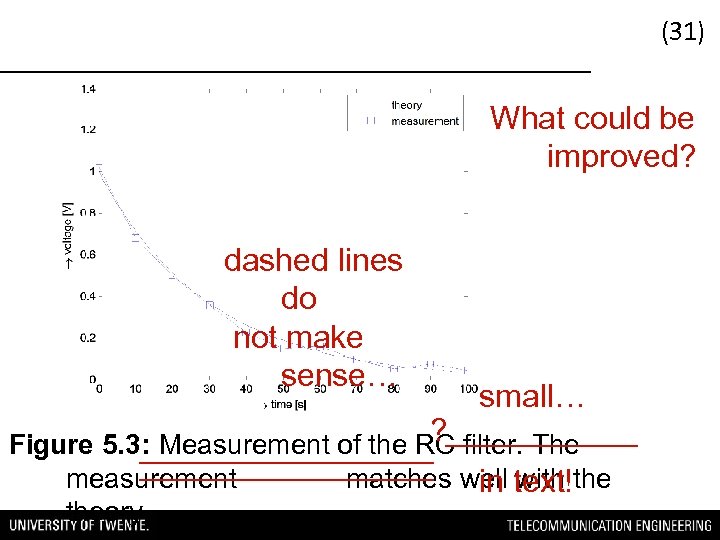 (31) What could be improved? dashed lines do not make sense… small… ? Figure 5. 3: Measurement of the RC filter. The measurement matches well text!the in with theory.
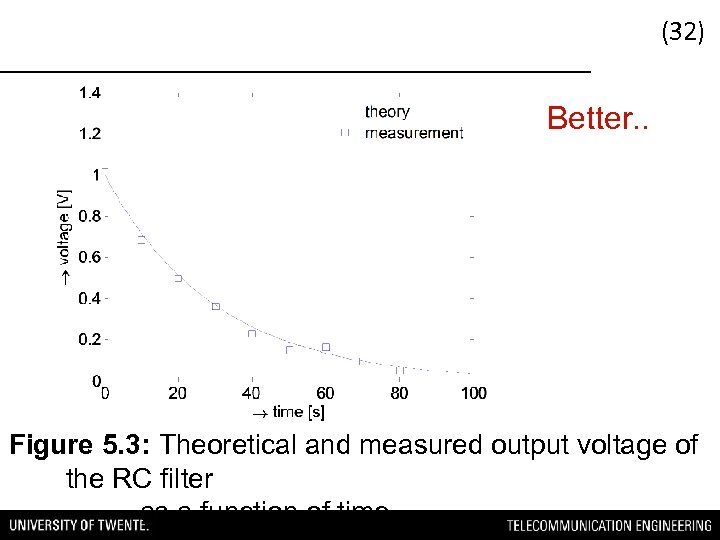 (32) Better. . Figure 5. 3: Theoretical and measured output voltage of the RC filter as a function of time
 5. The actual writing (11) (33) refe Figures & tables r! § Purpose: illustration, support, attraction, esthetics § Should explain (not be explained) § Should not contain more information than needed e. g. graphs § Independent var. on x axis; dependent var. on y axis § Clearly define variables and units § Scales: illustrative and consistent Captions
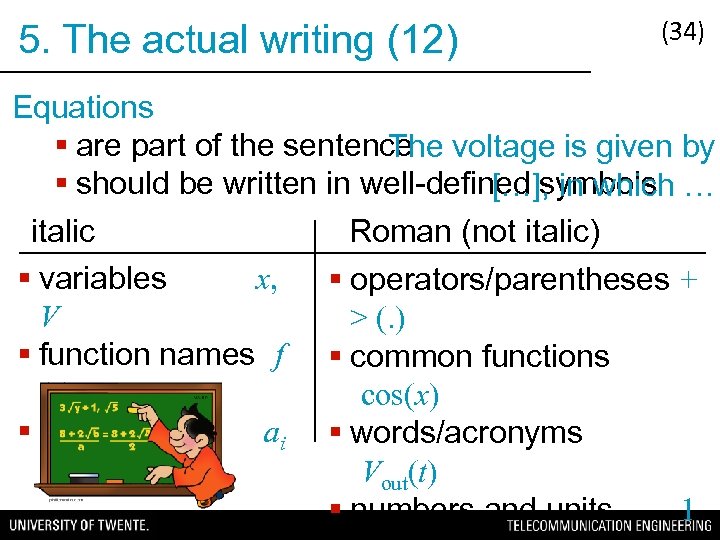 5. The actual writing (12) (34) Equations § are part of the sentence voltage is given by The § should be written in well-defined symbols … […], in which italic Roman (not italic) § variables x, § operators/parentheses + V > (. ) § function names f § common functions (x) cos(x) § indices ai § words/acronyms Vout(t) § numbers and units 1
 Outline 1. Motivation 2. Proficient communication 3. Some myths & facts about writing 4. Preparation 5. The actual writing 6. Revision 7. Other forms of communication 8. Conclusion (35)
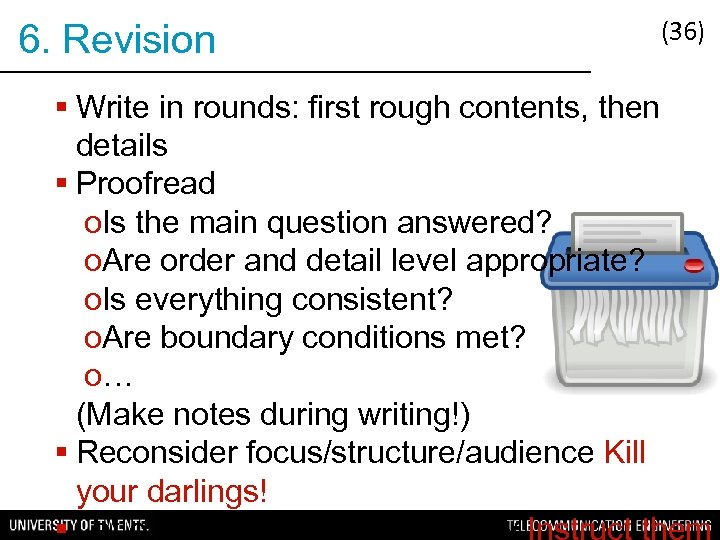 6. Revision (36) § Write in rounds: first rough contents, then details § Proofread o. Is the main question answered? o. Are order and detail level appropriate? o. Is everything consistent? o. Are boundary conditions met? o… (Make notes during writing!) § Reconsider focus/structure/audience Kill your darlings! § Let others (co-authors? ) review Instruct them
 Outline 1. Motivation 2. Proficient communication 3. Some myths & facts about writing 4. Preparation 5. The actual writing 6. Revision 7. Other forms of communication 8. Conclusion (37)
 7. Other forms of communication Presentations Main difference with report/paper? § perception by audience! i. e. more effort required on: § focus § clear presentation § motivation § stressing important § completeness things §… Main difference oral/poster presentation? Other examples E-mails, phonecalls, meetings, … (38)
 8. Conclusion (39) Proper writing is mainly a matter of being aware of your goal and having the right attitude …just like doing the actual research itself (…and many other things you do in life). Good luck writing