 Скачать презентацию Tele-Trade Stepping-Stone or Stumbling-Block on the Way to
47ee67344f17ff60943b92013fab565a.ppt
- Количество слайдов: 33



Tele-Trade: Stepping-Stone or Stumbling-Block on the Way to e. Commerce in Vietnam Stefan Probst, Opticom Technologies Ltd. Internet Society VN, Internet Societal Task Force, with valuable support of the GTZ SME Project www. SMEnet. com. vn Copyright, 2001 © Stefan Probst “stand-alone” version of 24. 11. 2001
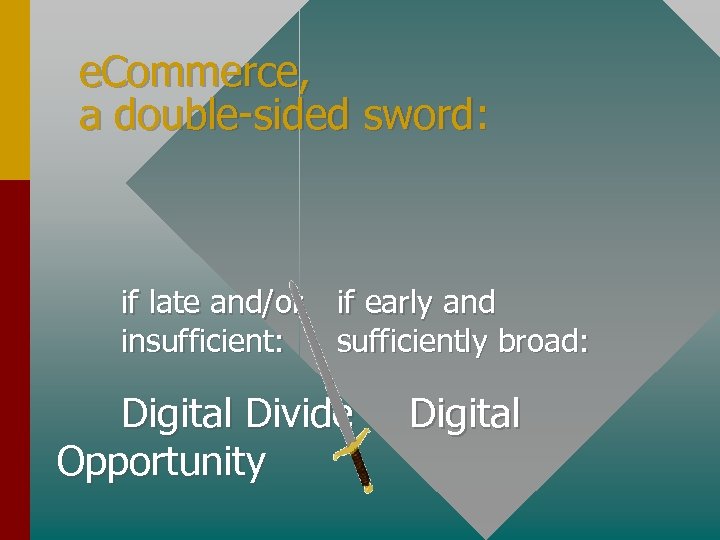
e. Commerce, a double-sided sword: if late and/or insufficient: if early and sufficiently broad: Digital Divide Opportunity Digital
“e. Commerce” in Vietnam - Legislation - • “By end of 2005 a majority of Vietnamese businesses and all Government offices will be involved in e. Commerce” • “… the legal environment is the primary factor for developing e. Commerce… Relevant e. Commerce laws have yet to be issued. . . ” • e. Commerce Project under Ministry of Trade, 14 sub projects, 24 State bodies involved
“e. Commerce” in Vietnam - Business - • Much hype, little real action: until today (Nov. 2001), not a single Vietnamese site accepts firm orders or on-line payments. • VERY few companies have a detailed on-line catalogue, i. e. the first step to e. Commerce. • Until recently (before “Decree #55”), Internet presence was difficult and/or expensive.
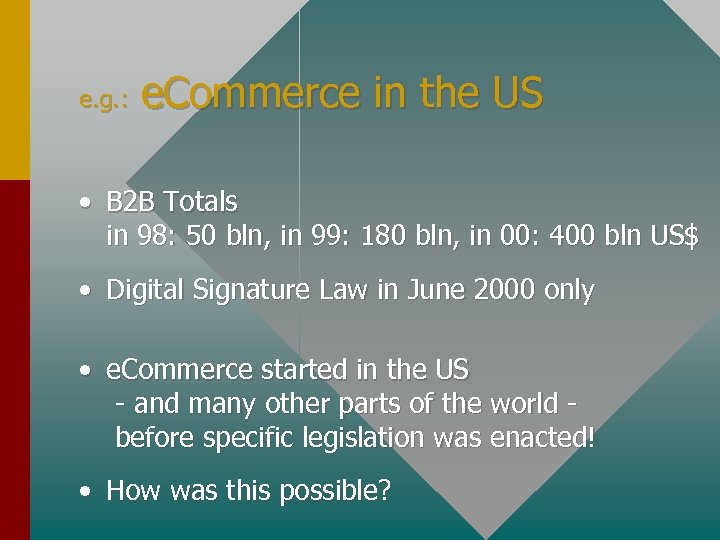
e. g. : e. Commerce in the US • B 2 B Totals in 98: 50 bln, in 99: 180 bln, in 00: 400 bln US$ • Digital Signature Law in June 2000 only • e. Commerce started in the US - and many other parts of the world before specific legislation was enacted! • How was this possible?
Before there was e. Commerce. . . • Because in many countries in the West, there was long time already “Tele-Trade”: – buyers and sellers never meet in person; an “unpersonal” business relation – offering, ordering, payment, delivery is done over a distance – post, telecom, and bank services made this possible; laws and regulations didn’t obstruct.
e. g. : Tele-Trade in Germany (data taken from two biggest German mail-order companies) • 1878: Cash on Delivery Service by Post Office (seller sends good via post office, buyer pays on receiving to the post man post office transfers the money to the seller) (safe for the seller: looses max. the post/mailing fee, safe for the buyer: no need for advance payment) – VN: not yet!
Tele-Trade in Germany • 1878: Cash on Delivery Service by Post Office • 1927: Mail-Order Company founded – not yet in VN (quite impossible without COD)
Tele-Trade in Germany • 1878: Cash on Delivery Service by Post Office • 1927: Mail-Order Company founded • 1928: First printed catalogue – in VN since about mid ‘ 90 s – still very rare and unusual – often very incomplete
Tele-Trade in Germany • 1878: Cash on Delivery Service by Post Office • 1927: Mail-Order Company founded • 1928: First printed catalogue • mid 60 s: Telephone orders – VN, since mid 90 s: only for direct deliveries (e. g. gas bottles, fast food, medical services) or to known customers
Tele-Trade in Germany • 1878: Cash on Delivery Service by Post Office • 1927: Mail-Order Company founded • 1928: First printed catalogue • mid 60 s: Telephone orders • 1989: 24 h-Delivery Service • 1990: Telephone orders 24 h/7 d (COD or CC) • 02. 95: Catalogue on CD-ROM
e. Commerce in Germany • 08. 95: from Tele-Trade to e. Commerce: – e. Offer: Catalogue in the Internet – e. Order: e. Mail or “shopping cart” on Website – e. Invoice: e. Mail or print-out of Website, if at all – e. Payment: e. Banking with Credit Card on Website or via – e. Delivery: (n/a in this case; only digital goods) alternative payments: * COD (cash on delivery) * “open invoice” (for known customers, state offices, etc. )
From Tele-Trade to e. Commerce • A comparable small step - for buyers and sellers from Tele-Trade to e. Commerce! • If Tele-Trade is possible, then only very few additional legislation is needed, but some more is helpful: e. g. USA: * Digital Signature Law in June 2000 only
Official Awareness in Vietnam • The Party and the Government consider e. Commerce as important (but tend to underestimate the urgency). • International Donors are willing to assist (but think actually only about the small step from Tele-Trade to e. Commerce and tend to forget the pre-conditions).
Official’s and Media Awareness • Confusion about Segments, Importance, Implementation Differences: – B 2 C vs. B 2 B cited problems: “few credit cards, few bank accounts” “high connection cost” BUT B 2 B is world-wide larger than B 2 C, Businesses can easily obtain a credit card, they have bank accounts, and commercial benefits outweigh high connection cost
Official’s and Media Awareness • Confusion about Segments, Importance, Implementation Differences: – B 2 C vs. B 2 B – domestic vs. international Differences: not always need for credit cards for domestic e. Commerce, excessive import/export procedures, strict “financial Invoices” unknown abroad, foreign bank accounts are strictly regulated/not allowed, use of foreign currencies is regulated International segment is more important and more urgent
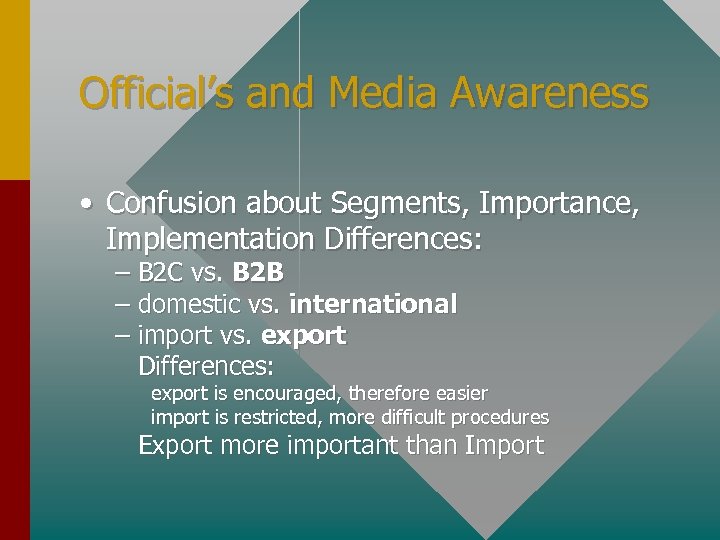
Official’s and Media Awareness • Confusion about Segments, Importance, Implementation Differences: – B 2 C vs. B 2 B – domestic vs. international – import vs. export Differences: export is encouraged, therefore easier import is restricted, more difficult procedures Export more important than Import
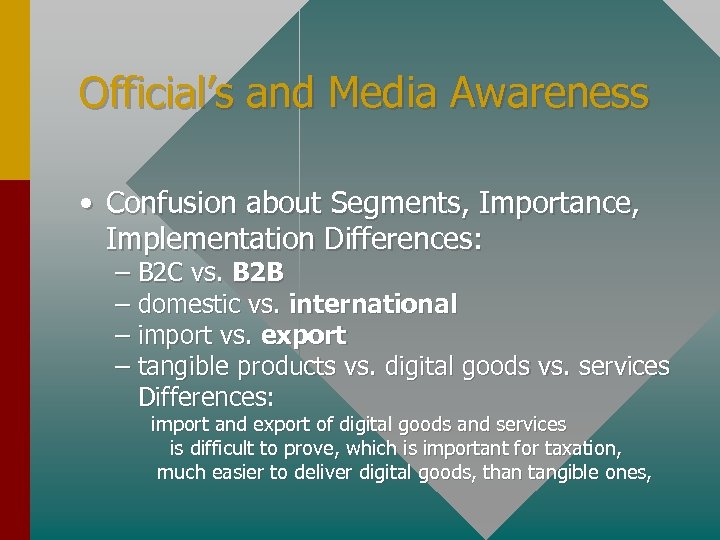
Official’s and Media Awareness • Confusion about Segments, Importance, Implementation Differences: – B 2 C vs. B 2 B – domestic vs. international – import vs. export – tangible products vs. digital goods vs. services Differences: import and export of digital goods and services is difficult to prove, which is important for taxation, much easier to deliver digital goods, than tangible ones,
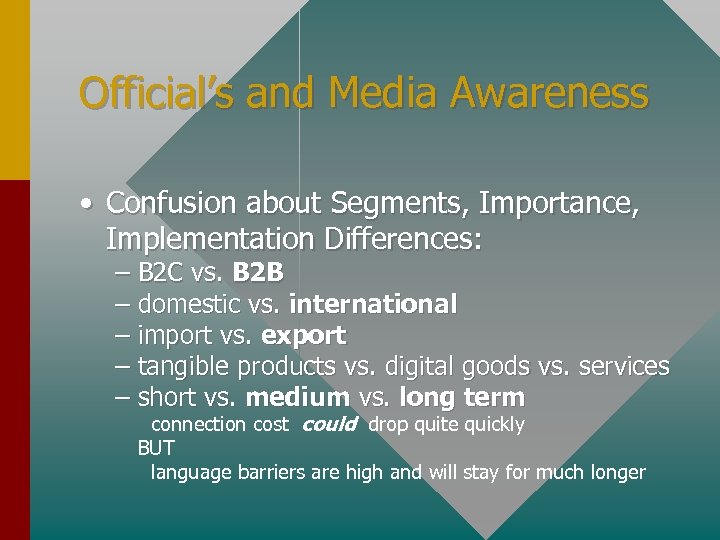
Official’s and Media Awareness • Confusion about Segments, Importance, Implementation Differences: – B 2 C vs. B 2 B – domestic vs. international – import vs. export – tangible products vs. digital goods vs. services – short vs. medium vs. long term connection cost could drop quite quickly BUT language barriers are high and will stay for much longer
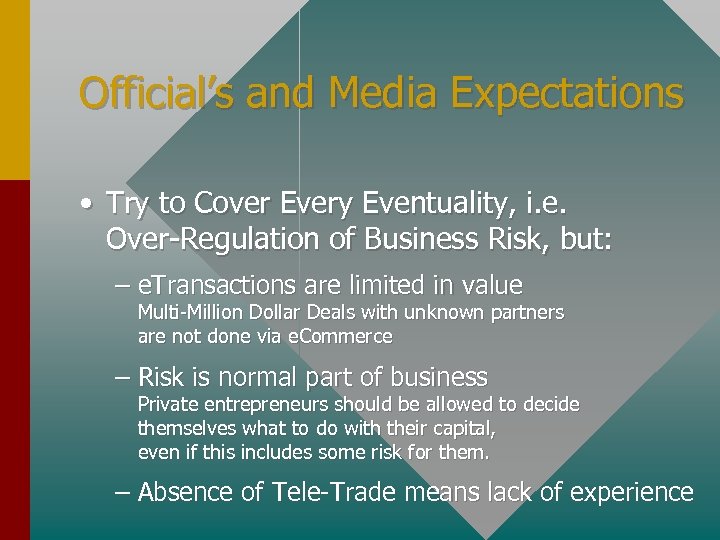
Official’s and Media Expectations • Try to Cover Every Eventuality, i. e. Over-Regulation of Business Risk, but: – e. Transactions are limited in value Multi-Million Dollar Deals with unknown partners are not done via e. Commerce – Risk is normal part of business Private entrepreneurs should be allowed to decide themselves what to do with their capital, even if this includes some risk for them. – Absence of Tele-Trade means lack of experience
Businesses’ Awareness • Don’t recognize important changes during the last years (e. g. Commercial Law). • Believe too much the poor information in the media (e. g. “Cannot start until more Laws are issued”). • Wait sometimes too much for the State. • Often prefer to pay “tea money” instead of insisting on their rights (e. g. when new regulations).
The Situation in Vietnam • The most important e. Commerce enabling laws are already in place! – the Civil Code allows verbal contracts and contracts by specific action – the Commercial Law gives agreements by e. Mail and other electronic communication the status of written contracts – a new official letter allows export contracts by e. Mail etc. , according to Commercial Law
The Situation in Vietnam • The most important e. Commerce enabling laws are already in place! • Tele-Trade is next to impossible: – no COD service by Post Office – sellers not used to comprehensive catalogues – details of taxation, customs, other regulations make Tele-Trade very difficult or impossible
To Do - Short Term: The Government, Ministries, etc. • Introduce COD Service (DGPT) • Allow Basic Forms of Encryption for e. Commerce (Gov. Committee on Encryption) • Allow Companies to open Bank Accounts Abroad to receive e. Commerce payments. • Allow Verbal and Electronic Form for “Economic Contracts” (Government)
To Do - Short Term: The Government, Ministries, etc. • Speed-up the Implementation of Payment Gateway (Banks, Finance Ministry) • Allow Foreign Currencies for Domestic e. Commerce (as long as VND is not yet possible). • Set-up a “Red Tape e. Task Force” where businesses can report problems with existing regulations - and maybe get solutions
To Do - Medium Term: The Government, Ministries, etc. • Overhaul - or abolish - the Ordinance on Economic Contracts • Overhaul the Financial Invoice Regime • Focus on “Localization” of the Internet: * Tools (Hardware and Software) * Standards * Content (other problems will disappear over time, or solved elsewhere, but this very big one will have to be solved by Vietnam itself)
Difficult, but Possible Now • Domestic B 2 B Trade (very difficult to receive credit card payments) • Domestic B 2 C Trade (but no “trial sales”) (very difficult to receive credit card payments and no COD, therefore only advance payment or open invoice) • Note: paying on-line with a credit card is usually done via an encrypted Internet transmission protocol (https). Encryption is at present not allowed in VN.
Possible Now Already • Export of Tangible Goods (via foreign payment clearing house, or conventional payment) • Import of Tangible Goods (using a credit card or conventional payment) (but needs a “contract” by e. Mail or webpage) • Import of Digital Goods for Re-sale (actually grey-area: goods would be de-facto smuggled into VN, but since all taxes (VAT) would be paid on re-sale, the state would loose no taxes)
Benefits • SMEs can get additional foreign customers - no need to visit expensive fairs abroad - no middle man, therefore make full use of low labour cost • Easy International Procurement - wide range of available products - search for lowest prices
Benefits • Study Competition (as part of marketing) - adapt products (to the customer’s taste) - adapt prices (stay competitive) • Bridge Domestic Urban-Rural Gap: - buy from everywhere - sell to everywhere
Conclusions • NO new laws are needed to START • Some changes are needed to make it easier • Most of the changes could be done quickly • Allow business risks - at least for private sector • Foreign Markets don’t wait - Act now! • Domestic Sellers: Prepare and Start NOW!
Conclusions From US Government “A Framework for Global Electronic Commerce”: “There is a great opportunity for commercial activity on the Internet. If the private sector and governments act appropriately, this opportunity can be realised for the benefit of all people. ”
e. Commerce Consultancy: e. Commerce@opticom-vn. com e. Commerce Workgroup: e. Commerce@ISOC-VN. org Full presentation, with translation, will be on-line at www. ISOC-VN. org
Скачать презентацию Tele-Trade Stepping-Stone or Stumbling-Block on the Way to
47ee67344f17ff60943b92013fab565a.ppt