 Скачать презентацию Tele Med IS A Novel Mobile-Health System
1a0a8df09fb95f4325b24a671b94c60d.ppt
- Количество слайдов: 26



Tele. Med. IS ™ A Novel Mobile-Health System in Sweden Presentation by: R&D Engineer, Sven Jonsson Biomedical Engineering Department, Karolinska University Hospital Project co-financed by:
Agenda q Tele. Med. ISTM Project q Tele. Med. ISTM Main Sub-systems q The Users q Trials Program q Potential Benefits q Conclusion q Reflection from the past TTe. C 2006, Tromsö, Sven Jonsson, Karolinska
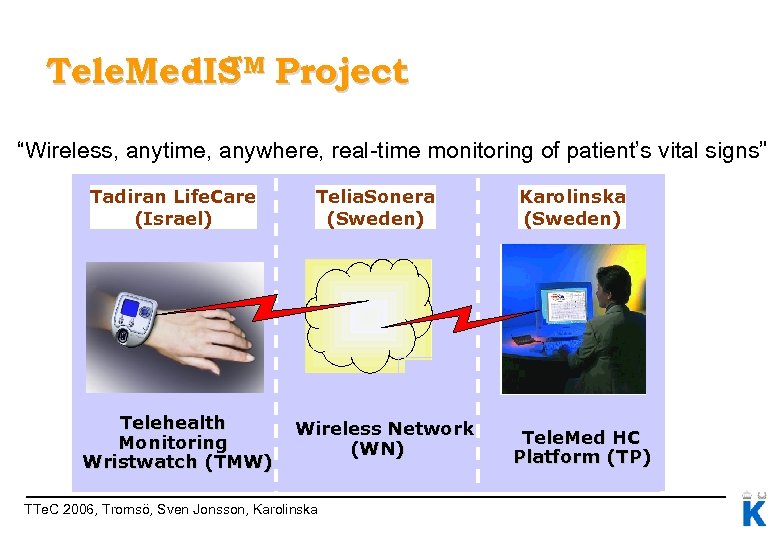
TM Tele. Med. IS Project “Wireless, anytime, anywhere, real-time monitoring of patient’s vital signs” Tadiran Life. Care (Israel) Telehealth Monitoring Wristwatch (TMW) Telia. Sonera (Sweden) Wireless Network (WN) TTe. C 2006, Tromsö, Sven Jonsson, Karolinska (Sweden) Tele. Med HC Platform (TP)
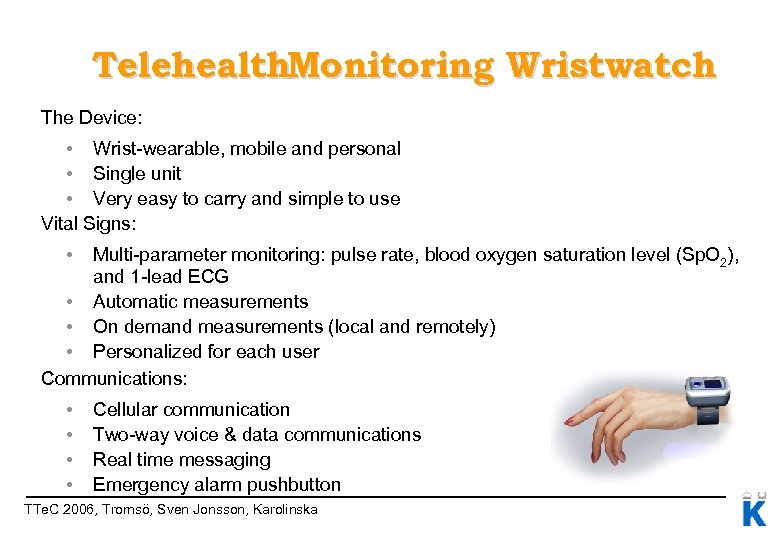
Telehealth. Monitoring Wristwatch The Device: • Wrist-wearable, mobile and personal • Single unit • Very easy to carry and simple to use Vital Signs: • Multi-parameter monitoring: pulse rate, blood oxygen saturation level (Sp. O 2), and 1 -lead ECG • Automatic measurements • On demand measurements (local and remotely) • Personalized for each user Communications: • • Cellular communication Two-way voice & data communications Real time messaging Emergency alarm pushbutton TTe. C 2006, Tromsö, Sven Jonsson, Karolinska
Tele. Med Home-Care Platform Seamless connection of the hospital to patients (in and out of the hospital) Integrate and coordinate patient’s medical data from various resources Enhanced level of information in real-time for patients & caregivers Common infrastructure for telemedicine applications Rapid Development of future applications Easier management, and greater extensibility TTe. C 2006, Tromsö, Sven Jonsson, Karolinska
TM Tele. Med. IS – System Layout TTe. C 2006, Tromsö, Sven Jonsson, Karolinska
TM Tele. Med. IS Users Populations: • In-hospital patients • Post-hospital patients (at home) • People at risk groups (living in the community) • Elderly people Diseases: • Congestive Heart Failure (CHF) • Arythmia • Respiratory diseases • COPD follow-up TTe. C 2006, Tromsö, Sven Jonsson, Karolinska
Engineering Trials Program Usability tests Communication tests Reliability tests Security and safety tests Interoperability tests TTe. C 2006, Tromsö, Sven Jonsson, Karolinska
Engineering Trials Results Usability tests • Handling TMW through application • Assigning TMW to patients • Managing updates to TMW work very well towards end-users • Error handling in TMW and detection by TP and technical staff was smooth as well. Note: usability of Tele. Med. IS System will be conducted also during Clinical trials TTe. C 2006, Tromsö, Sven Jonsson, Karolinska
Engineering Trials Results Communication tests • Sending data from 250 simulated TMWs • Processing time took only 28 seconds for FTP Server Procesing time only 74 seconds for Ensemble. Conclusion: • Clinical and technical staff at Karolinska will be able to look at patient information of 250 patients after 2 minutes from the time when TMW sends patient information to Karolinska. TTe. C 2006, Tromsö, Sven Jonsson, Karolinska
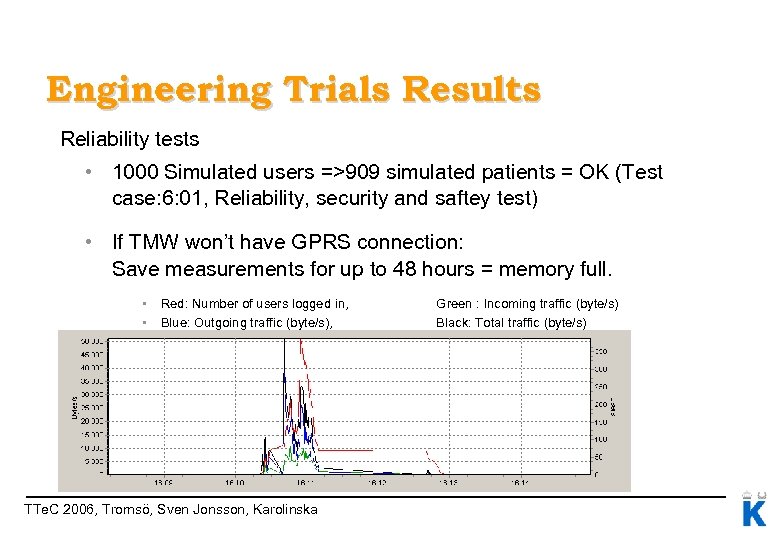
Engineering Trials Results Reliability tests • 1000 Simulated users =>909 simulated patients = OK (Test case: 6: 01, Reliability, security and saftey test) • If TMW won’t have GPRS connection: Save measurements for up to 48 hours = memory full. • • Red: Number of users logged in, Blue: Outgoing traffic (byte/s), TTe. C 2006, Tromsö, Sven Jonsson, Karolinska Green : Incoming traffic (byte/s) Black: Total traffic (byte/s)
Engineering Trials Results Security and Saftey tests • Implemented state-of-the-art security solutions from TMW to Tele. Med. IS Gateway. • All messages are sent through encrypted channels. • And in addition, no names and personal identification numbers are sent through those channels. • Therefore, even if intruder gets down to the information sent from TMW, he/she won’t pinpoint the actual patient. • Once the message is decrypted at Tele. Med. IS Gateway, it is sent to the TP in plain text. This is a normal practice in Karolinska, where the network is already secured. This is part of Sjunet security service. TTe. C 2006, Tromsö, Sven Jonsson, Karolinska
Engineering Trials Results Interoperability tests • Tele. Med. IS System comprises of: • • TMW Gateway TP Clinical and TMW Manager Applications. Tests have been performed to identify interoperability issues, and any deviations from current standards. Conclusion: At its current state, Tele. Med. IS System is interoperable. TTe. C 2006, Tromsö, Sven Jonsson, Karolinska
Engineering Trials Results Back draw • TMW Manager and Clinical applications that are hosted in TP were developed in early phases of the project and therefore lacked user-friendliness towards clinical staff. • Small interoperability issues between Gateway, and TP, which was mostly due to software updates between partners. => Once latest releases were integrated => OK • Some issues between TP and Clinical and TMW Manager Applications, due to incompatible Java Interface at TP. => This has been solved by implementing new Java Interface at TP. TTe. C 2006, Tromsö, Sven Jonsson, Karolinska
Resume Enineering Trials The results were positive and necessary towards further improvement of Tele. Med. IS System can be used at its current stage, without further upgrade of hardware and software. Conclusion: Therefore, the system is ready to be rolled out for Clinical Trials. TTe. C 2006, Tromsö, Sven Jonsson, Karolinska
Clinical Trial. Objectives INSIDE TRIAL: Compare the measured values with conventional equipment Testing of the Tele. Med. IS system in real life situations To control the usability of the TMW and the TP TTe. C 2006, Tromsö, Sven Jonsson, Karolinska
Clinical Trial. Objectives OUTSIDE TRIAL: Testing of the Tele. Med. IS system in real life situations To control the usability of the TMW and the TP TTe. C 2006, Tromsö, Sven Jonsson, Karolinska
Patientcharacteristics Male or female patient suffering from severe COPD Subjects must be enough healthy to be able to handle the TMW Subjects must have a prescribed oxygen treatment at home Subjects must sign the written informed consent TTe. C 2006, Tromsö, Sven Jonsson, Karolinska
Trial procedure. Inside Hospital Approximately 24 hours Compare to conventional equipment Perform Pulse rate, ECG and Sp. O 2 measurements once an hour Information will be sent to the TP at least once a day (Automatically, TP request or patient selection) TTe. C 2006, Tromsö, Sven Jonsson, Karolinska
Trial procedure Outside Hospital , One week Perform Pulse rate, ECG and Sp. O 2 measurements once an hour Information will be sent to the TP at least once a day (Automatically, TP request or patient selection) TTe. C 2006, Tromsö, Sven Jonsson, Karolinska
Clinical Trial Program (1) s Evaluation of Information Quality Success: • Accuracy • Presentation • Flexibility Evaluation of System Use Success: • Usefulness • Easy of learning • Convenience • User support TTe. C 2006, Tromsö, Sven Jonsson, Karolinska
Clinical Trial Program ( ) s 2 Evaluation of User Satisfaction Success: • Patients • Healthcare professionals (HCP) Evaluation of Service Impacts Success: • Service quality for patients, relatives and HCP • Monitoring accuracy TTe. C 2006, Tromsö, Sven Jonsson, Karolinska
Sweden – Potential Benefits Government/Public: • Economical: • Possible cost reduction in healthcare systems • Enabling process oriented healthcare services • Assisting nurses and medical staff • May be integrated with future systems, like: Sjunet (the Swedish national health information network) Patients: • Better healthcare – long arm of the hospital • Increasing patient’s involvement Physicians: 1. Effective information for efficient medical treatment 2. More efficient medication management TTe. C 2006, Tromsö, Sven Jonsson, Karolinska
Conclusion Based on the trial outcomes and the expected results of the clinical trials we recognized the potential benefits for patients, physicians, administrators and other stakeholders using the Tele. Med. IS system as follows: • On-line contact with medical center • More efficient medical treatment • Better post hospital treatment and recuperation • Cost savings to providers and users by reduction the numbers of visits at the clinic • Enhanced, timely information for physicians & patients • Eliminate the need to travel to clinic for unnecessary visits • Enhanced lifestyle and peace in mind TTe. C 2006, Tromsö, Sven Jonsson, Karolinska
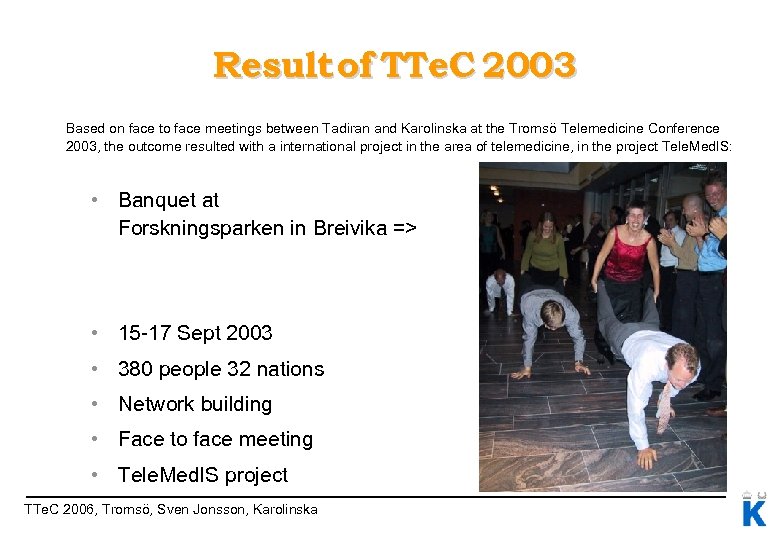
Result of TTe. C 2003 Based on face to face meetings between Tadiran and Karolinska at the Tromsö Telemedicine Conference 2003, the outcome resulted with a international project in the area of telemedicine, in the project Tele. Med. IS: • Banquet at Forskningsparken in Breivika => • 15 -17 Sept 2003 • 380 people 32 nations • Network building • Face to face meeting • Tele. Med. IS project TTe. C 2006, Tromsö, Sven Jonsson, Karolinska
Questions Contact: Sven Jonsson sven. jonsson@karolinska. se Phone: 08 -585 807 55 www. karolinska. se/mta TTe. C 2006, Tromsö, Sven Jonsson, Karolinska
Скачать презентацию Tele Med IS A Novel Mobile-Health System
1a0a8df09fb95f4325b24a671b94c60d.ppt