


 Скачать презентацию TEL 355 Communication and Information Systems in Organizations
938a7473ff4ffa7a0bb8d5db44f8591e.ppt
- Количество слайдов: 17
 TEL 355: Communication and Information Systems in Organizations Speech-Enabled Interactive Voice Response Systems Professor John F. Clark
 Interactive Voice Response • Serves as the bridge between people and computer databases via phone lines • Used in a variety of applications including stock trades, account information and transactions, ticket reservations, etc. • Represents the natural progression from touch-tone systems to natural speech recognition in telephony-based self-service
 Speech Recognition Spectrum • Touch-Tone Replacement – Recognizes spoken letters and words that represent the keypad • Directed Dialogue – Recognizes fairly simple words and phrases that are clearly enunciated • Natural Language – Recognizes more complex phrases and sentences spoken in a conversational manner
 History of IVR • Significant research and development by ARPA since the late 80 s • Early Discrete Number Recognition required careful enunciation and separation • Continuous Speech Recognition can handle unbroken strings of words • But, recognition of free-form conversation is not yet a reality • However, it is commercially viable in a number of customer service applications
 Natural Language Technology • Phonetic Speech Recognition – Breaks spoken words into fundamental sound units called phonemes – Enables greater accuracy in recognizing larger vocabularies • Language Modeling – Makes the best guess for sounds that are not adequately recognized – Compares sounds to a database of sounds and creates a confidence score for possible meaning
 Rationale for IVR • Reduces spiraling labor costs • Higher call volumes make IVR a more costeffective solution • Increased processing power means newer systems are faster and more accurate • Software and hardware costs continue to decrease • IVRs are less costly and faster to implement than Web-based solutions
 Benefits of IVR • Dramatic reduction in operational costs • Improves productivity – A higher percentage of calls can be partially or fully automated – Frees the service agent from many routine tasks • Savings in overhead costs – As a result of decreased labor expenses – As a result of decreased real estate requirements and related infrastructure
 IVR Capabilities • • Speaker-independent phonetic recognition Natural language and number recognition Continuous alpha-numeric recognition Modular approach to software development Barge-in capability Speaker-trained voice verification Support for multiple languages
 Commercial Viability of IVR • Customers interact with business via phone • IVR reliability and accuracy is over 90% • By 2003, 30% of new automated lines in call centers will understand speech • Directed speech recognition application pays for itself in 9 -18 months in call centers with more than 50 agents • Total revenues for speech technology and services in telephony will exceed $38 billion by 2003
 Current Uses for IVR • • • Package tracking Stock quotes and trading Insurance claims Travel arrangements Prescription refills Restaurant reservations Banking activities Interaction with government agencies Directory Assistance
 IVR Security • Verbal security steps such as PIN numbers are easier to accomplish for the user than touch-tone keypad entry • Voice Print Technology – Tests vocal characteristics of utterances to verify the identity of the speaker – Especially beneficial for providers of financial services and telecommunications services where much information is subject to fraud
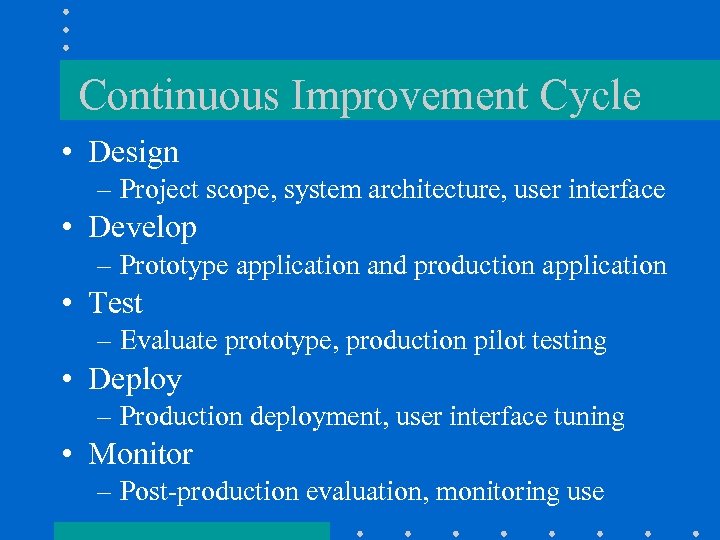 Continuous Improvement Cycle • Design – Project scope, system architecture, user interface • Develop – Prototype application and production application • Test – Evaluate prototype, production pilot testing • Deploy – Production deployment, user interface tuning • Monitor – Post-production evaluation, monitoring use
 Development and Deployment Strategy, Part I: Design • Determine the project scope – Explore business objectives and goals – Evaluate how users will use the system and the kind of transactions you will support • Determine the system architecture – Decide on specific applications – Determine the specifications for applications – Plan for a smooth transition • Assign development responsibilities and develop budgets
 Development and Deployment Strategy, Part II: Develop • Develop prototype applications – Subsets of your system’s ultimate functionality – Observe and assess the experiences of a select group of users – Determine all the features to be included in your production application – Think about connectivity with data, telecommunications, and information systems
 Development and Deployment Strategy, Part III: Test • Reduce risk by testing with targeted end users and conduct focus groups • Observe and evaluate minimally-trained workers in realistic settings • Implement a pilot test in an actual business setting with live, untrained callers as a preliminary, limited deployment • Identify desired improvements
 Development and Deployment Strategy, Part IV: Deploy • Fully deploy the IVR system • Manage the upgrade so that it doesn’t affect system reliability • Tune the user interface and vocabulary to the production environment • Ensure the IVR system is consistently satisfying callers and meeting your business objectives
 Development and Deployment Strategy, Part V: Monitor • Track critical usability indicators – Recognition accuracy – Transaction completion rates • Create usage reports and detailed call statistics • Design and implement evaluation tools such as customer satisfaction surveys • Fine-tune your system for maximum performance