 Скачать презентацию Ted Barnes Physics Div ORNL Dept of Physics
87e8a13a47c593197e38fb7ffbeee17b.ppt
- Количество слайдов: 68



Ted Barnes Physics Div. ORNL Dept. of Physics, U. Tenn. Strong Decays (open flavor) 1) 2) 3) 4) Big Questions Strong Decays: Historical introduction Status and prospects in quarkonia + exotica Future: Unquenching the quark model … q and g decay models. Mesons almost exclusively.
1. ) The Big Questions: We know LQCD … but what does it predict? What types of hadrons exist (as resonances)? Isn’t that just color singlets? No! (Beware multiquark systems. ) What are their masses and quantum numbers? State composition? What are their social properties? GOALS: 1. Establish and understand the spectrum. Requires: observe and analyze decays (esp. strong; maybe radiative) 2. Interactions
2. ) Strong Decays (open flavor): Historical Introduction (1969) The model used for strong decays now in current use (3 P 0) is due to L. Micu, Nucl. Phys. B 10, 521 -526 (1969) “Decay Rates of Meson Resonances in a Quark Model” In this pre-QCD model, Micu suggested that the simplest possible quantum numbers be assumed for the JPC of the qq pair produced in two-body open-flavor decays of quark model mesons and baryons, JPC = 0++ = vacuum quantum numbers. With no knowledge of the qq pair production mechanism this is simplest assumption.
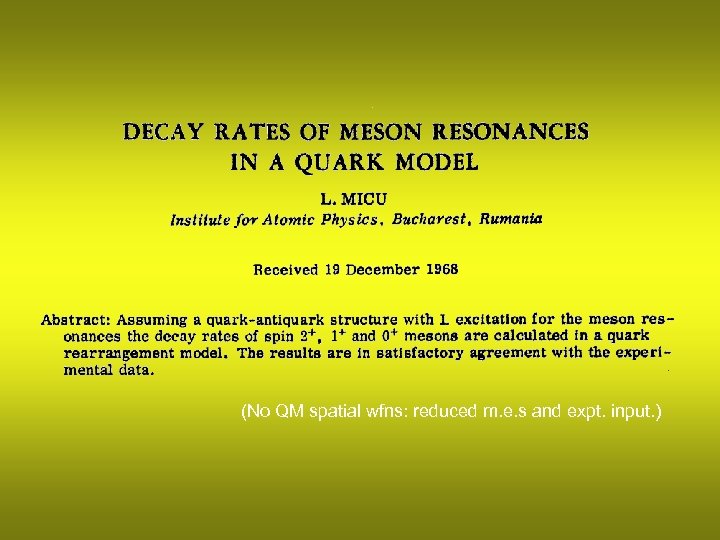
(No QM spatial wfns: reduced m. e. s and expt. input. )
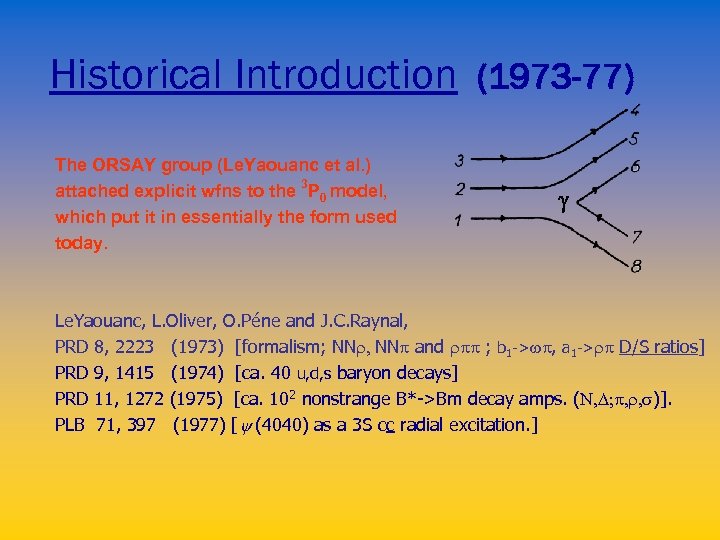
Historical Introduction (1973 -77) The ORSAY group (Le. Yaouanc et al. ) attached explicit wfns to the 3 P 0 model, which put it in essentially the form used today. g Le. Yaouanc, L. Oliver, O. Péne and J. C. Raynal, PRD 8, 2223 (1973) [formalism; NNr, NNp and rpp ; b 1 ->wp, a 1 ->rp D/S ratios] PRD 9, 1415 (1974) [ca. 40 u, d, s baryon decays] PRD 11, 1272 (1975) [ca. 102 nonstrange B*->Bm decay amps. (N, D; p, r, s)]. PLB 71, 397 (1977) [y (4040) as a 3 S cc radial excitation. ]
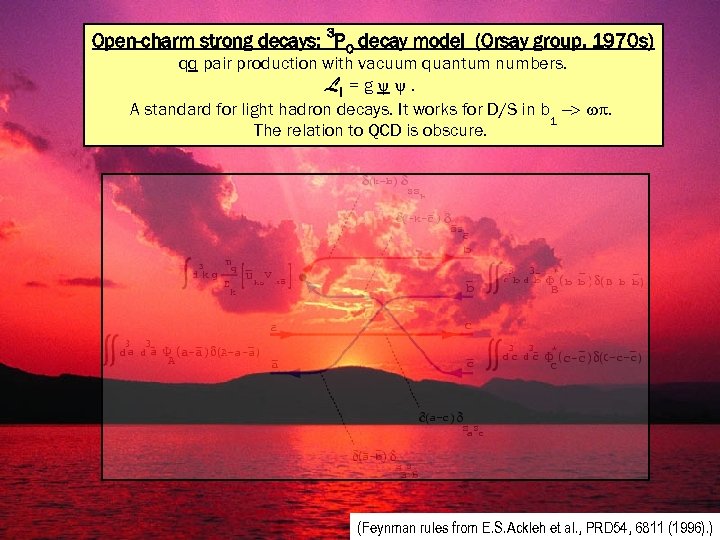
Open-charm strong decays: 3 P 0 decay model (Orsay group, 1970 s) qq pair production with vacuum quantum numbers. LI = g y y. A standard for light hadron decays. It works for D/S in b -> wp. 1 The relation to QCD is obscure. (Feynman rules from E. S. Ackleh et al. , PRD 54, 6811 (1996). )
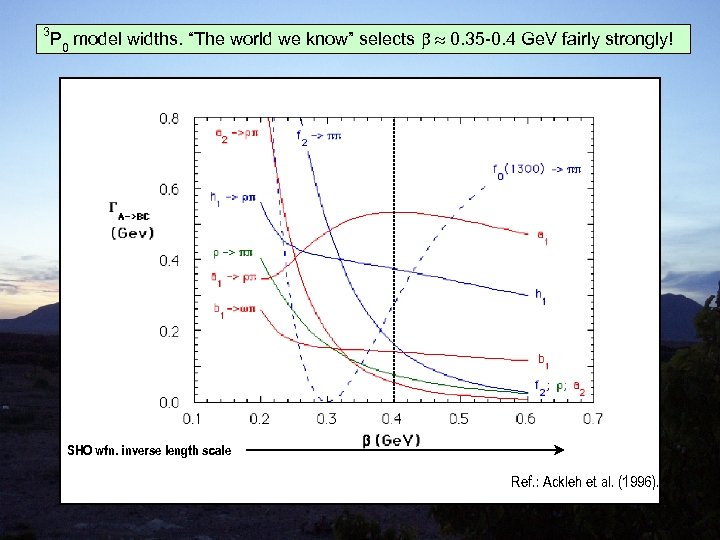
3 P 0 model widths. “The world we know” selects b » 0. 35 -0. 4 Ge. V fairly strongly! b = 0. 4 Ge. V = typical light qq meson SHO length scale SHO wfn. inverse length scale Ref. : Ackleh et al. (1996).
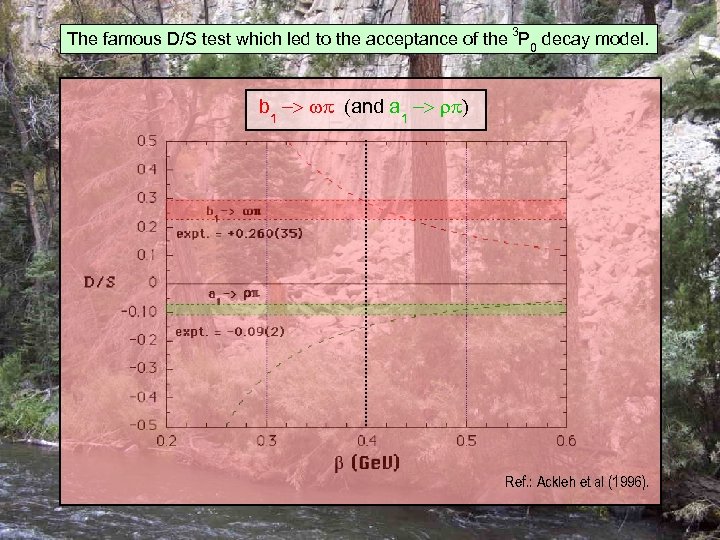
The famous D/S test which led to the acceptance of the 3 P 0 decay model. b 1 -> wp (and a 1 -> rp) Ref. : Ackleh et al (1996).
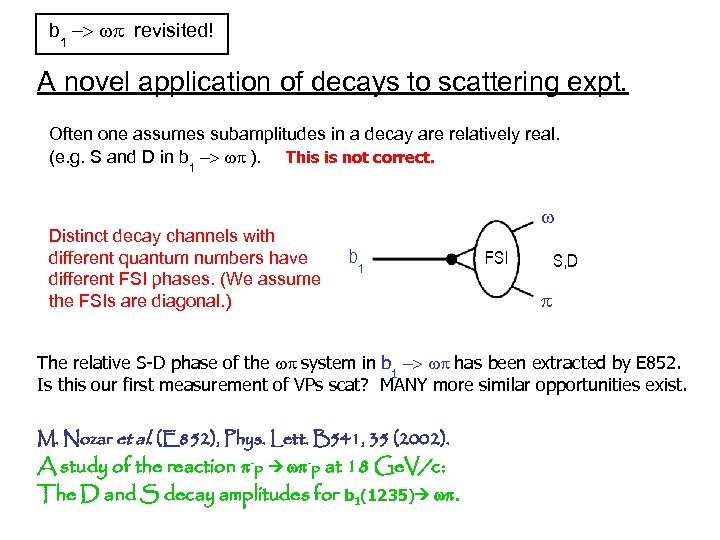
b 1 -> wp revisited! A novel application of decays to scattering expt. Often one assumes subamplitudes in a decay are relatively real. (e. g. S and D in b 1 -> wp ). This is not correct. Distinct decay channels with different quantum numbers have different FSI phases. (We assume the FSIs are diagonal. ) w b 1 FSI S, D p The relative S-D phase of the wp system in b 1 -> wp has been extracted by E 852. Is this our first measurement of VPs scat? MANY more similar opportunities exist. M. Nozar et al. (E 852), Phys. Lett. B 541, 35 (2002). A study of the reaction p-p wp-p at 18 Ge. V/c: The D and S decay amplitudes for b 1(1235) wp.
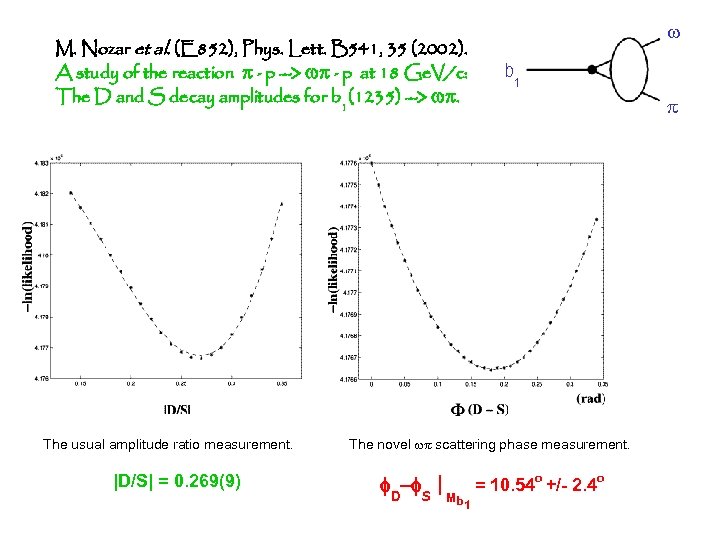
M. Nozar et al. (E 852), Phys. Lett. B 541, 35 (2002). A study of the reaction p --> wp - p at 18 Ge. V/c: The D and S decay amplitudes for b (1235) --> wp. w b 1 p 1 The usual amplitude ratio measurement. |D/S| = 0. 269(9) The novel wp scattering phase measurement. f. D-f. S | Mb 1 = 10. 54 o +/- 2. 4 o
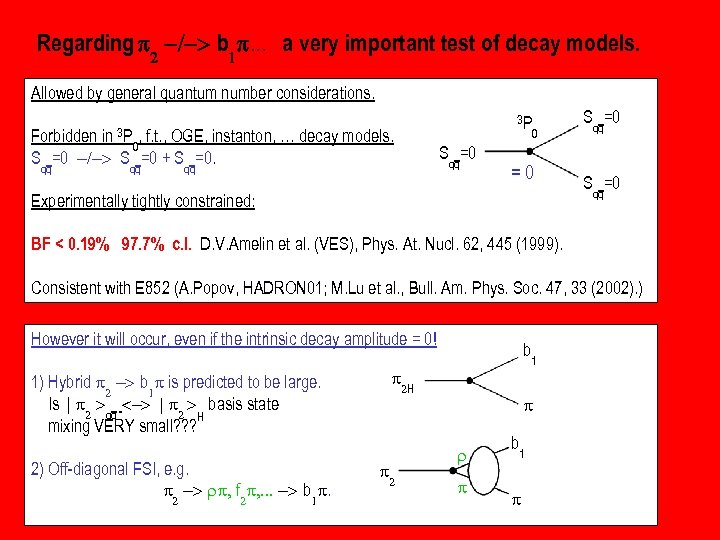
Regarding p 2 -/-> b 1 p. . . a very important test of decay models. Allowed by general quantum number considerations. Forbidden in 3 P 0, f. t. , OGE, instanton, … decay models. Sqq=0 -/-> Sqq=0 + Sqq=0. 3 P Sqq=0 0 =0 Experimentally tightly constrained: Sqq=0 BF < 0. 19% 97. 7% c. l. D. V. Amelin et al. (VES), Phys. At. Nucl. 62, 445 (1999). Consistent with E 852 (A. Popov, HADRON 01; M. Lu et al. , Bull. Am. Phys. Soc. 47, 33 (2002). ) However it will occur, even if the intrinsic decay amplitude = 0! 1) Hybrid p 2 -> b 1 p is predicted to be large. Is | p 2 >qq <-> | p 2 > basis state H mixing VERY small? ? ? 2) Off-diagonal FSI, e. g. p 2 -> rp, f 2 p, . . . -> b 1 p. b 1 p 2 H p 2 p r p b 1 p
Two principal lines of research on strong decays: 1. Try to understand what’s going on in terms of QCD. (less common) 2. Just assume a decay model and calculate every partial width and amplitude of interest.
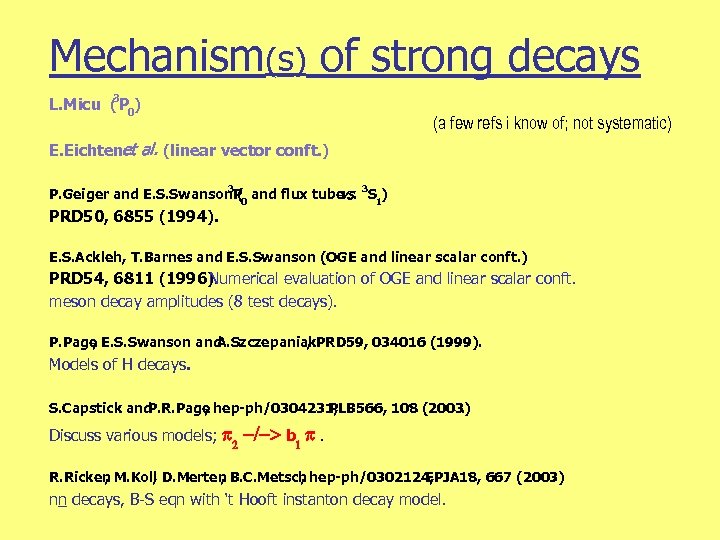
Mechanism(s) of strong decays 3 L. Micu ( P 0) (a few refs i know of; not systematic) E. Eichtenet al. (linear vector conft. ) 3 P. Geiger and E. S. Swanson P 0 and flux tube. 3 S 1) ( vs PRD 50, 6855 (1994). E. S. Ackleh, T. Barnes and E. S. Swanson (OGE and linear scalar conft. ) PRD 54, 6811 (1996). Numerical evaluation of OGE and linear scalar conft. meson decay amplitudes (8 test decays). P. Page E. S. Swanson and , A. Szczepaniak. PRD 59, 034016 (1999). , Models of H decays. S. Capstick and P. R. Page hep-ph/0304231, , PLB 566, 108 (2003). Discuss various models; p 2 -/-> b 1 p. R. Ricken M. Koll D. Merten B. C. Metsch hep-ph/0302124, , , EPJA 18, 667 (2003). nn decays, B-S eqn with ‘t Hooft instanton decay model.
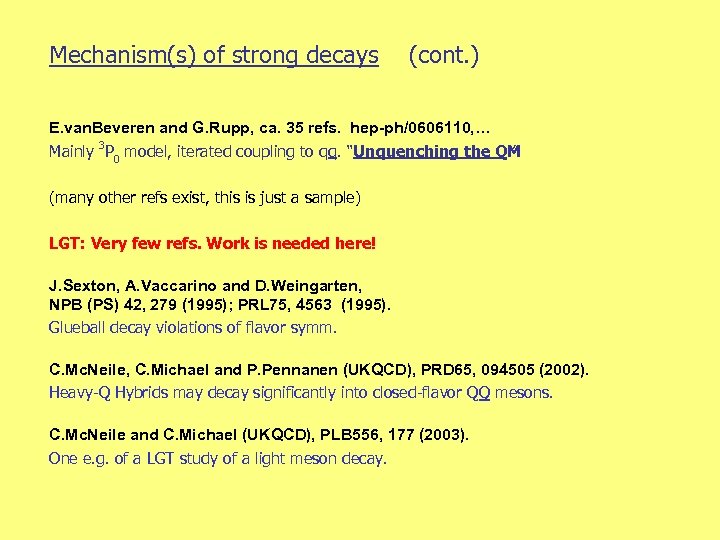
Mechanism(s) of strong decays (cont. ) E. van. Beveren and G. Rupp, ca. 35 refs. hep-ph/0606110, … Mainly 3 P 0 model, iterated coupling to qq. “Unquenching the QM. ” (many other refs exist, this is just a sample) LGT: Very few refs. Work is needed here! J. Sexton, A. Vaccarino and D. Weingarten, NPB (PS) 42, 279 (1995); PRL 75, 4563 (1995). Glueball decay violations of flavor symm. C. Mc. Neile, C. Michael and P. Pennanen (UKQCD), PRD 65, 094505 (2002). Heavy-Q Hybrids may decay significantly into closed-flavor QQ mesons. C. Mc. Neile and C. Michael (UKQCD), PLB 556, 177 (2003). One e. g. of a LGT study of a light meson decay.
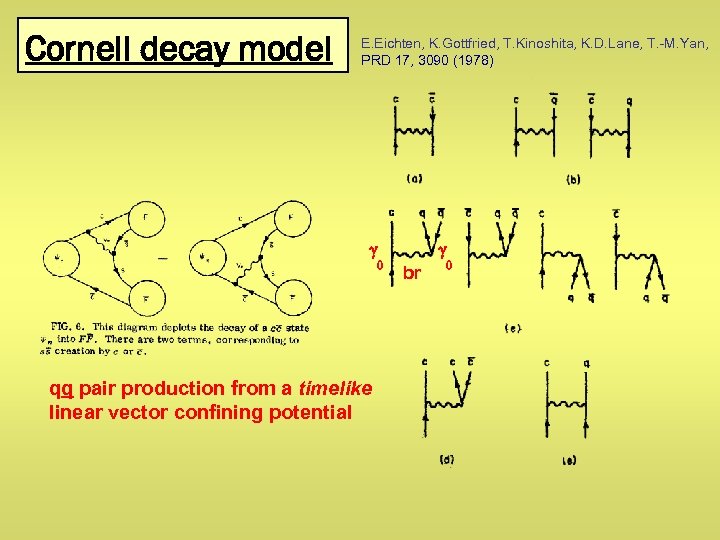
Cornell decay model E. Eichten, K. Gottfried, T. Kinoshita, K. D. Lane, T. -M. Yan, PRD 17, 3090 (1978) g qq pair production from a timelike linear vector confining potential 0 g br 0
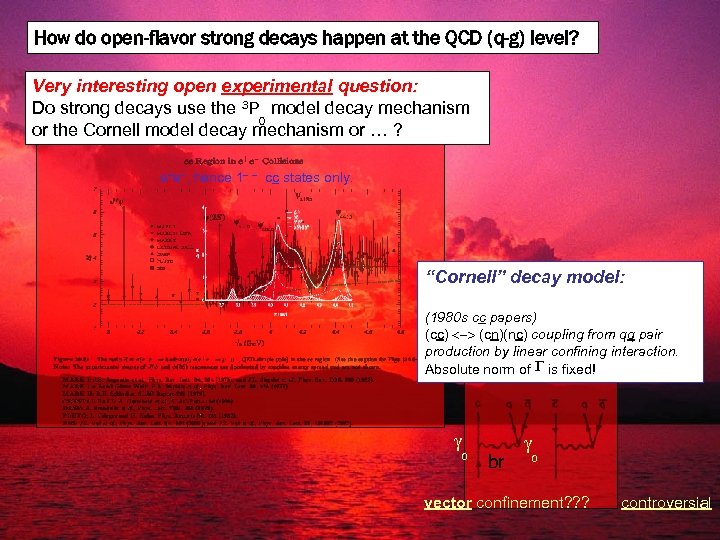
How do open-flavor strong decays happen at the QCD (q-g) level? Experimental R summary (2003 PDG) Very interesting open experimental question: Do strong decays use the 3 P model decay mechanism 0 or the Cornell model decay mechanism or … ? e+e-, hence 1 - - cc states only. “Cornell” decay model: (1980 s cc papers) (cc) <-> (cn)(nc) coupling from qq pair production by linear confining interaction. Absolute norm of G is fixed! g 0 br g 0 vector confinement? ? ? controversial
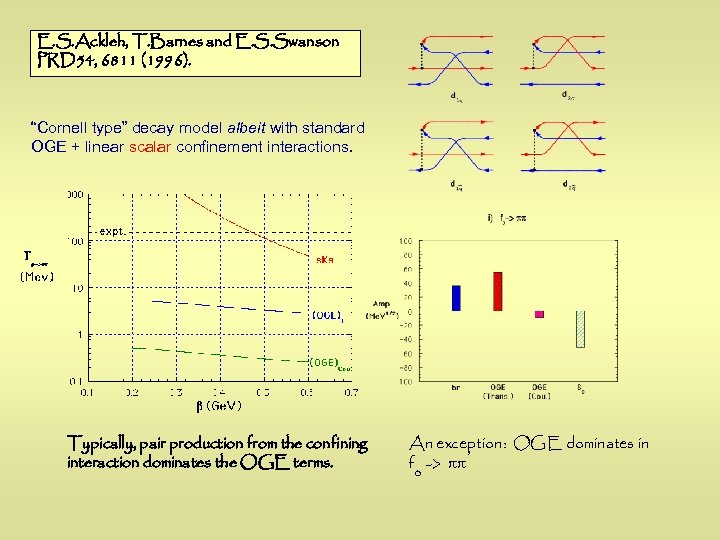
E. S. Ackleh, T. Barnes and E. S. Swanson PRD 54, 6811 (1996). “Cornell type” decay model albeit with standard OGE + linear scalar confinement interactions. Typically, pair production from the confining interaction dominates the OGE terms. An exception: OGE dominates in f 0 -> pp
LGT studies of strong decays LGT has been applied to strong decays of glueballs, conventional light mesons, and heavy-quark hybrids. The results are all “to be confirmed”, and some LGT practitioners are skeptical. Nonetheless here are some references and results:
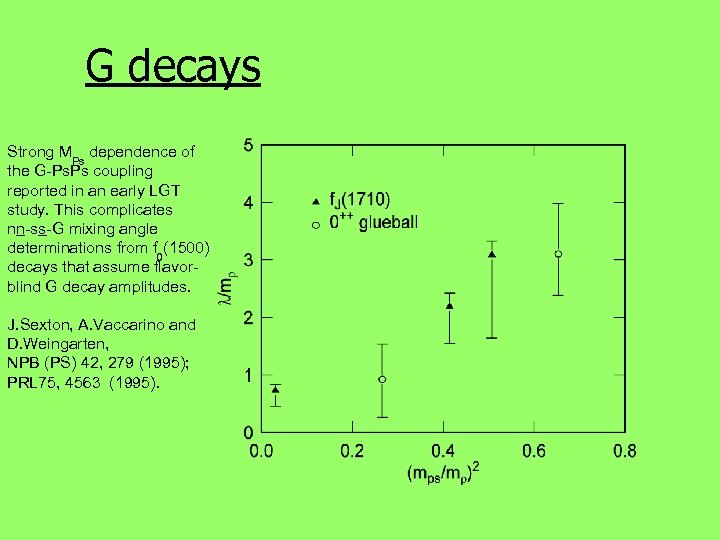
G decays Strong MPs dependence of the G-Ps. Ps coupling reported in an early LGT study. This complicates nn-ss-G mixing angle determinations from f 0(1500) decays that assume flavorblind G decay amplitudes. J. Sexton, A. Vaccarino and D. Weingarten, NPB (PS) 42, 279 (1995); PRL 75, 4563 (1995).
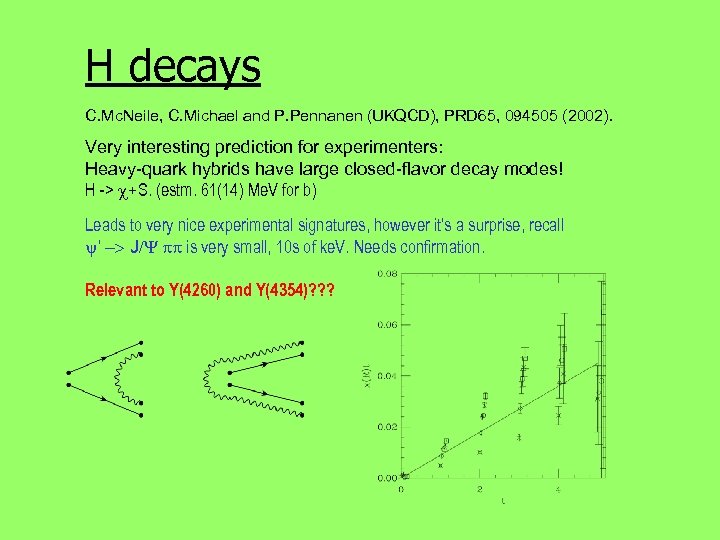
H decays C. Mc. Neile, C. Michael and P. Pennanen (UKQCD), PRD 65, 094505 (2002). Very interesting prediction for experimenters: Heavy-quark hybrids have large closed-flavor decay modes! H -> c+S. (estm. 61(14) Me. V for b) Leads to very nice experimental signatures, however it’s a surprise, recall y’ -> J/Y pp is very small, 10 s of ke. V. Needs confirmation. Relevant to Y(4260) and Y(4354)? ? ?
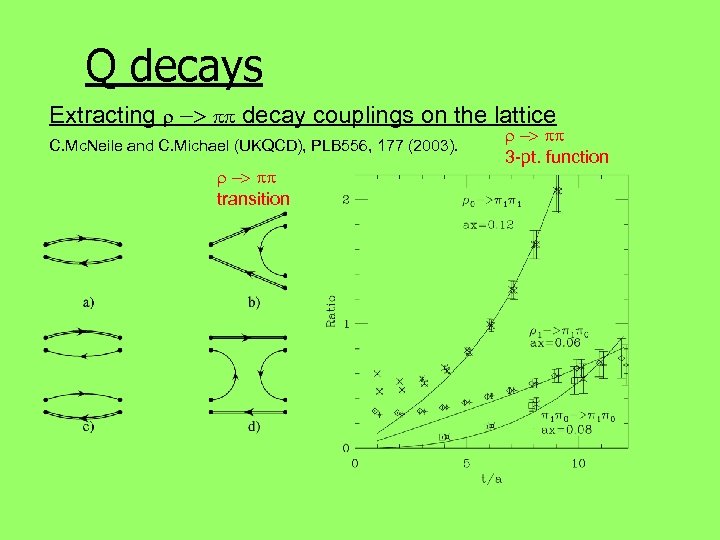
Q decays Extracting r -> pp decay couplings on the lattice C. Mc. Neile and C. Michael (UKQCD), PLB 556, 177 (2003). r -> pp transition r -> pp 3 -pt. function
Two principal lines of research on strong decays: 1. Try to understand what’s going on in terms of QCD. (less common) 2. Just assume a decay model and calculate every partial width and amplitude of interest. some e. g. s from s (Hall. D) and c mesons (CLEO, SLAC, BES, GSI)
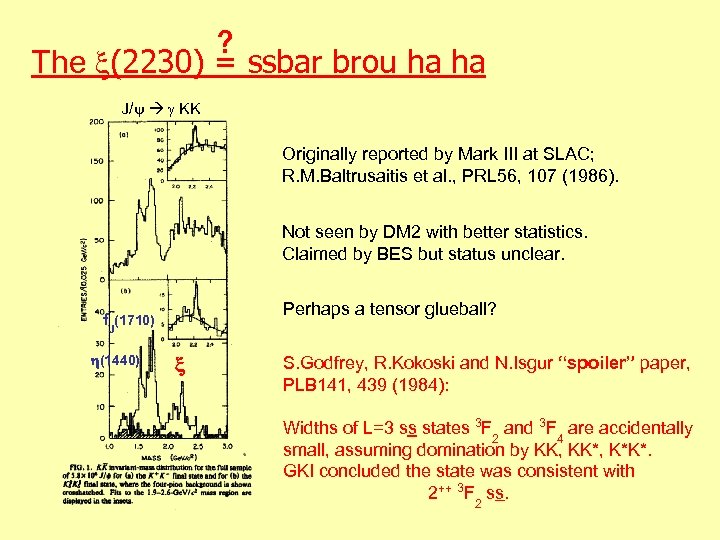
? The x(2230) = ssbar brou ha ha J/y g KK Originally reported by Mark III at SLAC; R. M. Baltrusaitis et al. , PRL 56, 107 (1986). Not seen by DM 2 with better statistics. Claimed by BES but status unclear. Perhaps a tensor glueball? f. J(1710) h(1440) x S. Godfrey, R. Kokoski and N. Isgur “spoiler” paper, PLB 141, 439 (1984): Widths of L=3 ss states 3 F 2 and 3 F 4 are accidentally small, assuming domination by KK, KK*, K*K*. GKI concluded the state was consistent with 2++ 3 F 2 ss.
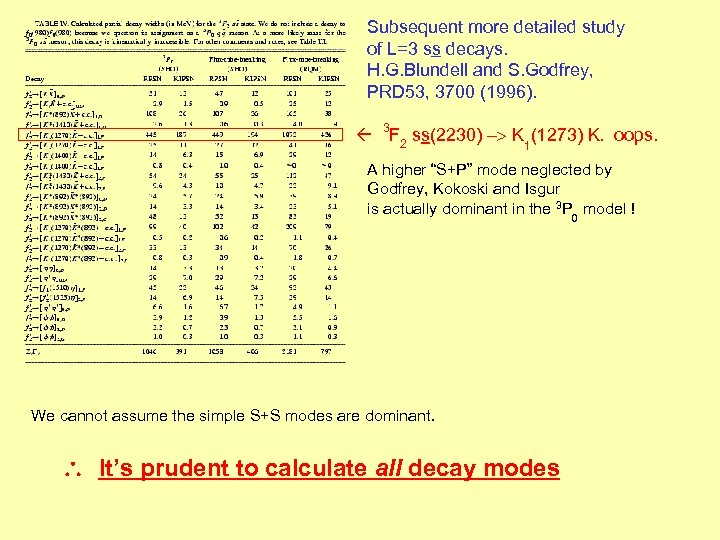
Subsequent more detailed study of L=3 ss decays. H. G. Blundell and S. Godfrey, PRD 53, 3700 (1996). 3 F 2 ss(2230) -> K 1(1273) K. oops. A higher “S+P” mode neglected by Godfrey, Kokoski and Isgur is actually dominant in the 3 P 0 model ! We cannot assume the simple S+S modes are dominant. It’s prudent to calculate all decay modes
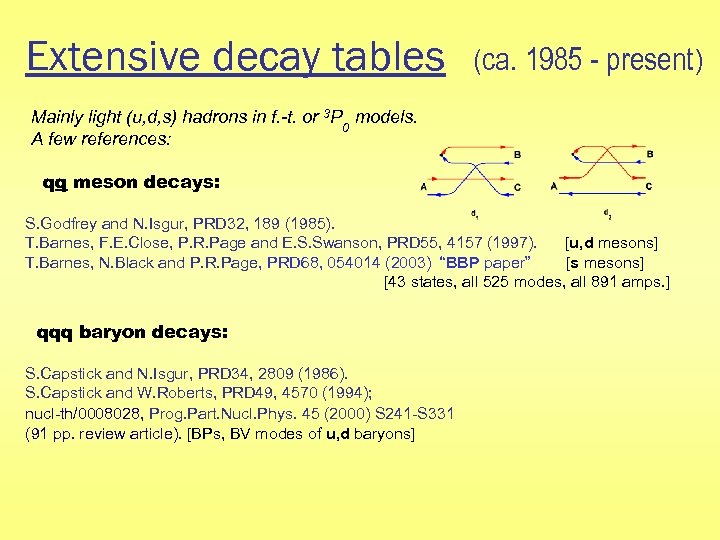
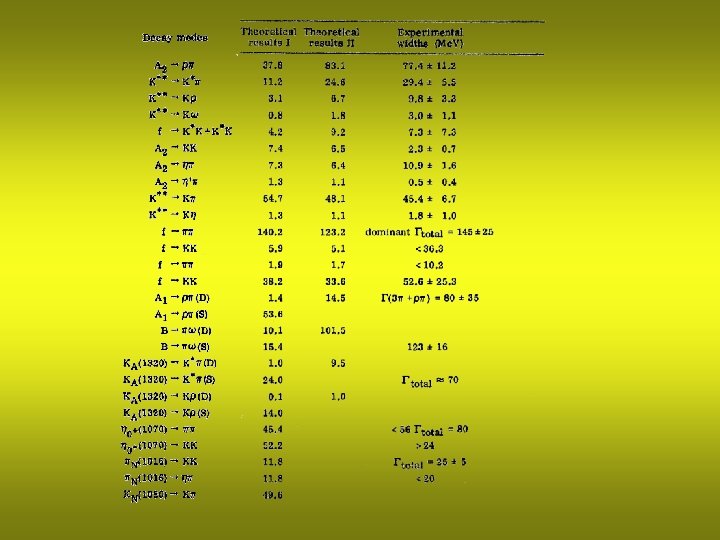
Extensive decay tables (ca. 1985 - present) Mainly light (u, d, s) hadrons in f. -t. or 3 P 0 models. A few references: qq meson decays: S. Godfrey and N. Isgur, PRD 32, 189 (1985). T. Barnes, F. E. Close, P. R. Page and E. S. Swanson, PRD 55, 4157 (1997). [u, d mesons] T. Barnes, N. Black and P. R. Page, PRD 68, 054014 (2003) “BBP paper” [s mesons] [43 states, all 525 modes, all 891 amps. ] qqq baryon decays: S. Capstick and N. Isgur, PRD 34, 2809 (1986). S. Capstick and W. Roberts, PRD 49, 4570 (1994); nucl-th/0008028, Prog. Part. Nucl. Phys. 45 (2000) S 241 -S 331 (91 pp. review article). [BPs, BV modes of u, d baryons]
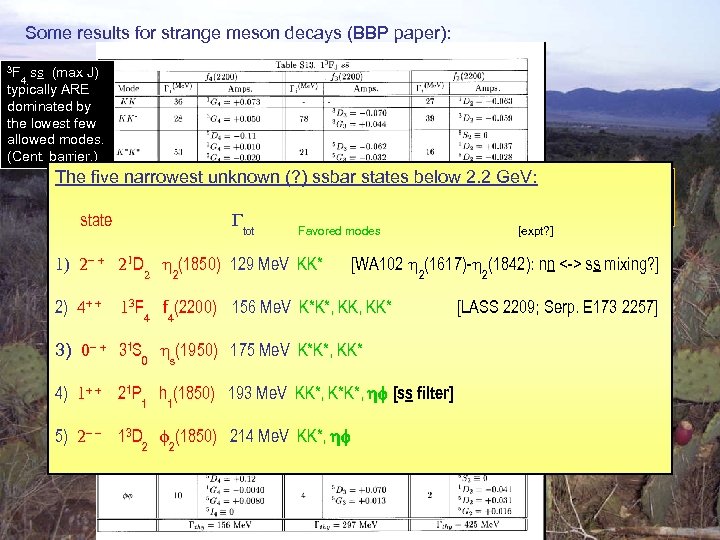
Some results for strange meson decays (BBP paper): 3 F ss (max J) typically ARE dominated by the lowest few allowed modes. (Cent. barrier. ) 4 3 The five narrowest unknown (? ) ssbar states below 2. 2 Ge. V: F state Gtot ss -> K (1273) K 1 confirms Blundell and Godfrey. Favored modes 1) 2 - + 21 D 2 h 2(1850) 129 Me. V KK* 3 2) 4+ + [expt? ] [WA 102 h 2(1617)-h 2(1842): nn <-> ss mixing? ] F ss -> K *K 3 2 dominant 13 F 4 f 4(2200) 156 Me. V K*K*, KK* 3) 0 - + 31 S 0 hs(1950) 175 Me. V K*K*, KK* 4) 1+ + 21 P 1 h 1(1850) 193 Me. V KK*, K*K*, hf [ss filter] 5) 2 - - 13 D 2 f 2(1850) 214 Me. V KK*, hf 2 [LASS 2209; Serp. E 173 2257]
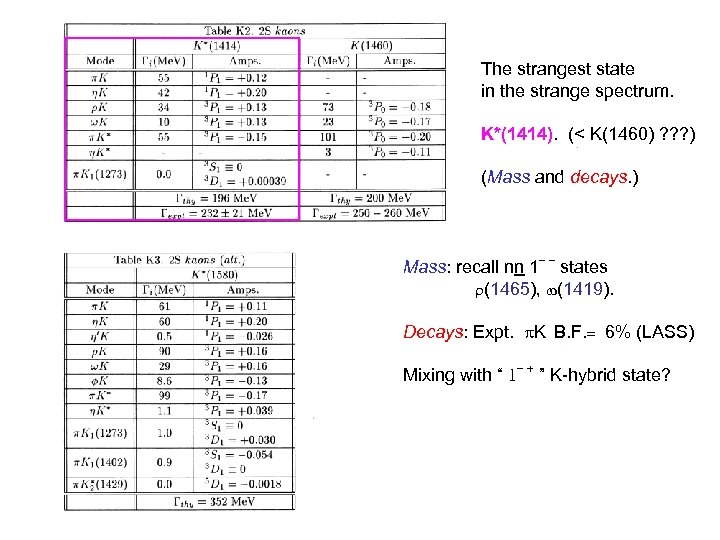
The strangest state in the strange spectrum. K*(1414). (< K(1460) ? ? ? ) (Mass and decays. ) Mass: recall nn 1 - - states r(1465), w(1419). Decays: Expt. p. K B. F. = 6% (LASS) Mixing with “ 1 - + ” K-hybrid state?
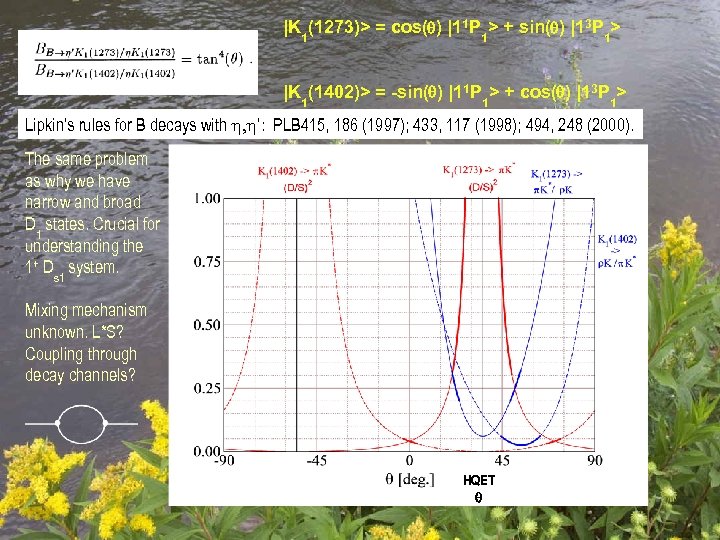
|K 1(1273)> = cos(q) |11 P 1> + sin(q) |13 P 1> |K 1(1402)> = -sin(q) |11 P 1> + cos(q) |13 P 1> Lipkin’s rules for B decays with h, h’: PLB 415, 186 (1997); 433, 117 (1998); 494, 248 (2000). The same problem as why we have narrow and broad D 1 states. Crucial for understanding the 1+ D system. s 1 Mixing mechanism unknown. L*S? Coupling through decay channels? HQET q
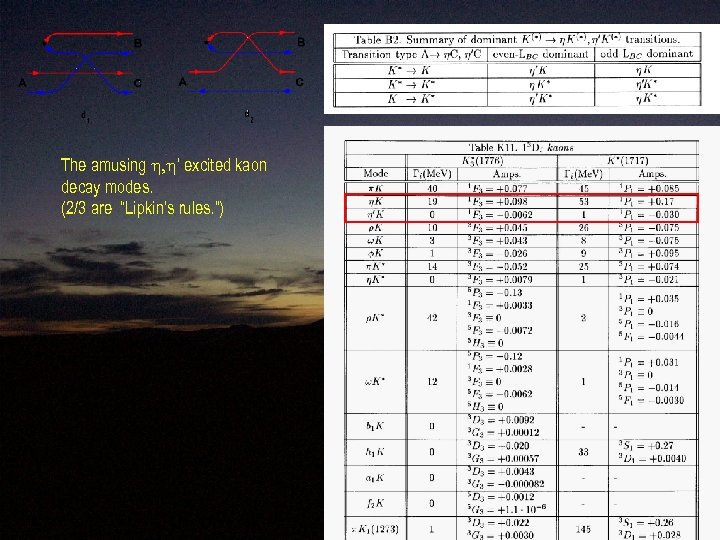
The amusing h, h’ excited kaon decay modes. (2/3 are “Lipkin’s rules. ”)
New Millennium: Charm and Charmonium decays
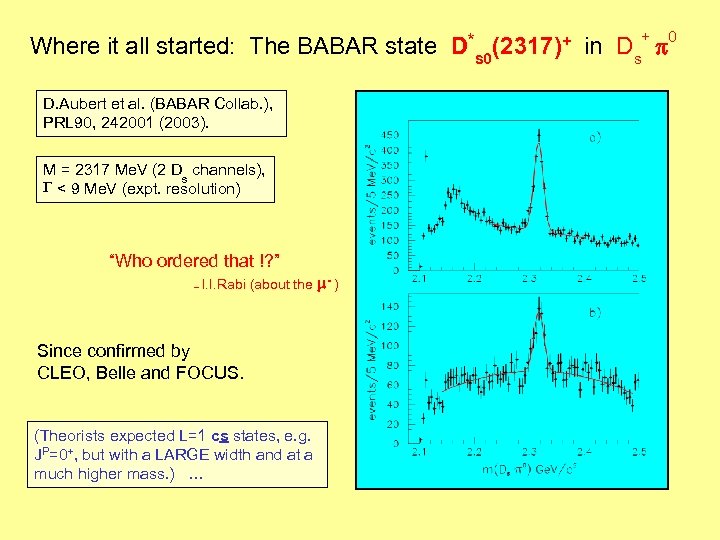
Where it all started: The BABAR state D*s 0(2317)+ in Ds+ p 0 D. Aubert et al. (BABAR Collab. ), PRL 90, 242001 (2003). M = 2317 Me. V (2 Ds channels), G < 9 Me. V (expt. resolution) “Who ordered that !? ” - I. I. Rabi (about the m- ) Since confirmed by CLEO, Belle and FOCUS. (Theorists expected L=1 cs states, e. g. JP=0+, but with a LARGE width and at a much higher mass. ) …
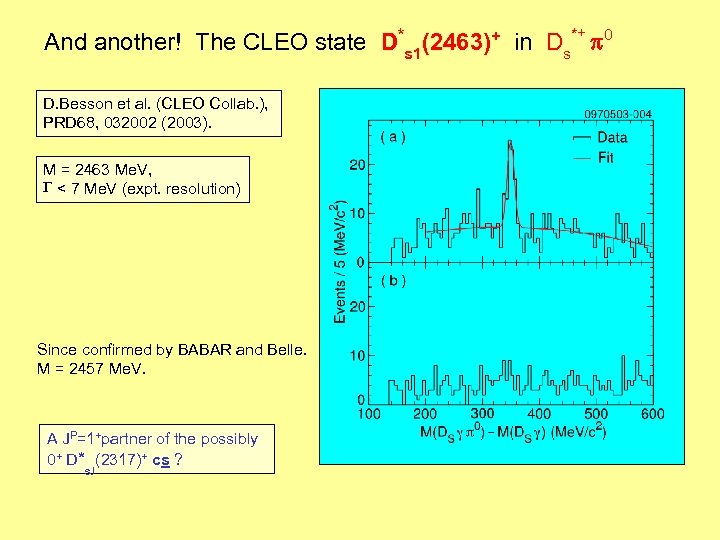
And another! The CLEO state D*s 1(2463)+ in Ds*+ p 0 D. Besson et al. (CLEO Collab. ), PRD 68, 032002 (2003). M = 2463 Me. V, G < 7 Me. V (expt. resolution) Since confirmed by BABAR and Belle. M = 2457 Me. V. A JP=1+partner of the possibly 0+ D* (2317)+ cs ? s. J
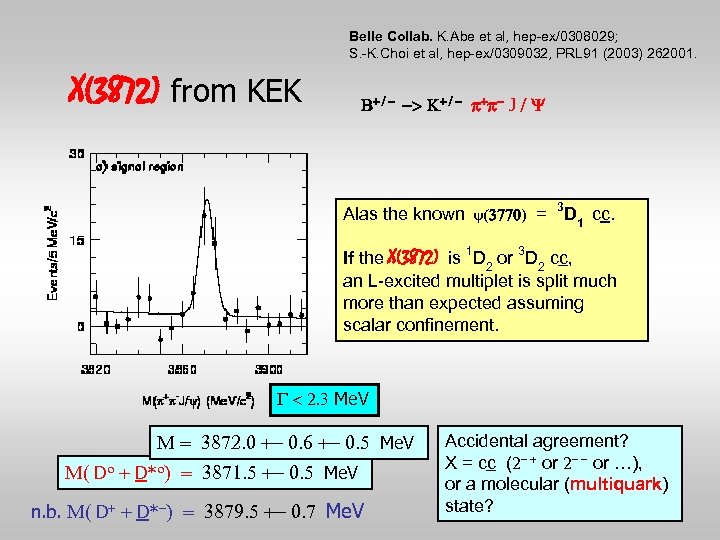
Belle Collab. K. Abe et al, hep-ex/0308029; S. -K. Choi et al, hep-ex/0309032, PRL 91 (2003) 262001. X(3872) from KEK B+ / - -> K+ / - p+p- J / Y Alas the known y(3770) = 3 D 1 cc. 1 3 If the X(3872) is D 2 or D 2 cc, an L-excited multiplet is split much more than expected assuming scalar confinement. G < 2. 3 Me. V M = 3872. 0 +- 0. 6 +- 0. 5 Me. V M( Do + D*o) = 3871. 5 +- 0. 5 Me. V n. b. M( D+ + D*-) = 3879. 5 +- 0. 7 Me. V Accidental agreement? X = cc (2 - + or 2 - - or …), or a molecular (multiquark) state?
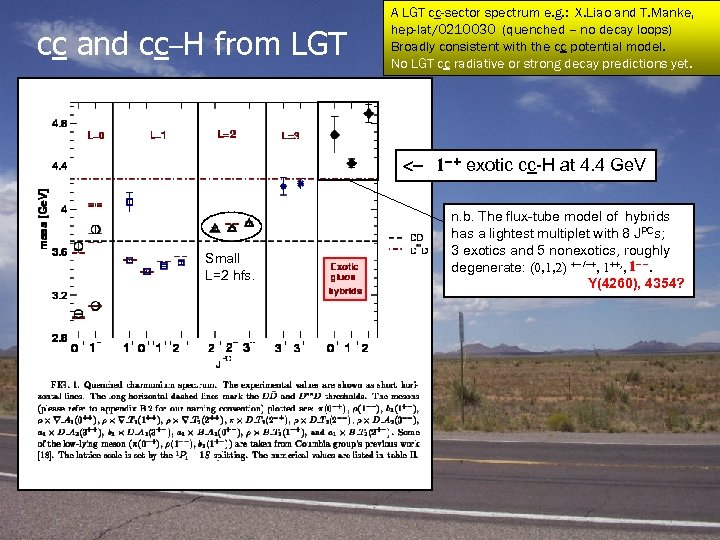
cc and cc–H from LGT A LGT cc-sector spectrum e. g. : X. Liao and T. Manke, hep-lat/0210030 (quenched – no decay loops) Broadly consistent with the cc potential model. No LGT cc radiative or strong decay predictions yet. <- 1 - + exotic cc-H at 4. 4 Ge. V Small L=2 hfs. n. b. The flux-tube model of hybrids has a lightest multiplet with 8 JPCs; 3 exotics and 5 nonexotics, roughly degenerate: (0, 1, 2) +- /-+, 1++, , 1 - -. Y(4260), 4354?
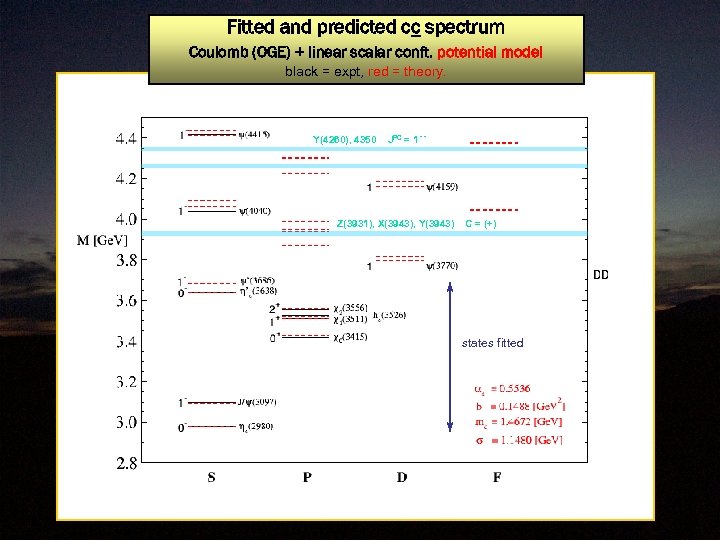
Fitted and predicted cc spectrum Coulomb (OGE) + linear scalar conft. potential model black = expt, red = theory. Y(4260), 4350 JPC = 1 - - Z(3931), X(3943), Y(3943) C = (+) states fitted S*S OGE
Charmonium decays (1976 -80) A series of papers by the Cornell group addressed open-charm strong decays of charmonium states above 3. 73 Ge. V. They assumed an unusual non-3 P 0 decay model, qq pair production from linear, timelike vector confinement. The absolute decay rates predicted (they actually extracted R) were reasonably close to experiment. The y (4040) decay branching fractions in particular were explained as due to nodes in the 33 S 1 radial wavefunction. E. Eichten, K. Gottfried, T. Kinoshita, K. D. Lane, T. -M. Yan, PRL 36, 500 (1976) PRD 17, 3090 (1978) PRD 21, 203 (1980).
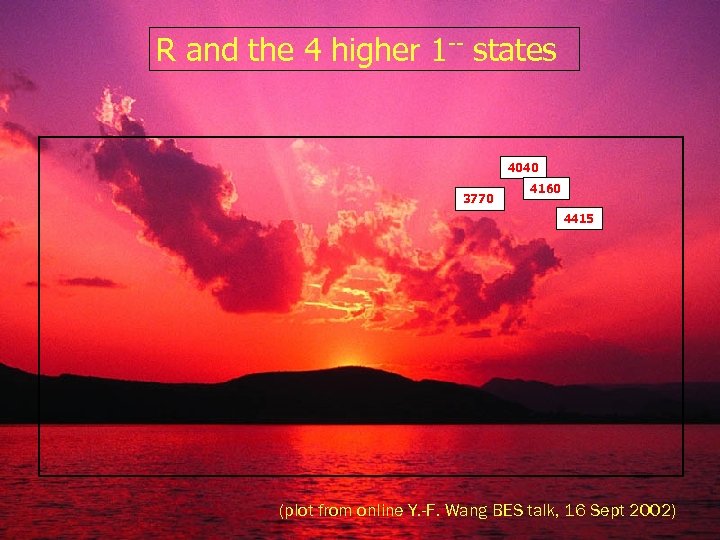
R and the 4 higher 1 -- states 4040 3770 4160 4415 (plot from online Y. -F. Wang BES talk, 16 Sept 2002)
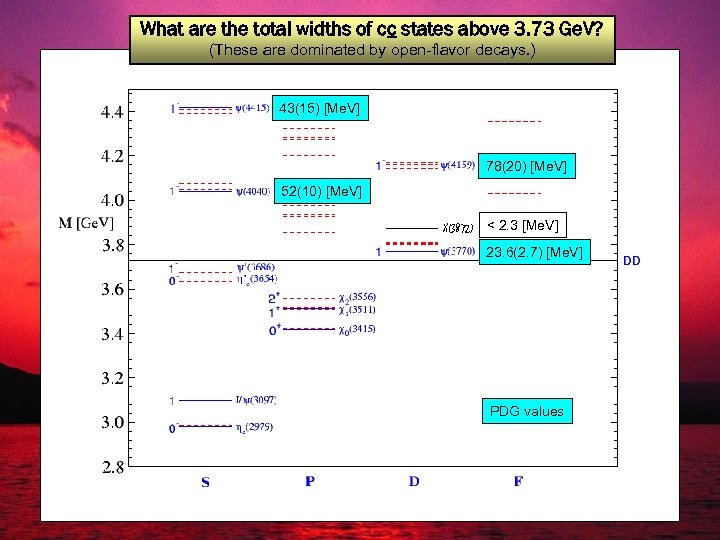
What are the total widths of cc states above 3. 73 Ge. V? (These are dominated by open-flavor decays. ) 43(15) [Me. V] 78(20) [Me. V] 52(10) [Me. V] X(3872) < 2. 3 [Me. V] 23. 6(2. 7) [Me. V] PDG values
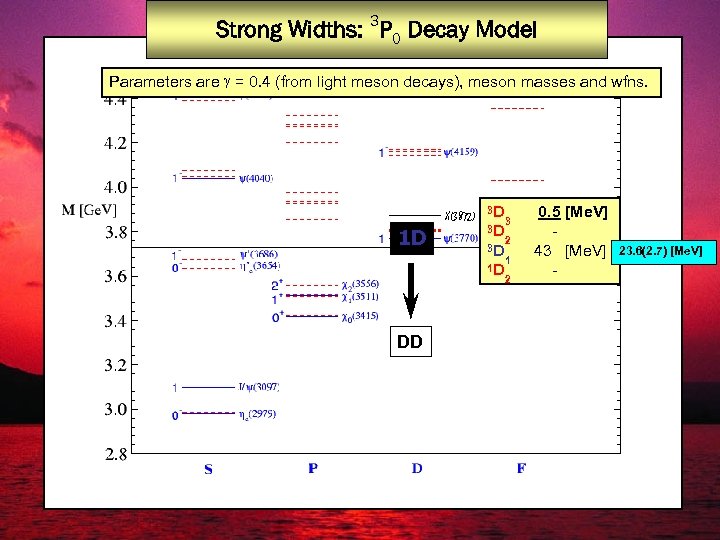
Strong Widths: 3 P 0 Decay Model Parameters are g = 0. 4 (from light meson decays), meson masses and wfns. X(3872) 1 D 3 D 3 D 3 D 1 D DD 3 2 1 2 0. 5 [Me. V] 43 [Me. V] - 23. 6(2. 7) [Me. V]
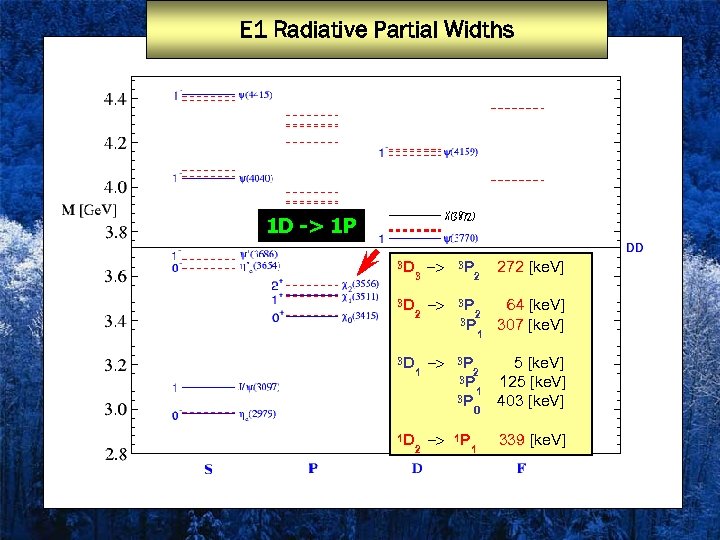
E 1 Radiative Partial Widths X(3872) 1 D -> 1 P 3 D 3 D 3 D 3 2 1 -> 3 P 2 2 3 P -> 3 P 1 2 3 P 3 P 1 D 2 1 0 -> 1 P 1 272 [ke. V] 64 [ke. V] 307 [ke. V] 5 [ke. V] 125 [ke. V] 403 [ke. V] 339 [ke. V]
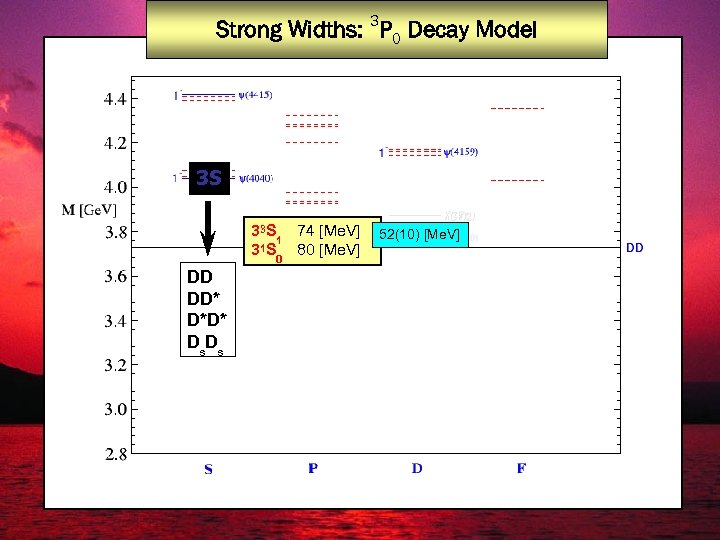
Strong Widths: 3 P 0 Decay Model 3 S 33 S 1 31 S 0 DD DD* D*D* Ds. Ds 74 [Me. V] 80 [Me. V] X(3872) 52(10) [Me. V]
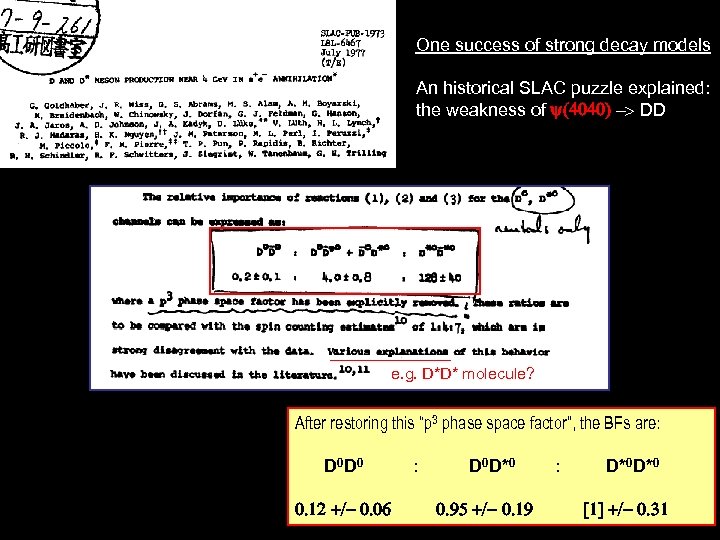
One success of strong decay models An historical SLAC puzzle explained: the weakness of y(4040) -> DD e. g. D*D* molecule? After restoring this “p 3 phase space factor”, the BFs are: D 0 0. 12 +/- 0. 06 : D 0 D*0 0. 95 +/- 0. 19 : D*0 D*0 [1] +/- 0. 31
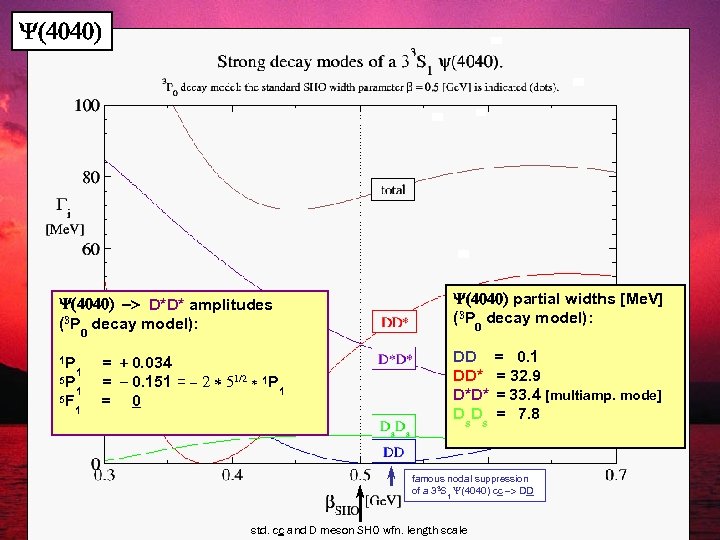
Y(4040) -> D*D* amplitudes (3 P 0 decay model): 1 P 5 P 5 F 1 1 1 = + 0. 034 = - 0. 151 = - 2 * 51/2 * 1 P 1 = 0 Y(4040) partial widths [Me. V] (3 P 0 decay model): DD DD* D*D* Ds Ds = 0. 1 = 32. 9 = 33. 4 [multiamp. mode] = 7. 8 famous nodal suppression of a 33 S 1 Y(4040) cc -> DD std. cc and D meson SHO wfn. length scale
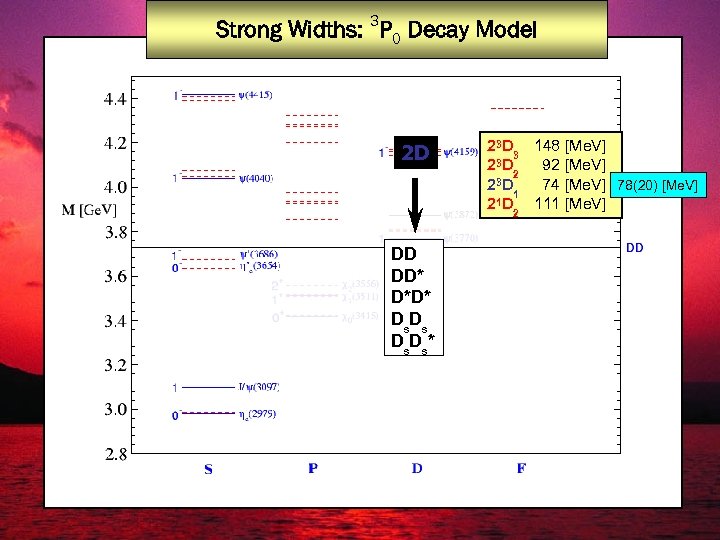
Strong Widths: 3 P 0 Decay Model 2 D DD DD* D*D* Ds. Ds* 23 D 3 148 [Me. V] 23 D 2 92 [Me. V] 23 D 1 74 [Me. V] 78(20) [Me. V] 21 D 2 111 [Me. V]
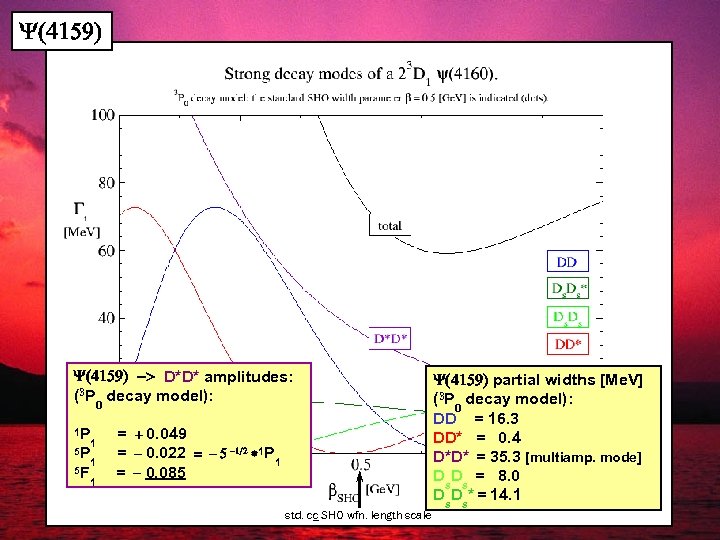
Y(4159) -> D*D* amplitudes: (3 P 0 decay model): 1 P 5 P 5 F 1 1 1 = + 0. 049 = - 0. 022 = - 5 -1/2 *1 P 1 = - 0. 085 std. cc SHO wfn. length scale Y(4159) partial widths [Me. V] (3 P 0 decay model): DD = 16. 3 DD* = 0. 4 D*D* = 35. 3 [multiamp. mode] Ds. Ds = 8. 0 Ds. Ds* = 14. 1
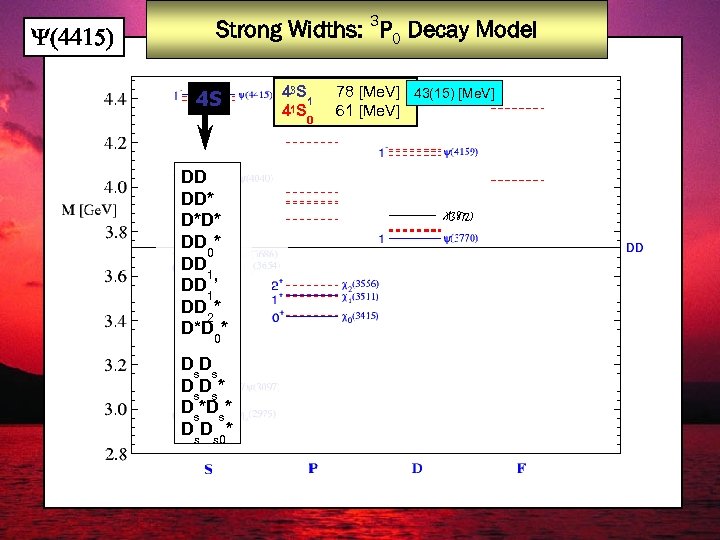
Y(4415) Strong Widths: 3 P 0 Decay Model 4 S DD DD* D*D* DD 0* DD 1’ DD 2* D*D 0* Ds. Ds* Ds*Ds* Ds. Ds 0* 43 S 1 41 S 0 78 [Me. V] 43(15) [Me. V] 61 [Me. V] X(3872)
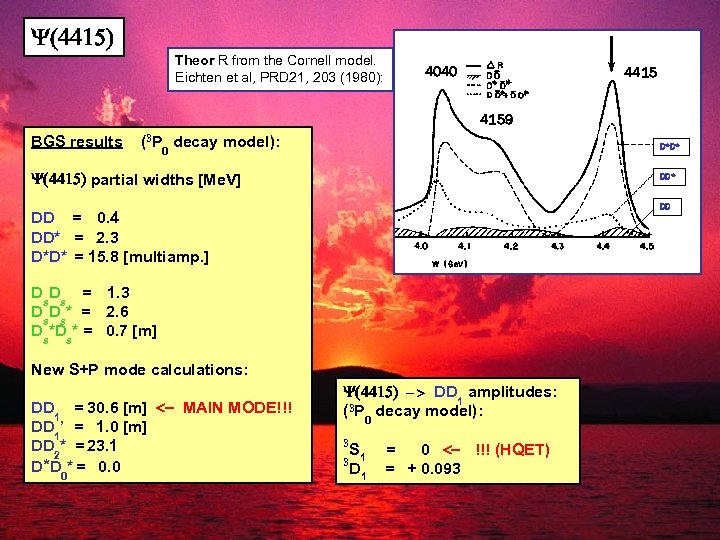
Y(4415) Theor R from the Cornell model. Eichten et al, PRD 21, 203 (1980): 4040 4415 4159 BGS results (3 P 0 decay model): D*D* Y(4415) partial widths [Me. V] DD* DD DD = 0. 4 DD* = 2. 3 D*D* = 15. 8 [multiamp. ] Ds. Ds = 1. 3 Ds. Ds* = 2. 6 Ds*Ds* = 0. 7 [m] New S+P mode calculations: DD 1 = 30. 6 [m] <- MAIN MODE!!! DD 1’ = 1. 0 [m] DD 2* = 23. 1 D*D 0* = 0. 0 Y(4415) - > DD 1 amplitudes: (3 P 0 decay model): 3 3 S 1 D 1 = 0 <- !!! (HQET) = + 0. 093
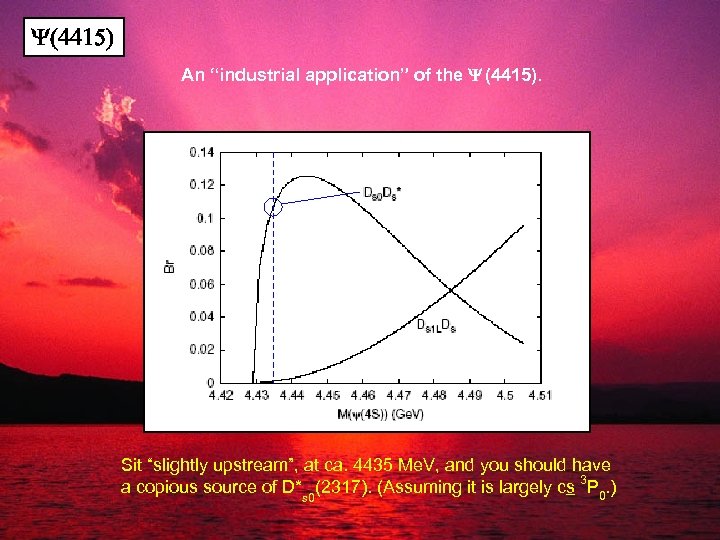
Y(4415) An “industrial application” of the Y (4415). Sit “slightly upstream”, at ca. 4435 Me. V, and you should have a copious source of D*s 0(2317). (Assuming it is largely cs 3 P 0. )
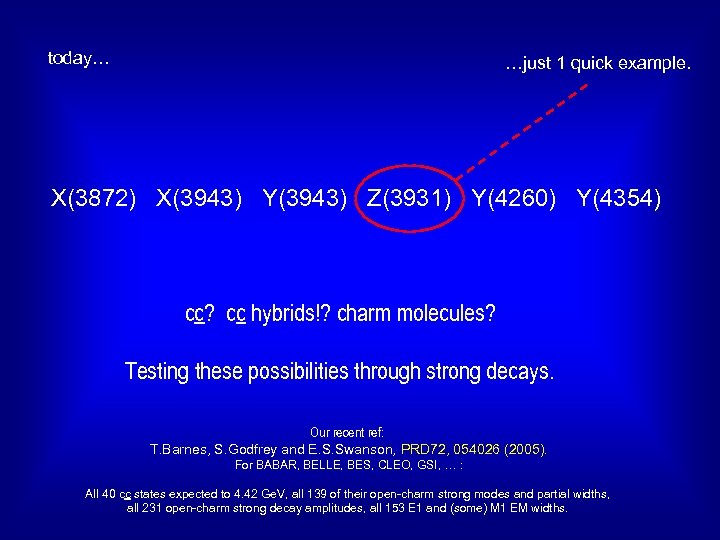
today… …just 1 quick example. X(3872) X(3943) Y(3943) Z(3931) Y(4260) Y(4354) cc? cc hybrids!? charm molecules? Testing these possibilities through strong decays. Our recent ref: T. Barnes, S. Godfrey and E. S. Swanson, PRD 72, 054026 (2005). For BABAR, BELLE, BES, CLEO, GSI, … : All 40 cc states expected to 4. 42 Ge. V, all 139 of their open-charm strong modes and partial widths, all 231 open-charm strong decay amplitudes, all 153 E 1 and (some) M 1 EM widths.
![Z(3931) gg -> Z(3931) -> DD [ JPC(gg). ne. 1++ ] [ref] = S.](https://present5.com/presentation/87e8a13a47c593197e38fb7ffbeee17b/image-51.jpg "Z(3931) gg -> Z(3931) -> DD [ JPC(gg). ne. 1++ ] [ref] = S.")
Z(3931) gg -> Z(3931) -> DD [ JPC(gg). ne. 1++ ] [ref] = S. Uehara et al. (Belle), hep-ex/0507033, 8 Jul 2005.
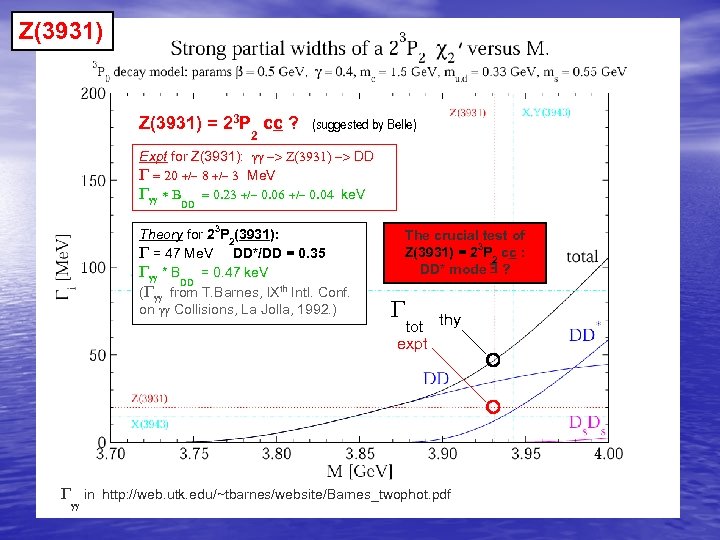
Z(3931) = 23 P cc ? 2 (suggested by Belle) Expt for Z(3931): gg -> Z(3931) -> DD G = 20 +/- 8 +/- 3 Me. V Ggg * B = 0. 23 +/- 0. 06 +/- 0. 04 ke. V DD Theory for 23 P 2(3931): G = 47 Me. V DD*/DD = 0. 35 Ggg * B = 0. 47 ke. V DD (Ggg from T. Barnes, IXth Intl. Conf. on gg Collisions, La Jolla, 1992. ) The crucial test of 3 Z(3931) = 2 P 2 cc : DD* mode $ ? G tot thy expt G in http: //web. utk. edu/~tbarnes/website/Barnes_twophot. pdf gg
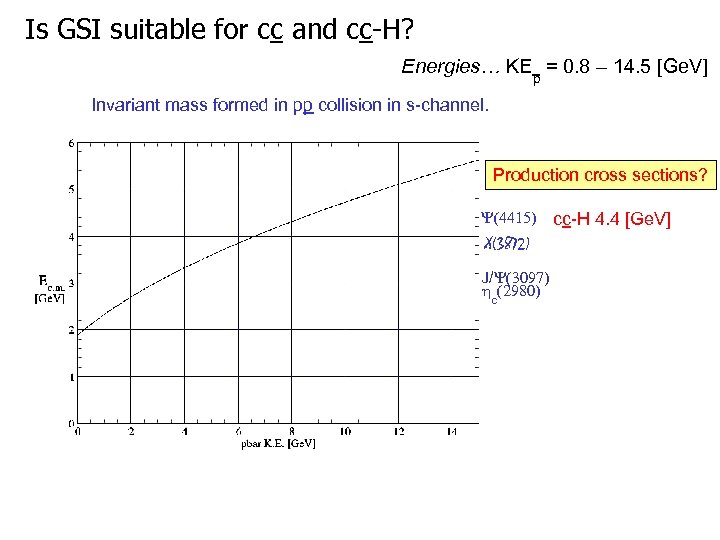
Is GSI suitable for cc and cc-H? Energies… KEp = 0. 8 – 14. 5 [Ge. V] Invariant mass formed in pp collision in s-channel. Production cross sections? Y(4415) X(3872) J/Y(3097) hc(2980) cc-H 4. 4 [Ge. V]
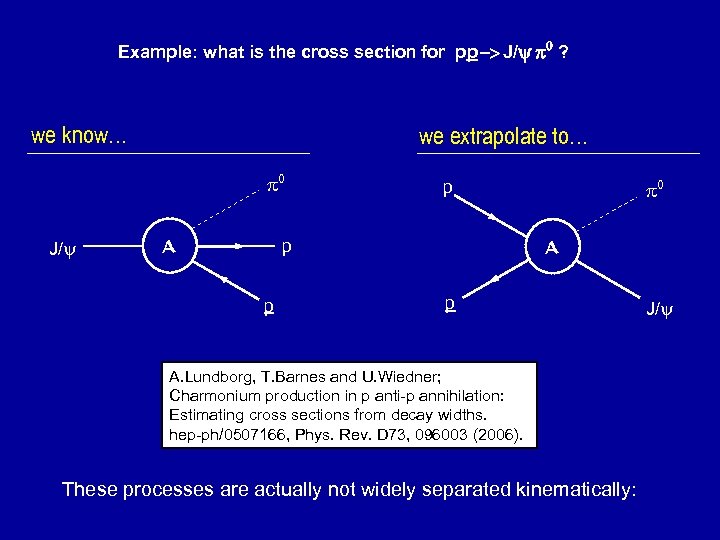
Example: what is the cross section for pp -> J/y p 0 ? we know… we extrapolate to… p 0 J/y p A p p 0 p A. Lundborg, T. Barnes and U. Wiedner; Charmonium production in p anti-p annihilation: Estimating cross sections from decay widths. hep-ph/0507166, Phys. Rev. D 73, 096003 (2006). These processes are actually not widely separated kinematically: J/y
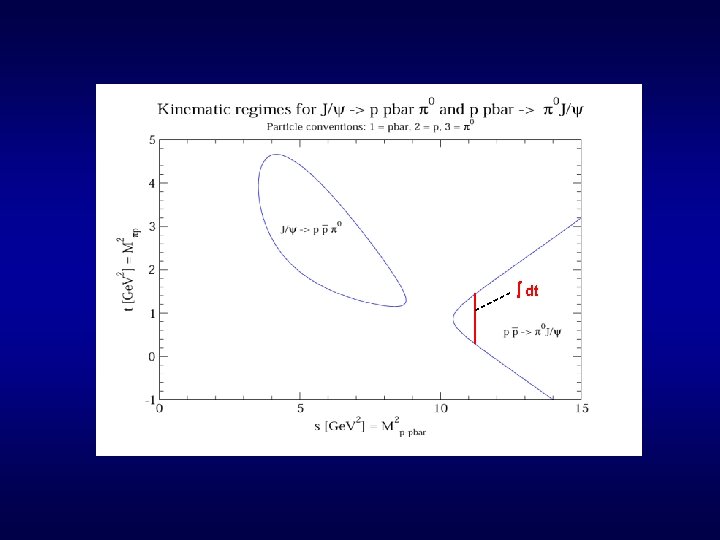
ò dt
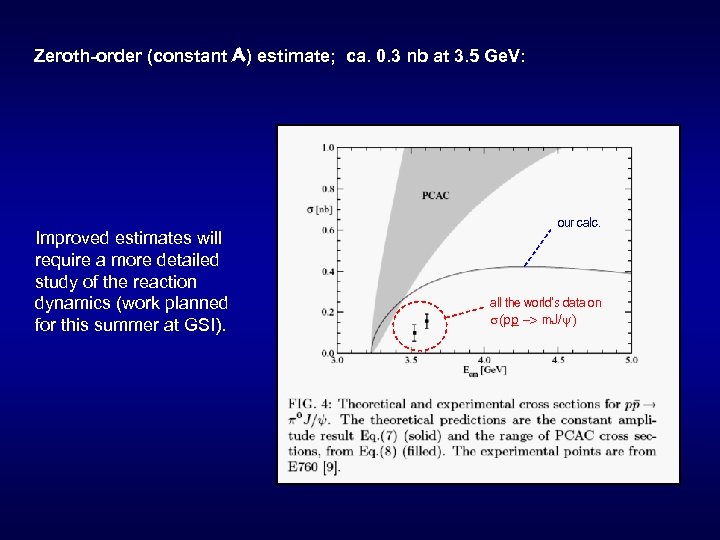
Zeroth-order (constant A) estimate; ca. 0. 3 nb at 3. 5 Ge. V: Improved estimates will require a more detailed study of the reaction dynamics (work planned for this summer at GSI). our calc. all the world’s data on s(pp -> m. J/y)
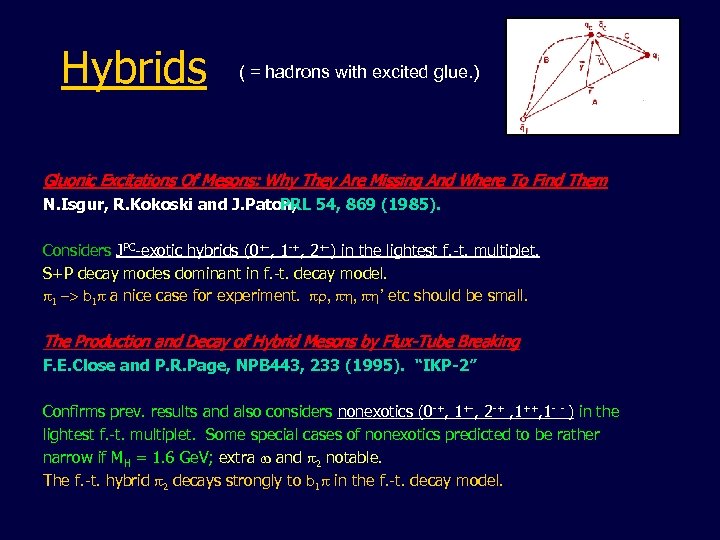
Hybrids ( = hadrons with excited glue. ) Gluonic Excitations Of Mesons: Why They Are Missing And Where To Find Them N. Isgur, R. Kokoski and J. Paton, 54, 869 (1985). PRL Considers JPC-exotic hybrids (0+-, 1 -+, 2+-) in the lightest f. -t. multiplet. S+P decay modes dominant in f. -t. decay model. p 1 -> b 1 p a nice case for experiment. pr, ph’ etc should be small. The Production and Decay of Hybrid Mesons by Flux-Tube Breaking F. E. Close and P. R. Page, NPB 443, 233 (1995). “IKP-2” Confirms prev. results and also considers nonexotics (0 -+, 1+-, 2 -+ , 1++, 1 - - ) in the lightest f. -t. multiplet. Some special cases of nonexotics predicted to be rather narrow if MH = 1. 6 Ge. V; extra w and p 2 notable. The f. -t. hybrid p 2 decays strongly to b 1 p in the f. -t. decay model.
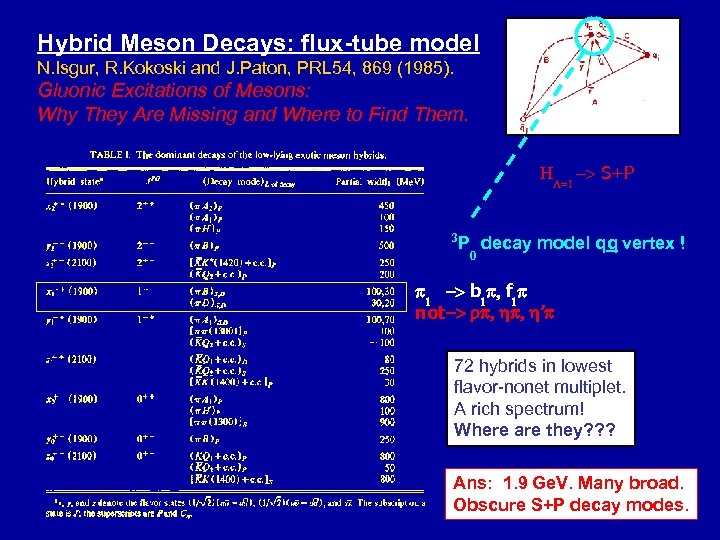
Hybrid Meson Decays: flux-tube model N. Isgur, R. Kokoski and J. Paton, PRL 54, 869 (1985). Gluonic Excitations of Mesons: Why They Are Missing and Where to Find Them. HL=1 -> S+P 3 P decay model qq vertex ! 0 p 1 -> b 1 p, f 1 p not -> rp, h’p 72 hybrids in lowest flavor-nonet multiplet. A rich spectrum! Where are they? ? ? Ans: 1. 9 Ge. V. Many broad. Obscure S+P decay modes.
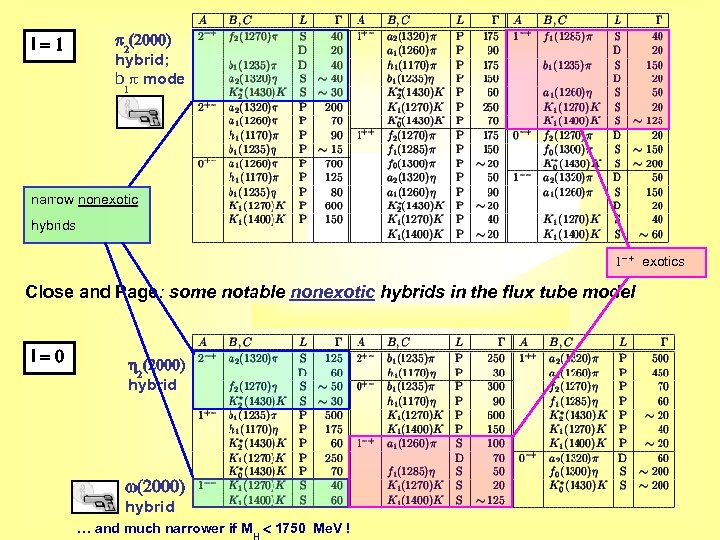
I=1 p 2(2000) hybrid; b p mode 1 narrow nonexotic hybrids 1 - + exotics Close and Page: some notable nonexotic hybrids in the flux tube model I=0 h 2(2000) hybrid w(2000) hybrid … and much narrower if M < 1750 Me. V !
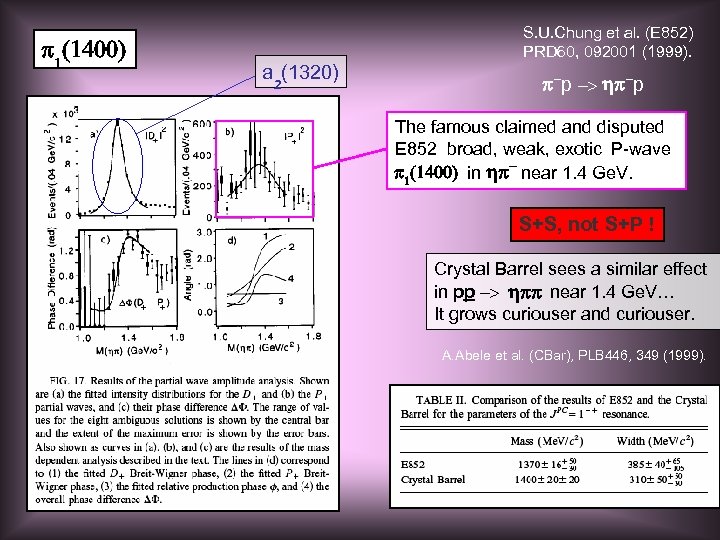
p (1400) 1 a 2(1320) S. U. Chung et al. (E 852) PRD 60, 092001 (1999). p-p -> hp-p The famous claimed and disputed E 852 broad, weak, exotic P-wave p 1(1400) in hp- near 1. 4 Ge. V. S+S, not S+P ! Crystal Barrel sees a similar effect in pp -> hpp near 1. 4 Ge. V… It grows curiouser and curiouser. A. Abele et al. (CBar), PLB 446, 349 (1999).
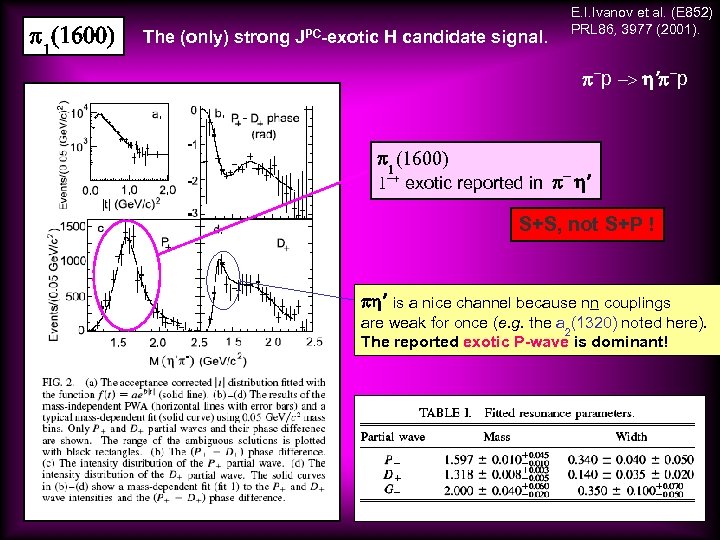
p (1600) 1 The (only) strong JPC-exotic H candidate signal. E. I. Ivanov et al. (E 852) PRL 86, 3977 (2001). p-p -> h’p-p p 1(1600) 1 -+ exotic reported in p- h’ S+S, not S+P ! ph’ is a nice channel because nn couplings are weak for once (e. g. the a 2(1320) noted here). The reported exotic P-wave is dominant!
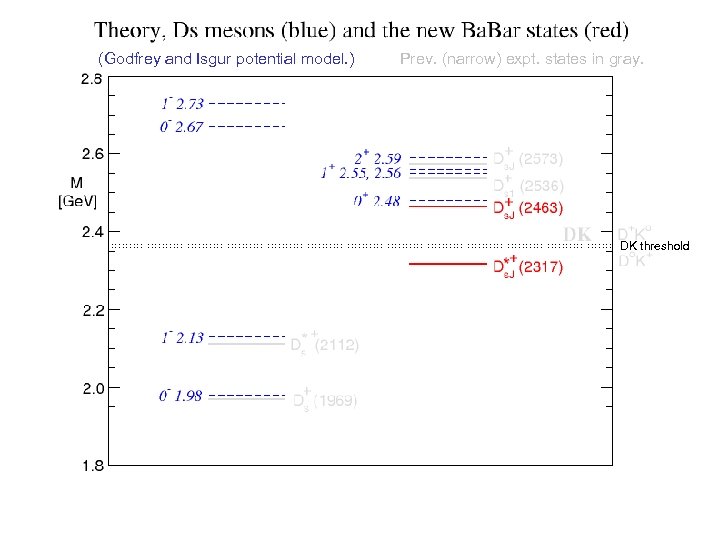
(Godfrey and Isgur potential model. ) Prev. (narrow) expt. states in gray. DK threshold
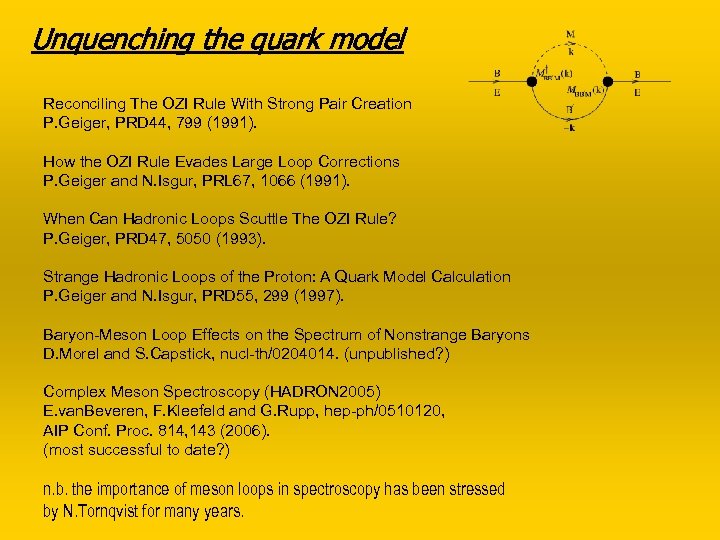
Unquenching the quark model Reconciling The OZI Rule With Strong Pair Creation P. Geiger, PRD 44, 799 (1991). How the OZI Rule Evades Large Loop Corrections P. Geiger and N. Isgur, PRL 67, 1066 (1991). When Can Hadronic Loops Scuttle The OZI Rule? P. Geiger, PRD 47, 5050 (1993). Strange Hadronic Loops of the Proton: A Quark Model Calculation P. Geiger and N. Isgur, PRD 55, 299 (1997). Baryon-Meson Loop Effects on the Spectrum of Nonstrange Baryons D. Morel and S. Capstick, nucl-th/0204014. (unpublished? ) Complex Meson Spectroscopy (HADRON 2005) E. van. Beveren, F. Kleefeld and G. Rupp, hep-ph/0510120, AIP Conf. Proc. 814, 143 (2006). (most successful to date? ) n. b. the importance of meson loops in spectroscopy has been stressed by N. Tornqvist for many years.
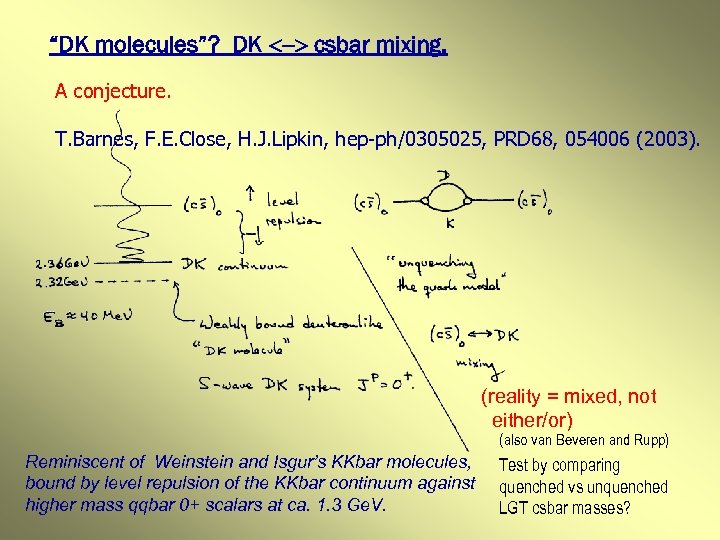
“DK molecules”? DK <-> csbar mixing. A conjecture. T. Barnes, F. E. Close, H. J. Lipkin, hep-ph/0305025, PRD 68, 054006 (2003). (reality = mixed, not either/or) (also van Beveren and Rupp) Reminiscent of Weinstein and Isgur’s KKbar molecules, bound by level repulsion of the KKbar continuum against higher mass qqbar 0+ scalars at ca. 1. 3 Ge. V. Test by comparing quenched vs unquenched LGT csbar masses?
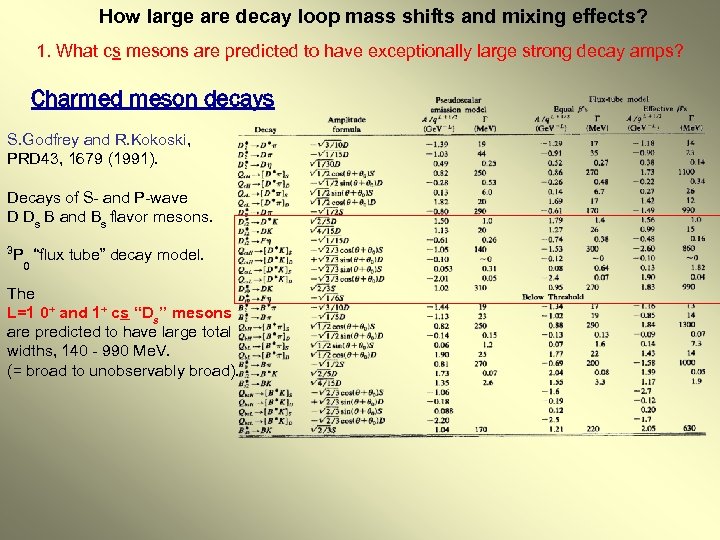
How large are decay loop mass shifts and mixing effects? 1. What cs mesons are predicted to have exceptionally large strong decay amps? Charmed meson decays S. Godfrey and R. Kokoski, PRD 43, 1679 (1991). Decays of S- and P-wave D Ds B and Bs flavor mesons. 3 P “flux tube” decay model. 0 The L=1 0+ and 1+ cs “Ds” mesons are predicted to have large total widths, 140 - 990 Me. V. (= broad to unobservably broad).
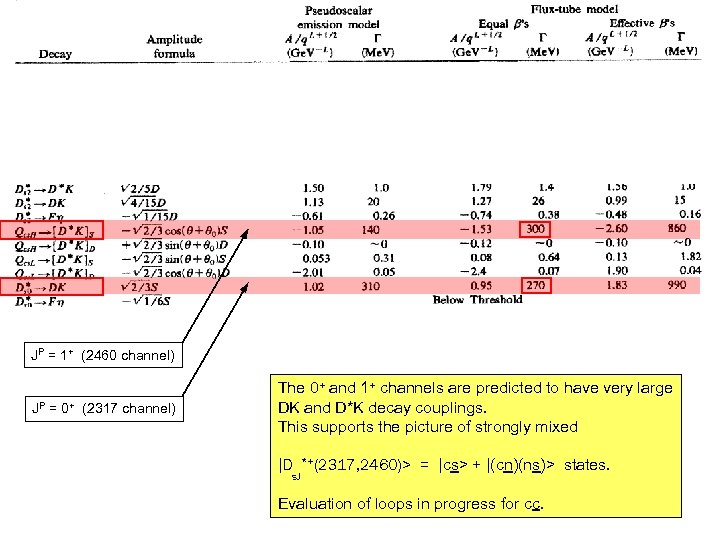
JP = 1+ (2460 channel) JP = 0+ (2317 channel) The 0+ and 1+ channels are predicted to have very large DK and D*K decay couplings. This supports the picture of strongly mixed |D s. J *+(2317, 2460)> = |cs> + |(cn)(ns)> states. Evaluation of loops in progress for cc.
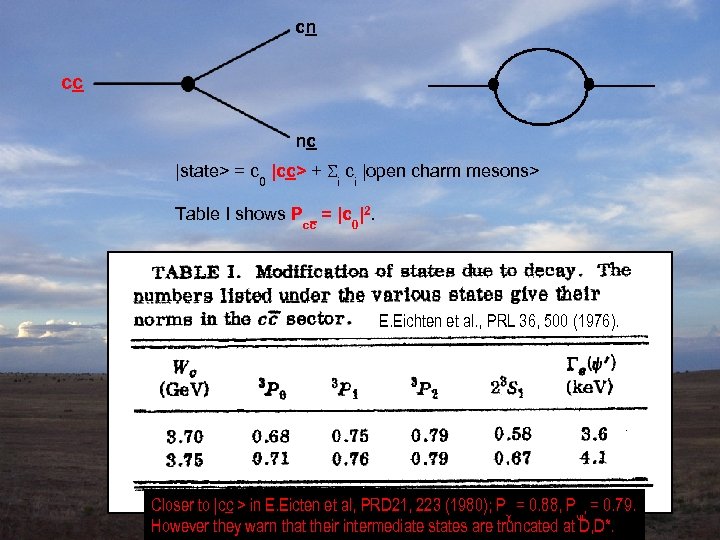
cn cc nc |state> = c 0 |cc> + Si ci |open charm mesons> Table I shows Pcc = |c 0|2. E. Eichten et al. , PRL 36, 500 (1976). Closer to |cc > in E. Eicten et al, PRD 21, 223 (1980); P = 0. 88, P = 0. 79. c y’ However they warn that their intermediate states are truncated at D, D*.
Summary and conclusions FIN
Скачать презентацию Ted Barnes Physics Div ORNL Dept of Physics
87e8a13a47c593197e38fb7ffbeee17b.ppt