 Скачать презентацию Ted Barnes BNL Seminar 18 Mar 2008 Recent
6e6f70bff7fcbcf3d8f4c367c2876019.ppt
- Количество слайдов: 72



Ted Barnes BNL Seminar 18 Mar. 2008 Recent developments in charm meson spectroscopy: Chaos, confusion and craziness. Basic hadronics Making charmonium Spectrum of charmonium Exciting new developments (2003 -present): D*s 0, Ds 1, X(3872), …(X, Y, Z), Y(4260), Z(4430). Theory abstracted from T. Barnes, S. Godfrey and E. S. Swanson, PRD 72, 054026 (2005). For BABAR, BELLE, BES, CLEO, GSI, … : All 40 cc states expected to 4. 42 Ge. V, all 139 of their open flavor strong modes and partial widths, all 231 o. f. strong decay amplitudes, all 153 E 1 and (some) M 1 EM widths. Phew.
1. Basic hadronics.
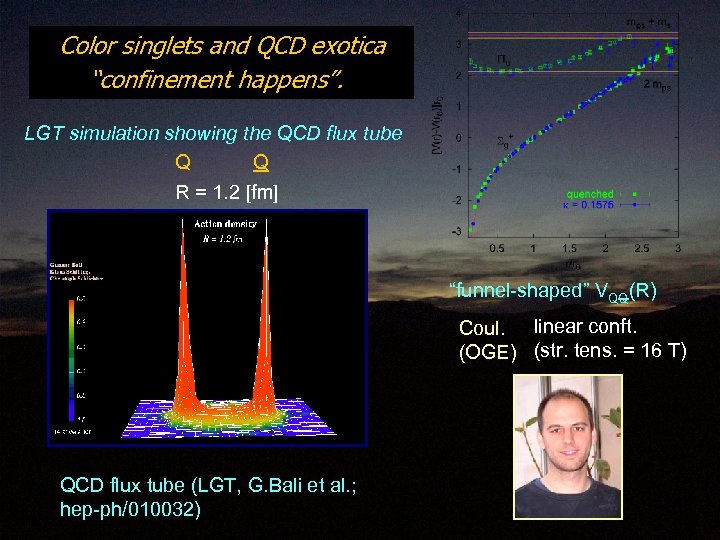
Color singlets and QCD exotica “confinement happens”. LGT simulation showing the QCD flux tube Q Q R = 1. 2 [fm] “funnel-shaped” VQQ(R) Coul. linear conft. (OGE) (str. tens. = 16 T) QCD flux tube (LGT, G. Bali et al. ; hep-ph/010032)
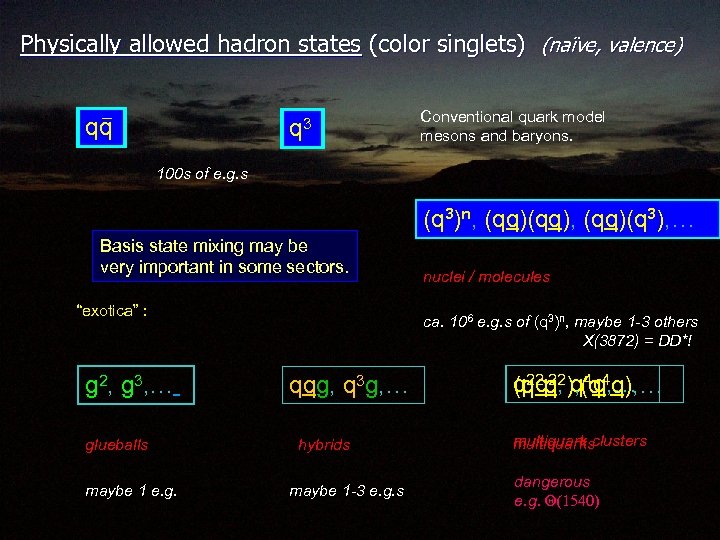
Physically allowed hadron states (color singlets) (naïve, valence) _ qq q 3 Conventional quark model mesons and baryons. 100 s of e. g. s (q 3)n, (qq), (qq)(q 3), … Basis state mixing may be very important in some sectors. “exotica” : g 2, g 3, … glueballs maybe 1 e. g. nuclei / molecules ca. 106 e. g. s of (q 3)n, maybe 1 -3 others X(3872) = DD*! qqg, q 3 g, … hybrids maybe 1 -3 e. g. s q 22 q 2), (q 4 q), … (qq 2, q 4 q, … multiquarksclusters dangerous e. g. Q(1540)
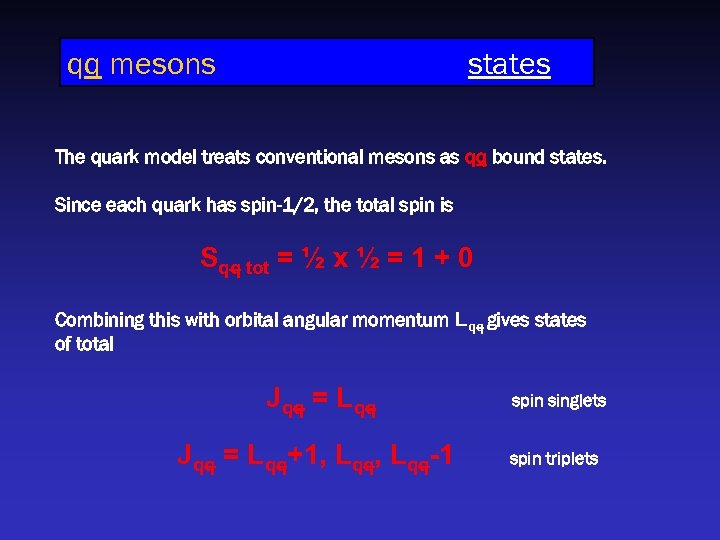
qq mesons states The quark model treats conventional mesons as qq bound states. Since each quark has spin-1/2, the total spin is Sqq tot =½x½=1+0 Combining this with orbital angular momentum Lqq gives states of total Jqq = Lqq spin singlets = Lqq+1, Lqq-1 spin triplets
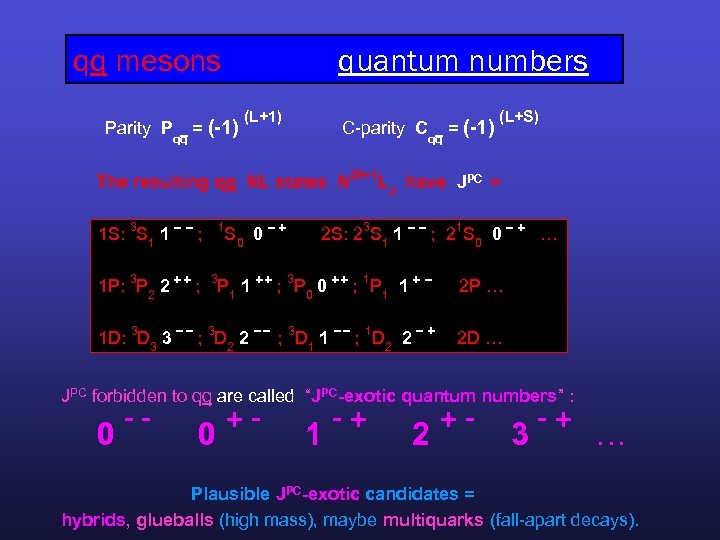
qq mesons quantum numbers Parity Pqq = (-1) (L+1) C-parity Cqq = (-1) (L+S) The resulting qq NL states N 2 S+1 LJ have JPC = 1 S: 3 S 1 1 - - ; 1 S 0 0 - + 2 S: 23 S 1 1 - - ; 21 S 0 0 - + … 1 P: 3 P 2 2 + + ; 3 P 1 1 + + ; 3 P 0 0 + + ; 1 P 1 1 + - 2 P … 1 D: 3 D 3 3 - - ; 3 D 2 2 - - ; 3 D 1 1 - - ; 1 D 2 2 - + 2 D … JPC forbidden to qq are called “JPC-exotic quantum numbers” : 0 -- 0 +- 1 -+ 2 +- 3 -+ … Plausible JPC-exotic candidates = hybrids, glueballs (high mass), maybe multiquarks (fall-apart decays).
2. Making charmonium.
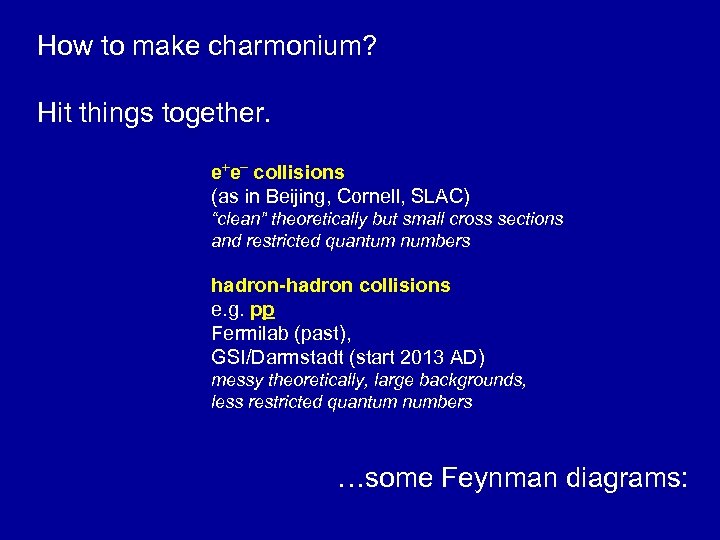
How to make charmonium? Hit things together. e+e- collisions (as in Beijing, Cornell, SLAC) “clean” theoretically but small cross sections and restricted quantum numbers hadron-hadron collisions e. g. pp Fermilab (past), GSI/Darmstadt (start 2013 AD) messy theoretically, large backgrounds, less restricted quantum numbers …some Feynman diagrams:
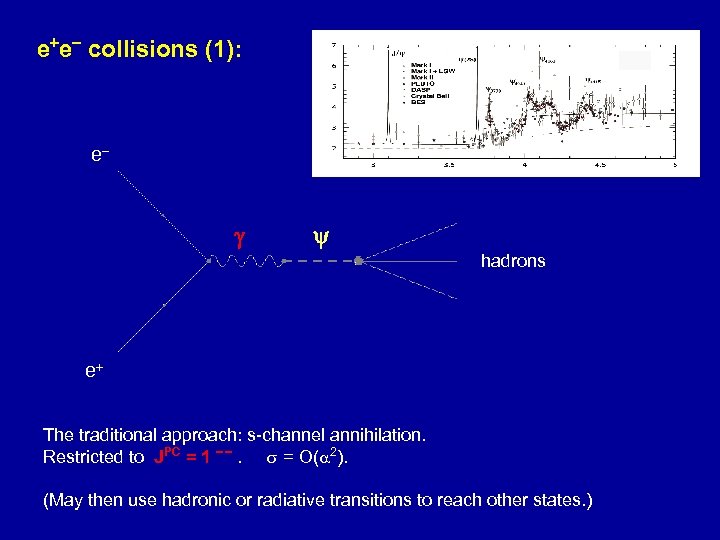
e+e- collisions (1): e- g y hadrons e+ The traditional approach: s-channel annihilation. Restricted to JPC = 1 - -. s = O(a 2). (May then use hadronic or radiative transitions to reach other states. )
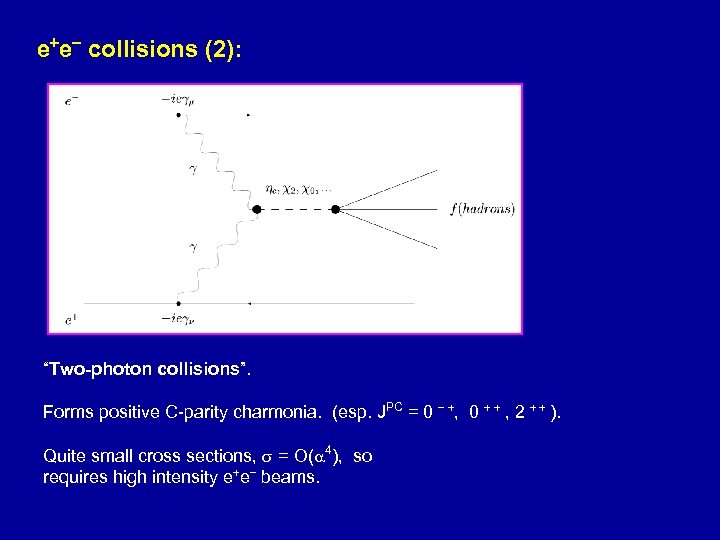
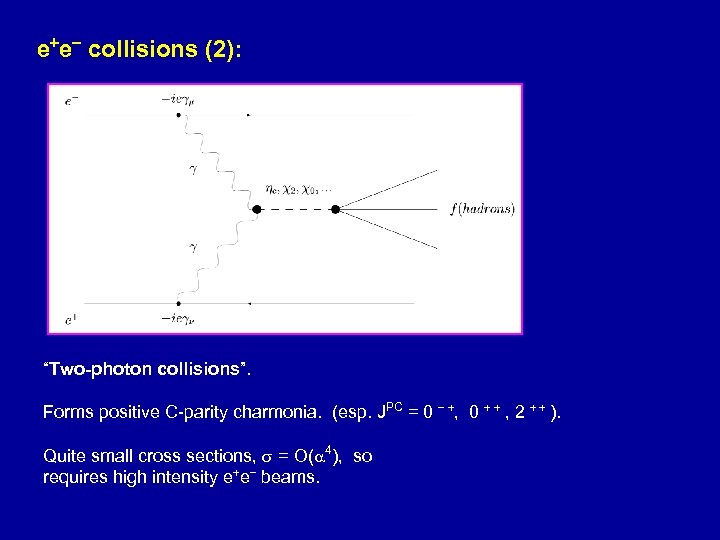
e+e- collisions (2): “Two-photon collisions”. Forms positive C-parity charmonia. (esp. JPC = 0 - +, 0 + + , 2 + + ). Quite small cross sections, s = O(a 4), so requires high intensity e+e- beams.
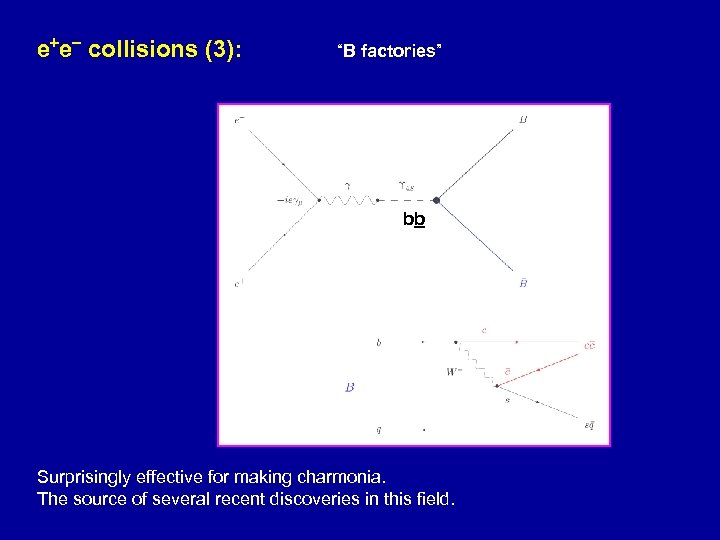
e+e- collisions (3): “B factories” bb Surprisingly effective for making charmonia. The source of several recent discoveries in this field.
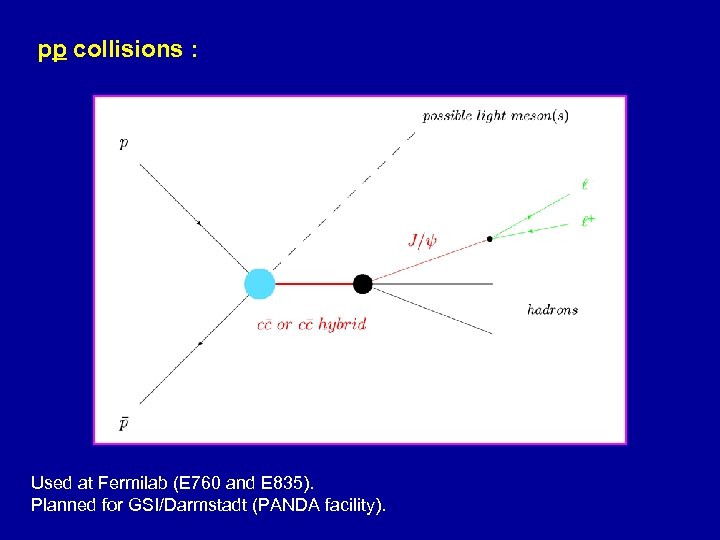
pp collisions : Used at Fermilab (E 760 and E 835). Planned for GSI/Darmstadt (PANDA facility).
3. The spectrum of charmonium. Pre-dawn, a lava field near Carrizozo, New Mexico.
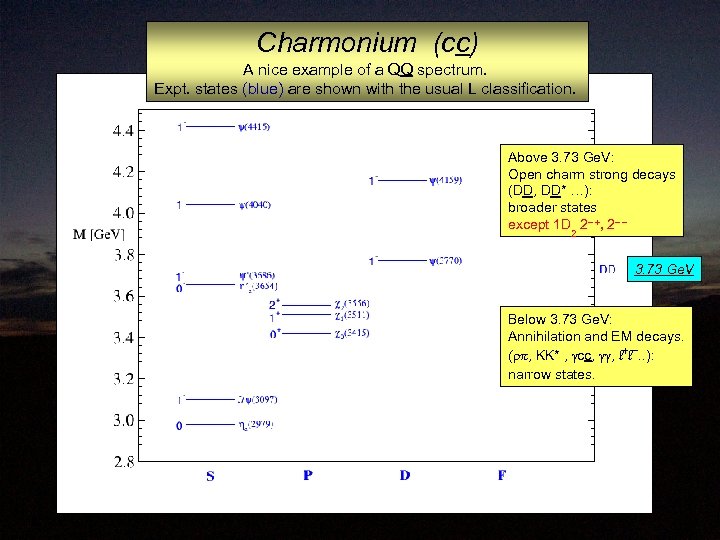
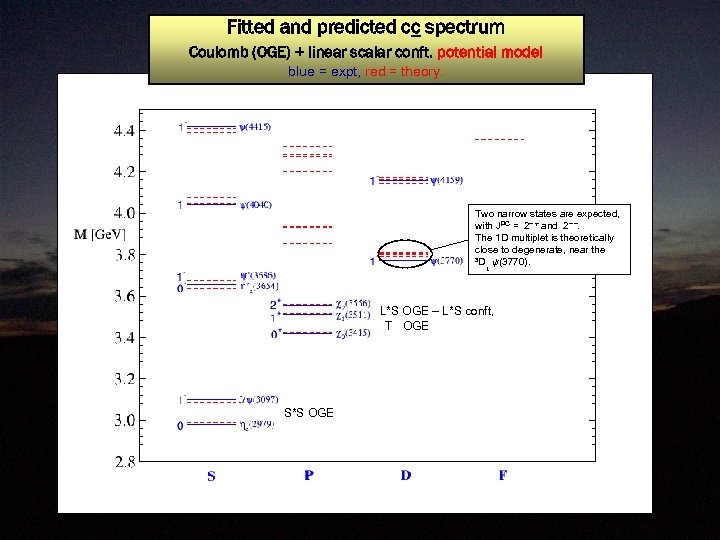
Charmonium (cc) A nice example of a QQ spectrum. Expt. states (blue) are shown with the usual L classification. Above 3. 73 Ge. V: Open charm strong decays (DD, DD* …): broader states except 1 D 2 - +, 2 - 2 3. 73 Ge. V Below 3. 73 Ge. V: Annihilation and EM decays. (rp, KK* , gcc, gg, l+l-. . ): narrow states.
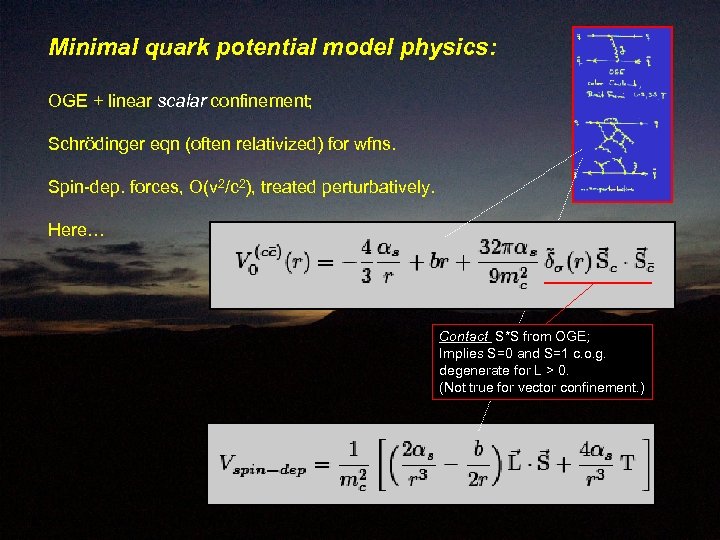
Minimal quark potential model physics: OGE + linear scalar confinement; Schrödinger eqn (often relativized) for wfns. Spin-dep. forces, O(v 2/c 2), treated perturbatively. Here… Contact S*S from OGE; Implies S=0 and S=1 c. o. g. degenerate for L > 0. (Not true for vector confinement. )
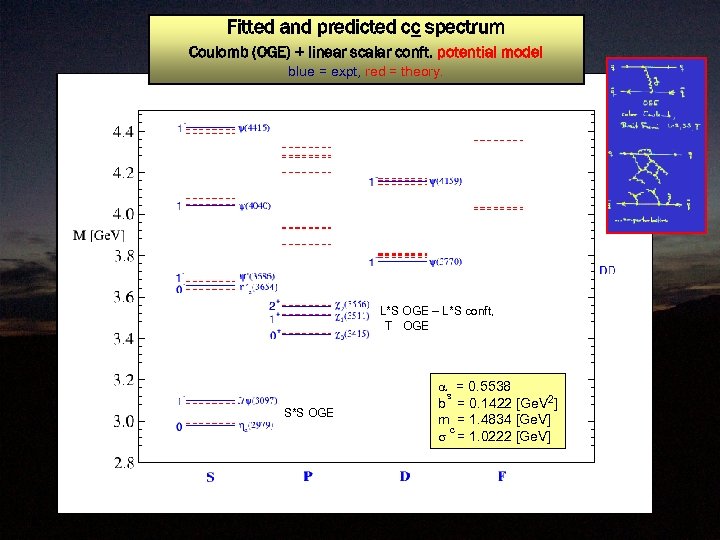
Fitted and predicted cc spectrum Coulomb (OGE) + linear scalar conft. potential model blue = expt, red = theory. L*S OGE – L*S conft, T OGE S*S OGE a = 0. 5538 s b = 0. 1422 [Ge. V 2] m = 1. 4834 [Ge. V] c s = 1. 0222 [Ge. V]
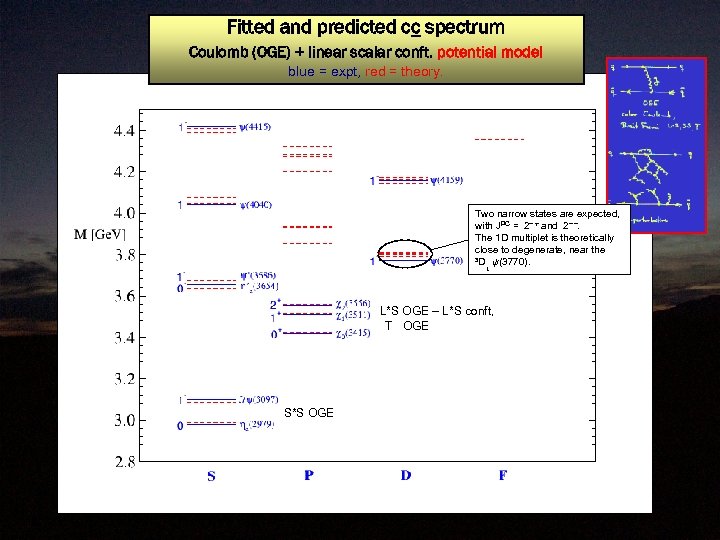
Fitted and predicted cc spectrum Coulomb (OGE) + linear scalar conft. potential model blue = expt, red = theory. Two narrow states are expected, with JPC = 2 - + and 2 - -. The 1 D multiplet is theoretically close to degenerate, near the 3 D y(3770). 1 L*S OGE – L*S conft, T OGE S*S OGE
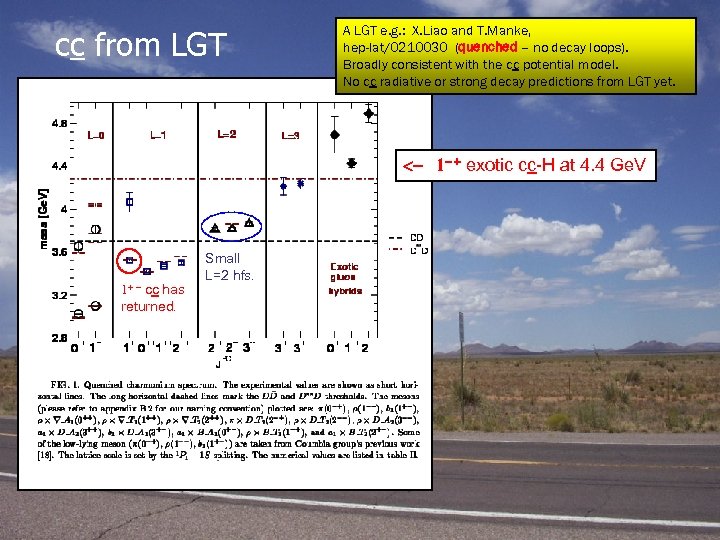
cc from LGT A LGT e. g. : X. Liao and T. Manke, hep-lat/0210030 (quenched – no decay loops). Broadly consistent with the cc potential model. No cc radiative or strong decay predictions from LGT yet. <- 1 - + exotic cc-H at 4. 4 Ge. V 1+ - cc has returned. Small L=2 hfs.
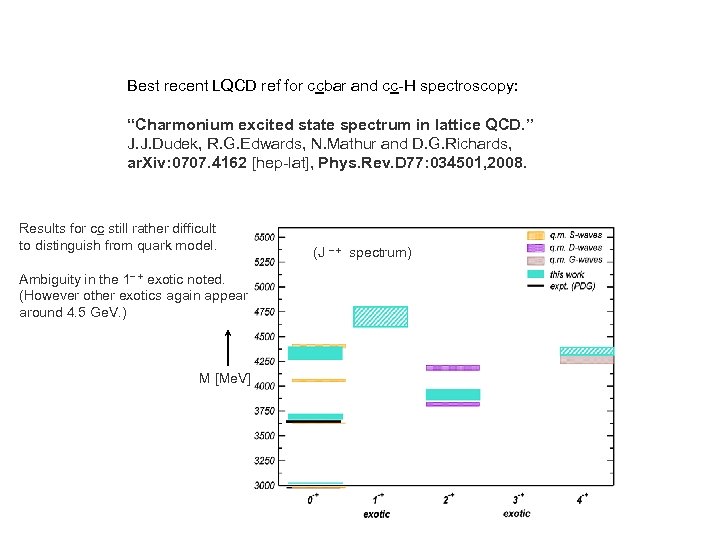
Best recent LQCD ref for ccbar and cc-H spectroscopy: “Charmonium excited state spectrum in lattice QCD. ” J. J. Dudek, R. G. Edwards, N. Mathur and D. G. Richards, ar. Xiv: 0707. 4162 [hep-lat], Phys. Rev. D 77: 034501, 2008. Results for cc still rather difficult to distinguish from quark model. Ambiguity in the 1 - + exotic noted. (However other exotics again appear around 4. 5 Ge. V. ) M [Me. V] (J - + spectrum)
End of Introduction to cc
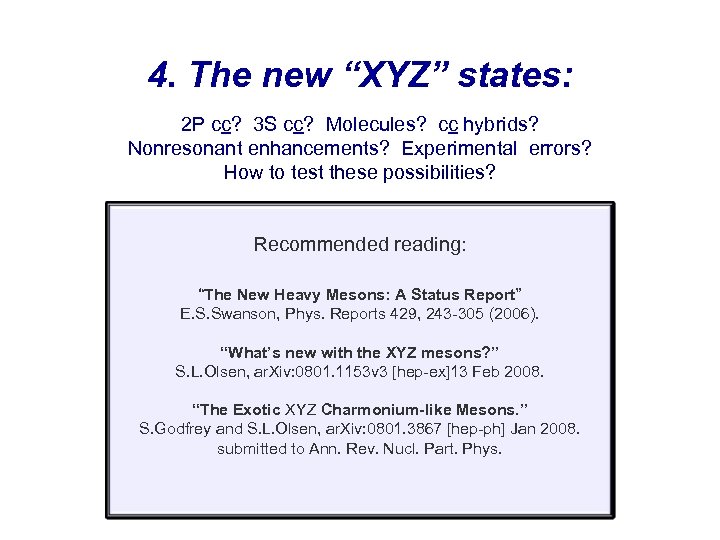
4. The new “XYZ” states: 2 P cc? 3 S cc? Molecules? cc hybrids? Nonresonant enhancements? Experimental errors? How to test these possibilities? Recommended reading: “The New Heavy Mesons: A Status Report” E. S. Swanson, Phys. Reports 429, 243 -305 (2006). “What’s new with the XYZ mesons? ” S. L. Olsen, ar. Xiv: 0801. 1153 v 3 [hep-ex]13 Feb 2008. “The Exotic XYZ Charmonium-like Mesons. ” S. Godfrey and S. L. Olsen, ar. Xiv: 0801. 3867 [hep-ph] Jan 2008. submitted to Ann. Rev. Nucl. Part. Phys.
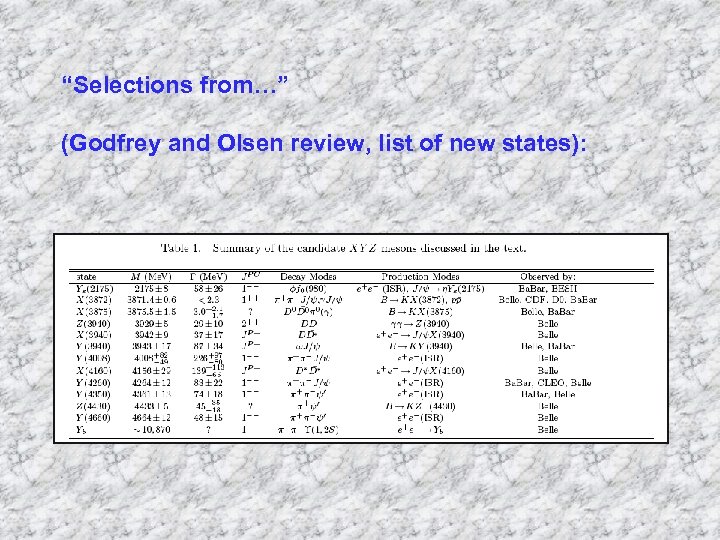
“Selections from…” (Godfrey and Olsen review, list of new states):
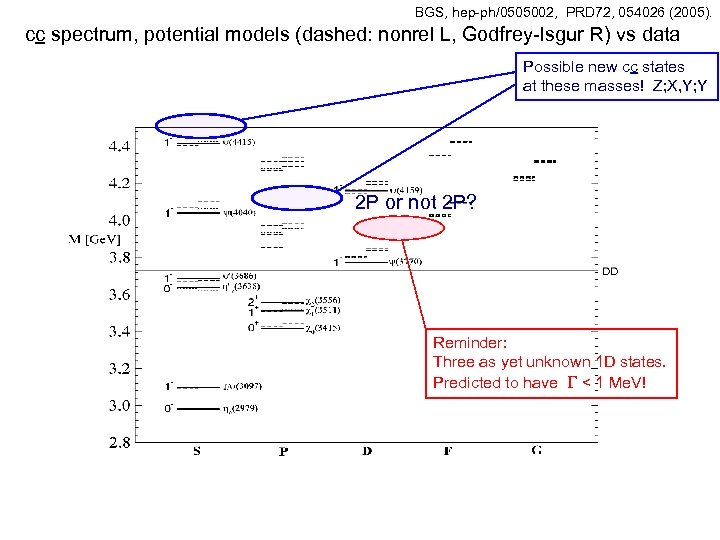
BGS, hep-ph/0505002, PRD 72, 054026 (2005). cc spectrum, potential models (dashed: nonrel L, Godfrey-Isgur R) vs data Possible new cc states at these masses! Z; X, Y; Y 2 P or not 2 P? Reminder: Three as yet unknown 1 D states. Predicted to have G < 1 Me. V!
… but first, the first of the new discoveries: new, unexpected, very long-lived mesons in the cs sector! D*s 0 (2317) and Ds 1(2457) cs mesons or DK molecules? (or both)
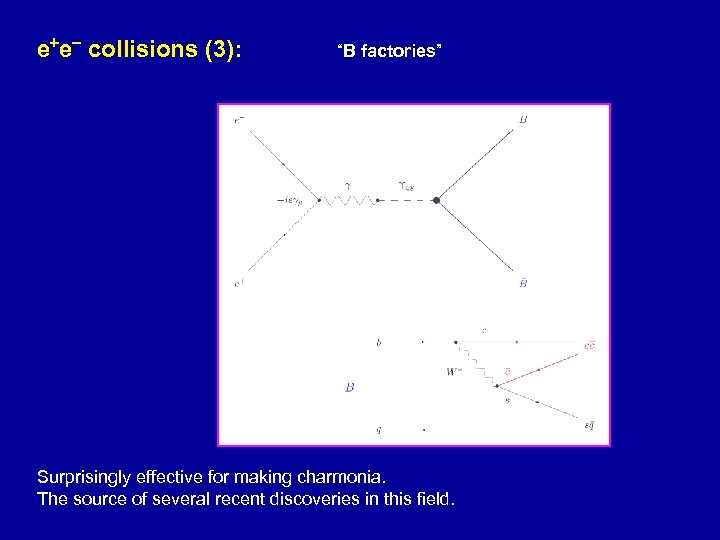
e+e- collisions (3): “B factories” Surprisingly effective for making charmonia. The source of several recent discoveries in this field.
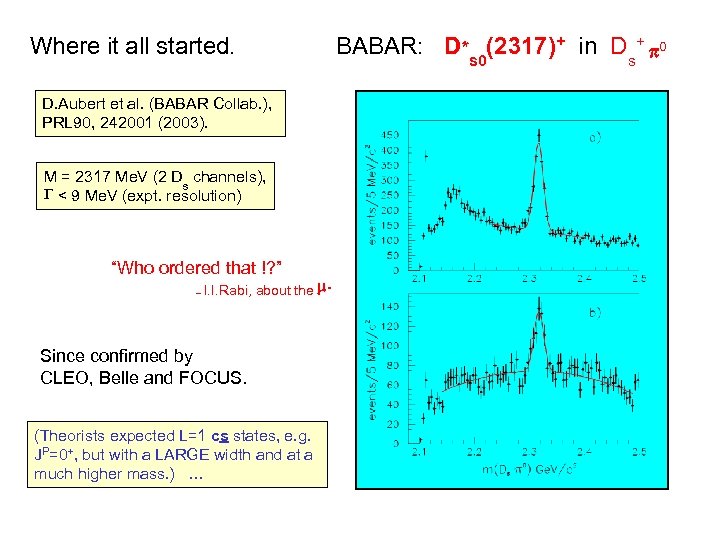
Where it all started. BABAR: D*s 0(2317)+ in Ds+ p 0 D. Aubert et al. (BABAR Collab. ), PRL 90, 242001 (2003). M = 2317 Me. V (2 Ds channels), G < 9 Me. V (expt. resolution) “Who ordered that !? ” - I. I. Rabi, about the m- Since confirmed by CLEO, Belle and FOCUS. (Theorists expected L=1 cs states, e. g. JP=0+, but with a LARGE width and at a much higher mass. ) …
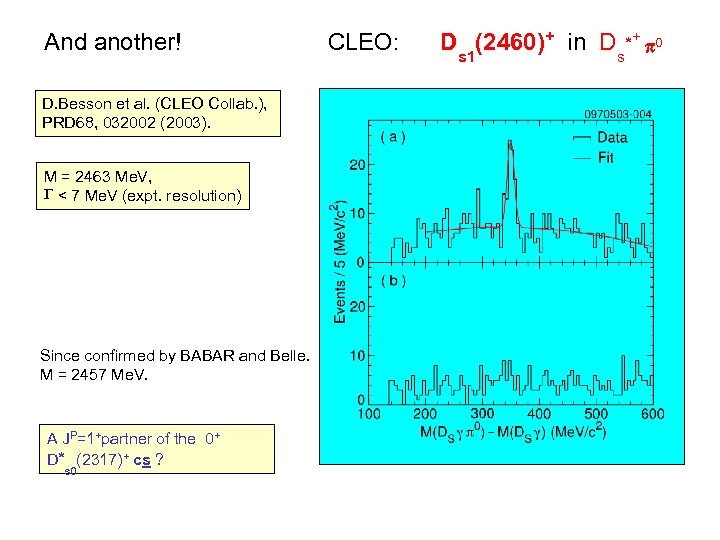
And another! CLEO: Ds 1(2460)+ in Ds*+ p 0 D. Besson et al. (CLEO Collab. ), PRD 68, 032002 (2003). M = 2463 Me. V, G < 7 Me. V (expt. resolution) Since confirmed by BABAR and Belle. M = 2457 Me. V. A JP=1+partner of the 0+ D* (2317)+ cs ? s 0
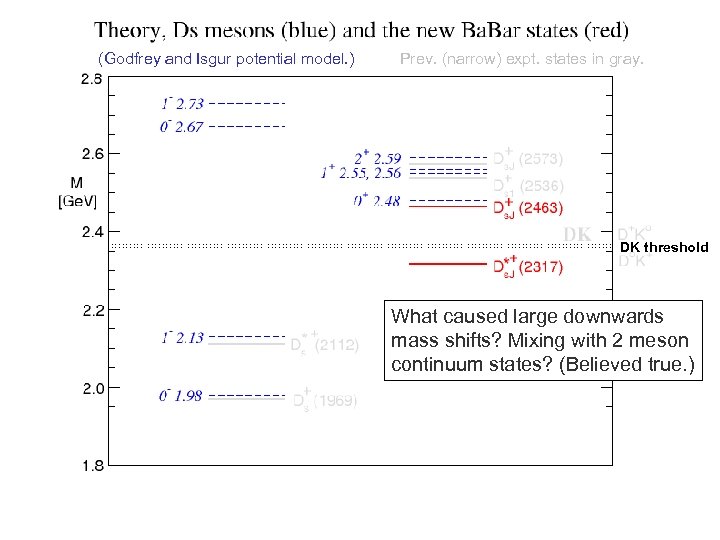
(Godfrey and Isgur potential model. ) Prev. (narrow) expt. states in gray. DK threshold What caused large downwards mass shifts? Mixing with 2 meson continuum states? (Believed true. )
![L’oops [ J/y - M M - J/y ] 1 MM 1 DD DM](https://present5.com/presentation/6e6f70bff7fcbcf3d8f4c367c2876019/image-29.jpg "L’oops [ J/y - M M - J/y ] 1 MM 1 DD DM")
L’oops [ J/y - M M - J/y ] 1 MM 1 DD DM [J/y] P 2 DD* D*D* DD s s [J/y] M M 1 2 3 P 2 decay model, std. params. and SHO wfns. 0 - 23. Me. V 0. 021 - 83. Me. V 0. 066 famous 1 : 4 : 7 ratio DD : DD* : D*D* - 132. Me. V 0. 094 - 21. Me. V 0. 015 DD* - 76. Me. V 0. 048 D *D * - 123. Me. V 0. 072 Sum = - 457. Me. V P = 69. % cc VERY LARGE mass shift and large non-cc component! Can the QM really accommodate such large mass shifts? ? ? Other “cc” states?
![L’oops [ cc - M M - cc ] 3 P 1 0 2](https://present5.com/presentation/6e6f70bff7fcbcf3d8f4c367c2876019/image-30.jpg "L’oops [ cc - M M - cc ] 3 P 1 0 2")
L’oops [ cc - M M - cc ] 3 P 1 0 2 decay model, std. params. and SHO wfns. Loops produce a roughly state-independent overall negative mass shift !
![L’oops [ cc - M M - cc ] 3 P 1 0 2](https://present5.com/presentation/6e6f70bff7fcbcf3d8f4c367c2876019/image-31.jpg "L’oops [ cc - M M - cc ] 3 P 1 0 2")
L’oops [ cc - M M - cc ] 3 P 1 0 2 decay model, std. params. and SHO wfns. Loop mass shifts of states within L, S cc multiplets are analytically identical if the initial masses are equal, if you sum over multiplets of loop spin states! (A theorem in: ) “Hadron Loops: General Theorems and Application to Charmonium” T. Barnes and E. S. Swanson, ar. Xiv: 0711. 2080 [hep-ph] (Nov. 2007)
X(3872) a charmed meson molecule?
Fitted and predicted cc spectrum Coulomb (OGE) + linear scalar conft. potential model blue = expt, red = theory. Two narrow states are expected, with JPC = 2 - + and 2 - -. The 1 D multiplet is theoretically close to degenerate, near the 3 D y(3770). 1 L*S OGE – L*S conft, T OGE S*S OGE
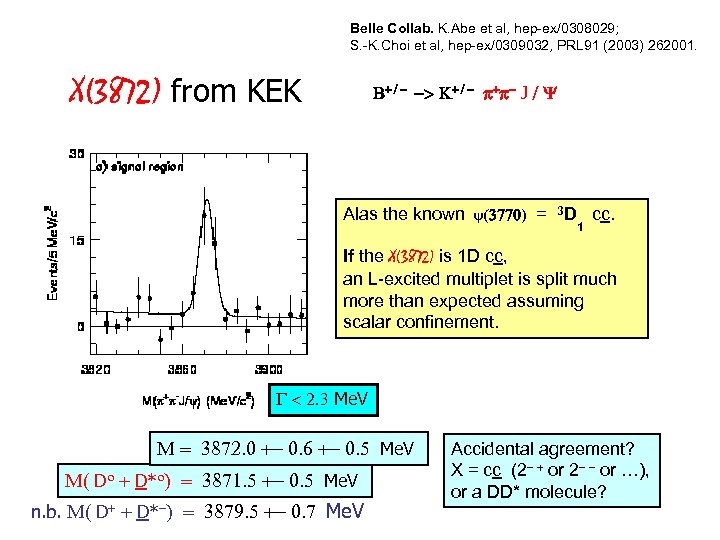
Belle Collab. K. Abe et al, hep-ex/0308029; S. -K. Choi et al, hep-ex/0309032, PRL 91 (2003) 262001. X(3872) from KEK B+ / - -> K+ / - p+p- J / Y Alas the known y(3770) = 3 D cc. 1 If the X(3872) is 1 D cc, an L-excited multiplet is split much more than expected assuming scalar confinement. G < 2. 3 Me. V M = 3872. 0 +- 0. 6 +- 0. 5 Me. V M( Do + D*o) = 3871. 5 +- 0. 5 Me. V n. b. M( D+ + D*-) = 3879. 5 +- 0. 7 Me. V Accidental agreement? X = cc (2 - + or 2 - - or …), or a DD* molecule?
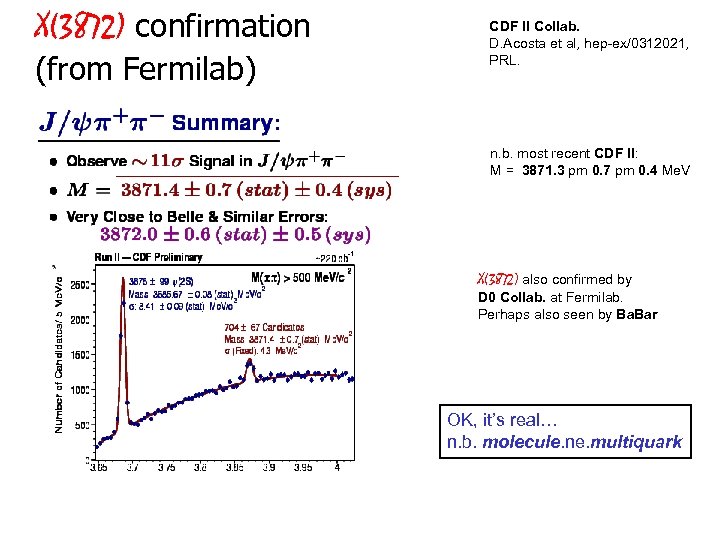
X(3872) confirmation (from Fermilab) CDF II Collab. D. Acosta et al, hep-ex/0312021, PRL. n. b. most recent CDF II: M = 3871. 3 pm 0. 7 pm 0. 4 Me. V X(3872) also confirmed by D 0 Collab. at Fermilab. Perhaps also seen by Ba. Bar OK, it’s real… n. b. molecule. ne. multiquark
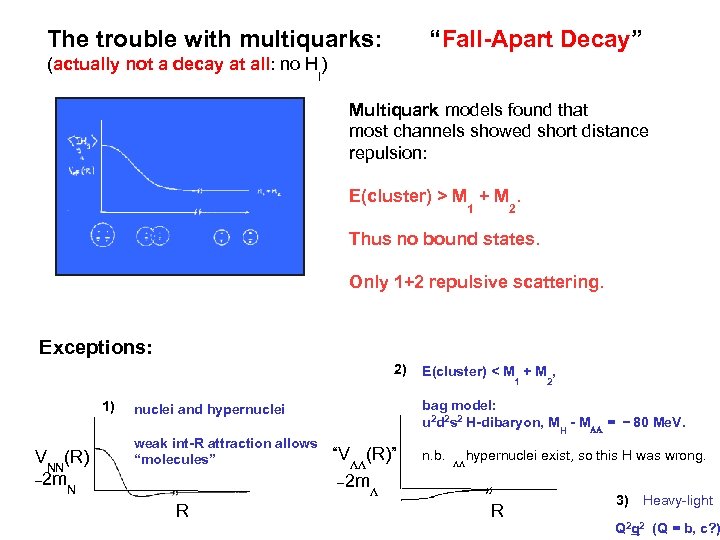
The trouble with multiquarks: “Fall-Apart Decay” (actually not a decay at all: no H ) I Multiquark models found that most channels showed short distance repulsion: E(cluster) > M + M. 1 2 Thus no bound states. Only 1+2 repulsive scattering. Exceptions: 2) 1) VNN(R) -2 m N “VLL(R)” -2 m R 1 2 bag model: u 2 d 2 s 2 H-dibaryon, MH - MLL = - 80 Me. V. nuclei and hypernuclei weak int-R attraction allows “molecules” E(cluster) < M + M , n. b. LLhypernuclei exist, so this H was wrong. L R 3) Heavy-light Q 2 q 2 (Q = b, c? )
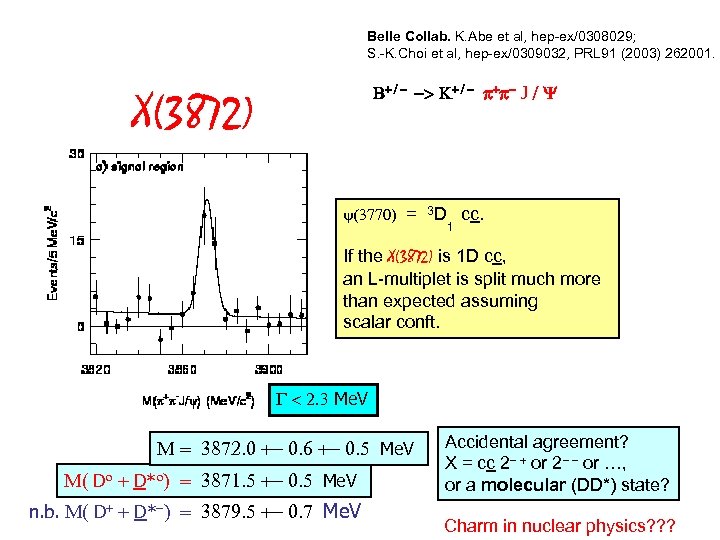
Belle Collab. K. Abe et al, hep-ex/0308029; S. -K. Choi et al, hep-ex/0309032, PRL 91 (2003) 262001. B+ / - -> K+ / - p+p- J / Y X(3872) y(3770) = 3 D cc. 1 If the X(3872) is 1 D cc, an L-multiplet is split much more than expected assuming scalar conft. G < 2. 3 Me. V M = 3872. 0 +- 0. 6 +- 0. 5 Me. V M( Do + D*o) = 3871. 5 +- 0. 5 Me. V n. b. M( D+ + D*-) = 3879. 5 +- 0. 7 Me. V Accidental agreement? X = cc 2 - + or 2 - - or …, or a molecular (DD*) state? Charm in nuclear physics? ? ?
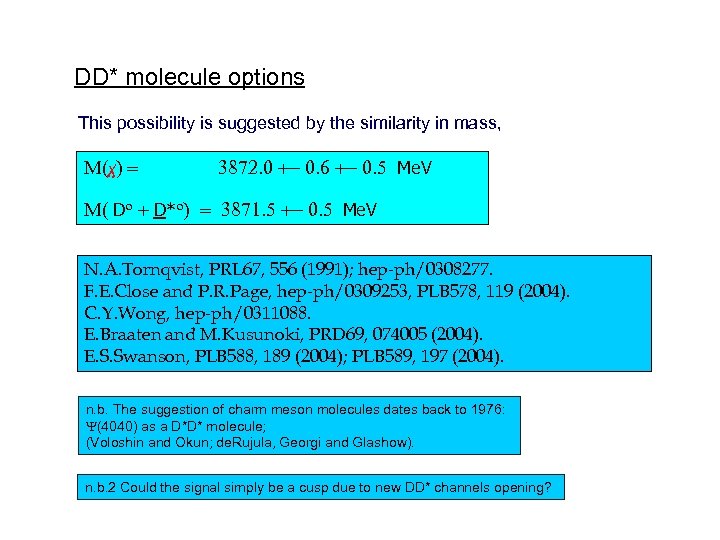
DD* molecule options This possibility is suggested by the similarity in mass, M(X) = 3872. 0 +- 0. 6 +- 0. 5 Me. V Do + D*o) = 3871. 5 +- 0. 5 M( Me. V N. A. Tornqvist, PRL 67, 556 (1991); hep-ph/0308277. F. E. Close and P. R. Page, hep-ph/0309253, PLB 578, 119 (2004). C. Y. Wong, hep-ph/0311088. E. Braaten and M. Kusunoki, PRD 69, 074005 (2004). E. S. Swanson, PLB 588, 189 (2004); PLB 589, 197 (2004). n. b. The suggestion of charm meson molecules dates back to 1976: Y(4040) as a D*D* molecule; (Voloshin and Okun; de. Rujula, Georgi and Glashow). n. b. 2 Could the signal simply be a cusp due to new DD* channels opening?
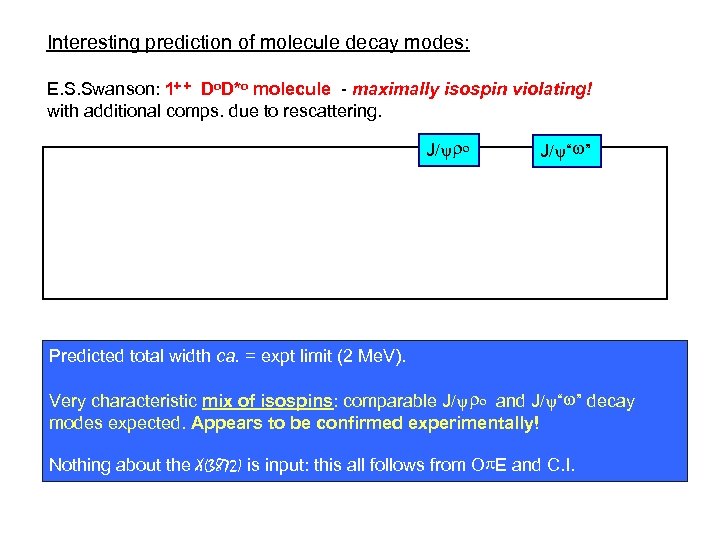
Interesting prediction of molecule decay modes: E. S. Swanson: 1+ + Do. D*o molecule - maximally isospin violating! with additional comps. due to rescattering. J/yro J/y“w” Predicted total width ca. = expt limit (2 Me. V). Very characteristic mix of isospins: comparable J/yro and J/y“w” decay modes expected. Appears to be confirmed experimentally! Nothing about the X(3872) is input: this all follows from Op. E and C. I.
Z(3930) a 23 P 2 charmonium state?
e+e- collisions (2): “Two-photon collisions”. Forms positive C-parity charmonia. (esp. JPC = 0 - +, 0 + + , 2 + + ). Quite small cross sections, s = O(a 4), so requires high intensity e+e- beams.
![Z(3931) [ref] = Belle, hep-ex/0507033, 8 Jul 2005. gg -> Z(3931) -> DD](https://present5.com/presentation/6e6f70bff7fcbcf3d8f4c367c2876019/image-42.jpg "Z(3931) [ref] = Belle, hep-ex/0507033, 8 Jul 2005. gg -> Z(3931) -> DD")
Z(3931) [ref] = Belle, hep-ex/0507033, 8 Jul 2005. gg -> Z(3931) -> DD
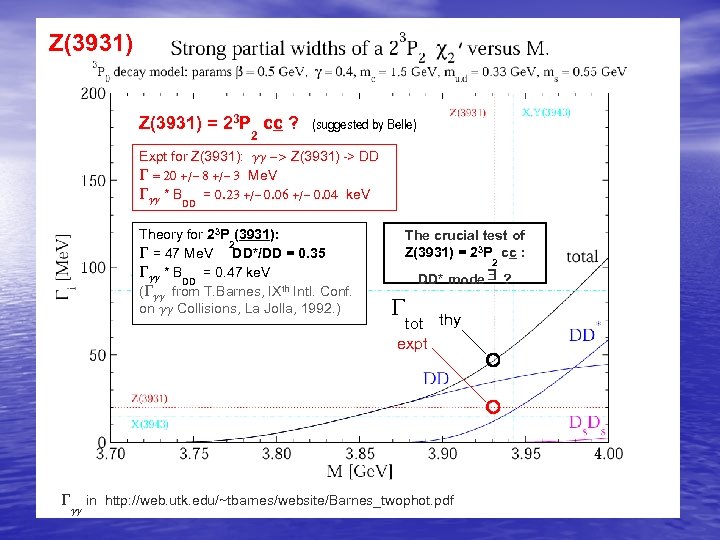
Z(3931) = 23 P cc ? 2 (suggested by Belle) Expt for Z(3931): gg -> Z(3931) -> DD G = 20 +/- 8 +/- 3 Me. V Ggg * B = 0. 23 +/- 0. 06 +/- 0. 04 ke. V DD Theory for 23 P (3931): 2 G = 47 Me. V DD*/DD = 0. 35 Ggg * B = 0. 47 ke. V DD (Ggg from T. Barnes, IXth Intl. Conf. on gg Collisions, La Jolla, 1992. ) The crucial test of Z(3931) = 23 P cc : 2 DD* mode $ ? G tot thy expt G in http: //web. utk. edu/~tbarnes/website/Barnes_twophot. pdf gg
X(3940) and double charmonium production
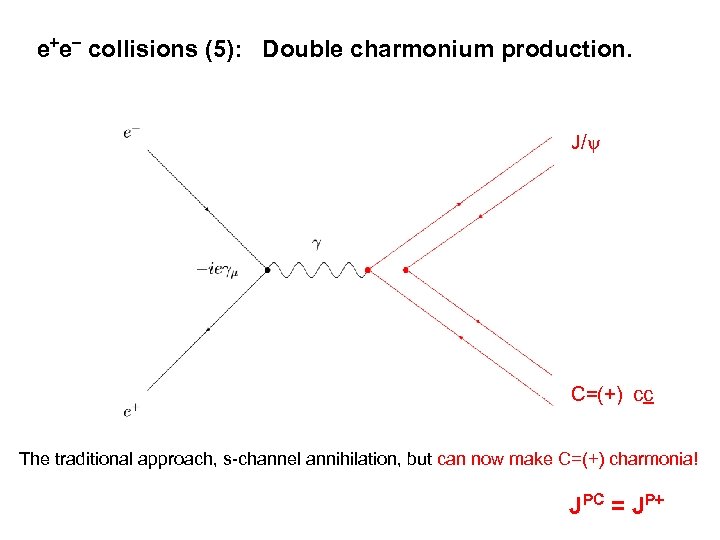
e+e- collisions (5): Double charmonium production. J/y C=(+) cc The traditional approach, s-channel annihilation, but can now make C=(+) charmonia! J PC = JP+
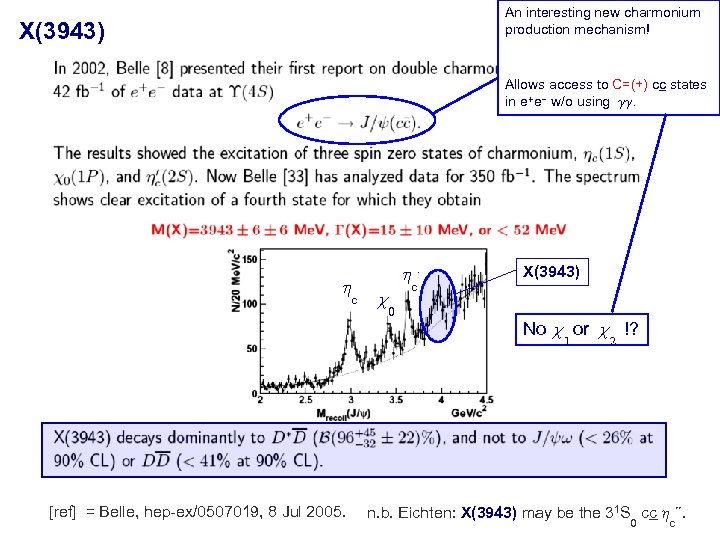
An interesting new charmonium production mechanism! X(3943) Allows access to C=(+) cc states in e+e- w/o using gg. h h’ c c c 0 X(3943) No c or c !? 1 [ref] = Belle, hep-ex/0507019, 8 Jul 2005. 2 n. b. Eichten: X(3943) may be the 31 S cc h ’’. 0 c
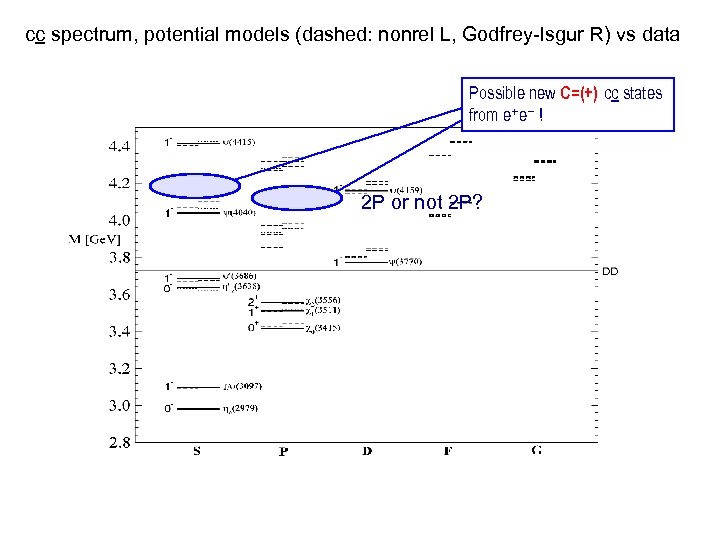
cc spectrum, potential models (dashed: nonrel L, Godfrey-Isgur R) vs data Possible new C=(+) cc states from e+e- ! 2 P or not 2 P?
Y(4260) a charmonium hybrid?
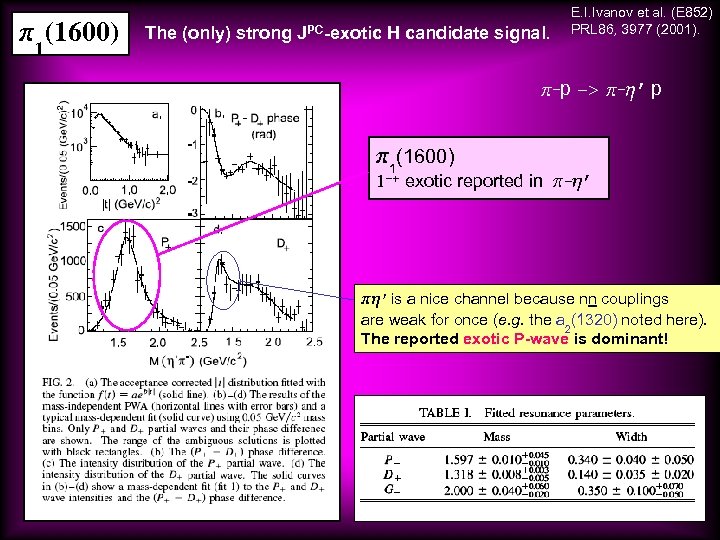
p (1600) 1 The (only) strong JPC-exotic H candidate signal. E. I. Ivanov et al. (E 852) PRL 86, 3977 (2001). p-p -> p-h’ p p 1(1600) 1 -+ exotic reported in p-h’ ph’is a nice channel because nn couplings are weak for once (e. g. the a 2(1320) noted here). The reported exotic P-wave is dominant!
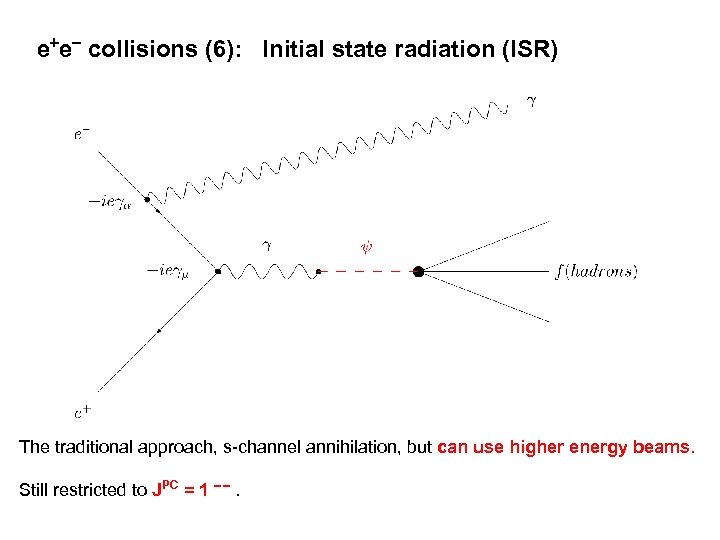
e+e- collisions (6): Initial state radiation (ISR) J/y The traditional approach, s-channel annihilation, but can use higher energy beams. Still restricted to JPC = 1 - -.
![Y(4260) e+e- -> Y(4260) , Y -> p+p-J/y ISR [ref] = Ba. Bar, PRL](https://present5.com/presentation/6e6f70bff7fcbcf3d8f4c367c2876019/image-51.jpg "Y(4260) e+e- -> Y(4260) , Y -> p+p-J/y ISR [ref] = Ba. Bar, PRL")
Y(4260) e+e- -> Y(4260) , Y -> p+p-J/y ISR [ref] = Ba. Bar, PRL 95, 142001 (2005). closed-flavor decay mode !? Not seen in R. Hmmm? ! log scale
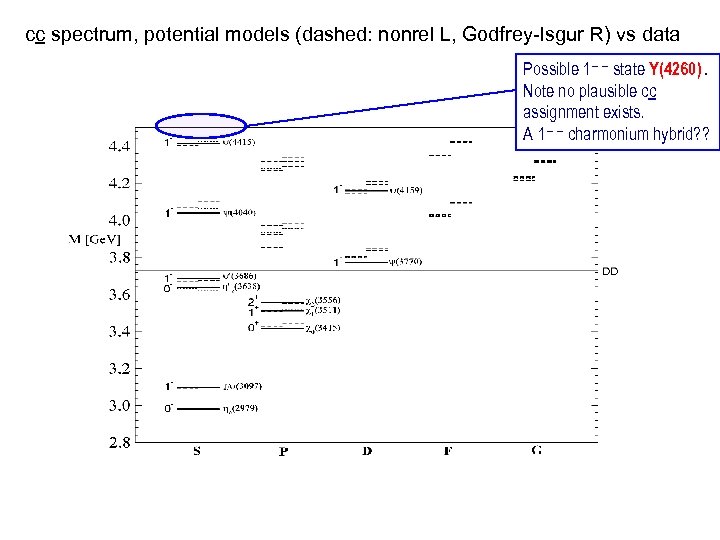
cc spectrum, potential models (dashed: nonrel L, Godfrey-Isgur R) vs data Possible 1 - - state Y(4260). Note no plausible cc assignment exists. A 1 - - charmonium hybrid? ?
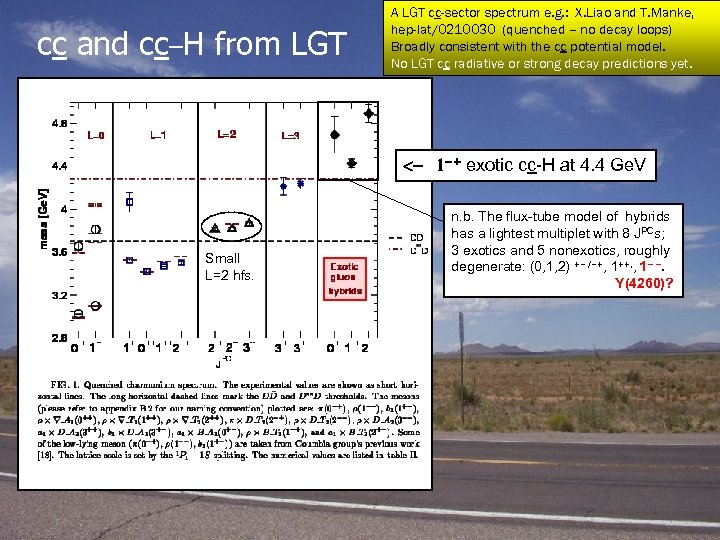
cc and cc–H from LGT A LGT cc-sector spectrum e. g. : X. Liao and T. Manke, hep-lat/0210030 (quenched – no decay loops) Broadly consistent with the cc potential model. No LGT cc radiative or strong decay predictions yet. <- 1 - + exotic cc-H at 4. 4 Ge. V Small L=2 hfs. n. b. The flux-tube model of hybrids has a lightest multiplet with 8 JPCs; 3 exotics and 5 nonexotics, roughly degenerate: (0, 1, 2) +- /-+, 1++, , 1 - -. Y(4260)?
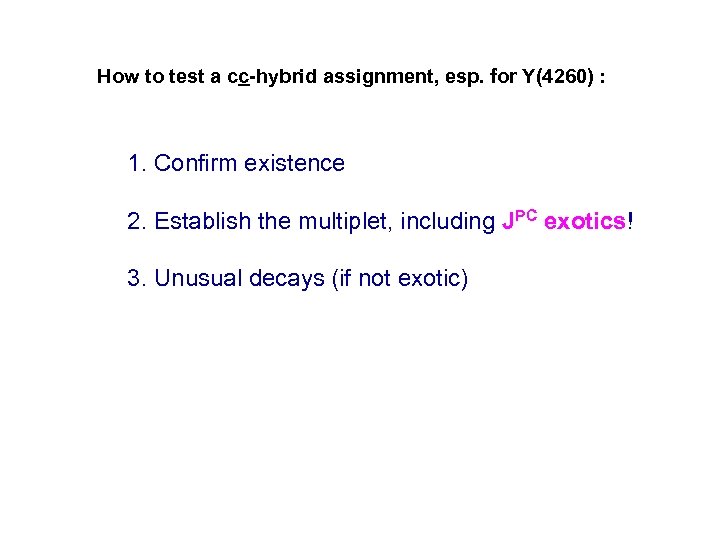
How to test a cc-hybrid assignment, esp. for Y(4260) : 1. Confirm existence 2. Establish the multiplet, including JPC exotics! 3. Unusual decays (if not exotic)
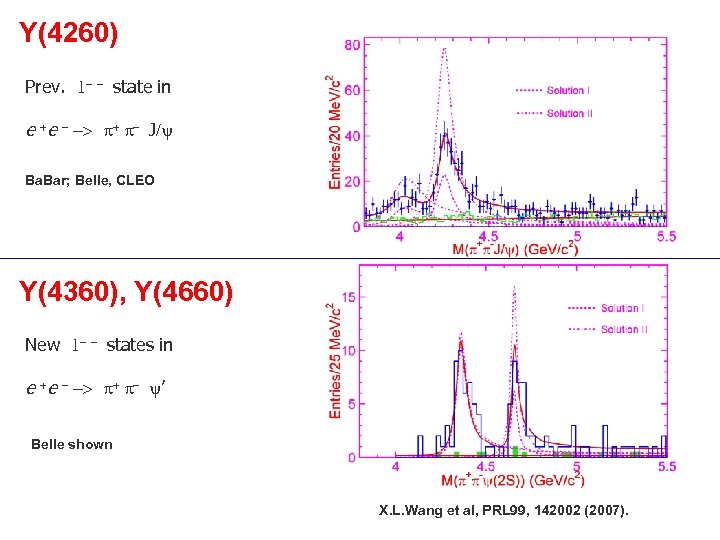
Y(4260) Prev. 1 - - state in e +e - -> p+ p- J/y Ba. Bar; Belle, CLEO Y(4360), Y(4660) New 1 - - states in e +e - -> p+ p- y’ Belle shown X. L. Wang et al, PRL 99, 142002 (2007).
The latest craziness… Z+/-(4430) charged charmonium? ? ?
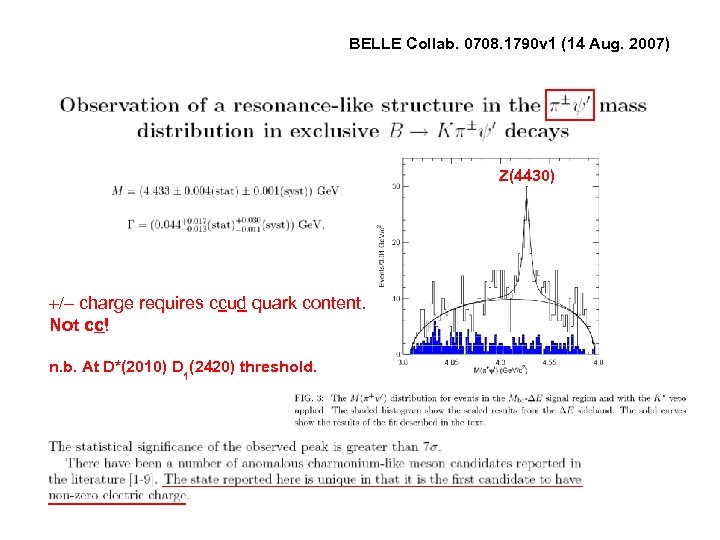
BELLE Collab. 0708. 1790 v 1 (14 Aug. 2007) Z(4430) +/- charge requires ccud quark content. Not cc! n. b. At D*(2010) D 1(2420) threshold.
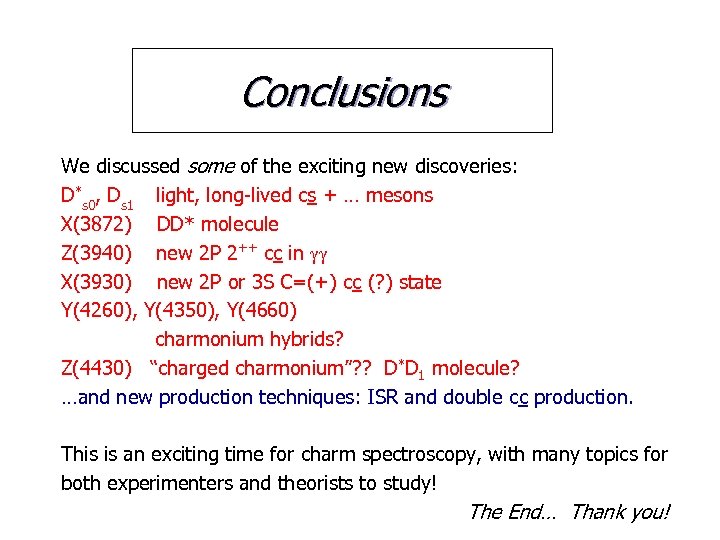
Conclusions We discussed some of the exciting new discoveries: D*s 0, Ds 1 light, long-lived cs + … mesons X(3872) DD* molecule Z(3940) new 2 P 2++ cc in gg X(3930) new 2 P or 3 S C=(+) cc (? ) state Y(4260), Y(4350), Y(4660) charmonium hybrids? Z(4430) “charged charmonium”? ? D*D 1 molecule? …and new production techniques: ISR and double cc production. This is an exciting time for charm spectroscopy, with many topics for both experimenters and theorists to study! The End… Thank you!
END / EXTRAS
3. b. Strong decays
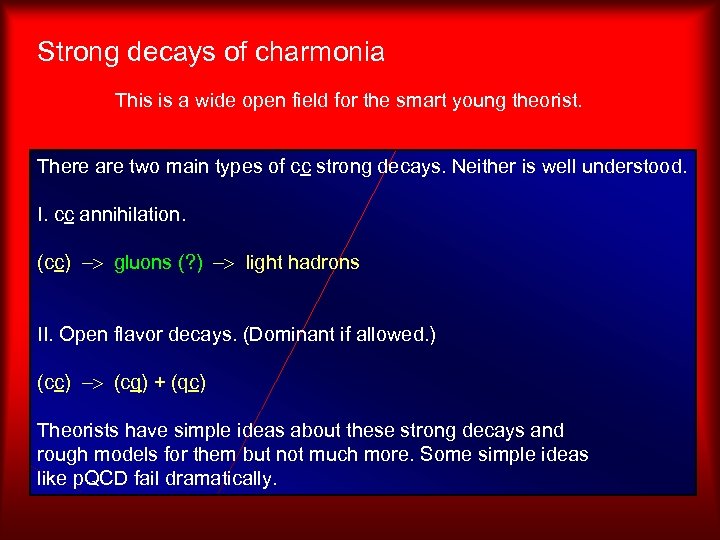
Strong decays of charmonia This is a wide open field for the smart young theorist. There are two main types of cc strong decays. Neither is well understood. I. cc annihilation. (cc) -> gluons (? ) -> light hadrons II. Open flavor decays. (Dominant if allowed. ) (cc) -> (cq) + (qc) Theorists have simple ideas about these strong decays and rough models for them but not much more. Some simple ideas like p. QCD fail dramatically.
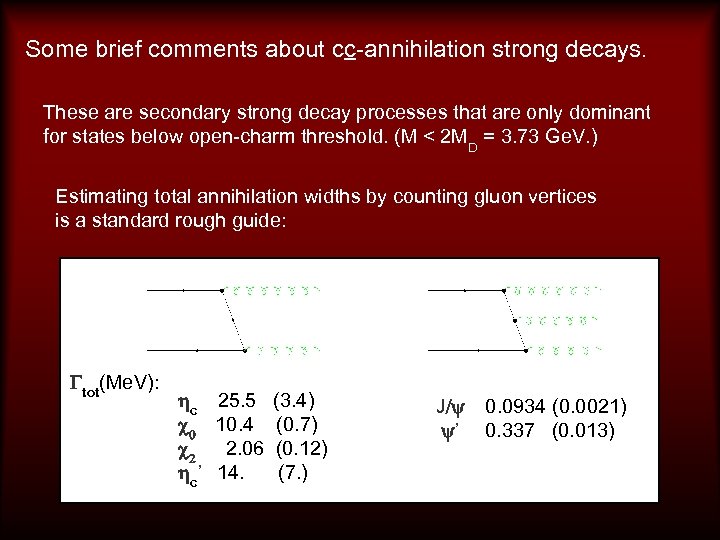
Some brief comments about cc-annihilation strong decays. These are secondary strong decay processes that are only dominant for states below open-charm threshold. (M < 2 MD = 3. 73 Ge. V. ) Estimating total annihilation widths by counting gluon vertices is a standard rough guide: Gtot(Me. V): hc 25. 5 (3. 4) c 0 10. 4 (0. 7) c 2 2. 06 (0. 12) hc’ 14. (7. ) J/y 0. 0934 (0. 0021) y’ 0. 337 (0. 013)
Strong decays (open flavor)
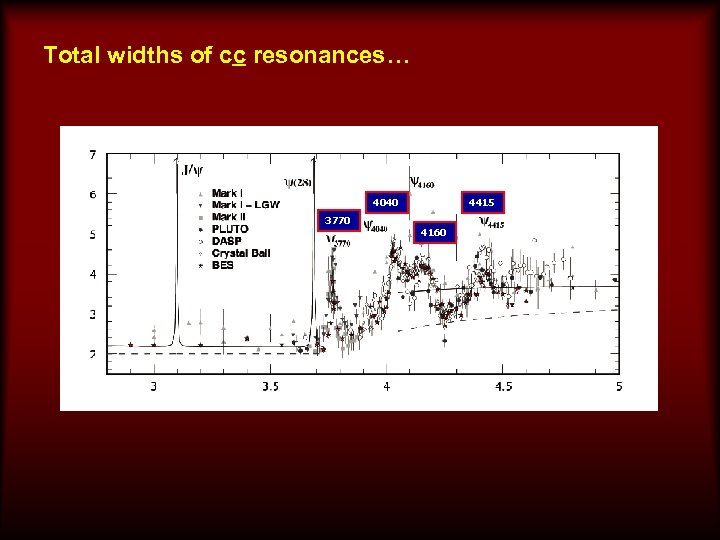
Total widths of cc resonances… 4040 3770 4415 4160
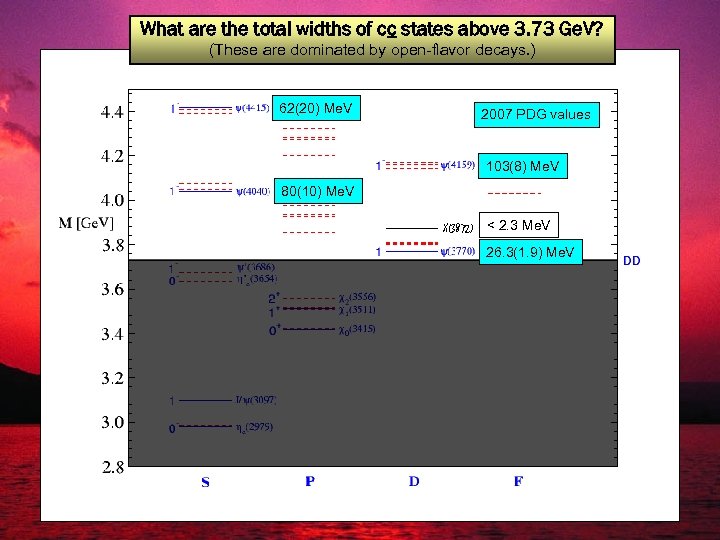
What are the total widths of cc states above 3. 73 Ge. V? (These are dominated by open-flavor decays. ) 62(20) Me. V 2007 PDG values 103(8) Me. V 80(10) Me. V X(3872) < 2. 3 Me. V 26. 3(1. 9) Me. V
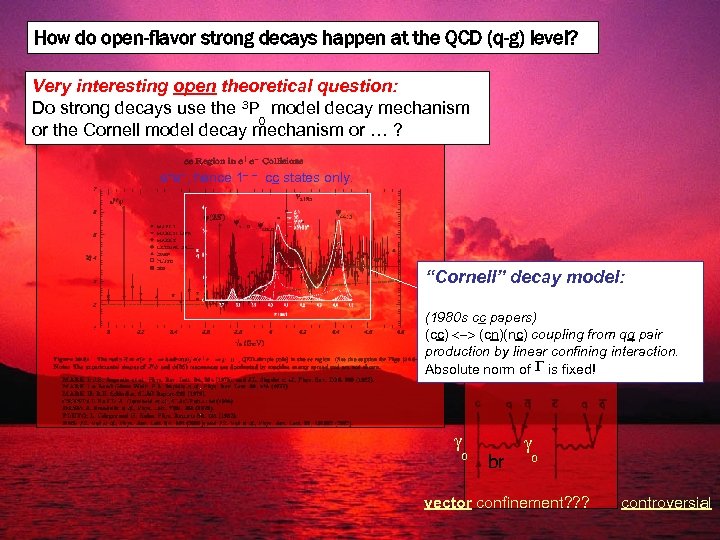
How do open-flavor strong decays happen at the QCD (q-g) level? Experimental R summary (2003 PDG) Very interesting open theoretical question: Do strong decays use the 3 P model decay mechanism 0 or the Cornell model decay mechanism or … ? e+e-, hence 1 - - cc states only. “Cornell” decay model: (1980 s cc papers) (cc) <-> (cn)(nc) coupling from qq pair production by linear confining interaction. Absolute norm of G is fixed! g 0 br g 0 vector confinement? ? ? controversial
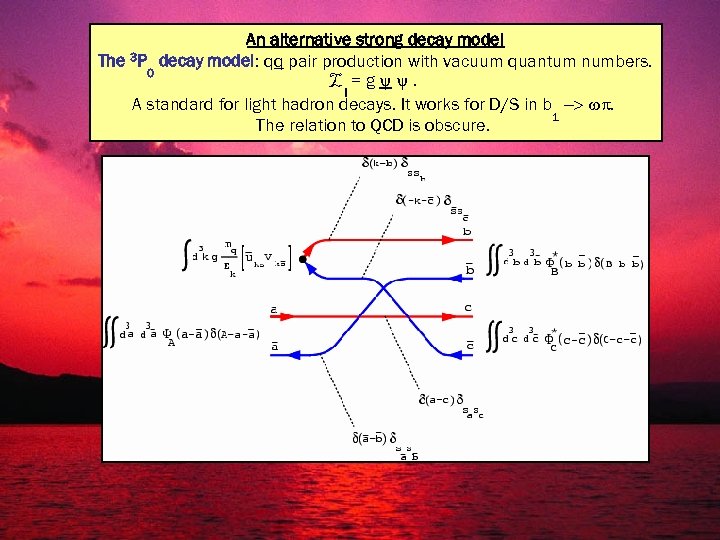
An alternative strong decay model The 3 P decay model: qq pair production with vacuum quantum numbers. 0 L =gyy. I A standard for light hadron decays. It works for D/S in b -> wp. 1 The relation to QCD is obscure.
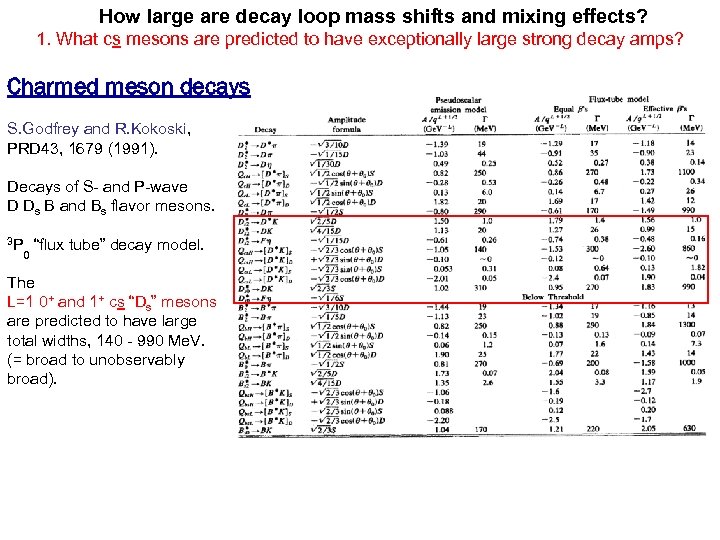
How large are decay loop mass shifts and mixing effects? 1. What cs mesons are predicted to have exceptionally large strong decay amps? Charmed meson decays S. Godfrey and R. Kokoski, PRD 43, 1679 (1991). Decays of S- and P-wave D Ds B and Bs flavor mesons. 3 P 0 “flux tube” decay model. The L=1 0+ and 1+ cs “Ds” mesons are predicted to have large total widths, 140 - 990 Me. V. (= broad to unobservably broad).
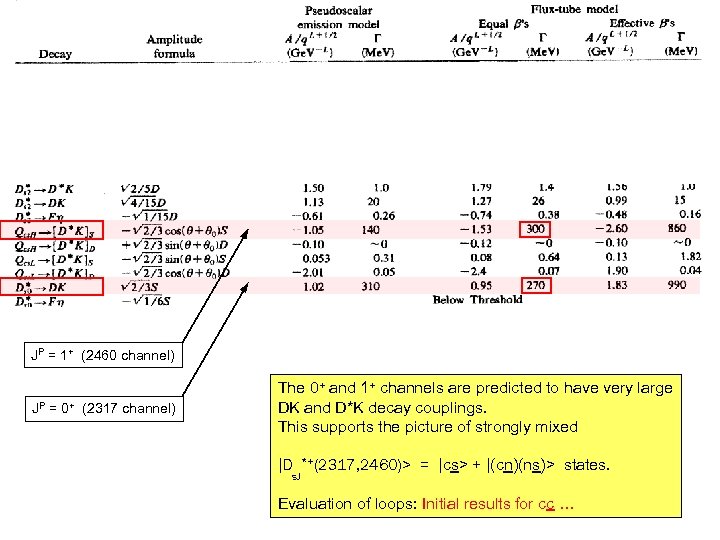
JP = 1+ (2460 channel) JP = 0+ (2317 channel) The 0+ and 1+ channels are predicted to have very large DK and D*K decay couplings. This supports the picture of strongly mixed |D s. J *+(2317, 2460)> = |cs> + |(cn)(ns)> states. Evaluation of loops: Initial results for cc …
cc-hybrids, theory
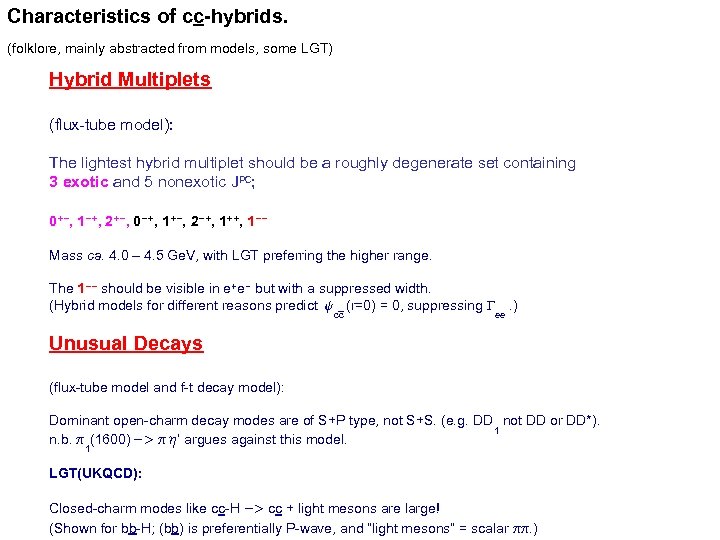
Characteristics of cc-hybrids. (folklore, mainly abstracted from models, some LGT) Hybrid Multiplets (flux-tube model): The lightest hybrid multiplet should be a roughly degenerate set containing 3 exotic and 5 nonexotic JPC; 0+-, 1 -+, 2+-, 0 -+, 1+-, 2 -+, 1++, 1 -Mass ca. 4. 0 – 4. 5 Ge. V, with LGT preferring the higher range. The 1 -- should be visible in e+e- but with a suppressed width. (Hybrid models for different reasons predict y (r=0) = 0, suppressing G . ) cc ee Unusual Decays (flux-tube model and f-t decay model): Dominant open-charm decay modes are of S+P type, not S+S. (e. g. DD not DD or DD*). 1 n. b. p (1600) -> p h’ argues against this model. 1 LGT(UKQCD): Closed-charm modes like cc-H -> cc + light mesons are large! (Shown for bb-H; (bb) is preferentially P-wave, and “light mesons” = scalar pp. )
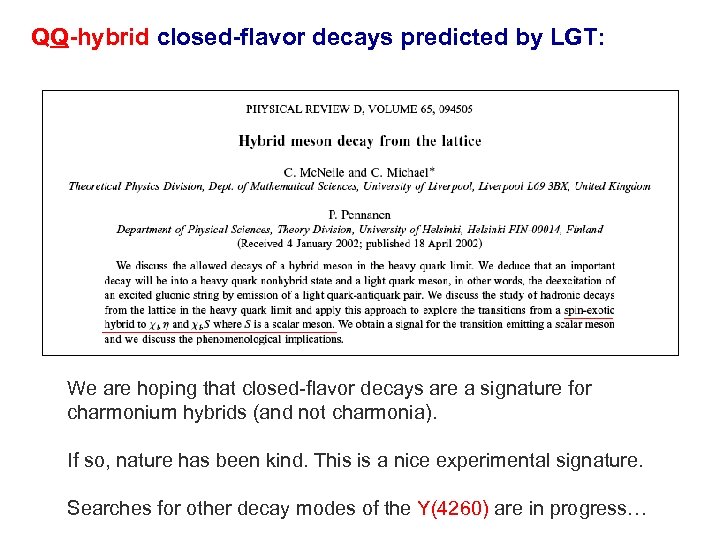
QQ-hybrid closed-flavor decays predicted by LGT: We are hoping that closed-flavor decays are a signature for charmonium hybrids (and not charmonia). If so, nature has been kind. This is a nice experimental signature. Searches for other decay modes of the Y(4260) are in progress…
Скачать презентацию Ted Barnes BNL Seminar 18 Mar 2008 Recent
6e6f70bff7fcbcf3d8f4c367c2876019.ppt