


 Скачать презентацию Technology Transition Workshop DART Workshop Ames IA
577c5a2849d61a9f2423d4a8d2c6dd00.ppt
- Количество слайдов: 78
 Technology Transition Workshop DART Workshop – Ames, IA August 2008 Use of the Accu. TOF-DART system for the forensic analysis of drugs of abuse Bob Steiner Virginia Department of Forensic Science Central Laboratory Richmond, VA 804 -786 -4707 x 22347 robert. steiner@dfs. virginia. gov
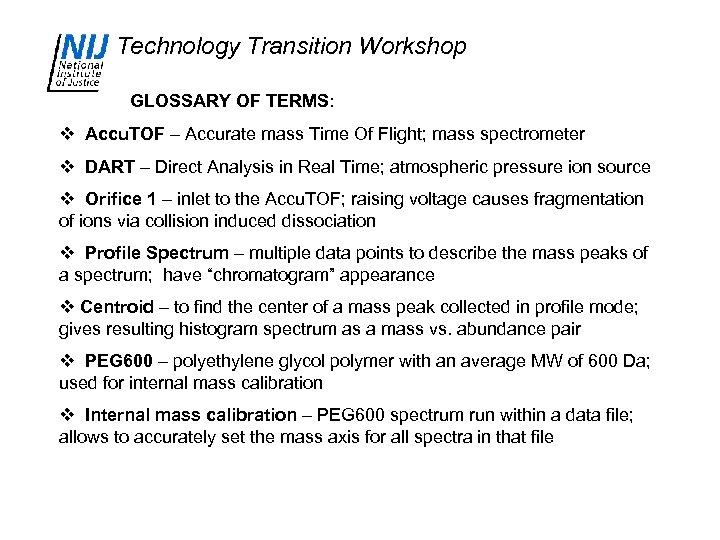 Technology Transition Workshop GLOSSARY OF TERMS: v Accu. TOF – Accurate mass Time Of Flight; mass spectrometer v DART – Direct Analysis in Real Time; atmospheric pressure ion source v Orifice 1 – inlet to the Accu. TOF; raising voltage causes fragmentation of ions via collision induced dissociation v Profile Spectrum – multiple data points to describe the mass peaks of a spectrum; have “chromatogram” appearance v Centroid – to find the center of a mass peak collected in profile mode; gives resulting histogram spectrum as a mass vs. abundance pair v PEG 600 – polyethylene glycol polymer with an average MW of 600 Da; used for internal mass calibration v Internal mass calibration – PEG 600 spectrum run within a data file; allows to accurately set the mass axis for all spectra in that file
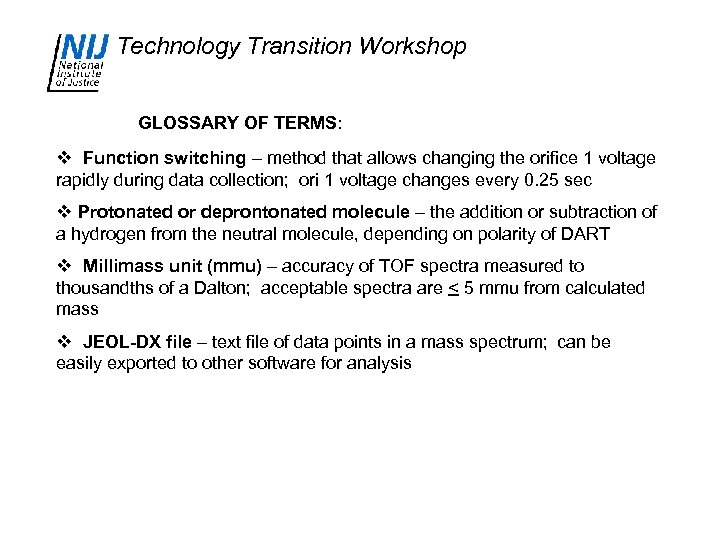 Technology Transition Workshop GLOSSARY OF TERMS: v Function switching – method that allows changing the orifice 1 voltage rapidly during data collection; ori 1 voltage changes every 0. 25 sec v Protonated or deprontonated molecule – the addition or subtraction of a hydrogen from the neutral molecule, depending on polarity of DART v Millimass unit (mmu) – accuracy of TOF spectra measured to thousandths of a Dalton; acceptable spectra are < 5 mmu from calculated mass v JEOL-DX file – text file of data points in a mass spectrum; can be easily exported to other software for analysis
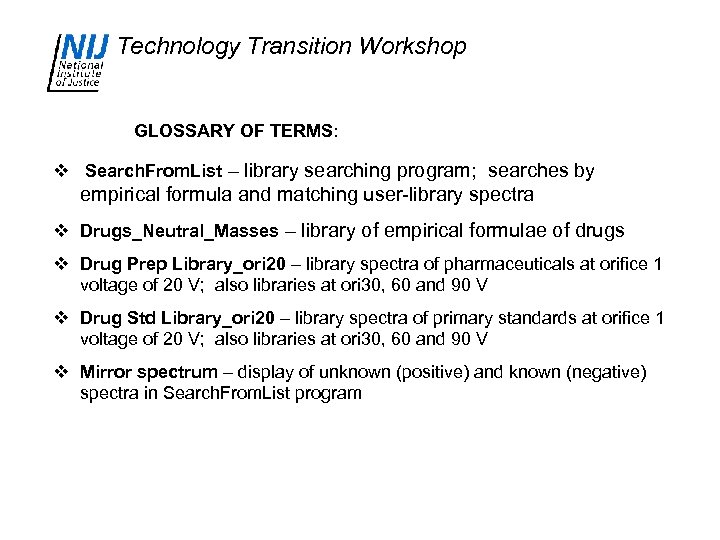 Technology Transition Workshop GLOSSARY OF TERMS: v Search. From. List – library searching program; searches by empirical formula and matching user-library spectra v Drugs_Neutral_Masses – library of empirical formulae of drugs v Drug Prep Library_ori 20 – library spectra of pharmaceuticals at orifice 1 voltage of 20 V; also libraries at ori 30, 60 and 90 V v Drug Std Library_ori 20 – library spectra of primary standards at orifice 1 voltage of 20 V; also libraries at ori 30, 60 and 90 V v Mirror spectrum – display of unknown (positive) and known (negative) spectra in Search. From. List program
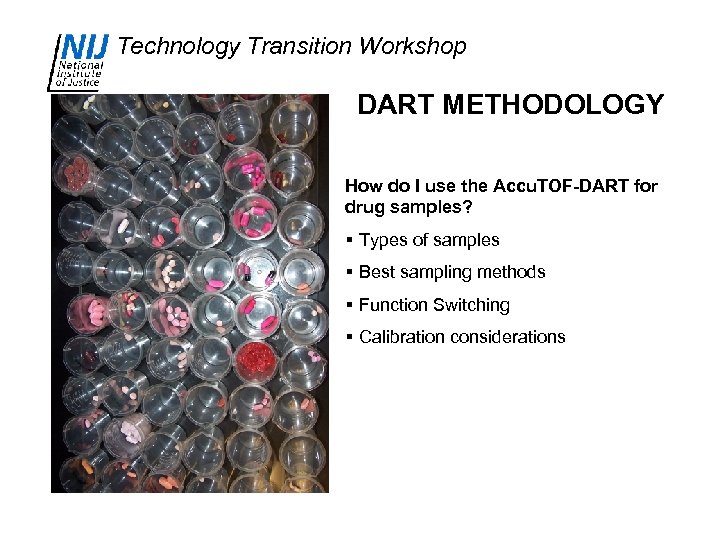 Technology Transition Workshop DART METHODOLOGY How do I use the Accu. TOF-DART for drug samples? § Types of samples § Best sampling methods § Function Switching § Calibration considerations
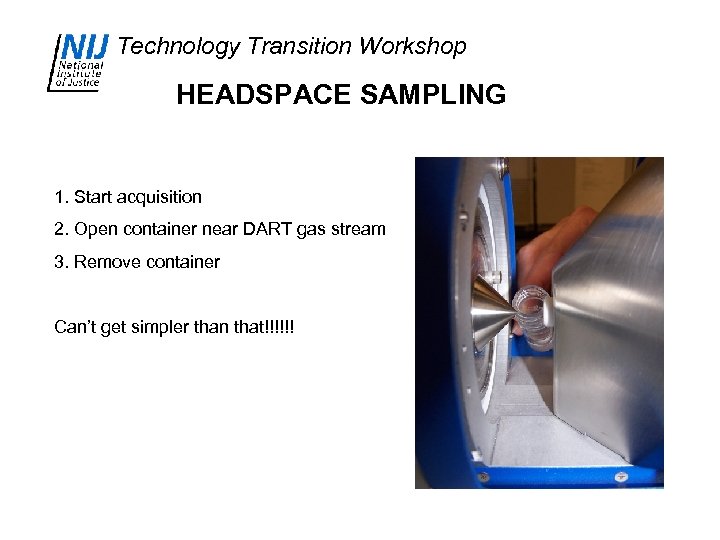 Technology Transition Workshop HEADSPACE SAMPLING 1. Start acquisition 2. Open container near DART gas stream 3. Remove container Can’t get simpler than that!!!!!!
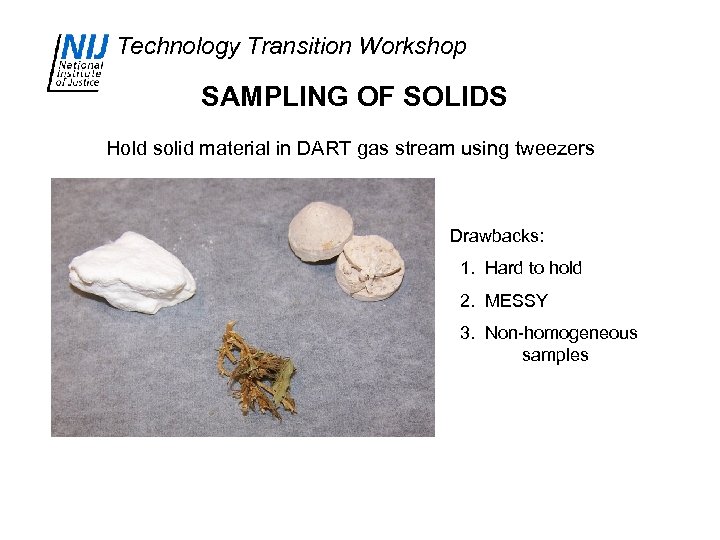 Technology Transition Workshop SAMPLING OF SOLIDS Hold solid material in DART gas stream using tweezers Drawbacks: 1. Hard to hold 2. MESSY 3. Non-homogeneous samples
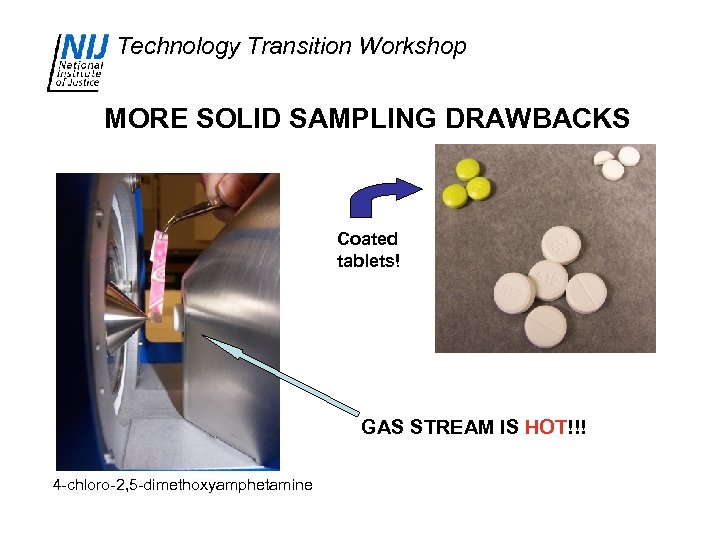 Technology Transition Workshop MORE SOLID SAMPLING DRAWBACKS Coated tablets! GAS STREAM IS HOT!!! 4 -chloro-2, 5 -dimethoxyamphetamine
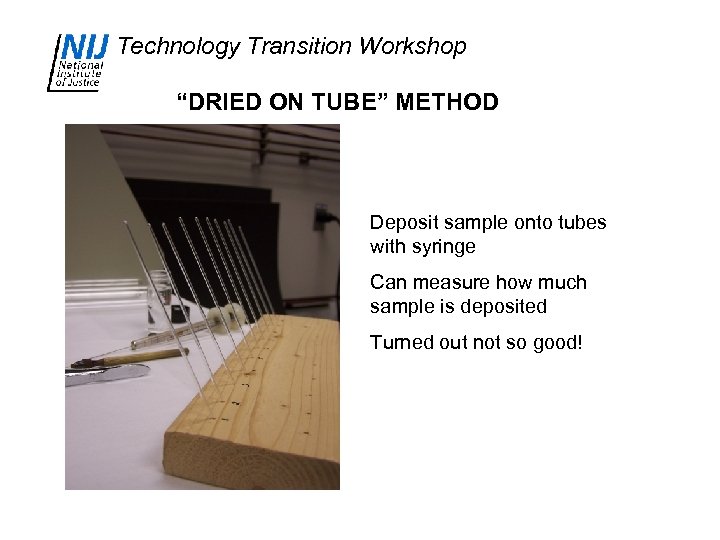 Technology Transition Workshop “DRIED ON TUBE” METHOD Deposit sample onto tubes with syringe Can measure how much sample is deposited Turned out not so good!
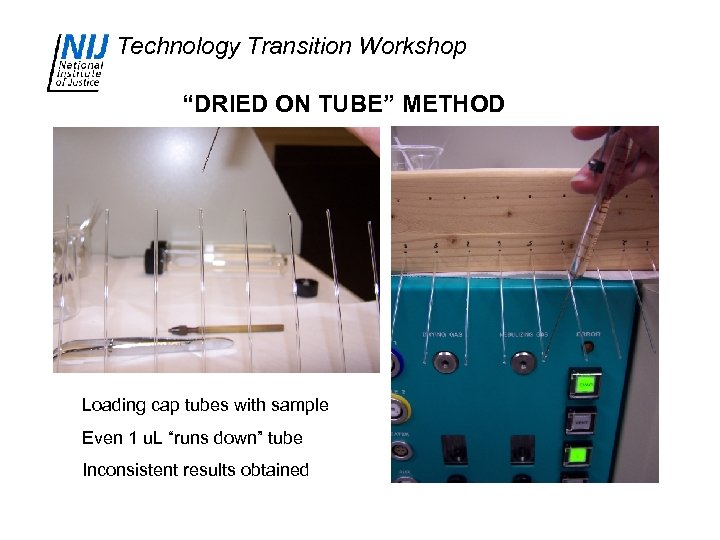 Technology Transition Workshop “DRIED ON TUBE” METHOD Loading cap tubes with sample Even 1 u. L “runs down” tube Inconsistent results obtained
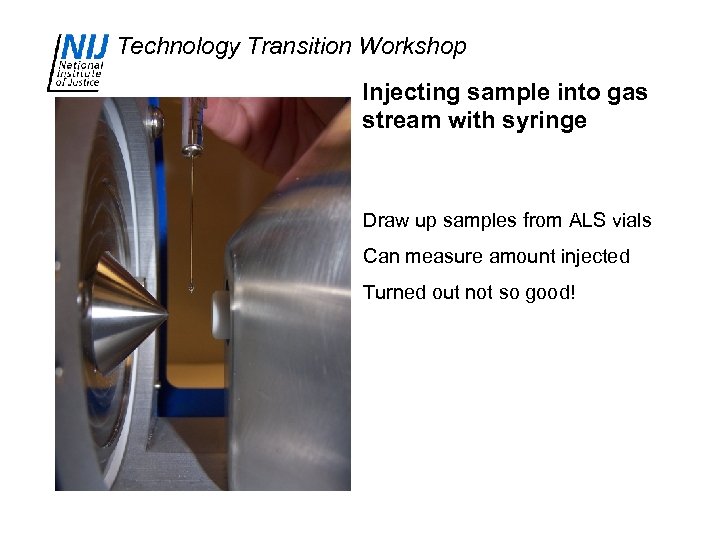 Technology Transition Workshop Injecting sample into gas stream with syringe Draw up samples from ALS vials Can measure amount injected Turned out not so good!
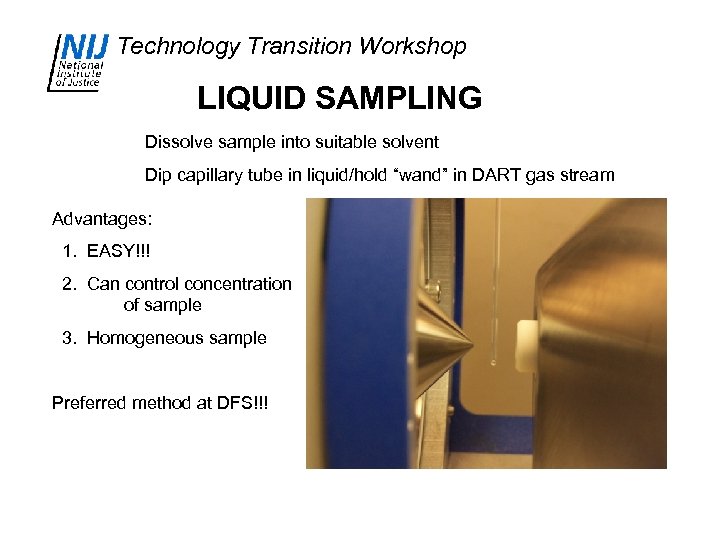 Technology Transition Workshop LIQUID SAMPLING Dissolve sample into suitable solvent Dip capillary tube in liquid/hold “wand” in DART gas stream Advantages: 1. EASY!!! 2. Can control concentration of sample 3. Homogeneous sample Preferred method at DFS!!!
 Technology Transition Workshop DART sampling by hand is an ART! Consistency from one person to the next is difficult to obtain!!! Buy an Auto. DART? ? ?
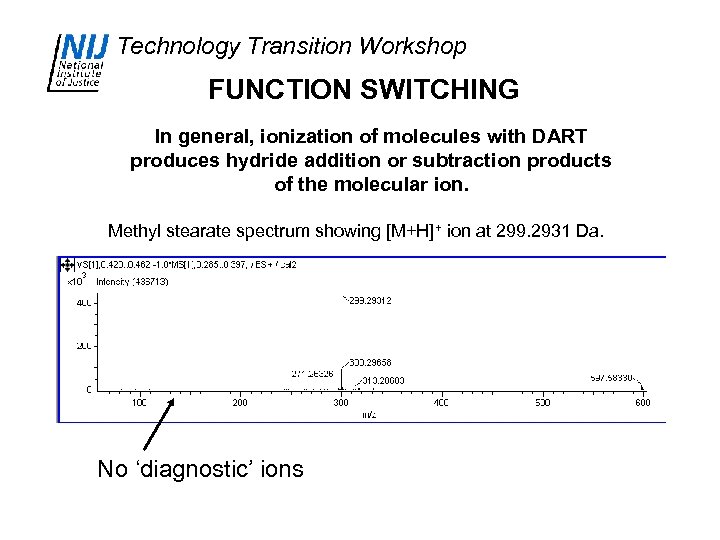 Technology Transition Workshop FUNCTION SWITCHING In general, ionization of molecules with DART produces hydride addition or subtraction products of the molecular ion. Methyl stearate spectrum showing [M+H]+ ion at 299. 2931 Da. No ‘diagnostic’ ions
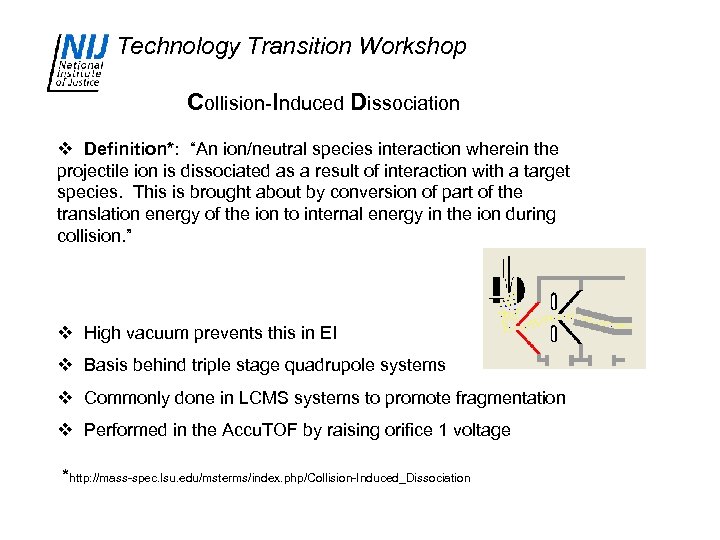 Technology Transition Workshop Collision-Induced Dissociation v Definition*: “An ion/neutral species interaction wherein the projectile ion is dissociated as a result of interaction with a target species. This is brought about by conversion of part of the translation energy of the ion to internal energy in the ion during collision. ” v High vacuum prevents this in EI v Basis behind triple stage quadrupole systems v Commonly done in LCMS systems to promote fragmentation v Performed in the Accu. TOF by raising orifice 1 voltage *http: //mass-spec. lsu. edu/msterms/index. php/Collision-Induced_Dissociation
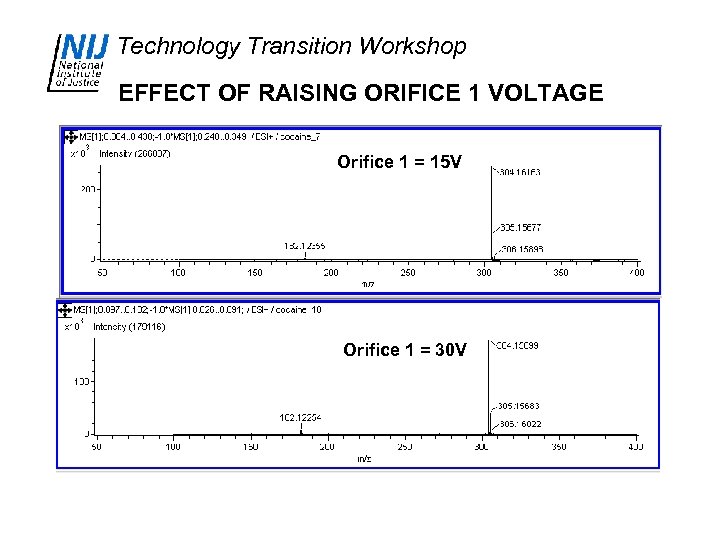 Technology Transition Workshop EFFECT OF RAISING ORIFICE 1 VOLTAGE Orifice 1 = 15 V Orifice 1 = 30 V
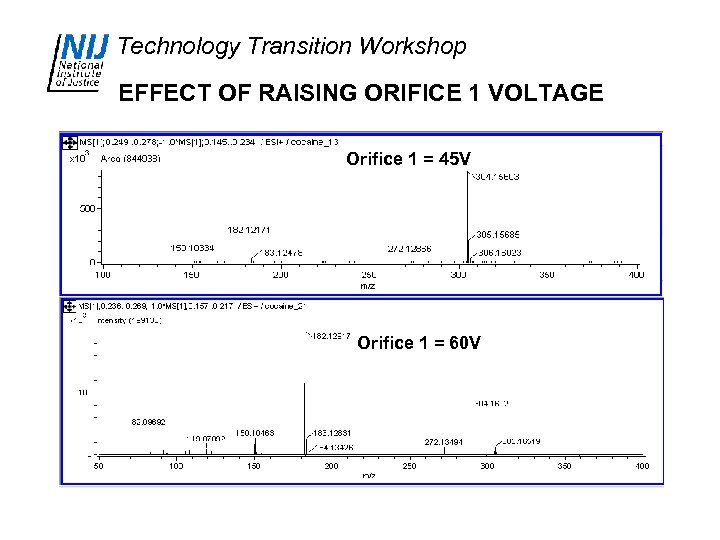 Technology Transition Workshop EFFECT OF RAISING ORIFICE 1 VOLTAGE Orifice 1 = 45 V Orifice 1 = 60 V
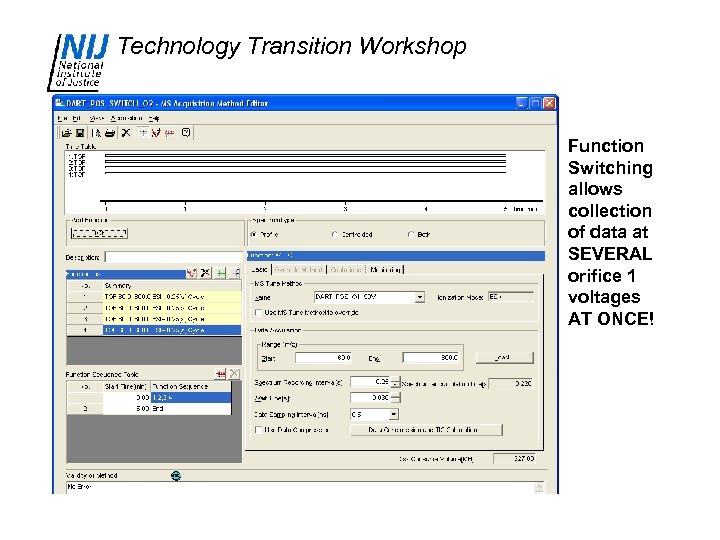 Technology Transition Workshop Function Switching allows collection of data at SEVERAL orifice 1 voltages AT ONCE!
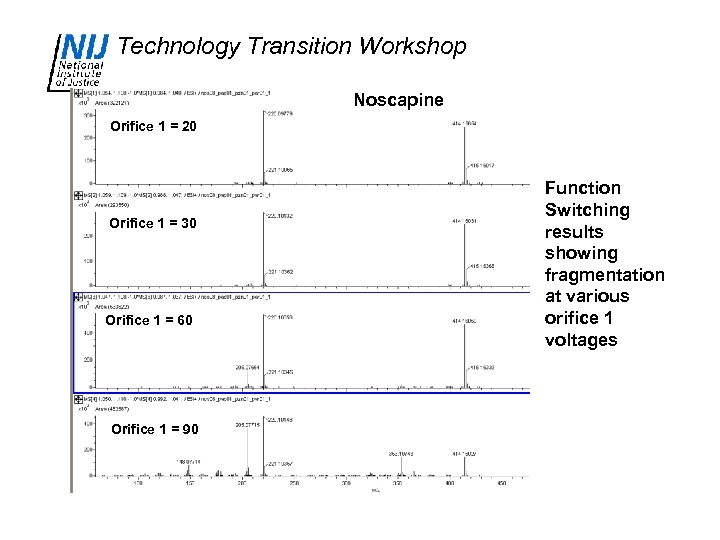 Technology Transition Workshop Noscapine Orifice 1 = 20 Orifice 1 = 30 Orifice 1 = 60 Orifice 1 = 90 Function Switching results showing fragmentation at various orifice 1 voltages
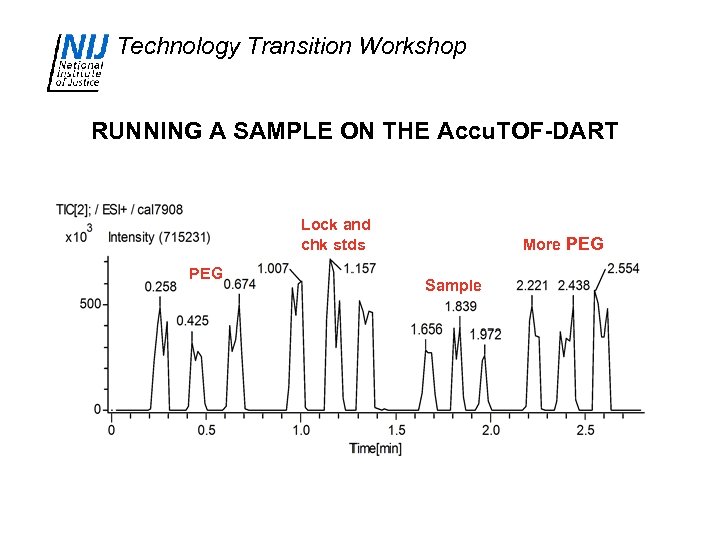 Technology Transition Workshop RUNNING A SAMPLE ON THE Accu. TOF-DART Lock and chk stds PEG More PEG Sample
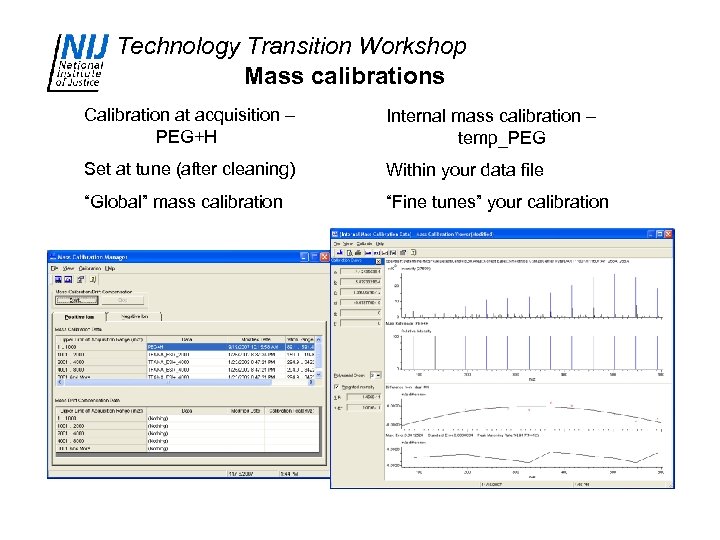 Technology Transition Workshop Mass calibrations Calibration at acquisition – PEG+H Internal mass calibration – temp_PEG Set at tune (after cleaning) Within your data file “Global” mass calibration “Fine tunes” your calibration
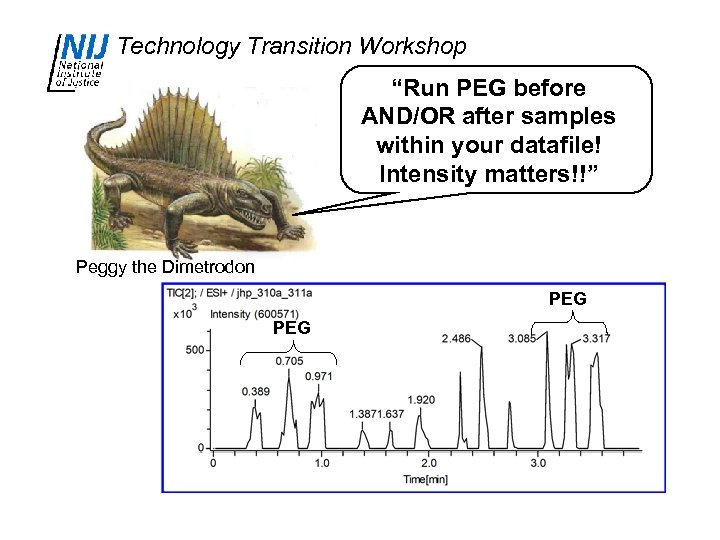 Technology Transition Workshop “Run PEG before AND/OR after samples within your datafile! Intensity matters!!” Peggy the Dimetrodon PEG
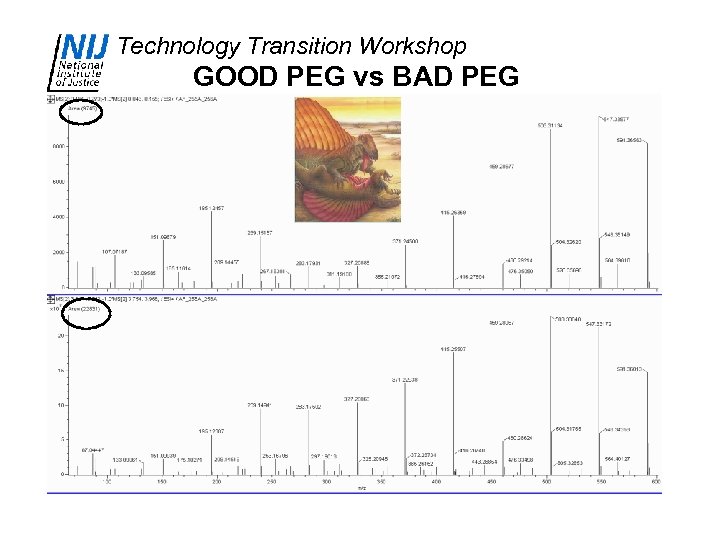 Technology Transition Workshop GOOD PEG vs BAD PEG
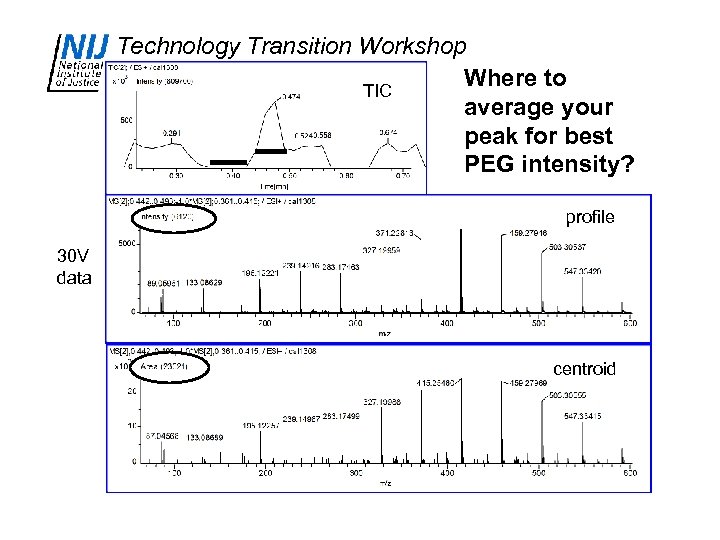 Technology Transition Workshop Where to TIC average your peak for best PEG intensity? profile 30 V data centroid
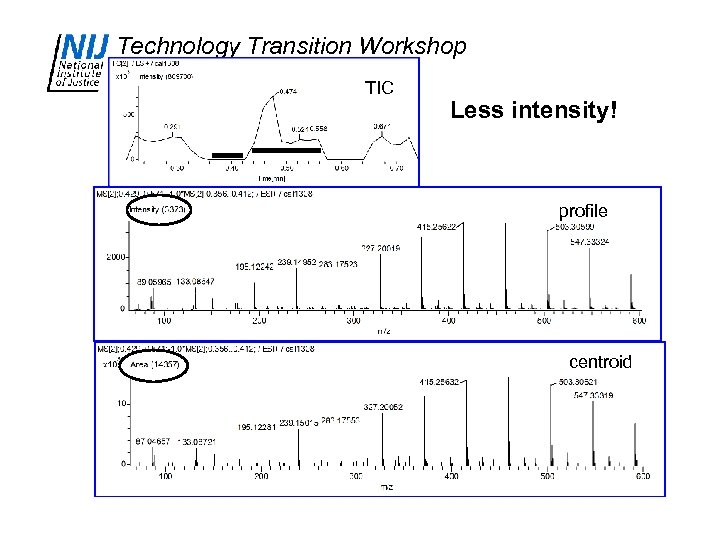 Technology Transition Workshop TIC Less intensity! profile centroid
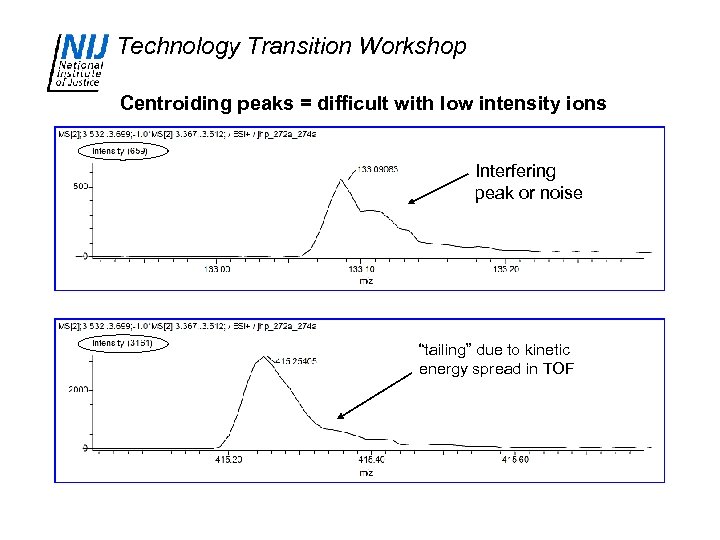 Technology Transition Workshop Centroiding peaks = difficult with low intensity ions Interfering peak or noise “tailing” due to kinetic energy spread in TOF
 Technology Transition Workshop LOCK MASS AND CHECK STANDARDS § Mix of cocaine, methamphetamine and nefazodone § MWs span the mass range § Cocaine is used as drift compensation “lock” at 304. 1549 Da § Methamphetamine (150. 1283 Da) and Nefazodone (470. 2323 Da) cover the low and high ends of mass range § Adds another level of calibration applied to sample data
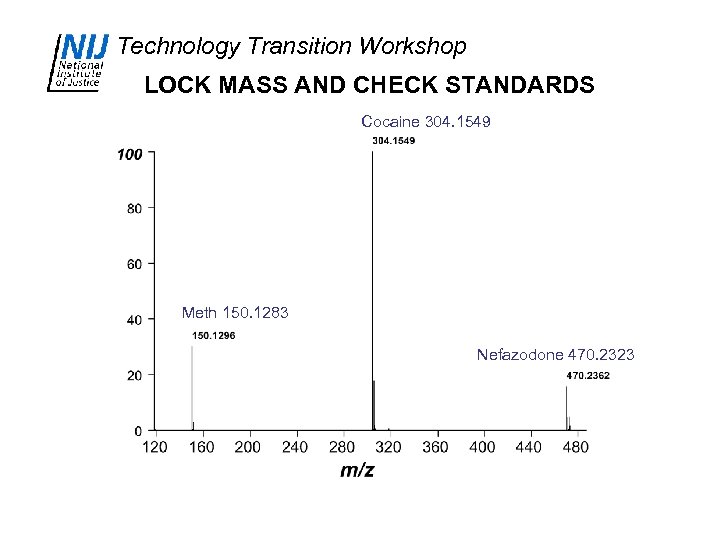 Technology Transition Workshop LOCK MASS AND CHECK STANDARDS Cocaine 304. 1549 Meth 150. 1283 Nefazodone 470. 2323
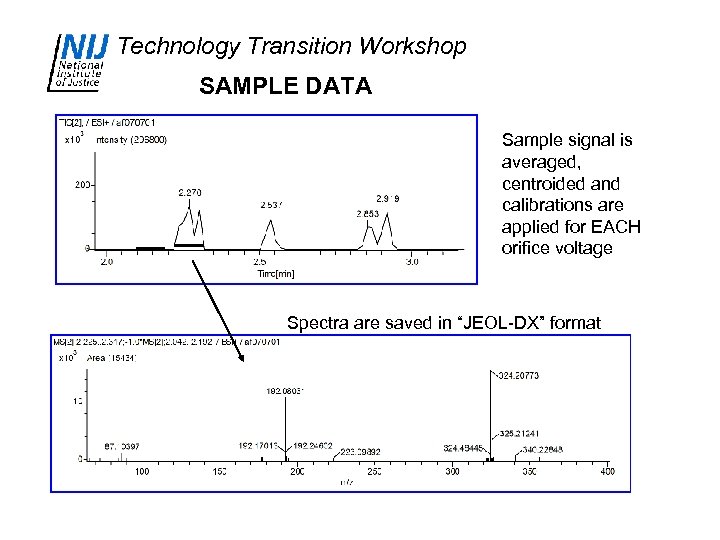 Technology Transition Workshop SAMPLE DATA Sample signal is averaged, centroided and calibrations are applied for EACH orifice voltage Spectra are saved in “JEOL-DX” format
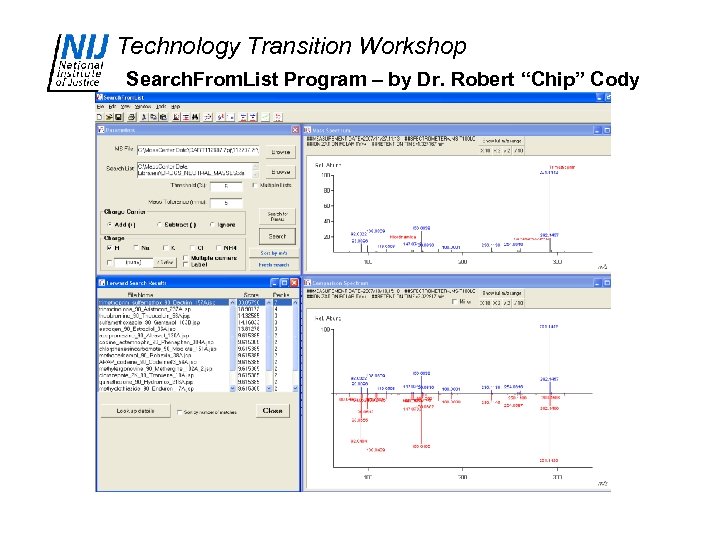 Technology Transition Workshop Search. From. List Program – by Dr. Robert “Chip” Cody
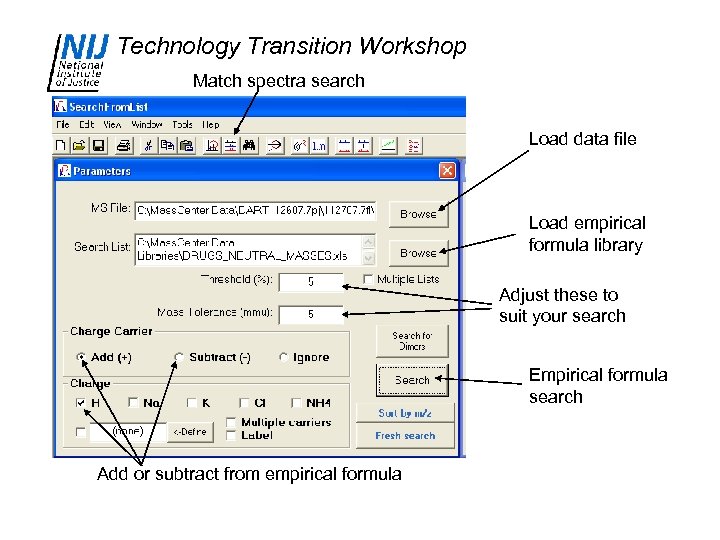 Technology Transition Workshop Match spectra search Load data file Load empirical formula library Adjust these to suit your search Empirical formula search Add or subtract from empirical formula
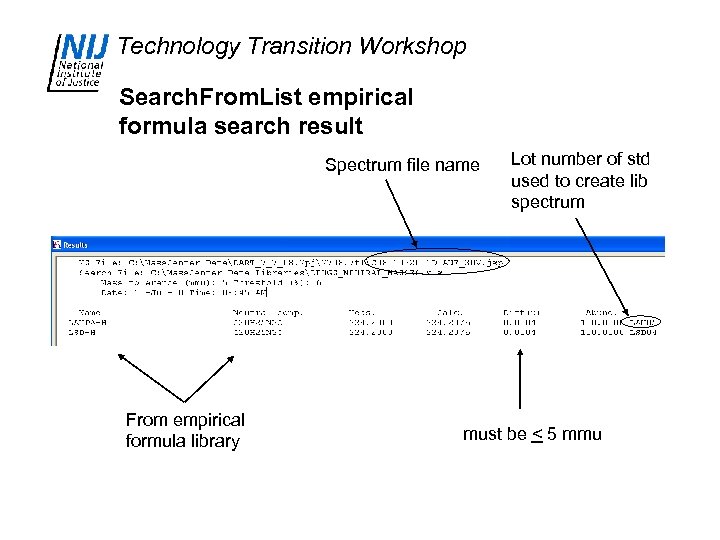 Technology Transition Workshop Search. From. List empirical formula search result Spectrum file name From empirical formula library Lot number of std used to create lib spectrum must be < 5 mmu
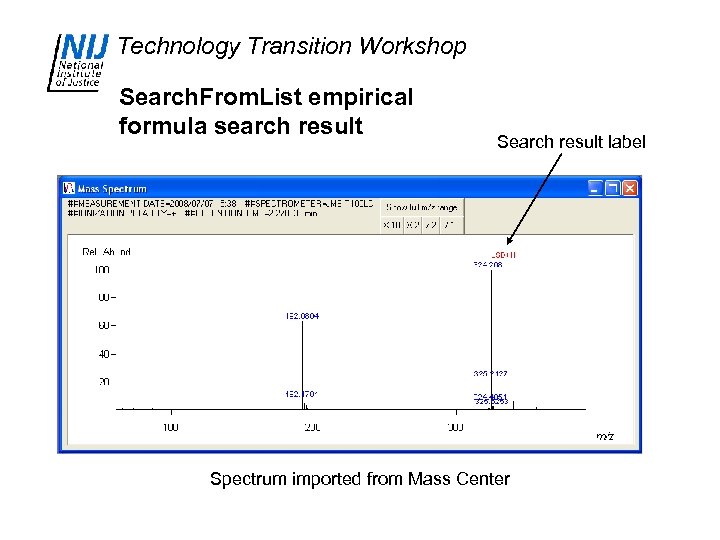 Technology Transition Workshop Search. From. List empirical formula search result Search result label Spectrum imported from Mass Center
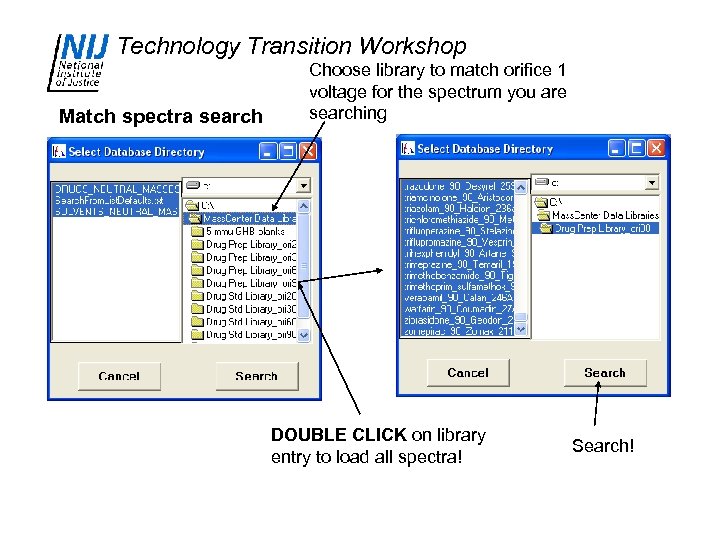 Technology Transition Workshop Match spectra search Choose library to match orifice 1 voltage for the spectrum you are searching DOUBLE CLICK on library entry to load all spectra! Search!
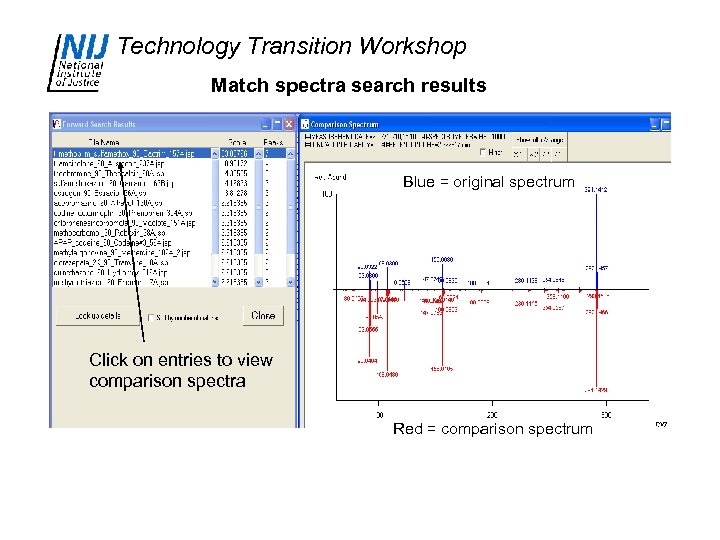 Technology Transition Workshop Match spectra search results Blue = original spectrum Click on entries to view comparison spectra Red = comparison spectrum
![Technology Transition Workshop Suggested Data for casefiles • Print out: TIC[2] from Chromatogram view](https://present5.com/presentation/577c5a2849d61a9f2423d4a8d2c6dd00/image-36.jpg "Technology Transition Workshop Suggested Data for casefiles • Print out: TIC[2] from Chromatogram view") Technology Transition Workshop Suggested Data for casefiles • Print out: TIC[2] from Chromatogram view • Print out spectrum of cocaine lock mass and check stds • Save spectra as averaged, background subtracted, centroided, calibrated JEOL-DX files • Print out: Search. From. List search result for 20 V spectrum • Print out: Other spectra or search results at other voltages – enough to characterize the spectrum
Technology Transition Workshop Suggested Data for casefiles • Print out: TIC[2] from Chromatogram view • Print out spectrum of cocaine lock mass and check stds • Save spectra as averaged, background subtracted, centroided, calibrated JEOL-DX files • Print out: Search. From. List search result for 20 V spectrum • Print out: Other spectra or search results at other voltages – enough to characterize the spectrum
 Technology Transition Workshop FUNCTION SWITCHING - ADVANTAGES § FOUR spectra collected every second § Higher orifice 1 voltages result in more fragmentation § Can lead to greater confidence for identification § Except for mixtures, spectra are reproducible
 Technology Transition Workshop FUNCTION SWITCHING - DISADVANTAGES § Mixture spectra – no prior chromatography (can be good OR bad!!) § Less sensitivity – splitting ionization between four functions § Finite database for searching – library databases need to be developed!
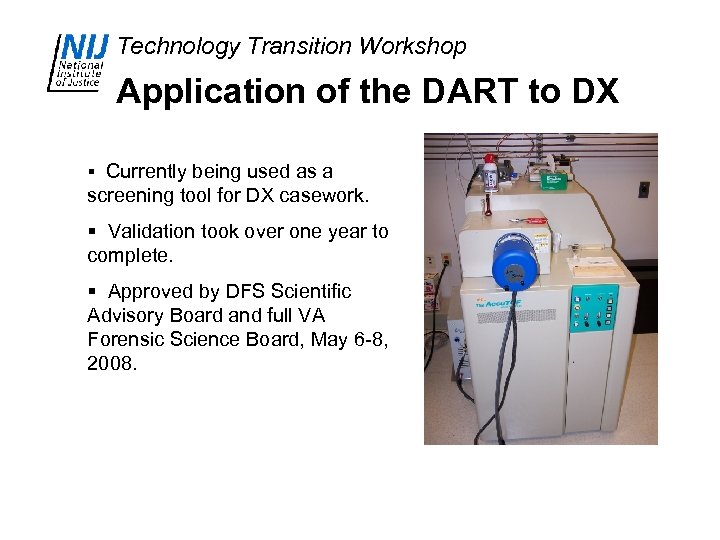 Technology Transition Workshop Application of the DART to DX § Currently being used as a screening tool for DX casework. § Validation took over one year to complete. § Approved by DFS Scientific Advisory Board and full VA Forensic Science Board, May 6 -8, 2008.
 Technology Transition Workshop Accu. TOF-DART Validation at DFS 1. DART screening method - LLOD determined for 7 drugs; daily calibration data to show stability of instrument 2. DART sampling methods – why we use methanol and MP tube ‘wands’ 3. Comparison of DART to GCMS – new technology vs. established technology; 553 samples run on each – ALL match in highest Scheduled drug found; DART typically showed more cmpds! 4. Selectivity study – can you tell the difference in DART spectra of drugs with the SAME empirical formula? ? 5. “Rugustness” – same result on different days with different people? ?
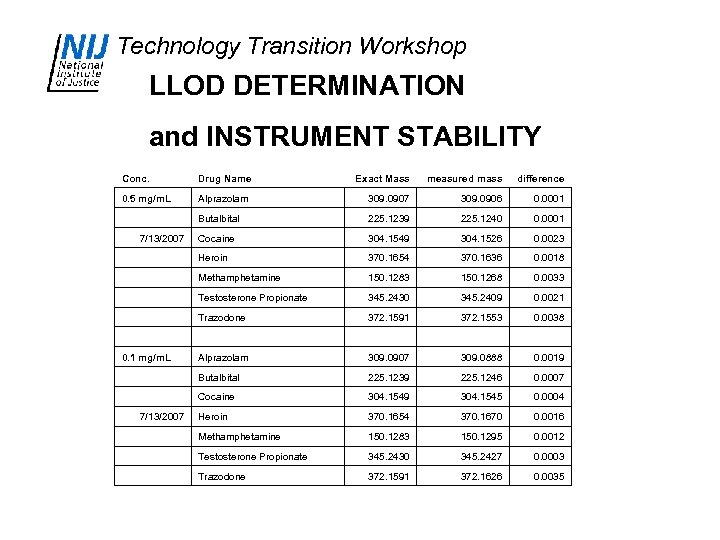 Technology Transition Workshop LLOD DETERMINATION and INSTRUMENT STABILITY Conc. Drug Name Exact Mass measured mass difference 0. 5 mg/m. L Alprazolam 309. 0907 309. 0906 0. 0001 Butalbital 225. 1239 225. 1240 0. 0001 Cocaine 304. 1549 304. 1526 0. 0023 Heroin 370. 1654 370. 1636 0. 0018 Methamphetamine 150. 1283 150. 1268 0. 0033 Testosterone Propionate 345. 2430 345. 2409 0. 0021 Trazodone 372. 1591 372. 1553 0. 0038 0. 1 mg/m. L Alprazolam 309. 0907 309. 0888 0. 0019 Butalbital 225. 1239 225. 1246 0. 0007 Cocaine 304. 1549 304. 1545 0. 0004 Heroin 370. 1654 370. 1670 0. 0016 Methamphetamine 150. 1283 150. 1295 0. 0012 Testosterone Propionate 345. 2430 345. 2427 0. 0003 Trazodone 372. 1591 372. 1626 0. 0035 7/13/2007
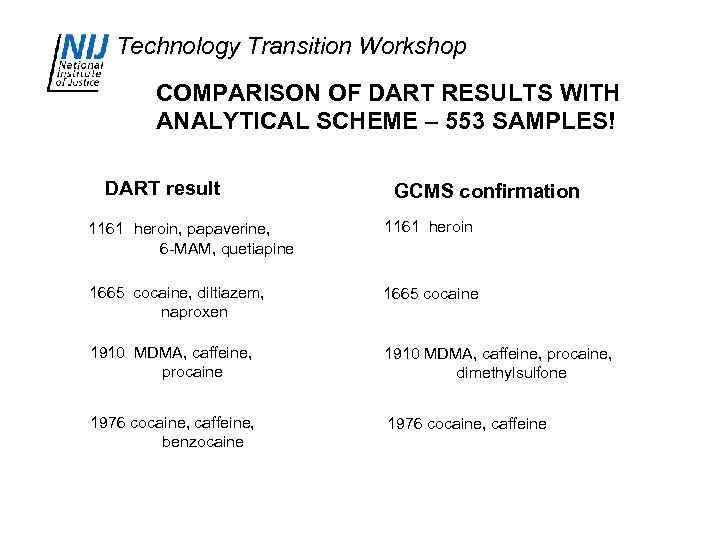 Technology Transition Workshop COMPARISON OF DART RESULTS WITH ANALYTICAL SCHEME – 553 SAMPLES! DART result GCMS confirmation 1161 heroin, papaverine, 6 -MAM, quetiapine 1161 heroin 1665 cocaine, diltiazem, naproxen 1665 cocaine 1910 MDMA, caffeine, procaine 1910 MDMA, caffeine, procaine, dimethylsulfone 1976 cocaine, caffeine, benzocaine 1976 cocaine, caffeine
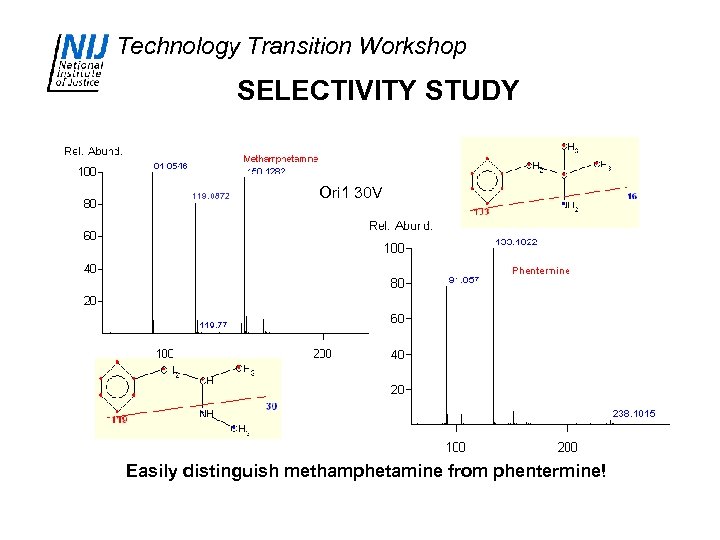 Technology Transition Workshop SELECTIVITY STUDY 119. 0872 Ori 1 30 V Easily distinguish methamphetamine from phentermine!
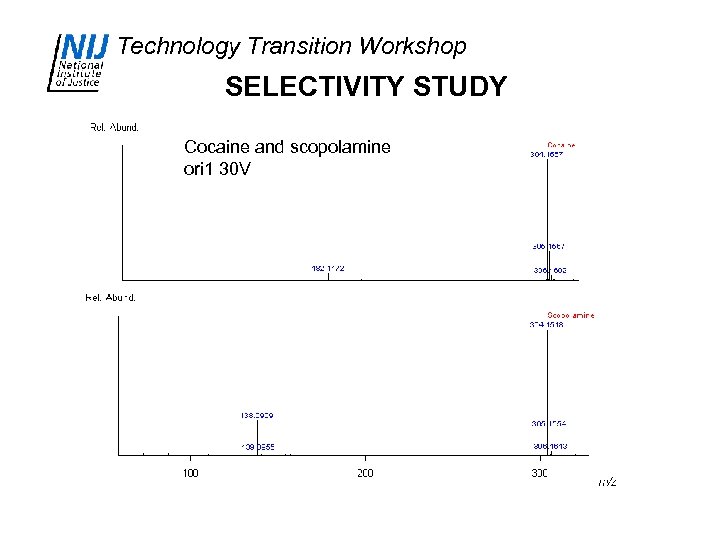 Technology Transition Workshop SELECTIVITY STUDY Cocaine and scopolamine ori 1 30 V
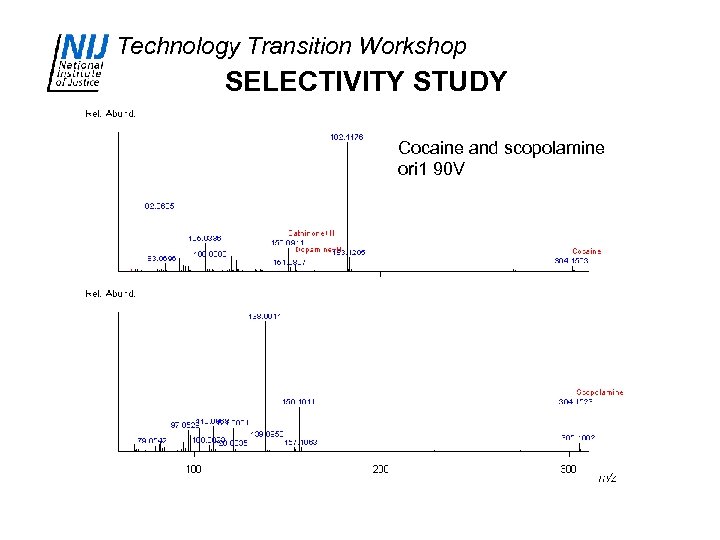 Technology Transition Workshop SELECTIVITY STUDY Cocaine and scopolamine ori 1 90 V
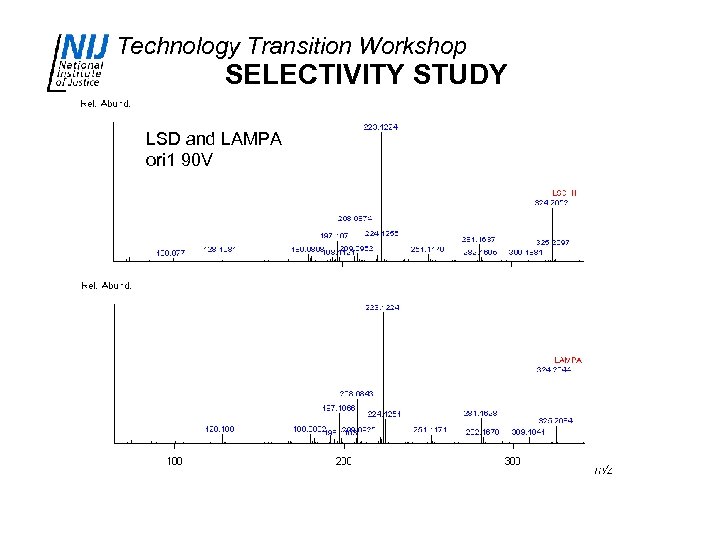 Technology Transition Workshop SELECTIVITY STUDY LSD and LAMPA ori 1 90 V
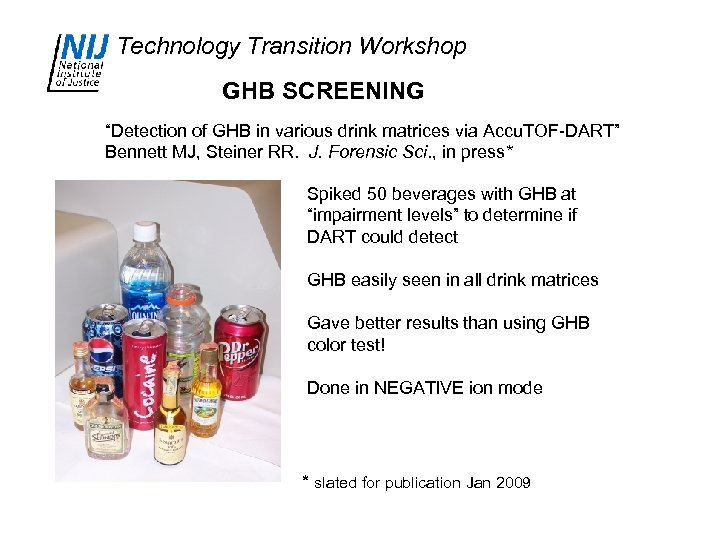 Technology Transition Workshop GHB SCREENING “Detection of GHB in various drink matrices via Accu. TOF-DART” Bennett MJ, Steiner RR. J. Forensic Sci. , in press* Spiked 50 beverages with GHB at “impairment levels” to determine if DART could detect GHB easily seen in all drink matrices Gave better results than using GHB color test! Done in NEGATIVE ion mode * slated for publication Jan 2009
![Technology Transition Workshop GHB SCREENING blank [GHB-H]- Ocean Spray Cranberry Juice - blank Ocean](https://present5.com/presentation/577c5a2849d61a9f2423d4a8d2c6dd00/image-48.jpg "Technology Transition Workshop GHB SCREENING blank [GHB-H]- Ocean Spray Cranberry Juice - blank Ocean") Technology Transition Workshop GHB SCREENING blank [GHB-H]- Ocean Spray Cranberry Juice - blank Ocean Spray Cranberry Juice – 2 mg/m. L spike with GHB
Technology Transition Workshop GHB SCREENING blank [GHB-H]- Ocean Spray Cranberry Juice - blank Ocean Spray Cranberry Juice – 2 mg/m. L spike with GHB
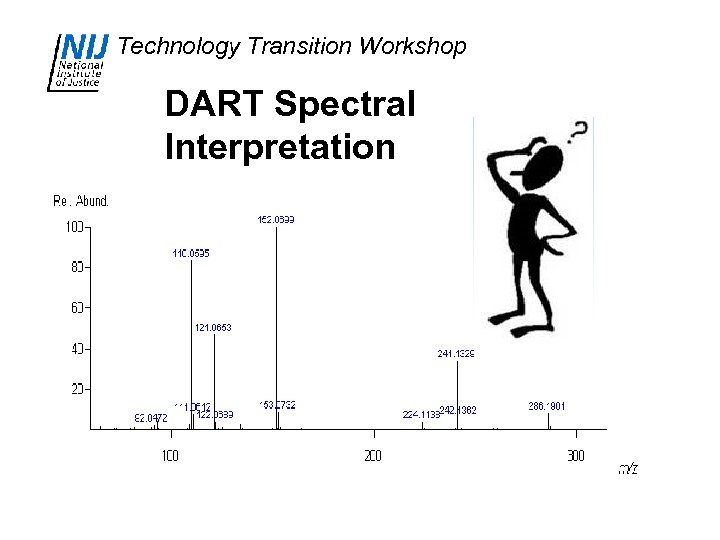 Technology Transition Workshop DART Spectral Interpretation
 Technology Transition Workshop Molecular Weight Information Electron Impact Ionization DART Ionization • M+. § [M+H]+ or [M-H]- • Unstable – leads to extensive fragmentation §Very stable • Usually the peak @ highest mass, excluding isotope peaks • Look for “logical neutral losses” • Sometimes hard to find! §Very little fragmentation (without help!) §Proper terms: Protonated or deprotonated molecule §Loss of stable neutrals § Use Search. From. List to find
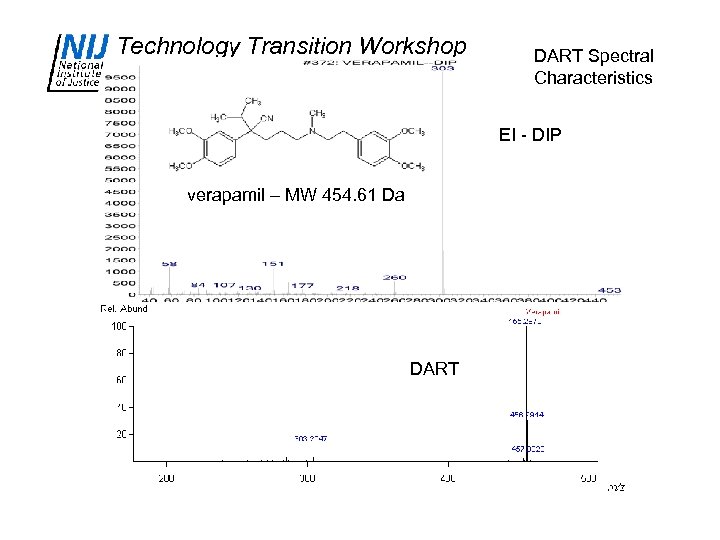 Technology Transition Workshop DART Spectral Characteristics EI - DIP verapamil – MW 454. 61 Da DART
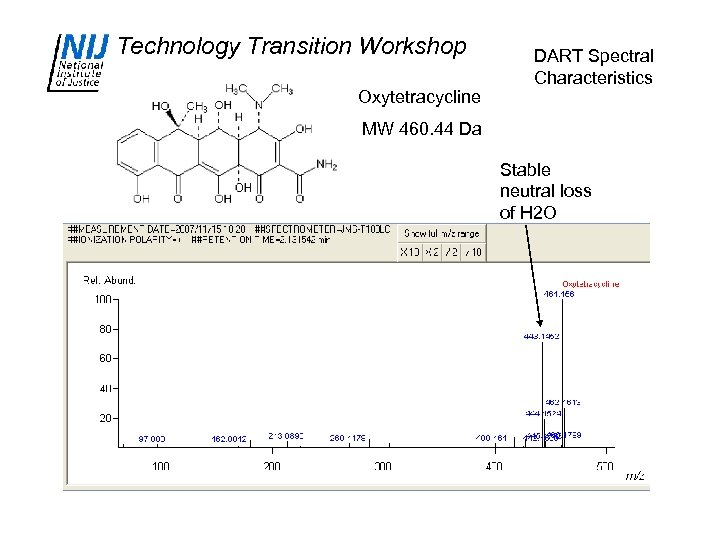 Technology Transition Workshop Oxytetracycline DART Spectral Characteristics MW 460. 44 Da Stable neutral loss of H 2 O
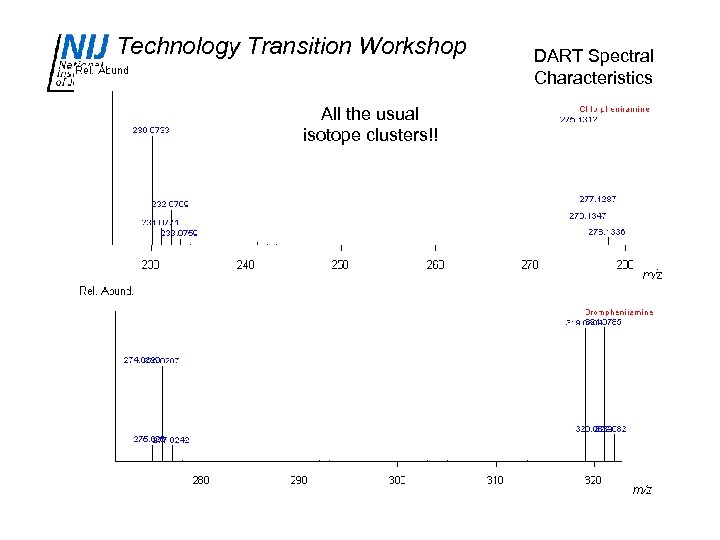 Technology Transition Workshop All the usual isotope clusters!! DART Spectral Characteristics
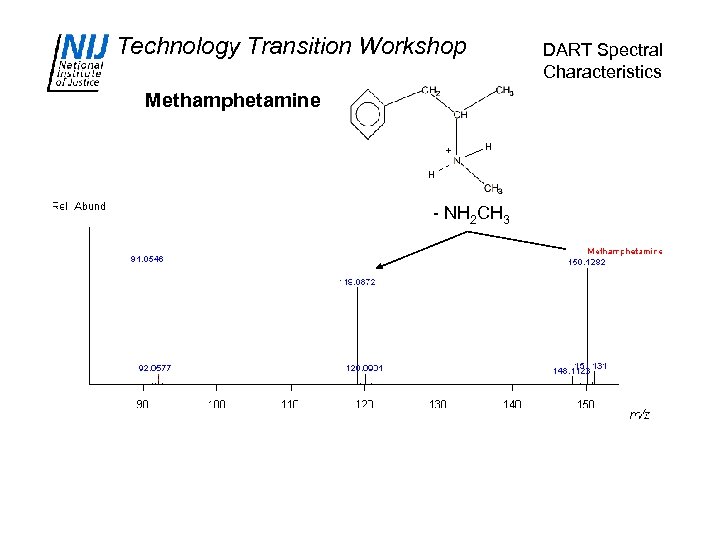 Technology Transition Workshop DART Spectral Characteristics Methamphetamine + H H - NH 2 CH 3
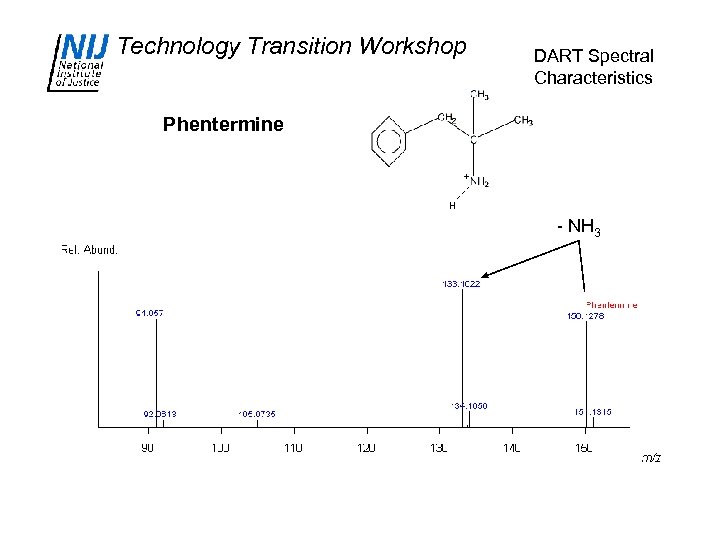 Technology Transition Workshop DART Spectral Characteristics Phentermine + H - NH 3
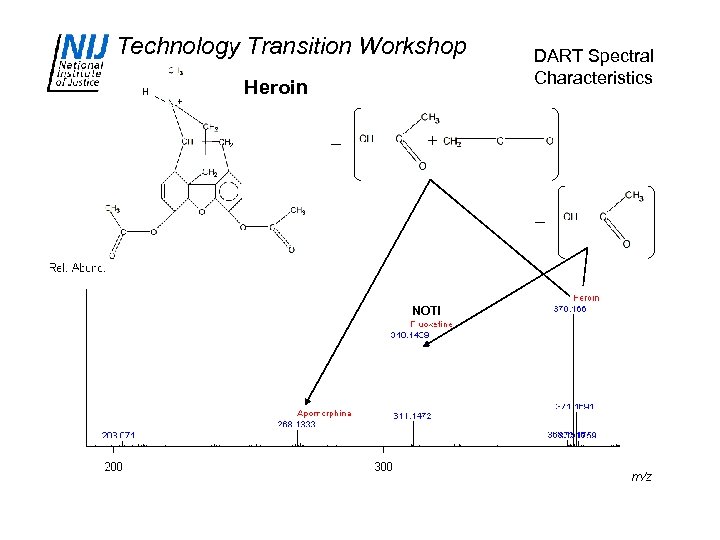 Technology Transition Workshop H + Heroin _ DART Spectral Characteristics + _ NOT!
 Technology Transition Workshop DIMERS and Toto, too!! TRIMERS and ADDUCTS!!! OH MY!!!!!
![Technology Transition Workshop Dimers – hydrocodone/APAP (Lortab) Ori 1 = 20 V [M+H]+ Ori](https://present5.com/presentation/577c5a2849d61a9f2423d4a8d2c6dd00/image-58.jpg "Technology Transition Workshop Dimers – hydrocodone/APAP (Lortab) Ori 1 = 20 V [M+H]+ Ori") Technology Transition Workshop Dimers – hydrocodone/APAP (Lortab) Ori 1 = 20 V [M+H]+ Ori 1 = 20 V dimer
Technology Transition Workshop Dimers – hydrocodone/APAP (Lortab) Ori 1 = 20 V [M+H]+ Ori 1 = 20 V dimer
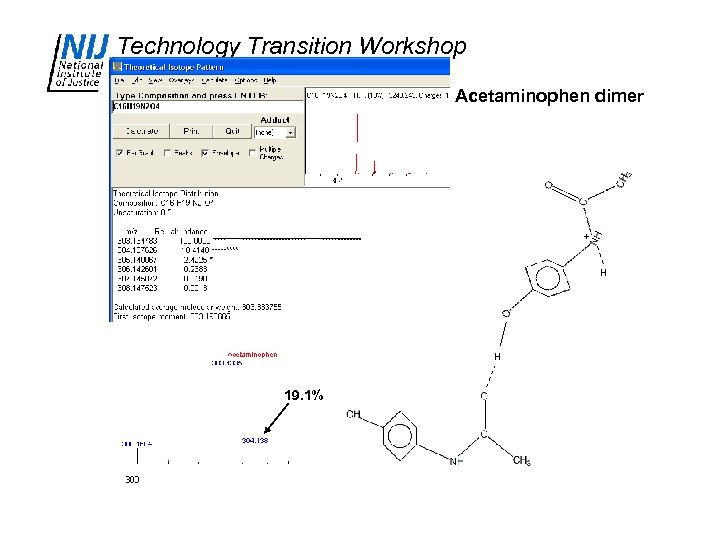 Technology Transition Workshop Acetaminophen dimer + H H 19. 1%
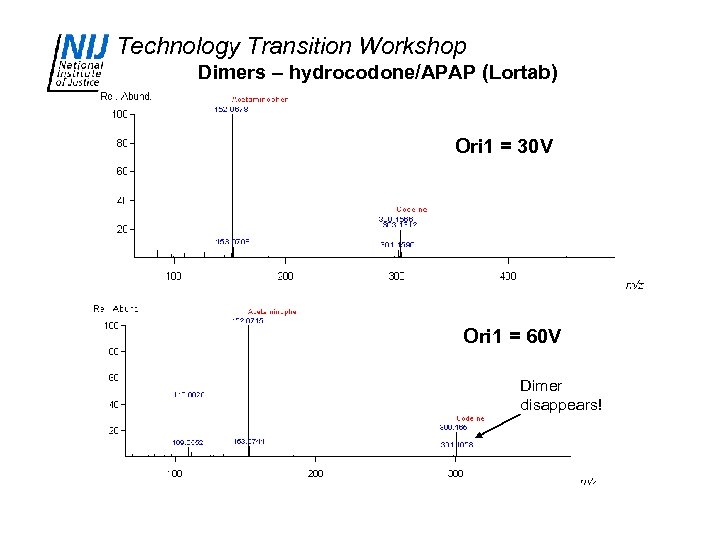 Technology Transition Workshop Dimers – hydrocodone/APAP (Lortab) Ori 1 = 30 V Ori 1 = 60 V Dimer disappears!
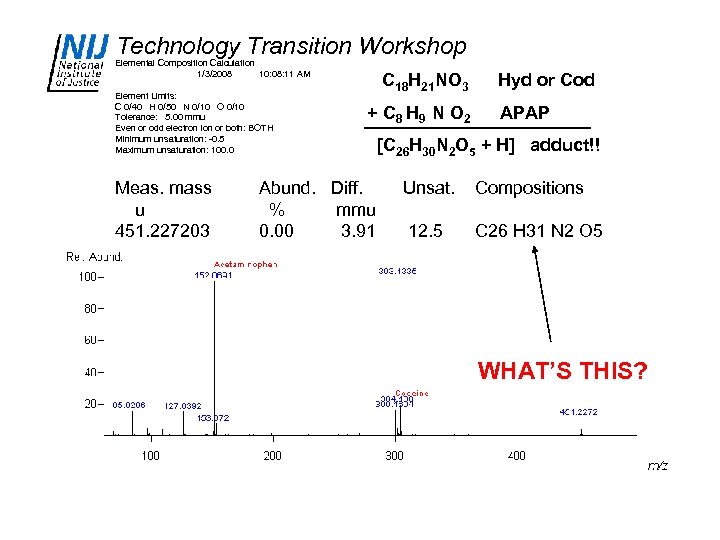 Technology Transition Workshop Elemental Composition Calculation 1/3/2008 10: 08: 11 AM Element Limits: C 0/40 H 0/50 N 0/10 O 0/10 Tolerance: 5. 00 mmu Even or odd electron ion or both: BOTH Minimum unsaturation: -0. 5 Maximum unsaturation: 100. 0 Meas. mass u 451. 227203 C 18 H 21 NO 3 Hyd or Cod + C 8 H 9 N O 2 APAP Abund. Diff. % mmu 0. 00 3. 91 [C 26 H 30 N 2 O 5 + H] adduct!! Unsat. Compositions 12. 5 C 26 H 31 N 2 O 5 WHAT’S THIS?
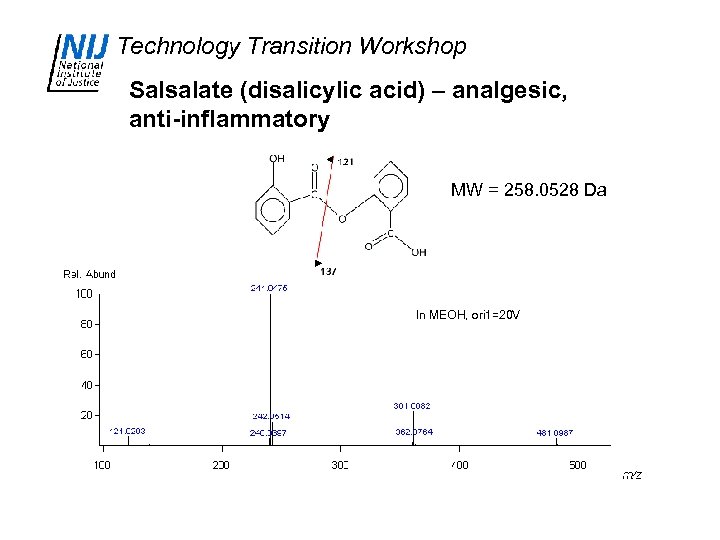 Technology Transition Workshop Salsalate (disalicylic acid) – analgesic, anti-inflammatory MW = 258. 0528 Da In MEOH, ori 1=20 V
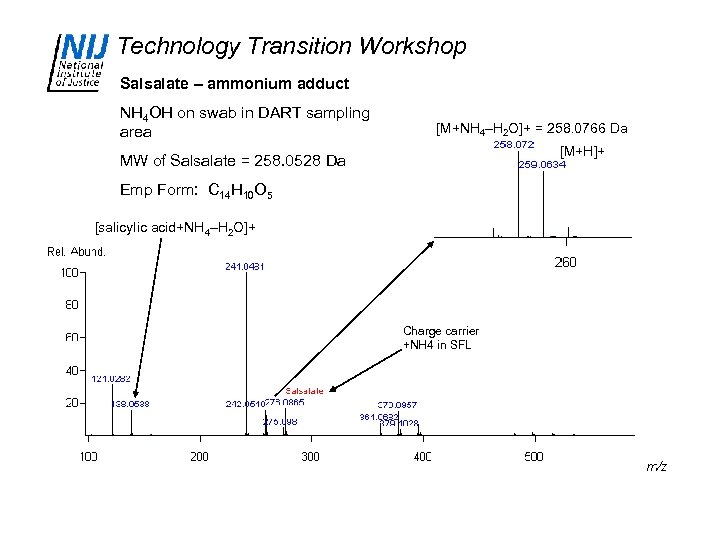 Technology Transition Workshop Salsalate – ammonium adduct NH 4 OH on swab in DART sampling area [M+NH 4–H 2 O]+ = 258. 0766 Da [M+H]+ MW of Salsalate = 258. 0528 Da Emp Form: C 14 H 10 O 5 [salicylic acid+NH 4–H 2 O]+ Charge carrier +NH 4 in SFL
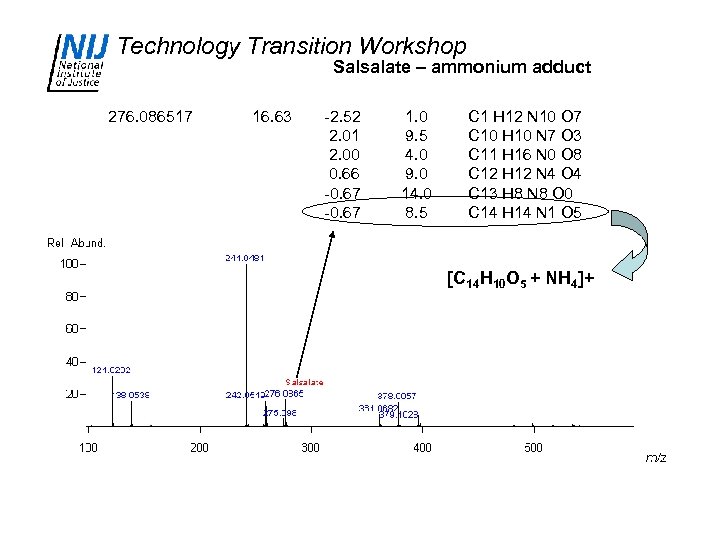 Technology Transition Workshop Salsalate – ammonium adduct 276. 086517 16. 63 -2. 52 2. 01 2. 00 0. 66 -0. 67 1. 0 9. 5 4. 0 9. 0 14. 0 8. 5 C 1 H 12 N 10 O 7 C 10 H 10 N 7 O 3 C 11 H 16 N 0 O 8 C 12 H 12 N 4 O 4 C 13 H 8 N 8 O 0 C 14 H 14 N 1 O 5 [C 14 H 10 O 5 + NH 4]+
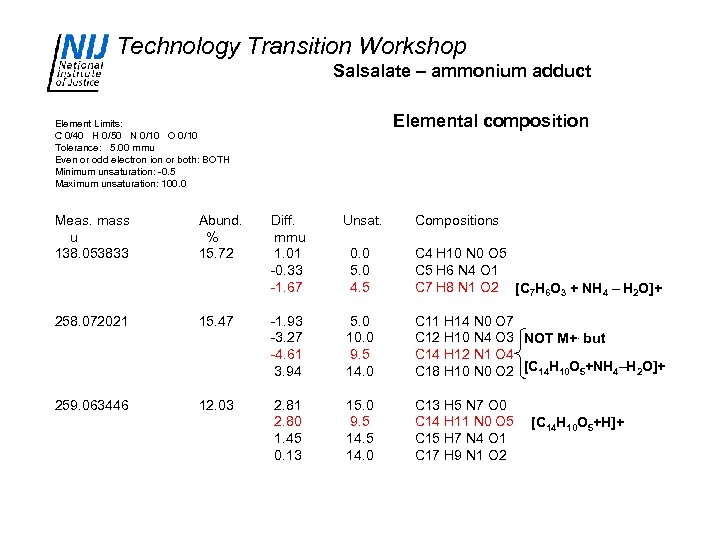 Technology Transition Workshop Salsalate – ammonium adduct Elemental composition Element Limits: C 0/40 H 0/50 N 0/10 O 0/10 Tolerance: 5. 00 mmu Even or odd electron ion or both: BOTH Minimum unsaturation: -0. 5 Maximum unsaturation: 100. 0 Meas. mass u 138. 053833 Abund. % 15. 72 Diff. mmu 1. 01 -0. 33 -1. 67 Unsat. Compositions 0. 0 5. 0 4. 5 C 4 H 10 N 0 O 5 C 5 H 6 N 4 O 1 C 7 H 8 N 1 O 2 [C 7 H 6 O 3 + NH 4 – H 2 O]+ 258. 072021 15. 47 -1. 93 -3. 27 -4. 61 3. 94 5. 0 10. 0 9. 5 14. 0 C 11 H 14 N 0 O 7 C 12 H 10 N 4 O 3 NOT M+. but C 14 H 12 N 1 O 4 C 18 H 10 N 0 O 2 [C 14 H 10 O 5+NH 4–H 2 O]+ 259. 063446 12. 03 2. 81 2. 80 1. 45 0. 13 15. 0 9. 5 14. 0 C 13 H 5 N 7 O 0 C 14 H 11 N 0 O 5 [C 14 H 10 O 5+H]+ C 15 H 7 N 4 O 1 C 17 H 9 N 1 O 2
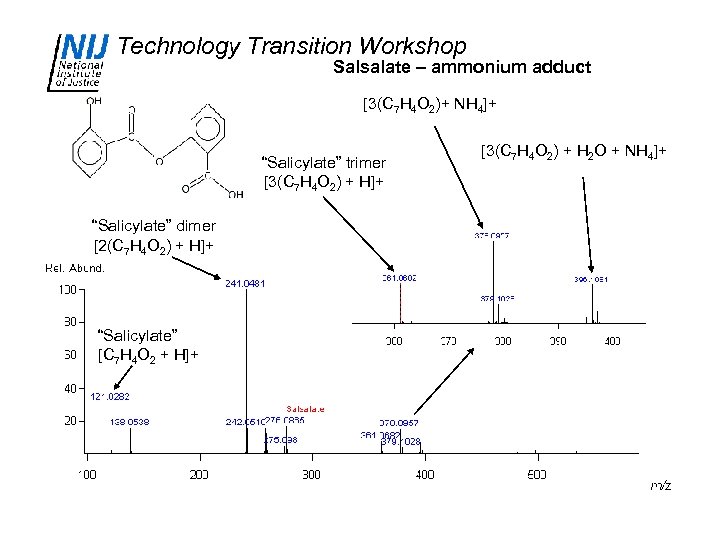 Technology Transition Workshop Salsalate – ammonium adduct [3(C 7 H 4 O 2)+ NH 4]+ “Salicylate” trimer [3(C 7 H 4 O 2) + H]+ “Salicylate” dimer [2(C 7 H 4 O 2) + H]+ “Salicylate” [C 7 H 4 O 2 + H]+ [3(C 7 H 4 O 2) + H 2 O + NH 4]+
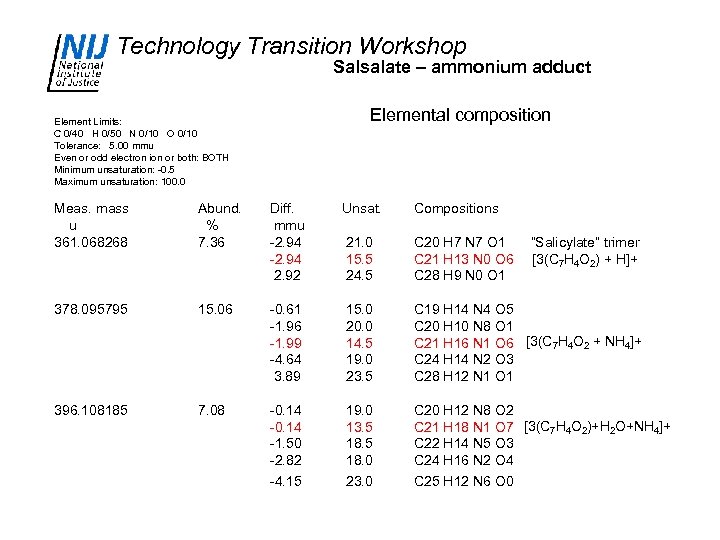 Technology Transition Workshop Salsalate – ammonium adduct Elemental composition Element Limits: C 0/40 H 0/50 N 0/10 O 0/10 Tolerance: 5. 00 mmu Even or odd electron ion or both: BOTH Minimum unsaturation: -0. 5 Maximum unsaturation: 100. 0 Meas. mass u 361. 068268 378. 095795 396. 108185 Abund. % 7. 36 Diff. mmu -2. 94 2. 92 Unsat. Compositions 21. 0 15. 5 24. 5 C 20 H 7 N 7 O 1 “Salicylate” trimer C 21 H 13 N 0 O 6 [3(C 7 H 4 O 2) + H]+ C 28 H 9 N 0 O 1 15. 06 -0. 61 -1. 96 -1. 99 -4. 64 3. 89 15. 0 20. 0 14. 5 19. 0 23. 5 C 19 H 14 N 4 O 5 C 20 H 10 N 8 O 1 C 21 H 16 N 1 O 6 [3(C 7 H 4 O 2 + NH 4]+ C 24 H 14 N 2 O 3 C 28 H 12 N 1 O 1 7. 08 -0. 14 -1. 50 -2. 82 -4. 15 19. 0 13. 5 18. 0 23. 0 C 20 H 12 N 8 O 2 C 21 H 18 N 1 O 7 [3(C 7 H 4 O 2)+H 2 O+NH 4]+ C 22 H 14 N 5 O 3 C 24 H 16 N 2 O 4 C 25 H 12 N 6 O 0
![Technology Transition Workshop What is this? ? ? Hydroxyzine (Vistaril) [M+H]+: 375. 1839 Da](https://present5.com/presentation/577c5a2849d61a9f2423d4a8d2c6dd00/image-68.jpg "Technology Transition Workshop What is this? ? ? Hydroxyzine (Vistaril) [M+H]+: 375. 1839 Da") Technology Transition Workshop What is this? ? ? Hydroxyzine (Vistaril) [M+H]+: 375. 1839 Da In MEOH, ori 1 20 V Chlorinated!
Technology Transition Workshop What is this? ? ? Hydroxyzine (Vistaril) [M+H]+: 375. 1839 Da In MEOH, ori 1 20 V Chlorinated!
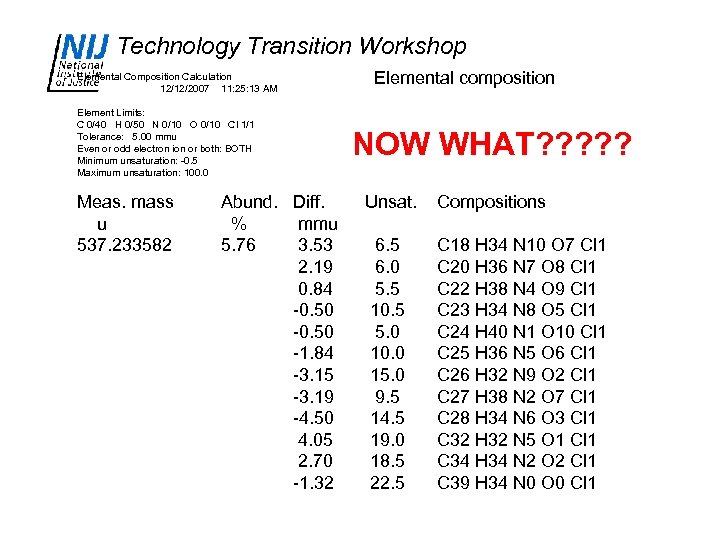 Technology Transition Workshop Elemental composition Elemental Composition Calculation 12/12/2007 11: 25: 13 AM Element Limits: C 0/40 H 0/50 N 0/10 O 0/10 Cl 1/1 Tolerance: 5. 00 mmu Even or odd electron ion or both: BOTH Minimum unsaturation: -0. 5 Maximum unsaturation: 100. 0 Meas. mass u 537. 233582 Abund. % 5. 76 NOW WHAT? ? ? Diff. mmu 3. 53 2. 19 0. 84 -0. 50 -1. 84 -3. 15 -3. 19 -4. 50 4. 05 2. 70 -1. 32 Unsat. Compositions 6. 5 6. 0 5. 5 10. 5 5. 0 10. 0 15. 0 9. 5 14. 5 19. 0 18. 5 22. 5 C 18 H 34 N 10 O 7 Cl 1 C 20 H 36 N 7 O 8 Cl 1 C 22 H 38 N 4 O 9 Cl 1 C 23 H 34 N 8 O 5 Cl 1 C 24 H 40 N 1 O 10 Cl 1 C 25 H 36 N 5 O 6 Cl 1 C 26 H 32 N 9 O 2 Cl 1 C 27 H 38 N 2 O 7 Cl 1 C 28 H 34 N 6 O 3 Cl 1 C 32 H 32 N 5 O 1 Cl 1 C 34 H 34 N 2 O 2 Cl 1 C 39 H 34 N 0 O 0 Cl 1
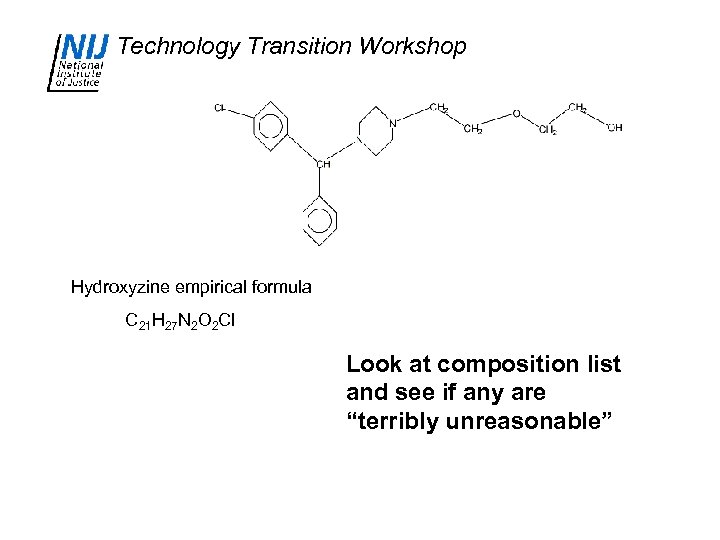 Technology Transition Workshop Hydroxyzine empirical formula C 21 H 27 N 2 O 2 Cl Look at composition list and see if any are “terribly unreasonable”
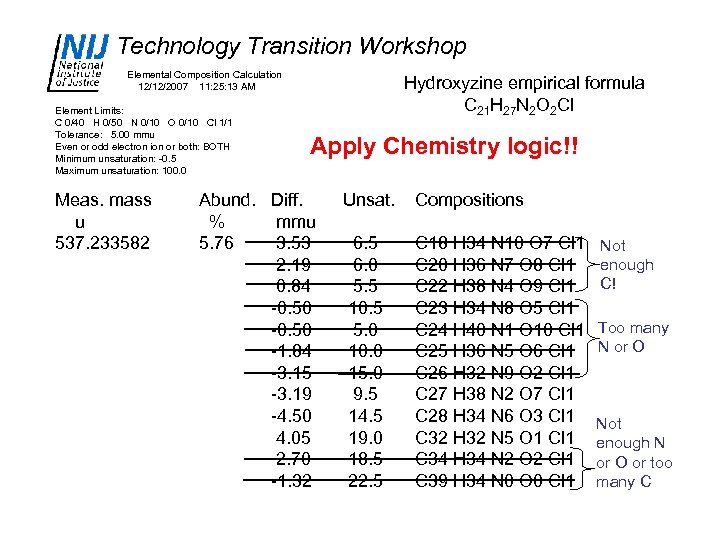 Technology Transition Workshop Elemental Composition Calculation 12/12/2007 11: 25: 13 AM Element Limits: C 0/40 H 0/50 N 0/10 O 0/10 Cl 1/1 Tolerance: 5. 00 mmu Even or odd electron ion or both: BOTH Minimum unsaturation: -0. 5 Maximum unsaturation: 100. 0 Meas. mass u 537. 233582 Abund. % 5. 76 Hydroxyzine empirical formula C 21 H 27 N 2 O 2 Cl Apply Chemistry logic!! Diff. mmu 3. 53 2. 19 0. 84 -0. 50 -1. 84 -3. 15 -3. 19 -4. 50 4. 05 2. 70 -1. 32 Unsat. Compositions 6. 5 6. 0 5. 5 10. 5 5. 0 10. 0 15. 0 9. 5 14. 5 19. 0 18. 5 22. 5 C 18 H 34 N 10 O 7 Cl 1 C 20 H 36 N 7 O 8 Cl 1 C 22 H 38 N 4 O 9 Cl 1 C 23 H 34 N 8 O 5 Cl 1 C 24 H 40 N 1 O 10 Cl 1 C 25 H 36 N 5 O 6 Cl 1 C 26 H 32 N 9 O 2 Cl 1 C 27 H 38 N 2 O 7 Cl 1 C 28 H 34 N 6 O 3 Cl 1 C 32 H 32 N 5 O 1 Cl 1 C 34 H 34 N 2 O 2 Cl 1 C 39 H 34 N 0 O 0 Cl 1 Not enough C! Too many N or O Not enough N or O or too many C
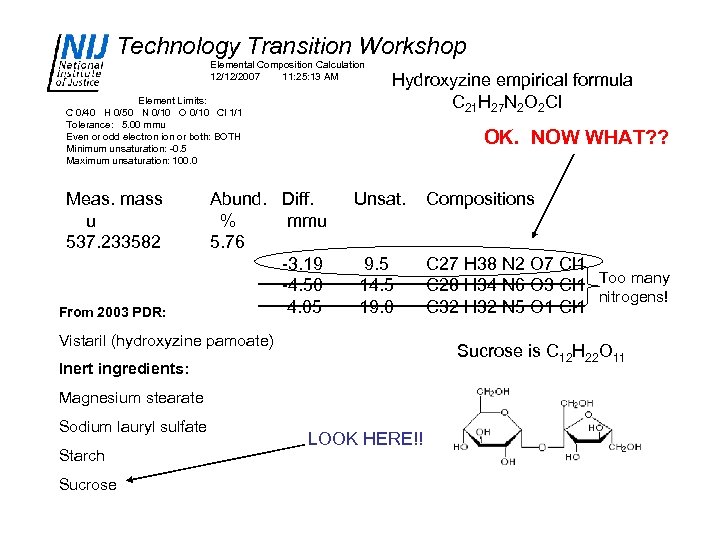 Technology Transition Workshop Elemental Composition Calculation 12/12/2007 11: 25: 13 AM Element Limits: C 0/40 H 0/50 N 0/10 O 0/10 Cl 1/1 Tolerance: 5. 00 mmu Even or odd electron ion or both: BOTH Minimum unsaturation: -0. 5 Maximum unsaturation: 100. 0 Meas. mass u 537. 233582 From 2003 PDR: Abund. % 5. 76 Hydroxyzine empirical formula C 21 H 27 N 2 O 2 Cl OK. NOW WHAT? ? Diff. mmu -3. 19 -4. 50 4. 05 Unsat. Compositions 9. 5 14. 5 19. 0 C 27 H 38 N 2 O 7 Cl 1 C 28 H 34 N 6 O 3 Cl 1 Too many nitrogens! C 32 H 32 N 5 O 1 Cl 1 Vistaril (hydroxyzine pamoate) Sucrose is C 12 H 22 O 11 Inert ingredients: Magnesium stearate Sodium lauryl sulfate Starch Sucrose LOOK HERE!!
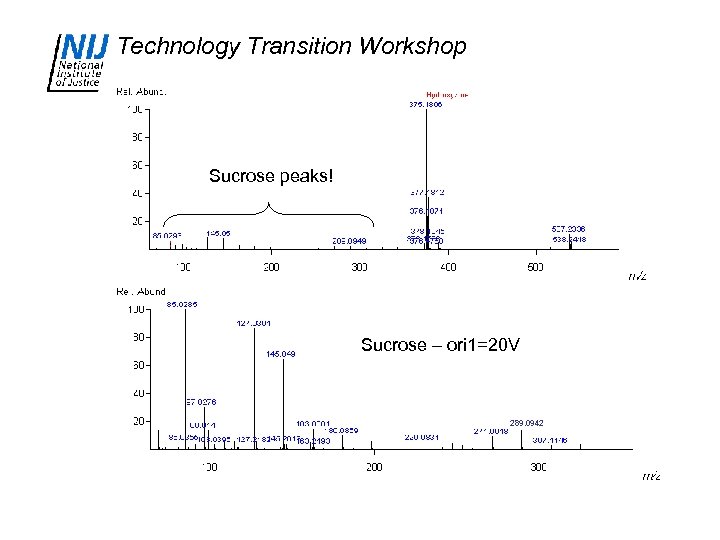 Technology Transition Workshop Sucrose peaks! Sucrose – ori 1=20 V 289. 0942
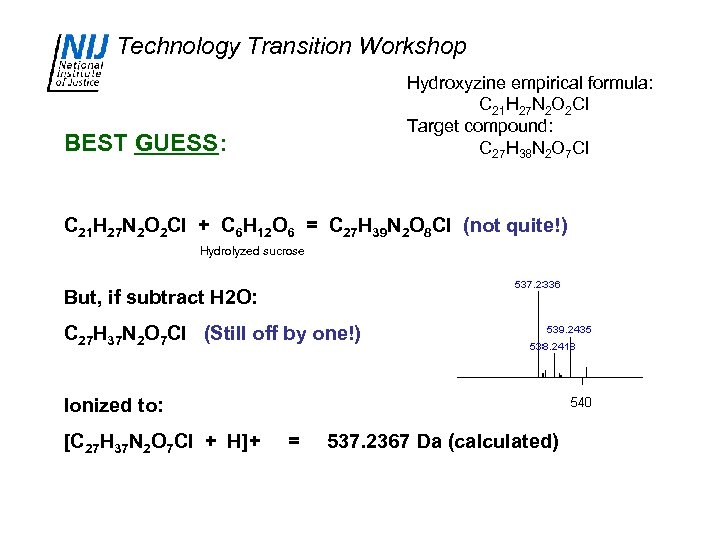 Technology Transition Workshop Hydroxyzine empirical formula: C 21 H 27 N 2 O 2 Cl Target compound: C 27 H 38 N 2 O 7 Cl BEST GUESS: C 21 H 27 N 2 O 2 Cl + C 6 H 12 O 6 = C 27 H 39 N 2 O 8 Cl (not quite!) Hydrolyzed sucrose But, if subtract H 2 O: C 27 H 37 N 2 O 7 Cl (Still off by one!) Ionized to: [C 27 H 37 N 2 O 7 Cl + H]+ = 537. 2367 Da (calculated)
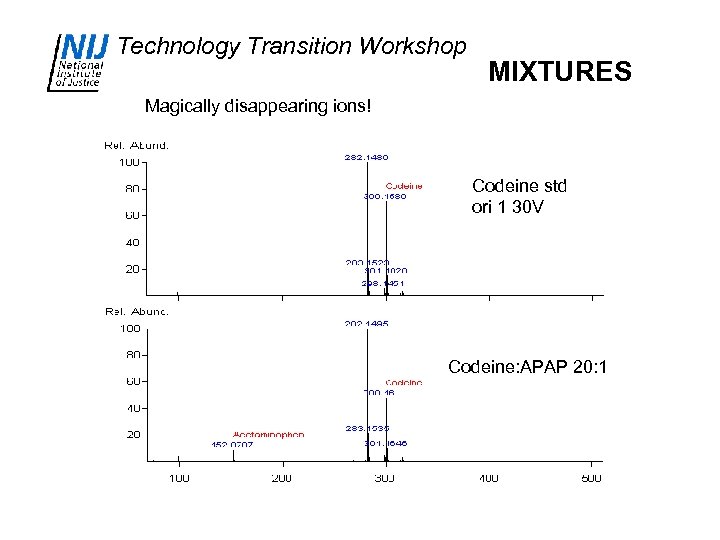 Technology Transition Workshop MIXTURES Magically disappearing ions! Codeine std ori 1 30 V Codeine: APAP 20: 1
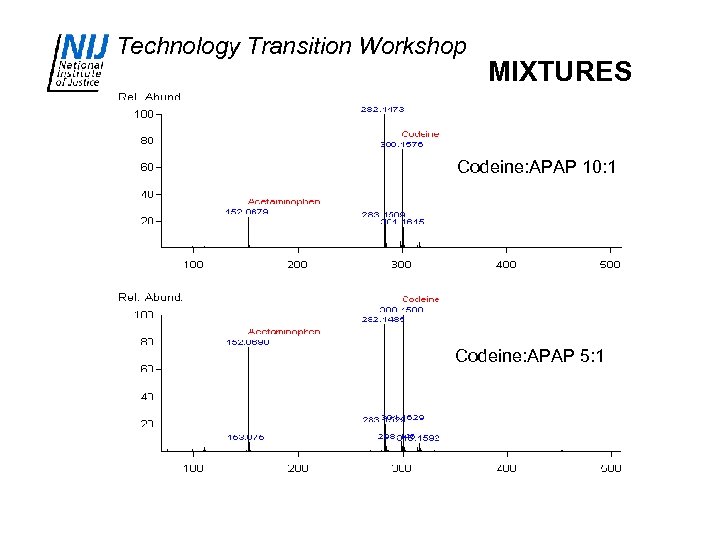 Technology Transition Workshop MIXTURES Codeine: APAP 10: 1 Codeine: APAP 5: 1
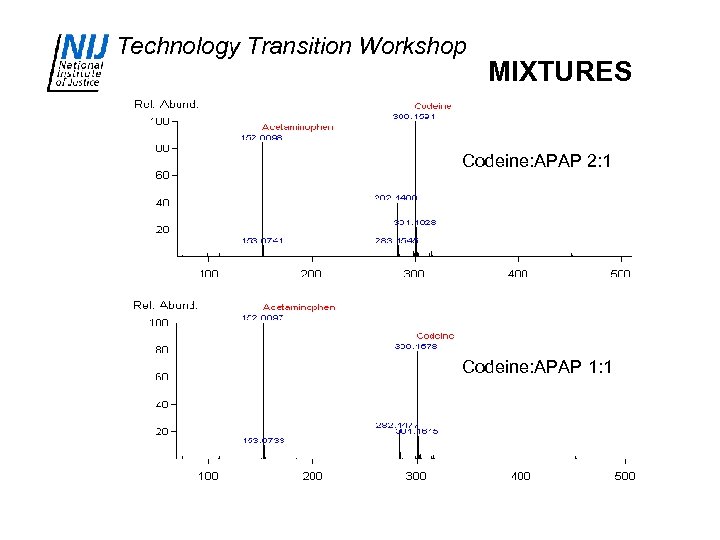 Technology Transition Workshop MIXTURES Codeine: APAP 2: 1 Codeine: APAP 1: 1
 Technology Transition Workshop “Today is done!”