


 Скачать презентацию Technology Transfer Professor Richard Modjeski Ph D n
3e549904fe47f4144d416f76959955e2.ppt
- Количество слайдов: 14
 Technology Transfer Professor Richard Modjeski Ph. D. n n Visiting Professor XIMb 25 years U. S. Government Consultant DARPA Past Postings University of Maryland University of Southern California (USC) University of Hawaii Florida Institute of Technology
 Technology Transfer Insertion of New Technology is conflict a based Activity Six Forces acting as Stimulus to Change n n n Nature of the workforce Technology Economic shocks Social trends World politics
 Technology Transfer Nature of the workforce n n n Increase in professionals New entrants with little skills More cultural diversity Technology n n Faster & cheaper computers Mobile communication devices (Blackberry)
 Technology Transfer Economic shocks n n n Rise and fall of dot. com stocks (dot. gone) Decline/rise in value of currency Collapse of Enron Corporation Competition n Global competitors Mergers and consolidations Growth of e - commerce
 Technology Transfer Social trends n n n Internet chat rooms Retirement of Western Baby Boomers Urbanization World politics n n n Hostilities in the Middle East Open markets in China, Europe, USA War on terrorism after 11. 9. 01
 Technology Transfer Five Reasons Individual Resist Change n n n Habit Security Economic Factors (Pay & Performance) Fear of the Unknown Selective Information Processing
 Technology Transfer Six Sources of Organizational Resistance to change n n n Structural Inertia (select in/out; Cyber loafing climate) Limited Focus of change (interdependent Subsystems – modification of Organization Structure) Group inertia (Group Think/Shift; Social Loafing) Threat of Expertise (Job Security) Threat to Established Power Relationships (Cronyism, Favoritism) Threats to Established Resource Allocations (Budget/Staff Wars)
 Technology Transfer Six Tactics for Overcoming Resistance to Change involving new technology transfer n n n Education and Communication Participation Facilitation & Support Negotiation Manipulation & Cooptation Coercion
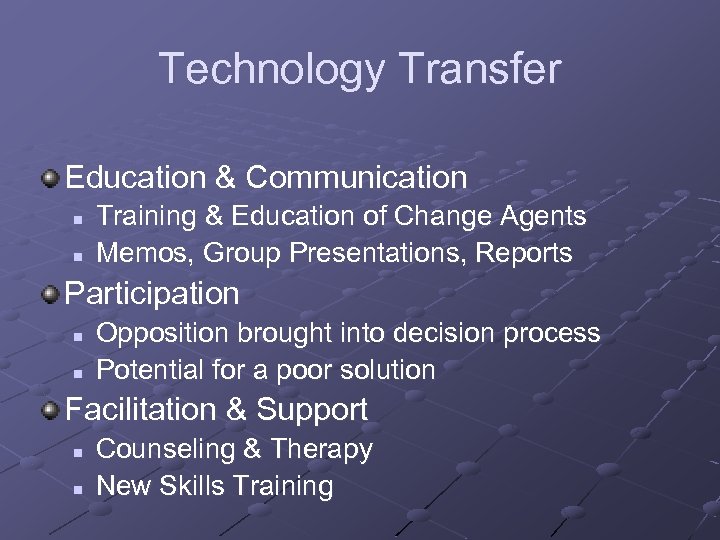 Technology Transfer Education & Communication n n Training & Education of Change Agents Memos, Group Presentations, Reports Participation n n Opposition brought into decision process Potential for a poor solution Facilitation & Support n n Counseling & Therapy New Skills Training
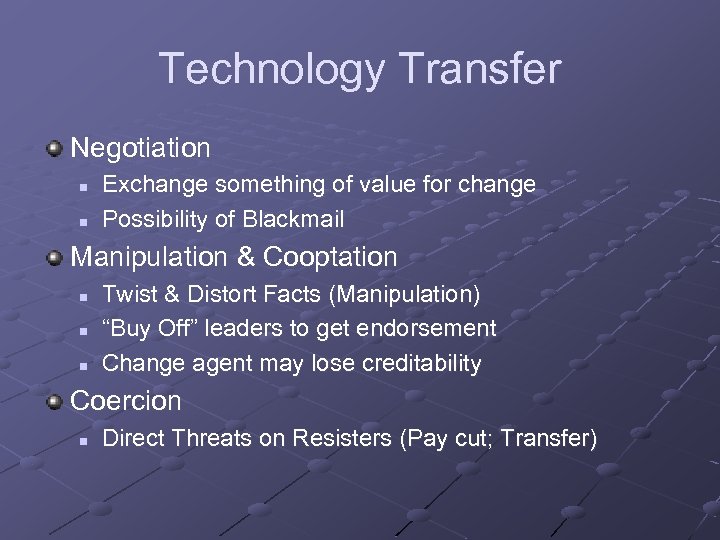 Technology Transfer Negotiation n n Exchange something of value for change Possibility of Blackmail Manipulation & Cooptation n Twist & Distort Facts (Manipulation) “Buy Off” leaders to get endorsement Change agent may lose creditability Coercion n Direct Threats on Resisters (Pay cut; Transfer)
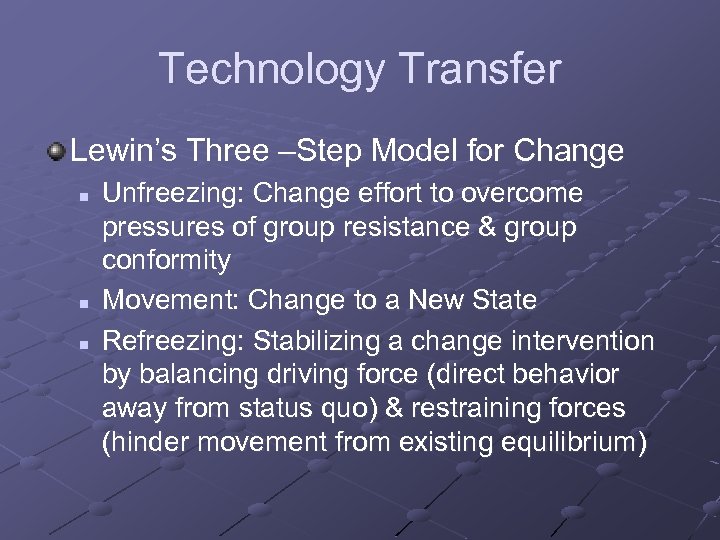 Technology Transfer Lewin’s Three –Step Model for Change n n n Unfreezing: Change effort to overcome pressures of group resistance & group conformity Movement: Change to a New State Refreezing: Stabilizing a change intervention by balancing driving force (direct behavior away from status quo) & restraining forces (hinder movement from existing equilibrium)
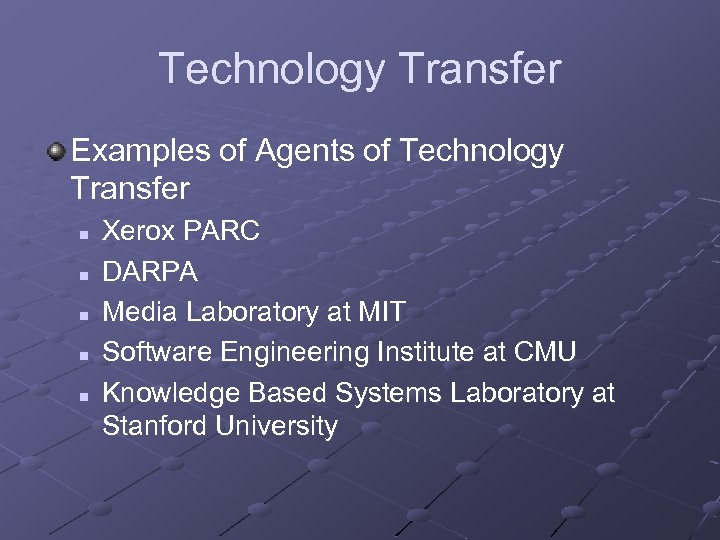 Technology Transfer Examples of Agents of Technology Transfer n n n Xerox PARC DARPA Media Laboratory at MIT Software Engineering Institute at CMU Knowledge Based Systems Laboratory at Stanford University
 Technology Transfer References n n Dressler, G. (1985). Management fundamentals: Modern principles & Practices (4 th edition). Reston, VA: Reston Publishing Company. Fishwick, P. , & Modjeski, R. (1991). Knowledge – based simulation: Methodology and Application. New York: Springer – Verlag. Robbins, S. P. (2004). Organizational behavior (10 th edition). Delhi: Prentice – Hall of India Turban, E. , Aronson, J. E. , & Liang, T-P. (2005). Decision support systems and intelligent systems (7 th edition). Delhi: Pearson Education.
 Technology Transfer Notice: Intellectual Property Rights are Retained by the authors and publishers of the text cited.