 Скачать презентацию Technology Strategy Sustainable Production and Consumption Christopher Stewart
2dc42b8b615f94a471619085ff0ec464.ppt
- Количество слайдов: 24



Technology Strategy Sustainable Production and Consumption Christopher Stewart Energy & Environment DTI
Technology Strategy TSB’s Call to Action, November ‘ 05 Seven thematic areas – Advanced Materials – Bioscience and Healthcare Technologies – Design Engineering and Advanced Manufacturing – Electronics and Photonics – Emerging Energy Technologies – Information and Communication Technologies – Sustainable Production and Consumption (SPC) … But SPC should also underlie all technology themes
Technology Strategy What does SPC mean? • SPC goal is to ensure economic growth and social progress to meet the needs of the present, without compromising the health of the ecosystems that support us, or the ability of future generations to meet their own needs (Brundtland report). • decoupling economic growth and environmental degradation • Innovation technologies will be central to achieving these goals. • Policy context: responsibility is shared across many govt. departments, notably DEFRA (sustainability, farming, waste, climate change), DTI (business, innovation, productivity), ODPM (housing), Df. T (transport)…
Technology Strategy Scope of the SPC Technology Theme • • Industrial and domestic Waste: – Waste minimisation – Waste Treatment and Recycling – Pollution Control Energy Efficiency: – Challenge based approach? – Buildings – Manufacturing and Industry Sustainable Water Supply (Aspiration): – Balancing supply and demand – Security of supply Sustainable Food Chain (Aspiration): – Processing (energy, waste) – Distribution (wholesale, retail and home delivery) – Packaging (alternatives, lightweight packaging, bioplastics)
Technology Strategy Towards a rational Technology Strategy Criteria for assessing UK potential in a technology area: • Drivers of change • UK capacity to develop and exploit the technologies • Global market opportunity • Potential for impact, timescale – Metrology and standards – International activities • A clear role for the TSB
Technology Strategy Waste Minimisation and Pollution Control • In the UK, waste volumes are rising by 3% per year. • In 2002/3 the UK produced about 330 million tonnes (Mt) of waste, 71% mineral, construction and demolition waste • Very strong pressures on Business: – Regulation tightening (e. g. WEE, ROHS, Landfill and Water directives) landfill tax ramping up • Opportunities: – £ 6 Bn UK expenditure on solid waste and waste water management. The waste industry employs 40, 000 people. – The UK has ca. 100, 000 contaminated sites in need of remediation, with a further 700, 000 sites in Europe alone. The UK market for remediation and assessment is currently worth £ 1 billion, growing by 20% since 2000. – The global markets in waste and pollution management are growing fast.
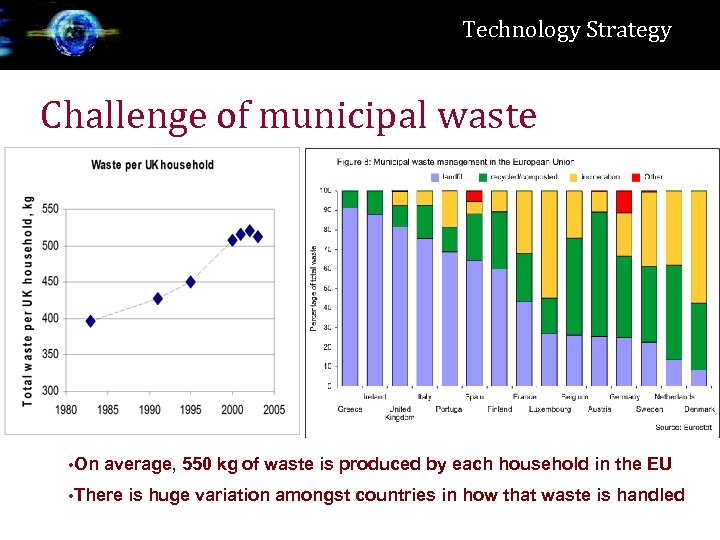
Technology Strategy Challenge of municipal waste • On average, 550 kg of waste is produced by each household in the EU • There is huge variation amongst countries in how that waste is handled
Technology Strategy Key Waste/Pollution Technologies • OVERALL: Life Cycle approach – Upstream waste minimisation, Downstream end-of-pipe treatment and recycling – Dealing with legacy issues • Sustainable design: – Product design – Resource consumption – End-of-life • Materials Recovery – Recycling – Separation and Recovery – Composting • Energy Recovery from Waste – Biofuels – Anaerobic digestion, Gasification, Pyrolysis • Contaminated Land Remediation – Site investigation and monitoring – Risk Assessment and Management – Prevention
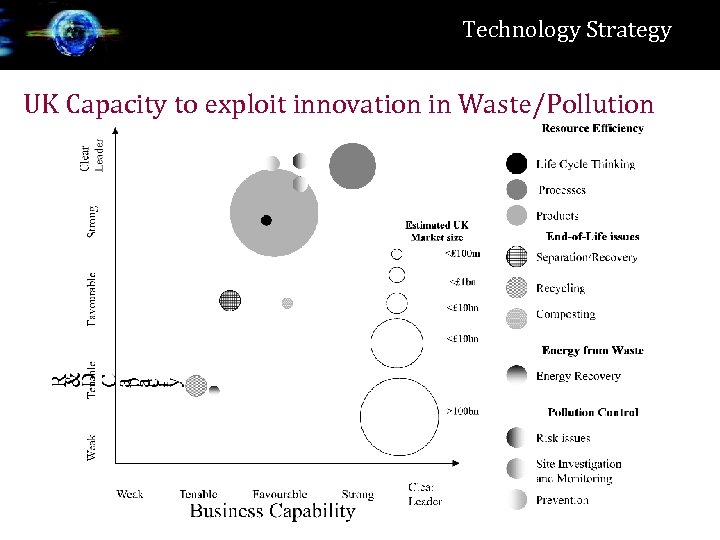
Technology Strategy UK Capacity to exploit innovation in Waste/Pollution
Technology Strategy Energy Efficiency technologies • UK primary energy consumption = 235 mtoe per year, > 90% fossil fuels • Final energy consumption evenly spilt: industry (21%), domestic housing (30%), and transport (36%), leaving ca 13% for agriculture, services and the public sector. UK energy bill in 2004 came to £ 75 billion. • Energy efficient technologies come in a huge variety of forms and receive fragmented government support • About £ 15 million a year in total is spent by public bodies on energy-efficiency RD&D. • UK energy goals: reducing carbon emissions, ensuring security of supply through reduced demand, maintaining competitiveness and tackling fuel poverty.
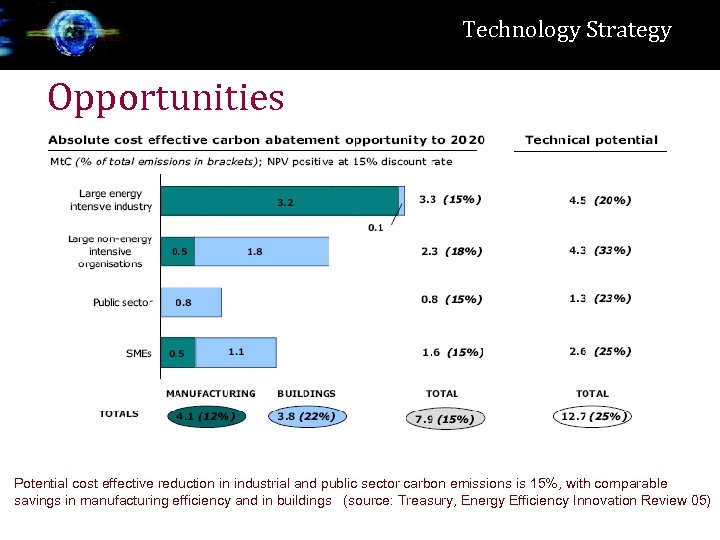
Technology Strategy Opportunities Potential cost effective reduction in industrial and public sector carbon emissions is 15%, with comparable savings in manufacturing efficiency and in buildings (source: Treasury, Energy Efficiency Innovation Review 05)
Technology Strategy Energy Efficiency Innovation – Key Technologies Energy Consumption in Manufacturing and Industry Key technologies • efficient boilers • process and waste heat recovery • separation technologies • plant optimisation. Energy Consumption in Domestic Buildings Key technologies: • building design and control, air-conditioning, ventilation • advanced building management systems. • innovative insulation and glazing • innovative lighting • appliance networking Cross-cutting challenges • light weighting and materials substitution • decarbonisation and dematerialisation
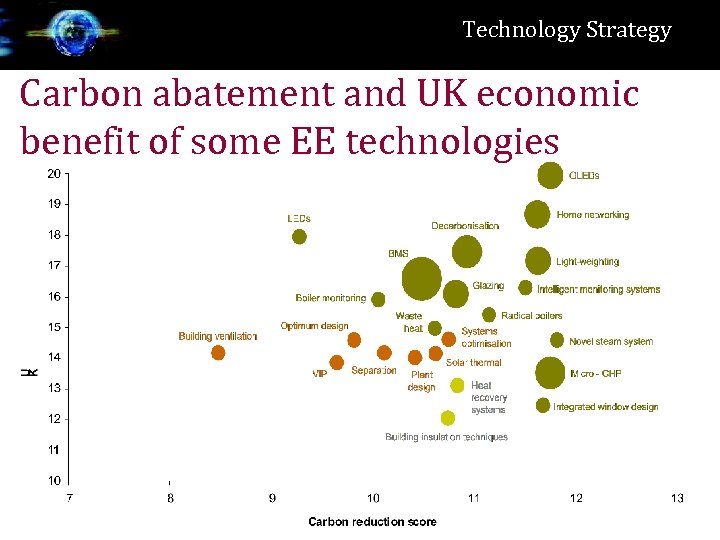
Technology Strategy Carbon abatement and UK economic benefit of some EE technologies
Technology Strategy The Sustainable Food Chain • The food chain accounts for 8% of UK GDP, £ 73. 7 Bn Gross Value Added from primary producers to consumers • Food Chain industries employ 12. 7% of the UK workforce (3. 8 million jobs). • Food manufacturing accounts for 14% of industrial energy use, 10% of industrial water use and 10% of industrial and commercial waste • Food and drink products are estimated to be the largest single source of greenhouse gas emissions (LCA) • • Food and eating habits are among the most important factors in lifestyle and age related diseases • Strategic importance of maintaining food security • Primary food production is key to the ecology and landscape of the UK
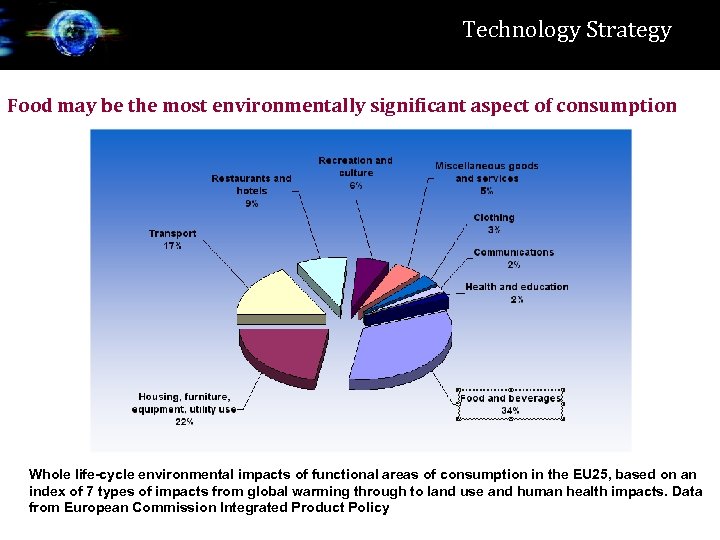
Technology Strategy Food may be the most environmentally significant aspect of consumption Whole life-cycle environmental impacts of functional areas of consumption in the EU 25, based on an index of 7 types of impacts from global warming through to land use and human health impacts. Data from European Commission Integrated Product Policy
Technology Strategy Sustainable Food Chain Technologies Sustainability implications across the whole food chain • • Primary Production Food & Drink Processing Transport and distribution Retail, Wholesale, Catering Market opportunities flowing from: • • Improving energy efficiency, waste and water management across the supply chain Integrating sustainable primary food production with food processing, distribution and delivery, to maximise value and minimise life-cycle impact. Providing increased traceability, security and quality Innovative and sustainable products in response to consumer needs
Technology Strategy Sustainable Water Supply UK water industry: • Collects, treats and supplies over 16 billion litres per day • Collects and treats over 10 billion litres of resulting wastewaters • Fixed assets replacement value £ 200 billion • Industry employs around 40, 000 people, plus a similar number of contractors • combined annual turnover of £ 7 billion, invested about £ 50 billion since 1990 Opportunities: • UK equipment & materials suppliers and consultancy in water/ wastewater are a very strong element of environmental industries, contributing a substantial proportion of export earnings. • Global water industry £ 250 Bn market • Need for water systems to serve extra 200, 000 people every day for the next 10 years to meet UN targets
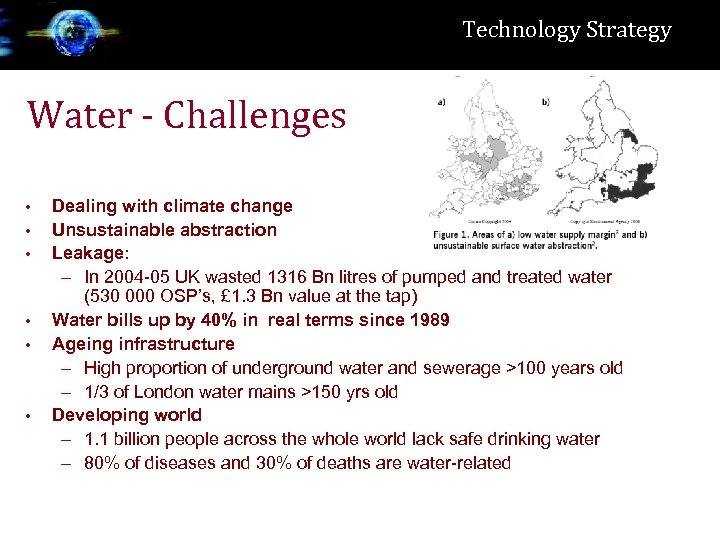
Technology Strategy Water - Challenges • • • Dealing with climate change Unsustainable abstraction Leakage: – In 2004 -05 UK wasted 1316 Bn litres of pumped and treated water (530 000 OSP’s, £ 1. 3 Bn value at the tap) Water bills up by 40% in real terms since 1989 Ageing infrastructure – High proportion of underground water and sewerage >100 years old – 1/3 of London water mains >150 yrs old Developing world – 1. 1 billion people across the whole world lack safe drinking water – 80% of diseases and 30% of deaths are water-related
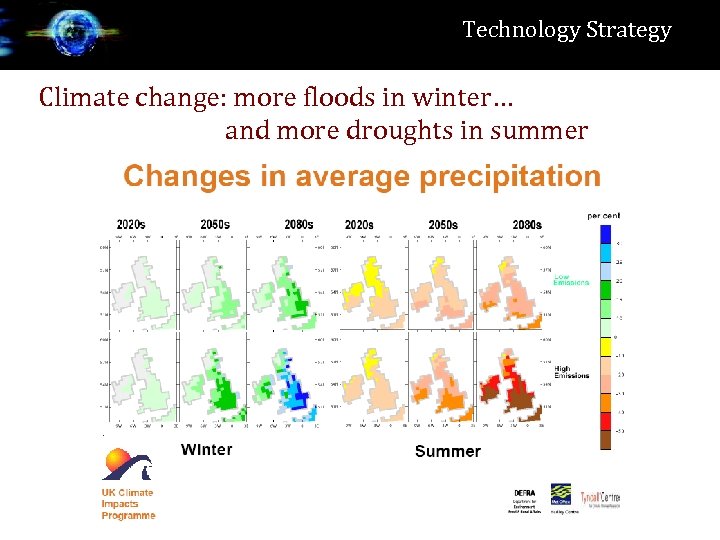
Technology Strategy Climate change: more floods in winter… and more droughts in summer
Technology Strategy Water - Key Technology categories • Balancing demand supply • Ensuring quality and security of supply • Reducing the environmental impact from water supply and sanitation • Managing assets • Improving efficiency and competitiveness
Technology Strategy SPC innovation – near-term priorities: • Industry-led projects • Drawing on the UK science base • Minimising or eliminating industrial and commercial waste • Resource- and energy- efficient products and processes
Technology Strategy Sustainable Production and Consumption – so far Networks: • • • Resource Efficiency KTN (waste minimisation) Integrated Pollution Management KTN (contaminated land/water) Food Processing KTN also… Materials, Bioscience for Business, Chemical Innovation and others Technology Programme CR&D Competitions: • Nov 04: Waste Management and Minimisation (£ 9 m): technologies and processes to eliminate, reduce, re-use, recycle or treat waste products • April 05: Meeting the Challenge of the Zero Emission Enterprise (£ <10 m): innovative ways to eliminate industrial and commercial waste and create more resource-efficient processes • Nov 05: Manufacture and Design of sustainable products (£ 5 m): reducing waste and environmental impact across a product’s life-cycle • Nov 05: Contaminated Land Remediation Technologies (£ 5 m): techniques for assessing and remediating contaminated land groundwater • April 06: Energy efficiency in Buildings and Manufacturing (£ 12 M)
Technology Strategy Where to next? • Roadmaps for each major theme of SPC – KTNs, UKWIR, ETAP, RDAs, BREW (Carbon Trust, MTP…), industry, RC’s • Consultation on the SPC Strategy Framework • Better coordination across Government • Devising a diverse range of incentives • Tackling barriers – metrology, standards, regulation
Technology Strategy Thank You
Скачать презентацию Technology Strategy Sustainable Production and Consumption Christopher Stewart
2dc42b8b615f94a471619085ff0ec464.ppt