


 Скачать презентацию Technology Performance and Market Report of Wind Diesel
b9636f6de0939720e10f69f9aed6dd12.ppt
- Количество слайдов: 25
 Technology, Performance, and Market Report of Wind. Diesel Applications for Remote and Island Communities EWEC 2009 Marseille, France E. Ian Baring-Gould National Renewable Energy Laboratory Martina Dabo Alaska Energy Authority / TDX Power March 17, 2009 NREL is a national laboratory of the U. S. Department of Energy Office of Energy Efficiency and Renewable Energy operated by the Alliance for Sustainable Energy, LLC
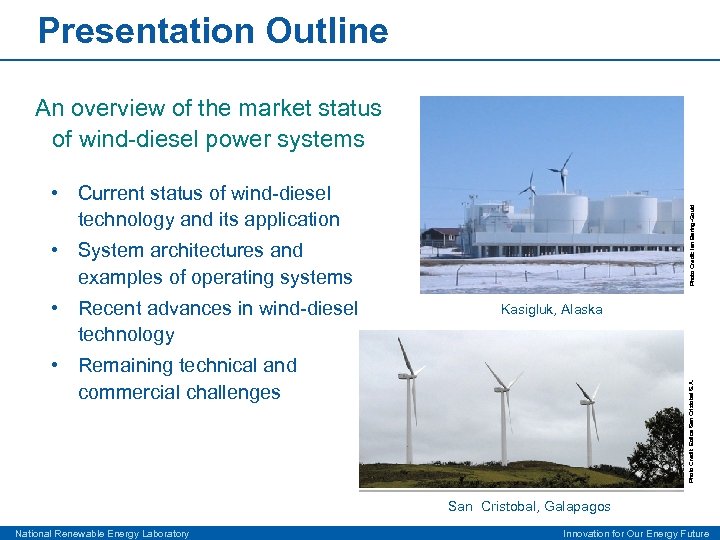 Presentation Outline An overview of the market status of wind-diesel power systems Photo Credit: Ian Baring-Gould • Current status of wind-diesel technology and its application • System architectures and examples of operating systems • Recent advances in wind-diesel technology Kasigluk, Alaska Photo Credit: Eolica San Cristobal S. A. • Remaining technical and commercial challenges San Cristobal, Galapagos National Renewable Energy Laboratory Innovation for Our Energy Future
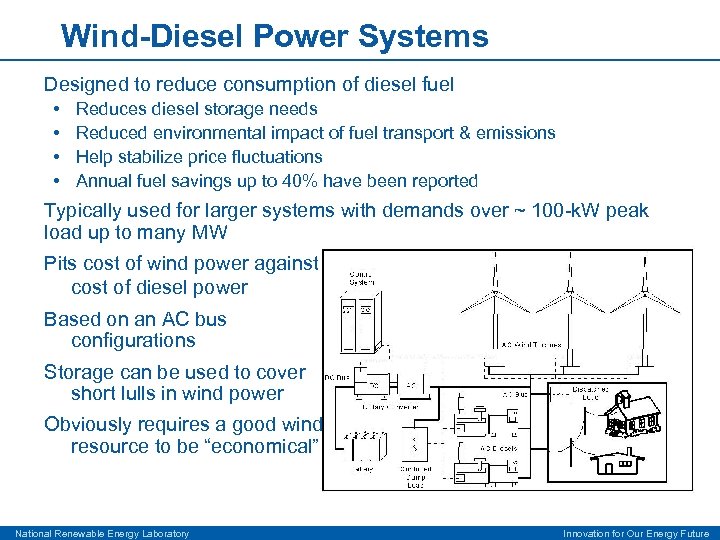 Wind-Diesel Power Systems Designed to reduce consumption of diesel fuel • • Reduces diesel storage needs Reduced environmental impact of fuel transport & emissions Help stabilize price fluctuations Annual fuel savings up to 40% have been reported Typically used for larger systems with demands over ~ 100 -k. W peak load up to many MW Pits cost of wind power against cost of diesel power Based on an AC bus configurations Storage can be used to cover short lulls in wind power Obviously requires a good wind resource to be “economical” National Renewable Energy Laboratory Innovation for Our Energy Future
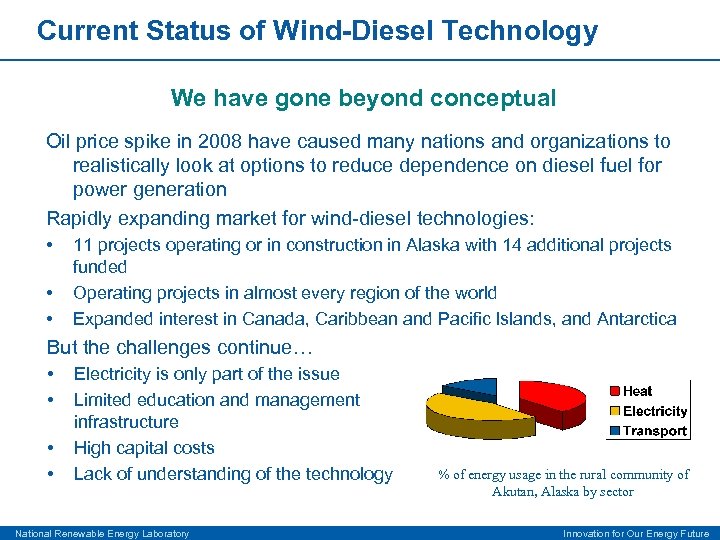 Current Status of Wind-Diesel Technology We have gone beyond conceptual Oil price spike in 2008 have caused many nations and organizations to realistically look at options to reduce dependence on diesel fuel for power generation Rapidly expanding market for wind-diesel technologies: • • • 11 projects operating or in construction in Alaska with 14 additional projects funded Operating projects in almost every region of the world Expanded interest in Canada, Caribbean and Pacific Islands, and Antarctica But the challenges continue… • • Electricity is only part of the issue Limited education and management infrastructure High capital costs Lack of understanding of the technology National Renewable Energy Laboratory % of energy usage in the rural community of Akutan, Alaska by sector Innovation for Our Energy Future
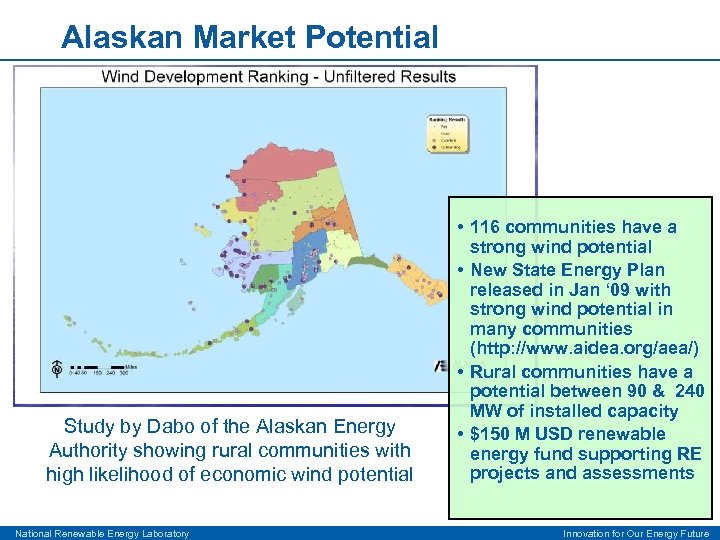 Alaskan Market Potential Study by Dabo of the Alaskan Energy Authority showing rural communities with high likelihood of economic wind potential National Renewable Energy Laboratory • 116 communities have a strong wind potential • New State Energy Plan released in Jan ‘ 09 with strong wind potential in many communities (http: //www. aidea. org/aea/) • Rural communities have a potential between 90 & 240 MW of installed capacity • $150 M USD renewable energy fund supporting RE projects and assessments Innovation for Our Energy Future
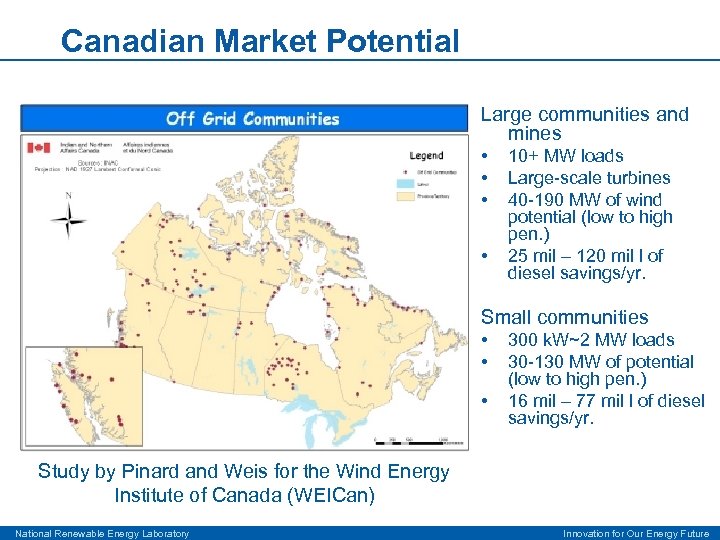 Canadian Market Potential Large communities and mines • • 10+ MW loads Large-scale turbines 40 -190 MW of wind potential (low to high pen. ) 25 mil – 120 mil l of diesel savings/yr. Small communities • • • 300 k. W~2 MW loads 30 -130 MW of potential (low to high pen. ) 16 mil – 77 mil l of diesel savings/yr. Study by Pinard and Weis for the Wind Energy Institute of Canada (WEICan) National Renewable Energy Laboratory Innovation for Our Energy Future
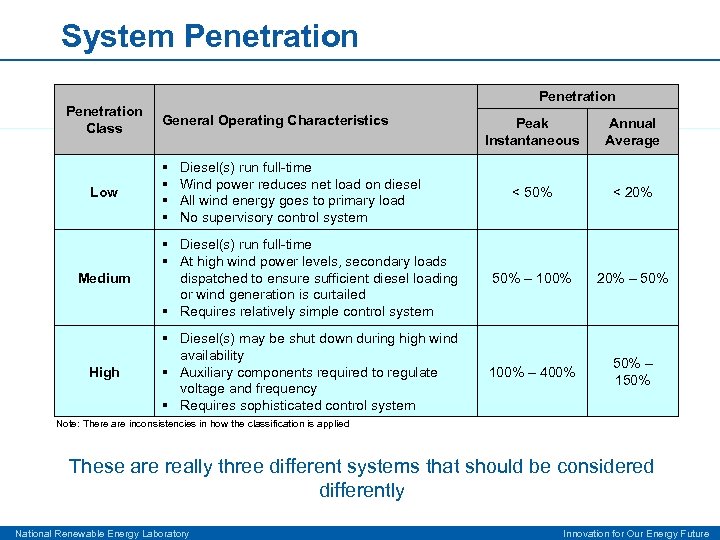 System Penetration Class Penetration General Operating Characteristics Peak Instantaneous Annual Average < 50% < 20% Medium Diesel(s) run full-time At high wind power levels, secondary loads dispatched to ensure sufficient diesel loading or wind generation is curtailed Requires relatively simple control system 50% – 100% 20% – 50% High Diesel(s) may be shut down during high wind availability Auxiliary components required to regulate voltage and frequency Requires sophisticated control system 100% – 400% 50% – 150% Low Diesel(s) run full-time Wind power reduces net load on diesel All wind energy goes to primary load No supervisory control system Note: There are inconsistencies in how the classification is applied These are really three different systems that should be considered differently National Renewable Energy Laboratory Innovation for Our Energy Future
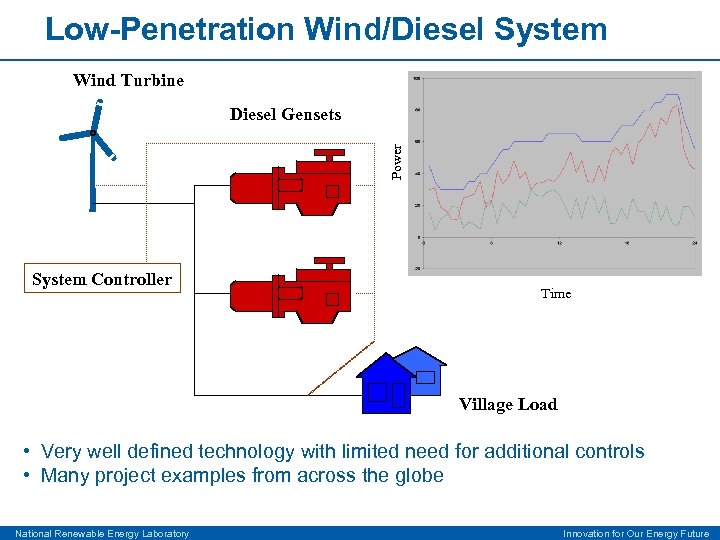 Low-Penetration Wind/Diesel System Wind Turbine Power Diesel Gensets System Controller Time Village Load • Very well defined technology with limited need for additional controls • Many project examples from across the globe National Renewable Energy Laboratory Innovation for Our Energy Future
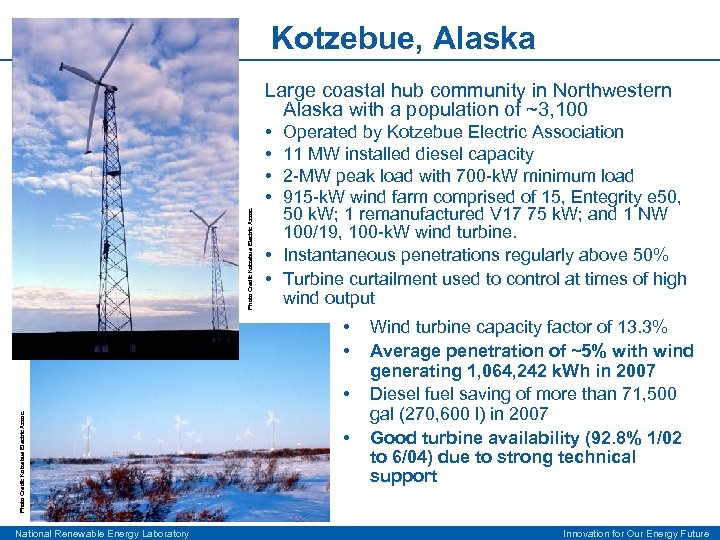 Kotzebue, Alaska Photo Credit: Kotzebue Electric Assoc. Large coastal hub community in Northwestern Alaska with a population of ~3, 100 • • Operated by Kotzebue Electric Association 11 MW installed diesel capacity 2 -MW peak load with 700 -k. W minimum load 915 -k. W wind farm comprised of 15, Entegrity e 50, 50 k. W; 1 remanufactured V 17 75 k. W; and 1 NW 100/19, 100 -k. W wind turbine. • Instantaneous penetrations regularly above 50% • Turbine curtailment used to control at times of high wind output • • Photo Credit: Kotzebue Electric Assoc. • National Renewable Energy Laboratory • Wind turbine capacity factor of 13. 3% Average penetration of ~5% with wind generating 1, 064, 242 k. Wh in 2007 Diesel fuel saving of more than 71, 500 gal (270, 600 l) in 2007 Good turbine availability (92. 8% 1/02 to 6/04) due to strong technical support Innovation for Our Energy Future
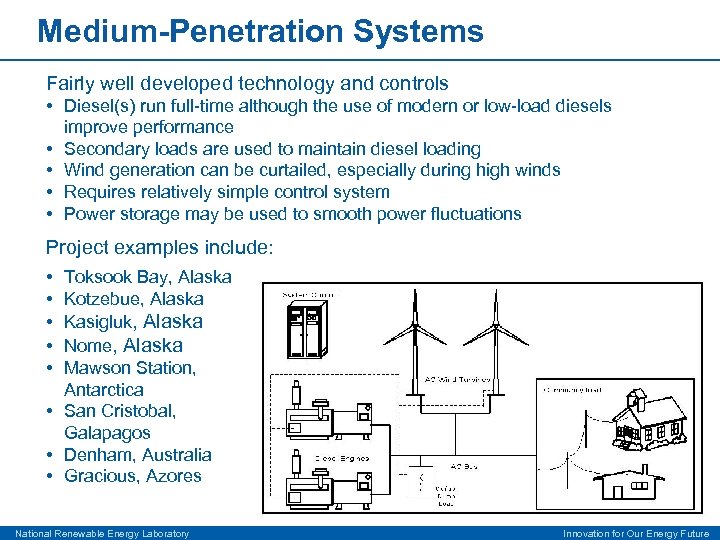 Medium-Penetration Systems Fairly well developed technology and controls • Diesel(s) run full-time although the use of modern or low-load diesels improve performance • Secondary loads are used to maintain diesel loading • Wind generation can be curtailed, especially during high winds • Requires relatively simple control system • Power storage may be used to smooth power fluctuations Project examples include: • • • Toksook Bay, Alaska Kotzebue, Alaska Kasigluk, Alaska Nome, Alaska Mawson Station, Antarctica • San Cristobal, Galapagos • Denham, Australia • Gracious, Azores National Renewable Energy Laboratory Innovation for Our Energy Future
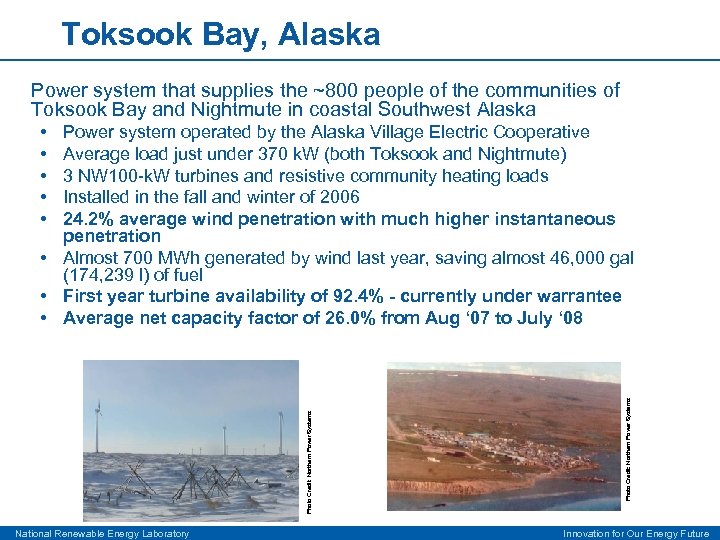 Toksook Bay, Alaska Power system that supplies the ~800 people of the communities of Toksook Bay and Nightmute in coastal Southwest Alaska • • • National Renewable Energy Laboratory Photo Credit: Northern Power Systems Power system operated by the Alaska Village Electric Cooperative Average load just under 370 k. W (both Toksook and Nightmute) 3 NW 100 -k. W turbines and resistive community heating loads Installed in the fall and winter of 2006 24. 2% average wind penetration with much higher instantaneous penetration • Almost 700 MWh generated by wind last year, saving almost 46, 000 gal (174, 239 l) of fuel • First year turbine availability of 92. 4% - currently under warrantee • Average net capacity factor of 26. 0% from Aug ‘ 07 to July ‘ 08 Innovation for Our Energy Future
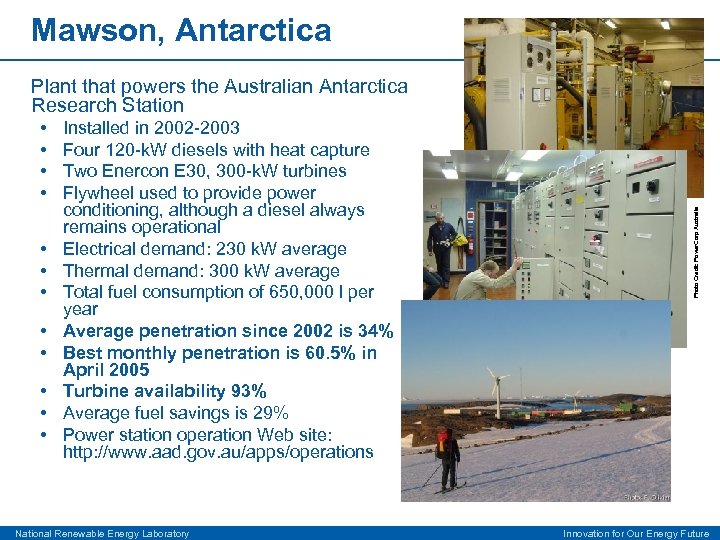 Mawson, Antarctica • • • Installed in 2002 -2003 Four 120 -k. W diesels with heat capture Two Enercon E 30, 300 -k. W turbines Flywheel used to provide power conditioning, although a diesel always remains operational Electrical demand: 230 k. W average Thermal demand: 300 k. W average Total fuel consumption of 650, 000 l per year Average penetration since 2002 is 34% Best monthly penetration is 60. 5% in April 2005 Turbine availability 93% Average fuel savings is 29% Power station operation Web site: http: //www. aad. gov. au/apps/operations National Renewable Energy Laboratory Photo Credit: Power. Corp Australia Plant that powers the Australian Antarctica Research Station Innovation for Our Energy Future
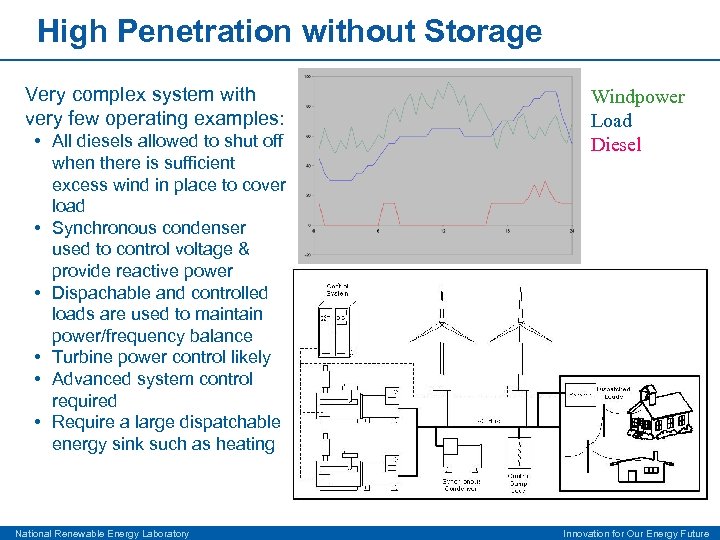 High Penetration without Storage Very complex system with very few operating examples: • All diesels allowed to shut off when there is sufficient excess wind in place to cover load • Synchronous condenser used to control voltage & provide reactive power • Dispachable and controlled loads are used to maintain power/frequency balance • Turbine power control likely • Advanced system control required • Require a large dispatchable energy sink such as heating National Renewable Energy Laboratory Windpower Load Diesel Innovation for Our Energy Future
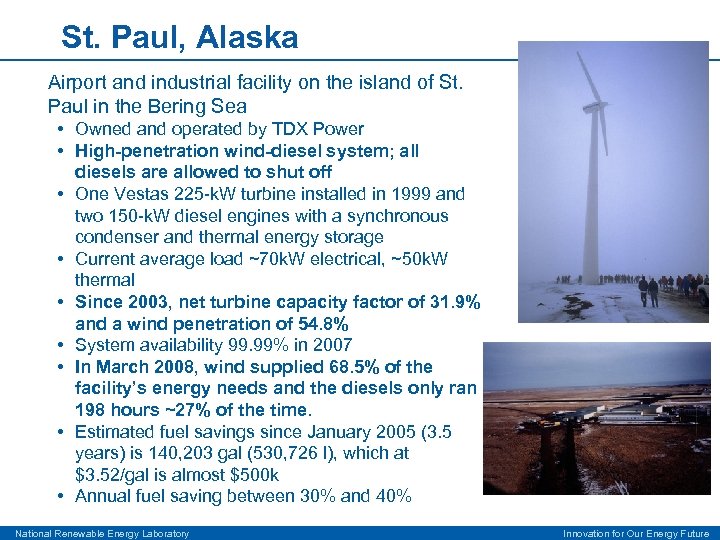 St. Paul, Alaska Airport and industrial facility on the island of St. Paul in the Bering Sea • Owned and operated by TDX Power • High-penetration wind-diesel system; all diesels are allowed to shut off • One Vestas 225 -k. W turbine installed in 1999 and two 150 -k. W diesel engines with a synchronous condenser and thermal energy storage • Current average load ~70 k. W electrical, ~50 k. W thermal • Since 2003, net turbine capacity factor of 31. 9% and a wind penetration of 54. 8% • System availability 99. 99% in 2007 • In March 2008, wind supplied 68. 5% of the facility’s energy needs and the diesels only ran 198 hours ~27% of the time. • Estimated fuel savings since January 2005 (3. 5 years) is 140, 203 gal (530, 726 l), which at $3. 52/gal is almost $500 k • Annual fuel saving between 30% and 40% National Renewable Energy Laboratory Innovation for Our Energy Future
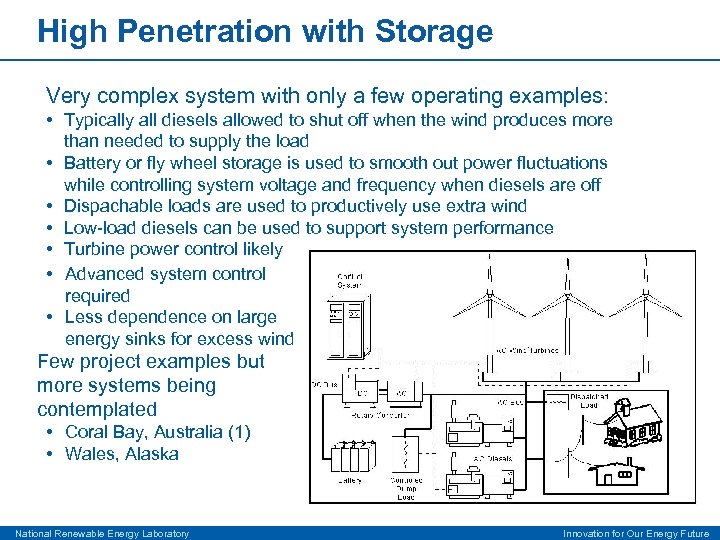 High Penetration with Storage Very complex system with only a few operating examples: • Typically all diesels allowed to shut off when the wind produces more than needed to supply the load • Battery or fly wheel storage is used to smooth out power fluctuations while controlling system voltage and frequency when diesels are off • Dispachable loads are used to productively use extra wind • Low-load diesels can be used to support system performance • Turbine power control likely • Advanced system control required • Less dependence on large energy sinks for excess wind Few project examples but more systems being contemplated • Coral Bay, Australia (1) • Wales, Alaska National Renewable Energy Laboratory Innovation for Our Energy Future
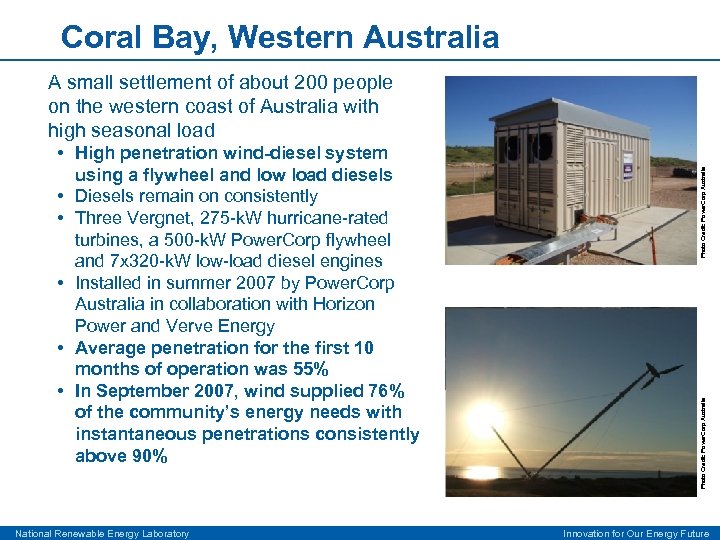 Coral Bay, Western Australia National Renewable Energy Laboratory Photo Credit: Power. Corp Australia • High penetration wind-diesel system using a flywheel and low load diesels • Diesels remain on consistently • Three Vergnet, 275 -k. W hurricane-rated turbines, a 500 -k. W Power. Corp flywheel and 7 x 320 -k. W low-load diesel engines • Installed in summer 2007 by Power. Corp Australia in collaboration with Horizon Power and Verve Energy • Average penetration for the first 10 months of operation was 55% • In September 2007, wind supplied 76% of the community’s energy needs with instantaneous penetrations consistently above 90% Photo Credit: Power. Corp Australia A small settlement of about 200 people on the western coast of Australia with high seasonal load Innovation for Our Energy Future
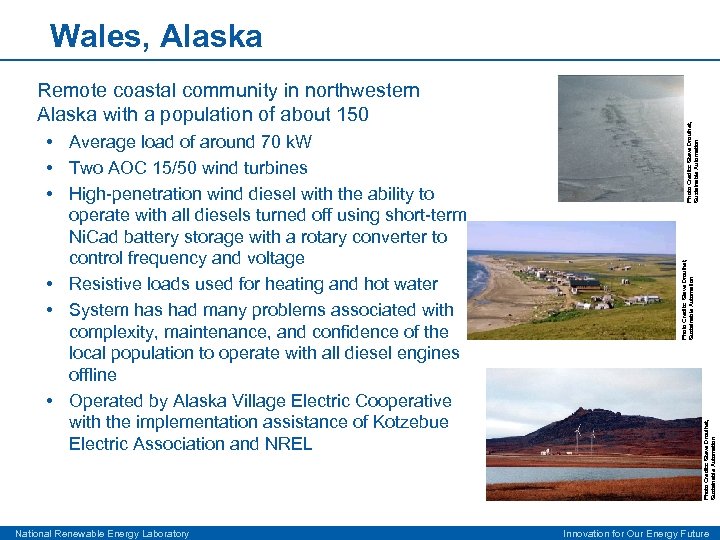 National Renewable Energy Laboratory Photo Credits: Steve Drouihet, Sustainable Automation • Average load of around 70 k. W • Two AOC 15/50 wind turbines • High-penetration wind diesel with the ability to operate with all diesels turned off using short-term Ni. Cad battery storage with a rotary converter to control frequency and voltage • Resistive loads used for heating and hot water • System has had many problems associated with complexity, maintenance, and confidence of the local population to operate with all diesel engines offline • Operated by Alaska Village Electric Cooperative with the implementation assistance of Kotzebue Electric Association and NREL Photo Credits: Steve Drouihet, Sustainable Automation Remote coastal community in northwestern Alaska with a population of about 150 Photo Credits: Steve Drouihet, Sustainable Automation Wales, Alaska Innovation for Our Energy Future
 Technology Advances Power control Secondary dispatchable loads • • • Electric or hybrid electric vehicles Electric heating through thermal loads Water desalination Medium-scale turbines for remote applications Advancements in software models • Expanded modeling capabilities in resource assessment, performance, control, and electrical response have improved the ability to understand wind-diesel systems New ownership models including power purchase agreements More systems being implemented Advances in diesel technology, low load and fuel injected Although there have been advances, ultimate penetrations are staying low in most applications, supplying less than 50% of the communities’ energy needs National Renewable Energy Laboratory Innovation for Our Energy Future
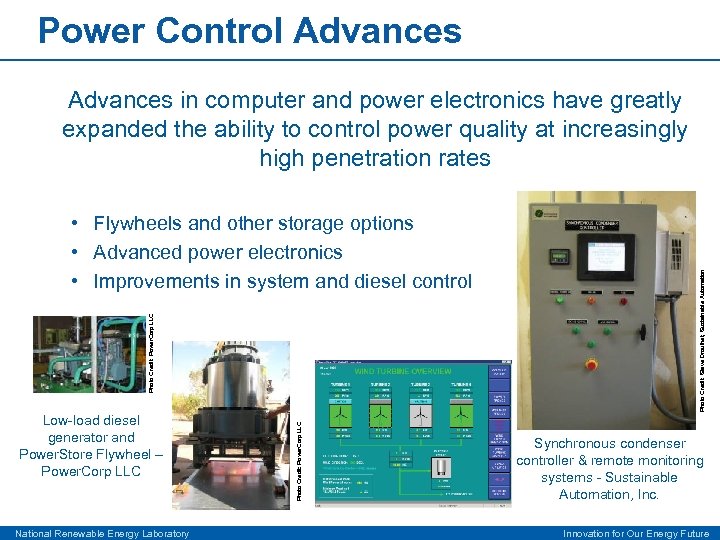 Power Control Advances Low-load diesel generator and Power. Store Flywheel – Power. Corp LLC National Renewable Energy Laboratory Photo Credit: Power. Corp LLC • Flywheels and other storage options • Advanced power electronics • Improvements in system and diesel control Photo Credit: Steve Drouihet, Sustainable Automation Advances in computer and power electronics have greatly expanded the ability to control power quality at increasingly high penetration rates Synchronous condenser controller & remote monitoring systems - Sustainable Automation, Inc. Innovation for Our Energy Future
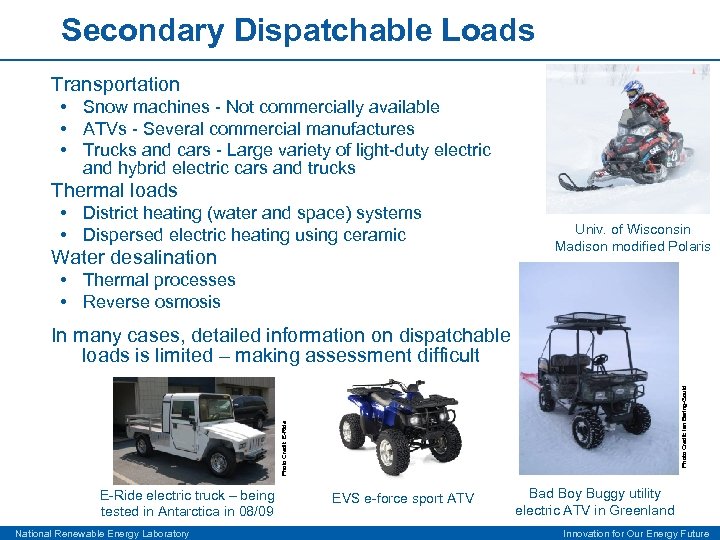 Secondary Dispatchable Loads Transportation • Snow machines - Not commercially available • ATVs - Several commercial manufactures • Trucks and cars - Large variety of light-duty electric and hybrid electric cars and trucks Thermal loads • District heating (water and space) systems • Dispersed electric heating using ceramic Water desalination Univ. of Wisconsin Madison modified Polaris • Thermal processes • Reverse osmosis Photo Credit: E-Ride Photo Credit: Ian Baring-Gould In many cases, detailed information on dispatchable loads is limited – making assessment difficult E-Ride electric truck – being tested in Antarctica in 08/09 National Renewable Energy Laboratory EVS e-force sport ATV Bad Boy Buggy utility electric ATV in Greenland Innovation for Our Energy Future
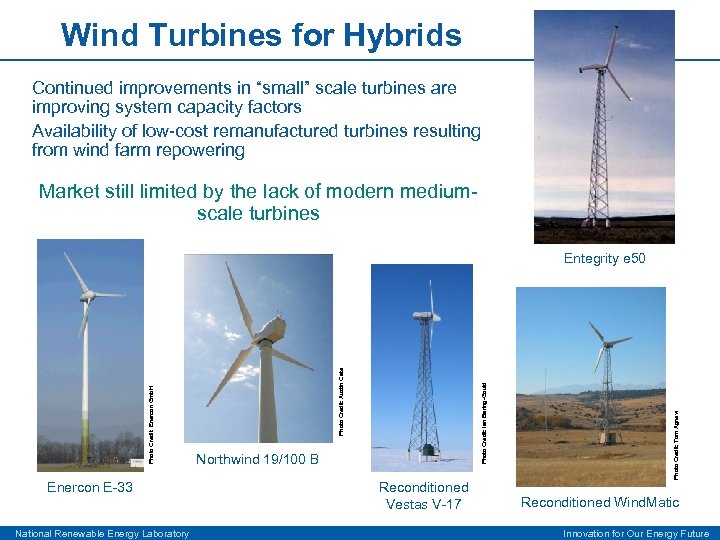 Wind Turbines for Hybrids Continued improvements in “small” scale turbines are improving system capacity factors Availability of low-cost remanufactured turbines resulting from wind farm repowering Market still limited by the lack of modern mediumscale turbines National Renewable Energy Laboratory Photo Credit: Ian Baring-Gould Northwind 19/100 B Reconditioned Vestas V-17 Photo Credit: Tom Agnew Enercon E-33 Photo Credit: Austin Cate Photo Credit: Enercon Gmb. H Entegrity e 50 Reconditioned Wind. Matic Innovation for Our Energy Future
 Industry Challenges Technical • • Lack of dispatchable load & controllers to allow higher-penetration systems Lack of guidelines and standards Lack of an established technology track record High and undocumented installation and operation expense Institutional • • Poor understanding of the technology by decision makers Lack of trained personnel and the ability to keep trained personnel in communities Vested interests in maintaining the existing infrastructure and systems Environmental, siting, or other development concerns Policy • • High capital cost and general discounting of sustainability Preserved risk and associated higher financial costs Subsidized diesel fuel markets Lack of consideration of environmental impacts of diesel power generation Lack of funding to support the development of diesel alternative systems Complicated and multi-jurisdictional permitting processes Lack of regional implementation approaches National Renewable Energy Laboratory Innovation for Our Energy Future
 Expand the Community After ~20 years as an over-thehorizon technology, the wind-diesel market is currently expanding rapidly Wind-Diesel 2008 in Girdwood, Alaska • • ~ 200 people attend Proceedings at http: //www. aidea. org/aea/programwindrep orts. html Upcoming Meetings • • • 2009 International Wind-Diesel Workshop – Ottawa, Canada Alaska wind-diesel meeting in September – Kodiak Strong market opportunities in Alaska currently Other Ideas • • Revitalizing IEA task Expanded regional meetings National Renewable Energy Laboratory Innovation for Our Energy Future
 Conclusions • Strong defined market in the U. S. and Canada • Other potential markets yet to be defined • Many successful wind-diesel projects have been implemented, but not every project is successful • Projects can be very difficult and expensive to implement, especially in rural areas • All energy options should be considered in communities, including advanced diesels and control, locally derived fuels, and “other” community loads • Need to expand beyond standard energy markets • Social sustainability issues dominate over technical ones Renewable power systems, specifically wind-diesel, can be implemented successfully National Renewable Energy Laboratory Innovation for Our Energy Future
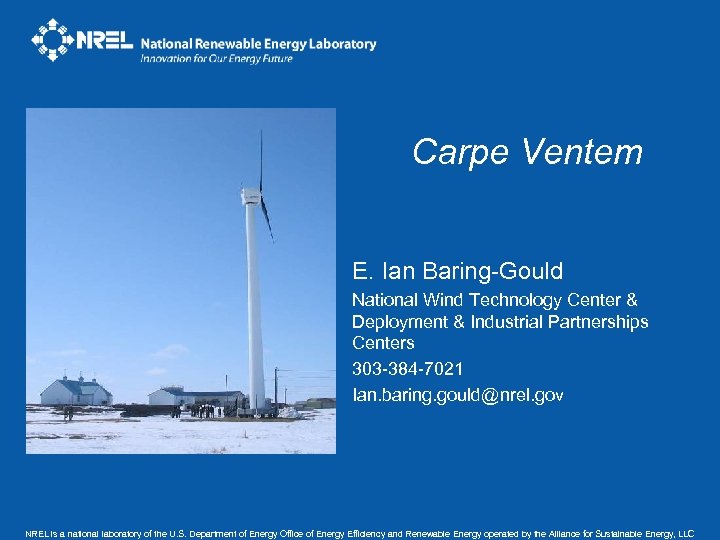 Carpe Ventem E. Ian Baring-Gould National Wind Technology Center & Deployment & Industrial Partnerships Centers 303 -384 -7021 Ian. baring. gould@nrel. gov NREL is a national laboratory of the U. S. Department of Energy Office of Energy Efficiency and Renewable Energy operated by the Alliance for Sustainable Energy, LLC