 Скачать презентацию Technology Overview and Operations Concept for SCAN Testbed
cf46857d9cffc29ebf7157c5b4887187.ppt
- Количество слайдов: 65



Technology Overview and Operations Concept for SCAN Testbed NASA Glenn Research Center June, 2011
Introductory Material
Overview ¨ Communications, Networking and Navigation re-Configurable Testbed (Co. NNe. CT) is the name of the project; Space Communications And Navigation (SCAN) Testbed is the Op Nom for the Payload ¨ The SCAN Testbed provides a platform for Software Defined Radios (SDRs) to experiment with software and firmware configurations, while communicating via RF links with the TDRSS and GPS satellite constellations and Near Earth Network. ¨ Launch vehicle: HTV-3; January 2012 ¨ $100 M payload funded by HQ/SOMD/SCa. N Program ¨ Planned minimum mission duration is through FY 2017 on ISS ¨ Payload operations are based at the GRC Telescience Support Center (TSC) · SCAN Testbed will be operated from the Co. NNe. CT Control Center (CCC) which is inside the GRC TSC · The CCC will be staffed when SCAN Testbed Operational power is on ¾ Maintain flexibility to take advantage of SN & NEN opportunities. ¾ Nominal coverage is 40 -50 hours on console per week
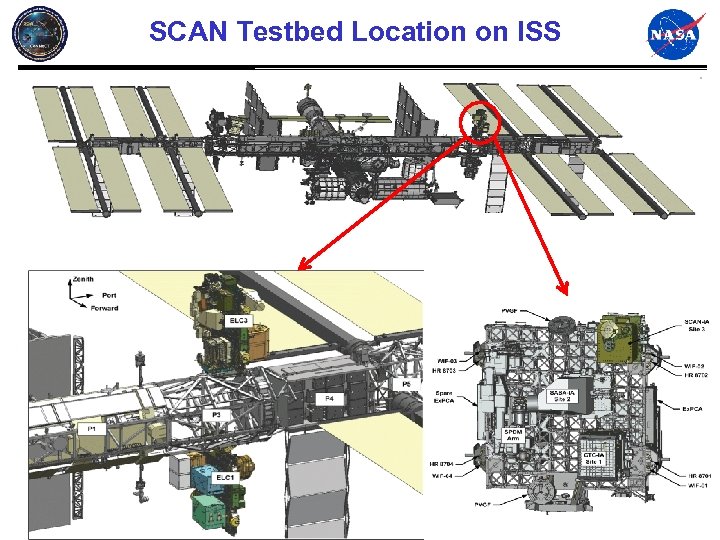
SCAN Testbed Location on ISS
Top Level Objectives ¨ Testbed for Communications, Networking, and Navigation experiments ¨ Will be used to validate future mission concepts for NASA’s Comm, Networking and Navigation needs · S-Band, Ka-Band, GPS, Networking ¨ Experiments will advance SDRs to Technology Readiness Level-7 ¨ Reconfiguration of SDRs will advance the Space Telecommunications Radio System (STRS) Standard · STRS-compliant SDRs developed by Harris Corp, General Dynamics (GD), and JPL · Evaluate performance of uploaded waveforms (WF library) · Software updates after launch (SDR reconfiguration) ¨ Includes a Ground Verification Facility (GVF) for testing of waveform uploads, on-orbit troubleshooting, and experiment preparation · The GVF includes a high fidelity Ground Integration Unit (GIU) comprised of Engineering Model Hardware ¨ Multi-Center participation (GRC, GSFC, JPL, JSC, KSC, MSFC, WGS, WSC) ¨ High Reliability and Availability
Science Overview ¨ The SCAN Testbed will exercise various components of the SDRs’ operating environments (OE), waveforms (WF), and performance characteristics · The operating environment is like the operating system on a computer (Unix, Windows, etc) · The waveform is like a program running on the computer (Excel, Auto. CAD, i. Tunes, etc) · Both OEs and WFs have parameters that can be adjusted to improve performance ¨ The operating systems and waveforms on the SDRs are reconfigurable and will be changed often during operations · The scientists & technologists will explore the effectiveness and efficiency of different combinations of OEs and WFs · These changes are the experiments
SCAN Testbed Science Requirements – Advance SDRs and STRS Standard to TRL-7 ¨ Perform Communications, Networking and Navigation experiments by utilizing current suite of capabilities, as well as developing, uploading and executing new OEs and Waveforms. ¨ SCAN Testbed is expected to support 10 – 20 Principle Investigators per year. (First 5 are in the queue and utilize current capability. ) · This requires a sufficient amount of “On Time” and contacts with SN, NEN, and GPS. · Required operational time is currently estimated at 8 – 10 hrs/day, 5 days/week, 2000 – 2500 hrs/year. ¨ Basis of Estimate for Operational Time Requirements: · Each PI’s campaign will consist of 2 – 4 months of ISS operations · 3 – 6 PI’s experiments are interweaved simultaneously during operations · 200 hours of operations per quarter for each SDR required to complete experiments, based upon first set of PI experiments ¾ 400 to 600 hours of “On Time” per quarter (some multi-SDR ops) ¨ SN and NEN “Contact” requirements necessary to meet the PI throughput, are documented in our agreements with GSFC · S-Band: Up to 10 contacts/day, up to 40 min/contact, up to 650 hrs/year · Ka-band: Up to 8 contacts/day, up to 40 min/contact, up to 600 hrs/year · NEN: ~40 contacts/year (significantly restricted due to geometry)
Science & Technology Goals & Objectives ¨ INVESTIGATE the APPLICATION of SDRS TO NASA MISSIONS · Mission advantages and unique development/verification/operations aspects · Reconfigurable SDR (e. g. STRS OE, wf updates, modulation, coding, framing) · More process intensive functions within the radio subsystem ¾ physical layer bit streams to higher layer link layer and networking protocols ¨ SDR TECHNOLOGY DEVELOPMENT · SDR platform hardware & waveform firmware/software compliant to STRS, TRL-7 · Promote development and Agency-wide adoption of NASA’s SDR Standard, STRS · Separate SDR hw, sw performance from space/link effects (e. g. SEE) ¨ VALIDATE FUTURE MISSION OPERATIONAL CAPABILITIES · Capability representative of future missions ¾ Comm data rate, performance, networking/routing, navigation/GPS · Understand SDR performance (reliability, SEE, telemetry, instrumentation) · Multiple and simultaneous RF Links (Ka-band, S-band, L-band/GPS) · Load/run/reconfigure experimenter sw applications external to SDRs (flight computer) ¾ On-board networking (e. g. DTN), routing, and security applications
Technology Details: SDRs and STRS Architecture
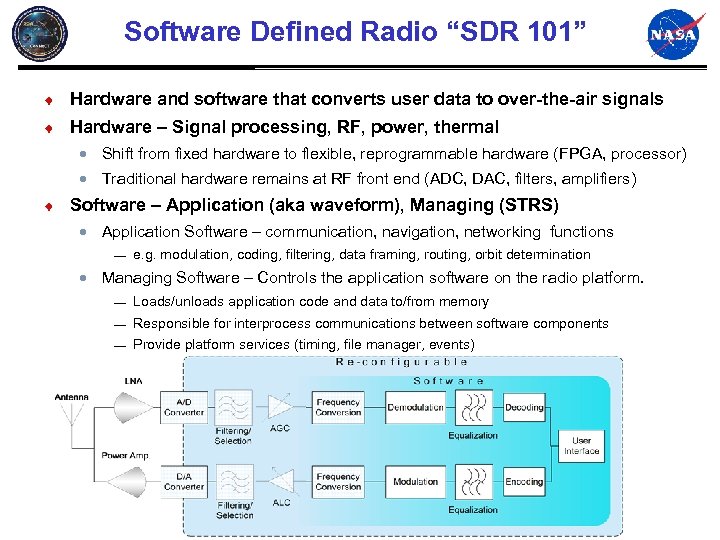
Software Defined Radio “SDR 101” ¨ Hardware and software that converts user data to over-the-air signals ¨ Hardware – Signal processing, RF, power, thermal · Shift from fixed hardware to flexible, reprogrammable hardware (FPGA, processor) · Traditional hardware remains at RF front end (ADC, DAC, filters, amplifiers) ¨ Software – Application (aka waveform), Managing (STRS) · Application Software – communication, navigation, networking functions ¾ e. g. modulation, coding, filtering, data framing, routing, orbit determination · Managing Software – Controls the application software on the radio platform. ¾ Loads/unloads application code and data to/from memory ¾ Responsible for interprocess communications between software components ¾ Provide platform services (timing, file manager, events)
Advancing the Field of SDRs in Space ¨ Experiments Program seeks participation by NASA, industry, academia, and OGA to use the SCAN Testbed ¨ Broad participation will create a forum to exchange ideas and results, create new experiments, new partnerships, and disseminate results ¨ STRS apps will increase the base of domain experts —Agency personnel, sw and hw providers, and the user and operations communities—all knowledgeable of the common standard. ¨ Publish understanding of system performance and operations in a mission context ¨ Reduce the risk of infusing SDRs and their applications (comm, nav, networking) into NASA missions
Shift Towards SDR Technology ¨ NASA looking at how to use or infuse SDR technology into NASA missions and infrastructure (space or ground) ¨ Assess fixed (e. g. ASIC or OTP) DSP hardware vs SDR architecture · Industry pursuing processor & FPGA-based architecture · Enable NASA to leverage SDR developments across missions. · In-flight Reconfigurability ¨ Leverage commercial and NASA Labs’ (JPL, APL) SDR product lines, with capability for typical or envisioned NASA functions and capability ¨ Common SDR Architecture: Platforms and waveform STRS compliant · Separation of waveform application from SDR Platform ¾ Abstract waveform from underlying hardware (need for standard architecture) ¾ Platform and waveform requirements separation · Reduce long-term dependence on SDR developer for software upgrades
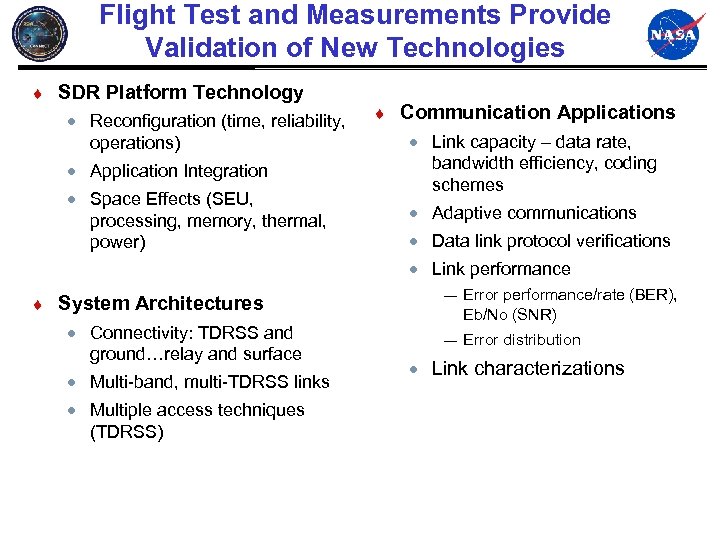
Flight Test and Measurements Provide Validation of New Technologies ¨ SDR Platform Technology · Reconfiguration (time, reliability, operations) · Application Integration · Space Effects (SEU, processing, memory, thermal, power) ¨ Communication Applications · Link capacity – data rate, bandwidth efficiency, coding schemes · Adaptive communications · Data link protocol verifications · Link performance ¨ System Architectures · Connectivity: TDRSS and ground…relay and surface · Multi-band, multi-TDRSS links · Multiple access techniques (TDRSS) ¾ Error performance/rate (BER), Eb/No (SNR) ¾ Error distribution · Link characterizations
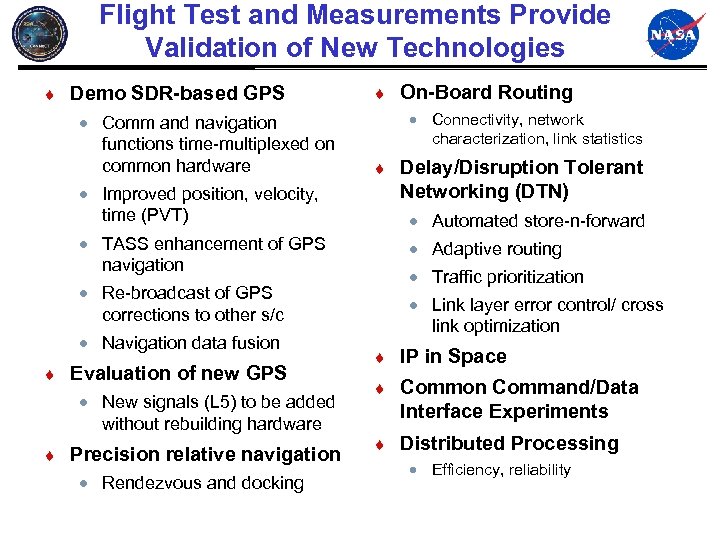
Flight Test and Measurements Provide Validation of New Technologies ¨ Demo SDR-based GPS · Comm and navigation functions time-multiplexed on common hardware ¨ On-Board Routing · Connectivity, network characterization, link statistics ¨ Delay/Disruption Tolerant · Improved position, velocity, time (PVT) Networking (DTN) · TASS enhancement of GPS navigation · Adaptive routing · Re-broadcast of GPS corrections to other s/c · Navigation data fusion ¨ Evaluation of new GPS · New signals (L 5) to be added without rebuilding hardware ¨ Precision relative navigation · Rendezvous and docking · Automated store-n-forward · Traffic prioritization · Link layer error control/ cross link optimization ¨ IP in Space ¨ Common Command/Data Interface Experiments ¨ Distributed Processing · Efficiency, reliability
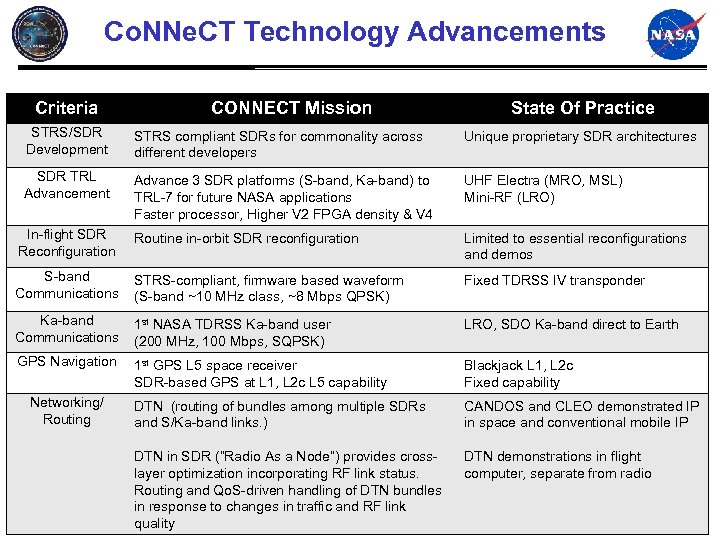
Co. NNe. CT Technology Advancements Criteria CONNECT Mission State Of Practice STRS/SDR Development STRS compliant SDRs for commonality across different developers Unique proprietary SDR architectures SDR TRL Advancement Advance 3 SDR platforms (S-band, Ka-band) to TRL-7 for future NASA applications Faster processor, Higher V 2 FPGA density & V 4 UHF Electra (MRO, MSL) Mini-RF (LRO) In-flight SDR Reconfiguration Routine in-orbit SDR reconfiguration Limited to essential reconfigurations and demos S-band Communications STRS-compliant, firmware based waveform (S-band ~10 MHz class, ~8 Mbps QPSK) Fixed TDRSS IV transponder Ka-band Communications 1 st NASA TDRSS Ka-band user (200 MHz, 100 Mbps, SQPSK) LRO, SDO Ka-band direct to Earth GPS Navigation 1 st GPS L 5 space receiver SDR-based GPS at L 1, L 2 c L 5 capability Blackjack L 1, L 2 c Fixed capability DTN (routing of bundles among multiple SDRs and S/Ka-band links. ) CANDOS and CLEO demonstrated IP in space and conventional mobile IP DTN in SDR (“Radio As a Node”) provides crosslayer optimization incorporating RF link status. Routing and Qo. S-driven handling of DTN bundles in response to changes in traffic and RF link quality DTN demonstrations in flight computer, separate from radio Networking/ Routing
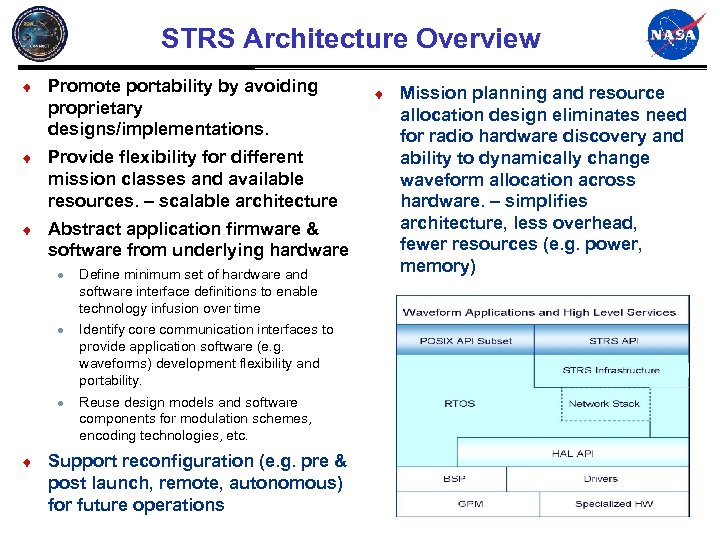
STRS Architecture Overview ¨ Promote portability by avoiding proprietary designs/implementations. ¨ Provide flexibility for different mission classes and available resources. – scalable architecture ¨ Abstract application firmware & software from underlying hardware · Define minimum set of hardware and software interface definitions to enable technology infusion over time · Identify core communication interfaces to provide application software (e. g. waveforms) development flexibility and portability. · Reuse design models and software components for modulation schemes, encoding technologies, etc. ¨ Support reconfiguration (e. g. pre & post launch, remote, autonomous) for future operations ¨ Mission planning and resource allocation design eliminates need for radio hardware discovery and ability to dynamically change waveform allocation across hardware. – simplifies architecture, less overhead, fewer resources (e. g. power, memory)
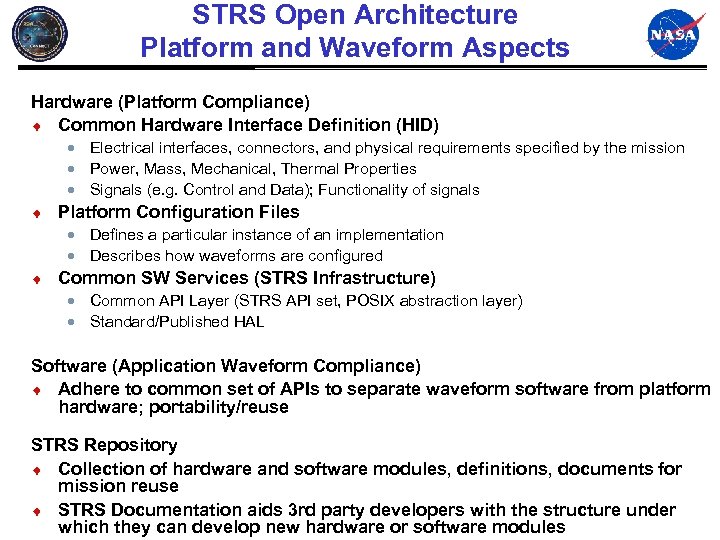
STRS Open Architecture Platform and Waveform Aspects Hardware (Platform Compliance) ¨ Common Hardware Interface Definition (HID) · Electrical interfaces, connectors, and physical requirements specified by the mission · Power, Mass, Mechanical, Thermal Properties · Signals (e. g. Control and Data); Functionality of signals ¨ Platform Configuration Files · Defines a particular instance of an implementation · Describes how waveforms are configured ¨ Common SW Services (STRS Infrastructure) · Common API Layer (STRS API set, POSIX abstraction layer) · Standard/Published HAL Software (Application Waveform Compliance) ¨ Adhere to common set of APIs to separate waveform software from platform hardware; portability/reuse STRS Repository ¨ Collection of hardware and software modules, definitions, documents for mission reuse ¨ STRS Documentation aids 3 rd party developers with the structure under which they can develop new hardware or software modules
Hardware
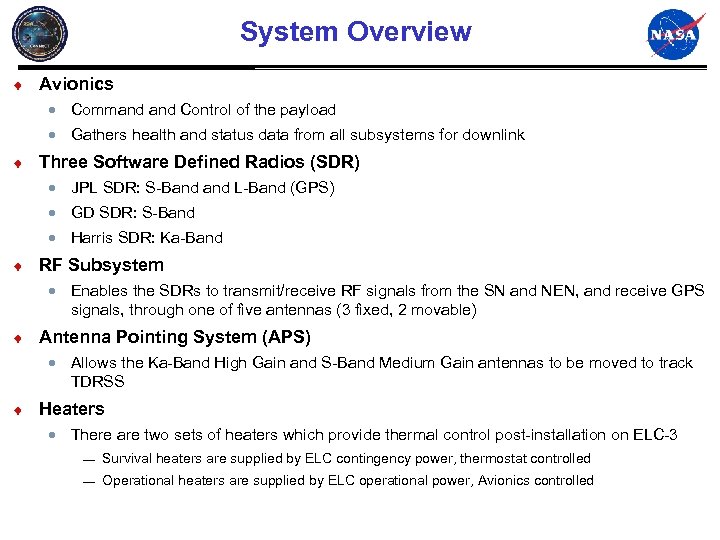
System Overview ¨ Avionics · Command Control of the payload · Gathers health and status data from all subsystems for downlink ¨ Three Software Defined Radios (SDR) · JPL SDR: S-Band L-Band (GPS) · GD SDR: S-Band · Harris SDR: Ka-Band ¨ RF Subsystem · Enables the SDRs to transmit/receive RF signals from the SN and NEN, and receive GPS signals, through one of five antennas (3 fixed, 2 movable) ¨ Antenna Pointing System (APS) · Allows the Ka-Band High Gain and S-Band Medium Gain antennas to be moved to track TDRSS ¨ Heaters · There are two sets of heaters which provide thermal control post-installation on ELC-3 ¾ Survival heaters are supplied by ELC contingency power, thermostat controlled ¾ Operational heaters are supplied by ELC operational power, Avionics controlled
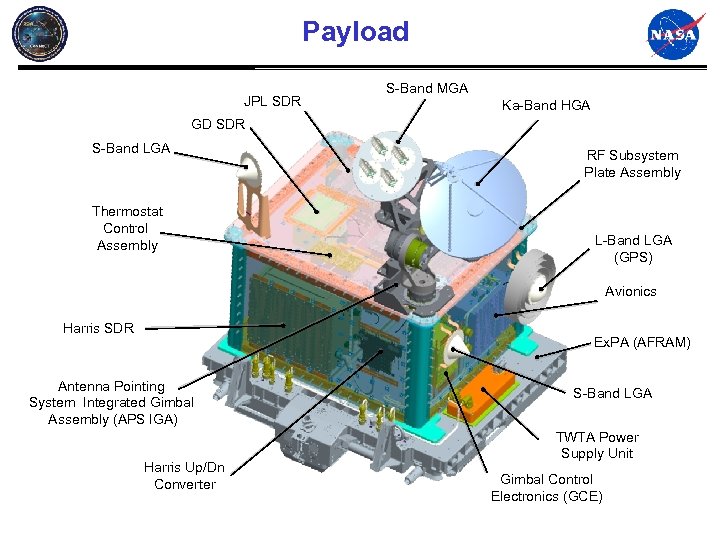
Payload JPL SDR S-Band MGA Ka-Band HGA GD SDR S-Band LGA Thermostat Control Assembly RF Subsystem Plate Assembly L-Band LGA (GPS) Avionics Harris SDR Ex. PA (AFRAM) Antenna Pointing System Integrated Gimbal Assembly (APS IGA) Harris Up/Dn Converter S-Band LGA TWTA Power Supply Unit Gimbal Control Electronics (GCE)
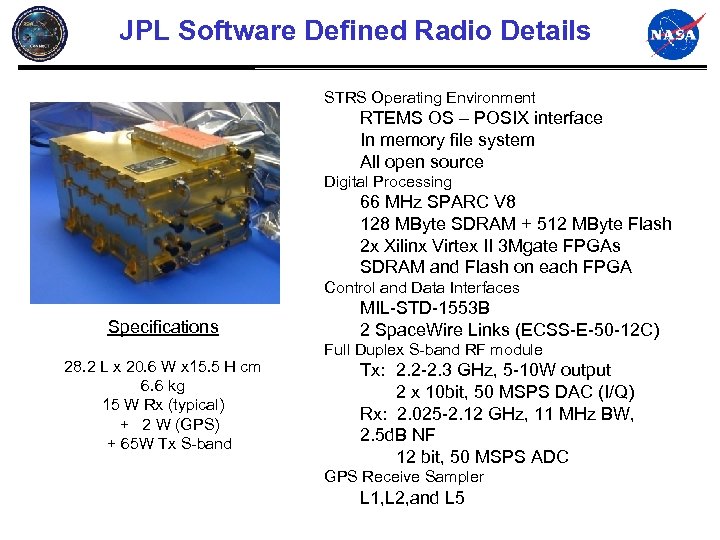
JPL Software Defined Radio Details STRS Operating Environment RTEMS OS – POSIX interface In memory file system All open source Digital Processing 66 MHz SPARC V 8 128 MByte SDRAM + 512 MByte Flash 2 x Xilinx Virtex II 3 Mgate FPGAs SDRAM and Flash on each FPGA Control and Data Interfaces Specifications 28. 2 L x 20. 6 W x 15. 5 H cm 6. 6 kg 15 W Rx (typical) + 2 W (GPS) + 65 W Tx S-band MIL-STD-1553 B 2 Space. Wire Links (ECSS-E-50 -12 C) Full Duplex S-band RF module Tx: 2. 2 -2. 3 GHz, 5 -10 W output 2 x 10 bit, 50 MSPS DAC (I/Q) Rx: 2. 025 -2. 12 GHz, 11 MHz BW, 2. 5 d. B NF 12 bit, 50 MSPS ADC GPS Receive Sampler L 1, L 2, and L 5
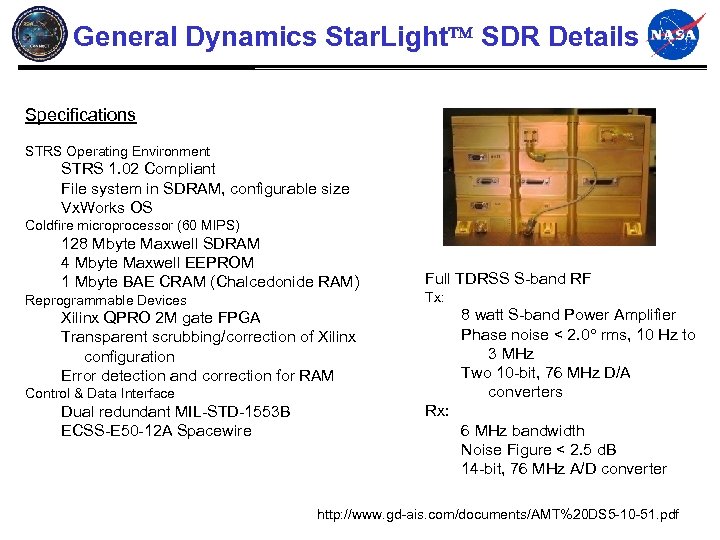
General Dynamics Star. Light SDR Details Specifications STRS Operating Environment STRS 1. 02 Compliant File system in SDRAM, configurable size Vx. Works OS Coldfire microprocessor (60 MIPS) 128 Mbyte Maxwell SDRAM 4 Mbyte Maxwell EEPROM 1 Mbyte BAE CRAM (Chalcedonide RAM) Reprogrammable Devices Full TDRSS S-band RF Tx: 8 watt S-band Power Amplifier Phase noise < 2. 0 rms, 10 Hz to 3 MHz Two 10 -bit, 76 MHz D/A converters Xilinx QPRO 2 M gate FPGA Transparent scrubbing/correction of Xilinx configuration Error detection and correction for RAM Control & Data Interface Dual redundant MIL-STD-1553 B ECSS-E 50 -12 A Spacewire Rx: 6 MHz bandwidth Noise Figure < 2. 5 d. B 14 -bit, 76 MHz A/D converter http: //www. gd-ais. com/documents/AMT%20 DS 5 -10 -51. pdf
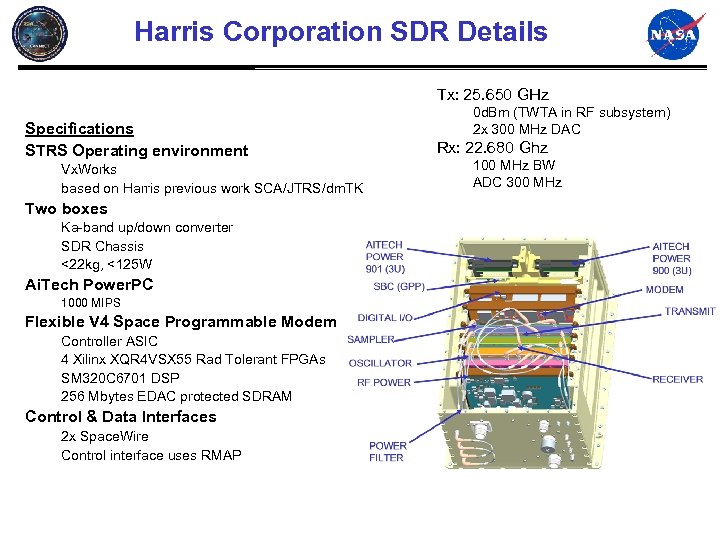
Harris Corporation SDR Details Tx: 25. 650 GHz Specifications STRS Operating environment Vx. Works based on Harris previous work SCA/JTRS/dm. TK Two boxes Ka-band up/down converter SDR Chassis <22 kg, <125 W Ai. Tech Power. PC 1000 MIPS Flexible V 4 Space Programmable Modem Controller ASIC 4 Xilinx XQR 4 VSX 55 Rad Tolerant FPGAs SM 320 C 6701 DSP 256 Mbytes EDAC protected SDRAM Control & Data Interfaces 2 x Space. Wire Control interface uses RMAP 0 d. Bm (TWTA in RF subsystem) 2 x 300 MHz DAC Rx: 22. 680 Ghz 100 MHz BW ADC 300 MHz
SCa. N Testbed Communication
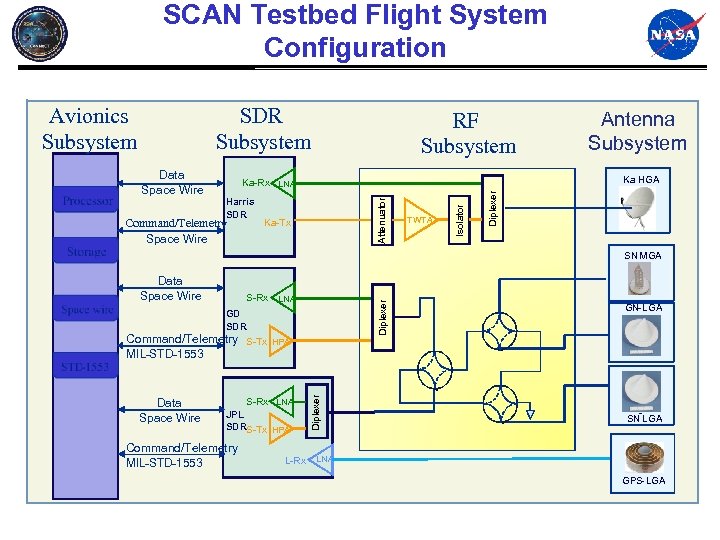
SCAN Testbed Flight System Configuration SDR Subsystem Command/Telemetry Space Wire Ka-Tx TWTA Diplexer Harris SDR Antenna Subsystem Ka HGA Ka-Rx LNA Isolator Data Space Wire RF Subsystem Attenuator Avionics Subsystem SN-MGA S-Rx LNA Diplexer Data Space Wire GD SDR Data Space Wire HPA S-Rx LNA JPL SDRS-Tx HPA Command/Telemetry MIL-STD-1553 L-Rx Diplexer Command/Telemetry S-Tx MIL-STD-1553 GN- LGA SN LGA LNA GPS LGA -
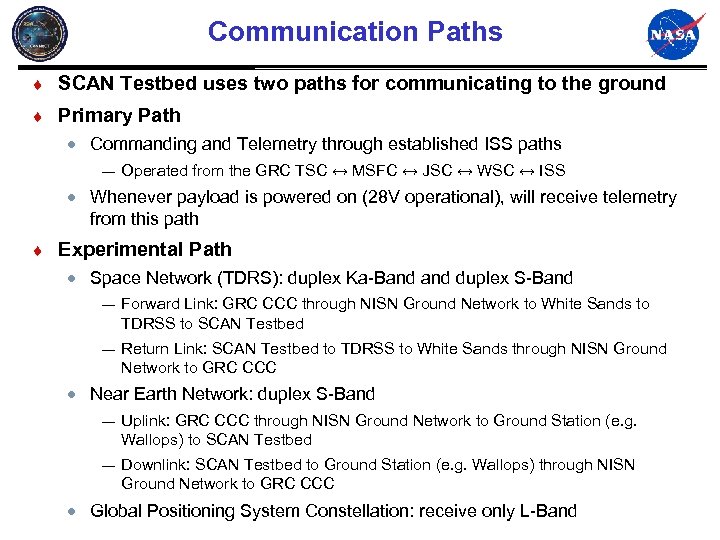
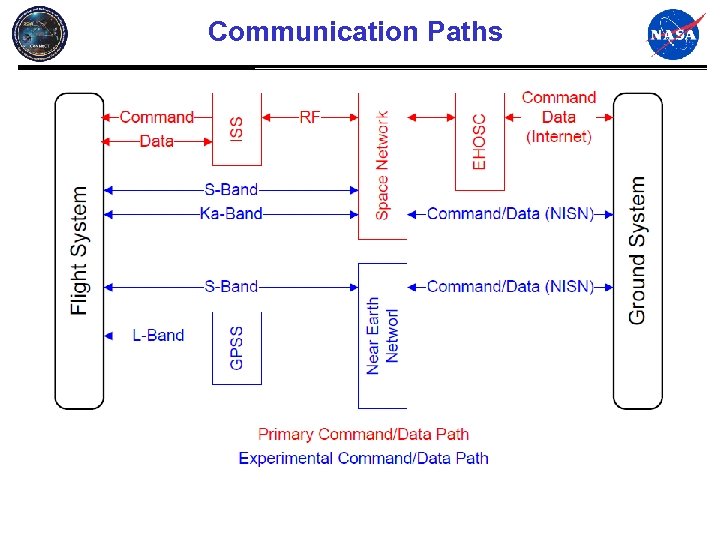
Communication Paths ¨ SCAN Testbed uses two paths for communicating to the ground ¨ Primary Path · Commanding and Telemetry through established ISS paths ¾ Operated from the GRC TSC ↔ MSFC ↔ JSC ↔ WSC ↔ ISS · Whenever payload is powered on (28 V operational), will receive telemetry from this path ¨ Experimental Path · Space Network (TDRS): duplex Ka-Band duplex S-Band ¾ Forward Link: GRC CCC through NISN Ground Network to White Sands to TDRSS to SCAN Testbed ¾ Return Link: SCAN Testbed to TDRSS to White Sands through NISN Ground Network to GRC CCC · Near Earth Network: duplex S-Band ¾ Uplink: GRC CCC through NISN Ground Network to Ground Station (e. g. Wallops) to SCAN Testbed ¾ Downlink: SCAN Testbed to Ground Station (e. g. Wallops) through NISN Ground Network to GRC CCC · Global Positioning System Constellation: receive only L-Band
Communication Paths
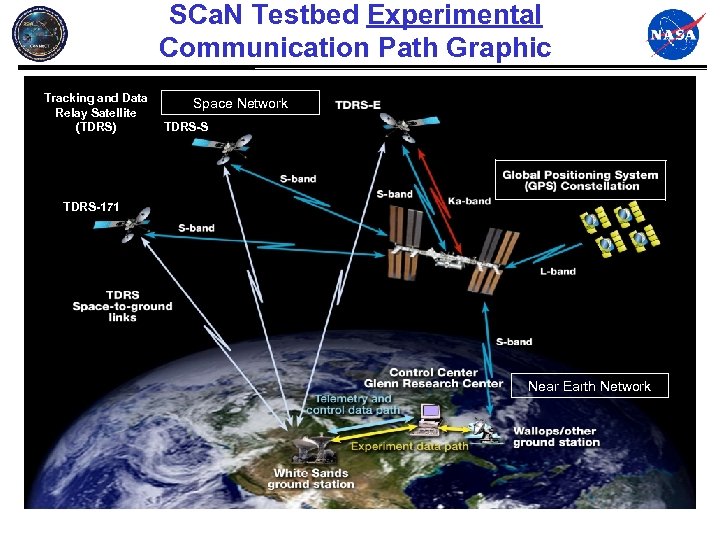
SCa. N Testbed Experimental Communication Path Graphic Tracking and Data Relay Satellite (TDRS) Space Network TDRS-S TDRS-171 Near Earth Network
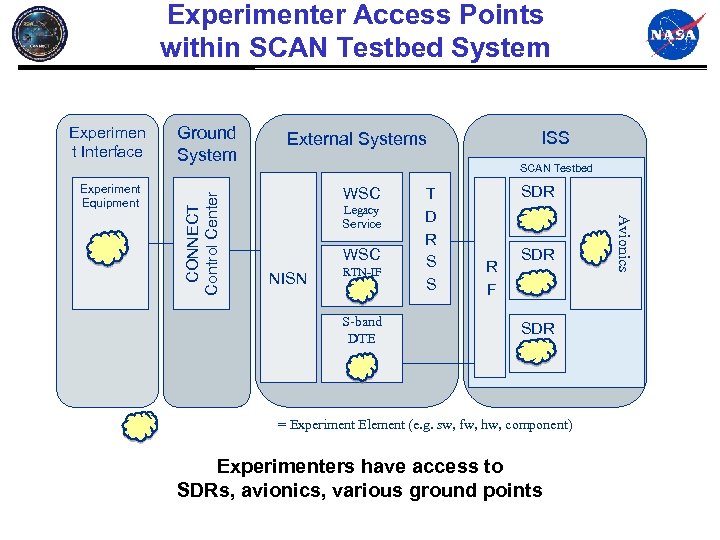
Experimenter Access Points within SCAN Testbed System Experiment Equipment Ground System ISS External Systems SCAN Testbed WSC Legacy Service WSC NISN RTN-IF S-band DTE T D R S S SDR R F SDR = Experiment Element (e. g. sw, fw, hw, component) Experimenters have access to SDRs, avionics, various ground points Avionics CONNECT Control Center Experimen t Interface
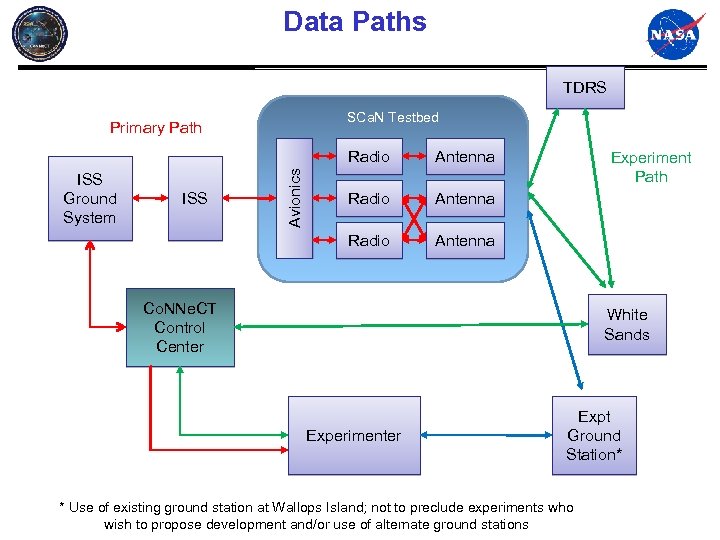
Data Paths TDRS SCa. N Testbed Primary Path ISS Antenna Radio ISS Ground System Avionics Radio Antenna Experiment Path Co. NNe. CT Control Center White Sands Experimenter Expt Ground Station* * Use of existing ground station at Wallops Island; not to preclude experiments who wish to propose development and/or use of alternate ground stations
Testbed Capability and ISS Parameters
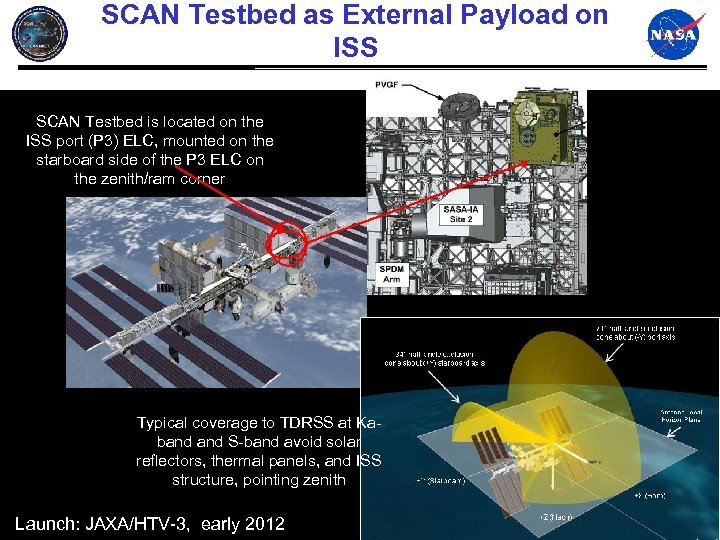
SCAN Testbed as External Payload on ISS SCAN Testbed is located on the ISS port (P 3) ELC, mounted on the starboard side of the P 3 ELC on the zenith/ram corner Typical coverage to TDRSS at Kaband S-band avoid solar reflectors, thermal panels, and ISS structure, pointing zenith Launch: JAXA/HTV-3, early 2012
Power ¨ Power from ELC-3 ¨ Operational Power · 28 VDC for the Payload Avionics · 120 VDC for the TWTA PSU (Power Supply Unit) and operational heaters ¨ Contingency Power · 120 VDC for payload survival heaters ¨ Payload meets the planned 6 hour loss of power requirement · Prior to removal of contingency heater power, need to pre-heat the payload for up to 24 hours, by turning on radios, and other subsystems. · For unplanned outage, survival time depends on the beta angle and initial temperatures of the payload. During worst case beta, survival is less than 6 hours. · A Payload Regulation will be needed for planned loss of power. ¾ Will instruct POIC to notify Ops team so preparations can be made
Commanding ¨ Primary Path · Nominal commanding from the GRC TSC ¾ Commands fall into 10 categories ¾ Antenna & Gimbal, Avionics, File Manager, GD, Harris Power, JPL, Subsystem Main Power & Digital IO Cards 1 & 2, Subsystem Redundant Power & Digital IO Card 3, TWTA · Critical commanding from the POIC – see Safety Section ¾ 13 commands have been classified as critical · 8 nominal, 5 redundant ¾ Power on commands for the Harris SDR and TWTA (Ka-Band) ¾ Power on commands for the JPL and GD SDRs (S-Band) ¾ POIC “critical” designation via command database for hazard control commands · These 13 commands are only in the POIC database; not in the payload database · POIF agrees to Co. FR the SCAN critical commands sent by MSFC PRO · ELC-3 power commands sent by PRO
Commanding ¨ Experimental Path · No critical commanding on this path ¾ No SDR and TWTA ‘power on’ commands · All other commands can be sent over this path · SCAN Testbed will brief PRO prior to the command window to provide situational awareness
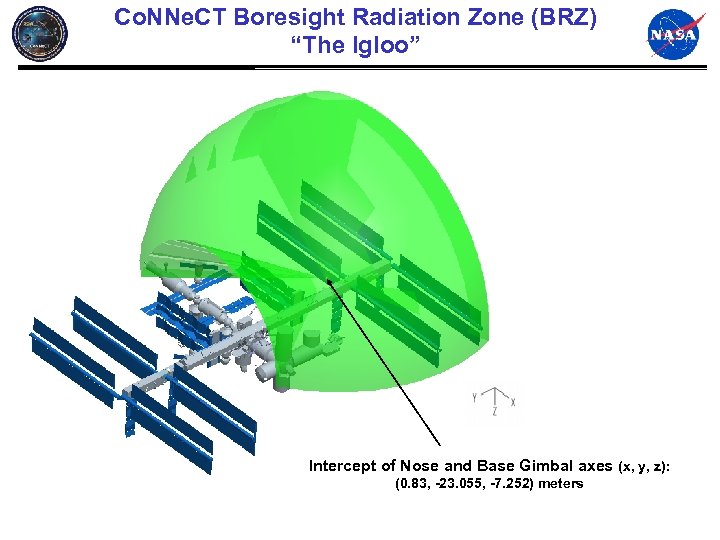
Co. NNe. CT Boresight Radiation Zone (BRZ) “The Igloo” Intercept of Nose and Base Gimbal axes (x, y, z): (0. 83, -23. 055, -7. 252) meters
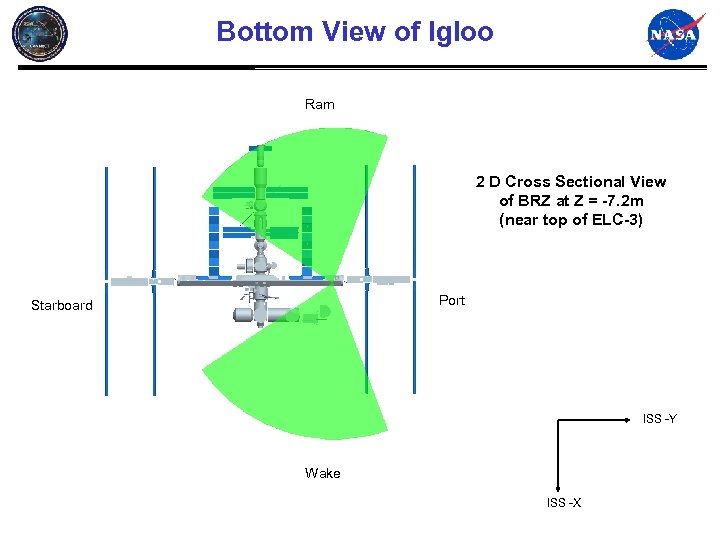
Bottom View of Igloo Ram 2 D Cross Sectional View of BRZ at Z = -7. 2 m (near top of ELC-3) Port Starboard ISS -Y Wake ISS -X
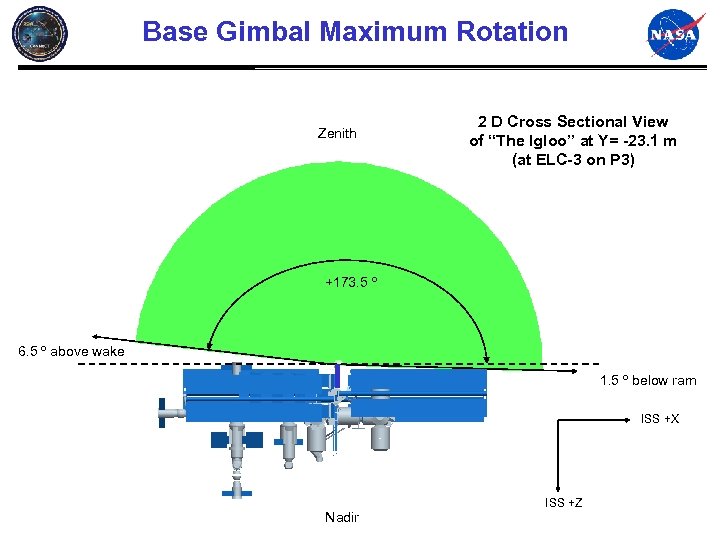
Base Gimbal Maximum Rotation Zenith 2 D Cross Sectional View of “The Igloo” at Y= -23. 1 m (at ELC-3 on P 3) +173. 5 º 6. 5 º above wake 1. 5 º below ram ISS +X Nadir ISS +Z
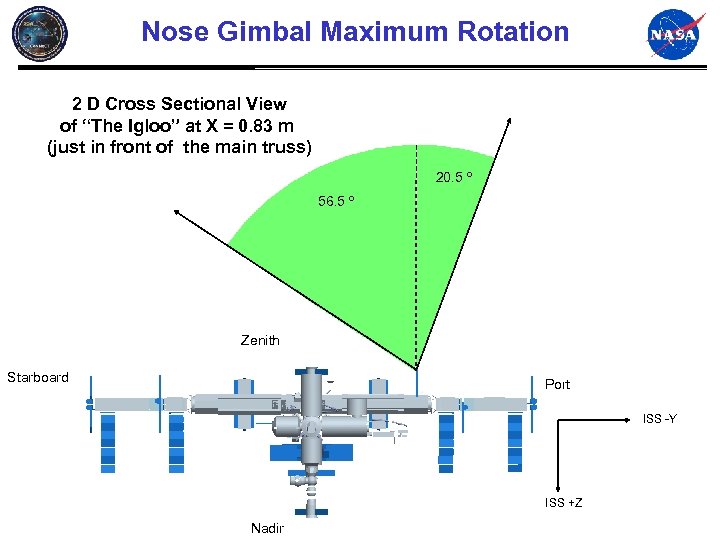
Nose Gimbal Maximum Rotation 2 D Cross Sectional View of “The Igloo” at X = 0. 83 m (just in front of the main truss) 20. 5 º 56. 5 º Zenith Starboard Port ISS -Y ISS +Z Nadir
ISS Telemetry ¨ The Ku-Band bandwidth is defined in the PDL C&DH data set. The total is approximately 0. 02 Mbps. ¨ SCAN does not send telemetry down on the ISS S-Band ¨ High rate · 2 APIDs ¾ Hardware/software information · 3 APIDs ¾ One for each SDR · 1 APID ¾ Reserved ¨ Low rate (MIL-STD-1553) · FRAM Cargo (SCAN Testbed) EH&S packets sent to ELC-3 ¾ Becomes part of the Carrier Health & Status packet · 2 APIDs ¾ One for redundant command status, avionics data (currents, temperatures) ¾ One is reserved for future use
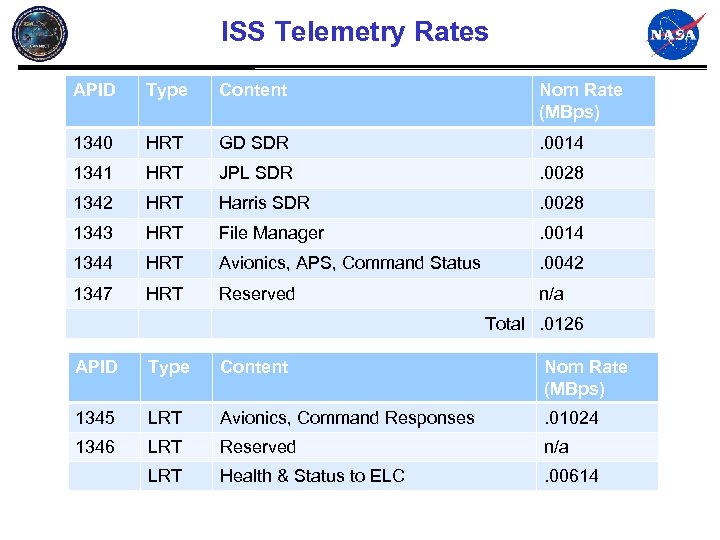
ISS Telemetry Rates APID Type Content Nom Rate (MBps) 1340 HRT GD SDR . 0014 1341 HRT JPL SDR . 0028 1342 HRT Harris SDR . 0028 1343 HRT File Manager . 0014 1344 HRT Avionics, APS, Command Status . 0042 1347 HRT Reserved n/a Total. 0126 APID Type Content Nom Rate (MBps) 1345 LRT Avionics, Command Responses . 01024 1346 LRT Reserved n/a LRT Health & Status to ELC . 00614
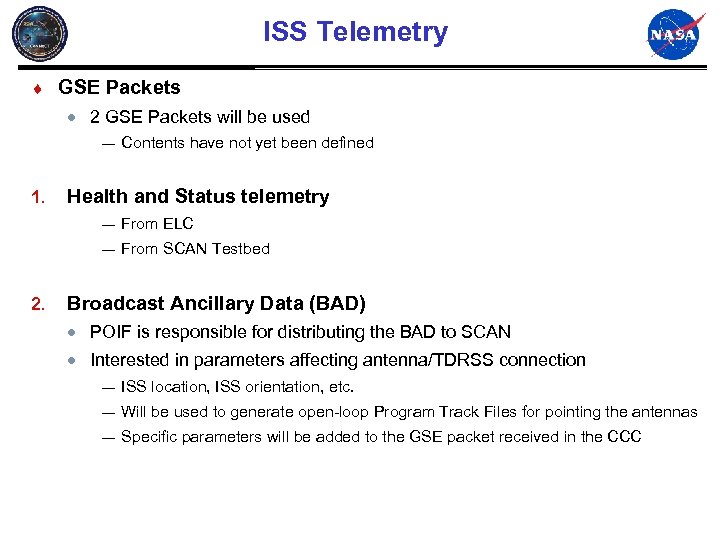
ISS Telemetry ¨ GSE Packets · 2 GSE Packets will be used ¾ 1. Contents have not yet been defined Health and Status telemetry ¾ ¾ 2. From ELC From SCAN Testbed Broadcast Ancillary Data (BAD) · POIF is responsible for distributing the BAD to SCAN · Interested in parameters affecting antenna/TDRSS connection ¾ ISS location, ISS orientation, etc. ¾ Will be used to generate open-loop Program Track Files for pointing the antennas ¾ Specific parameters will be added to the GSE packet received in the CCC
Additional Details for Experimenters
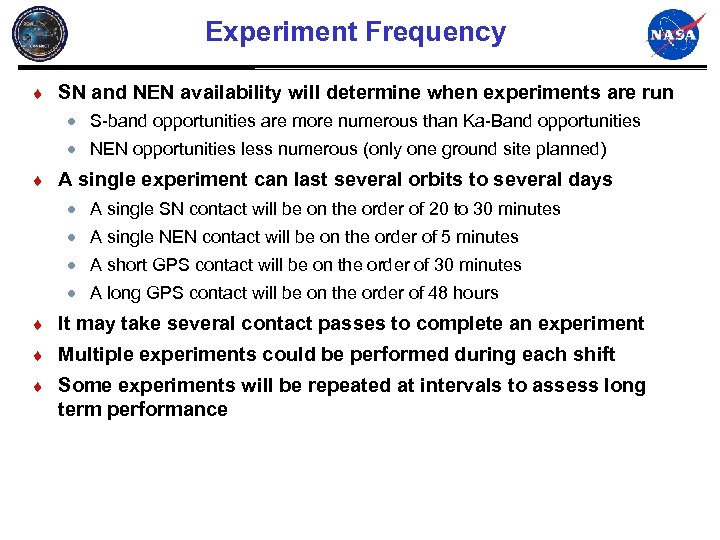
Experiment Frequency ¨ SN and NEN availability will determine when experiments are run · S-band opportunities are more numerous than Ka-Band opportunities · NEN opportunities less numerous (only one ground site planned) ¨ A single experiment can last several orbits to several days · A single SN contact will be on the order of 20 to 30 minutes · A single NEN contact will be on the order of 5 minutes · A short GPS contact will be on the order of 30 minutes · A long GPS contact will be on the order of 48 hours ¨ It may take several contact passes to complete an experiment ¨ Multiple experiments could be performed during each shift ¨ Some experiments will be repeated at intervals to assess long term performance
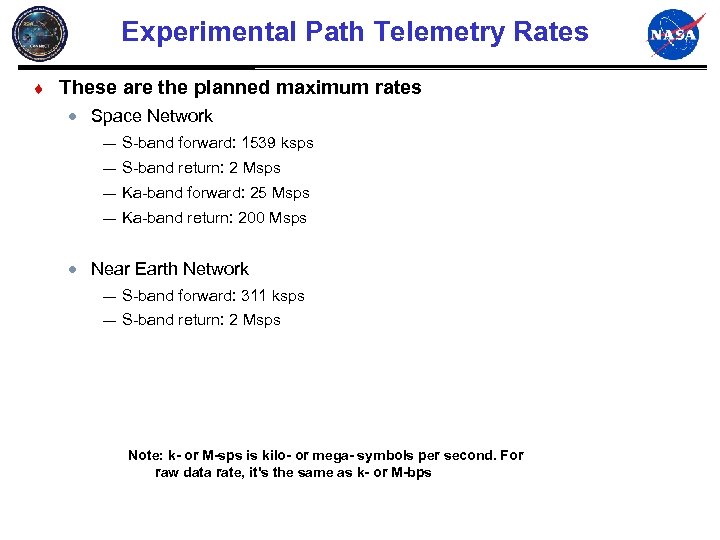
Experimental Path Telemetry Rates ¨ These are the planned maximum rates · Space Network ¾ S-band forward: 1539 ksps ¾ S-band return: 2 Msps ¾ Ka-band forward: 25 Msps ¾ Ka-band return: 200 Msps · Near Earth Network ¾ S-band forward: 311 ksps ¾ S-band return: 2 Msps Note: k- or M-sps is kilo- or mega- symbols per second. For raw data rate, it's the same as k- or M-bps
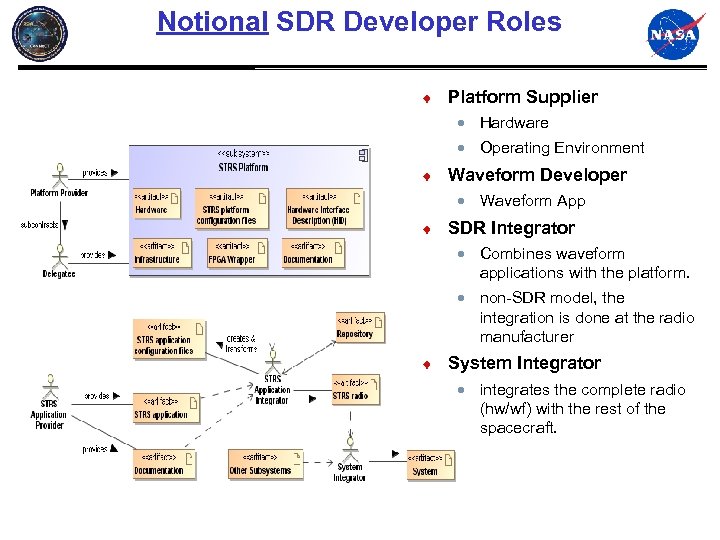
Notional SDR Developer Roles ¨ Platform Supplier · Hardware · Operating Environment ¨ Waveform Developer · Waveform App ¨ SDR Integrator · Combines waveform applications with the platform. · non-SDR model, the integration is done at the radio manufacturer ¨ System Integrator · integrates the complete radio (hw/wf) with the rest of the spacecraft.
File Uploads ¨ File Uploads will be a normal part of operations · Avionics Software updates (full load or PI-specific “plug-ins” to execute a specific sequence of tasks) · Waveforms for SDRs · Operating Environments for SDRs · APS open loop program track files ¾ Multiple track files will be uploaded covering multiple links ¾ Depending on projected pointing error magnitude, open loop track files may be update before experiment execution · APS Lynx. CAT controller parameter files ¾ Lynx. CAT controller parameters are set in XML based format ¾ Operational simulations will indicate if control parameters are to be updated, e. g. gains or operational modes ¾ Parameter files include the control stop (CS) 4 point placard (keep out zone) which may be adjusted with visiting vehicles or arm placement ¨ Planning a weekly file upload window · Allows regular updates · Easier to plan and coordinate
File Uploads ¨ File uploads will be done over both the primary path and the experimental path · PCB Approved on 1/27/2010 · All files will be tested, verified, and approved in the GVF before uploading to the payload · All files planned for transfer will be configuration managed · All files transferred to/from the CCC will be virus scanned ¨ Primary Path Uplinks · Files under 100 KB can be sent directly to the flight system through SCAN commands · Files over 100 KB will use the PLMDM ¾ Co. NNe. CT will provide the file in advance via OCR and, upon approval, PRO would have defined command windows on OSTPV for the uplinks. PRO position would uplink the file. (per SOP 6. 22) ¾ OCR process will also be used for the avionics software updates ¨ Experimental Path Uplinks · A process will be worked out to coordinate with the PSCP
Imagery ¨ Imagery only required for payload checkout · During EVR installation on ELC-3 · To inspect tamper evident seals after installation ¨ The APS will be initially moved during the Checkout phase · Video requested to confirm movement and tracking ¨ Requirements have been submitted for ISS Increments 30 and 31. ¨ Imagery is not nominally required after initial checkout operations – but could be requested based on defined experimenter need.
Thermal Analysis ¨ Per SSP 57003 -ELC, the ISS attitude used for thermal analysis was XVV Z Nadir and the Beta Angle was +/- 75° ¨ All Co. NNe. CT components (Radios, Avionics, APS, etc. ) were analyzed for worst case hot and cold environments as required. · Requirements dictate worst case parameters such as beta angle; solar, albedo and IR Planetshine heating; orbital altitude; plume impingement heating; etc. ¨ All these parameters were set to their worst case hot and cold, respectively, for the worst case hot and cold analysis. ¨ For worst case hot environment, there are some hot beta angles during which we can’t operate at full power, but we monitor the temperatures and control the situation. ¨ For worst case cold environment (without power such as during transfers and planned 6 hour unpowered scenarios), the Co. NNe. CT payload was sized to survive using all the worst case cold parameters including minimum heater power with additional 20 -25% margin and component temperature margins ≥ 5 o. C.
Attitude and Pointing Requirements ¨ The SCAN Testbed attitude and pointing requirements are summarized below: · The S-Band LGA and L-Band LGA antennas on the -Z (Zenith) face of the Payload must face Zenith with an unobstructed 60 degree half-angle cone. The Co. NNe. CT Project understands that the ISS Arrays sweep through these viewing fields. · The Ka-Band HGA and S-Band MGA on the +X (Ram) face of the Payload must have an unobstructed 180 degree viewing angle from Ram to Wake through Zenith. · The S-Band LGA on the +X (Ram) face of the Payload must face Ram with an Earth Limb: unobstructed 60 degree half-angle cone with a centerline angled 20 degrees towards Nadir. The Co. NNe. CT Project understands that the JEMEF extends into this viewing field.
Antenna Analysis ¨ Meets the requirement to handle a full reflection back into the transmit front end of the Ka-Band S-Band Medium Gain antennas · For the Ka-band system there is an isolator to protect the TWTA (Traveling Wave Tube Amplifier) and no reflected energy can enter the Harris transmit front end. · The diplexers protect the SDR receiver front end from reflections downstream to the antennas. ¨ The line-of-sight for the GPS antenna has been analyzed (GRC-CONN_PLAN- 0103 Link Analysis) for possible multi-pathing from ISS Structure. The GPS antenna also has a choke ring to address possible multipath issues. ¨ No keep out zones have been identified near the GPS antenna to prevent parking the SSRMS or SSRMS/SPDM combo overnight. ¨ Due to the Ka-Band S-Band antennas, parking locations of MSS equipment has the potential to affect our ability to operate. · When EVR equipment is close to the Boresight Radiation Zones (BRZs), SCAN Testbed must be powered off to control the hazard. · Request MSS equipment be parked in areas suitably away from the BRZs to allow SCAN Testbed operations.
Planning ¨ ISS Planning · Will use a computed line-of-sight model for initial predictions of the SN and NEN service windows · May need to make adjustments in the WLPs and STPs to account for shifts in the service windows · MSFC PPMs will write GR&Cs from OCADs and Flight Rules. Follow normal planning process in WPR and OSTPV ¨ Space Network · Submit service window requests approximately 3 weeks prior to operations ¾ Ka is only available to SCAN Testbed on TDRSS F 10 · Schedule is confirmed 1 week prior to operations ¾ Guarantees operations for users · TDRSS Unused Time (TUT) can be requested as late as one day before ops ¨ Near Earth Network · Submit service window requests approximately 3 weeks prior to operations · Schedule is confirmed 1 week prior to operations ¾ Guarantees operations for users
Planning of Contact Windows ¨ SCa. N Testbed will schedule their own TDRS time in accordance with the Space Network scheduling policies. ¨ SCa. N Testbed will schedule their own passes with the Near Earth Network. ¨ Due to the Flight Rules, SCAN is constrained by EVR operations. To assist in scheduling activities, the existing notification of robotic events is being extended to payloads. · POD, PPM, OC, and TCO will be included in the internal ROBO Flight Note · POIC will notify SCAN ¨ SCa. N Testbed will need notification of attitude change information · POIC will work on a process to provide the notification
Program Track Files ¨ SCa. N Testbed will develop Program Track Files from products produced by JSC/MOD and GSFC/FDF. · ¨ The Satellite Took Kit (STK) from Analytical Graphics, Inc. is used to perform the line of sight analysis SCAN will check the Altitude Timeline webpage (JSC) and the FDF webpage (GSFC) weekly. · The JSC webpage has the ISS 6 -week predicted ephemeris in J 2 K coordinates and the ISS attitude increment timeline. · The GSFC webpage has the TDRS state vectors. · If there is an automated notification system for attitude changes, SCAN would like to be included. ¨ This data will be used with the STK program to determine the available contacts. ¨ These contacts are converted into a Program Track File. · ¨ The command file upload will be used to put the Program Track File on the flight system. In preparation for running an experiment that uses an antenna located on the APS, SCAN will obtain the latest TDRS state vectors from GSFC/FDF. · In addition, SCAN will request ISS attitude quaternion (Q 0, Q 1, Q 2, Q 3) and time plus ISS position (X, Y, Z), velocity (Vx, Vy, Vz), and time. · Both types of data will be retrieved from the BAD PUIs, starting 24 hours prior to the experiment and continued through experiment completion. · If the pointing data has changed, Program Track Files will be updated approximately 1 hour prior to experiment execution.
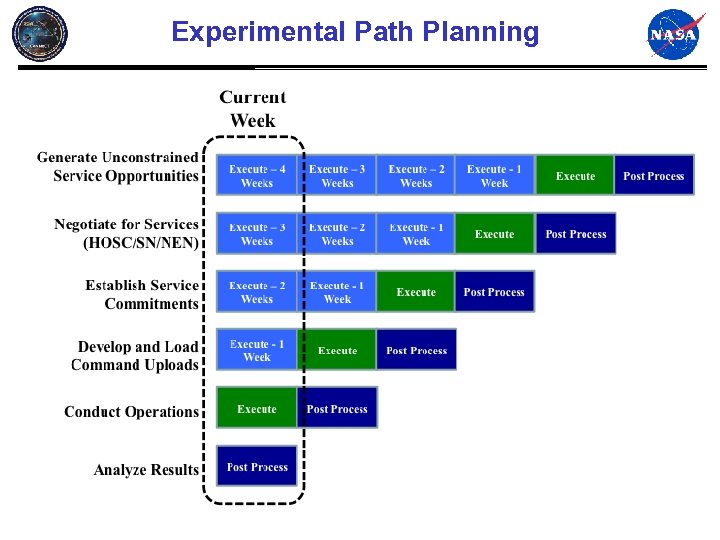
Experimental Path Planning
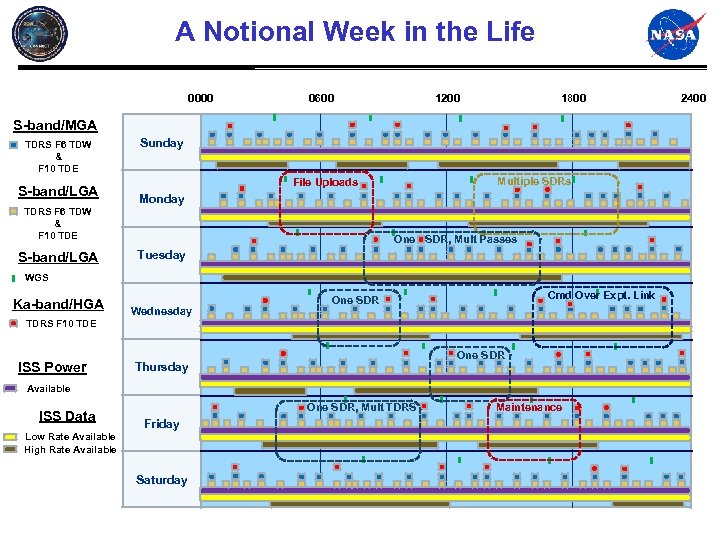
A Notional Week in the Life 0000 0600 1200 1800 S-band/MGA TDRS F 6 TDW & F 10 TDE S-band/LGA Sunday Monday TDRS F 6 TDW & F 10 TDE S-band/LGA Multiple SDRs File Uploads One SDR, Mult Passes Tuesday WGS Ka-band/HGA Wednesday Cmd Over Expt. Link One SDR TDRS F 10 TDE ISS Power One SDR Thursday Available ISS Data One SDR, Mult TDRS Friday Low Rate Available High Rate Available Saturday Maintenance 2400
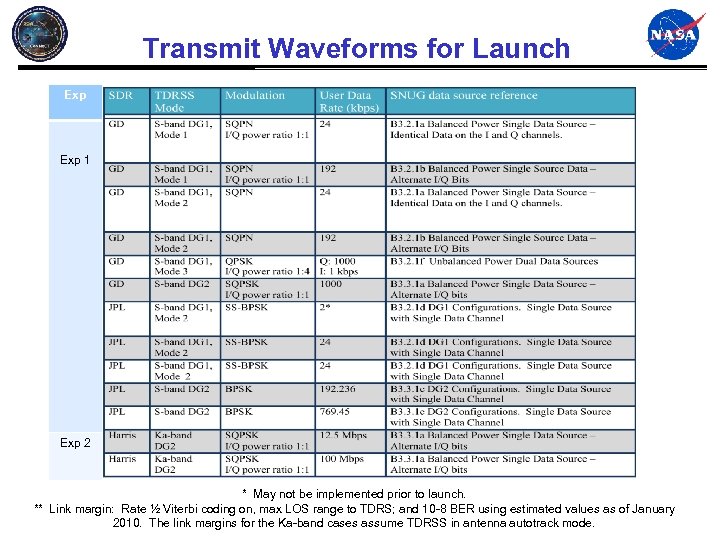
Transmit Waveforms for Launch Exp 1 Exp 2 * May not be implemented prior to launch. ** Link margin: Rate ½ Viterbi coding on, max LOS range to TDRS; and 10 -8 BER using estimated values as of January 2010. The link margins for the Ka-band cases assume TDRSS in antenna autotrack mode.
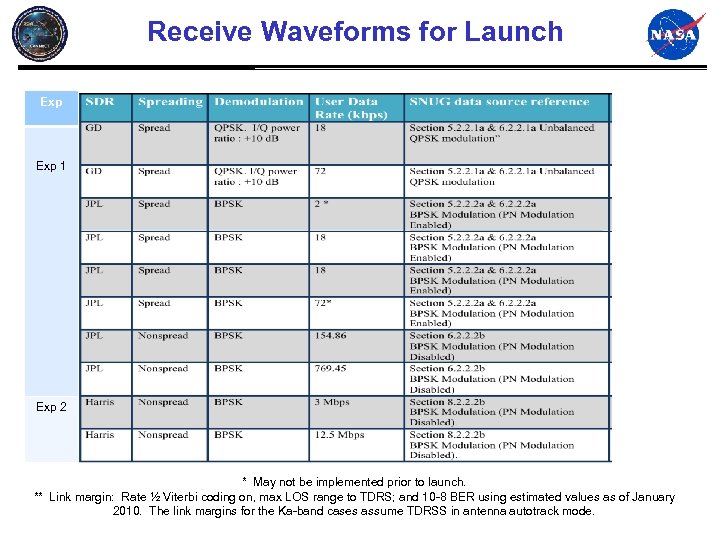
Receive Waveforms for Launch Exp 1 Exp 2 * May not be implemented prior to launch. ** Link margin: Rate ½ Viterbi coding on, max LOS range to TDRS; and 10 -8 BER using estimated values as of January 2010. The link margins for the Ka-band cases assume TDRSS in antenna autotrack mode.
Acronyms
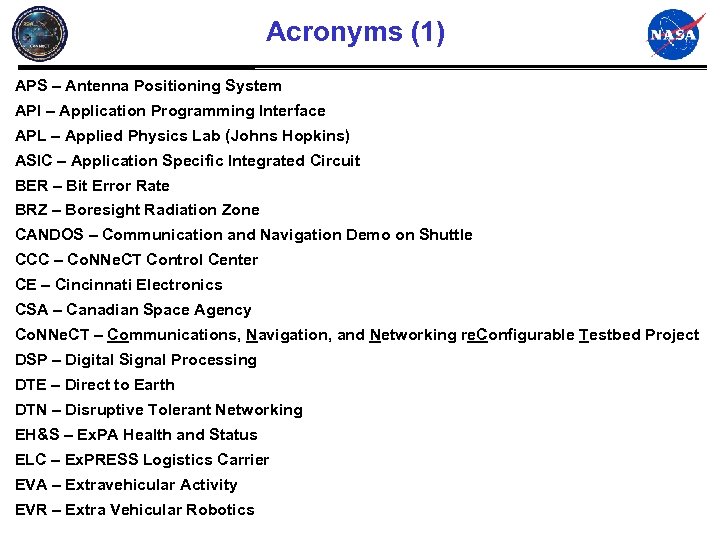
Acronyms (1) APS – Antenna Positioning System API – Application Programming Interface APL – Applied Physics Lab (Johns Hopkins) ASIC – Application Specific Integrated Circuit BER – Bit Error Rate BRZ – Boresight Radiation Zone CANDOS – Communication and Navigation Demo on Shuttle CCC – Co. NNe. CT Control Center CE – Cincinnati Electronics CSA – Canadian Space Agency Co. NNe. CT – Communications, Navigation, and Networking re. Configurable Testbed Project DSP – Digital Signal Processing DTE – Direct to Earth DTN – Disruptive Tolerant Networking EH&S – Ex. PA Health and Status ELC – Ex. PRESS Logistics Carrier EVA – Extravehicular Activity EVR – Extra Vehicular Robotics
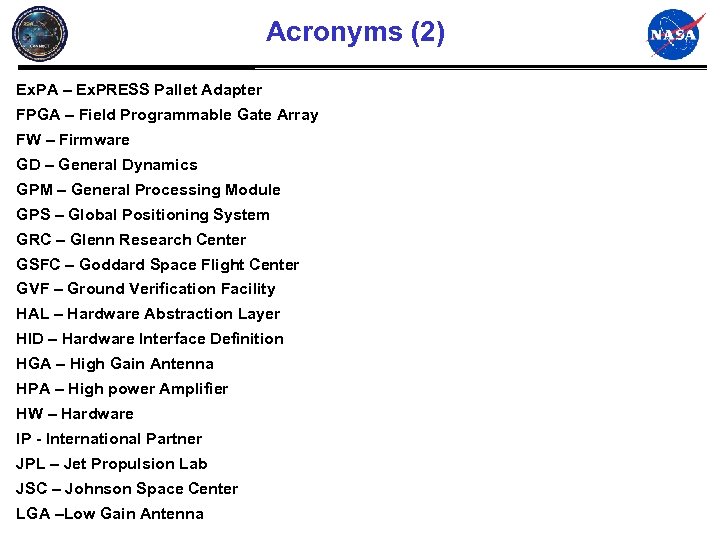
Acronyms (2) Ex. PA – Ex. PRESS Pallet Adapter FPGA – Field Programmable Gate Array FW – Firmware GD – General Dynamics GPM – General Processing Module GPS – Global Positioning System GRC – Glenn Research Center GSFC – Goddard Space Flight Center GVF – Ground Verification Facility HAL – Hardware Abstraction Layer HID – Hardware Interface Definition HGA – High Gain Antenna HPA – High power Amplifier HW – Hardware IP - International Partner JPL – Jet Propulsion Lab JSC – Johnson Space Center LGA –Low Gain Antenna
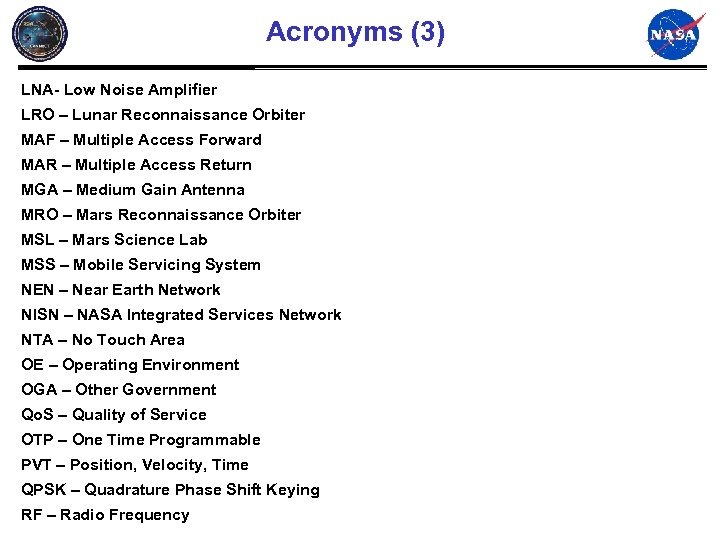
Acronyms (3) LNA- Low Noise Amplifier LRO – Lunar Reconnaissance Orbiter MAF – Multiple Access Forward MAR – Multiple Access Return MGA – Medium Gain Antenna MRO – Mars Reconnaissance Orbiter MSL – Mars Science Lab MSS – Mobile Servicing System NEN – Near Earth Network NISN – NASA Integrated Services Network NTA – No Touch Area OE – Operating Environment OGA – Other Government Qo. S – Quality of Service OTP – One Time Programmable PVT – Position, Velocity, Time QPSK – Quadrature Phase Shift Keying RF – Radio Frequency
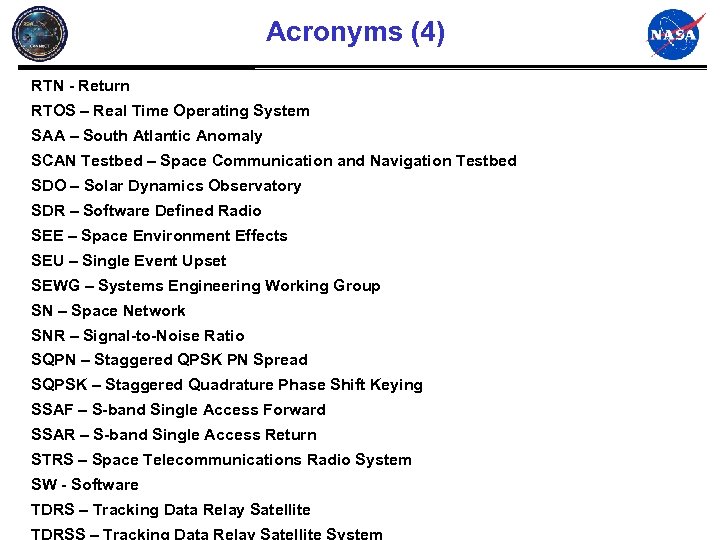
Acronyms (4) RTN - Return RTOS – Real Time Operating System SAA – South Atlantic Anomaly SCAN Testbed – Space Communication and Navigation Testbed SDO – Solar Dynamics Observatory SDR – Software Defined Radio SEE – Space Environment Effects SEU – Single Event Upset SEWG – Systems Engineering Working Group SN – Space Network SNR – Signal-to-Noise Ratio SQPN – Staggered QPSK PN Spread SQPSK – Staggered Quadrature Phase Shift Keying SSAF – S-band Single Access Forward SSAR – S-band Single Access Return STRS – Space Telecommunications Radio System SW - Software TDRS – Tracking Data Relay Satellite
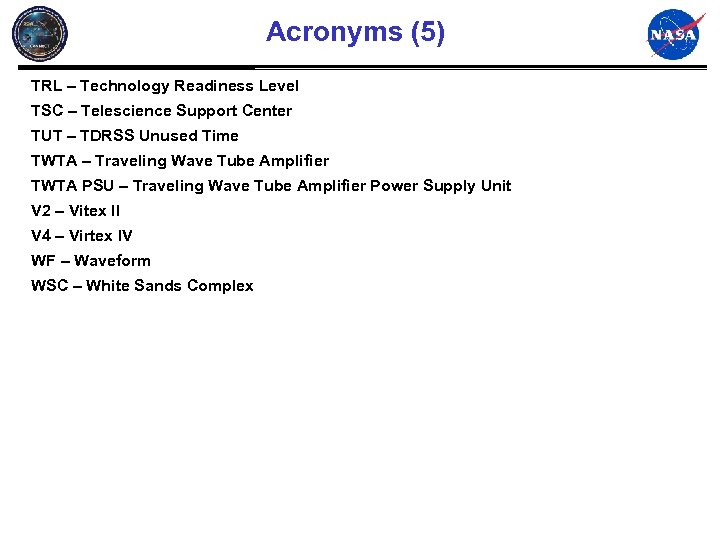
Acronyms (5) TRL – Technology Readiness Level TSC – Telescience Support Center TUT – TDRSS Unused Time TWTA – Traveling Wave Tube Amplifier TWTA PSU – Traveling Wave Tube Amplifier Power Supply Unit V 2 – Vitex II V 4 – Virtex IV WF – Waveform WSC – White Sands Complex
Скачать презентацию Technology Overview and Operations Concept for SCAN Testbed
cf46857d9cffc29ebf7157c5b4887187.ppt