


 Скачать презентацию Technology has revolutionized our lives completely today we
Microsoft PowerPoint Presentation (4).pptx
- Количество слайдов: 9
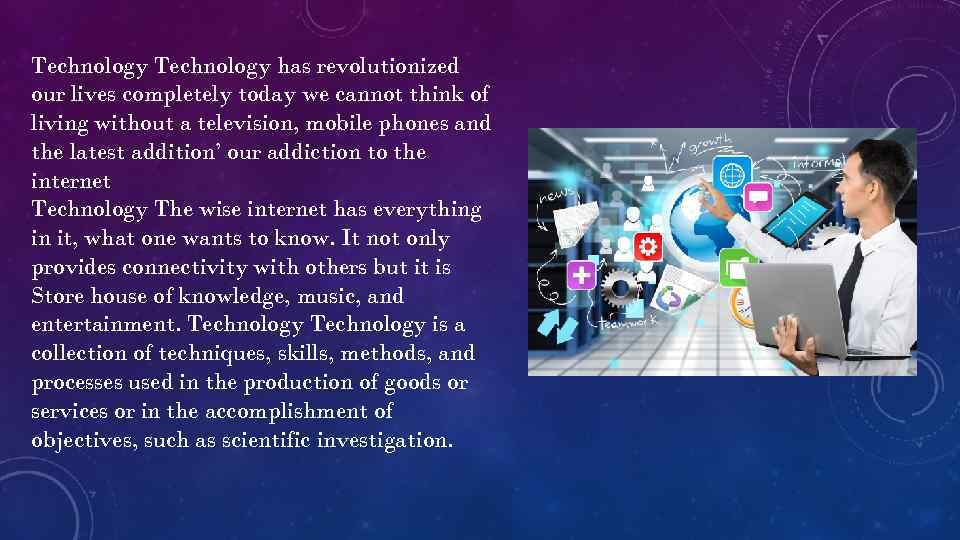 Technology has revolutionized our lives completely today we cannot think of living without a television, mobile phones and the latest addition’ our addiction to the internet Technology The wise internet has everything in it, what one wants to know. It not only provides connectivity with others but it is Store house of knowledge, music, and entertainment. Technology is a collection of techniques, skills, methods, and processes used in the production of goods or services or in the accomplishment of objectives, such as scientific investigation.
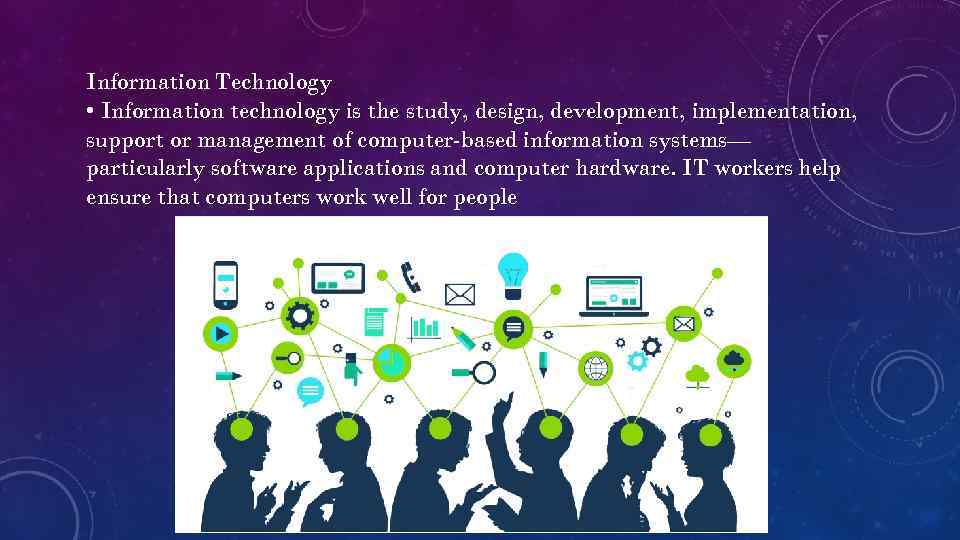 Information Technology • Information technology is the study, design, development, implementation, support or management of computer-based information systems— particularly software applications and computer hardware. IT workers help ensure that computers work well for people
 Information Technology • Information technology has helped in shaping both the business world and our society in general. Many fields have been impacted by information technology and these include; • Education • Health • Entertainment • Communication Information Technology As the world develops, more technology will emerge and this technology will have both positive and negative impacts.
 OBJECTIVE Secondary school students plan and realize an English lesson for pupils of primary school Mutual aims: communication – both groups use English doing pleasant and motivating activities relations – between different age-groups cooperation – teaching and learning coexist
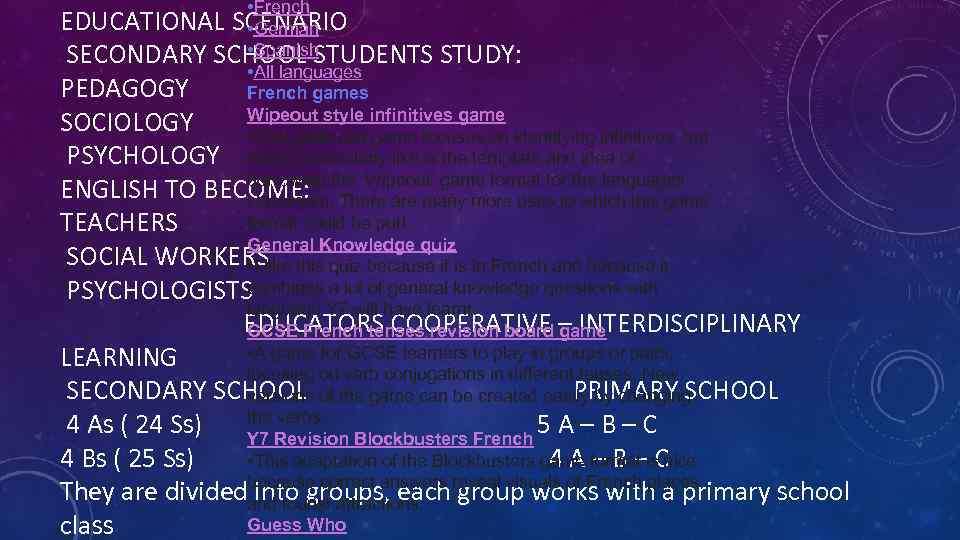 • French EDUCATIONAL SCENARIO • German • Spanish SECONDARY SCHOOL STUDENTS STUDY: • All languages PEDAGOGY French games Wipeout style infinitives game SOCIOLOGY • This particular game focuses on identifying infinitives, but PSYCHOLOGY what I particularly like is the template and idea of borrowing the ‘Wipeout’ game format for the languages ENGLISH TO BECOME: classroom. There are many more uses to which this game format could be put! TEACHERS General Knowledge quiz SOCIAL WORKERS • I like this quiz because it is in French and because it PSYCHOLOGISTScombines a lot of general knowledge questions with language Y 7 will have learnt. EDUCATORS COOPERATIVE – INTERDISCIPLINARY GCSE French tenses revision board game • A game for GCSE learners to play in groups or pairs, LEARNING focusing on verb conjugations in different tenses. New SECONDARY SCHOOL PRIMARY SCHOOL versions of the game can be created easily by changing the verbs. 4 As ( 24 Ss) 5 A–B–C Y 7 Revision Blockbusters French • This adaptation of the Blockbusters game format is nice 4 Bs ( 25 Ss) 4 A–B–C They are dividedbecause correct answers reveal visuals of French places into groups, each group works with a primary school and tourist attractions. Guess Who class
 MFLT (Methods of Foreign Language Teaching) is a scientifically tested theory concerning the teaching of foreign languages in schools and other educational institutions. It covers three main problems: 1. aims of teaching a FL; 2. content of teaching (i. e. what to teach to attain the aims); 3. methods and techniques of teaching (how to teach a FL to attain the aims in the most effective way). MFLT is closely related to other sciences such as pedagogy, psychology, physiology, linguistics and some others. In MFLT we differentiate between aims (long-term goals) and objectives (short-term goals, immediate lesson goals).
 Aims of teaching a foreign language There are three aims which should be achieved in FL teaching: practical, educational, cultural. A)The practical aim: the acquisition of a FL as a means of communication. Practical aims cover habits and skills which pupils acquire in using a foreign language. A habit is an automatic response to specific situations, acquired normally as a result of repetition and learning. A skill is a combination of useful habits serving a definite purpose and requiring application of certain knowledge. B) The educational aim: through FL study we can develop the pupil’s intellect. Teaching a FL helps the teacher to develop the pupils’ voluntary and involuntary memory, his imaginative abilities and will power. C) Cultural aims: learning a FL makes the pupil acquainted with the life, customs and traditions of the people whose language he studies through visual material and reading material; with the countries where the target language is spoken.