


 Скачать презентацию Technology enhancement a full role for the
897de5c3f72afa6ba83ddfbf60243c4b.ppt
- Количество слайдов: 27
 Technology enhancement – a full role for the Elderly Marcus Wigan Adjunct Professor, Faculty of Health Art and Design, Institute for Social Research Swinburne University of Technology www. mwigan. com Melbourne University Graduate House Luncheon Address 1
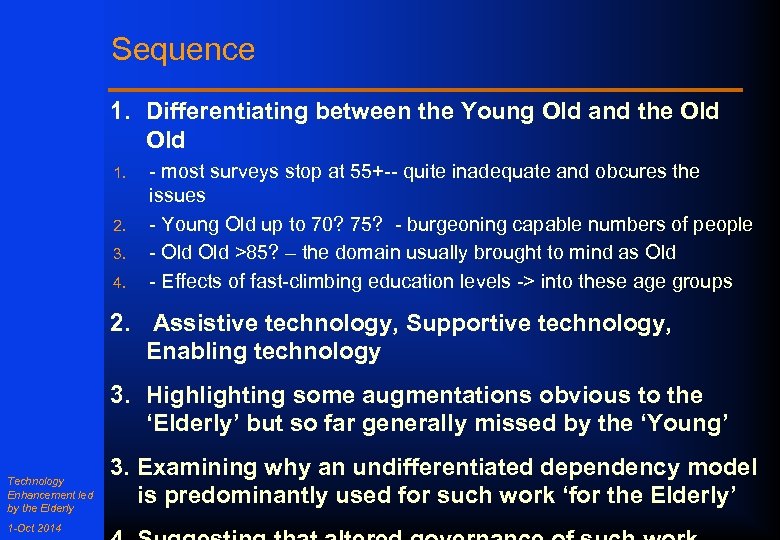 Sequence 1. Differentiating between the Young Old and the Old 1. 2. 3. 4. - most surveys stop at 55+-- quite inadequate and obcures the issues - Young Old up to 70? 75? - burgeoning capable numbers of people - Old >85? – the domain usually brought to mind as Old - Effects of fast-climbing education levels -> into these age groups 2. Assistive technology, Supportive technology, Enabling technology 3. Highlighting some augmentations obvious to the ‘Elderly’ but so far generally missed by the ‘Young’ Technology Enhancement led by the Elderly 1 -Oct 2014 3. Examining why an undifferentiated dependency model is predominantly used for such work ‘for the Elderly’
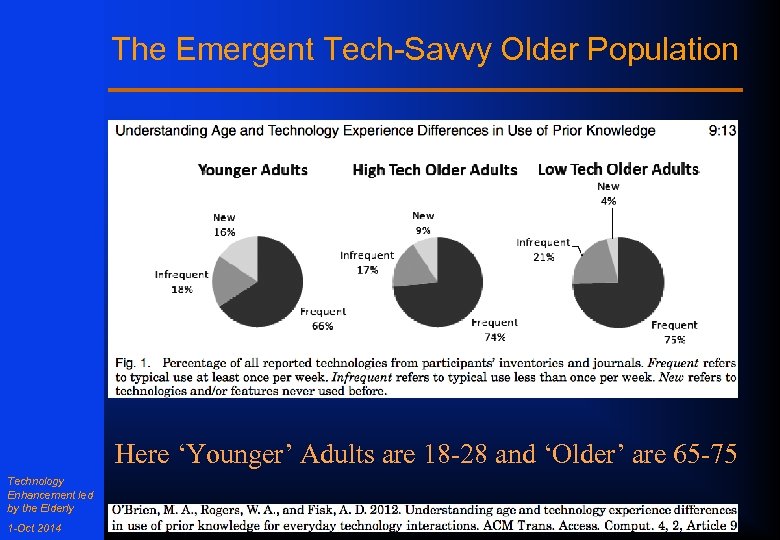 The Emergent Tech-Savvy Older Population Here ‘Younger’ Adults are 18 -28 and ‘Older’ are 65 -75 Technology Enhancement led by the Elderly 1 -Oct 2014
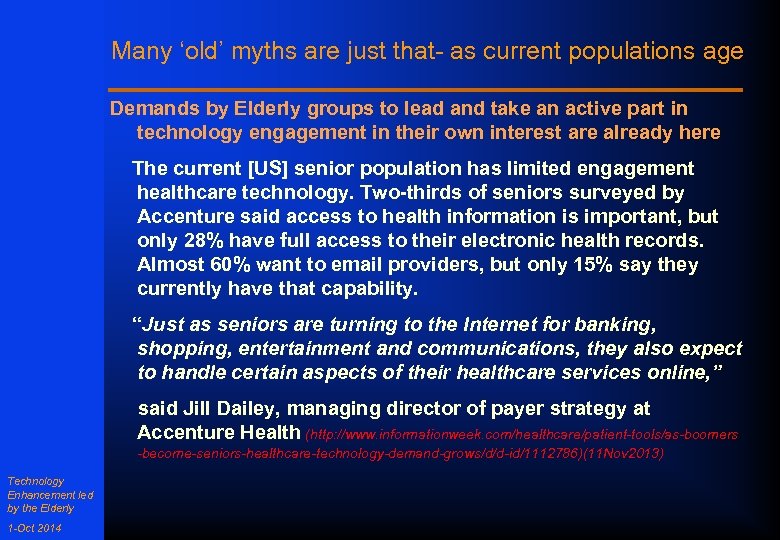 Many ‘old’ myths are just that- as current populations age Demands by Elderly groups to lead and take an active part in technology engagement in their own interest are already here The current [US] senior population has limited engagement healthcare technology. Two-thirds of seniors surveyed by Accenture said access to health information is important, but only 28% have full access to their electronic health records. Almost 60% want to email providers, but only 15% say they currently have that capability. “Just as seniors are turning to the Internet for banking, shopping, entertainment and communications, they also expect to handle certain aspects of their healthcare services online, ” said Jill Dailey, managing director of payer strategy at Accenture Health (http: //www. informationweek. com/healthcare/patient-tools/as-boomers -become-seniors-healthcare-technology-demand-grows/d/d-id/1112786)(11 Nov 2013) Technology Enhancement led by the Elderly 1 -Oct 2014
 Impacts of lagging stereotypes of the Elderly Rising cognitive levels Evidence has been growing that cognitive functioning at a given age has been improving over time through a generational effect. Freedman found that the cognitive performance of 80 years olds in 1998 exceeded that of those of the same age measured in the early 1990 s (Freedman, 2001) Ignoring social and fiscal contribution levels Technology Enhancement led by the Elderly 1 -Oct 2014 A common political strategy is to focus on the generation after the retiring Boomers, to drive a division between the Boomers and the subsequent generation (X) as a politically expedient means of diminishing the influence of the growing elderly generations as whole, and playing up the ‘burden’ argument to the elderly in general. So far this has been a fairly successful political strategy, but is unlikely to remain as unchallenged as it currently is (Wigan, 2013).
 Roles vary by type of technology targeting With these terms come very different perspectives Assistive technology (a dependency framing) - Usually used in terms of ‘age care’ emergency, communications and surveillance technologies (http: //www. aaate. net/sites/default/files/AAATEworkshop. Sheffield 2010_pr oceedings. pdf#page=53) Supportive technology (an augmentation framing) - A term suggested for recovering pre-existing capacities (http: //www. inclusivedesigntoolkit. com/betterdesign 2/ http: //designingwithpeople. rca. ac. uk www. sus-it. lboro. ac. uk ) Other examples include Driverless Cars etc Enabling technology (an enhancement framing) Technology Enhancement led by the Elderly 1 -Oct 2014 Overlaps with disability support enabling capacities that would otherwise be lost, but also applies to enhancement of fully-abled people. Sometimes also expressed as Augmentation (“The computer is one of the 5 C’s in my life – the others being children, car, church and cat” Howard 78; If they had to give up using their computers. “Very upset - it's my window on the world. It helps me with my interests and
 Assistive Technology – Domestic Robots Elderly-expressed requirements for robotic support. . …. elderly people worrying the most about a personal cognitive weakening showed a stronger confidence that the robot would make people feel tranquil at home… …. the elderly who showed a higher apprehension for the weakening of cognitive competence expressed a more positive emotional reaction to the robot, being the agent perceived as more pleasant, useful and dynamic, and less overwhelming… …the issue of acceptability of robotic agents in everyday life of elderly people…. . the role of a domestic robot in the everyday experience of elderly people clearly emerged. In their eyes, the robot is perceived as a practical device, with one physical key feature: it should not resemble a human being…. Technology Enhancement led by the Elderly 1 -Oct 2014 (Cesta, A et al (2007) Psychological Implications of Domestic Assistive Technology for the Elderly. Psych. Nology Journal 5(3) 229 -252)
 Why talk about this subject today? • I was asked last year as an Elderly person to respond to a survey on emergency assistance for the aged • Project survey framed in a dependency, emergency support and non- consultative mode • No useable questions on technology awareness, needs or suggestions from the subject group provided • The address today arose initially from a wish to make such surveys more useful to the elderly by acting to: - Draw on modern pervasive technologies - Focus on a key issue (falls) Technology Enhancement led by the Elderly 1 -Oct 2014 - Highlight a modern approach to mobility barriers - Emphasise the need for appropriate elderly in a governance role
 Illustrative Suggestions made 1. Use of smart phones, with or without additional sensors, to diagnose emergencies and communicate 2. Minimal exoskeletons for anti-fall stability 3. Mobility solutions that include access AND egress from public transport Common factors 1. Not considered due to paternalistic framing of ‘elderly clients’ 2. Exclusion of such clients in design and execution of such work Technology Enhancement led by the Elderly 1 -Oct 2014 3. Barriers – especially regulatory ones – neither recognised nor addressed
 Smart phones as easy user-led augmentation 1. Accelerometers and GPS are standard: ECGs, Blood sugar levels etc within current scope 2. So. . using largely already available tools (mid 2013)falls could be diagnosed for energy transfer (impact severity), diabetic comas or epileptic episodes 3. The correct emergency medical care numbers can then be called scaled for severity with the data. . plus structured sequences of calls to family etc 4. The Elderly must be involved in active governance and researcher roles: The Role of older people in identifying &developing Technology Enhancement led by the Elderly 1 -Oct 2014 solutions “Despite experiencing challenges and problems, it is evident that older people are often exceptionally tenacious in trying to remain digitally connected”. . “Older people have been core participants throughout the research process to identify solutions to prevent or postpone disengagement. They have actively participated in sandpits to shape design of future ICTs, evaluation and testing of software, and problem solving workshops to specify their requirements for provision of ICT learning and support(sus-it)
 A key current research program EU Framework I-DONT-FALL (http: //www. idontfall. eu/) “deploys, pilots and evaluates a range of innovative ICT solutions for fall detection and prevention management. The platform will be flexibly configured to the needs of specific target groups and risk factors associated with fall incidents”. - Uses a centralised E-Medicine database Knowledge base and a special fall sensor device. - Uses a special gait sensor and trainer trolley No civil society body included in the Partners Technology Enhancement led by the Elderly 1 -Oct 2014 Sadly no attention is paid to direct stability support by minimal intelligent lightweight exoskeletons
 Some existing Apps/sensors in early 2013 1. ECG : www. alivecor. com i. Phone 2. Diabetes : http: //www. echotx. com/ Symphony sensor 3. Heart rate: http: //www. azumio. com/apps/heart-rate/. $. 99 i. Phone app using the light as a sensor 4. Many more that collect life data with minimal or no sensors required (Fit. Bit etc) 5. These illustrate that already many of the specialised solutions can be handled by standard devices already carried by many elderly as telephones, in many cases even without external sensors. Technology Enhancement led by the Elderly 1 -Oct 2014 6. This suggests that a client-centred view would yield significant benefits as well as enhanced engagement
 Mobility Augmentation 1. An unfortunate ‘access’ criterion to transit is being within 400 m of a bus/train stop. 2. This doesn’t work for many of even the Young Old 3. Consider Young Old as up to 75, Old as 75+ 4. Even this threshold is rising. . 1. - 400 m is more than many can always manage 2. - it does not include actual services at these points 3. - it omits the necessary access to the end destination So what Mobility Augmentation is needed? Technology Enhancement led by the Elderly 1 -Oct 2014
 A Proposed Performance Based Standard 1. 10 kg total mass (portability, with or without roller wheels) 2. Limited to 25 km/hr, minimum range 20 km 3. Electrically powered, rechargeable from the mains 4. ABS, high intensity LED lighting, fail safe controller 5. This will require 450 w for other than flat surfaces, as manual ancillary power will not be available in 10 kg This device category can be carried safely on and off public transit, light aircraft, car boots etc. The Yike. Bike is 11 kg. Technology Enhancement led by the Elderly 1 -Oct 2014 Example Video: Yike. Bike (NZ) http: //www. youtube. com/watch? feature=player_embedded&v=aj 3 de 3_9 fv. M Ssike(Catalonia) http: //www. ssike. com/features. html 20 Km/h Top Speed - 50 Kms of Range - 12 Kgs of Weight - Lithium Ion Battery - 5 Seconds Fold time : but no pedals!
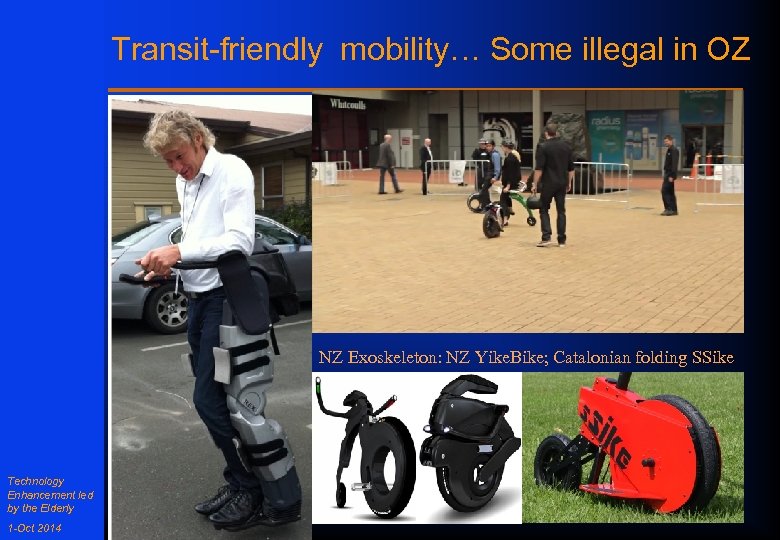 Transit-friendly mobility… Some illegal in OZ NZ Exoskeleton: NZ Yike. Bike; Catalonian folding SSike Technology Enhancement led by the Elderly 1 -Oct 2014
 Barriers: Technical and Governance 1 Most such vehicles are illegal and cannot meet legal requirements as a bicycle, moped, motorcycle or motor vehicle, and is therefore illegal for use on roads or sidewalks in Australia 2 Why? Because the formal e. Bike specification has been set to require pedals and their use for ancillary power in the EU and Australia as enforcing ‘Pedelecs’ rather than e. Bikes and 450 w. Ssike it also ruled out 3 This has much merit for the bulk of the population for health, but blocks these and many other forms of mobility augmentation for the elderly Technology Enhancement led by the Elderly 1 -Oct 2014 4 Another illustration where engagement (and indeed the availability of relevant elderly expert researchers) has been forgotten
 What is being done on mobility augmentation? 1. A typical example is the EU Project ASSISTANT http: //www. aal-europe. eu/projects/assistant/ 2. This project focuses on end-to-end travel support using smartphones and is restricted to information 3. Unusually it is being developed with active engagement of the target elderly market segment with multiple design test initiatives in the project design. 4. Active communication to enable unfamiliar system mode changes and stop-related anxieties to be handled. Technology Enhancement led by the Elderly 1 -Oct 2014 5. Example for elderly mobility augmentation helping all parties, especially tourists and occasional users of public transport. A common call by & for the disabled
 Elderly Monitoring but not Self Empowered 1. GPS is already being used to monitor the elderly simply for institutional convenience, even those without Alzheimers 2. Memoto (a full life logging microcamera) is a likely next step. . And includes cloud based storage 3. Used in surveillance modes, with their retrospective examination built in, these devices severely constrain the life space of those subjected to their enforced usage Technology Enhancement led by the Elderly 1 -Oct 2014 4. The assumption that these are appropriate for the elderly is a paternalistic view, excludes any participative governance, and is well out of date. 5. Engagement -> exception reporting with disclosure
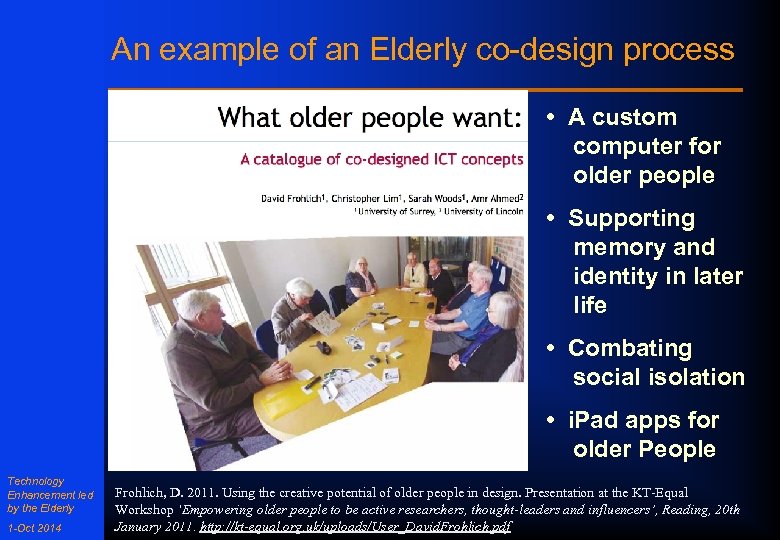 An example of an Elderly co-design process • A custom computer for older people • Supporting memory and identity in later life • Combating social isolation • i. Pad apps for older People Technology Enhancement led by the Elderly 1 -Oct 2014 Frohlich, D. 2011. Using the creative potential of older people in design. Presentation at the KT-Equal Workshop ‘Empowering older people to be active researchers, thought-leaders and influencers’, Reading, 20 th January 2011. http: //kt-equal. org. uk/uploads/User_David. Frohlich. pdf
![Examples of Elderly co-and re-design [dwrc] Non-PC using Elderly group design Technology Enhancement led](https://present5.com/presentation/897de5c3f72afa6ba83ddfbf60243c4b/image-20.jpg "Examples of Elderly co-and re-design [dwrc] Non-PC using Elderly group design Technology Enhancement led") Examples of Elderly co-and re-design [dwrc] Non-PC using Elderly group design Technology Enhancement led by the Elderly 1 -Oct 2014 Pc using Elderly group design ALL pre Google Glass
Examples of Elderly co-and re-design [dwrc] Non-PC using Elderly group design Technology Enhancement led by the Elderly 1 -Oct 2014 Pc using Elderly group design ALL pre Google Glass
 Some professed good intentions The Committee notes, however, that no specific mechanism exists under the legislation to include senior Victorians in stakeholder engagement and community participation processes. A strategy for including older people in decision making about transport issues is critical to ensure that the transport needs of senior (i. e. 60+) Victorians are met Victorian Government Inquiry into Opportunities for Participation of Victorian Seniors (2012) Technology Enhancement led by the Elderly 1 -Oct 2014 This is a welcome – if rare - official recognition that the governance processes currently do not include a growing fraction of the population, which is more than capable of such participation, very effectively. Of course, we the Elderly await any substantive enactment
 Why does this paternalistic approach obtain? 1 The Elderly are still stereotyped as one dependent group 2 The rapid growth in health of the Young Old is ignored 3 The rising levels of education of this group are ignored 4 Framing as a ‘costly group to pay for’ due to ignorance of the massive unpriced voluntary and honorary inputs to the economy - and huge time and resource contributions allowing dual income families to stay so 5 Structural exclusion by age–specific conditions 6 Lack of awareness that the power holding groups are about to move into the elderly age brackets themselves Technology Enhancement led by the Elderly 1 -Oct 2014 7 Low awareness of the rising number of active researchers available from the elderly age group itself
 And so- lets use the term Augmentation 1. Technology for Augmentation almost inevitably requires data flows and changes to old barriers 2. The ethical and privacy issues of the elderly need to be seriously addressed. This will also benefit the whole community as sensor and LBS surveillance and Big Data integration becomes ever more omnipresent. 3. Augmentation of the Elderly ‘within the house’ needs direct governance engagement, let alone research involvement, to ensure that the Smart House, Internet of Things and Smart Augmentation technologies are designed, implemented and used acceptably. Technology Enhancement led by the Elderly 1 -Oct 2014 4. Augmentation of the Elderly ‘outside the house’ requires further governance inclusion
 Elderly in appropriate technologies planning Are visible almost entirely by their absence - Tegart’s excellent global review of assistive technologies for the elderly took a dependency attitude throughout: Yet –typically - he was himself in this age group (2003). - The large scale visioning BRAID project by the EU completely omitted governance and leadership by the elderly although claiming to include earlier projects that were aimed specifically at extending the inputs from professionals as they aged (2012). Technology Enhancement led by the Elderly 1 -Oct 2014 - As skilled and experienced educated manpower continues to rise in demand, the resources of those prematurely excluded by age will be increasingly needed: let us call it an all too evident wisdom drought
 What do we gain if we do? “Even in the general population, vocabularies are larger and knowledge about the world is greater in the old as compared to the young. Recent findings suggest that older people are more likely to change attitudes in light of new information, and they appear better able to take the perspective of younger people than younger people are able to adopt perspectives of the old. Presented with cultural and economic disputes over resources, older people generate more even-handed and acceptable solutions than younger counterparts”. (World Economic Forum 2011) Technology Enhancement led by the Elderly 1 -Oct 2014 A further argument for the broader formal engagement of Elderly in governance; as well as in initiating, and reviewing, and not being solely the subject of assistive and augmentation technologies.
 Conclusion Technologies of all kinds offer much to the whole community The Elderly can gain more than most The Elderly can contribute more than most IF they are an active part of the governance, design and execution This will happen only if the current stereotypes and lumping together of 55+ to 90 age groups is changed Technology Enhancement led by the Elderly 1 -Oct 2014
 Some of the Resources Referred to here Andrich, Ret al (2010) The European Assistive Technology Information Network (http: //www. aaate. net/sites/default/files/AAATEworkshop. Sheffield 2010_proceedings. pdf#page=53) BRAID Project (2012) Bridging Research in Ageing and ICT Development Workpackage 4. 2 Consolidated vision of ICT and ageing. European Comission Framework 7 Program. http: //www. braidproject. eu/sites/default/files/D 4. 2%20 Final. pdf Cesta, A et al (2007) Psychological Implications of Domestic Assistive Technology for the Elderly. Psych. Nology Journal 5(3) 229 -252 [Domestic Robots] Freedman, V (2001) Aggregate changes in severe cognitive impairment among older Americans: 1993 and 1998. Journal of Gerontology: Social Sciences (56 B) S 100 -S 111. Frohlich, D. 2011. Using the creative potential of older people in design. Presentation at the KT-Equal Workshop ‘Empowering older people to be active researchers, thought-leaders and influencers’, Reading, 20 th January 2011. Examples at: http: //kt-equal. org. uk/uploads/User_David. Frohlich. pdf Mc. Caig, M et al (2012) The lived experience of older people using assistive technology. Working with older people: Community Care Policy and Practice. (16) 170 -4 Morris, M et al (2012) Smart technologies for older people. A systematic literature review of smart technologies that promote health and wellbeing of older people living at home. Institute for a Broadband-Enabled Society [http: //broadband. unimelb. edu. au/resources/Smart-technologies-for-older-people. pdf] Tegart, G (2010) Smart technology for healthy longevity. Australian Academy of Technological Sciences and Engineering, Melbourne Technology Enhancement led by the Elderly 1 -Oct 2014 Victorian Parliament (2012) Inquiry into opportunities for participation of Victorian Seniors. Family and Community Development Committee, Melbournehttp: //www. parliament. vic. gov. au/images/stories/committees/fcdc/inquiries/57 th/iopvs/Report/O pportunities_for_Seniors_Final_Report. pdf Wigan, M (2013) Constructing Age and Technology as Augmentation, not Degradation : Exploring what the aged themselves think they need, not what is decided for them. IEEE International Symposium on Technology and Society (ISTAS), 136 -143. Doi 10. 1109/ISTAS. 2013. 6613112