


 Скачать презентацию Technology Choices for Data Collection and Condition Assessment
7f1e3582e8f31ca47a04cbe8b03a7354.ppt
- Количество слайдов: 45
 Technology Choices for Data Collection and Condition Assessment Leonard (Len) Schultz Transportation Engineer Manager Highway Maintenance Division Maryland State Highway Administration

 ASSET MANAGEMENT DATA COLLECTION GUIDE DRAFT DOCUMENT Version: June 2004 Prepared by: J. W. Bryant, Jr. , Ph. D. , P. E. , Virginia Transportation Research Council James. Bryant 3@Virginia. Dot. org C. D. Larson, P. E. , PMP, Virginia Department of Transportation Chucj. Larson@Virginia. Dot. org
 Asset Management Primer
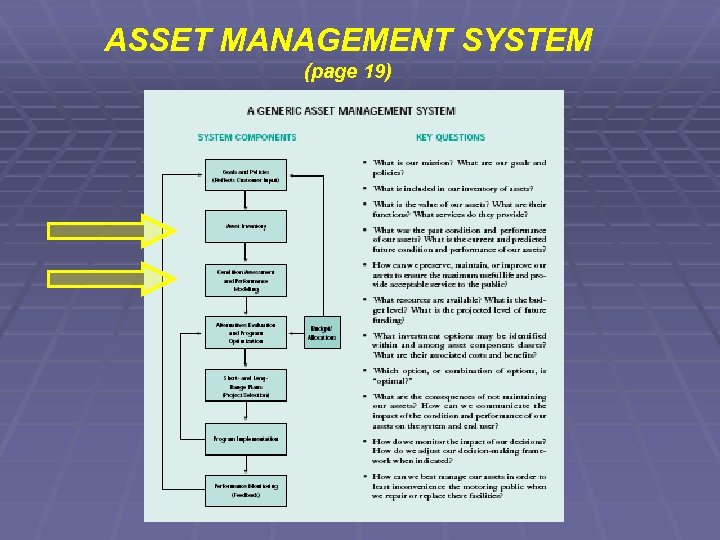 ASSET MANAGEMENT SYSTEM (page 19)
 Maintenance Management Systems
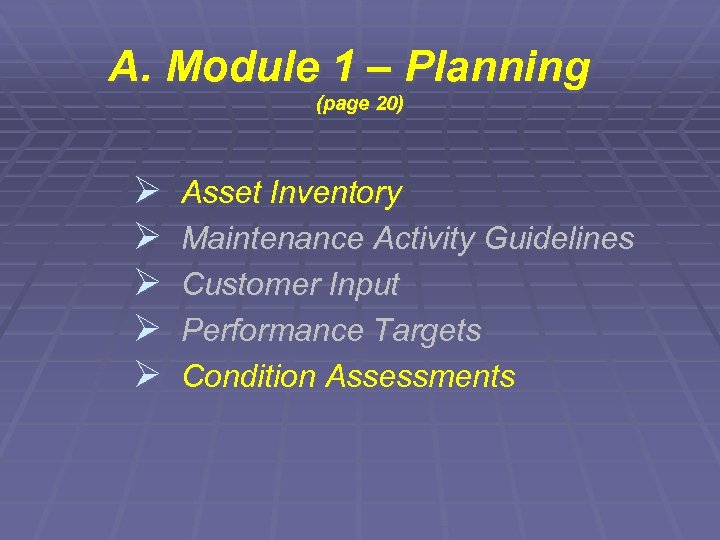 A. Module 1 – Planning (page 20) Ø Ø Ø Asset Inventory Maintenance Activity Guidelines Customer Input Performance Targets Condition Assessments
 ASSET MANAGEMENT DATA COLLECTION GUIDE DRAFT DOCUMENT Version: June 2004 Prepared by: J. W. Bryant, Jr. , Ph. D. , P. E. , Virginia Transportation Research Council James. Bryant 3@Virginia. Dot. org C. D. Larson, P. E. , PMP, Virginia Department of Transportation Chucj. Larson@Virginia. Dot. org
 In general the asset data collection requirements can be categorized into the following: (1) Location; (2) Physical Attributes; and (3) Condition. Locations are usually denoted by a “from – to” county-route-mile (CRM) for linear assets. Nonlinear assets are point specific and are denoted by either a single CRM or by use of landmark data. In all cases GPS coordinates and or physical landmarks can be used to acquire the location information for both linear and nonlinear assets. The physical attributes collected will vary from asset to asset. Physical attributes are used to describe the asset in question. General attributes that are consistent across assets include: material type, size, and length. Condition assessment is depended on the specified performance criteria for the asset. Data for condition assessment can be broad for some assets requiring only Good, Bad or fair, while other assets may require a more detailed approach set forth by national or regional accepted practices or standards. Table 2 -1 presents the basic inventory attributes for transportation assets. Condition attributes vary greatly from asset to asset as to how they are reported; therefore they were excluded from Table 2 -1.
 General assets groups and associated asset types § Pavements: Flexible Pavements (HMA), PCC Pavements, Unpaved Roads; Paved Shoulders, and Unpaved Shoulders § Roadsides: Vegetation and aesthetics, Trees, Shrubs and brush, Historic Markers, and Right-of-way Fence § Drainage Structures: Cross Pipes and Box Culverts, Entrance Pipes, Curb & Gutter, Paved Ditches, Unpaved Ditches, Edge Drains and Under-drains, Storm Water Ponds, and Drop Inlets § Traffic: Attenuators, Guardrail, Pavement striping, Pavement markings, Raised pavement markers, Delineators, Signs, and Highway Lighting § Structures and Bridges: Overhead Sign Structures, Structural Culverts, Overall Bridge, Sound Barriers, and Retaining Walls § Special Facilities: Movable Bridges, Rest Areas, River and Mountain Tunnels, Weigh Stations, and Traffic monitoring Systems
 Data Collection § Data collection methods should be developed with data at its core rather than the applications they serve. Applications may go obsolete and be updated but the data collection and how it is structured must be able to be migrated and integrated to multiple/other systems. Therefore, the electronic collection, dissemination, and updating is critical.
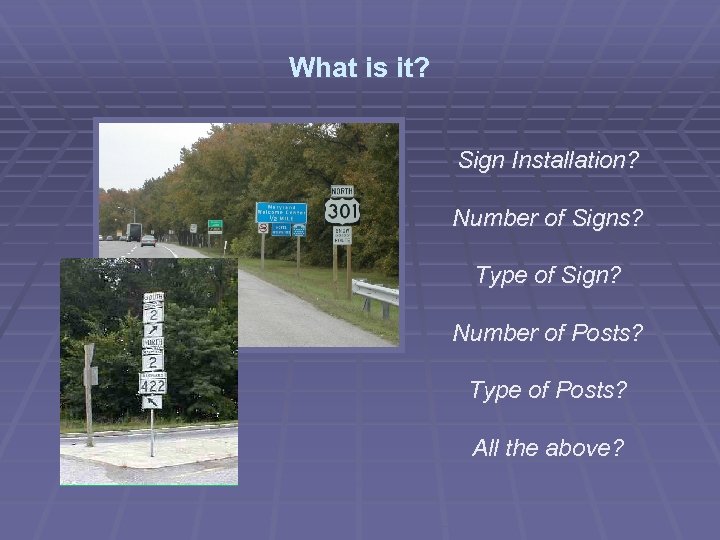 What is it? Sign Installation? Number of Signs? Type of Sign? Number of Posts? Type of Posts? All the above?
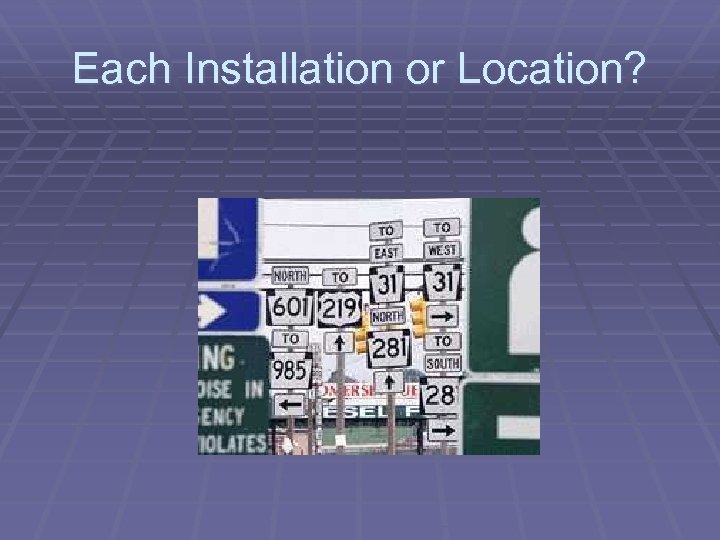 Each Installation or Location?
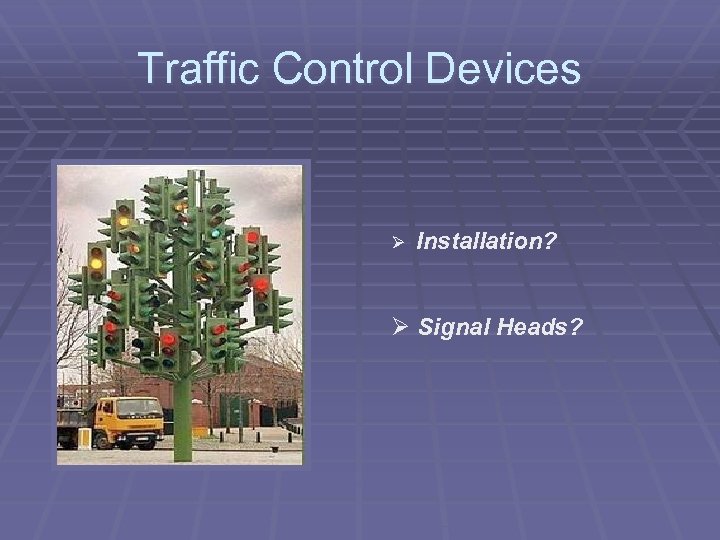 Traffic Control Devices Ø Installation? Ø Signal Heads?
 “In general the asset data collection requirement can be categorized into the following: Locations are usually denoted by a “from – to” county-route-mile (CRM) for linear assets. Nonlinear assets are point specific and are denoted by either a single CRM or by use of landmark data. In all cases GPS coordinates and or physical landmarks can be used to acquire the location information for both linear and nonlinear assets. Physical Attributes collected will vary from asset to asset. Physical attributes are used to describe the asset in question. General attributes that are consistent across assets include: material type, size, and length. Condition assessment is depended on the specified performance criteria for the asset. Condition Assessment can be broad for some assets requiring only Good, Bad or Fair, while other assets may require a more detailed approach set forth by national or regional accepted practices or standards. Table 2 -1 presents the basic inventory attributes for transportation assets. Condition attributes vary greatly from asset to asset as to how they are reported; therefore they were excluded from Table 2 -1. ”
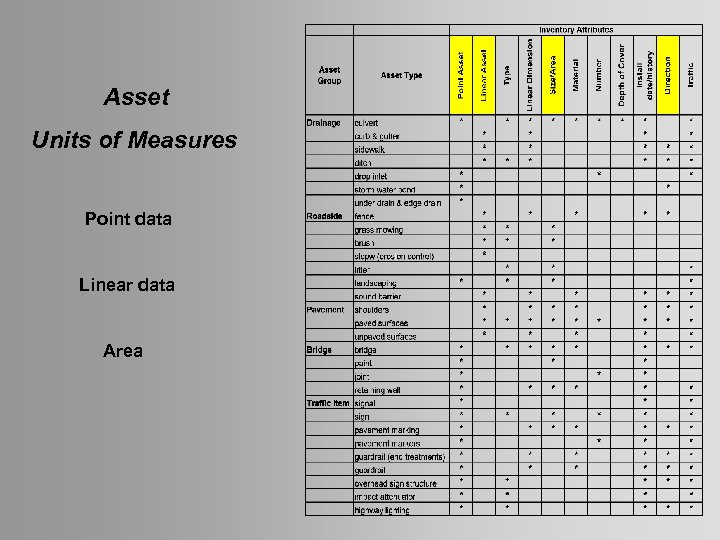 Asset Units of Measures Point data Linear data Area
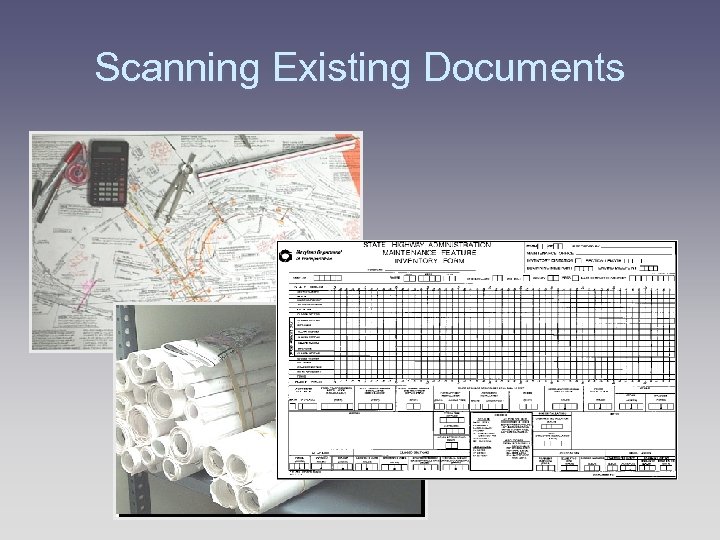 Scanning Existing Documents
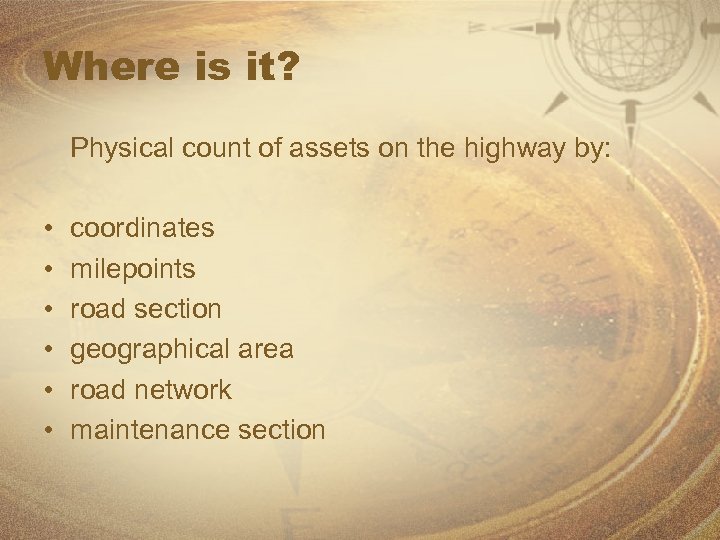 Where is it? Physical count of assets on the highway by: • • • coordinates milepoints road section geographical area road network maintenance section
 Dynamic Segmentation Ø Dynamic Segmentation is a term used to describe the process of combining data from two or more perspectives by "dynamically" creating a third set of sections that represents the smallest common denominator sections between the first two sets. Ø Dynamic Segmentation is useful for performing, "show me" kind of reports on a roadway database. It is not, however, very useful for sharing data across many applications. Ø It is easy to illustrate Dynamic Segmentation by drawing two strip maps of a road both showing the set of sections from two different section perspectives
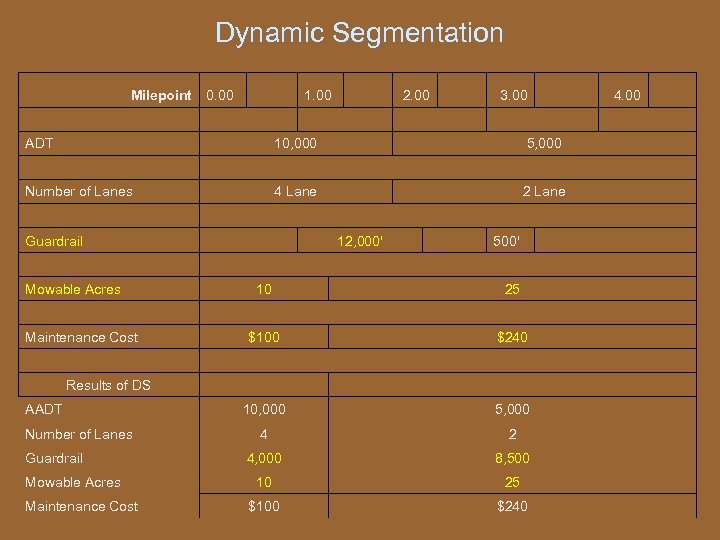 Dynamic Segmentation Milepoint 0. 00 1. 00 2. 00 ADT 3. 00 4. 00 10, 000 5, 000 Number of Lanes 4 Lane 2 Lane Guardrail 12, 000' 500' Mowable Acres 10 25 Maintenance Cost $100 $240 Results of DS AADT Number of Lanes Guardrail Mowable Acres Maintenance Cost 10, 000 5, 000 4 2 4, 000 8, 500 10 25 $100 $240
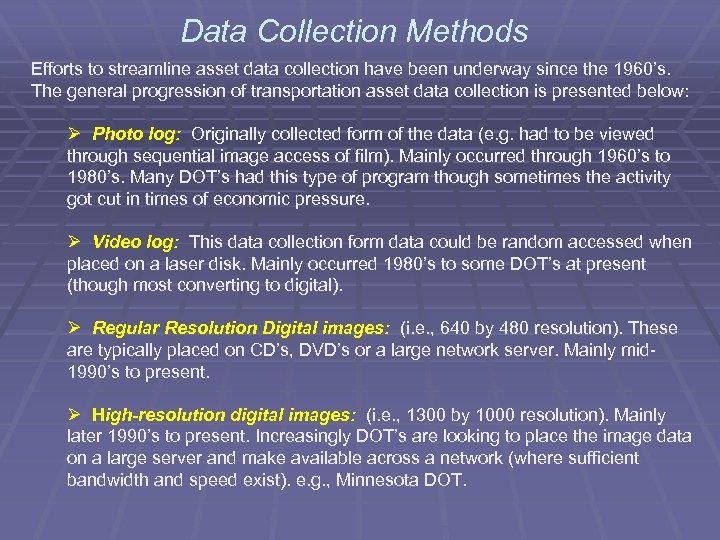 Data Collection Methods Efforts to streamline asset data collection have been underway since the 1960’s. The general progression of transportation asset data collection is presented below: Ø Photo log: Originally collected form of the data (e. g. had to be viewed through sequential image access of film). Mainly occurred through 1960’s to 1980’s. Many DOT’s had this type of program though sometimes the activity got cut in times of economic pressure. Ø Video log: This data collection form data could be random accessed when placed on a laser disk. Mainly occurred 1980’s to some DOT’s at present (though most converting to digital). Ø Regular Resolution Digital images: (i. e. , 640 by 480 resolution). These are typically placed on CD’s, DVD’s or a large network server. Mainly mid 1990’s to present. Ø High-resolution digital images: (i. e. , 1300 by 1000 resolution). Mainly later 1990’s to present. Increasingly DOT’s are looking to place the image data on a large server and make available across a network (where sufficient bandwidth and speed exist). e. g. , Minnesota DOT.
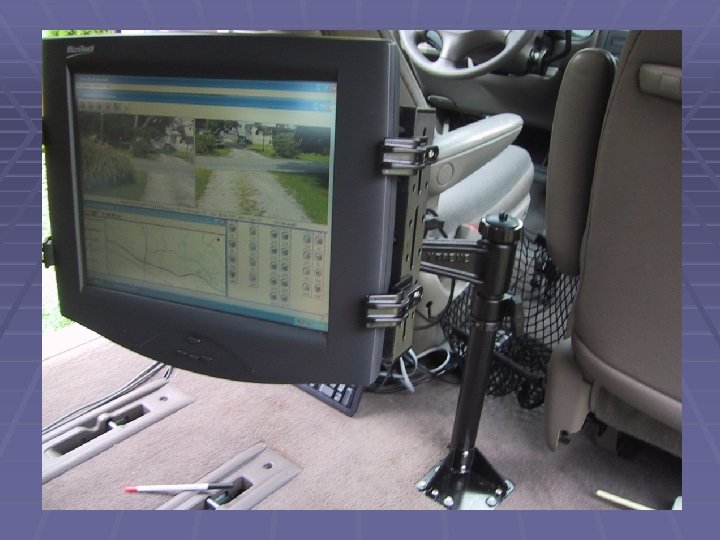
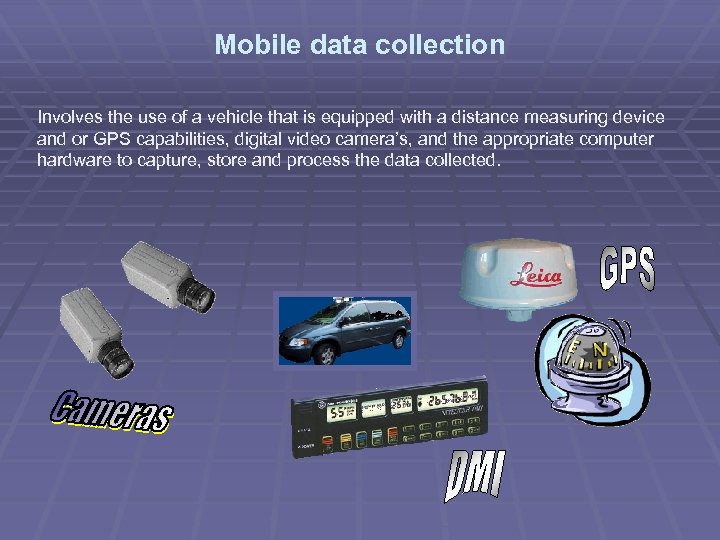 Mobile data collection Involves the use of a vehicle that is equipped with a distance measuring device and or GPS capabilities, digital video camera’s, and the appropriate computer hardware to capture, store and process the data collected.
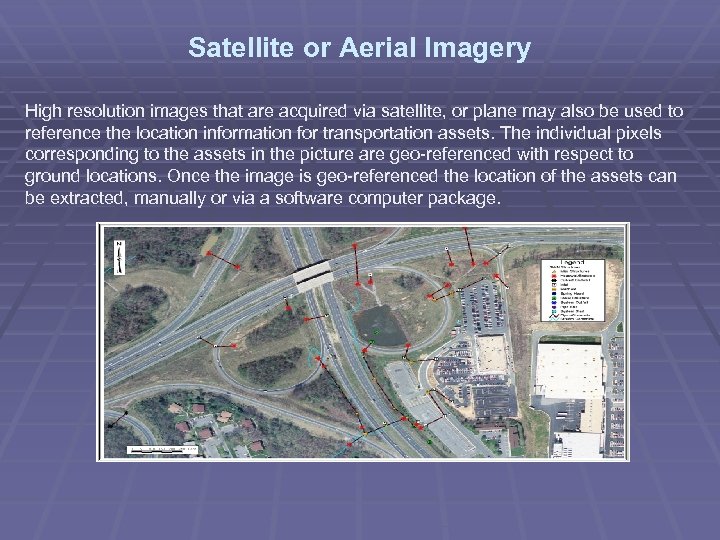 Satellite or Aerial Imagery High resolution images that are acquired via satellite, or plane may also be used to reference the location information for transportation assets. The individual pixels corresponding to the assets in the picture are geo-referenced with respect to ground locations. Once the image is geo-referenced the location of the assets can be extracted, manually or via a software computer package.
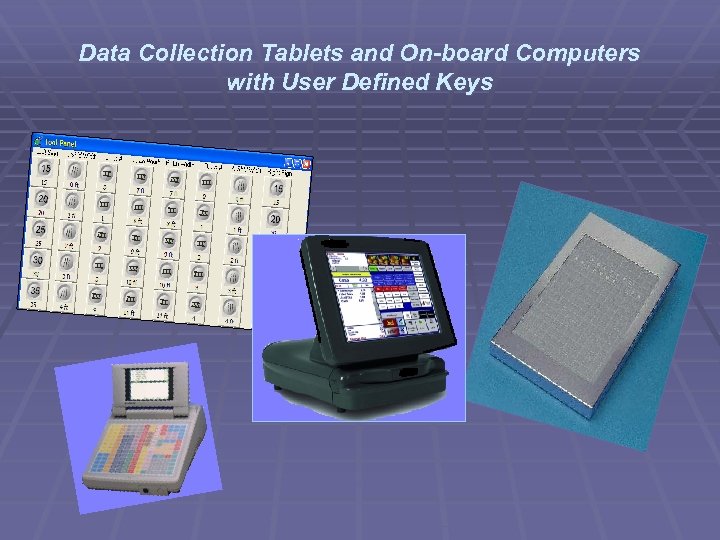 Data Collection Tablets and On-board Computers with User Defined Keys
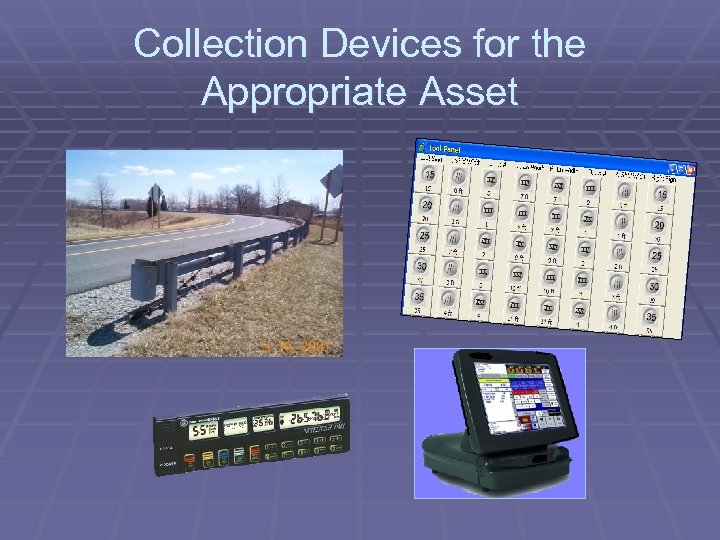 Collection Devices for the Appropriate Asset
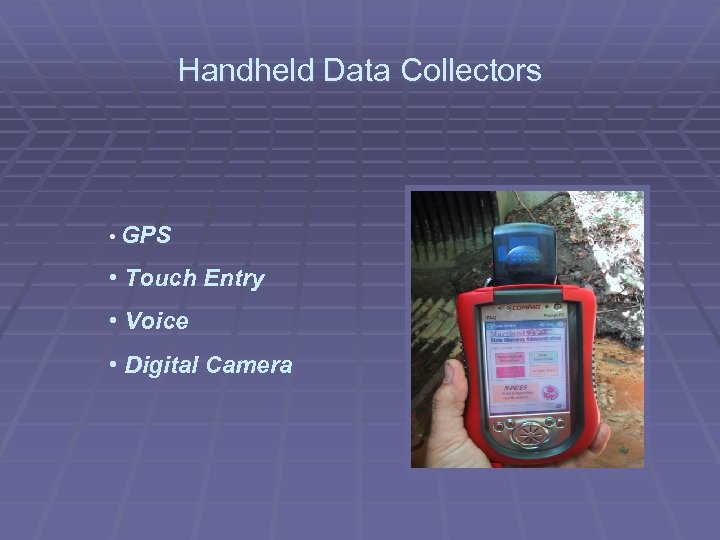 Handheld Data Collectors • GPS • Touch Entry • Voice • Digital Camera
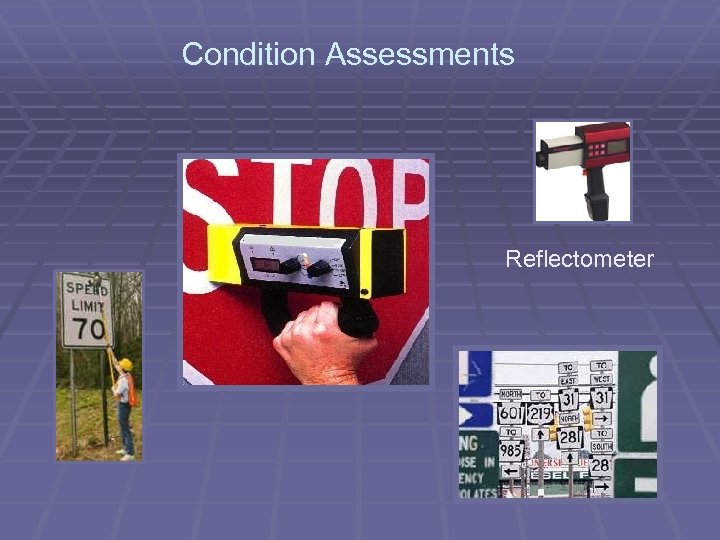 Condition Assessments Reflectometer
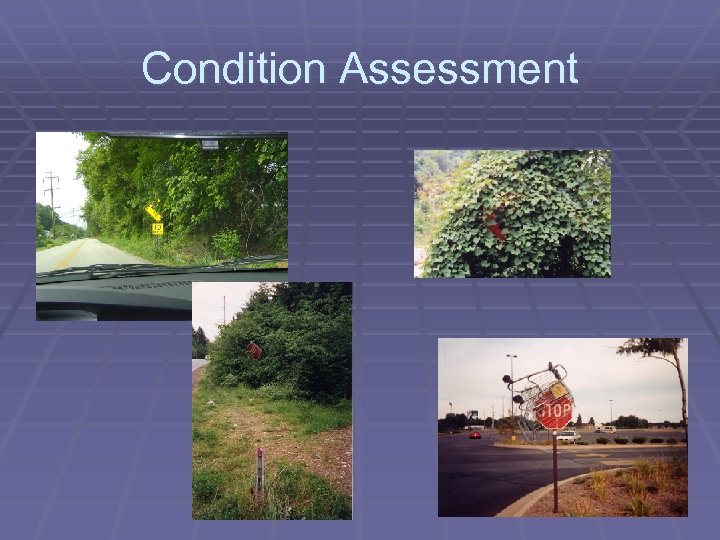 Condition Assessment
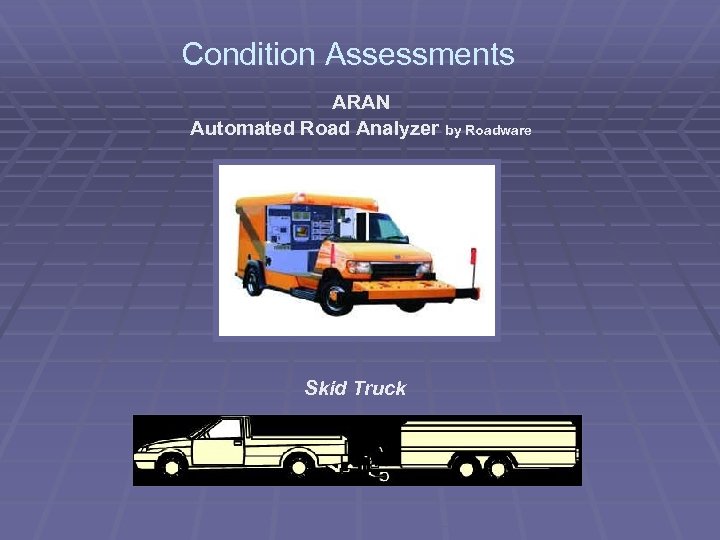 Condition Assessments ARAN Automated Road Analyzer by Roadware Skid Truck
 Sharing the Pain § Pavements: Flexible Pavements (HMA), PCC Pavements, Unpaved Roads; Paved Shoulders, and Unpaved Shoulders § Roadsides: Vegetation and aesthetics, Trees, Shrubs and brush, Historic Markers, and Right-of-way Fence § Drainage Structures: Cross Pipes and Box Culverts, Entrance Pipes, Curb & Gutter, Paved Ditches, Unpaved Ditches, Edge Drains and Underdrains, Storm Water Ponds, and Drop Inlets § Traffic: Attenuators, Guardrail, Pavement striping, Pavement markings, Raised pavement markers, Delineators, Signs, and Highway Lighting § Structures and Bridges: Overhead Sign Structures, Structural Culverts, Overall Bridge, Sound Barriers, and Retaining Walls § Special Facilities: Movable Bridges, Rest Areas, River and Mountain Tunnels, Weigh Stations, and Traffic monitoring Systems
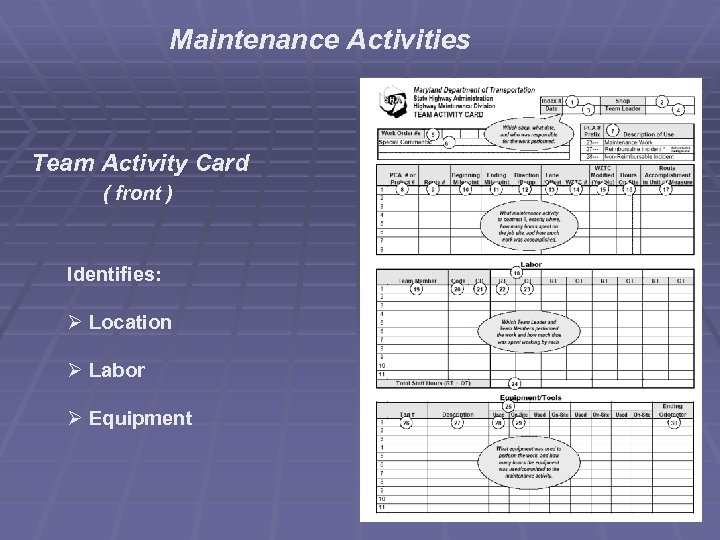 Maintenance Activities Team Activity Card ( front ) Identifies: Ø Location Ø Labor Ø Equipment
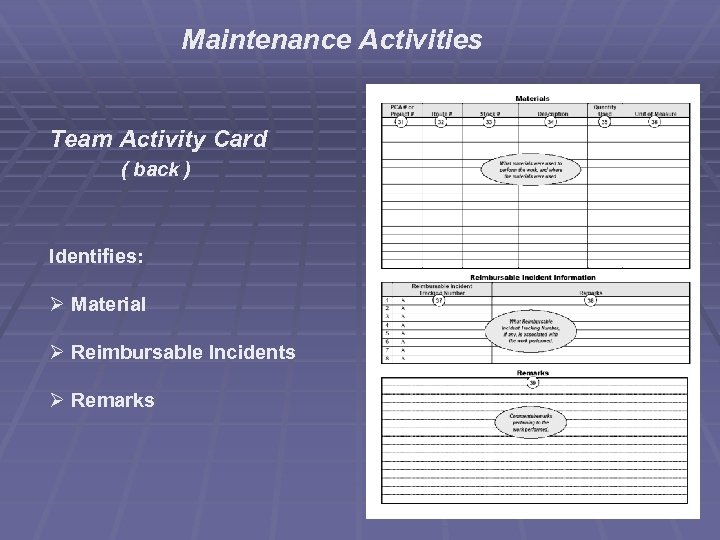 Maintenance Activities Team Activity Card ( back ) Identifies: Ø Material Ø Reimbursable Incidents Ø Remarks

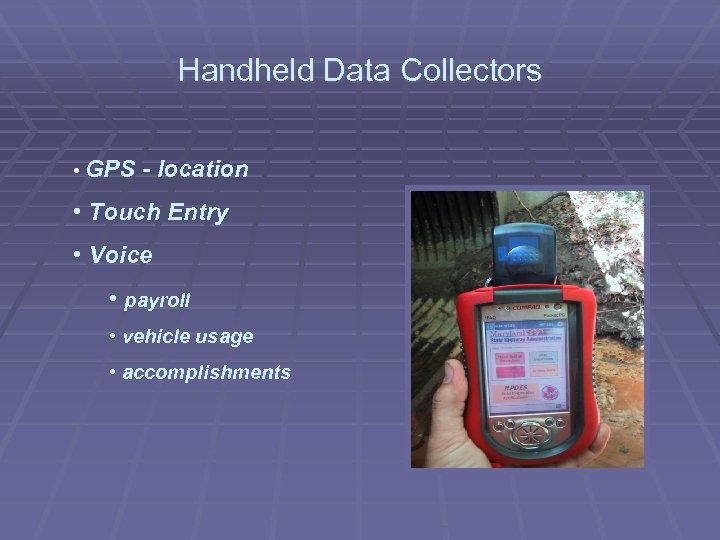 Handheld Data Collectors • GPS - location • Touch Entry • Voice • payroll • vehicle usage • accomplishments
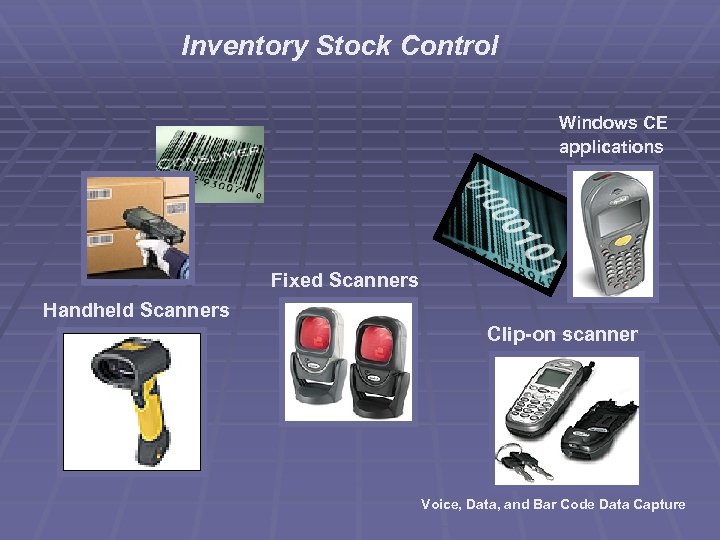 Inventory Stock Control Windows CE applications Fixed Scanners Handheld Scanners Clip-on scanner Voice, Data, and Bar Code Data Capture
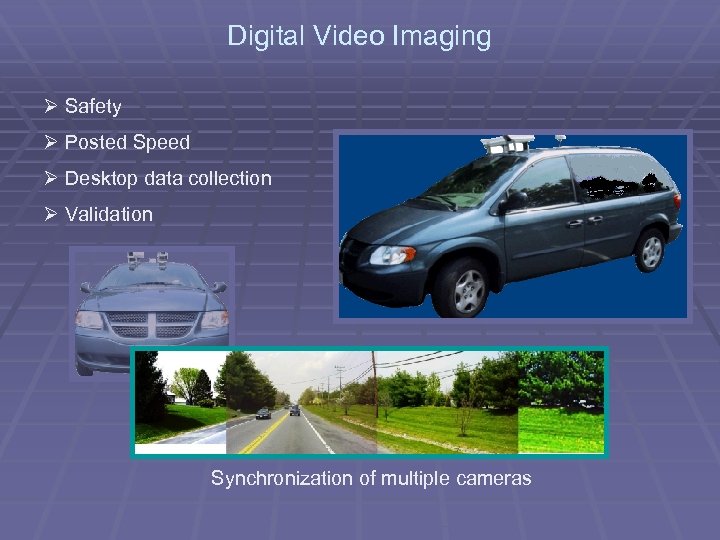 Digital Video Imaging Ø Safety Ø Posted Speed Ø Desktop data collection Ø Validation Synchronization of multiple cameras
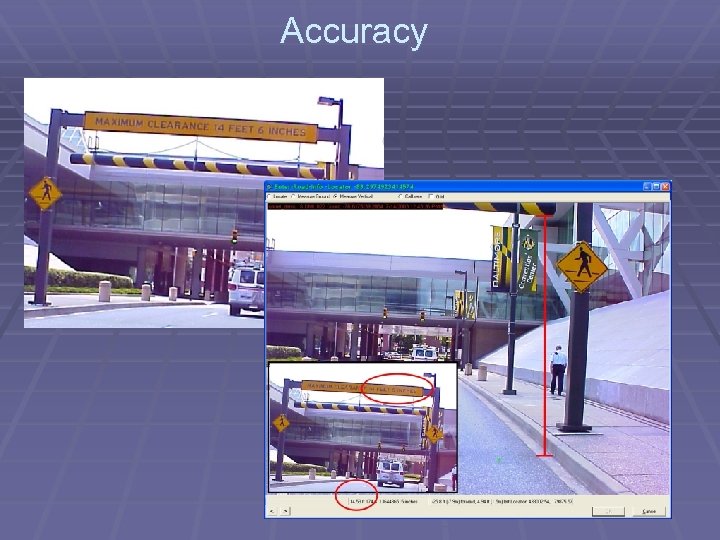 Accuracy
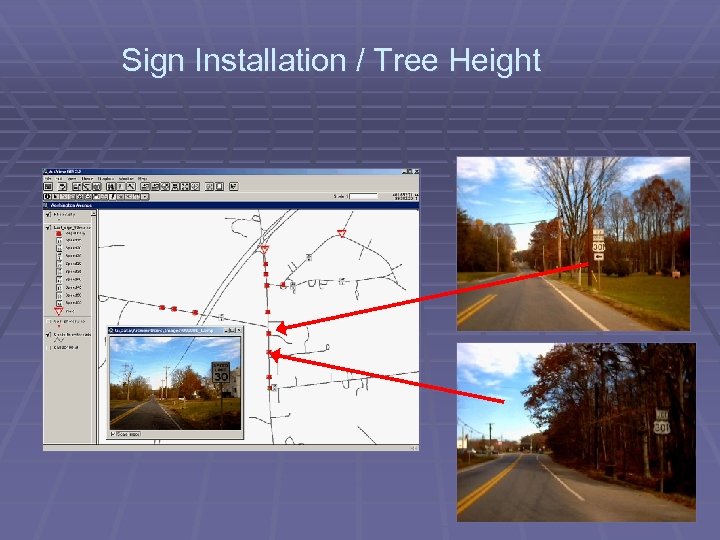 Sign Installation / Tree Height
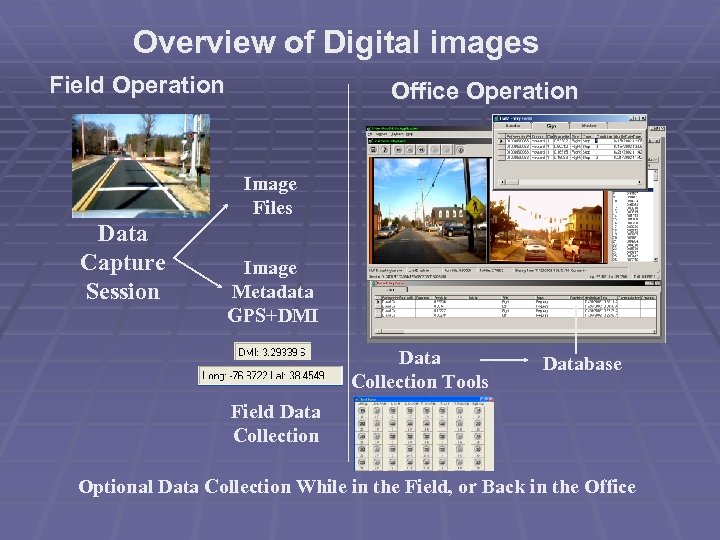 Overview of Digital images Field Operation Office Operation Image Files Data Capture Session Image Metadata GPS+DMI Data Collection Tools Database Field Data Collection Optional Data Collection While in the Field, or Back in the Office
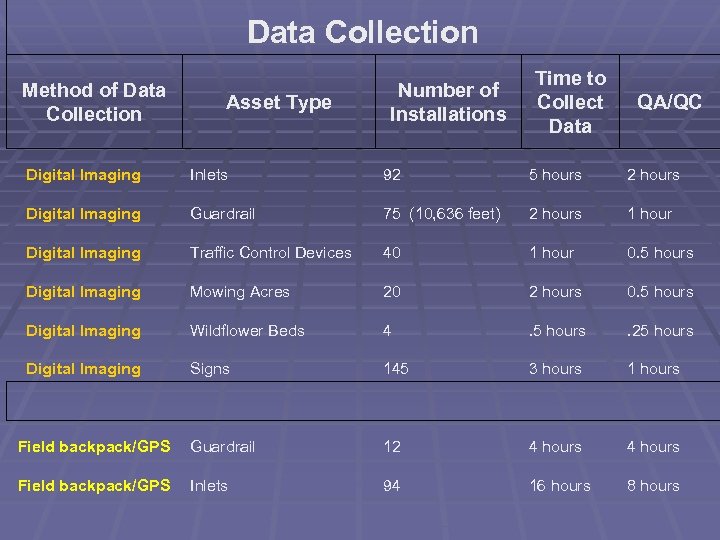 Data Collection Method of Data Collection Time to Collect Data Number of Installations Asset Type QA/QC Digital Imaging Inlets 92 5 hours 2 hours Digital Imaging Guardrail 75 (10, 636 feet) 2 hours 1 hour Digital Imaging Traffic Control Devices 40 1 hour 0. 5 hours Digital Imaging Mowing Acres 20 2 hours 0. 5 hours Digital Imaging Wildflower Beds 4 . 5 hours . 25 hours Digital Imaging Signs 145 3 hours 1 hours Field backpack/GPS Guardrail 12 4 hours Field backpack/GPS Inlets 94 16 hours 8 hours
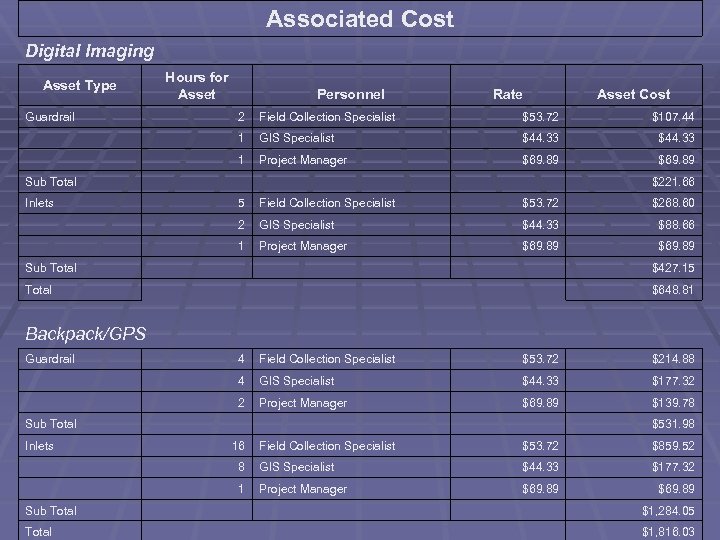 Associated Cost Digital Imaging Hours for Asset Type Personnel Rate Asset Cost Guardrail 2 Field Collection Specialist $53. 72 $107. 44 1 GIS Specialist $44. 33 1 Project Manager $69. 89 Sub Total $221. 66 Inlets 5 Field Collection Specialist $53. 72 $268. 60 2 GIS Specialist $44. 33 $88. 66 1 Project Manager $69. 89 Sub Total $427. 15 $648. 81 Backpack/GPS Guardrail 4 Field Collection Specialist $53. 72 $214. 88 4 GIS Specialist $44. 33 $177. 32 2 Project Manager $69. 89 $139. 78 Sub Total Inlets 16 $531. 98 Field Collection Specialist $53. 72 $859. 52 8 GIS Specialist $44. 33 $177. 32 1 Project Manager $69. 89 Sub Total $1, 284. 05 $1, 816. 03
 Who will collect the data?
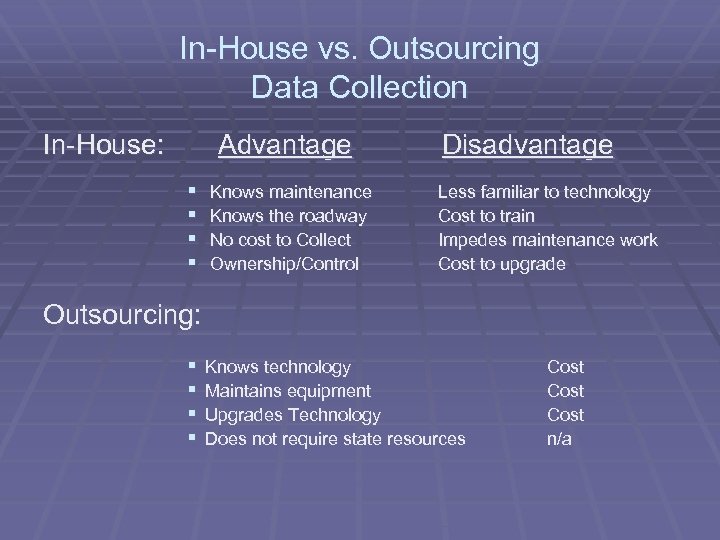 In-House vs. Outsourcing Data Collection In-House: Advantage § § Knows maintenance Knows the roadway No cost to Collect Ownership/Control Disadvantage Less familiar to technology Cost to train Impedes maintenance work Cost to upgrade Outsourcing: § § Knows technology Maintains equipment Upgrades Technology Does not require state resources Cost n/a
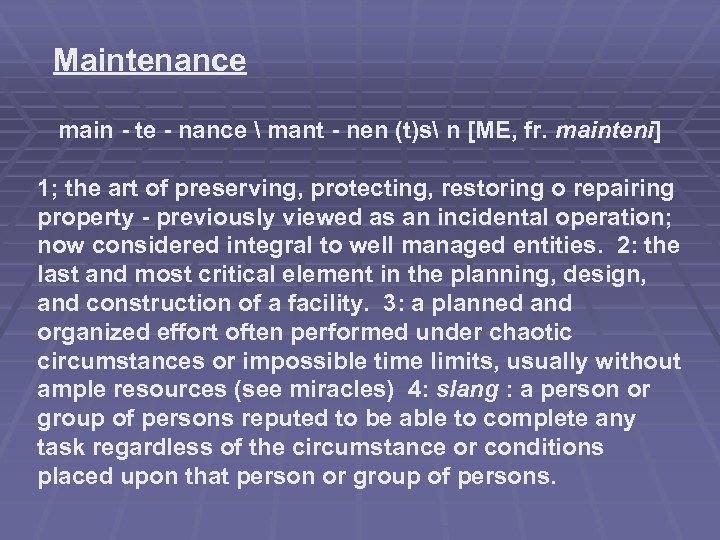 Maintenance main - te - nance mant - nen (t)s n [ME, fr. mainteni] 1; the art of preserving, protecting, restoring o repairing property - previously viewed as an incidental operation; now considered integral to well managed entities. 2: the last and most critical element in the planning, design, and construction of a facility. 3: a planned and organized effort often performed under chaotic circumstances or impossible time limits, usually without ample resources (see miracles) 4: slang : a person or group of persons reputed to be able to complete any task regardless of the circumstance or conditions placed upon that person or group of persons.