 Скачать презентацию Technology and Corruption The Case of FMIS Bill
30d66aff0fd7f96b19c0f05fbc11612c.ppt
- Количество слайдов: 16



Technology and Corruption: The Case of FMIS Bill Dorotinsky The World Bank March 26, 2003 IACC Seoul, Korea
Outline • • What is an FMIS? What are elements of an FMIS? What is an “integrated” FMIS? What constitutes a “good” IFMIS? Why invest in an IFMIS? IFMIS and Corruption Bank Experience Summary The World Bank 2
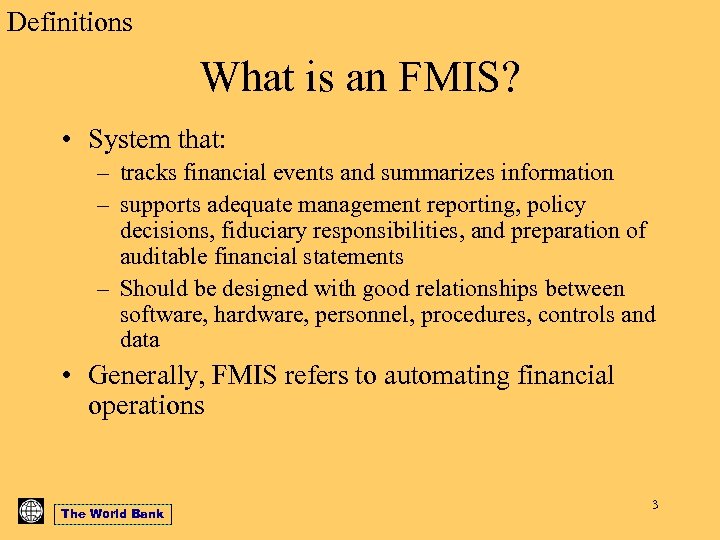
Definitions What is an FMIS? • System that: – tracks financial events and summarizes information – supports adequate management reporting, policy decisions, fiduciary responsibilities, and preparation of auditable financial statements – Should be designed with good relationships between software, hardware, personnel, procedures, controls and data • Generally, FMIS refers to automating financial operations The World Bank 3
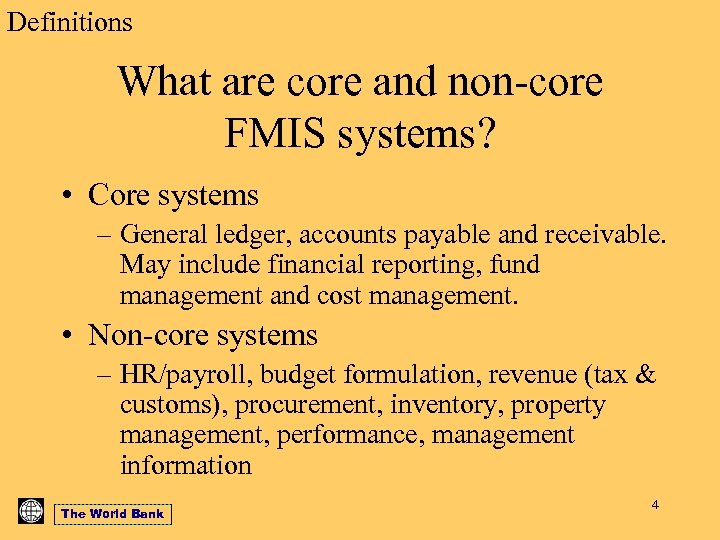
Definitions What are core and non-core FMIS systems? • Core systems – General ledger, accounts payable and receivable. May include financial reporting, fund management and cost management. • Non-core systems – HR/payroll, budget formulation, revenue (tax & customs), procurement, inventory, property management, performance, management information The World Bank 4
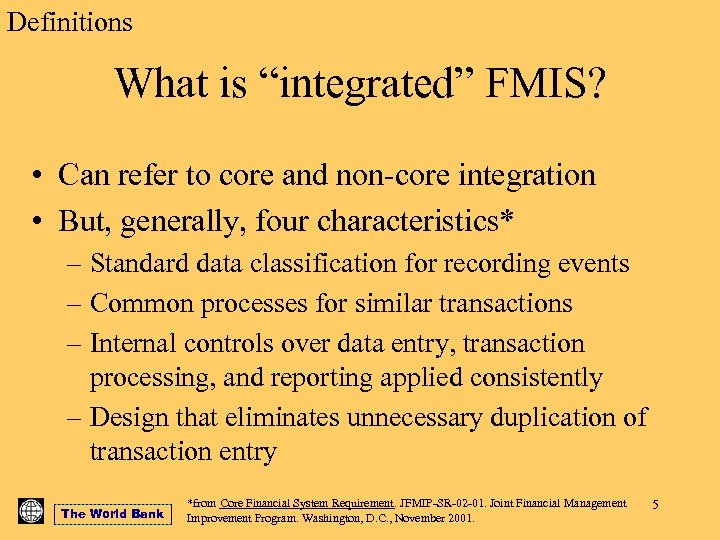
Definitions What is “integrated” FMIS? • Can refer to core and non-core integration • But, generally, four characteristics* – Standard data classification for recording events – Common processes for similar transactions – Internal controls over data entry, transaction processing, and reporting applied consistently – Design that eliminates unnecessary duplication of transaction entry The World Bank *from Core Financial System Requirement. JFMIP-SR-02 -01. Joint Financial Management Improvement Program. Washington, D. C. , November 2001. 5
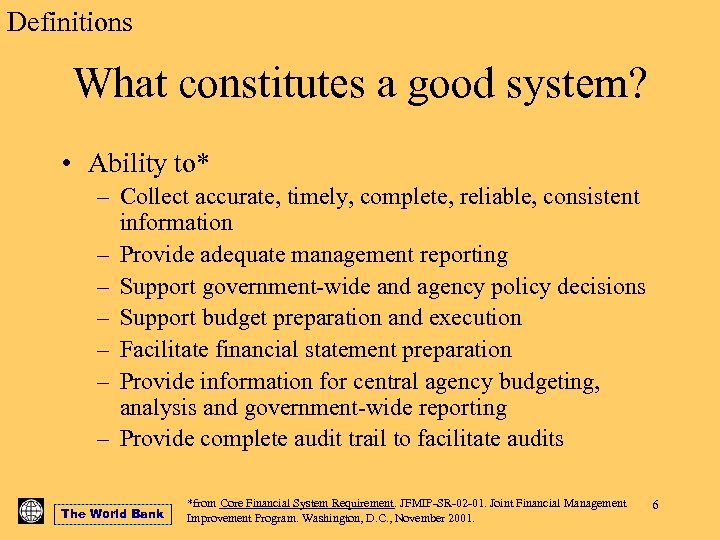
Definitions What constitutes a good system? • Ability to* – Collect accurate, timely, complete, reliable, consistent information – Provide adequate management reporting – Support government-wide and agency policy decisions – Support budget preparation and execution – Facilitate financial statement preparation – Provide information for central agency budgeting, analysis and government-wide reporting – Provide complete audit trail to facilitate audits The World Bank *from Core Financial System Requirement. JFMIP-SR-02 -01. Joint Financial Management Improvement Program. Washington, D. C. , November 2001. 6
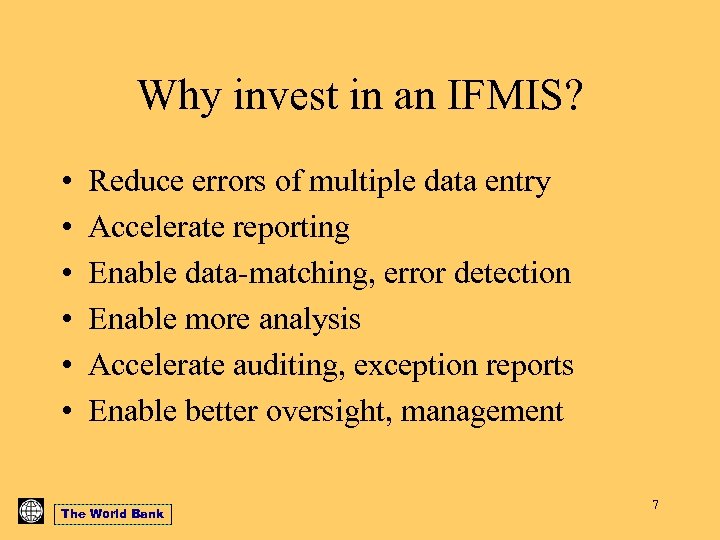
Why invest in an IFMIS? • • • Reduce errors of multiple data entry Accelerate reporting Enable data-matching, error detection Enable more analysis Accelerate auditing, exception reports Enable better oversight, management The World Bank 7
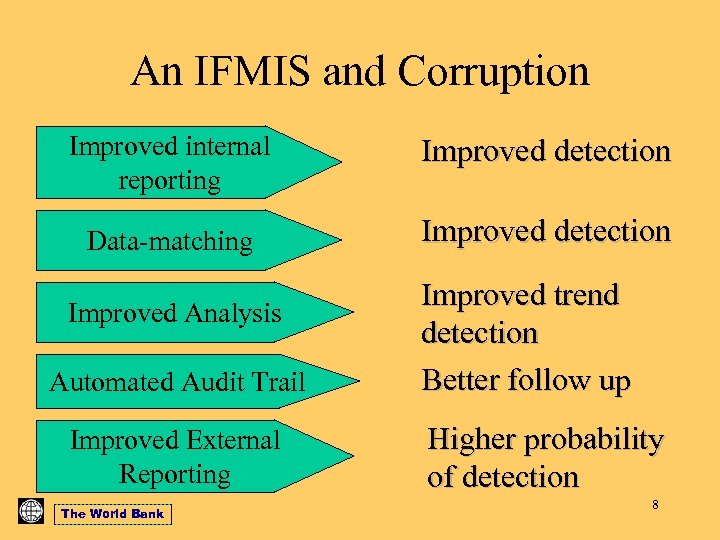
An IFMIS and Corruption Improved internal reporting Improved detection Data-matching Improved detection Improved Analysis Automated Audit Trail Improved External Reporting The World Bank Improved trend detection Better follow up Higher probability of detection 8
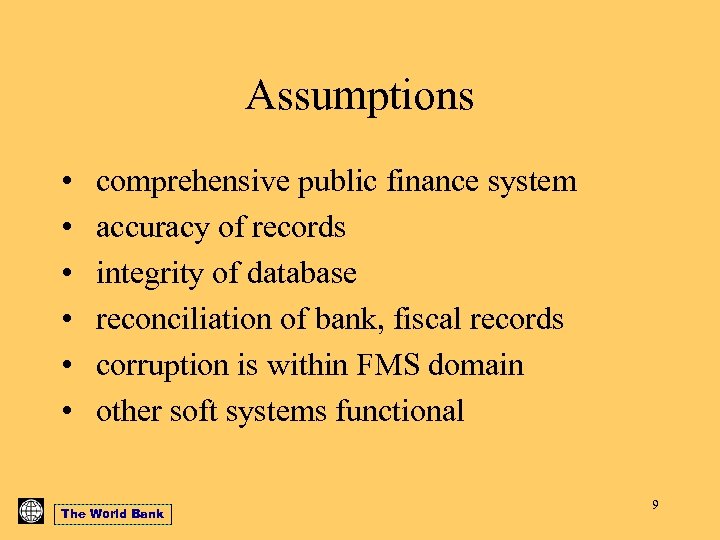
Assumptions • • • comprehensive public finance system accuracy of records integrity of database reconciliation of bank, fiscal records corruption is within FMS domain other soft systems functional The World Bank 9
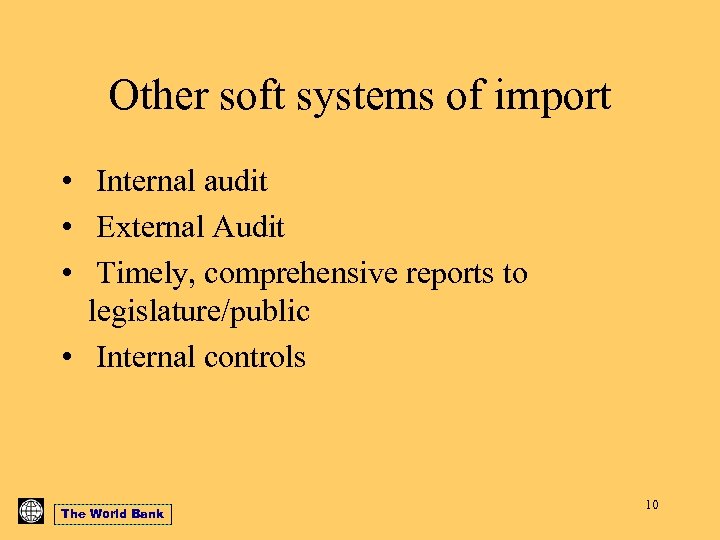
Other soft systems of import • Internal audit • External Audit • Timely, comprehensive reports to legislature/public • Internal controls The World Bank 10
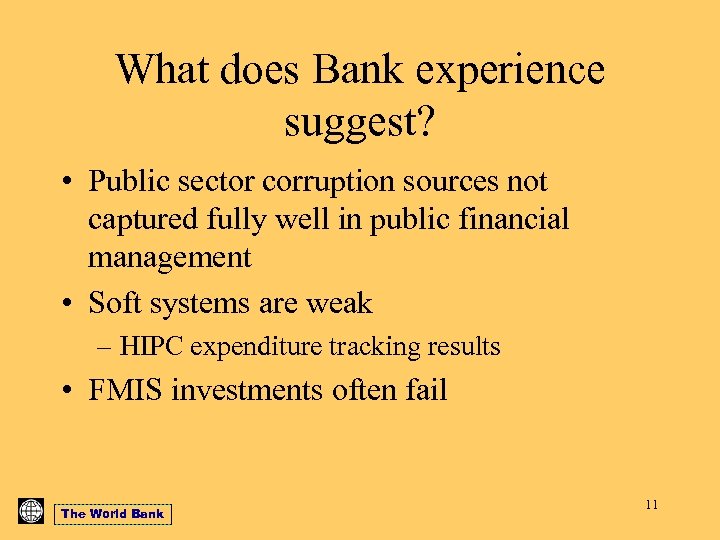
What does Bank experience suggest? • Public sector corruption sources not captured fully well in public financial management • Soft systems are weak – HIPC expenditure tracking results • FMIS investments often fail The World Bank 11
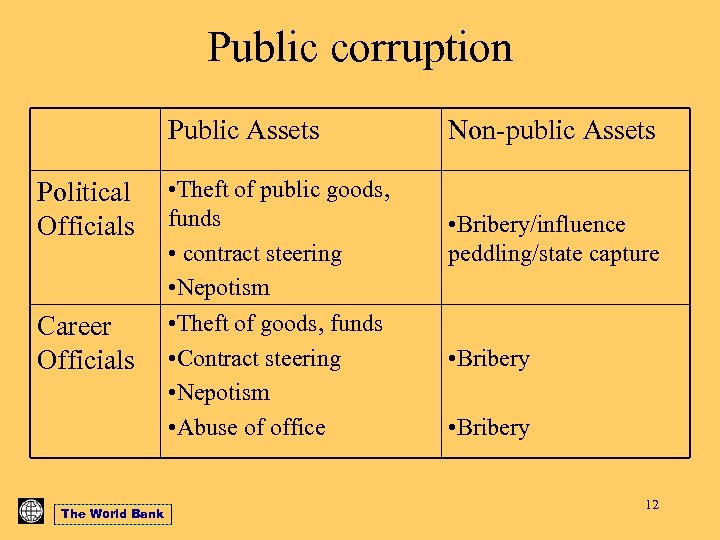
Public corruption Public Assets Political Officials Career Officials The World Bank • Theft of public goods, funds • contract steering • Nepotism • Theft of goods, funds • Contract steering • Nepotism • Abuse of office Non-public Assets • Bribery/influence peddling/state capture • Bribery 12
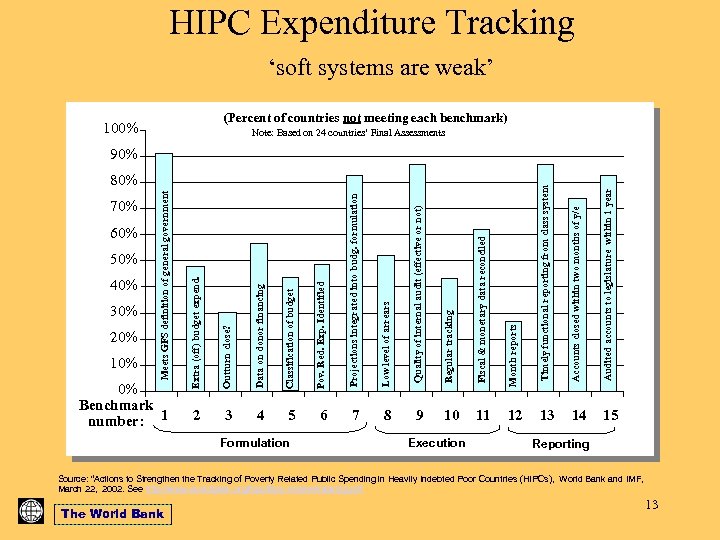
HIPC Expenditure Tracking ‘soft systems are weak’ (Percent of countries not meeting each benchmark) 100% Note: Based on 24 countries’ Final Assessments Fiscal & monetary data reconciled Month reports 3 4 5 6 7 8 9 10 11 12 Formulation Execution Audited accounts to legislature within 1 year Regular tracking 2 Accounts closed within two months of y/e Quality of internal audit (effective or not) 0% Benchmark number: 1 Low level of arrears 10% Projections integrated into budg. formulation 20% Pov. Red. Exp. Identified 30% Classification of budget 40% Data on donor financing 50% Outturn close? 60% Extra (off) budget expend. 70% Meets GFS definition of general government 80% Timely functional reporting from class system 90% 13 14 15 Reporting Source: “Actions to Strengthen the Tracking of Poverty Related Public Spending in Heavily Indebted Poor Countries (HIPCs), World Bank and IMF, March 22, 2002. See http: //www. worldbank. org/hipc-review/tracking. pdf The World Bank 13
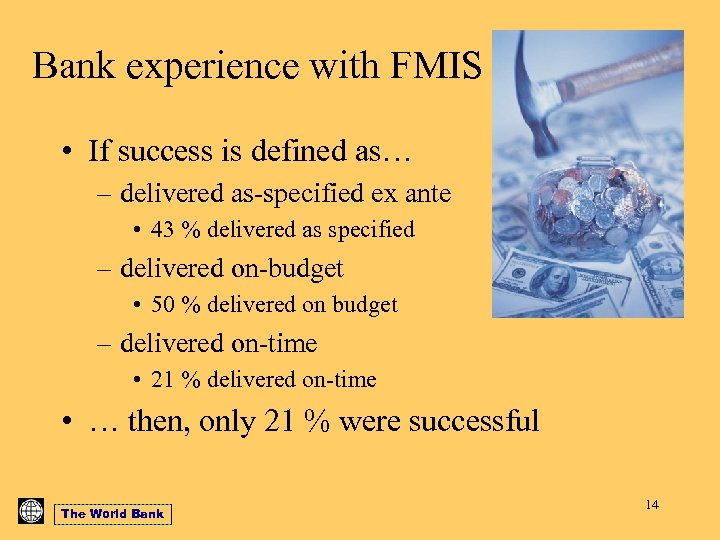
Bank experience with FMIS • If success is defined as… – delivered as-specified ex ante • 43 % delivered as specified – delivered on-budget • 50 % delivered on budget – delivered on-time • 21 % delivered on-time • … then, only 21 % were successful The World Bank 14
More Bank experience with FMIS • But, these indicators only looks at project, not impact on over-all financial management, operations – Improvements to reporting? Staffing changes? • Generally, • no or weak performance indicators in projects • no baseline • broader impact assessment difficult. • However, in self-assessed sustainability • 25 % unsustainable • 69 % likely sustainable • 6 % highly likely to be sustainable The World Bank 15
Summary • IFMIS/technology enabling tool for transparency and anticorruption • But not substitute for – attention to institutional environment (‘soft systems’) – underlying factors (e. g. comprehensiveness) • May not target prime areas of corruption • May not be optimal investment for anticorruption The World Bank 16
Скачать презентацию Technology and Corruption The Case of FMIS Bill
30d66aff0fd7f96b19c0f05fbc11612c.ppt