


 Скачать презентацию Technologies in Large-Scale Assessments טיוטא New Directions Challenges
f5a56b1cbf89234d2fc5968368704bdc.ppt
- Количество слайдов: 65
 Technologies in Large-Scale Assessments טיוטא New Directions, Challenges & Opportunities Michal Beller Director-General of RAMA The National Authority for Measurement and Evaluation in Education, Israel Introductio n CET Large Scale Assessmen ts (LSA) Internationa l Large Scale Assessment s (ILSA) Recent Developme nts The Challenges International Large-Scale Assessment Conference March 16 -18, 2011 ETS , Princeton, NJ ראמ"ה רשות ארצית למדידה והערכה בחינוך © 2011 # 1
 Personal Preface Introductio n טיוטא CET Large Scale Assessmen ts (LSA) Internationa l Large Scale Assessment s (ILSA) Recent Developme nts The Challenges RAMA - The National Authority for Measurement and Evaluation in Education ראמ"ה רשות ארצית למדידה והערכה בחינוך © 2011 # 2
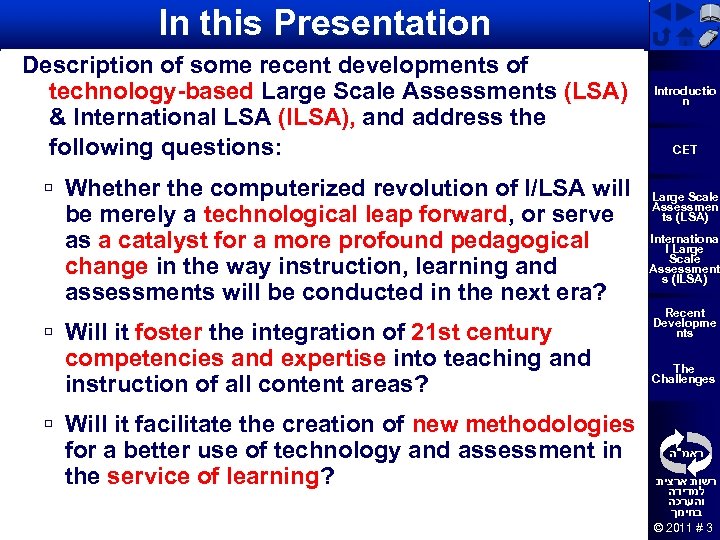 In this Presentation Description of some recent developments of technology-based Large Scale Assessments (LSA) & International LSA (ILSA), and address the following questions: טיוטא ú Whether the computerized revolution of I/LSA will be merely a technological leap forward, or serve as a catalyst for a more profound pedagogical change in the way instruction, learning and assessments will be conducted in the next era? ú Will it foster the integration of 21 st century competencies and expertise into teaching and instruction of all content areas? ú Will it facilitate the creation of new methodologies for a better use of technology and assessment in the service of learning? Introductio n CET Large Scale Assessmen ts (LSA) Internationa l Large Scale Assessment s (ILSA) Recent Developme nts The Challenges ראמ"ה רשות ארצית למדידה והערכה בחינוך © 2011 # 3
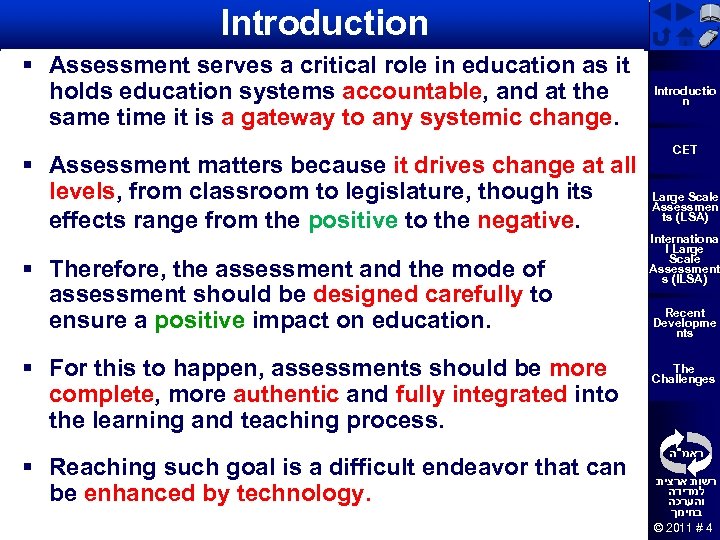 Introduction § Assessment serves a critical role in education as it holds education systems accountable, and at the same time it is a gateway to any systemic change. טיוטא § Assessment matters because it drives change at all levels, from classroom to legislature, though its effects range from the positive to the negative. § Therefore, the assessment and the mode of assessment should be designed carefully to ensure a positive impact on education. § For this to happen, assessments should be more complete, more authentic and fully integrated into the learning and teaching process. § Reaching such goal is a difficult endeavor that can be enhanced by technology. Introductio n CET Large Scale Assessmen ts (LSA) Internationa l Large Scale Assessment s (ILSA) Recent Developme nts The Challenges ראמ"ה רשות ארצית למדידה והערכה בחינוך © 2011 # 4
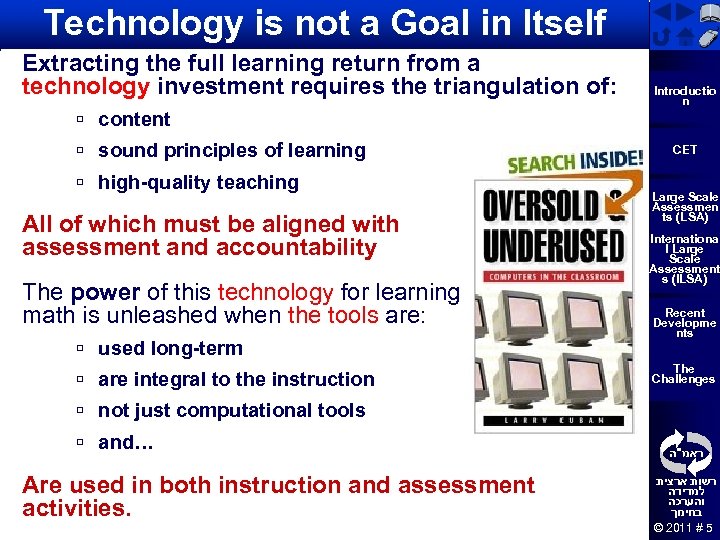 Technology is not a Goal in Itself Extracting the full learning return from a technology investment requires the triangulation of: ú content טיוטא ú sound principles of learning ú high-quality teaching All of which must be aligned with assessment and accountability The power of this technology for learning math is unleashed when the tools are: ú used long-term ú are integral to the instruction Introductio n CET Large Scale Assessmen ts (LSA) Internationa l Large Scale Assessment s (ILSA) Recent Developme nts The Challenges ú not just computational tools ú and… Are used in both instruction and assessment activities. ראמ"ה רשות ארצית למדידה והערכה בחינוך © 2011 # 5
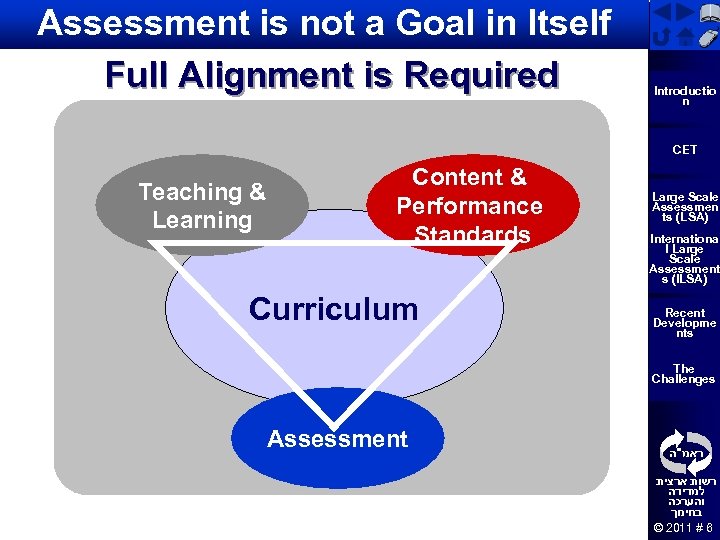 Assessment is not a Goal in Itself Full Alignment is Required טיוטא Teaching & Learning Content & Performance Standards Curriculum Introductio n CET Large Scale Assessmen ts (LSA) Internationa l Large Scale Assessment s (ILSA) Recent Developme nts The Challenges Assessment ראמ"ה רשות ארצית למדידה והערכה בחינוך © 2011 # 6
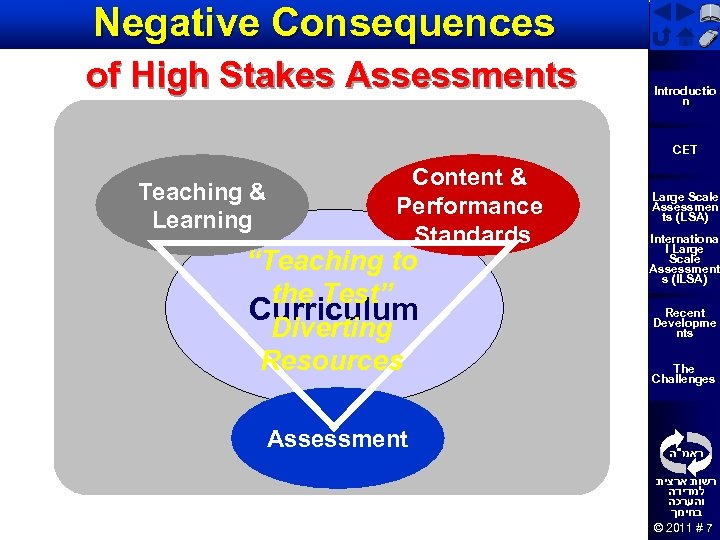 Negative Consequences of High Stakes Assessments טיוטא Teaching & Learning Content & Performance Standards “Teaching to Curriculum the Test” Curriculum Diverting Resources Assessment Introductio n CET Large Scale Assessmen ts (LSA) Internationa l Large Scale Assessment s (ILSA) Recent Developme nts The Challenges ראמ"ה רשות ארצית למדידה והערכה בחינוך © 2011 # 7
 Effective Integration of. . . § Effective integration of technology in the learning and teaching process is a common challenge to almost every education system in the world. טיוטא § Effective integration of assessment in learning and teaching is an even greater challenge, particularly due to the need to strike the right balance between formative and summative assessments Introductio n CET Large Scale Assessmen ts (LSA) Internationa l Large Scale Assessment s (ILSA) Recent Developme nts The Challenges ראמ"ה רשות ארצית למדידה והערכה בחינוך © 2011 # 8
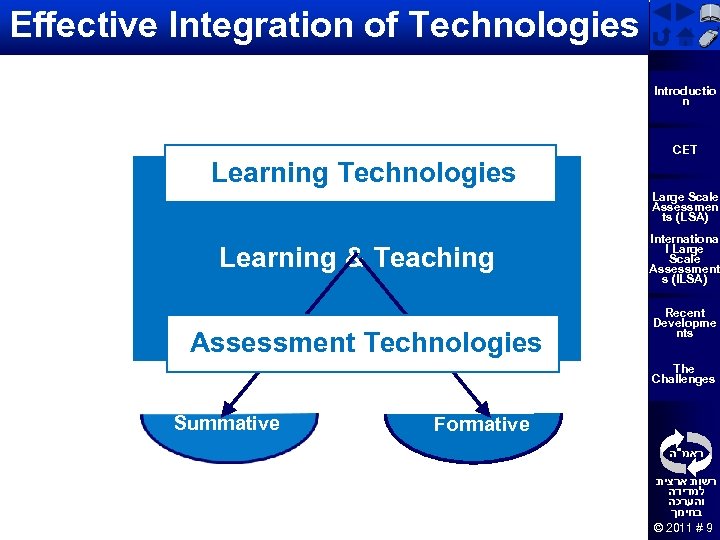 Effective Integration of Technologies Introductio n טיוטא Learning Technologies CET Large Scale Assessmen ts (LSA) Learning & Teaching Assessment Technologies Internationa l Large Scale Assessment s (ILSA) Recent Developme nts The Challenges Summative Formative ראמ"ה רשות ארצית למדידה והערכה בחינוך © 2011 # 9
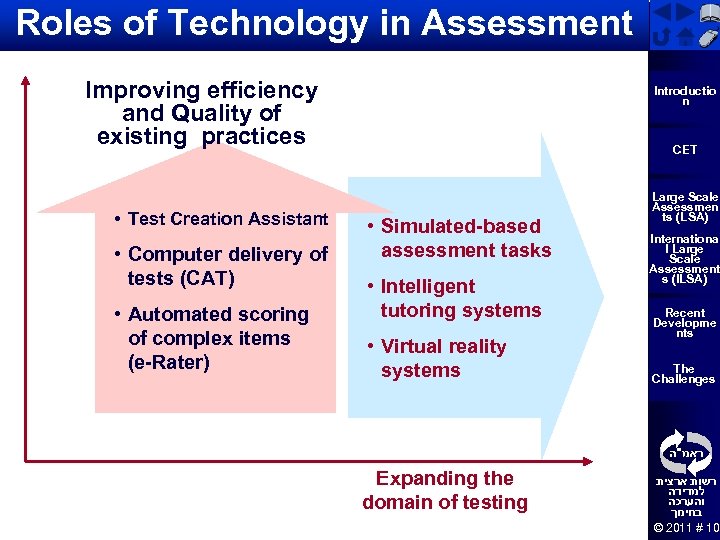 Roles of Technology in Assessment Improving efficiency and Quality of existing practices Introductio n טיוטא • Test Creation Assistant • Computer delivery of tests (CAT) • Automated scoring of complex items (e-Rater) • Simulated-based assessment tasks • Intelligent tutoring systems • Virtual reality systems CET Large Scale Assessmen ts (LSA) Internationa l Large Scale Assessment s (ILSA) Recent Developme nts The Challenges ראמ"ה Expanding the domain of testing רשות ארצית למדידה והערכה בחינוך © 2011 # 10
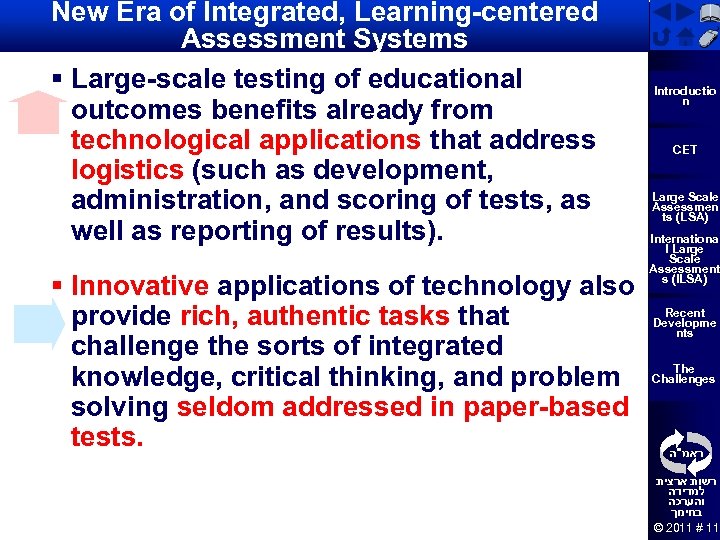 New Era of Integrated, Learning-centered Assessment Systems § Large-scale testing of educational outcomes benefits already from technological applications that address logistics (such as development, administration, and scoring of tests, as well as reporting of results). טיוטא § Innovative applications of technology also provide rich, authentic tasks that challenge the sorts of integrated knowledge, critical thinking, and problem solving seldom addressed in paper-based tests. Introductio n CET Large Scale Assessmen ts (LSA) Internationa l Large Scale Assessment s (ILSA) Recent Developme nts The Challenges ראמ"ה רשות ארצית למדידה והערכה בחינוך © 2011 # 11
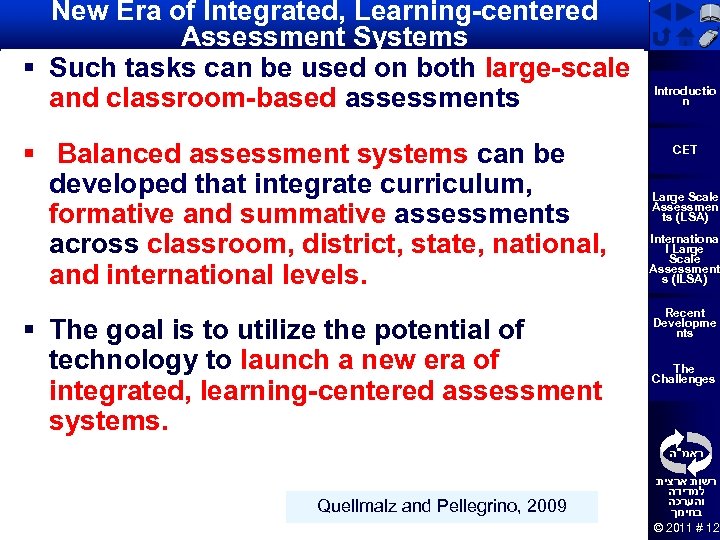 New Era of Integrated, Learning-centered Assessment Systems § Such tasks can be used on both large-scale and classroom-based assessments טיוטא § Balanced assessment systems can be developed that integrate curriculum, formative and summative assessments across classroom, district, state, national, and international levels. § The goal is to utilize the potential of technology to launch a new era of integrated, learning-centered assessment systems. Introductio n CET Large Scale Assessmen ts (LSA) Internationa l Large Scale Assessment s (ILSA) Recent Developme nts The Challenges ראמ"ה Quellmalz and Pellegrino, 2009 רשות ארצית למדידה והערכה בחינוך © 2011 # 12
 Universal Design of Assessment § Technology allows the development of assessments using Universal Design principles that make assessments more accessible, effective, and valid for students with greater diversity in terms of disabilities and limited language proficiency. טיוטא § Main design principles: ú Alternative representations of same concepts and skills ú Presenting information through multiple modalities Introductio n CET Large Scale Assessmen ts (LSA) Internationa l Large Scale Assessment s (ILSA) Recent Developme nts The Challenges ú Assistive technologies ראמ"ה רשות ארצית למדידה והערכה בחינוך © 2011 # 13
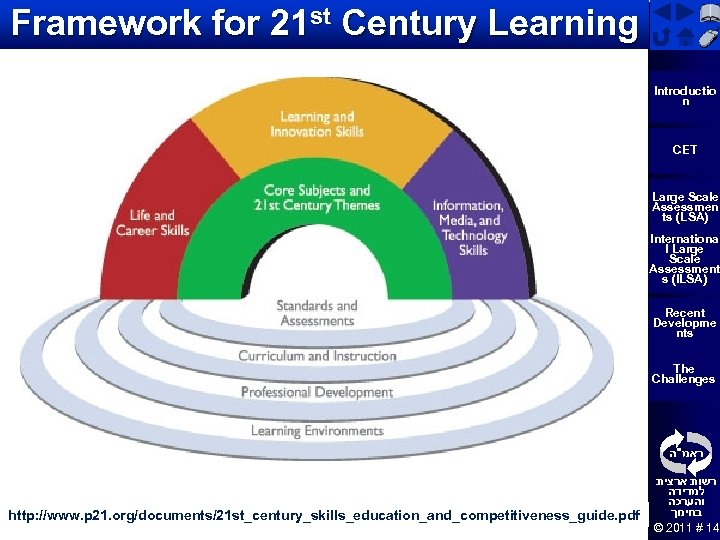 Framework for 21 st Century Learning Introductio n טיוטא CET Large Scale Assessmen ts (LSA) Internationa l Large Scale Assessment s (ILSA) Recent Developme nts The Challenges ראמ"ה http: //www. p 21. org/documents/21 st_century_skills_education_and_competitiveness_guide. pdf רשות ארצית למדידה והערכה בחינוך © 2011 # 14
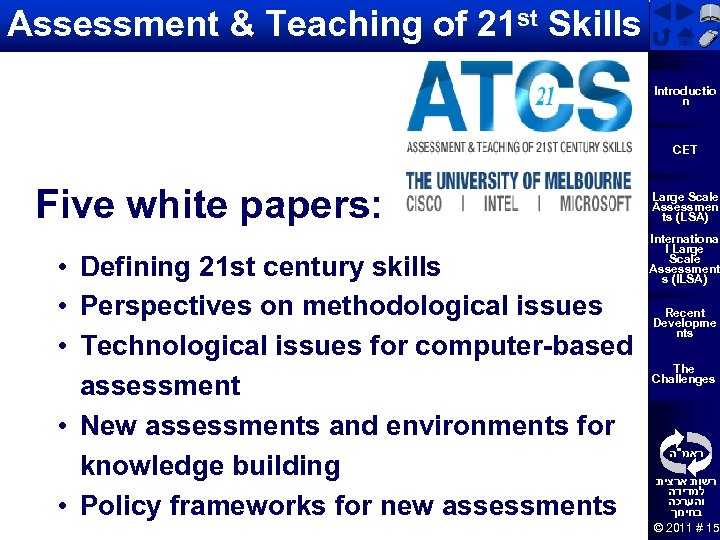 Assessment & Teaching of 21 st Skills Introductio n טיוטא Five white papers: • Defining 21 st century skills • Perspectives on methodological issues • Technological issues for computer-based assessment • New assessments and environments for knowledge building • Policy frameworks for new assessments CET Large Scale Assessmen ts (LSA) Internationa l Large Scale Assessment s (ILSA) Recent Developme nts The Challenges ראמ"ה רשות ארצית למדידה והערכה בחינוך © 2011 # 15
 Working Group on Technological Issues Led by Benő Csapó the group looks at the many ways technology can be used to improve assessment: טיוטא • Detecting and recording students’ psychomotor, cognitive and emotional characteristics • Enabling adaptive or personalized testing, in which students are presented with a unique set of tasks focused on their individual performance levels • Administering dynamic problems that change the conditions, information or instructions as the student is working • Evaluating how fast students arrived at the answers and the processes they used - making the students’ thinking visible Introductio n CET Large Scale Assessmen ts (LSA) Internationa l Large Scale Assessment s (ILSA) Recent Developme nts The Challenges ראמ"ה רשות ארצית למדידה והערכה בחינוך © 2011 # 16
 Requirements for Effective Integration of Technologies and Assessment should be: ú Aligned with the development of significant 21 st century learning goals טיוטא ú Adaptable and responsive to new developments in technology and in education ú Largely performance-based ú Add value for teaching and learning by providing information that can be acted upon by students, teachers, and administrators ú Better meet general criteria for good assessment (i. e. , be fair, technically sound, valid for purpose, and part of a comprehensive and well-aligned system of assessment at all levels of education) Introductio n CET Large Scale Assessmen ts (LSA) Internationa l Large Scale Assessment s (ILSA) Recent Developme nts The Challenges ראמ"ה רשות ארצית למדידה והערכה בחינוך © 2011 # 17
 Goals of Integration of Technology into Assessment Thoughtful integration of technology into assessment may serve two complementary goals: טיוטא § An innovative use of technology for learning and for the assessment of complex cognitive skills (e. g. , Diagnoser, Sim. Scientists, CET). § A new accountability paradigm which fully integrates sequential formative assessments and periodic summative assessments via computers (e. g. , CBAL to be discussed later). Introductio n CET Large Scale Assessmen ts (LSA) Internationa l Large Scale Assessment s (ILSA) Recent Developme nts The Challenges ראמ"ה רשות ארצית למדידה והערכה בחינוך © 2011 # 18
 Sim. Scientists ? What is § Introductio n טיוטא The Sim. Scientists program in West. Ed's Science, Technology, Engineering & Mathematics (STEM) program is comprised of a portfolio of research and development projects that focus on the roles that simulations can play in enriching science learning and assessment. The capabilities of technology allow modifications of simulationbased activities to offer accommodations for English learners and students with disabilities. Science simulations can be used in curriculum activities, as embedded, formative assessments, and as summative assessments. The Sim. Scientists program investigates design principles to guide the creation of effective simulations as learning and assessment tools. In addition, the Sim. Scientists program studies how science simulations can be used at different levels of the educational system - classroom, district, and state in balanced state science assessment systems. CET Large Scale Assessmen ts (LSA) Internationa l Large Scale Assessment s (ILSA) Recent Developme nts The Challenges ראמ"ה רשות ארצית למדידה והערכה בחינוך © 2011 # 19
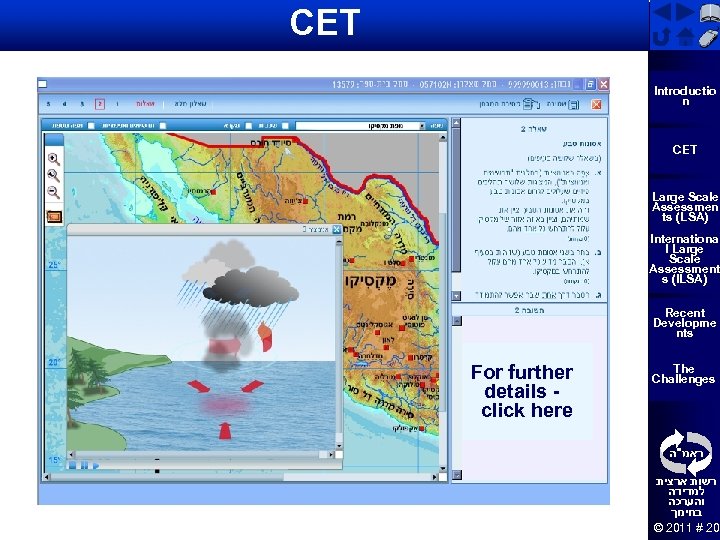 CET Introductio n טיוטא CET Large Scale Assessmen ts (LSA) Internationa l Large Scale Assessment s (ILSA) Recent Developme nts For further details - click here The Challenges ראמ"ה רשות ארצית למדידה והערכה בחינוך © 2011 # 20
 Introductio n טיוטא The Role of Technology in National Large Scale Assessments (LSA) CET Large Scale Assessmen ts (LSA) Internationa l Large Scale Assessment s (ILSA) Recent Developme nts The Challenges ראמ"ה רשות ארצית למדידה והערכה בחינוך © 2011 # 21
 Organizational and Technical Issues § In large-scale implementation efforts up until now, the school infrastructure are usually given, and either the existing equipment is used as is they are, or new equipment is installed for assessment However, this presentation will not deal purposes. Logistics in these cases plays with technological opportunities ahead a crucial role. of us, nor with technological barriers existing today (e. g. , access to § It is rather clear that existing computers in schools, bi-directional innovative technologies, such adaptation of the test platform). as smart phones and tablets, as well as future technologies, hold the potential to dramatically change the way assessment will be implemented in the future. טיוטא Introductio n CET Large Scale Assessmen ts (LSA) Internationa l Large Scale Assessment s (ILSA) Recent Developme nts The Challenges ראמ"ה רשות ארצית למדידה והערכה בחינוך © 2011 # 22
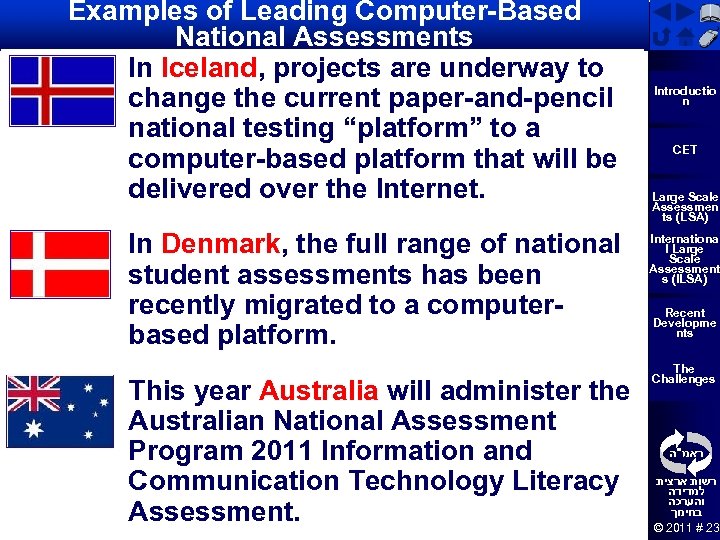 Examples of Leading Computer-Based National Assessments In Iceland, projects are underway to change the current paper-and-pencil national testing “platform” to a computer-based platform that will be delivered over the Internet. טיוטא In Denmark, the full range of national student assessments has been recently migrated to a computerbased platform. This year Australia will administer the Australian National Assessment Program 2011 Information and Communication Technology Literacy Assessment. Introductio n CET Large Scale Assessmen ts (LSA) Internationa l Large Scale Assessment s (ILSA) Recent Developme nts The Challenges ראמ"ה רשות ארצית למדידה והערכה בחינוך © 2011 # 23
 National Assessment of Educational Progress Introductio n Research Projects: טיוטא CET • MOL - Math Online Large Scale Assessmen ts (LSA) • WOL - Writing Online Internationa l Large Scale Assessment s (ILSA) • TRE - Problem Solving in Technology-Rich Environment Recent Developme nts The Challenges Large Scale Implementations 8 th Grade 12 th Grade TELA 2014 ראמ"ה רשות ארצית למדידה והערכה בחינוך © 2011 # 24
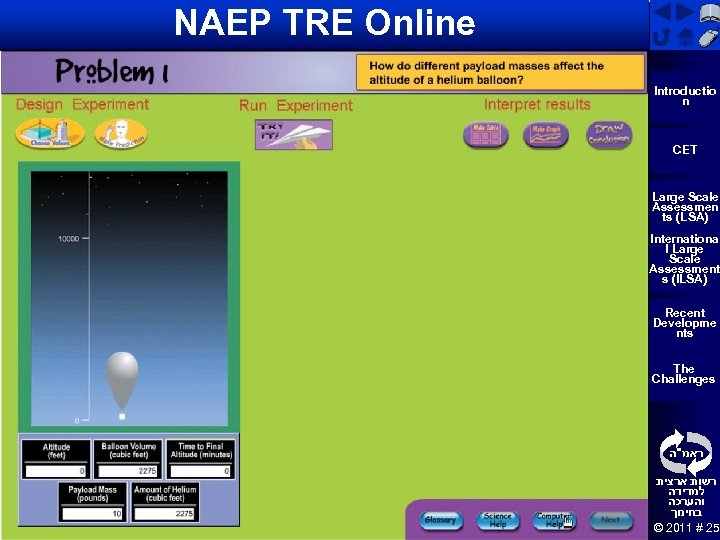 NAEP TRE Online Introductio n טיוטא CET Large Scale Assessmen ts (LSA) Internationa l Large Scale Assessment s (ILSA) Recent Developme nts The Challenges ראמ"ה רשות ארצית למדידה והערכה בחינוך © 2011 # 25
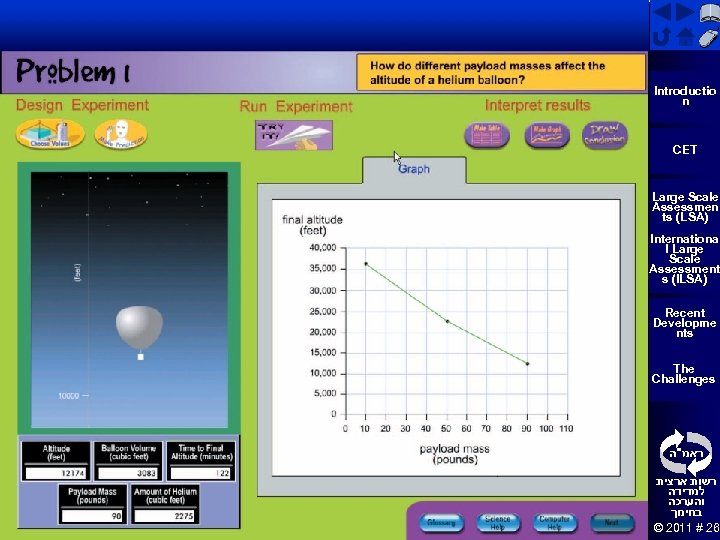 Introductio n טיוטא CET Large Scale Assessmen ts (LSA) Internationa l Large Scale Assessment s (ILSA) Recent Developme nts The Challenges ראמ"ה רשות ארצית למדידה והערכה בחינוך © 2011 # 26
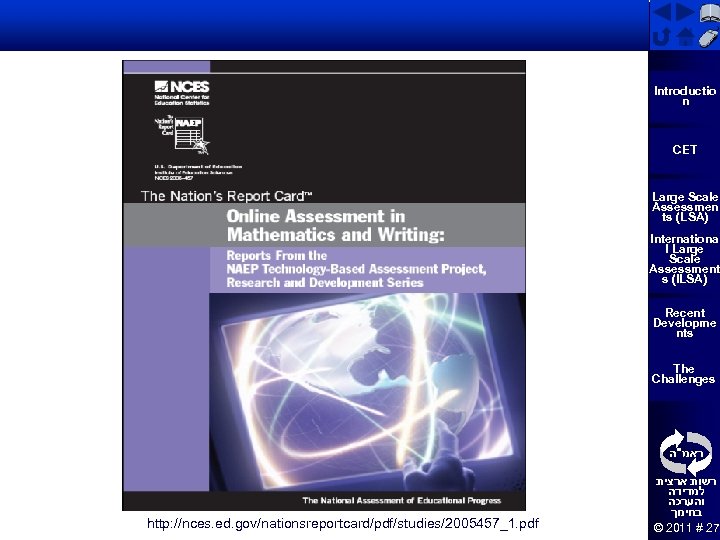 Introductio n טיוטא CET Large Scale Assessmen ts (LSA) Internationa l Large Scale Assessment s (ILSA) Recent Developme nts The Challenges ראמ"ה http: //nces. ed. gov/nationsreportcard/pdf/studies/2005457_1. pdf רשות ארצית למדידה והערכה בחינוך © 2011 # 27
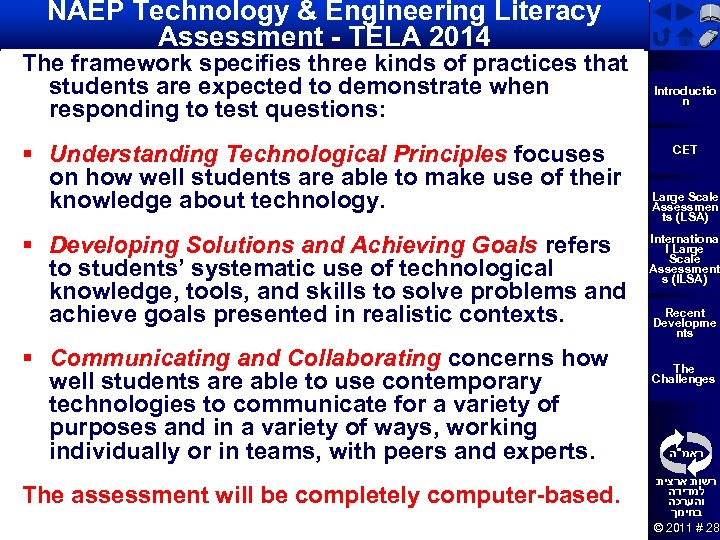 NAEP Technology & Engineering Literacy Assessment - TELA 2014 The framework specifies three kinds of practices that students are expected to demonstrate when responding to test questions: טיוטא § Understanding Technological Principles focuses on how well students are able to make use of their knowledge about technology. § Developing Solutions and Achieving Goals refers to students’ systematic use of technological knowledge, tools, and skills to solve problems and achieve goals presented in realistic contexts. § Communicating and Collaborating concerns how well students are able to use contemporary technologies to communicate for a variety of purposes and in a variety of ways, working individually or in teams, with peers and experts. The assessment will be completely computer-based. Introductio n CET Large Scale Assessmen ts (LSA) Internationa l Large Scale Assessment s (ILSA) Recent Developme nts The Challenges ראמ"ה רשות ארצית למדידה והערכה בחינוך © 2011 # 28
 State Assessments: Oregon and West Virginia Oregon Introductio n טיוטא OAKS - Oregon Assessment of Knowledge & CET Skills, is a new online testing system assessing students' mastery of Oregon content standards. Large Scale Assessmen The OAKS online operational test is now ts (LSA) available for Reading, Mathematics, Science, and Internationa l Large Scale Social Sciences. Assessment s (ILSA) West Virginia Recent Developme nts tech. Steps is a personalized, project-based The Challenges technology literacy curriculum that infuses technology skills into core instruction, promoting core subject area outcomes while also teaching ראמ"ה skills for 21 st century. רשות ארצית למדידה והערכה בחינוך © 2011 # 29
 Introductio n טיוטא The Role of Technology in International Large Scale Assessments (ILSA) CET Large Scale Assessmen ts (LSA) Internationa l Large Scale Assessment s (ILSA) Recent Developme nts The Challenges ראמ"ה רשות ארצית למדידה והערכה בחינוך © 2011 # 30
 ILSA - Introduction The growing popularity of International Large Scale Assessments (ILSA) has been accompanied, along with its positive impact, by the following: טיוטא § In many countries today ILSA frameworks constitute de-facto standards for learning goals in the subjects measured, and thus the curricula in different countries have been aligned with theoretical framework of these assessments. § In a number of countries the results and rankings of ILSA have become politically high-stakes: Education ministers and governments perceive them as being a test of the success of their policy (e. g. , Poland, Germany, and Israel). As such these international assessments exacerbate the negative consequences that accompany highstakes tests in different countries ("teaching to the test", diverting resources, etc. ). Introductio n CET Large Scale Assessmen ts (LSA) Internationa l Large Scale Assessment s (ILSA) Recent Developme nts The Challenges ראמ"ה רשות ארצית למדידה והערכה בחינוך © 2011 # 31
 Benefits of Technology for ILSA § A computer-based approach to assessments could ensure that tests align better with the performance levels of individual students, giving them more challenging and more manageable and adaptive tasks based on their past performance. טיוטא § In particular, adaptive tests allow for a more finegrained analysis of the entire performance continuum, embracing the most and least able students. § Use of technology make assessment more inclusive and fair for all students, including those with disabilities (i. e. , by using alternate representations of the same task). § Finally, computer delivery brings practical advantages, including automated scoring, timely reporting and lower data entry costs. Introductio n CET Large Scale Assessmen ts (LSA) Internationa l Large Scale Assessment s (ILSA) Recent Developme nts The Challenges ראמ"ה רשות ארצית למדידה והערכה בחינוך © 2011 # 32
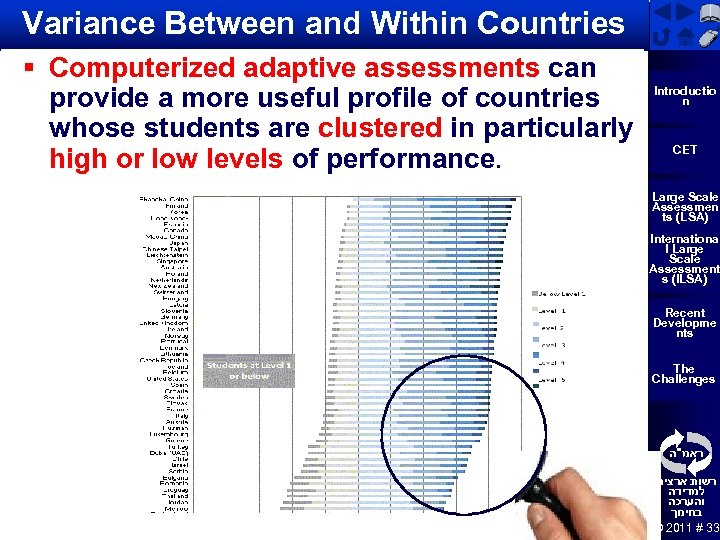 Variance Between and Within Countries § Computerized adaptive assessments can provide a more useful profile of countries whose students are clustered in particularly high or low levels of performance. טיוטא Introductio n CET Large Scale Assessmen ts (LSA) Internationa l Large Scale Assessment s (ILSA) Recent Developme nts The Challenges ראמ"ה רשות ארצית למדידה והערכה בחינוך © 2011 # 33
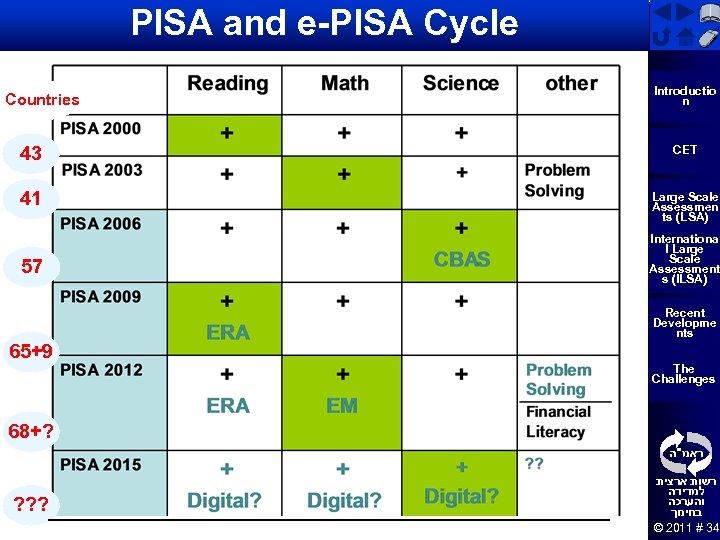 PISA and e-PISA Cycle Introductio n Countries 43 41 57 טיוטא CET Large Scale Assessmen ts (LSA) Internationa l Large Scale Assessment s (ILSA) Recent Developme nts 65+9 The Challenges 68+? ראמ"ה ? ? ? רשות ארצית למדידה והערכה בחינוך © 2011 # 34
 PISA: Making Use of Electronic Assessments Not only to Measure Information and Communication Technology (ICT) Literacy Skills But also to: טיוטא ú Allow for a wider range of dynamic and interactive tasks ú Explore more efficient ways of carrying out the main tests of student knowledge and skills in reading, mathematics and science Introductio n CET Large Scale Assessmen ts (LSA) Internationa l Large Scale Assessment s (ILSA) Recent Developme nts The Challenges ראמ"ה רשות ארצית למדידה והערכה בחינוך © 2011 # 35
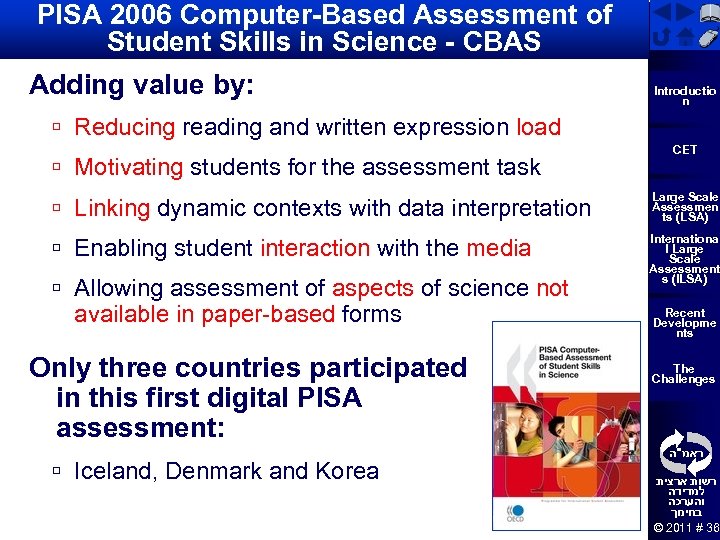 PISA 2006 Computer-Based Assessment of Student Skills in Science - CBAS Adding value by: טיוטא Introductio n ú Reducing reading and written expression load ú Motivating students for the assessment task CET ú Linking dynamic contexts with data interpretation Large Scale Assessmen ts (LSA) ú Enabling student interaction with the media Internationa l Large Scale Assessment s (ILSA) ú Allowing assessment of aspects of science not available in paper-based forms Only three countries participated in this first digital PISA assessment: ú Iceland, Denmark and Korea Recent Developme nts The Challenges ראמ"ה רשות ארצית למדידה והערכה בחינוך © 2011 # 36
 PISA 2009/2012 ERA § § Reading of electronic texts is becoming increasingly necessary and prevalent in society. טיוטא PISA recognized this and integrated the reading of electronic texts into the PISA 2009 Reading (ERA) Framework. Introductio n CET Large Scale Assessmen ts (LSA) § ERA is aimed at assessing the reading literacy of 15 -year-olds using electronic texts. § Recent It was an international option in PISA Developme nts 2009 (19 countries participated), and it is an option also for PISA 2012. The Challenges § ERA is a 40 -minute test using existing school IT infrastructure. Internationa l Large Scale Assessment s (ILSA) ראמ"ה רשות ארצית למדידה והערכה בחינוך © 2011 # 37
 Three Major Differences between Print and Electronic Texts § Electronic reading is more likely to traverse different kinds of texts from different sources. ú The PISA electronic reading framework sketches a classification of text forms found in the digital medium, and represents this diversity in the ERA instrument with mixed and multiple texts that require readers to integrate information across several sites or pages presenting information in different forms. טיוטא § There is a greater onus on the reader to evaluate the text. ú This is because electronic texts have not typically undergone the scrutiny that is involved in the publication of print-based text. The implication of the mass of information has major implications for readers’ ability to reflect on and evaluate what they read. Readers need to swiftly evaluate the credibility of information; critical thinking therefore gains even more importance in this medium. § There is a greater onus on the reader to select and construct the text. ú In print-based texts, the physical status of the printed text encourages the reader to approach the content of the text in a particular sequence. In contrast, electronic texts have navigation tools and features that make possible and indeed even require that the reader create their own reading sequence. Introductio n CET Large Scale Assessmen ts (LSA) Internationa l Large Scale Assessment s (ILSA) Recent Developme nts The Challenges ראמ"ה רשות ארצית למדידה והערכה בחינוך © 2011 # 38
 PISA 2012 - Electronic Math § The definition of mathematical literacy in PISA 2012 explicitly calls for the use of mathematical tools, which include technological tools, to make judgments and decisions. טיוטא § Since PISA items reflect problems that arise in personal, occupational, social and scientific contexts, a calculator is of assistance in many PISA items. Computers and calculators relieve the burden of computation so that individual respondents' attention can be focused on strategies, concepts and structures, rather than on mechanical procedures. § A computer-based assessment will provide the opportunity to extend the integration of technologies - such as statistical tools, geometric construction and visualization utilities, and virtual measuring instruments - into the test items. Introductio n CET Large Scale Assessmen ts (LSA) Internationa l Large Scale Assessment s (ILSA) Recent Developme nts The Challenges ראמ"ה רשות ארצית למדידה והערכה בחינוך © 2011 # 39
 PISA 2012 e-Problem Solving § The development of competency in problem solving is a central objective within the educational programs of many countries. Introductio n § Inclusion of problems which cannot be solved without the respondent interacting with the problem situation: Large Scale Assessmen ts (LSA) טיוטא ú It will focus on the cognitive skills required to solve unfamiliar problems in life. These cognitive skills may involve modeling or representation of the problem, creative thinking and critical thinking in solving the problem. ú The assessment items be situated in a wide range of real-world contexts and may not have any definite solution. ú The computer-delivered medium will resemble problem solving in real-life situations: variation in the problem situation during the problem solving process, and interaction between the problem solver and the problem. CET Internationa l Large Scale Assessment s (ILSA) Recent Developme nts The Challenges ראמ"ה רשות ארצית למדידה והערכה בחינוך © 2011 # 40
 PISA 2015 - A Recent Call for Tender The plans for PISA 2015 are proceeding on the assumption that computer delivery will be a significant aspect of PISA 2015. טיוטא § All-around solution: item development, item review, test compilation, test delivery and administration. Introductio n CET Large Scale Assessmen ts (LSA) § Ubiquitous: extensive range of operating systems, over the internet. Internationa l Large Scale Assessment s (ILSA) § Innovation: Exploit the possibilities that arise from the use of new technologies to assess students' knowledge and skills in everyday tasks and challenges, in keeping with PISA's definition of literacy. Recent Developme nts § Adaptability: solution should also be adaptable to allow for evolution over the PISA cycles e. g. , to assess new domains, to cope with new test designs. The Challenges ראמ"ה רשות ארצית למדידה והערכה בחינוך © 2011 # 41
 Programme for the International Assessment of Adult Competencies (PIAAC) Aims at developing a strategy to address the supply and demand of adult (16 -64) competencies that would: טיוטא Computer -based Introductio n CET Large Scale Assessmen ts (LSA) § Identify and measure differences between Internationa individuals and countries in competencies believed l Large Scale Assessment to underlie both personal and societal success. s (ILSA) § Assess the impact of these competencies on social and economic outcomes at individual and aggregate levels. Recent Developme nts The Challenges § Gauge the performance of education and training systems in generating required competencies. ראמ"ה § Help to clarify the policy levers that could contribute to enhancing competencies. רשות ארצית למדידה והערכה בחינוך © 2011 # 42
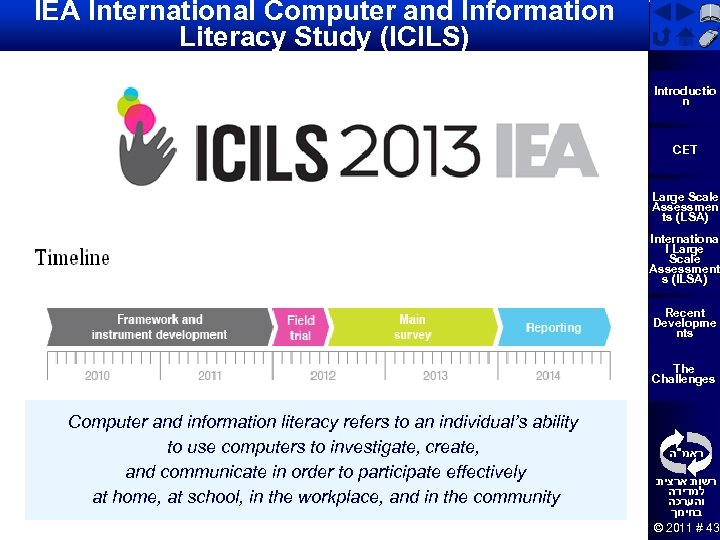 IEA International Computer and Information Literacy Study (ICILS) Introductio n טיוטא CET Large Scale Assessmen ts (LSA) Internationa l Large Scale Assessment s (ILSA) Recent Developme nts The Challenges Computer and information literacy refers to an individual’s ability to use computers to investigate, create, and communicate in order to participate effectively at home, at school, in the workplace, and in the community ראמ"ה רשות ארצית למדידה והערכה בחינוך © 2011 # 43
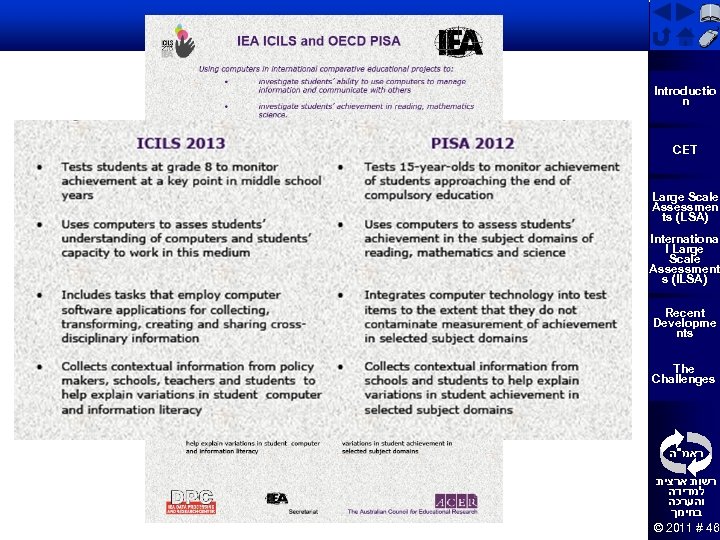
 ICILS 2013 § The assessment of Computer and Information Literacy (CIL) will be authentic and computerbased. טיוטא § ICILS will incorporate multiple-choice and constructed response items based on realistic stimulus material; software simulations of generic applications so that students are required to complete an action in response to an instruction; and authentic tasks that require students to modify and create information products using “live” computer software applications. § ICILS is an interdisciplinary assessment and the modules represent a range of focuses, tasks, & contexts related to CIL. Introductio n CET Large Scale Assessmen ts (LSA) Internationa l Large Scale Assessment s (ILSA) Recent Developme nts The Challenges ראמ"ה רשות ארצית למדידה והערכה בחינוך © 2011 # 44
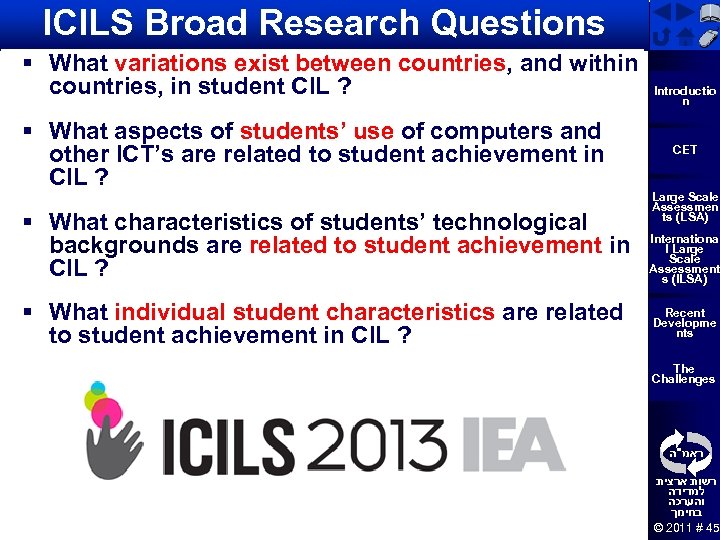 ICILS Broad Research Questions § What variations exist between countries, and within countries, in student CIL ? טיוטא § What aspects of students’ use of computers and other ICT’s are related to student achievement in CIL ? § What characteristics of students’ technological backgrounds are related to student achievement in CIL ? § What individual student characteristics are related to student achievement in CIL ? Introductio n CET Large Scale Assessmen ts (LSA) Internationa l Large Scale Assessment s (ILSA) Recent Developme nts The Challenges ראמ"ה רשות ארצית למדידה והערכה בחינוך © 2011 # 45
 Introductio n טיוטא CET Large Scale Assessmen ts (LSA) Internationa l Large Scale Assessment s (ILSA) Recent Developme nts The Challenges ראמ"ה רשות ארצית למדידה והערכה בחינוך © 2011 # 46
 Introductio n טיוטא Recent Developments CET Large Scale Assessmen ts (LSA) Internationa l Large Scale Assessment s (ILSA) Recent Developme nts The Challenges ראמ"ה רשות ארצית למדידה והערכה בחינוך © 2011 # 47
 Measurement, 8: 70– 91, 2010 Copyright © Educational Testing Service טיוטא Cognitively Based Assessment of, for, and as Learning (CBAL) A Preliminary Theory of Action for Summative and Formative Assessment Introductio n CET Large Scale Assessmen ts (LSA) Internationa l Large Scale Assessment s (ILSA) Recent Developme nts The Challenges Randy Elliot Bennett ראמ"ה Educational Testing Service רשות ארצית למדידה והערכה בחינוך © 2011 # 48
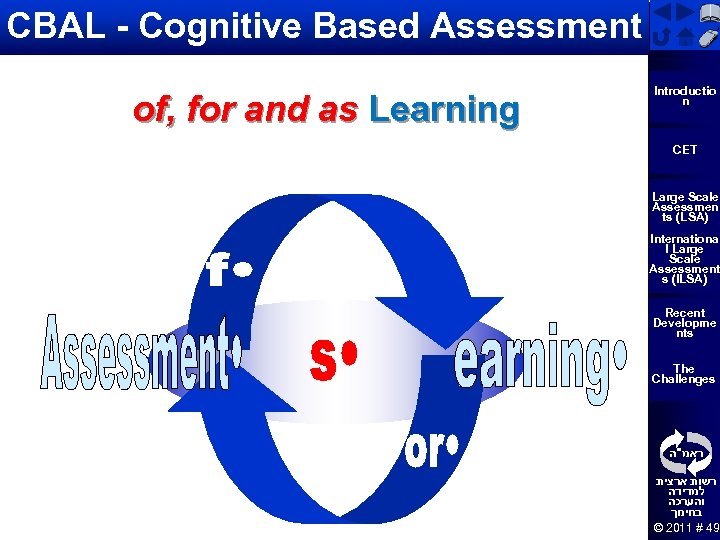 CBAL - Cognitive Based Assessment of, for and as Learning טיוטא Introductio n CET Large Scale Assessmen ts (LSA) Internationa l Large Scale Assessment s (ILSA) Recent Developme nts The Challenges ראמ"ה רשות ארצית למדידה והערכה בחינוך © 2011 # 49
 A Presidential Call President Barack Obama, Address to the Hispanic Chamber of Commerce, March 10, 2009 טיוטא “I'm calling on our nation's governors and state education chiefs to develop standards and assessments that don't simply measure whether students can fill in a bubble on a test, Introductio n CET Large Scale Assessmen ts (LSA) Internationa l Large Scale Assessment s (ILSA) Recent Developme nts The Challenges but whether they possess 21 st century skills like problem-solving and critical thinking and entrepreneurship and creativity. ” ראמ"ה רשות ארצית למדידה והערכה בחינוך © 2011 # 50
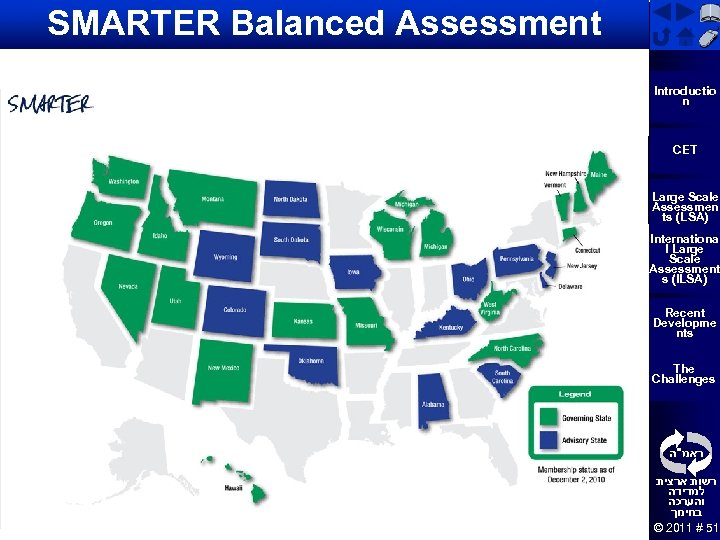 SMARTER Balanced Assessment Introductio n טיוטא CET Large Scale Assessmen ts (LSA) Internationa l Large Scale Assessment s (ILSA) Recent Developme nts The Challenges ראמ"ה רשות ארצית למדידה והערכה בחינוך © 2011 # 51
 SMARTER Balanced Assessment Consortium (SBAC) § SBAC will create state-of-the-art adaptive online 30 states collaboration: a four-year $176 exams, using “open source” technology. million Race to the Top assessment grant טיוטא § The online system will provide accurate assessment information to teachers and others on the progress of all students, including those with disabilities, English language learners and low- and highperforming students. § The system will include: ú the required summative exams (offered twice each school year); ú optional formative, or benchmark, exams ú a variety of tools, processes and practices that teachers may use in planning and implementing informal, ongoing assessment. This will assist teachers in understanding what students are and are not learning on a daily basis so they can adjust instruction accordingly. Introductio n CET Large Scale Assessmen ts (LSA) Internationa l Large Scale Assessment s (ILSA) Recent Developme nts The Challenges ראמ"ה רשות ארצית למדידה והערכה בחינוך © 2011 # 52
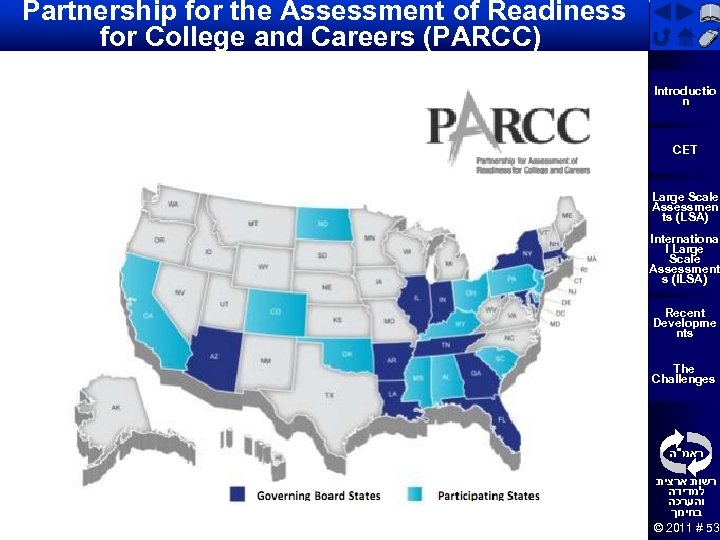 Partnership for the Assessment of Readiness for College and Careers (PARCC) Introductio n טיוטא CET Large Scale Assessmen ts (LSA) Internationa l Large Scale Assessment s (ILSA) Recent Developme nts The Challenges ראמ"ה רשות ארצית למדידה והערכה בחינוך © 2011 # 53
 Partnership for the Assessment of Readiness for College and Careers (PARCC) Create an assessment system and supporting 30 states collaboration: a four-year $176 tools that will help states dramatically increase million Race to the Top assessment grant the number of students who graduate high school ready for college and careers and provide students, parents, teachers and policymakers with the tools they need to help students - from grade three through high school - stay on track to graduate prepared. טיוטא PARCC Goals: 1. Build a pathway to college and career readiness 2. Construct assessments that enable cross-state comparisons Introductio n CET Large Scale Assessmen ts (LSA) Internationa l Large Scale Assessment s (ILSA) Recent Developme nts The Challenges 3. Create better assessments 4. Make better use of technology in assessments 5. Match investments in testing with investments in teaching ראמ"ה רשות ארצית למדידה והערכה בחינוך © 2011 # 54
 The Winning Consortia § The consortia - the Partnership for Assessment of Readiness for Colleges and Careers and the smarter Balanced Assessment Consortium - were awarded $170 million and $160 million, respectively, to build assessments that evaluate students based on common -core standards by the 2014 -15 school year. טיוטא "As I travel around the country the number one complaint I hear from teachers is that state bubble tests pressure teachers to teach to a test that doesn't measure what really matters, " said Duncan. "Both of these winning applicants are planning to develop assessments that will move us far beyond this and measure real student knowledge and skills. “ http: //www. ed. gov/news/press-releases/us-secretary-education-duncanannounces-winners-competition-improve-student-asse Introductio n CET Large Scale Assessmen ts (LSA) Internationa l Large Scale Assessment s (ILSA) Recent Developme nts The Challenges ראמ"ה רשות ארצית למדידה והערכה בחינוך © 2011 # 55
 Robert Linn on CBAL A New Era of Test-Based Educational Accountability § The cognitively-based assessment of, for, and as learning (CBAL) system has many of the features that are envisioned in the “smarter balanced’ assessment consortium. טיוטא § The CBAL summative assessments are not one time events in the Spring, but rather are spread over several occasions throughout the school year. This is a feature that has attracted a good deal of attention in discussions of the consortia plans. § CBAL also emphasizes the use of formative assessments by teachers and teacher professional development. § CBAL is based on a theory of action. It is explicitly intended to have positive effects on teacher practice and student learning. § A program of validity research consistent with the CBAL theory of action would have to give considerable attention to the consequences of test use. § The developers of the new systems could learn a great deal from the experience and research findings of CBAL. Introductio n CET Large Scale Assessmen ts (LSA) Internationa l Large Scale Assessment s (ILSA) Recent Developme nts The Challenges ראמ"ה רשות ארצית למדידה והערכה בחינוך © 2011 # 56
 Introductio n טיוטא The Challenges CET Large Scale Assessmen ts (LSA) Internationa l Large Scale Assessment s (ILSA) Recent Developme nts The Challenges ראמ"ה רשות ארצית למדידה והערכה בחינוך © 2011 # 57
 Policy Challenges § Do all the above computerized assessments Introductio n indicate that the educational world is approaching a turning point regarding the incorporation of technology into large-scale CET assessment? Large Scale Assessmen טיוטא ts (LSA) § Are schools pedagogically, technologically, logistically and socially prepared for this development? § What are the implications for educators, and for policymakers? § What will make this mega investment worthwhile? Internationa l Large Scale Assessment s (ILSA) Recent Developme nts The Challenges ראמ"ה רשות ארצית למדידה והערכה בחינוך © 2011 # 58
 Yet to be Resolved Several issues are yet to be resolved before moving LSA and ILSA to a full blown digital and online system, among them: טיוטא § Maintaining trend lines between P&P and digital assessments § Ensuring gender equality § Narrowing the digital divide § School system readiness (personnel, hardware, connectivity) § Infrastructure adaptation to various languages (including right-to-left languages). Introductio n CET Large Scale Assessmen ts (LSA) Internationa l Large Scale Assessment s (ILSA) Recent Developme nts The Challenges ראמ"ה רשות ארצית למדידה והערכה בחינוך © 2011 # 59
 Can a CBAL-like Model be Applied to ILSA? § The ability to integrate continual formative assessments with periodic summative assessments entails complete alignment of the curricula, the content and standards, with the external and internal assessment tasks. טיוטא § The solution proposed by CBAL, according to which formative and summative assessment are fully aligned and integrated via technology, may not be easily applicable to ILSA. Introductio n CET Large Scale Assessmen ts (LSA) Internationa l Large Scale Assessment s (ILSA) Recent Developme nts The Challenges ראמ"ה רשות ארצית למדידה והערכה בחינוך © 2011 # 60
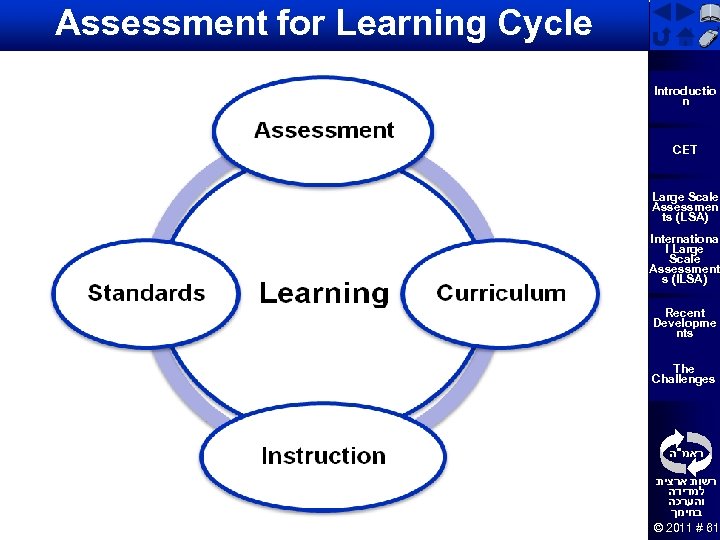 Assessment for Learning Cycle Introductio n טיוטא CET Large Scale Assessmen ts (LSA) Internationa l Large Scale Assessment s (ILSA) Recent Developme nts The Challenges ראמ"ה רשות ארצית למדידה והערכה בחינוך © 2011 # 61
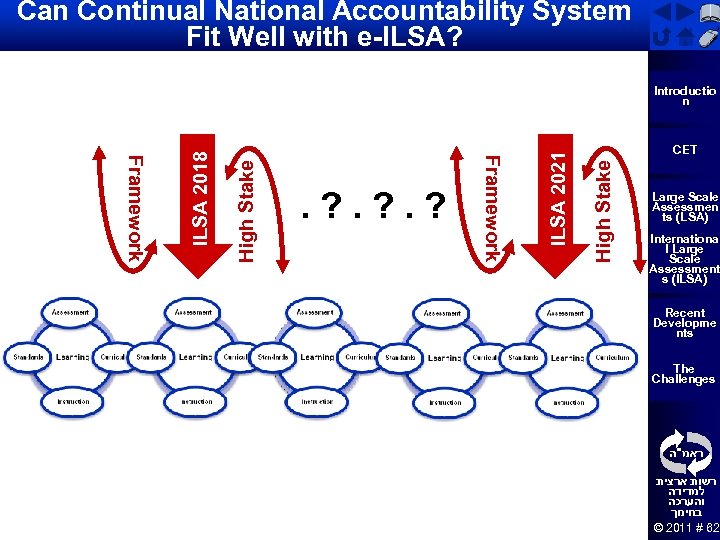 Can Continual National Accountability System Fit Well with e-ILSA? CET High Stake ILSA 2021 High Stake טיוטא . ? . ? Framework ILSA 2018 Introductio n Large Scale Assessmen ts (LSA) Internationa l Large Scale Assessment s (ILSA) Recent Developme nts The Challenges ראמ"ה רשות ארצית למדידה והערכה בחינוך © 2011 # 62
 Alignment of LSA and ILSA § It is not clear whether such an alignment is possible, or even desired, with regard to the ILSA tasks and national curricula across different education systems in the world. טיוטא § Also, ILSA take place on a cycle that is well suited for international comparisons (3, 4, or 5 years). § As ILSA results have often become a national goal -- this cycle causes certain irregularity in the organization of the learning and the national large scale assessments (LSA) in years which coincide with ILSA. Thus, there is a need to better synchronize the national and international assessments in countries where both systems exist. Introductio n CET Large Scale Assessmen ts (LSA) Internationa l Large Scale Assessment s (ILSA) Recent Developme nts The Challenges ראמ"ה רשות ארצית למדידה והערכה בחינוך © 2011 # 63
 Concluding Remarks § It is rather clear that technology will continue to advance and improve both LSA and ILSA in an evolutionary manner. טיוטא § Technology even has the potential to revolutionize LSA and its alignment with learning and teaching as proposed by the CBAL model. However, the extent to which ILSA -- based on a common framework which is often not fully aligned with the national curricula -- can join this revolution remains a pedagogical and strategic challenge. Introductio n CET Large Scale Assessmen ts (LSA) Internationa l Large Scale Assessment s (ILSA) Recent Developme nts The Challenges ראמ"ה רשות ארצית למדידה והערכה בחינוך © 2011 # 64
 Thanks! טיוטא Q&A? Introductio n CET Large Scale Assessmen ts (LSA) Internationa l Large Scale Assessment s (ILSA) Recent Developme nts The Challenges ראמ"ה רשות ארצית למדידה והערכה בחינוך © 2011 # 65