 Скачать презентацию TECHNOL CORPORATE Strategies for Enhanced Dual Failure Restorability
c29496bfe2d789148d0c344c8a8fc0c0.ppt
- Количество слайдов: 24



TECHNOL CORPORATE Strategies for Enhanced Dual Failure Restorability with Static or Reconfigurable p-Cycle Networks International Conference on Communications (ICC) Paris, France - June 22, 2004 Dominic A. Schupke* Siemens AG, Corporate Technology Otto-Hahn-Ring 6, 81730 Munich, Germany E-mail: Wayne D. Grover, Matthieu Clouqueur TRLabs and University of Alberta 7 th Floor, 9107 116 St NW, Edmonton, Alberta, Canada T 6 G 2 V 4 E-mail: {grover, clouqueur}@trlabs. ca *Results from work at Technische Universität München and TRLabs
TECHNOL CORPORATE Outline • Introduction • The p-Cycle Concept • p-Cycles and Dual Failures • Network Design • Results • Conclusions © TRLabs / University of Alberta and Siemens AG, CT IC 2 ON, Dominic Schupke, 2004 -06 -22
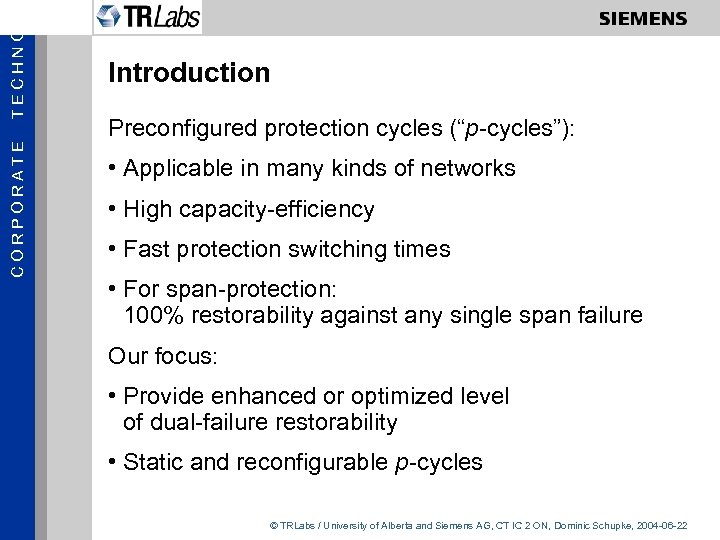
CORPORATE TECHNOL Introduction Preconfigured protection cycles (“p-cycles”): • Applicable in many kinds of networks • High capacity-efficiency • Fast protection switching times • For span-protection: 100% restorability against any single span failure Our focus: • Provide enhanced or optimized level of dual-failure restorability • Static and reconfigurable p-cycles © TRLabs / University of Alberta and Siemens AG, CT IC 2 ON, Dominic Schupke, 2004 -06 -22
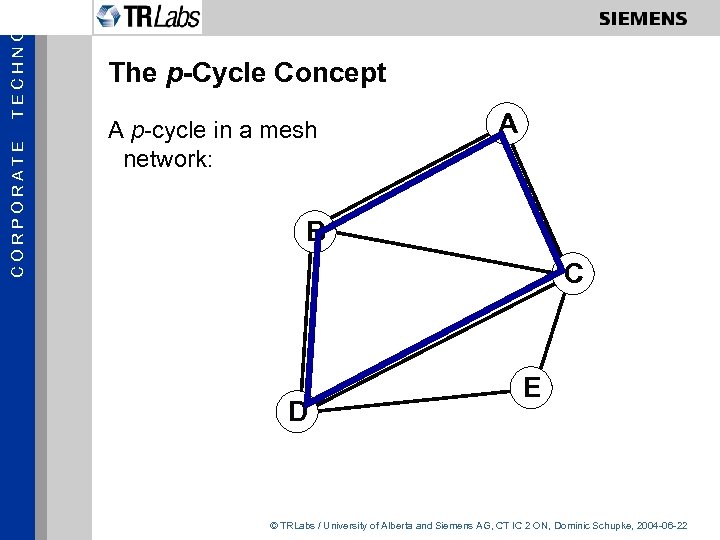
TECHNOL CORPORATE The p-Cycle Concept A p-cycle in a mesh network: A B C D E © TRLabs / University of Alberta and Siemens AG, CT IC 2 ON, Dominic Schupke, 2004 -06 -22
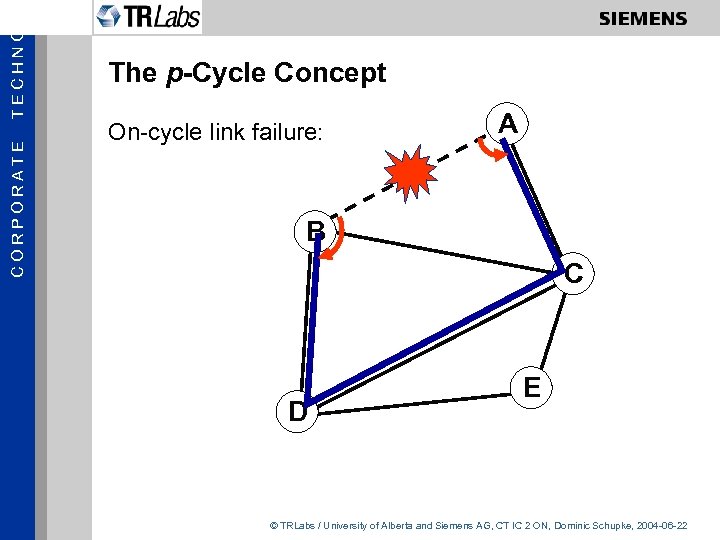
TECHNOL CORPORATE The p-Cycle Concept On-cycle link failure: A B C D E © TRLabs / University of Alberta and Siemens AG, CT IC 2 ON, Dominic Schupke, 2004 -06 -22
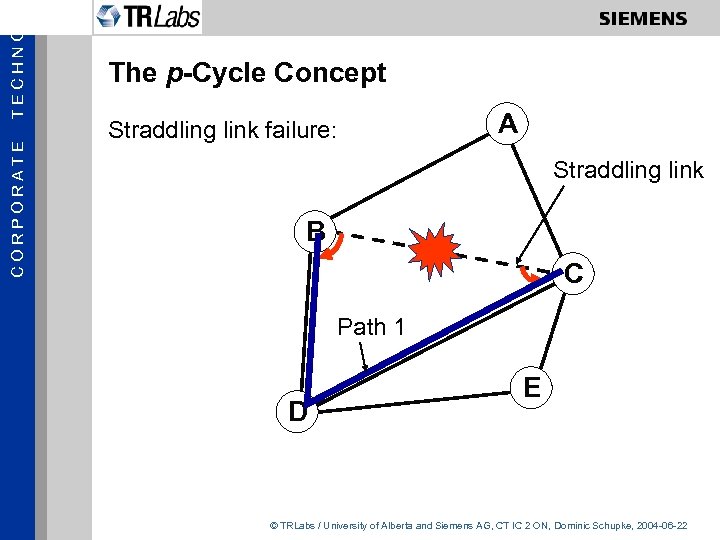
TECHNOL CORPORATE The p-Cycle Concept Straddling link failure: A Straddling link B C Path 1 D E © TRLabs / University of Alberta and Siemens AG, CT IC 2 ON, Dominic Schupke, 2004 -06 -22
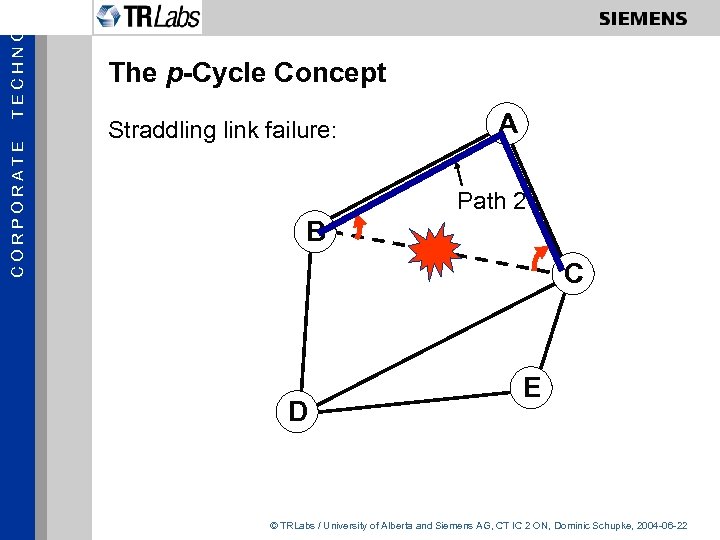
TECHNOL CORPORATE The p-Cycle Concept Straddling link failure: A Path 2 B C D E © TRLabs / University of Alberta and Siemens AG, CT IC 2 ON, Dominic Schupke, 2004 -06 -22
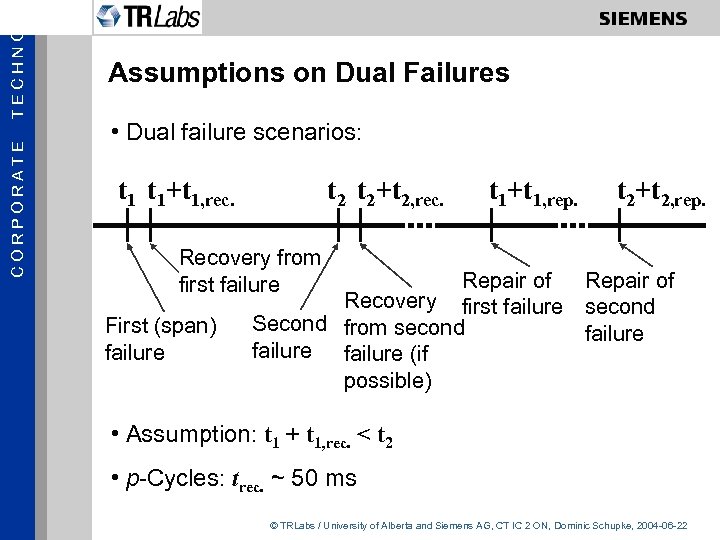
TECHNOL CORPORATE Assumptions on Dual Failures • Dual failure scenarios: t 1+t 1, rec. t 2+t 2, rec. t 1+t 1, rep. t 2+t 2, rep. Recovery from first failure First (span) failure Repair of Recovery first failure second Second from second failure (if possible) • Assumption: t 1 + t 1, rec. < t 2 • p-Cycles: trec. ~ 50 ms © TRLabs / University of Alberta and Siemens AG, CT IC 2 ON, Dominic Schupke, 2004 -06 -22
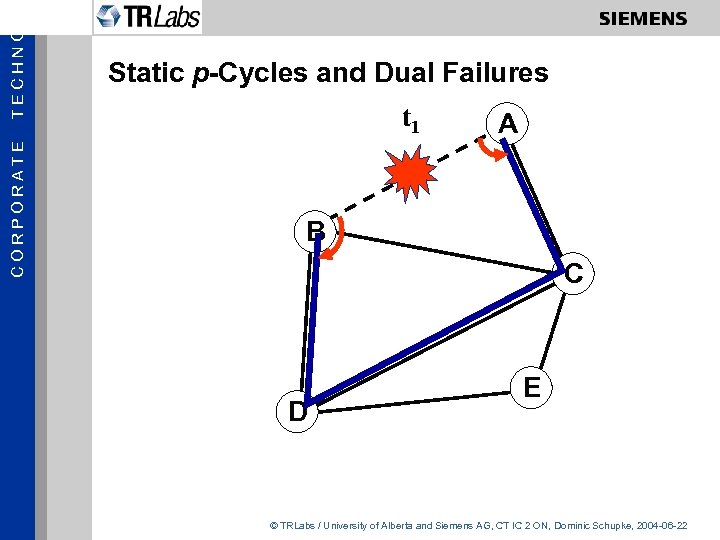
TECHNOL CORPORATE Static p-Cycles and Dual Failures t 1 A B C D E © TRLabs / University of Alberta and Siemens AG, CT IC 2 ON, Dominic Schupke, 2004 -06 -22
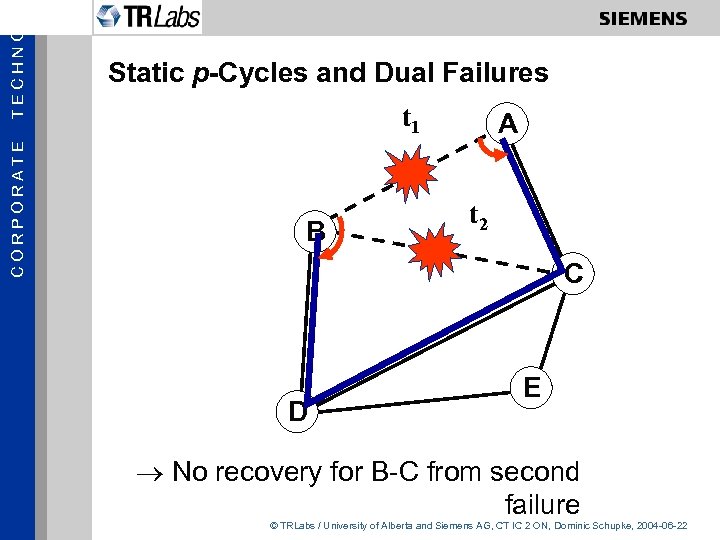
TECHNOL CORPORATE Static p-Cycles and Dual Failures t 1 B A t 2 C D E No recovery for B-C from second failure © TRLabs / University of Alberta and Siemens AG, CT IC 2 ON, Dominic Schupke, 2004 -06 -22
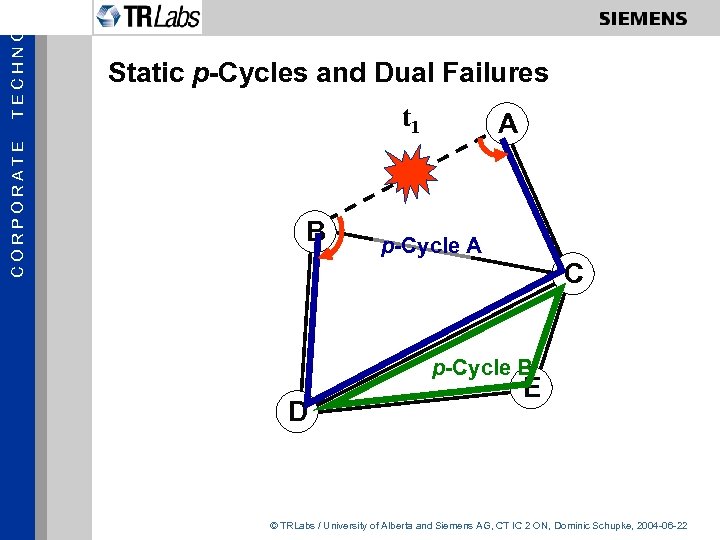
TECHNOL CORPORATE Static p-Cycles and Dual Failures t 1 B A p-Cycle A C p-Cycle B D E © TRLabs / University of Alberta and Siemens AG, CT IC 2 ON, Dominic Schupke, 2004 -06 -22
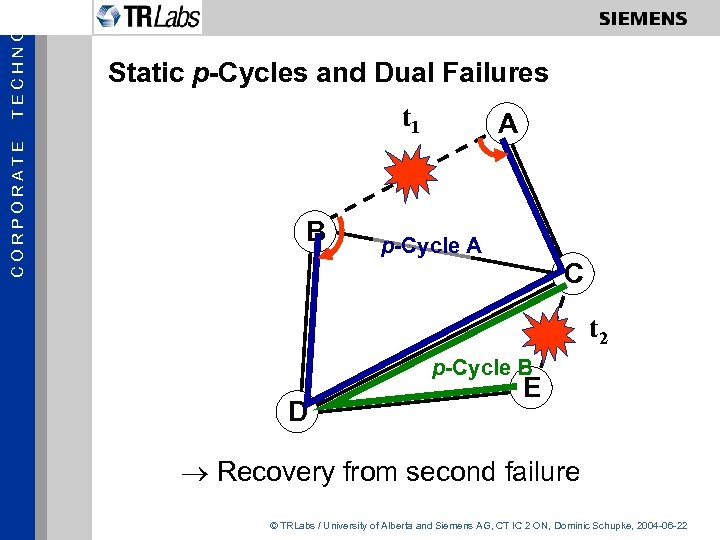
TECHNOL CORPORATE Static p-Cycles and Dual Failures t 1 B A p-Cycle A C t 2 p-Cycle B D E Recovery from second failure © TRLabs / University of Alberta and Siemens AG, CT IC 2 ON, Dominic Schupke, 2004 -06 -22
TECHNOL Susceptibility Concept CORPORATE • p-Cycle protects s working spans Susceptible to s (s-1) failure events • p-Cycle susceptible to a dual failure combination: Both failures affect working spans protected by it • Susceptibility s per p-cycle not larger than given σmax • Restrict when selecting eligible p-cycles for design Other approach: • Failure dispersal concept (see paper) © TRLabs / University of Alberta and Siemens AG, CT IC 2 ON, Dominic Schupke, 2004 -06 -22
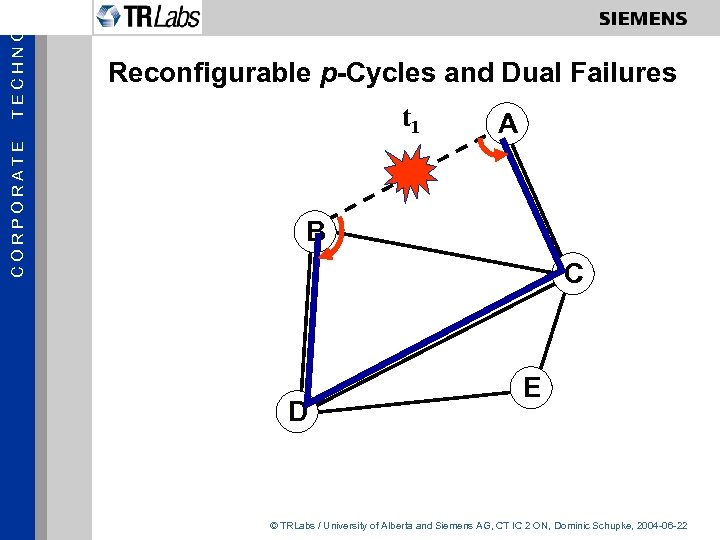
TECHNOL CORPORATE Reconfigurable p-Cycles and Dual Failures t 1 A B C D E © TRLabs / University of Alberta and Siemens AG, CT IC 2 ON, Dominic Schupke, 2004 -06 -22
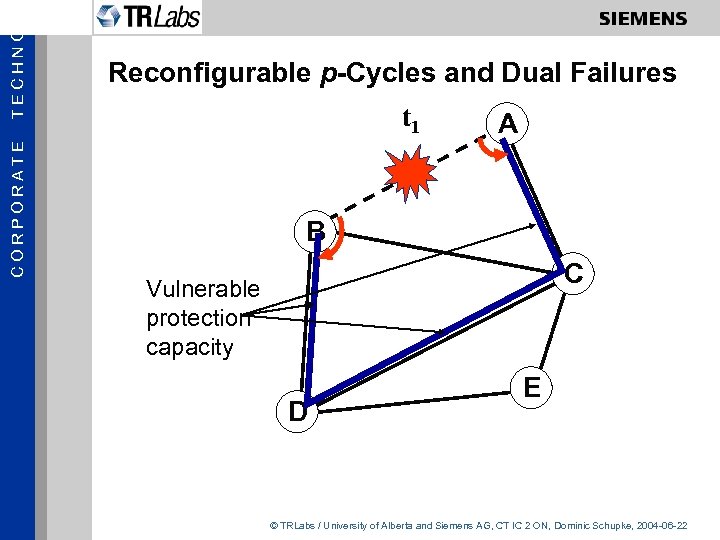
TECHNOL CORPORATE Reconfigurable p-Cycles and Dual Failures t 1 A B C Vulnerable protection capacity D E © TRLabs / University of Alberta and Siemens AG, CT IC 2 ON, Dominic Schupke, 2004 -06 -22
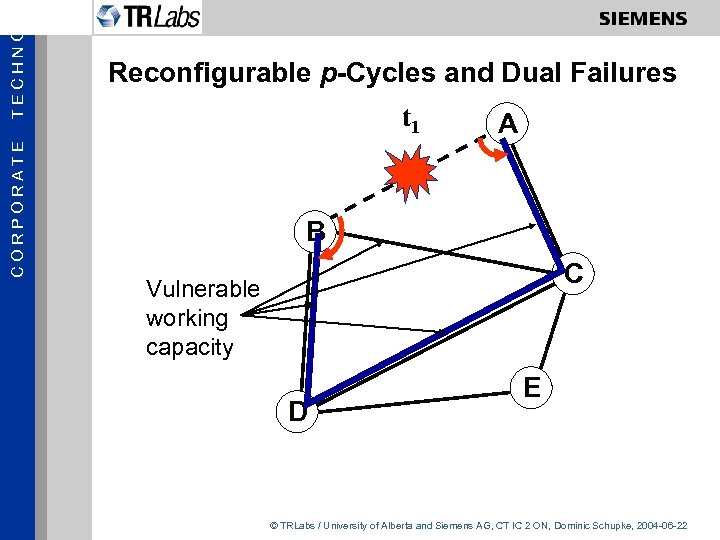
TECHNOL CORPORATE Reconfigurable p-Cycles and Dual Failures t 1 A B C Vulnerable working capacity D E © TRLabs / University of Alberta and Siemens AG, CT IC 2 ON, Dominic Schupke, 2004 -06 -22
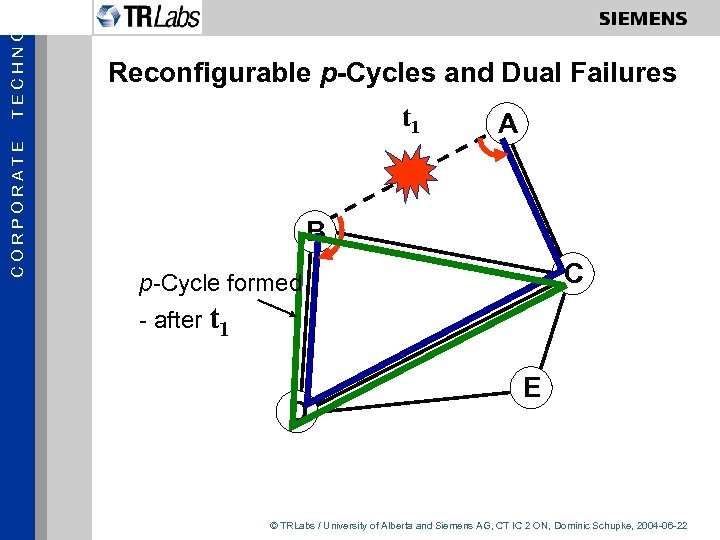
TECHNOL CORPORATE Reconfigurable p-Cycles and Dual Failures t 1 A B C p-Cycle formed - after t 1 D E © TRLabs / University of Alberta and Siemens AG, CT IC 2 ON, Dominic Schupke, 2004 -06 -22
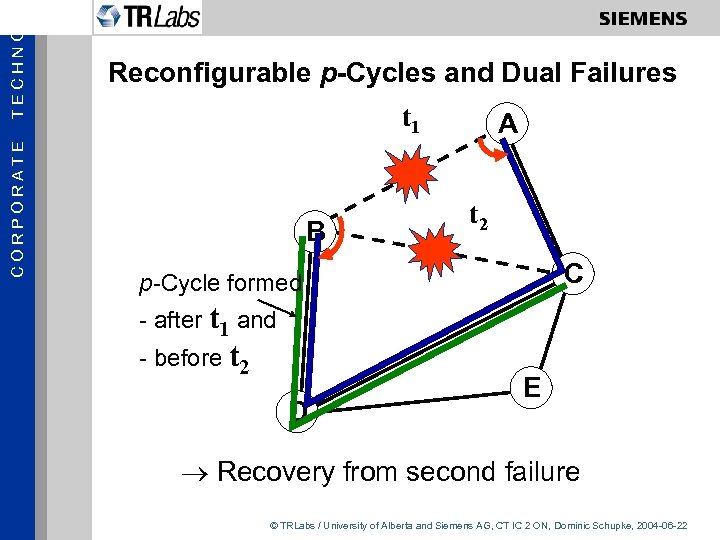
TECHNOL CORPORATE Reconfigurable p-Cycles and Dual Failures t 1 B A t 2 C p-Cycle formed - after t 1 and - before t 2 D E Recovery from second failure © TRLabs / University of Alberta and Siemens AG, CT IC 2 ON, Dominic Schupke, 2004 -06 -22
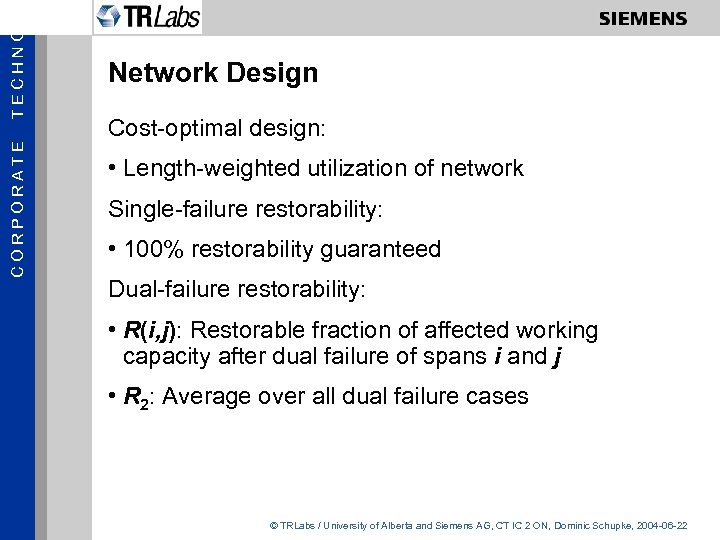
TECHNOL CORPORATE Network Design Cost-optimal design: • Length-weighted utilization of network Single-failure restorability: • 100% restorability guaranteed Dual-failure restorability: • R(i, j): Restorable fraction of affected working capacity after dual failure of spans i and j • R 2: Average over all dual failure cases © TRLabs / University of Alberta and Siemens AG, CT IC 2 ON, Dominic Schupke, 2004 -06 -22
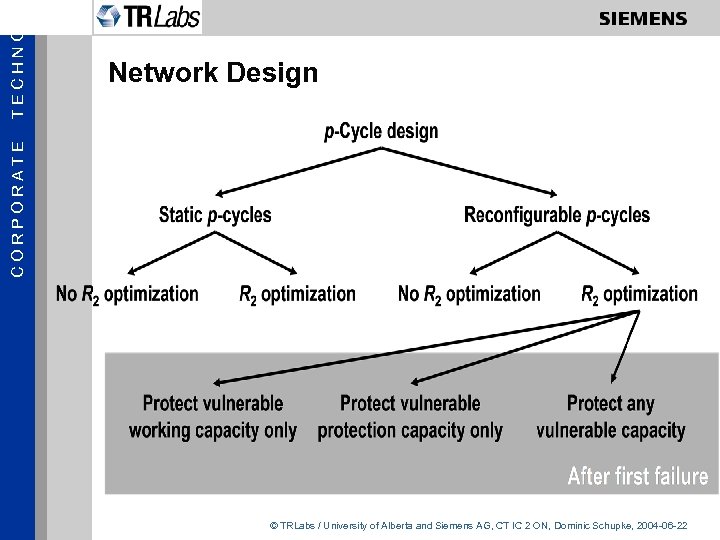
TECHNOL CORPORATE Network Design © TRLabs / University of Alberta and Siemens AG, CT IC 2 ON, Dominic Schupke, 2004 -06 -22
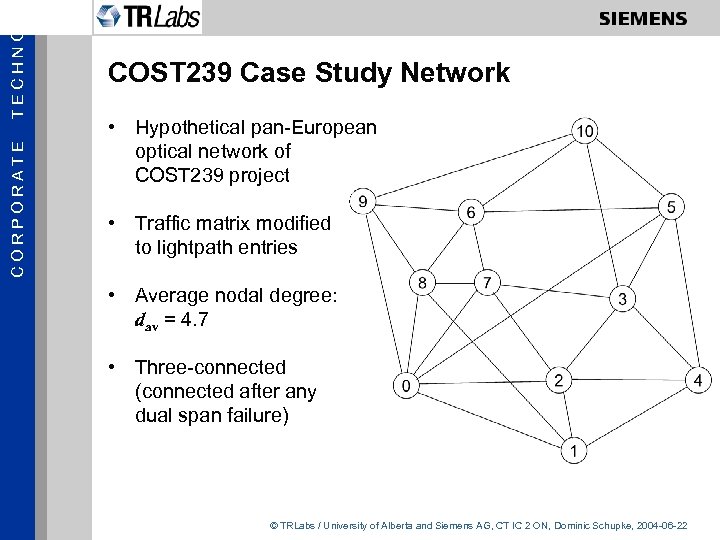
TECHNOL CORPORATE COST 239 Case Study Network • Hypothetical pan-European optical network of COST 239 project • Traffic matrix modified to lightpath entries • Average nodal degree: dav = 4. 7 • Three-connected (connected after any dual span failure) © TRLabs / University of Alberta and Siemens AG, CT IC 2 ON, Dominic Schupke, 2004 -06 -22
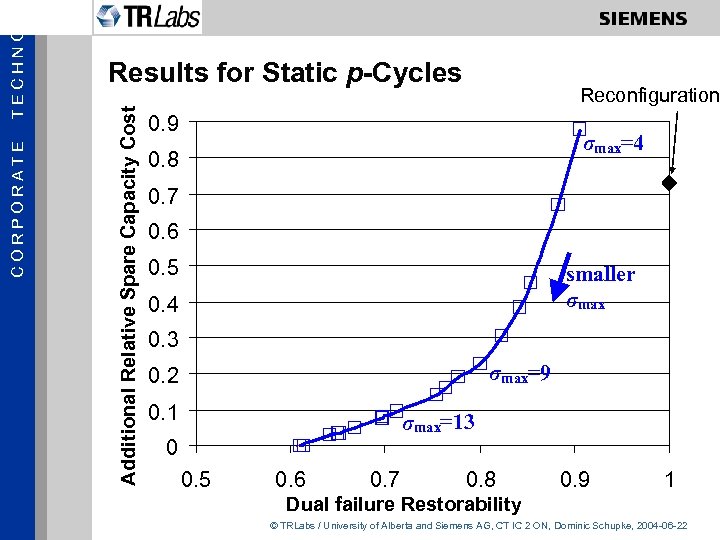
Additional Relative Spare Capacity Cost TECHNOL CORPORATE Results for Static p-Cycles Reconfiguration 0. 9 σmax=4 0. 8 0. 7 0. 6 0. 5 smaller σmax 0. 4 0. 3 σmax=9 0. 2 0. 1 σmax=13 0 0. 5 0. 6 0. 7 0. 8 0. 9 1 Dual failure Restorability © TRLabs / University of Alberta and Siemens AG, CT IC 2 ON, Dominic Schupke, 2004 -06 -22
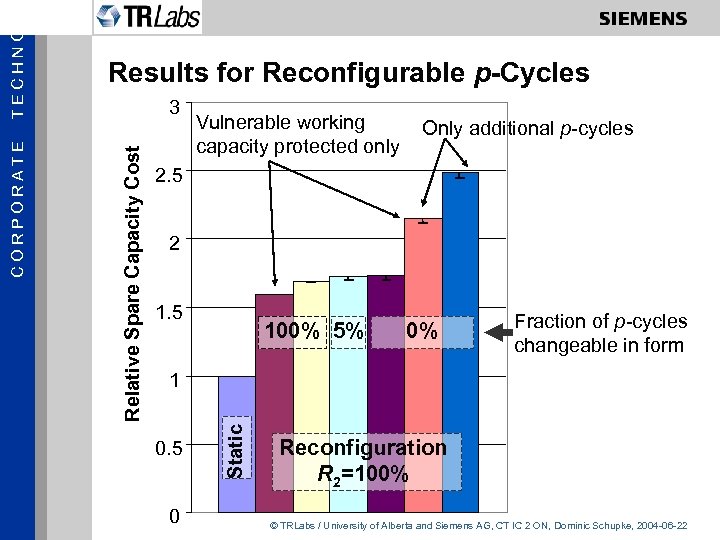
3 Vulnerable working capacity protected only Only additional p-cycles 2. 5 2 1. 5 100% 5% 0% Fraction of p-cycles changeable in form 1 0. 5 0 Static Relative Spare Capacity Cost TECHNOL CORPORATE Results for Reconfigurable p-Cycles Reconfiguration R 2=100% © TRLabs / University of Alberta and Siemens AG, CT IC 2 ON, Dominic Schupke, 2004 -06 -22
TECHNOL CORPORATE Conclusions Capacity design methods: • Static p-cycles: • Improved dual-failure restorability • Susceptibility viable approach to control restorability • Reconfigurable p-cycles: • Complete dual-failure restorability • Different operational options Outlook: • Reconfigurable p-cycles in networks designed for single-failure restorability only • Multiple protection classes © TRLabs / University of Alberta and Siemens AG, CT IC 2 ON, Dominic Schupke, 2004 -06 -22
Скачать презентацию TECHNOL CORPORATE Strategies for Enhanced Dual Failure Restorability
c29496bfe2d789148d0c344c8a8fc0c0.ppt