Скачать презентацию Techno-Economic assessment of Potential for Energy savings TEPE
84c9486839285598757d81e7cc0a53ac.ppt
- Количество слайдов: 30
 Techno-Economic assessment of Potential for Energy savings (TEPE) Potential and policies for energy efficiency in Swedish buildings built before 1945 Bahram Moshfegh, Linn Liu, Stig-Inge Gustafsson Division of Energy Systems, Department of Management and Engineering, Linköping University
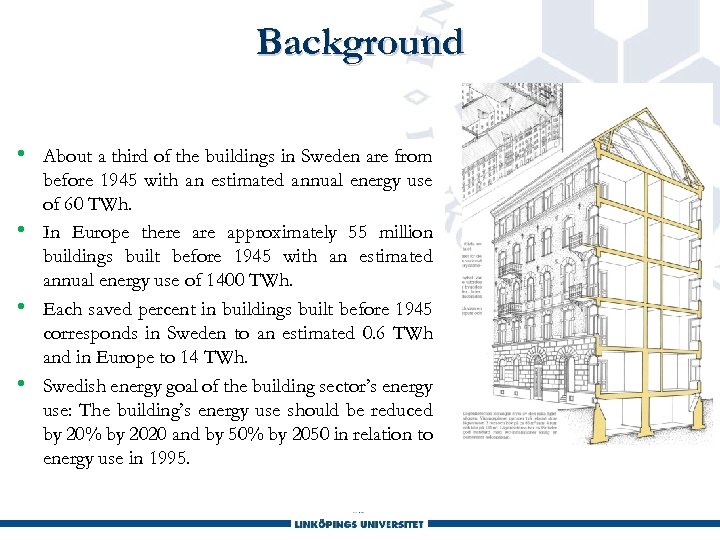 Background • • About a third of the buildings in Sweden are from before 1945 with an estimated annual energy use of 60 TWh. In Europe there approximately 55 million buildings built before 1945 with an estimated annual energy use of 1400 TWh. Each saved percent in buildings built before 1945 corresponds in Sweden to an estimated 0. 6 TWh and in Europe to 14 TWh. Swedish energy goal of the building sector’s energy use: The building’s energy use should be reduced by 20% by 2020 and by 50% by 2050 in relation to energy use in 1995.
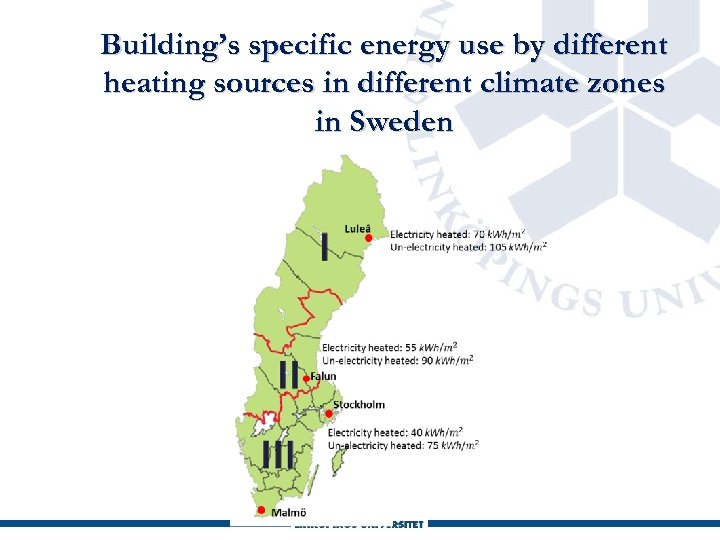 Building’s specific energy use by different heating sources in different climate zones in Sweden
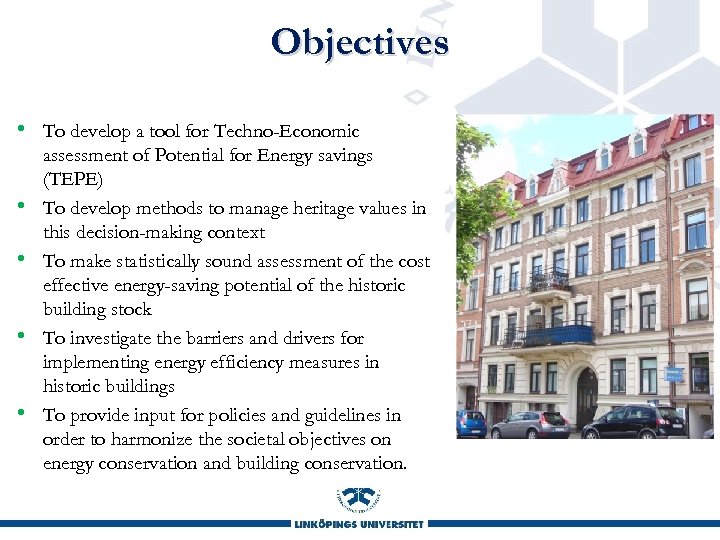 Objectives • • • To develop a tool for Techno-Economic assessment of Potential for Energy savings (TEPE) To develop methods to manage heritage values in this decision-making context To make statistically sound assessment of the cost effective energy-saving potential of the historic building stock To investigate the barriers and drivers for implementing energy efficiency measures in historic buildings To provide input for policies and guidelines in order to harmonize the societal objectives on energy conservation and building conservation.
 The OPERA - MILP model A short description • • • A computer program for optimal refurbishment of buildings Present values! LCC Minimization Calculus and trail-and-error Starts with an old building (In the form of a computer text file) Ends with a new building (Also a text file) OPERA – MILP (Optimal Energy Retrofits Advisory - Mixed Integer Linear Program)
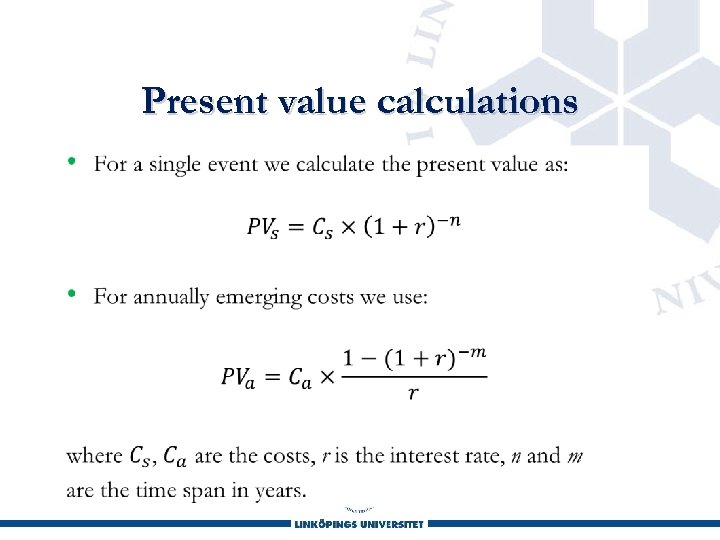 Present value calculations •
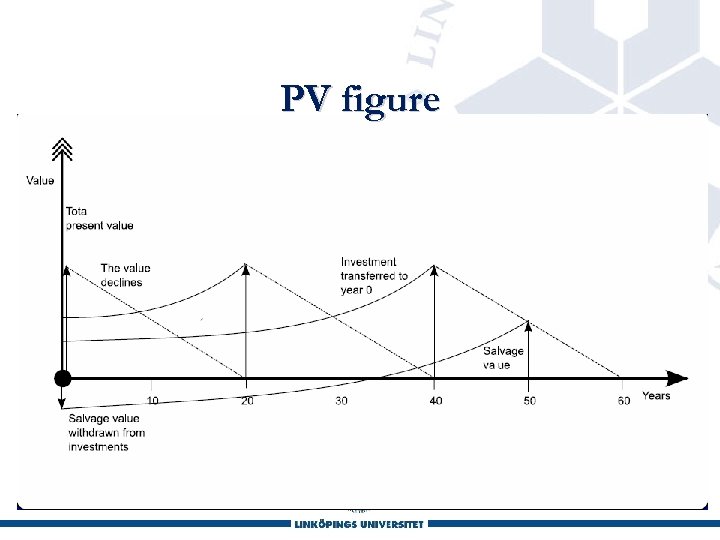 PV figure
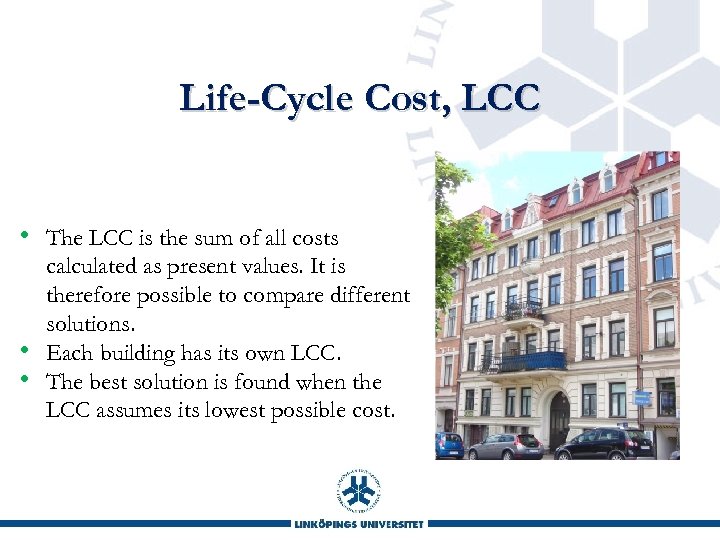 Life-Cycle Cost, LCC • • • The LCC is the sum of all costs calculated as present values. It is therefore possible to compare different solutions. Each building has its own LCC. The best solution is found when the LCC assumes its lowest possible cost.
 Principal scheme
 Optimization LCC-calculations and optimisation can be easy at first sight: • Find a function describing the cost • Finding the minimum point for that function But: • Is the function continuous? • One function enough? • One function influenced by another? • Optimization method(s)?
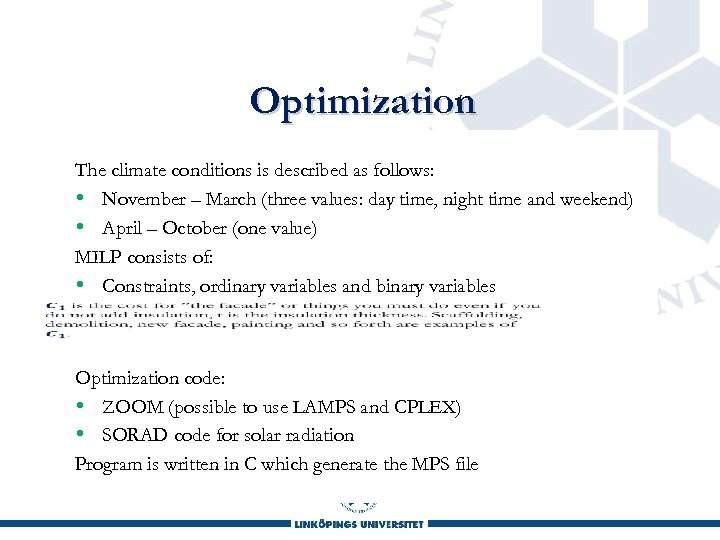 Optimization The climate conditions is described as follows: • November – March (three values: day time, night time and weekend) • April – October (one value) MILP consists of: • Constraints, ordinary variables and binary variables Optimization code: • ZOOM (possible to use LAMPS and CPLEX) • SORAD code for solar radiation Program is written in C which generate the MPS file
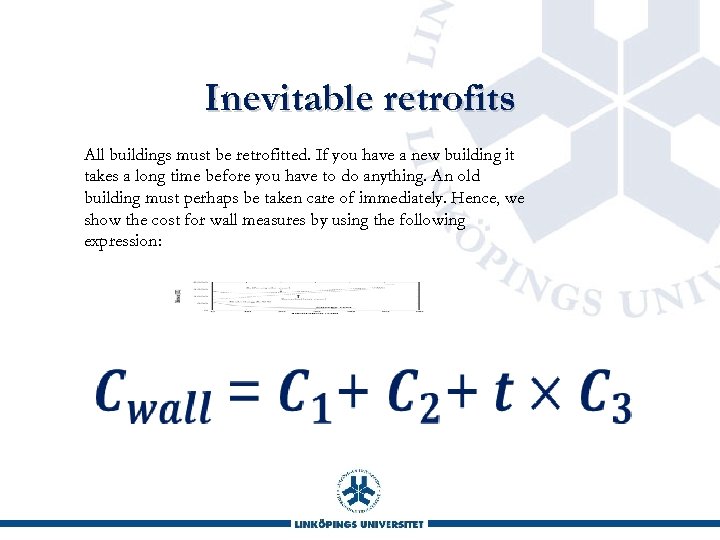 Inevitable retrofits All buildings must be retrofitted. If you have a new building it takes a long time before you have to do anything. An old building must perhaps be taken care of immediately. Hence, we show the cost for wall measures by using the following expression:
 Inevitable retrofits We have inevitable costs also for windows, boilers and many other things in the building. The ”Existing LCC” includes costs for changing one old item to a new item with the same ”energy standard”. A poor double-paned window is changed to a new good one of the same type.
 Inevitable retrofits Consider oil-fired boilers with chimneys, ground-water coupled heat pumps with water wells or solar heating devices with all pipes. A water well will have alonger life than the compressor in a heat pump. This must be considered.
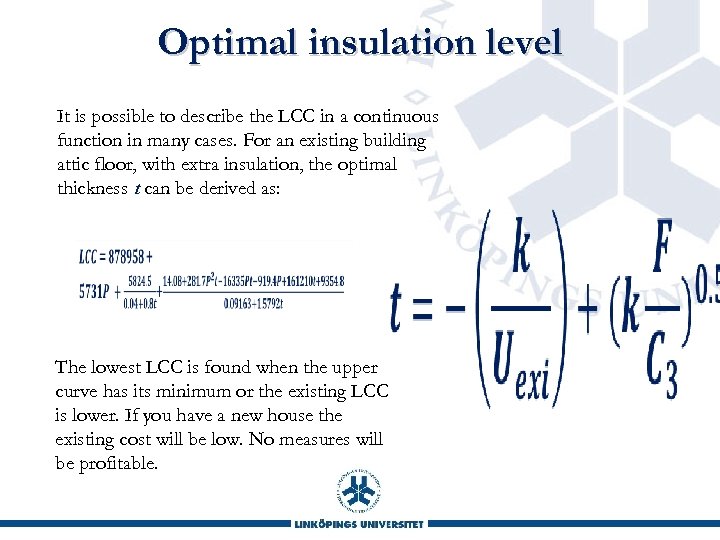 Optimal insulation level It is possible to describe the LCC in a continuous function in many cases. For an existing building attic floor, with extra insulation, the optimal thickness t can be derived as: The lowest LCC is found when the upper curve has its minimum or the existing LCC is lower. If you have a new house the existing cost will be low. No measures will be profitable.
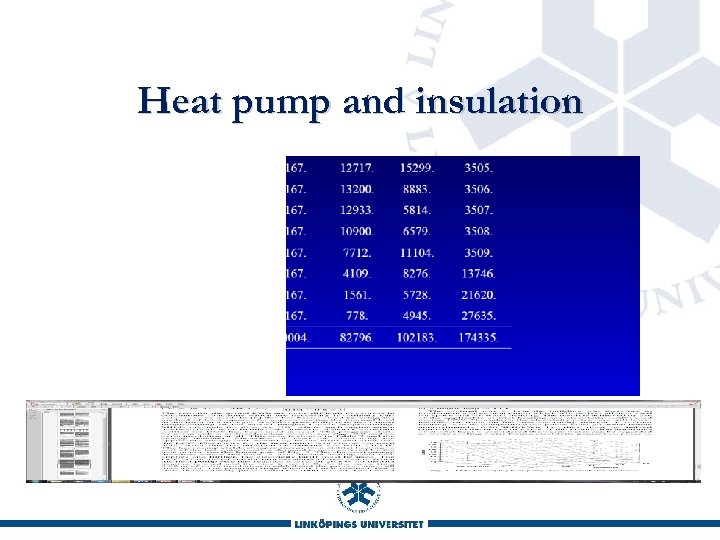 Heat pump and insulation
 Trail and error Sometimes it is difficult to find continuous functions. This is the case for e. g. : • Different window constructions • Different boilers or heating systems • Time-of-use tariffs • Different ventilation systems • Exhaust air heat pumps • Weather-stripping
 The energy cost Sometimes it is difficult to find the proper energy cost • The cost is based on a tariff • The total cost is valid for a complete building, not only a part of the building. • Some of the costs are only applied during the winter • The heating season might change • Saving heat in the summer is normally ”useless” • The tariff is not continuous
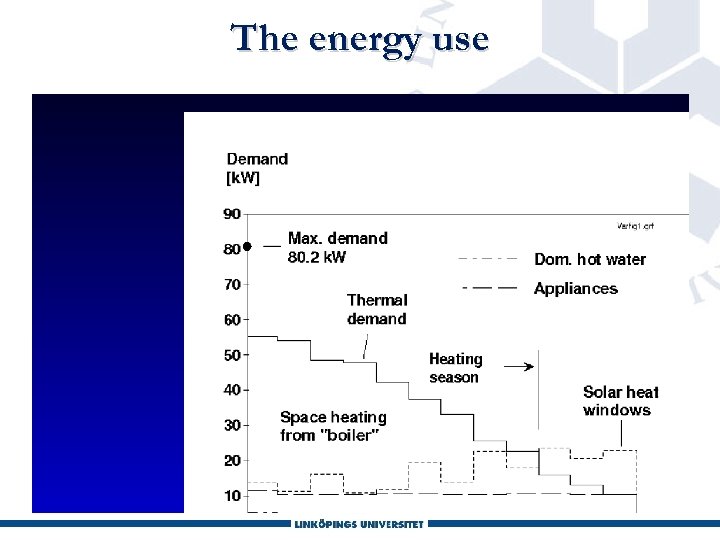 The energy use
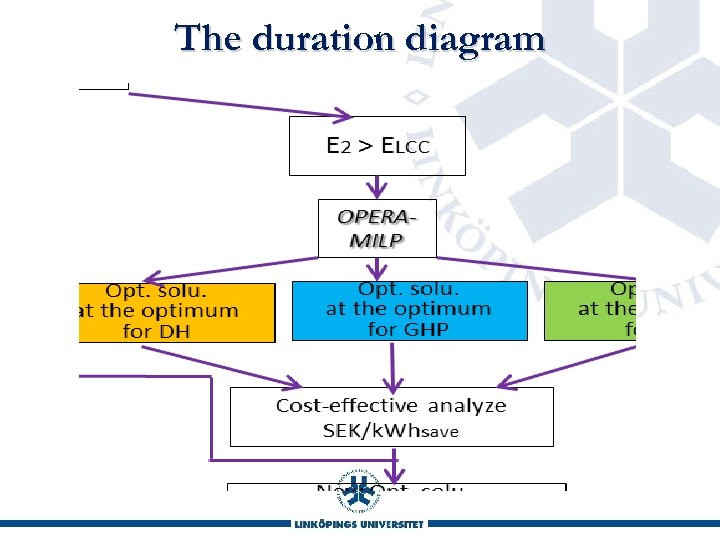 The duration diagram
 OPERA can treat the following measures • • Attic floor insulation Ground floor insulation External wall insulation from outside External wall insulation from inside Window change Weather stripping Heating systems – – Wood boiler – WB; Ground water heat pump – GHP; District Heating –DH Exhaust air heat pump – EAHP
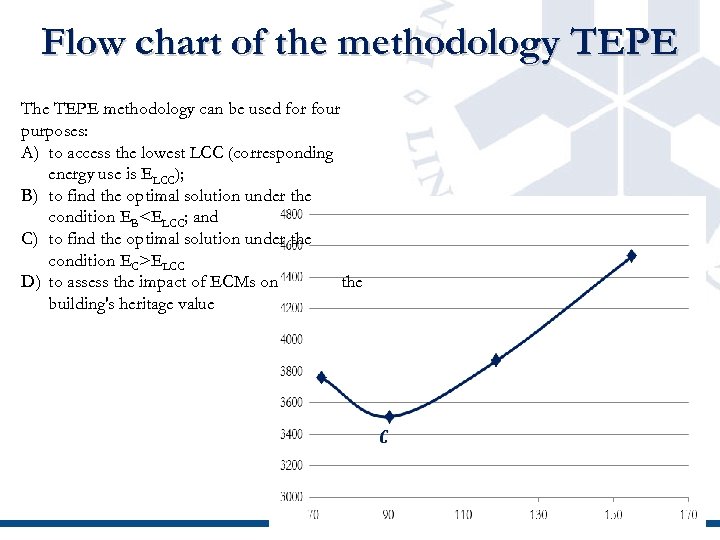 Flow chart of the methodology TEPE The TEPE methodology can be used for four purposes: A) to access the lowest LCC (corresponding energy use is ELCC); B) to find the optimal solution under the condition EB
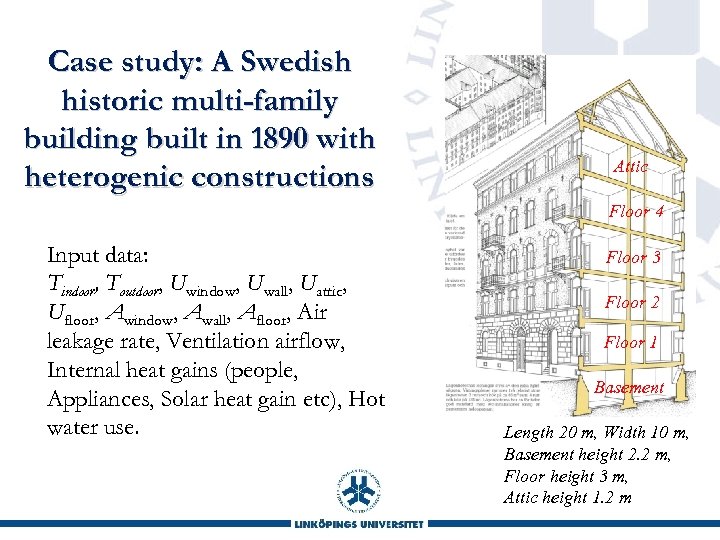 Case study: A Swedish historic multi-family building built in 1890 with heterogenic constructions Attic Floor 4 Input data: Tindoor, Toutdoor, Uwindow, Uwall, Uattic, Ufloor, Awindow, Awall, Afloor, Air leakage rate, Ventilation airflow, Internal heat gains (people, Appliances, Solar heat gain etc), Hot water use. Floor 3 Floor 2 Floor 1 Basement Length 20 m, Width 10 m, Basement height 2. 2 m, Floor height 3 m, Attic height 1. 2 m
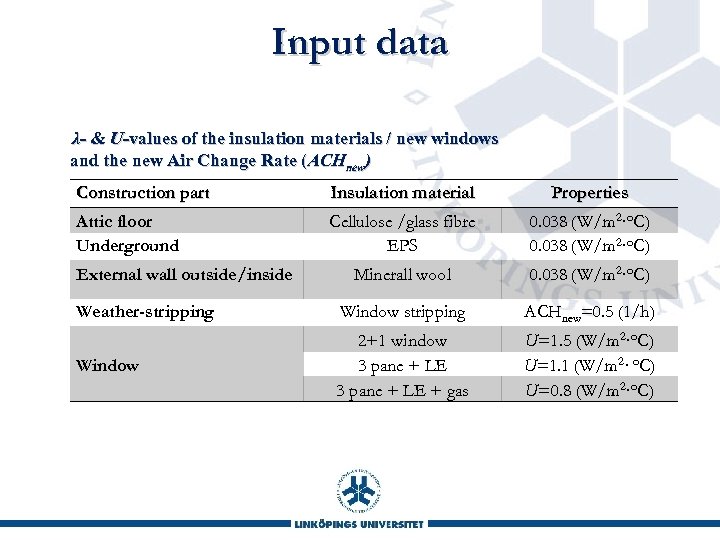 Input data λ- & U-values of the insulation materials / new windows and the new Air Change Rate (ACHnew) Construction part Insulation material Properties Attic floor Underground Cellulose /glass fibre EPS 0. 038 (W/m 2·o. C) Minerall wool 0. 038 (W/m 2·o. C) Weather-stripping Window stripping ACHnew=0. 5 (1/h) Window 2+1 window 3 pane + LE + gas U=1. 5 (W/m 2·o. C) U=1. 1 (W/m 2· o. C) U=0. 8 (W/m 2·o. C) External wall outside/inside
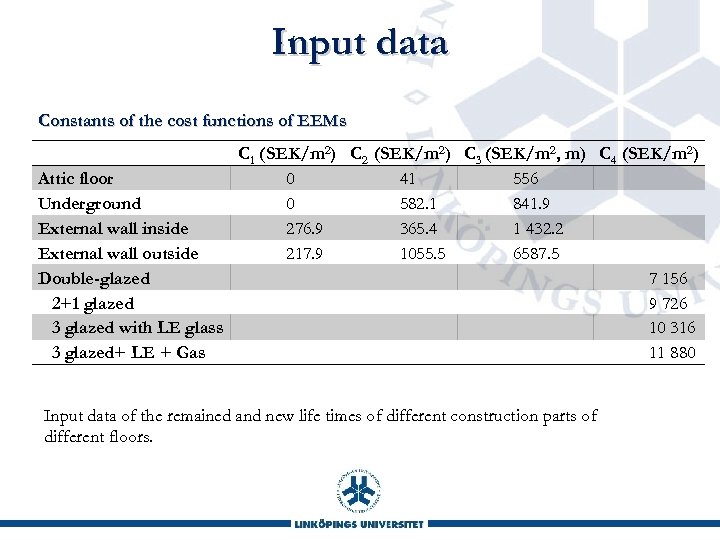 Input data Constants of the cost functions of EEMs C 1 (SEK/m 2) C 2 (SEK/m 2) C 3 (SEK/m 2, m) C 4 (SEK/m 2) Attic floor 0 41 556 Underground 0 582. 1 841. 9 External wall inside 276. 9 365. 4 1 432. 2 External wall outside 217. 9 1055. 5 6587. 5 Double-glazed 7 156 2+1 glazed 9 726 3 glazed with LE glass 10 316 3 glazed+ LE + Gas 11 880 Input data of the remained and new life times of different construction parts of different floors.
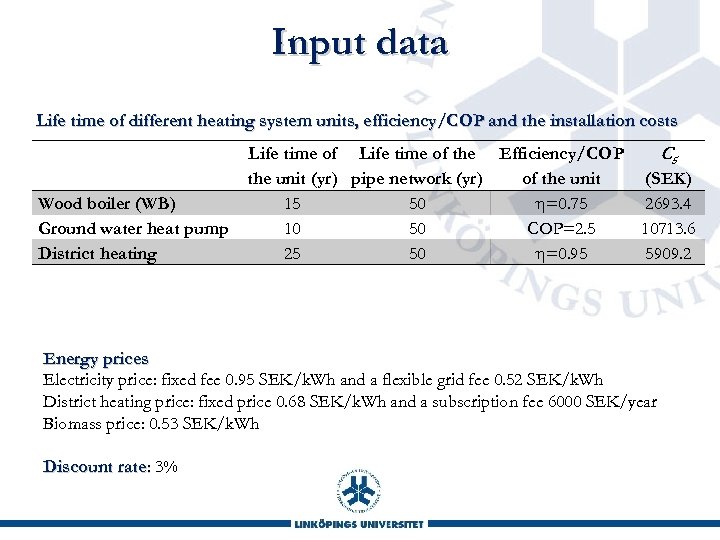 Input data Life time of different heating system units, efficiency/COP and the installation costs Wood boiler (WB) Ground water heat pump District heating Life time of the Efficiency/COP C 5 the unit (yr) pipe network (yr) of the unit (SEK) 15 50 h=0. 75 2693. 4 10 50 COP=2. 5 10713. 6 25 50 h=0. 95 5909. 2 Energy prices Electricity price: fixed fee 0. 95 SEK/k. Wh and a flexible grid fee 0. 52 SEK/k. Wh District heating price: fixed price 0. 68 SEK/k. Wh and a subscription fee 6000 SEK/year Biomass price: 0. 53 SEK/k. Wh Discount rate: 3%
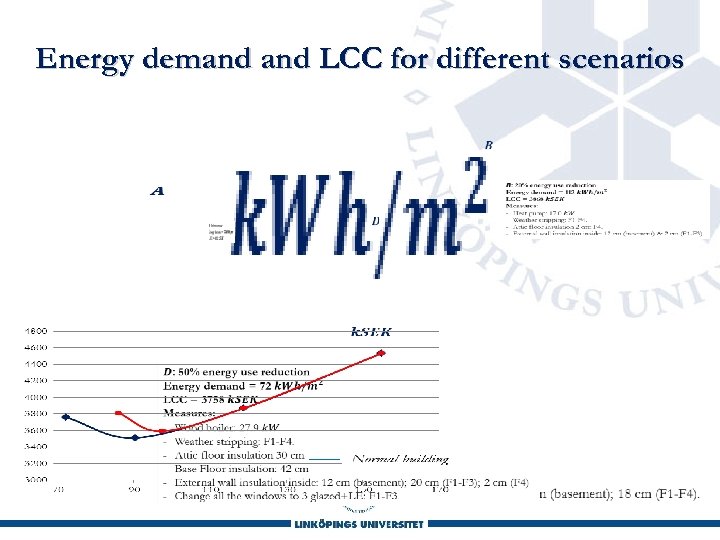 Energy demand LCC for different scenarios
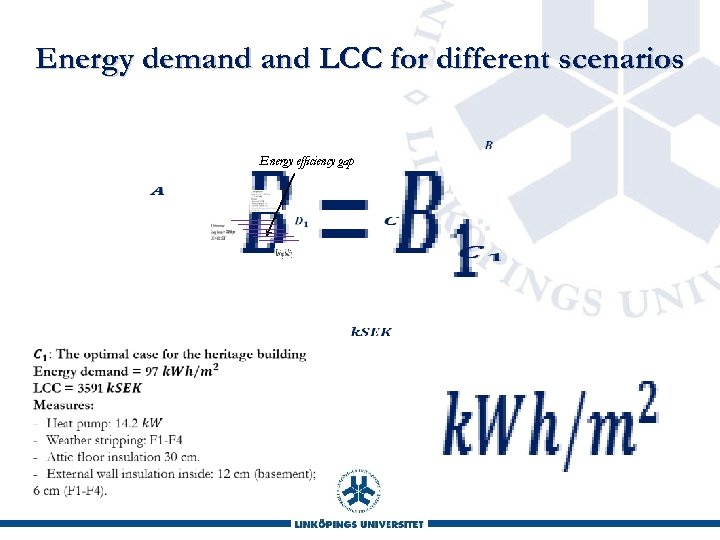 Energy demand LCC for different scenarios Energy efficiency gap
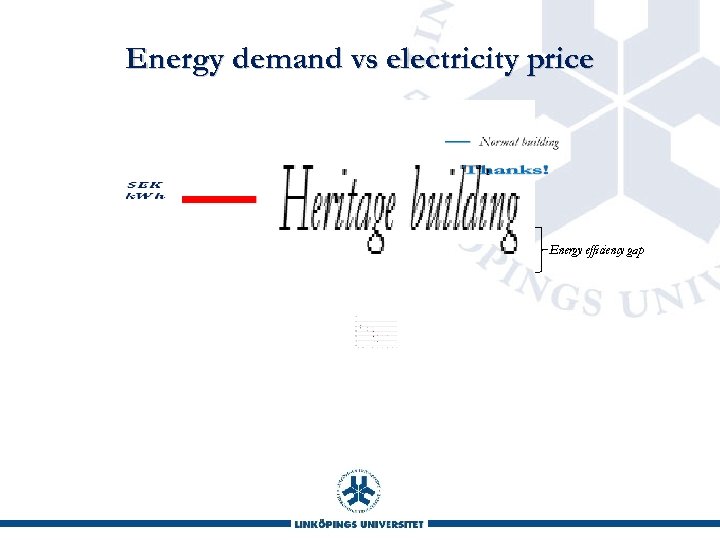 Energy demand vs electricity price Energy efficiency gap